
Loading article…

フランスは、843年に西フランク王国が建国されてから、数回の中断を挟みつつ、1870年に フランス第二帝政が終わるまで、君主によって統治されていました。
古典的なフランスの歴史学では、フランク王クローヴィス1世(在位 507-511年)をフランス最初の王とみなすことが多い。しかし、今日の歴史家は、 800年代のカロリング朝の崩壊中に西フランク王国が設立されるまで、そのような王国は始まらなかったと考えている。 [1] [2]
タイトル
王たちは12世紀後半まで「フランク王」(ラテン語:Rex Francorum )の称号を使用していた。「フランス王」(ラテン語:Rex Franciae、フランス語:roi de France)の称号を最初に採用したのは、1190年のフィリップ2世(在位1180年 - 1223年)であり、その後「フランク王」の称号は徐々に廃れていった。[3]しかし、Francorum Rexは、例えば1499年のルイ12世、 1515年のフランソワ1世、 1550年頃のアンリ2世などによって時々使用され続け、18世紀まで硬貨にも使用されていた。[4]
1791年のフランス憲法が施行されていた短い期間(1791年~1792年)と1830年の7月革命後、 「フランス国王(およびナバラ国王)」の代わりに「フランス国王」(roi des Français )という称号が使用された。これは人民君主制として知られる憲法上の革新であり、国王の称号をフランスの領土の所有ではなくフランス国民に結び付けた。[5]
ボナパルト家では、「フランス皇帝」(Empereur des Français )の称号は、 19世紀フランス、第1次および第2次フランス帝政の期間、1804年から1814年、1815年、そして1852年から1870年の間に使用されました。[6]
14世紀から1801年まで、イングランド(後にイギリス)の君主がフランスの王位を主張したが、そのような主張は、イングランドのヘンリー6世がパリを含む北フランスのほとんどを支配していた百年戦争中の短い期間を除いて、完全に名目上のものであった。1453年までに、イングランド人はフランスからほぼ追放されており、ヘンリーの主張はそれ以来不当であると見なされており、フランスの歴史学では一般的にイングランドのヘンリー6世をフランス王の中に認めていない。
フランク王(843–987)
カロリング朝(843年 - 887年)
カロリング家はフランクの貴族の家系で、7世紀のアルヌルフィング家とピッピン家から起源を持つ。8世紀に権力を固め、最終的には宮廷長とフランク公の地位を世襲制とし、メロヴィング朝の王たちの背後で実権を握るようになった。この王朝は宮廷長のひとり、カール・マルテルにちなんで名づけられた。カール・マルテルの息子ピピン3世は751年にメロヴィング家を廃位し、教皇と貴族の同意を得てフランク王に即位した。[7]カール大帝(在位768年 - 814年)は通称「カール大帝」の治世下、フランク王国は中央ヨーロッパの奥深くまで拡大し、イタリアと現代のドイツの大部分を征服した。彼は教皇によって「ローマ皇帝」の称号も授けられ、この称号は最終的に神聖ローマ帝国のドイツ人支配者たちに受け継がれた。
カール大帝の後を継いだのは息子のルイ敬虔王(在位814年 - 840年)で、最終的に王国は息子たちの間で分割された。しかし彼の死後、3年間に及ぶ内戦が起こり、ヴェルダン条約で終結した。この条約によりフランク王国は3つの王国に分割されたが、そのうちの1つ(中フランク王国)は短命に終わった。現代のフランスは西フランク王国から発展し、東フランク王国は神聖ローマ帝国、そして後にドイツとなった。この頃には、すでに東フランク王国と西フランク王国では異なる言語と文化が育まれていた。[8] [9]
ロベール朝(888年 - 898年)
カロリング朝(898年 - 922年)
ロベール朝(922-923)
ボソン朝(923-936)
カロリング朝(936年 - 987年)
カペー朝(987年 - 1792年、1814年 - 1848年)
カペー朝は、フランク公爵を務め、987年に国王に選ばれたロベール家のユーグ・カペーにちなんで名づけられた。ボナパルトが率いた帝国を除き、フランスの君主はすべてユーグ・カペーの男系の子孫であった。王権は14世紀まで父から息子へと父系で継承され、カペー朝親政として知られる時代が続いた。その後、王位はフィリップ3世の子孫であるヴァロワ家に継承された。ヴァロワ家の主張は、フランス人の母イザベラを通じて自らを正当なフランス王であると主張するイングランドのプランタジネット王エドワード3世によって争われた。2つの家はこの問題をめぐって百年戦争を戦い、イングランドのヘンリー6世がフランス王として部分的に認められた時期もあった。
ヴァロワ家は16世紀後半のフランス宗教戦争中に断絶し、遠縁のブルボン家が取って代わった。ブルボン家はカペー朝直系のルイ9世の子孫である。ブルボン家はフランス革命で廃位されるまでフランスを統治したが、ナポレオンの失脚後に王位に復帰した。カペー家最後の統治者は、ブルボン=オルレアン家出身の七月王政(1830年 - 1848年)の国王ルイ・フィリップ1世であった。
カペー家 (987–1328)
カペー家は一般に「カペー家直系」としても知られています。
ヴァロワ家 (1328–1589)
シャルル4世の死により、フランス王位をめぐってヴァロワ家とプランタジネット家の間で百年戦争が始まった。プランタジネット家の主張は、ランカスター家として知られる分家によって引き継がれた。ヴァロワ家は、フランス王に最も近い男系の家系として、古代サリカ法に基づく男子のみの長子相続による継承権を主張した。彼らはフィリップ3世の3男、ヴァロワ伯シャルルの子孫であった。プランタジネット家は、より最近のフランス王に近いことを主張の根拠とし、イングランドのエドワード3世は母イザベラを通してフィリップ4世の孫にあたる。
両家は自らの主張を貫くため百年戦争を戦った。ヴァロワ家が最終的に勝利し、フランスの歴史学では両家の指導者を正当な王とみなしている。プランタジネット家の一人であるイングランド王ヘンリー6世はトロワ条約に続いてフランス王位の法的支配権を享受し、これが1801年までイングランドがフランス王位を主張し続ける根拠となった。ヴァロワ家は1589年にフランス宗教戦争を背景に断絶するまでフランスを統治した。ナバラには男子のみの長子相続の伝統がなかったため、ルイ10世の娘である ジャンヌ2世によってナバラの王政はフランスとは区別されるようになった。
ヴァロワ=オルレアン家 (1498–1515)
ヴァロワ アングレーム家 (1515–1589)
ブルボン家 (1589–1792)
The Valois line looked strong on the death of Henry II, who left four male heirs. His first son, Francis II, died in his minority. His second son, Charles IX, had no legitimate sons to inherit. Following the premature death of his fourth son Hercule François and the assassination of his third son, the childless Henry III, France was plunged into a succession crisis over which distant cousin of the king would inherit the throne. The best claimant, King Henry III of Navarre, was a Protestant, and thus unacceptable to much of the French nobility.
Ultimately, after winning numerous battles in defence of his claim, Henry converted to Catholicism and was crowned as King Henry IV, founding the House of Bourbon. This marked the second time the thrones of Navarre and France were united under one monarch, as different inheritance laws had caused them to become separated during the events of the Hundred Years Wars. The House of Bourbon was overthrown during the French Revolution and replaced by a short-lived republic.
Long 19th-century (1792–1870)
The period known as the "long nineteenth century" was a tumultuous time in French politics. The period is generally considered to have begun with the French Revolution, which deposed and then executed Louis XVI. Royalists continued to recognize his son, the putative king Louis XVII, as ruler of France. Louis was under arrest by the government of the Revolution and died in captivity having never ruled. The republican government went through several changes in form and constitution until France was declared an empire, following the ascension of the First Consul Napoleon Bonaparte as Emperor Napoleon I. Napoleon was overthrown twice following military defeats during the Napoleonic Wars.
After the Napoleonic period followed two different royal governments, the Bourbon Restoration, which was ruled successively by two younger brothers of Louis XVI, and the July Monarchy, ruled by Louis Philippe I, a distant cousin who claimed descent from Louis XIII. The French Revolution of 1848 brought an end to the monarchy again, instituting a brief Second Republic that lasted four years, before its President declared himself Emperor Napoleon III, who was deposed and replaced by the Third Republic, and ending monarchic rule in France for good.
House of Bonaparte, First French Empire (1804–1814)
House of Bourbon, First Restoration (1814–1815)
House of Bonaparte, Hundred Days (1815)
House of Bourbon, Second Restoration (1815–1830)
House of Bourbon-Orléans, July Monarchy (1830–1848)
The Bourbon Restoration came to an end with the July Revolution of 1830 which deposed Charles X and replaced him with Louis Philippe I, a distant cousin with more liberal politics. Charles X's son Louis signed a document renouncing his own right to the throne only after a 20-minute argument with his father. Because he was never crowned he is disputed as a genuine king of France. Louis's nephew Henry was likewise considered by some to be Henry V, but the new regime did not recognise his claim and he never ruled.
Charles X named Louis Philippe as Lieutenant général du royaume, a regent to the young Henry V, and charged him to announce his desire to have his grandson succeed him to the Chamber of Deputies, the lower house of the French Parliament at the time, the French equivalent at the time of the UK House of Commons. Louis Philippe did not do this, in order to increase his own chances of succession. As a consequence, and because the French parliamentarians were aware of his liberal policies and of his popularity at the time with the French population, they proclaimed Louis Philippe as the new French king, displacing the senior branch of the House of Bourbon.
House of Bonaparte, Second French Empire (1852–1870)
The French Second Republic lasted from 1848 to 1852, when its president, Charles-Louis-Napoléon Bonaparte, was declared Emperor of the French under the regnal name of Napoleon III. He would later be overthrown during the events of the Franco-Prussian War, becoming the last monarch to rule France.
Later pretenders
Various pretenders descended from the preceding monarchs have claimed to be the legitimate monarch of France, rejecting the claims of the president of France and of one another. These groups are:
- Legitimist claimants to the throne of France: descendants of the Bourbons. In 1883, after the death of Henri V, grandson of Charles X, unionists recognized the Orléanist claimant as the pretender to the throne of France, as Henri V died without heirs, and also due to the Spanish renunciation, to them the House of Bourbon-Orléans became the senior line of the Capetian dynasty in France.[clarification needed]
- Blancs d'Espagne: descendants of Louis XIV, claiming precedence over the House of Bourbon-Orléans by virtue of primogeniture. They argue that the claimant to the throne would be a Bourbon from the Spanish branch of the family. They ignore the Spanish renunciation: the fact that King Philip V of Spain, whose descendants they are, has renounced the throne of France for himself and his descendants in the Treaty of Utrecht.
- Orléanist claimants to the throne of France: descendants of Louis-Phillippe, himself descended from a junior line of the Bourbon dynasty, rejecting all heads of state since 1848. They argue that King Louis Philippe acquired legitimacy via popular sovereignty when the representatives of the French people in the French Parliament recognized him as king, with the Bourbons having already been rejected and dethroned by the French people after two revolutions. Blancs d'Espagne argue that the Orléans do not deserve the throne because they are descended from a regicide, Louis Philippe II, Duke of Orléans, who voted for the execution of King Louis XVI during the French Revolution, violating the fundamental laws of the kingdom. Another argument against the Orléans is that the very French Parliament that recognized Louis Philippe as king refused to give the throne to his grandson (and descendants) and proclaimed the Second French Republic.
- Bonapartist claimants to the throne of France: descendants of Napoleon I and his brothers, rejecting all heads of state 1815–48 and since 1870. They argue that the Imperial throne needs to return to the House of Bonaparte, as the monarchs of this house had been chosen directly by the people through referendums, giving them legitimacy to reign via popular sovereignty, and both the Bourbons and the Orléans were rejected and dethroned through revolutions and that the Bonapartes were only dethroned due the interference of foreign enemies, with no popular revolution taking place to overthrow the Bonapartes and that the Third Republic was originally intended to be a provisional regime to return the throne to an Orléans or Bourbon (that never happened).
- English claimants to the throne of France: kings of England and later of Great Britain (renounced by Hanoverian King George III upon union with Ireland in 1800).
- Jacobite claimants to the throne of France: senior heirs-general of Edward III of England and thus his claim to the French throne, also claiming England, Scotland, and Ireland.
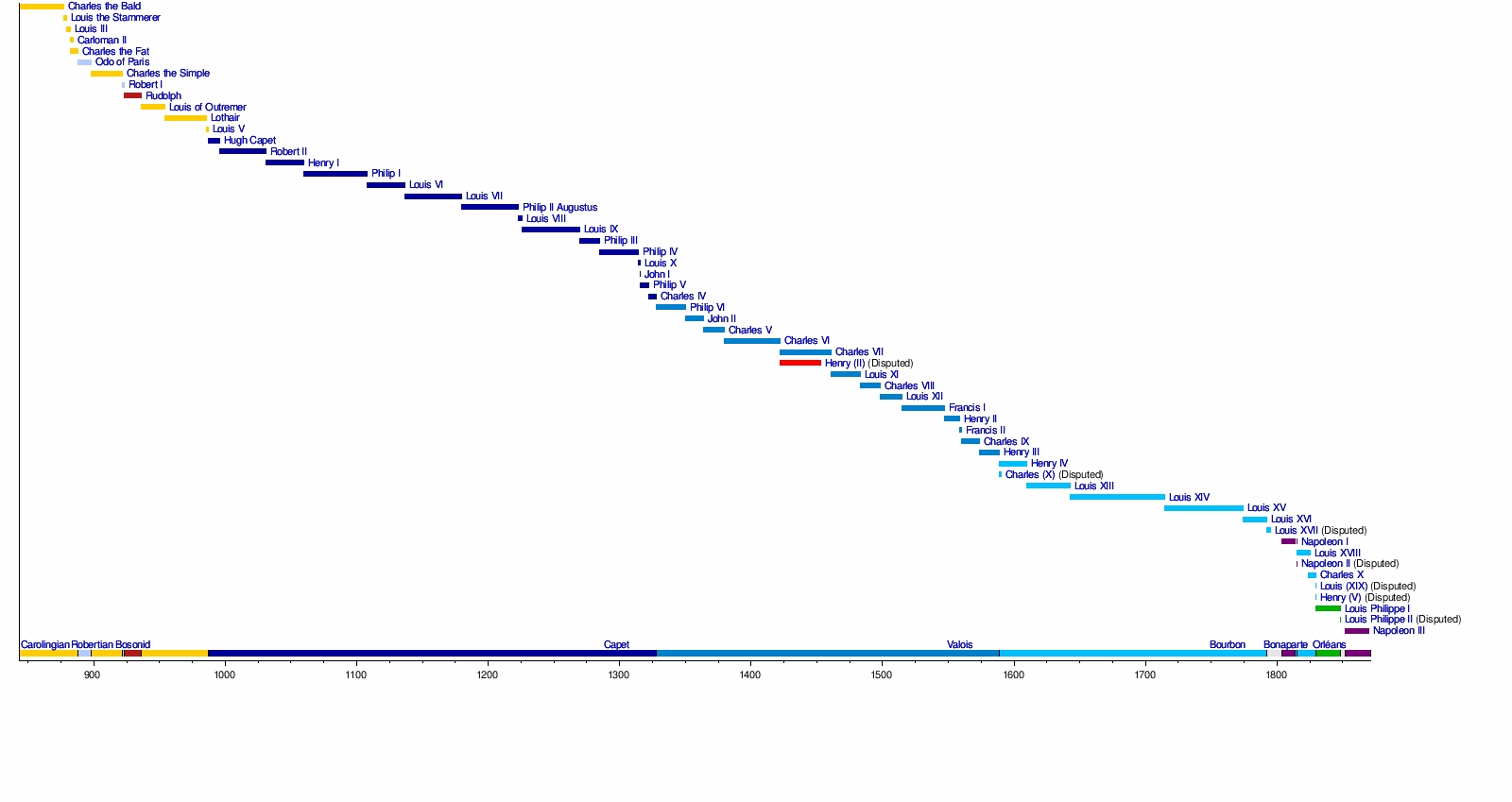
Timeline
See also
- Family tree of French monarchs
- Family tree of French monarchs (simplified)
- English claims to the French throne
- Fundamental laws of the Kingdom of France
- List of French royal consorts
- List of heirs to the French throne
- List of presidents of France
- Style of the French sovereign
- Succession to the French throne
Notes
- ^ Louis the Pious and Charlemagne are both enumerated as "Louis I" and "Charles I" in the lists of French and German monarchs.
- ^ Older scholars give his birth as 15 May,[10] the ides of May. However, ancient sources record his birth as 13 June, the ides of June.[11]
- ^ Not to be confused with Louis II the German, son of Louis the Pious and king of East Francia (Germany). Both French and German monarchs saw themselves as the successors of Charlemagne, which is why many rulers share the same regnal name.
- ^ Scholars give his death as either 3,[16] 4,[17] or 10 August,[18] but ancient sources clearly indicates 5 August.[19]
- ^ Some modern sources give his death as "12 December", but this is a mistake.[21][22][23]
- ^ Charles the Fat was initially king of East Francia (Germany) and Holy Roman Emperor. Given that he was the third emperor with that name, he is also known as Charles III. He must not to be confused with Charles the Simple, who is also enumerated as Charles III. This discrepancy originates from the regnal number adopted by Charles V, the first French king to assume one.[25]
- ^ This is the most accepted and cited date, although it is not entirely confirmed.[28][27]
- ^ In older sources his birth was dated to 832, but nowadays 839 is the accepted date.[29]
- ^ Odo's death is universally given as 1 January, as given by a late 13th century chronicle,[32] but the earliest source on the matter, from the early 11th century, records his death as 3 January.[33] Another source, from the 13th century, records his death as 2 January.[34]
- ^ a b See main entry for references.
- ^ Some scholars give his death as 21 May, but contemporary sources give 22 May.[42]
- ^ "Capet" (latin: Cappetus) was not actually a name, but a nickname adopted by later historians. It probably derived from chappe, an ecclesiastical mantle wore at the Abbey of Saint Martin of Tours.[44]
- ^ Hugh was also descendant of Charlemagne's sons Louis the Pious and Pepin of Italy through his mother and paternal grandmother, respectively, and was also a nephew of Otto I, Holy Roman Emperor.[46]
- ^ a b Because neither Hugh nor Philip were sole or senior king in their own lifetimes, they are not traditionally listed as kings of France and are not given ordinals.
- ^ He lived from 15 to 19 November according to the continuator of Guillaume de Nangis.[61] The Chronique Parisienne Anonyme de 1316 à 1339 gives 13 and 18 November.[62] Modern sources often give his lifespan as 15–20 November.[63]
- ^ Humphreys, p. 16 gives 6 January, the same date of Philip IV's coronation. This is a confusion.[64]
- ^ Sources give his birth date as 6, 16, 20 or 26 April.
- ^ This is the date in which the last English holdout was expelled by the French, with the exception of Calais.
- ^ Henry III was elected on 5 May 1573.[80] He was crowned on 21 February 1574,[81] but he was declared deposed soon after, on 12 May.[82]
- ^ Lower Navarre was integrated into France during his reign.
- ^ Louis XVI's powers as king became obsolete following the March on Versailles on 5 October 1789, after which he became a hostage of the revolutionary forces.
- ^ The Sénat proclaimed the deposition in absentia of Napoleon on 2 April, which was followed by the Corps législatif on 3 April. Napoleon wrote an act of abdication on 4 April renouncing the throne in favour of his son. However, this was not accepted by the Coalition, so he wrote an unconditional abdication on 6 April renouncing his rights and that of his family.[91]
- ^ Although claimed as the shortest reigning monarch by the Guinness World Records,[97] this claim appears to be unsustained.[98] The exact circumstances of his "abdication" are unknown, as it was announced in a document firmed by both Charles X and Louis, who is only called Dauphin. He is said to have been "king" between his father's signature and his own, as he (allegedly) initially refused to sign the document.
Coronations
- ^ Charles II was crowned emperor on 25 December 875. For later Frankish and German emperors, see Holy Roman Emperor.
- ^ Louis II was crowned on 8 December 877.[13]
- ^ Louis III and Carloman II were crowned on September 879.[15]
- ^ Louis III and Carloman II were crowned on September 879.[15]
- ^ Charles the Fat was most likely crowned on 20 May 885.[26] He was already king of East Francia since 28 August 876. He was also crowned emperor on 12 February 881.[27]
- ^ Odo was crowned on 29 February 888 and then again on 13 November.[31]
- ^ Charles III was crowned on 28 January 893, in opposition to Odo.[j]
- ^ Robert I was crowned on 30 June 922.[37]
- ^ Rudolph was crowned on 13 July 923.[j]
- ^ Louis IV was crowned on 19 June 936, following a brief interregnum after the death of Rudolph.
- ^ Lothair was crowned on 12 November 954.
- ^ Louis V was crowned on 8 June 979.
- ^ Hugh was elected and crowned king on 1 June 987, in Noyon. He was crowned again on 3 July in Paris by the archbishop of Reims. The latter date is usually regarded as the "official" start of the Capetian dynasty.[45]
- ^ Robert II was crowned on 30 December 987.[45]
- ^ Henry I was crowned on 14 May 1027.
- ^ Philip I was crowned on 23 May 1059.
- ^ Louis VI was crowned on 3 August 1108.
- ^ Louis VII was crowned as a child on 25 October 1131, and again on 25 December 1137 alongside Eleanor of Aquitaine.
- ^ Philip II was crowned on 1 November 1179.
- ^ Louis VIII was crowned on 6 August 1223.
- ^ Louis IX was crowned on 29 November 1226.
- ^ Philip III was crowned on 30 August 1271.
- ^ Philip IV was crowned on 6 January 1286.
- ^ Louis X was crowned on 24 August 1315.
- ^ Philip V was crowned on 9 January 1317.[p]
- ^ Charles IV was crowned on 21 February 1322.
- ^ Philip VI was crowned on 29 May 1328.
- ^ John II was crowned on 26 September 1350.
- ^ Charles V was crowned on 19 May 1364.
- ^ Charles VI was crowned on 4 November 1380.
- ^ Henry (II) was crowned on 16 December 1431, at Notre-Dame de Paris.
- ^ Charles VII was crowned on 17 July 1429.
- ^ Louis XI was crowned on 15 August 1461.
- ^ Charles VIII was crowned on 30 May 1484.
- ^ Louis XII was crowned on 27 May 1498.
- ^ Francis I was crowned on 25 January 1515.
- ^ Henry II was crowned on 26 July 1547.
- ^ Francis II was crowned on 18 September 1559.
- ^ Charles IX was crowned on 15 May 1561.
- ^ Henry III was crowned on 13 February 1575.
- ^ Henry IV was crowned on 27 February 1594.
- ^ Louis XIII was crowned on 17 October 1610.
- ^ Louis XIV was crowned on 7 June 1654.
- ^ Louis XV was crowned on 25 October 1722.
- ^ Louis XVI was crowned on 11 June 1775.
- ^ Napoleon I was crowned on 2 December 1804.
- ^ Louis XVIII decided not to have a coronation.
- ^ Charles X was crowned on 29 May 1825, an unsuccessful attempt to revive the old monarchical traditions.
- ^ Louis Philippe I decided not to have a coronation.
- ^ A coronation ceremony for Napoleon III was planned, but never executed.
References
Citations
- ^ Guyotjeannin, Olivier, ed. (1996). Clovis chez les historiens (in French). Librairie Droz. pp. 241ff. ISBN 9782600055925. Archived from the original on 16 March 2022. Retrieved 16 March 2022.
- ^ Sewell, Elizabeth Missing (1876). Popular History of France. Longman. pp. 48–49.
- ^ Aguilera-Barchet, Bruno (2014). A History of Western Public Law. Springer. p. 182. ISBN 9783319118031. Archived from the original on 14 March 2022. Retrieved 14 March 2022.
- ^ Potter, David (2008). Renaissance France at War. Boydell & Brewer Ltd. p. viii. ISBN 9781843834052.
- ^ Deploige, Jeroen; Deneckere, Gita, eds. (2006). Mystifying the Monarch. Amsterdam, Netherlands: Amsterdam University Press. p. 182. ISBN 9789053567678.
- ^ Pascal, Adrien (1853). Histoire de Napoléon III. Paris, France: Barbier. p. 359.
- ^ Babcock, Philip (1993). Webster's Third New International Dictionary of the English Language, Unabridged. MA, US: Merriam-Webster. p. 341.
- ^ Reynolds, Susan (1984). Kingdoms and communities in Western Europe, 900–1300. Oxford: Clarendon Press. pp. 256–257. ISBN 978-0-19-821955-2.
- ^ Scales, Len (2012). The Shaping of German Identity: Authority and Crisis, 1245-1414. Cambridge University Press. pp. 155–182. ISBN 9780521573337. Archived from the original on 1 April 2022. Retrieved 1 April 2022.
- ^ McCarty, p. 328; Peignot, p. lv; de Wailly, p. 10.
- ^ Annales S. Benigni Divionensis 824. Archived 26 March 2023 at the Wayback Machine MGH V, 39.
- ^ Peignot, p. lv; de Wailly, p. 10; Thoison, p. 189; McCarty, p. 328; EB, Charles II.
- ^ Jackson 1995, Vol 1, pp. 110–123.
- ^ Peignot, p. lv; de Wailly, p. 10; Thoison, p. 189; McCarty, p. 328; EB, Louis II.
- ^ a b McKitterick 1995, p. 137.
- ^ Thoison, p. 189; de Wailly, p. 10.
- ^ Peignot, p. lviii.
- ^ McCarty, p. 327.
- ^ Annales Vedastini 882 Archived 25 December 2010 at the Wayback Machine. "Nonis Augusti"
- ^ Peignot, p. lviii; Thoison, p. 189; McCarty, p. 328; Dutton 1994, p. 227; EB, Louis III.
- ^ Annales Vedastini. 884. Archived 25 December 2010 at the Wayback Machine "...he survived seven more days, and died in the same place... in December, about 18 years of age."
- ^ Obituaires de la province de Sens Archived 6 October 2022 at the Wayback Machine I, p. 351. "VIII id. [6 December]."
- ^ Annales S. Benigni Divionensis 884. Archived 26 March 2023 at the Wayback Machine "Non. Decemb. [5 December]".
- ^ Peignot, p. lviii; Thoison, p. 189; Dutton 1994, p. 227; EB, Carloman.
- ^ Brunel 2007, p. 79.
- ^ MacLean 2003, p. 126.
- ^ a b Schieffer, Theodor (1977), "Karl III", Neue Deutsche Biographie (in German), vol. 11, pp. 181–184, archived from the original on 21 July 2023, retrieved 21 July 2023
- ^ MacLean 2003, p. 194.
- ^ MacLean 2003, p. 84.
- ^ Peignot, p. lv; de Wailly, p. 10; McCarty, p. 329; EB, Charles III.
- ^ Jackson 1995, Vol 1, pp. 133–138.
- ^ Annales S. Benigni Divionensis 899. Archived 29 March 2022 at the Wayback Machine MGH V, 40.
- ^ Annales Prumienses 898. Archived 29 March 2022 at the Wayback Machine MGH XV(2), 1292.
- ^ Obituaires de la province de Sens Archived 6 October 2022 at the Wayback Machine I, p. 343.
- ^ Peignot, p. lix; de Wailly, p. 10; McCarty, p. 329; EB, Eudes.
- ^ Peignot, pp. lix–lx; de Wailly, p. 10; Thoison, p. 189; McCarty, p. 329; EB, Charles III.
- ^ Champion 1976, pp. 9–11.
- ^ Peignot, p. lx; de Wailly, p. 10; Thoison, p. 189; McCarty, p. 329; EB, Eudes.
- ^ Peignot, p. lxi; de Wailly, p. 10; Thoison, p. 189; McCarty, p. 329; EB, Rudolf.
- ^ Peignot, p. lxi; de Wailly, p. 10; McCarty, p. 329; EB, Louis IV.
- ^ Peignot, p. lxii; de Wailly, p. 10; Thoison, p. 190; McCarty, p. 329; EB, Lothar.
- ^ Richer (1845) [c. 995]. Histoire de son temps (in French). Vol. IV. J. Renouard. p. 147. Archived from the original on 11 March 2022. Retrieved 14 March 2022.
- ^ Peignot, pp. lxii–lxiii; de Wailly, p. 10; McCarty, p. 329; EB, Louis V.
- ^ Bodin 1840, p. 43.
- ^ a b Havet 1891.
- ^ Alcan 1892, pp. 254–261.
- ^ Peignot, pp. 10–16; Humphreys, p. 1; EB, Hugh.
- ^ Peignot, pp. 16–20; Humphreys, p. 2; EB, Robert II.
- ^ Peignot, p. 17.
- ^ Peignot, p. 20–22; Humphreys, p. 3; EB, Henry I.
- ^ Thoison, p. 190; Humphreys, p. 4; EB, Philip I.
- ^ Peignot, p. 29–32; Humphreys, p. 5; EB, Louis VI.
- ^ Peignot, p. 29.
- ^ Thoison, p. 190; Humphreys, p. 6; EB, Louis VII.
- ^ Thoison, p. 190; Humphreys, p. 8; EB, Philip II.
- ^ Thoison, p. 190; Humphreys, p. 10; EB, Louis VIII.
- ^ Thoison, p. 191; Humphreys, p. 11; EB, Louis IX.
- ^ Thoison, p. 191; Humphreys, p. 12; EB, Philip III.
- ^ Thoison, p. 191; Humphreys, p. 14; EB, Philip IV.
- ^ McCarty, p. 330; Humphreys, p. 15; EB, Philip IV.
- ^ Hercule Géraud (1843) Chronique latine de Guillaume de Nangis, de 1113 à 1300 Archived 28 January 2024 at the Wayback Machine. pp. 430–431.
- ^ Amedée Hellot (1884). Chronique parisienne anonyme du XIVe siècle Archived 29 February 2024 at the Wayback Machine. p. 26.
- ^ Humphreys, p. 15; EB, John I ("19/20 November").
- ^ Jackson 1995, Vol II, p. 376.
- ^ Thoison, p. 192; Humphreys, p. 16; EB, Philip V.
- ^ Peignot, p. 85; Humphreys, p. 17; EB, Charles IV.
- ^ Peignot, pp. 91–96; Humphreys, p. 19; EB, Philip VI.
- ^ Peignot, p. 96; Humphreys, p. 19; EB, John II.
- ^ Peignot, p. 105; Humphreys, p. 20; EB, Henry I.
- ^ Peignot, p. 112; Humphreys, p. 21; EB, Charles VI.
- ^ Curry 1993, pp. 102–122; Bradford 2004, pp. 621–625; EB, Henry VI.
- ^ Peignot, p. 123; Humphreys, p. 23; EB, Frances I.
- ^ Peignot, p. 136; Humphreys, p. 25; EB, Louis XI.
- ^ Peignot, p. 143; Humphreys, p. 27; Knecht 2007, p. 125; EB, Charles VII.
- ^ Peignot, pp. 150; Humphreys, p. 28; Knecht 2007, p. 112; EB, Louis XII.
- ^ Peignot, p. 157; Humphreys, p. 30; Knecht 2007, p. 112; EB, Francis I.
- ^ Peignot, p. 168; Humphreys, p. 33; EB, Henry II.
- ^ Curry 1993, pp. 103–122; Humphreys, p. 35; EB, Francis II.
- ^ Peignot, p. 179; Humphreys, p. 36; EB, Charles IX.
- ^ Knecht 2016, p. 56. "On 5 May three orators were chosen [...] On 11 May the minority conceded defeat [but the election] did not happen till 15 May.".
- ^ Knecht 2016, p. 76.
- ^ Knecht 2016, p. 84.
- ^ Peignot, p. 186; Humphreys, p. 38; EB, Henry III.
- ^ Peignot, p. 203; Wellman, p. 83; Treccani, Carlo.
- ^ Peignot, p. 195; Humphreys, p. 39; EB, Henry IV.
- ^ Peignot, p. 205; Humphreys, p. 42; EB, Louis XIII.
- ^ Peignot, p. 216; Humphreys, p. 43; EB, Louis XIV.
- ^ Peignot, p. 238; Humphreys, p. 47; EB, Louis XV.
- ^ Peignot, p. 253; Humphreys, p. 51; EB, Louis XVI.
- ^ Peignot, p. 260; EB, p. Louis (XVII).
- ^ Vial, Charles-Éloi (2014). "Les trois actes d'abdication de Napoléon Ier". Napoleonica la Revue (in French). 19 (1): 3. doi:10.3917/napo.141.0003. Archived from the original on 2 July 2023. Retrieved 9 December 2023.
- ^ a b Peignot, p. 261; EB, p. Napoleon I.
- ^ a b Peignot, p. 262; EB, p. Louis XVIII.
- ^ EB, Napoléon-François-Charles-Joseph Bonaparte.
- ^ "France: Commission of Government: 1815 - Archontology". www.archontology.org. Archived from the original on 9 December 2023. Retrieved 9 December 2023.
- ^ EB, Charles X.
- ^ "Shortest reign of a monarch". Guinness World Records. Archived from the original on 28 May 2022. Retrieved 10 February 2023.
- ^ Pinoteau, Hervé (1982). "Notes de vexillologie royale française". Hidalguía (172–173). Madrid: 361–362. Archived from the original on 19 September 2023. Retrieved 9 December 2023.
- ^ Castelot 1988, p. 454; Blanc 1848, p. 214.
- ^ EB, Henri Dieudonné.
- ^ Brownell, p. 120; EB, p. Louis Philippe.
- ^ Holoman 2004, p. 184; EB, Louis Philippe.
- ^ EB, Napoleon III.
Main bibliography
- de Wailly, E. (1838). "Liste Chronologique des rois de France". Eléments de paléographie. Vol. 1. Ghent University. Archived from the original on 29 March 2022. Retrieved 10 April 2022.
- Jacquin, Emmanuel (2000), Les Tuileries, Du Louvre à la Concorde, Editions du Patrimoine, Centres des Monuments Nationaux, Paris. (ISBN 978-2-85822-296-4)
- Encyclopædia Britannica Online
- Humphreys, A.L. (1907). The Kings of France, their Wives and Mistresses. London. ASIN B004Z0M2K2. OCLC 1047511953.
{{cite book}}: CS1 maint: location missing publisher (link) - McCarty, L. P. (1890). "France". The Annual Statistician and Economist. Harvard University: Pacific Press Publishing Company. pp. 327–332. Archived from the original on 25 March 2022. Retrieved 10 April 2022.
- Peignot, Gabriel (1819). Abrégé de l'histoire de France (in French). Harvard University. Archived from the original on 26 March 2022. Retrieved 10 April 2022.
- Thoison, E. (1888). "Table Chronologique". Les séjours des rois de France: 481–1789. Société historique et archéologique du Gâtinais. Bibliothèque nationale de France. Archived from the original on 13 March 2022. Retrieved 14 March 2022.
{{cite book}}: CS1 maint: location missing publisher (link)
Secondary bibliography
- Alcan, Félix (1892). Revue historique (in French). Vol. 40. Archived from the original on 31 March 2022. Retrieved 10 April 2022.
- Blanc, Louis (1848). France Under Louis Philippe. Translated by Walter Kelly. Archived from the original on 13 March 2022. Retrieved 14 March 2022.
- Bodin, Felix (1840). Resumé de l'histoire de France. London: Joseph Rickerby. p. 43. Archived from the original on 13 March 2022. Retrieved 14 March 2022.
- Bradford, James C. (2004). International Encyclopedia of Military History. Routledge. ISBN 9781135950347. Archived from the original on 8 April 2022. Retrieved 10 April 2022.
- Brownell, Henry (1854). "The Rulers of France". The People's Book of Ancient and Modern History. Dayton & Wentworth. Archived from the original on 14 March 2022. Retrieved 14 March 2022.
- Brunel, G. (2007). "Les cisterciens et Charles V". Société de l'histoire de France: 67–92. JSTOR 23408518. Archived from the original on 13 March 2022. Retrieved 10 April 2022.
- Castelot, André (1988). Charles X. Librairie Académique Perrin. ISBN 2-262-00545-1.
- Curry, Anne (1993). The Hundred Years War. Macmillan. ISBN 9781349227112. Archived from the original on 8 April 2022. Retrieved 10 April 2022.
- Champion, Honoré (1976). Robert Ier et Raoul de Bourgogne. Slatkine. pp. 9–11. Archived from the original on 25 March 2022. Retrieved 10 April 2022.
- Dutton, Paul E. (1994). The Politics of Dreaming in the Carolingian Empire. University of Nebraska Press. p. 227. ISBN 9780803216532. Archived from the original on 26 March 2022. Retrieved 10 April 2022.
- Holoman, D. Kern (2004). The Société Des Concerts Du Conservatoire, 1828–1967. University of California Press. ISBN 9780520236646. Archived from the original on 13 March 2022. Retrieved 14 March 2022.
- Knecht, Robert (2007). The Valois: Kings of France. A&C Black. ISBN 9781852855222.
- Knecht, Robert (2016). Hero or Tyrant? Henry III, King of France. Routledge. ISBN 9781317122142. Archived from the original on 26 March 2023. Retrieved 14 April 2022.
- McKitterick, Rosamond (1995). The New Cambridge Medieval History. Vol. 2. Cambridge University Press. p. 137. ISBN 9780521362924. Archived from the original on 23 July 2023. Retrieved 14 March 2022.
- MacLean, Simon (2003). Charles the Fat and the End of the Carolingian Empire. Cambridge University Press. ISBN 9781139440295.
- Jackson, Richard A. (1995). Ordines Coronationis Franciae. University of Pennsylvania Press. ISBN 9781512821604. JSTOR j.ctt1kgqwvd. Archived from the original on 26 March 2023. Retrieved 14 April 2022.
- Havet, Julien (1891). "Les couronnements des rois Hugues et Robert". Revue historique. 45: 290–297. JSTOR 40939391. Archived from the original on 13 March 2022. Retrieved 14 March 2022.
- Wellman, Kathleen (2013). Queens and Mistresses of Renaissance France. Yale University Press. ISBN 9780300178852. Archived from the original on 13 March 2022. Retrieved 14 March 2022.
Further reading
- Allevy, Alcide (1863). Histoire de France allevysée (in French). British Library. pp. 75–105. Archived from the original on 26 March 2022. Retrieved 10 April 2022.
- Babbitt, Susan M. (1985). The France of Charles V. APS. ISBN 9780871697516.
- Bak, János M. (1990). Coronations: Medieval and Early Modern Monarchic Ritual. University of California Press. ISBN 9780801469138. Archived from the original on 13 March 2022. Retrieved 14 March 2022.
- Brougham, Henry (1861). Principles of Government: Monarchical government. Political Philosophy. Harvard: Bohn. Archived from the original on 13 March 2022. Retrieved 14 March 2022.
- d'Hozier, Louis (1738). Armorial général de la France. パリ. pp. xvi–xvii. 2022年3月13日時点のオリジナルよりアーカイブ。2022年3月14日閲覧。
- ドイル、ウィリアム編(2001年)。『旧体制時代のフランス。オックスフォード・フランス小史』オックスフォード大学出版局。ISBN 0-19-873129-9。
- イングランド、H. (1816)。 Leçons élémentaires sur l'Histoire de France (フランス語)。大英図書館。 2022年3月29日のオリジナルからアーカイブ。2022 年4 月 10 日に取得。
- フィエロ、アルフレッド (1996)。パリの歴史と辞書。ロバート・ラフォント。ISBN 2-221--07862-4。