
Loading article…
| ミッドランド本線 | |||
|---|---|---|---|
 | |||
| 概要 | |||
| 状態 | 運用 | ||
| 所有者 | ネットワークレール | ||
| ロケール | |||
| テルミニ | |||
| 駅 | 35(ロンドンからシェフィールド) | ||
| サービス | |||
| タイプ | 都市間鉄道、通勤鉄道、 地域鉄道、重鉄道 | ||
| システム | ナショナルレール | ||
| オペレーター | |||
| デポ | |||
| 車両 | |||
| 歴史 | |||
| オープン | 1830年代から1860年代のステージ | ||
| テクニカル | |||
| トラック数 | 2~4 | ||
| 軌道ゲージ | 4フィート 8インチ+1 ⁄ 2 インチ(1,435 mm)標準軌 | ||
| 荷重ゲージ | W6 – W8、[1] W12へのアップグレードが計画されている[2] | ||
| 電化 | 25 kV 50 Hz AC OHLE (ロンドン・セント・パンクラスからコービーまで) | ||
| 動作速度 | 最高速度 125 mph (201 km/h) | ||
| |||
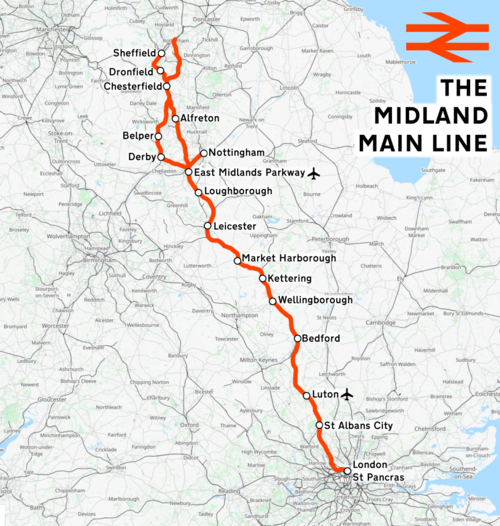
ミッドランド本線( MML ) は、ミッドランド本線とも表記され、ロンドンからイーストミッドランズを経由してヨークシャーのシェフィールドに至る主要鉄道路線である。ロンドンのセント・パンクラス駅からレスター、ダービー/ノッティンガム、チェスターフィールドを経由して結ばれる路線から構成される。
この路線の急行旅客サービスはイースト・ミッドランズ鉄道(EMR) によって運営されている。この路線はセント・パンクラスとコービーの間が電化されており、ベッドフォード以南の区間はテムズリンク ネットワークの北半分の支線となっており、ブライトン行きの準急サービスやその他の郊外サービスが運行されている。路線の北部、ダービーとチェスターフィールドの間は、クロスカントリーが運営するクロスカントリー ルートの一部でもある。ノッティンガムからバーンズリー、シェフィールドを経由してリーズに至る線路は、ノーザン鉄道と共有されている。イースト・ミッドランズ鉄道は、路線の一部を使用して地域サービスやローカル サービスも運営している。
ミッドランド本線は、ロンドンからシェフィールドまでの新しいデジタル信号と全線電化の大規模なアップグレードが行われています。[3] ハイスピード2は、イーストミッドランズパークウェイ鉄道駅でミッドランド本線に分岐する予定でした。[4]
歴史
ミッドランド郡の初期の発展

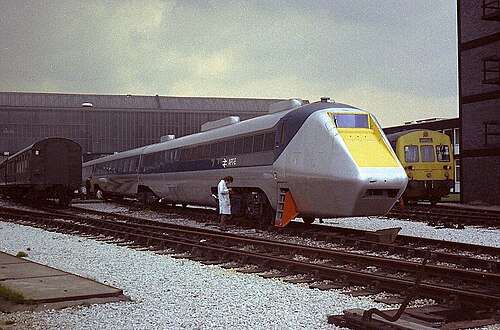
ミッドランド本線は1830年代から1870年代にかけて段階的に建設された。最も古い区間は1839年6月4日にミッドランド・カウンティーズ鉄道によってノッティンガムとダービーの間で開通した。[5] 1840年5月5日にはトレント・ジャンクションからレスターまでの区間が開通した。[6]
1840年7月1日、ダービーの路線はノース・ミッドランド鉄道と接続され、チェスターフィールド、ロザラム・マスバラ、[n 1]スウィントン、ノーマントンを経由してリーズ・ハンスレット・レーンまで延伸された。
1844 年 5 月 10 日、ノース ミッドランド鉄道、ミッドランド カウンティーズ鉄道、バーミンガム アンド ダービー ジャンクション鉄道が合併してミッドランド鉄道が設立されました。
ミッドランド本線南延伸
ロンドンへの独自の路線を持たないミッドランド鉄道は、ロンドン・ユーストンにある首都へのアクセスに、ラグビーにあるロンドン・バーミンガム鉄道線のジャンクションに依存していました。1850年代までに、ラグビーのジャンクションはひどく混雑するようになりました。ミッドランド鉄道はトーマス・ブラッシーを雇い、レスターからケタリング、ウェリングバラ、ベッドフォードを経由してヒッチンに至る新しい路線を建設し、ヒッチンからグレート・ノーザン鉄道を経由してロンドンにアクセスできるようにしました。[7]クリミア戦争により労働力と資金が不足し、建設に充てられた資金はわずか90万ポンド(2023年の1億844万8661ポンドに相当) [8]で、1マイルあたり約1万5000ポンド(2023年の180万7478ポンドに相当)でした。 [9]建設費を削減するため、鉄道は自然の輪郭に沿っており、多くのカーブと勾配が生じました。7つの橋と1つのトンネルが必要で、デスボローとシャーンブルックには60フィート(18メートル)の切通しがありました。キブワース、デスボロー、シャーンブルックには大きな山頂もあり、南から3マイル(4.8km)にわたって119分の1の勾配で海抜340フィート(104メートル)に達します。この路線は1857年4月15日に石炭輸送用に、5月4日に貨物輸送用に、8月16日に旅客輸送用に開通しました。 5月[10]レスターとベッドフォード間の区間は、現在もミッドランド本線の一部となっている。
これによりラグビー経由の路線の負担がいくらか軽減されたが、GNRはロンドン行きの乗客がヒッチンで下車し、短時間で切符を購入してGNRの列車に乗って旅を終えることを主張した。ジェームズ・オールポートは、キングス・クロスまで乗り入れる7年間の契約をGNと取り決め、年間2万ポンド(2023年には241万ポンドに相当)を保証した。[8]ロンドンへの直通列車は1858年2月に導入された。[11]
この路線は、ラグビー経由の旧路線と同様にヒッチンで容量不足に陥ったため、ベッドフォードからルートンを経由してセント・パンクラスまで新路線が建設され[12]、1868年10月1日に開通した[9]。ロンドン延伸工事には900万ポンド(2023年には10億2300万ポンドに相当)の費用がかかった[13] 。
交通量が増えるにつれ、ミッドランド鉄道は1885年6月26日にマーケット・ハーバラ駅のすぐ北に新しい迂回路を開き、ラグビー・アンド・スタンフォード鉄道の平坦な交差点を撤去した。[14]
最北端のセクション
ミッドランド鉄道がダービーからマンチェスターまで直通の路線を建設する計画は、ウェストコースト本線を独占しようとしたバクストン線の建設者によって1863年に阻止された。
1870年、ミッドランド鉄道はブラッドウェイ・トンネルを経由してシェフィールドを通るチェスターフィールドからロザラムへの新しい路線を開通した。
1870 年代半ばには、ミッドランド線がヨークシャー・デールズとエデン・バレーを通って北に延長され、現在はセトル・カーライル鉄道と呼ばれています。
ビーチング時代の路線閉鎖以前は、バクストン行きとミラーズ・デール経由の路線がほとんどの年でロンドンからマンチェスターへの代替(かつ競合)本線となり、ザ・パラティンや「ブルー・プルマン」ディーゼル機関車のマンチェスター・ロンドン間サービス(ミッドランド・プルマン)などの名だたる急行列車が運行されていた。テムズ・クライド・エクスプレスなどのリーズやスコットランド行きの急行列車は主にミッドランドの派生路線であるエレウォッシュ・バレー線を使用し、同線に戻ってからセトル・カーライル線を使用した。ザ・ウェイヴァリーなどのエディンバラ・ウェイヴァリー行き急行はコービーとノッティンガムを通過した。
イギリス国鉄と民営化の下で
1958年4月14日から、レスター・ノッティンガム間のローカル旅客列車のほとんどはディーゼル機関車に引き継がれ、両都市間の所要時間は約51分となった。[15] [全文引用必要] 1966年にグレート・セントラル本線が廃止される と、ミッドランド本線がロンドンとイースト・ミッドランズおよびサウス・ヨークシャーの一部を結ぶ唯一の直通本線鉄道となった。
ビーチング鉄道の廃止とウェストコースト本線の電化により、わずかに長かったシェフィールド経由のロンドン・マンチェスター間のサービスは終了した。
1977年、国有化産業に関する議会特別委員会は、英国の鉄道網のより多くの部分の電化を検討することを勧告し、1979年までにBRは、2000年までにロンドンからヨークシャーまでのミッドランド本線を電化するという一連の選択肢を提示した。 [16] 1983年までに、この路線はムーアゲートからベッドフォードまで電化されたが、ノッティンガムとシェフィールドまで電化を続ける提案は実施されなかった。

1983年5月にレスター地域の信号再整備に続いて高速鉄道(HST)が導入され、高速路線の最高速度が時速90マイル(145 km/h)から時速110マイル(177 km/h)に向上しました。
2001年から2003年にかけて、ダービーとシェフィールド間の路線は、ネットワークレールが資金提供したクロスカントリー路線のアップグレードであるオペレーション・プリンセスの一環として、時速100マイル(161 km/h)から時速110マイル(177 km/h)にアップグレードされました。
2009年1月、イースト・ミッドランズ・パークウェイという新しい駅がラフバラーとトレント・ジャンクションの間に開業し、イースト・ミッドランズの各都市からの郊外旅行者のためのパーク・アンド・ライド駅として、また近くのイースト・ミッドランズ空港へのサービス提供を目的としている。[17]
それ以来、長距離区間で時速125マイル(201 km/h)の運転が導入された。信号の改善、線路数の増加、ベッドフォードからシェフィールドまでの電化延長案の復活などが進行中である。この7,000万ポンドの改修の大部分は、一部の線路速度の向上を含め、2013年12月9日に開始された(下記参照)。[18]
ネットワークレールの貨物輸送ルート戦略 2007
ネットワークレールは2007年に貨物路線利用戦略を発表しました。[19]今後数年間で、バーミンガムからピーターバラまでの路線を強化し、レスターを通る容量を増やし、シストンとウィグストンのジャンクションを改造して、国内を横断する貨物路線が開発される予定です。
ネットワークレール 2010 路線計画

ミッドランド本線の交通量は全国平均よりも速いペースで増加しており、今後も増加が続くと予想されている。2006年、戦略鉄道局はミッドランド本線の路線利用戦略を作成し、この需要を満たす方法を提案した。[20] ネットワークレールは2008年2月に新たな調査を開始し、2010年2月に発表した。[21] [22] [23] [24]
After electrification, the North Northamptonshire towns (Wellingborough, Kettering, and Corby) are planned to have an additional 'Outer Suburban service' into London St Pancras, similar to the West Midlands Trains' Crewe – London Euston services, to cater for the growing commuter market. North Northamptonshire is a major growth area, with over 7,400 new homes planned to be built in Wellingborough[25] and 5,500 new homes planned for Kettering.[26][27]
Highlights include:[28]
- Work related to line speed increases, removing foot crossings and replacing with footbridges
- Capacity enhancements for freight
- Re-signalling of the entire route, expected to be complete by 2016 when all signalling will be controlled by the East Midlands signalling centre in Derby[29]
- Rebuilding Bedford and Leicester[30]
- Accessibility enhancements at Elstree & Borehamwood, Harpenden, Loughborough, Long Eaton, Luton, and Wellingborough by 2015[31][needs update]
- Upgraded approach signalling (flashing yellow aspects) added at key junctions – Radlett, Harpenden, and Leagrave allowing trains to traverse them at higher speeds[needs update]
- Lengthening of platforms at Wellingborough, Kettering, Market Harborough, Loughborough, Long Eaton, and Beeston stations as well as work related to the Thameslink Programme (see below)
- Realignment of the track and construction of new platforms to increase the permissible speed through Market Harborough station from 60 mph to 85 mph saving 30–60 seconds
- Electrification (see below)
- Re-doubling the Kettering to Oakham Line between Kettering North Junction and Corby as well as re-signalling to Syston Junction via Oakham, allowing a half hourly London to Corby passenger service (from an infrastructure perspective) from December 2017 and creating additional paths for rail freight.[32][33]
Thameslink Programme

The Thameslink Programme has lengthened the platforms at most stations south of Bedford to 12-car capability. St Pancras, Cricklewood, Hendon, and Luton Airport Parkway were already long enough, but bridges at Kentish Town mean it cannot expand beyond the current 8-car platform length. West Hampstead Thameslink has a new footbridge and a new station building. In September 2014 the current Thameslink Great Northern franchise was awarded and trains on this route are currently operated by Thameslink. In 2018 the Thameslink network expanded when some Southern services merged into it.
Station improvements
In 2013/14 Nottingham station was refurbished and the platforms restructured.
As part of Wellingborough's Stanton Cross development, Wellingborough station is to be expanded.[34]
Ilkeston between Nottingham and Langley Mill was opened on 2 April 2017.[35]
Two new stations are planned:
- Brent Cross West between Cricklewood and Hendon as part of the Brent Cross Cricklewood development in North London. It opened in December 2023. [36]
- Wixams between Flitwick and Bedford as part of the new town just outside Bedford. Expected to be built by 2015,[37] scheduled for 2019,[38] but now expected to be 2024.
Some new stations have been proposed:
- Clay Cross between Chesterfield and Ambergate/Alferton.[39]
- Irchester (Rushden Parkway) between Wellingborough and Bedford.[40]
- Ampthill between Bedford and Flitwick.[41]
Extension of electrification

Unlike the West Coast and East Coast Main Lines, the Midland Main Line has not been electrified along its full length. The line was electrified as far as Bedford in the early 1980s, but services relied on diesel traction beyond that.
In 2011 work commenced to extend the electrification, including to both Corby and Nottingham. Increasing costs initially saw this terminated at Kettering in 2017, but in 2021 work began on extending electrification to Market Harborough with plans to extend further to Sheffield.[42][43][44][45]
In May 2022, a briefing to contractors was released ahead of an invitation to tender for Midland Mainline Electrification project work to extend electrification to Nottingham and Sheffield. This scheme is expected to cost £1.3 billion.[46]
2021 Integrated Rail Plan
In November 2021 the Government announced its Integrated Rail Plan for the North and Midlands which made a number of proposals for the Midland Main Line. These included a commitment to complete the stalled electrification work, an upgrade to digital signalling, and a connection to High Speed 2. The latter would see a junction built south of East Midlands Parkway station rather than the previous plan of an East Midlands Hub further north on the Toton sidings. This will allow HS2 services to connect to both Derby and Nottingham city centres directly using the MML for access, which was a criticism of the previous HS2 eastern leg proposal.[4]
Route definition
The term Midland Main Line has been used from the late 1840s to describe any route of the Midland Railway on which express trains were operated.
It is first recorded in print in 1848 in Bradshaw's railway almanack of that year.[47] In 1849 it begins to be mentioned regularly in newspapers such as the Derby Mercury.[48]
In 1867, the Birmingham Journal uses the term to describe the new railway running into St Pancras railway station.[49]
In 1868, the term was used to describe the Midland Railway main route from North to South through Sheffield[50] and also on routes to Manchester, Leeds and Carlisle.
Under British Rail the term was used to define the route between St Pancras and Sheffield, but since then, Network Rail has restricted it in its description of Route 19[51] to the lines between St. Pancras and Chesterfield.
Accidents
- 26 September 1860 Bull bridge accident; bridge collapse
- 2 September 1861 Kentish Town rail accident; collision
- 2 September 1898 Wellingborough rail accident; derailment due to post trolley on track
- 24 December 1910 Hawes Junction rail crash; signalman forgot about train
- 2 September 1913 Ais Gill rail accident; collision
- 3 December 1923 Nunnery Colliery
- 13 December 1926 Orgreave Paddy Mail accident
- 1 February 2008 Barrow upon Soar rail accident
Operators

.jpg/500px-700013_Sevenoaks_to_London_Blackfriars_2B81_(37214254496).jpg)
East Midlands Railway
The principal operator is East Midlands Railway, which operates four InterCity trains every hour from London St Pancras with two trains per hour to both Nottingham and Sheffield. EMR use Class 222 Meridian trains in various carriage formations for its InterCity services.
EMR also operate a twice hourly commuter service from London St Pancras to Corby, which is branded as EMR Connect, using Class 360 Desiro electric trains.[52]
Thameslink
Thameslink provides frequent, 24-hour[53] commuter services south of Bedford as part of its Thameslink route to London Bridge, Gatwick Airport, Brighton, and Sutton, using 8-car and 12-car electric Class 700 trains.[54]
Other operators
CrossCountry runs an hourly service between Derby and Sheffield on its route between the South West and North East, and twice-hourly services between Nottingham and Derby, continuing to Birmingham and Cardiff. Northern runs an hourly service from Leeds to Nottingham via Barnsley and Alfreton. TransPennine Express also operates in the Sheffield area.
Route description
The cities, towns and villages served by the MML are listed below. Stations in bold have a high usage. This table includes the historical extensions to Manchester (where it linked to the West Coast Main Line) and Carlisle (via Leeds where it meets with the 'modern' East Coast Main Line).
Network Rail groups all lines in the East Midlands and the route north as far as Chesterfield and south to London as route 19. The actual line extends beyond this into routes 10 and 11.
London to Nottingham and Sheffield (Network Rail Route 19)
Tunnels, viaducts and major bridges
Major civil engineering structures on the Midland Main Line include the following.[55][56]
Line-side monitoring equipment
Line-side train monitoring equipment includes hot axle box detectors (HABD) and wheel impact load detectors (WILD) ‘Wheelchex’, these are located as follows.[56][58][55]
Ambergate Junction to Manchester
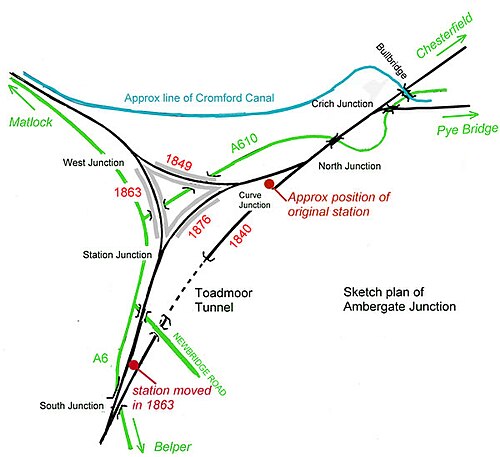
For marketing and franchising, this is no longer considered part of the Midland Main Line: see Manchester, Buxton, Matlock and Midlands Junction Railway
The line was once the Midland Railway's route from London St Pancras to Manchester, branching at Ambergate Junction along the Manchester, Buxton, Matlock and Midlands Junction Railway, now known as the Derwent Valley line. In days gone by, it featured named expresses such as The Palatine. Much later in the twentieth century, it carried the Midland Pullman.
This line was closed in the 1960s between Matlock and Buxton, severing an important link between Manchester and the East Midlands, which has never been satisfactorily replaced by any mode of transport. A section of the route remains in the hands of the Peak Rail preservation group, operating between Matlock and Rowsley to the north.
Leeds to Carlisle
For marketing and franchising, this is no longer considered part of the Midland Main Line: see Settle–Carlisle Railway.
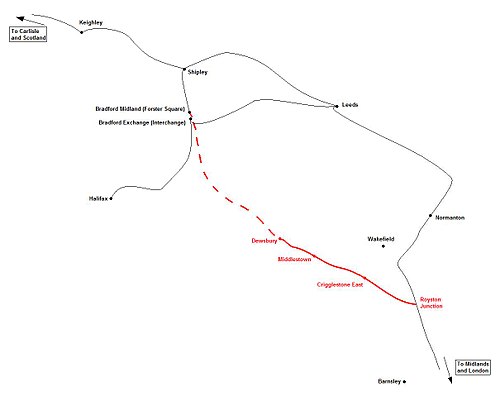

World War I prevented the Midland Railway from finishing its direct route through the West Riding to join the Settle and Carlisle (which would have cut six miles from the journey and avoided the need for reversal at Leeds).
The first part of the Midland's West Riding extension from the main line at Royston (Yorks.) to Dewsbury was opened before the war. However, the second part of the extension was not completed. This involved a viaduct at Dewsbury over the River Calder, a tunnel under Dewsbury Moor and a new approach railway into Bradford from the south at a lower level than the existing railway (a good part of which was to be in tunnel) leading into Bradford Midland (or Bradford Forster Square) station.
The 500 yards (460 m) gap between the stations at Bradford still exists. Closing it today would also need to take into account the different levels between the two Bradford stations, a task made easier in the days of electric rather than steam traction, allowing for steeper gradients than possible at the time of the Midland's proposed extension.
Two impressive viaducts remain on the completed part of the line between Royston Junction and Dewsbury as a testament to the Midland's ambition to complete a third direct Anglo–Scottish route. The line served two goods stations and provided a route for occasional express passenger trains before its eventual closure in 1968.
The failure to complete this section ended the Midland's hopes of being a serious competitor on routes to Scotland and finally put beyond all doubt that Leeds, not Bradford, would be the West Riding's principal city. Midland trains to Scotland therefore continued to call at Leeds before travelling along the Aire Valley to the Settle and Carlisle. From Carlisle they then travelled onwards via either the Glasgow and South Western or Waverley Route. In days gone by the line enjoyed named expresses such as the Thames–Clyde Express and The Waverley.
- Leeds along the Airedale line
- Here is Apperley Junction for the Wharfedale line
- Shipley: here is the triangular junction for the branch line serving Bradford Forster Square
- Saltaire
- Bingley
- Crossflatts
- Keighley
- Here is the Worth Valley Branch junction to Oxenhope.
- Steeton & Silsden
- Cononley
- Skipton
- Here is Settle Junction for the line to Morecambe
- Giggleswick
- Clapham
- Here was the junction for Ingleton and an end-on junction via Sedbergh to Low Gill on the London and North Western Railway (LNW) West Coast Main Line
- Bentham
- Lancaster Green Ayre
- At this point the line divided: a triangular junction for the two lines:
- Morecambe
- Heysham Port, including a station for Middleton Road Heysham
- At this point the line divided: a triangular junction for the two lines:
- Here is Settle Junction for the line to Morecambe
- Settle
- Horton-in-Ribblesdale
- Ribblehead
- Dent
- Garsdale
- At Hawes station, on the branch to the east of the main line, there was an end-on junction with the North Eastern Railway (NER) line across the Pennines to Northallerton
- Kirkby Stephen
- Appleby
- Langwathby
- Armathwaite
- Cumwhinton
- Carlisle
Former stations
As with most railway lines in Britain, the route used to serve far more stations than it currently does (and consequently passes close to settlements that it no longer serves). Places that the current main line used to serve include
- London to Leicester
- Camden Road
- Haverstock Hill
- Finchley Road
- Welsh Harp
- Napsbury
- Chiltern Green
- Ampthill
- Oakley
- Sharnbrook
- Irchester
- Finedon
- Isham and Burton Latimer
- Glendon and Rushton
- Desborough
- East Langton
- Kibworth
- Great Glen
- Wigston Magna
- Leicester to Trent Junction
- Leicester Humberstone Road
- Cossington Gate
- Hathern
- Kegworth
- Trent
- Derwent Valley
- Breaston (later Sawley – see Long Eaton)
- Draycott
- Borrowash
- Derby Nottingham Road
- Wingfield
- Stretton
- Clay Cross
- Erewash Valley
- Long Eaton (Original Midland Counties Railway station not the present one)
- Stapleford and Sandiacre
- Stanton Gate
- Trowell
- Ilkeston Junction and Cossall – reopened as Ilkeston
- Shipley Gate
- Codnor Park and Ironville
- Pye Bridge
- Westhouses and Blackwell
- Doe Hill
- Chesterfield to Leeds
- Staveley
- Eckington and Renishaw
- Killamarsh West
- Beighton
- Woodhouse Mill
- Treeton
- Sheepbridge
- Unstone
- Beauchief
- Millhouses
- Heeley
- Attercliffe Road
- Brightside
- Holmes
- Rotherham Masborough
- Parkgate and Rawmarsh
- Kilnhurst
- Swinton West (reopened Swinton)
The following on the original North Midland Railway line
-
 Looking south along the Midland Main Line at St Albans
 -
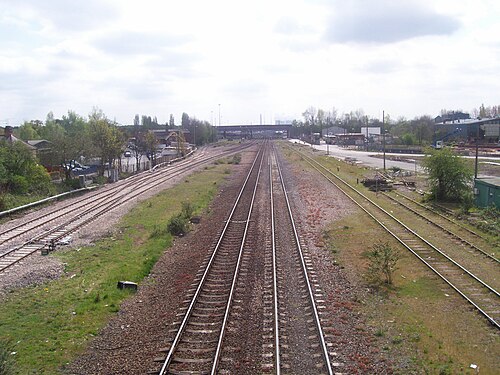 The Erewash Valley Line, part of the Midland Main Line. Seen here at Stapleford
 -

-
 Leeds railway station, a former key reversal point on the Midland Main Line on the route north
See also
- Midland Main Line railway upgrade
- Great Central Main Line – Former competing main line
- East Coast Main Line
- West Coast Main Line
- Great Western Main Line
- Highland Main Line
Notes and references
- Notes
- ^ Quickly the Sheffield and Rotherham Railway ran its branch line to Sheffield Wicker
- References
- ^ "East Midlands RUS Loading Gauge". Network Rail. p. 55. Retrieved 21 August 2010.
- ^ "East Midlands Route Study, 2016" (PDF). Network Rail.
- ^ "Midland Main Line Upgrade". Network Rail. July 2022.
- ^ a b "Integrated Rail Plan for the North and Midlands". Department for Transport. 22 March 2022.
- ^ "The Railway between Nottingham and Derby". Stamford Mercury. British Newspaper Archive. 7 June 1839. Retrieved 5 July 2016.
- ^ "Midland Counties Railway". Leicester Chronicle. British Newspaper Archive. 9 May 1840. Retrieved 5 July 2016.
- ^ "A Midland Railway chronology>Incorporation and expansion". The Midland Railway Society. 1998. Archived from the original on 28 December 2008.
- ^ a b UK Retail Price Index inflation figures are based on data from Clark, Gregory (2017). "The Annual RPI and Average Earnings for Britain, 1209 to Present (New Series)". MeasuringWorth. Retrieved 7 May 2024.
- ^ a b Leleux, Robin. A Regional History of the Railways of Great Britain. Volume 9. David & Charles, Newton Abbot. p. 92. ISBN 0715371657.
- ^ "Opening of the Leicester and Hitchin Line". Bedfordshire Mercury. British Newspaper Archive. 9 May 1857. Retrieved 5 July 2016.
- ^ Davies, R.; Grant, M.D. (1984). Forgotten Railways: Chilterns and Cotswolds. Newton Abbot, Devon: David St John Thomas. ISBN 0-946537-07-0, p. 110–111.
- ^ "A Midland Railway chronology>London extension". The Midland Railway Society. 1998. Archived from the original on 28 December 2008.
- ^ Barnes, E. G. (1969). The Rise of the Midland Railway 1844–1874. Augustus M. Kelley, New York. p. 308.
- ^ Radford, B., (1983) Midland Line Memories: a Pictorial History of the Midland Railway Main Line Between London (St Pancras) & Derby London: Bloomsbury Books
- ^ The Railway Magazine. June 1958. p. 432.
{{cite magazine}}: Missing or empty|title=(help) - ^ Railway Electrification. British Railways Board (Central Publicity Unit). Winter 1979. pp. 0–2, 8.
- ^ "East Midlands Parkway – Our greenest station to open on 26 January" (Press release). East Midlands Trains. 14 January 2009.[dead link]
- ^ "Midland Main Line celebrates at 125mph". Rail News. Retrieved 20 July 2017.
- ^ "Route Utilisation Strategy > Freight". Network Rail.
- ^ "Midland Main Line / East Midlands Route Utilisation Strategy". Strategic Rail Authority. Retrieved 29 August 2008.
- ^ "East Midlands Route Utilisation Strategy". Network Rail. February 2010. Retrieved 29 August 2008.
- ^ "Midlands line 'to be electrified'". BBC News Online. 14 July 2012. Retrieved 14 July 2012.
A £500m scheme … Transport Secretary Justine Greening is set to outline plans to complete the electrification of the route from Sheffield to London on Monday.
- ^ Odell, Mark; Parker, George (13 July 2012). "Osborne backs £10bn rail plan". Financial Times. Archived from the original on 10 December 2022. Retrieved 14 July 2012.
announcement, expected on Monday, is likely to include a £530m plan to complete electrification of the Midland mainline between Bedford and Sheffield
- ^ "Working Group 4 – Electrification Strategy". Network Rail. Retrieved 27 September 2009.
- ^ Barton, Tom (17 March 2014). "Developers taking too long to build homes, MP says". BBC News Online. Retrieved 21 March 2014.
- ^ "Kettering East: Compromise deal agreed over funding". BBC News Online. 13 March 2013. Retrieved 21 March 2014.
- ^ Broadbent, Steve (19 February 2014). "Switching on the Electric Spine". RAIL. No. 742. pp. 69–75.
- ^ "Midland Main Line 2010 route plan" (PDF). Network Rail. 2010. Archived from the original (PDF) on 29 September 2012. Retrieved 8 November 2017.
- ^ "Secretary of State opens Network Rail control centre" (Press release). Network Rail. Archived from the original on 26 September 2008. Retrieved 29 August 2008.
- ^ "Plans for £150m station facelift". BBC News Online. London. 6 March 2008.
- ^ Department for Transport (26 July 2011). "Access for all – stations". GOV.UK. Retrieved 11 April 2014.
- ^ Rail Magazine. Issue 742. 19 February – 4 March. pp. 69–75.
- ^ "Second Corby to Kettering railway track to be restored". BBC News Online. London. 6 February 2014.
- ^ "Wellingborough railway station expansion plan unveiled". BBC News. 18 April 2012. Retrieved 23 August 2013.
- ^ "Wait finally over for Ilkeston train station as hundreds turn up to opening". Nottingham Post. 2 April 2017. Retrieved 7 May 2017.[permanent dead link]
- ^ Brent Cross Cricklewood: Transport Archived 29 September 2013 at the Wayback Machine Retrieved 23 August 2013
- ^ The Wixams: Transportation Archived 17 October 2015 at the Wayback Machine Retrieved 23 August 2013
- ^ "Route Specifications 2015 – London North Eastern and East Midlands" (PDF). Network Rail. April 2015. Retrieved 10 August 2016.
- ^ "Connecting Communities – Expanding Access to the Rail Network" (PDF). London: Association of Train Operating Companies. June 2009. p. 9. Retrieved 7 September 2018.
- ^ ATOC 2009, p. 19.
- ^ Bedfordshire Ampthill station Archived 13 May 2008 at the Wayback Machine, Railway & Transport Association. Retrieved 4 January 2010.
- ^ "Electrification to reach Market Harborough".
- ^ "Spades in ground as government delivers on rail investment promise for North and Midlands". GOV.UK. Retrieved 21 December 2021.
- ^ "Main works on next stage of Midland Main Line electrification due to begin". RailBusinessDaily. 21 December 2021. Retrieved 21 December 2021.
- ^ "Rail industry welcomes progress on Midland Mainline electrification". www.riagb.org.uk. Retrieved 21 December 2021.
- ^ "Contractors alerted to next phase of £1.3bn Midland Main Line electrification". 24 May 2022.
- ^ Bradshaw, George (1848). Bradshaw's railway almanack, directory, shareholders' guide and manual. George Bradshaw. p. 204.
- ^ "The Leeds and Bradford". Derby Mercury. British Newspaper Archive. 15 August 1849. Retrieved 10 August 2016 – via British Newspaper Archive.
- ^ "The New Works of the Midland Railway Company". Birmingham Journal. British Newspaper Archive. 21 December 1867. Retrieved 10 August 2016 – via British Newspaper Archive.
- ^ "The New Midland Railway Station at Sheffield". Sheffield Independent. 12 December 1868. Retrieved 10 August 2016 – via British Newspaper Archive.
- ^ "Route 19 Midland Main Line and East Midlands" (PDF). Archived from the original (PDF) on 15 September 2016. Retrieved 10 August 2016.
- ^ Moran, Mark (24 May 2021). "EMR Connect launches all-electric Corby-St Pancras service". Transport Xtra. London: Landor LINKS. Retrieved 16 August 2021.
- ^ First Capital Connect: Thameslink Route Timetable B Archived 26 June 2013 at the Wayback Machine Retrieved 24 August 2013
- ^ "New cutting-edge trains in full operation across Thameslink route". mynewsdesk.com. Mynewsdesk. 18 September 2017. Retrieved 8 November 2017.
- ^ a b Bridge, Mike (2013). Railway Track Diagrams Book 4 Midlands & North West. Bradford on Avon: Trackmaps. pp. 1–5. ISBN 978-0-9549866-7-4.
- ^ a b Brailsford, Martyn (2016). Railway Track Diagrams Book 2: Eastern. Frome: Trackmaps. pp. 1, 27. ISBN 978-0-9549866-8-1.
- ^ "London North Eastern Route Sectional Appendix; LOR LN3201 Seq001 to 030" (PDF). Network Rail. Retrieved 13 January 2018.
- ^ "Railway Codes: HABD and WILD equipment".
External links
Wikimedia Commons has media related to Midland Main Line.
Template:Attached KML/Midland Main Line
KML is from Wikidata