
Loading article…

The history of Lebanon covers the history of the modern Republic of Lebanon and the earlier emergence of Greater Lebanon under the French Mandate for Syria and the Lebanon, as well as the previous history of the region, covered by the modern state.[1]
The modern State of Lebanon has existed within its current borders since 1920, when Greater Lebanon was created under French and British mandate, resulting from the dismemberment of the Ottoman Empire at the end of World War I.[2] Before this date, the designation "Lebanon" concerned a territory with vaguely defined borders, encompassing the mountain range of Mount Lebanon and its outskirts (mainly the Mediterranean coast and the plains of Bekaa and Akkar). The idea of an independent Lebanon, however, emerged during the end of the Mount Lebanon Emirate where Maronite clerics vowed for an independent nation.
Ksar Akil, 10 kilometres (6.2 mi) northeast of Beirut, is a large rock shelter below a steep limestone cliff where excavations have shown occupational deposits reaching down to a depth of 23.6 metres (77 ft) with one of the longest sequences of Paleolithicflintarchaeological industry is a very well tained Upper Levalloiso-Mousterian remains with long and triangular lithic flakes. The level above this showed industries accounting for all six stages of the Upper Paleolithic. An Emireh point was found at the first stage of this level (XXIV), at around 15.2 metres (50 ft) below datum with a complete skeleton of an eight-year-old modern human (called Egbert, now in the National Museum of Beirut after being studied in America) was discovered at 11.6 metres (38 ft), cemented into breccia. A fragment of a Neanderthalmaxilla was also discovered in material from level XXVI or XXV, at around 15 metres (49 ft). Studies by Hooijer showed wild goat and fallow deer were dominant in the fauna along with the extinct narrow-nosed rhinoceros in later Levalloiso-Mousterian levels.[3]
It is believed to be one of the earliest known sites containing Upper Paleolithic technologies. Artifacts recovered from the site include Ksar Akil flakes, the main type of tool found at the site, along with shells with holes and chipped edge modifications that are suggested to have been used as pendants or beads. These indicate that the inhabitants were among the first in Western Eurasia to use personal ornaments. Results from radiocarbon dating indicate that the early humans may have lived at the site approximately 45,000 years ago or earlier. The presence of personal ornaments at Ksar Akil is suggestive of modern human behavior. The findings of ornaments at the site are contemporaneous with ornaments found at Late Stone Age sites such as Enkapune Ya Muto.[4][5][6]
The earliest prehistoric cultures of Lebanon, such as the Qaraoun culture gave rise to the civilization of the Canaanite period, when the region was populated by ancient peoples, cultivating land and living in sophisticated societies during the 2nd millennium BC. Northern Canaanites are mentioned in the Bible as well as in other Semitic records from that period.
Canaanites were the creators of the oldest known 24-letter alphabet, a shortening of earlier 30-letter alphabets such as Proto-Sinaitic and Ugaritic. The Canaanite alphabet later developed into the Phoenician one (with sister alphabets of Hebrew, Aramaic and Moabite), influencing the writing systems of the entire Mediterranean region, and ultimately much of Africa, Asia, and Europe.
The coastal plain of Lebanon is the historic home of a string of coastal trading cities of Semitic culture, which the Greeks termed Phoenicia, whose maritime culture flourished there for more than 1,000 years. Ancient ruins in Byblos, Berytus (Beirut), Sidon, Sarepta (Sarafand), and Tyre show a civilized nation, with urban centres and sophisticated arts.
Phoenicia was a cosmopolitan centre for many nations and cultures. Phoenician art, customs and religion reveal considerable Mesopotamian and Egyptian influence. The sarcophagi of Sidonian kings Eshmunazzar II and Tabnit reveal that Phoenician royalty adopted Egyptian burial customs.
Phoenician traders exported spices from Arabia, such as cinnamon and frankincense, to the Greeks.[7] This trade likely led to the transmission of the Phoenician alphabet to Greece. Herodotus attests that the Phoenicians
"introduced into Greece upon their arrival a great variety of arts, among the rest that of writing, whereof the Greeks till then had, as I think, been ignorant."[8]
According to legend however, it is Cadmus, Prince of Tyre, who brought the alphabet with him to Greece in his search for his abducted sister Europa. Cadmus ultimately settles in Greece and founds the city of Thebes. Ancient Greek history accepts the Phoenician origin of the Greek alphabet. According to Herodotus,
"[the Greeks] originally they shaped their letters exactly like all the other Phoenicians, but afterwards, in course of time, they changed by degrees their language, and together with it the form likewise of their characters."[8]
Herodotus attests the persistence of traces of the Phoenician alphabet in Greece on tripods in Delphi in what is now known as the 5th century BC.[9] The Phoenicians were equally reputed for their seafaring skills. They were allegedly the first to circumnavigate the African continent. Herodotus writes that Egyptian Pharaoh Necos,
"[...] sent to sea a number of ships manned by Phoenicians, with orders to make for the Pillars of Hercules [the Strait of Gibraltar], and return to Egypt through them, and by the Mediterranean. The Phoenicians took their departure from Egypt by way of the Erythraean sea [the Red Sea], and so sailed into the southern ocean. When autumn came, they went ashore, wherever they might happen to be, and having sown a tract of land with corn, waited until the grain was fit to cut. Having reaped it, they again set sail; and thus it came to pass that two whole years went by, and it was not till the third year that they doubled the Pillars of Hercules, and made good their voyage home. On their return, they declared — I for my part do not believe them, but perhaps others may - that in sailing round Libya [i.e., Africa] they had the sun upon their right hand. In this way was the extent of Libya first discovered."[10]
The last phrase is usually regarded by modern historians as lending credibility to the Phoenician narrative, as they could not have otherwise known that the sun would be on their right hand side as they sailed southwards below the Equator line.
The Phoenicians founded various colonies in the Mediterranean. The most famous of them are Carthage in today's Tunisia, Tripoli in today's Libya, Gadir (Cadiz) and Barcelona in today's Spain, Palermo in today's Italy, Lisbon in today's Portugal.[11][12][13][14]
Phoenicia maintained an uneasy tributary relationship with the neo-Assyrian and neo-Babylonian empires during the 9th to 6th centuries BC.
After the gradual decline of their strength, the Phoenician city-states on the Lebanese coast were conquered outright in 539 BC by Achaemenid Persia under Cyrus the Great. Under Darius I, the area comprising Phoenicia, Canaan, Syria, and Cyprus was administered in a single satrapy and paid a yearly tribute of three hundred and fifty talents. By comparison, Egypt and Libya paid seven hundred talents.[15] Many Phoenician colonies continued their independent existence—most notably Carthage. The Persians forced some of the population to migrate to Carthage, which remained a powerful nation until the Second Punic War.
The Phoenicians of Tyre showed greater solidarity with their former colony Carthage than loyalty towards Persian king Cambyses, by refusing to sail against the former when ordered.[16]
The Phoenicians furnished the bulk of the Persian fleet during the Greco-Persian Wars.[17] Herodotus considers them as "the best sailors" in the Persian fleet.[18] Phoenicians under Xerxes I were equally commended for their ingenuity in building the Xerxes Canal.[19] Nevertheless, they were harshly punished by the Persian king following the Battle of Salamis, which culminated in a defeat for the Achaemenid Empire.[20]
In 350 or 345 BC, a rebellion in Sidon led by Tennes was crushed by Artaxerxes III. Its destruction was described by Diodorus Siculus.
After two centuries of Persian rule, the Macedonian ruler Alexander the Great, during his war against Persia, attacked and burned Tyre, the most prominent Phoenician city. He conquered what is now Lebanon and other nearby regions in 332 BC.[21] After Alexander's death the region was absorbed into the Seleucid Empire and became known as Coele-Syria.
In 64 BC, the region was conquered by a Roman army under general Pompey and became a part of the Roman state. Christianity was introduced to the coastal plain of Lebanon from neighboring Galilee, already in the 1st century. The region, as with the rest of Syria and much of Anatolia, became a major center of Christianity. Mount Lebanon and its coastal plain became part of the Diocese of the East, divided to provinces of Phoenice Paralia and Phoenice Libanensis (which also extended over large parts of modern Syria).
During the late 4th and early 5th centuries in Lebanon, a hermit named Maron established a monastic tradition, focused on the importance of monotheism and asceticism, near the mountain range of Mount Lebanon. The monks who followed Maron spread his teachings among the native Lebanese Christians and remaining pagans in the mountains and coast of Lebanon. These Lebanese Christians came to be known as Maronites, and moved into the mountains to avoid religious persecution by Roman authorities.[22] During the frequent Roman–Persian Wars that lasted for many centuries, the Sassanid Persians occupied what is now Lebanon from 619 to 629.[23]
During the 7th century AD the Muslim Arabs conquered Syria soon after the death of Muhammad, establishing a new regime to replace the Romans (or Byzantines as the Eastern Romans are sometimes called). Though Islam and the Arabic language were officially dominant under this new regime, the general populace still took time to convert from Christianity and the Syriac language. In particular, the Maronite community clung to its faith and managed to maintain a large degree of autonomy despite the succession of rulers over Syria. Muslim influence increased greatly in the seventh century, when the nearby city Damascus, in modern-day Syria, was set as the capital of the Umayyad Caliphate.
644年から656年にかけて正統カリフ国を統治したウスマーンの治世中、ダマスカスではイスラム教が隆盛を極めたが、これは主にウスマーンの親族で総督を務めたムアーウィヤによるものであった。ムアーウィヤはレバノンの沿岸地域に軍隊を派遣し、そこでイスラム教の影響力を拡大し、沿岸住民の間でイスラム教への改宗を促した。しかし、山岳地帯では、地元住民はキリスト教やその他の文化的伝統を保持していた。[ 24 ]さらに、キリスト教徒とユダヤ教徒はともに、イスラム教の支配者に人頭税であるジズヤを支払う義務があった。山岳地帯のキリスト教徒からのこの税の徴収は、第1回十字軍まで一貫して行われず、ラテン支配下で廃止された。マムルーク朝で復活したが、1856年にオスマン帝国の勅令によって廃止された。[ 25 ]
イスラム征服後、地中海貿易はイスラム・カリフ国とビザンツ帝国との海上紛争により3世紀にわたる長期にわたる衰退に直面した。カリフ国の海軍拠点として重要であった部分的に損傷した港は、繁栄を取り戻すのに苦労した。軍事力の投入や新たな入植者の誘致といった試みにもかかわらず、ティルス、シドン、ベイルート、トリポリの各都市は、ウマイヤ朝とアッバース朝の時代にはそれぞれ数千人程度の人口しか維持できなかったと考えられる。[ 25 ]
758年までに、アッバース朝のカリフ、アル・マンスールは、アラブのタヌーヒド族にベイルート周辺の丘陵地帯の防衛を命じた。845年には、タヌーヒド族とキリスト教徒がキスラワンで衝突し、緊張が高まった。[ 25 ]
980年代、ファーティマ朝カリフ国はレバノン山地を支配下に置いた。ファーティマ朝の統治下で、この地域はビザンツ帝国やイタリアとの商業的なつながりによって刺激され、レバノン沿岸の地中海貿易が復興した。その結果、トリポリとティルスは11世紀まで繁栄し、綿織物や絹織物、砂糖、ガラス製品などの輸出を専門としていた。[ 25 ]
1020年代、ドゥルーズ派はイスマーイール派シーア派イスラム教から分派し始めた。タヌーヒドの首長たちは「呼びかけ」を受け入れ、ファーティマ朝のカリフ、アル=ハーキム・ビ=アムル・アッラーを神として認め、こうしてレバノン山地にこの宗派の基礎を築いた。[ 25 ]この新しい信仰はレバノン南部で信者を獲得した。
Following the fall of Roman/Christian Anatolia to the Muslim Turks of the Seljuk Empire in the 11th century, the Romans in Constantinople appealed to the Pope in Rome for assistance. There resulted a series of wars known as the Crusades, launched by Latin Christians (of mainly French origin) in Western Europe to reclaim the former Roman territories in the Eastern Mediterranean, especially Syria and Palestine (the Levant). Lebanon stood in the main path of the First Crusade's advance on Jerusalem from Anatolia. Frankish nobles occupied areas within present-day Lebanon as part of the southeastern Crusader States. The southern half of present-day Lebanon formed the northern march of the Kingdom of Jerusalem (founded in 1099); the northern half became the heartland of the County of Tripoli (founded in 1109). Although Saladin eliminated Christian control of the Holy Land around 1190, the Crusader states in Lebanon and Syria were better defended.

One of the most lasting effects of the Crusades in this region was the contact between the crusaders (mainly French) and the Maronites. Unlike most other Christian communities in the region, who swore allegiance to Constantinople or other local patriarchs, the Maronites proclaimed allegiance to the Pope in Rome. As such the Franks saw them as Roman Catholic brethren. These initial contacts led to centuries of support for the Maronites from France and Italy, even after the later fall of the Crusader states in the region.
Muslim control of Lebanon was reestablished in the late 13th century under the Mamluk sultans of Egypt, who reinstated Sunni Islamic dominance. Initially sacking Crusader towns and punishing perceived infidels and heretics in the mountains, the Mamluks later became more discerning in their actions. They demolished less fortified ports south of Sidon, and reconstructed Sidon, Beirut, and Tripoli. This resulted in the decline of Tyre while propelling Tripoli to prominence as the region's foremost port town. Now a provincial capital, Tripoli evolved into a center for Sunni religious education and became the primary hub for long-distance trade in Syria. The Mamluks also invested in Baalbek as an inland center.[25]
Despite facing the devastating impact of the Black Death in 1348–1349, which reduced the population by a third and curtailed economic activity for over two centuries, the Mamluks contributed to the enduring architectural legacy of the region, including the restoration of the Crusader Citadel of Tripoli and the construction of stone buildings and mosques.[25]
Starting from the 16th century, the Ottoman Turks formed an empire which came to encompass the Balkans, Middle East and North Africa. The Ottoman sultan Selim I (1516–20), after defeating the Persians, conquered the Mamluks. His troops, invading Syria, destroyed Mamluk resistance in 1516 at Marj Dabiq, north of Aleppo.[26]
Ottoman control was uncontested during the early modern period, but the Lebanese coast became important for its contacts and trades with the maritime republics of Venice, Genoa other Italian city-states. (See also Levantines)
The mountainous territory of Mount Lebanon has long been a shelter for minority and persecuted groups, including its historic Maronite Christian majority and Druze communities. It was an autonomous region of the Ottoman Empire.
During the conflict between the Mamluks and the Ottomans, the amirs of Lebanon linked their fate to that of Ghazali, governor (pasha) of Damascus.[26] He won the confidence of the Ottomans by fighting on their side at Marj Dabiq and, apparently pleased with the behavior of the Lebanese amirs, introduced them to Salim I when he entered Damascus.[26] Salim I decided to grant the Lebanese amirs a semiautonomous status.[26] The Ottomans, through the two main feudal families, the Maans who were Druze and the Chehabs who were Sunni Muslim Arab converts to Maronite Christianity, ruled Lebanon until the middle of the nineteenth century.[26] During Ottoman rule the term Syria was used to designate the approximate area including present-day Lebanon, Syria, Jordan, and Israel/Palestine.[26]
マーン族は1120年にレバノンにやって来た。[ 27 ]彼らはカフタニ・アラブの部族であり王朝で、レバノン山脈の南西斜面に定住し、すぐにドゥルーズ教を受け入れた。[ 27 ]彼らの権威は、オスマン帝国当局から独自の軍隊を組織することを許可されたファフル・アッディーン1世とともに高まり始め、ファフル・アッディーン2世(1570年~1635年)で頂点に達した。[ 27 ](「ファフル・アッディーン1世」の存在は一部の学者によって疑問視されている。[ 28 ])

ファクル・アルディン2世はバアクラインでドゥルーズ派の家庭に生まれたが、13歳の時に父が亡くなり、母は息子を別の王族であるマロン派のハゼン家に託した。1608年、ファクル・アルディンはイタリアのトスカーナ大公国と同盟を結んだ。この同盟には公的な経済部門と秘密の軍事部門の両方が含まれていた。ファクル・アルディンの野心、人気、そして無許可の外国との接触はオスマン帝国を警戒させ、オスマン帝国はファクル・アルディンの勢力拡大を抑えるため、1613年にダマスカスのムハーフィズであるハーフィズ・アフメド・パシャにレバノンへの攻撃を命じた。
ハーフィズの5万人の軍隊に直面したファフル・アッディーンは、トスカーナへの亡命を選び、国政を弟のエミール・ユニスと息子のエミール・アリ・ベグに任せた。彼らは、ファフル・アッディーンの権力の要であったバニアス(スバイバ)やニハなどの要塞の大部分を攻略することに成功した。ファフル・アッディーンは出発前に、忠誠を確保するため、常備軍のソクバン(傭兵)に2年分の給料を支払った。
メディチ家に迎えられてトスカーナに滞在したファクル・アルディンは、大公コジモ2世の歓迎を受け、メディチ家の宮廷で過ごした2年間、コジモ2世は彼の庇護者であり後援者となった。その後、彼はさらに3年間、シチリアおよびナポリのスペイン総督オズナ公の賓客として過ごした。ファクル・アルディンは、故郷をオスマン帝国の支配から解放するための「十字軍」にトスカーナ人や他のヨーロッパ人の支援を求めようとしたが、トスカーナにはそのような遠征を行うだけの財力がないため、拒否された。王子は最終的に、ヨーロッパは聖地奪還よりもオスマン帝国との貿易に関心があることを悟り、その考えを諦めた。しかし、彼の滞在は、17世紀のヨーロッパの文化復興を目の当たりにし、ルネサンスの思想や建築様式をヨーロッパに持ち帰る機会となった。
1618年までに、オスマン帝国のスルタン国における政治的変化により、ファクル・アルディンの敵の多くが権力の座から追放され、ファクル・アルディンはレバノンに帰還することができた。その後、彼はレバノンの山岳地帯の境界を越えたすべての土地を速やかに再統一し、アミール・ユースフ・パシャ・イブン・シイファに復讐を果たした。アッカールにある彼の拠点を攻撃し、宮殿を破壊して領地を奪い、1613年に手放さざるを得なかったシドン、トリポリ、ベッカー高原などの領土を取り戻した。彼の統治下では、印刷機が導入され、イエズス会司祭やカトリック修道女が全国各地に学校を開設するよう奨励された。

1623年、王子はペルシャ戦線から帰還途中の軍隊がベッカー渓谷で越冬することを拒否し、オスマン帝国を怒らせた。このこと(およびダマスカスの強力なイェニチェリ駐屯軍の扇動)により、ダマスカス総督ムスタファ・パシャは王子に対して攻撃を開始し、マジュデル・アンジャルの戦いが起こった。この戦いでは、ファフル・アッディーンの軍は数では劣勢であったものの、パシャを捕らえ、レバノンの王子とその同盟者に待望の軍事的勝利をもたらした。この時点までのファフル・アッディーンの経歴に関する最良の資料(アラビア語)は、アル=ハリディ・アッ=サファディが署名した回想録である。彼はヨーロッパでアミールに同行していなかったが、おそらくファフル・アッディーン本人と思われる人物と接触していた。しかし、時が経つにつれ、オスマン帝国は王子の権力の増大とヨーロッパとの関係の拡大にますます不快感を抱くようになった。 1632年、クチュク・アフメド・パシャはダマスカスのムハーフィズに任命された。彼はファクル・アルディンのライバルであり、ムラト4世の友人でもあった。ムラト4世はクチュク・アフメド・パシャとスルタン国の海軍にレバノンを攻撃し、ファクル・アルディンを廃位するよう命じた。
今回、王子はレバノンに留まり攻勢に抵抗することを決意したが、息子のアリー・ベイク首長がワディ・エル・タイムで戦死したことが敗北の始まりとなった。その後、王子はジェジンの洞窟に避難し、クチュク・アフメド・パシャがすぐ後ろに迫っていた。王子は、よく知っていたオスマン帝国の将軍ジャアファル・パシャに降伏したが、その経緯は不明である。
ファフル・アルディンはコンスタンティノープルに連行され、イェディクレ牢獄に2年間収監された。その後、スルタンの前に召喚された。ファフル・アルディンと彼の息子たちのうち1人か2人は反逆罪で告発され、1635年4月13日にそこで処刑された。2人の息子のうち年下の息子は命を助けられ、ハーレムで育てられ、後にオスマン帝国のインド大使になったという根拠のない噂がある。

Although Fakhr ad-Din II's aspirations toward complete independence for Lebanon ended tragically, he greatly enhanced Lebanon's military and economic development.[29] Noted for religious tolerance, the prince attempted to merge the country's different religious groups into one Lebanese community.[29] In an effort to attain complete independence for Lebanon, he concluded a secret agreement with Ferdinand I, grand duke of Tuscany.[29]
Following his return from Tuscany, Fakhr ad-Din II, realizing the need for a strong and disciplined armed force, channeled his financial resources into building a regular army.[29] This army proved itself in 1623, when Mustafa Pasha, the new governor of Damascus, underestimating the capabilities of the Lebanese army, engaged it in battle and was decisively defeated at Anjar in the Beqaa Valley.[29]
In addition to building up the army, Fakhr ad-Din II, who became acquainted with Italian culture during his stay in Tuscany, initiated measures to modernize the country.[29] After forming close ties and establishing diplomatic relations with Tuscany, he brought in architects, irrigation engineers, and agricultural experts from Italy in an effort to promote prosperity in the country.[29] He also strengthened Lebanon's strategic position by expanding its territory, building forts as far away as Palmyra in Syria, and gaining control of Palestine.[29] Finally, the Ottoman sultan Murad IV of Istanbul, wanting to thwart Lebanon's progress toward complete independence, ordered Kutshuk, then governor of Damascus, to attack the Lebanese ruler.[29] This time Fakhr ad-Din was defeated, and he was executed in Istanbul in 1635. No significant Maan rulers succeeded Fakhr ad-Din II.[29]
Fakhreddine is regarded by the Lebanese as the best leader and prince the country has ever seen. Lebanon has achieved during Fakhreddine's reign enormous heights that the country had and would never witness again.
1697年、アイン・ダラの戦いの後、シハブ族はマーン族の後を継いだ[ 30 ]。この戦いは、カイシー族とイエメン族という2つのアラブ部族の衝突が勃発し、レバノンの様相を一変させた戦いだった。当時アフマド・シハブが率いていたカイシー族が勝利し、イエメン族をレバノンからシリアへ追放した。これにより、当時多数派であったレバノン山地のドゥルーズ族の人口が大幅に減少し、キリスト教徒が人口的にドゥルーズ族を凌駕することになった。このカイシー族の「勝利」により、カイシー族自身でありレバノンの同盟者であったシハブ族がレバノン山地を支配するようになった。シハブ族はもともとシリア南西部のハウラン地方に住んでおり、レバノン南部のワディ・アル・タイムに定住した[ 30 ] 。
1768年から1774年の露土戦争中、地中海で活動していたアレクセイ・オルロフ提督率いるロシア海軍第1次群島遠征隊に対応して、レバノンの地方当局は一時的にロシアの保護下に入ろうと試みた。[ 31 ]
最も著名なシハブ族のバシール・シハブ2世[ 30 ]は、1789年から1840年までレバノン山の首長として統治した。1799年の出来事は、ナポレオンがティルスの南約40キロにあるパレスチナの要塞都市アッコを包囲した際に、政治家としての彼の能力が試された[ 30 ]。ナポレオンとアッコの総督アル・ジャザールは共にシハブ族の指導者に支援を求めたが、バシールは中立を保ち、どちらの戦闘員にも支援を拒否した[ 30 ] 。アッコを征服できなかったナポレオンはエジプトに戻り、1804年にアル・ジャザールが死去したことで、この地域におけるバシールの主要な敵対者がいなくなった。
シハブ家は元々スンニ派イスラム教徒の家族でしたが、 18世紀後半にキリスト教に改宗しました[ 30 ] 。
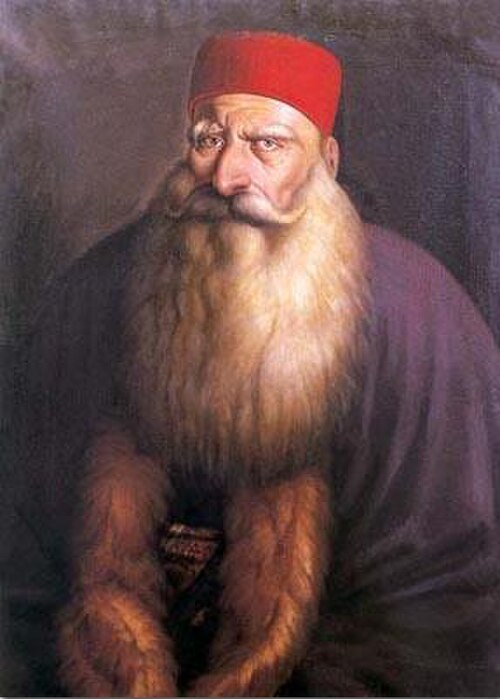
In 1788 Bashir Shihab II (or Bachir in French sources) would rise to become the Emir. Born into poverty, he was elected emir upon the abdication of his predecessor, and would rule under Ottoman suzerainty, being appointed wali or governor of Mt Lebanon, the Beqaa valley and Jabal Amil. Together this is about two thirds of modern-day Lebanon. He would reform taxes and attempt to break the feudal system, in order to undercut rivals, the most important of which was also named Bashir: Bashir Jumblatt, whose wealth and feudal backers equaled or exceeded Bashir II—and who had increasing support in the Druze community. In 1822 the Ottoman wali of Damascus went to war with Acre, which was allied with Muhammad Ali, the pasha of Egypt. As part of this conflict one of the most remembered massacres of Maronite Christians by Druze forces occurred, forces that were aligned with the wali of Damascus. Jumblatt represented the increasingly disaffected Druze, who were both shut out from official power and angered at the growing ties with the Maronites by Bashir II, who was himself a Maronite Christian.
Bashir II was overthrown as wali when he backed Acre, and fled to Egypt, later to return and organize an army. Jumblatt gathered the Druze factions together, and the war became sectarian in character: the Maronites backing Bashir II, the Druze backing Bashir Jumblatt. Jumblatt declared a rebellion, and between 1821 and 1825 there were massacres and battles, with the Maronites attempting to gain control of the Mt. Lebanon district, and the Druze gaining control over the Beqaa valley. In 1825 Bashir II, helped by the Ottomans and the Jezzar, defeated his rival in the Battle of Simqanieh. Bashir Jumblatt died in Acre at the order of the Jezzar. Bashir II was not a forgiving man and repressed the Druze rebellion, particularly in and around Beirut. This made Bashir Chehab the only leader of Mount Lebanon. However, Bashir Chehab was depicted as a nasty leader because Bashir Jumblatt was his all-time friend and has saved his life when the Keserwan peasants tried to kill the prince, by sending 1000 of his men to save him. Also, days before the Battle of Simqania, Bashir Jumblatt had the chance to kill Bashir II when he was returning from Acre when he reportedly kissed the Jezzar's feet in order to help him against Jumblatt, but Bashir II reminded him of their friendship and told Jumblatt to "pardon when you can". The high morals of Jumblatt led him to pardon Bashir II, a decision he should have regretted.
地方政治を通じて権力を握ったものの、地方政治との乖離が深まるにつれて失脚寸前となったバシール2世は、同盟国を求めた。同盟国は、地域全体を「東洋」と見なし、忠誠を要求せず、また際限のない内紛に巻き込まれることもなく、貿易、武器、資金を提供できる国々であった。彼はドゥルーズ派を武装解除し、フランスと同盟を結び、1832年にレバノンに入城して正式に支配権を握ったエジプトのパシャ、ムハンマド・アリーの名の下に統治を行った。その後の8年間、1821年から1825年の紛争で生じた宗派的、封建的な亀裂は、ドゥルーズ派の経済的孤立の深化とマロン派の富の増大によってさらに激化した。
19世紀、ベイルートは南方のアッコに代わり、この地域で最も重要な港となった。これは主に、レバノン山脈がヨーロッパへの輸出用絹の生産中心地となったためである。この産業によってこの地域は富を得たが、同時にヨーロッパとの繋がりにも依存するようになった。絹のほとんどがマルセイユに送られたため、フランスはこの地域に大きな影響力を持つようになった。

不満はオスマン帝国とイギリスの資金と支援を受けて公然たる反乱へと発展し、バシール2世は逃亡、オスマン帝国は支配権を回復し、1839年から1841年まで大宰相を務めたメフメト・ヒュスレフ・パシャは、シハブ家の別の人物を任命し、その人物はバシール3世と名乗った。策略、武力、外交によって52年間レバノン山地とベッカー高原を支配した人物の後を継いだバシール3世の治世は長くは続かなかった。1841年、貧困にあえぐドゥルーズ派とマロン派キリスト教徒の間で紛争が勃発し、ドゥルーズ派がデイル・アル・カマルでキリスト教徒を虐殺し、逃げた生存者はオスマン正規軍によって虐殺された。オスマン帝国はレバノン山地をキリスト教徒地区とドゥルーズ派地区に分割することで平和を築こうとしたが、これは単に交戦勢力の地理的な勢力基盤を作り出すだけであり、宗派間の戦争だけでなく、封建階級に対するマロン派の反乱も含む内戦に再び陥り、1858年に古い封建的な税制と徴税制度の打倒で終結した。状況は不安定だった。マロン派は大きな町に住んでいたが、それらの町はしばしばペリオイコイとして暮らすドゥルーズ派の村々に囲まれていた。

ドルーズ派とキリスト教徒の関係は、調和と平和共存によって特徴づけられており、[ 33 ] [ 34 ] [ 35 ] [ 32 ] 1860年のレバノン山内戦などいくつかの期間を除いて、歴史を通じて両グループ間の友好的な関係が続いてきた。 [ 36 ] [ 37 ] 1860年、マロン派がオスマン帝国の権力に公然と反対し始めたとき、これは全面的な宗派戦争に再燃した。もう一つの不安定化要因は、フランスがドルーズ派に対抗してマロン派キリスト教徒を支援したことであり、これが今度はイギリスがドルーズ派を支援することにつながり、両コミュニティ間の宗教的および経済的緊張を悪化させた。ドルーズ派はこのことを利用してマロン派の村を焼き始めた。ドゥルーズ派はバシール2世によるマロン派への優遇にますます憤慨し、レバノンに対する支配力を拡大しようとオスマン帝国とダマスカスのワリの支援を受けた。一方、マロン派は経済的、政治的な便宜からフランスの支援を受けた。ドゥルーズ派は村の焼き討ちや虐殺を含む軍事作戦を開始し、マロン派の非正規兵は独自の攻撃で反撃した。しかし、マロン派は徐々にいくつかの拠点に追い詰められ、ヨーロッパ協調体制が介入し[ 38 ]、結果を決定するための委員会を設置した[ 39 ]とき、軍事的敗北の瀬戸際にあった。そこに展開したフランス軍は、最終決定を強制するために使用された。フランスはドゥルーズ派が支配権を確立したことを認め、マロン派はベイルート自体を直接支配することさえできない、レバノン山周辺の半自治地域に縮小された。レバノン州はマロン派によって支配されることになったが、全域はダマスカス総督の直接統治下に置かれ、オスマン帝国によって厳重に監視された。
The long siege of Deir al-Qamar found a Maronite garrison holding out against Druze forces backed by Ottoman soldiers; the area in every direction was despoiled by the besiegers. In July 1860, with European intervention threatening, the Turkish government tried to quiet the strife, but Napoleon III of France sent 7,000 troops to Beirut and helped impose a partition: The Druze control of the territory was recognized as the fact on the ground, and the Maronites were forced into an enclave, arrangements ratified by the Concert of Europe in 1861. They were confined to a mountainous district, cut off from both the Beqaa and Beirut, and faced with the prospect of ever-growing poverty. Resentments and fears would brood, ones which would resurface in the coming decades.
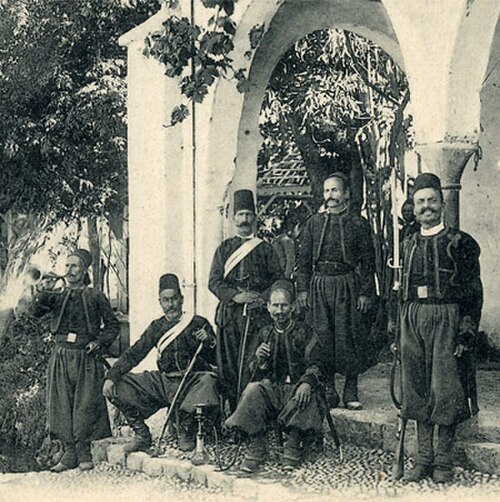
Youssef Bey Karam,[40] a Lebanese nationalist played an influential role in Lebanon's independence during this era.
In December 1831 Tyre fell under the rule of Muhammad Ali Pasha of Egypt, after an army led by his son Ibrahim Pasha had entered Jaffa and Haifa without resistance.[41] Two years later, Shiite forces under Hamad al-Mahmud from the Ali al-Saghir dynasty rebelled against the occupation. They were supported by the British Empire and Austria-Hungary: Tyre was captured on 24 September 1839 after allied naval bombardments.[42] For their fight against the Egyptian invaders, al-Mahmud and his successor Ali El-Assaad – a relative – were rewarded by the Ottoman rulers with the restoration of Shiite autonomy in Jabal Amel. However, in Tyre it was the Mamluk family that gained a dominant position. Its head Jussuf Aga ibn Mamluk was reportedly a son of the anti-Shiite Jazzar Pasha.

The MaroniteCatholics and the Druze founded modern Lebanon in the early eighteenth century, through the ruling and social system known as the "Maronite-Druze dualism" in Mount Lebanon Mutasarrifate.[43] The remainder of the 19th century saw a relative period of stability, as Muslim, Druze and Maronite groups focused on economic and cultural development which saw the founding of the American University of Beirut and a flowering of literary and political activity associated with the attempts to liberalize the Ottoman Empire. Late in the century there was a short Druze uprising over the extremely harsh government and high taxation rates, but there was far less of the violence that had scalded the area earlier in the century.
In the approach to World War I, Beirut became a center of various reforming movements, and would send delegates to the Arab Syrian conference and Franco-Syrian conference held in Paris. There was a complex array of solutions, from pan-Arab nationalism, to separatism for Beirut, and several status quo movements that sought stability and reform within the context of Ottoman government. The Young Turk revolution brought these movements to the front, hoping that the reform of Ottoman Empire would lead to broader reforms. The outbreak of hostilities changed this, as Lebanon was to feel the weight of the conflict in the Middle East more heavily than most other areas occupied by the Syrians.
They lost so many loved ones during that time. My father once said that the rich families survived as they were able to bribe and get supplies on the black market. It was the unemployed, the middle class and the poor that were dying in the streets.
—Teresa Michel, son of famine survivors[44]
About half the population of the Mount Lebanon subdivision, overwhelmingly Maronites, starved to death (200,000 killed out of 400,000 of the total populace) throughout the years of 1915–1918 during what is now known as the Great Famine of Mount Lebanon,[45] as a consequence of a mixed combination of crop failure, punitive governance practices, naval blockade of the coast by the Allies, and an Ottoman military ban on exports from Syria into Lebanon, during World War I.[46] Dead bodies were piled in the streets and starving Lebanese civilians were reported to be eating street animals while some even resorted to cannibalism.[47]


第一次世界大戦後のオスマン帝国の崩壊に伴い、国際連盟は現在のレバノンを構成する5つの州をフランスの直接統治下に置いた。当初、オスマン帝国のアラビア語圏の分割はサイクス・ピコ協定によって行われる予定であったが、最終的な決定は1920年のサンレモ会議で行われ、委任統治領、その境界、目的、組織に関する決定は1921年に国際連盟によって批准され、1922年に発効した。
サンレモで締結された協定によれば、フランスは、1920年にダマスカスを占領したシリアと呼ばれる地域に対する支配権を認められた。かつてオスマン帝国領だった他の地域と同様に、シリアはA級委任統治領であり、「独立国家としての存在が暫定的に認められる段階に達した」とみなされ、委任統治国による行政上の助言と支援を受けながら、自立できるようになるまで統治が続くものとされた。委任統治国の選定においては、これらの共同体の意思が最優先事項とされなければならない。当時、地中海沿岸の行政区を含め、フランスの委任統治領全域が「シリア」と呼ばれていた。フランスは、自国の直接支配地域を最大化し、ダマスカスを中心とするアラブ系シリアを抑え込み、防衛可能な国境を確保しようと、レバノンとシリアの国境をベッカー渓谷の東にあるアンチレバノン山脈に移した。この地域は歴史的に何百年もの間ダマスカス県に属しており、文化や影響力の面でベイルートよりもダマスカスとの結びつきがはるかに強かった。これにより、ベイルートの支配地域は倍増したが、その代償として後のシリア国家となる地域が犠牲になった。

On 27 October 1919, the Lebanese delegation led by Maronite Patriarch Elias Peter Hoayek presented the Lebanese aspirations in a memorandum to the Paris Peace Conference. This included a significant extension of the frontiers of the Lebanon Mutasarrifate,[50] arguing that the additional areas constituted natural parts of Lebanon, despite the fact that the Christian community would not be a clear majority in such an enlarged state.[50] The quest for the annexation of agricultural lands in the Bekaa and Akkar was fueled by existential fears following the death of nearly half of the Mount Lebanon Mutasarrifate population in the Great Famine; the Maronite church and the secular leaders sought a state that could better provide for its people.[51] The areas to be added to the Mutasarrifate included the coastal towns of Beirut, Tripoli, Sidon and Tyre and their respective hinterlands, all of which belonged to the Beirut Vilayet, together with four Kazas of the Syria Vilayet (Baalbek, the Bekaa, Rashaya and Hasbaya).[50]
As a consequence of this also, the demographics of Lebanon were profoundly altered, as the added territory contained people who were predominantly Muslim; Lebanese Christians, of which the Maronites were the largest subgrouping, now constituted barely more than 50% of the population, while Sunni Muslims and Shi'ite Muslims saw their numbers increase. Modern Lebanon's constitution, drawn up in 1926, specified a balance of power between the various religious groups. The president was required to be a Christian (in practice, a Maronite), the prime minister a Sunni Muslim. On the basis of the 1932 census, parliament seats were divided according to a six-to-five Christian/Muslim ratio. The constitution gave the president veto power over any legislation approved by parliament, virtually ensuring that the 6:5 ratio would not be revised in case the population distribution changed. By 1960, Muslims were thought to constitute a majority of the population, which contributed to Muslim unrest regarding the political system.
During World War II when the Vichy government assumed power over French territory in 1940, General Henri Fernand Dentz was appointed as high commissioner of Lebanon. This new turning point led to the resignation of Lebanese president Émile Eddé on 4 April 1941. After five days, Dentz appointed Alfred Naqqache for a presidency period that lasted only three months. The Vichy authorities allowed Nazi Germany to move aircraft and supplies through Syria to Iraq where they were used against British forces. Britain, fearing that Nazi Germany would gain full control of Lebanon and Syria by pressure on the weak Vichy government, sent its army into Syria and Lebanon.[52]
After the fighting ended in Lebanon, General Charles de Gaulle visited the area. Under various political pressures from both inside and outside Lebanon, de Gaulle decided to recognize the independence of Lebanon. On 26 November 1941, General Georges Catroux announced that Lebanon would become independent under the authority of the Free French government.
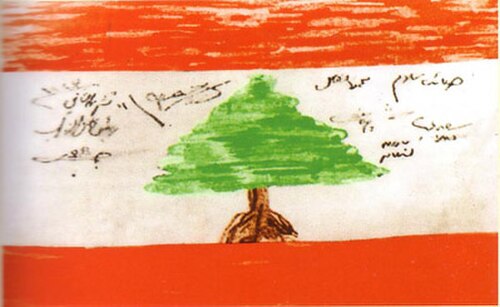
Elections were held in 1943 and on 8 November 1943, the new Lebanese government unilaterally abolished the mandate. The French reacted by throwing the new government into prison. In the face of international pressure, the French released the government officials on 22 November 1943, and accepted the independence of Lebanon.
The allies kept the region under control until the end of World War II. The last French troops withdrew in 1946.
Lebanon's history since independence has been marked by alternating periods of political stability and turmoil interspersed with prosperity built on Beirut's position as a freely trading regional center for finance and trade. Beirut became a prime location for institutions of international commerce and finance, as well as wealthy tourists, and enjoyed a reputation as the "Paris of the Middle East" until the outbreak of the Lebanese Civil War.
In the aftermath of the 1948 Arab–Israeli War, Lebanon became home to more than 110,000 Palestinian refugees.

In 1958, during the last months of President Camille Chamoun's term, an insurrection broke out, and 5,000 United States Marines were briefly dispatched to Beirut on 15 July in response to an appeal by the government. After the crisis, a new government was formed, led by the popular former general Fuad Chehab.
During the 1960s, Lebanon enjoyed a period of relative calm, with Beirut-focused tourism and banking sector-driven prosperity. Lebanon reached the peak of its economic success in the mid–1960s—the country was seen as a bastion of economic strength by the oil-rich Persian Gulf Arab states, whose funds made Lebanon one of the world's fastest growing economies. This period of economic stability and prosperity was brought to an abrupt halt with the collapse of Yousef Beidas' Intra Bank, the country's largest bank and financial backbone, in 1966.
Additional Palestinian refugees arrived after the 1967 Arab–Israeli War. Following their defeat in the Jordanian civil war, thousands of Palestinian militiamen regrouped in Lebanon, led by Yasser Arafat's Palestine Liberation Organization, with the intention of replicating the modus operandi of attacking Israel from a politically and militarily weak neighbour. Starting in 1968, Palestinian militants of various affiliations began to use southern Lebanon as a launching pad for attacks on Israel. Two of these attacks led to a watershed event in Lebanon's inchoate civil war. In July 1968, a faction of George Habash's Popular Front for the Liberation of Palestine (PFLP) hijacked an Israeli El Al civilian plane en route to Algiers; in December, two PFLP gunmen shot at an El Al plane in Athens, resulting in the death of an Israeli.
As a result, two days later, an Israeli commando flew into Beirut's international airport and destroyed more than a dozen civilian airliners belonging to various Arab carriers. Israel defended its actions by informing the Lebanese government that it was responsible for encouraging the PFLP. The retaliation, which was intended to encourage a Lebanese government crackdown on Palestinian militants, instead polarized Lebanese society on the Palestinian question, deepening the divide between pro- and anti-Palestinian factions, with the Muslims leading the former grouping and Maronites primarily constituting the latter. This dispute reflected increasing tensions between Christian and Muslim communities over the distribution of political power, and would ultimately foment the outbreak of civil war in 1975.
その間、マロン派が支配する政府下のレバノン軍がパレスチナ人戦闘員と交戦する中、エジプトの指導者ガマル・アブドゥル・ナセルは、アラファトとレバノン政府の間で1969年の「カイロ合意」の交渉を仲介した。この合意は、パレスチナ難民キャンプとイスラエル北部へのアクセスルートに対するPLOの自治権をPLOがレバノンの主権を承認する代わりに認めるものであった。この合意は、パレスチナ人への過剰な譲歩と見なされたため、マロン派の不満を招き、その後、パレスチナ人を放っておくよう求められた政府軍が残した空白を埋めるために、親マロン派の民兵組織が結成された。特に、この頃、ジェマイエル家のメンバーが率いるマロン派民兵組織であるファランヘ党が台頭した。[ 53 ]
1970年9月、1950年代に他のマロン派教徒を含む数百人を殺害したとして告発され、一時的にラタキアに逃亡していたスレイマン・フランジエが、議会で僅差の投票により大統領に選出された。11月には、亡命中にフランジエを受け入れた親友のハーフィズ・アル=アサドがシリアで権力を掌握した。その後、1976年にフランジエはシリア人をレバノンに招き入れた。[ 54 ]
一方、PLOは新たな特権を利用してレバノン南部に事実上の「ミニ国家」を樹立し、イスラエル北部の入植地への攻撃を激化させた。さらに事態を悪化させたのは、1970年のヨルダンによる弾圧から逃れてきたアラファトとそのファタハ運動を含む武装パレスチナ人戦闘員がレバノンに流入したことである。この時期から始まったPLOの「イスラエルに対する残忍なテロ攻撃」[ 55 ]に対し、イスラエルはレバノン南部で爆撃を行い、「1968年以来、150以上の町や村がイスラエル軍によって繰り返し荒らされてきた」。その中でも、キヤム村はおそらく最もよく知られた例である。[ 56 ]イスラエル国防軍の公式統計によると、1967 年以降、パレスチナ人の攻撃によりイスラエル北部で 106 人の命が奪われた一方、レバノン軍は「1968 年から 74 年にかけて、イスラエルによるレバノン領土への侵犯が 1 日あたり 1.4 回」記録している。[ 57 ] 1949 年から 1968 年の間、レバノンとイスラエルの間に紛争はなかったが、1968 年以降、レバノンの南部国境では攻撃と報復のサイクルがエスカレートし始め、内戦、外国の侵略、国際介入の混乱につながった。PLO のレバノンへの到来の影響は今日まで続いている。
1974年、シーア派政党であり元民兵組織であるアマル運動が、ムーサ・アル=サドルとフセイン・エル=フセイニによって設立された。[ 58 ]その目標は、レバノンの貧困層の社会的・政治的状況を改善することであった。主な焦点はシーア派コミュニティにあったが、この運動は世俗的な組織として運営され、他のコミュニティの支持も得ていた。[ 59 ]
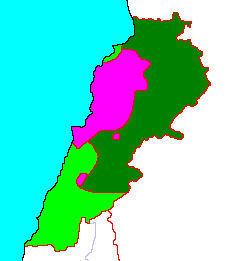
レバノン内戦は、オスマン帝国崩壊後のレバノンの紛争と政治的妥協に端を発し、人口動態の変化、宗教間の対立、シリア、パレスチナ解放機構、イスラエルとの近接性によって悪化した。1975年までに、レバノンは宗教的にも民族的にも多様な国となり、マロン派キリスト教徒、東方正教会、スンニ派イスラム教徒、シーア派イスラム教徒が多数を占め、ドゥルーズ派、クルド人、アルメニア人、パレスチナ難民とその子孫が相当数の少数派として存在していた。
レバノンの暴力的な崩壊に寄与した出来事や政治運動には、とりわけ、アラブ民族主義の台頭、冷戦下におけるアラブ社会主義、アラブ・イスラエル紛争、バアス党、イラン革命、パレスチナ過激派、ヨルダンの黒い九月事件、イスラム原理主義、イラン・イラク戦争などが挙げられる。
レバノンの16年にわたる戦争では、合計で10万人以上が死亡し、さらに10万人が負傷により障害を負ったと推定されている。戦前の居住人口の最大5分の1、つまり約90万人が家を追われ、そのうちおそらく25万人が永住のために国外へ移住した。[ 60 ]地雷の設置の多くの段階で、何千人もの人々が手足を失った。
この戦争は大きくいくつかの時期に分けられる。1970年代半ばの最初の勃発、1970年代後半のシリアとイスラエルの介入、1980年代初頭のPLOとイスラエルの紛争の激化、1982年のイスラエルによる侵攻、短期間の多国籍軍の介入、そして最終的にはシリアによる占領という形での解決である。
憲法で保障されたキリスト教徒による政府支配は、イスラム教徒や左派からの批判にさらされるようになり、1969年には国民運動が結成され、新たな国勢調査の実施と、その結果を反映した新たな政府構造の策定が求められた。政治的緊張は軍事衝突へと発展し、1975年4月には全面的な内戦に突入した。1976年、指導部はシリアの介入を要請し、レバノンへのシリア軍の駐留が実現した。また、危機を収束させるため、1976年にアラブ首脳会議が開催された。
南部では、イスラエルとPLOの軍事衝突により、イスラエルはサード・ハッダドの南レバノン軍(SLA)を支援し、イスラエルの北部国境沿いに安全保障地帯を確立しようとした。この取り組みは、1977年にイスラエルの新首相メナヘム・ベギンが選出されたことでさらに強化された。1978年3月、イスラエルはイスラエル国内でのファタハの攻撃への報復としてレバノンに侵攻した。沿岸道路虐殺としても知られるファタハの攻撃では、パレスチナのテロリストがイスラエルの沿岸道路でバスをハイジャックし、乗客38人(うち子供13人)を殺害した。最終的に、イスラエルはリタニ川以南の地域の大部分を支配下に置いた。その結果、少なくとも10万人のレバノン人が避難し[ 61 ]、約2000人が死亡した[ 62 ] 。
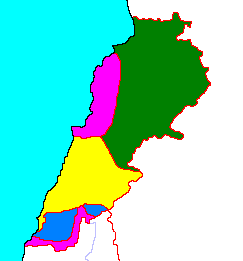
国連安全保障理事会は、イスラエル軍の即時撤退と、平和維持を任務とする国連レバノン暫定軍(UNIFIL)の創設を求める決議425を採択した。イスラエル軍は1978年後半に撤退したが、パレスチナ解放機構(PLO)の越境攻撃に対する防護緩衝地帯として、シエラレオネ軍(SLA)が支配する国境地帯を残した。
宗教グループ間の争いに加えて、マロン派グループ間の対立もあった。1978年6月、スレイマン・フランジエの息子の一人、トニーは、妻と幼い娘とともに、バシール・ジェマイエル、サミール・ゲアゲア、そして彼らのファランジスト部隊による夜間の町への攻撃で殺害されたと伝えられている。 [ 63 ]
同時に、シリアとファランヘ党の間の緊張が高まり、イスラエルによるマロン派グループへの支援が増大し、1981年4月にはイスラエルとシリアの間で直接的な衝突が発生し、アメリカの外交介入につながった。フィリップ・ハビブは事態のさらなる悪化を防ぐため現地に派遣され、5月に締結された合意によってその目的を成功裏に達成した。
パレスチナ内部の戦闘とPLOとイスラエルの紛争は続き、1981年7月24日、ハビブはPLOとイスラエルとの間で停戦協定を仲介した。両者はレバノン国内およびイスラエルとレバノンの国境沿いでの敵対行為を停止することで合意した。
PLOとイスラエルのやり取りが続いた後、イスラエルは1982年6月6日に「ガリラヤの平和作戦」というコードネームでレバノンに侵攻した。同年6月15日までにイスラエル軍はベイルート郊外に陣地を築き、ヤーセル・アラファトは交渉を通じてPLOの撤退を試みた。6月から8月にかけてのイスラエルによるベイルート包囲を含む作戦全体で、民間人を含む約2万人が双方で死亡したと推定されている[ 64 ] [ 65 ] 。これらの数字には、700人から3500人のパレスチナ人が殺害されたサブラとシャティーラの虐殺は含まれていない[ 64 ] 。米海兵隊とフランス軍、イタリア軍からなる多国籍軍が到着し、PLOの撤退と民間人の保護を確実にした。9月1日までに約1万5000人のパレスチナ人戦闘員が撤退した。
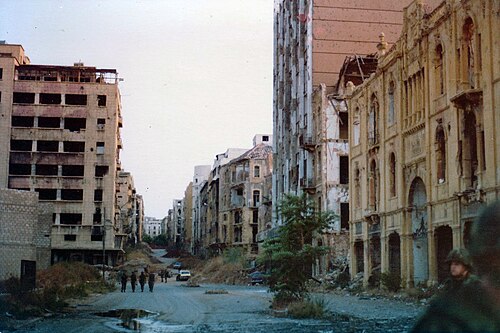
バシール・ジェマイエルはイスラエルと公には協力しなかった ものの、長年にわたるイスラエルとの戦術的な協力関係は、多くのレバノン人、特にイスラム教徒の目には不利に働いた。共和国大統領選に立候補を表明したのは彼一人だったが、国民議会は1982年8月23日、レバノン史上2番目に僅差の得票差(92票中57票)で彼を選出した。議会のイスラム教徒議員のほとんどは投票をボイコットした。就任予定日の9日前、ジェマイエルは1982年9月14日、ベイルートのキリスト教徒地区アシュラフィエにあるカタイブ党本部で発生した爆発で、他の25人とともに暗殺された。

ファランジストは9月16日午後6時にパレスチナ難民キャンプに侵入し、 9月19日朝まで滞在し、700人から3500人のパレスチナ人を虐殺した[ 64 ]。「犠牲者の中にPLO部隊のメンバーはいなかったようだ」[ 66 ] 。サブラとシャティーラの虐殺として知られるこの攻撃は、停戦協定に違反した西ベイルートでのイスラエル軍の進軍によって可能になった[ 67 ] 。ファランジストは、ジェマイエルの暗殺と、PLO戦闘員が以前キリスト教徒の町で犯したダモールの虐殺に対する報復だと考えていたと考えられている[ 68 ] 。
バシール・ジェマイエルの後を継いで大統領に就任したのは、兄のアミン・ジェマイエルで、1982年から1988年まで務めた。アミン・ジェマイエルは気質が兄とはかなり異なり、カリスマ性や決断力に欠けると広く見なされており、兄の支持者の多くは不満を抱いていた。
アミン・ジェマイエルは、イスラエル軍とシリア軍の撤退確保に尽力した。1983年5月17日、レバノン、イスラエル、米国の間で、シリア軍の撤退を条件とするイスラエル軍の撤退に関する合意が成立した。しかし、シリアはこの合意に反対し、自国軍の撤退に関する協議を拒否したため、事態は膠着状態に陥った。
1983年、イスラエル国防軍(IDF)は南へ撤退し、シュフ地方から撤退。2000年までは「安全保障地帯」にのみ駐留した。これが、ドゥルーズ派の進歩社会党( PSP)とマロン派レバノン軍( LF)の間で山岳戦争を引き起こした。PSPはシュフ地方とアレイ地区で行われた決定的な戦いに勝利し、LFに大きな損害を与えた。その結果、キリスト教徒はレバノン山地南部から追放された。
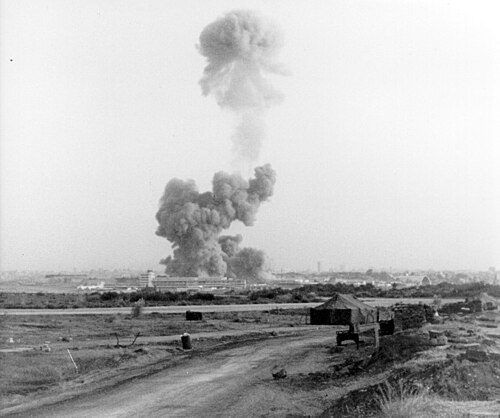
1983年と1984年に発生した米国大使館への2度のトラック爆弾テロや、1983年10月23日に発生した米海兵隊とフランス空挺連隊の兵舎への歴史的な攻撃など、米国および西側諸国の権益に対する激しい攻撃が、米国の撤退につながった。
1984年2月6日、PSPとアマルという二大同盟勢力が主導したベイルートでのインティファーダにおいて、レバノン軍が事実上崩壊したことは、政府にとって大きな打撃となった。インティファーダと山岳戦の結果、レバノン政府は3月5日、1983年5月17日の合意を破棄した。米海兵隊は数週間後に撤退した。
Between 1985 and 1989, heavy fighting took place in the "War of the Camps". The Shi'a MuslimAmal militia sought to rout the Palestinians from Lebanese strongholds.
Combat returned to Beirut in 1987, with Palestinians, leftists and Druze fighters allied against Amal. After winning the battle, the PSP controlled West Beirut. The Syrians then entered Beirut. This combat was fueled by the Syrians in order to take control of Beirut by taking as a pretext of stopping the fights between the brothers, the PSP and Amal. Violent confrontation flared up again in Beirut in 1988 between Amal and Hezbollah.
Meanwhile, on the political front, Prime Minister Rashid Karami, head of a government of national unity set up after the failed peace efforts of 1984, was assassinated on 1 June 1987. President Gemayel's term of office expired in September 1988. Before stepping down, he appointed another Maronite Christian, Lebanese Armed Forces Commanding General Michel Aoun, as acting prime minister, as was his right under the Lebanese constitution of 1943. This action was highly controversial.
Muslim groups rejected the move and pledged support to Selim al-Hoss, a Sunni who had succeeded Karami. Lebanon was thus divided between a Christian government in East Beirut and a Muslim government in West Beirut, with no president.
In February 1989, General Aoun launched the "War of liberation", a war against the Syrian Armed Forces in Lebanon. His campaign was partially supported by a few foreign nations but the method and approach was disputed within the Christian community. This led to the Lebanese forces to abstain from the Syrian attack against Aoun. In October 1990, the Syrian air force, backed by the US and pro-Syrian Lebanese groups (including Hariri, Joumblatt, Berri, Geagea and Lahoud) attacked the Presidential Palace at B'abda and forced Aoun to take refuge in the French embassy in Beirut and later go into exile in Paris. 13 October 1990, is regarded as the date the civil war ended, and Syria is widely recognized as playing a critical role in its end.[69]
The Taif Agreement of 1989 marked the beginning of the end of the war, and was ratified on 4 November. President Rene Mouawad was elected the following day, but was assassinated in a car bombing in Beirut on 22 November as his motorcade returned from Lebanese independence day ceremonies. He was succeeded by Elias Hrawi, who remained in office until 1998.
1990年8月、議会と新大統領は、タイフで構想された政治改革の一部を具体化した憲法改正案に合意した。国民議会は128議席に拡大され、キリスト教徒とイスラム教徒が同数となった。1991年3月、議会は恩赦法を可決し、外国の外交官に対する犯罪や、内閣が最高司法評議会に付託した特定の犯罪を除き、施行前に犯されたほとんどの政治犯罪を赦免した。
1991年5月、民兵組織(ヒズボラという重要な例外を除く)は解散され、レバノン軍はレバノン唯一の主要な非宗派組織として、徐々に再建を開始した。
暴力事件は依然として発生した。1991年12月下旬、バスタのイスラム教徒地区で自動車爆弾(TNT火薬100kg相当と推定)が爆発した。防弾車に乗っていたシャフィク・ワッザン元首相を含む少なくとも30人が死亡、120人が負傷した。これは、1985年6月18日にレバノン北部の港町トリポリで爆発が発生し、60人が死亡、110人が負傷して以来、レバノンで最も死者数の多い自動車爆弾事件となった。
1980年代半ばにヒズボラによって誘拐された欧米人のうち、最後の者たちが解放されたのは1992年5月だった。
戦争終結以来、レバノンでは幾度かの選挙が実施され、ほとんどの民兵組織は弱体化または解散し、レバノン軍(LAF)は中央政府の権限を国土の約3分の2にまで拡大した。ヒズボラだけが武器を保持し、イスラエルの占領からレバノンを守ったことから、レバノン議会の支持を得てその状態を維持した。一方、シリアはレバノンの大部分に軍事拠点を維持し、国内の様々な政府機関も掌握することで、占領を強化した。イスラエル軍は2000年5月にレバノン南部から撤退したが、シリアによるレバノンの大部分の占領はその後も続いた。
1992年11月初旬までに、新しい議会が選出され、ラフィク・ハリリ首相は内閣を組閣し、自身は財務大臣のポストを保持した。成功した億万長者の実業家が率いる政府の形成は、レバノンが国の再建と経済の再生を優先する兆候として広く見なされた。ベイルート中心部の再建のために設立された民間不動産会社ソリデールは、経済回復を民間投資に結びつけるハリリの戦略の象徴であった。フラウィ大統領の任期延長後、1998年に当時のレバノン軍司令官エミール・ラフードが大統領に選出されると、サリム・アル・ホスが再び首相を務めた。ハリリは2000年11月に首相に復帰した。基本的なインフラと政府サービスの問題が依然として残っており、レバノンは現在多額の債務を抱えているが、内戦による被害の多くは全国的に修復され、多くの外国人投資家や観光客が戻ってきている。
戦後の社会・政治情勢の不安定化は、経済不安とレバノン通貨の暴落によってさらに悪化し、オマル・カラミ首相は就任からわずか2年足らずの1992年5月に辞任に追い込まれた。後任にはラシード・ソル元首相が就任したが、彼は20年ぶりとなるレバノンの議会選挙を監督する暫定首相と広く見なされていた。
レバノンは過去10年間で、長引く内戦によるインフラへの壊滅的な被害からある程度回復したが、その紛争を引き起こし、維持してきた社会的・政治的分裂は依然として大部分が未解決のままである。議会選挙、そして最近では地方選挙は、紛争直後よりも不正が少なく、国民の参加率も高く、レバノンの市民社会は概してアラブ世界の他の地域よりもかなり自由を享受している。しかしながら、宗派間の緊張は依然として存在し、シリアをはじめとする外部勢力の影響に対する不安も根強く残っている。

1990年代後半、政府は北部で兵士を攻撃したスンニ派イスラム過激派に対して行動を起こし、オサマ・ビンラディンのアルカイダネットワークと提携していると非難されているアスバト・アル・アンサールなどのグループに対する取り締まりを続けている。2002年1月24日、サブラとシャティーラの虐殺に関与し、後に3つの内閣と議会で要職を務めた元レバノン軍団のエリー・ホベイカが、ベイルートでの自動車爆弾テロで暗殺された。
レバノン内戦中、シリア軍のレバノンへの展開は、アラブ連盟の支持を受けたタイフ合意においてレバノン議会によって正当化され、1990年10月に内戦を終結させた大きな要因の一つとされている。その後15年間、ダマスカスとベイルートは、国内外の安全保障上の脅威に直面したレバノン軍の弱体化と、タイフ合意における憲法改正案のすべてを実施するというレバノン政府との合意を理由に、シリア軍のレバノンにおける継続的な軍事的プレゼンスを正当化してきた。タイフ合意の下では、ヒズボラ民兵は最終的に解体され、レバノン軍はイスラエルとの国境沿いに展開することが認められることになっていた。レバノンは国連安全保障理事会決議1391号で南部国境沿いに部隊を配備するよう求められ、国連安保理決議1496号でそうするよう促され、国連安保理決議1559号で配備を要求された。レバノンにおけるシリア軍と諜報機関の存在は、レバノン国内外の右派の一部から批判されたが、他の人々はそれが内戦の再発を防ぎ、イスラエルの侵略を抑止するのに役立つと信じ、また他の人々はその存在と影響力はレバノンの安定と平和に役立つが縮小すべきだと信じていた。[ 70 ]主要国である米国とフランスは、シリアがレバノン政府の同意を得てレバノンにいるというシリアの主張を拒否した。両国は、レバノン政府はシリアに買収されており、実際にはレバノン政府はシリアの傀儡であると主張した。[ 71 ]
2005 年まで、14,000 ~ 15,000 人のシリア軍 (35,000 人から減少) [ 72 ]がレバノンの多くの地域に駐留していたが、タイフは1992 年 9 月までにシリア政府とレバノン政府の間で、レバノンのベッカー渓谷への再配置に関する合意を求めていた。2000 年にイスラエルが南レバノンから撤退した後もシリアがレバノンから撤退することを拒否したことで、最初にレバノンのマロン派キリスト教徒[ 73 ]とドゥルーズ派の間で批判が起こり、後にレバノンのスンニ派イスラム教徒の多くがこれに加わった。[ 74 ]一方、レバノンのシーア派は、ヒズボラ民兵組織および政党と同様に、シリアの駐留を長年支持してきた。米国は、シリアに占領を終わらせ、レバノンの内政干渉をやめるよう圧力をかけ始めた。[ 75 ] 2004年、シリアはレバノンの国会議員に圧力をかけ、任期制限を改正し、レバノンの親シリア派大統領エミール・ラフードが3期目に立候補できるようにする憲法改正案を支持するよう促したと多くの人が考えている。フランス、ドイツ、イギリスは、多くのレバノンの政治家とともに、米国とともに、シリアの干渉疑惑を非難した。[ 76 ] 2004年9月2日、国連安全保障理事会は、フランスと米国が異例の協力を示す形で起草した国連安全保障理事会決議1559を採択した。この決議は、「レバノンに残るすべての外国軍の撤退」と「すべてのレバノンおよび非レバノン民兵の解散と武装解除」を求めた。
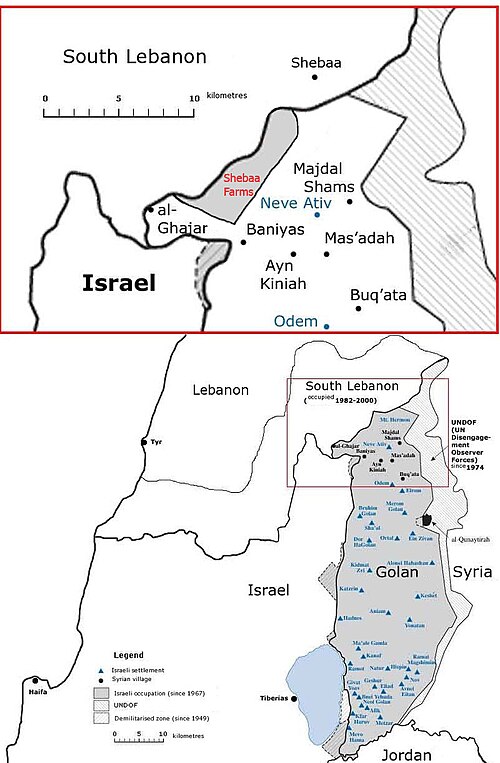
2000年5月25日、イスラエルは国連安全保障理事会決議425号に従ってレバノン南部からの撤退を完了した。[ 77 ]シェバア農場として一般的に知られている50平方キロメートルの山岳地帯は、イスラエルの支配下に残っている。国連はイスラエルの撤退を認定し[ 78 ]、シェバア農場を占領下のシリア領土とみなしているが、レバノンとシリアは、この地域をレバノン領土とみなしていると表明している。[ 79 ] 2005年1月20日の国連事務総長のレバノンに関する報告書は、「レバノン政府が繰り返し主張している、シャバア農場地域におけるブルーラインは無効であるという立場は、安全保障理事会決議と相容れない。安保理は、決議425(1978)に基づくイスラエルの撤退を確認する目的で、ブルーラインが有効であると認めている。レバノン政府は、安保理が当事者に対しブルーライン全体を尊重するよう繰り返し求めていることに耳を傾けるべきである」と述べている。[ 80 ]
国連は決議425で、レバノン政府が「当該地域における実効支配権を取り戻す」ことを支援することを目標としており、そのためにはレバノン軍の公式な駐留が必要となる。さらに、国連安全保障理事会決議1559では、ヒズボラ民兵の解体が求められている。しかし、ヒズボラはブルーライン沿いに依然として展開している。[ 81 ]国連によれば、ヒズボラとイスラエルは共にブルーラインを複数回侵害している。[ 82 ] [ 83 ]最も一般的な暴力のパターンは、ヒズボラがシェバア農場地域に国境を侵犯し、その後イスラエルがレバノン南部を空爆するというものである。[ 84 ]国連事務総長は、「ヒズボラに影響力を持つすべての政府に対し、当該地域の緊張を高める可能性のあるいかなる行動もヒズボラが取らないように阻止するよう」求めている。[ 85 ]南レバノン担当事務総長個人代表のスタファン・デ・ミスラ氏は、「ヒズボラとの衝突中にイスラエルがブルーラインを越えて領空侵犯を続けていることに深く懸念している」と述べ、[ 86 ]「イスラエル当局に対し、そのような侵犯をやめ、ブルーラインを完全に尊重するよう」求めた。[ 87 ] 2001年にもデ・ミスラ氏は同様に、ヒズボラがブルーラインを侵犯することを許していることについてレバノンの首相に懸念を表明し、それは国連がイスラエルの南レバノンからの撤退が完了したと認定した国連決議425の「明白な違反」であると述べた。[ 88 ] 2005年1月28日、国連安全保障理事会決議1583は、レバノン政府に対し、ブルーライン沿いを含む地域全体の平穏な環境を確保するため、十分な数のレバノン軍および治安部隊の配備を含め、南部全域で唯一かつ実効的な権限を完全に拡大し行使し、自国領土内および自国領土からの武力行使を統制するよう求めた。[ 80 ] 2006年1月23日、国連安全保障理事会は、レバノン政府に対し、自国領土の統制と民兵組織の解散においてさらなる進展を図るよう求めるとともに、シリアに対しこれらの取り組みに協力するよう求めた。タンザニアのオーガスティン・マヒガ議長が1月に読み上げた声明の中で、安保理はシリアに対し、レバノンへの武器と人員の移動を阻止するための措置を講じるよう求めた。[ 89 ]
2004年9月3日、国民議会は96対29で憲法を改正し、親シリア派のエミール・ラフード大統領の任期を9年に延長することで、さらに3年間大統領の座にとどまることを可能にする。多くの人々は、シリアがラフードに有利な形で憲法を改正するようレバノン議会に圧力をかけた2度目の事例と見なした(1度目は、ラフードがレバノン軍最高司令官を辞任した直後の1998年の大統領選出を可能にするものだった)。[ 90 ] 3人の閣僚が投票を欠席し、後に辞任した。米国は、シリアが国民議会に圧力をかけて憲法を改正したと非難し、多くのレバノン国民は、憲法とその原則に反するとしてこれを拒否した。[ 91 ]これらには、マロン派の最も著名な宗教的人物であるマロン派総主教マル・ナスララ・ブトロス・スフェイルと、ドゥルーズ派の指導者ワリド・ジュンブラットが含まれる。
多くの人々の予想に反して、この修正案に猛烈に反対していたラフィク・ハリリ首相は、最終的にこれを受け入れたように見え、彼の党のほとんどの議員も同様だった。しかし、彼は最終的にこの修正案に抗議して辞任した。その後まもなく彼は暗殺され、杉の革命を引き起こした。この修正案は、レバノンで新たな大統領選挙を求めた国連安全保障理事会決議1559号と矛盾している。
2004年10月1日、エミール・ラフードの任期延長に反対する主要人物の一人であり、辞任したばかりのドゥルーズ派の元大臣マルワン・ハマデが、ベイルートの自宅に入るために車を減速させたところ、自動車爆弾攻撃の標的となった。ハマデ氏とボディーガードは負傷し、運転手は死亡した。ドゥルーズ派の指導者ワリド・ジュンブラットは冷静さを求めたが、自動車爆弾は反対派への明確なメッセージだと述べた。[ 92 ]国連事務総長コフィ・アナンは、この攻撃に深刻な懸念を表明した。[ 93 ]
2004年10月7日、コフィ・アナン国連事務総長は安全保障理事会に対し、シリアがレバノンから軍隊を撤退させていないと報告した。アナン氏は報告の最後に、「敵対行為の終結から14年、イスラエル軍のレバノンからの撤退から4年が経過した今、関係するすべての当事者が過去の残滓を捨て去るべき時が来た。外国軍の撤退と民兵組織の解散および武装解除は、レバノンの歴史におけるあの悲しい章を最終的に終わらせるだろう」と述べた。[ 94 ] 2004年10月19日、国連事務総長の報告を受けて、国連安全保障理事会は全会一致で(つまり、安全保障理事会唯一のアラブ加盟国であるアルジェリアの支持を得て)、決議1559に従ってシリアにレバノンからの軍隊撤退を求める声明を発表した。[ 95 ]

2004年10月20日、ラフィク・ハリリ首相が辞任し、翌日、元首相でシリアの忠実な支持者であるオマル・カラミが首相に任命された。[ 96 ] 2005年2月14日、ハリリ元首相は自動車爆弾攻撃で暗殺され、21人が死亡、100人が負傷した。2005年2月21日、数万人のレバノンの抗議者が暗殺現場で集会を開き、シリアの平和維持部隊の撤退を求め、シリアと親シリア派のラフード大統領を殺害の責任者として非難した。[ 97 ]
ハリリ氏の暗殺は、シリアに対する国際的な圧力の高まりを引き起こした。ブッシュ米大統領とシラク仏大統領は共同声明で、この殺害を非難し、国連安保理決議1559の完全な履行を求めた。コフィ・アナン国連事務総長は、アイルランドの副警察長官ピーター・フィッツジェラルド氏率いるチームを派遣し、暗殺事件を捜査すると発表した。[ 98 ]また、アラブ連盟のアムル・ムーサ事務総長は、シリアのアサド大統領が2年間かけて段階的に撤退すると約束したと述べたが、シリアの情報相マフディ・ダクララ氏は、ムーサ氏がシリアの指導者の発言を誤解していると述べた。ダクララ氏は、シリアは単に部隊をレバノン東部に移動させるだけだと述べた。ロシア[ 99 ] 、ドイツ[ 100 ]、サウジアラビア[ 100 ]は、いずれもシリア軍の撤退を求めた。
レバノン国内の圧力も高まった。シリア占領に対する抗議デモが毎日2万5千人規模に拡大するにつれ、一連の劇的な出来事が起こった。このような大規模な抗議デモはアラブ世界では極めて異例であり、90年代には反シリアデモ参加者の大半がキリスト教徒であったのに対し、今回のデモはキリスト教徒とスンニ派のデモであった。[ 101 ] 2月28日、親シリア派のオマル・カラミ首相の政権が辞任し、新たな選挙の実施を求めた。カラミ氏は声明の中で、「この国のために善を望む人々の前に、政府が障害とならないことを強く願っている」と述べた。ベイルートの殉教者広場に集まった数万人は、この発表に歓声を上げ、「カラミは倒れた、次はラフード、そしてバシャールの番だ」と叫んだ。[ 102 ]野党議員もカラミ氏の辞任に満足せず、シリア軍の完全撤退を強く求め続けた。 2004年10月1日に同様の自動車爆弾攻撃を生き延びた元大臣で国会議員のマルワン・ハマデ氏は、「私はこの政府を、少なくとも扇動、怠慢、欠陥、そして実行はしないまでも計画の隠蔽で非難する」と述べた。2日後、シリアの指導者バシャール・アル・アサドは、自軍が「今後数ヶ月以内」にレバノンから完全に撤退すると発表した。この発表に対し、野党指導者のワリド・ジュンブラット氏は、撤退に関するダマスカスからのより具体的な説明を聞きたいと述べた。「それは良いジェスチャーだが、『今後数ヶ月以内』というのはかなり曖昧だ。明確なタイムテーブルが必要だ」。[ 103 ]
3月5日、シリアのアサド大統領はテレビ演説で、シリア軍をレバノン東部のベッカー渓谷、そしてシリアとレバノンの国境まで撤退させると宣言した。アサド大統領は、1万4000人の兵士と諜報員からなるシリア軍のレバノンからの完全撤退の時期については示さなかった。[ 104 ]一方、ヒズボラの指導者ナスララは火曜日、国連決議1559号に反対する「大規模な民衆集会」を呼びかけ、「レバノンは自国を守るために抵抗運動を必要としているため、抵抗運動は武器を放棄しない」と述べ、さらに「国連決議のすべての条項は、犯罪の責任を問われるべきイスラエルの敵に無償のサービスを提供しており、イスラエルは今や犯罪の報酬を得て、すべての要求を実現している」と付け加えた。[ 105 ]ナスララの呼びかけに反対し、3月7日月曜日には少なくとも7万人(推定ではその2倍)が中央の殉教者広場に集まり、シリアの完全撤退を要求した。[ 106 ]
翌日、親シリア派のデモは新記録を樹立し、ヒズボラはベイルートのリアド・ソル広場に40万~50万人のデモ参加者を集めた。そのほとんどは、シーア派住民が多いレバノン南部とベッカー渓谷東部からバスで送り込まれた人々だった。この力の誇示は、シリアが民兵組織の保持を認めた唯一のレバノン政党であるヒズボラの影響力、財力、組織力を示した。ナスララ師は演説で、ヒズボラの民兵組織の解散を求める国連安全保障理事会決議1559を外国の介入だと非難した。ナスララ師はまた、イスラエルの破壊を求める以前の呼びかけを改めて繰り返し、「この敵に我々は再び言う。ここにはお前たちの居場所はなく、我々の間にはお前たちの生きる道はない。イスラエルに死を!」と述べた。ヒズボラは大成功を収めた集会を組織したが、野党指導者らは、ヒズボラがレバノン政府とシリアから積極的な支援を受けていることをすぐに指摘した。民主化運動の集会では、デモ参加者が引き返すか殉教者広場まで長距離を行進せざるを得ないような道路封鎖に対処しなければならなかったのに対し、ヒズボラは人々をバスで直接リアド・ソル広場まで送り込むことができた。野党指導者のドリー・シャムーン氏は、「違いは、我々のデモでは人々がバスではなく、自発的に徒歩で到着することだ」と指摘した。別の野党関係者は、親シリア政府が人々を動員するよう圧力をかけ、シリアが国境を越えて人々をバスで送り込んだという報道もあったと述べた。しかし、ベイルートに通じる山道では、首都に向かう親シリア支持者の車列の中で、シリアのナンバープレートを付けたバスが1台だけ目撃されただけであり、ヒズボラ当局はこれらの主張を否定した。[ 107 ] 野党議員のアクラム・チェハイエブ氏は、「我々と彼らの違いはそこにある。彼らはこれらの人々をここに呼ぶように頼み、ここに連れてきたが、野党支持者は自らここに来ている。我々の抗議は自発的なものだ。我々には大義がある。彼らの大義は何だ?」と述べた。[ 108 ]
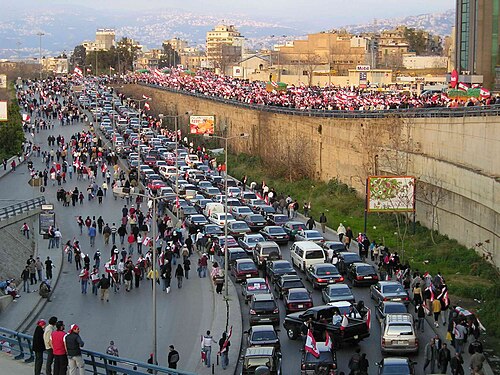
ハリリ氏暗殺から1か月後、ベイルートの殉教者広場に大規模な反シリア集会が開かれた。複数の報道機関は、参加者数を80万人から100万人と推定した。これはスンニ派イスラム教徒、キリスト教徒、ドゥルーズ派のコミュニティによる示威行動であった。この集会は、前週にヒズボラが主催した、主にシーア派による親シリア集会の2倍の規模であった。 [ 109 ]ハリリ氏の妹が「レバノンはシリアの土地が解放され、占領下のゴラン高原で主権を取り戻すまでシリアを支持すべきだ」と親シリア的な立場を取ったとき、群衆は彼女を嘲笑した。[ 110 ]この感情は、レバノンとシリアの利益は結びついているという主張に基づいて武装解除を拒否するヒズボラに反対する集会参加者の間で広く見られた。[ 112 ]
レバノン治安部隊におけるシリア側の協力者であったジャミル・アル・サイードは、シリア軍がレバノンから完全に撤退するわずか1日前の4月25日に辞任した。
2005年4月26日、最後の250人のシリア軍兵士がレバノンを離れた。出国式典で、シリア軍参謀総長のアリ・ハビブは、レバノン軍が「確固たる国家基盤の上に再建され、国家を守る能力を得た」ため、シリア大統領が部隊の撤退を決定したと述べた。
セネガル人のムハマドゥ・カンジが率い、レバノン人のイマド・アンカが案内役を務める国連軍は、安全保障理事会決議1559号で義務付けられた軍の撤退を確認するため、レバノンに派遣された。
シリア軍撤退後、反シリア陣営によるレバノンの政治家やジャーナリストの暗殺が相次いで始まった。これまでに多くの爆破事件が発生し、国連安全保障理事会や国連事務総長から非難の声が上がっている。[ 113 ]
レバノンのラフィク・ハリリ首相の暗殺をめぐり、国内外から激しい非難が巻き起こる中、シリアがレバノンから撤退してから8か月が経過したが、国連の調査はまだ完了していない。国連調査官のデトレフ・メーリス氏はレバノンのシリア情報機関を非難しているものの、国連国際独立調査委員会(UNIIC)が暗殺の背後にいると疑っているシリア当局者への全面的なアクセスはまだ許可されていない。[ 114 ] UNIIICは最新の報告書で、シリア当局者が、以前委員会に証言した内容を撤回した証人の近親者を逮捕し脅迫したという「信頼できる情報」を入手しており、尋問した2人のシリア人容疑者が、レバノンに関するシリアの情報文書はすべて焼却されたと示唆したと述べている。[ 115 ] 反シリア陣営に関連する政治家、ジャーナリスト、さらには民間人の居住地域に対する爆弾攻撃のキャンペーンは、国連[ 113 ]やその他の場所でシリアに対する多くの否定的な注目を集めている。
2005年12月15日、国連安全保障理事会はUNIIICの任務を延長した。
2005年12月30日、シリアの元副大統領アブドゥル・ハリム・ハッダムは、「ハリリはシリアのバシャール・アル・アサド大統領から多くの脅迫を受けた」と述べた。[ 116 ]シリアがレバノンから撤退する前、ハッダム氏はシリアのレバノン政策を担当し、レバノンの資源の乱用について主に責任を負っていた。ハッダム氏は汚職と恐喝の経歴を清算する機会を捉えたと多くの人が考えている。
2005年春の選挙後初の議会で、レバノン軍団の元軍閥指導者サミール・ジャアジャの釈放が可決された。ジャアジャは内戦中に紛争に関連する罪で起訴された唯一の指導者だった。ミシェル・アウンが復帰したことで、2005年2月14日にラフィク・ハリリ元首相が暗殺された後、傷を癒し国を統一しようとする機運が高まっていた。ジャアジャは2005年7月26日に釈放され、直ちに非公開のヨーロッパの国へ向かい、健康診断と療養を受けた。
杉の革命の間、ヒズボラは一連の親シリア集会を組織した。ヒズボラは2005年の選挙後、レバノン政府の一部となったが、民兵組織の解体を求める国連安保理決議1559号に関して岐路に立たされている。2005年11月21日、ヒズボラはイスラエルとの国境全体に沿って攻撃を開始した。これはイスラエル撤退後5年半で最も激しい攻撃だった。砲撃は、ヒズボラの特殊部隊がアル・ガジャール村のイスラエル側でイスラエル軍を拉致しようとする試みを戦術的に援護するためのものだった。[ 117 ]イスラエル国防軍空挺部隊による待ち伏せ攻撃でヒズボラのメンバー4人が死亡し、残りは散り散りになったため、攻撃は失敗に終わった。 [ 118 ]国連安全保障理事会はヒズボラが敵対行為を開始したと非難した。[ 119 ]

2005年12月27日、ヒズボラの支配地域から発射されたカチューシャロケット弾がイスラエルのキリヤット・シュモナ村の住宅に着弾し、3人が負傷した。[ 120 ]国連事務総長コフィ・アナンはレバノン政府に対し、「全領土に対する支配を拡大し、武力行使の独占権を行使し、こうした攻撃をすべて終結させる」よう求めた。[ 121 ]レバノンのフアド・サニオラ首相は、この攻撃を「治安を不安定化させ、国内で蔓延している内政問題の解決に向けた努力から注意をそらすことを目的とした」ものだと非難した。[ 122 ] 2005年12月30日、レバノン軍は国境の町ナクーラで発見された別の2発のカチューシャロケット弾を解体した。これはサニオラ首相の怒りの発言を受けて警戒が強まったことを示唆する行動だった。サニオラ氏は新たな声明で、アルカイダが攻撃の責任を負っているという主張を否定し、これは政府の権威に挑戦する国内の行動であると改めて主張した。[ 123 ]
2006年のレバノン戦争は、レバノンとイスラエル北部で34日間続いた軍事衝突である。主な当事者はヒズボラ民兵組織とイスラエル軍であった。この紛争は2006年7月12日に始まり、国連の仲介による停戦が2006年8月14日朝に発効するまで続いたが、正式にはイスラエルがレバノンに対する海上封鎖を解除した2006年9月8日に終結した。
2007年、ナール・アル・バレッド難民キャンプは、レバノン軍とファタハ・アル・イスラムの間の2007年レバノン紛争の中心地となった。この戦闘で少なくとも兵士169人、反乱軍287人、民間人47人が死亡した。この地域の復興のための資金はなかなか集まらない。[ 124 ]
2006年から2008年にかけて、親欧米派のフアド・シニオラ首相に反対するグループが主導する一連の抗議活動は、主にシーア派の野党グループが拒否権を持つ国民統一政府の樹立を要求した。2007年10月にエミール・ラフード大統領の任期が終了すると、野党は権力分担協定が成立しない限り後継者を選ぶ投票を拒否し、レバノンは無大統領の状態に陥った。
2008 年 5 月 9 日、ヒズボラとアマルの勢力は、ヒズボラの通信網が違法であるとの政府の宣言に触発され、西ベイルートを占拠し[ 125 ] 、 2008 年のレバノン紛争につながった[ 126 ]。レバノン政府は、この暴力をクーデター未遂として非難した[ 127 ] 。その結果、親政府派と反政府派の民兵の間で衝突が発生し、少なくとも 62 人が死亡した[ 128 ] 。2008年 5 月 21 日、ドーハ合意の署名により戦闘は終結した[ 125 ] [ 128 ]。18 か月に及ぶ政治的麻痺状態を終わらせたこの合意の一環として[ 129 ] 、ミシェル・スレイマンが大統領に就任し、国民統一政府が樹立され、野党に拒否権が与えられた。[ 125 ]この合意は、政府が彼らの主要な要求すべてに屈したため、野党勢力の勝利となった。[ 128 ]
2011年1月初旬、ハリリ暗殺事件でヒズボラのメンバーを起訴すると予想されていたレバノン特別法廷をめぐる緊張の高まりにより、国民統一政府は崩壊した。 [ 130 ]議会は、ヒズボラ主導の3月8日同盟の候補者であるナジブ・ミカティをレバノン首相に選出し、新政権樹立の責任を負わせた。[ 131 ]ヒズボラの指導者ハッサン・ナスララは、ハリリ暗殺はイスラエルの責任であると主張している。[ 132 ] 2010年11月にアル・アクバル紙がリークした報告書によると、レバノン特別法廷がヒズボラのメンバーを起訴した場合、ヒズボラは国を乗っ取る計画を立てているという。[ 133 ] [ 134 ]
2012年、シリア内戦はレバノンに波及する恐れがあり、トリポリでは宗派間の暴力やスンニ派とアラウィ派の武力衝突が多発した。[ 135 ] 2013年8月6日現在、677,702人以上のシリア難民がレバノンにいる。[ 136 ]シリア難民の増加に伴い、レバノン軍団党、カタイブ党、自由愛国運動は、同国の宗派に基づく政治体制が弱体化することを懸念している。[ 137 ]

2019年10月、政府の多くの失敗や不正行為に抗議して、全国規模の一連の抗議活動が始まった。抗議活動が始まる数ヶ月前には、外貨準備の流動性危機がますます深刻化していた。[ 138 ] [ 139 ]抗議活動が始まる数日前には、シュフ、クルーブ、その他のレバノンの地域で約100件の大規模な山火事が発生し、数百人が避難を余儀なくされ、レバノンの野生生物に甚大な被害が出た。レバノン政府は、メンテナンス不足と資金の不正流用により、消防設備を配備できなかった。レバノンは、近隣のキプロス、ヨルダン、トルコ、ギリシャからの援助に頼らざるを得なかった。[ 140 ] [ 141 ] 2019年11月、商業銀行は、レバノン中央銀行(BDL)による銀行規制に関する公式な法律がないにもかかわらず、自らを保護するために違法な資本規制を課すことで流動性危機に対応した。[ 142 ] [ 143 ]
抗議活動はレバノンで政治危機を引き起こし、サード・ハリリ首相は辞任を表明し、独立した専門家による政府を求める抗議者の要求に同調した。[ 144 ]ハッサン・ディアブを首班とする内閣が2020年に発足した。
COVID-19パンデミックと同時期に、レバノン中央銀行(BdL)は2020年3月に900億ドルの国債債務不履行に陥り、レバノン・ポンドの価値が暴落した。[ 145 ] [ 146 ]この決定は、3月7日にハッサン・ディアブ首相の議長の下で開催された閣議で全会一致で下された。その結果、BdLが国の不安定な安定を維持するために用いていた複雑で不透明な金融工学が崩壊した。 [ 146 ]同時に、商業銀行は「預金者が引き出せるドルの額や海外送金を制限する非公式の資本規制」を課した。[ 145 ]資本規制は少なくとも2025年まで継続されると予想された。[ 145 ]当時、人口700万人未満のレバノンは「生産量が少なく、消費する商品の約80%を輸入している」と指摘された。[ 145 ]債務返済は最近の予算の30パーセントを占めていた。[ 145 ]
6月25日、IMFは損失額を490億ドルと推定した。これは「世界銀行の数字によれば、2019年のレバノンの総経済生産高の91%に相当し、レバノン中央銀行が国内の商業銀行から保有する預金総額とほぼ同額である」[ 146 ] 。レバノン政府はIMFの推定に同意した[ 146 ] 。レバノン中央銀行が1米ドルあたり1,507.5ポンドに人為的に固定していたポンドの価値は、2020年6月には非公式市場で1米ドルあたり5,000ポンドで取引され、同時にレバノン中央銀行は公式出版物でIMFの関与を歓迎した[ 146 ] 。
2018年のBdLの財務監査の結果が7月23日に公表され、BdL総裁のリアド・サラメが資産を架空化し、不正会計を行い、帳簿を改ざんしていたことが明らかになった。[ 147 ]その2日前、政府はニューヨークに拠点を置くアルバレス&マーサルとBdLの財務の「フォレンジック監査」を行う契約を結んだと発表していた。[ 148 ]

2020年8月4日、ベイルートの港湾地区で爆発が発生し、数ヘクタールの建物が破壊され、200人以上が死亡した。爆発は国中に感じられた。4日後の8月8日、ベイルート港から国会議事堂に向かう平和的な抗議活動が組織された。 [ 149 ]デモ参加者は、治安部隊による実弾の使用を含む残忍で致命的な、極めて過剰な武力に直面し、デモ参加者を抑圧し制圧した。8月8日の抗議活動で728人のデモ参加者が負傷し、少なくとも153人の負傷は周辺の病院で治療を受けるほど重傷だった。[ 150 ]国民の大きな不安の中、ハッサン・ディアブ内閣は8月10日に総辞職し、暫定政府は8月13日に非常事態宣言を発令した。この非常事態宣言により、「軍は集会を阻止し、メディアを検閲し、安全保障上の脅威とみなされる者を逮捕する広範な権限」を得た。8月14日、ヒズボラの指導者ハッサン・ナスララは、反政府デモ隊が早期選挙を強要すれば「内戦の可能性」があると述べた。一方、イランのジャバド・ザリフ外相は、 「医療支援やその他の援助物資の輸送を支援するために派遣されたフランスとイギリスの軍艦」の存在について不満を述べた。 [ 151 ] [ 152 ]また8月14日、国連人道問題調整事務所(UNOCHA)は、爆発の犠牲者への援助のために5億6500万ドルの寄付を募った。国連の取り組みは、食事、応急処置、避難所、学校の修復に重点を置くことになっていた。[ 153 ]
2020年8月にハッサン・ディアブ首相が辞任した後、ムスタファ・アディブとサード・ハリリはともに 政権樹立に失敗した。 2021年7月26日、ナジブ・ミカティが首相に指名された。 [ 154 ]彼は128人の国会議員のうち72票を獲得した。[ 155 ] 2021年9月10日、ミカティは政権を樹立することができた。[ 156 ]彼はレバノンが直面している危機から脱却するためにアラブ諸国に支援を求めたいと発表した。[ 157 ]
2021年10月14日、ベイルートでキリスト教民兵組織レバノン軍とアマル運動に支援されたヒズボラ戦闘員との間で衝突が発生した。[ 158 ]
2022年5月、レバノンは深刻な経済危機により破綻国家の瀬戸際に立たされて以来、初めて選挙を実施した。レバノンの危機は非常に深刻で、現在では国連によって人口の80%以上が貧困層とみなされている。選挙では、イランの支援を受けたシーア派イスラム教ヒズボラ運動とその同盟勢力が議会の過半数を失った。ヒズボラは議席を失わなかったが、その同盟勢力は議席を失った。ヒズボラの同盟勢力であるミシェル・アウン大統領の自由愛国運動は、選挙後、もはや最大のキリスト教政党ではなくなった。サウジアラビアと密接な関係を持つサミール・ジャアジャ率いるライバルのキリスト教政党、レバノン軍団(LF)は議席を増やした。サード・ハリリ元首相率いるスンニ派の未来運動は選挙に参加せず、他のスンニ派政治家が埋めるべき政治的空白を残した。[ 159 ] [ 160 ] [ 161 ]
2023年現在、レバノンは慢性的な貧困、経済運営の失敗、銀行の崩壊に苦しむ破綻国家になったと考える人もいる。 [ 162 ]

ガザ戦争は、イスラエルとヒズボラの新たな紛争を引き起こした。2023年10月8日、ヒズボラはイスラエル北部に向けてロケット弾の発射を開始し、6万人以上のイスラエル人が避難を余儀なくされた。[163] ヒズボラは、イスラエルがガザでの攻撃と軍事作戦を停止するまでイスラエルへの攻撃を止めないと述べている。[ 164 ]ガザでは、1,600人以上のイスラエル人と4万人のパレスチナ人が死亡している。[ 165 ] 2024年9月にイスラエルがヒズボラのポケベルとトランシーバーを爆破したことで、 [ 166 ]紛争は深刻化し、[ 167 ] 2024年9月23日のイスラエルによるレバノンへの空爆で、 9月23日と24日に少なくとも569人が死亡し、レバノン南部からの大規模な避難が引き起こされた。[ 168 ] 2024年9月27日、ヒズボラの長年の指導者であるハッサン・ナスララが、ベイルートに対するイスラエル軍の大規模空爆で死亡した。ナスララはしばしばレバノンで最も権力のある人物と評されていた。[ 169 ]
2024年11月、イスラエルとレバノンの武装組織ヒズボラの間で、13カ月に及ぶ紛争を終結させるための停戦協定が締結された。この協定によれば、ヒズボラはレバノン南部での武装勢力の駐留を60日以内に停止するよう命じられ、イスラエル軍は同期間内に同地域から撤退する義務を負った。 [ 170 ]シリアのアサドのバアス党政権の崩壊は、イスラエルの軍事行動によって既に弱体化していたレバノンの同盟組織ヒズボラにとって、さらなる打撃となった。[ 171 ] 2024年12月のシリア政権交代は、レバノン政治の新たな章の始まりとなったと言われている。[ 172 ] 2025年1月、レバノン軍司令官のジョセフ・アウンが、 2年間の空席を経てレバノン第14代大統領に選出された。 [ 173 ] 2025年2月、国際司法裁判所(ICJ)の元所長であるナワフ・サラム首相は、2年間の暫定内閣を経て、24人の閣僚からなる新内閣を発足させた。[ 174 ] 2025年2月26日、レバノンのナワフ・サラム内閣は議会で信任投票に勝利した。[ 175 ]
2026年3月2日以降、レバノン全土で激化したイスラエルの攻撃により1,000人以上が死亡し、100万人近くが避難を余儀なくされた[ 176 ]。これは同国の人口の約20%に相当する[ 177 ] 。
{{cite book}}: CS1メンテナンス: アーカイブサービスは非推奨になりました (リンク)
1772年6月28日、レバノン山の首長ユスフ・シハブ(1752年 - 1790年)は、ロシアの「保護領」への移行と年貢の支払いに同意すると発表した[...]。[...] 相互の和解は、1772年5月20日にフォクシャニで締結されたロシアとオスマン帝国の休戦協定によって中断された。[...] 1774年1月1日、ロシア船がベイルートを出港する前夜、レバノン山の首長はオルロフ伯爵に、エカチェリーナ2世女帝の服従をオルロフ伯爵に延長するよう嘆願した。
シュフ山脈のドゥルーズ派とキリスト教徒は、かつては完全に調和して暮らしていた。
キリスト教徒と調和して暮らすことができた
ドゥルーズ派の人々が「他の信者よりもキリスト教徒を愛している」こと、そして「トルコ人、イスラム教徒、アラブ人(ベドウィン)を激しく憎んでいる」ことを伝えた。
ドゥルーズ派とキリスト教徒は、この上なく調和と善意をもって共に暮らしていた。」
18世紀初頭にレバノンを建国したマロン派とドゥルーズ派。