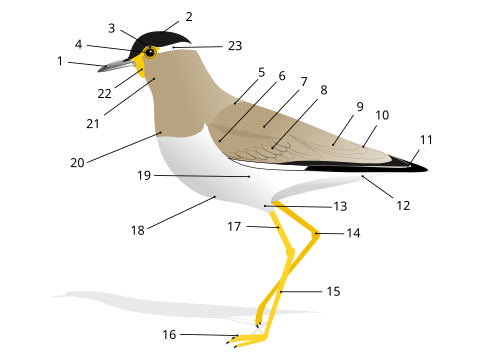
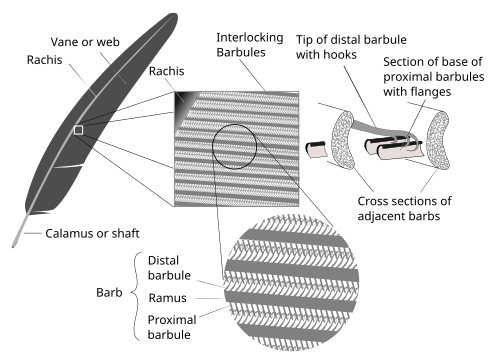
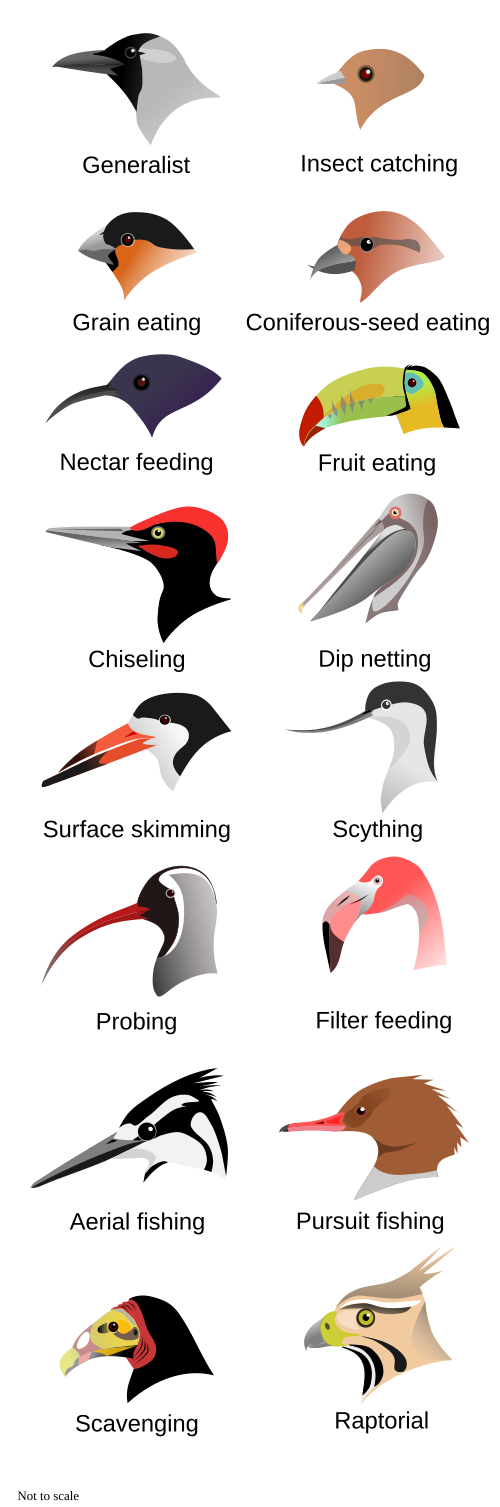
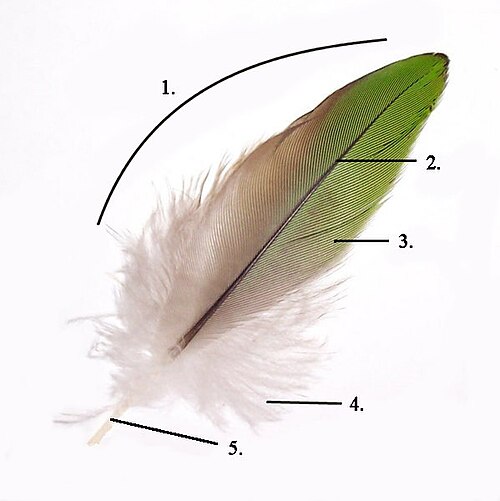
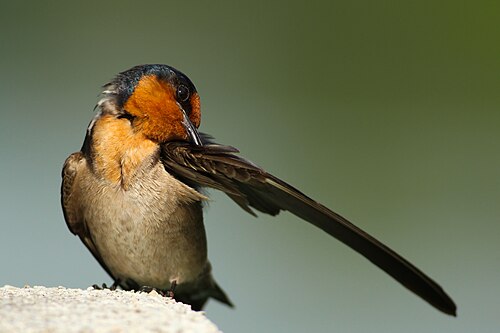
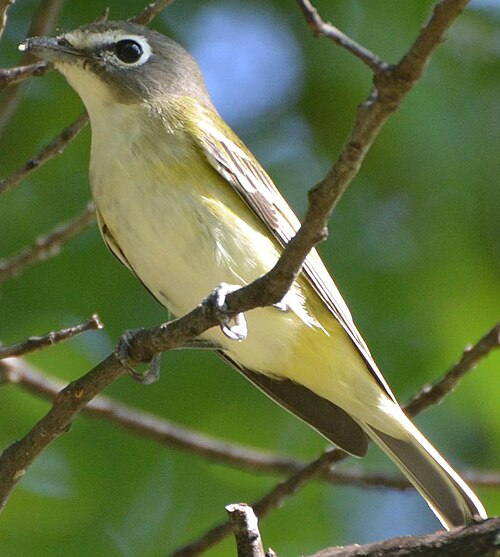
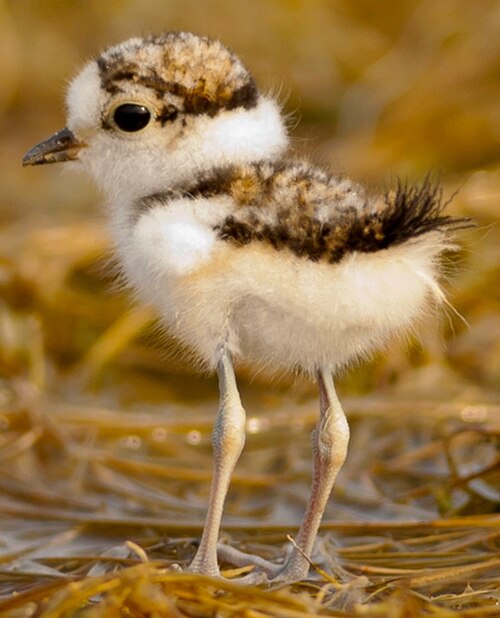
Also, molt (chiefly U.S.) and moulting/molting. The periodic replacement of feathers by shedding old feathers while producing new ones. Feathers are dead structures at maturity which are gradually abraded and need to be replaced. Adult birds moult at least once a year, although many moult twice and a few three times each year. It is generally a slow process, as birds rarely shed all their feathers at any one time; the bird must retain sufficient feathers to regulate its body temperature and repel moisture. The number and area of feathers that are shed varies. In some moulting periods, a bird may renew only the feathers on the head and body, shedding the wing and tail feathers during a later moulting period. Some species of bird become flightless during an annual "wing moult" and must seek a protected habitat with a reliable food supply during that time. Typically, a bird begins to shed some old feathers, then pin feathers grow in to replace the old feathers. As the pin feathers become full feathers, other feathers are shed. This is a cyclical process that occurs in many phases. It is usually symmetrical, with feather loss equal on each side of the body. Because feathers make up 4–12% of a bird's body weight, it takes a large amount of energy to replace them. For this reason, moults often occur immediately after the breeding season, but while food is still abundant. The plumage produced during this time is called postnuptial plumage.[292]
moult strategy
Specialized types defined: simple basic strategy; simple alternate strategy; complex basic strategy; complex alternate strategy. The pattern of moults that occurs regularly based on the season and time. There are four main moulting strategies: i) simple basic strategy, in which there is one moult per year, every year; ii) simple alternate strategy, in which there are two moults per year, every year; iii) complex basic strategy, in which there is one moult per year, except in the first year of life, where there is an additional moult; and iv) complex alternate strategy, in which there are two moults per year, except in the first year of life, where there is an additional moult.[293]
New Zealand pipit Anthus novaeseelandiae novaeseelandiae, displaying a prominent moustachial stripe
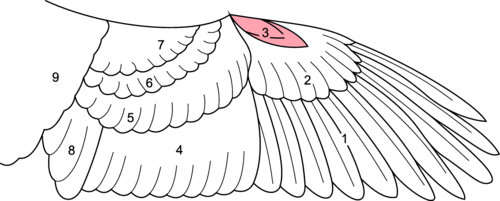
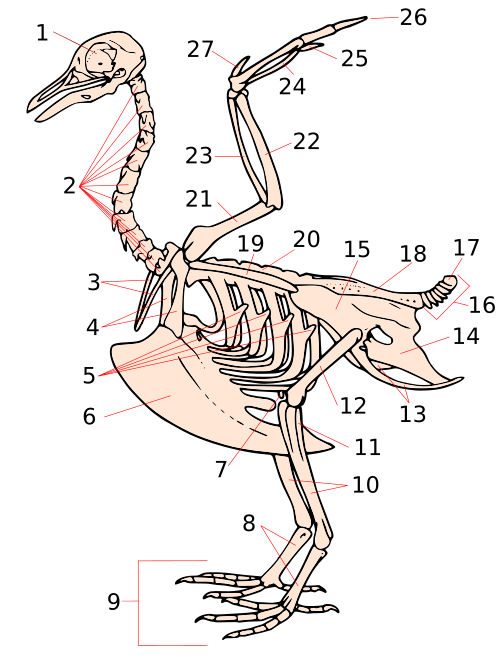
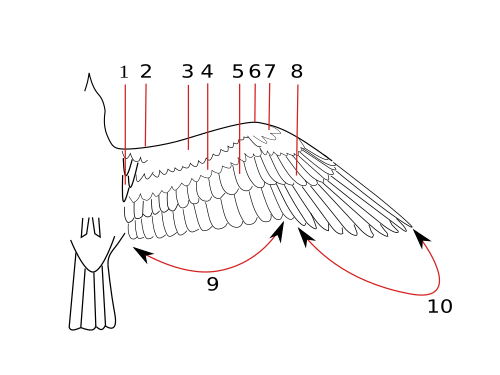
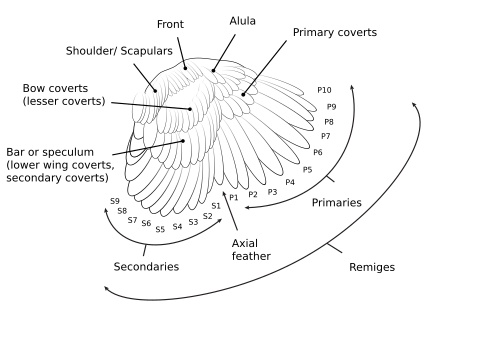
Wing types defined: elliptical; high speed; high aspect ratio; soaring. The bird's forelimbs that are the key to flight. Each wing has a central axis, composed of three limb bones: the humerus, ulna and radius. The hand, or manus, which ancestrally was composed of five digits, is reduced to three digits (digit II, III and IV or I, II, III depending on the scheme followed[454]), which serves as an anchor for the primaries, one of two groups of flight feathers responsible for the wing's airfoil shape. The other set of flight feathers, behind the carpal joint on the ulna, are called the secondaries. The remaining feathers on the wing are known as coverts, of which there are three sets. The wing sometimes has vestigial claws. In most species these are lost by the time the bird is adult (such as the highly visible ones used for active climbing by hoatzin chicks), but claws are retained into adulthood by the secretarybird, screamers, finfoots, ostriches, several swifts and numerous others, as a local trait, in a few specimens. Bird wings are generally grouped into four types: i) elliptical wings—short, rounded and having a low aspect ratio, they allow for tight maneuvering in confined spaces such as might be found in dense vegetation. They are common in forest raptors, many migratory species of passerines, and in species such as pheasants and partridges that use a rapid take-off to evade predators. ii) High speed wings—short, pointed wings that, when combined with a heavy wing loading and rapid wingbeats, provide an energetically expensive high speed, as used by the bird with the fastest wing speed, the peregrine falcon. Most ducks and auks have this type of wing but use the configuration for a different purpose, to "fly" underwater. iii) High aspect ratio wings—typified by low wing loading and being far longer than they are wide, they are used for slower flight, which may take the form of almost hovering (as used by kestrels, terns and nightjars), or in soaring and gliding flight, particularly the dynamic soaring used by seabirds, which takes advantage of wind speed variation at different altitudes (wind shear) above ocean waves to provide lift. iv) Soaring wings with deep slots—common in larger species of inland birds, such as eagles, vultures, pelicans and storks. The slots at the end of the wings, between the primaries, reduce the induced drag and wingtip vortices, while the shorter size of the wings aids in takeoff (high aspect ratio wings require a long taxi to get airborne).[455]
The distance between each of the tips of the fully extended wings.[456] The living bird species with the largest wingspan is the wandering albatross, typically ranging from 2.5 to 3.5m (8ft 2in to 11ft 6in).[457] In contrast, the living bird species with the smallest wingspan is the bee hummingbird (also the smallest bird overall) with a wingspan of just 6.6cm (2.6in).[458]
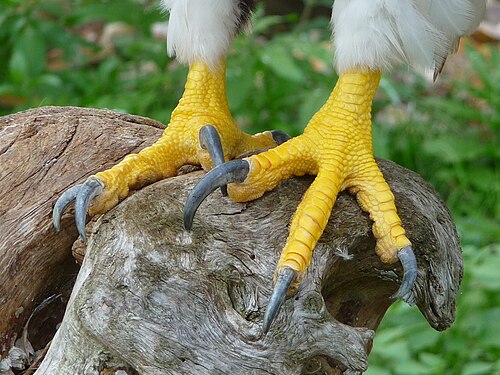
Also, yoke-toed. Also defined: heterodactylous. Descriptive of tetradactyl (four-toed) birds in which the architecture of the foot consists of two toes projecting forward and two toes projecting backward, such as in parrots, woodpeckers and cuckoos. In most birds with zygodactylous feet, the forward projecting toes are the second and third toes and the backward projecting toes are the fourth toe and hallux. However, in trogons alone, the third and fourth toes are in front, and the second and hallux are behind. This arrangement is sometimes separately designated, and termed heterodactylous.[20][459]
↑Ornithologists from the American Museum of Natural History suggested in a 2016 article published in PLOS ONE, that the use of the "biological species concept"—classifying a grouping of birds as making up a single species by their ability to breed—is outdated and should be discarded in favour of a species' model that looks to similarity and dissimilarity in characteristics such as plumage, pattern and colouring to individuate bird species. Under such a model, it is suggested that there are ±18,000 individual living bird species in the world as of 2016.[4]
↑Emus and cassowaries are an exception in that their afterfeathers are neither downy nor diminutive in relation to the vanes, but are comparable in size to them; such feathers are thus sometimes referred to as being "double plumed". The feathers of ostrich and rhea, also flightless birds, are by contrast "soft and filmy" in makeup, lacking any barbules to add the stiffness needed in working flight feathers.[7]
↑Birds that undergo a second, non-breeding season moult (third moult overall) include: ptarmigans (Lagopus) (in the summer); long-tailed duck (Clangula hyemalis) (in the winter); ruff (Philomachus pugnax) (in the late winter or early spring); and may occur in other members of the sandpiper (Scolopacidae) family.[31]
↑In relation to flanks being defined as under parts, in the treatise Ornithology in Laboratory and Field, the author states: "[a]lthough technically the sides of the body belong to both the upper parts and the lower parts, the imaginary line separating the two surfaces is so high on the trunk that the sides of the body are generally considered under parts only."[96]
Citations
↑Prum, Richard O. (19 December 2008). "Who's Your Daddy?". Science. 322 (5909): 1799–1800. doi:10.1126/science.1168808. PMID19095929. S2CID206517571.
↑(in English)Gill, F, D Donsker, and P Rasmussen (Eds). 2024. IOC World Bird List (v 14.1). https://www.worldbirdnames.orgArchived 2020-10-04 at the Wayback Machine
↑Newton, Ian (2003). The Speciation and Biogeography of Birds. Gulf Professional Publishing. p.93. ISBN978-0-12-517375-9.
↑Waters, Hannah (December 15, 2016). "New Study Doubles the World's Number of Bird Species By Redefining 'Species'". National Audubon Society. Archived from the original on December 21, 2016.
↑Encyclopaedia perthensis, or, Universal dictionary of the arts, sciences, literature, etc. Edinburgh: John Brown. 1816. p.166.
↑Mandal, Fatik Baran (2012). Textbook of Animal Behavior. New Delhi: PHI Learning Pvt. Ltd. p.188. ISBN978-81-203-4519-5.
123Humphrey, Philip S.; Parkes, Kenneth C. (January 1959). "An Approach to the Study of Molts and Plumage". The Auk. Vol.76, no.1. pp.1–31. doi:10.2307/4081839. JSTOR4081839.
123Summers, Kyle; Crespi, Bernard (2013). Human Social Evolution: The Foundational Works of Richard D. Alexander. Oxford University Press. p.192. ISBN978-0-19-933963-1.
↑Howell, Steve N. G. (2014). Peterson Reference Guide to Molt in North American Birds. Houghton Mifflin Harcourt. p.8. ISBN978-0-547-48769-4.
12Johnston, Richard (2013). Current Ornithology. Springer Science & Business Media. p.34. ISBN978-1-4615-6781-3.
12Urfi, A. J. (2011). The Painted Stork: Ecology and Conservation. Springer Science & Business Media. p.88. ISBN978-1-4419-8468-5.
↑Osborn, Sophie A. H. (September 1998). "Anting by an American Dipper (Cinclus mexicanus)"(PDF). The Wilson Bulletin. Vol.110, no.3. pp.423–425. Archived(PDF) from the original on 2019-11-14. Retrieved 2017-01-22.
↑Alderfer, Jonathan K.; Dunn, Jon (January 2007). National Geographic Birding Essentials: All the Tools, Techniques, and Tips You Need to Begin and Become a Better Birder. National Geographic. p.216. ISBN978-1-4262-0135-6.
↑Partington, Charles Frederick (1835). The British cyclopæedia of natural history: combining a scientific classification of animals, plants, and minerals. Orr & Smith. p.417.
↑Ralph, Charles L. (May 1969). "The Control of Color in Birds". American Zoologist. Vol.9, no.2. pp.521–530. doi:10.1093/icb/9.2.521. JSTOR3881820. PMID5362278.
↑"Bird Beaks: Anatomy, Care, and Diseases". Veterinary & Aquatic Services Department, Drs. Foster & Smith. Archived from the original on June 4, 2012. Retrieved January 29, 2017.
↑Ash, Lydia. "Coping your Raptor". The Modern Apprentice. Archived from the original on April 6, 2005. Retrieved January 29, 2017.
↑Baird, Spencer Fullerton; Brewer, Thomas Mayo; Ridgway, Robert (1874). A History of North American Birds. Little, Brown. p.535.
↑Bierma, Nathan (August 12, 2004). "Add this to life list: 'Birding' has inspired flock of words". Chicago Tribune. Archived from the original on 2012-08-12. Retrieved 2017-01-20.
↑Schreiber, Elizabeth Anne; Burger, Joanna, eds. (2002). Biology of Marine Birds. Boca Raton, FL: CRC Press. p.325. ISBN978-0-8493-9882-7.
↑Cunningham, Susan J.; Alley, Maurice R.; Castro, Isabel; Potter, Murray A.; Cunningham, Malcolm; Pyne, Michael J. (2010). "Bill morphology of Ibises suggests a remote-tactile sensory system for prey detection". The Auk. Vol.127, no.2. pp.308–316. doi:10.1525/auk.2009.09117. S2CID85254980.
↑Busse, Przemyslaw; Meissner, Wlodzimierz (2015). Bird Ringing Station Manual. Warsaw: De Gruyter. ISBN978-83-7656-053-3.
↑Vuilleumier, françois, ed. (2011). American Museum of Natural History Birds of North America Eastern Region. DK Publishing. p.473. ISBN978-0-7566-7387-1.
↑Ranquini, Juan Homedes; Garcia, Francisco Haro (1958). Zoogenética. Salvat.
↑"Merriam-Webster definition". Archived from the original on March 26, 2017. Retrieved March 12, 2017.
↑Turner, J. Scott (1997). "On the thermal capacity of a bird's egg warmed by a brood patch". Physiological Zoology. Vol.70, no.4. pp.470–80. doi:10.1086/515854. PMID9237308.
↑Aragon, S.; Møller, A. P.; Soler, J. J.; Soler, M. (1999). "Molecular phylogeny of cuckoos supports a polyphyletic origin of brood parasitism". Journal of Evolutionary Biology. Vol.12, no.3. pp.495–506. doi:10.1046/j.1420-9101.1999.00052.x. S2CID16923328.
↑Sorenson, M.D.; Payne, R.B. (2001). "A single ancient origin of brood parasitism in African finches: implications for host-parasite coevolution"(PDF). Evolution. Vol.55, no.12. pp.2550–2567. doi:10.1554/0014-3820(2001)055[2550:asaoob]2.0.co;2. hdl:2027.42/72018. PMID11831669.
12Ritchison, Gary. "Ornithology (Bio 554/754): Feather Evolution". Department of Biological Sciences, Eastern Kentucky University. Archived from the original on February 25, 2017. Retrieved January 16, 2017.
↑"Latin Dictionary". Archived from the original on October 16, 2021. Retrieved May 1, 2020.
12Ehrlich, Paul R.; Dobkin, David S.; Wheye, Darryl. ""Bird Voices" and "Vocal Development" from Birds of Stanford essays". Archived from the original on 25 July 2018. Retrieved 9 September 2008.
↑Lengagne, T.; Lauga, J.; Aubin, T. (2001). "Intra-syllabic acoustic signatures used by the King Penguin in parent-chick recognition: an experimental approach"(PDF). The Journal of Experimental Biology. Vol.204, no.Pt. 4. pp.663–672. PMID11171348. Archived(PDF) from the original on 2007-09-30. Retrieved 2017-04-01.
↑MacKay, Barry Kent (January 2001). Bird Sounds: How and why Birds Sing, Call, Chatter, and Screech. Stackpole Books. p.28. ISBN978-0-8117-2787-7.
↑Alcock, John (1998). Animal Behavior: An Evolutionary Approach (6thed.). Sunderland: Sinauer Associates. ISBN978-0-87893-009-8.
↑Brown, C. H. (1982). "Ventriloquial and locatable vocalizations in birds". Zeitschrift für Tierpsychologie. Vol.59, no.4. pp.338–350. doi:10.1111/j.1439-0310.1982.tb00346.x.
↑Rowinski, Kate (2011). The Joy of Birding: A Beginner's Guide. Skyhorse Publishing Inc. pp.22–. ISBN978-1-61608-122-5.
↑Thorpe, W. H. (1963). "Antiphonal Singing in Birds as Evidence for Avian Auditory Reaction Time". Nature. Vol.197, no.4869. pp.774–776. Bibcode:1963Natur.197..774T. doi:10.1038/197774a0. S2CID30542781.
↑Stokes, A. W.; Williams, H. W. (1968). "Antiphonal calling in quail"(PDF). Auk. Vol.85, no.1. pp.83–89. doi:10.2307/4083626. JSTOR4083626. Archived(PDF) from the original on 2014-04-29. Retrieved 2017-04-01.
↑Harris, Tony; Franklin, Kim (2000). Shrikes and Bush-Shrikes. Princeton University Press. pp.257–260. ISBN978-0-691-07036-0.
↑Osmaston, B. B. (1941). "'Duetting' in birds". Ibis. Vol.5, no.2. pp.310–311. doi:10.1111/j.1474-919X.1941.tb00620.x.
↑Power, D. M. (1966). "Antiphonal duetting and evidence for auditory reaction time in the Orange-chinned Parakeet". Auk. Vol.83, no.2. pp.314–319. doi:10.2307/4083033. JSTOR4083033.
↑Hancock, James; Kushlan, James (2010). The Herons Handbook. London: A&C Black. pp.20, 101–102. ISBN978-1-4081-3496-2.
↑Sharpe, Richard Bowdler (1888). Catalogue of the birds in the British Museum. British Natural History Museum Department of Zoology.
↑Audubon, John James; Amadon, Dean; Bull, John L. (1967). The Birds of America. Dover Publications. OCLC555150.
↑Burke, Don (2005). The Complete Burke's Backyard: The Ultimate Book of Fact Sheets. Allen & Unwin. p.702. ISBN9781740457392.
↑Baratti, Mariella; Ammannati, Martina; Magnelli, Claudia; Massolo, Alessandro; Dessì-Fulgheri, Francesco (2010). "Are large wattles related to particular MHC genotypes in the male pheasant?". Genetica. Vol.138, no.6. pp.657–665. doi:10.1007/s10709-010-9440-5. ISSN0016-6707. PMID20145977. S2CID35053439.
↑Buchholz, Richard (1996). "Thermoregulatory Role of the Unfeathered Head and Neck in Male Wild Turkeys"(PDF). The Auk. Vol.113, no.2. pp.310–318. doi:10.2307/4088897. JSTOR4088897. Archived(PDF) from the original on 2014-05-18. Retrieved 2017-02-11.
↑Blake, Emmet Reid (1977). Manual of Neotropical Birds. University of Chicago Press. p.428. ISBN978-0-226-05641-8.
↑Pratt, Thane K.; Beehler, Bruce M. (2014). Birds of New Guinea (2nded.). Oxford: Princeton University Press. p.262. ISBN978-1-4008-6511-6.
↑Reilly, Edgar M.; National Audubon Society (1968). The Audubon illustrated handbook of American birds. McGraw-Hill. p.142.
↑Stejneger, Leonhard Hess (1885). Results of Ornithological Explorations in the Commander Islands and in Kamtschatka. U.S. Government Printing Office. pp.52–53.
↑National Geographic Society (2009). Harris, Tim (ed.). Complete Birds of the World. National Geographic. p.226. ISBN978-1-4262-0403-6.
↑Jupiter, Tony; Parr, Mike (2010). Parrots: A Guide to Parrots of the World. A&C Black. p.17. ISBN978-1-4081-3575-4.
12345Stettenheim, Peter R. (2000). "The Integumentary Morphology of Modern Birds—An Overview". Integrative and Comparative Biology. Vol.40, no.4. pp.461–477. doi:10.1093/icb/40.4.461. Archived from the original(PDF) on April 20, 2012.
↑Mougeo, François; Arroyo, Beatriz E. (June 22, 2006). "Ultraviolet reflectance by the cere of raptors". Biology Letters. Vol.2, no.2. pp.173–176. doi:10.1098/rsbl.2005.0434. PMC1618910. PMID17148356.
↑Leopold, Aldo Starker (1972). Wildlife of Mexico: The Game Birds and Mammals. Berkeley, CA: University of California Press. p.202. ISBN978-0-520-00724-6.
↑Alderton, David (1996). A Birdkeeper's Guide to Budgies. Tetra Press. p.12.
↑Ehrlich, Paul R.; Dobkin, David S.; Wheye, Darryl (1988). "Drinking". Birds of Stanford. Stanford University. Archived from the original on May 2, 2006. Retrieved January 29, 2017.
↑Tsahar, Ella; Martínez Del Rio, C.; Izhaki, I.; Arad, Z. (2005). "Can birds be ammonotelic? Nitrogen balance and excretion in two frugivores". Journal of Experimental Biology. Vol.208, no.6. pp.1, 025–34. doi:10.1242/jeb.01495. PMID15767304.
↑Skadhauge, E.; Erlwanger, K.H.; Ruziwa, S.D.; Dantzer, V.; Elbrønd, V.S.; Chamunorwa, J.P. (2003). "Does the ostrich (Struthio camelus) coprodeum have the electrophysiological properties and microstructure of other birds?". Comparative Biochemistry and Physiology Part A: Molecular & Integrative Physiology. 134 (4): 749–755. doi:10.1016/S1095-6433(03)00006-0. PMID12814783.
↑Yong, Ed (6 June 2013). "Phenomena: Not Exactly Rocket Science How Chickens Lost Their Penises (And Ducks Kept Theirs)". Phenomena.nationalgeographic.com. Archived from the original on June 9, 2013. Retrieved January 29, 2017.
↑"Ornithology, 3rd Edition – Waterfowl: Order Anseriformes". Archived from the original on June 22, 2015. Retrieved January 29, 2017.
↑Danchin, E.; Wagner, R.H. (1997). "The evolution of coloniality: the emergence of new perspectives"(PDF). Trends in Ecology and Evolution. Vol.12, no.2. pp.342–347. doi:10.1016/S0169-5347(97)01124-5. PMID21238100. Archived from the original(PDF) on 2011-10-03. Retrieved 2017-04-01.
↑Rolland, Cecile; Danchin, Etienne; de Fraipont, Michelle (1998). "The Evolution of Coloniality in Birds in Relation to Food, Habitat, Predation, and Life-History Traits: A Comparative Analysis"(PDF). The American Naturalist. Vol.151, no.6. pp.514–529. doi:10.1086/286137. PMID18811373. Archived from the original(PDF) on June 20, 2010.
↑Tye, Hilary (December 1985). "The erectile crest and other head feathering in the genus Picathartes". Bulletin of the British Ornithologists' Club. Vol.106, no.3. p.91. Archived from the original on 2018-08-07. Retrieved 2018-01-14.
↑Burns, Jim (2008). Jim Burns' Arizona Birds: From the Backyard to the Backwoods. University of Arizona Press. p.166. ISBN978-0-8165-2644-4.
↑Ramel, Gordon (September 29, 2008). "The Alimentary Canal in Birds". Archived from the original on February 1, 2017. Retrieved January 16, 2017.
↑Levi, Wendell (1977). The Pigeon. Sumter, S.C.: Levi Publishing Co, Inc. ISBN978-0-85390-013-9.
12Silver, Rae (1984). "Prolactin and Parenting in the Pigeon Family"(PDF). The Journal of Experimental Zoology. Vol.232, no.3. pp.617–625. doi:10.1002/jez.1402320330. PMID6394702. Archived from the original(PDF) on September 13, 2016.
↑Eraud, C.; Dorie, A.; Jacquet, A.; Faivre, B. (2008). "The crop milk: a potential new route for carotenoid-mediated parental effects". Journal of Avian Biology. Vol.39, no.2. pp.247–251. doi:10.1111/j.0908-8857.2008.04053.x.
↑Ehrlich, Paul R.; Dobkin, David S. and Wheye, Darryl (1988) Bird MilkArchived 2012-10-15 at the Wayback Machine. stanford.edu
↑Phillips, Campbelll (September 22, 2011). "Mysteries of pigeon milk explained". Australian Geographic. Archived from the original on August 14, 2013. Retrieved August 17, 2017.
↑Pyle, Peter; Howell, Steve N. G.; Yunick, Robert P.; DeSante, David F. (1987). Identification Guide to North America Passerines. Bolinas, CA: Slate Creek Press. pp.6–7. ISBN978-0-9618940-0-9.
↑Borras, A.; Pascual, J.; Senar, J. C. (Autumn 2000). "What Do Different Bill Measures Measure and What Is the Best Method to Use in Granivorous Birds?"(PDF). Journal of Field Ornithology. Vol.71, no.4. pp.606–611. doi:10.1648/0273-8570-71.4.606. JSTOR4514529. Archived(PDF) from the original on 2016-03-04. Retrieved 2017-01-17.
↑Mullarney, Killian; Svensson, Lars; Zetterström, Dan; Grant, Peter J. (1999). Collins Bird Guide: The Most Complete Field Guide to the Birds of Britain and Europe. London: Harper Collins. p.357. ISBN978-0-00-711332-3.
↑Scanes, Colin G. (2014). Sturkie's Avian Physiology. Elsevier Science. p.61. ISBN978-0-12-407243-5.
↑Adams, Rick A.; Pedersen, Scott C. (2000). Ontogeny, Functional Ecology, and Evolution of Bats. Cambridge University Press. p.124. ISBN978-1-139-42949-8.
12345678910Irwin, Mark D.; Stoner, John B.; Cobaugh, Aaron M. (2013). Zookeeping: An Introduction to the Science and Technology. University of Chicago Press. p.166. ISBN978-0-226-92532-5.
12Moore, Peter D. (January 1, 2009). Tropical Forests. Infobase Publishing. p.164. ISBN978-1-4381-1874-1.
↑Swan, William Draper (1848). The Instructive Reader, Or, A Course of Reading in Natural History, Science and Literature: Designed for the Use of Schools. Thomas, Cowperthwait. p.71.
↑Newton, Ian (1998). Population Limitation in Birds. Academic Press. p.341. ISBN978-0-08-087923-9.
12Farner, Donald S.; King, James R. (2013). Avian Biology. Elsevier. p.13. ISBN978-1-4832-6942-9.
↑Pycraft, W.P. (1908). Scientific American: Supplement: The Curious Phenomena of Eggshell Pigmentation. Munn and Company. p.376.
↑Hill, Geoffrey Edward; McGraw, Kevin J. (2006). Bird Coloration: Mechanisms and measurements. Harvard University Press. p.368. ISBN978-0-674-01893-8.
↑Arias, J. L.; Fernandez, M. S. (2001). "Role of extracellular matrix molecules in shell formation and structure". World's Poultry Science Journal. Vol.57, no.4. pp.349–357. doi:10.1079/WPS20010024. S2CID86152776.
12Hunton, P. (2005). "Research on eggshell structure and quality: an historical overview". Revista Brasileira de Ciência Avícola. Vol.7, no.2. pp.67–71. doi:10.1590/S1516-635X2005000200001.
↑Nys, Yves; Gautron, Joël; Garcia-Ruiz, Juan M.; Hincke, Maxwell T. (2004). "Avian eggshell mineralization: biochemical and functional characterization of matrix proteins". Comptes Rendus Palevol. Vol.3, no.6–7. pp.549–562. doi:10.1016/j.crpv.2004.08.002.
↑Romanoff, Alexis L.; Romanoff, Anastasia J. (1949). The Avian Egg. New York: Wiley. OCLC191965542.
↑Burley, R.W.; Vadehra, Dharam V. (1989). The Avian Egg: Chemistry and Biology. New York: Wiley. ISBN978-0-471-84995-7.
↑Lavelin, I. N.; Meiri, M. Pines (2000). "New insight in eggshell formation". Poultry Science. Vol.79, no.7. pp.1014–1017. doi:10.1093/ps/79.7.1014. PMID10901204.
↑Alderton, David (1998). The Complete Guide to Bird Care. Howell Book House. ISBN978-0-87605-038-5.
↑Harrison, John (2011). Backgarden Chickens and Other Poultry. Little, Brown Book Group. p.125. ISBN978-0-7160-2276-3.
↑Damerow, Gail (2013). Hatching & Brooding Your Own Chicks: Chickens, Turkeys, Ducks, Geese, Guinea Fowl. Storey Publishing. p.142. ISBN978-1-60342-878-1.
↑Patten, Bradley M. (2008). Early Embryology of the Chick. Wildside Press LLC. p.17. ISBN978-1-4344-7385-1.
↑Stout, Jane D. (May 2016). "Common emergencies in pet birds". The Veterinary Clinics of North America. Exotic Animal Practice. Vol.19, no.2. pp.513–41. doi:10.1016/j.cvex.2016.01.002. PMID26948267.
↑Barrows, Edward M. (2000). Animal Behavior Desk Reference: A Dictionary of Animal Behavior, Ecology, and Evolution, Second Edition. CRC Press. p.79. ISBN978-0-8493-2005-7.
123Jehl, Joseph R. Jr. (September 1968). "The Egg Tooth of Some Charadriiform Birds"(PDF). The Wilson Bulletin. Vol.80, no.3. pp.328–9. Archived(PDF) from the original on 2020-10-22. Retrieved 2020-10-19.
12Perrins, Christopher M.; Attenborough, David; Arlott, Norman (1987). New Generation Guide to the Birds of Britain and Europe. Austin, TX: University of Texas Press. p.205. ISBN978-0-292-75532-1.
↑Clark, George A. Jr. (September 1961). "Occurrence and Timing of Egg Teeth in Birds"(PDF). The Wilson Bulletin. Vol.73, no.3. pp.268–278. Archived(PDF) from the original on 2016-03-04. Retrieved 2017-01-20.
123Prum, Richard O.; Brush, A.H. (2002). "The evolutionary origin and diversification of feathers"(PDF). The Quarterly Review of Biology. Vol.77, no.3. pp.261–295. doi:10.1086/341993. PMID12365352. Archived(PDF) from the original on 2011-06-29. Retrieved 2017-01-17.
↑Prum, Richard O.; Brush, A.H. (March 2003). "Which Came First, the Feather or the Bird?"(PDF). Scientific American. Vol.288, no.3. pp.84–93. Bibcode:2003SciAm.288c..84P. doi:10.1038/scientificamerican0303-84 (inactive 31 January 2026). PMID12616863. Archived(PDF) from the original on 2011-06-29. Retrieved 2017-01-17.{{cite magazine}}: CS1 maint: DOI inactive as of January 2026 (link)
↑Prum, Richard O. (1999). "Development and Evolutionary Origin of Feathers"(PDF). Journal of Experimental Zoology. Vol.285, no.4. pp.291–306. doi:10.1002/(SICI)1097-010X(19991215)285:4<291::AID-JEZ1>3.0.CO;2-9. PMID10578107. Archived(PDF) from the original on 2018-05-02. Retrieved 2017-04-12.
↑Li, Quanguo (March 9, 2012). "Reconstruction of Microraptor and the Evolution of Iridescent Plumage". Science. Vol.335, no.6073. pp.1215–1219. Bibcode:2012Sci...335.1215L. doi:10.1126/science.1213780. PMID22403389. S2CID206537426.
↑McLelland, J. (1991). A color atlas of avian anatomy. W.B. Saunders Co. ISBN978-0-7216-3536-1.
↑Huber-Eicher, B.; Sebo, F. (2001). "The prevalence of feather pecking and development in commercial flocks of laying hens". Applied Animal Behaviour Science. Vol.74, no.3. pp.223–231. doi:10.1016/S0168-1591(01)00173-3.
↑Sherwin, C.M.; Richards, G.J; Nicol, C.J. (2010). "A comparison of the welfare of layer hens in four housing systems in the UK". British Poultry Science. Vol.51, no.4. pp.488–499. doi:10.1080/00071668.2010.502518. PMID20924842. S2CID8968010.
↑Butler, D.A.; Davis, C. (2010). "Effects of plastic bits on the condition and behaviour of captive-reared pheasants". Veterinary Record. Vol.166, no.13. pp.398–401. doi:10.1136/vr.b4804. PMID20348469. S2CID7549266.
↑Sherwin, C.M. (2010). "Turkeys: Behavior, Management and Well-Being". In Pond, Wilson G.; Bell, Alan W. (eds.). The Encyclopaedia of Animal Science. Marcel Dekker. pp.847–849.
↑Gustafson, Leslie A.; Cheng, Heng-Wei; Garner, Joseph P.; Pajorc, Edmond A.; Mench, Joy A. (2007). "Effects of bill-trimming Muscovy ducks on behavior, body weight gain, and bill morphopathology". Applied Animal Behaviour Science. Vol.103, no.1–2. pp.59–74. doi:10.1016/j.applanim.2006.04.003.
↑Reischl, E.; Sambraus, H.H. (2003). "Feather-pecking of African ostriches in Israel". Tierarztliche Umschau. Vol.58, no.7. pp.364–369.
↑McAdie, T.M.; Keeling, L.J. (2002). "The social transmission of feather pecking in laying hens: effects of environment and age". Applied Animal Behaviour Science. Vol.75, no.2. pp.147–159. doi:10.1016/S0168-1591(01)00182-4.
↑Lumeij, Johannes T.; Hommers, Caroline J. (2008). "Foraging 'enrichment' as treatment for Pterotillomania"(PDF). Applied Animal Behaviour Science. Vol.111, no.1–2. pp.85–94. doi:10.1016/j.applanim.2007.05.015. Archived from the original(PDF) on 2015-11-23. Retrieved 2020-12-20.
↑"Feather Plucking in Pet Birds". Beauty of Birds. 2011. Archived from the original on November 2, 2019. Retrieved December 21, 2020.
↑Steeves, Susan A. (December 21, 2005). "Parrots' behaviors mirror human mental disorders". Purdue University. Archived from the original on April 10, 2021. Retrieved December 21, 2020.
↑van Zeeland, Yvonne R.A.; Spruit, Berry M.; Rodenburg, T. Bass; etal. (November 2009). "Feather damaging behaviour in parrots: A review with consideration of comparative aspects". Applied Animal Behaviour Science. Vol.121, no.2. pp.75–95. doi:10.1016/j.applanim.2009.09.006. Archived from the original on 2023-05-28. Retrieved 2020-12-21.
↑Choiniere, J.; Mowbray Golding, C.; Vezo, T. (2005). What's That Bird?. Storey Publishing. p.33. ISBN978-1-58017-554-8.
12O'Connor, R. J. (1984). The Growth and Development of Birds. Wiley Interscience. p.174. ISBN978-0-471-90345-1.
↑Ricklefs, R. E. (1996). "Behavior of Young Cactus Wrens and Curve-billed Thrashers"(PDF). The Wilson Bulletin. Vol.78, no.1. pp.47–56. Archived from the original(PDF) on October 10, 2008.
↑Nitzsch, Christian Ludwig (1867). Nitzsch's Pterylography. Ray Society. p.14.
↑Eastman, John (2000). Birds of Field and Shore: Grassland and Shoreline Birds of Eastern North America. Stackpole Books. p.13. ISBN978-0-8117-2699-3.
↑Stiteler, Sharon (2013). 1001 Secrets Every Birder Should Know: Tips and Trivia for the Backyard and Beyond. London: Running Press. p.389. ISBN978-0-7624-4832-6.
↑McNab, Brian K. (October 1994). "Energy Conservation and the Evolution of Flightlessness in Birds". The American Naturalist. Vol.144, no.4. pp.628–42. doi:10.1086/285697. JSTOR2462941.
↑Kovacs, Christopher E.; Meyers, RA (2000). "Anatomy and histochemistry of flight muscles in a wing-propelled diving bird, the Atlantic Puffin, Fratercula arctica". Journal of Morphology. Vol.244, no.2. pp.109–25. doi:10.1002/(SICI)1097-4687(200005)244:2<109::AID-JMOR2>3.0.CO;2-0. PMID10761049.
↑Baumel, Julian J. (1993). Handbook of Avian Anatomy: Nomina Anatomica Avium. Nuttall Ornithological Club.
↑Whitney, William Dwight (1906). The Century Dictionary and Cyclopedia. Entry for "Feather". The Century Co. p.2, 164. OCLC825679.
↑Buckley, P. A. (January–December 1966). "Foot-paddling in Four American Gulls, with Comments on its Possible Function and Stimulation". Ethology. Vol.23, no.4. pp.395–402. PMID5992179.
↑Walls, Gordon L. (1942). "Adaptations to Diurnal Activity". Bulletin: The Vertebrate Eye and its Adaptive Radiation. The Cranbrook Institute of Science. p.188.
↑Holden, Peter (2016). RSPB Birds: their Hidden World. London: Bloomsbury Publishing. p.245. ISBN978-1-4729-3224-2.
↑Davison, G. W. H. (November 1982). "Notes on the Extinct Argusianus Bipuntatus". Bulletin of the British Ornithologists' Club. Vol.103, no.3. p.87. Archived from the original on 2017-08-05. Retrieved 2018-01-14.
↑Videler, John J. (2005). Avian Flight. OUP Oxford. pp.58–61. ISBN978-0-19-929992-8.
↑Grouw, Katrina Van (2013). The Unfeathered Bird. Princeton University Press. p.58. ISBN978-0-691-15134-2.
↑Alvareza F, Sanchez CS, Angulo S (2005). "The frontal shield of the moorhen: sex differences and relationship with body condition". Ethology, Ecology & Evolution. Vol.17, no.2. pp.135–148. CiteSeerX10.1.1.158.6095. doi:10.1080/08927014.2005.9522603. S2CID85892241.
↑Gullion, Gordon W. (1951). "The frontal shield of the American Coot". Wilson Bulletin. Vol.63, no.3. pp.157–166.
↑"Furcula". Oxford English Dictionary (onlineed.). Oxford University Press.(Subscription or participating institution membership required.)
12Newman, Kenneth B. (2000). Newman's birds by colour. Struik. p.14. ISBN978-1-86872-448-2.
↑Wheelwright, NT (1985). "Fruit size, gape width and the diets of fruit-eating birds"(PDF). Ecology. Vol.66, no.3. pp.808–818. doi:10.2307/1940542. JSTOR1940542. Archived from the original(PDF) on April 8, 2016.
↑Zickefoose, Julie (July 25, 2014). "Backyard Mystery Birds". Bird Watcher's Digest. Archived from the original on December 13, 2010. Retrieved January 29, 2017.
↑Russell, Peter J.; Wolfe, Stephen L.; Hertz, Paul E.; Starr, Cecie (2008). Biology: The Dynamic Science. Vol.2. Belmont, CA: Thomson Brooks/Cole. p.1255. ISBN978-0-495-01033-3.
↑Howell, Steve N. G. (2002). Hummingbirds of North America: The Photographic Guide. Academic Press. p.1. ISBN978-0-12-356955-4.
↑Ridgely, Robert S.; Tudor, Guy; Brown, William L. (1994). The Birds of South America: The suboscine passerines. Austin, TX: University of Texas Press. p.771. ISBN978-0-292-77063-8.
↑Christensen, Glen C. (1970). The Chukar Partridge: Its Introduction, Life History and Management. Reno, NV: Nevada Department of Fish and Game. p.33.
↑Sundstorm, Bob (8 April 2015). "A Hummingbird's Shining Armor". BirdNote (Podcast). Narrated by Mary McCann. BirdNote. Archived from the original on 27 December 2017. Retrieved 26 December 2017.
↑Morris, Christopher G.; Academic Press (1992). Academic Press Dictionary of Science and Technology. Gulf Professional Publishing. p.971. ISBN978-0-12-200400-1.
↑Day, Leslie; Riepe, Don (2015). Field Guide to the Neighborhood Birds of New York City. JHU Press. p.36. ISBN978-1-4214-1617-5.
↑Lederer, Roger (2016). Beaks, Bones and Bird Songs: How the Struggle for Survival Has Shaped Birds and Their Behavior. Timber Press. p.157. ISBN978-1-60469-752-0.
↑Odum, Eugene P.; Kuenzler, Edward J. (1955). "Measurement of territory and home range size in birds". The Auk. Vol.72, no.2. pp.128–137. doi:10.2307/4081419. ISSN0004-8038. JSTOR4081419.
↑Harestad, A. S.; Bunnel, F. L. (1979). "Home range and body weight--a reevaluation". Ecology. Vol.60, no.2. pp.389–402. doi:10.2307/1937667. ISSN0012-9658. JSTOR1937667.
↑Jung, Jae-Young; Naleway, Steven E.; Yaraghi, Nicholas A.; Herrera, Steven; Sherman, Vincent R.; Bushong, Eric A.; Ellisman, Mark H.; Kisailus, David; McKittrick, Joanna (2016). "Structural analysis of the tongue and hyoid apparatus in a woodpecker". Acta Biomaterialia. Vol.37. pp.1–13. doi:10.1016/j.actbio.2016.03.030. ISSN1742-7061. PMC5063634. PMID27000554.
↑Duerden, J.E. (July 1922). "The origin of feathers from the scales of reptiles". Journal of the Department of Agriculture. Vol.5, no.1. p.67. Archived from the original on 2017-04-18. Retrieved 2017-04-17.
↑Zimmer, Kevin J. (2000). Birding in the American West: A Handbook. Cornell University Press. p.47. ISBN978-0-8014-8328-8.
↑McDonald, David (March 1996). "The Etymology of Jizz". Canberra Bird Notes. Vol.21, no.1. pp.2–11. Archived from the original on 2016-04-18. Retrieved 2017-09-09.
↑"Jizz". Oxford English Dictionary (onlineed.). Oxford University Press.(Subscription or participating institution membership required.)
↑Dooley, Sean (2005). The Big Twitch. Allen & Unwin. p.78. ISBN978-1-74114-528-1.
↑Dave Madden (August 2, 2011). The Authentic Animal: Inside the Odd and Obsessive World of Taxidermy. St. Martin's Press. pp.127–. ISBN978-1-4299-8762-2.
↑Mayr, Gerald (2005). "A new eocene Chascacocolius-like mousebird (Aves: Coliiformes) with a remarkable gaping adaptation"(PDF). Organisms, Diversity & Evolution. Vol.5, no.3. pp.167–171. doi:10.1016/j.ode.2004.10.013. Archived(PDF) from the original on 2016-04-11. Retrieved 2017-01-19.
↑Kaiser, Gary W. (2007). The Inner Bird: Anatomy and Evolution. Vancouver, BC: UBC Press. p.19. ISBN978-0-7748-1343-3.
↑Stokes, Donald W. & Stokes, Lillian Q. (2003). Stokes Backyard Bird Book. Emmaus, PA: Rodale. p.141. ISBN1-57954-864-4.
↑Berthold, Peter; Bauer, Hans-Günther; Westhead, Valerie (2001). Bird Migration: A General Survey. Oxford: Oxford University Press. ISBN978-0-19-850787-1.
↑Sekercioglu, C.H. (2007). "Conservation ecology: area trumps mobility in fragment bird extinctions". Current Biology. Vol.17, no.8. pp.283–286. doi:10.1016/j.cub.2007.04.045. PMID1743770.
↑Rolland, Jonathan; Jiguet, Frédéric; Jønsson, Knud Andreas; Condamine, Fabien L.; Morlon, Hélène (2014). "Settling down of seasonal migrants promotes bird diversification". Proceedings of the Royal Society B. Vol.281, no.1784. p.20140473. doi:10.1098/rspb.2014.0473. PMC4043101. PMID24759866.
↑Newton, Ian (2008). The Migration Ecology of Birds. Elsevier. ISBN978-0-12-517367-4.
↑Chan, Ken (January 2001). "Partial migration in Australian landbirds: a review". Emu. Vol.101, no.4. pp.281–292. doi:10.1071/MU00034.
↑Hummel, D.; Beukenberg, M. (1989). "Aerodynamische Interferenzeffekte beim Formationsfl ug von Vogeln". J. Ornithol. Vol.130. pp.15–24. doi:10.1007/BF01647158.
↑Cutts, C. J.; Speakman, J. R. (1994). "Energy savings in formation flight of Pink-footed Geese"(PDF). J. Exp. Biol. Vol.189, no.1. pp.251–261. PMID9317742. Archived(PDF) from the original on 2008-10-31. Retrieved 2017-04-01.
↑Laboratory of Ornithology, Cornell University (March 1974). "Scheduled Birding Trips Around the State Join Newell". Scissortail. Vol.24. p.32. ISSN0582-2637.
↑Beedy, Ted; Pandolfino, Ed (2013). Birds of the Sierra Nevada: Their Natural History, Status, and Distribution. University of California Press. p.47. ISBN978-0-520-95447-2.
↑Elliot, Daniel Giraud (1898). The Wild Fowl of the United States and British Possessions. New York, NY: F. P. Harper. p.xviii. LCCN98001121.
↑Perrins, Christopher M. (1974). Birds. London, UK: Collins. p.24. ISBN978-0-00-212173-6.
↑Petrie, Chuck (2006). Why Ducks Do That: 40 Distinctive Duck Behaviors Explained and Photographed. Minocqua, WI: Willow Creek Press. p.31. ISBN978-1-59543-050-2.
↑Goodman, Donald Charles; Fisher, Harvey I. (1962). Functional Anatomy of the Feeding Apparatus in Waterfowl (Aves:Anatidae). Carbondale, IL: Southern Illinois University Press. p.179. OCLC646859135.
↑Hosker, Anne (1936). "Studies on the epidermal structures of birds". Philosophical Transactions of the Royal Society of London. Series B, Biological Sciences. Vol.226, no.533. pp.143–188. Bibcode:1936RSPTB.226..143H. doi:10.1098/rstb.1936.0006. ISSN0080-4622. JSTOR92253.
↑Skutch, Alexander F (1960). "The nest as a dormitory". Ibis. Vol.103, no.1. pp.50–70. doi:10.1111/j.1474-919X.1961.tb02420.x.
↑Gibbon, Johnny (April 20, 2015). "Bird Nests: Variety Is Key For The World's Avian Architects". Smithsonian. Archived from the original on January 3, 2017. Retrieved February 7, 2017.
↑Williams, David L.; Flach, E (March 2003). "Symblepharon with aberrant protrusion of the nictitating membrane in the snowy owl (Nyctea scandiaca)". Veterinary Ophthalmology. Vol.6, no.1. pp.11–13. doi:10.1046/j.1463-5224.2003.00250.x. PMID12641836.
↑Hauber, Mark E. (1 August 2014). The Book of Eggs: A Life-Size Guide to the Eggs of Six Hundred of the World's Bird Species. Chicago: University of Chicago Press. p.31. ISBN978-0-226-05781-1. Archived from the original on 24 February 2024. Retrieved 14 June 2018.
↑Whitney, William Dwight; Smith, Benjamin Eli (1911). The Century Dictionary and Cyclopedia, Vol. 6. New York: The Century Company. p.4123. LCCN11031934.
↑Bock, Walter J. (1989). "Organisms as Functional Machines: A Connectivity Explanation". American Zoologist. Vol.29, no.3. pp.1119–1132. doi:10.1093/icb/29.3.1119. JSTOR3883510.
↑Mayr, Ernst (1946). "The Number of Species of Birds"(PDF). The Auk. Vol.63, no.1. pp.64–69. doi:10.2307/4079907. JSTOR4079907. Archived(PDF) from the original on 2016-03-04. Retrieved 2017-01-21.
↑Kennedy, Adam Scott (2014). Birds of the Serengeti and Ngorongoro Conservation Area. Princeton University Press. p.198. ISBN978-0-691-15910-2. Archived from the original on 2023-05-28. Retrieved 2023-03-19.
↑Bush, Sarah E.; Villa, Scott M.; Boves, Than J.; Brewer, Dallas; Belthoff, James R. (April 1, 2012). "Influence of bill and foot morphology on the ectoparasites of barn owls". Journal of Parasitology. Vol.98, no.2. pp.256–261. doi:10.1645/GE-2888.1. PMID22010835.
↑Evans, Matthew R. & Hatchwell, B.J. (1992). "An experimental study of male adornment in the scarlet-tufted malachite sunbird: I. The role of pectoral tufts in territorial defence". Behavioral Ecology and Sociobiology. 29 (6): 413–419. Bibcode:1992BEcoS..29..413E. doi:10.1007/BF00170171. JSTOR4600642.
↑"GEOL 204 The Fossil Record: Feathered Dragons: The Origins of Birds and of Avian Flight". Department of Geology at the University of Maryland. Archived from the original on March 17, 2017. Retrieved January 29, 2017.
↑Rosenberg, Daniel K.; Geist, Dennis; Harpp, Karen. "Galapagos plumology"(PDF). darwinfoundation.org. Charles Darwin Collections Database by the Charles Darwin Foundation. ISSN1390-2830. Archived from the original on March 17, 2016. Retrieved January 29, 2017.
↑Podulka, Sandy; Rohrbaugh, Ronald W.; Bonney, Rick, eds. (2003). Home Study Course in Bird Biology, second edition. Cornell Laboratory of Ornithology. p.55 (Glossary).
↑Juniper, Tony; Parr, Mike (2003). Parrots: A Guide to the Parrots of the World. London: Christopher Helm. p.17. ISBN978-0-7136-6933-6.
↑Kalstone, Shirlee (2006). Allergic to Pets?: The Breakthrough Guide to Living with the Animals You Love. New York, NY: Bantam Dell. pp.34–35. ISBN978-0-553-38367-6.
↑Howell, Steve N. G.; Lewington, Ian; Russell, Will (February 16, 2014). Rare Birds of North America. Princeton University Press. p.34. ISBN978-1-4008-4807-2.
↑Walther, Bruno A. (2005). "Elaborate ornaments are costly to maintain: evidence for high maintenance handicaps". Behavioral Ecology. Vol.16, no.1. pp.89–95. doi:10.1093/beheco/arh135.
↑Shawkey, Matthew D.; Pillai, Shreekumar R.; Hill, Geoffrey E. (2003). "Chemical warfare? Effects of uropygial oil on feather-degrading bacteria". Journal of Avian Biology. Vol.34, no.4. pp.345–49. doi:10.1111/j.0908-8857.2003.03193.x.
↑Ehrlich, Paul R. (1986). "The Adaptive Significance of Anting"(PDF). The Auk. Vol.103, no.4. p.835. Archived from the original(PDF) on March 5, 2016.
↑Svensson, Lars; Grant, Peter J. (1999). Collins Bird Guide: The Most Complete Field Guide to the Birds of Britain and Europe. London: HarperCollins. p.231. ISBN978-0-00-219728-1.
↑Christie, Thomas Alerstam (1993). Bird migration. Translated by David A. Cambridge [England]: Cambridge University Press. p.253. ISBN978-0-521-44822-2.
↑Hall, K.; Susanna, S. (2005). "Do nine-primaried passerines have nine or ten primary feathers? The evolution of a concept". Journal of Ornithology. Vol.146, no.2. pp.121–126. doi:10.1007/s10336-004-0070-5. S2CID36055848.
↑Pycraft, W. P. (1895). "On the pterylography of the hoatzin (Opisthocomus cristatus)". Ibis. Vol.37, no.3. pp.345–373. doi:10.1111/j.1474-919X.1895.tb06744.x.
↑Baird, Spencer Fullerton; Brewer, Thomas Mayo; Ridgway, Robert (1874). A History of North American Birds. Little, Brown. p.554.
↑Chatterjee, Sankar (2015). The Rise of Birds: 225 Million Years of Evolution. JHU Press. pp.114–115. ISBN978-1-4214-1614-4.
↑Lillie, Frank R. (November 1941). "On the Development of Feathers". Biological Reviews. Vol.17, no.3. p.247. doi:10.1111/j.1469-185X.1942.tb00439.x. S2CID84592534.
↑Podulka, Sandy; Rohrbaugh, Ronald W.; Bonney, Rick, eds. (2003). Home Study Course in Bird Biology, Second Edition. Ithaca, New York: Cornell Lab of Ornithology. p.1.11.
↑Moller, Anders Pape; Hoglund, Jacob (1991). "Patterns of Fluctuating Asymmetry in Avian Feather Ornaments: Implications for Models of Sexual Selection". Proceedings: Biological Sciences. Vol.245, no.1312. pp.1–5. Bibcode:1991RSPSB.245....1P. doi:10.1098/rspb.1991.0080. S2CID84991514.
↑Stresemann, Erwin (November–December 1963). "Variations in the Number of Primaries"(PDF). The Condor. Vol.65, no.6. pp.449–459. doi:10.2307/1365506. JSTOR1365506. Archived(PDF) from the original on 2021-10-19. Retrieved 2017-02-05.
↑Terrill, Scott B.; Abel, Kenneth P. (January 1988). "Bird Migration Terminology"(PDF). The Auk. Vol.105. p.206. doi:10.1093/auk/105.1.205. Archived(PDF) from the original on 2021-10-19. Retrieved 2017-03-19.
12Lederer, Roger J. "The Role of Avian Rictal Bristles"(PDF). The Wilson Bulletin. Vol.84, no.2. pp.193–197. Archived(PDF) from the original on 2014-02-04. Retrieved 2017-01-20.
12Conover, Michael R.; Miller, Don E. (November 1980). "Rictal Bristle Function in Willow Flycatcher"(PDF). The Condor. Vol.82, no.4. pp.469–471. doi:10.2307/1367580. JSTOR1367580. Archived(PDF) from the original on 2017-08-12. Retrieved 2017-01-20.
↑Lederer, Roger J. (1972). "The role of avian rictal bristles"(PDF). The Wilson Bulletin. Vol.84. pp.193–97. Archived(PDF) from the original on 2014-02-04. Retrieved 2017-01-20.
↑Harris, Mike P. (2014). "Aging Atlantic Puffins Fratercula arctica in summer and winter"(PDF). Seabird. Vol.27. pp.22–40. Archived from the original(PDF) on June 11, 2016.
↑"Skomer Island Puffin Factsheet"(PDF). welshwildlife.org. Wildlife Trust of South & West Wales. May 2011. Archived from the original(PDF) on 2020-10-19. Retrieved 2017-01-20.
↑Girling, Simon (2003). Veterinary Nursing of Exotic Pets. Oxford, UK: Blackwell Publishing. p.4. ISBN978-1-4051-0747-1.
↑Bonse, R.H.; Witter, Mark S. (1993). "Indentation hardness of the bill keratin of the European Starling"(PDF). The Condor. Vol.95, no.3. pp.736–738. doi:10.2307/1369622. JSTOR1369622. Archived(PDF) from the original on 2016-03-04. Retrieved 2017-01-19.
↑Damerow, Gail (2012). The Chicken Encyclopedia: An Illustrated Reference. Storey Publishing, LLC. p.278. ISBN978-1-60342-561-2.
↑Lucas, Alfred M. (1972). Avian Anatomy – integument. East Lansing, Michigan: USDA Avian Anatomy Project, Michigan State University. pp.67, 344, 394–601.
↑Sawyer, R.H., Knapp, L.W. 2003. Avian Skin Development and the Evolutionary Origin of Feathers. J.Exp.Zool. (Mol.Dev.Evol) 298B:57–72.
123Dhouailly, D. (April 2009). "A New Scenario for the Evolutionary Origin of Hair, Feather, and Avian Scales". Journal of Anatomy. Vol.214, no.4. pp.587–606. doi:10.1111/j.1469-7580.2008.01041.x. PMC2736124. PMID19422430.
123Lucas, Alfred Martin; Stettenheim, Peter Rich (1972). Avian Anatomy Integument. U.S. Government Printing Office. p.597.
↑Zheng, X.; Zhou, Z.; Wang, X.; Zhang, F.; Zhang, X.; Wang, Y.; Xu, X. (2013). "Hind wings in basal birds and the evolution of leg feathers". Science. Vol.339, no.6125. pp.1309–1312. Bibcode:2013Sci...339.1309Z. CiteSeerX10.1.1.1031.5732. doi:10.1126/science.1228753. PMID23493711. S2CID206544531.
↑Andersson, Malte B. (1994). Sexual Selection. Princeton University Press. p.269. ISBN978-0-691-00057-2. Archived from the original on 2023-01-19. Retrieved 2017-03-15.
↑Berns, Chelsea M.; Adams, Dean C. (November 11, 2012). "Becoming Different But Staying Alike: Patterns of Sexual Size and Shape Dimorphism in Bills of Hummingbirds". Evolutionary Biology. Vol.40, no.2. pp.246–260. doi:10.1007/s11692-012-9206-3. ISSN0071-3260.
↑McGraw, K. J.; Hill, G. E.; Stradi, R.; Parker, R. S. (2002). "The effect of dietary carotenoid access on sexual dichromatism and plumage pigment composition in the American goldfinch"(PDF). Comparative Biochemistry and Physiology Part B-Biochemistry and Molecular Biology. Vol.131, no.2. pp.261–269. doi:10.1016/S1096-4959(01)00500-0. PMID11818247. Archived from the original(PDF) on August 28, 2005.
↑Owens, I. P. F.; Hartley, I. R. (1998). "Sexual dimorphism in birds: why are there so many different forms of dimorphism?". Proceedings of the Royal Society B. Vol.265, no.1394. pp.397–407. doi:10.1098/rspb.1998.0308. JSTOR50849. PMC1688905.
↑Frederick II, (Holy Roman Emperor) (1943). Wood, Casey Albert; Fyfe, Florence Marjorie (eds.). De Arte Venardi Cum Avibus: Being the De Arte Venandi Cum Avibus of Frederick II of Hohenstaufen[The Art of Falconry]. Stanford University Press. p.72. ISBN978-0-8047-0374-1.{{cite book}}: ISBN / Date incompatibility (help)
↑Cooper, J.G. (1870). Baird, S.F. (ed.). Ornithology. Geological Survey of California, J.D. Whitney, State Geologist. p.570. ISBN978-5-87984-211-1.{{cite book}}: ISBN / Date incompatibility (help)
↑Ridgely, Robert S.; Gwynne, John A. Jr. (1989). Birds of Panama with Costa Rica, Nicaragua, and Honduras. Princeton University Press. ISBN978-0-691-08529-6.
↑Rand, A.L. (June 1954). "On the spurs on birds' wings"(PDF). The Wilson Bulletin. Vol.66, no.2. pp.127–134. Archived(PDF) from the original on 2016-03-03. Retrieved 2017-04-24.
↑Dunn, Jon L.; Alderfer, Jonathan, eds. (2006). Field Guide to the Birds of North America. Washington, D.C.: National Geographic Society. p.10. ISBN978-0-7922-5314-3.
↑Larsen, O. N.; Goller, Franz (2002). "Direct observation of syringeal muscle function in songbirds and a parrot". The Journal of Experimental Biology. Vol.205, no.Pt 1. pp.25–35. PMID11818409. Archived from the original on 2015-12-22. Retrieved 2017-01-22.
↑Suthers, R.A. (October 1990). "Contributions to birdsong from the left and right sides of the intact syrinx". Nature. Vol.347, no.6292. pp.473–477. Bibcode:1990Natur.347..473S. doi:10.1038/347473a0.
↑Cade, Thomas Joseph (1982). The falcons of the world. Ithaca, N.Y.: Comstock/Cornell University Press. p.13. ISBN978-0-8014-1454-1.
↑Mo̸ller, A. P.; Barbosa, A.; Cuervo, J. J.; Lope, F. d.; Merino, S.; Saino, N. (1998). "Sexual selection and tail streamers in the barn swallow". Proceedings of the Royal Society B: Biological Sciences. Vol.265, no.1394. pp.409–414. doi:10.1098/rspb.1998.0309. ISSN0962-8452. PMC1688894.
↑Matyjasiak, Piotr; JabŁoński, Piotr G. (2001). "Hypothetical mechanisms of the initial evolution of sexually dimorphic tail streamers in Hirundinidae". Evolution. Vol.55, no.2. p.446. doi:10.1554/0014-3820(2001)055[0446:HMOTIE]2.0.CO;2. ISSN0014-3820. PMID11308101.
↑Buchanan, K. L. (2000). "The effect of tail streamer length on aerodynamic performance in the barn swallow". Behavioral Ecology. Vol.11, no.2. pp.228–238. doi:10.1093/beheco/11.2.228. ISSN1465-7279.
↑Fowler, D.W.; Freedman, E.A.; Scannella, J.B. (2009). Pizzari, Tom (ed.). "Predatory Functional Morphology in Raptors: Interdigital Variation in Talon Size Is Related to Prey Restraint and Immobilisation Technique". PLoS ONE. Vol.4, no.11. pp.e7999. Bibcode:2009PLoSO...4.7999F. doi:10.1371/journal.pone.0007999. PMC2776979. PMID19946365.
↑Fain, Matthew G.; Houde, Peter (2004). "Parallel radiations in the primary clades of birds"(PDF). Evolution. Vol.58, no.11. pp.2558–2573. doi:10.1554/04-235. PMID15612298. Archived from the original(PDF) on July 9, 2017.
↑Parker, W. K. (1891). "On the Morphology of a Reptilian Bird, Opisthocomus hoazin". Transactions of the Zoological Society of London. Vol.13, no.2. pp.43–89. doi:10.1111/j.1096-3642.1891.tb00045.x. Archived from the original on 2017-07-01. Retrieved 2018-02-21.
↑Sir Walter Lawry Buller (1888): A History of the Birds of New Zealand. London excerptArchived 2011-07-27 at the Wayback Machine from Zealand Electronic Text Centre collection
↑Ferguson-Lees, James; Christie, David A. (2001). Raptors of the World. London: Christopher Helm. p.27. ISBN978-0-7136-8026-3.
↑Hickman, Scott (2008). "The trouble with tertials". Auk. Vol.125, no.2. p.493. doi:10.1525/auk.2008.2408.
↑Berger, A.J.; Lunk, W.A. (1954). "The Pterylosis of the Nestling Coua ruficeps"(PDF). The Wilson Bulletin. Vol.66, no.2. pp.119–126. Archived(PDF) from the original on 2022-08-08. Retrieved 2017-01-16.
↑Schodde, R; Mason, IJ (1999). Directory of Australian Birds: Passerines: Passerines. Csiro Publishing. p.1122. ISBN978-0-643-10293-4.
↑Klasing, Kirk C. (1999). "Avian gastrointestinal anatomy and physiology". Seminars in Avian and Exotic Pet Medicine. Vol.8, no.2. pp.42–50. doi:10.1016/S1055-937X(99)80036-X.
↑Gosner, Kenneth L. (June 1993). "Scopate Tomia: An Adaptation for Handling Hard-shelled Prey?"(PDF). The Wilson Bulletin. Vol.105, no.2. pp.316–324. Archived(PDF) from the original on 2016-03-04. Retrieved 2017-01-17.
↑Ornelas, Juan Francisco. "Serrate Tomia: An Adaptation for Nectar Robbing in Hummingbirds?"(PDF). The Auk. Vol.111, no.3. pp.703–710. Archived(PDF) from the original on 2016-03-05. Retrieved 2017-01-17.
↑Schleucher, Elke (2004). "Torpor in birds: taxonomy, energetics, and ecology". Physiological and Biochemical Zoology. Vol.77, no.6. pp.942–949. doi:10.1086/423744. PMID15674768.
↑Brigham, R. Mark (1992). "Daily torpor in a free-ranging goatsucker, the common poorwill (Phalaenoptilus nuttallii)". Physiological Zoology. Vol.65, no.2. pp.457–472. doi:10.1086/physzool.65.2.30158263. JSTOR30158263.
↑"Underwing". Oxford English Dictionary (onlineed.). Oxford University Press.(Subscription or participating institution membership required.)
12Wheelock, Irene Grosvenor (1904). Birds of California: An Introduction to More than 300 Common Birds of the State and Adjacent Islands. Chicago: A.C. McClurg. p.15. OCLC2064174.
↑"Glossary of Bird Terms". www.nebraskabirdlibrary.org. Archived from the original on March 27, 2017. Retrieved March 26, 2017.
↑"vagrant". Oxford English Dictionary (onlineed.). Oxford University Press.(Subscription or participating institution membership required.)
↑Alderfer, Jonathan K. (2012). Bird-watcher's Bible: A Complete Treasury: Science, Know-how, Beauty, Lore. National Geographic. p.32. ISBN978-1-4262-0964-2.
↑Kahn, Cynthia M. (2007). The Merck/Merial Manual For Pet Health: The complete health resource for your dog, cat, horse or other pets – in everyday language. Simon and Schuster. p.849. ISBN978-0-911910-99-5.
↑Sherwin, C.M., (2010). The welfare and ethical assessment of housing for egg production. In The Welfare of Domestic Fowl and Other Captive Birds, I.J.H. Duncan and P. Hawkins (eds), Springer, pp. 237–258
↑Potzsch, C. J.; Lewis, K.; Nicol, C. J.; Green, L. E. (2001). "A cross-sectional study of the prevalence of vent pecking in laying hens in alternative systems and its associations with feather pecking, management and disease". Applied Animal Behaviour Science. Vol.74, no.4. pp.259–272. doi:10.1016/S0168-1591(01)00167-8.
↑"Wattle". Oxford English Dictionary (onlineed.). Oxford University Press.(Subscription or participating institution membership required.)
↑Cruickshank, Allan D.; Cruickshank, Helen Gere (1976). 1001 Questions Answered about Birds. Courier Corporation. p.97. ISBN978-0-486-23315-4.
↑Kochan, Jack B. (September 1995). Bills & mouths. Stackpole Books. p.12. ISBN978-0-8117-3057-0.
↑Stark, Arthur Cowell (1900). The Birds of South Africa Vol. 1. Vol.1. London: R. H. Porter. p.23. Archived from the original on 2018-09-28. Retrieved 2018-09-27.
↑Kricher, John (February 18, 2015). A Neotropical Companion: An Introduction to the Animals, Plants, and Ecosystems of the New World Tropics. Illustrated by Andrea S. LeJeune. Princeton University Press. p.273. ISBN978-1-4008-6691-5.
↑Ogilvie, M.A.; Wallace, D.I.M. (1975). "Field identification of grey geese". British Birds. Vol.68. pp.57–67.
↑Ceurstemont, Sandrine (January 25, 2012). "Goose flying upside down captured in slow-mo movie". New Scientist TV. Archived from the original on August 17, 2017. Retrieved April 19, 2017.
↑Attenborough, David (September 24, 1998). The life of birds. BBC. p.49. ISBN978-0-563-38792-3.
↑Dunn, Jon Lloyd; Alderfer, Jonathan K. (2006). National Geographic Field Guide to the Birds of North America. Washington D.C.: National Geographic Books. p.12. ISBN978-0-7922-5314-3.
↑Brooks, W.E.; Etáwah, C.E. (1872). The Honorary Secretaries (ed.). Proceedings of the Asiatic Society of Bengal: 1872 – Brooks on Imperial Eagles of India. Calcutta: C.B. Lewis, Baptist Mission Press. p.65.
↑Jones, Alan K. "Wing Clipping in Pet Birds - a study and comparison of techniques". The Parrot Society UK. Archived from the original on January 16, 2021. Retrieved December 21, 2020.
↑Hess, Laurie (February 27, 2017). "How to Clip a Bird's Wings". PetMD. Archived from the original on 29 October 2020. Retrieved 22 December 2020.
↑Speer, Brian (2015). Current Therapy in Avian Medicine and Surgery. Elsevier Health Sciences. p.700. ISBN978-0-323-24367-4.
↑Baumel, J.J. (1993) Handbook of Avian Anatomy: Nomina Anatomica Avium. 2nd Ed. Nuttall Ornithological Club. Cambridge, MA
Bird, David Michael (2004). The Bird Almanac: A Guide to Essential Facts and Figures of the World's Birds. Firefly Books. ISBN978-1-55297-925-9.
Campbell, Bruce; Lack, Elizabeth, eds. (1985). A Dictionary of Birds. Carlton, England: T and A D Poyser. ISBN978-0-85661-039-4.
Carnaby, Trevor (2008). Beat about the Bush: Birds. Johannesburg: Jacana Media. ISBN978-1-77009-241-9.
Chandler, Asa C. (1916). A study of the structure of feathers, with reference to their taxonomic significance. Berkeley, CA: University of California Press.
Cheke, Robert A.; Mann, Clive F. & Allen, Richard (2001). Sunbirds: A Guide to the Sunbirds, Flowerpeckers, Spiderhunters and Sugarbirds of the World. London: Christopher Helm. ISBN978-1-873403-80-8.
Coues, Elliott (1890). Handbook of Field and General Ornithology. London: Macmillan and Co. OCLC263166207.
Ehrlich, Paul R.; Dobkin, Darryl A.; Wheye, Darryl; Pimm, Stuart L. (1994). The Birdwatcher's Handbook. Oxford University Press. ISBN978-0-19-858407-0.
Elphick, Jonathan (2016). Birds: A Complete Guide to their Biology and Behavior. Buffalo, New York: Firefly Books. ISBN978-1-77085-762-9.
Feduccia, Alan (1999). The Origin and Evolution of Birds. Yale University Press. ISBN978-0-300-07861-9.
Floyd, Ted (2008). Smithsonian Field Guide to the Birds of North America. HarperCollins. ISBN978-0-06-112040-4.
Gill, Frank B. (1995). Ornithology (2ed.). New York, NY: W. H. Freeman and Company. ISBN978-0-7167-2415-5.
Howell, Steve N. G. (2007). Gulls of the Americas. New York: Houghton Mifflin Company. ISBN978-0-618-72641-7.
King, Anthony Stuart; McLelland, John, eds. (1985). Form and Function in Birds, volume 3. London, UK: Academic Press. ISBN978-0-12-407503-0.
Lovette, Irby J.; Fitzpatrick, John W. (2016). Handbook of Bird Biology. Wiley. ISBN978-1-118-29104-7.
Newton, Alfred; Gadow, Hans Friedrich; Lydekker, Richard; Roy, Charles Smart; Shufeldt, Robert Wilson (1899). A Dictionary of Birds. London: A. and C. Black. OCLC623393918.
Mobley, Jason A.; Brewer, Duncan; Elphick, Jonathan; Hoare, Ben; Unwin, Mike; Woodward, John; etal. (2008). Birds of the World. Tarrytown, NY: Marshall Cavendish. ISBN978-0-7614-7775-4.
Pettingill, Olin Sewall Jr. (1985). Ornithology in Laboratory and Field. Orlando, FL: Academic Press. ISBN978-0-12-552455-1.
Pettingill Jr., Olin Sewall (2013). Ornithology in Laboratory and Field. Elsevier. ISBN978-1-4832-6311-3.
Proctor, Noble S.; Lynch, Patrick J. (1998). Manual of Ornithology: Avian Structure and Function. New Haven, CT: Yale University Press. ISBN978-0-300-07619-6.
Scott, Graham (2010). Essential Ornithology. Oxford University Press. ISBN978-0-19-856997-8.
Sibley, David; etal. (2001). The Sibley Guide to Bird Life & Behaviour. London: Christopher Helm. ISBN978-0-7136-6250-4.
Terres, J. K. (1980). The Audubon Society Encyclopedia of North American Birds. New York, NY: Knopf. ISBN978-0-394-46651-4.
Trail, Pepper (2001). "Wing Feathers"(PDF). U.S. Fish and Wildlife Service. Archived from the original(PDF) on September 30, 2017. Retrieved August 5, 2017.
Vinicombe, Keith (2014). The Helm Guide to Bird Identification. London: Bloomsbury Publishing. ISBN978-1-4729-0554-3.
Weaver, Peter (1981). The Birdwatcher's Dictionary. London: Bloomsbury Publishing. ISBN978-1-4081-3852-6.