
Loading article…
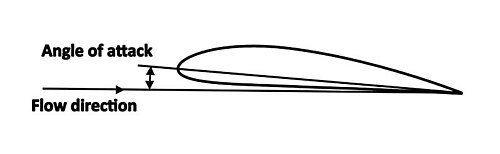
流体力学では、迎角(AOA、α、または迎角は、物体の基準線(多くの場合、翼型の弦線)と、物体と物体が移動する流体との間の相対運動を表すベクトルとの間の角度です。 [ 1 ]迎角は、物体の基準線と流入する流れとの間の角度です。この記事では、最も一般的な応用例である、空気中を移動する翼または翼型の迎角に焦点を当てます。
空気力学では、迎角は固定翼の翼弦線と航空機と大気間の相対運動を表すベクトルとの間の角度を指定します。翼にはねじれがあるため、翼全体の翼弦線を定義できない場合があり、代替の基準線が単純に定義されます。多くの場合、翼の根元の翼弦線が基準線として選択されます。別の選択肢は、胴体上の水平線を基準線(および縦軸)として使用することです。[ 2 ]一部の著者[ 3 ] [ 4 ]は、任意の翼弦線を使用せず、定義により迎角がゼロのときに揚力係数がゼロとなるゼロ揚力軸を使用します。
イギリスの著者の中には、迎角の代わりに迎角という用語を使用している者もいる。 [ 5 ]しかし、これは、翼型の弦と飛行機内の固定された基準点との間の角度を意味するリガーの迎角という用語と混同される可能性がある。 [ 6 ]


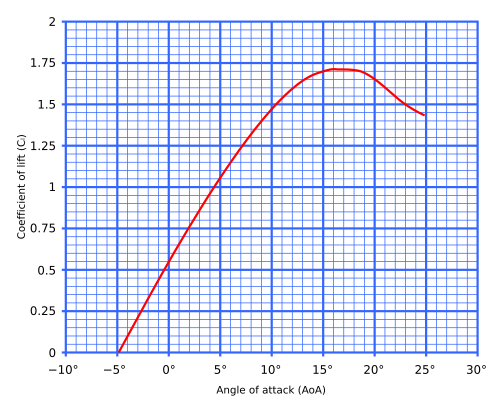
固定翼航空機の揚力係数は迎角によって変化する。迎角が増加すると揚力係数も増加し、最大揚力係数に達した後は揚力係数は減少する。[ 7 ]
As the angle of attack of a fixed-wing aircraft increases, separation of the airflow from the upper surface of the wing becomes more pronounced, leading to a reduction in the rate of increase of the lift coefficient. The figure shows a typical curve for a cambered straight wing. Cambered airfoils are curved such that they generate some lift at small negative angles of attack. A symmetrical wing has zero lift at 0 degrees angle of attack. The lift curve is also influenced by the wing shape, including its airfoil section and wing planform. A swept wing has a lower, flatter curve with a higher critical angle.
The critical angle of attack is the angle of attack which produces the maximum lift coefficient. This is also called the "stall angle of attack". Below the critical angle of attack, as the angle of attack decreases, the lift coefficient decreases. Conversely, above the critical angle of attack, as the angle of attack increases, the air begins to flow less smoothly over the upper surface of the airfoil and begins to separate from the upper surface. On most airfoil shapes, as the angle of attack increases, the upper surface separation point of the flow moves from the trailing edge towards the leading edge. At the critical angle of attack, upper surface flow is more separated and the airfoil or wing is producing its maximum lift coefficient. As the angle of attack increases further, the upper surface flow becomes more fully separated and the lift coefficient reduces further.[7]
Above this critical angle of attack, the aircraft is said to be in a stall. A fixed-wing aircraft by definition is stalled at or above the critical angle of attack rather than at or below a particular airspeed. The airspeed at which the aircraft stalls varies with the weight of the aircraft, the load factor, the center of gravity of the aircraft and other factors. However, the aircraft normally stalls at the same critical angle of attack, unless icing conditions prevail. The critical or stalling angle of attack is typically around 15° - 18° for many airfoils.
Some aircraft are equipped with a built-in flight computer that automatically prevents the aircraft from increasing the angle of attack any further when a maximum angle of attack is reached, regardless of pilot input. This is called the 'angle of attack limiter' or 'alpha limiter'. Modern airliners that have fly-by-wire technology avoid the critical angle of attack by means of software in the computer systems that govern the flight control surfaces.[8]
海軍航空母艦の運用やSTOL(短距離離着陸)による未開地飛行など、短距離滑走路からの離着陸操作では、航空機に迎角計または揚力予備計が装備されている場合があります。これらの計器は迎角(AOA)または翼揚力ポテンシャル(POWL、または揚力予備)を直接測定し、パイロットが失速点にさらに近い位置でより正確に飛行するのに役立ちます。STOL操作では、着陸時には臨界迎角に近い位置で、離陸時には最適な上昇角で航空機が動作できることが求められます。対気速度情報は失速挙動に間接的にしか関連しないため、迎角計はこれらの操縦中に最高のパフォーマンスを発揮するためにパイロットによって使用されます。
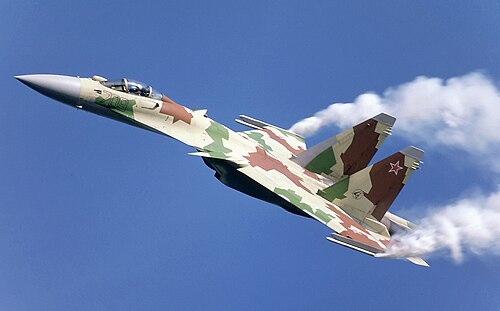
軍用機の中には、非常に高い迎角で制御飛行を実現できるものがあるが、その代償として大きな誘導抗力が発生する。これにより、航空機は優れた機動性を得る。有名な例としては、プガチョフのコブラがある。この機動では、航空機は高い迎角を経験するが、機動が終了するまで、空力方向制御も水平飛行の維持もできない。コブラは、機動の大部分で航空機の翼が臨界迎角をはるかに超えているため、スーパーマニューバリングの例である[ 9 ] [ 10 ]。
翼根前縁延長部などの「高揚力装置」と呼ばれる追加の空力面により、戦闘機は、これらの装置を持たない航空機の約20°に比べて、45°を超えるはるかに大きな飛行可能な「真の」迎角を実現できます。これは、高高度では、上空の空気密度が低いため、わずかな操縦でも大きな迎角が必要になる場合があり、また、低高度で低速飛行しているとき、水平飛行時の迎角と失速時の迎角の差が小さくなる場合にも役立ちます。航空機の高い迎角能力は、パイロットに緩衝材を提供し、航空機の失速(臨界迎角を超えたときに発生する)をより困難にします。しかし、軍用機は通常、戦闘中にこのような高い迎角を得ることはありません。誘導抗力によって航空機の速度が非常に速く低下し、極端な場合には、前面投影面積の増加と寄生抗力が発生するためです。このような操縦は航空機の速度を低下させるだけでなく、高速飛行時に大きな構造的ストレスを引き起こします。現代の飛行制御システムは、戦闘機の迎角をその最大空力限界をはるかに下回る角度に制限する傾向がある。
セーリングでは、関係する物理原理は航空機と同じで、帆は翼型である。[ 11 ]帆の迎角は、帆の弦線と相対風の方向との間の角度である。
