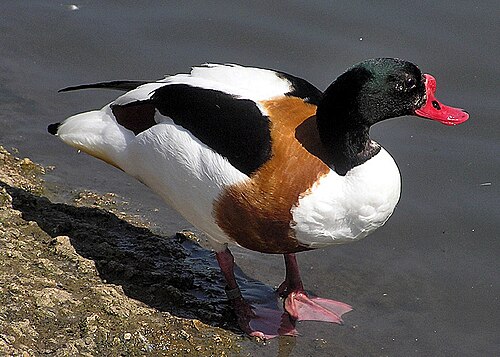
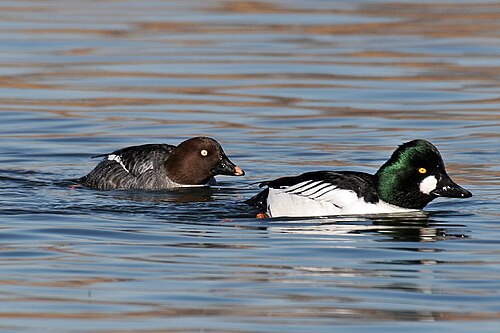
カモ科:コガモ( Anas crecca )、オカヨシガモ( Anas strepera )、オナガガモ( Anas acuta )、マガモ( Anas platyrhynchos )、オオホシハジロ( Aythya marila )、コオリガモ( Clangula hyemalis )、ハシビロガモ( Anas clypeata )、コガモ( Anas querquedula )、ヒドリガモ( Anas penelope )、アカハジロ( Aythya nyroca )、キンクロハジロ( Bucephala clangula )、ウミアイサ( Mergus merganser )、ミコアイサ( Mergellus albellus )、キンクロハジロ( Aythya fuligula )、ウミアイサ( Mergus serrator )、ホシハジロ( Aythya ferina )。ベラルーシの郵便局、1996年。
分類の歴史
The name Anatidae for the family was introduced by the English zoologist William Elford Leach in a guide to the contents of the British Museum published in 1819.[8][9] While the status of the Anatidae as a family is straightforward, and which species properly belong to it is little debated, the relationships of the different tribes and subfamilies within it are poorly understood.
The systematics of the Anatidae are in a state of flux. Previously divided into six subfamilies, a study of anatomical characters by Livezey[10] suggests the Anatidae are better treated in nine subfamilies. This classification was popular in the late 1980s to 1990s.[11] But mtDNAsequence analyses[12][13] indicate, for example, the dabbling and diving ducks do not belong in the same subfamily.
While a comprehensive review of the Anatidae which unites all evidence into a robust phylogeny is still lacking, the reasons for the confusing data are at least clear: As demonstrated by the Late CretaceousfossilVegavis iaai—an early modern waterbird which belonged to an extinct lineage—the Anatidae are an ancient group among the modern birds. Their earliest direct ancestors, though not documented by fossils yet, likewise can be assumed to have been contemporaries with the non-avian dinosaurs. The long period of evolution and shifts from one kind of waterbird lifestyle to another have obscured many plesiomorphies, while apparent apomorphies are quite often the result of parallel evolution, for example the "non-diving duck" type displayed by such unrelated genera as Dendrocygna, Amazonetta, and Cairina.
Alternatively,[14] the Anatidae may be considered to consist of three subfamilies (ducks, geese, and swans, essentially) which contain the groups as presented here as tribes, with the swans separated as subfamily Cygninae, the goose subfamily Anserinae also containing the whistling ducks, and the Anatinae containing all other clades.
Genera
For the living and recently extinct members of each genus, see the article List of Anatidae species.
Subfamily: Dendrocygninae (one pantropical genus, of distinctive long-legged goose-like birds)
Dendrocheninae – a more advanced relative of the whistling-ducks or an ancestral relative of stifftail ducks paralleling whistling-ducks; if not extinct possibly belong in Oxyurinae (including Malacorhynchus)
Mionetta (Late Oligocene – Middle Miocene of Central Europe and Kazakhstan) – includes "Anas" blanchardi, "A." consobrina, "A." natator, "Aythya" arvernensis
Manuherikia (Bathans Early/Middle Miocene of Otago, New Zealand)
Dendrochen (Early– Late? Miocene) – includes "Anas" integra, "A." oligocaena
Dendrocheninae gen. et sp. indet. (Late Miocene of Argentina)
1 2 Olson, Storrs L.; Feduccia, A. (1980). " Presbyornis and the Origin of the Anseriformes (Aves: Charadriomorphae)" (PDF) . Smithsonian Contributions to Zoology . 323 (323). Smithsonian Institution: 1– 24. doi : 10.5479/si.00810282.323 . 2012-02-27 のオリジナル(PDF)からアーカイブ済み。2010-01-25に取得。
1 2 Carboneras, Carles (1992): Family Anatidae (Ducks, Geese and Swans). In: del Hoyo, Josep; Elliott, Andrew & Sargatal, Jordi (eds.): Handbook of Birds of the World (Volume 1: Ostrich to Ducks): 536–629. Lynx Edicions, Barcelona. ISBN84-87334-10-5
1 2 3トッド、フランク S. ( 1991)。フォーショー、ジョセフ (編)。動物百科事典:鳥類。ロンドン:メアハースト・プレス。pp. 81–87。ISBN1-85391-186-0。
↑McCracken, Kevin G. (2000). "The 20-cm Spiny Penis of the Argentine Lake Duck (Oxyura vittata)"(PDF). The Auk. 117 (3): 820–825. doi:10.2307/4089612. JSTOR4089612. Archived from the original(PDF) on 2008-07-05.
↑Brennan, Patricia; Birkhead, Tim; Zyskowski, Kristof; Van Der Waag, Jessica; Prum, Richard (2008). "Independent evolutionary reductions of the phallus in basal birds"(PDF). Journal of Avian Biology. 39 (5): 487–492. doi:10.1111/j.0908-8857.2008.04610.x.
↑Briskie, James; Montgomerie, Robert (1997). "Sexual selection and the intromittent organ of birds". Journal of Avian Biology. 28 (1): 73–86. doi:10.2307/3677097. JSTOR3677097.
↑Leach, William Elford (1819). "Eleventh Room". Synopsis of the Contents of the British Museum (15thed.). London: British Museum. pp.63–68 [67]. The name of the author is not specified in the document, Leach was the Keeper of Zoology at the time.
↑Bock, Walter J. (1994). History and Nomenclature of Avian Family-Group Names. Bulletin of the American Museum of Natural History. Vol.222. New York: American Museum of Natural History. pp.133, 245. hdl:2246/830.
1234Livezey, Bradley C. (1986). "A phylogenetic analysis of recent anseriform genera using morphological characters"(PDF). Auk. 103 (4): 737–754. doi:10.1093/auk/103.4.737. JSTOR4087184.
↑Madge, Steve & Burn, Hilary (1987): Wildfowl: an identification guide to the ducks, geese and swans of the world. Christopher Helm, London. ISBN0-7470-2201-1
↑ Sraml, M.; Christidis, L.; Easteal, S.; Horn, P.; Collet, C. (1996). "オーストラリア水鳥(カモ目)内の分子系統関係". Australian Journal of Zoology . 44 (1): 47– 58. doi : 10.1071/ZO9960047 .
1 2 3 Johnson, Kevin P.; Sorenson, Michael D. (1999). "水面採食性カモ類(Anas属)の系統発生と生物地理:分子学的証拠と形態学的証拠の比較" (PDF) . Auk . 116 (3): 792– 805. doi : 10.2307/4089339 . JSTOR 4089339 .
↑ Collar, NJ; Andreev, AV; Chan, S.; Crosby, MJ; Subramanya, S. & Tobias, JA (編) (2001): Pink-headed Duck ( Wayback Machineに 2007-03-11 にアーカイブ)。In : Threatened Birds of Asia: The BirdLife International Red Data Book : 489–501。BirdLife International。ISBN0-946888-44-2
↑ Buckner, Janet C; Ellingson, Ryan; Gold, David A; Jones, Terry L; Jacobs, David K (2018). "ミトゲノミクスは絶滅した潜水ガモChendytes lawiの予想外の分類学的関係を支持し、絶滅したラブラドールダックの位置を確定的に決定する" (PDF) . Molecular Phylogenetics and Evolution . 122 : 102– 109. Bibcode : 2018MolPE.122..102B . doi : 10.1016/j.ympev.2017.12.008 . PMID 29247849 .
↑ Burney, David A.; James, Helen F.; Burney, Lida Pigott; Olson, Storrs L.; Kikuchi, William; Wagner, Warren L.; Burney, Mara; McCloskey, Deirdre; Kikuchi, Delores; Grady, Frederick V.; Gage, Reginald II; Nishek, Robert (2001). "カウアイ島の多様な生物相の化石証拠と人類到来後のその変容" (PDF) . Ecological Monographs . 71 (4): 615– 641. doi : 10.2307/3100038 . JSTOR 3100038 .
↑ Short, Lester L. (1970). "ネブラスカ鮮新世の新カモ目属および新種" (PDF) . Auk . 87 (3): 537– 543. doi : 10.2307/4083796 . JSTOR 4083796 .
↑ Mlíkovský, J. (1992). "中央ヨーロッパの第三紀鳥類の現在の知識状況" (PDF) . サイエンスシリーズ。ロサンゼルス郡、カリフォルニア州:自然史博物館。2012年2月19日にオリジナル(PDF)からアーカイブ済み。 2013年3月11日に取得。
↑ガル、エリカ。ヒル、ヤーノス。ケスラー、オイゲン & コーカイ、ヨーゼフ (1998–99):コゼプソミオセン・オスマラドヴァーニョク、マトラショールス、ラーコーツィ・カポルナ・アラッティ・ウトベヴァガスボル。 I. A Mátraszõlõs 1. lelõhely 2011-07-21 にWayback Machineにアーカイブ[Mátraszőlős の Rákóczi 礼拝堂のセクションから中期中新世の化石。産地 Mátraszõlõs I.]。 Folia Historico Naturalia Musei Matraensis 23 : 33–78。 [ハンガリー語と英語の要旨]