
Loading article…

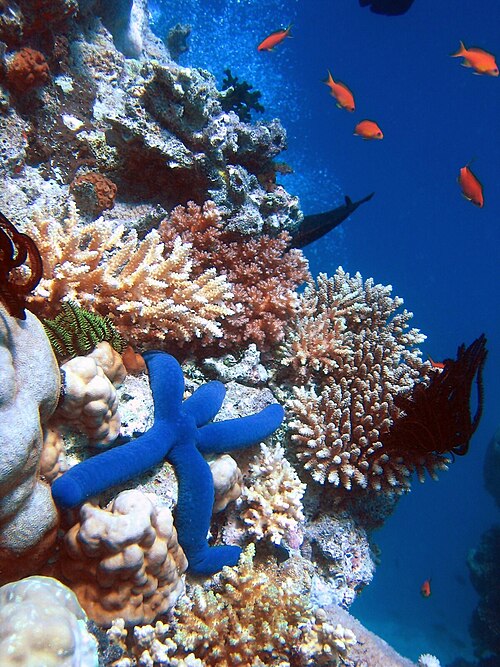
A coral reef is an underwater ecosystem characterized by reef-building corals. Reefs are formed of colonies of coral polyps held together by calcium carbonate.[1] Most coral reefs are built from stony corals, whose polyps cluster in groups.
Coral belongs to the classAnthozoa in the animal phylumCnidaria, which includes sea anemones and jellyfish. Unlike sea anemones, corals secrete hard carbonate exoskeletons that support and protect the coral. Most reefs grow best in warm, shallow, clear, sunny, and agitated water. Coral reefs first appeared 485 million years ago, at the dawn of the Early Ordovician, displacing the microbial and sponge reefs of the Cambrian.[2]
Sometimes called rainforests of the sea,[3] shallow coral reefs form some of Earth's most diverse ecosystems. They occupy less than 0.1% of the world's ocean area, about half the area of France. Yet, they provide a home for at least 25% of all marine species,[4][5][6][7] including fish, mollusks, worms, crustaceans, echinoderms, sponges, tunicates and other cnidarians.[8] Coral reefs flourish in ocean waters that provide few nutrients. They are most commonly found at shallow depths in tropical waters, but deep water and cold water coral reefs exist on smaller scales in other areas.[9]
Shallow tropical coral reefs have declined by 50% since 1950, partly because they are sensitive to water conditions.[10] They are under threat from excess nutrients (nitrogen and phosphorus), rising ocean heat content and acidification, overfishing (e.g., from blast fishing, cyanide fishing, spearfishing on scuba), sunscreen use,[11] and harmful land-use practices, including runoff and seeps (e.g., from injection wells and cesspools).[12][13][14]
Coral reefs deliver ecosystem services for tourism, fisheries, and shoreline protection. The annual global economic value of coral reefs has been estimated at anywhere from US$30–375 billion (1997 and 2003 estimates)[15][16] to US$2.7 trillion (a 2020 estimate)[17] to US$9.9 trillion (a 2014 estimate).[18]
Most coral reefs were formed after the Last Glacial Period when melting ice caused sea level to rise and flood continental shelves. Most coral reefs are less than 10,000 years old. As communities established themselves, the reefs grew upward, keeping pace with rising sea levels. Reefs that rose too slowly could become drowned, without sufficient light.[19] Coral reefs are also found in the deep sea away from continental shelves, around oceanic islands and atolls. The majority of these islands are volcanic in origin. Others have tectonic origins where plate movements lifted the deep ocean floor.
In The Structure and Distribution of Coral Reefs,[20]Charles Darwin set out his theory of the formation of atoll reefs, an idea he conceived during the voyage of the Beagle. He theorized that uplift and subsidence of Earth's oceanic crust beneath the oceans formed the atolls.[21] Darwin set out a sequence of three stages in atoll formation. A fringing reef forms around an extinct volcanic island as the island and ocean floor subside. As the subsidence continues, the fringing reef becomes a barrier reef and ultimately an atoll reef.
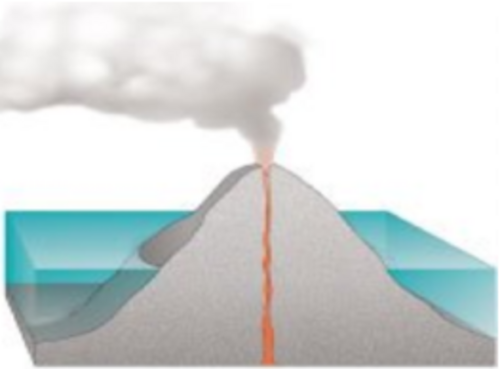
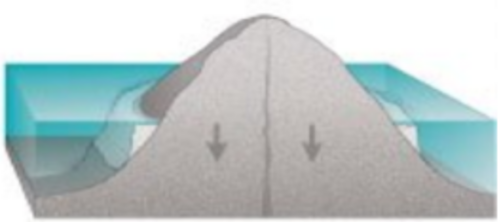

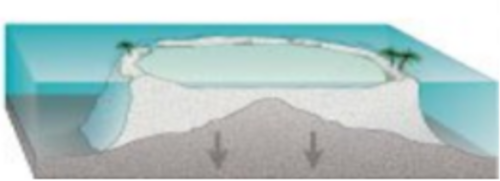
Darwin predicted that underneath each lagoon would be a bedrock base, the remains of the original volcano.[22] Subsequent research supported this hypothesis. Darwin's theory followed from his understanding that coral polyps thrive in the tropics where the water is agitated, but can only live within a limited depth range, starting just below low tide. Where the underlying earth allows, corals grow along the coast to form fringing reefs, which can eventually become barrier reefs.

海底が上昇している場所では、裾礁が海岸沿いに成長しますが、海面より上に突き出たサンゴは死にます。陸地がゆっくりと沈下する場合、裾礁は古い死んだサンゴの基部で上方に成長することで、沈下速度に追いつき、礁と陸地の間のラグーンを囲むバリアリーフを形成します。バリアリーフは島を囲むことができ、島が海面下に沈むと、成長中のサンゴのほぼ円形の環礁が海面に合わせて成長し続け、中央にラグーンを形成します。バリアリーフと環礁は通常完全な円形にはならず、嵐によって部分的に分断されます。海面上昇と同様に、急速に沈下する海底はサンゴの成長を圧倒し、サンゴと礁を死に至らしめることがあります。これはサンゴの溺死と呼ばれます。[ 24 ]褐虫藻に依存するサンゴは、光への曝露が減少するため、共生藻が十分に光合成を行うには水深が深くなりすぎると死に至ります。 [ 25 ]
サンゴ礁の地形、つまり形状を決定する主な2つの要因は、サンゴ礁が乗っている基質の性質と、その基質に対する海面水位の変化の歴史である。
約2万年前のグレートバリアリーフは、大陸棚でサンゴ礁がどのように形成されたかを示す好例です。当時の海面は21世紀より120メートル(390フィート)低かったのです。 [ 26 ] [ 27 ]海面が上昇するにつれて、水とサンゴはオーストラリア沿岸平野の丘だった場所に侵入していきました。1万3000年前までに、海面は現在より60メートル(200フィート)低くなり、沿岸平野の多くの丘は大陸島になりました。海面の上昇が続くと、ほとんどの大陸島は水に覆われました。するとサンゴが丘を覆い、小島やサンゴ礁を形成するようになりました。グレートバリアリーフの海面は、過去6000年間大きく変化していません。[ 27 ]生きているサンゴ礁構造の年齢は 6,000 年から 8,000 年と推定されている。[ 28 ]グレートバリアリーフは火山島の周囲ではなく大陸棚に沿って形成されたが、ダーウィンの原理が適用される。オーストラリアは沈没するわけではないので、発達はバリアリーフの段階で止まった。海岸から300 ~ 1,000 m (980 ~ 3,280フィート)のところに、 2,000 km (1,200マイル)にわたって伸びる世界最大のバリアリーフを形成した。[ 29 ]
Healthy tropical coral reefs grow horizontally from 1 to 3 cm (0.39 to 1.18 in) per year, and grow vertically anywhere from 1 to 25 cm (0.39 to 9.84 in) per year; however, they grow only at depths shallower than 150 m (490 ft) because of their need for sunlight, and cannot grow above sea level.[30]
As the name implies, coral reefs are made up of coral skeletons from mostly intact coral colonies. As other chemical elements present in corals become incorporated into the calcium carbonate deposits, aragonite is formed. However, shell fragments and the remains of coralline algae such as the green-segmented genusHalimeda can add to the reef's ability to withstand damage from storms and other threats. Such mixtures are visible in structures such as Eniwetok Atoll.[31]

The times of maximum reef development were in the Middle Cambrian (513–501 Ma), Devonian (416–359 Ma) and Carboniferous (359–299 Ma), owing to extinct order Rugosa corals, and Late Cretaceous (100–66 Ma) and Neogene (23 Ma–present), owing to orderScleractinia corals.[32]
Not all reefs in the past were formed by corals: those in the Early Cambrian (542–513 Ma) resulted from calcareous algae and archaeocyathids (small animals with conical shape, probably related to sponges) and in the Late Cretaceous (100–66 Ma), when reefs formed by a group of bivalves called rudists existed; one of the valves formed the main conical structure and the other, much smaller valve acted as a cap.[33]
Measurements of the oxygen isotopic composition of the aragonitic skeleton of coral reefs, such as Porites, can indicate changes in sea surface temperature and sea surface salinity conditions during the growth of the coral. Climate scientists often use this technique to infer a region's paleoclimate.[34]
ダーウィンが火山島の周りの裾礁が堡礁になり、その後環礁になるという3つの古典的な礁の形成を特定して以来[ 35 ]、科学者たちはさらに多くの礁のタイプを特定してきました。一部の資料では3つしか見つけていませんが[ 36 ] [ 37 ]、トーマスはストッダート、DR(1969)に基づいて「大規模なサンゴ礁の4つの主要な形態」である裾礁、堡礁、環礁、テーブル礁を挙げています[ 38 ] [ 39 ] 。 スポルディングらは、裾礁、堡礁、環礁、および「バンクまたはプラットフォーム礁」という明確に図示できる4つの主要な礁のタイプを挙げ、パッチ礁など、厳密な定義に容易に適合しない他の多くの構造が存在することを指摘しています[ 40 ] 。
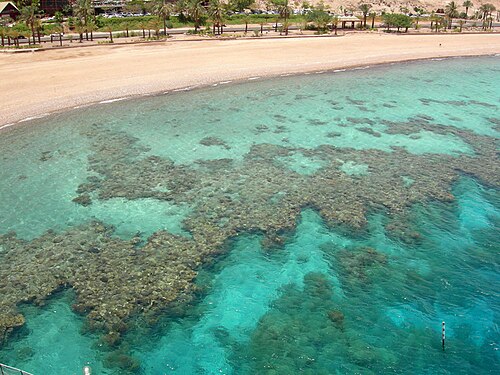
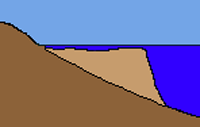
裾礁(海岸礁とも呼ばれる)[ 41 ]は、海岸に直接付着しているか[ 42 ] 、狭く浅い水路や潟湖を介して海岸に接している[ 43 ]。これは最も一般的な礁のタイプである[ 43 ] 。 裾礁は海岸線に沿って伸び、何キロメートルにも及ぶことがある[ 44 ] 。通常は幅が100メートル未満 だが、数百メートルに及ぶものもある[ 45 ] 。裾礁は、最初は低潮位の海岸に形成され、大きくなるにつれて海に向かって拡大する。最終的な幅は、海底が急激に落ち始める場所によって決まる。裾礁の表面は、一般的に同じ高さ、つまり水面直下にとどまる。古い裾礁では、外側の領域が海に大きく押し出され、内側の部分は侵食によって深くなり、最終的に潟湖を形成する。[ 46 ]裾礁ラグーンは幅が100メートル以上、深さが数メートルになることがあります。裾礁自体と同様に、海岸線と平行に伸びています。紅海 の裾礁は「世界で最も発達したもののひとつ」であり、砂浜の湾を除いて、紅海の海岸線全体に分布しています。[ 47 ]
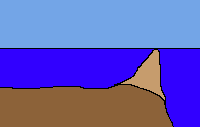
Barrier reefs are separated from a mainland or island shore by a deep channel or lagoon.[43] They resemble the later stages of a fringing reef with its lagoon, but differ from the latter mainly in size and origin. Their lagoons can be several kilometres wide and 30 to 70 metres deep. Above all, the offshore outer reef edge formed in open water rather than next to a shoreline. Like an atoll, it is thought that these reefs are formed either as the seabed lowered or the sea level rose. Formation takes considerably longer than for a fringing reef; thus, barrier reefs are much rarer.
The best known and largest example of a barrier reef is the Australian Great Barrier Reef.[43][48] Other major examples are the Mesoamerican Barrier Reef System and the New Caledonian Barrier Reef.[48] Barrier reefs are also found on the coasts of Providencia,[48]Mayotte, the Gambier Islands, on the southeast coast of Kalimantan, on parts of the coast of Sulawesi, southeastern New Guinea and the south coast of the Louisiade Archipelago.
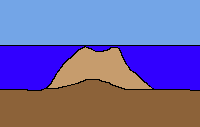
Platform reefs, variously called bank or table reefs, can form on the continental shelf, as well as in the open ocean, in fact anywhere where the seabed rises close enough to the surface of the ocean to enable the growth of zooxanthemic, reef-forming corals.[49] Platform reefs are found in the southern Great Barrier Reef, the Swain[50] and Capricorn Group[51] on the continental shelf, about 100–200 km from the coast. Some platform reefs of the northern Mascarenes are several thousand kilometres from the mainland. Unlike fringing and barrier reefs, which extend only seaward, platform reefs grow in all directions.[49] They are variable in size, ranging from a few hundred metres to many kilometres across. Their usual shape is oval to elongated. Parts of these reefs can reach the surface, forming sandbanks and small islands around which fringing reefs may form. A lagoon may form in the middle of a platform reef.
Platform reefs are typically situated within atolls, where they adopt the name "patch reefs" and often span a diameter of just a few dozen meters. When platform reefs develop along elongated structures, such as old, weathered barrier reefs, they tend to form a linear arrangement. This is the case, for example, on the east coast of the Red Sea near Jeddah. In old platform reefs, the inner part can be so heavily eroded that it forms a pseudo-atoll.[49] These can be distinguished from real atolls only by detailed investigation, possibly including core drilling. Some platform reefs of the Laccadives are U-shaped, due to wind and water flow.
Atolls or atoll reefs are a more or less circular or continuous barrier reef that extends all the way around a lagoon without a central island.[52] They are usually formed from fringing reefs around volcanic islands.[43] Over time, the island erodes away and sinks below sea level.[43] Atolls may also be formed by the sinking of the seabed or rising of the sea level. A ring of reefs results, which encloses a lagoon. Atolls are numerous in the South Pacific, where they usually occur in mid-ocean, for example, in the Caroline Islands, the Cook Islands, French Polynesia, the Marshall Islands, and Micronesia.[48]
Atolls are found in the Indian Ocean, for example, in the Maldives, the Chagos Islands, the Seychelles, and around Cocos Island.[48] The entire Maldives consists of 26 atolls.[53]


Coral reef ecosystems contain distinct zones that host different kinds of habitats. Usually, three major zones are recognized: the fore reef, the reef crest, and the back reef (also called the reef lagoon).
The three zones are physically and ecologically interconnected. Reef life and oceanic processes create opportunities for the exchange of seawater, sediment, nutrients, and marine life.
Most coral reefs exist in waters less than 50 m deep.[57] Some inhabit tropical continental shelves where cool, nutrient-rich upwelling does not occur, such as the Great Barrier Reef. Others are found in the deep ocean surrounding islands or as atolls, such as in the Maldives. The reefs surrounding islands form when islands subside into the ocean, and atolls form when an island subsides below the surface of the sea.
Alternatively, Moyle and Cech distinguish six zones, though most reefs possess only some of the zones.[58]

The reef surface is the shallowest part of the reef. It is subject to surge and tides. When waves pass over shallow areas, they shoal, as shown in the adjacent diagram. This means the water is often agitated. These are the precise conditions under which corals flourish. The light is sufficient for photosynthesis by the symbiotic zooxanthellae, and agitated water brings plankton to feed the coral.
The off-reef floor is the shallow sea floor surrounding a reef. This zone occurs next to reefs on continental shelves. Reefs around tropical islands and atolls drop abruptly to great depths and do not have such a floor. Usually sandy, the floor often supports seagrass meadows, which are important foraging areas for reef fish.
The reef drop-off is, for its first 50 m, habitat for reef fish who find shelter on the cliff face and plankton in the water nearby. The drop-off zone primarily occurs around oceanic islands and atolls.
The reef face or forereef is the zone above the reef floor or the reef drop-off. This zone is often the reef's most diverse area. Coral and calcareous algae provide complex habitats and areas that offer protection, such as cracks and crevices. Invertebrates and epiphytic algae provide much of the food for other organisms.[58] A common feature of this forereef zone is spur and groove formations that serve to transport sediment downslope.
リーフフラットとは、サンゴの塊を含む、メインリーフの後ろにある砂底の平坦な場所のことです。このゾーンはラグーンに隣接して保護区域として機能する場合もあれば、リーフと海岸の間にある場合もあり、後者の場合は平坦な岩場です。魚はリーフフラットが存在する場合、好む傾向があります。[ 58 ]
リーフラグーンは完全に閉鎖された領域であり、波の影響を受けにくい領域で、小さなサンゴ礁のパッチが含まれていることが多い。[ 58 ]
しかし、サンゴ礁の地形は絶えず変化しています。それぞれのサンゴ礁は、藻類、固着性無脊椎動物、むき出しの岩や砂の不規則なパッチで構成されています。これらのパッチの大きさ、形状、相対的な存在量は、あるタイプのパッチを他のタイプよりも優勢にするさまざまな要因に応じて、年ごとに変化します。たとえば、サンゴの成長は、サンゴ礁の微細構造に絶え間ない変化をもたらします。より大きなスケールでは、熱帯の嵐がサンゴ礁の大きな部分を破壊し、砂地の岩を移動させる可能性があります。[ 59 ]

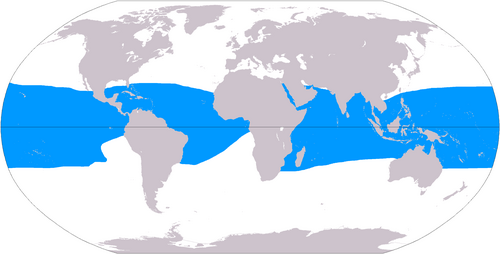
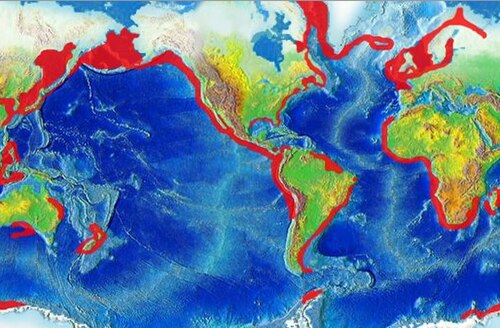
サンゴ礁は、海洋表面積の0.1%弱にあたる284,300 km 2 (109,800 sq mi)を覆っていると推定されています。 [ 60 ]この総面積の91.9%はインド太平洋地域(紅海、インド洋、東南アジア、太平洋を含む)が占めています。東南アジアはそのうち32.3%を占め、オーストラリアを含む太平洋は40.8%を占めています。大西洋とカリブ海のサンゴ礁は7.6%を占めています。[ 5 ]
サンゴは温帯と熱帯の両方の海域に生息していますが、浅瀬のサンゴ礁は赤道から北緯約30度 から南緯約30度の範囲にしか形成されません。熱帯のサンゴは水深50メートル(160フィート)を超える深さでは成長しません。ほとんどのサンゴ礁の最適温度は26~27 ℃(79~81 °F)で、18 ℃(64 °F)以下の海域にはほとんどサンゴ礁は存在しません。[ 61 ]造礁サンゴの純生産量が相対的な海面水位に追いつかなくなり、サンゴ礁構造が永久に水没すると、ダーウィンポイントに達します。そのようなポイントの1つがハワイ諸島の北西端に存在します。ハワイの火山の進化#サンゴ環礁段階を参照してください。[ 62 ] [ 63 ]
しかし、ペルシャ湾のサンゴ礁は、冬には13 ℃(55 °F) 、夏には38 ℃(100 °F)の温度に適応している。 [ 64 ]ララク島周辺には、37種のイシサンゴ類が生息している。[ 65 ]
深海サンゴは、より深い水深とより低い水温の、はるか北のノルウェーまで、より高緯度の地域に生息しています。[ 66 ]深海サンゴは礁を形成することがありますが、それらについてはほとんど知られていません。
地球上で最も北に位置するサンゴ礁は、イスラエルのエイラート近郊にあります。[ 67 ]アメリカ大陸とアフリカ大陸の西海岸では、湧昇流と強い冷たい沿岸流(それぞれフンボルト海流、ベンゲラ海流、カナリア海流)によって水温が低下するため、サンゴ礁はまれです。[68] 南アジアの海岸線(インドの東端(チェンナイ)からバングラデシュとミャンマーの国境まで)[ 5 ]、および南米北東部とバングラデシュの海岸線では、アマゾン川とガンジス川からの淡水の流入により、サンゴはほとんど見られません。
主要なサンゴ礁には以下のようなものがある。
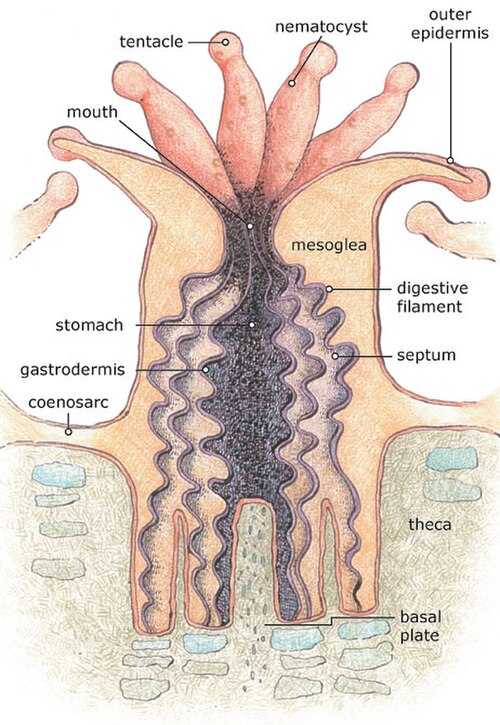
When alive, corals are colonies of small animals embedded in calcium carbonate shells. Coral heads consist of accumulations of individual animals called polyps, arranged in diverse shapes.[74] Polyps are usually tiny, but they can range in size from a pinhead to 12 inches (30 cm) across.
Reef-building or hermatypic corals live only in the photic zone (above 70 m), the depth to which sufficient sunlight penetrates the water.[75]
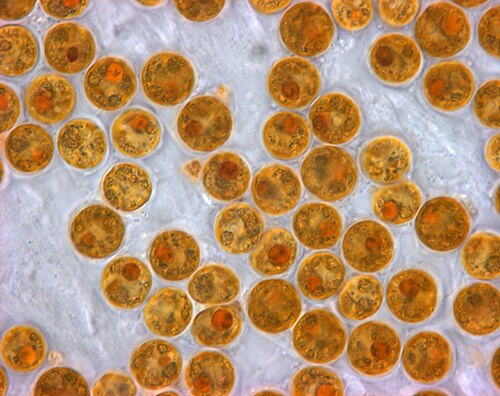
Coral polyps do not photosynthesize, but have a symbiotic relationship with microscopic algae (dinoflagellates) of the genus Symbiodinium, commonly referred to as zooxanthellae. These organisms live within the polyps' tissues and provide organic nutrients that nourish the polyp in the form of glucose, glycerol, and amino acids.[76] Because of this relationship, coral reefs grow much faster in clear water, which admits more sunlight. Without their symbionts, coral growth would be too slow to form significant reef structures. Corals get up to 90% of their nutrients from their symbionts.[77] In return, as an example of mutualism, the corals shelter the zooxanthellae, averaging one million for every cubic centimetre of coral, and provide a constant supply of the carbon dioxide they need for photosynthesis.

The varying pigments in different species of zooxanthellae give them an overall brown or golden-brown appearance and give brown corals their colors. Other pigments, such as reds, blues, and greens, are produced by colored proteins in coral animals. Coral that loses a significant fraction of its zooxanthellae becomes white (or sometimes pastel shades in corals that are pigmented with their own proteins) and is said to be bleached, a condition which, unless corrected, can kill the coral.
Symbiodinium系統型には8 つのクレードがあります。ほとんどの研究はクレード A~D で行われています。各クレードは、サンゴ宿主の生存に利点と不適合な特性の両方をもたらします。各光合成生物は、タンパク質などの生存に必要な化合物の光損傷に対する特定のレベルの感受性を持っています。再生と複製の速度が、生物の生存能力を決定します。系統型A は浅瀬でより多く見られます。グリセリンの誘導体を使用して紫外線を吸収し、紫外線耐性のあるミコスポリン様アミノ酸を生成することができ、それによってより暖かい水温に適応することができます。紫外線または熱による損傷が発生した場合、修復が起こった場合、宿主と共生生物の生存の可能性が高まります。このことから、進化的に、系統型A は他のクレードよりも紫外線耐性と熱耐性が高いという考えにつながります。[ 78 ]
クレード BとCはより深い水域でより頻繁に見られるため、水温上昇に対する脆弱性が高いことが説明できるかもしれない。下草の中に生息し、日光の当たりが悪い陸上植物は、クレード B、C、Dに類似している。クレードBからDはより深い水域に生息するため、エネルギー合成に必要な光吸収率が高くなる。紫外線波長での吸収率が高いため、これらの系統群は浅瀬に生息するクレードAよりもサンゴの白化現象を起こしやすい。
クレード Dは高温耐性があり、現代の白化現象 においてクレードBおよびCよりも生存率が高いことが観察されている。[ 78 ]
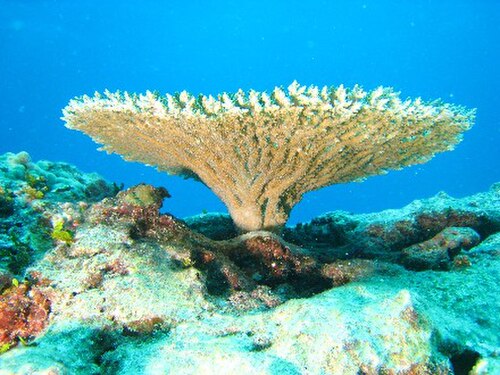
サンゴ礁は、ポリプやその他の生物がサンゴの基盤となる炭酸カルシウム[ 79 ] [ 80 ]を、自身の下や周囲に骨格構造として沈着させ、サンゴの頭部の頂部を上向きと外側に押し上げることで成長します[ 81 ] 。波、草食魚(ブダイなど)、ウニ、海綿動物、その他の力や生物は生物侵食者として働き、サンゴの骨格を破片に分解し、サンゴ礁構造の隙間に沈んだり、関連するサンゴ礁ラグーンの砂底を形成したりします。
サンゴの典型的な形状は、しわくちゃの脳、キャベツ、テーブルの天板、鹿の角、ワイヤーの撚り線、柱など、陸上の物体に似ていることから名付けられています。これらの形状は、光への曝露や波の作用などのサンゴの生活史[ 82 ]や、破損などの出来事[ 83 ]によって左右されることがあります。

サンゴは有性生殖と無性生殖の両方で繁殖します。個々のポリプは一生のうちに両方の生殖様式を利用します。サンゴは体内受精または体外受精によって有性生殖を行います。生殖細胞は、胃腔の内壁を覆う組織層から内側に向かって放射状に伸びる膜である腸間膜上にあります。成熟した成体サンゴの中には雌雄同体のものもあれば、雄または雌のみのものもいます。ごく一部の種は成長するにつれて性転換します。
体内受精卵は、数日から数週間かけてポリプ内で発育します。その後の発育で、プラヌラと呼ばれる小さな幼生が生まれます。体外受精卵は、同期産卵中に発育します。サンゴ礁のポリプは、卵と精子を一斉に水中に放出します。産卵は広範囲に分散します。産卵のタイミングは、季節、水温、潮汐と月の周期によって異なります。産卵は、満潮と干潮の差が小さいときに最も成功します。水の動きが少ないほど、受精の可能性が高くなります。卵またはプラヌラの放出は通常夜間に行われ、月の周期(満月の3~6日後)と同期している場合もあります。[ 85 ] [ 86 ] [ 87 ]

放出から定着までの期間はわずか数日ですが、一部のプラヌラは数週間浮遊して生存することができます。この過程で、幼生は適切な定着場所を見つけるためにいくつかの手がかりを利用する可能性があります。遠距離では既存のサンゴ礁からの音が重要である可能性が高く[ 88 ] 、近距離では化学物質が重要になります[ 89 ] 。幼生は捕食や環境条件に対して脆弱です。基質にうまく付着できた幸運な少数のプラヌラは、餌と場所をめぐって競争します。
サンゴは最も優れた造礁生物です。しかし、サンゴ礁群集に生息する他の多くの生物も、サンゴと同様に骨格となる炭酸カルシウムを供給しています。これには、石灰藻、一部の海綿動物、二枚貝などが含まれます。[ 91 ]サンゴ礁は常にこれらの異なる門の共同作業によって形成され、他の地質時代には他の生物が造礁を主導していました。[ 92 ]

サンゴ藻はサンゴ礁の構造に不可欠な役割を果たしています。サンゴに比べて鉱物沈着速度ははるかに遅いものの、荒波に対する耐性が高く、外洋に面した礁前面など、波による最も大きな力にさらされる礁の部分を保護する地殻を形成するのに役立ちます。また、サンゴ礁の表面に石灰岩をシート状に沈着させることで、礁の構造を強化します。さらに、サンゴの成長に適さない場所では、サンゴ藻が藻類礁の主要な形成者となることもあります。[ 93 ] [ 94 ]

海綿礁は、海綿によって作られた礁です。六放海綿は、ブリティッシュコロンビア州、アラスカ州南東部、ワシントン州の沿岸で礁を形成することが知られています。[ 95 ]ブリティッシュコロンビア州のヘカテ海峡で発見された礁は、 長さが最大7キロメートル、高さが20メートルにまで成長しています 。[ 96 ]六放海綿礁は、中期三畳紀(2億4500万年前~2億800万年前)に初めて確認されました。海綿は、後期ジュラ紀(2億100万年前~1億4500万年前) に最大規模に達し、長さ7000キロメートルの不連続な礁システムが北テチス海盆と北大西洋盆地に広がっていましたが、[ 97 ]その後衰退し、1987~1988年に現存する礁が発見されるまで絶滅したと考えられていました。[ 98 ]
Archaeocyatha, an extinct clade of sponges, were the planet's first reef-building animals and are an index fossil[99] for the Lower Cambrian worldwide. Similarly, Stromatoporoidea was another extinct clade of reef-building sponges. Unlike corals, stromatoporoids usually settled on soft substrates, so their 'reefs' occupied only a single level rather than a multi-tiered vertical framework of built-up skeletons.[100]

Oyster reefs are dense aggregations of oysters living in colonial communities. Other regionally specific names for these structures include oyster beds and oyster banks. Oyster larvae require a hard substrate or surface to attach to, which includes the shells of old or dead oysters. Thus, reefs can build up over time as new larvae settle on older individuals. Crassostrea virginica were once abundant in Chesapeake Bay and shorelines bordering the Atlantic coastal plain until the late nineteenth century.[101]Ostrea angasi is a species of flat oyster that has also formed large reefs in South Australia.[102]
Hippuritida, an extinct order of bivalves known as rudists, were major reef-building organisms during the Cretaceous. By the mid-Cretaceous, rudists became the dominant tropical reef-builders, becoming more numerous than scleractinian corals. During this period, ocean temperatures and saline levels—which corals are sensitive to—were higher than they are today, which may have contributed to the success of rudist reefs.[33]
Some gastropods, like family Vermetidae, are sessile and cement themselves to the substrate, contributing to the reef building.[103]
Darwin's paradox"Coral... seems to proliferate when ocean waters are warm, poor, clear and agitated, a fact which Darwin had already noted when he passed through Tahiti in 1842. This constitutes a fundamental paradox, as shown quantitatively by the apparent impossibility of balancing the input and output of the nutritive elements that control coral polyp metabolism.
Recent oceanographic research has brought to light the reality of this paradox by confirming that the oligotrophy of the ocean euphotic zone persists right up to the swell-battered reef crest. When you approach the reef edges and atolls from the quasidesert of the open sea, the near absence of living matter suddenly becomes a plethora of life, without transition. So why is there something rather than nothing, and more precisely, where do the necessary nutrients for the functioning of this extraordinary coral reef machine come from?" — Francis Rougerie[104]
In The Structure and Distribution of Coral Reefs, published in 1842, Darwin described how coral reefs were found in some tropical areas but not others, with no obvious cause. The largest and strongest corals grew in parts of the reef exposed to the most violent surf, and corals were weakened or absent where loose sediment accumulated.[20]
Tropical waters contain few nutrients[105] yet a coral reef can flourish like an "oasis in the desert".[106] This has given rise to the ecosystem conundrum, sometimes called "Darwin's paradox": "How can such high production flourish in such nutrient poor conditions?"[107][108][109]
Coral reefs support over one-quarter of all marine species. This diversity results in complex food webs, with large predator fish eating smaller forage fish, which eat yet smaller zooplankton, and so on. However, all food webs ultimately depend on plants, which serve as primary producers. Coral reefs typically produce 5–10 grams of carbon per square meter per day (gC·m−2·day−1) biomass.[110][111]
熱帯の海水が異常に澄んでいる理由の一つは、栄養分が乏しく、プランクトンが漂っていることです。さらに、熱帯では一年中太陽が照りつけ、表層が温められるため、表層は下層よりも密度が低くなります。暖かい海水は、温度が急激に変化する安定した水温躍層によって、より深い冷たい海水から隔てられています。これにより、暖かい表層水は、より冷たい深層水の上に浮かんでいます。海洋のほとんどの地域では、これらの層間の物質の交換はほとんどありません。水生環境で死んだ生物は一般的に海底に沈み、そこで分解され、窒素(N)、リン(P)、カリウム(K)の形で栄養分を放出します。これらの栄養分は植物の成長に必要ですが、熱帯では直接表層に戻ることはありません。
植物は食物連鎖の基盤を形成し、成長するために日光と栄養分を必要とします。海洋では、これらの植物は主に水柱を漂う微細な植物プランクトンです。植物プランクトンは光合成のために日光を必要とし、光合成は炭素固定のエネルギー源となるため、比較的表層近くにしか生息していませんが、栄養分も必要とします。植物プランクトンは表層水中の栄養分を急速に消費し、熱帯地域では水温躍層のためにこれらの栄養分は通常補充されません。[ 112 ]
サンゴ礁の周囲には、サンゴ礁や島から浸食された土砂でできた潟湖が形成される。これらの潟湖は海洋生物にとっての避難場所となり、波や嵐から彼らを守る役割を果たす。
最も重要なのは、サンゴ礁が栄養素を循環させることであり、これは外洋でははるかに少ない。サンゴ礁やラグーンでは、生産者には植物プランクトン、海藻、石灰藻類、特に芝生状藻類と呼ばれる小型のものが含まれ、これらが栄養素をサンゴに供給する。[ 113 ]植物プランクトンは食物連鎖の基盤を形成し、魚類や甲殻類に食べられる。栄養素の循環により、コミュニティを維持するために必要な栄養素の投入量が全体的に減少する。[ 77 ]
サンゴは無機窒素やリンなどの栄養素を水から直接吸収します。多くのサンゴは夜間に触手を伸ばして近くを通る動物プランクトンを捕らえます。動物プランクトンはポリプに窒素を供給し、ポリプはその窒素の一部を褐虫藻と共有します。褐虫藻もこの元素を必要とします。[ 113 ]

Sponges live in the crevices of reefs. They are efficient filter feeders, and in the Red Sea they consume about 60% of the phytoplankton that drifts by. Sponges eventually excrete nutrients in a form that corals can use.[114]
The roughness of coral surfaces is key to coral survival in agitated waters. Normally, a boundary layer of still water forms around a submerged object, acting as a barrier. Waves breaking on the extremely rough edges of corals disrupt the boundary layer, allowing the corals access to passing nutrients. Turbulent water thereby promotes reef growth. Without access to nutrients brought by rough coral surfaces, even the most effective recycling would not suffice.[115]
Deep nutrient-rich water entering coral reefs through isolated events may have significant effects on temperature and nutrient systems.[116][117] This water movement disrupts the relatively stable thermocline that usually exists between warm shallow water and deeper colder water. Temperature regimes on coral reefs in the Bahamas and Florida are highly variable, spanning temporal scales from minutes to seasons and spatial scales across depths.[118]
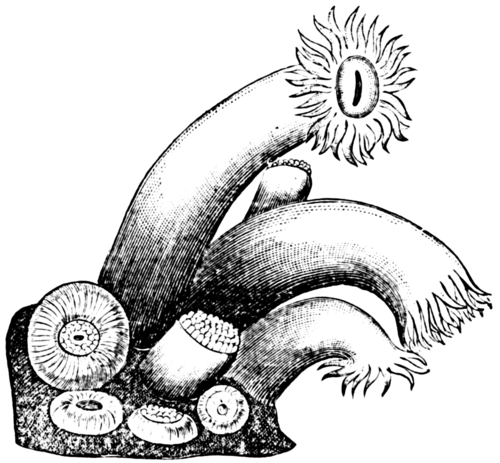
水は、潮流リング、表面波、内部波、潮汐変化など、さまざまな方法でサンゴ礁を通過することができます。[ 116 ] [ 119 ] [ 120 ] [ 121 ] 一般的に、動きは潮汐と風によって生み出されます。潮汐がさまざまな海底地形と相互作用し、風が表面水と混ざると、内部波が発生します。内部波は、海洋内の密度成層に沿って移動する重力波です。水塊が異なる密度に遭遇すると、振動して内部波が発生します。[ 122 ]内部波は一般的に表面波よりも周波数が低いですが、多くの場合、単一の波として形成され、斜面に衝突して上昇すると複数の波に分裂します。[ 123 ]この内部波の垂直方向の分裂は、大きな密度差混合と乱流を引き起こします。[ 124 ] [ 125 ]内部波は栄養ポンプとして機能し、プランクトンと冷たく栄養豊富な水を表面に運びます。[ 116 ] [ 121 ] [ 126 ] [ 127 ] [ 128 ] [ 129 ] [ 130 ] [ 131 ] [ 132 ] [ 133 ] [ 134 ]

The irregular structure of coral reef bathymetry may enhance mixing, producing pockets of cooler water and variable nutrient levels.[135] Arrival of cool, nutrient-rich water from depths due to internal waves and tidal bores has been linked to growth rates of suspension feeders and benthic algae[121][134][136] as well as plankton and larval organisms.[121][137] The seaweed Codium isthmocladum reacts to deep water nutrient sources because their tissues have different concentrations of nutrients dependent upon depth.[134] Aggregations of eggs, larval organisms, and plankton on reefs respond to deep water intrusions.[128] Similarly, as internal waves and bores move vertically, surface-dwelling larval organisms are carried toward the shore.[137] This has significant biological importance to cascading effects of food chains in coral reef ecosystems and may provide yet another key to unlocking the paradox.
Cyanobacteria provide soluble nitrates via nitrogen fixation.[138]
Coral reefs often depend on surrounding habitats, such as seagrass meadows and mangrove forests, for nutrients. Seagrass and mangroves supply dead plants and animals that are rich in nitrogen and serve to feed fish and animals from the reef by supplying wood and vegetation. Reefs, in turn, protect mangroves and seagrass from waves and produce sediment in which the mangroves and seagrass can root.[64]

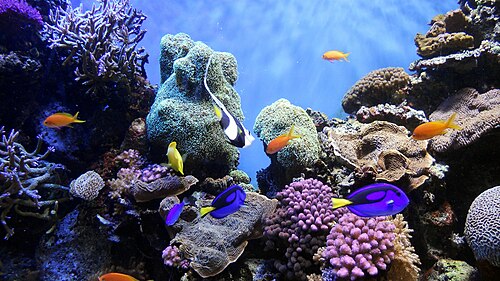

サンゴ礁は世界で最も生産性の高い生態系の一つであり、多種多様な生物を支える複雑で多様な海洋生息地を提供している。 [ 139 ] [ 140 ]干潮線直下の裾礁は、満潮線上のマングローブ林やその間の海草藻場と相互に有益な関係にある。サンゴ礁は、マングローブや海草を、損傷を与えたり、根を張っている堆積物を侵食したりする強い潮流や波から保護し、一方、マングローブや海草は、大量のシルト、淡水、汚染物質の流入からサンゴを保護する。このような環境の多様性は、例えば海草を餌にしたり、サンゴ礁を保護や繁殖に利用したりする多くのサンゴ礁動物に恩恵をもたらしている。[ 141 ]
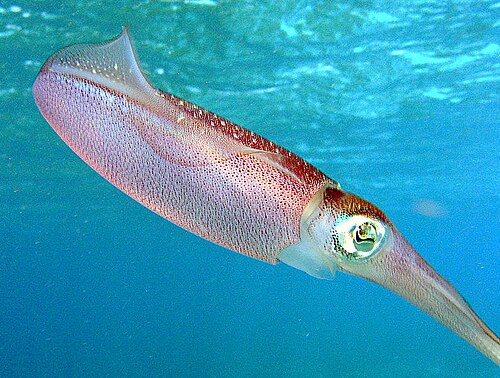
サンゴ礁には、魚類、海鳥、海綿動物、刺胞動物(サンゴやクラゲの一部を含む)、蠕虫、甲殻類(エビ、クリーナーシュリンプ、イセエビ、カニを含む)、軟体動物(頭足類を含む)、棘皮動物(ヒトデ、ウニ、ナマコを含む) 、ホヤ、ウミガメ、ウミヘビなど、さまざまな動物が生息しています。人間を除けば、哺乳類はサンゴ礁ではまれで、イルカなどの訪れる鯨類が主な例外です。いくつかの種はサンゴを直接食べ、他の種はサンゴ礁の藻類を食べます。[ 5 ] [ 113 ]サンゴ礁のバイオマスは種の多様性と正の相関関係にあります。[ 142 ]
異なる種が、時間帯によってサンゴ礁の同じ隠れ場所に定期的に生息することがある。テンジクダイやイシダイなどの夜行性の捕食者は日中は隠れ、スズメダイ、ニザダイ、モンガラカワハギ、ベラ、ブダイはウナギやサメから身を隠す。[ 31 ]: 49
The great number and diversity of hiding places in coral reefs, i.e., refuges, are the most important factors driving the high diversity and high biomass of organisms in coral reefs.[143][144]
Coral reefs also have a very high degree of microorganism diversity compared to other environments.[145]
Reefs are chronically at risk of algal encroachment. Overfishing and excess nutrient supply from onshore can enable algae to outcompete and kill the coral.[146][147] Increased nutrient levels can be a result of sewage or chemical fertilizer runoff. Runoff can carry nitrogen and phosphorus, which promote excess algae growth. Algae can sometimes out-compete the coral for space. The algae can then smother the coral by decreasing the oxygen supply available to the reef.[148] Decreased oxygen levels can slow down calcification rates, weakening the coral and leaving it more susceptible to disease and degradation.[149] Algae inhabit a large percentage of surveyed coral locations.[150] The algal population consists of turf algae, coralline algae and macro algae. Some sea urchins (such as Diadema antillarum) eat these algae and could thus decrease the risk of algal encroachment.
Sea sponges are an essential component of coral reef communities. There are 420 species of sponges in coral reefs from Indonesia, 486 species in coral reefs from Indian waters, and 1500 species in the Great Barrier Reef from Australia.[151]
Sponges occupy an important role as detritivores in coral reef food webs by recycling detritus to higher trophic levels through their sponge loop.[152] For example, several sponge species can convert dissolved organic matter (DOM) derived from corals and algae into sponge detritus, which serves as food for species incapable of directly consuming DOM.[152][153][154]
Sponges with photosynthesizingendosymbionts also produce up to three times more oxygen, as well as more organic matter than they consume. Such contributions to their habitats' resources are significant along Australia's Great Barrier Reef but relatively minor in the Caribbean.[155]
海綿動物は栄養を提供するだけでなく、さまざまな無脊椎動物や一部の魚類に微小生息地も提供する。[ 151 ]
サンゴ礁には4,000種以上の魚が生息している。[ 5 ]この多様性の理由は依然として不明である。仮説としては、「くじ引き」説(最初に縄張りに加入した(幸運な)個体が通常、後から加入した個体から縄張りを守ることができる)、成魚が縄張りをめぐって競争し、競争力の低い種は劣悪な生息地でも生き残らなければならないという「競争」説、そして「捕食」説(個体数は定着後の魚食動物の死亡率の関数である)などがある。[ 156 ]健康なサンゴ礁は1平方キロメートルあたり年間最大35トンの魚を生産できるが、損傷したサンゴ礁ではそれよりはるかに少ない。[ 157 ]
ウニ、ドティ科、ウミウシは海藻を食べます。ダイアデマ・アンティラルムなどのウニのいくつかの種は、藻類がサンゴ礁を覆い尽くすのを防ぐ上で重要な役割を果たすことができます。[ 158 ]研究者たちは、サンゴ礁への侵入性藻類の拡散を軽減するための生物防除剤としての可能性について、在来の収集ウニであるトリプネウステス・グラティラの利用を調査しています。 [ 159 ] [ 160 ]ウミウシとイソギンチャクは海綿を食べます。
「クリプトファウナ」と呼ばれるいくつかの無脊椎動物は、サンゴの骨格基質自体に生息しており、骨格に穴を掘って(生物侵食の過程を通じて)生息したり、既存の空隙や割れ目に生息したりしている。岩に穴を掘る動物には、海綿動物、二枚貝類、星口動物などが含まれる。礁に定着する動物には、甲殻類や多毛類など、他の多くの種が含まれる。[ 68 ]
サンゴ礁システムは、絶滅危惧種を含む多くの海鳥にとって重要な生息地となっている。例えば、ハワイのミッドウェー環礁には、約300万羽の海鳥が生息しており、その中にはコアホウドリの世界個体数の3分の2(150万羽)とクロアシアホウドリの世界個体数の3分の1が含まれている。[ 161 ]それぞれの海鳥は、環礁内に営巣する特定の場所を持っている。ミッドウェーには合計17種の海鳥が生息している。最も希少なのはアホウドリで、19世紀後半の過剰な羽毛採取の後、2,200羽未満しか生き残っていない。[ 162 ]
Sea snakes feed exclusively on fish and their eggs.[163][164][165] Marine birds, such as herons, gannets, pelicans and boobies, feed on reef fish. Some land-based reptiles intermittently associate with reefs, such as monitor lizards, the marine crocodile and semiaquatic snakes, such as Laticauda colubrina. Sea turtles, particularly hawksbill sea turtles, feed on sponges.[166][167][168]



Coral reefs deliver ecosystem services to tourism, fisheries, and coastline protection. The global economic value of coral reefs has been estimated to be between US$29.8 billion[15] and $375 billion per year.[16] About 500 million people benefit from ecosystem services provided by coral reefs.[169]
The economic cost of destroying one square kilometre of coral reef over 25 years has been estimated at between $137,000 and $1,200,000.[170]
To improve the management of coastal coral reefs, the World Resources Institute (WRI) developed and published tools to calculate the value of coral reef-related tourism, shoreline protection, and fisheries, partnering with five Caribbean countries. As of April 2011, published working papers covered St. Lucia, Tobago, Belize, and the Dominican Republic. The WRI was "making sure that the study results support improved coastal policies and management planning".[171] The Belize study estimated the value of reef and mangrove services at $395–559 million annually.[172]
Bermuda's coral reefs provide economic benefits to the Island worth, on average, $722 million per year, based on six key ecosystem services, according to Sarkis et al. (2010).[173]

サンゴ礁は波のエネルギーを吸収することで海岸線を保護し、多くの小さな島々はサンゴ礁がなければ存在しなかったでしょう。サンゴ礁は波のエネルギーを97%削減することができ、人命の損失や財産の損害を防ぐのに役立ちます。サンゴ礁によって保護された海岸線は、そうでない海岸線よりも侵食の面でより安定しています。サンゴ礁は、防波堤などの沿岸防衛用に設計された人工構造物と同等かそれ以上に波を減衰させることができます。 [ 174 ]その結果、標高10m以下で サンゴ礁から50km以内に住む推定1億9700万人が、サンゴ礁によるリスク軽減の恩恵を受ける可能性があります。熱帯環境では、人工防波堤を建設するよりもサンゴ礁を再生する方がはるかに安価です。最上部の1mのサンゴ礁がなければ、洪水による被害は2倍になり、頻繁な嵐による費用は3倍になるでしょう。100年に一度の嵐の場合、最上部の1mがなければ、洪水被害は91%増加して2720億米ドルになります。[ 175 ]
毎年、サンゴ礁からは約600万トンの魚が漁獲されている。適切に管理されたサンゴ礁では、1平方キロメートルあたり平均年間15トンの海産物が収穫できる。東南アジアのサンゴ礁漁業だけでも、年間約24億ドルの海産物が生産されている。[ 170 ]


4億8500万年前に出現して以来、サンゴ礁は病気[ 177 ]、捕食[ 178 ]、外来種、草食魚による生物侵食[ 179 ] 、藻類の異常繁殖、地質災害など、多くの脅威に直面してきました。近年の人間の活動は新たな脅威をもたらしています。2009年から2018年にかけて、世界中のサンゴ礁は14%減少しました[ 180 ] 。
Human activities that threaten coral include coral mining, bottom trawling,[181] and the digging of canals and accesses into islands and bays, all of which can damage marine ecosystems if not done sustainably. Other localized threats include blast fishing, overfishing, coral overmining,[182] and marine pollution, including use of the banned anti-foulingbiocidetributyltin; although absent in developed countries, these activities continue in places with few environmental protections or poor regulatory enforcement.[183][184][185] Chemicals in sunscreens may awaken latent viral infections in zooxanthellae[11] and impact reproduction.[186] However, concentrating tourism activities via offshore platforms has been shown to limit the spread of coral disease by tourists.[187]
Greenhouse gas emissions present a broader threat through sea temperature rise and sea level rise, resulting in widespread coral bleaching and loss of coral cover.[188]Climate change causes more frequent and more severe storms, also changes ocean circulation patterns, which can destroy coral reefs.[189]Ocean acidification also affects corals by decreasing calcification rates and increasing dissolution rates, although corals can adapt their calcifying fluids to changes in seawater pH and carbonate levels to mitigate the impact.[190][191] Volcanic and human-made aerosol pollution can modulate regional sea surface temperatures.[192]
In 2011, two researchers suggested that "extant marine invertebrates face the same synergistic effects of multiple stressors" that occurred during the end-Permian extinction. That genus "with poorly buffered respiratory physiology and calcareous shells", such as corals, was particularly vulnerable.[193][194][195]
Corals respond to stress by "bleaching", or expelling their colorful zooxanthellateendosymbionts. Corals with Clade C zooxanthellae are generally vulnerable to heat-induced bleaching, whereas corals with the hardier Clade A or D are generally resistant,[196] as are tougher coral genera like Porites and Montipora.[197]
Every 4–7 years, an El Niño event causes some reefs with heat-sensitive corals to bleach,[198] with especially widespread bleachings in 1998 and 2010.[199][200] However, reefs that experience a severe bleaching event become resistant to future heat-induced bleaching,[201][202][197] due to rapid directional selection.[202] Similar rapid adaptation may protect coral reefs from global warming.[203]
A large-scale systematic study of the Jarvis Island coral community, which experienced 10 El Niño-coincident coral bleaching events from 1960 to 2016, found that the reef recovered from near-total mortality after severe events.[198]

Marine protected areas (MPAs) are areas designated because they provide various kinds of protection to ocean and/or estuarine areas. They are intended to promote responsible fishery management and habitat protection. MPAs can also encompass social and biological objectives, including reef restoration, aesthetics, biodiversity, and economic benefits.
海洋保護区の有効性については依然として議論が続いている。例えば、インドネシア、フィリピン、パプアニューギニアの少数の海洋保護区の成功を調査した研究では、海洋保護区と保護されていない場所との間に有意な差は見られなかった。[ 204 ] [ 205 ]さらに、地域住民の参加不足、政府と漁業関係者の意見の対立、保護区の有効性、資金不足などにより、場合によっては地域紛争を引き起こすこともある。[ 206 ]フェニックス諸島保護区のように、海洋保護区が地元住民に収入をもたらす場合もある。提供される収入レベルは、管理がなければ得られたであろう収入と同程度である。[ 207 ]総じて、海洋保護区は地元のサンゴ礁を保護できると思われるが、明確な管理と十分な資金が必要である。
カリブ海のサンゴ礁 – 現状報告 1970–2012 では、サンゴの衰退は軽減または逆転する可能性があると述べている。そのためには、乱獲、特にブダイなどのサンゴ礁にとって重要な種の漁獲を止める必要がある。サンゴ礁への直接的な人為的圧力も減らし、下水の流入を最小限に抑える必要がある。これを実現するための対策としては、沿岸部の居住、開発、観光を制限することなどが挙げられる。報告書によると、カリブ海のサンゴ礁の健全性が高いのは、ブダイの個体数が多く健全なサンゴ礁である。こうしたサンゴ礁は、ブダイやウニなどの他の種を保護している国で見られる。また、これらの国では、魚の罠猟や銛突き漁も禁止されていることが多い。これらの対策を総合すると、「回復力のあるサンゴ礁」の創出に役立つ。[ 208 ] [ 209 ]
気候変動の避難場所だけでなく、多様で健全なサンゴ礁のネットワークを保護することは、サンゴが新しい気候に適応するために不可欠な遺伝的多様性を最大限に確保するのに役立ちます。 [ 210 ]海洋および陸上の脅威にさらされている生態系全体に適用されるさまざまな保全方法により、サンゴの適応がより可能性が高く効果的になります。[ 210 ]
Designating a reef as a biosphere reserve, marine park, national monument, or world heritage site can offer protection. For example, Belize's barrier reef, Sian Ka'an, the Galapagos islands, Great Barrier Reef, Henderson Island, Palau and Papahānaumokuākea Marine National Monument are world heritage sites.[211]
In Australia, the Great Barrier Reef is protected by the Great Barrier Reef Marine Park Authority, and is the subject of much legislation, including a biodiversity action plan.[212] Australia compiled a Coral Reef Resilience Action Plan. This plan consists of adaptive management strategies, including reducing carbon footprint. A public awareness plan provides education on the "rainforests of the sea" and how people can reduce carbon emissions.[213]
Inhabitants of Ahus Island, Manus Province, Papua New Guinea, have followed a generations-old practice of restricting fishing in six areas of their reef lagoon. Their cultural traditions allow line fishing, but no net or spear fishing. Both biomass and individual fish sizes are significantly larger than in places where fishing is unrestricted.[214][215]
Increased atmospheric CO2 levels contribute to ocean acidification, which in turn damages coral reefs. To help combat ocean acidification, several countries have enacted laws to reduce greenhouse gas emissions, such as carbon dioxide. Many land use laws aim to reduce CO2 emissions by limiting deforestation. Deforestation can release significant amounts of CO2 unless sequestered through active follow-up forestry programs. Deforestation can also cause erosion, which flows into the ocean, contributing to ocean acidification. Incentives are used to reduce vehicle miles traveled, thereby reducing carbon emissions into the atmosphere and lowering dissolved CO2 in the ocean. State and federal governments also regulate land activities that affect coastal erosion.[216] High-end satellite technology can monitor reef conditions.[217]
The United States Clean Water Act puts pressure on state governments to monitor and limit run-off of polluted water.
地球上で前例のないサンゴ礁の死滅が起こっているため、過去数十年にわたりサンゴ礁の再生が重要性を増してきました。サンゴ礁のストレス要因には、汚染、海水温の上昇、異常気象、乱獲などがあります。世界のサンゴ礁の劣化に伴い、魚の産卵場所、生物多様性、沿岸開発、生計、自然の美しさが脅かされています。幸いなことに、研究者たちは1970年代から1980年代にかけて、サンゴ礁再生という新しい分野を開発しました[ 218 ]。

サンゴ養殖は、サンゴ養殖またはサンゴ園芸とも呼ばれ、サンゴ礁の再生に効果的なツールとして有望視されています。[ 219 ] [ 220 ] [ 221 ]「園芸」プロセスでは、サンゴが最も死滅する危険にさらされている初期成長段階を回避します。サンゴの種は養殖場で育てられ、その後サンゴ礁に植え替えられます。[ 222 ]サンゴは、サンゴ礁の保護から収入の増加まで、さまざまな関心を持つサンゴ養殖業者によって養殖されています。そのプロセスが単純で、この技術がサンゴ礁の成長に大きな効果をもたらすという十分な証拠があるため、サンゴ養殖場はサンゴ再生のための最も普及した、そしておそらく最も効果的な方法になりました。[ 223 ]

サンゴ園は、サンゴが自然に断片化し、断片が新しい基質に定着できれば成長を続ける能力を利用しています。この方法は、1995 年に Baruch Rinkevich [ 224 ]によって初めてテストされ、当時成功を収めました。今日の基準では、サンゴ養殖はさまざまな形態に進化していますが、依然としてサンゴを栽培することを目的としています。その結果、サンゴ養殖は、サンゴ群体の一部または全体を物理的に新しい場所に移動させる以前の移植方法に急速に取って代わりました。[ 223 ]移植は過去に成功を収めており、数十年にわたる実験により高い成功率と生存率が得られています。しかし、この方法では、既存のサンゴ礁からサンゴを取り除く必要があります。サンゴ礁の現状を考えると、この方法は可能であれば一般的に避けるべきです。健全なサンゴを侵食された基質や崩壊する運命にあるサンゴ礁から救うことは、移植を使用することの大きな利点となる可能性があります。
Coral gardens generally take on safe forms, no matter where you go. It begins with the establishment of a nursery where operators can observe and care for coral fragments.[223] It goes without saying that nurseries should be established in areas that are going to maximize growth and minimize mortality. Floating offshore coral trees or even aquariums are possible locations where corals can grow. After a location has been determined, collection and cultivation can occur.
The primary benefit of using coral farms is that they reduce polyp and juvenile mortality. By removing predators and recruitment obstacles, corals can mature without much hindrance. However, nurseries cannot stop climate stressors. Warming temperatures or hurricanes can still disrupt or even kill nursery corals.
Technology is becoming more popular in the coral farming process. Teams from the Reef Restoration and Adaptation Program (RRAP) have trialled coral-counting technology using a prototype robotic camera. The camera uses computer vision and machine learning algorithms to detect and count individual coral babies, and to track their growth and health in real time. This technology, led by QUT, is intended for use during annual coral spawning events and will provide researchers with control not currently possible when mass-producing corals.[225]

Efforts to expand the size and number of coral reefs generally involve supplying substrate to allow more corals to find a home. Substrate materials include discarded vehicle tires, scuttled ships, subway cars, and formed concrete, such as reef balls. Reefs grow unaided on marine structures such as oil rigs. In large restoration projects, propagated hermatypic coral on substrate can be secured with metal pins, superglue, or milliput. Needle and thread can also attach A-hermatype coral to the substrate.
バイオロックは、特許取得済みのプロセスによって製造される基質です。このプロセスでは、海水に低電圧の電流を流し、溶解した鉱物を鋼鉄製の構造物上に沈殿させます。生成される白色の炭酸塩(アラゴナイト)は、天然のサンゴ礁を構成する鉱物と同じです。サンゴは、このコーティングされた構造物上に急速に定着し、成長します。電流は、化学石灰岩の形成と成長、そしてサンゴやカキなどの貝類を含む他の生物の骨格の形成と成長も促進します。陽極と陰極の近傍は高pH環境となり、競合する糸状藻類や肉質藻類の成長を抑制します。成長速度の向上は、完全に付着活動に依存します。電場の影響下では、サンゴは成長速度、サイズ、密度が向上します。
海底に多くの構造物があるだけではサンゴ礁は形成されません。修復プロジェクトでは、将来のサンゴ礁のために作られる基質の複雑さを考慮する必要があります。研究者たちは2013年にフィリピンのティカオ島付近で実験を行いました[ 226 ]。この実験では、近くの劣化したサンゴ礁に、複雑さの異なる複数の基質を設置しました。複雑度が高い区画は、人工基質(滑らかな岩と粗い岩)と周囲の柵の両方がある区画で構成され、中程度の区画は人工基質のみで構成され、小さい区画は柵も基質もありませんでした。1か月後、研究者たちは構造の複雑さと幼生の加入率の間に正の相関関係があることを発見しました[ 226 ] 。中程度の複雑さが最も良い結果を示し、幼生は滑らかな岩よりも粗い岩を好みました。1年間の研究の後、研究者たちは現場を訪れ、多くの場所が地元の漁業を支えていることを確認しました。彼らは、サンゴ礁の修復は費用対効果が高く、保護および維持されれば長期的な利益をもたらすと結論付けました[ 226 ] 。

サンゴ礁再生に関する事例研究の一つが、ハワイのオアフ島で行われた。ハワイ大学は、ハワイのサンゴ礁の移設と再生を支援するサンゴ礁評価・モニタリングプログラムを運営している。オアフ島からココナッツ島にあるハワイ海洋生物研究所へ続く航路は、サンゴ礁で密集していた。航路内の多くのサンゴ礁は、過去の浚渫によって損傷を受けていた。
Dredging covers corals with sand. Coral larvae cannot settle on sand; they can only build on existing reefs or compatible hard surfaces, such as rock or concrete. Because of this, the university decided to relocate some of the coral. They transplanted them with the help of United States Army divers to a site relatively close to the channel. They observed little to no damage to any of the colonies during transport, and no coral reef mortality at the transplant site. While attaching the coral to the transplant site, they found that coral placed on hard rock grew well, including on the wires connecting it to the site.
No environmental effects were seen from the transplantation process, recreational activities were not decreased, and no scenic areas were affected.
As an alternative to transplanting coral themselves, juvenile fish can also be encouraged to relocate to existing coral reefs by auditory simulation. In damaged sections of the Great Barrier Reef, loudspeakers playing recordings of healthy reef environments were found to attract fish twice as often as equivalent patches where no sound was played, and also increased species biodiversity by 50%.
Another possibility for coral restoration is gene therapy: inoculating coral with genetically modified bacteria, or naturally occurring heat-tolerant varieties of coral symbiotes, may make it possible to grow corals that are more resistant to climate change and other threats.[227] Warming oceans are forcing corals to adapt to unprecedented temperatures. Those that do not have a tolerance for the elevated temperatures experience coral bleaching and eventually mortality. There is already research aimed at creating genetically modified corals that can withstand a warming ocean. Madeleine J. H. van Oppen, James K. Oliver, Hollie M. Putnam, and Ruth D. Gates described four levels of human intervention for genetically modifying corals, each increasing in intensity.[228] These methods focus on altering the genetics of the zooxanthellae within coral rather than the alternative.
最初の方法は、第一世代のサンゴの順応を誘導することです。[ 228 ]成体および子孫のサンゴがストレス要因にさらされると、褐虫藻が突然変異を起こすという考えです。この方法は、褐虫藻が温暖な水域でよりよく生き残ることができる特定の形質を獲得する可能性に主に基づいています。2番目の方法は、サンゴ内のさまざまな種類の褐虫藻を特定し、特定の年齢のサンゴ内にそれぞれが何匹生息しているかを決定することに焦点を当てています。[ 228 ]前の方法で褐虫藻を使用すると、この方法の成功率が向上するだけです。ただし、褐虫藻群集を後のライフステージで操作する以前の実験はすべて失敗しているため、この方法は今のところ若いサンゴにのみ適用されます。3番目の方法は、選択的育種戦術に焦点を当てています。[ 228 ]選択されたサンゴは、実験室で飼育され、模擬ストレス要因にさらされます。最後の方法は、褐虫藻自体を遺伝子操作することです。[ 228 ]望ましい突然変異が得られたら、遺伝子操作された褐虫藻を共生藻のないポリプに導入し、新しいサンゴを生成します。この方法は4番目の中で最も手間がかかりますが、研究者たちは、この方法がもっと使われるべきであり、サンゴの再生における遺伝子工学の最も大きな可能性を秘めていると考えています。
侵入藻類の蔓延によって覆われたハワイのサンゴ礁は、2つのアプローチで管理されました。ダイバーがスーパースキャッカーバージの支援を受けて侵入藻類を手作業で除去しました。侵入藻類の再増殖を防ぐために、侵入藻類に対する摂食圧を高める必要がありました。研究者たちは、サンゴ礁に残っている侵入藻類を根絶するための藻類生物防除には、在来の収集ウニが適していることを発見しました。[ 159 ]
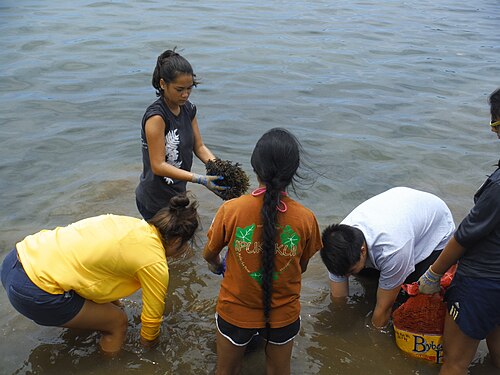
大型藻類、つまり海藻は、多くのサンゴ種と競争して優位に立つことができるため、サンゴ礁の崩壊を引き起こす可能性があります。大型藻類はサンゴを覆い尽くし、日陰を作り、加入を妨げ、産卵を阻害する可能性のある生化学物質を放出し、サンゴに有害な細菌を形成する可能性があります。[ 229 ] [ 230 ]歴史的に、藻類の成長は草食魚やウニによって制御されていました。ブダイはサンゴ礁の世話役の代表例です。したがって、これら2種はサンゴ礁の保護における役割から、サンゴ礁環境におけるキーストーン種とみなすことができます。
1980 年代以前は、ジャマイカのサンゴ礁は繁栄し、手入れが行き届いていましたが、 1980 年にハリケーン アレンが発生し、未知の病気がカリブ海に蔓延した後、状況は一変しました。これらの出来事の後、ジャマイカのサンゴ礁とカリブ海のウニの個体群の両方に甚大な被害が発生しました。元のウニの個体群のうち、病気を生き延びたのはわずか 2% でした。[ 230 ]破壊されたサンゴ礁の後には、主に大型藻類が繁殖し、やがてより大きく、より回復力のある大型藻類が優勢な生物として取って代わりました。[ 230 ] [ 231 ]当時、数十年にわたる乱獲と混獲のため、ブダイやその他の草食魚の数は少なくなりました。[ 231 ]歴史的に、ジャマイカの海岸は 90% のサンゴ被覆率でしたが、1990 年代には 5% に減少しました。[ 231 ]最終的に、ウニの個体数が増加している地域ではサンゴが回復することができました。ウニは餌を食べ、繁殖し、基質を掃除して、サンゴのポリプが定着して成熟できる場所を残しました。しかし、ウニの個体数は、非常に繁殖力が高いにもかかわらず、研究者が予測したほど速くは回復していません。[ 230 ]謎の病気がまだ存在し、ウニの個体数の回復を妨げているかどうかは不明です。いずれにせよ、これらの地域はウニの摂食の助けを借りてゆっくりと回復しています。この出来事は、藻類の過剰繁殖を防ぐためにウニを養殖してサンゴ礁に放流するという初期の修復アイデアを裏付けています。[ 232 ] [ 233 ]
2014年、フロリダ州サマーランドキーのモート海洋研究所の国際サンゴ礁研究・修復センターのクリストファー・ペイジ、エリン・ミュラー、デビッド・ヴォーンは、「マイクロフラグメンテーション」と呼ばれる新しい技術を開発しました。これは、特殊なダイヤモンドバンドソーを使用して、脳サンゴ、巨岩サンゴ、星サンゴの成長を促進するために、サンゴを6cm²ではなく1cm²の断片 に切断するものです。 [ 234 ]フロリダの海岸沖に、いくつかのマイクロフラグメントアレイでOrbicella faveolataとMontastraea cavernosaというサンゴが移植されました。2年後、 O. faveolataは元のサイズの6.5倍に成長し、M. cavernosaはほぼ2倍に成長しました。[ 234 ]従来の方法では、両方のサンゴが同じサイズに達するには数十年かかったでしょう。実験開始時に捕食イベントが発生していなければ、 O. faveolataは少なくとも元のサイズの10倍に成長したと推測されます。 [ 234 ]この方法を用いることで、モート海洋研究所は1年以内に25,000個のサンゴを生成することに成功し、その後、そのうち10,000個をフロリダキーズに移植した。その後まもなく、これらの微小断片が同じ親サンゴ由来の他の微小断片と融合することを発見した。通常、同じ親から生まれたのではないサンゴは、生き残り拡大するために近くのサンゴと戦って殺す。この「融合」と呼ばれる新しい技術は、通常の25~75年ではなく、わずか2年でサンゴ群体を成長させることが示されている。融合が起こると、サンゴ礁は複数の独立したサンゴ礁ではなく、単一の生物として機能する。現在、この方法に関する研究は発表されていない。[ 234 ]
{{citation}}: CS1メンテナンス: DOIは2025年7月現在非アクティブです(リンク){{cite encyclopedia}}: CS1メンテナンス: 場所の発行元が見つかりません (リンク){{cite journal}}: CS1メンテナンス: DOIは2025年7月現在非アクティブです(リンク) この資料は、クリエイティブ・コモンズ表示4.0国際ライセンスの下で利用可能なこのソースからコピーされました。
{{cite journal}}: CS1メンテナンス: アーカイブサービスは非推奨になりました (リンク)