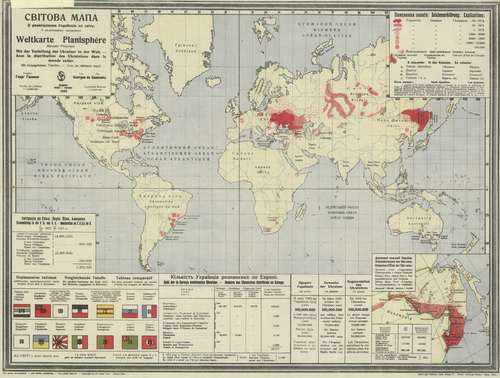
これまでのいくつかの想定によると、ウクライナ出身の人々は北米に約240万人いると推定されています(カナダに1,359,655人、米国に1,028,492人)。また、ブラジル(60万人)、 [ b ]カザフスタン(338,022人)、モルドバ(325,235人)、アルゼンチン(305,000人)、(ドイツ)(272,000人)、イタリア(234,354人)、ベラルーシ(225,734人)、ウズベキスタン(124,602人)、チェコ共和国(110,245人)、スペイン(90,530~100,000人)、ルーマニア(51,703~200,000人)にも多数のウクライナ人が住んでいます。ラトビア、ポルトガル、フランス、オーストラリア、パラグアイ、イギリス、イスラエル、スロバキア、キルギス、オーストリア、ウルグアイ、旧ユーゴスラビア諸国などにも、大規模なウクライナ人コミュニティが存在する。概して、ウクライナ系移民は世界120カ国以上に居住している。
The watershed period in the development of modern Ukrainian national consciousness was the struggle for independence during the creation of the Ukrainian People's Republic from 1917 to 1921.[123] A concerted effort to reverse the growth of Ukrainian national consciousness was begun by the regime of Joseph Stalin in the late 1920s, continuing with minor interruptions until the most recent times. The man-made famine of 1932–33, the deportations of the so-called kulaks, the physical annihilation of the nationally conscious intelligentsia, and terror in general were used to destroy and subdue the Ukrainian nation.[124] Even after Joseph Stalin's death, the concept of a Russified though multiethnic Soviet people was officially promoted, according to which non-Russian nationals were relegated to second-class status. Despite this, many Ukrainians played prominent roles in the Soviet Union, including such public figures as Semen Tymoshenko.
The creation of a sovereign and independent Ukraine in 1991, however, pointed to the failure of the policy of the "merging of nations" and to the enduring strength of the Ukrainian national consciousness.
Biculturalism is especially present in southeastern Ukraine, where there is a significant Russian minority. Historical colonisation of Ukraine is one reason that creates confusion about national identity to this day.[125] Many citizens of Ukraine have adopted Ukrainian national identity in the past 20 years. According to the concept of nationality dominant in Eastern Europe, the Ukrainians are people whose native language is Ukrainian (an objective criterion) whether or not they are nationally conscious, and all those who identify themselves as Ukrainian (a subjective criterion) whether or not they speak Ukrainian.[126]
Attempts to introduce a territorial-political concept of Ukrainian nationality on the Western European model (presented by political philosopher Vyacheslav Lypynsky) were unsuccessful until the 1990s. Territorial loyalty has also been manifested by the historical national minorities living in Ukraine. The official declaration of Ukrainian sovereignty of 16 July 1990 stated that "citizens of the Republic of all nationalities constitute the people of Ukraine."[127][128]
↑ "Bevölkerung in Privathaushalten nach Migrationshintergrund im weiteren Sinn nach ausgewählten Geburtsstaaten"。連邦統計。2019年4月20日のオリジナルからアーカイブ。2022 年2 月 10 日に取得。
↑ "Статистический ежегодник 2017" . Министерство экономического развития, Государственная служба статистики Приднестровской Молдавской Республики。2017 年 9 月 27 日のオリジナルからアーカイブ。2017 年9 月 30 日に取得。
↑ "Євгеній Семенов: "Українська громада в ОАЕ об'єднується, не чекаючи жодних офіційних статусів чи закликів、іце – головне!」" . chasipodii.net。2017年10月16日にオリジナルからアーカイブされました。2017年10月13日に取得。
↑ "Befolkning efter födelseland, ålder, kön och år" .中央統計局。2008 年 12 月 20 日のオリジナルからアーカイブ。2020 年2 月 25 日に取得。
↑ヴコビッチ、ガブリエラ (2018)。Mikrocenzus 2016 – 12. Nemzetiségi adatok [ 2016 microcensus – 12. Ethnic data ] (PDF) (ハンガリー語)。ブダペスト: ハンガリー中央統計局。ISBN978-963-235-542-9. 2022年10月9日にオリジナルからアーカイブ(PDF)。2019年1月9日に取得。
↑カペラー、アンドレアス(2023)。Ungleiche Brüder: Russen und Ukrainer vom Mittelalter bis zur Gegenwart。ミュンヘン: CHBeck oHG。 p. 260.ISBN978-3-406-80042-9。...、政治国家、ウィレンスネーション、政治国家、ウィレンスネーションなどのポストでウクライナ人が死ぬのは、非常に重要なグループです。[ ...ソ連崩壊後の時代、ウクライナ人は自分たちを政治国家、つまりいくつかの民族および言語グループを含む意志による国家 (ウィレンスネーション、市民国家) であるとますます見なすようになりました。】
1 2ルチェンコ、ヴァレンティン(2009 年 2 月 11 日)。Походження назви "Україна"[ウクライナという名前の由来](ウクライナ語)。luchenko.com。2016年3月9日にオリジナルからアーカイブ済み。2016年3月16日に取得。
1 2 3Історія України IX-XVIII Історія України IX-XVIII ст。 Персоджерела та інтерпретації[ウクライナの歴史 9~18世紀。一次資料と解釈](ウクライナ語)。Litopys.org.ua。2012年12月10日にオリジナルからアーカイブ。 2016年3月16日取得。
1 2 3Україна。 Русь。 Назви території і народу[ウクライナ。ルーシ。地域名と民族名]。ウクライナ百科事典 – I(ウクライナ語)。第1巻。Litopys.org.ua。1949年。2021年2月11日にオリジナルからアーカイブ。 2016年3月16日取得。
↑セルヒー・プロヒー(2008).ウクライナとロシア:過去の表象. トロント大学出版局. p. 139. ISBN978-0-8020-9327-12016年3月16日に取得。
↑ Baranovska NM (2012).Актуалізація ідей автономізму та федералізму в умовах національної революції 1917–1921 £。 як лях відстоювання державницького розвитку України[ 1917~1921年の国民革命の状況下における自治と連邦制の理念の実現:ウクライナ国家の発展を守る道] (PDF) (ウクライナ語)。リヴィウ工科大学。2013年12月19日にオリジナル(PDF)からアーカイブ。 2016年3月15日取得。
↑ "Ф.А. Гайда. От Рязани и Москвы до Закарпатья. Происхождение и употребление слова "украинцы" // Родина. 2011. № 1. С. 82–85"。 Edrus.org。2015 年 9 月 23 日のオリジナルからアーカイブ。2012 年10 月 30 日に取得。
↑ "Україна" – це не "окраїна"。 Litopys.org.ua。2020年11月16日のオリジナルからアーカイブ。2012 年11 月 2 日に取得。
↑ 「Przynależność narodowo-etniczna ludności – wyniki spisu ludności i mieszkań 2011. Materiał na konferencję prasową w dniu 29. 01. 2013」(PDF)。stat.gov.pl。ポーランド中央統計局。 p. 3. 2020 年 5 月 15 日のオリジナルからアーカイブ(PDF) 。2017 年6 月 19 日に取得。
↑"See map: Ukrainians: World Distribution". Encyclopedia of Ukraine. Archived from the original on 17 September 2020. Retrieved 30 October 2012.
↑"UWC continually and diligently defends the interests of over 20 million Ukrainians". Ukrainian Canadian Congress. 25 May 2010. Archived from the original on 25 December 2018. Retrieved 2 November 2012.
↑"Ukrainian diaspora abroad makes up over 20 million". Ukrinform.ua. 28 August 2009. Archived from the original on 5 January 2012. Retrieved 2 November 2012.
↑"20million Ukrainians live in 46 different countries of the world". Ukraine-travel-advisor.com. 5 December 2001. Archived from the original on 29 March 2007. Retrieved 2 November 2012.
↑Compare: Volodymyr Kubijovyc; Danylo Husar Struk, eds. (1990). "Ukrainians". Encyclopedia of Ukraine. Canadian Institute of Ukrainian Studies (CIUS) (University of Alberta/University of Toronto). Archived from the original on 7 January 2019. Retrieved 10 November 2009. From the 7th century AD on, proto-Ukrainian tribes are known to have inhabited Ukrainian territory: the Volhynians, Derevlianians, Polianians, and Siverianians and the less significant Ulychians, Tivertsians, and White Croatians.
↑"Polianians (poliany)". Encyclopediaofukraine.com. Archived from the original on 1 November 2020. Retrieved 2 November 2012.
↑Zhukovsky, Arkadii. "Varangians". Encyclopediaofukraine.com. Archived from the original on 1 November 2020. Retrieved 2 November 2012. ...Varangians assimilated rapidly with the local population.
↑"Kyivan Rus'". www.encyclopediaofukraine.com. 1988. Archived from the original on 26 March 2023. Retrieved 1 April 2023. According to some sources, the first Varangian rulers of Rus' were Askold and Dyr.
↑Ihor Lysyj (10 July 2005). "The Viking "drakkar" and the Kozak "chaika"「 .ウクライナ週刊誌。ニュージャージー州パーシッパニー。2020年11月1日にオリジナルからアーカイブ済み。2012年11月2日に取得。
↑ Andriy Pyrohiv (1998). "Vikings and the Lavra Monastery" . Wumag.kiev.ua. 2012年9月1日時点のオリジナルよりアーカイブ。 2012年11月2日閲覧。
↑ France Meslè et Jacques Vallin avec destributions de Vladimir Shkolnikov, Serhii Pyrozhkov et Serguei Adamets, Mortalite et Cause de dècès en Ukraine au XX siècle Archived 13 June 2018 at the Wayback Machine p.28、参照 France Meslé、Gilles Pison、Jacques Vallinフランスとウクライナ: 歴史によって分けられた人口動態の双子2018 年 9 月 17 日にウェイバック マシンにアーカイブ,人口と社会, N°413, juin 2005
↑ Jacques Vallin、France Mesle、Serguei Adamets、Serhii Pyrozhkov、「 1930年代と1940年代の危機におけるウクライナの人口減少に関する新たな推計」(Wayback Machineに2022年3月23日にアーカイブ済み) 、 Population Studies、第56巻、第3号(2002年11月)、249~264ページ
↑スタニスラフ、クルチツキー (2002 年 11 月 23 ~ 29 日)。Сколько нас погибло от Голодомора 1933 года?[ 1933年のホロドモールで亡くなった人は何人いたのか?]。Zerkalo Nedeli(ロシア語)。2006年11月28日にオリジナルからアーカイブ済み。スタニスラフ・クルチツキー(2002年11月23~29日)。Скільки нас загинуло під Голодомору 1933 року?[ 1933年のホロドモールで亡くなった人は何人いるだろうか?]。Zerkalo Nedeli(ウクライナ語)。2003年2月1日にオリジナルからアーカイブ済み。
↑Peter Finn, Aftermath of a Soviet FamineArchived 21 October 2014 at the Wayback Machine, The Washington Post, 27 April 2008, "There are no exact figures on how many died. Modern historians place the number between 2.5million and 3.5million. Yushchenko and others have said at least 10 million were killed."
↑"Ukrainian National Republic". Encyclopediaofukraine.com. 1993. Archived from the original on 11 February 2021. Retrieved 15 March 2016.
↑"Famine-Genocide of 1932–3 (Голодомор; Holodomor)". Encyclopediaofukraine.com. 7 August 1932. Archived from the original on 16 November 2020. Retrieved 2 November 2012.
↑Олександр Lytvynenko, Oleksandr; Yakymenko, Yuriy (19 May 2008). "Russian-Speaking Citizens of Ukraine: "Imaginary Society" as it is". Razumkov Centre. Archived from the original on 19 March 2016. Retrieved 15 March 2016.
↑"Viewed from a historical perspective, Ukrainians are people whose native language is Ukrainian". Encyclopediaofukraine.com. 16 July 1990. Archived from the original on 7 January 2019. Retrieved 2 November 2012.
↑"Ukrainian nationality on the Western European model (e.g., by Vyacheslav Lypynsky) were unsuccessful until the 1990s". Encyclopediaofukraine.com. 16 July 1990. Archived from the original on 7 January 2019. Retrieved 2 November 2012.
↑"Ethnic Self-Identification in Ukraine". Archived from the original on 23 June 2011. Retrieved 2 November 2012– via Find Articles.
↑Paulsen, Martin (2011). "Digital Determinism: the Cyrillic Alphabet in the Age of New Technology". Russian Language Journal / Русский Язык. 61. American Councils for International Education: 119–141. JSTOR43669201.
↑ Kornienko, Anna (2020年6月12日). 「近縁言語と遠縁言語間のマスキングされた語彙プライミング」(PDF) .ベルゲン大学. 2021年9月24日にオリジナル(PDF)からアーカイブ済み. 2024年6月8日取得.
↑パブレンコ、アネタ (2011)。 「ロシア帝国における言語ロシア化:農民がロシア人に? / Языковая руссификация в Российской империи: стали ли крестьяне русскими?」。ロシア言語学。35 (3)。Springer Nature : 331–350 . doi : 10.1007/s11185-011-9078-7。JSTOR 41486701。
↑ Центр、Разумков。「Конфесійна та церковна належність громадян України (січень 2020р. соціологія)」。ラズムコフ.org.ua。2021年7月31日のオリジナルからアーカイブ。2021 年5 月 25 日に取得。
1 2Релігія, Церква, суспільство і держава: два роки після Майдану[宗教、教会、社会、国家:マイダン革命から2年] (PDF) (ウクライナ語)、キエフ:ラズムコフ・センター(全ウクライナ教会協議会との共同出版)、2016年5月26日、22、27、29、31ページ、2017年4月22日にオリジナル(PDF)からアーカイブ、 2017年4月28日取得
パーフェッキー、ジョージ A. (1973).ヒュパティア写本 第二部:ガリツィア・ヴォルィーニ年代記。ジョージ A. パーフェッキーによる注釈付き翻訳。ミュンヘン:ヴィルヘルム・フィンク出版。OCLC 902306。
マフノヴェツ、レオニード(1989)。Літопис Руський за Іпатським списком [ヒュパティア法典によるロシアの年代記] (ウクライナ語)。キエフ: ドニプロ。 p. 591.ISBN5-308-00052-22024年7月18日に取得。—ヒュパティアヌス写本に基づき、フレブニコフ写本からの注釈を加えた、ガリツィア・ヴォルィーニ年代記の現代ウクライナ語注釈付き翻訳。