
Loading article…
ブレグジットに関する議会投票(「意味のある投票」と呼ばれることもある)は、英国政府がブレグジット離脱協定を批准するために、政府と欧州連合間の第50条交渉の終了時に修正可能な議会動議を提出することを義務付ける、 2018年英国欧州連合(離脱)法第13条の規定に基づく議会投票であった。[ 1 ] [ 2 ]
この条項の文言[注1 ]は、庶民院と貴族院の両方で激しく争われ、貴族院は議会にさらなる権限を与える法案の修正案を提出した。法案が庶民院に戻された際、保守党政権は譲歩案を提示し、貴族院の修正案は否決された。その後、法案は2018年6月26日に法律として成立した。[ 3 ]
2019年3月末までに、政府は重要な採決でいずれも勝利を収めることができなかった。このため、ブレグジットの選択肢に関する拘束力のない「示唆的投票」が複数回行われ、離脱日は2019年の総選挙後まで延期された。

2016年6月23日の諮問国民投票の結果、英国が欧州連合からの離脱を決定したことを受け、英国政府は欧州連合条約第50条を発動した。そのため、英国は2019年3月29日午後11時(UTC)にEUを離脱することになっていた。[ 4 ]
英国の実業家ジーナ・ミラーは、議会の承認なしに第50条を発動する政府の権限に異議を唱え、政府を提訴した。2016年11月3日、高等法院は、R(ミラー)対欧州連合離脱担当国務長官事件においてミラーに有利な判決を下した。[ 5 ] [ 6 ]

2017年1月、保守党のテリーザ・メイ首相は、「本日、英国とEUの間で合意された最終合意案を、発効前に両院で採決にかけることを政府が確認できる」と発表した。[ 7 ] [ 8 ]その結果、2017年7月13日、欧州連合離脱担当大臣のデイビッド・デイビスは、以下の第9条の声明を含む法案を下院に提出した。
政府法案であるため、この第一読会は形式的なものであり、最初の討論は第二読会で行われた。[ 10 ]
2017年4月18日、テリーザ・メイ首相は、ブレグジット交渉における自身の立場を強化する目的で、2017年6月8日に総選挙を実施すると発表した。 [ 11 ][12]その結果、議会は過半数政党のない状態となり、保守党は1983年以来最高の得票率を獲得したにもかかわらず、議席数は330から317に減少した。そのため、メイ首相は少数与党政権を支えるため、民主統一党(DUP)と信任供給協定を結んだ。
2017年7月、欧州連合離脱担当国務大臣のデイビッド・ジョーンズは、EUとのブレグジット協定に関する議会の採決は「欧州議会が最終合意について議論し採決を行う前に」行われると予想していると下院で述べた。議員と上院議員が協定を好まないと判断した場合どうなるかを明確にするよう求められたジョーンズは、「採決は協定を受け入れるか、合意がないかのどちらかになるだろう」と述べた。[ 13 ] 10月の欧州連合離脱特別委員会の会合で、労働党議員のシーマ・マルホトラはデイビスに「英国議会の採決は2019年3月以降になる可能性があるか?」[注2 ]と尋ね、デイビスは「はい、可能性はあります」と答えた。[ 14 ]これに対し、労働党の野党議員と一部の保守党議員から批判が出た。 [ 15 ] [ 16 ]
2017年12月、英国がEUを離脱する予定日である2019年3月29日より前に、英国とEU間の離脱協定の最終条件を議会が承認できるように、第9条を修正するよう政府への圧力が高まった。保守党議員のドミニク・グリーブは、政府に自ら条項を修正するよう助言し、さもなければ法案に独自の修正案を提出するとした。[ 17 ]グリーブは、ブレグジット協定は政府命令によって実施されるのではなく、法律によって制定されなければならないとする修正案(修正案7)を法案に提出した。[ 18 ]
その後、第9条は以下のように議会に提出された(グリーブ議員による追加、修正案7は斜体で示す)。
修正案に関する下院での採決の前の週末、EU関係に関する超党派議員連盟の指導者らは、「全党の議員は既にEU(離脱)法案に貴重な精査を行い、政府にいくつかの譲歩を強いてきた。しかし、政府が欧州連合と交渉する離脱協定について真に意味のある採決ができない限り、それらのほとんどは何の意味もないだろう」という声明に署名した。[ 20 ] [ 21 ]
2017年12月13日の朝、デイビス氏は書面による声明を発表し、「英国では、政府は交渉終了後できるだけ早く議会で最終合意案の採決を行うことを約束した。この採決は議会の両院で決議という形で行われ、離脱協定と将来の関係に関する条件の両方を対象とする」と述べた。[ 22 ]
その日の午後、首相質疑で、保守党議員のアンナ・ソウブリーはメイ首相にグリーブ議員の修正案を受け入れるよう求め、「首相は、欧州連合を離脱する前に、ブレグジットに関する意味のある投票を望んでいると言っています。この最後の瞬間でも、ここにいる全員と国中の人々の団結の精神で、私の尊敬する友人[グリーブ]の修正案7を受け入れていただけますか?」[ 24 ]メイ首相はこの考えを拒否し、「意味のある投票が行われるまで、いかなる法令も開始しないことは明確にしてきましたが、現在の草案[グリーブの草案]では、離脱協定と実施法案が法律集に届くまで、いかなる取り決めや法令も実施すべきではないと修正案は述べています。それは手続きの非常に遅い段階になる可能性があり、そうなると、私たちが望むような秩序ある円滑な欧州連合からの離脱ができなくなる可能性があります」と述べた。[ 25 ]
その日の夕方、グリーブの修正案は309対305の4票差で可決され、政府にとって敗北となった。[ 18 ] [ 26 ] [ 27 ] [ 28 ] 12人の保守党議員が政府に反対票を投じた。グリーブ、ソウブリー、ハイディ・アレン、ケネス・クラーク、ジョナサン・ジャノグリー、スティーブン・ハモンド、オリバー・ヒールド、ニッキー・モーガン、ボブ・ニール、アントワネット・サンドバック、ジョン・スティーブンソン、サラ・ウォラストンの12人である。[ 26 ]その1か月前、スティーブンソンを除く全員が、同僚の保守党議員であるヴィッキー・フォード、ジェレミー・レフロイ、ポール・マスタートン、トム・トゥーゲンハットとともに、デイリー・テレグラフ紙の一面で「ブレグジットの反逆者」として紹介された。[ 29 ]

2018年4月の貴族院報告段階で、ヘイルシャム子爵[ 30 ]は次のような新しい条項を導入した。
新条項を含む修正案は、上院で335対244の91票差で可決され、政府にとってさらなる敗北となった。[ 32 ] [ 33 ]この新たな文言は、議員に英国のEU離脱を合意なしに阻止する権限、あるいはテリーザ・メイ首相を交渉の場に戻す権限を与えるものであった。[ 34 ]
政府は、議会が離脱協定を否決した場合に政府の次の行動を決定する権限を庶民院に与えるという貴族院の提案を拒否した。[ 35 ]

労働党のキア・スターマー議員は、英国のEU残留を望む保守党議員に対し、法案が下院に戻った際に労働党と共に上院修正案に賛成票を投じるよう促した[ 36 ] [ 37 ]。また、労働党の元首相ゴードン・ブラウンは、メイ首相が採決で敗北した場合、保守党の新たな首相に交代する可能性があると示唆した[ 38 ]。保守党の残留派の有力者であるアンバー・ラッドは、党所属議員に対し、採決で政府を支持するよう促した[ 36 ] 。
議会のピンポンプロセスは、2018年6月12日から20日の間に行われた。[ 39 ] [ 40 ]
法案が下院に再提出される予定だった2018年6月11日の前夜、ドミニク・グリーブは土壇場で代替修正案を提出した。上院の修正案は「合意なき離脱」シナリオを回避し、下院議員と上院議員はメイ首相に交渉のテーブルに戻ってより良い条件を得るよう求めることができるというものだった。グリーブの修正案は「合意なき離脱」シナリオにも対処したが、メイ首相が議会に戻って「合意なき離脱」の場合の政府の意向を表明し、その計画について議会の承認を得るための期日を定めた。[ 41 ]
グリーブ氏の修正案:
投票当日の2018年6月12日の朝、政府はグリーブ議員による代替修正案を否決した。これにより、英国が合意なしにEUを離脱する場合に議会が発言権を持つべきかどうかについての庶民院での議論に意見の相違が生じることになった。[ 41 ] [ 43 ]また、同日朝にはフィリップ・リー保守党の若手大臣が突然辞任し、「将来、自分の子供たちの目を見て、彼らのために最善を尽くしたと正直に言えるためには、我が国の現在のEU離脱の進め方を支持することは良心に反する」と述べた。[ 44 ]
議論が続く中、政府は保守党の反乱の可能性のある議員に対し、上院が検討する新たな修正案で彼らの懸念に対処すると保証した。閣僚が提示した譲歩には、ブレグジット合意が下院議員と上院議員によって否決された場合に新たな議会動議を提出することが含まれていると考えられており、[ 3 ]閣僚がブリュッセルで合意に達することができなかった場合、下院議員が交渉の主導権を握る道が開かれることになる。[ 45 ]この譲歩により、政府は324対298の票を獲得し、26票の多数派となった。[ 3 ] [ 46 ]
BBCのニュースナイトで、グリーブ氏は、メイ首相は、最終的なブレグジット合意について議会がより大きな発言権を持つという「保証」を守らなければならないと述べた。[ 47 ] [ 48 ]保守党内では合意内容について意見の相違があり、アンナ・ソウブリー議員は、「首相は昨日、ドミニク・グリーブ氏の修正案の条項cが、上院に提出される新たな修正案の一部として議論されると述べた」[ 49 ]と述べ、スティーブン・ハモンド議員は、「議会は『合意なき離脱』の状況で発言権を持てなければならず、我々は今日、この点を政府に強く伝えた。政府はこの点を認め、この状況に対応する新たな修正案が間もなく提出されることを期待している」[ 50 ]と書いている。
ダウニング街の報道官は、首相は協議を継続することのみに同意したと主張し、デイビスのブレグジット省は「我々は、下院が交渉において政府の手を縛ることに同意したことはなく、今後も同意することはない」という声明を発表した。[ 49 ]保守党議員のアンドリュー・ブリッジンは、ブレグジット法案に対するグリーブの修正案を支持する保守党残留派が、英国がEUから完全に離脱するのを意図的に阻止しようとしていると非難した。[ 51 ]
投票の翌日、下院での首相質疑でメイ首相は次のように述べた。「ブレグジットのプロセスにおける議会の役割について懸念が表明されているのを見てきました。昨日私が合意したのは、法案が上院に戻される際に、これらの懸念について同僚とさらに議論することです。今朝、ブレグジット担当大臣と合意し、上院に修正案を提出することになりました。その際、私たちのやり方を導くいくつかの事項があります…私の尊敬するブレグジット担当大臣が昨日下院で明確にしたように、交渉における政府の手は議会によって縛られることはありませんが、政府は議会に対して責任を負わなければなりません。政府が政策を決定し、その政策を実行できるようにするために議会の支持が必要になります。」[ 52 ] BBCのローラ・クエンスバーグは、 「リスクは、それが二枚舌に見えることだ」とコメントした。[ 53 ]
2018年6月14日の夜、政府は妥協案となる修正案を発表した。
2018年6月15日現在 反乱を起こした保守党議員らは、この修正案が下院に「中立的な表現での動議」しか認めていないため、依然として不満を抱いていると伝えられている(5C)(b)(i)。グリーブは当初、この修正案で、政府は行動方針について議会の承認を得なければならず、大臣は議員と貴族院議員の指示に従わなければならないと規定することを望んでいた。[ 55 ] [ 56 ]

2018年6月14日の夜、有意義な投票に関する当初の修正案を提出したヘイルシャム子爵は、グリーブの修正案を自身の名義で貴族院に全文再提出した。[ 30 ] [ 57 ]修正案が貴族院に再提出される前に、サンデー・ポリティクス番組でグリーブは次のように語った。「代替案は、我々全員が今、奴隷条項に署名しなければならないということだ。『1月に政府が何をしようとも、それが私の選挙区民や国にとってどれほど壊滅的な結果をもたらす可能性があろうとも、私は今、崖っぷちまでついていくと血で署名する』と。しかし、私はそんなことをする覚悟はない。」同じ番組に出演した法務長官で保守党議員のロバート・バックランド氏は、「もしあなたがミシェル・バルニエで、交渉と将来を見据えていたとしたら、英国政府が今何を言おうと、最終的にはこの関係に第三者、つまり議会が介入し、英国政府の言うことを覆すことになるということを知っていれば、彼には切り札が少しあることになる。これはデイビッド・デイビスにとって良い状況ではない。デイビッド・デイビスは、しっかりとした交渉力を持って臨む必要がある…」と答えた。[ 58 ]
6月18日、ヘイルシャム卿の修正案が貴族院で可決され、政府は354対235で敗北した。多数決は119票だった。[ 59 ] [ 60 ]
6月20日に法案が下院に戻された際、政府はさらなる譲歩を行った。この譲歩により、政府は319対303の票差で勝利し、16票の過半数を獲得した。[ 61 ] [ 62 ]
グリーブ氏は後にこう述べた。「我々は政府を崩壊させることなく妥協点に達することができた。そして、我々がそれにかなり近づいていたことに気づいていない人もいると思う。反対意見を持つ同僚の意見は完全に尊重するが、妥協できればより多くのことを達成できる。」[ 62 ]
2018年11月末、メイ首相はEUとの17ヶ月に及ぶ交渉を終え、欧州との将来の関係に関する合意案を下院に提出した。[ 64 ]その結果、意味のある投票の最初の実施は2018年12月11日に予定された。[ 65 ]
英国議会がこの合意案に反対票を投じた場合、政府は代替案、つまり「プランB」を提示する必要がある。[ 66 ]その結果、グリーブ議員は、議会が合意案を否決した場合の手続きについて、議事進行に関する修正案を提出した。[ 2 ]その修正案には次のように記されている(変更箇所は斜体):[ 67 ]
議事規則第24B条には、「議長の意見では、動議が中立的な表現で表現されている場合、その動議に対する修正案は提出できない」と規定されている。[ 68 ]グリーブの修正案は、この議事規則を同法の有意義な投票条項に基づいて提出された動議に適用しないものであり、これにより離脱手続きに関する動議は議会によって修正可能となる。[ 2 ]
グリーブの修正案が可決された(賛成321票、反対299票)ことで、議員は動議を変更できるようになり[ 65 ] 、英国のEU離脱に関してより大きな発言権を持つようになった[ 66 ] 。
2018年法の第13条は次のように規定している。
2018年12月4日、政府はS13(1)(b)の規定に従い、有意義な投票のスケジュールを定める議案を提出し、投票は2018年12月11日に予定された。[ 69 ]
2019年1月9日、政府は2018年12月11日の投票が中止されたことを受けて日程を改訂した。[ 70 ]
グリーブは改訂された時間割の別の修正案(変更箇所は斜体)で成功した:[ 71 ]
これは、政府が2019年1月15日の延期された重要な投票で敗北したとき、政府には「プランB」を作成するために3日間(2019年1月21日まで)の議会審議期間があったことを意味する。[ 72 ]

重要な投票は2019年1月15日に下院で行われた。[ 73 ]当初、投票は2018年12月11日に予定されていたが、12月10日にメイ首相は、政府のブレグジット合意案が否決されることが明らかになったため、投票を延期した。[ 74 ] [ 75 ]
予想通り、政党の立場に大きな変化がなかったため、政府は1月15日の投票で432対202で敗北した。230票差での敗北は、近代議会の歴史上、どの政府にとっても最悪の敗北となった。[ 76 ]保守党議員196名、労働党議員3名、無所属議員3名が合意を支持した。合意に反対票を投じたのは、保守党議員118名、労働党議員248名、スコットランド国民党議員35名全員、自由民主党議員11名全員、民主統一党議員10名全員、ウェールズ国民党議員4名全員、緑の党議員1名、無所属議員5名であった。[ 77 ]
この合意に賛成票を投じた労働党議員は、イアン・オースティン、ケビン・バロン、ジョン・マンの3名だった。この合意に賛成票を投じた無所属議員は、レディ・ハーモン(無所属で選出)、フランク・フィールド(労働党で選出)、スティーブン・ロイド(自由民主党で選出)の3名だった。この合意に反対票を投じた無所属議員は、ジョン・ウッドコック、ジャレッド・オマラ、ケルビン・ホプキンス、イヴァン・ルイス、フィオナ・オナサンヤの5名で、いずれも労働党で選出されていた。[ 77 ]
棄権したのは、労働党議員1名(長期療養のため欠席したポール・フリン) [ 78 ] 、棄権主義の方針に従うシン・フェイン党議員7名全員、その他8名(議長ジョン・バーコウ、副議長エレノア・レイン(保守党)、リンジー・ホイル(労働党)、ロージー・ウィンタートン(労働党))であった。さらに、投票集計係の投票は考慮されない(賛成票は保守党のウェンディ・モートンとイアン・スチュワート、反対票は労働党のヴィッキー・フォックスクロフトとニック・スミス)。[ 79 ] [ 80 ]
賛成(202)
ノーズ(432)
棄権(1)
直後、野党党首のジェレミー・コービンは政府に対する不信任決議案の採決を求め、2019年1月16日に採決が行われた。政府は325対306で19票差で勝利した。[ 81 ]
2018年法の第13条は、政府が、首相が1月21日と24日に発表した書面声明(首相は「プランB」を提示した)に対する中立的な表現での動議を提出することを義務付けていた。ドミニク・グリーブによる議会日程への「3日間の修正」に従い、この動議は1月21日(離脱協定案が議員によって否決されてから3会期後)に提出され、2019年1月29日に採決にかけられた。この動議は、下院が首相の声明を「検討した」という趣旨の決議の形をとった。この中立的な動議は修正の対象となり、主要な動議の採決に先立ち、下院は議員によって提案され議長によって選ばれた7つの修正案について採決を行った。[ 82 ]
2つの修正案が可決された。ブレイディ修正案は、政府に北アイルランドのバックストップについて再交渉するよう求めた。これは16票で可決され、保守党とDUPが他の政党を上回ったが、労働党議員7人が賛成し、保守党議員8人が反対した。スペルマン・ドロミー修正案は、合意なきブレグジットを回避したいという下院の意思を表明した。これは8票で可決され、保守党とDUPを除くすべての政党が賛成したが、保守党議員17人が賛成した。合意なき離脱を防ぐ拘束力のある法律への道を開くことを目指すクーパー・ボウルズ修正案は23票で否決された。他の3つの修正案も否決された。[ 83 ] [ 84 ]修正された主要動議は、その後、採決なしで可決された。
メイ首相は、さらなる「意味のある投票」が「可能な限り速やかに」行われると述べたが、2月13日までに行われなかった場合は声明を発表し、2月14日に修正動議に関する討論を行うと述べた。[ 86 ]
2019年2月12日、テリーザ・メイ首相は、離脱協定締結に向けた政府の進捗状況について下院で声明を発表した。[ 87 ]これに続き、2月14日には、以下の内容の修正動議が採決された。「本院は、2019年2月12日の首相の声明を歓迎し、2019年1月29日に本院が表明したEU離脱へのアプローチに対する支持を改めて表明するとともに、英国とEUの間で北アイルランドのバックストップに関する協議が継続中であることを留意する。」
動議に対するすべての修正案は否決された。動議自体も303対259の差で否決されたが、これは保守党議員の欧州研究グループ派が、この動議は離脱協定なしでのEU離脱を排除しているように見えると反対し、棄権したことが一因である。[ 88 ]
2月12日の声明で、首相は離脱協定に関する2度目の「意義のある投票」を行うという目標を改めて表明した。そして、2月26日までにこれが実現しない場合は、政府は議会に対し進捗状況に関する声明を改めて提出し、その声明に関連する修正動議を提出し、2月27日に採決に付す予定であると述べた。
2019年2月27日、下院は、以下の内容の修正動議を採決した。「本院は、2019年2月26日の首相による欧州連合離脱に関する声明を留意し、また、英国とEU間の協議が継続中であることを留意する。」
2つの修正案が可決された。英国とEUが市民の権利に関する共同の約束を求める修正案は、無投票で可決された。2019年3月にさらなる有意義な投票を行うための期限を定める修正案は、502対20の差で可決された。その後、修正された主要動議は無投票で可決された。[ 89 ]
2回目の重要な投票は2019年3月12日に行われた。[ 90 ]この合意は保守党議員235名、無所属議員4名、労働党議員のケビン・バロン、キャロライン・フリント、ジョン・マンによって支持され、残りの議員、すなわちDUP議員10名全員と保守党議員75名によって反対された。[ 91 ]保守党議員のダグラス・ロスは、投票日に子供が生まれたため、投票も代理投票の権利を行使することもできなかった。[ 92 ] [ 93 ]
賛成(242)
ノーズ(391)
Abstentions (1)

Under the terms of the 27 February motion, the defeat of the second meaningful vote means that the Government must promptly bring forward a motion regarding leaving the European Union without a withdrawal agreement. The motion, which blocked a no-deal Brexit, was presented on 13 March.[94][95] Two amendments to the motion were voted upon: the first, tabled by Caroline Spelman and categorically rejecting no-deal in any circumstances, passed 312–308; the second, the "Malthouse compromise" supporting a so-called "managed no-deal Brexit", failed 164–374.
As leaving the European Union without a deal was rejected, then the Government was required to bring to 14 March sitting a motion regarding extending Article 50 past 29 March.[97]
The motion as tabled by the Government states that if the Withdrawal Agreement had not been ratified by 20 March, then the Government would seek an extension of Article 50 to 30 June, the last possible day that Brexit could take place without requiring British participation in May's European elections.[98]
Four amendments were selected for debate alongside the motion:[99]
The main motion was approved by 412–202.
Tabled by Oliver Letwin, the amendment passed 329–302 and required the Commons to hold a series of indicative votes on 27 March. Three ministers resigned from the government to support the amendment: Richard Harrington (business minister), Alistair Burt (foreign office), and Steve Brine (health). The Beckett amendment, tabled by Margaret Beckett, was defeated 314–311. It would have required Parliament to vote favourably for a "no deal" Brexit or request an extension to Article 50 if the government was within seven days of leaving the European Union without a deal. The amended main motion (Letwin but not Beckett) passed 327–300.
As a result of the first Letwin amendment's success, indicative votes on Parliament's preferred Brexit options were held on 27 March. Eight propositions were voted upon, of which all eight failed.[101]
In a departure from Westminster parliamentary convention, all eight votes took place simultaneously, using ballot papers, rather than having MPs walk through lobbies to signify their vote.
As parliament had agreed to an extension of Article 50 to 30 June the possibility of a third meaningful vote was raised[98] and the Speaker ruled that "the same proposition or substantially the same proposition" could not be brought back in the same parliamentary session.[102][103] The Political Declaration was then removed from the ballot in order to make it a different proposition.[104]
The third vote meaningful vote on the Withdrawal Agreement was then able to take place on 29 March 2019.[105] May promised to resign as Prime Minister if the Withdrawal Agreement was passed.[106] In the end, May's deal was voted down again, albeit by a smaller margin than in the previous two votes.[107]
Further indicative votes were held on 1 April on propositions chosen by the Speaker.[108][109]
Once again, in a departure from parliamentary convention, rather than having MPs walk through lobbies to indicate their vote choice, all four votes took place simultaneously using ballot papers. In response to his and all other propositions being rejected, Nick Boles resigned from the Conservative party in protest, citing his party's "refusal to compromise".[110]
Since none of the tabled propositions in the second round of indicative votes could command a majority in the House of Commons, a third round of indicative votes was planned to be held on 3 April.[111] On the day of 3 April 2019, the House of Commons focused instead on debating the "European Union (Withdrawal) (No. 5) Bill". This bill was otherwise known as the Cooper–Letwin Bill, after its chief sponsors Yvette Cooper (Labour) and Oliver Letwin (Conservative). The bill places an obligation on the Government to seek consent for any or no extensions to the date of withdrawal from the EU. To do so, the House of Commons first debated a business of the House motion to allow the Bill to be brought in for debate on that day. There was one proposed amendment to the Business of the House motion, which would have sought to schedule more indicative votes for 8 April 2019; this failed in the first tied vote since 1993.[112]
The tie was broken by the Speaker in favour of "No" (in accordance with Speaker Denison's rule), meaning the motion was rejected. The lack of passage of this motion meant that no further indicative votes would be scheduled by the House of Commons to be held on 8 April 2019.[113]
After losing the third vote and the approval of the Cooper–Letwin Bill at the third reading by 313–312, May and her cabinet considered the possibility of bringing the withdrawal agreement back to parliament for a fourth vote.[115] In mid-May, May said that she would bring the withdrawal agreement to the parliament in the first week of June.[116] Due to huge opposition to the new agreement, May postponed the publication from 24 May to 4 June, and subsequently resigned as prime minister.[117]
Boris Johnson, elected Conservative Party leader in July, and invited by the Queen to become Prime Minister, announced on 28 August that he had requested the Queen to prorogue Parliament from between 9 September and 12 September until the beginning of a new session on 14 October. On the advice of the (minimally quorate) Privy Council and in accordance with constitutional convention, the Queen granted this request the same day.[118]
Once Parliament reconvened from summer recess, Labour MP Hilary Benn presented a bill that would rule out a unilateral no-deal Brexit by forcing the Government to reach an Agreement, get parliamentary approval for no-deal Brexit, or, if neither condition is fulfilled by 19 October, then request the European Council for an extension to the Brexit withdrawal date until 31 January 2020.[119][120]
On 3 September, Oliver Letwin submitted a motion for an emergency debate on this bill, in accordance with Standing Order No. 24. This motion, to allow the debate for the following day, passed, 328 to 301.[121][122] 21 Conservative MPs voted for the motion and were then removed from the Conservative whip, as Johnson had threatened to do in advance. The 21 MPs were Guto Bebb, Richard Benyon, Steve Brine, Alastair Burt, Greg Clark, Ken Clarke, David Gauke, Justine Greening, Dominic Grieve, Sam Gyimah, Philip Hammond, Stephen Hammond, Richard Harrington, Margot James, Letwin, Anne Milton, Caroline Nokes, Antoinette Sandbach, Nicholas Soames, Rory Stewart and Ed Vaizey. This, combined with Phillip Lee’s defection to the Liberal Democrats earlier that day, gave the Opposition a 43-seat majority over the Government.
Johnson further announced his intention to seek an early general election. Under the Fixed-Term Parliaments Act, a two-thirds majority of the House of Commons is necessary for this motion to pass, but opposition leaders indicated that they would refuse support until after Benn's bill is passed.[123]
On 4 September, the Benn Bill passed second reading by 329 to 300; a 22nd Conservative, Caroline Spelman, voted against the Government position.[124] Later the same day MPs subsequently rejected Johnson's motion to call an October general election, failing to achieve the two-thirds Commons majority needed under the Fixed-term Parliaments Act, in a vote of 298 to 56. Labour MPs abstained from the vote.[125]
On 9 September, the Benn Bill was granted royal assent.[126] On the same day, MPs backed a motion calling for the publication of all government communications relating to no-deal Brexit planning and the suspension of Parliament, voting 311 to 302.[127] A second government motion calling for an early general election failed to achieve the required super-majority, with 293 MPs voting in favour of it.[128] Parliament was then prorogued until 14 October.[129] The prorogation was subsequently overturned on 24 September following legal challenges against the government,[130][131][132] and parliament reconvened the following day,[133][134] with a shorter prorogation then taking place for six days, from 8 to 14 October.[135]
Following further negotiations between the UK and EU, a revised withdrawal agreement was reached on 17 October.[136] A special Saturday sitting of Parliament was held two days later to debate the new agreement.[137][138][139] MPs passed the second Letwin amendment 322 to 306, which withheld Parliament's approval until legislation implementing the deal has been passed, and forced the Government to request the EU for a delay to Brexit until 31 January 2020.[140] The amended motion was then passed by MPs without a vote as the Government effectively accepted defeat.[141] On 21 October the Speaker of the House of CommonsJohn Bercow refused a government request to hold a vote on the Brexit deal, citing their previous decision to withdraw it.[142]
On the evening of 19 October, 10 Downing Street confirmed that Boris Johnson would send a letter to the EU requesting an extension, but would not sign it.[143] EU Council President Donald Tusk subsequently confirmed receipt of the letter, which Johnson had described as "Parliament's letter, not my letter". In addition, Johnson sent a second letter expressing the view that any further delay to Brexit would be a mistake.[143]
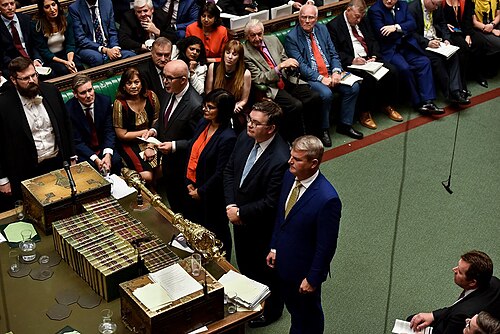
On 21 October, the government published the Withdrawal Agreement Bill and proposed three days of debate for opposition MPs to scrutinise it.[146] The government brought the recently revised EU Withdrawal Bill to the House of Commons for debate on the evening of 22 October 2019.[147] MPs voted to give the Bill a second reading which was passed by 329 votes to 299, and the timetable for debating the Bill, which was defeated by 322 votes to 308. Prior to the votes, Johnson had stated that if his timetable failed to generate the support needed to pass in parliament he would abandon attempts to get the deal approved and would seek a general election. Following the vote Johnson announced that the legislation would be paused while he consulted with other EU leaders.[147][148]
On 23 October, the House of Commons debated three technical pieces of legislation relating to the UK's withdrawal from the EU. The legislation debate addressed the repeal of certain technical provisions enshrined in UK law regarding the EU. Were the vote to pass for these three acts they would only come into effect if the UK were to ultimately leave the EU. The three items debated dealt with amendments to existing UK law in order to repeal 1) the freedom of movement provisions of the EU[151][152] 2) regulatory oversight of the UK by third party (EU) countries[153] 3) regulations on financial services codified by the EU.[154] All three amendments went to a division vote, and all three passed the House of Commons vote.[155][156][157]
On 20 December 2019, immediately after the state opening of Parliament following the 2019 United Kingdom general election (in which the Conservative Party secured a large majority of 80 seats), the Government presented another Bill to ratify its draft withdrawal agreement. It also proposed another guillotine motion to curtail debate on the Bill.
Afterwards, a proposed amendment by Ian Blackford to fail Third Reading was defeated by 62 ayes to 329 noes, and the Reading itself passed by 330–231.
There are four remaining areas where the two Houses are yet to agree on the text of the Bill: Meaningful vote: the House of Lords amended the Bill on a division to require that the Government bring forward an amendable motion at the end of the Article 50 negotiations ... Of these four areas, only the 'meaningful vote' proposal was made on a division, with the Government defeated. The other three proposals were brought forward by Government Ministers.Summary.
As Grieve headed to Question Time, where he promised to resume talks with the government, over in the Lords, Viscount Hailsham – who had proposed the original amendment on the meaningful vote – tabled Grieve's own amendment in full.
First of all, as I have said, we will bring a revised deal back to this House for a second meaningful vote as soon as we possibly can. While we will want the House to support that deal, if it did not, we would—just as before—table an amendable motion for debate the next day. Furthermore, if we have not brought a revised deal back to this House by Wednesday 13 February, we will make a statement and, again, table an amendable motion for debate the next day.
{{cite news}}: CS1 maint: multiple names: authors list (link){{cite web}}: CS1 maint: deprecated archival service (link)