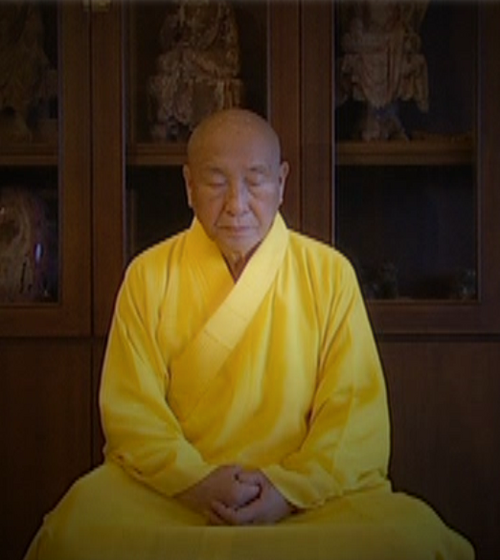
Samma-samadhi, "right samadhi," is the last of the eight elements of the Noble Eightfold Path.[web 1] When samadhi is developed, things are understood as they really are.[23]
Samma-samadhi is explicated as dhyana (jhāna, Pali: 𑀛𑀸𑀦), which is traditionally interpreted as one-pointed concentration. Yet, in the stock formula of dhyānasamādhi is only mentioned in the second dhyana, to give way to a state of equanimity and mindfulness, in which one keeps access to the senses in a mindful way, avoiding primary responses to the sense-impressions.[24][25]
With the fading away of pīti, a bhikkhu abides in upekkhā (equanimity," "affective detachment"[50][note 8]), sato (mindful) and [with] sampajañña ("fully knowing,"[54] "discerning awareness"[55]). [Still] experiencing sukha with the body, he enters upon and abides in the third jhana, on account of which the noble ones announce, "abiding in [bodily] pleasure, one is equanimous and mindful".
Fourth jhāna:
With the abandoning of [the desire for] sukha ("pleasure") and [aversion to] dukkha ("pain"[56][55]) and with the previous disappearance of [the inner movement between] somanassa ("gladness,"[57]) and domanassa ("discontent"[57]), a bhikkhu enters upon and abides in the fourth jhana, which is adukkham asukham ("neither-painful-nor-pleasurable,"[56] "freedom from pleasure and pain"[58]) and has upekkhā-sati-parisuddhi (complete purity of equanimity and mindfulness).[note 9]
The arupas
Appended to the jhana-scheme are four meditative states, referred to in the early texts as arupas or as āyatana. They are sometimes mentioned in sequence after the first four jhānas and thus came to be treated by later exegetes as jhānas. The immaterial are related to, or derived from, yogic meditation, and aim more specific at concentration, while the jhanas proper are related to the cultivation of the mind. The state of complete dwelling in emptiness is reached when the eighth jhāna is transcended. The four arupas are:
fifth jhāna: infinite space (Pali ākāsānañcāyatana, Skt. ākāśānantyāyatana),
eighth jhāna: neither perception nor non-perception (Pali nevasaññānāsaññāyatana, Skt. naivasaṃjñānāsaṃjñāyatana).
Although the "Dimension of Nothingness" and the "Dimension of Neither Perception nor Non-Perception" are included in the list of nine jhanas attributed to the Buddha, they are not included in the Noble Eightfold Path. Noble Path number eight is "Samma Samadhi" (Right Concentration), and only the first four Jhanas are considered "Right Concentration". When all the jhanas are mentioned, the emphasis is on the "Cessation of Feelings and Perceptions" rather than stopping short at the "Dimension of Neither Perception nor Non-Perception".
Theravāda
Samadhi as concentration
According to Gunaratana, the term 'samādhi' derives from the roots 'sam-ā-dhā', which means 'to collect' or 'bring together', and thus it is generally translated as "concentration." In the early Buddhist texts, samādhi is also associated with the term samatha (calm abiding). In the commentarial tradition, samādhi is defined as ekaggata, one-pointedness of mind (Cittass'ekaggatā).[17]
Buddhagosa defines samādhi as "the centering of consciousness and consciousness concomitants evenly and rightly on a single object [...] the state in virtue of which consciousness and its concomitants remain evenly and rightly on a single object, undistracted and unscattered".[60] According to Buddhaghosa, the TheravadaPali texts mention four attainments of samādhi:
Momentary concentration (khanikasamādhi): a mental stabilization which arises during samatha meditation.
Preliminary concentration (parikammasamādhi): arises out of the meditator's initial attempts to focus on a meditation object.
Access concentration (upacārasamādhi): arises when the five hindrances are dispelled, when jhāna is present, and with the appearance the 'counterpart sign' (patibhaganimitta).
Several western teachers (Thanissaro Bhikkhu, Leigh Brazington, Richard Shankman) make a distinction between 'sutta-oriented' jhana and 'Visuddhimagga-oriented' jhāna.[65] Thanissaro Bhikkhu has repeatedly argued that the Pali Canon and the Visuddhimagga give different descriptions of the jhanas, regarding the Visuddhimagga-description to be incorrect.[65] Keren Arbel has conducted extensive research on the jhānas and the contemporary criticisms of the commentarial interpretation. Based on this research, and her own experience as a senior meditation-teacher, she gives a reconstructed account of the original meaning of the dhyanas. She argues that the four jhānas are the outcome of both calming the mind and developing insight into the nature of experience and cannot not be seen in the suttas as two distinct and separated meditation techniques, but as integral dimensions of a single process that leads to awakening. She concludes that "the fourth jhāna is the optimal experiential event for the utter de-conditioning of unwholesome tendencies of mind and for the transformation of deep epistemological structures. This is because one embodies and actualizes an awakened awareness of experience."[34]
The earliest extant Indian Mahāyāna texts emphasize ascetic practices, forest-dwelling, and states of meditative oneness, i.e. samādhi. These practices seem to have occupied a central place in early Mahāyāna, also because they "may have given access to fresh revelations and inspiration".[66]
Indian Mahāyāna traditions refer to numerous forms of samādhi, for example, Section 21 of the Mahavyutpatti records 118 distinct forms of samādhi[67] and the Samadhiraja Sutra has as its main theme a samādhi called 'the samādhi that is manifested as the sameness of the essential nature of all dharmas' (sarva-dharma-svabhavā-samatā-vipañcita-samādhi).[68][note 13]
Vimokṣamukha
Buddhist Pali texts describe three kinds of samādhi which the commentarial tradition identify as the 'gates of liberation' (vimokṣamukha):[note 14]
Signlessness-samadhi (Sa:ānimitta-samādhi) (Pi:animitto samādhi) or marklessness-concentration (Sa:alakṣaṇa-samādhi)
According to Polak, these are alternative descriptions of the four dhyanas, describing the cognitive aspects instead of the bodily aspects.[69] According to Polak, in the final stages of dhyana no ideation of experience takes place, and no signs are grasped (animitta samādhi), which means that the concentrated attention cannot be directed (appaṇihita samādhi) towards those signs, and only the perception of the six senses remains, without a notion of "self" (suññata samādhi).[69]
In the Chinese Buddhist tradition these are called the 'three doors of liberation' (sān jiětuō mén, 三解脫門):[70] These three are not always cited in the same order. Nagarjuna, a Madhyamaka Buddhist scholar, in his Maha-prajnaparamita-sastra, listed apraṇihita before ānimitta in his first explanation on these "three samādhi", but in later listings and explanations in the same work reverted to the more common order. Others, such as Thích Nhất Hạnh, a Thien Buddhist teacher, list apraṇihita as the third after śūnyatā and ānimitta.[70][71] Nagarjuna lists these three kinds of samādhi among the qualities of the bodhisattva.[70]
サマーディ― ヨーギンがプラティヤーヤに意識を集中させ、自己意識を最小限に抑えると、ディヤーナはサマーディへと変化し、ヨーギンはプラティヤーヤと融合する。パタンジャリはこれを、色付きの表面に置かれた透明な宝石に例えている。宝石は表面の色を帯びる。同様に、サマーディでは、ヨーギンの意識は思考の対象であるプラティヤーヤと融合する。プラティヤーヤは色付きの表面のようなものであり、ヨーギンの意識は透明な宝石のようなものである。[ a ]
アーナンダ(「至福と共に」):別名「至高の至福」または「恍惚と共に」とも呼ばれるこの状態は、瞑想におけるさらに微細な至福の状態を強調するものであり、アーナンダはヴィタルカとヴィチャーラから解放されている。 [ web 2 ]
Āsmitā、「自我と共に」:チッタは「我あり」という感覚または感情に集中している。[ web 2 ]
Asamprajñata samādhi (also called nirvikalpa samādhi and nirbija samādhi)[web 3] refers to samādhi without the support of an object of meditation,[web 2] which leads to knowledge of purusha or consciousness, the subtlest element.[83][note 23]
Samprajñata samādhi
According to Paramahansa Yogananda, in this state one lets go of the ego and becomes aware of Spirit beyond creation. The soul is then able to absorb the fire of Spirit-Wisdom that "roasts" or destroys the seeds of body-bound inclinations. The soul as the meditator, its state of meditation, and the Spirit as the object of meditation all become one. The separate wave of the soul meditating in the ocean of Spirit becomes merged with the Spirit. The soul does not lose its identity, but only expands into Spirit. In savikalpa samādhi the mind is conscious only of the Spirit within; it is not conscious of the exterior world. The body is in a trancelike state, but the consciousness is fully perceptive of its blissful experience within.[88]
According to Ian Whicher, the status of ānanda and āsmitā in Patanjali's system is a matter of dispute.[90] According to Maehle, the first two constituents, deliberation and reflection, form the basis of the various types of samāpatti.[80] According to Feuerstein:
"Joy" and "I-am-ness" [...] must be regarded as accompanying phenomena of every cognitive [ecstasy]. The explanations of the classical commentators on this point appear to be foreign to Patanjali's hierarchy of [ecstatic] states, and it seems unlikely that ānanda and asmita should constitute independent levels of samādhi.[90]
According to Maehle, asamprajñata samādhi (also called nirvikalpa samādhi and nirbija samādhi)[web 3] leads to knowledge of purusha or consciousness, the subtlest element.[83]Heinrich Zimmer distinguishes nirvikalpa samādhi from other states as follows:
Nirvikalpa samādhi, on the other hand, absorption without self-consciousness, is a mergence of the mental activity (cittavṛtti) in the Self, to such a degree, or in such a way, that the distinction (vikalpa) of knower, act of knowing, and object known becomes dissolved — as waves vanish in water, and as foam vanishes into the sea.[93]
Swami Sivananda describes nirbija samādhi (lit. "samādhi" without seeds) as follows:
"Without seeds or Samskaras[...] All the seeds or impressions are burnt by the fire of knowledge [...] all the Samskaras and Vasanas which bring on rebirths are totally freed up. All Vrittis or mental modifications that arise from the mind-lake come under restraint. The five afflictions, viz., Avidya (ignorance), Asmita (egoism), Raga-dvesha (love and hatred) and Abhinivesha (clinging to life) are destroyed and the bonds of Karma are annihilated [...] It gives Moksha (deliverance from the wheel of births and deaths). With the advent of the knowledge of the Self, ignorance vanishes. With the disappearance of the root-cause, viz., ignorance, egoism, etc., also disappear".[web 3]
Sahaja samadhi is a state in which a silent level within the subject is maintained along with (simultaneously with) the full use of the human faculties.[94]
ケヴァラ・ニルヴィカルパ・サマーディは一時的なものであるのに対し、[ web 5 ] [ web 6 ]サハジャ・ニルヴィカルパ・サマーディは日常活動を通して継続する状態である。[ 94 ]この状態は、生活のいくつかの面、すなわち外的な活動、内的な静寂、そしてそれらの間の関係を含むため、サマーディよりも本質的に複雑であるように思われる。 [ 94 ]また、サマーディを習得した後に訪れるため、より高度な状態であるようにも思われる。[ 94 ] [注24 ] [注25 ]
↑ Lusthaus 2014、p.266: 「Sangharakshita はapraṇihita を「目的のなさ」と訳し、Conze は「願望のなさ」と訳し、 Buddhist Thought in India (Ann Arbor: University of Michigan Press、1967) p. 67 に次のように書いています。「a-pra-ni-hita という言葉は、文字通り「何も前に置かない」という意味で、未来の計画を立てず、未来に希望を持たず、目的がなく、何にも執着せず、無相[ animitta ]への集中によって拒絶された知覚の対象に対する好みや欲望を持たない人を指します。」
↑According to Jianxin Li Samprajnata Samadhi may be compared to the rupa jhānas of Buddhism.[77] This interpretation may conflict with Gombrich and Wynne, according to whom the first and second jhāna represent concentration, whereas the third and fourth jhāna combine concentration with mindfulness.[78] According to Eddie Crangle, the first jhāna resembles Patnajali's samprajñata samādhi, which both share the application of vitarka and vicara.[79]
↑Yoga Sutra 1.17: "Objective samādhi (samprajnata) is associated with deliberation, reflection, bliss, and I-am-ness (asmita).[82]
↑Yoga Sutra 1.42: "Deliberative (savitarka) samāpatti is that samādhi in which words, objects, and knowledge are commingled through conceptualization".[80]
↑Yoga Sutra 1.43: "When memory is purified, the mind appears to be emptied of its own nature and only the object shines forth. This is superdeliberative (nirvitarka) samāpatti".[85]
↑Following Yoga Sutra 1.17, meditation on the sense of "I-am-ness" is also grouped, in other descriptions, as "sāsmitā samāpatti"
↑Yoga Sutra 1.44: "In this way, reflective (savichara) and super-reflective (nirvichara) samāpatti, which are based on subtle objects, are also explained".[83]
↑According to Jianxin Li, Asamprajnata Samādhi may be compared to the arupa jhānas of Buddhism, and to Nirodha-samāpatti.[77] Crangle also notes that sabija-asamprajnata samādhi resembles the four formless jhānas.[79] According to Crangle, the fourth arupa jhāna is the stage of transition to Patanjali's "consciousness without seed".[87]
↑Karambelkar: The description here of the "samadhi", which is the transformation and culmination of dhyana, is "arthamatra nirbhasam" and "svarupa-sunyam-iva". "Arthamatra nirbhasa" means clear perception of the mere essence behind the form having qualities of the subject, chosen for meditation. The second phrase "svarupa-sunyam-iva" amplifies further this meaning of the first phrase by saying that the "svarupa" i.e. the original form and appearance of the subject becomes almost extinct. Therefore, the subject is now perceived or experienced in its usual way that is experienced in our empirical life, but is experienced or comprehended or better still "realized" in its subtle essence or reality, which is lying behind it.[16]
References
12Pragya, Samani Pratibha (2017), Prekṣā meditation: history and methods, p. 82. PhD Thesis, SOAS, University of London
↑"The eight limbs, The core of Yoga". Expressions of Spirit.
↑Buddhaghosa & Nanamoli (1999), pp.90–91 (II, 27–28, "Development in Brief"), 110ff. (starting with III, 104, "enumeration"). It can also be found sprinkled earlier in this text, as on p. 18 (I, 39, v. 2) and p. 39 (I, 107).
↑Nhat Hanh, Thich; Neumann, Rachel (2008). Buddha Mind, Buddha Body. ReadHowYouWant.com. p.140. ISBN978-1427092922. AIMLESSNESS The third concentration is aimlessness, apraṇihita. Without worry, without anxiety we are free to enjoy each moment of our lives. Not trying, not making great efforts, just being. What a joy! This seems to contradict our normal ...
↑Nhat Hanh, Thich. "Dharma Talk: The Fourth Establishment of Mindfulness and the Three Doors of Liberation". The Mindfulness Bell. Archived from the original on 9 July 2021. Retrieved 3 July 2021.
↑Jones, Constance; Ryan, James D. (2007). Encyclopedia of Hinduism. Encyclopedia of world religions. New York: Facts On File. p.377. ISBN978-0-8160-5458-9.
↑Das, Baba Hari (1999). The Yoga Sūtras of Patañjali: A Study Guide for Book I Samādhi Pāda. Santa Cruz, California: Sri Ramana Publishing. p.45. ISBN0-918100-20-8.
↑Yogananda, Paramahansa: God Talks with Arjuna, The Bhagavad Gita, A new translation and commentary, Self-Realization Fellowship 2001, ISBN0-87612-031-1 (paperback) ISBN0-87612-030-3 (hardcover), I,10.
↑Sarasvati Buhrman, Ph.D. (January 2000). Experiences of Meditation II. Julian Press. ISBN1-57951-038-8. Archived from the original on 14 May 2006.{{cite book}}: |website= ignored (help)
↑Swami Sivananda See here, Lt. Gen. Hanut Singh, Shri Shri Shri Shivabalayogi Maharaj: Life & Spiritual Ministration, pp. 109 Shri Shiva Rudra Balayogi "The Path Supreme" 2010 page 160 and See teachings of Shri Shiva Rudra Balayogi hereArchived 2010-03-29 at the Wayback Machine.
↑Thomas L. Palotas, "Divine Play, the Silent Teaching of Shivabalayogi", pp 87–9,
↑Lt. Gen. Hanut Singh, Shri Shri Shri Shivabalayogi Maharaj: Life & Spiritual Ministration, pp. 110. and Jestice, Phyllis G, Holy People of the World: A Cross-cultural Encyclopedia. ABC-CLIO. (2004) ISBN978-1-57607-355-1 pp 723.
↑"Glossary Of Siddha Yoga Terminology". Siddhayoga.org. 2010-07-25. Retrieved 2020-11-22.
12Blackman, Sushila (1997). Graceful Exits: How Great Beings Die: Death Stories Of Tibetan, Hindu & Zen Masters. New York: Weatherhill. ISBN0-8348-0391-7.
↑Yogananda, Paramahansa (1997). Autobiography of a Yogi – Chapter 36. Los Angeles: Self-Realization Fellowship. ISBN0-87612-086-9.
↑"Mahasamadhi —". Yogoda Satsanga Society of India. Retrieved 2020-02-11.
↑Goldberg, Philip (2018). The Life of Yogananda. California: Hay House, Inc. p.277. ISBN978-1-4019-5218-1.
↑Sutton, Nicholas (2016). Bhagavad-Gita. Oxford Centre for Hindu Studies. pp.42, 45. ISBN978-1-366-61059-1.
↑Thurman, Robert (1984). The Central Philosophy of Tibet. Princeton University Press. p.34.
↑Partial transcript from the workshop entitled “Self-Discovery through Buddhist Meditation”, presented by John Myrdhin Reynolds at Phoenix, Arizona, on October 20, 2001, http://www.vajranatha.com/articles/what-is-meditation.html?showall=1Archived 2020-03-05 at the Wayback Machine
↑Donald Jay Rothberg, Sean M. Kelly (1998), Ken Wilber in Dialogue: Conversations with Leading Transpersonal Thinkers
↑Candradhara Śarmā (1996), The Advaita Tradition in Indian Philosophy: A Study of Advaita in Buddhism, Vedānta and Kāshmīra Shaivism, Motilal Banarsidass, p.139: "In the Buddhist works, both in Pale and in Sanskrit, the words used for nirvikalpa-samadhi are samnja-vedayita-nirodha and nirodha-samāpatti".
↑Singh Khalsa, Sant (2015). Siri Guru Granth Sahib Ji. Espanola: SikhNet.
↑Clinton Bennett, Charles M. Ramsey South Asian Sufis: Devotion, Deviation, and Destiny A&C Black ISBN978-1-441-15127-8 page 23
Sources
Printed sources
Nagarjuna (2001). "Chapter X - The Qualities of the Bodhisattvas". Mahāprajñāpāramitāśāstra. Translated by Migme, Ani.
Arbel, Keren (2016), Early Buddhist Meditation: The Four Jhanas as the Actualization of Insight, Routledge, doi:10.4324/9781315676043, ISBN9781317383994
Berzin, Alexander (2006), Primary Minds and the 51 Mental Factors
Bronkhorst, Johannes (1993), The Two Traditions Of Meditation In Ancient India, Motilal Banarsidass Publ.
Bucknell, Robert S. (1993), "Reinterpreting the Jhanas", Journal of the International Association of Buddhist Studies, 16 (2): 375–409
Chen, Naichen (2017), The Great Prajna Paramita Sutra, Volume 1, Wheatmark
Conze, Edward (1962). Buddhist Thought in India. Allen & Unwin.
Crangle, Eddie (1984), "A Comparison of Hindu and Buddhist Techniques of Attaining Samādhi"(PDF), in Hutch, R.A.; Fenner, P.G. (eds.), Under The Shade of the Coolibah Tree: Australian Studies in Consciousness, University Press of America, archived from the original(PDF) on 2021-09-01, retrieved 2014-11-27
Crangle, Edward Fitzpatrick (1994), The Origin and Development of Early Indian Contemplative Practices, Harrassowitz Verlag
Diener, Michael S.; Erhard, Franz-Karl; Fischer-Schreiber, Ingrid (1991). The Shambhala Dictionary of Buddhism and Zen. Translated by Michael H. Kohn. Shambhala.
Edgerton, Franklin (1953). Buddhist Hybrid Sanskrit Grammar and Dictionary. Motilal Banarsidass. ISBN0-89581-180-4.{{cite book}}: ISBN / Date incompatibility (help)
Farquhar, J. N. (1920), Outline of the Religious Literature of India, Motilal Banarsidass, ISBN978-81-208-2086-9{{citation}}: ISBN / Date incompatibility (help)
Forman, Robert K.C. (1999), Mysticism, Mind, Consciousness, SUNY Press
Fuller-Sasaki, Ruth (2008), The Record of Lin-Ji, University of Hawaii Press
Gomez, Luis O.; Silk, Jonathan A. (1989). Studies in the literature of the great vehicle: three Mahāyāna Buddhist texts. Ann Arbor: Collegiate Institute for the Study of Buddhist Literature and Center for South and Southeast Asian Studies, University of Michigan. ISBN0891480544.
Guenther, Herbert V.; Kawamura, Leslie S. (1975), Mind in Buddhist Psychology: A Translation of Ye-shes rgyal-mtshan's "The Necklace of Clear Understanding" (Kindleed.), Dharma Publishing
Hui-Neng (1998). The Sutra of Hui-neng, grand master of Zen: with Hui-neng's commentary on the Diamond Sutra. Translated by Thomas Cleary. Boston: Shambhala. ISBN9781570623486.
Jianxin Li (2018), "A Comparative Study between Yoga and Indian Buddhism"(PDF), International Journal for the Study of Chan Buddhism and Human Civilization (3), asianscholarship.org: 107–123
Johansson, Rune Edvin Anders (1981), Pali Buddhist Texts: Explained to the Beginner, Psychology Press
Jones, Constance; Ryan, James D. (2006), Encyclopedia of Hinduism, Infobase Publishing, ISBN9780816075645
Kalupahana, David J. (1994), A history of Buddhist philosophy, Delhi: Motilal Banarsidass Publishers Private Limited
Kunsang, Erik Pema (2004), Gateway to Knowledge, Vol. 1, North Atlantic Books
Lusthaus, Dan (2002), Buddhist Phenomenology: A Philosophical Investigation of Yogacara Buddhism and the Ch'eng Wei-shih Lun, Routledge
Lusthaus, Dan (2014). Buddhist Phenomenology: A Philosophical Investigation of Yogacara Buddhism. Routledge. p.139. ISBN978-1317973423.
Maehle, Gregor (2007), Ashtanga Yoga: Practice and Philosophy, New World Library
Maezumi, Taizan; Cook, Francis Dojun (2007), "The Eight Awarenesses of the Enlightened Person": Dogen Zenji's Hachidainingaku", in Maezumi, Taizan; Glassman, Bernie (eds.), The Hazy Moon of Enlightenment, Wisdom Publications
McRae, John R. (2003). Seeing through Zen: Encounter, Transformation, and Genealogy in Chinese Chan Buddhism (1ed.). University of California Press. ISBN978-0-520-23797-1. JSTOR10.1525/j.ctt1pnz84.
Polak, Grzegorz (2011), Reexamining Jhana: Towards a Critical Reconstruction of Early Buddhist Soteriology, UMCS
Pradhan, Basant (2015), Yoga and Mindfulness Based Cognitive Therapy, Springer
Quli, Natalie (2008), "Multiple Buddhist Modernisms: Jhana in Convert Theravada"(PDF), Pacific World, 10: 225–249
Rhys-Davids, T.W.; Stede, William, eds. (1921–25), The Pali Text Society's Pali–English dictionary, Pali Text Society){{citation}}: CS1 maint: deprecated archival service (link)
Sangpo, Gelong Lodro; Dhammajoti, Bhikkhu K.L. (2012), Abhidharmakośa-Bhāṣya of Vasubandhu: The Treasury of the Abhidharma and Its (Auto) Commentary, Motilal Banarsidass
Sarbacker, Stuart Ray (2012), Samadhi: The Numinous and Cessative in Indo-Tibetan Yoga, SUNY Press, ISBN9780791482810
Sarbacker, Stuart Ray (2021), Tracing the Path of Yoga: The History and Philosophy of Indian Mind-Body Discipline, State University of New York Press
Shankman, Richard (2008), The Experience of Samadhi, Shambhala Publications
Siddheswarananda, Swami (1998), Hindu Thought and Carmelite Mysticism, Motilal Banarsidass Publ.
Skilton, Andrew (2002). "State or Statement?: "Samādhi" in Some Early Mahāyāna Sutras". The Eastern Buddhist. 34 (2): 51–93. ISSN0012-8708. JSTOR44362317.
Stuart-Fox, Martin (1989), "Jhana and Buddhist Scholasticism", Journal of the International Association of Buddhist Studies, 12 (2)
Sturgess, Stephen (2014a), The Book of Chakras & Subtle Bodies: Gateways to Supreme Consciousness, Watkins Media Limited
Taimni, I.K. (1961), The Science of Yoga, Quest Books
Vetter, Tilmann (1988), The Ideas and Meditative Practices of Early Buddhism, Leiden: Brill, ISBN978-90-04-08959-4
Wayman, Alex (1997), "Introduction", Calming the Mind and Discerning the Real: Buddhist Meditation and the Middle View, from the Lam Rim Chen Mo Tson-kha-pa, Motilal Banarsidass Publishers
Williams, Paul (2009). Mahāyāna Buddhism: the doctrinal foundations (2nded.). London: Routledge. ISBN9780415356534.
Werner, Karel (1994). The Yogi and the Mystic. Routledge. ISBN978-0700702725.
Whicher, Ian (1998). The Integrity of the Yoga Darśana: A Reconsideration of Classical Yoga. SUNY Press. ISBN978-0-7914-3815-2.
White, David Gordon (2014). The 'Yoga Sutra of Patanjali': A Biography. Princeton University Press. ISBN978-1-4008-5005-1.
Wynne, Alexander (2007), The Origin of Buddhist Meditation, Routledge
Zimmer, Heinrich (1951). Philosophies of India. New York, New York: Princeton University Press. ISBN0-691-01758-1.{{cite book}}: ISBN / Date incompatibility (help) Bollingen Series XXVI; Edited by Joseph Cambell.
Web-sources
12accesstoinsight, Right Concentration, samma samadhi
1234567Swami Jnaneshvara Bharati, Integrating 50+ Varieties of Yoga Meditation
12What is Liberation According to the Teachings of Sri Ramana Maharshi?
Further reading
Arya, Usharbudh (1986), Yoga-Sūtras of Patañjali (Volume 1ed.), Honesdale, Pennsylvania: The Himalayan International Institute, ISBN0-89389-092-8
Bucknell, Rod (1984), "The Buddhist to Liberation: An Analysis of the Listing of Stages", The Journal of the International Association of Buddhist Studies, 7 (2)
Chapple, Christopher (1984), Introduction to "The Concise Yoga Vasistha", State University of New York
Cousins, L. S. (1996), "The origins of insight meditation"(PDF), in Skorupski, T. (ed.), The Buddhist Forum IV, seminar papers 1994–1996 (pp. 35–58), London, UK: School of Oriental and African Studies
Gombrich, Richard F. (1997), How Buddhism Began, Munshiram Manoharlal
Schmithausen, Lambert (1981), On some Aspects of Descriptions or Theories of 'Liberating Insight' and 'Enlightenment' in Early Buddhism". In: Studien zum Jainismus und Buddhismus (Gedenkschrift für Ludwig Alsdorf), hrsg. von Klaus Bruhn und Albrecht Wezler, Wiesbaden 1981, 199–250
Williams, Paul (2000), Buddhist Thought. A Complete Introduction to the Indian Tradition, Routledge