Loading article…
 | ||||||||||||
| ラテン語: Collegium Regale Londinense [1] またはCollegium Regium apud Londinenses [2] | ||||||||||||
| モットー | ラテン語: Sancte et Sapienter | |||||||||||
|---|---|---|---|---|---|---|---|---|---|---|---|---|
英語のモットー | 神聖さと知恵をもって | |||||||||||
| タイプ | 公立 研究大学 | |||||||||||
| 設立 | 1829年(医学部での最初の教育記録は1561年)[3] | |||||||||||
| 寄付金 | 3億100万ポンド(2023年)[4] | |||||||||||
| 予算 | 12億3,000万ポンド(2022/23)[4] | |||||||||||
| 椅子 | ゲイト卿 | |||||||||||
| ビジター | ジャスティン・ウェルビー (職務上カンタベリー大主教 として) | |||||||||||
| 首相 | アン王女(ロンドン大学 総長) | |||||||||||
| 副学長兼学長 | シティジ・カプール | |||||||||||
教員 | 6,195(2022/23)[5] | |||||||||||
管理スタッフ | 4,510(2022/23)[5] | |||||||||||
| 学生 | 41,045(2022/23)[6] | |||||||||||
| 学部生 | 23,435(2022/23)[6] | |||||||||||
| 大学院生 | 17,610(2022/23)[6] | |||||||||||
| 位置 | ロンドン 、イングランド 51°30′43″N 0°06′58″W / 51.51194°N 0.11611°W / 51.51194; -0.11611 | |||||||||||
| キャンパス | 都会的な | |||||||||||
| パトロン | シャルル3世[7] | |||||||||||
| 色 | ||||||||||||
| 所属 | ||||||||||||
| マスコット | レジー・ザ・ライオン | |||||||||||
| Webサイト | イギリス | |||||||||||
 | ||||||||||||
キングス・カレッジ・ロンドン(非公式にはキングスまたはKCL)は、イギリスのロンドンにある公立の 研究大学です。キングスは、ジョージ4世とウェリントン公爵の後援の下、1829年に王室勅許により設立されました。[9] [10] 1836年、キングスはロンドン大学の創設カレッジ2校のうちの1つになりました。[11]イングランドで最も古い大学レベルの機関の1つです。[12] [13] 20世紀後半、キングスは、クイーンエリザベスカレッジとチェルシー科学技術カレッジ(1985年)、精神医学研究所(1997年)、ガイズ病院とセントトーマス病院の合同医科歯科学校、フローレンスナイチンゲール看護助産学校(1998年)と の合併など、一連の合併を通じて成長しました。
キングス大学には5つのキャンパスがある。ロンドン中心部にある歴史あるストランド・キャンパス、その近くのテムズ川沿いにある他の3つのキャンパス(ガイズ、セント・トーマス、ウォータールー)、そして南ロンドンのデンマーク・ヒルにあるキャンパスである。また、専門的な軍事教育のためにオックスフォードシャーのシュリヴェナムにキャンパスがあり、情報サービスセンターが置かれているコーンウォールのニューキーにもキャンパスがある。学術活動は9つの学部に分かれており、それらは多数の部門、センター、研究部門に細分化されている。2022/23年度、キングス大学の総収入は12億3,000万ポンドで、そのうち2億3,630万ポンドは研究助成金と契約によるものであった。[4]キングス大学はイギリスの大学の中で4番目に大きな基金を保有しており、ロンドンの大学の中では最大の基金を保有している。キングス大学は、総入学者数で英国第5位の大学であり[6]、毎年69,000人以上の学部生の入学希望者を受け入れています(国内36,000人、海外33,000人)。[14]
キングス大学は、英連邦大学協会、欧州大学協会、ラッセル・グループなどの学術団体の会員である。キングス大学には、医学研究会議のMRC神経発達障害センターがあり、キングス・ヘルス・パートナーズ 学術健康科学センター、フランシス・クリック研究所、メッドシティの創設メンバーでもある。学生数で見ると、大学院および大学院後の医学教育と生物医学研究のヨーロッパ最大のセンターであり、[15]世界初の看護学校であるフローレンス・ナイチンゲール看護助産学部も含まれる。[16]キングス大学は、オックスフォード、ケンブリッジ、ロンドンの各都市にある大学の「黄金の三角形」の一部であると一般にみなされている。 [17]キングス大学は設立当初から王室の後援を受けており、故エリザベス2世女王が後援者であり、2024年5月からは息子のチャールズ3世国王が後援者を引き継ぐ予定である。 [18] [19]
キングの卒業生と教職員には、14人のノーベル賞受賞者、 DNA構造、C型肝炎、D型肝炎 ゲノム、ヒッグス粒子の発見に貢献した人々 、体外受精、幹細胞/哺乳類クローン、現代のホスピス運動の先駆者、レーダー、ラジオ、テレビ、携帯電話の発展に尽力した主要な研究者などが含まれています。卒業生には、国家元首、政府首脳、政府間組織の元首、現下院議員17名、下院議長2名、現貴族院議員13名、アカデミー賞3回、グラミー賞3回、エミー賞1回、ゴールデングローブ賞1回、ブッカー賞1回の受賞者もいます。
歴史
財団

キングス・カレッジは、ジョージ4世の庇護を受けて1829年に設立された(キングス医学校であるセント・トーマスの起源は16世紀に遡り、最初の講義は1561年に記録されている)[3]。これは、 1826年の「ロンドン大学」(後のユニバーシティ・カレッジ・ロンドン)設立をめぐる神学論争に応えてのことである。 [20] [21]ロンドン大学は、功利主義者、ユダヤ人、非国教徒の支援を受けて、世俗的な機関として設立され、「15歳か16歳から20歳以上の中流階級の若者」を教育することを目的としていたため、[22]「ガワー街の無神論者大学」というあだ名が付けられた。[23]このような機関が必要になったのは、当時裕福な 英国国教徒の息子だけを教育していたオックスフォード大学とケンブリッジ大学の宗教的、社会的性質によるものであった。[24]ロンドン大学の世俗的な性格は非難を浴び、実際、「周囲で荒れ狂う反対の嵐は、残っていた活力の火花をすべて打ち砕く恐れがあった」[25] 。
対抗機関としてのキングス・カレッジの創設は、トーリー党が既成秩序の教育的価値を再主張する反応を示した。[26]より広い意味では、キングスは、産業革命とナポレオン戦争後のイギリスの大きな社会的変化の結果として19世紀初頭に誕生した一連の機関の最初の1つであった。[27]キングスは、その設立のおかげで、国王の保護を受け、カンタベリー大主教が訪問者として訪れ、19世紀には、大法官、庶民院議長、ロンドン市長が公式の理事として数えられた。[27]


バタシーフィールドでの決闘、1829年3月21日

初代ウェリントン公爵アーサー・ウェルズリー(当時は英国首相も務めていた)が、英国国教会のキングス・カレッジ・ロンドンとカトリック教徒救済法(カトリック教徒にほぼ完全な公民権を与えることになる)を同時に支持したことに対して、1829年初頭、第10代ウィンチルシー伯爵ジョージ・フィンチ=ハットンが異議を唱えた。ウィンチルシーとその支持者たちは、英国国教会の信者しか入学できないオックスフォード大学や、非英国国教会信者は入学できても卒業できないケンブリッジ大学のように、キングス・カレッジが試験法の対象となることを望んでいたが[28]、これはウェリントンの意図ではなかった。[29]
ウィンチルシーと約 150 人の他の寄付者は、ウェリントンがカトリック解放を支持したことに反発して、キングス カレッジ ロンドンへの支援を撤回した。ウェリントンに宛てた手紙の中で、彼は公爵が「我々の自由を侵害し、国のあらゆる部門にカトリックを導入する陰険な計画」を企てていると非難した。[30]この手紙は激しい手紙のやり取りを引き起こし、ウェリントンはウィンチルシーがキングス カレッジ ロンドンの設立に「不名誉で犯罪的な動機」があると非難したと非難した。ウィンチルシーが発言を撤回することを拒否すると、ウェリントンは「決闘の支持者ではない」と自白し、決闘の初心者でもあったが、武器による決闘で償いを要求した。「私は今、紳士が要求する権利があり、紳士が決して拒まないであろう、あなたの行為に対する償いを卿に求めます。」[31]
その結果、1829年3月21日にバタシーフィールドで決闘が行われた。 [21] [32]ウィンチルシーは発砲しなかったが、決闘の前に彼と副官がほぼ間違いなく決めていた計画だった。ウェリントンは狙いを定め、右に大きく外れて発砲した。ウェリントンが故意に外したかどうかについてはさまざまな報告がある。狙いが下手なことで知られるウェリントンはそう主張し、ウィンチルシーに同情的な他の報告は、殺すつもりだったと主張した。[33]名誉は守られ、ウィンチルシーはウェリントンに謝罪の手紙を書いた。[30]「決闘の日」は今でも毎年3月21日後の第1木曜日に祝われ、再現劇を含むさまざまなイベントがキングズ全体で行われる。[32] [34]
19世紀

キングス大学は1831年10月に開校し、聖職者ウィリアム・オッターが初代校長兼神学講師に任命された。[20]カンタベリー大主教が開校式を主宰し、礼拝堂でロンドン主教チャールズ・ジェームズ・ブロムフィールドが宗教教育と知的文化の融合をテーマに説教を行った。キングス大学を英国国教会のみにしようとする試みがあったにもかかわらず、当初の案内では「あらゆる種類の非国教徒が大学に自由に入学できる」とされていた。[35]ウィリアム・ハウリー:言語学者を除く理事と教授は英国国教会の信者でなければならなかったが、学生はそうでなかった。[36]ただし礼拝堂への出席は義務であった。[37]
キングス・カレッジは上級学部と下級学部に分かれており、下級学部はキングス・カレッジ・スクールとしても知られ、当初はストランド・キャンパスの地下に位置していた。[20]下級学部は生徒85名と教師3名で始まったが、1841年までに急速に500名にまで増加し、施設が手狭になったため、 1897年にウィンブルドンに移転し、現在もそこに残っているが、現在はキングス・カレッジ・ロンドンとは関係がない。[36]上級学部内では、教育は3つのコースに分かれていた。一般コースは神学、古典語、数学、英語文学、歴史で構成され、医学コースと、当時は体系的な学習コースとは関連がなく、継続するために臨時の生徒の供給に依存していた法律、政治経済、現代語などの雑多な科目で構成されていた。[20] 1833年に一般コースが再編成され、キングス・カレッジが発行した最初の資格であるキングス・カレッジ準会員(AKC)が授与されるようになった。[20]倫理と神学の問題を扱うこのコースは、現在でも、学業と並行して選択科目として3年間のコースを受講する学生と教職員に提供されています。
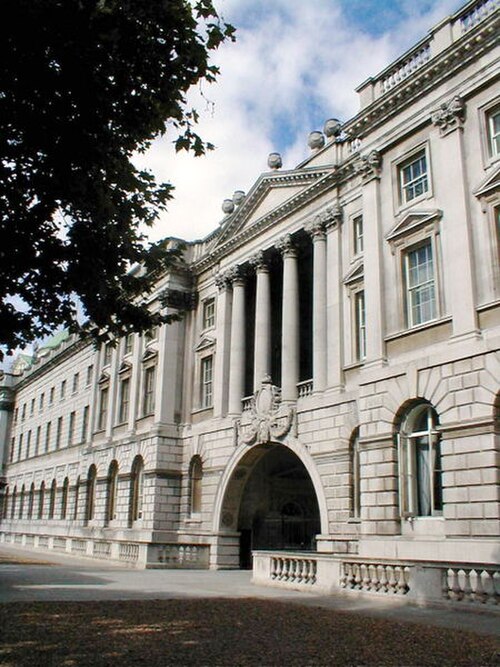
川沿いの建物は1835年4月に7,100ポンドの費用をかけて完成したが、[38]その完成にはキングス・カレッジ・ロンドンが王室から敷地を確保することが条件となっていた。[20]学校内の学生数とは異なり、上級学部の学生数はキングス・カレッジが設立されてから最初の5年間はほとんど変化がなかった。この間、医学部は非効率性とスタッフの分裂により衰退し、出席者数は着実に減少した。最も重要な人事の1つは、実験哲学の教授としてのチャールズ・ホイートストンの任命であった。 [20]
当時、キングス・カレッジも「ロンドン大学」もロンドンの病院の医学部も学位を授与することはできなかった。1835年、政府は学位を授与するための審査委員会を設立し、「ロンドン大学」とキングス・カレッジの両方を提携カレッジとすると発表した。これは1836年にロンドン大学となり、以前の「ロンドン大学」はユニバーシティ・カレッジ・ロンドン(UCL)となった。[24]ロンドン大学の最初の学位は1839年にキングス・カレッジ・ロンドンの学生に授与された。[39]
1840年、キングスはリンカーン・イン・フィールズ近くのポルトガル通りに独自の病院を開設した。この地域は貧困と病気が蔓延する過密な繁華街だった。キングス・カレッジ病院の運営は後に、1851年のキングス・カレッジ病院法により設立された病院法人に移管された。病院は1913年にカンバーウェルのデンマーク・ヒルに移転した。1877年にジョセフ・リスターが臨床外科教授に任命されたことは医学部にとって大きな利益となり、リスターの防腐手術法の導入により病院は国際的に名声を得た。[20]
1845年、キングズ校は陸軍とイギリス東インド会社の士官を養成する軍事学部を設立し、1846年には英国国教会の牧師を養成する神学部を設立した。1855年、キングズ校はロンドンで夜間クラスを初めて開設した。[36]キングズ校が夜間クラスの学生にロンドン大学の学位試験を受けるための大学出席証明書を授与したことは、ロンドン大学が1858年に付属カレッジ制度を廃止し、その試験をすべての人に開放するという決定を下す際に、これらの証明書の無価値さの例として挙げられた。[40]
| キングス・カレッジ・ロンドン法 1882 | |
|---|---|
| 議会法 | |
.svg/500px-Coat_of_Arms_of_the_United_Kingdom_(1837).svg.png) | |
| 引用 | 45 & 46 ヴィクトリア朝 13 世紀 |
| 日付 | |
| 王室の裁可 | 1882年5月19日 |
| その他の法律 | |
| 廃止 | キングス・カレッジ・ロンドン法 1978 |
| 制定当初の法令文 | |
の1882年キングス・カレッジ・ロンドン法(45年および46年ヴィクトリア朝第13章)は、憲法を改正した。この法律はキングスの所有権を剥奪し、法人名を「キングス・カレッジ・ロンドンの理事および所有者」から「キングス・カレッジ・ロンドン」に変更し、1829年の認可を無効にした(ただし、キングスはその認可の下で法人のままであった)。この法律はまた、キングス・カレッジ・ロンドンを(技術的には)営利法人から非営利法人に変更し(50年以上の運営で配当金は支払われていなかった)、キングスの目的を女性の教育にまで拡大した。[20][41]キングス・カレッジ・ロンドンの女子学部はケンジントン・スクエア、後に1902年にキングス・カレッジ女子学部となった。[39]
20世紀

| キングス・カレッジ・ロンドン法 1903 | |
|---|---|
| 議会法 | |
.svg/500px-Coat_of_arms_of_the_United_Kingdom_(1901-1952).svg.png) | |
| 引用 | 3 エドワード7世 92年頃 |
| 日付 | |
| 王室の裁可 | 1903年7月21日 |
| その他の法律 | |
| 廃止 | キングス・カレッジ・ロンドン法 1978 |
ステータス: 廃止 | |
| 制定当初の法令文 | |
| キングス・カレッジ・ロンドン(転校)法 1908 | |
|---|---|
| 議会法 | |
| |
| 引用 | 8 エドワード7世. c. xxxix |
| 日付 | |
| 王室の裁可 | 1908年8月1日 |
| 制定当初の法令文 | |
の1903年キングス・カレッジ・ロンドン法(3 Edw. 7. c. xcii)は、神学部を除く教職員に対する残りの宗教試験をすべて廃止しました。1910年、キングス・カレッジは(神学部を除いて)ロンドン大学に統合され、1908年キングス・カレッジ・ロンドン(移管)法(8 Edw. 7. c. xxxix)により、法的独立性を失った。[42]
第一次世界大戦中、医学部は初めて女性に開放された。[20] 1916年から1921年まで、大学のイタリア語学科は女性のリネッタ・デ・カステルヴェッキオが率いていた。[43]戦争の終わりには学生が殺到し、既存の施設が逼迫したため、一部の授業は校長宅で行われるようになった。[20]
第二次世界大戦中、キングス・カレッジ・ロンドンの建物は補助消防隊によって使用され、当時はカレッジ・サーヴァントと呼ばれていたキングス職員の多くが消防監視員として勤務した。ストランド・ビルディング、中庭、礼拝堂の後陣の屋根、ステンドグラスの窓の一部はロンドン大空襲で爆撃を受けた。[44] [45]戦後の再建中に、中庭の下の金庫室は2階建ての研究室に置き換えられ、1952年に物理学部と土木電気工学部の研究室としてオープンした。[20]
キングス大学で行われた最も有名な科学研究の一つは、1953年にモーリス・ウィルキンスとロザリンド・フランクリンが、キングス大学のランドール細胞分子生物物理学部門のレイモンド・ゴスリング、アレックス・ストークス、ハーバート・ウィルソンらの同僚らとともに行ったDNAの二重らせん構造の発見への重要な貢献である。 [46] [47] [48]
キングス校の大規模な改築は、高等教育に関するロビンズ報告書の出版を受けて、1966年に始まりました。EDジェフェリス・マシューズが設計したストランドに面した新しい建物は、1972年にオープンしました。 [36] 1980年、キングス校は新しい勅許状のもとで法的独立を取り戻しました。1993年、キングス校はロンドン大学の他の大規模カレッジとともに、政府資金(以前は大学を通じて提供されていた)を直接受けられるようになり、ロンドン大学の学位を授与する権利も獲得しました。これにより、キングス校と他の大規模カレッジは、事実上、それ自体が大学とみなされるようになりました。[49]
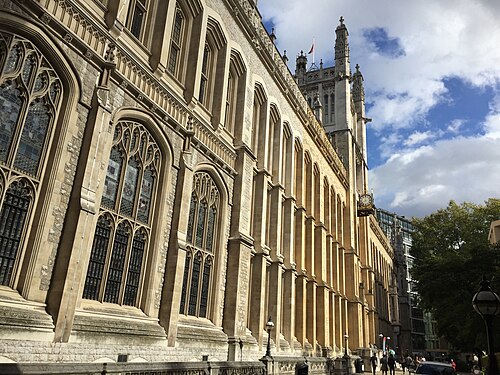
キングス・カレッジ・ロンドンは、20世紀後半に他の教育機関との合併を何度か経験している。その中には、1948年の 国民保健サービスの設立時にキングス・カレッジ病院から独立したキングス・カレッジ医科歯科学校の1983年の再編入、 1985年のクイーン・エリザベス・カレッジおよびチェルシー・カレッジとの合併、 1997年の精神医学研究所との合併などがある。1998年には、ガイズ病院とセント・トーマス病院の合同医科歯科学校がキングスと合併し、GKT医学教育学校が設立された。[36] [39] [50] [51]また1998年には、フローレンス・ナイチンゲールの元々の看護師養成学校がキングス看護学部と合併し、フローレンス・ナイチンゲール看護助産学校となった。同年、キングス・カレッジはチャンセリー・レーンにある旧公文書館の建物を取得し、3,500万ポンドをかけてモーガン図書館に改築し、2002年に開館した。[36]
21世紀
2006年7月、キングス・カレッジ・ロンドンは枢密院により、ロンドン大学を通さずに独自の学位授与権を与えられた。[53]この権限は2007年まで行使されなかったが、キングス・カレッジは、2007年9月以降にコースを開始するすべての学生に、ロンドン大学ではなくキングス・カレッジ自体が授与する学位を授与すると発表した。しかし、新しい証明書には、キングス・カレッジがロンドン大学の構成カレッジであるという事実が依然として記載されている。[54] 2007年8月、少なくとも1年間の学習が残っているすべての在校生は、ロンドン大学の学位またはキングス・カレッジの学位の授与を選択するオプションを提供された。最初のキングス・カレッジの学位は2008年夏に授与された。[55]
2011年4月、キングス・カレッジ・ロンドンは、後にフランシス・クリック研究所と改名された英国医療研究イノベーションセンターの創設パートナーとなり、このプロジェクトに4000万ポンドを投じました。[56]化学部門は2003年に閉鎖されましたが、2011年に再開されました。[57] 2012年2月、女王陛下はサマセット・ハウス・イースト・ウィングを正式にオープンしました。

2014年9月、キングス・カレッジ・ロンドンは、数学を専門とする無料の6年生向け学校、キングス・カレッジ・ロンドン数学学校をランベスに開校した。 [58] 2014年10月、エド・バーンが、10年間務めたリック・トレイナーの後任としてキングス・カレッジ・ロンドンの校長に就任した。 2014年12月、キングスは校名を「キングス・ロンドン」にリブランドする計画を発表した。 [59]キングスの正式名称を変更する計画はなく、「キングス・ロンドン」という名前はキングスを宣伝し、キングスが独立した大学であるという事実を強調するために作られたものであることが強調された。[60]キングスは、2015年1月にリブランド計画を中止したと発表した。[61] [62]
2015年、キングスは歴史的なブッシュハウスを含むオールドウィッチクォーターの敷地を50年間リースしました。2017年から使用されています。[63]
キャンパス
ストランドキャンパス


ストランド キャンパスはキングス創設キャンパスであり、シティ オブ ウェストミンスターのストランドに位置し、テムズ川に面しています。元のキャンパスは、サー ロバート スマークが設計した 1831 年のグレード I指定建造物であるキングス ビルディングと、サー ギルバート スコットが 1864 年に再設計したキングス カレッジ ロンドン礼拝堂で構成され、その後、第二次世界大戦後に隣接するサリー ストリートの大半 (ノーフォーク ビルディングとチェシャム ビルディングを含む) が購入され、1972 年にストランド ビルディングが建設されました。1975 年に建設されたマカダム ビルディングには、ストランド キャンパス学生組合が入居しており、キングス卒業生で全国学生組合の初代会長であるサー アイヴィソン マカダムにちなんで名付けられました。
ストランド キャンパスには、キングス大学の芸術学部と科学学部があり、芸術・人文科学、法学部、ビジネス学部、社会科学・公共政策学部、自然科学・数学・工学部などがあります。また、学長室もここにあります。
2010年以降、キャンパスは急速に拡大し、サマセット・ハウスの東棟と、キングスウェイのLSEの隣にあるヴァージニア・ウルフ・ビルが組み込まれました。また、以前はBBCワールド・サービスが入っていたブッシュ・ハウスも組み込まれました。
最寄りの地下鉄駅はテンプル駅、チャリングクロス駅、コヴェントガーデン駅です。
ガイズキャンパス
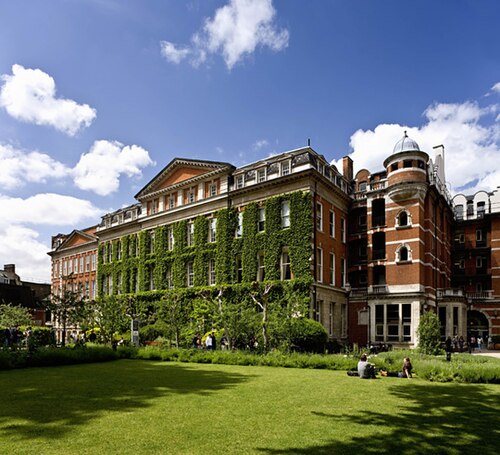
ガイズキャンパスはロンドン橋とテムズ川南岸のザ・シャードの近くに位置し、生命科学・医学部と歯学研究所が所在している。[64]
キャンパスは、1726年にロンドンのサザーク区に設立されたガイズ病院の創設者であり後援者であるトーマス・ガイにちなんで名付けられました。建物には、1902年に建設されたアンリエット・ラファエル・ビル、ゴードン病理学博物館、ホジキン・ビル、シェパーズ・ハウス、ガイズ・チャペルなどがあります。ガイズ・キャンパスには、学生自治会が活動室、会議室、学生カフェ「ザ・シェッド」、学生バー「ガイズ・バー」など、充実した施設を備えています。ガイズ・キャンパスは、サザークの旧セント・トーマス病院の一部であった 旧手術室博物館の向かいに位置しています。
最寄りの地下鉄駅はロンドン・ブリッジ駅とバラ駅です。
ウォータールーキャンパス

ウォータールー キャンパスは、ストランド キャンパスからウォータールー橋を渡ったところ、ロンドン ランベス区のサウスバンク センターの近くにあり、ジェームズ クラーク マクスウェルビル、フランクリン-ウィルキンスビル、ウォータールー ブリッジ ウィング ビルで構成されています。
コーンウォール・ハウス(現在はフランクリン・ウィルキンス・ビル)は1912年から1915年にかけて建設され、もともとは国王の文房具事務所(王室著作権と国立公文書館を担当)であったが、第一次世界大戦中の1915年に軍病院として使用するために徴用された。キング・ジョージ軍病院となり、63の病棟で約1,800人の患者を収容した。[65]
現在ロンドン最大の大学の建物であるこの建物は、1980年代にキングス大学に買収され、2000年に大規模な改修工事が行われました。 [66] [67]この建物は、 DNAの構造の発見に大きく貢献したロザリンド・フランクリンとモーリス・ウィルキンスにちなんで名付けられました。 [66]現在、この建物には以下の建物があります。
- 生物医学科学部、糖尿病・栄養科学科(生命科学・医学部の一部)
- 教育・コミュニケーション・社会学部(社会科学・公共政策学部の一部)
- LonDEC – ロンドン歯科教育センター(歯学部、口腔・頭蓋顔面科学部の一部)
隣接するジェームズ・クラーク・マクスウェルビルには、フローレンス・ナイチンゲール看護学部、助産学部、緩和ケア学部、および大学の主要な専門サービス機能の多くが入居している。このビルは、1860年から1865年までキングス・カレッジで自然哲学の教授を務めたスコットランドの数理物理学者 ジェームズ・クラーク・マクスウェルにちなんで名付けられた。 [68]
最寄りの地下鉄駅はウォータールーです。
セントトーマスキャンパス

ロンドンのランベス区にあるセント・トーマス・キャンパスは、テムズ川を挟んで国会議事堂に面しており、医学部と歯学研究所の一部が入っています。フローレンス・ナイチンゲール博物館もここにあります。[69]この博物館は、セント・トーマス病院のナイチンゲール訓練学校(現在はキングス・フローレンス・ナイチンゲール看護・助産・緩和ケア学部)の創設者であるフローレンス・ナイチンゲールに捧げられています。セント・トーマス病院は1998年にキングス・カレッジ・ロンドン医学部の一部となりました。セント・トーマス病院とキャンパスは、聖トマス・ベケットにちなんで名付けられました。[70]キングス・カレッジ・ロンドンの双子研究科(TwinsUk)は、セント・トーマス病院内にあります。
最寄りの地下鉄駅はウェストミンスター駅です。
デンマークヒルキャンパス

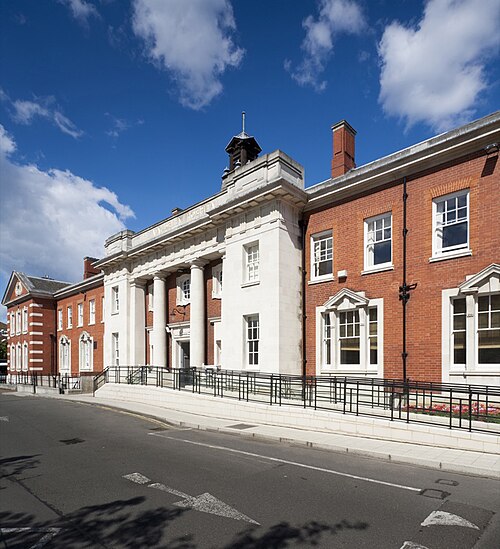
デンマークヒルキャンパスはロンドン南部、ランベス区とサザーク区の境界に近いカンバーウェルにあり、テムズ川沿いにない唯一のキャンパスである。キャンパスはキングス・カレッジ病院、モーズリー病院、精神医学・心理学・神経科学研究所(IoPPN)から構成される。精神医学・心理学・神経科学研究所に加え、歯科研究所と医学部の一部、そして大きな学生寮であるキングス・カレッジ・ホールもここにある。その他の建物にはウェストン教育センター(WEC)として知られるキャンパス図書館、ジェームズ・ブラック・センター、レイン研究所(血液腫瘍学)、シセリー・サンダース研究所(緩和ケア)などがある。[71]
モーリス・ウォール臨床神経科学研究所は、2015年にプリンセス・ロイヤルによってデンマーク・ヒル・キャンパスに開設されました。 [72]この研究所は、キングス大学と長い関わりを持ち、多くの医療プロジェクトを支援した英国の慈善家モーリス・ウォールにちなんで名付けられました。[73]
シュリヴェナム
キングス・カレッジは正式なキャンパスではないが、オックスフォードシャー州シュリヴェナムにある英国防衛アカデミーに学術施設を保有している。キングス・カレッジは防衛研究科を通じて、2000年以降、国防省との契約に基づき、統合軍指揮幕僚大学を通じて英国軍の多くに専門的な軍事訓練を提供してきた。[74]
再開発計画
1999年から2010年の間に、キングスの活動の半分以上が新しい建物または改装された建物に移転しました。[75]この期間の主なプロジェクトには、2002年に旧公文書館をモーガン図書館に改装するための4000万ポンド、2004年から2006年にかけてのキングスビルディングの4000万ポンドの改装、2009年(大学が78年間のリースを確保した時)から2012年にかけてのサマーセットハウスの東棟の改装、デンマークヒルキャンパスでの1000万ポンドのシセリーサンダース緩和ケア研究所の完成などがあります。[76]より最近では、モーリスウォール臨床神経科学研究所のための4200万ポンドの開発が2016年に完了し、[77] 2016年にオナーオールパークスポーツグラウンドにスポーツパビリオンが建設されました。[78]
ストランドキャンパスの再開発は、持続可能な建築として2007年にグリーンガウン賞を受賞した。この賞は、「キングスビルの歴史的なサウスレンジの持続可能な改修によるエネルギーと炭素排出量の削減」が認められたものである。 [79]キングスはまた、グレードII*に指定されているモーガン図書館の改修により、2003年のシティヘリテージ賞を受賞した。[80]
2012年4月、キングス・ビルディングとサマセット・ハウスの間にあるストランド・クアドラングルの2000万ポンド規模の再開発が発表された。 [81]これは2022年に完了した。クアドラングル内に新しい社交スペースが設けられるとともに、クアドラングルの下のスペースも再開発され、工学部用の3000平方メートルの新しい実験室と教育スペースが設けられた。[82]
2015年7月、キングス大学は、当初50年間の契約で、オールドウィッチ地区のいくつかの建物のリースを取得しました。これらの建物は2017年から使用されており、学術部門、学習および社交スペース、学生施設が含まれています。[83]当時の学長兼校長のエドワード・バーンは、この買収は「キングス大学の歴史における決定的な瞬間であり、大学の地位を50年以上にわたって確保する」ものであると述べました。[84]
ウェストミンスター市議会が主導したストランドの再開発は3年にわたって行われ、ブッシュハウスとストランドキャンパスの残りの部分を結ぶ歩行者専用スペースが作られ、かつては首都で最も混雑した通りの一つであったこの通りの安全性とアクセス性が向上しました。[85]
キングス大学はまた、ブッシュハウス・サウスウェストウィングの所有権を取得しており、現在、新たな学習拠点としての利用に向けて開発が進められており、2026年までに完成する予定である。[86]
組織と管理
ガバナンス
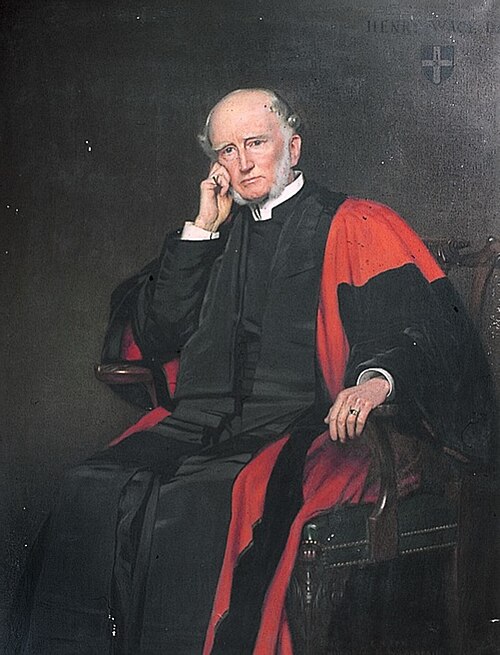
キングス・カレッジ・ロンドンの長は正式には学長兼学長であり、現在はシティジ・カプール氏が務めている。カプール氏は2021年1月のサー・エド・バーン氏の退任に伴い、2021年6月に任期を開始した。
「大学の学長兼総長」の職は、国王勅許状により「大学の最高学術責任者兼執行責任者」として設立され[87]、大学の規則では、総長兼総長は大学評議会に対して「大学の目的が達成されることを保証し、大学の効率、規律、秩序を維持し促進する」という一般的な責任を負うことが定められている。[88]現在の学長兼総長であるシッツィ・カプールは、「副総長兼総長」という肩書きを使用している。[89]現在の大学の上級役員には、学術、健康および生命科学、運営の各分野を担当する3人の上級副総長が含まれる。また、財務(大学の最高財務責任者でもある)、教育および学生の成功、国際、関与およびサービス、研究および革新、および人材の各分野を担当する5人の副総長もいる。[90]
カレッジ評議会は、憲章と規則に基づいて設立されたキングス・カレッジ・ロンドンの最高統治機関であり、21名のメンバーで構成されています。そのメンバーには、学生メンバーとしてキングス・カレッジ・ロンドン学生組合(KCLSU)の会長、学長および会長、最大7名のスタッフメンバー、およびキングスの従業員ではない最大12名の一般メンバーが含まれます。[91]カレッジ評議会は、いくつかの常設委員会によってサポートされています。[92]クリストファー・ガイド卿は、以前はエリザベス2世女王の私設秘書官(議長に就任した当時のキングス・カレッジ・ロンドンの後援者)であり、2016年度の初めからチャールズ・ウェルズリー(第9代ウェリントン公爵)の後任として評議会議長に就任しました。 [93] [94]その後、2017年11月3日にガイド卿になりました。[95]
キングス・カレッジ・ロンドンの現在の学部長は、エレン・クラーク・キング牧師である。[90]学部長職はカレッジの規則によって設置され、2022年7月にカレッジ評議会で可決された規則によれば、英国国教会の聖職者でなければならない。[ 96]学部長が聖職者であることは英国の大学では珍しいが、キングスが1829年に英国国教会の伝統の中に設立されたことを反映している。[97]学部長は「すべての学生とスタッフの精神的発達と福祉を監督する責任がある」。学部長室は、キングス・カレッジの準会員プログラム、カレッジ牧師会、および数多くの合唱奨学金を含むキングス・カレッジ・ロンドン合唱団を調整している。[97] [98]学部長の役割の1つは、英国国教会の聖職者への召命を奨励し、育成することである。[99]
カンタベリー大主教は、キングス・カレッジ・ロンドンが英国国教会の財団であるため、職務上の権利により同大学の訪問者となっている。 [100]現在の訪問者はジャスティン・ウェルビー大司教である。
学部・学科
19世紀、キングス・カレッジ・ロンドンには神学、一般文学・科学、応用科学、医学、軍事の5つの学部があった。[101] [102]神学部では、教会史、牧会神学、遺言の釈義を研究した。[102]言語と文学、歴史、法律と司法学、政治経済学、商業、フェンシング、数学、動物学、自然史は一般文学・科学科で教えられ、[102]自然哲学、地質学、鉱物学、芸術関連の科目は応用科学科で教えられた。[102]
2017年現在[update]、キングスには9つの学部があり、それらは学校(社会科学と公共政策、生命科学と医学)、学科、センター、研究部門に分かれています。最新の追加は、2017年8月に開校したブッシュハウスにあるキングスビジネススクールです。 [103]
文学部
学部はロンドン中心部のストランドに位置し、大英博物館、シェイクスピア・グローブ座、ナショナル・ポートレート・ギャラリー、コートールド美術館、大英図書館など、学部と密接な関係にある多くの有名な文化施設の近くにあります。[104] QS世界大学ランキング2024では、キングスは芸術・人文科学分野で世界第22位、英国第5位にランクされています。[105]

芸術・人文科学学部は、1989年に文学部、音楽学部、神学部が統合されて設立されました。[106]キングス・カレッジの芸術・人文科学学部は、哲学、古典学、神学、英語、歴史、言語、音楽などの長く確立された学問分野で並外れた強みを発揮し、デジタル人文学、映画、学際的教養、文化、メディア、クリエイティブ産業などの比較的最近確立された分野でも世界をリードする質を誇るという点で際立っています。[107]
2023年に、学部は2つの新しい研究所[108]、デジタルフューチャーズ研究所とグローバルカルチャー研究所を設立し、既存のプロジェクトを統合するとともに、幸福と社会への影響に焦点を当てた新しい独自の教育と研究を推進します。
歯学部、口腔・頭蓋顔面科学
歯学部、口腔・頭蓋顔面科学科(旧歯学研究所)はキングス・カレッジの歯学部であり、病気の理解、健康の増進、機能の回復に重点を置いています。 [109] QS世界大学ランキングによると、歯学部は世界第5位にランクされています。[110]この研究所は、ガイズ病院歯学部、キングス・カレッジ病院歯学部、ロンドン王立歯科病院歯科外科学校、ガイズ・アンド・セント・トーマス病院連合医科歯科学校の後継です。2005年までキングス医科歯科大学の一部でしたが、その後歯学部が歯学研究所となり、2019年に改名されました。
1799年、ジョセフ・フォックスはガイ病院で歯科外科に関する一連の講義を始め、同年歯科医に任命された。[111] トーマス・ベルは1817年か1825年にフォックスの後を継いで歯科医となった。[111] 1885年にガイ病院の歯科医助手に任命された フレデリック・ニューランド・ペドリーは病院内に歯科学校を設立することを提唱し、ロンドンの2つの歯科学校、メトロポリタン歯科学校とロンドン歯科外科学校に患者を送り込み、さらに病院が必要であることを証明した。[111] 1888年12月、ガイ病院歯科学校が設立された。[111] [112]ガイズ病院歯学部は1901年にロンドン大学の学校として認められた。1970年代に歯科サービスの需要が減少したため、英国保健省は歯科学部の学生数を減らし、すべてのコースの期間を短縮すべきだと提案した。 [111]この勧告を受けて、ロンドン王立歯科病院歯科外科学校は1983年8月1日にガイズ病院とセントトーマス病院の連合医科歯科学校のガイズ病院歯学部と合併した。 [111]
キングス・カレッジ病院歯科学校の設立は、1923年4月12日の病院管理委員会でハンブルデン子爵によって提案された。歯科学校は1923年11月12日にキングス・カレッジ病院に開校した。 [51] 1948年の国民保健法に基づき、キングス医科歯科学校はキングスから分離して独立した学校となったが、1983年にキングスと再合併した。[51]同校はさらに1998年にガイズ病院とセント・トーマス病院の合同医科歯科学校と合併した。[51]
生命科学・医学部

生命科学・医学部は、2014年に医学部と生物医学部が合併して設立されました。[113] QS世界大学ランキング2024では、キングス大学は生命科学と医学の分野で世界第12位、英国第5位にランクされています。[114]
生命科学・医学部には2つの教育学部があり、GKT医学教育学部はMBBSプログラムの学生の医学教育と訓練を担当し、生物科学教育学部は生物医学と健康専門職の教育と訓練を担当しています。[115]学部はさらに、基礎・医療生物科学、生物医学工学・画像科学、がん・薬学、心臓血管医学・科学、免疫学・微生物科学、ライフコース科学、人口健康科学の7つの学部に分かれています。[116]
精神医学・心理学・神経科学研究所
精神医学、心理学、神経科学研究所(IoPPN)は、精神疾患や脳疾患の原因を解明し、これらの疾患の新しい治療法の特定に役立てることを目的とした学部および研究機関です。[117]この研究所は、ヨーロッパ最大の精神医学、心理学、神経科学の研究および大学院教育センターです。[118]もともと1924年にモーズリー病院医学部として設立されたこの研究所は、1948年に精神医学研究所に改名され、1997年にキングス・カレッジ・ロンドンと合併し、2014年にIoPPNに改名されました。[119] [120] QS世界大学ランキング2024では、キングスは心理学で世界16位にランクされています。[121]
ディクソン・プーン法科大学院
ディクソン・プーン法科大学院はキングス大学の法科大学院です。キングス大学では1831年から法学を教えています。[122] 法学部は1909年に設立され、1991年に法科大学院となりました。[122]世界で最も権威があり、入学が厳しい法科大学院の一つで、2024年にはQS世界大学ランキングで世界トップ15、ヨーロッパとイギリスで5位にランクされました。[123]
この学部には、研究活動の中心となる様々な研究センターやグループがあり、その中には、欧州法センター(1974年設立)、医療法・倫理センター(1978年設立)、英国憲法・歴史センター(1988年設立)、建設法センター、社会における技術・倫理・法センター、政治・哲学・法センター、トランスナショナル法研究所、信託法委員会などがある。[124]
自然科学・数学・工学部
自然科学・数学学部は、物理科学・工学部の再編に伴い、2010年に設立されました。2021年2月に改名され、工学が主要学問分野として復活しました。この学部では、化学、情報科学、物理学、数学、工学、電気通信の教育と研究を行っています。物理学と数学は、それぞれ1829年と1830年から大学で研究されており、学部の学生または学術スタッフから6人のノーベル賞受賞者が出ています。[125]最も注目すべきは、実験物理学の教育がイギリスで最も古く、ジェームズ・クラーク・マクスウェル、ハロルド・A・ウィルソン、チャールズ・グローバー・バークラ、サー・オーウェン・リチャードソン、サー・エドワード・アップルトン、サー・チャールズ・エリスが教授職を担い、そのうち3人がノーベル賞受賞者となったことです。[ 126]
キングス・カレッジでは1829年の創立以来化学を教えており、コプリー賞受賞者の ジョン・フレデリック・ダニエルが初代教授に任命された。[127]化学科は学生数の減少と資金削減のため、2003年に閉鎖を余儀なくされた。[127] 2012年に新しい化学科が設立され、新しい学部課程である化学と生物医学が開始された。[127]新しい学科は、化学の伝統的な分野(有機化学、無機化学、物理化学、計算化学)と、細胞生物学や物理学を含む他の学問分野をカバーしている。[127]
工学部は1838年に設立され、おそらく英国最古の工学部である。 [128]同様に、キングス・カレッジ工学協会は機械技術者協会より6日前の1847年に設立されており、この種の協会としては最古である。工学部は1893年に英国最大の工学部であった。[128] [129]工学部は2013年に閉鎖され、2019年に再設置された。[128] [130]
フローレンス・ナイチンゲール看護助産学部

フローレンス・ナイチンゲール看護助産学部は、看護師と助産師のための学校です。また、看護研究を実施し、継続的な専門能力開発と大学院プログラムを提供しています。以前はナイチンゲール看護師養成学校およびホームとして知られていたこの学部は、 1860年にフローレンス・ナイチンゲールによって設立され、フルサービスの病院と医学校に継続的に接続された世界初の看護学校です。[131] [132] QS世界大学ランキング2024では、キングスは看護分野で世界第2位にランクされました。[133]
ナイチンゲール訓練学校は1996年にオリーブ・ヘイドン助産学校およびトーマス・ガイ・アンド・ルイシャム看護学校と合併し、1996年までにすべての教職員と学生がキングスに統合されました。[132] [134]
社会科学・公共政策学部
社会科学・公共政策学部は2001年に設立され、英国で政策志向の研究に重点を置く最大規模の大学センターの一つです。[135] 2016年の再編により、4つの学部に分割されました。
- 政治経済学部(ヨーロッパ国際研究科、政治経済学部、ロシア研究所)
- 教育・コミュニケーション・社会学部
- 国際関係学部(地理学科、国際保健・社会医学学科、国際開発学科、ブラジル研究所、インド研究所、ラウ・チャイナ研究所)
- 安全保障研究科(防衛研究科、戦争研究科)
戦争研究科は英国でもユニークな存在であり、キングス戦略コミュニケーションセンター、リデルハート軍事文書センター、キングス軍事健康研究センター(KCMHR)などの研究施設によってサポートされています。[136]
2002年に設立されたキングスリスクマネジメントセンター(KCRM)は、リスク管理、ガバナンス、コミュニケーションに関する国際的な研究を行い、さまざまなプロジェクト、会議、学術フェローシップを支援して、リスク研究を関連性のある実用的な政策ソリューションに変換することを促進しています。[137]
学部にはアフリカリーダーシップセンター、現代イギリス史研究所、ロンドンアジア太平洋社会科学センターも設置されている。[138]
キングスビジネススクール
.jpg/500px-Bush_House_30_Aldwych,_London_WC2B_4BG_(3).jpg)
キングスビジネススクールは2017年8月にブッシュハウスに設立されました。社会科学・公共政策学部の経営学部が改革され、キングスビジネススクールが設立されました。[139]この学校は、2021年のランキングで、英国コンプリート大学ガイドのビジネス・経営学部門で第2位にランクされました。 [140]
ビジネススクールの拡張に伴い、以下の4つの研究センターが設立されました。[141]
- 消費者および組織のデジタル分析 (CODA)
- 財務およびマクロ向けデータ分析 (DAFM)
- フィンワーク先物
- カタール国際銀行金融センター
キングス・ビジネス・スクールは、学部と大学院の両方の学位を提供しています。経済学、経営学、金融学、起業家精神、人的資源管理、マーケティングのプログラムを提供しています。学部の経営学コースは、「現代のビジネス理論と組織管理理論と実践」に基づいてカリキュラムが組まれています。教えられているコアコンテンツと重なる他の分野には、金融、会計学、経済学、社会科学、心理学、法学などがあります。経営学などの学部コースは、留学生の割合が高く (81%)、女性の割合も大きく、学生全体の 58% を占めています。[142] [143]
財務
2019年7月31日までの会計年度において、キングスカレッジの総収入は9億196万ポンド(2017/18年度は8億4103万ポンド)、総支出は10億8988万ポンド(2017/18年度は8億4243万ポンド)であった。[144]主な収入源は、授業料および教育契約による3億9379万ポンド(2017/18年度は3億4225万ポンド)、研究助成金および契約による1億9468万ポンド(2017/18年度は1億9442万ポンド)、資金協議会助成金による1億2830万ポンド(2017/18年度は1億2389万ポンド)、基金および投資収入による512万ポンド(2017/18年度は619万ポンド)であった。[144] 2018/19年度、キングスは7,890万ポンド(2017/18年度は1億3,370万ポンド)の資本支出を行った。[144]
2019年7月31日現在、キングス・カレッジの総基金は2億5,807万ポンド(2018年7月31日時点では2億3,346万ポンド)、純資産総額は7億9,158万ポンド(2018年7月31日時点では9億4,586万ポンド)となっている。[144]キングス・カレッジはスタンダード・アンド・プアーズからAAの信用格付けを得ている。[144]キングス・カレッジの総基金は英国の大学の中で4番目に高く、オックスフォード大学、ケンブリッジ大学、エディンバラ大学に次ぐものである。
2013/14年度、キングス大学はイギリスの大学の中で7番目に高い総収入を誇っていました。[145] 2018/19年度には、エディンバラ大学の総収入を抜いて6位になりました。
2010年10月、キングスは元英国首相ジョン・メージャーの指揮の下、2015年までに5億ポンドを集めることを目標とした大規模な募金キャンペーン「世界の疑問|キングスの答え」を開始した。 [146]この目標は2015年以前にすでに達成されており、キングスはその後目標を6億ポンドに引き上げた。[147]キングスは再びこの新しい目標を達成し、6億1000万ポンドを集めた。[148]
キングス大学はビル&メリンダ・ゲイツ財団から数多くの助成金を受け、世界の健康と世界の発展に関する様々な研究プロジェクトを支援してきました。[149]
紋章
.png/500px-Coat_of_Arms_of_King%E2%80%99s_College_London_(1829-1985).png)
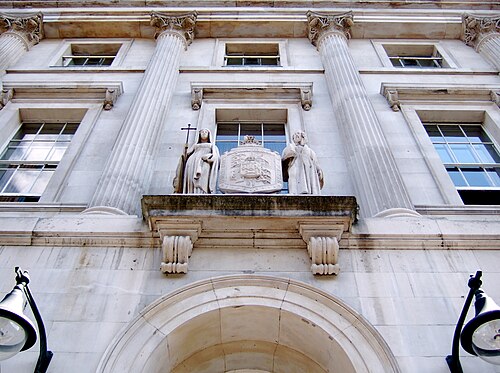
キングス・カレッジ・ロンドンの憲章に掲げられている紋章はジョージ4世のものである。盾にはハノーヴァー家の紋章とともに王家の紋章が描かれ、支柱にはキングのモットーである「聖にして賢明なる者」が刻まれている。この紋章の選択に関する書簡はキングスのアーカイブにも紋章院にも残っていないと考えられており、キングスの歴史を通じてさまざまな非公式な改変が使用されてきた。現在の紋章は1985年のクイーン・エリザベス・カレッジおよびチェルシー・カレッジとの合併後に策定され、それぞれの紋章学の側面が取り入れられている。[8]紋章学用語における公式の紋章は以下のとおりである。[150]
武器:
または、青白い背景に、尊大な赤いライオンが二頭立っており、その間に王冠で飾られた金色の錨があり、銀色の旗の上に古代のランプが燃え、二つの燃え盛る炉の間に金色に燃えているのも適切です。
紋章と支持者:
金と青の花輪が付いた兜の上に、金の王冠と赤の王冠から伸びる本の上に、縁に宝石がちりばめられており、2 つの青宝石 (1 つは明白)、4 つの緑宝石 (2 つは明白)、2 つの赤宝石が散りばめられている。赤の半ライオンがデクスターの杖を持っている。青の服を着た女性の姿。外套は銀色の髪飾りと袖で裏打ちされ、外側の手に金と不吉なロンドン十字架を持っている。男性像。青地に黒で縁取られたロングコート。内側の手に銀色のシャツを持っている。
医学部の紋章

1948年にセント・トーマス病院医学部とガイズ医学部はセント・トーマス病院とガイズ病院から独立した法人となったが、病院の盾と紋章を使用する伝統は今日まで続いている。[151]
1949年、セント・トーマス病院医学部は独自の紋章を授与された。しかし、セント・トーマス病院の紋章は今でも使用されている。[151]ガイズ医学部はガイズ病院から分離した後、独自の紋章を申請することを提案したが、1954年にガイズ病院の紋章を引き続き使用することに決定した。[151] 2つの医学部は1982年に合併し、ガイズ・セント・トーマス病院連合医科歯科学校(UMDS)となった。UMDSの事務局長サイモン・アーグルズは、医学部の名前を考えると、病院の紋章を使用する方が適切だと述べた。[151]
UMDSは1998年にキングス・カレッジ病院と合併し、ガイズ・キングス・セント・トーマス医学部となった。ガイズ病院とセント・トーマス病院の盾は、医学部の出版物や卒業資料でキングス病院の盾と組み合わせて使用されている。[151]
提携およびパートナーシップ
キングス・カレッジ・ロンドンはロンドン連邦大学の加盟校であり、創設時の2つのカレッジのうちの1つでした。[152] 1998年、キングス・カレッジは1994年に設立された24の公立研究大学の協会であるラッセル・グループに加盟しました。 [153]キングス・カレッジは、ヨーロッパの首都に拠点を置く高等教育機関のネットワークであるヨーロッパ首都大学ネットワーク(UNICA)[154]のメンバーでもあります。また、イギリス連邦大学協会(ACU)、欧州大学協会(EUA)、英国大学協会にも加盟しています。
キングス大学は、一般的に「ゴールデントライアングル」の一部とみなされている。これは、ケンブリッジ大学、オックスフォード大学、ロンドンの3つのイギリスの都市に位置する研究大学のグループであり、ケンブリッジ大学、オックスフォード大学、インペリアル・カレッジ・ロンドン、ロンドン・スクール・オブ・エコノミクス、ユニバーシティ・カレッジ・ロンドンも含まれる。[168]
キングス・カレッジ・ロンドンは、キングス・ヘルス・パートナーズの一部でもあり、ガイズ・アンド・セント・トーマスNHS財団信託、キングス・カレッジ病院NHS財団信託、サウス・ロンドン・アンド・モーズリーNHS財団信託、そしてキングス・カレッジ・ロンドン自体で構成される学術医療科学センターです。[169] [170] [171]キングスはフランシス・クリック研究所に参加しており、創設メンバーの1つです。[172]さらに、2014年に発足したメドシティは、キングスとロンドンの他の2つの主要な理系大学、インペリアル・カレッジとユニバーシティ・カレッジ・ロンドンとのコラボレーションです。[173]
2016年、キングス・カレッジ・ロンドンは、アリゾナ州立大学およびニューサウスウェールズ大学と共同で、地球規模の課題に取り組む国際大学連合であるPLuSアライアンスを結成した。 [174] [175]キングス・カレッジ・ロンドンは、 2012年12月に設立された大規模公開オンラインコース学習プラットフォームであるFutureLearnの創設パートナーでもある。
キングス校は、コロンビア大学[176]、 パリ第1大学[ 176] 、香港大学[ 176] 、シンガポール国立大学[177] 、王立音楽アカデミー[178 ] 、大英図書館[178] 、テート・モダン[ 178]、シェイクスピア・グローブ[ 178]、ナショナル・ギャラリー[178] 、ナショナル・ポートレート・ギャラリー[ 178]、大英博物館[179]など、多くの大学やその他の機関と共同学位を提供しています。[ 180]
数学の分野では、キングス・カレッジ・ロンドンはインペリアル・カレッジ・ロンドンおよびユニバーシティ・カレッジ・ロンドンと共同でロンドン幾何学・数論学校(LSGNT)を運営しており、これはEPSRCが資金を提供する博士課程トレーニングセンター(CDT)である。LSGNTは数論、幾何学、位相幾何学のさまざまな側面について、4年間の博士課程研究プロジェクトを幅広く提供している。[181]
キングス・カレッジ・ロンドンがインペリアル・カレッジ・ロンドンおよびユニバーシティ・カレッジ・ロンドンと結んでいるもう 1 つのパートナーシップはナノテクノロジーの分野で、3 つの大学が共同でロンドン・ナノテクノロジー・センター(LCN) を運営しています。LCN は、関連分野で生み出された研究の活用と商業化に重点を置いた、物理的および生物医学的ナノテクノロジーの多分野にわたる研究センターです。
キングス・カレッジ・ロンドンは2016年にSES工学・物理科学研究同盟に加盟した。この同盟にはケンブリッジ大学、オックスフォード大学、サウサンプトン大学、インペリアル・カレッジ・ロンドン、ロンドン大学クイーン・メアリー校、ユニバーシティ・カレッジ・ロンドンが加盟している。[182] キングス・カレッジ・ロンドンは、インペリアル・カレッジ・ロンドン、ユニバーシティ・カレッジ・ロンドン、ロンドン大学クイーン・メアリー校とともに、材料の理論とシミュレーションに取り組むロンドンの研究グループの同盟であるトーマス・ヤング・センターのメンバーでもある。[183]
同大学はロンドン大学の他の機関とともにロンドン大学スクリーン研究グループのメンバーでもある。 [184]
学術プロフィール
入学案内
キングス大学は2018年に英国の大学の中で学部生の平均入学資格が13番目に高く、新入生の平均UCASポイントは171点でした。[191] 2022年には、大学は志願者の39.3%に入学許可を出しましたが、これは全国で8番目に低い数字です。[192]
キングス大学の学部生の24.4%は私立教育を受けており、これは英国の主流大学の中で14番目に高い割合である。[193] 2016年から2017年の学年度では、同大学の居住地の内訳は英国人、EU人、非EU人の学生がそれぞれ67:12:20で、女性と男性の比率は62:37であった。[194]
2015年に情報公開請求を行ったところ、同大学は2014年から2015年にかけて31,857件の学部入学願書を受け取り、13,302件の入学許可を出していたことが明らかになった。その結果、入学許可率は41.8%、入学許可率45.3%、全体の合格率は18.9%となった。[195] 2018年、キングス・カレッジ・ロンドンは39,102件の学部入学願書を受け取り、受け入れられたのは4,728件のみで、全体の合格率は12.1%であった。[196]医学部は1,764件の願書を受け取り、39件の入学許可が出されたため、入学許可率はわずか2.2%であった。看護・助産、理学療法、臨床歯科の入学許可率はそれぞれ14%、16%、17%と最も低かった。[197]
教育
キング大学の学年は9月の最終月曜日から6月の最初の金曜日までです。[198]学部や学科によって学期構造が異なります。例えば、数学部と戦争研究科の学年は3学期(秋学期、春学期、夏学期)に分かれています。[199] [200]一方、人文科学部の学年は2学期制です。[201]
卒業


卒業式は1月(冬)と6月または7月(夏)に開催され、ほとんどの学部の学生の式典はウォータールーキャンパスの隣にあるテムズ川沿いのサウスバンクセンターで開催されます。 2018年までは、 ヨーロッパ最大の芸術複合施設であるバービカンセンターで式典が開催されていました。
セント・トーマス医学校のルーツはセント・メアリー・オーバリー修道院にまで遡ることができるため、GKT医学教育学部と歯学部、口腔・頭蓋顔面科学部の学生はガイズ・キャンパスに隣接するサザーク大聖堂から卒業します。 [202]
2006年にロンドン大学とは別に独自の学位を授与する権限が与えられて以来、[53]卒業生は2008年からキングス・カレッジ・ロンドンの学位服を着用し始めた。それ以来、キングス・カレッジの卒業生はヴィヴィアン・ウエストウッドがデザインしたガウンを着用している。[203]
研究
2022/23年度、キングス大学の研究収入総額は2億3,630万ポンドで、そのうち6,840万ポンドは研究会議から、4,830万ポンドは英国中央政府から、1,210万ポンドは英国産業界から、6,060万ポンドは英国の慈善団体から、2,250万ポンドはEUから、2,440万ポンドはその他の資金源から得られました。[4]
英国の高等教育機関の研究の質を評価する2021年の研究優秀性枠組み(REF)において、キングス大学はGPAで9位、研究力(大学の成績平均点に提出された研究者のフルタイム相当数を乗じたもの)で6位にランクされている。 [204]キングス大学は、2014年の研究優秀性枠組み(REF)評価に、27の評価単位にわたって合計1,369人のスタッフを提出した(2008年の研究評価演習(RAE 2008)に提出された1,172人と比較)。[205] REFの結果では、キングスが提出した研究の40%が4つ星、45%が3つ星、13%が2つ星、2%が1つ星に分類され、全体のGPAは3.23となった。[206] REFの結果に基づいてタイムズ・ハイアー・エデュケーションが作成したランキングでは、キングス大学は研究力で総合6位、GPAで7位にランクされました(RAE 2008の同等のランキングではそれぞれ11位と22位でした)。 [206]タイムズ・ハイアー・エデュケーションは、キングス大学がGPAで15位上昇し、約200人多い応募者数を記録したため、REF2014で「間違いなく最大の勝者」と評しました。[205]
薬
キングス・カレッジ・ロンドンの医学研究は複数の学部、特に歯学部、口腔・頭蓋顔面科学部、フローレンス・ナイチンゲール看護学部、助産学部、緩和ケア学部、生命科学・医学部に広がっています。[207]
キングス大学は、ヨーロッパ最大の医療教育センターであると主張している。[15]生命科学・医学部には、ガイズ病院、キングス・カレッジ病院、セント・トーマス病院の3つの主要な教育病院があり[208] 、ポーツマスにはポーツマス大学と共同で運営されている分校がある。[209]キングス・カレッジ・ロンドン歯学部は、2010年時点でヨーロッパ最大の歯学部であった[update]。[210] 1993年にキングス大学の一部となったフローレンス・ナイチンゲール看護助産学校は、世界最古の看護専門学校である。[211]
キングス大学はバイオメディカル研究の主要センターである。キングス・ヘルス・パートナーズの創設メンバーでもある。キングス・ヘルス・パートナーズはヨーロッパ最大の学術医療科学センターの一つで、売上高は20億ポンドを超え、従業員数は約2万5000人である。[15]また、医学研究会議のMRC神経発達障害センターの本拠地でもあり、 [212]イギリスの国立医療研究機構(NIHR)が設立した12のバイオメディカル研究センターのうち2つ、ガイズ・アンド・セント・トーマスNHS財団トラストとキングス・カレッジ・ロンドンのNIHRバイオメディカル研究センター、およびサウス・ロンドン・アンド・モーズリーNHS財団トラストとキングス・カレッジ・ロンドンのNIHRバイオメディカル研究センターの一部である。[213]
キングス大学の薬物管理センターは1978年に設立され、英国で唯一のWADA認定アンチ・ドーピング研究所であり、英国のアスリートに対するドーピング検査の実施に関する英国公式契約を締結している。[214] 1997年には、 ISO/IEC 17025品質基準を満たした最初の国際オリンピック委員会認定研究所となった。 [215]このセンターは、 2012年ロンドンオリンピック・パラリンピックのアンチ・ドーピング施設であった。[216]
図書館
キングス大学の図書館施設はキャンパス全体に広がっています。コレクションには 100 万冊を超える印刷書籍のほか、数千冊の雑誌や電子リソースが含まれています。
モーガン図書館


The Maughan Library is King's largest library and is housed in the Grade II* listed 19th century gothic former Public Record Office building situated on Chancery Lane at the Strand Campus. The building was designed by Sir James Pennethorne and is home to the books and journals of the Schools of Arts & Humanities, Law, Natural & Mathematical Sciences, and Social Science & Public Policy. It also houses the Special Collections and rare books. Inside the Library is the octagonal Round Reading Room, inspired by the reading room of the British Museum, and the former Rolls Chapel (renamed the Weston Room following a donation from the Garfield Weston Foundation) with its stained glass windows, mosaic floor and monuments, including a Renaissance terracotta figure by Pietro Torrigiano of Dr Yonge, Master of the Rolls, who died in 1516.
Other libraries
- Foyle Special Collections Library: Situated at Chancery Lane, the library houses a collection of 180,000 printed works as well as thousands of maps, slides, sound recordings and some manuscript material.[217] The collections are built up by purchase, gift and bequest over centuries, which cover all subject areas and contain many special items, including incunabula.[218] The collections are particularly strong in European military and diplomatic history, Jewish and Christian theology, the history of the British Empire, Greece and the Eastern Mediterranean, Germany, voyages and travels, medicine and science.[218]
- Tony Arnold Library: Situated at Chancery Lane, it houses a collection of over 3000 law books and 140 law journals. It was named after Tony Arnold, the longest serving Secretary of the Institute of Taxation. The library was opened on 18 December 1997, and in September 2001, the library became part of the law collection of King's College London.[219][220]
- Archives Reading Room: Situated at Chancery Lane, it holds a collection of institutional and research papers from King's and organisations merged with or founded by King's (such as King's College Hospital, Guy's and St Thomas' medical and dental schools, the Institute of Psychiatry).[221] The reading room also houses research papers of former staff and students, including Sir Charles Wheatstone, Maurice Wilkins and Eric Mottram.[221]
- Franklin-Wilkins Library: Situated at the Waterloo Campus, the library is home to extensive management and education holdings, as well as wide-ranging biomedical, health and life sciences coverage includes nursing, midwifery, public health, pharmacy, biological and environmental sciences, biochemistry and forensic science.[222]
- Wills Library and Keats Room: Situated in the Hodgkin Building at Guy's Campus, it was originally the main library for the Guy's Hospital Medical School. The Wills Library was a gift in 1903 by the former governor of Guy's Hospital, the late Sir Frederick Wills[223] and it was opened as the Medical School Library.[224] Many books, archives and documents that were kept in the Wills Library, such as Guy's committee minute books, have been moved to the King's College London Archives in 2004,[224] although the library still contains a collection of books that can be retrieved by request.[225] The Wills Library also incorporates the Keats Room named after King's alumni John Keats, who was a medical student at Guy's Hospital.[225]
- New Hunt's House Library: Situated at Guy's Campus, the library covers all aspects of biomedical science, including anatomy, biochemistry, cell biology, genetics, neuroscience, pharmacology and physiology. There are also extensive resources for medicine, dentistry, physiotherapy and health services.[226]
- St Thomas' House Library: Situated at St Thomas' Campus, its holdings cover all aspects of basic medical sciences, clinical medicine and health services research, and particularly focus on dermatology and paediatrics.[227]
- Institute of Psychiatry Library: The library is the largest psychiatric library in Western Europe,[228] holding 3,000 print journal titles, 550 of which are current subscriptions, as well as access to over 3,500 electronic journals, 42,000 books, and training materials. The collections focus on psychiatry, psychology, neuroscience, neurology, genetics and psychotherapy.[229]
- Weston Education Centre Library: Situated at the Denmark Hill Campus, the library has particular strengths in the areas of gastroenterology, liver disease, diabetes, obstetrics, gynaecology, paediatrics and the history of medicine.[230] The collection supports the teaching and research of the GKT School of Medicine and the Dental Institute, and also the clinical work of the King's College Hospital and the South London and Maudsley NHS Foundation Trust.[230]
Additionally, King's students and staff have full access to Senate House Library, the central library for the University of London and the School of Advanced Study.[231] Undergraduate and postgraduate students also have reference access to libraries of other University of London institutions under the University of London Libraries Access Agreement.[232]
Museums, galleries and collections

King's currently operates two museums: Gordon Museum of Pathology and Museum of Life Sciences. Opened in 1905 at Guy's Campus, the Gordon Museum is the largest medical museum in the United Kingdom,[233] and houses a collection of approximately 8000 pathological specimens, artefacts, models and paintings, including Astley Cooper's specimens and Sir Joseph Lister's antiseptic spray.[234] The Museum of Life Sciences was founded in 2009 adjacent to the Gordon Museum, and it houses historic biological and pharmaceutical collections from the constituent colleges of the modern King's College London.[235]
Between 1843 and 1927, the King George III Museum was a museum within King's College London which housed the collections of scientific instruments of George III and eminent nineteenth-century scientists (including Sir Charles Wheatstone and Charles Babbage). Due to space constraints within King's, much of the museum's collections were transferred on loan to the Science Museum in London or kept in King's College London Archives.[236]
The Anatomy Museum was a museum situated on the 6th floor of the King's Building at the Strand Campus. The Anatomy Theatre was built next door to the museum in 1927,[237] where anatomical dissections and demonstrations took place. The Anatomy Museum's collection includes casts of injuries, leather models, skins of various animals from Western Australia donated to the museum in 1846,[238] and casts of heads of John Bishop and Thomas Williams, the murderers in the Italian Boy's murder in 1831.[239] The last dissection in the Anatomy Theatre was performed in 1997.[237] The Anatomy Theatre and Museum was renovated and refurbished in 2009, and is now a facility for teaching, research and performance at King's.[240]
The Foyle Special Collections Library also houses a number of special collections, range in date from the 15th century to present, and in subject from human anatomy to Modern Greek poetry.[241] The Foreign and Commonwealth Office (FCO) Historical Collection is the largest collection contains material from the former FCO Library. The collection was a working tool used by the British government to inform and influence foreign and colonial policy.[242] Transferred to King's in 2007, the FCO Historical Collection contains over 80,000 items including books, pamphlets, manuscript, and photographic material.[242] The Medical Collection include the historical library collections of the constituent medical schools and institutes of King's. The Rare Books Collection holds 12,000 printed books, including a 1483 Venice printing of Silius Italicus's Punica, first editions of Charles Dickens' novels, and the 1937 (first) edition of George Orwell's The Road to Wigan Pier.[243]
King's College London Archives holds the institution's records, which are among the richest higher education records in London.[244] King's archives collections include institutional archives of King's since 1828, archives of institutions and schools that were created by or have merged with King's, and records relating to the history of medicine. Founded in 1964, the Liddell Hart Centre for Military Archives holds the private papers of over 800 senior British defence personnel who held office since 1900.[245]
Science Gallery London is set to open in 2018 on the Guy's Campus.[246] It is a public science centre where 'art and science collide',[247] and is a part of Global Science Gallery Network.[246][248] A flagship project for 'Culture at King's College London', Science Gallery will include 2,000 m2 (21,528 sq ft) of public space and a newly landscaped Georgian courtyard.[247] There will be exhibition galleries, theatres, meeting spaces and a café; while unlike other science centre, it will have no permanent collection.[247] Daniel Glaser, the former Head of Engaging Science at Wellcome Trust, is Director of Science Gallery London.[247]
Rankings and reputation
| National rankings | |
|---|---|
| Complete (2025)[249] | 24 |
| Guardian (2025)[250] | 28 |
| Times / Sunday Times (2025)[251] | 24= |
| Global rankings | |
| ARWU (2024)[252] | 53 |
| QS (2025)[253] | 40= |
| THE (2024)[254] | 38= |

Among global university rankings, King's is ranked 40th equal by the 2025 QS World University Rankings, [255]38th equal by the 2024 world university rankings of the Times Higher Education, [256]36th equal by the 2024 U.S. News & World Report Best Global Universities Rankings,[257] 53rd by the 2024 Academic Ranking of World Universities (ARWU).[258]
According to the 2025 Complete University Guide, 16 subjects offered by King's rank within the top 10 nationally, including Health Studies (1st), Social Policy (2nd), Business & Management Studies (3rd), Anthropology (4th), Law (5th), Music (6th), Classics (6th), Economics (8th), Politics (8th), Communication & Media Studies (8th), Food Science (9th), Philosophy (9th), Dentistry (9th), Biological Sciences (10th), History (10th), and Computer Science (10th). [259] The Guardian University Guide 2021 ranks King's in the top ten in 6 subjects, including Psychology (2nd), Politics (5th), Law (6th), Anatomy & physiology (8th), Media & film studies (9th), and Philosophy (9th). The Times Higher Education ranks King's College London the top 20 universities in the world for Psychology (11th), and Clinical, pre-clinical & health (16th) in the 2021 World University Rankings by subject.[260] King's College London has had 24 of its subject-areas awarded the highest rating of 5 or 5* for research quality in the 2004 Research Assessment Exercise,[261] and in 2007 it received a good result in its audit by the Quality Assurance Agency.[261]
King's was ranked joint 14th overall in The Sunday Times 10-year (1998–2007) average ranking of British universities based on consistent league table performance.[262] In recent years, however, the university has performed less well in domestic league tables, being placed outside of the top 20 in all three major tables for 2016. The methodologies of these tables include student satisfaction scores with teaching and feedback as a significant input.[263][264] In common with most other London institutions, King's performs less well on the National Student Survey (NSS), ranking 133rd for student satisfaction (out of 160 institutes) in the 2015 survey.[265]
According to the 2015 Times and Sunday Times University Guide, their inclusion of student satisfaction scores, along with international guides including reputation scores from academics and employers, explains the disparity between King's ranking on their (domestic) table and global tables. They add that when the university is ranked according to student satisfaction scores from undergraduates on factors such as academic support, teaching, assessment and feedback, "King's ranks 106 out of 123 institutions", although "despite the iffy student satisfaction scores, students continue to apply here in their droves" with an average of 8.1 applicants per place available for 2014 entry.[266] However, although the Complete University Guide has used the results of the NSS since at least 2011,[267] King's retained a position in their top 20 until the 2015 tables (published 2014),[268] managing 19th on the 2014 tables despite ranking joint 102nd (out of 124) for student satisfaction.[269]
King's was ranked 7th in the UK for Graduate Employability in the Times Higher Education's Global Employability University Ranking 2023.[270] King’s was further recognised by the High Fliers' Graduate Market Report 2024 as one of the top universities targeted by leading UK employers. [271] This is reaffirmed by the Teaching Excellence Framework (2023) which gave King's a gold rating for student outcomes.[272]
In a survey by The New York Times assessing the most valued graduates by business leaders, King's College London graduates ranked 22nd in the world and 5th in the UK.[273] In the 2015 Global Employability University Survey of international recruiters, King's is ranked 43rd in the world and 7th in the UK.[274] King's was chosen as the 5th best UK university by major British employers in 2015.[275]
In 2014, King's ranked 5th amongst multidisciplinary UK universities for highest graduate starting salaries (i.e. graduates' average annual salary six months after graduation).[276] In a big data research by the Institute for Fiscal Studies, University of Cambridge and Harvard University, it was revealed the top 10% of King's male graduates working in England were the 7th highest earning students 10 years after graduation in comparison to graduates of all Higher Education providers (both multi and uni-disciplinary universities) in the UK and the top 10% of its female graduates were the 9th highest earning students 10 years after graduation in the same study.[277] The Guardian University Guide 2017 named King's as the 6th best university in the country for graduate career prospects, with 84.3% of students finding graduate-level jobs within six months of graduation.[278]
In September 2010, the Sunday Times selected King's as the "University of the Year 2010–11".[279] King's was ranked as the 5th best university in the UK for the quality of graduates according to recruiters from the UK's major companies.[280]
Associateship of King's College
The Associateship of King's College (AKC) is the original award of King's College, dating back to its foundation in 1829 and first awarded in 1835. It was designed to reflect the twin objectives of King's College's 1829 royal charter to maintain the connection between "sound religion and useful learning" and to teach the "doctrines and duties of Christianity".[281]
Today, the AKC is a modern tradition that offers an inclusive, research-led programme of lectures that gives students the opportunities to engage with religious, philosophical and ethical issues alongside their main degree course. Graduates of King's College London may be eligible to be elected as 'Associates' of King's College by the authority of King's College London council, delegated to the academic board. After election, they are entitled to use the post-nominal letters "AKC".[282]
Fellowship of King's College
The Fellowship of King's College (FKC) is the highest award that can be bestowed upon an individual by King's College London. The award of the fellowship is governed by a statute of King's College London and reflects distinguished service to King's by a member of staff, conspicuous service to King's, or the achievement of distinction by those who were at one time closely associated with King's College London.[283]
The proposal to establish a fellowship of King's was first considered in 1847.[284] John Allen, a former chaplain of King's, was the first FKC. Each fellow had to pay two guineas for the fellowship privilege initially, but the fee was ceased from 1850.[284] A wide variety of people were elected as fellows of King's, including former principal Alfred Barry, former King's student then professor Thorold Rogers, architect William Burges and ornithologist Robert Swinhoe.[284] The first women fellows were elected in 1904.[284] Lilian Faithfull, vice-principal of the King's Ladies' Department from 1894 to 1906, was one of the first women fellows.[284]
Student life
Students' union

_Logo.png/500px-King's_College_London_Students'_Union_(KCLSU)_Logo.png)
Founded in 1873,[285] King's College, London Union Society which later, in 1908, reorganised into King's College London Students' Union, better known by its acronym KCLSU, is the oldest students' union in London (University College London Union being founded in 1893)[286] and has a claim to being the oldest Students' Union in England.[287][288] Athletic Club was one of the nineteenth-century student societies at King's formed in 1884.[289] The union provides a wide range of activities and services, including over 50 sports clubs (which includes the boat club which rows on the River Thames and the rifle club which uses the college's shooting range located at the disused Aldwych tube station beneath the Strand Campus),[290] over 300 activity groups,[291] a wide range of volunteering opportunities, bars and cafes (The Shack, The Shed, The Vault and Guy's Bar), and a shop (The Union Shop). Between 1992 and 2013 the union operated a nightclub, Tutu's, named after alumnus Desmond Tutu.[292] The union also previously operated Waterfront Bar until 2018, when it was replaced by The Vault, and Philosophy Bar until 2020, which was closed due to the COVID-19 pandemic and financial difficulty.[293]
The former President of KCLSU, Sir Ivison Macadam, after whom the former students' union building on the Strand Campus (Macadam Building) is named, went on to be elected as the first president of the National Union of Students.[294]
"Reggie the Lion" (informally "Reggie") is the official mascot of the students' union. In total there are four Reggies in existence. The original can be found on display in the undercroft of the Union's Bush House base at the Strand Campus. A papier-mâché Reggie lives outside the Great Hall at the Strand Campus. The third Reggie, given as a gift by alumnus Willie Kwan, guards the entrance of Willies Common Room in Somerset House East Wing.[295] A small sterling silver incarnation is displayed during graduation ceremonies, which was presented to King's by former Halliburton Professor of Physiology, Robert John Stewart McDowall, in 1959.[296]
Student media
KCLSU Student Media won Student Media of the Year 2014 at the Ents Forum awards[297] and came in the top three student media outlets in the country at the NUS Awards 2014.[298]
Roar News is a tabloid newspaper for students at King's which is owned and funded by KCLSU. It is editorially independent of both the university and the students' union and its award-winning website is read by tens of thousands of people per month in over 100 countries.[299] In 2014 it had a successful awards season, scooping several national awards and commendations, including a Mind Media Award and Student Media of the Year.[298][300]
The radio station of KCLSU, KCL Radio, was founded in 2009 as a podcast producer. The first live broadcast of KCL Radio was in 2011 at the London Varsity.[301] In 2013, KCL Radio relaunched as a live station with more than 45 hours of live programming a week. The schedule of the radio station includes news, music, entertainment, debate, sport and live performance.[301]
Other King's student media groups include the student television station KingsTV, and the photographic society KCLSU PhotoSoc.[302]
Sports
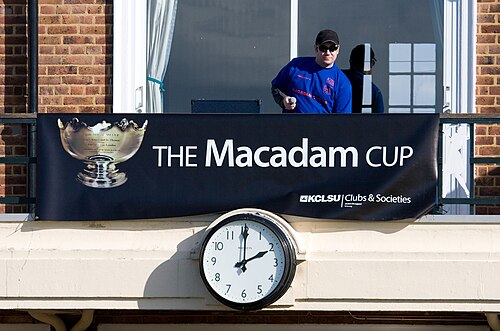

There are over 60 sports clubs, many of which compete in the University of London and British Universities & Colleges (BUCS) leagues across the South East.[290] The annual Macadam Cup is a varsity match played between the sports teams of King's College London proper (KCL) and King's College London Medical School (KCLMS). King's students and staff have played an important part in the formation of the London Universities and Colleges Athletics.
Created in January 2013, King's Sport, a partnership between King's College London and KCLSU, manages all the sports activities and facilities of King's.[303][304] King's Sport runs three fitness centres at the Waterloo, Guy's and Strand Campuses which include various studio spaces. King's Sport also operates three sports grounds in New Malden, Honor Oak Park and Dulwich.[305] There are also on-campus sports facilities at Guy's, St Thomas's and Denmark Hill campuses.[306] King's students and staff can utilize Guy's and St Thomas' NHS Foundation Trust's fitness centre and swimming pool based within the Guy's and St Thomas' hospitals.[306][307]
Societies and organisations
In addition to sporting clubs, King's College London also boast 300 other societies and groups in a wide variety of activities.[291] The societies are categorised by fourteen main groups: Business, Finance & Entrepreneur Ship; Culture; Medical; Faith & Spirituality; Academic; Common Interest; Music & Performance; Fundraising; Political; Volunteering & Fundraising; Cultural; Arts & Creative; Media; Causes & Campaigning.
Student-led think tank
Following the 2010 student demonstrations against increased tuition fees, King's College London students founded London's first student-led think tank, King's Think Tank (formerly known as KCL Think Tank).[308] With a membership of more than 2000,[309][310] it is the largest organisation of its kind in Europe.[311] This student initiative organises lectures and discussions in seven different policy areas, and assists students in lobbying politicians, non-governmental organisations (NGOs) and other policymakers with their ideas. Every May, it produces a peer-reviewed journal of policy recommendations called The Spectrum.[312][313]
Music
There are many music societies at King's including a cappella groups, orchestras, choir, musical theatre and jazz society.[314] King's has three orchestras: King's College London Symphony Orchestra (KCLSO), King's College London Chamber Orchestra and KCL Concert Orchestra.[314]
Founded in 1945, the Choir of King's College London, one of the most acclaimed university choirs in England,[315][316] consists of around 30 choral scholars.[317] The choir regularly broadcasts on BBC Radio 3 and Radio 4 and has made recordings mainly focus on 16th-century English and Spanish repertoire.[317]
All the King's Men is an all-male a cappella ensemble from King's College London. Founded in 2009, it become the first group outside of Oxford and Cambridge to win The Voice Festival UK in 2012.[318][319][better source needed]
American rock band Foo Fighters played their first UK gig at King's College London Students Union in 1995.[320] Pop singer Taylor Swift played her first UK gig at the Strand Campus in 2008.[321]
Rivalry with University College London
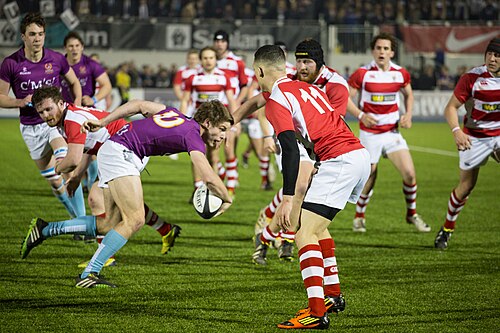
Competition within the University of London is most intense between King's and University College London, the two oldest institutions. Indeed, the University of London when it was established has been described as "an umbrella organisation designed to disguise the rivalry between UCL and KCL."[322] In the early twentieth century, King's College London and UCL rivalry was centred on their respective mascots.[323] University College's was Phineas Maclino, a wooden tobacconist's sign of a kilted Jacobite Highlander purloined from outside a shop in Tottenham Court Road during the celebrations of the relief of Ladysmith in 1900. King's later addition was a giant beer bottle representing "bottled youth". In 1923 it was replaced by a new mascot to rival Phineas – Reggie the Lion, who made his debut at a King's–UCL sporting rag in December 1923, protected by a lifeguard of engineering students armed with T-squares. Thereafter, Reggie formed the centrepiece of annual freshers' processions by King's students around Aldwych in which new students were typically flour bombed.[324]
Although riots between respective college students occurred in central London well into the 1950s, rivalry is now limited to the rugby union pitch and skulduggery over mascots, with the annual London Varsity series culminating in the historic match between King's College London RFC and University College London RFC.[323][325]
Rivalry with the London School of Economics
On 2 December 2005, tensions between King's and the London School of Economics (LSE) were ignited when at least 200 students from LSE (located in Aldwych near the Strand Campus) diverted off from the annual "barrel run" and caused an estimated £32,000 of damage to the English department at King's.[326][327] The Times reported that LSE director Howard Davies attended the fun run event,[328][329] while LSE claimed that Davies only attended for a short time.[330] King's principal, Sir Rick Trainor, deplored the behaviour, appealed to King's students to remain calm and called for no retaliation.[331][332] The LSE Students' Union later on 6 December issued a formal apology, condemned the actions, as well as promising to foot the bill for the damage repair.[330][332]
Student residences

King's owns and operates a total of thirteen halls of residence with nearly 6,000 rooms.[333] The university guarantees accommodation for all new first-year undergraduates, who make a firm acceptance of their offer and apply for accommodation by 6th June each year, and to postgraduates who make a firm acceptance of their offer and apply for accommodation by 17th June each year. Accommodation is also guaranteed for care-experienced students, and students who are under the age of 18 on move-in day. The university also has a scheme, King's Affordable Accommodation Scheme (KAAS) which enables undergraduate students to access accommodation priced at below market levels, provided applicants for the scheme meet the eligibility criteria.[334] There is a limited quota for KAAS rooms in a number of King's residences.
There are also five intercollegiate halls shared with the constituent colleges of the University of London, which full-time students at King's are eligible to live in.[335]
The university's Champion Hill residence has been empty since 2020, following the discovery of fire safety concerns and subsequent relocation of students and staff. A university spokesperson stated in March 2024, “We are working to refurbish these buildings with the aim to have them available as student accommodation as soon as work is completed, and it is safe to do so.”[336]
King's newest residence opened in Battersea, in September 2024, and contains 452 rooms. A number of affordable rooms have been secured under the KAAS scheme.[337]
Notable people
Notable alumni
Notable alumni in the sciences include Nobel laureates Peter Higgs (Physics),[338] Sir Michael Houghton (Medicine) and Michael Levitt (Chemistry).[339] Others include polymath and pioneer of eugenics, Sir Francis Galton;[340] Raymond Gosling who took Photograph 51 which was critical evidence in identifying the structure of DNA; co-discoverer of Hepatitis C and of the Hepatitis D genome Qui-Lim Choo;[341] pioneer of in-vitro fertilisation (IVF) Patrick Steptoe;[342] Kyoto Prize laureate Anthony Pawson;[343] Wolf Prize laureates Michael Fisher (Physics) and Sir James Gowans (Medicine); Lasker Award winner John Hughes; Gairdner Foundation International Award winner R. John Ellis; inventor of the seismometer John Milne, and at least 111 Fellows of the Royal Society.
Notable King's alumni in poetry and literature include the dramatist Sir W. S. Gilbert,[344] and the writers Thomas Hardy, Sir Arthur C. Clarke, Virginia Woolf,[345] Alain de Botton, Sir Michael Morpurgo, W. Somerset Maugham, Charles Kingsley, C. S. Forester, John Ruskin, Radclyffe Hall, Dame Susan Hill,[345] Hanif Kureishi, Maureen Duffy,[345] Khushwant Singh, Sir Leslie Stephen and the Booker Prize winner Anita Brookner.

King's alumni in religion include the Nobel Peace Prize laureate and Archbishop Emeritus of Cape Town, Desmond Tutu,[346] former Archbishop of Canterbury, Lord Carey,[347] former Chief Rabbi of the United Kingdom and the Commonwealth, Lord Sacks,[348] Primate of All Ireland, Richard Clarke, Archbishops of Cape Town, Njongonkulu Ndungane and Joost de Blank, Archbishop of the West Indies John Holder, Archbishop of New Zealand Churchill Julius, Bishop of Cape Coast, Victor Atta-Baffoe, and the Ethiopian cardinal Berhaneyesus Demerew Souraphiel.
Notable King's alumni to have held senior positions in British politics include two Speakers of the House of Commons (Lord Maybray-King and Lord Ullswater), one Foreign Secretary (David Owen), and the former Cabinet ministers Lord Watkinson, Lord Passfield and Lord Wilmot. As of the current Parliament there are 18 King's graduates in the House of Commons and 17 King's graduates in the House of Lords including Lord Carlile,[349] Lord Clinton-Davis, Lord Dunlop,[350] Lord Kakkar,[351] Lord MacGregor, Baroness Morgan, Baroness O'Loan,[352] Lord Owen, Lord Plant,[353] Lord Rowlands,[354] Baroness Watkins, and the Lords Spiritual Tim Dakin,[355] Nick Holtam,[356] and Tim Thornton.[357]
King's alumni in the arts include the impressionist Rory Bremner;[358] Queen bassist John Deacon;[358] Chief Executive of the Royal Opera House Alex Beard; Oscar winners Greer Garson, Edmund Gwenn and Anne Dudley; Grammy Award winners Boris Karloff, Sir John Eliot Gardiner and Peter Asher; Emmy Award winning director Sacha Gervasi, and the Golden Globe-winning composer Michael Nyman.[359]
In law, King's alumni include the Chief Prosecutor of the International Criminal Court Karim Ahmad Khan, Judge of the International Court of Justice, Patrick Lipton Robinson;[360] current High Court judges Sir David Foskett, Dame Bobbie Cheema-Grubb, Sir David Foxton and Dame Heather Williams,[361][362] and current Lady Justice of Appeal Geraldine Andrews.[363]
King's alumni in the military include former Deputy Supreme Allied Commanders Europe Sir Keith Blount, Sir Adrian Bradshaw and Sir Tim Radford, Chief of the Defence Staff Sir Tony Radakin, Chief of the Imperial General Staff Lord Harding, Chief of the Air Staff Sir Michael Wigston, head of the Singapore Armed Forces Neo Kian Hong, head of the Brazilian Armed Forces Renato Rodrigues de Aguiar Freire, head of the Nigerian Armed Forces Ola Ibrahim, head of the Maltese Armed Forces Martin Xuereb, head of the Bruneian Armed Forces Hamzah Sahat, the first female officer of The Life Guards Captain Elizabeth Godwin, PAF Air Commodore Rizwan Ullah Khan, and two recipients of the Victoria Cross, Ferdinand Le Quesne and Mark Sever Bell.
King's is also the alma mater of the founder of Bentley Motors, Walter Bentley;[364] oil magnate and philanthropist Calouste Gulbenkian; journalists Antoine Allen, Martin Bashir, Francine Lacqua, Diana Magnay, Sophie Long, Jane Corbin, Tom Rogan, Sean Fletcher, Anita Anand and David Bond;[365] and the Olympic gold medalists Dame Katherine Grainger,[345][366] Paul Bennett,[367] and Kieran West.[368]
-
 Polymath Sir Francis Galton (Medicine, 1839)
 -
 Dramatist Sir W. S. Gilbert of Gilbert and Sullivan (BA, 1856)
 -
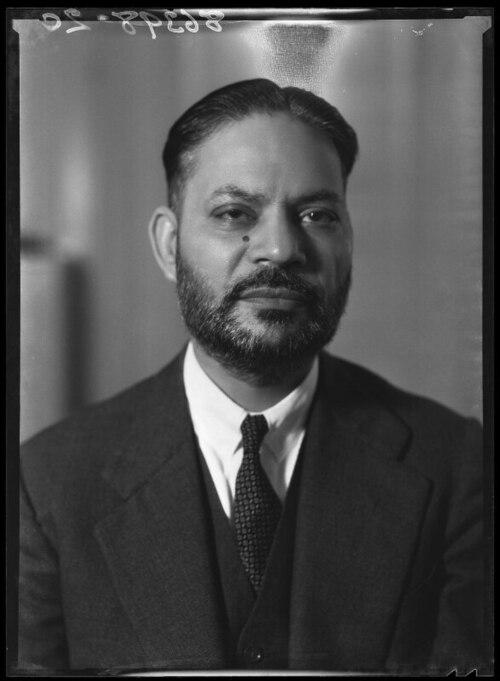 Jurist and diplomat Muhammad Zafarullah Khan (LLB, 1914)
 -
 Science fiction writer Sir Arthur C. Clarke (BSc, 1948)
 -
 Archbishop of Canterbury Lord Carey (BD, 1962)
 -
 Queen bassist John Deacon (BSc, 1971)
 -
 Impressionist and comedian Rory Bremner (BA, 1984)
 -
 Writer and philosopher Alain de Botton (MPhil, 1992)
 -
 Deputy Supreme Allied Commander Europe Sir Keith Blount (MA, 2004)
 -
 24th Chief of the Defence Staff Tony Radakin (MA, 2000)
.jpg/500px-Arthur_C._Clarke_(1982).jpg)
.jpg/500px-John_Deacon_(1977).jpg)
.jpg/500px-Vice_Admiral_Keith_Blount_DSACEUR_(cropped).jpg)
Nobel laureates
There are 14 Nobel laureates who were associated with King's College London or one of the institutions that have since merged with it.[369] The latest laureates are Sir Michael Houghton who received the 2020 Nobel Prize in Physiology or Medicine[370] and Sir Roger Penrose who received the 2020 Nobel Prize in Physics.[371]
Notable academics and staff
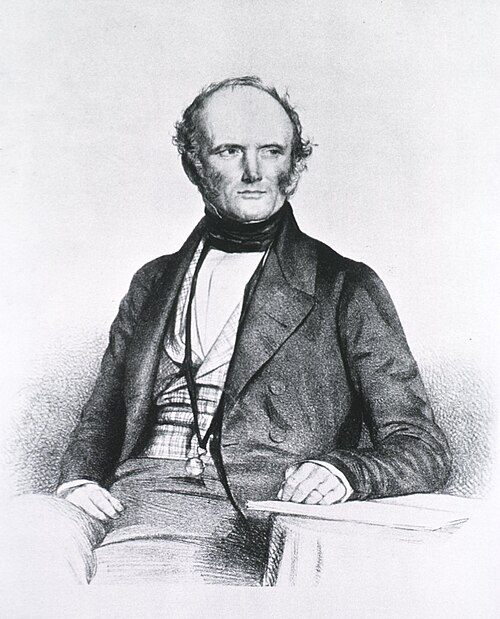
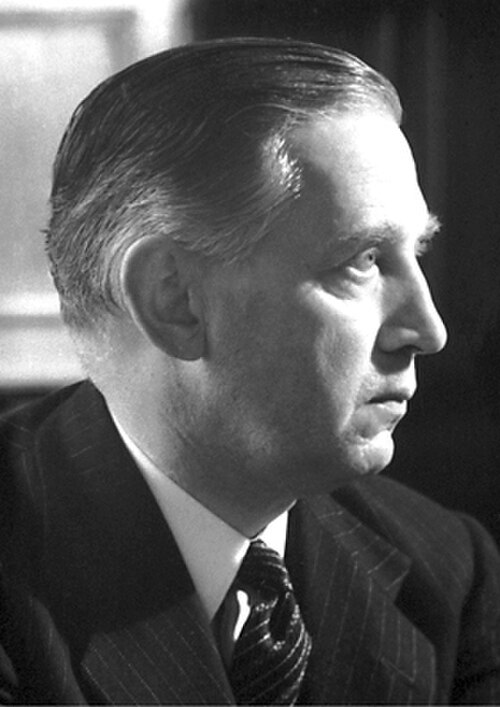
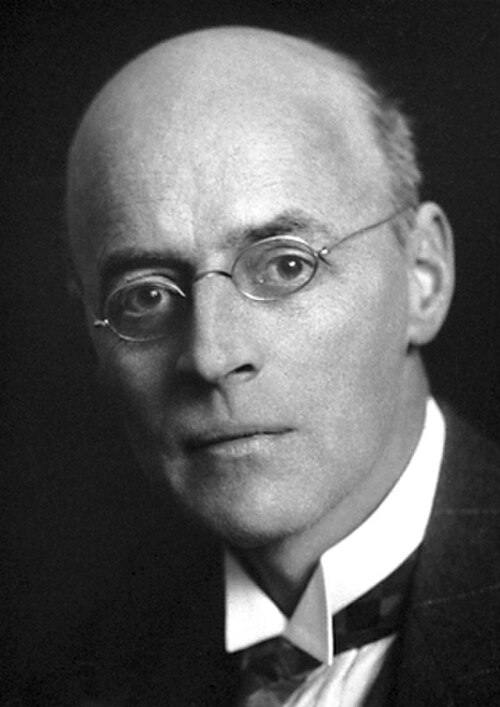
Notable academics at King's have included Sir Charles Lyell (lawyer and geologist), Sir Charles Wheatstone (best known for the Wheatstone bridge), Robert Bentley Todd (best known for describing Todd's paresis), James Clerk Maxwell (mathematical physicist), Joseph Lister (pioneer of antiseptic surgery), Charles Barkla (best known for the study of X-rays), Sir Edward Appleton (physicist), Sir Owen Richardson (physicist), Maurice Wilkins (best known for contributions to the discovery of the structure of DNA), Rosalind Franklin (best known for contributions to the discovery of the structure of DNA), Jean Hanson (biophysycist, best known for sliding filament theory), Mario Vargas Llosa (writer), Sir Roger Penrose (mathematical physicist) and John Ellis (theoretical physicist).




Heads of state, government and international organisations
King's has educated numerous foreign Heads of State and Government including two former Presidents of Cyprus, Tassos Papadopoulos[372] and Glafcos Clerides,[373] Prime Minister of Jordan Marouf al-Bakhit,[374] President of the Seychelles France-Albert René,[375] Prime Minister of the Bahamas Sir Lynden Pindling,[376] President of Uganda Godfrey Binaisa,[377] Prime Minister of Iraq Abd al-Rahman al-Bazzaz,[378] Prime Minister of Grenada Maurice Bishop, Prime Minister of Saint Kitts and Nevis Sir Lee Moore,[379] Governor General of Ghana William Hare, 5th Earl of Listowel, Governor General of Saint Vincent and the Grenadines Sir Sydney Gun-Munro, Governor of The British Virgin Islands Augustus Jaspert,[380] Governors of the Turks and Caicos Islands Martin Bourke[381] and John Freeman,[382] Governor of the Falkland Islands Nigel Phillips,[383] and Acting Prime Minister of Moldova Natalia Gherman.
At ministerial level King's alumni include Deputy Prime Ministers of Canada (Anne McLellan), Singapore (S. Rajaratnam), Turkey (Recep Akdağ) and Egypt (Ziad Bahaa-Eldin); Vice Presidents of Kenya (Michael Kijana Wamalwa) and Sierra Leone (Francis Minah and Abdulai Conteh); Foreign Ministers of Albania (Igli Hasani), Bulgaria (Nickolay Mladenov), Japan (Hayashi Tadasu), Malaysia (Rais Yatim), Pakistan (Sir Muhammad Zafarullah Khan, later President of the UN General Assembly and the International Court of Justice), Ghana (Obed Asamoah), Kenya (James Nyamweya), Sierra Leone (J. B. Dauda) and Guyana (Sir Shridath Ramphal, later Secretary-General of the Commonwealth, and Frederick Wills); and Chairman of the Irish Provisional Government Michael Collins.


In popular culture

Film and television settings
The neoclassical facade of King's, with the passage which connects the Strand to the Somerset House terrace has been utilised to reproduce the late Victorian Strand in the opening scenes of Oliver Parker's 2002 film The Importance of Being Earnest. The East Wing of King's appears, as a part of Somerset House, in a number of other productions, such as Wilde, Flyboys, and The Duchess.[405]
The Maughan Library has also been the location of some film shoots of popular movies and TV series, most notably Johnny English (see Maughan Library description), The Imitation Game, Enola Holmes and V for Vendetta.[405] Corridors from Guy's Campus were also used in the making of BBC series Killing Eve.
Part of Dan Brown's novel The Da Vinci Code was set in the Round Reading Room of the Maughan Library, although no part of the film adaption was filmed there.[406]
In September 1979, The Greenwood Theatre at Guy's Medical School (now King's GKT Medical School) became the first home for the BBC's Question Time programme. In December 2018, Question Time returned to the Greenwood Theatre for David Dimbleby's last programme as host.[407]
See also
Notes
- ^ Includes those who indicate that they identify as Asian, Black, Mixed Heritage, Arab or any other ethnicity except White.
- ^ Calculated from the Polar4 measure, using Quintile1, in England and Wales. Calculated from the Scottish Index of Multiple Deprivation (SIMD) measure, using SIMD20, in Scotland.
References
- ^ Trapp, Michael. "The memorial inscription to Joseph Anstice" – via www.academia.edu.
- ^ Record of the Celebration of the Quatercentenary of the University of Aberdeen. University of Aberdeen. 1907. p. 539.
- ^ a b "Our history". King's College London Faculty of Life Sciences and Medicine. Archived from the original on 18 October 2018. Retrieved 13 February 2016.
- ^ a b c d "Financial Statements for the year to 31 July 2023" (PDF). King's College London. Retrieved 13 December 2023.
- ^ a b "Who's working in HE?". www.hesa.ac.uk. Higher Education Statistics Agency.
- ^ a b c d "Where do HE students study? | HESA". hesa.ac.uk. Higher Education Statistics Agency.
- ^ "His Majesty the King becomes Royal Patron of King's College London".
- ^ a b "Branding Essentials" (PDF). Branding Essentials November 2018. Retrieved 24 March 2019.[permanent dead link]
- ^ "Foundation of the College". King's College London. Retrieved 19 January 2013.
- ^ "Royal Charter of King's College London" (PDF). King's College London. 2009. Archived from the original (PDF) on 1 August 2014. Retrieved 12 September 2013.
- ^ "A brief history". University of London. Archived from the original on 9 February 2014. Retrieved 19 January 2013.
- ^ "King's College London". Russell Group. 27 January 2024.
- ^ "King's College London". University of London.
- ^ a b c "UCAS Undergraduate Sector-Level End of Cycle Data Resources 2023". ucas.com. UCAS. December 2023. Show me... Domicile by Provider. Retrieved 30 April 2024.
- ^ a b c "Key Facts". King's Health Partners. Retrieved 17 October 2015.
- ^ Petroni, A (1969). "[The first nursing school in the world—St. Thomas Hospital School in London]". Munca Sanit. 17 (8): 449–54. PMID 5195090.
- ^ Mike Savage (5 November 2015). Social Class in the 21st Century. Penguin. p. 167. ISBN 9780141978925.
Higher education researchers often talk about a 'Golden Triangle' of universities. The 'triangle' describes an imaginary three-sided shape with corners in Oxford, Cambridge and London. The exact composition of the London 'corner' can vary, but typically it includes the London School of Economics, King's College London, University College London and Imperial College London.
- ^ "Remembering Her Majesty The Queen". King's College London. 8 September 2022. Retrieved 8 September 2022.
- ^ "His Majesty The King becomes Royal Patron of King's College London". King's College London. 14 May 2024. Archived from the original on 5 June 2024. Retrieved 5 June 2024.
- ^ a b c d e f g h i j k l Cockburn, King, McDonnell (1969), pp. 345–359
- ^ a b "Foundation". King's College London. Retrieved 9 February 2013.
- ^ Hearnshaw (1929), p. 38
- ^ Hibbert, Weinreb, Keay, Keay (2008), p. 958
- ^ a b Banerjee, Jacqueline. "The University of London: The Founding Colleges". Retrieved 26 May 2007.
- ^ MacIlwraith (1884), p. 32
- ^ Thompson (1990), p. 5
- ^ a b King's College London and Somerset House, King's College London, c. 1963, p. 2, retrieved 12 February 2013
- ^ "Beginnings: The History of Higher Education in Bloomsbury and Westminster – King's College London". Institute of Education. Archived from the original on 7 October 2013. Retrieved 13 February 2013. "Londoners who did study, for example in Oxford or Cambridge, had to be quite rich and also members of the Anglican Church."
- ^ "The famous Duel". King's College London. Retrieved 13 February 2013.
- ^ a b Holmes (2002), p. 275
- ^ "Winchilsea insults Wellington". King's College London College Archives. Retrieved 13 February 2013.
- ^ a b "Duel Day – Questions and Answers". King's College London. Retrieved 9 February 2013.
- ^ "Open Fire!". King's College London College Archives. Retrieved 13 February 2013.
- ^ "Alumni celebrate Duel Day". King's College London. 2007. Archived from the original on 1 October 2012. Retrieved 23 January 2008.
- ^ Hearnshaw (1929), p. 80
- ^ a b c d e f Hibbert, Weinreb, Keay, Keay (2008), p. 462
- ^ Prospectus of King's College, London: academical year 1854-5, p. 7
- ^ Thompson (1986), p. 6
- ^ a b c "History & today". About King's. King's College London. Retrieved 31 January 2016.
- ^ Opening of the University of London. Vol. 1554. 8 August 1857. pp. 1005–1007.
{{cite book}}:|work=ignored (help) - ^ The Calendar of King's College, London. 1896. pp. v–xvii.
- ^ University of London, the Historical Record: (1836–1912). University of London. 1912. pp. 7–24.
- ^ McNair, Philip (January 1977). "Linetta de Castelvecchio Richardson". Italian Studies. 32 (1). The Society for Italian Studies: 1–3. doi:10.1179/its.1977.32.1.1.
- ^ Heulin (1979), p. 2
- ^ "The Strand Quadrangle Architectural Competition Preliminary briefing paper" (PDF). King's College London. Archived from the original (PDF) on 4 March 2016. Retrieved 4 March 2013.
- ^ Maddox (2002), p. 124
- ^ "Maurice Wilkins and Rosalind Franklin". King's College London. Retrieved 21 January 2013.
- ^ "King's, DNA & the continuing story". King's College London. Archived from the original on 9 July 2012. Retrieved 21 January 2013.
- ^ Smithers, Rebecca; MacLeod, Donald (10 December 2005). "College vote brings break-up of university a step nearer". The Guardian.
Over the past 10 years the university has become an increasingly loose federation of independent institutions that are universities in their own right and receive their grants directly from the Higher Education Funding Council for England, although they still hand out degrees on behalf of the central university.
- ^ "Dates: 1900–1949". King's College London. Retrieved 21 January 2013.
- ^ a b c d "King's College Hospital". The birth of modern dentistry. King's Collections. Retrieved 29 January 2016.
- ^ O'Leary (2010), p. 404
- ^ a b "King's Governance". King's College London. Retrieved 29 December 2014.
- ^ "Certificate FAQs" (PDF). Archived from the original (PDF) on 3 September 2013. Retrieved 12 March 2013.
- ^ "King's College London – Lions on the catwalk". Times Higher Education. Retrieved 29 December 2014.
- ^ Jump, Paul (14 April 2011). "Three's company: Imperial, King's join UCL in £700m medical project". Times Higher Education. Retrieved 30 March 2013.
- ^ Jump, Paul (2 September 2011). "King's chemistry department rises again". Times Higher Education. Retrieved 12 March 2013.
- ^ "King's College London – King's College London Mathematics School". www.kcl.ac.uk.
- ^ "Officer Statement on the King's Rebrand". KCLSU Student Officers Blog. Retrieved 26 December 2015.
- ^ "King's rebrand – update". King's College London. Retrieved 26 December 2015.
- ^ Bawden, Tom (19 January 2015). "King's College London ditches 'pretentious' rebrand after student anger". Independent. Retrieved 26 December 2015.
- ^ Grove, Jack (19 January 2015). "King's College London drops rebrand plan". Times Higher Education. Retrieved 26 December 2015.
- ^ "King's College London adds the north-west wing to its Strand Campus (GB)". Europe Real Estate. 8 September 2016. Retrieved 18 October 2023.
- ^ "Guy's Campus". King's College London. Archived from the original on 23 November 2015. Retrieved 21 January 2013.
- ^ "Franklin Wilkins Building, King's College- 150 Stamford Street, London, UK". Manchesterhistory.net. Retrieved 20 March 2012.
- ^ a b "Waterloo Campus". King's College London. Archived from the original on 16 April 2016. Retrieved 21 January 2013.
- ^ "Waterloo Campus Tour" (PDF). King's College London. Retrieved 30 December 2015.
- ^ "James Clerk Maxwell". King's College London. Retrieved 30 December 2015.
- ^ "St Thomas' Campus". King's College London. Archived from the original on 1 February 2013. Retrieved 21 January 2013.
- ^ "The Foundation of St Thomas's" (PDF). p. 1. Archived from the original (PDF) on 16 December 2011. Retrieved 2 December 2018.
- ^ "Denmark Hill Campus". King's College London. Archived from the original on 4 April 2016. Retrieved 21 January 2013.
- ^ "HRH The Princess Royal opens one of the world's leading neuroscience institutes". King's College London. Archived from the original on 4 January 2019. Retrieved 21 November 2015.
- ^ "King's awarded £10m for world-leading Hub for Neuropsychiatry Imaging Research and Therapeutics". Science Business. Retrieved 21 November 2015.
- ^ "Defence Studies contract renewal" (Press release). King's College London. 18 October 2011. Archived from the original on 14 February 2021. Retrieved 8 February 2021.
- ^ "King's By Numbers". King's College London. Archived from the original on 21 October 2010. Retrieved 2 January 2024.
- ^ "Projects". King's College London. Archived from the original on 21 April 2013. Retrieved 20 January 2013.
- ^ "Maurice Wohl Clinical Neuroscience Institute". KCL. 1 August 2016. Retrieved 7 July 2024.
- ^ "Honor Oak Park Sportsground". KCL. 16 May 2016. Retrieved 7 July 2024.
- ^ "King's wins top Green Award". King's College London. Archived from the original on 11 June 2007. Retrieved 25 April 2007.
- ^ "King's library wins prestigious heritage award". King's College London. Archived from the original on 8 July 2007. Retrieved 25 April 2007.
- ^ "Strand Quad redevelopment". King's College London. Archived from the original on 17 January 2013. Retrieved 19 January 2013.
- ^ London, King's College (1 December 2022). "Celebrating the completion of the Quadrangle redevelopment project". King's College London. Retrieved 7 July 2024.
- ^ "Bush House Buildings". King's College London. 26 July 2017. Retrieved 7 July 2024.
- ^ "King's College London to use former BBC World Service HQ". Times Higher Education (THE). 10 March 2015. Retrieved 7 July 2024.
- ^ London, King's College (7 December 2022). "Transformed Strand Aldwych redevelopment officially opened". King's College London. Retrieved 7 July 2024.
- ^ London, King's College. "Capital Projects - Current". King's College London. Retrieved 7 July 2024.
- ^ "The Charter" (PDF). King's College London. 13 May 2009. Retrieved 18 October 2023.
- ^ "The Statutes". King's College London. 18 May 2023. Retrieved 18 October 2023.
- ^ "Professor Shitji Kapoor". King's College London. Retrieved 18 October 2023.
- ^ a b "Our people". King's College London. Retrieved 11 March 2023.
- ^ "College Council". King's College London. Archived from the original on 20 April 2013. Retrieved 9 February 2013.
- ^ "The Council and its standing committees" (PDF). King's College London. Archived from the original (PDF) on 20 June 2013. Retrieved 16 February 2013.
- ^ "Chairman of the College Council". King's College London. Archived from the original on 12 April 2013. Retrieved 22 January 2013.
- ^ "Sir Christopher Geidt announced as new King's Chairman". King's College London. Retrieved 14 February 2016.
- ^ "No. 62103". The London Gazette. 8 November 2017. p. 20550.
- ^ "Ordinances". King's College London. Retrieved 11 March 2023.
- ^ a b King's College London. "Why King's has a Dean". Retrieved 11 March 2023.
- ^ "Choral Scholarships". King's College London. Retrieved 11 March 2023.
- ^ "Vocations group". King's College London. Retrieved 11 March 2023.
- ^ "Archbishop of Canterbury visits King's". King's College London. 8 May 2006. Archived from the original on 23 March 2009. Retrieved 15 August 2007.
- ^ University of London, King's College (1850). The Calendar of King's College, London 1850–1851. John W Parker. Retrieved 21 January 2016.
- ^ a b c d University of London, King's College (1857). The Calendar of King's College, London 1857–1858. John W Parker. Retrieved 21 January 2016.
- ^ "Asia business leaders in fundraiser celebrations". News and Events. King's College London. Retrieved 20 June 2016.
- ^ "Our connections | Faculty of Arts & Humanities | King's College London". www.kcl.ac.uk. Retrieved 15 April 2024.
- ^ "QS World University Rankings for Arts and Humanities 2024". Top Universities. 10 July 2024. Retrieved 11 July 2024.
- ^ "Faculty of Arts & Humanities – About the Faculty". Faculty of Arts & Humanities. Retrieved 21 January 2016.
- ^ "About the Faculty of Arts & Humanities | Faculty of Arts & Humanities | King's College London". www.kcl.ac.uk. Retrieved 15 April 2024.
- ^ London, King's College. "Digital Futures Institute to help 'understand what it means to live well with technology'". King's College London. Retrieved 15 April 2024.
- ^ "Dental Institute – About the Institute". Dental Institute. Archived from the original on 16 December 2018. Retrieved 21 January 2016.
- ^ "QS World University Rankings for Dentistry 2024". Top Universities. 10 July 2024. Retrieved 11 July 2024.
- ^ a b c d e f "Guy's Hospital". The birth of modern dentistry. King's Collections. Retrieved 28 January 2016.
- ^ Kabir, Alamgir (May 1995). "Feature—Frederick Newland-Pedle" (PDF). Guy' S Gazette. 109 (2447): 151–167. Retrieved 29 January 2016.
- ^ "Faculty of Life Sciences & Medicine – Our history". King's College London. Archived from the original on 18 October 2018. Retrieved 21 January 2016.
- ^ "QS World University Rankings for Life Sciences & Medicine 2024". Top Universities. 10 July 2024. Retrieved 11 July 2024.
- ^ "Faculty of Life Sciences & Medicine" (PDF). Faculty of Life Sciences & Medicine. Archived from the original (PDF) on 22 July 2018. Retrieved 21 January 2016.
- ^ "King's College London – New faculty academic configuration". www.kcl.ac.uk. Archived from the original on 25 June 2017. Retrieved 17 September 2017.
- ^ "About the IoPPN". King's College London. Archived from the original on 4 November 2016. Retrieved 21 January 2016.
- ^ "Research". South London and Maudsley NHS Foundation Trust. Archived from the original on 14 May 2020. Retrieved 21 January 2016.
- ^ "Institute of Psychiatry gets a new name". British Psychological Society. Archived from the original on 27 January 2016. Retrieved 21 January 2016.
- ^ "IoPPN Our history". King's College London. Archived from the original on 4 November 2016. Retrieved 21 January 2016.
- ^ "QS World University Rankings for Psychology 2024". Top Universities. 10 July 2024. Retrieved 11 July 2024.
- ^ a b "King's College London School of Law Records". London: King's College London College Archives. March 2001. Archived from the original on 15 April 2013. Retrieved 22 January 2013.
- ^ "QS World University Rankings for Law & Legal Studies 2024". Top Universities. 10 July 2024. Retrieved 11 July 2024.
- ^ "The Dickson Poon School of Law – Our centres". Dickson Poon School of Law. Retrieved 21 January 2016.
- ^ "About the Faculty of Natural & Mathematical Sciences". Faculty of Natural & Mathematical Sciences. Retrieved 21 January 2016.
- ^ Wilkins, M. H. F. (August 1952). "Engineering, Biophysics and Physics at King's College, London" (PDF). Nature. 170 (4320): 261–263. doi:10.1038/170261a0. Retrieved 19 January 2020.
- ^ a b c d "Department of Chemistry – History". Department of Chemistry. Retrieved 28 January 2016.
- ^ a b c "About the Division of Engineering". Faculty of Natural & Mathematical Sciences. Archived from the original on 1 June 2017. Retrieved 21 January 2016.
- ^ "King's College London Engineering Student Records". National Archives. Retrieved 21 January 2016.
- ^ "Department of Engineering | King's College London". www.kcl.ac.uk. Retrieved 4 March 2021.
- ^ Petroni, A (1969). "[The first nursing school in the world—St. Thomas Hospital School in London]". Munca Sanit. 17 (8): 449–54. PMID 5195090.
- ^ a b "Florence Nightingale Faculty of Nursing & Midwifery – About the Faculty". King's College London. Retrieved 25 January 2016.
- ^ "QS World University Rankings for Nursing 2024". Top Universities. 10 July 2024. Retrieved 11 July 2024.
- ^ "Florence Nightingale Faculty of Nursing & Midwifery – History". Florence Nightingale Faculty of Nursing & Midwifery. Retrieved 25 January 2016.
- ^ "Faculty of Social Science & Public Policy – About". Faculty of Social Science & Public Policy. Retrieved 21 January 2016.
- ^ "King's Centre for Military Health Research". Retrieved 9 January 2013.
- ^ "King's College London – Welcome to KCRM". kcl.ac.uk. Archived from the original on 31 August 2015. Retrieved 21 January 2016.
- ^ "London Asia Pacific Centre". King's College London. Archived from the original on 5 November 2018. Retrieved 2 August 2017.
- ^ "School of Management & Business". King's College London. Retrieved 21 December 2016.
- ^ "Business & Management Studies Subject League Table 2022". www.thecompleteuniversityguide.co.uk.
- ^ "Research centres | King's Business School | King's College London". www.kcl.ac.uk. Archived from the original on 4 December 2020. Retrieved 5 November 2020.
- ^ "International Students – King's College London". www.thecompleteuniversityguide.co.uk. Retrieved 8 April 2020.
- ^ "Study Business Management at King's College London, University of London – The Uni Guide". www.theuniguide.co.uk. Retrieved 13 April 2020.
- ^ a b c d e "Financial Statements for the year to 31 July 2019" (PDF). King's College London. Archived from the original (PDF) on 24 September 2020. Retrieved 14 December 2019.
- ^ "Times Higher Education university financial health check 2015". Times Higher Education. 30 April 2015. Retrieved 3 May 2015.
- ^ "Major campaign aims to put King's among the fundraising elite". Times Higher Education. 28 October 2010. Retrieved 31 March 2013.
- ^ "King's College London – WHAT HAVE WE ACHIEVED?". www.kcl.ac.uk.
- ^ "World questions – King's answers – What have we achieved? – King's Alumni Community". alumni.kcl.ac.uk.
- ^ "Committed Grants". Bill & Melinda Gates Foundation. Archived from the original on 15 June 2022. Retrieved 15 June 2022.
- ^ King's College London (2008), King's College London Corporate identity guidelines, p. 4
- ^ a b c d e "The basics" (PDF). King's College London. Retrieved 20 January 2016.[permanent dead link]
- ^ "A brief history". University of London. Archived from the original on 9 February 2014. Retrieved 31 December 2015.
- ^ "Do you want to be in my gang?". Times Higher Education. 19 November 2009. Retrieved 31 December 2015.
- ^ "Members and Contacts". UNICA. Retrieved 31 December 2015.
- ^ "Golden opportunities". Nature. 6 July 2005.
No longer rivals, Oxford, Cambridge and London are now working towards a common goal – ensuring the 'golden triangle' becomes a global science hub.
- ^ "Oxbridge windfall". Times Higher Education. 4 August 1995.: "A large amount of the cash awarded to humanities postgraduates still goes to the "Golden Triangle" of Oxford, Cambridge and London, British Academy figures reveal."
- ^ "The future of the University of London: a discussion paper from the Provost of UCL" (PDF). University College London. Retrieved 14 February 2016.
- ^ "UK confirmed as 'global education superpower' in international university rankings". Re:locate. Retrieved 14 February 2016.
- ^ "London top city in global university rankings". BBC News. Retrieved 14 February 2016.
- ^ "Johnson floats £10bn biotech fund for London". Financial Times. 24 June 2015. Archived from the original on 10 December 2022. Retrieved 14 February 2016.
- ^ "Golden triangle pulls ahead in REF shake-out" (PDF). Research Fortnight. Archived from the original (PDF) on 21 January 2016. Retrieved 14 February 2016.
- ^ "'First large-scale evidence' that graduates from prestige universities dominate elite". Times Higher Education. Retrieved 14 February 2016.
- ^ "Unequal Britain: The growing power of a small elite". Big Issue. Archived from the original on 21 January 2016. Retrieved 14 February 2016.
- ^ "'Golden triangle' to win funding riches". Times Higher Education. 11 February 2010.
The other institutions in the Cambridge-Oxford-London 'golden triangle' – University College London, Imperial College London and the London School of Economics – will also receive big cash windfalls, as will the University of Manchester.
- ^ "England's golden triangle". New Scientist. 20 April 2005.
- ^ "The golden triangle holds the secret". Times Higher Education. 1 March 2002.
- ^ Alok Jha (3 June 2003). "Gold rush". The Guardian.
- ^ King's is included in some listing[155][156][157][158][159][160][161][162][163] but not in others [164][165][166][167]
- ^ "Heart operation using MRI is world first". BBC News. 9 January 2010. Retrieved 5 November 2010.
- ^ "Top hospitals link up with university to form research centre". London Evening Standard. 10 April 2008. Archived from the original on 19 April 2011. Retrieved 5 November 2010.
- ^ "The partners". King's Health Partners. Archived from the original on 31 October 2010. Retrieved 5 November 2010.
- ^ "About Us". Francis Crick Institute. Retrieved 31 December 2015.
- ^ "About Us". MedCity. Retrieved 31 December 2015.
- ^ "Our Global Reach". PLuS Alliance. Retrieved 14 February 2016.
- ^ "King's launch PLuS alliance". King's College London. Retrieved 14 February 2016.
- ^ a b c "International Dual Degrees". King's College London. Retrieved 14 January 2016.
- ^ "Contemporary India Research MPhil / PhD, option of joint PhD with NUS". King;s College London. Archived from the original on 29 December 2015. Retrieved 14 January 2016.
- ^ a b c d e f "Collaborations & partnerships". King's College London Faculty of Arts & Humanities. Archived from the original on 1 February 2016. Retrieved 14 January 2016.
- ^ "MA in 18th-Century Studies". British Museum. Retrieved 14 January 2016.
- ^ "Eighteenth-Century Studies MA". King's College London. Retrieved 14 January 2016.[permanent dead link]
- ^ "Home – LSGNT". www.lsgnt-cdt.ac.uk.
- ^ "Research heavyweights deny 'ganging up'". Times Higher Education. 9 May 2013. Retrieved 7 August 2014.
- ^ "About the Thomas Young Centre". Thomas Young Centre. Retrieved 30 August 2016.
- ^ "University of London Screen Studies Group". Goldsmiths, University of London. Retrieved 30 August 2021.
- ^ "2022 entry UCAS Undergraduate reports by sex, area background, and ethnic group". UCAS. 2 February 2023. Retrieved 2 February 2023.
- ^ "University League Tables entry standards 2024". The Complete University Guide.
- ^ "Where do HE students study?: Students by HE provider". HESA. HE student enrolments by HE provider. Retrieved 8 February 2023.
- ^ "Who's studying in HE?: Personal characteristics". HESA. 31 January 2023. Retrieved 8 February 2023.
- ^ "Widening participation: UK Performance Indicators: Table T2a – Participation of under-represented groups in higher education". Higher Education Statistics Authority. hesa.ac.uk. Retrieved 8 February 2023.
- ^ "Good University Guide: Social Inclusion Ranking". The Times. 16 September 2022.
- ^ "University League Table 2021 sorted by entry standards". Complete University Guide. Retrieved 9 June 2020.
- ^ "Cambridge to scrap 'unjust' state school targets". The Telegraph. Archived from the original on 31 March 2024. Retrieved 11 March 2024.
- ^ "Widening participation: UK Performance Indicators 2016/17". hesa.ac.uk. Higher Education Statistics Authority. Retrieved 1 February 2018.
- ^ "Where do HE students study?". hesa.ac.uk. Higher Education Statistics Authority. Retrieved 9 February 2018.
- ^ "KCL Undergraduate Admissions Statistics". theuniversitybuzz.blogspot.co.uk. Archived from the original on 2 October 2015. Retrieved 10 August 2015.
- ^ "KCL Undergraduate Admissions Statistics 2018" (PDF). charterhouse.org.uk.
- ^ "Breakdown of undergraduate admissions statistics – a Freedom of Information request to King's College London" (PDF). 11 July 2015.
- ^ "Term dates". King's College London. Archived from the original on 7 October 2010. Retrieved 7 October 2010.
- ^ "WAR STUDIES Term dates". King's College London. Archived from the original on 20 December 2015. Retrieved 31 December 2015.
- ^ "King's College London Maths School – Our Term Dates". King's College London. Retrieved 31 December 2015.
- ^ "Faculty of Arts & Humanities – Term dates". King's College London. Archived from the original on 4 January 2016. Retrieved 31 December 2015.
- ^ "Venue Information". Archived from the original on 17 September 2015.
- ^ Hume, Marion (September 2008). "Westwood unveils gowns" (PDF). London. Retrieved 24 June 2015.
- ^ "REF 2021: Quality ratings hit new high in expanded assessment". Times Higher Education. 12 May 2022. Retrieved 18 February 2023.
- ^ a b "REF 2014 winners: who performed best?". Times Higher Education. 18 December 2014. Retrieved 30 December 2014.
- ^ a b "Overall ranking of institutions including power market share" (PDF). Times Higher Education. Based upon the results of the 2014 Research Excellence Framework. 16 February 2016. Retrieved 30 December 2014.
- ^ "Faculties and departments". KCL. Retrieved 21 June 2024.
- ^ "Medicine MBBS". KCL. 7 August 2020. Retrieved 21 June 2024.
- ^ "Graduate Entry Medicine Programme (University of Portsmouth branch campus) MBBS". KCL. 13 December 2023. Retrieved 21 June 2024.
- ^ Dobson, Roger (29 July 2004). "Put a smile back on your face". The Independent. London. Archived from the original on 14 May 2010. Retrieved 7 September 2010.
- ^ "Nursing & Midwifery – About us". King's College London. Archived from the original on 22 October 2010. Retrieved 7 October 2010.
- ^ "MRC list of institutes, units and centres". Medical Research Council. Retrieved 21 June 2024.
- ^ "Biomedical Research Centres". NHS National Institute for Health Research. National Institute for Health Research. Archived from the original on 23 April 2015. Retrieved 23 January 2016.
- ^ "Drug Control Centre". King's College London. Retrieved 7 October 2010.
- ^ "The Drug Control Centre at King's College". King's College London. Retrieved 5 April 2013.
- ^ "London Olympics 2012". King's College London. Archived from the original on 8 December 2012. Retrieved 20 January 2013.
- ^ "About our collections". Archived from the original on 13 January 2016. Retrieved 12 November 2015.
- ^ a b "Special Collections". Archived from the original on 13 November 2015. Retrieved 11 November 2015.
- ^ "CIOT – Using the Library". Chartered Institute of Taxation. 18 December 1997. Archived from the original on 30 September 2006. Retrieved 29 April 2010.
- ^ "Tony Arnold Library". The Chartered Institute of Taxation. Archived from the original on 20 January 2016. Retrieved 30 January 2016.
- ^ a b "Archives Reading Room". King's College London. Archived from the original on 4 February 2016. Retrieved 30 January 2016.
- ^ "Franklin Wilkins Library". King's College London. Archived from the original on 28 April 2012. Retrieved 20 March 2012.
- ^ "Seventy-eighth Annual Meeting of the British Medical Association London, JUL". Br Med J. 2 (2553): 1622–1624. 4 December 1909. doi:10.1136/bmj.2.2553.1622. S2CID 220177133.
- ^ a b Gunga, Hanns-Christian (27 February 2009). Nathan Zuntz: His Life and Work in the Fields of High Altitude Physiology and Aviation Medicine. Academic Press. p. 204. ISBN 9780080885247. Retrieved 30 January 2016.
- ^ a b "Wills Library & Keats Room". King's College London. Archived from the original on 4 February 2016. Retrieved 30 January 2016.
- ^ "New Hunt's House Library". King's College London. Archived from the original on 16 September 2011. Retrieved 20 March 2012.
- ^ "St Thomas' House Library". King's College London. Archived from the original on 4 February 2016. Retrieved 30 January 2016.
- ^ "Institute of Psychiatry Library Collection". Cornucopia. Museums, Libraries and Archives Council. Retrieved 14 February 2016.[permanent dead link]
- ^ "Institute of Psychiatry, Psychology & Neuroscience Library". King's College London. Archived from the original on 4 February 2016. Retrieved 30 January 2016.
- ^ a b "Weston Education Centre". King's College London. Archived from the original on 4 May 2012. Retrieved 20 March 2012.
- ^ "University of London". Membership. Senate House Library. Retrieved 16 February 2016.
- ^ "University of London Libraries Access Agreement". The University of London. Retrieved 16 February 2016.
- ^ "About the Gordon Museum". Gordon Museum of Pathology. Retrieved 22 October 2015.
- ^ "The Gordon Museum collection". Gordon Museum of Pathology. Retrieved 22 October 2015.
- ^ "About the Museum of Life Sciences". Health Faculties, King's College London. Retrieved 23 October 2015.
- ^ "The King George III Museum Collection, [1768–1970]". College Archives. King's Collections. Retrieved 14 February 2016.
- ^ a b "Anatomy Museum". King's College London. Archived from the original on 4 March 2016. Retrieved 9 February 2016.
- ^ "KING'S COLLEGE LONDON: Secretary's in-correspondence". King's Collections. Retrieved 9 February 2016.
- ^ "The Italian Boy's murder discovered, 1831". Dickens, Scrooge and the Victorian poor. King's Collections. Retrieved 9 February 2016.
- ^ "Anatomy Theatre & Museum". King's College London. Archived from the original on 15 February 2016. Retrieved 9 February 2016.
- ^ "Overview of Special Collections". Archived from the original on 12 December 2015. Retrieved 12 November 2015.
- ^ a b "Explore 500 years of world history" (PDF). Library Services. Archived from the original (PDF) on 16 January 2017. Retrieved 16 February 2016.
- ^ "Rare Books Collection". Archived from the original on 12 December 2015. Retrieved 12 November 2015.
- ^ "College Archives". Archived from the original on 5 December 2015. Retrieved 12 November 2015.
- ^ "Liddell Hart Centre for Military Archives". Archived from the original on 5 December 2015. Retrieved 12 November 2015.
- ^ a b "Science Gallery London". King's College London. Archived from the original on 21 January 2016. Retrieved 15 January 2016.
- ^ a b c d "What is SG London". KCL. Archived from the original on 5 April 2016. Retrieved 15 January 2016.
- ^ "Science Gallery London". Science Gallery London. Retrieved 15 January 2016.
- ^ "Complete University Guide 2025". The Complete University Guide. 14 May 2024.
- ^ "Guardian University Guide 2025". The Guardian. 7 September 2024.
- ^ "Good University Guide 2025". The Times. 20 September 2024.
- ^ "Academic Ranking of World Universities 2024". Shanghai Ranking Consultancy. 15 August 2024.
- ^ "QS World University Rankings 2025". Quacquarelli Symonds Ltd. 4 June 2024.
- ^ "THE World University Rankings 2024". Times Higher Education. 28 September 2023.
- ^ "King's College London". Top Universities. Retrieved 25 June 2024.
- ^ "King's College London". Times Higher Education (THE). 26 March 2024. Retrieved 25 June 2024.
- ^ "King's College London".
- ^ "ShanghaiRanking-Univiersities". www.shanghairanking.com. Retrieved 15 August 2024.
- ^ "King's College London, University of London Ranking UK 2024 / 2025 - Complete University Guide". www.thecompleteuniversityguide.co.uk. Retrieved 25 June 2024.
- ^ "King's College London: World University Rankings". Times Higher Education. Retrieved 9 January 2021.
- ^ a b Profile, King's College London, 2006
- ^ "University ranking based on performance over 10 years" (PDF). The Times. London. 2007. Archived from the original (PDF) on 14 April 2008. Retrieved 28 April 2008.
- ^ "Methodology". League Tables. The Complete University Guide. Archived from the original on 16 April 2011. Retrieved 4 February 2016.
- ^ Hiely-Rayner, Matt (25 May 2015). "Methodology behind the Guardian University Guide 2016". The Guardian. Retrieved 5 February 2016.
- ^ "National Student Survey 2015: the overall satisfaction results in full". Times Higher Education. 12 August 2015.
- ^ "King's College London". The Times. London. Retrieved 15 June 2015.
- ^ "Methodology". 2011. Archived from the original on 16 April 2011.
- ^ "King's College London, University of London- Complete University Guide". www.thecompleteuniversityguide.co.uk.
- ^ "University League Table 2014". Archived from the original on 23 March 2016. Retrieved 7 February 2016.
- ^ "Graduate employability: top universities in the UK ranked by employers 2023-24". Student. 23 November 2023. Retrieved 10 July 2024.
- ^ "Graduate Market Report 2024". FlippingBook. Retrieved 10 July 2024.
- ^ London, King's College. "Teaching Excellence Framework". King's College London. Retrieved 10 July 2024.
- ^ "What business leaders say". The New York Times. 20 October 2011. Retrieved 14 February 2016.
- ^ "Global Employability University Ranking 2015 results". Times Higher Education. 6 November 2015. Retrieved 15 November 2015.
- ^ "The best UK universities chosen by major employers". Times Higher Education. Retrieved 23 February 2016.
- ^ "Best universities for high starting salaries". Daily Telegraph. London. 17 April 2016.
- ^ "How English domiciled graduate earnings vary with gender, institution attended, subject and socio-economic background" (PDF). Institute of Fiscal Studies. London. 17 April 2016. Archived from the original (PDF) on 17 April 2016. Retrieved 17 April 2016.
- ^ Ali, Aftab (24 May 2016). "Imperial College London beats Oxbridge universities for highest graduate employment rate". The Independent.
- ^ "King's wins 'University of the Year'". King's College London. 12 September 2010. Retrieved 15 November 2012.
- ^ "The best UK universities chosen by major employers". Times Higher Education. London. 12 November 2015.
- ^ "AKC". King's College London. Retrieved 10 March 2015.
- ^ "How to become an AKC". King's College London. Retrieved 14 February 2016.
- ^ "C3 Honorary Degrees, Fellowships and Honorary Fellowships of King's College London" (PDF). King's College London Ordinances. King's College London. November 2011. Retrieved 20 January 2013.[permanent dead link]
- ^ a b c d e "Fellows of King's". King's College London. Retrieved 31 January 2016.
- ^ "Timeline". History & today. King's College London. Retrieved 14 February 2016.
- ^ "UCLU". University College London Union. Retrieved 21 January 2013.
- ^ "Dates: 1850–1899". King's College London. Retrieved 21 January 2013. "1873 – The first students' Union Society is instituted at King's."
- ^ "KING'S COLLEGE LONDON: Union of Students". King's College London Archives. March 2001. Archived from the original on 15 April 2013. Retrieved 21 January 2013. "Records, 1874–1994, of King's College London Union Society, Students' Union, and other student societies".
- ^ "KING'S COLLEGE LONDON: Union of Students". College Archives. Retrieved 14 February 2016.
- ^ a b "Clubs". KCLSU. Retrieved 21 January 2013.
- ^ a b "Activity Groups". www.kclsu.org. Retrieved 11 July 2024.
- ^ "Farewell Tutu's: nightclub closes after over 20 years". King's College London Alumni Online. Retrieved 12 September 2013.
- ^ Unger-Verna, Marino (3 October 2020). "Farewell to Phil Bar: Memories of Past Patrons". Roar News. Retrieved 11 July 2024.
- ^ "A brief history". Our history. National Union of Students. Retrieved 14 February 2016.
- ^ "A new space for undergraduates". King's College London. Retrieved 27 December 2015.
- ^ "Graduation ceremonies" (PDF). King's College London. Archived from the original (PDF) on 4 March 2016. Retrieved 14 February 2016.
- ^ "King's student media 'best in the country' after another successful awards evening". Roar! News. 11 July 2014.
- ^ a b "Student media at King's comes in top three nationwide at NUS Awards". Roar! News. 4 July 2014.
- ^ "Roar! wins best website". King's College London. Archived from the original on 14 July 2014. Retrieved 30 July 2014.
- ^ "Mind Media Awards shortlist announced". www.mind.org.uk. Retrieved 13 September 2014.
- ^ a b "KCL Radio – King's College, London". The Student Radio Association Ltd. Archived from the original on 15 July 2016. Retrieved 29 January 2016.
- ^ "Student Media". KCLSU. Retrieved 14 February 2016.
- ^ "King's Sport". Sports. KCLSU. Retrieved 8 February 2016.
- ^ "About Us". King's Sport. King's College London. Archived from the original on 15 February 2016. Retrieved 8 February 2016.
- ^ "Facilities". King's sport. King's College London. Retrieved 8 February 2016.
- ^ a b "On Campus". Facilities. King's College London. Retrieved 8 February 2016.
- ^ "The Thomas Guy Club". Guy's and St Thomas' NHS Foundation Trust. Archived from the original on 16 February 2016. Retrieved 8 February 2016.
- ^ "Our Story – Our Mission". King's Think Tank. Retrieved 8 February 2016.
- ^ "KCL Think Tank Society". CampusPolicy. Archived from the original on 23 February 2016. Retrieved 8 February 2016.
- ^ "Bored of party politics on campus? Think about thinktanks". Guardian Students. The Guardian. 16 July 2015. Retrieved 8 February 2016.
- ^ King's College London (10 March 2011). "Student think tank launches at King's". Retrieved 21 August 2015.
- ^ KCL Think Tank Society. "Our Story – Our Mission". Retrieved 21 August 2015.
- ^ "King's College London – Student Think Tank re-launched for new academic year". King's College London. Archived from the original on 20 April 2013. Retrieved 21 April 2013.
- ^ a b "Music Societies". King's College London. Archived from the original on 8 September 2015. Retrieved 13 February 2016.
- ^ "King's College London Choir". Hyperion Records. Retrieved 13 February 2016.
- ^ "The Choir of King's College London at the Brandenburg Festival 2013". Bachtrack Ltd. Retrieved 13 February 2016.
- ^ a b "About the Choir". King's College London. Retrieved 13 February 2016.
- ^ "All the King's Men Reign in VF-UK Final". The UK University A Cappella Blog. 10 March 2012. Archived from the original on 7 January 2014. Retrieved 9 November 2015.
- ^ "All the King's Men Place Third in ICCA Finals; SoCal VoCals Win Third Title". The UK University A Cappella Blog. 29 April 2012. Archived from the original on 15 April 2014. Retrieved 9 November 2015.
- ^ Keith Cameron (3 June 2020). "Read NME's original review of Foo Fighters' debut UK gig, held 25 years ago today". NME.
- ^ Melissa Silva (28 June 2024). "Taylor Swift shouts out King's College London during recent Eras Tour Wembley show". The Tab.
- ^ Thompson (1990), p. 7
- ^ a b "History – The London Varsity". The London Varsity. Archived from the original on 6 August 2018. Retrieved 31 March 2013.
- ^ "The College mascots: Phineas and Reggie". King's Collections. Retrieved 16 February 2016.
- ^ "The London Varsity Live". UniSportOnline. 29 February 2012. Archived from the original on 24 May 2013. Retrieved 31 March 2013.
- ^ "Students in university rampage". BBC News. 7 December 2005. Retrieved 20 November 2006.
- ^ The Beaver. LSESU. 26 September 2006.
- ^ Foster, Patrick; Blair, Alexandra (8 December 2005). "LSE director at event that led to £30,000 rampage". The Times. Times Newspapers Limited.
Twenty-four hours after the LSE director expressed regret for "the damage and disturbance caused by a number of our students", photographs have revealed that Mr Davies, a former Deputy Governor of the Bank of England, also attended the event.
- ^ "Today's news". Times Higher Education. Retrieved 16 February 2016.
- ^ a b "AU Barrel incident on Friday 2 December". London School of Economics and Political Science. Archived from the original on 31 December 2015. Retrieved 16 February 2016.
- ^ "Partying students attack college". BBC News. 7 December 2005. Retrieved 16 February 2016.
- ^ a b MacLeod, Donald (6 December 2005). "LSE apologises for student rampage". The Guardian. Retrieved 16 February 2016.
- ^ "Accommodation | King's Accommodation | King's College London". www.kcl.ac.uk. Retrieved 11 July 2024.
- ^ "King's Affordable Accommodation Scheme | King's Accommodation | King's College London". www.kcl.ac.uk. Retrieved 11 July 2024.
- ^ "Intercollegiate halls | King's Accommodation | King's College London". www.kcl.ac.uk. Retrieved 11 July 2024.
- ^ Dixon, Imogen (23 March 2024). "KCL Accommodation Still Empty Four Years After Evacuation". Roar News. Retrieved 11 July 2024.
- ^ "Battersea". www.kcl.ac.uk. Retrieved 11 July 2024.
- ^ "Professor Peter Higgs". King's College London. Retrieved 12 September 2013.
- ^ "Michael Levitt". Archived from the original on 15 July 2010. Retrieved 15 July 2010.
- ^ ‘GALTON, Sir Francis', Who Was Who, A & C Black, an imprint of Bloomsbury Publishing plc, 1920–2016; online edn, Oxford University Press, 2014
- ^ Boyer, J. L.; Blum, H. E.; Maier, K. P.; Sauerbruch, T.; Stalder, G. A. (31 March 2001). Liver Cirrhosis and Its Development – Google Books. Springer. ISBN 978-0-7923-8760-2. Retrieved 12 January 2014.
- ^ ‘STEPTOE, Patrick Christopher', Who Was Who, A & C Black, an imprint of Bloomsbury Publishing plc, 1920–2016
- ^ "Obituaries: Professor Tony Pawson". The Daily Telegraph. 15 August 2013. Archived from the original on 11 January 2022. Retrieved 21 March 2016.
- ^ Jane W. Stedman, ‘Gilbert, Sir William Schwenck (1836–1911)', Oxford Dictionary of National Biography, Oxford University Press, 2004
- ^ a b c d "Notable Alumni". News & features. King's Alumni Community. Retrieved 15 February 2016.
- ^ "Desmond Tutu". King's College London. Retrieved 29 December 2021.
- ^ "George Carey – 103rd Archbishop of Canterbury". The Archbishop of Canterbury. Archived from the original on 10 November 2013. Retrieved 31 March 2013.
- ^ "Biography of the Chief Rabbi Lord Sacks". Office of the Chief Rabbi. Archived from the original on 1 April 2013. Retrieved 31 March 2013.
- ^ "New Year's Honours 2012". King's College London. Retrieved 12 September 2013.
- ^ ‘DUNLOP', Who's Who 2016, A & C Black, an imprint of Bloomsbury Publishing plc, 2016
- ^ ‘KAKKAR', Who's Who 2016, A & C Black, an imprint of Bloomsbury Publishing plc, 2016
- ^ ‘O'LOAN', Who's Who 2016, A & C Black, an imprint of Bloomsbury Publishing plc, 2016
- ^ ‘PLANT OF HIGHFIELD', Who's Who 2016, A & C Black, an imprint of Bloomsbury Publishing plc, 2016
- ^ ‘ROWLANDS', Who's Who 2016, A & C Black, an imprint of Bloomsbury Publishing plc, 2016
- ^ ‘WINCHESTER, Bishop of', Who's Who 2016, A & C Black, an imprint of Bloomsbury Publishing plc, 2016
- ^ ‘SALISBURY, Bishop of', Who's Who 2016, A & C Black, an imprint of Bloomsbury Publishing plc, 2016
- ^ TRURO, Bishop of', Who's Who 2016, A & C Black, an imprint of Bloomsbury Publishing plc, 2016
- ^ a b "King's Notable Alumni". King's College London. 2006. Archived from the original on 29 August 2007. Retrieved 16 January 2008.
- ^ ‘NYMAN, Michael', Who's Who 2016, A & C Black, an imprint of Bloomsbury Publishing plc, 2016
- ^ "ICJ Press Release" (PDF). ICJ official site. Archived from the original (PDF) on 29 November 2014. Retrieved 19 November 2014.
- ^ "The Hon Sir David Foskett FKC". King's College London. Archived from the original on 20 April 2013. Retrieved 31 March 2013.
- ^ ‘CHEEMA, Parmjit-Kaur, (Bobbie), (Mrs R. P. S. Cheema-Grubb)', Who's Who 2016, A & C Black, an imprint of Bloomsbury Publishing plc, 2016
- ^ "Courts and Tribunals Judiciary". judiciary.gov.uk. Archived from the original on 21 February 2014. Retrieved 11 October 2013.
- ^ "W. O. Bentley – The Founder of Bentley". Rolls-Royce & Bentley. 2016. Retrieved 14 July 2016.
- ^ "King's alumnus to anchor US TV news show". King's College London. 2005. Archived from the original on 27 June 2013. Retrieved 31 March 2013.
- ^ "KCL's Katherine Grainger wins gold – King's Alumni Online". kcl.ac.uk.
- ^ "Alumni produce Super Saturday double in Rio". kcl.ac.uk.
- ^ "King's Olympic Hopefuls – King's Alumni Online". kcl.ac.uk.
- ^ "King's Nobel laureates". KCL. Archived from the original on 13 January 2014. (lists 12 to 2013)
- ^ "The Nobel Prize in Physiology or Medicine 2020". NobelPrize.org.
- ^ "The Nobel Prize in Physics 2020". NobelPrize.org.
- ^ a b Smith, Helena (8 January 2009). "Obituary: Tassos Papadopoulos". The Guardian. London. Retrieved 31 March 2013.
- ^ a b "Glafkos Ioannou Clerides". Archived from the original on 4 August 2012. Retrieved 16 January 2008.
- ^ a b "Biography of Marouf al-Bakhit". Retrieved 22 December 2008.(subscription required)
- ^ Editors of the American Heritage Dictionaries (2005). The Riverside dictionary of biography. Houghton Mifflin. p. 670. ISBN 978-0-618-49337-1. Retrieved 31 March 2013.
- ^ O'Neill, Terry (2006). The Bahamas Speed Weeks. Veloce Publishing Ltd. p. 353. ISBN 978-1-84584-018-1. Retrieved 31 March 2013.
- ^ Wolfgang, M. E.; Lambert, R. D. (1977). Africa in Transition. American Academy of Political and Social Science. p. 204.
- ^ Esposito, John L (2004). The Oxford Dictionary of Islam – Abdul-Rahman al-Bazzaz. Oxford University Press. ISBN 978-0-19-512559-7. Retrieved 31 March 2013.
- ^ a b "Court Building to be named in honour of Sir Lee Llewellyn Moore on National Heroes Day". Office of the Prime Minister of the Government of St. Kitts & Nevis. Archived from the original on 24 November 2011. Retrieved 31 March 2013.
- ^ "Faculty of Social Science & Public Policy and Global Institutes" (PDF). King's College, London. Archived from the original (PDF) on 16 May 2017. Retrieved 23 August 2017.
- ^ a b "Martin Bourke". Who's Who.(subscription required)
- ^ Britain's nuclear arms control policy in the context of Anglo- American relations 1957–68 / John Patrick George Freeman. Senate House, London (Thesis). Retrieved 31 December 2017.
- ^ "Change of Governor of the Falkland Islands". gov.uk. 30 June 2017. Retrieved 5 August 2017.
- ^ a b "Connect, Give, Benefit". Alumni & Fundraising. King's College London. Archived from the original on 23 February 2016. Retrieved 15 February 2016.
- ^ O'Neill, Terry (2006). The Bahamas Speed Weeks. Veloce Publishing Ltd. p. 353. ISBN 978-1845840181. Retrieved 31 March 2013.
- ^ "Faculty of Social Science & Public Policy and Global Institutes" (PDF). King's College, London. Retrieved 23 August 2017.
- ^ "Glafcos Clerides – obituary". The Telegraph. Archived from the original on 11 January 2022. Retrieved 15 February 2016.
- ^ "John Harding". Oxford Dictionary of National Biography (online ed.). Oxford University Press. 2004. doi:10.1093/ref:odnb/40129. Retrieved 15 February 2016. (Subscription or UK public library membership required.)
- ^ "Petr Pavel: Ukraine supporter and military hero who swept to the Czech presidency". Euronews. 28 January 2023. Retrieved 29 January 2023.
- ^ "Change of Governor of the Falkland Islands". gov.uk. 30 June 2017. Retrieved 5 August 2017.
- ^ Listowel, W. F. A critical history of the main currents of modern aesthetics (Thesis). Senate House Libraries. Retrieved 15 February 2016.
- ^ ‘DAVIS, Lt Gen. Edward Grant Martin', Who's Who 2015, A & C Black, an imprint of Bloomsbury Publishing plc, 2015
- ^ Africana: The Encyclopedia of the African and African American Experience. p. 471. Retrieved 15 February 2016.[permanent dead link]
- ^ Esposito, John L (2004). The Oxford Dictionary of Islam – Abdul-Rahman al-Bazzaz. Oxford University Press. p. 40. ISBN 978-0-19-512559-7. Retrieved 15 February 2016.
- ^ Mackay, James (21 December 2012). Michael Collins: A Life. Random House. ISBN 978-1780575025.
- ^ "Famous alumni". King's College London. Retrieved 23 December 2008.
- ^ "H.E. Dr. Marouf al-Bakhit". The University of Jordan. Retrieved 15 February 2016.
- ^ "International Women's Day". News, events & features. King's College London. Retrieved 15 February 2016.
- ^ "Iurie LEANCA, Deputy Prime Minister, Minister of Foreign Affairs and European Integration | Iurie LEANCĂ, Minister of Foreign Affairs and European Integration | Government of Republic of Moldova". Archived from the original on 3 November 2012. Retrieved 19 September 2018.
- ^ "Gun-Munro, Sir Sydney Douglas (1916–2007)". The Royal College of Surgeons of England. Retrieved 15 February 2016.
- ^ Rake, Alan (2001). African Leaders: Guiding the New Millennium. Scarecrow Press. p. 201. ISBN 0810840197.
- ^ Editors of the American Heritage Dictionaries (2005). The Riverside dictionary of biography. Houghton Mifflin. p. 670. ISBN 978-0618493371. Retrieved 31 March 2013.
- ^ "Britain's nuclear arms control policy in the context of Anglo- American relations 1957–68 / John Patrick George Freeman". Senate House, London. Retrieved 31 December 2017.
- ^ Wolfgang, M. E. & Lambert, R. D. (1977). Africa in Transition. American Academy of Political and Social Science. p. 204.
- ^ a b "King's on screen: film scenes around campus". Alumni Online. Retrieved 31 October 2015.
- ^ "Round Reading Room" (PDF). Library News. King's College London. Spring 2013. Archived from the original (PDF) on 25 March 2016. Retrieved 10 June 2016.
- ^ "news-article | News Centre | King's College London". www.kcl.ac.uk. Archived from the original on 8 June 2021. Retrieved 8 June 2021.
- Bibliography
- Cockburn, J. S.; King, H. P. F.; McDonnell, K. G. T., eds. (1969). "The University of London: The Constituent Colleges". A History of the County of Middlesex: Volume 1 - Physique, Archaeology, Domesday, Ecclesiastical Organization, The Jews, Religious Houses, Education of Working Classes to 1870, Private Education from Sixteenth Century. Victoria County History. Institute of Historical Research, University of London. ISBN 978-0-19-722713-8. Retrieved 9 February 2013.
- Harte, N. B. (1986). The University of London, 1836–1986 An Illustrated History. London: Athlone Press Ltd. ISBN 978-0-485-12052-3.
- Hearnshaw, F. J. C. (1929). The Centenary History of King's College, London, 1828–1928. George G. Harrap & Co.
- Heulin, Gordon (1979). King's College London, the Chapel (PDF). King's College London. Archived from the original (PDF) on 21 June 2013. Retrieved 22 January 2013.
- C. Hibbert; B. Weinreb; J. Keay; J. Keay (2008). The London Encyclopedia (3rd ed.). p. 958.
- Holmes, Richard (2002). Wellington The Iron Duke. London: Harper Collins Publishers. ISBN 978-0-00-713750-3.
- MacIlwraith, W. (1884). The Life and Writings of George Grote: An Essay. Barford & Newitt.
- Maddox, Brenda (2002). Rosalind Franklin The Dark Lady of DNA. Harper Collins. ISBN 0-00-655211-0.
- Thompson, F.M.L. (1990). The University of London and the World of Learning, 1836–1986. Continuum International Publishing Group. ISBN 978-1-85285-032-6.
- King's College London (1854–1855). Prospectus of King's College, London academical year 1854-5. London: R. Clay. Retrieved 4 March 2013.
- House of Lords Sessional Papers 1801–1833 – Appendix to seventh Report of Commissioners of Woods, Forests & Land Revenue. Vol. 270. Her Majesty's Stationery Office. 1830. p. 48. Retrieved 3 March 2013.
- Comment – quarterly newsletter of King's College London, edited by the Public Relations Department.
- Profile Archived 1 May 2013 at the Wayback Machine – annual publication of King's College London.
- Report – annual publication of King's College London.
Further reading
- Hearnshaw, F. J. C. (1929). The Centenary History of King's College, London, 1828–1928. George G. Harrap & Co.
- Huelin, G. (1978) King's College London, 1828–1978.
- Jones, C. K. (2004) King's College London: In the service of society.
- Taylor, Claire; Williams, Gwyn; Kenyon-Jones, Christine (2006). King's College London Contributions to biomedicine A continuing story. King's College London School of Medicine. ISBN 978-0-9552620-0-5.
- "Student Records, 1836–1930". University of London. Archived from the original on 14 September 2010. Retrieved 6 May 2017.
{{cite web}}: CS1 maint: bot: original URL status unknown (link) (Includes King's students who matriculated in or graduated from the University of London) - "Military Service, 1914–1945". University of London. Archived from the original on 10 May 2013. Retrieved 6 May 2017.
{{cite web}}: CS1 maint: bot: original URL status unknown (link) (Includes personnel from King's)
External links

Wikimedia Commons has media related to King's College London.
- Official website