
Loading article…
これは、ドッキング式とドッキングレス式の両方の自転車シェアリングシステムの一覧です。2016年12月現在、世界中で約1,000の都市が自転車シェアリングプログラムを実施しています。[ 1 ] [ 2 ] [ 3 ] [ 4 ]
以下の表は、世界中の自転車シェアリングシステムを一覧にしたものです。掲載されているシステムのほとんどは、ネットワーク内の自動ステーションで自転車の貸し出しと返却が可能です(第3世代と表記)。その他の世代については、 「自転車シェアリングシステム」の「分類」の項で説明しています。
広告会社JCDecauxは、2003年にオーストリアのウィーンで、2005年にフランスのリヨンで「Cyclocity」プログラムを最初に開始しました。 [ 428 ]同社はまた、パリ、コルドバ、カザンなどのヨーロッパの他の都市や、オーストラリアのブリスベンなどのヨーロッパ以外の都市でもプログラムを開始しました。自転車の使用料の支払いにはスマートカードが使用されます。
競合他社であるクリアチャンネル(当時はアドシェルとして事業を展開)は、1997年にレンヌでこの種のサービスの最初の例を開設し、オスロ、ストックホルム、サンドネス、トロンハイムなど、競合他社が提供するサービスとほぼ同様の拠点を複数展開している。
バルセロナでは、広告ではなく公共道路に駐車する車の所有者が支払う「バイシング」と呼ばれる別の財政モデルが採用されている。広告は一部の場所ではJCDecauxに委託されている。 [ 429 ]
上記のリストには含まれていないものの、自転車シェアリングシステムを提供しているフランスの都市には、ロリアン、アヌマス、オーシュ、エクス=アン=プロヴァンスなどがある。
1965年、プロヴォというグループは50台の自転車を白く塗り、アムステルダムのダウンタウンに鍵をかけずにばらまき、誰でも自由に使えるようにした。[ 4 ]自転車は盗まれたり、市の条例で公共の場所に鍵をかけずに自転車を放置することが禁じられていたため、当局に押収されたりした。[ 430 ] [ 431 ]
1997年9月、英国のグリッパラックをベースにした公共シェアシステムのパイロットプロジェクトがロッテルダムで通勤者向けに開始されたが、電子式自転車ラックの機能性の悪さから翌年には中止された。[ 432 ]
ノルウェー初の自転車シェアリングシステムは、1996年にサンドネスで導入されました[ 433 ]。[ 434 ]これは、第一世代の自転車シェアリングシステムのように、無料で使用できる225台の緑色のDBS自転車で構成されていました。サンドネスのシステムは、2002年に第三世代の自動システムに移行しました[ 435 ] 。 1998年には、トロンハイムがコペンハーゲンのシステムをモデルにした200台の自転車による第二世代システムを導入しました。トロンハイムのシステムは、2005年に第三世代システムに移行しました。
以下の都市では、シティバイクのシステムが導入されていることが知られています。一部はプリペイド式の自動システム(例えばオスロ)で、一部は手動システム(トンスベルグ)です。2001年、ドラメンはクリアチャンネルと共同で第3世代システムを導入しました。[ 434 ]ノルウェーで2番目に大きな都市であるベルゲンでは、時折シティバイクが導入されており、2018年と2019年には、 OBOSとアーバンインフラストラクチャパートナーと共同で、オスロのシステムを基にした新しく改良されたシステムを開設しました。[ 436 ]
ポルトガルには、さまざまな都市や町で導入されている自転車シェアリングシステムがいくつかある。最大のものはリスボンのGIRA公共自転車シェアリングシステム[ 439 ]で、現在700台の電動アシスト自転車と従来の自転車が91のステーションで運用されているハイブリッドシステムである。2021年現在、リスボンの自転車シェアリングシステムの大規模な拡張が進行中で、車両数とカバー範囲の両方が倍増すると予想されている[ 440 ] 。運用エリアの規模に対して都市部をカバーしている他のシステムとしては、260台の自転車と43のステーションを持つヴィラモウラ[ 272 ] 、 260台の自転車と20のステーションを持つトーレス・ヴェドラス[ 441 ] [ 270 ]、 60台の自転車と12のステーションを持つヴィラ・ド・コンデのシステムがある。[ 271 ]ポルトガルで2番目に大きい自転車シェアリングシステムがあるカスカイスの町は、町の地理的範囲は比較的適切ですが、営業時間が限られており(午前7時から午後8時まで)、一部のステーションでは長期間自転車がほとんどまたはまったくなく、2020年3月中旬のCOVID-19パンデミックの発生から2021年6月までの15か月間、運営が停止され、その後システムは徐々に再開されました。他のシステムは、主に中央部と北部の沿岸地域沿いの町[ 443 ]とアゾレス諸島[ 444 ]の全国各地のさまざまな町で導入されています。
ティミショアラは、公共のレンタサイクルシステムを導入したルーマニア初の都市です。このシステムはVeloTMと呼ばれ、25のステーションと300台の自転車があります。レンタサイクルシステムはRATTカードで利用できます。自転車のレンタルは無料ですが、カードには料金がかかります。[ 445 ]
ロシアの自動公共自転車シェアリングシステムは、モスクワ、サンクトペテルブルク、カザン、アルメチェフスク(タタルスタン共和国)など、ロシアのさまざまな都市で運用されています。モスクワのシステムは毎年着実に拡大していますが[ 446 ] 、サンクトペテルブルクとカザンのシステムは存続に苦労し[ 447 ] [ 448 ]、後に閉鎖されました[ 278 ] [ 276 ] 。アルメチェフスクのシステムはドックレスで、市内に約300か所のあらかじめマークされた駐輪場があり、自転車は使用後にそこに置かなければなりません[ 449 ] 。ソチのアドレルスキー市街地には、小規模なドックレスシステムがいくつか導入されています[ 450 ] [ 451 ]。その後、ロシアの大手自転車シェアリング会社であるWhooshとMTS Urentが、ドックレスの電動自転車を提供することで競争に加わりました[ 452 ] [ 453 ]。


Velobikeシステムは2013年にデビューしました。2015年には、B'TWIN自転車を使用したSmooveベースのソリューションに完全に置き換えられました。[ 454 ] [ 455 ] 2018年には、システム内に430の駐輪ステーションがあり、4300台の自転車がありました。その年の登録ユーザー数は424,736人で、425万回の利用がありました。[ 446 ]
2022年、Velobikeはモスクワ州でサービスを開始した。[ 456 ]
2023年、Velobikeはドックレス電動自転車を発売した。[ 457 ]
2020年、ムルマンスクにVelobikeがオープンし、世界最北端の自転車シェアリングシステムとなった。[ 458 ]市中心部には10のステーションがあった。
しかし、2023年にVelobikeはムルマンスクでの事業を停止し、別の事業者が事業を開始した。[ 459 ]
2020年8月、ニジニ・ノヴゴロドでVelobikeがオープンした。[ 460 ]しかし、需要の低迷により2022年にサービスは終了した。[ 461 ]
2021年にチュメニでVelobikeが開始された。[ 462 ]しかし、2023年にチュメニ市との契約は市によってキャンセルされた。[ 463 ]
2020年、サンクトペテルブルク でスマートバイクシステムが開始された。民間所有のドックレスシステムであるスマートバイクは、ヴェロゴロドのステーションベースのシステムに取って代わった。[ 279 ]


ロシアを拠点とする自転車シェアリング会社Mobeeは、ドックレス型の自転車シェアリングネットワークをいくつか運営している。2019年現在、ソチ、ボルゴグラード、サラトフの3都市でサービスを開始している。[ 464 ] [ 465 ]
2001年、非営利団体BiCyBaはスロバキアのブラチスラバで白い自転車を公共利用のために導入した。その後3ヶ月の間に、すべての自転車が盗まれたり破壊されたりし、プロジェクトは中止された。[ 466 ]
2013年、ブラチスラバでWhite Bikesと呼ばれる新しいコミュニティ運営の自転車シェアリングプログラムが、約100台の自転車(地元のロータリークラブ[ 467 ]から寄贈)と60以上のステーションでサービスを開始しました。2017年12月時点で[ 468 ]これは、SMSとウェブアプリに基づくオープンソースの自転車シェアリングシステム[ 469 ]の上に構築されています。2013年にBikeKitchenイニシアチブと自転車擁護NGO Cyklokoaliciaによって開始されました。料金はかかりません。最初の紹介とトレーニングの後、メンバーシップが付与されます。自転車は年間を通して利用可能です。
ブラチスラバ市の公式自転車シェアリングシステムであるSlovnaft Bajkは、 Slovnaftとの協力のもと、2018年9月7日に開始されました[ 470 ]。当初は、約80のステーションで100台未満の自転車を提供していました[ 471 ] 。その後、自転車の数は約190台に増加しましたが、ユーザーからはUX、故障した自転車、レンタルプロセスについて苦情が出ました。自転車の約23% [ 472 ]は機能しないか、レンタルできない状態でした。チェコ共和国の別のフリーフローティング自転車シェアリングシステムであるRekolaは、 2020年9月に開始されました[ 473 ]。
スロバキア初の商用自転車シェアリングシステムは、2016年にプリエヴィザ市で開始されました。Zelený bicykel(緑の自転車)には19のステーションがあり、2018年にはさらに10のステーションが追加される予定でした。[ 474 ]自転車は冬季には利用できません。[ 475 ]
公共交通機関会社Arrivaは2017年にニトラで自転車シェアリングシステムを開始しました。これはバス利用者向けの補完サービスです。7つのドッキングステーションを備えています。料金は年間25ユーロ、1日3ユーロ、または1時間0.50ユーロです。[ 476 ] [ 477 ]冬季は自転車は利用できません。
別の商業的な浮遊式自転車シェアリングシステムは、通信事業者のAntik Telecomによって2019年5月にコシツェで開始されました。彼らは2020年6月にブラチスラバのRača [ 285 ]とVajnory [ 478 ]地区にシステムを導入しました。
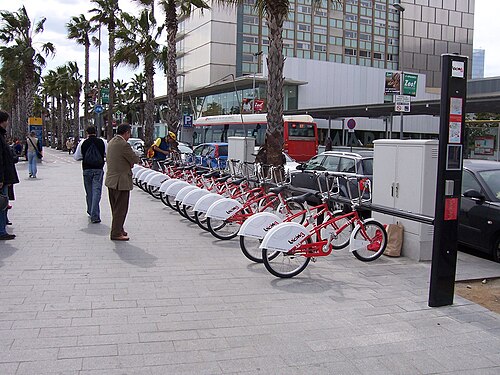
ブルゴス市役所[ 479 ]は、自転車シェアリングプログラム「BiciBur」[ 480 ]を運営しており、23か所に設置され、ほとんどの場所に10台の自転車を駐輪できるスペースがあります。年会費は15ユーロです。[ 480 ]
ストックホルム・シティ・バイク・システムには、80以上の駐輪スタンドと1,000台以上の自転車があります。このシステムは4月から10月まで稼働しています。[ 481 ]
ヨーテボリの自転車シェアリングシステム「Styr & ställ」は2010年8月に開始されました。このシステムには60のステーションと1,000台の自転車があります。[ 482 ]

スイスには、PubliBike、Smide、そして2017年7月5日にチューリッヒで開始されたoBikeなど、いくつかの自転車シェアリングシステムが存在する。[ 483 ]
PubliBikeネットワークは、全国に500以上のステーションと5000台の自転車で構成されています。[ 484 ]ローザンヌキャンパスには9つのステーションがあります。[ 485 ] oBikeは、チューリッヒ市内に350台の自転車を配備し、30分あたり1.50スイスフランの料金で、129スイスフランのデポジットが必要とされています。[ 486 ]チューリッヒ市には、複数のピックアップおよび返却場所がある無料の自転車レンタルプログラム「Züri rollt」もあります。[ 487 ]
1993年、イギリスのケンブリッジで、約300台の自転車を使ったグリーンバイクスキームという自転車シェアリングプログラムが開始された。しかし、プログラム開始から1年以内に自転車の圧倒的多数が盗難または紛失し、グリーンバイクスキームは中止された。[ 488 ] [ 489 ] [ 490 ]
盗難による損失を克服しようと、自転車シェアリングプログラムではいわゆる「スマートテクノロジー」が採用されました。最初の「スマートバイク」プログラムの1つは、ポーツマスのBikeaboutスキームで使用されているGrippa™自転車保管ラックシステムです。[ 491 ] [ 492 ] [ 432 ] Bikeaboutスキームは、1995年10月に英国のポーツマス大学によって、キャンパス間の職員と学生の自動車移動を削減するためのグリーン交通計画の一環として開始されました。[492] Bikeaboutスキームは、「スマートカード」による完全自動化システムでした。[ 492 ] [ 432 ] [ 493 ]少額の料金で、利用者は磁気ストライプ付きの「スマートカード」を受け取り、屋根付きの「自転車店」キオスクの電子カードリーダーに通して、保管ラックから自転車のロックを解除します。[ 492 ]破壊行為を制限するため、すべての自転車ステーションにCCTVカメラ監視が設置されました。 [ 492 ]目的地のステーションに到着すると、スマートカードを使用してサイクルラックが開き、自転車の安全な返却が記録されました。[ 492 ]自転車が破損して返却された場合、または時間が3時間の最大を超えた場合は、利用者のカードに自動的に料金が記録されました。[ 492 ]約20万ポンドの当初予算で実施されたポーツマス・バイクアバウト計画は、自転車キオスクの数と営業時間が限られていたこともあり、利用者の利用という点ではあまり成功しませんでした。 [ b ] [ 492 ] [ 493 ]季節的な天候による制限や、自転車の損傷に対する不当な料金への懸念も、利用の妨げとなりました。[ 492 ]バイクアバウトプログラムは、ミニバスサービスの拡大を優先して、1998年に大学によって中止されました。バイクアバウトプログラムの総費用は公表されていません。[ 494 ] [ 495 ] 1998年にポーツマス大学のバイクアバウト・プログラムが中止された後[ 496 ] (1996年に開始された)、[497 ] [ 498 ]英国では、新しい自転車シェアリングシステムの導入は、ヨーロッパの他の国々よりもゆっくりと進んだ。

2007年[ 499 ](別の情報源では2008年初頭)に、ロンドン市長のケン・リビングストンは、パリのヴェリブ・システムをモデルにした大規模な自転車シェアリング・システムを、任期最後の年にロンドンに導入すると約束した[ 500 ] 。この計画はボリス・ジョンソンが市長に就任するまで完了せず、そのため非公式に「ボリス・バイク」として知られるようになった[ 501 ] 。当初はバークレイズ、後にサンタンデールのスポンサーシップを受け、ロンドン交通局は2010年にこの計画を開始した。市内各地の専用駐輪場では、1日、1ヶ月、または1年分の料金を支払った後は、30分以内のレンタルは無料である[ 502 ] 。
ロンドン以外で最大の自転車シェアリング事業は、 Hourbikeが運営するブラックプールのレンタル自転車事業で、 60のステーションと500台の自転車があります。 [ 503 ]この事業では、居住者と訪問者の両方にRFID会員カードと即時販売会員登録の両方を使用しています。Hourbikeは、イングランドのリンカーン、レディング、リバプール、ノッティンガム、サウスポート、スコットランドのダンフリーズにも事業を展開しています。[ 504 ]
2017年、北京を拠点とする自転車シェアリング会社ofoは、英国のいくつかの都市でシェアサイクルサービスを提供する計画を発表した。2018年、同社は世界的な再編計画の一環として、英国のいくつかの町でサービスを撤退し、他の町でもサービス提供エリアを縮小した。[ 505 ]
2017年5月、ブリストルはYoBikeが運営するレンタサイクルシステムを導入した最初のヨーロッパの都市となった。[ 506 ] [ 507 ]
自転車シェアリングサービスの中には、携帯電話アプリを使って自転車を予約したり貸し出したりするものもあります。イギリスでは、OYBikeが2011年まで、2つの大学、3つのビジネスパーク、ロンドンの3つの区、ロンドンのプライベートホテルチェーンで小規模な事業を展開していました。ミュンヘンのCall-a-Bikeと同様に、OYBikeは携帯電話技術を使って利用状況を記録し、レンタル料金を請求し、レンタルポイントを最短10分で設置することができました。[ 508 ]
ブロンプトン・バイク・ハイヤーは、英国の主要な25か所に40か所のドックがあり、24時間2.50ポンドから利用できます。BIXIモントリオールと同じハードウェアを使用しており、会員は折りたたみ式のブロンプトン自転車をレンタルできます。ドックの場所には、ロンドン、バーミンガム、マンチェスター、ブリストル、レディング、サウサンプトン、オックスフォードなどがあります。[ 509 ]
2018年、シンガポールを拠点とするoBike社はロンドンで400台のドックレス自転車を導入し、英国の他の都市にも展開すると予想されていた。[ 510 ] [ 511 ]英国では、oBikeの自転車レンタル料金は30分50ペンスで、49ポンドのデポジットが必要だった。[ 510 ] [ 512 ]
2019年6月、自転車ライト会社のBerylは、ボーンマスとプールでドックレスのサイクルシェアリングサービスを開始し、翌年にはクライストチャーチにも拡大した。 [ 513 ] [ 514 ] Berylは、ヘレフォード、ノーウィッチ、ワトフォード、ワイト島でも同様のサービスを運営している。[ 515 ]
2021年6月、グレーター・マンチェスター交通局は、グレーター・マンチェスターのマンチェスター、トラフォード、サルフォードにまたがる200以上のドッキングステーションに、当初1,500台の自転車と電動自転車を配置する24時間年中無休のドッキング式公共自転車レンタル制度の設計、設置、運営を行うパートナーとしてBeryl社を選定したと発表した。[ 339 ]この制度は2021年11月に開始予定だった。 [ 516 ]
ベルファスト市は2015年4月27日に公共自転車レンタル制度を開始しました。この制度はコカ・コーラHBC北アイルランドがスポンサーとなり、コカ・コーラゼロベルファストバイクと呼ばれています。地域開発省(DRD)は、アクティブトラベル実証プロジェクト予算の一部として、この制度の初期資本資金を提供しました。NSLが制度の日常的な運営を監督し、Nextbikeが自転車を担当しています。[ 517 ]ドッキングステーションは33箇所あり、追加リソースの確保と議会の承認に応じて拡張のオプションがあります。[ 518 ] [ 519 ]
スコットランドの都市への最近の拡張には、グラスゴーとスターリングが含まれます。[ 520 ] [ 521 ] [ 522 ]スターリングの計画は、コミュニティでのコンテストを経て「ペダルフォース」と名付けられ、100台の自転車と11のステーションで構成されています。グラスゴーには、2014年に31のステーションに400台の自転車が提供されました。[ 523 ]これに加えて、2018年には、エディンバラがJust Eatと提携して、Just Eat Cyclesという独自の自転車レンタル計画を開始しました。
カーディフ
Nextbikeは2018年3月26日にカーディフで5つのドッキングステーションと50台の自転車を備えた公共自転車レンタル事業を開始しました。[ 524 ]当初の計画では、2017年秋までにカーディフで公共自転車レンタル事業を開始し[ 525 ]、市内の50以上のドッキングステーションに500台の自転車を設置する予定でした。[ 524 ]これは、2011年に市議会が資金提供を撤回したことを受けて、OYBikeが小規模な事業(10ステーション)を終了してから6年後のことでした。[ 525 ] 2023年12月7日、Nextbikeは破壊行為と盗難のため、31日に事業を終了すると発表しました。
スウォンジー
サンタンデール銀行は2018年の夏にスウォンジーで自転車シェアリング事業を開始した。[ 526 ]当初は5つのドッキングステーションがあったが、後にマンブルズに6つ目のステーションが追加された。この事業は好評を博しており、市内でのサービス拡大の見込みがある。
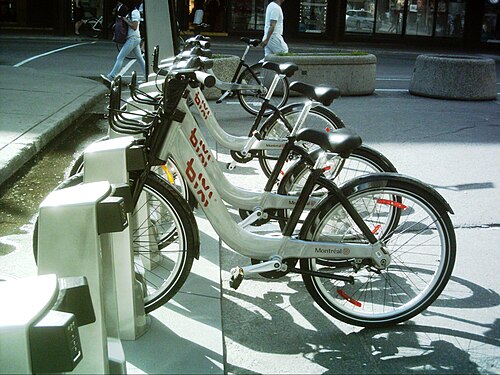
モントリオールで最初に広く展開された自転車シェアリングシステムは、2009 年に開始されたBIXI Montréalです。 [ 527 ] 540 か所のステーションに 6200 台の自転車が配置され、[ 528 ]トロントのシステムと並んで最大の自転車シェアリングシステムとなりました。Bixi プロジェクトの計画と実施のための初期プログラム費用は 1500 万ドルでしたが、プログラムの拡大に伴うその後の費用により、費用は 2300 万ドルを超えました 。[ 529 ] [ 530 ] [ 531 ] [ 532 ]このシステムは、 PBSC Urban Solutionsとベンダーのコンソーシアムによって開発されました。BIXIの技術は、後に北米、ヨーロッパ、オーストラリアの自転車シェアリングシステムで使用されました。モントリオールのシステムは、タイム誌によって2008年のベスト発明19位にランク付けされました。 [ 533 ] 2024年現在、Bixiは1万台以上の自転車を保有しており、そのうち2,600台は電動自転車で、ステーションは900か所あります。[ 534 ]
àVéloは2021年に100台の電動アシスト自転車と10か所のステーションでサービスを開始しました。2023年現在、àVéloは780台の電動アシスト自転車と74か所のステーションを保有しています。[ 535 ]
Sobi Hamiltonは2015年3月に100以上のステーションに750台の自転車を設置してサービスを開始しました。[ 41 ]
Bixi システムは、2009 年 6 月にオタワ/ガティノーでCapital Bixiとして導入されました。2009 年に、100 台の自転車と 10 か所のステーションで試験プログラムとして開始されました。2012 年に、自転車 250 台とステーション 25 か所に拡大されました。所有者であるNCC は、2014 年 1 月に運営会社であるモントリオールに拠点を置くPublic Bike System Company が破産保護を申請したため、2014 年 4 月に米国に拠点を置く CycleHop に売却しました。 [ 536 ] [ 537 ] CycleHop はサービスを VeloGo と改名し、 Bixi システムのように基地局に頼るのではなく、各自転車にGPS 追跡機能が組み込まれた「スマート」自転車に車両を置き換えました。VeloGo は 2015 年夏にサービスを開始しました。[ 538 ]
2001年から2006年にかけて、トロントのコミュニティ自転車ネットワーク(CBN)が運営するBikeShareは、一時期北米で最も人気のあるコミュニティ自転車シェアリングプログラムでした。BikeShareは、トロント中心部の16か所のハブに施錠された150台の再生された黄色い自転車を借りるには年間会員登録を義務付けることで、盗難の問題の一部を克服することを目的としていました。最盛期には、400人以上の会員がどのハブからでも最大3日間自転車を借りることができました。ハブは店舗、カフェ、コミュニティセンターに設置され、スタッフがボランティアで自転車の貸し出しと返却の手続きを行っていました。[ 539 ]管理、導入、維持にかかる費用は着実に増加していましたが、利用者が年間50ドル以上を会員費に費やすことはまずなかったため、CBNは実際の費用の約20%しか利用者に請求できませんでした。民間および政府からの助成金という形で十分な資金が得られなかったため、CBNは2006年にBikeShareを中止しました。[ 540 ]
Bixi Torontoは2011年に800台の自転車と80のステーションでサービスを開始しました。[ 541 ] 2013年、Public Bike System Companyが市への390万ドルの融資を返済できないことを認めたため 、システムはトロント駐車場局に引き継がれ、Bike Share Torontoと改名されました。[ 542 ] 2016年、トロント市はPBSCと契約を結び、システムを拡張しました。そのネットワークには625のステーションに6,850台の自転車が配置されています。[ 543 ] [ 544 ]
2016年7月、バンクーバーはCycleHop Corp.が運営する自転車シェアリングシステムMobiを導入した。 [ 545 ] Mobiは1500台の自転車と150のステーションでサービスを開始した。[ 546 ]
2017年9月、ビクトリア市でドックレス自転車シェアリングサービスが開始され、当初は150台の自転車が使用されました。[ 43 ]このドックレス自転車シェアリングサービスはU-Bicycleによって運営されていましたが、数年後には市内の道路から姿を消しました。[ 547 ]
2005年から2008年にかけて、アルバータ州エドモントンでは、ピープルズ・ペダルという団体が、ほとんど規制のない自転車シェアリングプログラムを運営していた。このプログラムは盗難や破壊行為が多発し、2008年までにサービスに投入された自転車の95%が盗難または紛失した。[ 548 ]
コスタリカのサンホセの東にあるカルタゴでは、2017年に自転車シェアリングプログラムが開始された。[ 549 ] [ 550 ]

Ecobiciは世界最大級の自転車シェアリングプログラムの一つで、35平方キロメートル(14平方マイル)のエリアに452のステーションがあります。[ 551 ] [ 552 ]
2010年2月、メキシコシティ市政府はEcobiciと呼ばれる自転車シェアリングネットワークを開始しました。[ 553 ]赤と白の独特な塗装が施された自転車で構成されたこのネットワークは、2015年2月現在、6,500台の自転車を備えた444のステーションで構成されています。[ 554 ] 24万人以上の登録ユーザーを抱えるEcobiciは、北米最大の自転車シェアリングプログラムであると主張されています。[ 555 ]このシステムは民間企業のClear Channel Méxicoによって運営されていますが、[ 556 ]政府が7,500万ペソの初期投資で資金を提供しています。システムの利用者は、1年間自転車を利用できるRFIDカードを400ペソで購入する必要があります。自転車の使用は最初の45分間は無料ですが、時間制限を超えると追加料金が発生します。
2014年12月、ハリスコ州政府は、86のステーションと860台の自転車を備えたMiBiciと呼ばれる自転車シェアリングシステムを導入しました。[ 557 ] 2021年8月現在、ステーションは300、自転車は3,200台です。[ 558 ]このシステムはPBSCの技術とハードウェアを使用しています。[ 559 ]
2015年11月、トルーカ市はPBSCをプロバイダーとして、26のステーションと300台の自転車を備えたHuitoluziと呼ばれる自転車シェアリングシステムを開設した。[ 560 ] [ 561 ]現在は休止中である。[ 237 ]
2016年2月、パチューカ市は6つのステーションと140台の自転車を備えた「ビシ・キャピタル」と呼ばれる自転車シェアリングシステムを開設した。[ 562 ]
2017年1月からプエブラでは、139のステーションと2,100台の自転車を備えた「ビシ・プエブラ」と呼ばれるシステムが計画されていた。[ 563 ]ビシ・プエブラは2025年時点ではもはや運用されていなかった。
In the United States, public bicycle share programs have largely centered around major cities and universities.[564] Some corporate campuses have private systems.[565] According to a report by the National Association of City Transportation Officials, a total of 35 million bike-share trips took place within the United States in 2017 across 100 bike-share systems across the country, operated by eight companies.[566] Seattle led the way with a dockless bike sharing system in the U.S. in the summer of 2017, and other cities soon joined the ranks. Nine months later, about 44% of rides were dockless.[566] The bikes became controversial in various cities;[567] Dallas reportedly had 20,000 bikes on the streets,[568] they were essentially banned in New York City and San Francisco,[569] with Austin, Texas issuing emergency rules for their implementation.[570]
In 2007, Bikes Belong (now known as PeopleForBikes), an advocacy group financed by major bicycle manufacturers, worked with city officials, local advocates, and the healthcare firm Humana to bring bike sharing to the Republican and Democratic 2008 conventions. Called "Freewheelin!" the program offered 1,000 bicycles at 12 stations throughout the downtowns of the host cities, Denver and Minneapolis/St. Paul, over the five days of each convention. Bikes Belong's stated goal was to provide a proof-of-concept that large-scale bicycle sharing that had gained popularity in European cities could work in U.S. cities and provide a valuable addition to the transportation mix. The program was popular among conventioneers and helped the city of Denver to create a narrative around the "green" attributes of the convention. Both Denver and Minneapolis successfully pursued permanent bike sharing systems, with Denver B-cycle launching on 22 April 2010 as the first of its scale in the U.S., followed by Minneapolis' NiceRide system launching on 10 June 2010.[571]
The system was launched in 2013 with 16 stations and 200 bikes with provider PBSC.[572][573]
In 2017, CDPHP Cycle! launched in Albany and three other Capital region cities.[574] The bikes can be locked to official docks or any other rack for a slightly higher fee.[575] The system is operated by CDTA.[575]
Alpharetta offered a bike share program operated by Zagster. Trips under three hours were free, and annual memberships were $20. Bikes could be rented from four stations throughout Alpharetta.[576] Bikes could be taken anywhere, including Alpharetta's Big Creek Greenway– a 12-foot wide concrete path that stretches eight scenic miles terminating in Big Creek park.[577] The service was suspended late May 2020 due to a large-scale Zagster shutdown, and all bicycles and stations were removed.[578][579]
In June 2016, Relay Bike Share launched as the bike share system for the City of Atlanta. The program, operated by Cyclehop and Social Bicycles, launched with 100 bicycles at 10 stations throughout the downtown area. The program aimed to offer 500 bicycles across the city by the end of 2016.[580]
In December 2013, Austin B-cycle was launched as the bike share system for the City of Austin with 11 stations.[581] Austin B-cycle set a national bike share record for the most checkouts per bicycle in a single day, 10.1 checkouts per bike, on 14 March 2015 during the SXSW festival.[582] In July 2020, Capital Metro and the city of Austin finalized a partnership to improve Austin's mobility network utilizing the city-owned BCycle bike share system. This partnership, now called Metrobike, aims to create long-term bike share service improvements such as expanding the BCycle fleet and stations, optimizing the system's first and last-mile transit solution, improving services and reaching communities outside of the downtown core, and fully electrifying BCycle's fleet. As of March 2022, the MetroBike system operated more than 75 bike share stations with 800 bikes in the central Austin area.[583]
In May 2014, over 40 bicycles were stolen from Baltimore Recreation and Parks department's bike-share program. The bikes were stolen during the city's Ride Around Reservoir program in Druid Hill Park. The bikes were set up to be lent out when a group of youths took them. The cost of replacing the stolen bikes is devastating to the program, which operates completely on donations.[584][585]
Birmingham launched Zyp Bikeshare in October 2015. Annual memberships are $75, with monthly passes for $20, 3-day passes for $12, and daily passes for $6.[586] Zyp also offers discounted annual memberships to individuals who qualify. Zyp operates 400 bikes at 40 kiosks. Bikes can be ridden anywhere in the downtown Birmingham area. Once a bike is unlocked, riders have 45 minutes to ride before incurring additional fees if they have not docked at another station. As well as traditional bikes, Zyp was the first bike share in North America to have electric pedal-assist bikes to help riders cover distances or mount hills faster.[587]
In 2007, Boston Mayor Thomas M. Menino and Director of Bicycle Programs, Nicole Freedman, decided to bring bike sharing to the Boston area. The Metropolitan Area Planning Council, the regional planning agency for the metro-Boston region of 101 cities and towns, joined the effort. Brookline, Cambridge, and Somerville also participated.
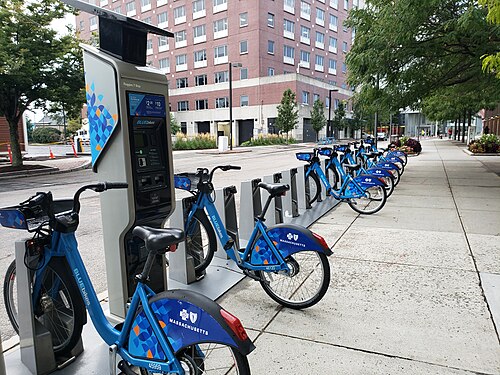
On 28 July 2011, Boston launched its 60-station, 600-bike Hubway system, sponsored by the shoe manufacturer New Balance and funded in part by a $3 million grant from the Federal Transit Administration. The contract to operate was awarded to Alta Bicycle Share and the equipment provider was PBSC Urban Solutions. Bicycle sharing was greeted with a mix of excitement and skepticism. In its first two and a half months, Hubway recorded 100,000 station-to-station rides. After recording 140,000 trips in four months, Boston's European-style bicycle-sharing system expanded outside city limits, planting stations across Cambridge, Somerville, and Brookline.
In the spring of 2018 Motivate the operator of the system changed sponsors from Hubway to the Blue Cross Blue Shield Association and officially changed the name of the bike share program to Bluebikes Boston.[588] As of December 2018, the system had deployed 262 stations with a fleet of over 2,500 bikes.[589]
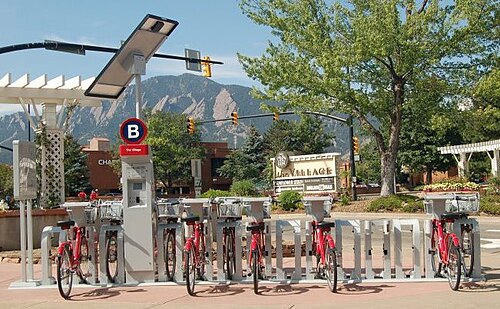
In May 2011, Boulder, Colorado launched a bicycle-sharing system, Boulder B-Cycle, with 100 bicycles and 15 stations. Like many in northern latitude cities, this system closes down during winter months to help preserve the life of the equipment.[590]
Broward B-Cycle launched in December 2011 as the country's first county-wide bike share program, with 200 bikes and 20 stations located in several cities within Broward County, including Fort Lauderdale. This system was funded through a public-private partnership with the Florida Department of Transportation providing a $311,000 grant through Broward County, and B-Cycle's sponsors providing the remainder of the initial capital and operating costs.[591]
Reddy Bikeshare launched in 2016 with 200 bicycles at 35 stations around the city.[592]
In August 2013, the College of Charleston's Office of Sustainability began a bike sharing program.[593] This program's 16 bicycles are free to use for all full-time students, faculty, and staff members.[594]
A system of B-Cycle stands is installed downtown and in a few places nearby.[393]
In July 2012, the Bike Chattanooga Bicycle Transit System launched in Chattanooga, Tennessee with 300 bikes and 28 solar-powered stations by PBSC.[595] It was the first large scale bicycle transit system in the Southeast. The system has expanded to 33 stations and had recorded over 78,000 trips by its second anniversary.[596]

On 28 June 2013, Chicago launched Divvy, a bike share system with 750 bikes at 75 stations.[597] As of September 2021, the system operates 16,500 bikes at over 800 stations,[598] using both PBSC's hardware and software.[599]
In September 2014, Cincinnati Red Bike started operation. It opened with 35 docking stations downtown, Over the Rhine, the University of Cincinnati's main campus, and surrounding areas. In 2023 Red Bike has expanded to 66 stations with over 600 bikes and has a ridership of 100,000+ per year.[600]
On 21 September 2016, Cleveland launched its UH Bike system, with 250 bicycles and 22 stations distributed around the city.[601][602]
In September 2018, Columbia launched BlueBikeSC with BlueCross BlueShield SC being the chief sponsor.[603] In March 2019, the regions transit authority, The Comet (transit) expanded the bike share system adding 10 stations to the system with a $250,000 grant from the federal transit authority.[604]
On 30 July 2013, CoGo Bike Share started in Columbus, Ohio. It opened with 300 bikes and 30 docking stations in downtown and surrounding areas,[605] all provided by PBSC and operated by Motivate.[606]
In the summer of 2015, Zagster launched a 115-bicycle, 15-station system on the Ohio State University campus. The university decided not to integrate with the city's CoGo system.[607] The Ohio State University announced plans to integrate electric assist bicycles as part of its bicycle share program launching in 2015.[608] The Zagster program at Ohio State University shut down in August 2018.[609]
On 22 April 2010, Denver became the first U.S. city with a large-scale smart-technology-enabled bicycle-sharing system with the launch of Denver B-cycle. The system launched with 45 stations and 450 bicycles throughout downtown, downtown-adjacent neighborhoods, and on higher-education campuses. Denver B-cycle's roots came from the "Freewheelin" bike sharing program which operated for 6 days during the 2008 DNC convention in Denver. In Denver, several B-cycle rental stations are located at RTD Light Rail Platforms. The Denver B-cycle program varies in cost depending on use. Fees range from $8 per day to $80 per year.[610]
Denver's B-cycle needed 7+1⁄2 months to reach 100,000 station-to-station rides.[611]
B-Cycle has partnered with the Des Moines Bicycle Collective, operating bike-sharing stations throughout the downtown core, East Village, Ingersoll, Sherman Hill, and Drake University neighborhoods. The system is in operation from 1 March - 30 November each year.[612]
MoGo, a nonprofit affiliate of the Downtown Detroit Partnership, launched MoGo Bike Share in the Greater Downtown area with 430 bicycles across 43 stations on 23 May 2017.[613]
PeaceHealth Rides is administered by JUMP Bikes (formerly Social Bicycles, and now owned by Uber) and is a partnership of the City of Eugene, Lane Transit District, and the University of Oregon. The system launched in downtown Eugene, the Whiteaker neighborhood, and the area around the University of Oregon with 300 bicycles across 36 stations in April 2018. PeaceHealth, a not-for-profit Catholic health system with 10 hospitals in three states including one hospital in Eugene, is the sponsor.[614]
In March 2015, bicycle advocacy nonprofit Great Rides Fargo launched Great Rides Bike Share, a system with 101 bicycles at 11 stations.[395] The system was launched in partnership with North Dakota State University, where students are enrolled at no additional cost. It was the first system to include integrated card access for enrolled students.[615][616][396]
In April 2016, The city of Fort Wayne announced a small system in its downtown area.[617]
On 22 April 2013, Fort Worth Bike Sharing, a 501(c)3 non-profit organization, launched a B-cycle system consisting of 300 bikes and 30 stations serving Downtown, Near Southside, and Cultural District in Fort Worth, Texas.[618][619] Fort Worth B-cycle is included in a program called "B-connected" which allows members of over 15 participating B-cycle cities to use their annual memberships for free in other cities.[620]
The City of Greenville and nearby Farmville launched the bike share system LimeBike in early 2018. It serves citizens as well as students of East Carolina University.[621]
The City of Harrisburg launched the Harrisburg Bike Share in late 2017 with 55 bikes through Zagster. 93% of the proceeds benefitted a state nonprofit to prevent school dropouts.[622] In June 2020 the bike share program was shut down when Zagster ceased operations across the country.[623][624]
It was replaced by SusqueCycle, which launched in Fall 2022.[625]
The City and County of Honolulu passed Bikeshare Resolution 14–35 on 14 March 2014. Bikeshare Hawaii, a local non-profit, operating as "Biki", started in June 2017 with about 100 stations and 1000 bicycles. During the first partial year, NACTO ranked Biki as the 8th most-ridden bike share service in the US. Biki reached 1 million rides after about 16 months of service. A 30% service expansion was undertaken in December 2018. The current service area extends from Iwilei to Waikiki / Diamond Head and mauka of H-I highway with about 1300 pedal bikes and over 130 stations. Biki had its first >100,000 ride month in October 2018 and had over 1 million rides during 2018. NACTO ranked Biki as the 6th most-ridden bike share service in the US for 2018. Biki chose PBSC's FIT model bicycle for its accessibility (lower weight and lower center of gravity), and as such has a much higher ratio of women riders (44%) than most US systems. Additionally, there is currently an independent small pilot program in Kailua (Hawai`i County) with three stations also utilizing PBSC equipment. This program received an additional small expansion grant in 2018.[626]
On 22 April 2014, Indianapolis launched a public bike-share program called Indiana Pacers Bikeshare with 25 stations and 250 bikes.[627] On 5 September 2019, the program expanded to include 21 more stations and 275 more bikes, bringing the program total to 525 bicycles and 50 stations.[628]

On 21 September 2015, the Citi Bike system that started in New York City in 2013 expanded across the Hudson River to Jersey City, New Jersey with 35 stations and 350 bikes. Even though Citi Bike Jersey City is independent of Citi Bike New York, one membership works for both systems.[629] The system experienced its first wave of expansion in July 2016 with 15 new stations and 150 additional bikes. The system currently boasts 50 stations with 500 bicycles throughout Jersey City.[630]
In 2012, Kansas City, Missouri launched Kansas City B-cycle in partnership with Blue Cross Blue Shield.[631] The system currently has 30 stations and over 200 bicycles reaching downtown, Union Hill, Westport, Plaza and as of Summer 2015, Brookside Trolley Trail. North Kansas City will be adding 3 more stations in spring 2017 as well as several more coming to Midtown KCMO.[632]
On 20 April 2021, Drift Cycle was launched with 40 bikes at 8 stations in downtown La Crosse. In 2022, the system was expanded and improved with new bikes, a new app and two new stations at the University of Wisconsin-La Crosse and Gundersen Health System. With the relaunch on 21 April 2022, there are ten stations and 50 bikes.[633][634]
On 7 July 2016, Los Angeles County launched Metro Bike Share,[635] a 1,400-bike system with equipment by B-Cycle, operated by Bicycle Transit Systems. It was the first North American system to be both branded as part of the public transit agency and accessible using the regional TAP card, though at the time of launch users were required to maintain separate accounts for each transit mode and pay separate fares.[636]
On 20 April 2018, BikeLNK was launched and as of 2019, is made up of 105 bicycles and 20 stations. The program has recorded over 70,000 trips in 18 months of usage.[382]
In 1996, Madison, Wisconsin, instituted its Red Bikes Project, a public bike sharing program. These red-painted bicycles were available for the use of the general public, primarily in the student areas of State Street between the University of Wisconsin campus and the Wisconsin State Capitol. Initially, the only rule regarding the use of a Red Bikes Project bicycle was that it was required to remain outside and unlocked, and thus available for any passerby. After a surge in bicycle thefts and vandalism, the program was modified to require a valid credit card and $80 in security deposits for both the bicycle and the now-mandatory bicycle lock.[637] The program is now only available seasonally, from spring (when all snow has melted) to 30 November.[638]
In 2015, the Green Apple Bikes bike-share system started in Manhattan, Kansas that makes single-speed cruisers available free for 4-hour periods. The program is funded by a consortium of businesses, and bicycles are maintained by volunteers.[639][640]
On 23 May 2018, Explore Bike Share launched in Memphis, TN, and West Memphis, AR.[641][642] The system was launched with 60 stations and 600 bicycles serving portions of West Memphis, Downtown Memphis, Uptown Memphis, Midtown Memphis, South Memphis, and Orange Mound, with a plan to add another 30 stations and 300 bicycles in 2019. The system uses B-Cycle equipment.[643]
In March 2011, DecoBike launched in Miami Beach, Florida.[644] The initial rollout of the program included "approximately 100 solar-powered stations and 1,000 custom-designed bikes available to residents and visitors."[369] This public bicycle sharing and rental program is owned and operated by DecoBike, LLC, a Miami-based company, and operates under a long-term agreement with the City of Miami Beach. The service is available to both residents and visitors: any adult with a major credit card can check out a bike to pedal to their next location. An iPhone app and an interactive map on the DecoBike website allow one to locate the nearest "station" and displays the number of bikes available and the number of free docking spaces in real time.[645]
In August 2014, the City of Milwaukee in partnership with a local non-profit organization, Midwest Bike Share, launched Bublr Bikes[646] with 10 stations in downtown Milwaukee.[647] The system grew to 17 stations by Fall 2015, and now there are 50 stations in the City of Milwaukee[648] plus another 7 stations in the adjacent suburb of Wauwatosa[649] (as of December 2016). Planning for additional stations within the City of Milwaukee is underway. Additionally, the adjacent communities of Shorewood and West Allis are expected to add around 7 stations each to the system in 2017.[650] In May 2019 a project to add an additional 26 stations to the existing 87 was announced, with plans to have the additional stations online by summer 2020.[651]
In June 2010, Minneapolis initiated Nice Ride, one of the first examples of a large-scale municipal bike sharing program in the United States. Phase 1 included 700 bikes and 65 stations throughout Minneapolis[652] Due to popularity, the system was aggressively expanded into neighboring Saint Paul in 2011. As of 29 April 2012, Nice Ride had recorded a total of 330,000 trips, and a systemwide total of 1,330 bikes at 146 stations.[653] The system is provided by PBSC.[654] Minneapolis, Nice Ride needed six months to reach 100,000 station-to-station rides.[611]
The village of New Paltz, New York, home of SUNY New Paltz, has a bicycle lending program.[655]

On Memorial Day, 27 May 2013, New York City started its privately funded Citi Bike program. It was the nation's largest when it began operation, but Washington, D.C.'s system has grown faster. It began with 6,000 bikes at 330 docking stations in Manhattan and parts of Brooklyn. According to the city vision OneNYC the city wants to expand it to 12,000 bikes and 750 docking stations in Manhattan, all of Brooklyn and Queens. By 29 May, on its third day of operation, the program had 21,300 individuals signed on as annual members.[656]As of June 2013 Citi Bike is the largest bike sharing program in the United States.[657] In August 2015, Citi Bike once again became the largest system in the United States with 400 stations.[658]Jump Bikes, a dockless electric bicycle-sharing system launched in the city in September 2017.[659]
On 18 May 2012, the City of Oklahoma City launched its bike share program known as Spokies. On 1 August 2014, Spokies became part of EMBARK, Oklahoma City's transit agency. The system has eight docking stations and 145 bikes throughout downtown Oklahoma City.[400]

On 23 April 2015, the City of Philadelphia launched its privately funded Indego bike share program with 60 docking stations and 600 bikes, located in Center City, South Philadelphia, Northern Liberties, and University City.[660] It uses equipment by B-Cycle and is operated by Bicycle Transit Systems with a naming sponsorship from locally based health insurer Independence.[661]
On 25 November 2014, Phoenix launched Grid Bike Share with 100 bikes at 27 stations.[662] It has since expanded to nearly 500 bikes at 48 stations and has plans to add another 200 bikes and 20 stations.[663]Mesa, AZ, joined the system in March 2016, with 100 bikes at 14 stations, with plans to add another 200 bikes and 10–14 stations. Tempe, AZ, intends to join the three-city system in early 2017 with 300 bikes at 31 stations.[664] In early December 2020, GRID announced the closure of the Bike Share program on 31 December 2020[665]
On 31 May 2015 Pittsburgh, during an Open Streets day, launched its Healthy Ride bike share program with nextbike hardware. The system launched with 50 docking stations and 500 bikes located in Downtown Pittsburgh, South Side Flats, North Shore, Strip District, Lawrenceville, Oakland, Bloomfield, and Shadyside.[666][667] By 2022, there were 106 stations.
Healthy Ride was retired in 2022, and replaced with POGOH, using stations and bikes from PBSC. It launched with 38 stations and 350 bikes, split between mechanical and e-bikes. In 2023, they expanded to 60 stations and 600 bikes.
First introduced in 2022 and operated by Tandem Mobility, Portland, Maine's bike share system has a combined 200 conventional and e-bikes at 40+ stations.[668]
One of the first community bicycle projects in the United States was started in Portland, Oregon in 1994 by civic and environmental activists Tom O'Keefe, Joe Keating, and Steve Gunther. It took the approach of simply releasing a number of bicycles to the streets for unrestricted use. While Portland's Yellow Bike Project was successful in terms of publicity, it proved unsustainable due to theft and vandalism of the bicycles. The Yellow Bike Project was eventually terminated, and replaced with the Create A Commuter (CAC) program, which provides free secondhand bicycles to certain preselected low-income and disadvantaged people who need a bicycle to get to work or attend job training courses.[669]
On 19 July 2016 Portland launched Biketown,[670] a system with 1,000 GPS-enabled smart bikes sold by Social Bicycles and operated by Motivate with a $10 million, five-year naming sponsorship by Nike.[671] It was the continent's largest smart-bike system at the time of launch. The 100 stations covered 8.1 square miles but were concentrated most densely in downtown Portland and the Pearl and Northwest Districts.[672] Funding came entirely from a $2 million allocation of federal dollars approved by the Metro regional government, from Nike, and from ongoing user fees and smaller sponsorships.[673]
In 2011, the city of Salem, Massachusetts launched a bike share program called Salem Spins, offering the use of bicycles free of charge, for use around the city. The seasonal program was financed in part with a $25,000 grant for a fleet of 20 bicycles.[674] The program was offered from April to October until June 2020, when the city's private bike share partner Zagster shut down.[675]
On 8 April 2013, Salt Lake City launched GREENbike as the region's Bike Share brand. The program launched in downtown Salt Lake City with 10 stations and added two new stations less than four months later. The program will be expanding to 20 stations by 2014 with the goal of 100 stations in downtown Salt Lake City. Satellite GREENbike systems in cities such as Ogden are in the works and will be connected by the state transit authority's Frontrunner light rail train.[676]
Though the City of San Diego signed a 10-year contract with Discover (formerly DECO) Bike in 2013, a docked bike-share, in January 2018 the city attorney Mara Elliot opined that the city's contract did not preclude other companies from operating within city limits, as long as there were "no city support or participation, other than legally required reviews and approvals."[677]Ofo and LimeBike began operating on 15 February 2018.[678] As of March 2018, Ofo, LimeBike, and Mobike offered dockless bike rentals within the city. LimeBike and Bird offer electric scooters, and LimeBike offered electric pedal-assist bikes as well.[679][680][681][682] However, there have been some concerns in high-pedestrian corridors.[683]
Due to a breach of contract (according to the city of San Diego), the City of San Diego withdrew the operations permit for the Discover Bike in March 2019 and thus ended docked bike share service in the city.[684]

In August 2013 the Bay Area Bike Share system began operating in the San Francisco Bay Area of California. The system allocated half of its 700 bicycle fleet in San Francisco, and the rest along the Caltrain corridor in Redwood City, Palo Alto, Mountain View and San Jose.[685] In 2015, it was announced that the scheme would expand to 7,000 bikes, over 2016–2017, and would include the East Bay Area communities of Berkeley, Emeryville, and Oakland.[686]
On 13 October 2014, Pronto Cycle Share launched with 500 bicycles and 50 stations. Pronto uses Motivate of New York City as the operator.[687] In January 2017, Seattle's mayor announced the system would be permanently shut down at the end of March 2017 due to funding shortfalls.[688] Dockless systems by LimeBike and Spin were introduced in July 2017 as their first large-city systems in the US.[689][690]
In April 2013, Stony Brook University launched the Wolf Ride Bike Share system with four stations and 48 bicycles. As of November 2015, the system consisted of 12 stations and 78 bicycles.[691][692]
On 15 April 2015, Topeka Metro Bikes launched with 100 smart bikes and 10 stations.[693] An additional 100 bikes were added to the system in April 2016.[694] The program shut down in July 2020,[695] and all 300 bikes were subsequently sold at auction.[696] A local non-profit purchased the bikes, modified them to remove the electronics, and gave them to members of the community on a first-come, first-served basis.[697]
In 1996, a pilot bicycle share project known as the Orange Bike Project was organised in Tucson, Arizona by Bootstraps to Share, a homeless advocacy organisation inspired by the Bikes Not Bombs movement.[698] Using funds from a government grant to obtain, recondition, and maintain 30 bicycles, project organisers announced plans to station the bicycles in downtown Tucson and areas adjacent to the University of Arizona.[698] The publicly shared bicycles, painted bright orange by Earl Scheib to identify them, were primarily intended for use by the homeless or those without means of affordable transportation.[698] The initial 30 bicycles placed into service for the Orange Bike Project were all stolen within a few weeks.[699] A total of 80 bicycles were eventually used in the Orange Bike Project, all of which were either stolen or vandalised beyond repair.[699] In one case, an Orange Bike Project bicycle was thrown in front of a freight train, in others, bikes were found with major frame damage consistent with deliberate vandalism.[699] The program was terminated after only five months of operation.[698][699]
The Tulsa Townies bicycle project was launched in August 2007 by Saint Francis Health System. This project is the first bicycle program of its kind in northeastern Oklahoma. As of 2016, the bicycle rental stations were located at the Tulsa River Parks trail along Riverside Drive at 19th and 41st streets and in Jenks at the 96th street Arkansas River pedestrian bridge.[700]
In Washington, D.C., the privately operated bike-sharing project SmartBike DC opened for service in 2008 in the District of Columbia with 10 stations and 120 bikes. Operated by the advertising firm Clear Channel Outdoor, the system was funded by advertising revenues from bus shelters on public streets, along with revenues from user membership and usage fees.[701] The program suffered from perennially low membership and rider usage rates, as well as a limited number of bike rental stations.[702] It was officially terminated in January 2011.[703]

On 20 September 2010, Arlington County, Virginia and the District of Columbia launched the U.S.'s first public-private partnership bike share system, Capital Bikeshare (CaBi), which replaced SmartBike DC. Unlike SmartBike, CaBi is a public taxpayer-supported (local government and federal funds) bicycle-sharing program. The initial scheme involved some 1,100 bicycles at 100 stations located throughout the District of Columbia and parts of Arlington County, Virginia. The cost of planning, implementation, and administration for Capital Bikeshare totaled US$5.0 million, with first-year operating costs of US$2.3 million for 100 stations.[704] CaBi was operated by Alta Bicycle Share (now Motivate International) with equipment from Montreal-based PBSC Urban Solutions. Capital Bike Share was the largest bike sharing system in the United States until May 2013.[705]
As of 2017, Washington, D.C. had four dockless bike-share systems.[706][707][708][709]
In June 2017, the city of Wauwatosa, Wisconsin partnered with Zagster to incorporate an adaptive bike-share station into their existing Bublr network. It was thought to be the first adaptive bike-share station in Wisconsin, and the dual partnership is thought to be the first of its kind in the United States.[710]
In California, many cities have launched or have stated plans to launch their own bike-sharing programs, including the cities of Anaheim (as of 2012, 10 bikes and 1 station, with plans for 100 bikes and 10 stations),[711] Los Angeles (as of 2012, plans for 4000 bikes at 400 stations),[712] Santa Monica (as of 2012, plans for 250 bikes at 25 locations),[713] and San Diego.[714] The San Francisco Bay Area's Bay Area Air Quality Management District, in partnership with Alta Bike Share, city governments, and transportation authorities, announced plans for a pilot regional sharing program in 2013 for the San Francisco Peninsula and San Jose.[715][716]
In the fall of 2009, the University of California, Irvine introduced its Zotwheels automated bike share program. Students and university employees may sign up for a Zotwheels membership card at an annual cost of $40, which enables the user to check out a bike from any bike station located throughout campus for a maximum of three hours and drop it off at any other station. A $200 charge is imposed for a lost, stolen, or severely damaged bike. Bicycle availability and station operational status may be determined using an interactive map. Revenues from membership fees are sufficient to offset only a small fraction of the total operating costs of the program; all remaining manufacture, installation, maintenance, and implementation costs of the Zotwheels systems and the bicycles themselves are borne by UCI.[717] Zotwheels was developed as a collaboration between the UCI Parking and Transportation Services, The Collegiate Bicycle Company, CSL Ltd, and Miles Data Technologies.[718]
In January 2018, e-bike provider Jump Bikes launched in San Francisco, becoming the first dockless bicycle-sharing system to launch in the city.[719]
ofo offers a partnership program with universities to provide sustainable campus transportation.[720] On 21 February 2018, ofo and Pomona College in Claremont, California launched the first college pilot program in California.[721]


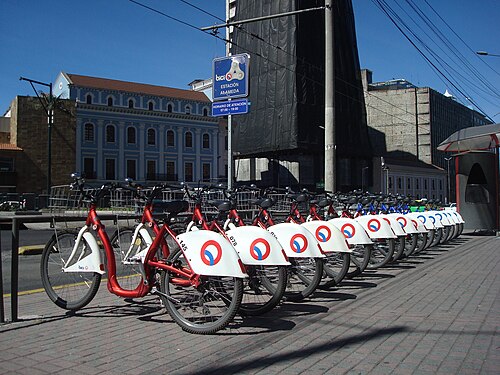
On 2 December 2015 Rosario launched Mi bici tu bici, which had 200 bicycles available at 18 rental stations downtown.[722]
In November 2016, San Lorenzo launched Biciudad, a free-to-use bike sharing system. The system was launched by the San Lorenzo Government to reduce the use of motor vehicles and enhance means of non-motorized transport.
The Biciudad Bike Sharing System is expanding along with the construction of a circuit of exclusive lanes for bicycles across the city.[723]
Bike Itaú is a public bicycle-sharing system in the city of Rio de Janeiro, Brazil. It is run by PBSC Urban Solutions and started on 20 February 2018, and is sponsored by the municipal government of Rio de Janeiro in partnership with Banco Itaú. The system replaces the old one operated by Serttel, a private concessionaire, that began operations in October 2011.[724]
A similar scheme was implemented in the city of São Paulo on 24 May 2012, called Bike Sampa. It is free up to the first hour of use, after which users are charged R$5 every 30 minutes.[725] There are about 140,000 registered users and, as of 6 May 2013, there had been 220,000 bicycle trips in the city.
Other cities with similar bike sharing systems are operated by Serttel: Brasília, Belo Horizonte, Salvador, Porto Alegre, Santos, Recife, Belém, Manaus, Fortaleza, Vitória and Aracaju. Fortaleza's bike sharing system, named Bicicletar, has the highest relative use in Brazil. With 800 bikes and 80 stations, the system registers 6.4 trips per bike on workdays as of 2015.[726]
There are three separate bike-share systems in the metropolitan area of Santiago, the capital city of Chile: Bikesantiago, Bici Las Condes, and Mobike.[727]
The commune of Providencia, part of the Santiago de Chile metropolitan area, implemented a public bike-share system named B'easy and started services in August 2008 with a monthly membership of 1000 Chilean Pesos (US$2) and four stations.[728]
Bikesantiago started its services in October 2013 in the metropolitan commune of Vitacura with 30 stations, 300 bicycles, and a monthly membership of 4990 Chilean pesos (US$8). By November 2015, it had 25000 subscribers, 132 stations, and 1882 bicycles in the communes of Lo Barnechea, Vitacura, Providencia (Replacing the original B'easy system), Santiago, Ñuñoa, Recoleta and Independencia and had contracts for a programmed expansion in a total of 14 communes, 200 stations and 2100 bikes in the Metropolitan Area of Santiago.[729][730]
Bici Las Condes is the communal bike-share system of Las Condes, part of the Metropolitan Area of Santiago. It began service in March 2015 with a total of 50 stations and 500 bikes and had a planned expansion to a total of 100 stations and 1000 bikes.[731] The decision of the Las Condes municipal council to not join the Metropolitan area tender for an interconnected bike-sharing system was controversial.[732]
The EnCicla Bike Share System in Medellín is operated by the metropolitan area of Aburrá Valley. EnCicla is integrated with the city's existing infrastructure of cycle routes, mass transit, and public transport systems.[733]
In August 2012 the Municipality of Quito government established a municipal bicycle-sharing system called Bici Q.[734][735][736] The Municipality of Cuenca implemented a public bicycle-sharing system in 2013.[737][738] Bici Q is free and available for anyone with a membership card, which can be obtained online or in person.[739][740]
The Movete Bike Share System in Montevideo is integrated with the city's existing infrastructure of cycle routes, mass transit and public transport systems.[741]
JoBike is a bicycle-sharing system serving the cities of Dhaka, Chittagong and Cox's Bazar.[742] Launched in 2018, it is the first such system in Bangladesh.[743]

Initially, a number of traditional (third-generation) docked public bike systems operated by local municipal governments opened across China, with the largest ones being in Wuhan and Hangzhou. The first was introduced in Beijing in 2007. However, third-generation bike sharing has not been considered successful in the majority of cities in China. Bike sharing in Beijing virtually stopped and also encountered difficulties in Shanghai and Wuhan.[744]
In 2014, students from Peking University created a company called ofo and initialize the fourth generation bike sharing system in their campus. In 2017, a number of private competing app-based dockless bike-sharing programs have started to appear in numerous cities across China. The two largest dockless operators are Mobike and Ofo, others include Bluegogo and Xiaoming.[745][746] Many Chinese cities saw massive growth in the number and use these dockless bike share programs, clogging sidewalks around major commercial hubs and subway stations with parked bikes.[747] Given the speed of growth with these services, local governments did not have any regulations or planning to accommodate these systems.[748] However the Chinese government encourages the development of dockless bikes to reduce urban pollution. Early studies in Beijing and Shanghai have linked the massive increase of dockless bike shares to the decrease in the number of private automobile trips that are less than five kilometres.[749] In Guangzhou, the arrival of dockless bike shares had a positive impact in the growth of cycling mode share.[750]

A municipal scheme in Beijing was launched in 2012 with the stationing of 2,000 bikes in the Chaoyang district.[751] The scheme was scheduled to consist of 20,000 rental bikes and 500 kiosks, according to the Beijing Municipal Commission of Development and Reform. The main operating area was to be in business districts and near subway stations and major public venues. By 2015, authorities intended to have 50,000 bikes available, similar to the Hangzhou scheme that was used as a model.[752][753] This development followed the failure of a scheme launched in 2005–2006 (ahead of Vélib') and in the light of a 2011 announcement by the Beijing Municipal Commission of Transport that it expected to raise the bike share of urban commuter journeys from 20 to 23 percent by 2015.[752]

In March 2017, Beijing saw over 200,000 dockless shared bikes from various companies enter service. The bikes are accessible via an app, and typically cost around 1 RMB per hour plus a refundable damage deposit of 299 RMB. Aside from the dockless bicycles, an existing municipal-run, dock-based bike network has 86,000 bikes. The Beijing municipal government pledged to improve management and parking availability in response to the rapidly growing fleets of dockless bikes.[754] Beijing cycling rates increased from 5.5% to 11.6% after the arrival of the dockless bike systems.[755]
In preparation for the 2010 World Expo in Shanghai, China, Shanghai launched a limited bike share programme accessible through RFID cards. Users could purchase 100-ride credits for about $30. Short rides are rewarded credits and longer rides subtract credits once the bikes have been re-docked. Shanghai planned to expand to 3,500 Bicycle Hot Spots throughout the entire city by 2010. Two years after the World Expo, Shanghai's bicycle-sharing programme was mostly limited to the Minhang District.[756][757]

The Shanghai Bike Authority estimated that there are 280,000 shared bikes in Shanghai by March 2017, with a projected increase of 220,000 bikes by June.[758] In March 2017, the government in Shanghai requested a temporary ban on the introduction of new private "dockless" shared bikes.[759] Shanghai prepared regulations restricting the age of riders to between 12 and 70 and mandating the removal of bikes that have been in service for more than three years in a row.[760]Mobike alone operates 100,000 bikes in Shanghai and has claimed to have made Shanghai into the city with the world's largest bike share network.[761]
Beginning around 2017, Haikou, the capital of Hainan province, experienced a massive increase in the number of dockless bikes by Ofo, Mobike, and Quick To.[762] The Haikou Public Bike System, a traditional municipal-run docked system, has about 20,000 bicycles.
Wenzhou has multiple bike share programs serving different districts of the city. The first one opened in 2012, serving Lucheng District with about 5,000 bikes and 180 stations.[763] In 2013, a bike share with 2,200 bikes and 66 stations opened in Longwan District. At the same time, a separate bike share program with 1,040 bikes and 32 stations opened in Ouhai District. The latter of the two was being expanded to 3,250 bikes and 109 stations as of 2017.[764] According to local government records, more than 20,000 dockless bikes from various private bike share companies had entered service in Wenzhou as of 2017.[765]
Guangzhou Bus Rapid Transit has a bike share program integrated around its stations. According to the local government, in 2017, Guangzhou had a fleet of over 700,000 bikes in various public and private bike share programs. On average 4 million trips each day were made using shared bikes.[766] The local government is reviewing traffic management strategies and road design standards to accommodate the increase in cycling traffic.[767][768]
In 2014, Guilin City opened a docked bike sharing system with 3,000 bikes spread out over 100 stations.[769]
The Hangzhou Public Bicycle bike-sharing system has 60,600 bikes and was started in 2008. Bike-sharing stations can be found in Hangzhou every 100 metres. The first hour of use is free, followed by 1 yuan ($0.15) for the first hour, 2 yuan the second hour, and 3 yuan for each subsequent hour.[770] In 2013 USA Today called the Hangzhou bike-sharing system the 'best in the world'.[771] A March 2010 survey of Hangzhou Public Bicycle members and non-members found that 30% of users incorporated bicycle sharing into their most common commutes. Furthermore, the bicycle-sharing system captured modal share from bus transit, walking, autos and taxis. Another key finding from the survey suggested that car ownership may not reduce the likelihood of bike sharing use. In fact, members of the Hangzhou system exhibited a higher rate of auto ownership in comparison to non-members.[772]
Before the arrival of private dockless systems, Hangzhou was the largest bike share system in the world until it was overtaken by Wuhan. In 2011, the system had 2,050 bike-share stations with a fleet of over 50,000 bikes and serving 240,000 trips per day.[773] By 2015, it was expanded to over 84,000 bikes and 3,354 stations.[774]
Since December 2013, Nanning has had a bicycle-sharing system with 1000 bicycles and 50 stations. The first hour of usage is free, and afterward it costs 2RMB/h.[775] By 2014, it was expanded to about 25,000 bikes and 896 stations.[776]
A municipal docked bike share program opened in 2013 with 7,500 bikes and 300 stations.[777] By 2015, it was expanded to 30,000 bikes spread over 1,240 stations across the city.[778]
A municipal docked bike share program, operated by Taiwan-based YouBike, opened in 2016 with over 200 stations and a fleet of 6,000 bikes.[779] As of 2017, it was being expanded to 410 stations with over 18,000 bikes.[780][781]
In 2011, a 1,500-bike, 26-station bike sharing system opened in Shaoxing.[782] In 2012, it was expanded by 2,000 bikes and 50 stations.[783]
The Suzhou Industrial Park has a bicycle-sharing system (苏州工业园区公共自行车) with 1,880 bicycles and 72 stations, which launched in January 2012.[784]
Since 2011, Xi'an has had a bicycle-sharing system with 8,000 bicycles and 375 stations.[785] By 2016, it was expanded to 52,000 public bicycles and 1,800 stations.[786]
In 2014, a bike sharing system was created around downtown Lanzhou with 377 stations.[787][788]
A municipal docked bike share program opened in 2015 with 5,000 bikes and over 700 stations.[789][790] In 2017, the system was expected to consist of 2,500 bike stations as far south as Chenggong District and approximately 45,000 bicycles. Kunming expects to expand its bicycle-sharing system to 6,500 stations by 2019. Bicycles are free for the first hour, 0.5 yuan for each additional half hour, and 15 yuan for an entire day.[791]
Major bicycle sharing operations in Hong Kong include ofo, Hoba Bike, Ketch'Up Bike, LocoBike, and oBike.[792][793]
The first dockless bike sharing provider in Hong Kong, Gobee.bike, launched in April 2017 but terminated in July 2018.[794][795]
Plans were announced by Cleantech Solutions in 2017 to enable users to rent bikes from multiple providers, by providing an app with a centralised list of available bicycles across all providers.[796]
In July 2016, the first Iranian modern public bike system was designed and established in Urmia city with 250 bikes in 20 stations by ASI company under the brand name "U Bike".[797] Later, in 2018, the Bdood bike-sharing was launched in Tehran.[798]

Mumbai operates two bicycle-sharing schemes,[210] and as of 2011 the Ministry of Urban Development was preparing to launch a 10-city public bike scheme as part of its "Mission for Sustainable Habitat".[799]
Mysore was the first Indian city to initiate cycle sharing in 2009.[800] As of 2009, it had 28 locations and 52 planned locations.[801][802]

A MyByk cycle sharing program in Ahmedabad started with eight stations in the city in 2013. Subscribers can keep bicycles as long as required without having to return them.[803][804]
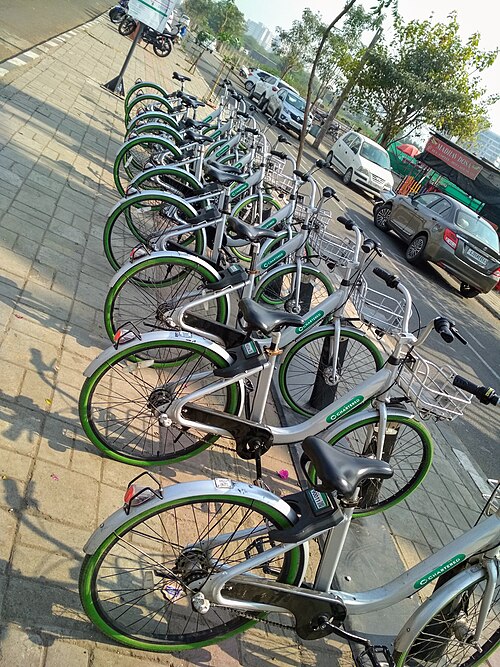
The Delhi Metro Rail Corporation (DMRC) launched a software-based Public bicycle sharing (PBS) scheme through which commuters can rent cycles from a residential area and travel to the nearest Metro station and then rent a cycle from a departing Metro station for use in nearby localities.[805]
In 2018, a Public bicycle sharing (PBS) system was launched in Bhubaneshwar. The bikes included Hexi bikes, Yana and Yulu, and comprised 2000 bikes overall.[806]
Many bicycle-sharing systems started in Pune. One system was initiated by PedalSaddle, providing cycles for rent for cheaper than public transportation.[807] In January 2018, Chinese bicycle-sharing company Ofo launched a dockless bicycle-sharing services in Pune.[808]
Bicycle-sharing systems are used in other cities including Rajkot,[809]Bhubaneswar,[810]Vadodara (Baroda),[811] Ranchi,[812]Surat, Udaipur, Jamnagar[813] and Panchkula.[814]
Bike2Work has operated as a bicycle-sharing network since 2004. As of 2015, it has 130 branches across Indonesia, including in Jakarta.[207]
The Bandung municipal government operates 30 stations with 270 bikes, called Boseh Bikesharing.[815]
Gowes, which means "to paddle" in Indonesian, started operation in limited areas of Jakarta in 2018.[208] Gowes was discontinued in December 2022, in order to be switched with an alternative using electric bicycles.[209]
Tel-O-Fun, started in 2011, is a bicycle-sharing program in Tel-Aviv with 2,000 bicycles and 200 stations throughout the city and in some surrounding towns.[816]
Docomo's bike share service has 10,800 bicycles and 2,190 stations in Japan, most of them in Tokyo.[817] Other services include HELLO CYCLING, P!PPA, COGICOGI, Charichari, ecobike, LUUP.
According to the Ministry of Land, Infrastructure, Transport and Tourism, in 2012, there were already a number of city-level pilot schemes in operation in Japan, the largest of which was in Tokyo's Edogawa City with 500 cycles available for hire.[818]Toyama also has a bicycle-sharing system, that takes the region's public transit IC cardPassca.[819]
Astana-Bike[820] in the capital Astana, has 200 bikes in 40 stations, and 1000 bikes for Expo 2017.[821]
Shymkent-bike[231] in Shymkent, 200 bikes in 44 stations.[822]

LinkBike in George Town, Penang commenced operations in December 2016 with 60 bicycles, making it the first city in Malaysia to introduce a public bicycle-sharing system. This service has since been expanded to 250 bicycles and 25 stations throughout George Town, covering destinations between Gurney Drive to the north and Queensbay Mall to the south.[825][826][827]
In March 2017, the Kota Kinabalu City Hall implemented a bicycle sharing service with 20 bicycles initially made available. Users of the service were required to have a City Hall 'touch and go' card with RM200 (U$45) as a deposit to use a bicycle for 24 hours. The deposit was refunded when the bicycle was returned. Its stations are available in major hotels in the city as well as in Tanjung Lipat and in front of the Grace Court apartment in Sembulan, with another 150 bicycles available in stores.[828]
The Subang Jaya LRT/KTM station was selected for a bicycle-sharing system from the Singaporean company oBike in 2017. Riders were to be charged RM1.00 per 15 minutes of usage.[829][830]
Following trials, a bike-sharing system named Ddareungi was introduced in Seoul in October 2015 in select areas on the right bank of the Han River.[831] After a few months, the number of stations reached 150 and 1500 bikes were made available.[832] In 2016, the number of stations increased to cover new districts.[833] As of July 2016, there were about 300 stations and 3000 bikes available, and Seoul mayor Park Won-soon confirmed his intention to increase the number of bikes available to 20,000.[834]

YouBike is the largest bicycle-sharing service in Taiwan. Launched in Taipei City in 2009 and expanded through cooperation between the Taipei City Government and Taiwanese bike manufacturer Giant, the system saw 22 million rentals in 2014, double the 11 million rentals in the previous year.[330]
Singaporean dockless bicycle-sharing platform oBike launched in Taiwan in April 2017 under the management of Taiwan's Aozhi Network Technology Co., Ltd.[835] The parking of the bikes in public areas such as sidewalks and motorcycle parking spaces caused controversy.[836][837] The service has shut down in June 2017, with all the bikes left on street.[838]
The southern city of Kaohsiung launched the country's first bicycle-sharing service, CityBike, on 1 March 2009 with 20 stations and 1,500 Merida bikes.[839] The service has been replaced by YouBike 2.0 since July 2020.[840]

Public bike sharing services in Turkey use the Baksi system.[841] In Istanbul, the system called İsbike, which was launched in 2012, has 140 stations and 1,500 bikes.[842] In İzmir, the Metropolitan Municipality launched a system called Bisim in 2014. It had 40 stations and 550 bikes as of 2020.[843]
Similar systems are operational in Antalya, Eskişehir, Kayseri, Kocaeli, Konya, and Samsun.[841]

ADCB Bikeshare scheme operates in the nation's capital city of Abu Dhabi, and is sponsored by Abu Dhabi Commercial Bank. ADCB Bikeshare launched in December 2015. Run by Cyacle, the programme operates on Yas Island and Al Raha Beach, where there are 11 stations with 75 bicycles available for hire. In the first eight months of operation, 5,641 people became members of the scheme and rode 78,689 kilometres (48,895 miles) on 8,536 trips.[844]
The German bike sharing company Nextbike temporarily also operated a bike sharing scheme in Dubai,[845] but apparently discontinued it.[846]
In 2024, a powerbank-sharing startup, Q.watt, launched bike-sharing in Tashkent.[427]
A number of Australian cities have had docking shared bike systems since 2010. In 2017, dockless bike sharing commenced in all the capital cities. The dockless systems experienced a higher degree of vandalism, including bikes dumped in rivers, than in other countries.[847] The dockless services all provided helmets with the bikes.
Melbourne Bike Share (MBS) was the first municipal bicycle share system in Australia, launched in Melbourne in June 2010. It started with 10 stations. Usage was lower than expected and has required ongoing public subsidy. Take-up was affected by the location of docking stations and the legal requirement for riders wear helmets, which are not provided with the bikes. Ridership doubled when $5 helmets were offered for sale from vending machines. The MBS used 500 cycles at about 50 stations around Melbourne's central business district before it was shut down in November 2019.[848]

Newcastle's central business district launched an e-bike share scheme on 21 May 2018, including 19 docking stations with 100 electric bikes.[849] The bike scheme was launched as a partnership between the operator BYKKO, and Transport for NSW. An initial pilot program funded with $2000AUD[850] of council grant money was conducted,[851] though evidence of the evaluation does not appear to be posted publicly. After speaking with the local newspaper, BYKKO said the aim of the project is to complement the existing public transport system.[852]
The Brisbane CityCycle, operated by JCDecaux, started on 1 September 2010 and grew to include 2000 bikes in 150 stations.[848][853] Its operation depended on public subsidy. Initially, helmets were not provided with the bikes, but this was later changed. After only achieving 80,000 trips in its first twelve months , this increased to 522,388 in the 2016-17 financial year.[854]
In 2017 dockless systems were launched in a number of Australian cities.
Ofo distributed 50 bikes throughout North Adelaide in October 2017.[861] In July 2018 Ofo announced it was leaving Australia.[858]
Airbike launched in Adelaide.[855]

Subscriptions for CityCycle, a Vélib'-style community bike hire scheme by JCDecaux for Brisbane started on 1 September 2010 and grew to include 2000 bikes in 150 stations from the University of Queensland to Tenerife.[848][853] Its operation depended on public subsidy. Initially, helmets were not provided with the bikes but this was later changed. After logging only 80,000 trips in its first twelve months, by 2016-17 this had increased to 522,388.[854]
The bikes were linked to the public transport go card – a single card covering all buses, trains, ferries, and the Gold Coast light rail system. In 2017 it was announced new bank card facilities would be added to the stations.[853]
After ten years of operation, the hire scheme's decommission was announced for 2021. Throughout 2021, CityCycle stations were removed to make way for shared e-bikes.[862]
Mobike started with 200 bikes around Surfers Paradise and Broadbeach in February 2018 with the number expected to grow to 2,000 by the time of the Commonwealth Games in April.[863] Mobike was granted exclusive rights to operate bike sharing by the local council and will partner with Transit Australia Group and Good Cycles.[864]
In both Auckland and Christchurch, Nextbike provides some limited cycle sharing facilities; plans are in hand to expand these. The New Zealand Transport Agency is working with Auckland Transport and the Christchurch City Council respectively to investigate cycle sharing schemes for each city. Independently, a private consortium proposed having a scheme in place in Auckland in 2017.[865]
Onzo NZ is the first and largest dockless bike sharing platform to launch in New Zealand, beginning in Auckland in late 2017,[866] and in Wellington in 2018.[867]
Several cycle hire schemes in UK towns and cities overlap their university areas, e.g. the one at Stirling.[874] Others, e.g. Leeds,[875] offer longer-term cycle hire. Kingston University is reported to have a scheme called KU Bikes that was due to begin in early 2018,[876] while Derby anticipates that Hourbike will run a scheme in Derby operating electric bikes, around the same time.[877]
{{cite web}}: CS1 maint: deprecated archival service (link){{cite web}}: CS1 maint: deprecated archival service (link){{cite web}}: CS1 maint: deprecated archival service (link){{cite web}}: CS1 maint: numeric names: authors list (link){{cite web}}: CS1 maint: deprecated archival service (link)Ecobici now has around 6,500 bikes and over 240,000 registered users (which, they argue, is the largest in North America).
{{cite web}}: CS1 maint: multiple names: authors list (link)The first bike-share systems, starting in 1960s Amsterdam....
{{cite web}}: CS1 maint: numeric names: authors list (link)