
Loading article…
| ジェームズ6世と1世 | |||||
|---|---|---|---|---|---|
 ジョン・ド・クリッツ作とされる肖像画、 1605年頃 | |||||
| イングランドとアイルランドの王 | |||||
| 治世 | 1603年3月24日 – 1625年3月27日 | ||||
| 戴冠式 | 1603年7月25日 | ||||
| 前任者 | エリザベス1世 | ||||
| 後継 | チャールズ1世 | ||||
| スコットランド王 | |||||
| 治世 | 1567年7月24日 – 1625年3月27日 | ||||
| 戴冠式 | 1567年7月29日 | ||||
| 前任者 | メアリー | ||||
| 後継 | チャールズ1世 | ||||
| リージェント | リストを見る
| ||||
| 生まれる | 1566年6月19日 エディンバラ城、エディンバラ、スコットランド | ||||
| 死亡 | 1625年3月27日(58歳)イギリス、ハートフォードシャー州、 テオバルズ・ハウス | ||||
| 埋葬 | 1625年5月7日 | ||||
| 配偶者 | |||||
| さらに問題 ... | |||||
| |||||
| 家 | スチュアート | ||||
| 父親 | ヘンリー・スチュアート、ダーンリー卿 | ||||
| 母親 | スコットランド女王メアリー | ||||
| サイン |  | ||||
ジェームズ6世および1世(ジェームズ・チャールズ・スチュアート、1566年6月19日 - 1625年3月27日)は、1567年7月24日からジェームズ6世としてスコットランド王であり、 1603年3月24日のスコットランドとイングランドの王位統合から1625年に死去するまでジェームズ1世としてイングランドおよびアイルランドの王であった。彼は長い間両国がより緊密な政治的統合を採用するよう努めたが、スコットランドとイングランドの王国は、ジェームズによる同君連合で統治され、独自の議会、司法機関、法律を持つ主権国家のままであった。
ジェームズは、スコットランド女王メアリーの息子であり、イングランド王でアイルランド卿のヘンリー7世の玄孫であり、したがって3つの王位すべての継承者となる可能性があった。母が彼に有利なように退位を余儀なくされた後、ジェームズは生後13か月でスコットランドの王位に就いた。1578年に正式に終わった彼の未成年期には4人の摂政が統治したが、彼が完全な政府を掌握したのは1583年になってからだった。1589年、ジェームズはアン・オブ・デンマークと結婚した。彼らの子供のうち3人が成人まで生き残った。ヘンリー・フレデリック、エリザベス、チャールズである。1603年、ジェームズは、子供を残さずに亡くなったイングランドとアイルランドの最後のテューダー朝君主で従妹のエリザベス1世の後を継いだ。彼は、1625年に亡くなるまで、22年間、3つの王国すべてを統治し続けました。この期間は、ジャコビアン時代として知られています。王冠合同の後、彼は1603年からイングランド(3つの王国の中で最大の国)に拠点を置き、1617年に一度だけスコットランドに戻り、 「グレートブリテンおよびアイルランドの王」を名乗りました。彼は、イングランドとスコットランドの単一の議会を主張しました。彼の治世中に、アルスター植民地化とアメリカ大陸のイギリスの植民地化が始まりました。
ジェームズ1世のスコットランドにおける統治は57年246日で、スコットランドの君主としては最長であった。彼はスコットランドで目的のほとんどを達成したが、イングランドでは1605年の火薬陰謀事件やイングランド議会との対立など大きな困難に直面した。ジェームズ1世の治世下、エリザベス朝文学と演劇の「黄金時代」が続き、ウィリアム・シェイクスピア、ジョン・ダン、ベン・ジョンソン、フランシス・ベーコンなどの作家が文学文化の繁栄に貢献した。[1]ジェームズは多作な作家で、 『デーモノロジー』(1597年)、『自由君主の真の法』(1598年)、『バジリコン・ドロン』 (1599年)などの作品を著した。[2]彼は聖書の英語への翻訳(後に彼の名にちなんで『欽定訳聖書』と名付けられた)と、1604年の祈祷書の改訂を支援した。[3] [4] アンソニー・ウェルドンは、ジェームズは「キリスト教世界で最も賢い愚か者」と呼ばれていたと主張し、それ以来、この呼び名は彼の性格と結びついている。[5] 20世紀後半以降、歴史家はジェームズの評判を修正し、彼を真面目で思慮深い君主として扱う傾向にある。[6]彼は平和政策に強く傾倒し、宗教戦争、特に中央ヨーロッパの多くを壊滅させた三十年戦争への関与を避けようとした。彼はスペインとの戦争を望むイギリス議会でのタカ派の台頭を阻止しようとしたが失敗した。[7]彼の後を継いだのは次男のチャールズ1世である。
子供時代
誕生

ジェームズは、スコットランド女王メアリーと彼女の2番目の夫であるダーンリー卿ヘンリー・ステュアートの一人息子であった。メアリーとダーンリーは、ヘンリー8世の姉マーガレット・テューダーを通じてイングランド王ヘンリー7世の曾孫にあたる。メアリーのスコットランド統治は不安定で、彼女と夫はローマカトリック教徒であったため、プロテスタント貴族の反乱に直面した。メアリーとダーンリーの困難な結婚生活の間、[8]ダーンリーは密かに反乱軍と同盟を組み、ジェームズが生まれるわずか3か月前に女王の私設秘書デイヴィッド・リッツィオの殺害を共謀した。[9]
ジェームズは1566年6月19日にエディンバラ城で生まれ、君主の長男で法定相続人であったため、自動的にロスシー公爵、スコットランド王子兼大執事となった。5日後、イギリスの外交官ヘンリー・キリグルーは、まだ完全に回復しておらずかすかにしか話せない女王に会った。赤ん坊は「乳母に乳を吸って」おり、「均整のとれた体つきで立派な王子になりそうだった」。[10]彼は1566年12月17日にスターリング城で行われたカトリックの儀式で「チャールズ・ジェームズ」または「ジェームズ・チャールズ」として洗礼を受けた。彼の代父母はフランス王シャルル9世(ブリエンヌ伯ジョンが代理)、イングランド王エリザベス1世(ベッドフォード伯フランシス・ラッセルが代理)、サヴォイ公エマニュエル・フィリベール(大使フィリベール・デュ・クロックが代理)であった。[a]メアリーは、当時の習慣であったセントアンドリュース大司教(メアリーは大司教を「ポッキー司祭」と呼んでいた)が子供の口に唾を吐くのを許さなかった。 [12]フランス人のバスティアン・パジェスが考案したその後の娯楽では、サテュロスに扮して尻尾をつけた男たちが登場したが、イギリス人の客たちはサテュロスが「自分たちに不利なことをした」と考えて腹を立てた。[13]
ダーンリー卿は1567年2月10日、エディンバラのカーク・オ・フィールドで殺害されたが、これはおそらくリッツィオ殺害への報復であった。ジェームズは父のオールバニ公爵とロス伯爵の爵位を継承した。メアリーはすでに不人気であったが、1567年5月15日にダーンリー殺害の容疑が広くかけられていたボスウェル伯爵ジェームズ・ヘップバーンと結婚したことで、メアリーに対する悪感情が広まった。[b] 1567年6月、プロテスタントの反乱軍がメアリーを逮捕し、ロックリーヴン城に投獄したため、メアリーは息子に二度と会うことはなかった。1567年7月24日、彼女は幼いジェームズに王位を譲り、私生児の異母兄弟であるマレー伯爵ジェームズ・スチュアートを摂政に任命せざるを得なくなった。[16]これによりジェームズは幼児として王位に就いた3人目のスコットランド王となった。
摂政
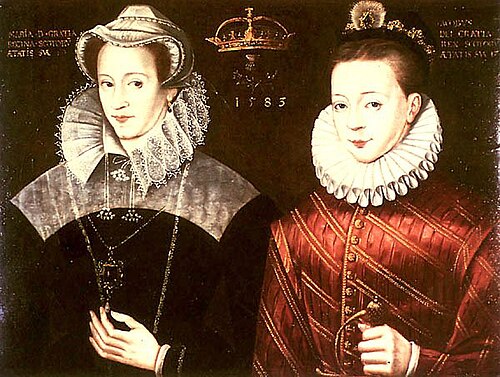
ジェームズの世話はマー伯爵と伯爵夫人に託され、スターリング城の安全な場所で「保護され、養育され、育てられる」こととなった[17] 。 [18]ジェームズは1567年7月29日、生後13か月でスターリングのホーリー・ルード教会でオークニー司教アダム・ボスウェルによってスコットランド王に任命された。 [19]戴冠式の説教はジョン・ノックスが行った。スコットランドの支配階級の大半の宗教的信条に従い、ジェームズはプロテスタント系スコットランド教会、カークの一員として育てられた。枢密院は、ジョージ・ブキャナン、ピーター・ヤング、アダム・アースキン(カンバスケネスの平信徒修道院長)、デイヴィッド・アースキン(ドライバーグの平信徒修道院長)をジェームズの教師または家庭教師として選んだ。 [20]若き王の主任家庭教師として、ブキャナンはジェームズを定期的に殴打したが、同時に生涯にわたる文学と学問への情熱を植え付けた。[21]ブキャナンは、ジェームズを、彼の論文『スコットランド王権の法理』で概説されているように、君主制の限界を受け入れた、神を畏れるプロテスタントの王に変えようとした。[22]
1568年、メアリーはロックリーヴン城から逃亡し、数年にわたって散発的な暴力が続いた。マレー伯爵はラングサイドの戦いでメアリーの軍隊を破り、メアリーはイングランドに逃亡したが、その後エリザベス女王によって監禁された。1570年1月23日、マレーはボスウェルハウのジェームズ・ハミルトンに暗殺された。[23]次の摂政はジェームズの父方の祖父、レノックス伯爵マシュー・スチュワートだったが、彼は1年後、メアリー支持者の襲撃で致命傷を負い、スターリング城に運ばれた。[24]彼の後継者であるマー伯爵は「重病にかかり」、1572年10月28日にスターリングで亡くなった。ジェームズ・メルヴィルは、マー伯爵の病気は、モートン伯爵ジェームズ・ダグラスがダルキース宮殿で開いた宴会の後に起こったと書いている。[25]
モートンはマーの役職に選出され、多くの点でジェームズの摂政の中で最も有能であることを証明したが、[26]その強欲さから敵を作った。[27]フランス人のエスメ・スチュアート、シュール・ドービニーがジェームズの父ダーンリー卿の従兄弟で、後のレノックス伯爵がスコットランドに到着し、すぐにジェームズの有力な寵臣の一人として地位を確立すると、モートンの寵愛は失われた。[28]ジェームズは1579年10月19日のエディンバラ入城の儀式で成人した統治者と宣言された。[29]モートンは1581年6月2日、ダーンリー殺害の共謀の罪で遅ればせながら起訴され、処刑された。[30] 8月8日、ジェームズはレノックスをスコットランドで唯一の公爵にした。[31]当時15歳だった王は、さらに1年ほどレノックスの影響下にとどまった。[32]
スコットランドの統治

レノックスはプロテスタントに改宗したが、スコットランドのカルヴァン派の信者たちは彼と国王の肉体的な愛情表現に気づき、レノックスが「国王を肉欲に引きずり込もうとした」と非難し、彼を信用しなかった。[27] 1582年8月、ルースベン襲撃として知られる事件で、プロテスタントのウィリアム・ルースベン伯爵(ゴーリー伯爵)とアーチボルド・ダグラス(アンガス伯爵)は、ジェームズをルースベン城に誘い込み、投獄し、[c]レノックスにスコットランドからの追放を強いた。1582年9月19日、ジェームズが投獄されている間、 1579年に国王が自ら王室牧師に任命したジョン・クレイグは、説教壇から、聖職者を非常に侮辱する布告を出したとして彼を厳しく叱責し、「国王は泣いた」。[34]
1583年6月27日にフォークランドから脱出したジェームズは、[35]王国の支配権を強めた。彼は教会に対する王権を主張するために黒法を成立させ、かつての家庭教師ブキャナンの著作を非難した。 [36] 1584年から1603年の間に、彼は効果的な王政を確立し、領主たちの間に比較的平和な関係を築かせた。その助けとなったのが、1592年まで政府を率いたサールステインのジョン・メイトランドだった。 [37] 1596年、オクタヴィアンとして知られる8人からなる委員会がジェームズの財政破綻をある程度コントロールしたが、既得権益層の反対を招いた。この委員会は、反カトリック主義に煽られたエディンバラの暴動により1年以内に解散し、宮廷は一時的にリンリスゴーに撤退した。[38]
スコットランド人が国王を襲撃した最後の事件は1600年8月、ゴーリー伯爵ジョン・ルースベンの弟アレクサンダー・ルースベンが、ルースベン家の居城であるゴーリー・ハウスでジェームズ王を襲撃したとみられる。 [39]ルースベンはジェームズ王の従弟ジョン・ラムゼイに刺され、ゴーリー伯爵はその後の騒動で殺害されたが、目撃者はほとんどいなかった。ジェームズ王とルースベン家との過去や、ジェームズ王がルースベン家に多額の借金を抱えていたことから、ジェームズ王の説明は広く信じられていたわけではない。[40]
1586年、ジェームズはイングランドとベリック条約を締結した。この条約と、1587年に母が処刑されたこと(ジェームズはこれを「不合理で奇妙な手続き」と非難した)が、国境の南側でのジェームズの王位継承への道を開くのに役立った。[d]エリザベス女王は未婚で子供もおらず、ジェームズが後継者になる可能性が最も高かった。イングランドの王位継承を確保することが彼の政策の要となった。[42] 1588年のスペイン艦隊の危機の際、ジェームズは「あなたの実子であり、あなたの国の同胞」としてエリザベスへの支持を約束した。 [43 ]エリザベスは1586年から毎年ジェームズに補助金を送り、スコットランド情勢に対する影響力をジェームズに与えた。[44]
結婚


ジェームズは若い頃、女性にほとんど興味を示さなかったため、貞潔さを賞賛された。レノックスを失った後も、彼は男性との付き合いを好んだ。[45]しかし、統治を強化するためにはふさわしい結婚が必要であり、その選択はプロテスタントのデンマーク王フレゼリク2世の次女で14歳のアン・オブ・デンマークに下った。1589年8月にコペンハーゲンで代理結婚した直後、アンはスコットランドに向けて出航したが、嵐のためにノルウェーの海岸に追いやられた。横断が中止されたと聞いたジェームズは、300人の従者を引き連れてリースを出航し、自らアンを迎えに行った。歴史家デイヴィッド・ハリス・ウィルソンはこれを「彼の生涯で唯一のロマンチックなエピソード」と呼んだ。[46] [e] 2人は11月23日にオスロの司教宮殿で正式に結婚した。ジェームズは75,000デンマーク・ダラーの結納品と、義母のゾフィー・フォン・メクレンブルク=ギュストロウから10,000ダラーの贈り物を受け取った。[48]エルシノアとコペンハーゲンに滞在し、ティコ・ブラーエと会見した後、ジェームズとアンは1590年5月1日にスコットランドに戻った。[49]誰の証言でも、ジェームズは最初アンに夢中になり、結婚して最初の数年間は常に彼女に忍耐と愛情を示していたようだ。[50]国王夫妻には成人まで生き残った3人の子供がいた。1612年に18歳で腸チフスで亡くなったウェールズ公ヘンリー・フレデリック、後のボヘミア女王エリザベス、そしてジェームズの後継者チャールズである。
アンは度重なる病気に苦しみ、1617年からは重病に陥った。ジェームズはアンが最後に病気になったときに3回だけ彼女を訪ねた。彼女は1619年3月に夫より先に亡くなった。 [51]
魔女狩り

魔女狩りで有名なデンマークを訪れたことで、ジェームズは魔術の研究に興味を持つようになり、[52]彼はそれを神学の一分野とみなした。[53]彼はノース・バーウィック魔女裁判に出席した。これは1563年の魔術法に基づくスコットランドでの最初の大規模な魔女迫害であった。数人が魔術を使ってジェームズの船に嵐をもたらしたとして有罪判決を受けたが、最も有名なのはアグネス・サンプソンである。[54]
ジェームズは魔女の脅威を懸念し、 1597年に『悪魔学』を執筆した。これは彼の個人的な関わりに触発されて書かれたもので、魔女の行為に反対し、シェークスピアの『マクベス』の背景資料となった。[55] [56]ジェームズは魔女とされた女性の拷問を個人的に監督した。[55] 1599年以降、彼の見解はより懐疑的になった。[57]後にイングランドで息子ヘンリーに書いた手紙の中で、ジェームズは王子に「あの小さな偽娘の発見。私は神に、あなたがそのような発見の私の後継者となることを祈る…今日では奇跡のほとんどが幻想に過ぎないことが証明されており、これによって裁判官が告発を信用する際にどれほど用心深くあるべきかが分かるだろう」と祝福している。[58]
高地と島々
1493年にスコットランド王ジェームズ4世が島嶼領主権を強制的に解散させたことで、西海岸は混乱の時代を迎えた。ジェームズ4世はヘブリディーズ諸島の組織的な軍事力を鎮圧したが、彼とその後継者たちには、統治の代替形態を提供する意志も能力もなかった。その結果、16世紀はリンナンクリーチ、つまり襲撃の時代として知られるようになった。[59]さらに、宗教改革の影響はガドゥヘールタハドになかなか及ばず、この地域と中央ベルトの政治支配の中心地との間に宗教的な溝ができた。[60]
1540年、ジェームズ5世はヘブリディーズ諸島を巡り、氏族長たちに同行を強要した。その後しばらく平和が続いたが、氏族はすぐに再び対立するようになった。[61]ジェームズ6世の治世中、ヘブリディーズ諸島の住民は、スコットランドのキリスト教と国家の揺籃の地ではなく、無法な野蛮人として描かれた。公式文書では、ハイランドの人々は「神の知恵と勇気を欠き」、「あらゆる種類の野蛮で残酷な行為」に陥りやすいとされている。[62]ジェームズ4世とおそらくジェームズ5世が流暢に話していたゲール語は、ジェームズ6世の時代に「エルス」またはアイルランド語として知られるようになり、本質的に外国語であることを暗示した。議会はゲール語がハイランダーの欠点の主な原因になっていると判断し、ゲール語の廃止を求めた。[63]

このような背景から、ジェームズ6世は1598年に「ファイフの紳士冒険家」に「最も野蛮なルイス島」を文明化する権限を与えた。ジェームズは、入植者は「地元住民との合意ではなく」、島を「根絶」することで行動すべきだと書いた。入植者のストーノウェイ上陸は順調に始まったが、入植者はマードックとニール・マクラウドが指揮する地元軍に追い出された。入植者は1605年に再度試み、結果は同じだったが、1607年の3回目の試みはより成功した。[64] 1609年に制定されたアイオナ法令では、氏族長にハイランド教区のプロテスタント牧師への支援、吟遊詩人の追放、行動の責任を取るためにエディンバラに定期的に報告、そして子孫をローランド・スコットランドに派遣して英語圏のプロテスタント学校で教育することが義務付けられた。[65]こうして「ゲール語の根絶、その伝統文化の破壊、そしてゲール語の担い手の抑圧を特に目的とした」プロセスが始まった。[66]
北方諸島では、ジェームズの従兄弟であるオークニー伯パトリック・スチュワートがアイオナ法令に抵抗し、投獄された。[67]彼の実子ロバートはジェームズに対する反乱を起こしたが失敗に終わり、伯爵とその息子は絞首刑に処された。[68]彼らの領地は没収され、オークニー諸島とシェトランド諸島は王室に併合された。[68]
君主制の理論

1597年から1598年にかけて、ジェームズは『自由君主制の真法』と『王の賜物』を著し、その中で君主制の神学的根拠を論じた。『真法』では、王の神権神授説を述べ、王は聖書的理由から他の人間よりも高位の存在であるが、「最も高い椅子は最も滑りやすい」と説明した。[69]この文書は絶対主義的な君主制の理論を提唱しており、王は王権によって新しい法律を施行できるが、伝統と神にも注意を払わなければならない。神は「邪悪な王を罰するために、自分の望むような鞭を振り回す」[70]
バシリコン・ドロン(Basilikon Doron)は、 4歳のヘンリー王子のための指導書として書かれ、王権についてのより実践的なガイドを提供している。[71]この作品はよく書かれており、おそらくジェームズの散文の最高の例であると考えられている。[72]ジェームズは議会を単に王の「首席裁判所」と理解していたが、議会に関する助言は、イングランド下院との彼の困難を予兆している。「議会は開かないように」と彼はヘンリーに告げる。「新しい法律が必要な場合を除き、それはめったにないだろう」。[73]ジェームズは『真の法』の中で、封建領主が領地を所有するのと同じように、王は領土を所有していると主張している。なぜなら、王は「いかなる階級や階級よりも前に、いかなる議会も開かれず、法律も制定される前に出現し、彼らによって土地が分配された。土地は当初完全に彼らのものだった。したがって、必然的に、王は法律の著者であり作成者であり、王の法律ではない」からである。[74]
文学のパトロン
1580年代から1590年代にかけて、ジェームズは母国の文学を振興した。1584年、18歳の時に『スコットランドの韻律で遵守すべき、避けるべき規則と注意』という論文を出版した。これは詩の手引書であると同時に、母国語であるスコットランド語の詩の伝統をルネッサンスの原理を適用した記述でもあった。 [75]また、音楽教育と音楽の関連性を考えて、音楽教育を改革し推進するための法定規定も作った。彼の治世中に制定された法令の1つに、スコットランドの都市に対し、サン・スキュリスの音楽教育を改革し支援するよう促すものがあった。[76]
これらの目的を推進するため、ジェームズは、カスタルィアン・バンドとして知られるスコットランドのジャコビアン朝の宮廷詩人や音楽家たちの緩やかなサークルのパトロンでありリーダーでもあった。このサークルにはウィリアム・ファウラーやアレクサンダー・モンゴメリーなどが含まれており、モンゴメリーは国王のお気に入りであった。[77]ジェームズ自身も詩人であり、このグループの活動的なメンバーとして見られることを喜んでいた。[78]
1590年代後半までに、ジェームズがイングランド王位を継承する可能性が高まったことにより、スコットランド固有の伝統に対する擁護はある程度減少した。[79] ウィリアム・アレクサンダーと他の宮廷詩人は、書き言葉を英語化し始め、1603年以降は国王に従ってロンドンに移住した。 [80]ジェームズは文学活動家およびパトロンとしての役割を担ったため、多くの点でイングランド・ルネサンスの詩と演劇の決定的な人物となり、彼の治世中に詩と演劇は頂点に達したが、[81]先祖であるスコットランド王ジェームズ1世を含むスコットランドの伝統における高尚なスタイルのパトロンとしての活動は、ほとんど脇に追いやられた。[82]
イングランドでの加盟

1601年、エリザベス女王の晩年、何人かのイギリスの政治家、特に首相ロバート・セシル[f]は、スムーズな王位継承のために事前に準備するためジェームズと秘密の手紙のやり取りを続けていた。[ 84]女王の死期が明らかになると、セシルは1603年3月にジェームズにイングランド王位継承の宣言文の草案を送った。エリザベスは3月24日の早朝に亡くなり、同日遅くにロンドンでジェームズが国王として宣言された。[85] [86]
4月5日、ジェームズは3年ごとに戻ってくると約束して(約束は果たされなかったが)、エディンバラを出発してロンドンに向かい、ゆっくりと南下した。道中、地元の領主たちはジェームズを惜しみないもてなしをもって迎え、ジェームズは新しい土地と臣下の豊かさに驚き、「石造りの長椅子を羽毛の厚いベッドに取り替えた」とまで言った。ジェームズはエリザベスの葬儀から9日後の5月7日に首都に到着した。[85] [87]彼の新しい臣下たちは、王位継承が騒乱や侵略を引き起こさなかったことに安堵し、彼に会いに集まった。[88]ロンドンに到着すると、彼は群衆に取り囲まれた。[89]
ジェームズ1世の戴冠式は7月25日にウェストミンスター寺院で行われた。疫病の流行により祝賀行事は制限された。トーマス・デッカーやベン・ジョンソンなどの劇詩人による精巧な寓話を伴う王室ロンドン入城は1604年3月15日に延期された。[90]デッカーは「通りには男たちが敷き詰められ、豪華な商品の代わりに子供たちが置かれた屋台が並び、開いた窓には女性たちが詰め込まれていた」と書いている。[91]
しかし、ジェームズが継承した王国には問題があった。独占と課税は広く不満を生み、アイルランドでの戦争費用は政府にとって重い負担となり、[92]政府は40万ポンドの負債を抱えていた。
イングランドにおける初期の統治

ジェームズは、王位継承がスムーズに進み、温かい歓迎を受けたにもかかわらず、治世の最初の年に2つの陰謀を生き延びた。バイ・プロットとメイン・プロットで、ヘンリー・ブルック、コブハム卿、ウォルター・ローリーなどが逮捕された。 [93]ジェームズによる政権交代を期待していた人々は、ジェームズがセシルと秘密裏に計画していたようにエリザベスの枢密顧問官を留任させたため、最初は失望したが、 [93]ジェームズはすぐに長年の支持者であるヘンリー・ハワードとその甥のトーマス・ハワード、および5人のスコットランド貴族を枢密院に加えた。[93] [g]
ジェームズ1世の治世の初期には、政府の日常的な運営は、抜け目のないセシル(後のソールズベリー伯)によって厳重に管理され、経験豊富なトーマス・エガートン(ジェームズ1世によってエルズミア男爵および大法官に任命された)とトーマス・サックヴィル(間もなくドーセット伯となり、引き続き財務大臣として留任)の助けを借りていた。[93]その結果、ジェームズ1世は、イングランドとスコットランドのより緊密な統合の計画や外交政策などのより大きな問題に集中するとともに、狩猟などの余暇を楽しむこともできた。[93]
ジェームズは、スコットランドとイングランドの同君連合を基盤として、1人の君主、1つの議会、1つの法律のもとに1つの国を樹立するという野心を抱いていたが、この計画は両王国で反対に遭った。[97]「神は我々を1つの島に創り、1つの海に囲まれ、本質的に分割できないものにしたのではないだろうか」とジェームズはイングランド議会に語った。しかし、1604年4月、庶民院は法的根拠に基づいて「グレートブリテン王」の称号を求める彼の要請を拒否した。[h] 1604年10月、彼は「イングランド王」や「スコットランド王」の代わりに「グレートブリテン王」の称号を名乗ったが、フランシス・ベーコンは彼に「いかなる法的手続き、文書、保証」にもその称号を使用することはできないと告げ、その称号はイングランドの法令では使用されなかった。[99]ジェームズはスコットランド議会にその称号の使用を強制し、両王国の布告、貨幣、書簡、条約でその称号が使用された。[100]
ジェームズは外交政策でより大きな成功を収めた。スペインと戦争をしたことがなく、彼は長きに渡る英西戦争を終わらせることに力を注ぎ、代表団、特にロバート・セシルとヘンリー・ハワード(ノーザンプトン伯)の巧みな外交手腕により、1604年8月に両国の間で和平条約が締結された。ジェームズは条約を祝って盛大な宴会を催した。[101]しかし、イングランドにおけるカトリック教徒の信仰の自由はスペインの政策の主要目標であり続け、ジェームズはカトリック教徒弾圧で国外では不信感を抱き、国内では枢密院からカトリック教徒に対するさらなる寛容さを示さないように促され、常にジレンマに陥っていた。[102]
火薬陰謀事件
1605 年 11 月 4 日から 5 日の夜、ジェームズ王の最初のイングランド議会の第 2 会期の開会前夜、反体制カトリック教徒のガイ・フォークスが国会議事堂の地下室で発見された。フォークスは、翌日国会議事堂を爆破し、ジェームズ王が述べたように「私だけでなく、妻や子孫だけでなく、国全体を滅ぼす」つもりでいた 36 樽の火薬のそばに積み上げられた木材を守っていた。[103]すぐに「火薬陰謀事件」として知られるようになったこの事件のセンセーショナルな発見は、国王とその息子たちの救出に国民の安堵感を呼び起こした。ソールズベリー伯はこれを利用し、エリザベス女王に与えられたもの以外では最高額の補助金を議会から引き出した。[104]フォークスと、この未遂に終わった陰謀に関与した他の者たちは処刑された。[105]
国王と議会
火薬陰謀事件後の君主と議会の協力は異例だった。その代わりに、1604年の前回の会期が、統治期間の残りの期間の双方の態度を形作った。ただし、当初の困難は、意識的な敵意というよりも、相互の無理解によるものだった。[106] 1604年7月7日、ジェームズは、完全な統合または財政的補助金のいずれについても議会の支持を得られなかったため、怒りに任せて議会を閉会した。「私は、感謝する必要がないと思うところには感謝しない」と、閉会の演説で述べた。「...私は愚か者を称賛するような人間ではない...あなたがたは、あなたがたがいかに多くのことをうまくやれなかったかを知っている...あなたがたが、今後はもっと謙虚に自由を利用してほしい」。[107]
ジェームズの治世が進むにつれ、彼の政府は、徐々に進行するインフレだけでなく、ジェームズの宮廷の浪費と財政無能さもあって、財政的圧力が高まっていった。1610年2月、ソールズベリーは、グレート・コントラクトとして知られる計画を提案した。これは、議会が10の王室譲歩と引き換えに、国王の負債の返済のために60万ポンドの一時金と、年間20万ポンドの補助金を与えるというものだった。 [108]その後の厄介な交渉は長引いたため、ジェームズはついに我慢できなくなり、1610年12月31日に議会を解散した。「あなたの最大の過ちは、胆汁から蜜を引き出そうとしたことである」と彼はソールズベリーに語った。[109]同じパターンが、1614年のいわゆる「混乱した議会」でも繰り返された。ジェームズは、下院が要求した資金の交付をためらったため、わずか9週間で議会を解散した。[110]その後ジェームズは1621年まで議会なしで統治し、商人のライオネル・クランフィールドのような役人を雇い、王室のために資金を集めて貯蓄することに長け、その多くがその目的のために創設された準男爵位やその他の爵位を売却して代替収入源とした。[111]
スペインの試合
もう一つの潜在的な収入源は、チャールズ皇太子とスペインのマリア・アンナ王女との結婚によるスペインからの持参金の見込みであった。[112]スペインとの結婚政策は、スペインとの平和を維持し、戦争による追加費用を回避する方法としてジェームズにとって魅力的であった。[113]平和は、結婚を成立させるのと同じくらい、交渉を継続することによっても効果的に維持できたため、ジェームズが交渉をほぼ10年も引き延ばした理由が説明できるかもしれない。[114]

この政策はハワード家やカトリック寄りの牧師や外交官(スペイン党として知られた)に支持されたが、プロテスタントのイングランドでは深い不信感を抱かれていた。ウォルター・ローリーは1616年に釈放されると、ジェームズからスペインと交戦しないよう厳しく指示され、南米で金鉱探しに乗り出した。 [115]ローリーの遠征は悲惨な失敗に終わり、息子のウォルターはスペインと戦って死んだ。[116]ローリーがイングランドに戻ると、ジェームズはスペインの宥和政策に反対する国民の憤慨をよそに彼を処刑した。[117]ジェームズ1世の政策は、三十年戦争の勃発によってさらに危険にさらされた。特に、プロテスタントの義理の息子でプファルツ選帝侯フリードリヒ5世が1620年にカトリックの皇帝フェルディナンド2世によってボヘミアから追放され、同時にスペイン軍がフリードリヒの故郷ラインラントに侵攻した後はなおさらだった。事態は、ジェームズ1世が1621年に義理の息子を支援する軍事遠征の資金を調達するために議会を招集したときに頂点に達した。[118]庶民院は一方では、フリードリヒを支援するための本格的な軍事作戦の資金を調達するには不十分な補助金を交付し、[119]他方では、エリザベス女王の治世中にスペインの金積荷に対する海軍の攻撃で得られた利益を思い出し、スペインとの直接戦争を求めた。 1621年11月、エドワード・コークに煽動され、彼らはスペインとの戦争だけでなく、チャールズ皇太子がプロテスタントと結婚することや反カトリック法の施行を求める請願書を作成した。[120]ジェームズは彼らに、王室の大権に関わる問題に干渉するな、さもなければ処罰を受けるぞときっぱりと告げた。 [121]これが彼らを刺激し、言論の自由を含む自分たちの権利に抗議する声明を発表させた。[122]バッキンガム公ジョージ・ヴィリアーズとスペイン大使ゴンドマール伯ディエゴ・サルミエント・デ・アクーニャに促され、ジェームズは記録簿から抗議文書を引き裂き、議会を解散した。[123]
1623年初頭、22歳になったチャールズ皇太子とバッキンガムは主導権を握り、スペインにお忍びでマリア・アンナ王女を直接勝ち取ろうと決意したが、この計画は無駄な失敗に終わった。[124]マリア・アンナはチャールズ皇太子を嫌っており、スペインは議会による反カトリック法の撤回を含む条件でチャールズ皇太子と対峙した。条約は調印されたものの、チャールズ皇太子とバッキンガムは10月に王女を連れてイングランドに戻り、即座に条約を破棄した。これはイギリス国民を大いに喜ばせた。[125]スペイン訪問に幻滅したチャールズ皇太子とバッキンガムはジェームズ1世のスペイン政策を一転させ、フランスとの同盟とハプスブルク帝国との戦争を求めた。[126]必要な資金を集めるため、彼らはジェームズにもう一度議会を召集するよう説得し、議会は1624年2月に開かれた。下院で噴出した反カトリック感情は、政策の主導権がジェームズからチャールズとバッキンガムに移りつつあった時に初めて宮廷に反映された。[127]彼らは国王に宣戦布告するよう圧力をかけ、費用を理由に計画に反対した財務大臣ライオネル・クランフィールド(当時ミドルセックス伯爵)の弾劾を画策した。 [128] 1624年の議会の結果は曖昧だった。ジェームズは依然として宣戦布告も資金提供も拒否したが、チャールズは下院がスペインとの戦争に資金を提供することを約束したと信じ、この姿勢は彼自身の治世中に議会との問題を引き起こすことになった。[129]
王と教会
火薬陰謀事件の後、ジェームズはイングランドのカトリック教徒を統制するために厳しい措置を承認した。1606年5月、議会はカトリック教徒反逆者法を可決した。これは、国王に対する教皇の権威を否定する忠誠の誓いを臣民に義務付けるものであった。 [130]ジェームズは忠誠の誓いを立てたカトリック教徒に対して融和的であり、[131]宮廷でさえ隠れカトリック教徒を容認した。[i]たとえば、ヘンリー・ハワードは隠れカトリック教徒であったが、最後の数か月でカトリック教会に復帰した。[132]ジェームズはイングランド王位に就くと、イングランドのカトリック教徒の支援が必要になるかもしれないと感じ、古い宗教の著名な同情者であるノーサンバーランド伯ヘンリー・パーシーに、「法に表面上従うだけで、おとなしくしている者」は迫害しないと保証した。[133]
In the Millenary Petition of 1603, the Puritan clergy demanded the abolition of confirmation, wedding rings, and the term "priest", among other things, and that the wearing of cap and surplice become optional.[134] James was strict in enforcing conformity at first, inducing a sense of persecution amongst many Puritans;[135] but ejections and suspensions from livings became rarer as the reign continued.[136] As a result of the Hampton Court Conference of 1604, some Puritan demands were acceded to in the 1604 Book of Common Prayer, though many remained displeased.[4][137] The conference also commissioned a new translation and compilation of approved books of the Bible to resolve discrepancies among different translations then being used. The King James Version, as it came to be known, was completed in 1611 and is considered a masterpiece of Jacobean prose.[138][139] It is still in widespread use.[138]
In Scotland, James attempted to bring the Scottish Kirk "so neir as can be" to the English church and to reestablish episcopacy, a policy that met with strong opposition from presbyterians.[j] James returned to Scotland in 1617 for the only time after his accession in England, in the hope of implementing Anglican ritual. James's bishops forced his Five Articles of Perth through a General Assembly the following year, but the rulings were widely resisted.[141] James left the church in Scotland divided at his death, a source of future problems for his son.[k]
Personal relationships
Robert Carr, Earl of Somerset (left), and George Villiers, Duke of Buckingham, are both said to have been James's lovers.
Throughout his life James had close relationships with male courtiers, which has caused debate among historians about their exact nature.[143] In Scotland Anne Murray was known as the king's mistress.[144] After his accession in England, his peaceful and scholarly attitude contrasted strikingly with the bellicose and flirtatious behaviour of Elizabeth,[143] as indicated by the contemporary epigram Rex fuit Elizabeth, nunc est regina Iacobus (Elizabeth was King, now James is Queen).[145]
Some of James's biographers conclude that Esmé Stewart, Duke of Lennox; Robert Carr, Earl of Somerset; and George Villiers, Duke of Buckingham, were his lovers.[146] John Oglander observed that he "never yet saw any fond husband make so much or so great dalliance over his beautiful spouse as I have seen King James over his favourites, especially the Duke of Buckingham"[147] whom the king would, recalled Sir Edward Peyton, "tumble and kiss as a mistress".[148] Restoration of Apethorpe Palace, Northamptonshire, undertaken in 2004–08 revealed a previously unknown passage linking the bedchambers of James and Villiers.[149]
Some biographers of James argue that the relationships were not sexual.[150] James's Basilikon Doron lists sodomy among crimes "ye are bound in conscience never to forgive", and James's wife Anne gave birth to seven live children, as well as suffering two stillbirths and at least three other miscarriages.[151] Contemporary Huguenot poet Théophile de Viau observed that "it is well known that the king of England / fucks the Duke of Buckingham".[152][l] Buckingham himself provides evidence that he slept in the same bed as the king, writing to James many years later that he had pondered "whether you loved me now ... better than at the time which I shall never forget at Farnham, where the bed's head could not be found between the master and his dog".[154] Buckingham's words may be interpreted as non-sexual, in the context of 17th-century court life,[155] and remain ambiguous despite their fondness.[156] It is also possible that James was bisexual.[157]
When the Earl of Salisbury died in 1612, he was little mourned by those who jostled to fill the power vacuum.[m] Until Salisbury's death, the Elizabethan administrative system over which he had presided continued to function with relative efficiency; from this time forward, however, James's government entered a period of decline and disrepute.[159] Salisbury's passing gave James the notion of governing in person as his own chief Minister of State, with his young Scottish favourite Robert Carr carrying out many of Salisbury's former duties, but James's inability to attend closely to official business exposed the government to factionalism.[160]
The Howard party (consisting of Henry Howard, Earl of Northampton; Thomas Howard, Earl of Suffolk; Suffolk's son-in-law William Knollys, Lord Knollys; Charles Howard, Earl of Nottingham; and Thomas Lake) soon took control of much of the government and its patronage. Even the powerful Carr fell into the Howard camp, hardly experienced for the responsibilities thrust upon him and often dependent on his intimate friend Thomas Overbury for assistance with government papers.[161] Carr had an adulterous affair with Frances Howard, Countess of Essex, daughter of the Earl of Suffolk. James assisted Frances by securing an annulment of her marriage to free her to marry Carr, now Earl of Somerset.[n]
In summer 1615, however, it emerged that Overbury had been poisoned. He had died on 15 September 1613 in the Tower of London, where he had been placed at the king's request.[163][o] Among those convicted of the murder were the Earl and Countess of Somerset; the Earl had been replaced as the king's favourite in the meantime by Villiers. James pardoned the Countess and commuted the Earl's sentence of death, eventually pardoning him in 1624.[166] The implication of the king in such a scandal provoked much public and literary conjecture and irreparably tarnished James's court with an image of corruption and depravity.[167] The subsequent downfall of the Howards left Villiers unchallenged as the supreme figure in the government by 1619.[168]
Health and death

In his later years, James suffered increasingly from arthritis, gout and kidney stones.[51][169] He also lost his teeth and drank heavily.[51][170] The king was often seriously ill during the last year of his life, leaving him an increasingly peripheral figure, rarely able to visit London, while Buckingham consolidated his control of Charles to ensure his own future.[p] One theory is that James suffered from porphyria, a disease of which his descendant George III exhibited some symptoms. James described his urine to physician Théodore de Mayerne as being the "dark red colour of Alicante wine".[173] The theory is dismissed by some experts, particularly in James's case, because he had kidney stones which can lead to blood in the urine, colouring it red.[174]
In early 1625, James was plagued by severe attacks of arthritis, gout, and fainting fits, and fell seriously ill in March with tertian ague and then suffered a stroke. He died at Theobalds House in Hertfordshire on 27 March during a violent attack of dysentery, with Buckingham at his bedside.[q] James's funeral on 7 May was a magnificent but disorderly affair.[176] Bishop John Williams of Lincoln preached the sermon, observing, "King Solomon died in Peace, when he had lived about sixty years ... and so you know did King James". The sermon was later printed as Great Britain's Salomon [sic].[177]
James was buried in Westminster Abbey. The position of the tomb was lost for many years until his lead coffin was found in the Henry VII vault, during an excavation in the 19th century.[178]
Legacy

James was widely mourned. For all his flaws, he had largely retained the affection of his people, who had enjoyed uninterrupted peace and comparatively low taxation during the Jacobean era. "As he lived in peace", remarked the Earl of Kellie, "so did he die in peace, and I pray God our king [Charles I] may follow him".[179] The Earl prayed in vain: once in power, King Charles I and the Duke of Buckingham sanctioned a series of reckless military expeditions that ended in humiliating failure.[180] James had often neglected the business of government for leisure pastimes, such as the hunt; his later dependence on favourites at a scandal-ridden court undermined the respected image of monarchy so carefully constructed by Elizabeth I.[181]
Under James, the Plantation of Ulster by English and Scots Protestants began, and the English colonisation of North America started its course with the foundation of Jamestown, Virginia, in 1607[182] and Cuper's Cove, Newfoundland, in 1610. During the next 150 years, England would fight with Spain, the Netherlands, and France for control of the continent, while religious division in Ireland between Protestants and Catholics has lasted for 400 years. By actively pursuing more than just a personal union of his realms, James helped lay the foundations for a unitary British state.[183]
According to a tradition originating with anti-Stuart historians of the mid-17th-century, James's taste for political absolutism, his financial irresponsibility, and his cultivation of unpopular favourites established the foundations of the English Civil War. James bequeathed his son Charles a fatal belief in the divine right of kings, combined with a disdain for Parliament, which culminated in the execution of Charles I and the abolition of the monarchy. Over the last three hundred years, the king's reputation has suffered from the acid description of him by Anthony Weldon, whom James had sacked and who wrote treatises on James in the 1650s.[184]
Other influential anti-James histories written during the 1650s include: Edward Peyton's Divine Catastrophe of the Kingly Family of the House of Stuarts (1652); Arthur Wilson's History of Great Britain, Being the Life and Reign of King James I (1658); and Francis Osborne's Historical Memoirs of the Reigns of Queen Elizabeth and King James (1658).[185] David Harris Willson's 1956 biography continued much of this hostility.[96][186] In the words of historian Jenny Wormald, Willson's book was an "astonishing spectacle of a work whose every page proclaimed its author's increasing hatred for his subject".[187] Since Willson, however, the stability of James's government in Scotland and in the early part of his English reign, as well as his relatively enlightened views on religion and war, have earned him a re-evaluation from many historians, who have rescued his reputation from this tradition of criticism.[r]
Representative of the new historical perspective is the 2003 biography by Pauline Croft. Reviewer John Cramsie summarises her findings:
Croft's overall assessment of James is appropriately mixed. She recognises his good intentions in matters like Anglo-Scottish union, his openness to different points of view, and his agenda of a peaceful foreign policy within his kingdoms' financial means. His actions moderated frictions between his diverse peoples. Yet he also created new ones, particularly by supporting colonisation that polarised the crown's interest groups in Ireland, obtaining insufficient political benefit with his open-handed patronage, an unfortunate lack of attention to the image of monarchy (particularly after the image-obsessed regime of Elizabeth), pursuing a pro-Spanish foreign policy that fired religious prejudice and opened the door for Arminians within the English church, and enforcing unpalatable religious changes on the Scottish Kirk. Many of these criticisms are framed within a longer view of James' reigns, including the legacy—now understood to be more troubled—which he left Charles I.[189]
Titles, styles, honours, and arms
Titles and styles
In Scotland, James was "James the sixth, King of Scotland", until 1604. He was proclaimed "James the first, King of England, France, and Ireland, defender of the faith" in London on 24 March 1603.[190] On 20 October 1604, James issued a proclamation at Westminster changing his style to "King of Great Brittaine, France and Ireland, Defender of the Faith, &c."[191] The style was not used on English statutes, but was used on proclamations, coinage, letters, treaties, and in Scotland.[192] James styled himself "King of France", in line with other monarchs of England between 1340 and 1801, although he did not actually rule France.
Arms
As King of Scotland, James bore the ancient royal arms of Scotland: Or, a lion rampant Gules armed and langued Azure within a double tressure flory counter-flory Gules. The arms were supported by two unicorns Argent armed, crined and unguled Proper, gorged with a coronet Or composed of crosses patée and fleurs de lys a chain affixed thereto passing between the forelegs and reflexed over the back also Or. The crest was a lion sejant affrontée Gules, imperially crowned Or, holding in the dexter paw a sword and in the sinister paw a sceptre both erect and Proper.[193]
The Union of the Crowns of England and Scotland under James was symbolised heraldically by combining their arms, supporters and badges. Contention as to how the arms should be marshalled, and to which kingdom should take precedence, was solved by having different arms for each country.[194]
The arms used in England were: Quarterly, I and IV, quarterly 1st and 4th Azure three fleurs de lys Or (for France), 2nd and 3rd Gules three lions passant guardant in pale Or (for England); II Or a lion rampant within a tressure flory-counter-flory Gules (for Scotland); III Azure a harp Or stringed Argent (for Ireland, this was the first time that Ireland was included in the royal arms).[195] The supporters became: dexter a lion rampant guardant Or imperially crowned and sinister the Scottish unicorn. The unicorn replaced the red dragon introduced by the Tudors. The unicorn has remained in the royal arms of the two united realms. The English crest and motto was retained. The compartment often contained a branch of the Tudor rose, with shamrock and thistle engrafted on the same stem. The arms were frequently shown with James's personal motto, Beati pacifici.[194]
The arms used in Scotland were: Quarterly, I and IV Scotland, II England and France, III Ireland, with Scotland taking precedence over England. The supporters were: dexter a unicorn of Scotland imperially crowned, supporting a tilting lance flying a banner Azure a saltire Argent (Cross of Saint Andrew) and sinister the crowned lion of England supporting a similar lance flying a banner Argent a cross Gules (Cross of Saint George). The Scottish crest and motto was retained, following the Scottish practice the motto In defens (which is short for In My Defens God Me Defend) was placed above the crest.[194]
As royal badges James used: the Tudor rose, the thistle (for Scotland; first used by James III of Scotland), the Tudor rose dimidiated with the thistle ensigned with the royal crown, a harp (for Ireland) and a fleur de lys (for France).[195]
Issue

James's queen, Anne of Denmark, gave birth to seven children who survived beyond birth, of whom three reached adulthood:[196]
- Henry Frederick, Prince of Wales (19 February 1594 – 6 November 1612). Died, probably of typhoid fever, aged 18.[197]
- Elizabeth, Queen of Bohemia (19 August 1596 – 13 February 1662). Married 1613 Frederick V, Elector Palatine. Died aged 65.
- Margaret (24 December 1598 – March 1600). Died aged 1.
- Charles I, King of England, Scotland and Ireland (19 November 1600 – 30 January 1649). Married 1625 Henrietta Maria of France. Succeeded James I & VI.
- Robert, Duke of Kintyre (18 January 1602 – 27 May 1602). Died aged 4 months.[198]
- Mary (8 April 1605 – 16 December 1607). Died aged 2.
- Sophia (June 1606). Died within 48 hours of birth.[199]
Family tree
Ancestry
List of writings
- The Essayes of a Prentise in the Divine Art of Poesie (also called Some Reulis and Cautelis), 1584
- His Majesties Poeticall Exercises at Vacant Houres, 1591
- Lepanto, poem
- Daemonologie, 1597
- Extra-titular Works from the Collected Demonology, 1616
- A Letter To The Whole Church Militant,
- The Argument Of This Whole Epistle,
- A Paraphrase Upon The Revelation,
- The Two Meditations
- The True Law of Free Monarchies, 1598
- Basilikon Doron, 1599
- A Counterblaste to Tobacco, 1604, a strong denunciation of tobacco
- An Apologie for the Oath of Allegiance, 1608
- A Premonition to All Most Mightie Monarches, 1609
Notes
- ^ As the Earl of Bedford was a Protestant, his place in the ceremony was taken by Jean, Countess of Argyll.[11]
- ^ Elizabeth I wrote to Mary: "My ears have been so astounded, my mind so disturbed and my heart so appalled at hearing the horrible report of the abominable murder of your late husband and my slaughtered cousin, that I can scarcely as yet summon the spirit to write about it ... I will not conceal from you that people for the most part are saying that you will look through your fingers at this deed instead of avenging it and that you don't care to take action against those who have done you this pleasure." Historian John Guy nonetheless concludes: "Not a single piece of uncontaminated evidence has ever been found to show that Mary had foreknowledge of Darnley's murder".[14] In historian David Harris Willson's view, however: "That Bothwell was the murderer no one can doubt; and that Mary was his accomplice seems equally certain."[15]
- ^ James's captors forced from him a proclamation, dated 30 August, declaring that he was not being held prisoner "forced or constrained, for fear or terror, or against his will", and that no one should come to his aid as a result of "seditious or contrary reports".[33]
- ^ James briefly broke off diplomatic relations with England over Mary's execution, but he wrote privately that Scotland "could never have been without factions if she had beene left alive".[41]
- ^ James heard on 7 October of the decision to postpone the crossing for winter.[47]
- ^ James described Cecil as "king there in effect".[83]
- ^ The introduction of Henry Howard (soon Earl of Northampton) and of Thomas Howard (soon Earl of Suffolk) marked the beginning of the rise of the Howard family to power in England, which culminated in their dominance of James's government after the death of Cecil in 1612. Henry Howard, son of poet Henry Howard, Earl of Surrey, had been a diligent correspondent with James in advance of the succession (James referred to him as "long approved and trusted Howard"). His connection with James may have owed something to the attempt by his brother Thomas Howard, Duke of Norfolk, to free and marry Mary, Queen of Scots, leading to his execution in 1572.[94] For details on the Howards, see The Trials of Frances Howard by David Lindley. Henry Howard is a traditionally reviled figure (Willson [1956] called him "A man of dark counsels and creeping schemes, learned but bombastic, and a most fulsome flatterer"[95]) whose reputation was upgraded by Linda Levy Peck's 1982 biography Northampton.[96]
- ^ English and Scot, James insisted, should "join and coalesce together in a sincere and perfect union, as two twins bred in one belly, to love one another as no more two but one estate".[98]
- ^ A crypto-Catholic was someone who outwardly conformed to Protestantism but remained a Catholic in private.
- ^ In March 1605, Archbishop Spottiswood wrote to James warning him that sermons against bishops were being preached daily in Edinburgh.[140]
- ^ Assessments of the Kirk at James's death are divided. Some historians argue that the Scots might have accepted James's policies eventually, others that James left the Kirk in crisis.[142]
- ^ In the original: Et ce savant roy d'Angleterre / foutoit-il pas le Boukinquan.[153]
- ^ Northampton assumed the day-to-day running of government business, and spoke of "the death of the little man for which so many rejoice and few do as much as seem to be sorry."[158]
- ^ The commissioners judging the case reached a 5–5 verdict, so James quickly appointed two extra judges guaranteed to vote in favour, an intervention which aroused public censure. When Thomas Bilson (son of Bishop Bilson of Winchester, one of the added commissioners) was knighted after the annulment, he was given the nickname "Sir Nullity Bilson".[162]
- ^ It is very likely that Overbury was the victim of a 'set-up' contrived by the earls of Northampton and Suffolk, with Carr's complicity, to keep him out of the way during the annulment proceedings. Overbury knew too much of Carr's dealings with Frances and he opposed the match with a fervour that made him dangerous, motivated by a deep political hostility to the Howards. It cannot have been difficult to secure James's compliance, because he disliked Overbury and his influence over Carr.[164] John Chamberlain reported that the king "hath long had a desire to remove him from about the lord of Rochester, as thinking it a dishonour to him that the world should have an opinion that Rochester ruled him and Overbury ruled Rochester".[165]
- ^ Some historians (for example Willson) consider James, who was 58 in 1624, to have lapsed into premature senility;[171] but he suffered from an agonising species of arthritis which constantly left him indisposed, as well as other ailments; and Pauline Croft suggests that James regained some control over his affairs in summer 1624, afforded relief by the warm weather. She sees his continuing refusal to sanction war against Spain as a deliberate stand against the aggressive policies of Charles and Buckingham.[172]
- ^ A medicine recommended by Buckingham had only served to make the king worse, which led to rumours that the duke had poisoned him.[175]
- ^ In recent decades, much scholarship has emphasised James's success in Scotland (though there have been partial dissenters, such as Michael Lynch), and there is an emerging appreciation of James's successes in the early part of his reign in England.[188]
References
- ^ Milling 2004, p. 155.
- ^ Fischlin & Fortier 2002, p. 39
- ^ Rhodes, Richards & Marshall 2003, p. 1: "James VI and I was the most writerly of British monarchs. He produced original poetry, as well as translation and a treatise on poetics; works on witchcraft and tobacco; meditations and commentaries on the Scriptures; a manual on kingship; works of political theory; and, of course, speeches to parliament ... He was the patron of Shakespeare, Jonson, Donne, and the translators of the "Authorized version" of the Bible, surely the greatest concentration of literary talent ever to enjoy royal sponsorship in England."
- ^ a b Cummings, Brian, ed. (2011). The Book of Common Prayer: The Texts of 1549, 1559, and 1662. Oxford World's Classics. Oxford: Oxford University Press. p. 737.
- ^ Smith 2003, p. 238: "The label 'the wisest fool in Christendom', often attributed to Henry IV of France but possibly coined by Anthony Weldon, catches James's paradoxical qualities very neatly"; Anthony Weldon (1651), The Court and Character of King James I, quoted by Stroud 1999, p. 27: "A very wise man was wont to say that he believed him the wisest fool in Christendom, meaning him wise in small things, but a fool in weighty affairs."
- ^ Croft 2003, p. 6: "Historians have returned to reconsidering James as a serious and intelligent ruler"; Lockyer 1998, pp. 4–6; Smith 2003, p. 238: "In contrast to earlier historians, recent research on his reign has tended to emphasize the wisdom and downplay the foolishness".
- ^ Davies 1959, pp. 47–57
- ^ Guy 2004, pp. 236–237, 241–242, 270; Willson 1963, p. 13.
- ^ Guy 2004, pp. 248–250; Willson 1963, p. 16.
- ^ Joseph Bain, Calendar State Papers Scotland, vol. 2 (Edinburgh, 1900), p. 290.
- ^ Willson 1963, p. 17.
- ^ Donaldson 1974, p. 99.
- ^ Thomson 1827, pp. 171–172.
- ^ Guy 2004, pp. 312–313.
- ^ Willson 1963, p. 18.
- ^ Guy 2004, pp. 364–365; Willson 1963, p. 19.
- ^ Letter of Mary to Mar, 29 March 1567, quoted by Stewart 2003, p. 27: "Suffer nor admit no noblemen of our realm or any others, of what condition soever they be of, to enter or come within our said Castle or to the presence of our said dearest son, with any more persons but two or three at the most."
- ^ Stewart 2003, p. 33; Willson 1963, p. 18.
- ^ Croft 2003, p. 11.
- ^ Willson 1963, p. 19.
- ^ Croft 2003, pp. 12–13.
- ^ Croft 2003, pp. 13, 18.
- ^ Spottiswoode, John (1851), History of the Church in Scotland, Edinburgh: Oliver & Boyd, vol. 2, p. 120.
- ^ Croft 2003, p. 13.
- ^ Thomson 1827, pp. 248–249.
- ^ Stewart 2003, p. 45; Willson 1963, pp. 28–29.
- ^ a b Croft 2003, p. 15.
- ^ Lockyer 1998, pp. 11–12; Stewart 2003, pp. 51–63.
- ^ Wiggins, Martin; Richardson, Catherine (2012). British Drama 1533–1642: A Catalogue. Vol. II: 1567–1589. Oxford University Press, USA. pp. 242–244. ISBN 978-0-1992-6572-5. OL 25969471M.
- ^ David Calderwood quoted by Stewart 2003, p. 63: "So ended this nobleman, one of the chief instruments of the reformation; a defender of the same, and of the King in his minority, for the which he is now unthankfully dealt with."
- ^ Stewart 2003, p. 63.
- ^ Lockyer 1998, pp. 13–15; Willson 1963, p. 35.
- ^ Stewart 2003, p. 66.
- ^ Law 1904, pp. 295, 297.
- ^ "Ruthven, William", by T. F. Henderson, in Dictionary of National Biography, Volume 50 (Smith, Elder, & Co., 1897)
- ^ Croft 2003, pp. 17–18; Willson 1963, pp. 39, 50.
- ^ Croft 2003, p. 20.
- ^ Croft 2003, pp. 29, 41–42; Willson 1963, pp. 121–124.
- ^ Lockyer 1998, pp. 24–25; Stewart 2003, pp. 150–157.
- ^ Croft 2003, p. 45; George Nicolson quoted by Stewart 2003, p. 154: "It is begun to be noted that the reports coming from the King should differ"; Williams 1970, p. 61: "The two principal characters were dead, the evidence of eyewitnesses was destroyed and only King James's version remained"; Willson 1963, pp. 126–130.
- ^ Croft 2003, p. 22.
- ^ Lockyer 1998, pp. 29–31; Willson 1963, p. 52.
- ^ Croft 2003, p. 23.
- ^ Goodare, Julian (2000). "James VI's English Subsidy". In Goodare, Julian; Lynch, Michael (eds.). The Reign of James VI. East Linton: Tuckwell. p. 115.
- ^ Croft 2003, pp. 23–24.
- ^ Willson 1963, p. 85.
- ^ Stewart 2003, pp. 107–110.
- ^ Kerr-Peterson, Miles; Pearce, Michael (2020). James VI's English Subsidy and Danish Dowry Accounts, 1588–1596. Scottish History Society Miscellany XVI. Woodbridge. p. 35.
- ^ Stevenson, David (1997). Scotland's Last Royal Wedding. Edinburgh: John Donald. pp. 99–100.
- ^ Willson 1963, pp. 85–95.
- ^ a b c Croft 2003, p. 101.
- ^ Croft 2003, p. 26.
- ^ Willson 1963, p. 103.
- ^ Willumsen, Liv Helene (1 December 2020). "Witchcraft against Royal Danish Ships in 1589 and the Transnational Transfer of Ideas". International Review of Scottish Studies. 45: 54–99. doi:10.21083/irss.v45i0.5801. hdl:10037/20205. ISSN 1923-5755. S2CID 229451135 – via www.irss.uoguelph.ca.
- ^ a b Keay & Keay 1994, p. 556.
- ^ Willson 1963, pp. 103–105.
- ^ Croft 2003, p. 27; Lockyer 1998, p. 21; Willson 1963, pp. 105, 308–309.
- ^ Akrigg 1984, p. 220; Willson 1963, p. 309.
- ^ Hunter 2000, pp. 143, 166.
- ^ Hunter 2000, p. 174.
- ^ Thompson 1968, pp. 40–41.
- ^ Hunter 2000, p. 175.
- ^ Thompson 1968, pp. 40–41; Hunter 2000, p. 175
- ^ Hunter 2000, p. 175; Rotary Club of Stornoway 1995, pp. 12–13
- ^ Hunter 2000, p. 176.
- ^ MacKinnon 1991, p. 46.
- ^ Croft 2003, p. 139; Lockyer 1998, p. 179
- ^ a b Willson 1963, p. 321.
- ^ James quoted by Willson 1963, p. 131: "Kings are called gods by the prophetical King David because they sit upon God His throne in earth and have the count of their administration to give unto Him."
- ^ Croft 2003, pp. 131–133.
- ^ Willson 1963, p. 133.
- ^ Croft 2003, pp. 134–135: "James wrote well, scattering engaging asides throughout the text"; Willson 1963, p. 132: "Basilikon Doron is the best prose James ever wrote".
- ^ Croft 2003, p. 133.
- ^ Quoted by Willson 1963, p. 132.
- ^ Jack 1988, pp. 126–127.
- ^ See: Jack, R. D. S. (2000), "Scottish Literature: 1603 and all that Archived 11 February 2012 at the Wayback Machine", Association for Scottish Literary Studies, retrieved 18 October 2011.
- ^ Jack, R. D. S. (1985), Alexander Montgomerie, Edinburgh: Scottish Academic Press, pp. 1–2.
- ^ Jack 1988, p. 125.
- ^ Jack 1988, p. 137.
- ^ Spiller, Michael (1988), "Poetry after the Union 1603–1660", in Craig, Cairns (general editor), The History of Scottish Literature, Aberdeen University Press, vol. 1, pp. 141–152. Spiller points out that the trend, although unambiguous, was generally more mixed.
- ^ See for example Rhodes, Neil (2004), "Wrapped in the Strong Arm of the Union: Shakespeare and King James", in Maley, Willy; Murphy, Andrew (eds), Shakespeare and Scotland, Manchester University Press, pp. 38–39.
- ^ Jack 1988, pp. 137–138.
- ^ Croft 2003, p. 48.
- ^ Lockyer 1998, pp. 161–162; Willson 1963, pp. 154–155.
- ^ a b Croft 2003, p. 49.
- ^ Willson 1963, p. 158.
- ^ Martin 2016, p. 315; Willson 1963, pp. 160–164.
- ^ Croft 2003, p. 50.
- ^ Stewart 2003, p. 169.
- ^ Stewart 2003, p. 172; Willson 1963, p. 165.
- ^ Stewart 2003, p. 173.
- ^ Croft 2003, pp. 50–51.
- ^ a b c d e Croft 2003, p. 51.
- ^ Guy 2004, pp. 461–468; Willson 1963, p. 156.
- ^ Willson 1963, p. 156.
- ^ a b Croft 2003, p. 6.
- ^ Croft 2003, pp. 52–54.
- ^ Willson 1963, p. 250.
- ^ Willson 1963, pp. 249–253.
- ^ Croft 2003, p. 67; Willson 1963, pp. 249–253.
- ^ Croft 2003, pp. 52–53.
- ^ Croft 2003, p. 118.
- ^ Stewart 2003, p. 219.
- ^ Croft 2003, p. 64.
- ^ Nicholls, Mark (2004). "Rookwood, Ambrose (c. 1578–1606)". Oxford Dictionary of National Biography. Oxford Dictionary of National Biography (online ed.). Oxford University Press. doi:10.1093/ref:odnb/24066. Retrieved 13 August 2022. (Subscription or UK public library membership required.)
- ^ Croft 2003, p. 63.
- ^ Quoted by Croft 2003, p. 62.
- ^ Croft 2003, pp. 75–81.
- ^ Croft 2003, p. 80; Lockyer 1998, p. 167; Willson 1963, p. 267.
- ^ Croft 2003, p. 93; Willson 1963, p. 348.
- ^ Willson 1963, p. 409.
- ^ Willson 1963, pp. 348, 357.
- ^ Schama 2001, p. 59.
- ^ Kenyon, J. P. (1978). Stuart England. Harmondsworth, England: Penguin Books. pp. 88–89.
- ^ Willson 1963, pp. 369–370.
- ^ Croft 2003, p. 104; Willson 1963, pp. 372–373.
- ^ Willson 1963, p. 374–377.
- ^ Willson 1963, p. 408–416.
- ^ Lockyer 1998, p. 148; Willson 1963, p. 417.
- ^ Willson 1963, p. 421.
- ^ Willson 1963, p. 422.
- ^ James quoted by Willson 1963, p. 423: "We cannot with patience endure our subjects to use such anti-monarchical words to us concerning their liberties, except they had subjoined that they were granted unto them by the grace and favour of our predecessors."
- ^ Willson 1963, p. 243.
- ^ Croft 2003, pp. 118–119; Willson 1963, pp. 431–435.
- ^ Cogswell 2005, pp. 224–225, 243, 281–299; Croft 2003, p. 120; Schama 2001, p. 64.
- ^ Croft 2003, pp. 120–121.
- ^ Krugler 2004, pp. 63–64: "The aging monarch was no match for the two men closest to him. By the end of the year, the prince and the royal favourite spoke openly against the Spanish marriage and pressured James to call a parliament to consider their now repugnant treaties ... with hindsight ... the prince's return from Madrid marked the end of the king's reign. The prince and the favourite encouraged popular anti-Spanish sentiments to commandeer control of foreign and domestic policy".
- ^ Croft 2003, p. 125; Lockyer 1998, p. 195.
- ^ Croft 2003, p. 126: "On that divergence of interpretation, relations between the future king and the Parliaments of the years 1625–9 were to founder".
- ^ Stewart 2003, p. 225.
- ^ Willson 1963, p. 228.
- ^ Croft 2003, p. 162.
- ^ Akrigg 1984, pp. 207–208; Willson 1963, pp. 148–149.
- ^ Willson 1963, p. 201.
- ^ Croft 2003, p. 156; Stewart 2003, p. 205: "In seeking conformity, James gave a name and a purpose to nonconformity"; Basilikon Doron quoted by Willson 1963, pp. 201, 209: "In things indifferent, they are seditious which obey not the magistrates".
- ^ Croft 2003, p. 158.
- ^ Spinks, Bryan D. (2006). "Anglicans and Dissenters". In Wainwright, Geoffrey; Westerfield Tucker, Karen B. (eds.). The Oxford History of Christian Worship. Oxford: Oxford University Press. p. 503-504. ISBN 978-0-1951-3886-3.
- ^ a b Croft 2003, p. 157.
- ^ Willson 1963, pp. 213–215.
- ^ Croft 2003, p. 164.
- ^ Croft 2003, p. 166; Lockyer 1998, pp. 185–186; Willson 1963, p. 320.
- ^ Croft 2003, p. 167.
- ^ a b Bucholz & Key 2004, p. 208: "... his sexuality has long been a matter of debate. He clearly preferred the company of handsome young men. The evidence of his correspondence and contemporary accounts have led some historians to conclude that the king was homosexual or bisexual. In fact, the issue is murky."
- ^ Bain, Joseph (1894), Calendar of letters and papers relating to the affairs of the borders of England and Scotland, vol. 2, Edinburgh: Creative Media Partners, pp. 30–31, 44, ISBN 978-1-0157-9859-5, OL 46169615M
- ^ Hyde, H. Montgomery (1970). The Love That Dared Not Speak its Name. London: Heinemann. pp. 43–44.
- ^ e.g. Young, Michael B. (2000), King James and the History of Homosexuality, New York University Press, ISBN 978-0-8147-9693-1; Bergeron, David M. (1991), Royal Family, Royal Lovers: King James of England and Scotland, University of Missouri Press; Murphy, Timothy (2011), Reader's Guide To Gay & Lesbian Studies, Routledge Dearborn Publishers, p. 312.
- ^ Bergeron, David M. (1999). King James and Letters of Homoerotic Desire. Iowa City: University of Iowa Press. p. 348.
- ^ Ruigh, Robert E. (1971). The Parliament of 1624: Politics and Foreign Policy. Harvard University Press. p. 77.
- ^ Graham, Fiona (5 June 2008). "To the manor bought". BBC News. Retrieved 18 October 2008.
- ^ e.g. Lee, Maurice (1990), Great Britain's Solomon: James VI and I in his Three Kingdoms, Urbana: University of Illinois Press, ISBN 978-0-2520-1686-8.
- ^ Lockyer 1981, pp. 19, 21; Weir, Alison (1996). Britain's Royal Families: The Complete Genealogy. Random House. pp. 249–251. ISBN 0-7126-7448-9.
- ^ Norton, Rictor (8 January 2000), "Queen James and His Courtiers", Gay History and Literature, retrieved 9 December 2015.
- ^ Gaudiani, Claire Lynn (1981), The Cabaret poetry of Théophile de Viau: Texts and Traditions, Tübingen: Gunter Narr Verlag, pp. 103–104, ISBN 978-3-8780-8892-9, retrieved 9 December 2015.
- ^ Lockyer 1981, p. 22.
- ^ Bray, Alan (2003). The Friend. University of Chicago Press. pp. 167–170. ISBN 0-2260-7180-4.; Bray, Alan (1994). "Homosexuality and the Signs of Male Friendship in Elizabethan England". In Goldberg, Jonathan (ed.). Queering the Renaissance. Duke University Press. pp. 42–44. ISBN 0-8223-1385-5.
- ^ Ackroyd, Peter (2014). The History of England. Vol. III: Civil War. Macmillan. p. 45. ISBN 978-0-2307-0641-5.; Miller, John (2004). The Stuarts. Hambledon. p. 38. ISBN 1-8528-5432-4.
- ^ Dabiri, Emma. "Filled with 'a number of male lovelies': the surprising court of King James VI and I". BBC Scotland. BBC. Retrieved 28 August 2020.
- ^ Willson 1963, p. 269.
- ^ Willson 1963, p. 333: "Finances fell into chaos, foreign affairs became more difficult. James exalted a worthless favourite and increased the power of the Howards. As government relaxed and honour cheapened, we enter a period of decline and weakness, of intrigue, scandal, confusion and treachery."
- ^ Willson 1963, pp. 334–335.
- ^ Willson 1963, p. 349; Francis Bacon, speaking at Carr's trial, quoted by Perry 2006, p. 105: "Packets were sent, sometimes opened by my lord, sometimes unbroken unto Overbury, who perused them, registered them, made table-talk of them, as they thought good. So I will undertake the time was, when Overbury knew more of the secrets of state, than the council-table did."
- ^ Lindley 1993, p. 120.
- ^ Barroll 2001, p. 136: "Rumours of foul play involving Rochester and his wife with Overbury had, however, been circulating since his death. Indeed, almost two years later, in September 1615, and as James was in the process of replacing Rochester with a new favourite, George Villiers, the Governor of the Tower of London sent a letter to the king informing him that one of the warders in the days before Overbury had been found dead had been bringing the prisoner poisoned food and medicine"; Lindley 1993, p. 146.
- ^ Lindley 1993, p. 145.
- ^ Willson 1963, p. 342.
- ^ Croft 2003, p. 91.
- ^ Davies 1959, p. 20: "Probably no single event, prior to the attempt to arrest the five members in 1642, did more to lessen the general reverence with which royalty was regarded in England than this unsavoury episode."
- ^ Croft 2003, pp. 98–99; Willson 1963, p. 397.
- ^ Willson 1963, pp. 378, 404.
- ^ Willson 1963, p. 379.
- ^ Willson 1963, p. 425.
- ^ Croft 2003, pp. 126–127; Croft 2003, p. 101: "James never became a cypher"; Lockyer 1998, p. 174: "During the last eighteen months of his life James fought a very effective rearguard action to preserve his control of foreign policy ... he never became a cypher."
- ^ Röhl, John C. G.; Warren, Martin; Hunt, David (1998), Purple Secret: Genes, "Madness" and the Royal Houses of Europe, London: Bantam Press, ISBN 0-5930-4148-8.
- ^ e.g. Dean, Geoffrey (2002), The Turnstone: A Doctor's Story., Liverpool University Press, pp. 128–129.
- ^ Croft 2003, pp. 127–128; Willson 1963, pp. 445–447.
- ^ John Chamberlain quoted in Croft 2003, p. 129 and Willson 1963, p. 447: "All was performed with great magnificence, but ... very confused and disorderly."
- ^ Croft 2003, pp. 129–130; "Great Britains Salomon A sermon preached at the magnificent funerall, of the most high and mighty king, Iames, the late King of Great Britaine, France, and Ireland, defender of the faith, &c. At the Collegiat Church of Saint Peter at Westminster, the seuenth of May 1625. By the Right Honorable, and Right Reuerend Father in God, Iohn, Lord Bishop of Lincolne, Lord Keeper of the Great Seale of England, &c". quod.lib.umich.edu. Retrieved 1 April 2021.
- ^ Stanley, Arthur (1886), Historical Memorials of Westminster Abbey, London: John Murray, pp. 499–526.
- ^ Croft 2003, p. 130.
- ^ Stewart 2003, p. 348: "A 1627 mission to save the Huguenots of La Rochelle ended in an ignominious siege on the Isle of Ré, leaving the Duke as the object of widespread ridicule."
- ^ Croft 2003, p. 129.
- ^ Croft 2003, p. 146.
- ^ Croft 2003, p. 67.
- ^ Croft 2003, pp. 3–4: "Often witty and perceptive but also prejudiced and abusive, their status as eye-witness accounts and their compulsive readability led too many historians to take them at face value"; Lockyer 1998, pp. 1–4.
- ^ For more on the influence of Commonwealth historians on the tradition of tracing Charles I's errors back to his father's reign, see Lindley 1993, p. 44.
- ^ Lockyer 1998, p. 4.
- ^ Wormald 2011.
- ^ Croft 2003, pp. 1–9, 46.
- ^ Cramsie, John (June 2003), "The Changing Reputations of Elizabeth I and James VI & I", Reviews and History: Covering books and digital resources across all fields of history (review no. 334)
- ^ Velde, Francois, Proclamation by the King, 24 March 1603, heraldica.org, retrieved 9 February 2013.
- ^ Velde, Francois, Proclamation by the King, 20 October 1604, heraldica.org, retrieved 9 February 2013.
- ^ Willson 1963, pp. 252–253.
- ^ Pinches, John Harvey; Pinches, Rosemary (1974), The Royal Heraldry of England, Heraldry Today, Slough, Buckinghamshire: Hollen Street Press, ISBN 0-9004-5525-X, pp. 159–160.
- ^ a b c Pinches and Pinches, pp. 168–169.
- ^ a b Brooke-Little, J. P. (1978) [1950], Boutell's Heraldry Revised edition, London: Frederick Warne, ISBN 0-7232-2096-4, pp. 213, 215.
- ^ Stewart 2003, pp. 140, 142.
- ^ Stewart 2003, p. 248: "Latter day experts have suggested enteric fever, typhoid fever, or porphyria, but at the time poison was the most popular explanation ... John Chamberlain wrote that it was 'verily thought that the disease was no other than the ordinary ague that had reigned and raged all over England'."
- ^ Barroll 2001, p. 27; Willson 1963, p. 452.
- ^ Croft 2003, p. 55; Stewart 2003, p. 142; Willson 1963, p. 456.
- ^ Warnicke 2006, p. xvi–xvii
Sources
- Akrigg, G. P. V. (George Philip Vernon), ed. (1984), Letters of King James VI & I, Berkeley & Los Angeles: University of California, ISBN 978-0-5200-4707-5
- Barroll, J. Leeds (2001), Anna of Denmark, Queen of England: A Cultural Biography, Philadelphia: University of Pennsylvania, ISBN 978-0-8122-3574-6
- Bucholz, Robert; Key, Newton (2004), Early Modern England, 1485–1714: A Narrative History, Oxford: Blackwell, ISBN 978-0-6312-1393-2
- Cogswell, Thomas (2005) [1989], The Blessed Revolution: English Politics and the Coming of War 1621–24, Cambridge University Press, ISBN 978-0-5210-2313-9
- Croft, Pauline (2003), King James, Basingstoke and New York: Palgrave Macmillan, ISBN 978-0-3336-1395-5.
- Davies, Godfrey (1959) [1937], The Early Stuarts, Oxford: Clarendon Press, ISBN 978-0-1982-1704-6
- Donaldson, Gordon (1974), Mary, Queen of Scots, London: English Universities Press, ISBN 978-0-3401-2383-6
- Fischlin, Daniel; Fortier, Mark (2002), "'Enregistrate Speech': Stratagems of Monarchic Writing in the Work of James VI and I", in Fischlin, Daniel; Fortier, Mark (eds.), Royal Subjects: Essays on the Writings of James VI and I, Wayne State University Press, ISBN 978-0-8143-2877-4
- Guy, John (2004), My Heart is My Own: The Life of Mary Queen of Scots, London and New York: Fourth Estate, ISBN 978-1-8411-5752-8
- Hunter, James (2000), Last of the Free: A History of the Highlands and Islands of Scotland, Edinburgh: Mainstream, ISBN 978-1-8401-8376-4
- Jack, R. D. S. (Ronald) (1988), "Poetry under King James VI", in Craig, Cairns (ed.), The History of Scottish Literature, vol. 1, Aberdeen University Press
- Keay, John; Keay, Julia (1994), Collins Encyclopaedia of Scotland, London: HarperCollins, ISBN 978-0-0025-5082-6
- Krugler, John D. (2004), English and Catholic: The Lords Baltimore in the Seventeenth Century, Baltimore: Johns Hopkins University Press, ISBN 978-0-8018-7963-0
- Law, Thomas Graves (1904), "John Craig", in Brown, P. Hume (ed.), Collected Essays and Reviews of Thomas Graves Law, Edinburgh: T. & A. Constable, Edinburgh University Press
- Lindley, David (1993), The Trials of Frances Howard: Fact and Fiction at the Court of King James, Routledge, ISBN 978-0-4150-5206-1
- Lockyer, Roger (1981), Buckingham: The Life and Political Career of George Villiers, First Duke of Buckingham, 1592–1628, Longman, ISBN 978-0-5825-0296-3
- —— (1998), James VI and I, Longman, ISBN 978-0-5822-7961-2
- MacKinnon, Kenneth (1991), Gaelic – A Past and Future Prospect, Edinburgh: The Saltire Society, ISBN 978-0-8541-1047-6
- Martin, Patrick H. (2016), Elizabethan Espionage: Plotters and Spies in the Struggle Between Catholicism and the Crown, Jefferson, North Carolina: McFarland, ISBN 978-1-4766-6255-8
- Milling, Jane (2004), "The Development of a Professional Theatre", in Milling, Jane; Thomson, Peter; Donohue, Joseph W. (eds.), The Cambridge History of British Theatre, Cambridge: Cambridge University Press, ISBN 978-0-5216-5040-3
- Perry, Curtis (2006), Literature and Favoritism in Early Modern England, Cambridge; New York: Cambridge University Press, ISBN 978-0-5218-5405-4
- Rhodes, Neil; Richards, Jennifer; Marshall, Joseph (2003), King James VI and I: Selected Writings, Ashgate Publishing, ISBN 978-0-7546-0482-2
- Rotary Club of Stornoway (1995), The Outer Hebrides Handbook and Guide, Machynlleth: Kittiwake, ISBN 978-0-9511-0035-6
- Schama, Simon (2001), A History of Britain, vol. II, New York: Hyperion, ISBN 978-0-7868-6752-3
- Smith, David L. (2003), "Politics in Early Stuart Britain", in Coward, Barry (ed.), A Companion to Stuart Britain, Blackwell Publishing, ISBN 978-0-6312-1874-6
- Stewart, Alan (2003), The Cradle King: A Life of James VI & I, London: Chatto and Windus, ISBN 978-0-7011-6984-8
- Stroud, Angus (1999), Stuart England, Routledge, ISBN 978-0-4152-0652-5
- Thompson, Francis (1968), Harris and Lewis, Outer Hebrides, Newton Abbot: David & Charles, ISBN 978-0-7153-4260-2
- Thomson, Thomas, ed. (1827), Sir James Melvill of Halhill; Memoirs of his own life, Bannatyne Club
- Warnicke, Retha M. (2006). Mary Queen of Scots. New York: Routledge. ISBN 978-0-4152-9182-8.
- Williams, Ethel Carleton (1970), Anne of Denmark, London: Longman, ISBN 978-0-5821-2783-8
- Willson, David Harris (1963) [1956], King James VI & I, London: Jonathan Cape, ISBN 978-0-2246-0572-4
- Wormald, Jenny (May 2011) [2004], "James VI and I (1566–1625)", Oxford Dictionary of National Biography (online ed.), Oxford University Press, doi:10.1093/ref:odnb/14592 (Subscription or UK public library membership required.)
Further reading
- Akrigg, G. P. V. (1978). Jacobean Pageant: The Court of King James I. New York: Atheneum. ISBN 0-6897-0003-2.
- Fraser, Antonia (1974). King James VI of Scotland, I of England. London: Weidenfeld and Nicolson. ISBN 0-2977-6775-5.
- Coward, B. (2017). The Stuart Age – England, 1603–1714 5th edition ch.4. Routledge. ISBN 978-1-4058-5916-5
- Durston, C. (1993). James I. Routledge. ISBN 0-4150-7779-6
- Fincham, Kenneth; Lake, Peter (1985). "The ecclesiastical policy of King James I" Journal of British Studies 24 (2): 169–207
- Gardiner, S. R. (1907). "Britain under James I" in The Cambridge Modern History vol. 3 ch. 17 online
- Goodare, Julian (2009). "The debts of James VI of Scotland" The Economic History Review 62 (4): 926–952
- Hirst, Derek (1986). Authority and Conflict – England 1603–1658 pp. 96–136, Harvard University Press. ISBN 0-6740-5290-0
- Houston, S. J. (1974). James I. Longman. ISBN 0-5823-5208-8
- Lee, Maurice (1984). "James I and the Historians: Not a Bad King After All?" Albion 16 (2): 151–163. in JSTOR
- Montague, F. C. (1907). The History of England from the Accession of James 1st to the Restoration (1603–1660) online
- Peck, Linda Levy (1982). Northampton: Patronage and Policy at the Court of James I. Harper Collins. ISBN 0-0494-2177-8
- Schwarz, Marc L. (1974). "James I and the Historians: Toward a Reconsideration" Journal of British Studies 13 (2): 114–134 in JSTOR
- Smith, D. L. (1998). A History of the Modern British Isles – 1603–1707 – The Double Crown chs. 2, 3.1, and 3.2. Blackwell. ISBN 978-0-6311-9402-6
- Wormald, Jenny (1983). "James VI and I: Two Kings or One?". History. 68 (223): 187–209. doi:10.1111/j.1468-229X.1983.tb01404.x.
- Young, Michael B. (1999). King James VI and I and the History of Homosexuality. Springer.
- —— (2012). "James VI and I: Time for a Reconsideration?". Journal of British Studies. 51 (3): 540–567. doi:10.1086/664955. S2CID 142991232.
External links

Wikisource has original works by or about:
James VI and I
James VI and I

Wikimedia Commons has media related to James I of England.

Wikiquote has quotations related to James I of England.
- James VI and I at the official website of the British monarchy
- James I at the official website of the Royal Collection Trust
- James I and VI at BBC History
- Portraits of King James I and VI at the National Portrait Gallery, London
- Works by James VI and I at Project Gutenberg
- Works by or about James VI and I at the Internet Archive
- Works by James VI and I at LibriVox (public domain audiobooks)

- Documents on James I curated by The National Archives (United Kingdom)