
Loading article…
ロシア正教会( ROC、ロシア語: Русская православная церковь、РПЦ 、ローマ字表記: Russkaya pravoslavnaya tserkov'、RPTs ; [ a ] )、正式にはモスクワ総主教庁(ロシア語: Московский)としても知られています。 патриархат 、ローマ字表記: Moskovskiy patriarkhat )、[ 10 ]は独立した東方正教会です。ロシア国内に194の教区がある。[ 11 ]中華民国の霊長類はモスクワと全ロシアの族長である。
ロシア正教会の歴史は、キエフ・ルーシのキリスト教化に始まり、それは988年にコンスタンティノープル総主教の聖職者によってウラジーミル大公とその臣民が洗礼を受けたことから始まった。[ 12 ] [ 13 ] 14世紀以降、モスクワはロシア正教会の府主教の主要な居住地となった。[ 14 ]ロシア正教会は1448年に独自の府主教を選出し、独立教会を宣言した。 [ 15 ] 1589年、府主教はコンスタンティノープルの同意を得て総主教の地位に昇格した。[ 16 ] 17世紀半ば、一連の改革により、古儀式派が変更に反対したため、ロシア正教会に分裂が生じた。 [ 17 ]
中華民国は現在、民族的背景に関係なく、旧ソ連構成共和国(グルジアを除く)に居住する東方正教徒に対して排他的管轄権を主張している。中華民国はまた、日本正教会と中国正教会という自治的な組織も設立した。 1990年代のソ連崩壊以降、ベラルーシとラトビアにある中華民国の教区は、正式な教会自治権には及ばないものの、様々な程度の自治権を享受している。
The ROC should also not be confused with the Russian Orthodox Church Outside of Russia (or ROCOR, also known as the Russian Orthodox Church Abroad), headquartered in the United States. The ROCOR was instituted in the 1920s by Russian communities outside the Soviet Union, which had refused to recognise the authority of the Moscow Patriarchate that was de facto headed by MetropolitanSergius Stragorodsky. The two churches reconciled on 17 May 2007; the ROCOR is now a self-governing part of the Russian Orthodox Church.

One of the foundational narratives associated with the history of Orthodoxy in Russia is found in the 12th-century Primary Chronicle, which says that the Apostle Andrew visited Scythia and Greek colonies along the northern coast of the Black Sea before making his way to Chersonesus in Crimea.[18][19] According to the legend, Andrew reached the future location of Kiev and foretold the foundation of a great Christian city with many churches.[20] Then, "he came to the [land of the] Slovenians where Novgorod now [stands]" and observed the locals, before eventually arriving in Rome.[21] Despite the lack of historical evidence supporting this narrative, modern church historians in Russia have often incorporated this tale into their studies.[12]
10 世紀には、キリスト教がキエフ ルーシに根付き始めた。[ 22 ]イーゴリの治世の終わり頃には、ヴァリャーグ人の中にキリスト教徒がいたことが言及されている。 [ 23 ] 944 ~945 年のビザンツ帝国との条約に関する文書では、年代記作者は、イーゴリの使節のためにコンスタンティノープルで行われた宣誓式と、キエフで行われた同様の式についても記録している。[ 22 ]イーゴリの妻オリガは10 世紀半ばに洗礼を受けたが、学者たちは彼女の改宗の正確な年と場所について議論しており、日付は 946 年から 960 年までと幅がある。[ 24 ]ほとんどの学者は彼女がコンスタンティノープルで洗礼を受けたことに同意しているが、改宗はキエフで行われたと主張する学者もいる。[ 25 ]オルガの息子スヴャトスラフは、母親の説得にもかかわらず改宗に反対し、[ 22 ] 969年から988年の間の期間の資料にはキリスト教に関する情報はほとんどない。[ 26 ]
権力を掌握してから10年後、大公ウラジーミルは988年に洗礼を受け、帰国後、国民のキリスト教化を開始した。 [ 27 ] 1988年にロシア正教会によって、この年が国のキリスト教化の日付として宣言された。[ 27 ]年代記によると、ウラジーミルは以前にもさまざまな信仰を調査するために使節を送っていた。[ 27 ]コンスタンティノープルについて素晴らしい報告を受けた後、[ 27 ]彼はクリミアのケルソネソスを占領し、バシレイオス2世の妹をそこに送るよう要求した。[ 28 ]結婚はウラジーミルもそこで洗礼を受けることを条件に行われた。[ 28 ]ウラジーミルはビザンツ皇帝にかなりの軍事的支援を与えており、反乱を起こしたバルダス・フォカス側についたために都市を包囲した可能性がある。[ 28 ] 11世紀初頭までに、キリスト教は国教として確立された。[ 29 ] 13世紀初頭までに、約40の司教座が設立され、それらはすべて最終的にコンスタンティノープルに服従した。[ 30 ]
After Kiev lost its significance following the Mongol invasions, Metropolitan Maximus moved his seat to Vladimir in 1299.[31] His successor, Peter, found himself caught in the conflict between the principalities of Tver and Moscow for supremacy in northwest Russia.[32][33] Peter moved his residence to Moscow in 1325 and became a strong ally of the prince of Moscow.[34] During Peter's tenure in Moscow, the foundation for the Dormition Cathedral was laid and Peter was buried there.[35] By choosing to reside and be buried in Moscow, Peter had designated Moscow as the future center of the Russian Orthodox Church.[34]
Peter was succeeded by Theognostus, who, like his predecessor, pursued policies that supported the rise of the Moscow principality.[36][37] During the first four years of his tenure, the Dormition Cathedral was completed and an additional four stone churches were constructed in Moscow.[36] By the end of 1331, Theognostus was able to restore ecclesiastical control over Lithuania.[38] Theognostus also proceeded with the canonization of Peter in 1339, which helped to increase Moscow's prestige.[36] His successor Alexius lost ecclesiastical over Lithuania in 1355, but kept the traditional title.[39]

1439年7月5日、フィレンツェ公会議において、公会議に出席した唯一のロシア人聖職者が連合に署名したが、同行者によれば、それは強制によるものであった。[ 40 ]イシドール府主教は1439年9月6日にフィレンツェを出発し、1441年3月19日にモスクワに戻った。 [ 41 ]年代記によれば、モスクワ到着から3日後、大公ヴァシリー2世はイシドールを逮捕し、チュドフ修道院に監禁した。[ 42 ]大公の年代記編者によれば、「公爵、ボヤール、その他多くの人々、特にロシアの司教たちは沈黙し、うとうとして眠り込んでいた」が、「神の知恵に満ちたキリストを愛する君主、大公ヴァシリー・ヴァシリエヴィチがイシドールを辱め、彼を牧師や教師ではなく、邪悪で有害な狼と呼んだ」。[ 43 ]年代記では異端の背教者 と呼ばれているにもかかわらず、イシドールは1441年9月15日にモスクワを去るまで、ヴァシリー2世によって正当な府主教として認められていた。[ 43 ]
その後の 7 年間、府主教の座は空席のままであった。[ 44 ]ヴァシリー2 世は反乱を起こしたドミトリー シェミャカ を破り、1447 年 2 月にモスクワに戻った。[ 45 ] 1448 年 12 月 15 日、ロシアの司教会議はコンスタンティノープル総主教の同意なしにヨナを府主教に選出し、これがロシア正教会の独立の始まりとなった。 [ 45 ]ロシアの聖職者全員がヨナを支持したわけではないが、この動きは後に 1453 年のコンスタンティノープル陥落後、ロシアの視点から正当化され、これは神の罰と解釈された。[ 46 ]コンスタンティノープルからの祝福が得られなかったのは意図的ではなかった可能性もあるが、いずれにせよ、これはロシア正教会の独立の始まりとなった。[ 47 ]

Jonah's policy as metropolitan was to recover the areas lost to the Uniate church.[48] He was able to include Lithuania and Kiev to his title, but not Galicia.[48] Lithuania was separated from his jurisdiction in 1458, and the influence of Catholicism increased in those regions.[48] As soon as Vasily II heard about the ordination of Gregory as metropolitan of the newly established metropolis of Kiev, he sent a delegation to the king of Poland warning him not to accept Gregory; Jonah also attempted to persuade feudal princes and nobles who resided in Lithuania to continue to side with Orthodoxy, but this attempt failed.[48]
The fall of Constantinople and the beginning of autocephaly of the Russian Church contributed to political consolidation in Russia and the development of a new identity based on awareness that Moscow was only metropolitanate in the Orthodox oikoumene that remained politically independent.[47] The formulation of the idea of Moscow as the "third Rome" is primarily associated with the monk Philotheus of Pskov, who stated that "Moscow alone shines over all the earth more radiantly than the sun" because of its fidelity to the faith.[47] The marriage of Ivan III to Sophia Palaiologina, the niece of the last Byzantine emperor, and the defeat of the Tatars, helped to solidify this view.[47][49][50]
16 世紀初頭までに、ロシアにおける正教の統合は続き、ノヴゴロド大主教ゲンナジーは1499 年に聖書を教会スラヴ語に完全に翻訳した最初の写本を作成し、これはゲンナジー聖書として知られている。[ 16 ]同時に、ロシア正教会内では、異なる教会観を持つ 2 つの運動が出現した。[ 16 ]ソラのニルス(1433–1508) は、慈善目的以外での修道院の土地所有に反対し、教会が国家の事柄に強く関与することを主張する非所有派を率い、一方、ヴォロツクのヨシフ(1439–1515) は、教会が国家の事柄に強く関与することを支持する運動を率いた。[ 16 ] 1551 年までに、ストグラウ教会会議は、既存の教会の慣習の統一性の欠如に対処した。[ 16 ]マカリウス府主教はまた、「ロシアの地で入手可能なすべての聖典」を集め、ロシア正教の物語的伝統の形成に影響を与えた大メナイオンを完成させた。 [ 16 ] 1589年、フョードル 1世の治世中、ボリス・ゴドゥノフの指導の下、モスクワ府主教ヨブは、コンスタンティノープルのエレミアス2世の祝福を受けて、最初のロシア総主教として聖別された。[ 51 ] [ 16 ]総主教座を設立する勅令では、ロシア全土が「第三のローマ」と呼ばれている。[ 52 ]
17世紀半ばまでに、ロシア正教会の宗教的慣習はギリシャ正教会のそれとは異なっていた。[ 17 ]ニコン総主教は、その慣習のほとんどを当時のギリシャ正教の礼拝形式に適合させるために教会を改革した。[ 17 ]ニコンによる文書の翻訳の修正と典礼改革の実施の努力は、すべての人に受け入れられたわけではなかった。[ 17 ]大司祭アヴァクムは、総主教が「信仰を汚し」、「ロシアの地に激しい怒りを注ぎ込んだ」と非難した。[ 17 ]その結果、分裂が生じ、新しい慣習に抵抗した人々は古儀式派として知られるようになった。[ 17 ]
ペレヤスラフ条約の余波で、オスマン帝国は、ロシアの摂政ソフィア・アレクセーエヴナの代理として行動したとされ、コンスタンティノープル総主教に圧力をかけ、キエフ大主教区をコンスタンティノープルの管轄からモスクワの管轄に移管させた。この移管により、数百万人の信徒と6つの教区がモスクワ総主教、後にロシア聖シノドスの最終的な行政管理下に置かれ、ロシア正教会におけるウクライナ人の存在感が高まり、それは18世紀まで続いた。[ 53 ]大主教区の移管の正確な条件は依然として議論の的となっている。[ 54 ] [ 55 ] [ 56 ] [ 57 ]

Following the death of Patriarch Adrian in 1700, Peter I of Russia (r.1682–1725) decided against an election of a new patriarch, and drawing on the clergy that came from Ukraine, he appointed Stefan Yavorsky as locum tenens.[58] Peter believed that Russia's resources, including the church, could be used to establish a modern European state and he sought to strengthen the authority of the monarch.[58] He was also inspired by church–state relations in the West and therefore brought the institutional structure of the church in line with other ministries.[59]Theophan Prokopovich wrote Peter's Spiritual Regulation, which no longer legally recognized the separation of the church and the state.[59]
Peter replaced the patriarch with a council known as the Most Holy Synod in 1721, which consisted of appointed bishops, monks, and priests.[59] The church was also overseen by an ober-procurator that would directly report to the emperor.[59] Peter's reforms marked the beginning of the Synodal period of the Russian Church, which would last until 1917.[59] In order to make monasticism more socially useful, Peter began the processes that would eventually lead to the large-scale secularization of monastic landholdings in 1764 under Catherine II.[59][60] 822 monasteries were closed between 1701 and 1805, and monastic communities became highly regulated, receiving funds from the state for support.[59]
The late 18th century saw the rise of starchestvo under Paisiy Velichkovsky and his disciples at the Optina Monastery. This marked a beginning of a significant spiritual revival in the Russian Church after a lengthy period of modernization, personified by such figures as Demetrius of Rostov and Platon of Moscow. Aleksey Khomyakov, Ivan Kireevsky and other lay theologians with Slavophile leanings elaborated some key concepts of the renovated Orthodox doctrine, including that of sobornost. The resurgence of Eastern Orthodoxy was reflected in Russian literature, an example is the figure of StaretsZosima in Fyodor Dostoyevsky's Brothers Karamazov.
In the Russian Orthodox Church, the clergy, over time, formed a hereditary caste of priests. Marrying outside of these priestly families was strictly forbidden; indeed, some bishops did not even tolerate their clergy marrying outside of the priestly families of their diocese.[61]
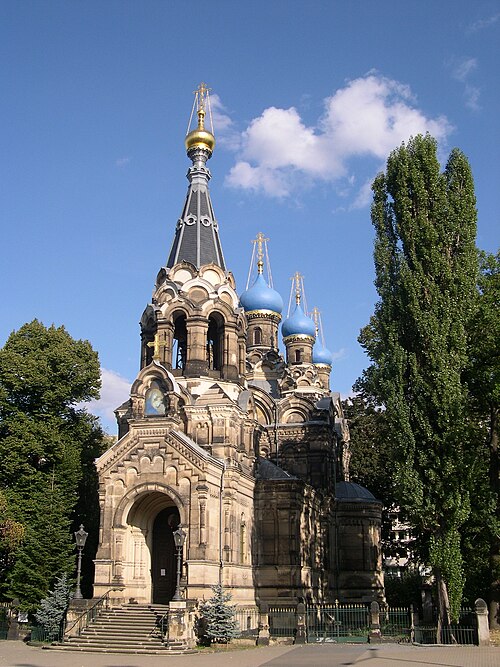
In 1909, a volume of essays appeared under the title Vekhi ("Milestones" or "Landmarks"), authored by a group of leading left-wing intellectuals, including Sergei Bulgakov, Peter Struve and former Marxists.
It is possible to see a similarly renewed vigor and variety in religious life and spirituality among the lower classes, especially after the upheavals of 1905. Among the peasantry, there was widespread interest in spiritual-ethical literature and non-conformist moral-spiritual movements, an upsurge in pilgrimage and other devotions to sacred spaces and objects (especially icons), persistent beliefs in the presence and power of the supernatural (apparitions, possession, walking-dead, demons, spirits, miracles and magic), the renewed vitality of local "ecclesial communities" actively shaping their own ritual and spiritual lives, sometimes in the absence of clergy, and defining their own sacred places and forms of piety. Also apparent was the proliferation of what the Orthodox establishment branded as "sectarianism", including both non-Eastern Orthodox Christian denominations, notably Baptists, and various forms of popular Orthodoxy and mysticism.[62]
1914年当時、ロシアには55,173のロシア正教会と29,593の礼拝堂、112,629人の司祭と助祭、550の修道院と475の女子修道院があり、合計95,259人の修道士と修道女がいた。[ 63 ]
1917年はロシアの歴史、そしてロシア正教会にとっても大きな転換点となった。[ 64 ] 1917年3月初旬(旧暦)、皇帝は退位を余儀なくされ、ロシア帝国は崩壊し始め、政府による教会の直接支配は1917年8月までにほぼ終焉を迎えた。8月15日(旧暦)、クレムリンのモスクワ聖母被昇天大聖堂で、17世紀末以来初となるロシア正教会の地方(ポメストニー)会議が開かれた。会議は1918年9月まで会期を続け、総主教制の復活を含む多くの重要な改革を採択した。総主教制の復活は、10月25日(旧暦)にボリシェヴィキがペトログラードの臨時政府を打倒してから3日後に決定された。11月5日、モスクワ府主教ティホンが、約200年にわたる聖職者会議による統治の後、最初のロシア総主教に選出された。
1918年2月初旬、ボリシェヴィキが支配するソビエト・ロシア政府は、政教分離と学校と教会の分離を宣言する政教分離令を発布した。この政教分離令は、ロシアにおける政教分離、いかなる宗教を信仰する自由、あるいは無宗教の自由を宣言し、宗教団体から財産権と法的地位を剥奪した。ボリシェヴィキの支配地域における合法的な宗教活動は、事実上、教会堂内での礼拝と説教に限定された。この布告とボリシェヴィキ当局による教会財産の徴発の試みは、ロシア正教会の聖職者の間で激しい憤りを引き起こし、時には暴力的な衝突を招いた。2月1日(旧暦1月19日)、ペトログラードのアレクサンドル・ネフスキー大修道院で、修道院の敷地を支配しようとするボリシェヴィキと信者との間で血みどろの衝突が起きた数時間後、ティホン総主教は、そのような行為を行った者たちを破門する布告を出した。[ 65 ]
The church was caught in the crossfire of the Russian Civil War that began later in 1918, and church leadership, despite their attempts to be politically neutral (from the autumn of 1918), as well as the clergy generally were perceived by the Soviet authorities as a "counter-revolutionary" force and thus subject to suppression and eventual liquidation.
In the first five years after the Bolshevik revolution, 28 bishops and 1,200 priests were executed.[66]

The Soviet Union, formally created in December 1922, was the first state to have elimination of religion as an ideological objective espoused by the country's ruling political party, which held the doctrine of state atheism.[67][68] Toward that end, the Communist regime confiscated church property, ridiculed religion, harassed believers, and propagated materialism and atheism in schools.[69] Actions toward particular religions, however, were determined by State interests, and most organized religions were never outlawed.
Orthodox Christian clergy and active believers, among Christians from other denominations, were treated by the Soviet law-enforcement apparatus as anti-revolutionary elements and were habitually subjected to formal prosecutions on political charges, arrests, exiles, imprisonment in camps, and later could also be incarcerated in mental hospitals.[70][71][72]
However, the Soviet policy vis-a-vis organised religion vacillated over time between, on the one hand, a utopian determination to substitute secular rationalism for what they considered to be an outmoded "superstitious" worldview and, on the other, pragmatic acceptance of the tenaciousness of religious faith and institutions. In any case, religious beliefs and practices did persist, not only in the domestic and private spheres but also in the scattered public spaces allowed by a state that recognized its failure to eradicate religion and the political dangers of an unrelenting culture war.[73]

ロシア正教会は、1922年5月にソ連秘密警察の支援を受けた改革運動である「刷新教会(生ける教会)」がティホン総主教から離脱したことで、著しく弱体化した(ヨシフ派とロシア正教会も参照)。この動きは聖職者と信徒の間に分裂を引き起こし、その分裂は1946年まで続いた。
1917年から1935年の間に、13万人の東方正教会の司祭が逮捕された。そのうち9万5千人が処刑された。迫害の犠牲者のうち数千人が、「ロシアの新殉教者・信仰告白者」として知られる特別な聖人列に名を連ねた。
1925年にティホン総主教が死去すると、ソビエト当局は総主教選挙を禁止した。総主教代理を務めたセルギウス府主教(ストラゴロツキー、1887年~1944年)は、教会の多くの教区の意見に反して、1927年にソビエト当局の教会に対する権限を正当なものとして受け入れ、政府への協力を誓約し、教会内の政治的反対を非難する宣言を発表した。この宣言により、セルギウスは、投獄されたペーター府主教の代理人であり、彼の意思に反して行動しているため、使徒法典第34 条に従って権限を行使する権利はないという権限を自らに与えた。これは、ロシア国外のロシア正教会とソビエト連邦内のロシア正教会(ロシア地下教会)との分裂につながった。両教会は使徒法典に忠実であり続けたとされ、セルギウス府主教が率いる教会の部分は分裂、時にはセルギウス主義と呼ばれるようになった。この教会法上の意見の相違により、1925 年以前に存在したロシア正教会の正当な後継教会はどれであるかが議論されている。[ 74 ] [ 75 ] [ 76 ] [ 77 ]
1927年、パリ府主教エヴロギーはロシア正教会国外管区(ROCOR)と決別した(ニューヨーク府主教プラトン(ロジェストヴェンスキー)は、アメリカにおけるロシア正教会管区の指導者であった)。1930年、ロンドンでソビエト政権下で苦しむキリスト教徒のために祈祷会に参加した後、エヴロギーはセルギウスによって解任され、後任が任命された。西ヨーロッパにあるエヴロギーの教区のほとんどは彼に忠誠を誓い続けた。その後、エヴロギーは全地総主教フォティオス2世に教会法上の保護下に入るよう請願し、1931年に受け入れられた。これにより、ロシア国外、特に西ヨーロッパにあるロシア正教徒の多くの教区が、全地総主教庁の西ヨーロッパにおけるロシア正教会の管区となった。
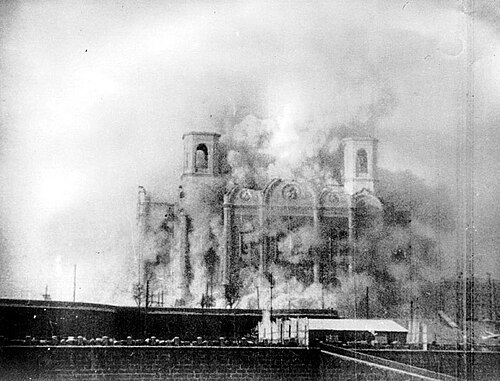
メソジスト教会の援助により、エキュメニカルな取り組みの結果として、1920年代に2つのロシア正教神学校が再開された。[ 78 ]さらに、1929年の選挙では、正教会は共産党に対する本格的な反対グループとして自らを組織しようと試み、共産党の候補者に対抗して独自の候補者を擁立しようとした。1936年のソビエト憲法第124条は、ソビエト連邦内での信教の自由を正式に認めており、当初は複数候補者による選挙であるとの声明とともに、教会は1937年の選挙でも再び独自の宗教的候補者を擁立しようと試みた。しかし、複数候補者による選挙への支持は選挙実施の数ヶ月前に撤回され、1929年と1937年のいずれにおいても正教会の候補者は選出されなかった。[ 79 ]
After Nazi Germany's attack on the Soviet Union in 1941, Joseph Stalin revived the Russian Orthodox Church to intensify patriotic support for the war effort. In the early hours of 5 September 1943, Metropolitans Sergius (Stragorodsky), Alexius (Simansky) and Nicholas (Yarushevich) had a meeting with Stalin and received permission to convene a council on 8 September 1943, which elected Sergius Patriarch of Moscow and all the Rus'. This is considered by some as violation of the Apostolic canon, as no church hierarch could be consecrated by secular authorities.[74] A new patriarch was elected, theological schools were opened, and thousands of churches began to function. The Moscow Theological Academy Seminary, which had been closed since 1918, was re-opened.
In December 2017, the Security Service of Ukraine lifted classified top secret status of documents revealing that the NKVD of the USSR and its units were engaged in the selection of candidates for participation in the 1945 Local Council from the representatives of the clergy and the laity. NKVD demanded "to outline persons who have religious authority among the clergy and believers, and at the same time checked for civic or patriotic work". In the letter sent in September 1944, it was emphasized: "It is important to ensure that the number of nominated candidates is dominated by the agents of the NKVD, capable of holding the line that we need at the Council".[80][81]
A new and widespread persecution of the Christians was subsequently instituted under the leadership of Nikita Khrushchev and Leonid Brezhnev. A second round of repression, harassment and church closures took place between 1959 and 1964 when Nikita Khrushchev was in office. The number of Orthodox churches fell from around 22,000 in 1959 to around 8,000 in 1965;[82] priests, monks and faithful were killed or imprisoned and the number of functioning monasteries was reduced to less than twenty.
Subsequent to Khrushchev's ousting, the church and the government remained on unfriendly terms until 1988. In practice, the most important aspect of this conflict was that openly religious people could not join the Communist Party of the Soviet Union, which meant that they could not hold any political office. However, among the general population, large numbers remained religious.
正教会の信者や司祭の中には、反体制運動に参加して良心の囚人となった者もいた。正教会の司祭であるグレブ・ヤクーニン、セルギー・ジェルドコフらは、信仰の自由を守るために尽力したため、ソ連の刑務所や流刑地で何年も過ごした。[ 83 ]当時の著名な人物には、ドミトリー・ドゥドコ[ 84 ]やアレクサンドル・メンがいた。メンは司祭としての使命をよりよく果たすために反体制運動の実務からは距離を置こうとしたが、メンと多くの反体制派の間には精神的なつながりがあった。彼らの中にはメンを友人とみなす者もいれば、名付け親とみなす者もおり、ヤクーニンを含む多くの人々にとっては精神的な父であった。[ 85 ]
ウラジーミル府主教によると、1988年までにソビエト連邦で機能している教会の数は6,893に、機能している修道院と僧院の数はわずか21にまで減少した。[ 86 ] [ 87 ] 1987年のロシア・ソビエト連邦社会主義共和国では、新生児の40%から50%(地域によって異なる)が洗礼を受けた。全死亡者の60%以上がキリスト教式の葬儀を受けた。
1980年代後半、ミハイル・ゴルバチョフ政権下で、新たな政治的・社会的自由がもたらされ、多くの教会建築物が教会に返還され、地元の信徒によって修復されるようになった。ロシア正教会の歴史における転換点は、キエフ・ルーシのキリスト教化1000周年にあたる1988年に訪れた。その年の夏を通して、モスクワをはじめとする各地で政府主導の大規模な祝典が行われ、多くの古い教会やいくつかの修道院が再開された。国営テレビにおける宗教宣伝の暗黙の禁止がついに解除され、ソ連史上初めて、人々はテレビで教会礼拝の生中継を見ることができるようになった。
Gleb Yakunin, a critic of the Moscow Patriarchate who was one of those who briefly gained access to the KGB's archives in the early 1990s, argued that the Moscow Patriarchate was "practically a subsidiary, a sister company of the KGB".[88] Critics charge that the archives showed the extent of active participation of the top ROC hierarchs in the KGB efforts overseas.[89][90][91][92][93][94]George Trofimoff, the highest-ranking US military officer ever indicted for, and convicted of, espionage by the United States and sentenced to life imprisonment on 27 September 2001, had been "recruited into the service of the KGB"[95] by Igor Susemihl (a.k.a. Zuzemihl), a bishop in the Russian Orthodox Church (subsequently, a high-ranking hierarch—the ROC Metropolitan Iriney of Vienna, who died in July 1999).[96]
Konstanin Kharchev, former chairman of the Soviet Council on Religious Affairs, explained: "Not a single candidate for the office of bishop or any other high-ranking office, much less a member of the Holy Synod, went through without confirmation by the Central Committee of the CPSU and the KGB".[92] Professor Nathaniel Davis points out: "If the bishops wished to defend their people and survive in office, they had to collaborate to some degree with the KGB, with the commissioners of the Council for Religious Affairs, and with other party and governmental authorities".[97] Patriarch Alexy II, acknowledged that compromises were made with the Soviet government by bishops of the Moscow Patriarchate, himself included, and he publicly repented for these compromises.[98][99]
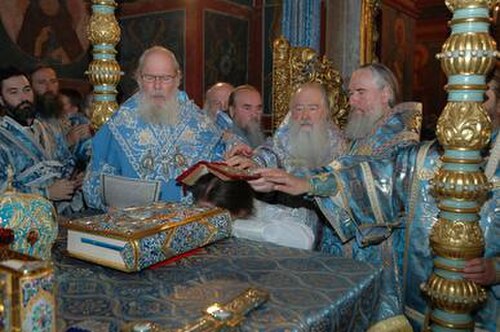
Metropolitan Alexy (Ridiger) of Leningrad, ascended the patriarchal throne in 1990 and presided over the partial return of Orthodox Christianity to Russian society after 70 years of repression, transforming the ROC to something resembling its pre-communist appearance; some 15,000 churches had been re-opened or built by the end of his tenure, and the process of recovery and rebuilding has continued under his successor Patriarch Kirill. According to official figures, in 2016 the church had 174 dioceses, 361 bishops, and 34,764 parishes served by 39,800 clergy. There were 926 monasteries and 30 theological schools.[100]
The Russian Church also sought to fill the ideological vacuum left by the collapse of Communism and even, in the opinion of some analysts, became "a separate branch of power".[101]
In August 2000, the ROC adopted its Basis of the Social Concept[102] and in July 2008, its Basic Teaching on Human Dignity, Freedom and Rights.[103]

Under Patriarch Aleksey, there were difficulties in the relationship between the Russian Orthodox Church and the Vatican, especially since 2002, when Pope John Paul II created a Catholic diocesan structure for Russian territory. The leaders of the Russian Church saw this action as a throwback to prior attempts by the Vatican to proselytize the Russian Orthodox faithful to become Roman Catholic. This point of view was based upon the stance of the Russian Orthodox Church (and the Eastern Orthodox Church) that the Church of Rome is in schism, after breaking off from the Orthodox Church. The Roman Catholic Church, on the other hand, while acknowledging the primacy of the Russian Orthodox Church in Russia, believed that the small Roman Catholic minority in Russia, in continuous existence since at least the 18th century, should be served by a fully developed church hierarchy with a presence and status in Russia, just as the Russian Orthodox Church is present in other countries (including constructing a cathedral in Rome, near the Vatican).
1990年代半ば、エストニア正教会をめぐって、エキュメニカル総主教庁との間で激しい対立が生じ、ロシア正教会は教会間の聖体拝領関係を一方的に停止した。[ 104 ]この緊張は続き、2007年10月初旬にラヴェンナで開催された正教会とカトリック教会の対話の参加者の会合でも見られた。モスクワ総主教庁の代表であるイラリオン・アルフェエフ主教は、エキュメニカル総主教庁の管轄下にあるエストニア使徒正教会の代表者が出席していたため、会合から退席した。会合では、ロシア代表団が退席する前に、正教会の代表者の間で共同声明案の文言について実質的な意見の相違もあった。[ 105 ]ロシア代表団の退去後、残りの正教会代表は、エキュメニカル総主教庁の代表が提唱した形式を承認した。[ 106 ]ラヴェンナのエキュメニカル総主教庁代表は、ヒラリオンの立場は「モスクワ教会の影響力を誇示することを目的とした権威主義の表れと見なされるべきだ。しかし、昨年のベオグラードと同様、モスクワが達成したのは、他のどの正教会もモスクワの先例に従わず、コンスタンティノープルに忠実であり続けたため、再び孤立することだけだった」と述べた。[ 107 ] [ 108 ]

Canon Michael Bourdeaux, former president of the Keston Institute, said in January 2008 that "the Moscow Patriarchate acts as though it heads a state church, while the few Orthodox clergy who oppose the church-state symbiosis face severe criticism, even loss of livelihood."[109] Such a view is backed up by other observers of Russian political life.[110] Clifford J. Levy of The New York Times wrote in April 2008: "Just as the government has tightened control over political life, so, too, has it intruded in matters of faith. The Kremlin's surrogates in many areas have turned the Russian Orthodox Church into a de facto official religion, warding off other Christian denominations that seem to offer the most significant competition for worshipers. [...] This close alliance between the government and the Russian Orthodox Church has become a defining characteristic of Mr. Putin's tenure, a mutually reinforcing choreography that is usually described here as working 'in symphony'."[111]
Throughout Patriarch Alexy's reign, the massive program of costly restoration and reopening of devastated churches and monasteries (as well as the construction of new ones) was criticized for having eclipsed the church's principal mission of evangelizing.[112][113]
On 5 December 2008, the day of Patriarch Alexy's death, the Financial Times said: "While the church had been a force for liberal reform under the Soviet Union, it soon became a center of strength for conservatives and nationalists in the post-communist era. Alexei's death could well result in an even more conservative church."[114]

On 27 January 2009, the ROC Local Council elected Metropolitan Kirill of Smolensk Patriarch of Moscow and All Rus′ by 508 votes out of a total of 700.[115] He was enthroned on 1 February 2009.
キリル総主教はモスクワ総主教庁の行政構造に改革を実施しました。2011年7月27日、聖シノドは中央アジア大主教区を設立し、タジキスタン、ウズベキスタン、キルギスタン、トルクメニスタンの教会の構造を再編成しました。[ 116 ]さらに、2011年10月6日、総主教の要請により、聖シノドは隣接する教区を統合する行政構造である大主教区(ロシア語: митрополия、mitropoliya)を導入しました。[ 117 ]
キリル総主教の下、ロシア正教会はクレムリンとの緊密な関係を維持し続け、ロシア国内外でロシア正教を動員しようとしてきたウラジーミル・プーチン大統領の庇護を受けていた。 [ 118 ] [ 119 ]キリル総主教は2012年のプーチンの当選を支持し、2月には2000年代のプーチンの任期を「神の奇跡」と呼んだ。[ 120 ] [ 121 ]それにもかかわらず、2017年秋にはロシア内部の情報筋が、大統領府がウクライナ東部での親ロシア派蜂起への支援の程度についてモスクワ総主教庁から誤った情報を得ていたこと、またキリル総主教の個人的な不人気により政治的負債と見なされるようになったことから、プーチンとキリル総主教の関係は2014年以降悪化していると述べている。[ 122 ] [ 123 ] [ 124 ]
2018年、モスクワ総主教庁とコンスタンティノープル総主教庁の伝統的な対立に加え、モスクワがエキュメニカル総主教によるウクライナ正教会への独立教会権付与の決定に憤慨したことから、ロシア正教会は数十年にわたり全ての正教会が準備してきた聖大公会議をボイコットした。 [ 125 ] [ 126 ]
ロシア正教会の聖シノドは、2018年10月15日の会合で、コンスタンティノープル総主教庁との完全な交わりを断ち切った。 [ 127 ] [ 128 ]この決定は、ロシア正教会とクレムリンの激しい反対にもかかわらず、数日前にコンスタンティノープル総主教庁が行った、事実上モスクワ総主教庁のウクライナに対する管轄権を終了させ、ウクライナに独立教会としての地位を約束する動きに対応して下された。[ 129 ] [ 118 ] [ 130 ] [ 131 ] [ 132 ]
2019年1月5日にエキュメニカル総主教庁がウクライナ正教会の設立を最終決定した一方で、ロシア正教会は、国内で唯一正当な正教会管轄区は自教会の支部であると主張し続けた。[ 133 ] 2018年末に採択されたウクライナの法律により、後者は「侵略国家」に拠点を置くロシア正教会との関係を明らかにするために、正式名称を変更する必要があった。[ 134 ] [ 135 ] 2019年12月11日、ウクライナ最高裁判所は、モスクワ総主教庁ウクライナ正教会(UOC-MP)がその名称を維持することを許可した。[ 136 ]
2019年10月、ロシア正教会は、ギリシャ正教会がウクライナの独立教会としての地位を承認したことを受け、ギリシャ正教会との聖餐関係を一方的に断絶した。[ 137 ] 11月3日、キリル総主教はモスクワで行われた典礼において、ギリシャ正教会の首座主教であるアテネ大主教イエロニモス2世の追悼を行わなかった。[ 138 ]さらに、ロシア正教会の指導部は、アテネを含むギリシャのいくつかの教区に関して、信徒の巡礼を禁止した。[ 139 ]
2019年11月8日、ロシア正教会は、同日、アレクサンドリアおよび全アフリカ総主教とその教会がOCUを承認したことを受け、キリル総主教がアレクサンドリアおよび全アフリカ総主教の記念行事を中止すると発表した。 [ 140 ] [ 141 ] [ 142 ]
2021年9月27日、中華民国はソ連政権によって迫害されたすべての東方正教徒のための宗教的な追悼の日を制定した。この日は10月30日である。 [ 143 ] [ 144 ]

ウクライナ正教会(モスクワ総主教庁) (UOC-MP)の首座主教であるキエフ府主教オヌフリイは、この戦争を「大惨事」と呼び、「ウクライナ人とロシア人はドニエプル川の洗礼盤から生まれたのであり、この二つの民族間の戦争は、嫉妬から自分の兄弟を殺したカインの罪の繰り返しである。このような戦争は、神からも人からも正当化されない」と述べた。[ 146 ]彼はまた、プーチンに直接訴え、「兄弟殺しの戦争」の即時終結を求めた。[ 147 ] [ 148 ] 2022年4月、ロシアの侵攻後、多くのUOC-MP教区がウクライナ正教会への忠誠の転換を表明した。[ 149 ]モスクワ総主教キリルの戦争に対する態度と姿勢は、よく引用される理由の一つである。[ 145 ]リトアニアのロシア正教会の首長であるイノセント(ヴァシリエフ)府主教は、キリル総主教の「戦争に関する政治的発言」を「個人的な意見」と呼んだ。[ 145 ] 2022年3月7日、ラトビア正教会の首長であるアレクサンドルス・クドリャショフスは、ロシアによるウクライナ侵攻を非難した。[ 150 ]
On 27 February 2022, a group of 286 Russian Orthodox priests published an open letter calling for an end to the war and criticised the suppression of non-violent anti-war protests in Russia.[151] On 6 March 2022, Russian Orthodox priest of Moscow Patriarchate's Kostroma Diocese was fined by Russian authorities for anti-war sermon and stressing the importance of the commandment "Thou shalt not kill".[152] Some priests in the Russian Orthodox Church have publicly opposed the invasion, with some facing arrest under the Russian 2022 war censorship laws.[153][154][155] In Kazakhstan, Russian Orthodox priest Iakov Vorontsov, who signed an open letter condemning the invasion of Ukraine, was forced to resign.[156] Former Russian Orthodox priest Father Grigory Michnov-Vaytenko, head of the Russian Apostolic Church—a recognized religious organization founded by other dissident priests such as Father Gleb Yakunin—said that "The [Russian Orthodox] church now works like the commissars did in the Soviet Union. And people of course see it. People don't like it. Especially after February [2022], a lot of people have left the church, both priests and people who were there for years."[157]
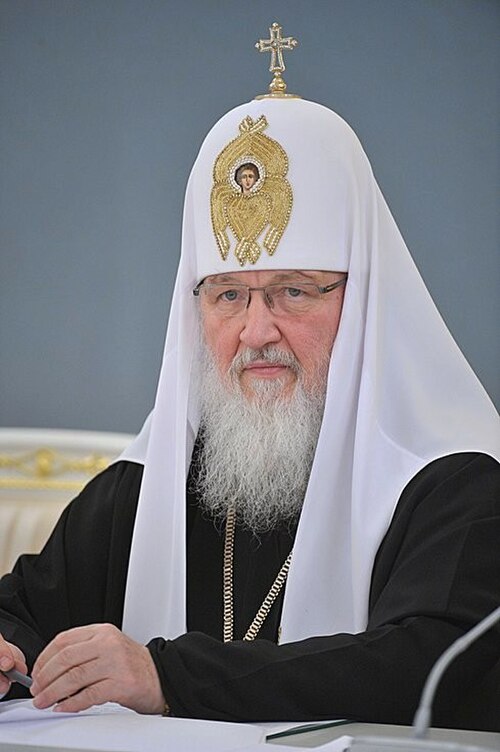

Patriarch Kirill has referred to the 2022 Russian invasion of Ukraine as "current events" and has avoided using terms like war or invasion,[159] thereby complying with Russian censorship law.[160] Kirill approves the invasion, and has blessed the Russian soldiers fighting there. As a consequence, several priests of the Russian Orthodox Church in Ukraine have stopped mentioning Kirill's name during the divine service.[161] The Moscow patriarchate views Ukraine as a part of their "canonical territory". Kirill has said that the Russian army has chosen a very correct way.[162]
キリルは、ロシアがウクライナに対して戦争を仕掛ける理由の一つとして、ゲイプライドパレードを挙げている。 [ 163 ]彼は、この戦争は物理的に重要なのではなく、むしろ形而上学的に重要なのだと述べている。[ 164 ]
ブチャ虐殺事件の後、キリルは信徒たちはどんな状況下でも「我々の家を守る」準備をしておくべきだと述べた。[ 165 ]
2022年3月6日(赦しの主日)、救世主キリスト教会での礼拝中、彼はウクライナへのロシアの攻撃を正当化し、「ドンバス」(すなわちドネツクとルハンスク人民共和国)側に立つことが必要だと述べた。同地域ではウクライナによる8年間の「ジェノサイド」が進行中であり、キリルによれば、ウクライナは地元住民に同性愛者のプライドイベントを強制しようとしているという。この祝日は赦しの概念に捧げられているにもかかわらず、キリルはまず「正義」を果たさなければ赦しはあり得ず、そうでなければそれは降伏と弱さだと述べた。[ 166 ]この演説は、キリルがロシアはウクライナで「ファシズム」と戦っているというプーチン大統領の主張をオウム返しにしたため、国際的な監視下に置かれた。[ 167 ]演説中、キリルは「ウクライナ人」という言葉を使わず、ロシア人とウクライナ人の両方を単に「聖なるロシア人」と呼び、ウクライナにいるロシア兵は「友のために命を捧げている」と主張し、ヨハネの福音書を引用した。[ 167 ]
2022年3月9日、礼拝後、彼は、ロシアはロシアの安全保障を確保するためにウクライナに対して武力を行使する権利があり、ウクライナ人とロシア人は一つの民族であり、ロシアとウクライナは一つの国であり、西側諸国はロシア人とウクライナ人の間に不和を撒き散らすためにウクライナ人にロシア人を殺害するよう扇動し、この特定の目的のためにウクライナ人に武器を与えており、したがって西側諸国はロシアと神の敵であると宣言した。[ 168 ]
2022年3月に世界教会協議会(WCC)に送られた書簡の中で、キリルはNATOの拡大、ロシア語の保護、ウクライナ正教会の設立を理由にウクライナへの攻撃を正当化した。この書簡の中で、彼はウクライナ人の死者に対する哀悼の意を表明しなかった。[ 169 ] [ 170 ]
キリルは2022年3月16日にフランシスコ教皇とのZoomビデオ通話に参加し、フランシスコ教皇はインタビューで[ 171 ]、キリルが「手に持っていた紙に書かれたロシアの侵攻を正当化するすべての理由を読み上げた」と述べた[ 172 ] 。
バチカンの代表は、ウクライナでの和平を求める意思がないとしてキリルを批判した。[ 173 ] 4月3日、元カンタベリー大主教ローワン・ウィリアムズは、ロシア正教会を世界教会協議会から追放する強い根拠があると述べ、「教会が侵略戦争を積極的に支持し、戦時中のあらゆる倫理的行為の明白な違反を非難しない場合、他の教会は疑問を呈する権利がある…私は、無辜の人々の虐殺はあらゆる形態のキリスト教によって明確に非難されていると正教会の高位聖職者が言うのを今も待っている」と述べた。[ 174 ]
オランダのアムステルダムにあるロシア正教会の聖ニコラス教会は、キリル総主教がロシアの侵略に対して取った態度のため、モスクワ総主教庁内で活動することはもはや不可能であると宣言し、代わりにコンスタンティノープル総主教庁への加入を要請した。[ 175 ]リトアニアのロシア正教会は、キリル総主教の政治的見解や認識を共有していないため、モスクワからの独立を求めていると宣言した。[ 176 ]
2022年4月10日、ウクライナ正教会(モスクワ総主教庁)の司祭200人が、他の独立東方正教会の首座主教たちに公開要請を発表し、全正教会レベルで古代東方教会の首座主教会議を招集し、キリルを「ロシア世界の教義」を説いた異端と、「ウクライナに対する戦争を祝福し、ウクライナ領土におけるロシア軍の攻撃性を全面的に支持した」道徳的罪で裁くよう求めた。彼らは「モスクワ総主教へのいかなる形の正統的服従も続けることはできない」と述べ、首座主教会議に「キリル総主教を裁き、総主教座を保持する権利を剥奪する」よう求めた。[ 177 ] [ 178 ]
When the Ukrainian Orthodox Church (Moscow Patriarchate) removed itself from the Moscow Patriarchate on 27 May 2022, Kirill claimed that the "spirits of malice" wanted to separate the Russian and Ukrainian peoples but they will not succeed.[179] The Ukrainian church released a declaration in which it stated "it had adopted relevant additions and changes to the Statute on the Administration of the Ukrainian Orthodox Church, which testify to the complete autonomy and independence of the Ukrainian Orthodox Church."[180] The church did not publish its new constitution.[181] Although in this Ukrainian Orthodox Church clergymen now claims that 'any provisions that at least somehow hinted at or indicated the connection with Moscow were excluded' the Russian Orthodox Church ignores this and continues to include UOC-MP clerics in its various commissions or working groups despite these individuals not agreeing to this nor even wanting to be included.[182]

Cardinal Kurt Koch, president of the Pontifical Council for Promoting Christian Unity, said that the patriarch's legitimization of the "brutal and absurd war" is "a heresy".[183]
Kirill supported the mobilization of citizens to go to the front in Ukraine, he urged citizens to fulfill their military duty and that if they gave their lives for their country they will be with God in his kingdom.[184][185][186]
North Macedonia and Bulgaria expelled senior members of the Russian Orthodox Church for acts contravening their national security in 2023, raising questions about the church using their position to spy and to spread Russian political propaganda.[187] In 2023 Patriarch Bartholomew criticised the Russian church, which he says is teaching a "theology of war". "This is the theology that the sister Church of Russia began to teach, trying to justify an unjust, unholy, unprovoked, diabolical war against a sovereign and independent country—Ukraine."[188] In January 2024, the senior priest of the Church of the Life-Giving Trinity in Ostankino, Moscow, was removed from his post for calling for peace.[189]
2024年3月下旬にキリルが議長を務める世界ロシア人民評議会で、ロシアによるウクライナ侵攻は「聖戦」であるとする文書が承認された。[ 190 ]この文書は、戦争の目的は「グローバリズムの猛攻と、悪魔崇拝に陥った西側の勝利から世界を守ること」であると述べている。[ 190 ]また、この文書は、戦争後には「現代ウクライナの全領土がロシアの排他的影響圏に入るべきである」とも述べている。[ 190 ]これは、「この領土にロシアとその国民に敵対的なロシア嫌悪の政治体制が存在する可能性、およびロシアに敵対的な外部の中心から支配される政治体制が存在する可能性を完全に排除するため」に行われるべきである。[ 190 ]この文書はまた、「ロシア民族の三位一体」に言及し、ベラルーシ人とウクライナ人は「ロシア人の下位民族集団としてのみ認識されるべきである」と主張した。[ 190 ]
2024年8月20日、ウクライナ最高議会は、ウクライナ法「宗教団体の活動領域における憲法秩序の保護について」を採択し、ウクライナにおけるロシア正教会を禁止した。[ 191 ] [ 192 ]ロシア正教会に所属するウクライナの宗教団体は、ウクライナ民族政策・良心の自由国家庁が命令を発令した時点から9か月後に禁止される。ただし、この宗教団体が正教会の教会法に従ってロシア正教会との関係を断絶しない場合に限る。[ 193 ] [ 194 ] [ 195 ]この禁止は、一部のオンライン上の主張とは異なり、東方正教会全般には及ばなかった。[ 196 ] [ 197 ]

The ROC constituent parts in other than the Russian Federation countries of its exclusive jurisdiction such as Ukraine, Belarus et al., are legally registered as separate legal entities in accordance with the relevant legislation of those independent states.
Ecclesiastiacally, the ROC is organized in a hierarchical structure. The lowest level of organization, which normally would be a single ROC building and its attendees, headed by a priest who acts as Father superior (Russian: настоятель, nastoyatel), constitute a parish (Russian: приход, prihod). All parishes in a geographical region belong to an eparchy (Russian: епархия—equivalent to a Western diocese). Eparchies are governed by bishops (Russian: епископ, episcop or архиерей, archiereus). There are 261 Russian Orthodox eparchies worldwide (June 2012).
Further, some eparchies may be organized into exarchates (currently the Belarusian exarchate), and since 2003 into metropolitan districts (митрополичий округ), such as the ROC eparchies in Kazakhstan and the Central Asia (Среднеазиатский митрополичий округ).

Since the early 1990s, the ROC eparchies in some newly independent states of the former USSR enjoy the status of self-governing churches within the Moscow Patriarchate (which status, according to the ROC legal terminology, is distinct from the "autonomous" one): the Estonian Orthodox Church of Moscow Patriarchate, Latvian Orthodox Church, Moldovan Orthodox Church, Ukrainian Orthodox Church (Moscow Patriarchate) (UOC-MP), the last one being virtually fully independent in administrative matters. (Following Russia's 2014 Invasion of Ukraine, the UOC-MP—which held nearly a third of the ROC(MP)'s churches—began to fragment, particularly since 2019, with some separatist congregations leaving the ROC(MP) to join the newly independent Orthodox Church of Ukraine (OCU) despite strident objections from the Moscow Patriarchate and the Russian government.[198][125])
Similar status, since 2007, is enjoyed by the Russian Orthodox Church Outside Russia (previously fully independent and deemed schismatic by the ROC). The Chinese Orthodox Church and the Japanese Orthodox Church were granted full autonomy by the Moscow Patriarchate, but this autonomy is not universally recognized.
Smaller eparchies are usually governed by a single bishop. Larger eparchies, exarchates, and self-governing churches are governed by a metropolitan archbishop and sometimes also have one or more bishops assigned to them.
The highest level of authority in the ROC is vested in the Local Council (Pomestny Sobor), which comprises all the bishops as well as representatives from the clergy and laypersons. Another organ of power is the Bishops' Council (Архиерейский Собор). In the periods between the Councils the highest administrative powers are exercised by the Holy Synod of the Russian Orthodox Church, which includes seven permanent members and is chaired by the Patriarch of Moscow and All Russia, Primate of the Moscow Patriarchate.
Although the Patriarch of Moscow enjoys extensive administrative powers, unlike the Pope, he has no direct canonical jurisdiction outside the Urban Diocese of Moscow, nor does he have single-handed authority over matters pertaining to faith as well as issues concerning the entire Orthodox Christian community such as the Catholic-Orthodox split.
The Russian Orthodox Church claims the following sixteen countries as its canonical territory:[199]
However, these claims are not universally recognized; in particular, the Orthodox Church of Ukraine claims Ukraine as its canonical territory and is recognized as such by the Ecumenical Patriarchate of Constantinople. Similarly, the Romanian Orthodox Church claims Moldova as part of its own canonical territory and the Ecumenical Patriarchate claims Estonia as the autonomous Estonian Apostolic Orthodox Church.

アメリカ正教会(OCA)の起源は、1794年に当時ロシア領だったアラスカに8人のロシア正教修道士によって設立された宣教地に遡ります。1867年にアメリカ合衆国がロシアからアラスカを購入した後、この宣教地はロシア正教会の正式な教区へと発展しました。19世紀後半には、東欧や中央ヨーロッパ、そして中東からの移民の流入により、ロシア正教会はアメリカ合衆国の他の地域にも広がりを見せました。これらの移民の多くは、かつて東方カトリック教会(「ギリシャ・カトリック」)に属していました。国籍や民族的背景に関わらず、これらの移民はロシア正教会の北米教区という一つの組織のもとに結集しました。
第二次世界大戦中、モスクワ総主教庁は海外に拠点を置くグループの支配権を取り戻そうと試みたが、失敗に終わった。1960年代初頭にモスクワとの連絡を再開し、 1970年に独立教会としての地位を認められた後、メトロポリアはアメリカ正教会として知られるようになった。[ 200 ]しかし、その独立教会としての地位は普遍的に認められているわけではない。エキュメニカル総主教(アメリカ・ギリシャ正教会大主教区の管轄権を持つ)や他の管轄区は公式にはこれを認めていない。エキュメニカル総主教や他の管轄区はOCAとの交わりを維持している。モスクワ総主教庁は、米国とカナダにおける以前の正統的な主張を放棄し、1970年に日本に自治教会が設立されたことも認めた。

ロシア正教会はボリシェヴィキ革命の余波によって壊滅的な打撃を受けた。その影響の一つとして、ロシアからアメリカ、カナダ、そしてヨーロッパへの難民の流入が起こった。1918年の革命は、アメリカ、日本、満州の教区、そしてヨーロッパの難民など、ロシア正教会の多くの部分を本教会との定期的な交流から切り離してしまった。
2006年12月28日、ロシア正教会(ROC)と在外ロシア正教会(ROCOR)の間で、正統的交わりに関する協定が最終的に署名されることが正式に発表された。署名は2007年5月17日に行われ、その後すぐにモスクワ総主教庁との完全な交わりの回復が、モスクワの救世主キリスト大聖堂での聖体礼儀によって祝われた。この聖体礼儀では、モスクワおよび全ロシア総主教アレクシオス2世とROCORの首座主教が初めて共同司式を行った。
この法律に基づき、在外ロシア正教会(ROCOR)はロシア正教会内の自治組織として存続する。行政、司牧、財産に関する事項において独立性を保ち、引き続き主教会議とその常設執行機関である聖務会によって統治される。ROCORの首座主教および主教は、主教会議によって選出され、モスクワ総主教によって承認される。ROCORの主教は、ロシア正教会全体の主教会議に参加する。
正典的交わりの法の署名に応えて、オデッサのアガタンゲル(パシュコフスキー)主教と、同法に反対する教区や聖職者たちはロシア正教会在外シノドスとの交わりを断ち、ロシア正教会在外シノドス(ROCA(A))を設立した。[ 201 ]同法に反対する他の人々は、他のギリシャ正教旧暦派グループに加わった。[ 202 ]
現在、OCAとROCORはともに、2007年以降、ROCと聖餐関係にある。
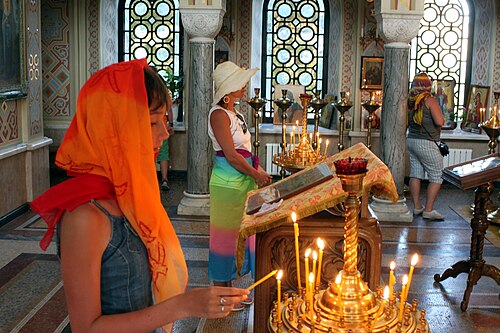
ロシア正教会には4つのレベルの自治がある。[ 203 ] [ 204 ]
ロシア正教会に属する自治教会は以下のとおりです。
ウクライナ正教会(モスクワ総主教庁)は、「少なくとも何らかの形でモスクワとのつながりを示唆する条項はすべて除外された」と主張しているが( 2022年のロシアによるウクライナ侵攻後)、ロシア正教会はこれを無視し、ウクライナ正教会モスクワ総主教庁の聖職者が同意していない、あるいは参加を望んでいないにもかかわらず、様々な委員会や作業グループに彼らを参加させ続けている。[ 205 ]
正教会の慣例に従い、特定の信仰の英雄は、まず地方教会や教区内でのみ、地域レベルで列聖される。こうした権利は管轄の主教に属し、総主教の祝福を受けた場合にのみ行われる。地方教区の信徒の役割は、奇跡の記述を記録し、聖人の伝記を作成し、イコンを描き、聖人の列聖式典の典礼文を作成することである。これらはすべて列聖のためのシノドス委員会に送られ、委員会は地元の信仰の英雄を列聖するか否かを決定する。その後、総主教が祝福を与え、地方の主教が地域レベルで列聖式を執り行う。ただし、聖人を称える典礼文はすべての教会の書籍に掲載されるわけではなく、地方の出版物にのみ掲載される。同様に、これらの聖人は、教会全体ではまだ列聖され崇敬されておらず、地域レベルでのみ列聖されています。聖人の列聖が教区の範囲を超える場合、総主教と聖シノドが教会レベルでの列聖について決定します。シノドの支持と総主教の祝福を受けた後、特定の聖人の教会全体での列聖の問題は、ロシア正教会の地方会議に検討のために付託されます。
革命後、そして1970年までの共産主義政権による迫害の期間中、列聖は行われなかった。1970年、聖シノドスは日本への宣教師ニコライ・カサトキン(1836年~1912年)を列聖することを決定した。1977年には、シベリア、極東、アリューシャン列島、アラスカ、モスクワの府主教であったモスクワの聖インノケンティウス(1797年~1879年)も列聖された。1978年には、ロシア正教会がハリコフのメレティウスのための祈祷式を制定したと宣言された。これは事実上、当時の唯一の列聖方法であったため、彼の列聖を意味した。同様に、他の正教会の聖人も教会暦に加えられました。1962年には聖ヨハネ・ロシア人、1970年にはアラスカの聖ヘルマン、1993年にはアトス山の長老であるアトス山のシロウアン(1987年にコンスタンティノープル総主教庁によって既に列聖されていた)が列聖されました。1980年代には、ロシア正教会が半世紀にわたって中断されていた列聖の手続きを再開しました。
In 1989, the Holy Synod established the Synodal Commission for canonization. The 1990 Local Council of the Russian Orthodox Church gave an order for the Synodal Commission for Canonisation to prepare documents for canonization of new martyrs who had suffered from the 20th century Communist repressions. In 1991 it was decided that a local commission for canonization would be established in every eparchy which would gather the local documents and would send them to the Synodal Commission. Its task was to study the local archives, collect memories of believers, record all the miracles that are connected with addressing the martyrs. In 1992 the church established 25 January as a day when it venerates the new 20th century martyrs of faith. The day was specifically chosen because on this day in 1918 the Metropolitan of Kiev Vladimir (Bogoyavlensky) was killed, thus becoming the first victim of communist terror among the hierarchs of the church.
During the 2000 Council of the Russian Orthodox Church, the greatest general canonization in the history of the Orthodox Church took place: not only regarding the number of saints but also as in this canonization, all unknown saints were mentioned. There were 1,765 canonized saints known by name and others unknown by name but "known to God".[206]

The use and making of icons entered Kievan Rus' following its conversion to Orthodox Christianity in AD 988. As a general rule, these icons strictly followed models and formulas hallowed by Byzantine art, led from the capital in Constantinople. As time passed, the Russians widened the vocabulary of types and styles far beyond anything found elsewhere in the Orthodox world. Russian icons are typically paintings on wood, often small, though some in churches and monasteries may be much larger. Some Russian icons were made of copper.[207] Many religious homes in Russia have icons hanging on the wall in the krasny ugol, the "red" or "beautiful" corner. There is a rich history and elaborate religious symbolism associated with icons. In Russian churches, the nave is typically separated from the sanctuary by an iconostasis (Russian: иконостас, ikonostas), or icon-screen, a wall of icons with double doors in the centre. Russians sometimes speak of an icon as having been "written", because in the Russian language (like Greek, but unlike English) the same word (Russian: писать, pisat') means both to paint and to write. Icons are considered to be the Gospel in paint, and therefore careful attention is paid to ensure that the Gospel is faithfully and accurately conveyed. Icons considered miraculous were said to "appear". The "appearance" (Russian: явление, yavlenie) of an icon is its supposedly miraculous discovery. "A true icon is one that has 'appeared', a gift from above, one opening the way to the Prototype and able to perform miracles".[208]

In May 2011, Hilarion Alfeyev, the Metropolitan of Volokolamsk and head of external relations for the Moscow Patriarchate of the Russian Orthodox Church, stated that Orthodox and Evangelical Christians share the same positions on "such issues as abortion, the family, and marriage" and desire "vigorous grassroots engagement" between the two Christian communions on such issues.[209]
The Metropolitan also believes in the possibility of peaceful coexistence between Islam and Christianity because the two religions have never fought religious wars in Russia.[210] Alfeyev stated that the Russian Orthodox Church "disagrees with atheistsecularism in some areas very strongly" and "believes that it destroys something very essential about human life."[210]
Today, the Russian Orthodox Church has ecclesiastical missions in Jerusalem and some other countries around the world.[211][212]

ロシア正教会は、世界中の東方正教会の中で最大規模であるとよく言われる[ 213 ] 。その監督下にあるすべての独立教会を含めると、信者数は世界中で1億1200万人を超え、東方正教会の推定信者数2億人から2億2000万人[ 9 ] [ 214 ]の約半分である。キリスト教の教会の中で、ロシア正教会は信者数でローマ・カトリック教会に次ぐ2位である。ロシア国内では、2007年のVTsIOMの世論調査の結果、人口の約75%が自分を正教徒だと考えていることが示された。[ 215 ]ロシア民族の最大 65% [ 216 ] [ 217 ]および他の民族グループ (オセチア人、チュヴァシ人[ 218 ]コーカサス・ギリシャ人、クリャシェン人[ 219 ]など) に属するロシア出身のロシア語話者、および同様の割合のベラルーシ人およびウクライナ人が「正教徒」であると自認しています。[ 215 ] [ 216 ]しかし、教会関連のウェブサイトPravmir.comが 2012 年 12 月に発表した世論調査によると、ロシア人口の 41% だけがロシア正教会に属していると自認していました。[ 220 ] Pravmir.com はまた、尊敬されているレバダ組織 VTsIOM による 2012 年の世論調査も発表しており、ロシア人の 74% が正教徒であると考えていることを示しています。[ 221 ]ピュー・リサーチ・センターが実施した2017年の中央・東ヨーロッパにおける宗教的信念と国民意識に関する調査では、ロシア人の71%が正教徒であると回答しており、[ 222 ] 2021年には、ロシア世論調査センター(VCIOM)がロシア人の66%が正教徒であると推定している。[ 223 ]
2017年にピュー・リサーチ・センターが発表した調査によると、ロシア正教会の信者のうち「少なくとも週に一度」礼拝に出席しているのはわずか6%である。[ 224 ]同調査では、ロシア正教徒の15%が宗教は生活の中で「非常に重要」だと答え、18%が毎日祈っていると答えている。また、ロシア正教徒の87%が自宅にイコンを飾っていると答えている。[ 224 ]
He reminded the Poles of their religious heritage, and act that was strongly discouraged by the USSR's state atheism doctrine.
メソジスト教会は、今度はOC(正教会)と共にエキュメニカルな取り組みを続けた。これには、ヨーロッパとアメリカの資源からの財政支援の継続が含まれ、ロシアにある2つのOC神学校(以前はすべて閉鎖されていた)を再開するのに十分な額だった。OCの指導者たちは、自発的に2つの声明を発表した。アメリカのメソジスト教会や他のキリスト教の友人たちによって提供された奉仕は、教会の暗く困難な時代における最も輝かしいページの一つとして、正教会の歴史に刻まれるだろう。私たちの教会は、あなた方の教会全体が無私に提供してくれたサマリア人の奉仕を決して忘れないだろう。これが、私たちの教会と国家間のより緊密な友好関係の始まりとなることを願います。(マローン 1995、50-51 より引用)
{{cite web}}: CS1 maint: 複数の名前: 著者リスト (リンク){{cite book}}: CS1メンテナンス: 場所の発行元が見つかりません (リンク)2. В дополнение к ежегодному поминовению пострадавлових в годы гонений за веру Христову благословить на территории России 30 октября совер程ение заупокойных богослужений о всех православных христианах, безвинно богоборцами убиенных или問題はそれです。
{{cite web}}: CS1 maint: タイトルとしてアーカイブされたコピー (リンク)多くの福音派は、中絶、家族、結婚などの問題に関して、私たちと保守的な立場を共有しています。正教会と福音派の間で活発な草の根レベルの交流を望みますか?はい、例えば家族の崩壊のような問題については。多くの結婚が破綻しています。多くの家族は子供が一人しかいないか、子供がいません。
イスラム教について(もちろん穏健なイスラム教を意味するのであれば)話すならば、イスラム教とキリスト教の間には平和共存の可能性があると私は信じています。ロシアでは何世紀にもわたってこれが実現してきました。なぜなら、ロシアのイスラム教には非常に長い伝統があるからです。しかし、私たちは宗教戦争を経験したことはありません。今日では、キリスト教の宗派とイスラム教の間には良好な協力体制があります。世俗主義は、人間の生活を破壊するので危険です。家族など、人間の生活に関連する本質的な概念を破壊します。そして、この点で私たちは無神論的世俗主義にいくつかの点で強く反対しており、それが人間の生活の非常に本質的な何かを破壊すると信じています。私たちは世俗主義イデオロギーの代表者と非常に正直で直接的な対話を行うべきです。そしてもちろん、私が世俗主義イデオロギーについて話すとき、ここでは主に無神論イデオロギーを意味します。
1991年以来
歴史的
歴史学
 ウィキメディア・コモンズにあるロシア正教会関連のメディア