
Loading article…
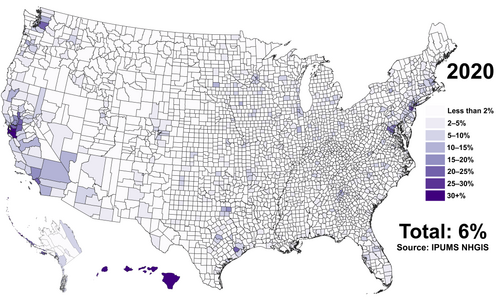 2020年国勢調査によるアジア系アメリカ人の郡別分布 | |
| 総人口 | |
|---|---|
単独(単一人種)20,052,323人(2023年アメリカコミュニティ調査) [1]米国総人口の6.00%混合(多民族)5,835,155人(2023年アメリカコミュニティ調査)[1] [2]米国総人口の1.24%単独または混合25,887,478人(2023年アメリカコミュニティ調査)[2]米国総人口の7.24% | |
| 人口の多い地域 | |
| 西海岸と東海岸、南部、中西部、南西部の郊外と都市部、ハワイと太平洋地域 | |
 カリフォルニア カリフォルニア | 6,085,947 [3] |
 ニューヨーク ニューヨーク | 1,933,127 [3] |
 テキサス テキサス | 1,585,480 [3] |
 ニュージャージー ニュージャージー | 950,090 [3] |
 イリノイ州 イリノイ州 | 754,878 [3] |
| 言語 | |
| 宗教 | |
| キリスト教(42%)、 無宗教(26%)、 仏教徒(14%)、 ヒンズー教徒(10%)、イスラム 教徒(6%)、 シーク教徒(1%)、その他(1%)、ジャイナ教、ゾロアスター教、テングリズリ、神道、中国の民間宗教(道教と儒教)、ベトナムの民間宗教 を含む[4] | |
アジア系アメリカ人は、アジア大陸を祖先とするアメリカ人である(アジアの特定地域からの移民で帰化したアメリカ人とその移民の子孫を含む)。[5]この用語は歴史的にアジア大陸のすべての先住民族に対して使用されてきたが、米国国勢調査局による「アジア人」という用語は、東アジア、南アジア、東南アジアに起源または祖先を持つ人々のみを含む人種グループであり、 [6] 2030年の国勢調査から中東系アメリカ人として分類される西アジアを含むアジアの特定地域の民族的起源を持つ人々を除外している。[7] [8]さらに、中央アジア人はどの国勢調査の人種カテゴリーにも記載されていない。[9]「アジア人」の国勢調査カテゴリーには、国勢調査で人種を「アジア人」と回答した人、または「中国人、インド人、バングラデシュ人、フィリピン人、ベトナム人、インドネシア人、韓国人、日本人、パキスタン人、マレーシア人、その他のアジア人」と報告した人が含まれます。[10] 2020年には、アジア人のみ(19,886,049人)または他の人種と組み合わせてアジア人であると自認したアメリカ人(4,114,949人)が米国の人口の7.2%を占めました。[11]
中国系、インド系、フィリピン系アメリカ人は、それぞれ500万人、430万人、400万人で、アジア系アメリカ人の人口の最大の割合を占めています。これらの数字は、アジア系アメリカ人の総人口の23%、20%、18%に相当し、米国の総人口の1.5%、1.2%、1.2%に相当します。[12]
アジアからの移民は17世紀から現代アメリカの一部にいたものの、大規模な移民は19世紀半ばまで始まらなかった。1880年代から1920年代にかけての移民法はさまざまなアジア系グループを除外し、最終的にはアメリカ大陸へのアジア系移民のほぼすべてを禁止した。1940年代から1960年代にかけて移民法が改正され、国籍別移民割当が廃止されると、アジア系移民は急増した。2010年の国勢調査の分析によると、パーセンテージの変化で見ると、アジア系アメリカ人はアメリカで最も急速に増加している人種グループである。[13]
用語
他の人種や民族に基づく用語と同様に、この用語の短い歴史の中で、正式および一般的な使用法は著しく変化してきました。1960年代後半以前は、さまざまなアジア系の祖先を持つ人々は通常、黄色人種、東洋人、アジア人、褐色人種、モンゴロイド、またはヒンドゥー人と呼ばれていました。[14] [15] [16]さらに、アメリカの「アジア人」の定義には、もともと西アジアの民族グループ、特にトルコ系アメリカ人、アルメニア系アメリカ人、アッシリア系アメリカ人、イラン系アメリカ人、クルド人アメリカ人、中東系のユダヤ系アメリカ人、および特定のアラブ系アメリカ人が含まれていましたが、現代ではこれらのグループは現在中東系アメリカ人とみなされ、国勢調査では白人アメリカ人に分類されています。 [17] [8] [18]「アジア系アメリカ人」という用語は、歴史活動家のユウジ・イチオカとエマ・ジーによって1968年にアジア系アメリカ人政治同盟の設立時に造られ、[19] [20]、彼らはこの用語を普及させたとされており、この用語は新しい「多民族・汎アジア系アメリカ人の自己定義政治グループ」を形成するために使用されることを意図していました。[14] [21]この取り組みは、不当と見なされていたベトナム戦争に直接反対する、新左翼の反戦・反帝国主義運動の一部でした。[22]
1980年代に「アジア人」のカテゴリーに含まれる以前は、多くの南アジア系アメリカ人は、通常、自分たちをコーカサス人またはその他の人種と分類していました。[23]移民パターンの変化とアジア系移民の長期にわたる排除により、人口動態の変化が起こり、それが今度はアジア系アメリカ人を定義する公式かつ一般的な理解に影響を与えました。たとえば、 1965年に「国籍」による制限的な割り当てが撤廃されて以来、アジア系アメリカ人の人口は大きく多様化し、アジアのさまざまな地域を祖先とする人々がより多く含まれるようになりました。[24]
今日、「アジア系アメリカ人」は、政府や学術研究などのほとんどの正式な目的で受け入れられている用語ですが、一般的な用法ではアジア人と短縮されることがよくあります。[25]アジア系アメリカ人の最も一般的な定義は、米国国勢調査局の定義であり、東アジア、南アジア、東南アジアを起源とするすべての人々が含まれます。[10]これは主に、国勢調査の定義が、特に機会均等プログラムや測定において多くの政府の分類を決定しているためです。[26]
オックスフォード英語辞典によると、米国における「アジア人」は、東アジア系の人を指すことが多い。[27] [28]日常会話では、「アジア人」は通常、東アジアまたは東南アジア系の人を指し、南アジア系はそれほど多く含まれない。[29]これは米国国勢調査の定義とは異なり[10] [30]、多くの大学のアジア系アメリカ人研究学科では、東アジア、南アジア、東南アジア系の人すべてを「アジア人」とみなしている。[31]
国勢調査の定義
米国の国勢調査では、東アジア、南アジア、東南アジアに起源を持つ人々はアジア人種の一部として分類されている。[6]一方、西アジア(イスラエル人、トルコ人、ペルシャ人、クルド人、アッシリア人、アラブ人など)およびコーカサス(グルジア人、アルメニア人、アゼルバイジャン人、チェチェン人、チェルケス人など)に起源を持つ人々は「中東および北アフリカ」人種に分類されている。[32] [7] [33]また、中央アジア(カザフ人、ウズベク人、トルクメン人、タジク人、キルギス人、アフガニスタン人など)に起源を持つ人々は、米国国勢調査局のいかなる人種定義にも記載されていない。[7] [34]そのため、「アジア人」と「アフリカ人」の祖先は国勢調査の目的のためだけの人種カテゴリーと見なされており、その定義は西アジア、北アフリカ、中央アジア以外のアジア大陸とアフリカ大陸の一部の祖先を指します。
1980年以前、国勢調査用紙には、白人や黒人とともに、特定のアジア系祖先が別のグループとして記載されていた。[35]アジア系アメリカ人は「その他」としても分類されていた。[36] 1977年、連邦行政管理予算局は、政府機関に「アジア系または太平洋諸島系」を含む人種グループの統計を維持するよう求める指令を出した。[37] 1990年の国勢調査では、「アジア系または太平洋諸島系(API)」が明確なカテゴリーとして含まれていたが、回答者はサブカテゴリーとして特定の祖先を1つ選択する必要があった。 [38] 2000年の国勢調査からは、「アジア系アメリカ人」と「ハワイ先住民およびその他の太平洋諸島系」という2つの別々のカテゴリーが使用されるようになった。[39 ]
議論と批判
アジア系アメリカ人の定義には、さまざまな文脈での「アメリカ人」という言葉の使用に起因するバリエーションがある。移民ステータス、市民権(出生によるものと帰化によるもの)、文化適応、言語能力は、さまざまな目的でアメリカ人を定義するために使用される変数の一部であり、公式および日常的な使用法では異なる場合があります。[40]たとえば、アメリカ人を米国市民のみに限定すると、アジア系アメリカ人のビジネスに関する議論と矛盾します。アジア系アメリカ人のビジネスでは、通常、市民と非市民の両方の所有者を指します。[41] 2023年のピュー研究所のアジア系アメリカ人の調査では、28%が自分自身を「アジア人」と認識し、52%がより具体的な民族グループで自分自身を呼ぶことを好み、10%が単に「アメリカ人」と自己認識していることがわかりました。[42]
2004年のPBSのインタビューで、アジア系アメリカ人作家のパネルは、一部のグループが中東系の人々をアジア系アメリカ人のカテゴリーに含める理由について議論した。[43]アジア系アメリカ人作家のスチュワート・イケダは、「『アジア系アメリカ人』の定義は、誰が質問し、誰が定義し、どのような文脈で、なぜそうするのかによっても変わることが多い...『アジア太平洋系アメリカ人』の可能な定義は多く、複雑で、変化している...アジア系アメリカ人研究会議の一部の学者は、ロシア人、イラン人、イスラエル人はすべて、この分野の研究対象に当てはまるかもしれないと示唆している」と述べている。[44] ウォール・ストリート・ジャーナルのジェフ・ヤンは、アジア系アメリカ人の汎民族的定義はアメリカ独自の概念であり、アイデンティティとしては「未確定」であると書いている。[45]アジア系アメリカ人の大多数は、自分たちを識別するための用語としての「アジア系アメリカ人」という用語に相反する感情を抱いている。[46]クイーンズ・カレッジの社会学者で社会学教授のピョン・ガプ・ミンは、この用語は単に政治用語であり、アジア系アメリカ人の活動家によって使用され、政府によってさらに強化されたものだと述べた。さらに、彼は南アジア人と東アジア人は「文化、身体的特徴、または移住前の歴史的経験」において共通点がないと感じている。[47]
学者たちは、アジア系アメリカ人という用語の正確さ、正しさ、有用性について取り組んできた。アジア系アメリカ人の「アジア人」という用語は、アジアの多様な人々の一部のみを包含し、人種的ではない「民族」カテゴリではなく人種的カテゴリと見なされているという理由で、最も頻繁に非難されている。これは、人種的に異なる南アジア人と東アジア人を同じ「人種」の一部として分類しているためである。[26]さらに、西アジア人(米国国勢調査では「アジア人」とは見なされていない)はインド人と文化的類似点がいくつかあるが、東アジア人とはほとんど共通点がなく、後者の2つのグループは「アジア人」に分類されていることが指摘されている。[48]学者たちは、アジア系アメリカ人のカテゴリが同様に多様な起源を持つ人々から構成されていることを考えると、なぜアジア系アメリカ人が「人種」と見なされ、ヒスパニック系およびラテン系アメリカ人が人種的ではない「民族グループ」と見なされるのかを判断するのが難しいと感じている。[49]しかし、仏教の起源が南アジアにあることから、南アジア人と東アジア人を「正当に」グループ化できるという主張もある。[50]
対照的に、人種とアジア系アメリカ人のアイデンティティを研究する主要な社会科学と人文科学の学者は、人種に対する社会的態度やアジア系祖先に対する態度を含む米国の人種的構造により、アジア系アメリカ人は「共通の人種的経験」を持っていると指摘している。 [51]この共通の経験により、アジア系アメリカ人という用語は、このカテゴリーの人々に特有のステレオタイプを含むアジア系アメリカ人間のいくつかの経験の類似性により、依然として有用な汎民族的カテゴリーであると主張されている。 [51]それにもかかわらず、多くのアメリカ人はすべてのアジア系アメリカ人を平等に扱っていないと述べる者もおり、「アジア系アメリカ人」は一般に東アジア系の人々と同義であり、東南アジアと南アジア出身の人々を除外しているという事実を強調している。[52]南アジア系アメリカ人と東南アジア系アメリカ人の中には、東アジア系アメリカ人との人種的および文化的違いが認識されているため、アジア系アメリカ人というラベルに自分を当てはめず、代わりに「褐色アジア人」または単に「褐色」と表現する者もいる。[53] [54] [55]
人口統計
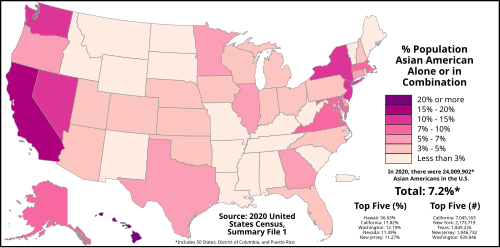
2020年米国国勢調査時点における米国各州、コロンビア特別区、プエルトリコにおけるアジア系アメリカ人の割合


アジア系アメリカ人の人口統計は、東アジア、南アジア、東南アジアの1つ以上の国に祖先をたどることができる、米国内の多様な人々のグループを表しています。[56]彼らは米国の全人口の7.3%を占めているため、メディアやニュースでの「アジア人」や「アジア系アメリカ人」の議論では、このグループの多様性はしばしば無視されています。[57]民族サブグループ間で共通点がいくつかありますが、各グループの歴史に関連するさまざまなアジアの民族間には大きな違いがあります。[58]アジア系アメリカ人の人口は大幅に都市化しており、その4分の3近くが人口250万人を超える大都市圏に住んでいます。[59] 2015年7月現在[update]、カリフォルニア州はどの州よりもアジア系アメリカ人の人口が多く、ハワイ州はアジア系アメリカ人が人口の過半数を占める唯一の州でした。[60]
アジア系アメリカ人の人口統計は、アルファベット順にさらに細分化できます。
- 東アジア系アメリカ人。中国系アメリカ人、香港系アメリカ人、日系アメリカ人、韓国系アメリカ人、マカオ系アメリカ人、モンゴル系アメリカ人、琉球系アメリカ人、台湾系アメリカ人、チベット系アメリカ人を含む。
- 南アジア系アメリカ人には、バングラデシュ系アメリカ人、ブータン系アメリカ人、インド系アメリカ人、インド系カリブ系アメリカ人、インド系フィジー系アメリカ人、モルディブ系アメリカ人、ネパール系アメリカ人、パキスタン系アメリカ人、スリランカ系アメリカ人が含まれます。
- 東南アジア系アメリカ人、これには、ブルネイ系アメリカ人、ビルマ系アメリカ人、カンボジア系アメリカ人、フィリピン系アメリカ人、モン族系アメリカ人、インドネシア系アメリカ人、ユミエン系アメリカ人、カレン系アメリカ人、ラオス系アメリカ人、マレーシア系アメリカ人、シンガポール系アメリカ人、タイ系アメリカ人、東ティモール系アメリカ人、およびベトナム系アメリカ人が含まれます。
このグループ分けは、米国への移民前の出身国によるものであり、必ずしも民族によるものではありません。たとえば、シンガポール系アメリカ人は、中国系、インド系、またはマレー系の血統である可能性があります (限定的ではありません)。
アジア系アメリカ人には、上記のグループと別の人種、または上記のグループの複数の人種に起源または祖先を持つ 多民族または混血の人々が含まれます。
各郡の割合
- アジア系アメリカ人(単独)の人口分布の推移
-
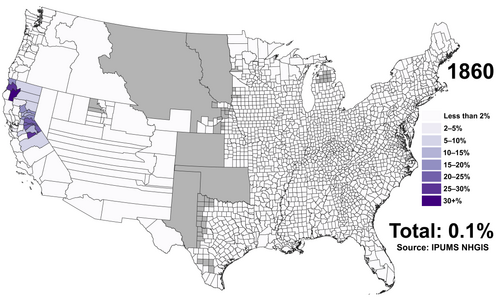 1860
1860 -
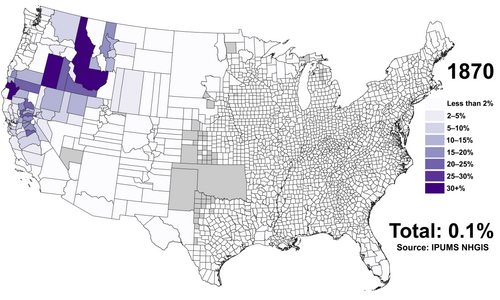 1870
1870 -
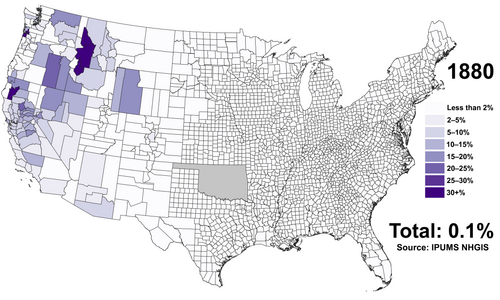 1880
1880 -
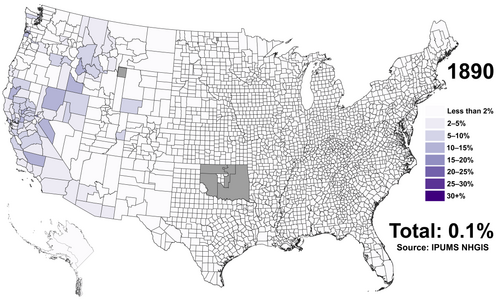 1890
1890 -
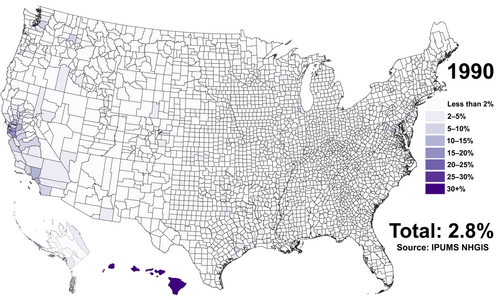 1990
1990 -
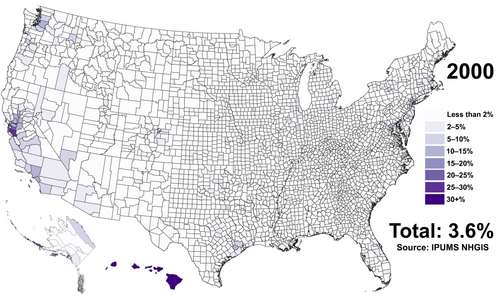 2000
2000 -
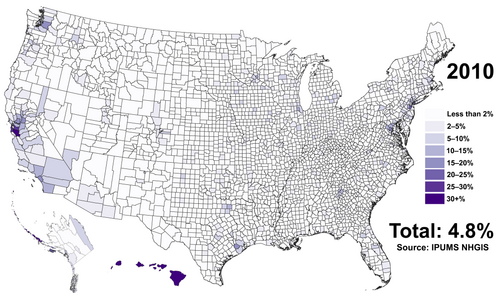 2010
2010 -
2020
祖先
2022年のアメリカコミュニティ調査の推定によると、アジア系アメリカ人の人口は次のグループで構成されています。
言語
2010年には、家庭で中国語のいずれかを話す人(5歳以上)は280万人に上りました。 [64]中国語はスペイン語に次いで米国で3番目に多い言語です。[64]その他の大規模なアジアの言語には、ヒンドゥスターニー語(ヒンディー語/ウルドゥー語)、タガログ語、ベトナム語、韓国語があり、これら4言語はすべて米国で100万人以上の話者がいます。[64]
2012年には、アラスカ、カリフォルニア、ハワイ、イリノイ、マサチューセッツ、ミシガン、ネバダ、ニュージャージー、ニューヨーク、テキサス、ワシントンの各州が投票権法に基づきアジア言語で選挙資料を出版した。[65]これらの言語にはタガログ語、北京語、ベトナム語、スペイン語、[66] ヒンディー語、ベンガル語が含まれる。 [65]選挙資料はグジャラート語、日本語、クメール語、韓国語、タイ語でも入手可能であった。[67] 2013年の世論調査では、アジア系アメリカ人の48%が母国語のメディアを主要なニュースソースとみなしていることが明らかになった。[68]
2000年の国勢調査によると、アジア系アメリカ人コミュニティの主な言語は、中国語(広東語、台山語、福建語)、タガログ語、ベトナム語、韓国語、日本語、ヒンディー語、ウルドゥー語、テルグ語、グジャラート語であることがわかりました。[69] 2008年には、中国語、日本語、韓国語、タガログ語、ベトナム語がすべて、アラスカ州、カリフォルニア州、ハワイ州、イリノイ州、ニューヨーク州、テキサス州、ワシントン州の選挙で使用されています。[70]
セクシュアリティ
2012年6月から9月にかけて実施されたギャラップ社の調査によると、アジア系アメリカ人の4.3%がLGBTであると自認しているのに対し、一般のアメリカ人では3.4%となっている。このことから、LGBTコミュニティ内でアジア系アメリカ人が過剰に代表されていることがわかる。[71] 2017年に実施されたギャラップ社の調査では、アジア系アメリカ人の4.9%がLGBTであると自認しており、これはヒスパニック系アメリカ人に次いで米国で2番目に高いLGBTの増加率を示している。[72]
宗教
2022年7月5日から2023年1月27日まで実施されたピュー研究所の調査によると、アジア系アメリカ人の宗教的状況は多様で進化している。 [73]調査によると、アジア系アメリカ人の32%は宗教に属さず、2012年の26%から増加している。キリスト教はアジア系アメリカ人の中で34%で最大の信仰グループのままだが、2012年以降8%減少している。[74]
キリスト教
最新のピュー研究所の調査によると、アジア系アメリカ人の成人の約34%がキリスト教徒であると自認しており、2012年の42%から減少している。この減少は特にプロテスタントの間で顕著で、現在アジア系アメリカ人の人口の16%を占めており、2012年の22%から減少している。[75]一方、カトリック教徒は比較的安定した存在を維持しており、アジア系アメリカ人の成人人口の17%を占めており、2012年の19%からほぼ横ばいである。正式な宗教的アイデンティティに加えて、アジア系アメリカ人の18%が文化的または家族的な面でキリスト教との近さを報告している。これは、アジア系アメリカ人の約51%がキリスト教信仰との何らかのつながりを表明していることを意味する。[75]
フィリピン系アメリカ人と韓国系アメリカ人は、キリスト教との結びつきが特に強い。フィリピン系アメリカ人の74%がキリスト教徒であると自認しており、文化的にキリスト教に近いと感じる人々を含めると、この数字は90%に上昇する。韓国系アメリカ人では、59%がキリスト教徒であると自認し、81%が何らかの形で信仰とつながりを表明している。フィリピン系アメリカ人のほとんどはカトリック教徒(57%)であるが、韓国系アメリカ人はプロテスタントである傾向があり、34%が福音派プロテスタントであると自認している。[75]
無所属
アジア系アメリカ人の宗教的無所属は着実に増加している。アジア系アメリカ人の32%は無宗教であると自認しており、これには無神論者、不可知論者、または「特に何もない」と自認する個人が含まれる。[76]これは2012年の26%から増加している。これらの個人の大多数は、無神論者または不可知論者と明確に自認するのではなく、自分の宗教を「特に何もない」と表現している。正式な宗教的所属がないにもかかわらず、宗教的無所属のアジア系アメリカ人の多くは、文化的または先祖の理由により、さまざまな宗教的または哲学的伝統とのつながりを維持している。全体として、アジア系アメリカ人のわずか12%が、いかなる宗教的または哲学的伝統にもつながりがないと報告している。[76]
アジア系アメリカ人の中では、中国系アメリカ人と日系アメリカ人は無宗教である傾向が高く、それぞれ56%と47%が無宗教であると自認している。また、両グループは正式な宗教に属していないにもかかわらず、文化や祖先の信仰の伝統とのつながりを感じる傾向が高い。逆に、インド系、フィリピン系、ベトナム系アメリカ人は無宗教である傾向がかなり低く、宗教的伝統との何らかのつながりを表明する傾向が高い。[76]
宗教的傾向
アジア系アメリカ人のキリスト教徒の割合は、キリスト教が少数派宗教である国(特に中国とインド)からの大規模な移民が主な原因で、1990年代以降急激に減少している。1990年にはアジア系アメリカ人の63%がキリスト教徒であったが、2001年には43%にまで減少した。[77]この傾向は、アジアの伝統的な宗教の台頭を伴っており、同じ10年間にそれらの宗教を信仰する人の数が倍増した。[78]
歴史
初期の移民

アジア系アメリカ人やその祖先は様々な国からアメリカに移住してきたため、それぞれのアジア系アメリカ人には独自の移民の歴史がある。[79]
フィリピン人は16世紀から、後にアメリカ合衆国となる地域に住んでいた。[80] 1635年、バージニア州ジェームズタウンに「東インディアン」が記録されている。[81]これに先立ち、1790年代には東海岸、 1800年代には西海岸にインディアン移民が広く定住した。 [82] 1763年、フィリピン人はスペイン船での虐待から逃れ、ルイジアナ州サンマロに小さな集落を建設した。[83]フィリピン人女性は同行していなかったため、これらの「マニラメン」はケイジャンや先住民の女性と結婚した。[84]アメリカ合衆国にやって来て、長期間滞在した最初の日本人は、1841年に東海岸に到着した中浜万次郎であり、ジョセフ・ヒコは1858年に日系アメリカ人として初めて帰化した。[85]
中国人の船員が初めてハワイに来たのは1789年[86]で、キャプテン・ジェームズ・クックが島に到着してから数年後のことである。多くがハワイに定住し、ハワイ人女性と結婚した。ハワイやサンフランシスコに移住した中国人、韓国人、日本人のほとんどは、19世紀に砂糖農園や建設現場で働く労働者として到着した。[ 87] 1898年にハワイが米国に併合されたとき、何千人ものアジア人がハワイに住んでいた。 [88]その後、フィリピン人も仕事の機会に惹かれて労働者として働くようになったが、仕事の機会は限られていた。[89] 琉球人は1900年にハワイへの移住を始めた。[90]
アジアからアメリカへの大規模な移住は、19世紀半ばに中国人移民が西海岸に到着したときに始まった。 [91]カリフォルニアのゴールドラッシュの一部を形成したこれらの初期の中国人移民は、鉱山事業に積極的に参加し、後に大陸横断鉄道の建設にも参加した。1852年までに、サンフランシスコの中国人移民の数は2万人以上に急増した。1868年の明治維新後、アメリカへの日本人移民の波が始まった。 [92] 1898年、米西戦争でのスペインの敗北に伴いアメリカがフィリピン諸島の植民地支配を引き継いだとき、フィリピン諸島のすべてのフィリピン人はアメリカ国籍となった。[93]
排除の時代
この時期の米国法、特に1790年の帰化法では、「自由白人」のみが米国市民として帰化できる資格があった。市民権の資格がないために、アジア系移民は投票などのさまざまな権利を行使できなかった。[94] ビカジ・バルサラは、インド生まれで米国市民権を取得した最初の人物として知られる。[95]バルサラの帰化は標準ではなく例外であった。2つの訴訟、オザワ対米国(1922年)と米国対バガット・シン・シンド(1923年)で、最高裁判所は市民権の人種的資格を支持し、アジア人は「白人」ではないと判決を下した。しかし、第14修正条項の出生地主義市民権条項により、2世のアジア系アメリカ人は米国市民になることができた。この保証は、米国対ウォン・キム・アーク(1898年)で、人種や祖先に関係なく適用されることが最高裁判所によって確認された。[96]
1880年代から1920年代にかけて、米国はアジア系移民の排除の時代を始める法律を制定した。アジア系移民の正確な数は他の地域からの移民の数に比べると少なかったが、その多くは西部に集中しており、その増加は「黄禍論」として知られるある種の排外主義的感情を引き起こした。議会は1880年代に米国へのほぼすべての中国人移民を禁止する制限的な法律を可決した。 [97] 1907年の外交協定により、日本人移民は大幅に削減された。 1917年のアジア禁輸地域法は、ほぼすべてのアジア、つまり「アジア地域」からの移民をさらに禁止した。[98] 1924年の移民法は、「市民権を取得できない外国人」は米国への移民として認められないと規定し、アジア人移民の禁止を強化した。[99]
第二次世界大戦
ルーズベルト大統領は1942年2月19日に大統領令9066号を発令し、その結果、日系アメリカ人をはじめとする多くの人々が強制収容された。主に西海岸に住んでいた10万人以上の日系人が強制的に強制退去させられたが、この措置は後に効果がなく人種差別的であるとされた。[100]日系アメリカ人は、人種という理由だけで、子供、老人、若者を含めて軍の収容所に隔離された。『一世:第一世代』と『収容所の子供たち』は、第二次世界大戦中の日系アメリカ人の状況を表す素晴らしいドキュメンタリーである。
戦後の移民
第二次世界大戦時代の法律と司法の判決により、アジア系アメリカ人が移民し、帰化市民になる可能性が徐々に高まった。 1965年の移民国籍法改正の制定や、ベトナム戦争などの東南アジアで発生した紛争からの難民の流入により、移民は急速に増加した。アジア系アメリカ人移民の中には、すでに専門職の地位を獲得している者の割合がかなり高く、これは移民グループの中では初めてのことである。[101]
アメリカへのアジア系移民の数は「1960年の49万1000人から2014年には約1280万人に増加し、2,597パーセントの増加となった。」[102]アジア系アメリカ人は2000年から2010年の間に最も急速に増加した人種グループであった。 [79] [103] 2012年までに、アジアからの移民はラテンアメリカからの移民を上回った。 [104] 2015年、ピュー研究所は、2010年から2015年にかけてラテンアメリカからの移民を上回ったアジアからの移民がおり、1965年以降、アジア人はアメリカへの移民全体の4分の1を占めていることを発見した。[105]
アジア人は、外国生まれのアメリカ人に占める割合が増加している。「1960年には、アジア人は米国の外国生まれの人口の5%を占めていたが、2014年までにその割合は、国内の移民4240万人のうち30%にまで増加した。」[102] 2016年現在、「アジアは、米国移民の出生地として(ラテンアメリカに次いで)2番目に大きい地域である。」[102] 2013年、中国はメキシコを抜いて、米国への移民の出身国としてトップとなった。[106]アジア系移民は「全体の外国生まれの人口よりも帰化市民になる可能性が高い」。2014年、アジア系移民の59%が米国市民権を持っていたのに対し、全移民の47%が米国市民権を持っていた。[102]戦後の米国へのアジア系移民は多様であり、2014年には米国へのアジア系移民の31%が東アジア(主に中国と韓国)から、27.7%が南アジア(主にインド)から、32.6%が東南アジア(主にフィリピンとベトナム)から、8.3%が西アジアからであった。[102]
アジア系アメリカ人運動

1960年代以前、アジア系移民とその子孫は、中国人、日本人、フィリピン人、韓国人、アジア系インド人といったそれぞれの民族に応じて、社会的または政治的な目的のために組織化し、運動していた。アジア系アメリカ人運動(日系アメリカ人のユウジ・イチオカと中国系アメリカ人のエマ・ジーによる造語)は、人種差別という共通の問題と、特にアジアにおけるアメリカ帝国主義への共通の反対を認識し、これらすべてのグループを連合体にまとめた。この運動は、公民権運動やベトナム戦争反対運動に部分的に触発されて、1960年代に発展した。 「ブラックパワー運動や反戦運動の影響を受け、アジア系アメリカ人運動は、さまざまな民族のアジア人を団結させ、米国および海外の他の第三世界の人々との連帯を宣言する連合政治を形成した。運動の一部は、コミュニティによる教育管理を求めて闘い、社会サービスを提供し、アジア人ゲットーの低価格住宅を守り、搾取された労働者を組織化し、米国帝国主義に抗議し、新しい多民族文化機関を建設した。」[107]ウィリアム・ウェイは、この運動を「過去の抑圧の歴史と現在の解放闘争に根ざしたもの」と表現した。[108]この運動は、1960年代から1970年代に最も活発だった。[107]
アジア系アメリカ人の学生の間では、大学レベルでのアジアの歴史とアメリカとの関わりに関する研究と教育を求める声が高まっている。彼らは多文化主義と積極的差別是正措置を支持しているが、大学によるアジア系学生の割り当ては差別的だと反対している。[109] [110] [111]
注目すべき貢献
芸術とエンターテイメント


.jpg/500px-MS-Exec-Nadella-Satya-2017-08-31-22_(cropped).jpg)

アジア系アメリカ人は、チャン・バンカーとエン・バンカー(元祖「シャム双生児」)が帰化した19世紀前半から、エンターテインメント業界に関わってきた。 [112] 20世紀を通じて、テレビ、映画、演劇における俳優の役割は比較的少なく、多くの役は限定的でステレオタイプなキャラクターの役だった。ブルース・リー(カリフォルニア州サンフランシスコ生まれ)は、米国を離れて香港に移住してから初めて映画スターの座を獲得した。
最近では、若いアジア系アメリカ人のコメディアンや映画製作者たちがYouTubeに活動の場を見出し、同じアジア系アメリカ人の間で強力で忠実なファン層を獲得している。[113]アメリカのメディアには、1976年の『ミスターTとティナ』から始まり、最近では2015年のテレビシリーズ『フレッシュ・オフ・ザ・ボート』まで、アジア系アメリカ人を中心としたテレビ番組がいくつかある。 [114]
太平洋では、ハワイの中国系アメリカ人ビートボクサー、ジェイソン・トムがヒューマン・ビートボックス・アカデミーを共同設立し、米国第50番目の州であるハワイ州の最西端と最南端の主要都市ホノルルでアウトリーチパフォーマンス、講演、ワークショップを通じてビートボックスの芸術を永続させている。[115] [116] [117] [118] [119] [120]
仕事
19世紀、アジア系アメリカ人は労働市場からほとんど排除されていたが、彼らは自らのビジネスを始めた。彼らはコンビニや食料品店、医療や法律事務所などの専門オフィス、クリーニング店、レストラン、美容関連のベンチャー、ハイテク企業、その他多くの種類の企業を立ち上げ、アメリカ社会で非常に成功し、影響力を持つようになった。彼らはアメリカ経済全体への関与を劇的に拡大した。アジア系アメリカ人は、カリフォルニアのシリコンバレーのハイテク部門で不釣り合いなほど成功しており、これはゴールドシー100のアメリカで最も成功したアジア系起業家のコンピレーションによって証明されている。[121]
アジア系アメリカ人は、人口ベースと比較すると、専門職分野で活躍する人が多く、高給を得る傾向にあります。[122]ゴールドシーの著名なアジア系アメリカ人専門家のまとめによると、多くのアジア系アメリカ人が米国の大手企業で高い地位を占めており、その中には最高マーケティング責任者としての人が不釣り合いに多いことが示されています。[123]
アジア系アメリカ人はアメリカ経済に大きく貢献してきた。2012年には、アメリカ国内にアジア系アメリカ人所有の企業が48万6000社弱あり、360万人以上の従業員を雇用し、総収入と売上高は7076億ドル、年間給与総額は1120億ドルだった。2015年には、アジア系アメリカ人と太平洋諸島系アメリカ人の世帯の購買力は4556億ドル(ウォルマートの年間売上高に匹敵)で、1840億ドルの納税を行った。[124]
ファッションデザイナーで大物でもあるヴェラ・ウォンは、著名人のドレスをデザインすることで有名で、自身の名を冠した衣料品会社を立ち上げ、現在では高級ファッション商品を幅広く取り揃えている。アン・ワンは1951年6月にワン・ラボラトリーズを設立した。アマー・ボーズは1964年にボーズ・コーポレーションを設立した。チャールズ・ワンはコンピュータ・アソシエイツを設立し、後に同社のCEO兼会長に就任した。デビッド・キムとケニー・キムの2人の兄弟は1991年にヒップホップファッションの巨人サウスポールを設立した。ジェンスン・ホアンは1993年にエヌビディア社を共同設立した。ジェリー・ヤンは1994年にヤフー社を共同設立し、後に同社のCEOに就任した。アンドレア・ユングはエイボン・プロダクツの会長兼CEOを務めている。ヴィノッド・コースラはサン・マイクロシステムズの創業CEOで、著名なベンチャーキャピタル会社クライナー・パーキンス・コーフィールド・アンド・バイヤーズのゼネラル・パートナーである。スティーブ・チェンとジョード・カリムはYouTubeの共同創設者であり、 2006年にグーグルが16億5000万ドルで同社を買収した際に恩恵を受けた。フォーブス誌によると、ズーム・ビデオ・コミュニケーションズの創設者エリック・ユアンとジャクソンビル・ジャガーズのオーナーであるシャヒド・カーンは、ともに純資産額で米国トップ100に名を連ねている。[125] [126]アジア系アメリカ人は他の分野への貢献が大きいだけでなく、シリコンバレーやトライアングルなどの著名な革新的研究開発地域で、米国の科学技術分野でも多大な貢献を果たしている。
政府と政治
アジア系アメリカ人は、実際の投票人口の点で高いレベルの政治参加を誇っています。1907年以来、アジア系アメリカ人は全国レベルで活動しており、地方、州、全国レベルで複数の公職に就いています。より多くのアジア系アメリカ人が公職に選出されるにつれて、彼らは米国の外交関係、移民、国際貿易、その他の問題にますます大きな影響力を持つようになりました。[127]米国議会に選出された最初のアジア系アメリカ人は、 1957年のダリップ・シン・サウンドでした。
アメリカ合衆国議会で最高位の地位にあるアジア系アメリカ人は、2012年に在任中に死去した上院議員で暫定議長の ダニエル・イノウエである。アメリカ合衆国議会には活動的なアジア系アメリカ人が数人いる。アジア系アメリカ人の人口比率と密度が高いハワイは、上院に最も一貫してアジア系アメリカ人を送り出しており、ハワイとカリフォルニアは下院に最も一貫してアジア系アメリカ人を送り出している。[128]
米国閣僚初のアジア系アメリカ人は、ジョージ・W・ブッシュ政権で商務長官、次いで運輸長官を務めたノーマン・ミネタである。2021年現在、アジア系アメリカ人で最高位の地位にあるのは、カマラ・ハリス副大統領である。それ以前の最高位のアジア系アメリカ人は運輸長官のエレイン・チャオ(2017年~2021年)であり、彼女は米国労働長官(2001年~2009年)としても地位にあった。
これまでにアメリカ大統領選に出馬したアジア系アメリカ人の有力候補は、およそ「6人ほど」いる。[129]中国系移民の子であるハワイのハイラム・フォン上院議員は、1964年と1968年の共和党全国大会で「人気息子」候補だった。[130] [131] 1972年、日系アメリカ人のハワイのパッツィー・T・ミンク下院議員は、民主党の大統領候補指名を目指して失敗した。[132]インド系移民の子であるルイジアナ州知事ボビー・ジンダルは、2016年に共和党の大統領候補指名を目指して失敗した。 [133]台湾系移民の子である起業家で非営利団体の創設者アンドリュー・ヤンは、2020年に民主党の大統領候補指名を目指して失敗した。[129] 2021年1月、インド人の母とアフリカ人の父を持つカマラ・ハリスが、アメリカ合衆国初のアジア系アメリカ人副大統領に就任した。[134]
プミポン・アドゥンヤデート国王(1927年~2016年)は、アメリカ生まれの最初の君主でした。彼は1946年から2016年までタイの王位に就いていました。
投票行動
アジア系アメリカ人はかつて共和党の強力な支持基盤だった。1992年、ジョージ・H・W・ブッシュはアジア系有権者の55%を獲得した。[135]しかし、2020年までにアジア系アメリカ人は民主党支持に転じ、ジョー・バイデンの支持率は70%、ドナルド・トランプの支持率は29%となった。[136]近年の選挙では、民族的背景と出身国がアジア系アメリカ人の投票行動を決定づけており、インド系アメリカ人[137]と、それほどではないが中国系アメリカ人は民主党の強力な支持基盤であり、ベトナム系アメリカ人は共和党の強力な支持基盤である。[138]
2023年の調査では、フィリピン人の68%が民主党を政治的に支持しており、民主党に投票したと答えた。[139]
ジャーナリズム
コニー・チャンは、 1971年にCBSでリポーターを務め、大手テレビニュースネットワークにおける最初のアジア系アメリカ人全国特派員の一人でした。彼女は後に1993年から1995年までCBSイブニングニュースの共同アンカーを務め、アジア系アメリカ人初の全国ニュースアンカーとなりました。 [140] ABCでは、ケン・カシワハラが1974年に全国リポーターとして活躍しました。1989年、サンフランシスコ出身のフィリピン系アメリカ人記者エミル・ギレルモは、全米公共ラジオの『オール・シングス・コンシダード』のシニアホストを務め、全国ニュース番組の共同司会者を務めた初のアジア系アメリカ人男性となりました。1990年、ニューヨーク・タイムズの北京支局の外国特派員シェリル・ウーダンは、ピューリッツァー賞を受賞した初のアジア系アメリカ人となりました。アン・カリーは1990年にNBCニュースに記者として入社し、後に1997年のトゥデイ・ショーで有名になりました。キャロル・リンはおそらく、 CNNで9.11のニュースを最初に報じたことで最もよく知られています。サンジェイ・グプタ博士は現在、CNNの主任健康特派員です。ザ・ビューの元共同司会者であるリサ・リンは現在、CNNとオプラ・ウィンフリー・ショーで特別リポートを提供しているほか、ナショナル ジオグラフィック チャンネルのエクスプローラーの司会も務めています。ファリード・ザカリアはインド生まれの帰化移民で、国際情勢を専門とする著名なジャーナリスト兼作家です。彼はタイム誌の編集長であり、CNNのファリード・ザカリアGPSの司会者です。ジュジュ・チャン、ジェームズ・ハトリ、ジョン・ヤン、ヴェロニカ・デ・ラ・クルス、ミシェル・マルキン、ベティ・グエン、ジュリー・チェンはテレビのニュースでおなじみの顔になっています。シアトル・タイムズの記者アレックス・ティゾンは1997年にピューリッツァー賞を受賞した。
軍隊
米英戦争以来、アジア系アメリカ人は米国のために従軍し戦ってきた。 1948年に米軍の人種差別が撤廃されるまで、人種隔離部隊と非隔離部隊の両方に所属し、31人が戦闘勇敢さに対する国家最高の賞である名誉勲章を授与された。そのうち21人は、第二次世界大戦中の第442連隊戦闘団の第100歩兵大隊(ほとんどが日系アメリカ人)のメンバーに授与された。同大隊は、米軍史上、同規模の部隊としては最も多くの勲章を授与された。[141]アジア系アメリカ人軍人の中で最高位は、退役軍人局長官、4つ星将軍、陸軍参謀総長のエリック・シンセキであった。[142]
科学技術

アジア系アメリカ人は科学技術に多くの注目すべき貢献をしてきました。技術分野では、アジア系アメリカ人が最も影響力を持っています。ウェブサイト ideas.ted.com の記事によると、ハイテク企業の 40% 以上が高度なスキルを持つアジア系アメリカ人によって設立されています。また、AAPI (アジア系アメリカ人太平洋諸島民) が注目すべき技術革新と科学的発見に貢献していると述べられています。たとえば、Yahoo、Zoom、YouTube、LinkedIn の共同設立者はアジア系アメリカ人の貢献者です。21 世紀において、アジア系アメリカ人は中国、韓国、バングラデシュ、インドなど他のアジア諸国とのつながりを構築しています。別の例としては、インド出身のMicrosoftの CEOサティア ナデラが挙げられます。これは、技術分野におけるアジア系アメリカ人の貢献の一例です。アジア系アメリカ人は、技術や教育だけでなく、政治面でも重要な貢献をしています。一例として、米国農務省のウェブサイトに掲載された記事では、出生地主義の市民権法が米国最高裁で可決されたのは、ウォン・キム・アーク(サンフランシスコ生まれの中国系移民)と米国司法省との1年に及ぶ争いの結果であると述べられている。インド系移民の娘であるカマラ・ハリスは、2021年に米国初のアジア系アメリカ人副大統領に就任した。
スポーツ
アジア系アメリカ人は20世紀の大半を通じて米国のスポーツに貢献してきた。最も注目すべき貢献としてはオリンピック競技が挙げられるが、特に第二次世界大戦後のプロスポーツでも貢献している。20世紀後半にアジア系アメリカ人の人口が増加するにつれ、アジア系アメリカ人の貢献はより多くのスポーツに広がった。女性アジア系アメリカ人アスリートの例としては、ミシェル・クワン、クロエ・キム、ミキ・ゴーマン、長洲未来、マイア・シブタニなどがあげられる。[143]男性アジア系アメリカ人アスリートの例としては、ジェレミー・リン、タイガー・ウッズ、ハインズ・ウォード、リチャード・パーク、ネイサン・エイドリアンなどがあげられる。
文化の影響
アジア系アメリカ人と太平洋諸島民の独自の文化、伝統、歴史を認識し、米国政府は5月をアジア系アメリカ人、ネイティブ・ハワイアン、および太平洋諸島民の文化遺産月間と恒久的に指定しました。 [144] 2021年以前はアジア太平洋系アメリカ人文化遺産月間として知られていました。[145]中国人の親と思春期の関係を通して見られるアジア系アメリカ人の子育ては、ヨーロッパ人の親と思春期の関係よりも権威主義的で温かみに欠けるとされ、研究と議論のトピックとなっています。[146]これらの影響は親が子供を規制し監視する方法に影響を与えており、タイガー・ペアレンティングと呼ばれ、中国人以外の親の関心と好奇心を集めています。[147]
健康と医療
アジア系移民は、米国におけるアジア系医師の増加を通じて、米国の医療環境も変えつつある。1960年代から1970年代にかけて、米国政府は、農村部や医療が行き届いていない都市部における医師不足に対処するため、特にインドやフィリピンから多くの外国人医師を招聘した。しかし、米国の学校が増加する人口に見合うだけの医療従事者を輩出できなかったため、外国人医師の輸入傾向は長期的な解決策となった。高額な教育費や、仕事への不満、士気の低下、ストレス、訴訟の多さから、米国の大学生の間で医学への関心が低下する中、アジア系アメリカ人移民は、何百万人もの米国人に対する医療従事者の供給を維持した。医療従事者向けJ1ビザプログラムを利用して高度に熟練した外国人労働者を含むアジア系アメリカ人の国際医学部卒業生は、医療従事者不足地域(HPSA)や、特にプライマリケアや農村医療など、米国の医学部卒業生が充足していない専門分野で働く傾向があることが記録されている。[151] [152] 2020年、米国の医療従事者全体のうち、医師の17%がアジア系アメリカ人であり、医師助手の9%がアジア系アメリカ人であり、看護師の9%以上がアジア系アメリカ人であった。[153]
アジア系アメリカ人のほぼ4人に1人が一般的な代替医療を利用している可能性がある。[154]これには伝統的な中国医学とアーユルヴェーダが含まれる。[154] [155]使用の普及により、これらの一般的な代替医療の施術者を通じてアジア系アメリカ人の人口と関わることで、十分に活用されていない医療処置の使用が増える可能性がある。[156]
教育
アメリカの主な人種カテゴリーの中で、アジア系アメリカ人は最も高い学歴を持っています。しかし、これは個々の民族グループによって異なります。例えば、2010年に行われたアジア系アメリカ人の成人全員を対象とした調査では、42%が少なくとも大学の学位を取得しているのに対し、ベトナム系アメリカ人では16%、ラオス人とカンボジア人ではわずか5%でした。[161]しかし、2008年の米国国勢調査の統計では、ベトナム系アメリカ人の学士号取得率は26%であり、これは全アメリカ人の27%とあまり変わらないことが指摘されています。[162] 2010年の国勢調査データでは、アジア系成人の50%が少なくとも学士号を取得しているのに対し、全アメリカ人では28%、[163]非ヒスパニック系白人では34%です。[164]台湾系アメリカ人は最も高い教育率を誇っており、2010年には74%近くが少なくとも学士号を取得している。[160] 2012年12月現在、アジア系アメリカ人はアイビー[update]リーグの学生人口の12~18%を占めており、人口に占める割合を上回っている。[165] [a]たとえば、ハーバード大学2023年度入学者のうち25%がアジア系アメリカ人であった。[170]
2012年直前の数年間、アジア系アメリカ人の成人移民の61%が学士号以上の大学教育を受けています。[79]
2020年8月、米国司法省はイェール大学が人種を理由にアジア系受験生を差別したと主張したが、大学側はこれを否定した。 [171] [172]
人気メディア
アジア系アメリカ人の文化は、文学、テレビ番組、映画など、多くの主流の形態で言及されています。ジョン・M・チュー監督の『クレイジー・リッチ! 』は、中国系アメリカ人の経済学教授レイチェル・チューを主人公にしています。ミン・ジン・リーの小説『パチンコ』は、日本に移住した韓国人の世代を超えた物語です。人気のあるアジア系アメリカ人の演劇には、『チキンコープ・チャイナマン』、『そして魂は踊る』、『ペーパー・エンジェル』、『イエロー・フィーバー』などがあります。
身元
2023年現在、最近の調査では、回答者の5人に1人が非アジア人に対して自分をアジア人だと認識していないと答えています。移民のほとんどは、アメリカ生まれのアジア系アメリカ人と比較して、自分をアジア人だと認識しています。18歳未満の人は、自分をアジア人だと認識していない可能性が高いです。65歳以上の人は、自分をアジア人だと認識している可能性が高いです。[139] [173]
社会および政治問題
メディアの描写
.jpg/500px-Kung_Fu_Panda_Red_Carpet_Premiere_(5828919262).jpg)
アジア系アメリカ人は米国の全人口の約7.2% [174]を占めるため、グループ内の多様性はメディアの扱いにおいてしばしば見過ごされがちです。[175] [176]
竹の天井
この概念は、アジア系アメリカ人を成功し、高学歴で、知的で、裕福なエリート集団として描写することで、彼らを高く評価しているように見えるが、声高なリーダーシップ、否定的な感情、リスクを取ること、失敗から学ぶ能力、創造的な表現への欲求など、他の人間的資質を除外した、アジア系アメリカ人の過度に狭く、過度に一面的な描写とも考えられる。[177]さらに、模範的マイノリティの型にはまらないアジア系アメリカ人は、模範的マイノリティの神話に基づく人々の期待が現実と一致しない場合に困難に直面する可能性がある。模範的マイノリティの型から外れた特性は、一般的なアメリカ人の大多数にとっては肯定的な特性(リスクを取ること、自信があること、力があることなど)であるにもかかわらず、アジア系アメリカ人にとっては否定的な性格上の欠陥と見なされる可能性がある。このため、アジア系アメリカ人は、職場におけるガラスの天井に相当する「竹の天井」に遭遇しており、フォーチュン 500 社の CEOのうちアジア系はわずか 1.5% で、米国の全人口に占める割合よりも低い。[178]
竹の天井とは、組織内でのアジア系アメリカ人のキャリアアップを妨げる個人的、文化的、組織的要因の組み合わせとして定義される。それ以来、さまざまな分野(非営利団体、大学、政府を含む)が、アジア人と彼らが直面する課題に関連して、この天井の影響について議論してきた。アン・フィッシャーが述べたように、「竹の天井」とは、職務上のパフォーマンスや資格では実際には説明できない「リーダーシップの潜在能力の欠如」や「コミュニケーション能力の欠如」などの主観的要因に基づいて、アジア人やアジア系アメリカ人を幹部の地位から排除するプロセスや障壁を指す。[179]このテーマに関する記事は、クレインズ、フォーチュン誌、アトランティックに掲載されている。[180]
不法移民
2012年にはアジア系アメリカ人は130万人いたが、ビザを待っている人々については、45万人以上のフィリピン人、32万5千人以上のインド人、25万人以上のベトナム人、22万5千人以上の中国人がビザを待っているという長いバックログがあった。[181] 2009年時点で、フィリピン人とインド人は「アジア系アメリカ人」の中で最大の外国人移民数を占めており、それぞれ推定27万人と20万人の不法移民がいる。インド系アメリカ人は米国で最も急速に増加している外国人移民グループでもあり、2000年以降不法移民が125%増加している。[182]これに韓国人(20万人)と中国人(12万人)が続いている。[183] それにもかかわらず、アジア系アメリカ人は米国で最も高い帰化率を誇っています。2015年には、合計730,259人の申請者のうち、261,374人が新しいアメリカ人になりました。[ 184]米国国土安全保障省によると、2015年に米国の帰化を申請した国民のトップには、インド、フィリピン、中国の合法的な永住者またはグリーンカード保持者がいました。[185]
アジア系アメリカ人は集団として成功しており、米国内で犯罪率が最も低いという固定観念があるため、不法移民に対する世間の注目は主にメキシコやラテンアメリカからの移民に集中し、アジア人は除外されている。[186]アジア人は、ヒスパニックとラテン系に次いで、米国で2番目に大きい人種/民族の外国人移民グループである。[187]アジア系移民の大多数は合法的に米国に移住しているが、[188]アジア系移民の最大15%は合法的な文書なしで移住している。[189]
人種に基づく暴力
アジア系アメリカ人は、人種や民族を理由に暴力の標的にされてきた。この暴力には、ロックスプリングス虐殺[190] 、ワトソンビル 暴動[191] 、1916年の南アジア人に対するベリンガム暴動[192]、真珠湾攻撃後の日系アメリカ人への襲撃[193] 、 1992年のロサンゼルス暴動中に韓国系アメリカ人のビジネスが標的にされたなどの事件が含まれるが、これらに限定されない。[194]アメリカの開拓地では中国人への襲撃が一般的だった。これには、1866年のスネーク戦争中のパイユート・インディアンによる40~60人の中国人鉱山労働者の虐殺、1871年のロサンゼルス中国人虐殺、1887年のチャイニーズ・マスカレード・コーブでのカウボーイによる中国人鉱山労働者への襲撃(31人の死者)が含まれる。[195] 1980年代後半、ニュージャージー州でドットバスターズとして知られるラテン系のグループが南アジア人に対して暴行やその他のヘイトクライムを犯した。[196] 1990年代後半、白人至上主義者によるロサンゼルスのユダヤ人コミュニティセンター銃撃事件で唯一の死者はフィリピン人の郵便局員だった。[197] 1989年7月17日、カリフォルニア州ストックトンの元住民で放浪者のパトリック・エドワード・パーディが、主に東南アジア系のクリーブランド小学校の校庭で生徒に発砲した。報告は様々だが、数分以内に彼は数十発の弾丸を発射した。彼は2丁の拳銃と銃剣付きのAK-47で武装しており、5人の生徒を殺害し、少なくとも37人を射殺した。銃乱射事件の後、パーディは自殺した。[198]
暴力として現れなかったとしても、アジア系アメリカ人に対する軽蔑は、校庭で「中国人、日本人、汚い膝」という掛け声のような大衆文化の側面に反映されていた。[199]
9月11日の同時多発テロの後、シク教徒のアメリカ人が標的となり、殺人を含む数多くのヘイトクライムの被害者となった。[200]他のアジア系アメリカ人も、ブルックリン、[201]フィラデルフィア、[202]サンフランシスコ、[203]インディアナ州ブルーミントンで人種に基づく暴力の被害者となっている。[204]さらに、若いアジア系アメリカ人は同年代の若者よりも暴力の標的になりやすいと報告されている。[201] [205] 2017年には、ストックトンのリトルマニラにあるコミュニティセンターで人種差別的な落書きやその他の物的損害が発生した。[206]アジア系アメリカ人に対する人種差別と差別は依然として残っており、最近の移民だけでなく、高学歴で高度な訓練を受けた専門家に対しても行われている。[207]
近年、アフリカ系アメリカ人が多数居住する地域へのアジア系アメリカ人の移民の波が、深刻な人種間の緊張を引き起こしている。[208]黒人のクラスメートによるアジア系アメリカ人学生に対する大規模な暴力行為が、複数の都市で報告されている。[209] 2008年10月、サウスフィラデルフィア高校で30人の黒人学生が5人のアジア系学生を追いかけて襲撃し、[210] 1年後にも同じ学校でアジア系学生に対する同様の襲撃が発生し、アジア系学生による抗議が引き起こされた。[211]
アジア系経営の企業は、黒人とアジア系アメリカ人の間の緊張関係の標的になることが多々ある。1992年のロサンゼルス暴動では、2000以上の韓国系経営の企業がアフリカ系アメリカ人の集団によって略奪や放火の被害に遭った。[212] 1990年から1991年にかけて、ブルックリンのアジア系経営の店舗に対する人種差別を動機とした大規模なボイコットが地元の黒人民族主義活動家によって組織され、最終的にオーナーは事業の売却を余儀なくされた。[213] 2012年にはダラスで、アジア系経営の企業に対する人種差別を動機としたボイコットが起きた。これは、アジア系アメリカ人の店員が自分の店を強盗したアフリカ系アメリカ人を射殺した事件である。[214] 2014年のファーガソン騒乱ではアジア系経営の企業が略奪され、[215] 2015年のボルチモア抗議運動ではアジア系経営の店舗が略奪され、アフリカ系アメリカ人経営の店舗は無視された。[216]アジア系アメリカ人に対する暴力は人種に基づいて発生し続けており、[217]ある情報源は、アジア系アメリカ人がヘイトクライムと暴力の最も急速に増加している標的であると主張している。[218]
米国でのCOVID-19パンデミックの間、米国内での反アジア感情の高まりにより懸念が高まっている。[219] [220] 2020年3月、ドナルド・トランプ大統領は、その起源に基づいて、この病気を「中国ウイルス」および「カンフー・フルー」と呼んだ。これに対して、アジア系アメリカ人正義促進協会や西部州センターなどの組織は、そうすることで反アジア感情と暴力が増すと述べた。[221] Voxは、トランプ政権が「中国ウイルス」「カンフー・フルー」「武漢ウイルス」という用語を使用することで、外国人嫌悪が増すだろうと書いた。[222]この病名の論争は、中国外務省がこの病気は米国で発生したと主張していた時期に起こった。[223] この病気に関連して、アジア系アメリカ人に対する暴力行為は、主にニューヨーク、カリフォルニア、その他の地域で記録されている。[220] [224] 2020年12月31日現在、ニューヨークでのアジア人差別事件の報告は259件あり、Stop AAPI Hateに報告されている。[225] 2021年3月現在、アジア人差別事件は3800件以上発生している。[226]注目すべき事件は2021年のアトランタ・スパ銃乱射事件で、犠牲者8人のうち6人がアジア系だった。銃撃犯は「アジア人を全員殺してやる」と言ったと伝えられている。[227]
人種的ステレオタイプ
20世紀後半まで、「アジア系アメリカ人」という用語は主に活動家によって採用され、アジア系の祖先を持つ平均的な人は、自分の特定の民族を識別していました。[228] 1982年のヴィンセント・チンの殺害は、極めて重要な公民権訴訟であり、米国でアジア系アメリカ人が独自のグループとして出現したことを示しました。[228] [229]
アジア人に対するステレオタイプは、社会によって集団的に内面化されており、これらのステレオタイプの影響のほとんどは、日常の交流、時事問題、政府の法律において、アジア系アメリカ人とアジア系移民にとって否定的なものである。多くの場合、メディアによる東アジア人の描写は、真の文化、習慣、行動の現実的で本物の描写というよりも、支配的なアメリカ中心主義的な認識を反映していることが多い。 [230]アジア人は、民族的ステレオタイプに関連した差別やヘイトクライムの被害者となっている。[231]
ある調査によると、非アジア系アメリカ人のほとんどは、一般的に異なる民族のアジア系アメリカ人を区別していない。[232]中国系アメリカ人とアジア系アメリカ人に対する ステレオタイプはほぼ同じである。[233] 2002年に行われたアメリカ人のアジア系アメリカ人と中国系アメリカ人に対する態度に関する調査では、回答者の24%がアジア系アメリカ人との異人種間の結婚に反対しており、これはアフリカ系アメリカ人に次いで2番目である。23%はアジア系アメリカ人の大統領候補を支持することに抵抗を感じるが、アフリカ系アメリカ人の場合は15%、女性の場合は14%、ユダヤ人の場合は11%である。17%は相当数のアジア系アメリカ人が近所に引っ越してきたら腹を立てるだろう。25%は中国系アメリカ人全般に対してややまたは非常に否定的な態度をとっている。[234]この調査では、中国系アメリカ人に対する肯定的な認識もいくつか見つかった。家族を強く重視する(91%)、ビジネスマンとしての誠実さ(77%)、教育を重視する(67%)。[233]
アジア系アメリカ人は「アメリカ人」ではなく「永遠の外国人」であるという認識が広まっている。[234] [235] [236]アジア系アメリカ人は、彼ら自身や彼らの祖先が米国にどれだけ長く住み、その社会の一員であったかに関係なく、他のアメリカ人から「あなたは本当はどこから来たのですか?」と尋ねられることがよくあると報告している。 [237]多くのアジア系アメリカ人は移民ではなく、米国で生まれた人々である。多くの東アジア系アメリカ人は、過去の移民の主要グループに基づいた推測に基づいて、中国人か日本人かを尋ねられる。[235] [238]
ワシントン州立大学(WSU)で行われ、スティグマ・アンド・ヘルス誌に掲載された研究によると、米国ではCOVID-19パンデミックによりアジア人とアジア系アメリカ人に対する差別が増加した。[239]ニューヨーク市警は、2020年に反アジア感情によるヘイトクライムが1,900%増加したと報告しており、これは主にウイルスの発生源が中国・武漢にあるためである。[240] [241]
2022年に行われた世論調査によると、アメリカ人の33%はアジア系アメリカ人は米国よりも「母国に忠誠を誓っている」と信じており、21%はアジア系アメリカ人がCOVID-19パンデミックに少なくとも「部分的に責任がある」と誤って信じている。[242]さらに、アジア系アメリカ人のわずか29%が、米国に属し、米国に受け入れられていると感じているという意見に「完全に同意する」と考えている一方で、71%は米国で差別されていると答えている。[242]
模範的マイノリティ
アジア系アメリカ人は、米国では模範的な少数派とみなされることがある[243]。なぜなら、彼らの文化の多くは、強い労働倫理、年長者への敬意、高い職業的・学業的成功、家族、教育、宗教への高い評価を奨励しているからである[244] 。世帯収入が高く、投獄率が低いこと[245] 、多くの病気の発生率が低いこと、平均寿命が平均以上であることなどの統計も、アジア系アメリカ人の肯定的な側面として議論されている[ 246] 。
暗黙のアドバイスは、他の少数派は抗議をやめ、アジア系アメリカ人の勤労精神と高等教育への献身を真似すべきだというものだ。批評家の中には、この描写は生物学的な人種差別を文化的人種差別に置き換えるものであり、やめるべきだと言う人もいる。[ 247]ワシントンポスト紙によると、「アジア系アメリカ人は少数派グループの中では独特で、他の有色人種が直面する課題の影響を受けないという考えは、コミュニティにとって特に敏感な問題であり、最近は#ModelMinorityMutinyのような運動で社会正義の対話における地位を取り戻すために戦っている。」[248]
The model minority concept can also affect Asians' public education.[249] By comparison with other minorities, Asians often achieve higher test scores and grades compared to other Americans.[250] Stereotyping Asian American as over-achievers can lead to harm if school officials or peers expect all to perform higher than average.[251] The very high educational attainments of Asian Americans has often been noted; in 1980, for example, 74% of Chinese Americans, 62% of Japanese Americans, and 55% of Korean Americans aged 20–21 were in college, compared to only a third of the whites. The disparity at postgraduate levels is even greater, and the differential is especially notable in fields making heavy use of mathematics. By 2000, a plurality of undergraduates at such elite public California schools as UC Berkeley and UCLA, which are obligated by law to not consider race as a factor in admission, were Asian American. The pattern is rooted in the pre-World War II era. Native-born Chinese and Japanese Americans reached educational parity with majority whites in the early decades of the 20th century.[252] One group of writers who discuss the "model minority" stereotype, have taken to attaching the term "myth" after "model minority", thus encouraging discourse regarding how the concept and stereotype is harmful to Asian American communities and ethnic groups.[253]
The model minority concept can be emotionally damaging to some Asian Americans, particularly since they are expected to live up to those peers who fit the stereotype.[254] Studies have shown that some Asian Americans suffer from higher rates of stress, depression, mental illnesses, and suicides in comparison to other groups,[255] indicating that the pressures to achieve and live up to the model minority image may take a mental and psychological toll on some Asian Americans.[256] The American Psychological Association has published a paper relying on 2007 data that takes issue with what is said are myths about the suicide rates of Asian Americans.[257]
Alongside mental and psychological tolls that the model minority concept has on Asian Americans,[256] they are also faced with the repercussions that it has on physical health and the desire for individuals to seek medical care more specifically cancer screening or treatment. Asian Americans, between the other racial/ethnic groups in the United States, are the only group with the leading cause of death being cancer while having significantly low rates of cancer screenings.[258] Different pressures like alienation if diagnosed or the desire to conform to stereotypes of the image of a healthy lifestyle[259] can deter individuals from seeking cancer screenings or treatment before the onset of symptoms.[260]
The "model minority" stereotype fails to distinguish between different ethnic groups with different histories.[261] When divided up by ethnicity, it can be seen that the economic and academic successes supposedly enjoyed by Asian Americans are concentrated into a few ethnic groups.[262] Cambodians, Hmong, and Laotians (and to a lesser extent, Vietnamese) all have relatively low achievement rates, possibly due to their refugee status, and the fact that they are non-voluntary immigrants.[263]
Social and economic disparities
In 2015, Asian American earnings were found to exceed all other racial groups when all Asian ethnic groups are grouped as a whole.[264] Yet, a 2014 report from the Census Bureau reported that 12% of Asian Americans were living below the poverty line, while 10.1% of non-Hispanic White Americans live below the poverty line.[265][266] A 2017 study of wealth inequality within Asian Americans found a greater gap between wealthy and non-wealthy Asian Americans compared to non-Hispanic white Americans.[267] Once country of birth and other demographic factors are taken into account, a portion of the sub-groups that make up Asian Americans are much more likely than non-Hispanic White Americans to live in poverty.[268][269][270][271] Healthcare access varies greatly by race and ethnicity in the United States; some lifelong diseases and impairments affect Asian Americans more negatively compared to other US census-recognized racial groups.[243] Research shows many health disparities among different racial and ethnic groups in the United States.[272]
There are major disparities that exist among Asian Americans when specific ethnic groups are examined. For example, in 2012, Asian Americans had the highest educational attainment level of any racial demographic in the country.[79] Yet, there are many sub groups of Asian Americans who suffer in terms of education with some sub groups showing a high rate of dropping out of school or lacking a college education.[270][271][273] This occurs in terms of household income as well; in 2008 Asian Americans had the highest median household income overall of any racial demographic,[274][275] while there were Asian sub-groups who had average median incomes lower than both the US average and non-Hispanic Whites.[270] In 2014, data released by the US Census Bureau revealed that five Asian American ethnic groups are in the top ten lowest earning ethnicities in terms of per capita income in all of the United States.[276]
Politics
See also

.svg/500px-Asia_(orthographic_projection).svg.png)
- Middle Eastern Americans
- Central Asians in the United States
- Amerasian
- Asian American activism
- Asian American and Pacific Islander Policy Research Consortium
- Asian American studies
- Asian Americans in New York City
- Asian Pacific American
- Asian pride
- Category:Racially motivated violence against Asian Americans
- Hyphenated American
- Jade Ribbon Campaign
- Index of articles related to Asian Americans
- Asian Americans in California
Notes
- ^ It has been alleged that Asian Americans have been discriminated against during the admission process to certain universities.[166] These include, Harvard University,[167] University of California,[168] and University of Texas.[169]
References
- ^ a b "US Census Data". United States Census Bureau. Retrieved September 21, 2024.
- ^ a b "US Census Data". United States Census Bureau. Retrieved September 21, 2024.
- ^ a b c d e "Race and Ethnicity in the United States". United States Census Bureau. August 12, 2021. Retrieved August 17, 2021.
- ^ "Asian Americans: A Mosaic of Faiths". The Pew Forum on Religion & Public Life. Pew Research Center. July 19, 2012. Archived from the original on July 16, 2013. Retrieved February 15, 2013.
Christian 42%, Buddhist 14%, Hindu 10%, Muslim 6%, Sikh 1%, Jain *% Unaffiliated 26%, Don't know/Refused 1%
- ^ Karen R. Humes; Nicholas A. Jones; Roberto R. Ramirez (March 2011). "Overview of Race and Hispanic Origin: 2010" (PDF). United States Census Bureau. United States Department of Commerce. Archived (PDF) from the original on September 3, 2014. Retrieved January 5, 2012.
- ^ a b "State & Country QuickFacts: Race". United States Census Bureau. Archived from the original on November 30, 2009. Retrieved August 31, 2009.
- ^ a b c United States Census Bureau, 2000 Census of Population, Public Law 94-171 Redistricting Data File.Race at the Wayback Machine (archived November 3, 2001). (archived from the original on November 3, 2001).
- ^ a b Cortellessa, Eric (October 23, 2016). "Israeli, Palestinian Americans could share new 'Middle Eastern' census category". Times of Israel. Archived from the original on June 12, 2018. Retrieved April 22, 2018.
Nussbaum Cohen, Debra (June 18, 2015). "New U.S. Census Category to Include 'Israeli' Option". Haaretz. Archived from the original on July 10, 2017. Retrieved April 22, 2018.
- ^ "About the Topic of Race". Census.gov. United States Census Bureau.
- ^ a b c United States Census Bureau, Census 2000 Summary File 1 Technical Documentation Archived July 22, 2017, at the Wayback Machine, 2001, at Appendix B-14. "A person having origins in any of the original peoples of the Far East, Southeast Asia, or the Indian subcontinent including, for example, Cambodia, China, India, Japan, Korea, Malaysia, Pakistan, the Philippine Islands, Thailand, and Vietnam. It includes Asian Indian, Chinese, Filipino, Korean, Japanese, Vietnamese, and Other Asian."
- ^ "Table 1 – Population By Race: 2010 and 2020" (PDF). United States Census Bureau. Retrieved August 16, 2022.
- ^ Caitlin Brophy (December 23, 2020). "Asian American Population in the United States Continues to Grow Origin: 2020".
- ^ "U.S. Census Show Asians Are Fastest Growing Racial Group". NPR. Archived from the original on December 24, 2017. Retrieved October 26, 2016.
- ^ a b K. Connie Kang (September 7, 2002). "Yuji Ichioka, 66; Led Way in Studying Lives of Asian Americans". Los Angeles Times. Archived from the original on March 14, 2014. Retrieved May 4, 2013.
Yet Ichioka created the first inter-ethnic pan-Asian American political group. And he coined the term "Asian American" to frame a new self-defining political lexicon. Before that, people of Asian ancestry were generally called Oriental or Asiatic.
- ^ Mio, Jeffrey Scott, ed. (1999). Key Words in Multicultural Interventions: A Dictionary. ABC-Clio ebook. Greenwood Publishing Group. p. 20. ISBN 9780313295478. Archived from the original on January 3, 2016. Retrieved August 19, 2014.
The use of the term Asian American began in the late 1960s alongside the civil rights movement (Uba, 1994) and replaced disparaging labels of Oriental, Asiatic, and Mongoloid.
- ^ Lee, Jennifer; Ramakrishnan, Karthick (October 14, 2019). "Who counts as Asian" (PDF). Russellsage.org. p. 4. Retrieved July 7, 2021.
- ^ "Proceedings of the Asiatic Exclusion League" Asiatic Exclusion League. San Francisco: April 1910. Pg. 7. "To amend section twenty-one hundred and sixty-nine of the Revised Statutes of the United States. Be it enacted by the Senate and House of Representatives of the United States of America in Congress assembled, that section twenty-one hundred and sixty-nine of the Revised Statutes of the United States be, and the same is hereby, amended by adding thereto the following: And Mongolians, Malays, and other Asiatics, except Armenians, Assyrians, and Jews, shall not be naturalized in the United States."
- ^ How the U.S. Courts Established the White Race Archived August 11, 2014, at the Wayback Machine
- ^ Kambhampaty, Anna Purna (May 22, 2020). "In 1968, These Activists Coined the Term 'Asian American'—And Helped Shape Decades of Advocacy". Time. Archived from the original on June 1, 2020. Retrieved January 29, 2023.
- ^ Maeda, Daryl Joji (2012). Rethinking the Asian American Movement. New York: Routledge. pp. 9–13, 18, 26, 29, 32–35, 42–48, 80, 108, 116–117, 139. ISBN 978-0-415-80081-5.
- ^ Yen Espiritu (January 19, 2011). Asian American Panethnicity: Bridging Institutions and Identities. Temple University Press. p. 34. ISBN 978-1-4399-0556-2. Archived from the original on May 30, 2020. Retrieved April 19, 2019.
- ^ Gayla, Marella (October 20, 2021). "Searching for Coherence in Asian America". The New Yorker. New York. Retrieved July 10, 2022.
The term "Asian American" emerged from the radical student movements of the late nineteen-sixties, most notably at San Francisco State College and the University of California, Berkeley. The activists, modelling their work after Black and Latinx liberation movements, hoped to create a pan-Asian coalition that would become part of an international struggle against empire and capitalism.
- ^ Chandy, Sunu P. What is a Valid South Asian Struggle? Archived December 5, 2006, at the Wayback Machine Report on the Annual SASA Conference. Retrieved July 13, 2021.
- ^ Chin, Gabriel J. (April 18, 2008). "The Civil Rights Revolution Comes to Immigration Law: A New Look at the Immigration and Nationality Act of 1965". North Carolina Law Review. SSRN 1121504.
- ^ Robert M. Jiobu (1988). Ethnicity and Assimilation: Blacks, Chinese, Filipinos, Koreans, Japanese, Mexicans, Vietnamese, and Whites. SUNY Press. p. 13. ISBN 978-0-88706-647-4. Archived from the original on June 1, 2020. Retrieved March 28, 2018.
Chang, Benjamin (February 2017). "Asian Americans and Education". Oxford Research Encyclopedia of Education. 1. doi:10.1093/acrefore/9780190264093.013.102. ISBN 9780190264093. Archived from the original on March 28, 2018. Retrieved March 27, 2018. - ^ a b Sailer, Steve (July 11, 2002). "Feature: Who exactly is Asian American?". UPI. Los Angeles. Archived from the original on September 5, 2018. Retrieved September 4, 2018.
- ^ "Asian American". Oxford University Press. Archived from the original on March 26, 2021. Retrieved March 29, 2011.
- ^ "Asian". AskOxford.com. Archived from the original on April 15, 2008. Retrieved September 29, 2007.[full citation needed]
- ^ Epicanthal folds Archived May 12, 2016, at the Wayback Machine: MedicinePlus Medical Encyclopedia states that "The presence of an epicanthal fold is normal in people of Asiatic descent" assuming it the norm for all AsiansKawamura, Kathleen (2004). "Chapter 28. Asian American Body Images". In Thomas F. Cash; Thomas Pruzinsky (eds.). Body Image: A Handbook of Theory, Research, and Clinical Practice. Guilford Press. pp. 243–249. ISBN 978-1-59385-015-9. Archived from the original on May 30, 2020. Retrieved October 16, 2015.
- ^ "American Community Survey; Puerto Rico Community Survey; 2007 Subject Definitions" (PDF). United States Census Bureau. p. 31.[dead link]
"American Community Survey; Puerto Rico Community Survey; 2007 Subject Definitions" (PDF). United States Census Bureau. Retrieved April 11, 2011.[permanent dead link]
"American Community Survey and Puerto Rico Community Survey: 2017 Code List" (PDF). Code Lists, Definitions, and Accuracy. United States Department of Commerce. 2017. Archived (PDF) from the original on June 1, 2020. Retrieved May 3, 2019.
"American Community Survey and Puerto Rico Community Survey: 2017 Subject Definitions" (PDF). Code Lists, Definitions, and Accuracy. United States Department of Commerce. 2017. pp. 114–116. Archived (PDF) from the original on June 5, 2019. Retrieved May 4, 2019.Asian. A person having origins in any of the original peoples of East Asia, Southeast Asia, or the Indian subcontinent including, for example, Cambodia, China, India, Japan, Korea, Malaysia, Pakistan, the Philippine Islands, Thailand, and Vietnam. It includes people who indicate their race as "Asian Indian", "Chinese", "Filipino", "Korean", "Japanese", "Vietnamese", and "Other Asian" or provide other detailed Asian responses.
- ^ Cornell Asian American Studies Archived May 9, 2008, at the Wayback Machine; contains mentions to South Asians
UC Berkeley – General Catalog – Asian American Studies Courses Archived December 21, 2008, at the Wayback Machine; South and Southeast Asian courses are present
"Asian American Studies". 2009–2011 Undergraduate Catalog. University of Illinois at Chicago. 2009. Archived from the original on June 7, 2011. Retrieved April 11, 2011.
"Welcome to Asian American Studies". Asian American Studies. California State University, Fullerton. 2003. Archived from the original on July 11, 2012. Retrieved April 11, 2011.
"Program". Asian American Studies. Stanford University. Archived from the original on January 10, 2011. Retrieved April 11, 2011.
"About Us". Asian American Studies. Ohio State University. 2007. Archived from the original on August 11, 2011. Retrieved April 11, 2011.
"Welcome". Asian and Asian American Studies Certificate Program. University of Massachusetts Amherst. 2011. Archived from the original on December 23, 2011. Retrieved April 11, 2011.
"Overview". Cornell University Asian American Studies Program. Cornell University. 2007. Archived from the original on June 15, 2012. Retrieved April 11, 2011. - ^ Lo Wang, Hansi (March 28, 2024). "Next U.S. census will have new boxes for 'Middle Eastern or North African,' 'Latino'". NPR. Archived from the original on April 3, 2024. Retrieved April 3, 2024.
- ^ "COMPARATIVE ENROLLMENT BY RACE/ETHNIC ORIGIN" (PDF). Diversity and Inclusion Office. Ferris State University. Archived (PDF) from the original on September 24, 2015. Retrieved August 9, 2014.
original peoples of Europe, North Africa, or the Middle East.
"Not Quite White: Race Classification and the Arab American Experience". Arab American Institute. Arab Americans by the Center for Contemporary Arab Studies, Georgetown University. April 4, 1997. Archived from the original on August 26, 2014. Retrieved August 9, 2014.
Ian Haney Lopez (1996). "How the U.S. Courts Established the White Race". Model Minority. New York University Press. Archived from the original on August 11, 2014. Retrieved August 9, 2014.
"Race". United States Census Bureau. United States Department of Commerce. 2010. Archived from the original on July 16, 2014. Retrieved August 9, 2014.White. A person having origins in any of the original peoples of Europe, the Middle East, or North Africa. It includes people who indicate their race as "White" or report entries such as Irish, German, Italian, Lebanese, Arab, Moroccan, or Caucasian.
Kleinyesterday, Uri (June 18, 2015). "New U.S. census category to include 'Israeli' option – Jewish World Features – Haaretz – Israel News". Haaretz. Archived from the original on September 11, 2016. Retrieved February 27, 2017.
"Public Comments Received on Federal Register notice 79 FR 71377: Proposed Information Collection; Comment Request; 2015 National Content Test: U.S. Census Bureau; Department of Commerce: December 2, 2014 – February 2, 2015" (PDF). Census.gov. Archived (PDF) from the original on July 26, 2017. Retrieved February 27, 2017. - ^ "COMPARATIVE ENROLLMENT BY RACE/ETHNIC ORIGIN" (PDF). Diversity and Inclusion Office. Ferris State University. Archived from the original (PDF) on September 24, 2015. Retrieved August 9, 2014.
original peoples of Europe, North Africa, or the Middle East.
- ^ 1980 Census: Instructions to Respondents Archived November 30, 2006, at the Wayback Machine, republished by Integrated Public Use Microdata Series, Minnesota Population Center, University of Minnesota at http://www.ipums.org Archived July 11, 2013, at the Wayback Machine Accessed November 19, 2006.
- ^ Lee, Gordon. Hyphen magazine. "The Forgotten Revolution". Archived from the original on July 7, 2003. Retrieved June 1, 2016.. 2003. January 28, 2007 (archived from the original Archived October 2, 2007, at the Wayback Machine on March 17, 2008).
- ^ Wu, Frank H. Wu (2003). Yellow: race in America beyond black and white. New York: Basic Books. p. 310. ISBN 9780465006403. Retrieved April 15, 2011.
- ^ 1990 Census: Instructions to Respondents Archived April 6, 2012, at the Wayback Machine, republished by Integrated Public Use Microdata Series, Minnesota Population Center, University of Minnesota at http://www.ipums.org Archived July 11, 2013, at the Wayback Machine Accessed November 19, 2006.
Reeves, Terrance Claudett, Bennett. United States Census Bureau. Asian and Pacific Islander Population: March 2002 Archived January 10, 2021, at the Wayback Machine. 2003. September 30, 2006. - ^ "Census Data / API Identities | Research & Statistics | Resources Publications Research Statistics | Asian Pacific Institute on Gender-Based Violence". www.api-gbv.org. Archived from the original on June 9, 2016. Retrieved May 27, 2016.
- ^ Wood, Daniel B. "Common Ground on who's an American." Archived February 8, 2007, at the Wayback Machine Christian Science Monitor. January 19, 2006. Retrieved February 16, 2007.
- ^ Mary Frauenfelder. "Asian-Owned Businesses Nearing Two Million". census.gov. Archived from the original on July 19, 2018. Retrieved May 15, 2018.
- ^ Ruiz, Neil G.; Noe-Bustamante, Luis; Shah, Sono (May 8, 2023). "Diverse Cultures and Shared Experiences Shape Asian American Identities". Pew Research Center. Retrieved May 11, 2023.
- ^ "Searching For Asian America. Community Chats – PBS". pbs.org. Archived from the original on November 4, 2015. Retrieved November 22, 2017.
- ^ S. D. Ikeda. "What's an "Asian American" Now, Anyway?". Archived from the original on June 10, 2011.
- ^ Yang, Jeff (October 27, 2012). "Easy Tiger (Nation)". The Wall Street Journal. Archived from the original on March 16, 2013. Retrieved February 19, 2013.
- ^ Park, Jerry Z. (August 1, 2008). "Second-Generation Asian American Pan-Ethnic Identity: Pluralized Meanings of a Racial Label". Sociological Perspectives. 51 (3): 541–561. doi:10.1525/sop.2008.51.3.541. S2CID 146327919. Archived from the original on March 26, 2021. Retrieved August 14, 2019.
- ^ Sailer, Steve (July 11, 2002). "Feature: Who exactly is Asian American?". UPI. Los Angeles. Archived from the original on September 5, 2018. Retrieved September 20, 2020.
It is a political term used by Asian-American activists and enhanced by governmental treatment. In terms of culture, physical characteristics, and pre-migrant historical experiences, I have argued, South and East Asians do not have commonalities and as a result, they do not maintain close ties in terms friendship, intermarriage or sharing neighborhoods
- ^ Sailer, Steve (July 11, 2002). "Feature: Who exactly is Asian American?". UPI. Los Angeles. Archived from the original on September 5, 2018. Retrieved July 8, 2021.
Dinesh D'Souza ... told United Press International, "Middle Eastern culture has some similarities (religion, cuisine, taste in music and movies) with Asian Indian culture, but very few with Oriental (Far Eastern) culture."
- ^ Lee, S.S., Mountain, J. & Koenig, B.A. (2001). The Meanings of Race in the New Genomics: Implications for Health Disparities Research. Yale Journal of Health Policy, Law, and Ethics 1, (1). Pages 43, 44, & 45. Wayback Machine link.
- ^ Sailer, Steve (July 11, 2002). "Feature: Who exactly is Asian American?". UPI. Los Angeles. Archived from the original on September 5, 2018. Retrieved July 8, 2021.
The most common justification advanced for federal government's clustering together South Asians and East Asians is that Buddhism originated in India.
- ^ a b Han, Chong-Suk Winter (2015). Geisha of a Different Kind: Race and Sexuality in Gaysian America. New York: New York University Press. p. 4.
- ^ Kambhampaty, Anna Purna (March 12, 2020). "At Census Time, Asian Americans Again Confront the Question of Who 'Counts' as Asian. Here's How the Answer Got So Complicated". Time. Retrieved July 9, 2021.
But American culture tends not to think of all regions in Asia as equally Asian. A quick Google search of "Asian food nearby" is likely to call up Chinese or Japanese restaurants, but not Indian or Filipino. Years after someone posted a thread on College Confidential, a popular college admissions forum, titled "Do Indians count as Asians?" the SAT in 2016 tweaked its race categories, explaining to test-takers that "Asian" did include "Indian subcontinent and Philippines origin."
- ^ Schiavenza, Matt (October 19, 2016). "Why Some 'Brown Asians' Feel Left Out of the Asian American Conversation". Asia Society. Retrieved September 9, 2022.
It's one of the reasons many brown Asians do not identify as Asian Americans. Perhaps we just don't feel connected to East Asian people, cultures, and lived realities. Perhaps we also don't feel welcomed and included.
- ^ Schiavenza, Matt (October 19, 2016). "Why Some 'Brown Asians' Feel Left Out of the Asian American Conversation". Asia Society. Retrieved September 9, 2022.
And that, unfortunately, did not include any South Asians and only one Filipino. That caused a bit of an outcry. It raises a legitimate issue, of course, one about how 'brown Asians' often feel excluded from the Asian American conversation.
- ^ Nadal, Kevin L (February 2, 2020). "The Brown Asian American Movement: Advocating for South Asian, Southeast Asian, and Filipino American Communities". Asian American Policy Review. 29. Retrieved September 9, 2022.
South Asian Americans have shared how they are excluded from the Asian American umbrella because of their cultural, religious, and racial/phenotypic differences – resulting in lack of representation in Asian American Studies, narratives, and media representations.
- ^ Barringer, Felicity (March 2, 1990). "Asian Population in U.S. Grew by 70% in the 80's". The New York Times. Archived from the original on September 21, 2013. Retrieved January 10, 2013.
Lowe, Lisa (2004). "Heterogeneity, Hybridity, Multiplicity: Marking Asian American Differences". In Ono, Kent A. (ed.). A Companion to Asian American Studies. Blackwell Companions in Cultural Studies. John Wiley & Sons. p. 272. ISBN 978-1-4051-1595-7. Archived from the original on January 16, 2017. Retrieved January 10, 2013. Alt URL Archived September 21, 2013, at the Wayback Machine - ^ Skop, Emily; Li, Wei (2005). "Asians In America's Suburbs: Patterns And Consequences of Settlement". The Geographical Review. 95 (2): 168. Bibcode:2005GeoRv..95..167S. doi:10.1111/j.1931-0846.2005.tb00361.x. S2CID 162228375.
- ^ Fehr, Dennis Earl; Fehr, Mary Cain (2009). Teach boldly!: letters to teachers about contemporary issues in education. Peter Lang. p. 164. ISBN 978-1-4331-0491-6. Archived from the original on March 26, 2021. Retrieved March 6, 2012.
Raymond Arthur Smith (2009). "Issue Brief #160: Asian American Protest Politics: "The Politics of Identity"" (PDF). Majority Rule and Minority Rights Issue Briefs. Columbia University. Archived (PDF) from the original on September 21, 2013. Retrieved March 6, 2012. - ^ Lott, Juanita Tamayo (January 9, 2004). Asian-American Children Are Members of a Diverse and Urban Population (Report). Population Reference Bureau. Archived from the original on April 7, 2018. Retrieved April 6, 2018.
Hune, Shirley (April 16, 2002). "Demographics and Diversity of Asian American College Students". New Directions for Student Services. 2002 (97): 11–20. doi:10.1002/ss.35.
Franklin Ng (1998). The History and Immigration of Asian Americans. Taylor & Francis. p. 211. ISBN 978-0-8153-2690-8. Archived from the original on June 4, 2020. Retrieved April 7, 2018.
Xue Lan Rong; Judith Preissle (September 26, 2008). Educating Immigrant Students in the 21st Century: What Educators Need to Know. SAGE Publications. p. 133. ISBN 978-1-4522-9405-6. Archived from the original on June 1, 2020. Retrieved April 7, 2018. - ^ Wile, Rob (June 26, 2016). "Latinos are no longer the fastest-growing racial group in America". Fusion. Doral, Florida. Archived from the original on April 7, 2017. Retrieved May 3, 2017.
- ^ "Grid View: Table B02015 - Census Reporter". censusreporter.org. Retrieved July 2, 2024.
- ^ "Grid View: Table B02018 - Census Reporter". censusreporter.org. Retrieved July 2, 2024.
- ^ "Census profile: United States". Census Reporter. Retrieved July 2, 2024.
- ^ a b c "Asian/Pacific American Heritage Month: May 2012". United States Census Bureau. United States Department of Commerce. March 21, 2012. Archived from the original on January 6, 2013. Retrieved January 12, 2013.
- ^ a b Timothy Pratt (October 18, 2012). "More Asian Immigrants Are Finding Ballots in Their Native Tongue". The New York Times. Las Vegas. Archived from the original on December 25, 2012. Retrieved January 12, 2013.
- ^ Jonathan H. X. Lee; Kathleen M. Nadeau (2011). Encyclopedia of Asian American Folklore and Folklife. ABC-CLIO. pp. 333–334. ISBN 978-0-313-35066-5. Archived from the original on April 25, 2017. Retrieved September 28, 2017.
Since the Philippines was colonized by Spain, Filipino Americans in general can speak and understand Spanish too.
- ^ Leslie Berestein Rojas (November 6, 2012). "Five new Asian languages make their debut at the polls". KPCC. Archived from the original on June 10, 2015. Retrieved January 12, 2013.
- ^ Shaun Tandon (January 17, 2013). "Half of Asian Americans rely on ethnic media: poll". Agence France-Presse. Archived from the original on February 16, 2013. Retrieved January 25, 2013 – via Google News.
- ^ Shin, Hyon B.; Bruno, Rosalind (October 2003). "Language Use and English-Speaking Ability: 2000: Census 2000 Brief" (PDF). census.gov. Archived from the original (PDF) on February 18, 2008. Retrieved November 22, 2017.
- ^ "EAC Issues Glossaries of Election Terms in Five Asian Languages Translations to Make Voting More Accessible to a Majority of Asian American Citizens". Election Assistance Commission. June 20, 2008. (Archived from the original on July 31, 2008).
- ^ David Crary (October 18, 2012). "Gallup study: 3.4 percent of US adults are LGBT". WTOP. Associated Press. Archived from the original on May 13, 2013. Retrieved October 23, 2012.
Gary J. Gates; Frank Newport (October 18, 2012). "Special Report: 3.4% of U.S. Adults Identify as LGBT". Gallup. Retrieved March 17, 2017.Nonwhites are more likely than white segments of the U.S. population to identify as LGBT. The survey results show that 4.6% of African Americans identify as LGBT, along with 4.0% of Hispanics and 4.3% of Asians. The disproportionately higher representation of LGBT status among nonwhite population segments corresponds to the slightly below-average 3.2% of white Americans who identified as LGBT.
- ^ Newport, Frank (May 22, 2018). "In U.S., Estimate of LGBT Population Rises to 4.5%". Gallup. Retrieved December 9, 2019.
- ^ a b Mohamed, Besheer; Rotolo, Michael (October 11, 2023). "Religion Among Asian Americans". Pew Research Center's Religion & Public Life Project. Retrieved October 14, 2023.
- ^ "Asian Americans: A Mosaic of Faiths" (overview) (Archive). Pew Research. July 19, 2020. Retrieved on May 3, 2020.
- ^ a b c Mohamed, Besheer; Rotolo, Michael (October 11, 2023). "1. Christianity among Asian Americans". Pew Research Center's Religion & Public Life Project. Retrieved October 14, 2023.
- ^ a b c Mohamed, Besheer; Rotolo, Michael (October 11, 2023). "6. Religiously unaffiliated Asian Americans". Pew Research Center's Religion & Public Life Project. Retrieved October 14, 2023.
- ^ Leffel, Gregory P. Faith Seeking Action: Mission, Social Movements, and the Church in Motion Archived May 29, 2020, at the Wayback Machine. Scarecrow Press, 2007. ISBN 1461658578. p. 39
- ^ Sawyer, Mary R. The Church on the Margins: Living Christian Community Archived May 31, 2020, at the Wayback Machine. A&C Black, 2003. ISBN 1563383667. p. 156
- ^ a b c d Taylor, Paul; D'Vera Cohn; Wendy Wang; Jeffrey S. Passel; Rakesh Kochhar; Richard Fry; Kim Parker; Cary Funk; Gretchen M. Livingston; Eileen Patten; Seth Motel; Ana Gonzalez-Barrera (July 12, 2012). "The Rise of Asian Americans" (PDF). Pew Research Social & Demographic Trends. Pew Research Center. Archived from the original (PDF) on March 5, 2016. Retrieved January 28, 2013.
- ^ Gonzalez, Joaquin (2009). Filipino American Faith in Action: Immigration, Religion, and Civic Engagement. NYU Press. pp. 21–22. ISBN 9780814732977. Archived from the original on March 26, 2021. Retrieved May 11, 2013.
San Juan, E. Jr. (2009). "Emergency Signals from the Shipwreck". Toward Filipino Self-Determination. SUNY series in global modernity. SUNY Press. pp. 101–102. ISBN 9781438427379. Archived from the original on March 26, 2021. Retrieved May 11, 2013. - ^ Martha W. McCartney; Lorena S. Walsh; Ywone Edwards-Ingram; Andrew J. Butts; Beresford Callum (2003). "A Study of the Africans and African Americans on Jamestown Island and at Green Spring, 1619–1803" (PDF). Historic Jamestowne. National Park Service. Archived (PDF) from the original on November 4, 2012. Retrieved May 11, 2013.
Francis C. Assisi (May 16, 2007). "Indian Slaves in Colonial America". India Currents. Archived from the original on November 27, 2012. Retrieved May 11, 2013. - ^ Okihiro, Gary Y. (2005). The Columbia Guide To Asian American History. Columbia University Press. p. 178. ISBN 9780231115117. Archived from the original on March 26, 2021. Retrieved May 10, 2013.
- ^ "Filipinos in Louisiana". PBS. Archived from the original on March 21, 2012. Retrieved January 5, 2011.
- ^ Wachtel, Alan (2009). Southeast Asian Americans. Marshall Cavendish. p. 80. ISBN 978-0-7614-4312-4. Archived from the original on March 26, 2021. Retrieved December 5, 2010.
- ^ John E. Van Sant (2000). Pacific Pioneers: Japanese Journeys to America and Hawaii, 1850–80. University of Illinois Press. p. 22. ISBN 978-0-252-02560-0. Archived from the original on January 3, 2016. Retrieved October 16, 2015.
Sang Chi; Emily Moberg Robinson (January 2012). Voices of the Asian American and Pacific Islander Experience. ABC-CLIO. p. 377. ISBN 978-1-59884-354-5. Archived from the original on January 3, 2016. Retrieved October 16, 2015.
Joseph Nathan Kane (1964). Famous first facts: a record of first happenings, discoveries and inventions in the United States. H. W. Wilson. p. 161. Archived from the original on May 10, 2016. Retrieved October 16, 2015. - ^ Wai-Jane Cha. "Chinese Merchant-Adventurers and Sugar Masters in Hawaii: 1802–1852" (PDF). University of Hawaii at Manoa. Archived (PDF) from the original on September 18, 2009. Retrieved January 14, 2011.
- ^ Xiaojian Zhao; Edward J.W. Park Ph.D. (November 26, 2013). Asian Americans: An Encyclopedia of Social, Cultural, Economic, and Political History [3 volumes]: An Encyclopedia of Social, Cultural, Economic, and Political History. ABC-CLIO. pp. 357–358. ISBN 978-1-59884-240-1. Archived from the original on January 3, 2016. Retrieved October 16, 2015.
- ^ Ronald Takaki, Strangers from a Different Shore: A History of Asian Americans (2nd ed. 1998) pp 133–78
- ^ The Office of Multicultural Student Services (1999). "Filipino Migrant Workers in California". University of Hawaii. Archived from the original on December 4, 2014. Retrieved January 12, 2011.
Castillo, Adelaida (1976). "Filipino Migrants in San Diego 1900–1946". The Journal of San Diego History. 22 (3). San Diego Historical Society. Archived from the original on June 4, 2011. Retrieved January 12, 2011. - ^ "Center for Okinawan Studies". Archived from the original on January 1, 2020. Retrieved January 11, 2020.
- ^ L. Scott Miller (1995). An American Imperative: Accelerating Minority Educational Advancement. Yale University Press. p. 19. ISBN 978-0-300-07279-2. Archived from the original on January 3, 2016. Retrieved October 16, 2015.
- ^ Richard T. Schaefer (March 20, 2008). Encyclopedia of Race, Ethnicity, and Society. SAGE Publications. p. 872. ISBN 978-1-4522-6586-5. Archived from the original on January 3, 2016. Retrieved October 16, 2015.
- ^ Stephanie Hinnershitz-Hutchinson (May 2013). "The Legal Entanglements of Empire, Race, and Filipino Migration to the United States". Humanities and Social Sciences Net Online. Archived from the original on August 8, 2014. Retrieved August 7, 2014.
Baldoz, Rick (2011). The Third Asiatic Invasion: Migration and Empire in Filipino America, 1898–1946. NYU Press. p. 204. ISBN 9780814709214. Archived from the original on March 26, 2021. Retrieved August 7, 2014. - ^ Ngai, Mae M. (April 27, 2014). Impossible Subjects: Illegal Aliens and the Making of Modern America – Updated Edition. Princeton University Press. p. 2. ISBN 978-1-4008-5023-5. Archived from the original on June 1, 2020. Retrieved March 14, 2020.
- ^ Elliott Robert Barkan (January 17, 2013). Immigrants in American History: Arrival, Adaptation, and Integration [4 volumes]: Arrival, Adaptation, and Integration. ABC-CLIO. p. 301. ISBN 978-1-59884-220-3. Archived from the original on May 28, 2020. Retrieved March 17, 2018.
- ^ Soodalter, Ron (2016). "By Soil Or By Blood". American History. 50 (6): 56–63.
Not including children of diplomats. - ^ Takaki, Strangers from a Different Shore: A History of Asian Americans (1998) pp 370–78
- ^ Rothman, Lily; Ronk, Liz (February 2, 2017). "Congress Tightened Immigration Laws 100 Years Ago. Here's Who They Turned Away". Time. Archived from the original on June 30, 2020. Retrieved March 14, 2019.
Excluded from entry in 1917 were not only convicted criminals, chronic alcoholics and people with contagious diseases, but also people with epilepsy, anarchists, most people who couldn't read and almost everyone from Asia, as well as laborers who were "induced, assisted, encouraged, or solicited to migrate to this country by offers or promises of employment, whether such offers or promises are true or false" and "persons likely to become a public charge".
Boissoneault, Lorraine (February 6, 2017). "Literacy Tests and Asian Exclusion Were the Hallmarks of the 1917 Immigration Act". Smithsonian. Archived from the original on March 19, 2019. Retrieved March 14, 2019.The act also levied an $8 tax on every adult immigrant (about $160 today) and barred all immigrants from the "Asiatic zone".
Little, Becky (September 7, 2017). "The Birth of 'Illegal' Immigration". History. Archived from the original on March 14, 2019. Retrieved March 14, 2019.A decade later, the Asiatic Barred Zone Act banned most immigration from Asia, as well as immigration by prostitutes, polygamists, anarchists, and people with contagious diseases.
1917 Congressional Record, Vol. 63, Page 876 (5 February 1917)
Uma A. Segal (August 14, 2002). A Framework for Immigration: Asians in the United States. Columbia University Press. p. 134. ISBN 978-0-231-50633-5. Archived from the original on June 4, 2020. Retrieved March 15, 2019.Less than ten years later, Congress passed the Immigration Act of February 5, 1917 (commonly known as the Barred Zone Act), which enumerated the classes of people who were ineligible to enter the United States. Among them were those who were natives of a zone defined by latitude and longitude the geographic area identified became known as the Asiatic Barred Zone, and the act clearly became the Asiatic Barred Zone Act. Under the Asiatic Barred Zone Act, the only Asians allowed entry into the United States were Japanese and Filipinos.
Sixty-Fourth Congress (February 5, 1917). "CHAP. 29. – An Act To regulate the immigration of aliens to, and the residence of aliens in, the United States" (PDF). Library of Congress. Archived (PDF) from the original on April 12, 2019. Retrieved March 14, 2019.unless otherwise provided for by existing treaties, persons who are natives of islands not possessed by the United States adjacent to the Content of Asia, situate south of the twentieth parallel latitude north, west of the one hundred and sixtieth meridian of longitude east of Greenwich, and north of the tenth parallel of latitude south, or who are natives of any country, province, or dependency situate on the Continent of Asia west of the one hundred and tenth meridian of longitude east from Greenwich and east of the fiftieth meridian of longitude east from Greenwich and south of the fiftieth parallel of latitude north, except that portion of said territory situate between the fiftieth and the sixty-fourth meridians of longitude east from Greenwich and the twenty-fourth and thirty-eighth parallels of latitude north, and no alien now in any way excluded from, or prevented from entering, the United States shall be admitted to the United States.
Alt URL Archived May 8, 2019, at the Wayback Machine - ^ Franks, Joel (2015). "Anti-Asian Exclusion In The United States During The Nineteenth And Twentieth Centuries: The History Leading To The Immigration Act Of 1924". Journal of American Ethnic History. 34 (3): 121–122. doi:10.5406/jamerethnhist.34.3.0121.
Takaki, Strangers from a Different Shore: A History of Asian Americans (1998) pp 197–211 - ^ "Executive Order 9066: Resulting in Japanese-American Incarceration (1942)". National Archives. September 22, 2021.
- ^ Elaine Howard Ecklund; Jerry Z. Park. "Asian American Community Participation and Religion: Civic "Model Minorities?"". Project MUSE. Baylor University. Archived from the original on March 14, 2014. Retrieved March 7, 2012.
- ^ a b c d e Jie Zong & Jeanne Batalova, Asian Immigrants in the United States Archived April 30, 2017, at the Wayback Machine, Migration Policy Institute (January 6, 2016).
- ^ Semple, Kirk (January 8, 2013). "Asian-Americans Gain Influence in Philanthropy". The New York Times. Archived from the original on January 15, 2013. Retrieved March 3, 2013.
From 2000–2010, according to the Census Bureau, the number of people who identified themselves as partly or wholly Asian grew by nearly 46%, more than four times the growth rate of the overall population, making Asian-Americans the fastest-growing racial group in the nation.
- ^ Semple, Ken (June 18, 2012). "In a Shift, Biggest Wave of Migrants Is Now Asian". The New York Times. Archived from the original on March 26, 2021. Retrieved May 3, 2017.
"New Asian 'American Dream': Asians Surpass Hispanics in Immigration". ABC News. United States News. June 19, 2012. Archived from the original on April 23, 2018. Retrieved May 3, 2017.
Jonathan H. X. Lee (January 16, 2015). History of Asian Americans: Exploring Diverse Roots: Exploring Diverse Roots. ABC-CLIO. p. 53. ISBN 978-0-313-38459-2. Archived from the original on May 30, 2020. Retrieved May 3, 2017. - ^ Rivitz, Jessica (September 28, 2015). "Asians on pace to overtake Hispanics among U.S. immigrants, study shows". CNN. Atlanta. Archived from the original on June 7, 2017. Retrieved May 3, 2017.
- ^ Erika Lee, Chinese immigrants now largest group of new arrivals to the US Archived April 19, 2017, at the Wayback Machine, USA Today (July 7, 2015).
- ^ a b Maeda, Daryl Joji (2016). "The Asian American Movement". Oxford Research Encyclopedia of American History. doi:10.1093/acrefore/9780199329175.013.21. ISBN 978-0-19-932917-5. Archived from the original on March 26, 2021. Retrieved February 23, 2019.
- ^ Rhea, Joseph Tilden (May 1, 2001). Race Pride and the American Identity. Harvard University Press. p. 43. ISBN 9780674005761. Archived from the original on May 30, 2020. Retrieved June 16, 2016.
- ^ Jeanie Suk Gersen, "The Uncomfortable Truth About Affirmative Action and Asian-Americans" The New Yorker (2017)
- ^ Jennifer Lee, "69% of Asian American Registered Voters Support Affirmative Action" AAPI Data (2022)
- ^ "70% of Asian Americans support affirmative action. Here's why misconceptions persist." NBC News (November 14, 2020).
- ^ We Are Siamese Twins-Fai的分裂生活 Archived December 22, 2007, at the Wayback Machine
- ^ Lee, Elizabeth (February 28, 2013). "YouTube Spawns Asian-American Celebrities". VAO News. Archived from the original on February 18, 2013. Retrieved March 4, 2013.
- ^ Chow, Kat (February 5, 2015). "A Brief, Weird History Of Squashed Asian-American TV Shows". NPR. Archived from the original on February 8, 2015. Retrieved February 8, 2015.
Cruz, Lenika (February 4, 2015). "Why There's So Much Riding on Fresh Off the Boat". The Atlantic. Archived from the original on February 7, 2015. Retrieved February 8, 2015.
Gamboa, Glenn (January 30, 2015). "Eddie Huang a fresh voice in 'Fresh Off the Boat'". Newsday. Long Island, New York. Archived from the original on February 7, 2015. Retrieved February 8, 2015.
Lee, Adrian (February 5, 2015). "Will Fresh Off The Boat wind up being a noble failure?". MacLeans. Canada. Archived from the original on February 8, 2015. Retrieved February 8, 2015.
Oriel, Christina (December 20, 2014). "Asian American sitcom to air on ABC in 2015". Asian Journal. Los Angeles. Archived from the original on February 7, 2015. Retrieved February 8, 2015.
Beale, Lewis (February 3, 2015). "The Overdue Asian TV Movement". The Daily Beast. Archived from the original on February 11, 2015. Retrieved February 8, 2015.
Yang, Jeff (May 2, 2014). "Why the 'Fresh Off the Boat' TV Series Could Change the Game". The Wall Street Journal. Archived from the original on May 12, 2014. Retrieved February 8, 2015.
Joann Faung Jean Lee (August 1, 2000). Asian American Actors: Oral Histories from Stage, Screen, and Television. McFarland. p. 98. ISBN 978-0-7864-0730-9. Archived from the original on April 27, 2016. Retrieved October 16, 2015.
Branch, Chris (February 5, 2015). "'Fresh Off The Boat' Brings Asian-Americans To The Table On Network TV". Huffington Post. Archived from the original on February 7, 2015. Retrieved February 8, 2015. - ^ "Hawai'i's Human Beatbox". University of Hawaiʻi Foundation Office of Alumni Relations. October 19, 2018. Archived from the original on January 31, 2021. Retrieved January 23, 2021.
- ^ "Kapiʻolani CC alum stays on beat spreading message of perseverance". University of Hawaiʻi News. December 13, 2018. Archived from the original on December 15, 2019. Retrieved January 23, 2021.
- ^ Yamashiro, Lexus (July 15, 2017). "KCC Alumnus Inspires Community Through Beatboxing, Motivational Speaking". Kapiʻo News. Archived from the original on January 29, 2021. Retrieved January 23, 2021.
- ^ Ching, Kapiʻolani (December 13, 2018). "Hawaiʻi's Human Beatbox". University of Hawaiʻi at Kapiʻolani Alumni. Archived from the original on January 30, 2021. Retrieved January 23, 2021.
- ^ Lim, Woojin (January 21, 2021). "Jason Tom: Hawaii's Human Beatbox". The International Wave: A Collection of In-Depth Conversations With Artists of Asian Descent. Archived from the original on January 23, 2021. Retrieved January 23, 2021.
- ^ Hulme, Julia (January 25, 2016). "Jason Tom: The Human BeatBox". Millennial Magazine. Archived from the original on October 3, 2016. Retrieved January 23, 2021.
- ^ "100 Most Successful Asian American Entrepreneurs". Archived from the original on November 24, 2010. Retrieved November 3, 2010.
- ^ "Broad racial disparities persist". NBC News. November 14, 2006. Archived from the original on March 5, 2013. Retrieved December 18, 2006.
- ^ "Notable Asian American Professionals". Archived from the original on October 20, 2010. Retrieved November 3, 2010.
- ^ "How Asian Americans and Pacific Islanders Contribute to the U.S. Economy" (PDF). Partnership for a New American Economy Research Fund. October 2017. pp. 4, 12, 19. Archived (PDF) from the original on February 15, 2020. Retrieved February 15, 2020.
- ^ "Eric Yuan & family". Forbes.
- ^ Khan, Shahid. "Shahid Khan". Forbes.
- ^ Zhao, Xiaojian; Ph.D., Edward J.W. Park (November 26, 2013). "Conclusion". Asian Americans: An Encyclopedia of Social, Cultural, Economic, and Political History [3 volumes]: An Encyclopedia of Social, Cultural, Economic, and Political History. ABC-CLIO. p. 1. ISBN 978-1-59884-240-1. Archived from the original on June 1, 2020. Retrieved December 11, 2019.
Collet, Christian; Lien, Pei-Te (July 28, 2009). The Transnational Politics of Asian Americans. Temple University Press. p. 11. ISBN 978-1-59213-862-3. Archived from the original on June 1, 2020. Retrieved December 11, 2019. - ^ "U.S. Senate: Asian American, Pacific Islander, and Native Hawaiian Senators". www.senate.gov. Retrieved April 26, 2023.
- ^ a b Matt Stevens (February 11, 2020). "Andrew Yang Drops Out: 'It Is Clear Tonight From the Numbers That We Are Not Going to Win'". The New York Times. Archived from the original on September 24, 2020. Retrieved February 15, 2020.
- ^ Kai-Hwa Wang, Francis (June 25, 2015). "Indian Americans React to Bobby Jindal Presidential Announcement". NBC News. Archived from the original on August 28, 2019. Retrieved August 20, 2019.
- ^ "Hiram L. Fong, 97, Senator From Hawaii in 60's and 70's". The New York Times. The Associated Press. August 19, 2004. Archived from the original on July 18, 2019. Retrieved August 20, 2019.
Zhao, Xiaojian; Park, Edward J.W. (November 26, 2013). Asian Americans: An Encyclopedia of Social, Cultural, Economic, and Political History. ABC-CLIO. p. 435. ISBN 978-1-59884-240-1. Archived from the original on May 30, 2020. Retrieved August 21, 2019. - ^ Wallace Turner (May 10, 1972). "Mrs. Mink, Vying With McGovern, Offers Oregon a Choice". The New York Times. Archived from the original on March 26, 2021. Retrieved February 15, 2020.
- ^ Jonathan Martin (November 18, 2015). "Bobby Jindal Quits Republican Presidential Race". The New York Times. Archived from the original on March 26, 2021. Retrieved February 15, 2020.
- ^ Purna Kamphampaty, Anna; Lang, Cady (November 7, 2020). "The Historic Barriers Kamala Harris Overcame to Reach the Vice-Presidency". Time. Archived from the original on March 26, 2021. Retrieved November 9, 2020.
- ^ "How Groups Voted in 1992 | Roper Center for Public Opinion Research". ropercenter.cornell.edu. Retrieved November 4, 2022.
- ^ "Understanding The 2020 Electorate: AP VoteCast Survey". NPR. May 21, 2021. Retrieved November 4, 2022.
- ^ "Despite Trump-Modi Friendship, Survey Says Indian Americans Back Biden". NPR. Retrieved November 4, 2022.
- ^ Cai, Weiyi; Fessenden, Ford (December 21, 2020). "Immigrant Neighborhoods Shifted Red as the Country Chose Blue". The New York Times. ISSN 0362-4331. Retrieved November 4, 2022.
- ^ a b "Pew Study Finds Asian Americans Identify Themselves in Diverse Ways". May 8, 2023.
- ^ "CONNIE CHUNG". World Changers. Portland State University. Archived from the original on March 9, 2012. Retrieved February 21, 2012.
- ^ McNaughton, James C.; Edwards, Kristen E.; Price, Jay M. (November 1, 2002). ""Incontestable Proof Will Be Exacted": Historians, Asian Americans, and the Medal of Honor". The Public Historian. 24 (4): 11–33. doi:10.1525/tph.2002.24.4.11. ISSN 0272-3433.
- ^ Harper, Jon; Tritten, Travis J. (May 30, 2014). "VA Secretary Eric Shinseki resigns". Stars and Stripes. Archived from the original on June 16, 2018. Retrieved June 25, 2014.
- ^ Wenjen, Mia (March 6, 2021). "Asian Pacific American female Athletes Changing the Game". Mama Smiles. Retrieved May 19, 2021.
- ^ Tiangco, Arielle (April 25, 2022). "APA, AAPI, APIDA or AANHPI? The history and significance of the "Asian American" identity crisis". The Optimist Daily. Retrieved March 25, 2024.
Formerly known as Asian American and Pacific Islander Heritage Month, the name officially changed to Asian American, Native Hawaiian and Pacific Islander Heritage Month in April 2021, with President Joe Biden's signing of Proclamation 10189.
- ^ "About Asian-Pacific American Heritage Month". Library of Congress. Archived from the original on August 15, 2014. Retrieved August 18, 2014.
George Bush: "Statement on Signing Legislation Establishing Asian/Pacific American Heritage Month", October 23, 1992. Online by Gerhard Peters and John T. Woolley, The American Presidency Project. http://www.presidency.ucsb.edu/ws/index.php?pid=21645 Archived October 5, 2008, at the Wayback Machine - ^ Russell, Stepehn (2010). "Introduction: Asian American Parenting and Parent-Adolescent Relationships". Asian American Parenting and Parent-Adolescent Relationships. New York, NY: Springer. pp. 1–15. doi:10.1007/978-1-4419-5728-3_1. ISBN 978-1-4419-5727-6.
Karen Kurasaki; Sumie Okazaki; Stanley Sue (December 6, 2012). Asian American Mental Health: Assessment Theories and Methods. Springer Science & Business Media. p. 260. ISBN 978-1-4615-0735-2. Archived from the original on June 1, 2020. Retrieved February 16, 2019. - ^ Amy Chua (December 6, 2011). Battle Hymn of the Tiger Mother. A&C Black. ISBN 978-1-4088-2509-9. Archived from the original on March 26, 2021. Retrieved February 16, 2019.
Wang, Scarlett (Spring 2013). "The "Tiger Mom": Stereotypes of Chinese Parenting in the United States". Opus. Archived from the original on December 20, 2018. Retrieved February 15, 2019.
Chang, Bettina (June 18, 2014). "The Problem With A Culture of Excellence". Pacific Standard. The Social Justice Foundation. Archived from the original on February 16, 2019. Retrieved February 15, 2019. - ^ "International Medical Graduates by Country". American Medical Association. Archived from the original on July 5, 2008.
- ^ Sweis, L; Guay, A (2007). "Foreign-trained dentists licensed in the United States: Exploring their origins". J Am Dent Assoc. 138 (2): 219–224. doi:10.14219/jada.archive.2007.0140. PMID 17272378.
- ^ "Foreign Educated Nurses". ANA: American Nurses Association. Archived from the original on July 27, 2011. Retrieved August 31, 2009.
- ^ Koehn, N. N.; Fryer, G. E. "Jr, Phillips RL, Miller JB, Green LA. (2007) The increase in international medical graduates in family practice residency programs". Journal of Family Medicine. 34 (6): 468–9.
- ^ Mick, SS; Lee, SY (1999). "Are there need-based geographical differences between international medical graduates and U.S. medical graduates in rural U.S. counties?". J Rural Health. 15 (1): 26–43. doi:10.1111/j.1748-0361.1999.tb00596.x. PMID 10437329.
- ^ Gerstmann, Evan (April 4, 2020). "Irony: Hate Crimes Surge Against Asian Americans While They Are On The Front Lines Fighting COVID-19". Forbes. Archived from the original on May 30, 2020. Retrieved May 24, 2020.
- ^ a b Regan A. R. Gurung (April 21, 2014). Multicultural Approaches to Health and Wellness in America [2 volumes]. ABC-CLIO. p. 156. ISBN 978-1-4408-0350-5. Archived from the original on May 31, 2020. Retrieved February 28, 2019.
- ^ Caroline Young; Cyndie Koopsen (2005). Spirituality, Health, and Healing. Jones & Bartlett Learning. p. 87. ISBN 978-0-7637-4024-5. Archived from the original on May 29, 2020. Retrieved February 28, 2019.
Montenegro, Xenia P. (January 2015). The Health and Healthcare of Asian Americans and Pacific Islanders Age 50+ (PDF) (Report). AARP. Archived (PDF) from the original on February 28, 2019. Retrieved February 27, 2019. - ^ Wang, Jun; Burke, Adam; Ysoh, Janice Y.; Le, Gem M.; Stewart, Susan; Gildengorin, Ginny; Wong, Ching; Chow, Elaine; Woo, Kent (2014). "Engaging Traditional Medicine Providers in Colorectal Cancer Screening Education in a Chinese American Community: A Pilot Study". Preventing Chronic Disease. 11: E217. doi:10.5888/pcd11.140341. PMC 4264464. PMID 25496557. Archived from the original on February 28, 2019. Retrieved February 27, 2019.
- ^ Pakistan American Educational Attainment Archived February 10, 2020, at archive.today United States Census Bureau. Retrieved October 2, 2010.
- ^ "The American Community-Asians: 2004" (PDF). United States Census Bureau. February 2007. Archived from the original (PDF) on September 26, 2007. Retrieved September 5, 2007. (Figure 11, p.15)
- ^ Pakistani Migration to the United States: An economic perspective Archived January 22, 2013, at the Wayback Machine. Retrieved October 1, 2010.
- ^ a b Stella U. Ogunwole; Malcolm P. Drewery Jr; Merarys Rios-Vargas (May 2012). "The Population With a Bachelor's Degree or Higher by Race and Hispanic Origin: 2006–2010" (PDF). American Community Survey Briefs. United States Census Bureau. Archived from the original (PDF) on October 19, 2013. Retrieved February 18, 2013.
- ^ C.N. Le (2010). "School of Education at Johns Hopkins University-A Closer Look at Asian Americans and Education". New Horizons for Learning. Johns Hopkins University. Archived from the original on June 30, 2015. Retrieved February 18, 2013.
- ^ United States Census Bureau (March 3, 2008). "Asian/Pacific American Heritage Month: May 2008". Facts for Features. Archived from the original on May 23, 2010. Retrieved March 6, 2013.
- ^ "Asian/Pacific American Heritage Month: May 2012". Profile America Facts for Features. United States Census Bureau. March 21, 2012. Archived from the original on February 9, 2013. Retrieved February 18, 2013.
- ^ Richard Perez-Pena (February 23, 2012). "U.S. Bachelor Degree Rate Passes Milestone". The New York Times. Archived from the original on December 25, 2018. Retrieved February 18, 2013.
- ^ Chen, Carolyn (December 19, 2012). "Asians: Too Smart for Their Own Good?". The New York Times. Archived from the original on March 28, 2013. Retrieved March 3, 2013.
- ^ Jaschik, Scott (August 7, 2017). "The Numbers and the Arguments on Asian Admissions". Inside Higher Ed. Washington, DC. Archived from the original on June 18, 2020. Retrieved June 13, 2020.
- ^ Fuchs, Chris (October 30, 2019). "ASIAN AMERICA After Harvard affirmative action decision, Asian American students rethink college applications". NBC News. Archived from the original on August 7, 2020. Retrieved June 13, 2020.
Suk Gersen, Jeannie (October 7, 2019). "The Many Sins of College Admissions". The New Yorker. New York City: 7 October 2019. Archived from the original on May 13, 2020. Retrieved June 13, 2020.
Arcidiacono, Peter; Kisnler, Josh; Ransom, Tyler (April 21, 2020). Asian American Discrimination in Harvard Admissions* (PDF) (Report). Duke University. p. Peter Arcidiacono. Archived (PDF) from the original on July 2, 2020. Retrieved June 13, 2020. - ^ Jaschik, Scott (November 19, 2018). "New Front in Fight Over Affirmative Action". Inside Higher Ed. Washington, DC. Archived from the original on June 3, 2020. Retrieved June 13, 2020.
- ^ Gluckman, Nell (May 16, 2019). "U. of Texas Is Sued Over Affirmative Action in Admissions. Yes, Again". The Chronicle of Higher Education. Washington, DC. Archived from the original on June 7, 2020. Retrieved June 13, 2020.
- ^ FAS Communications (March 28, 2019). "Harvard College admits 1,950 to Class of '23". The Harvard Gazette. Harvard University. Archived from the original on April 19, 2020. Retrieved June 13, 2020.
- ^ David Shortell and Taylor Romine (August 13, 2020). "Justice Department accuses Yale of discriminating against Asian American and White applicants". CNN. Archived from the original on August 14, 2020. Retrieved August 14, 2020.
- ^ Xu, Kenny (2021). An Inconvenient Minority: The Attack on Asian American Excellence and the Fight for Meritocracy. Diversion Books. p. 288. ISBN 978-1635767568.
- ^ "Diverse Cultures and Shared Experiences Shape Asian American Identities". May 8, 2023.
- ^ "Asian and Pacific Islander Population in the United States". Census.gov. Retrieved February 27, 2022.
- ^ Fehr, Dennis Earl; Fehr, Mary Cain (2009). Teach boldly!: letters to teachers about contemporary issues in education. Peter Lang. p. 164. ISBN 978-1-4331-0491-6. Archived from the original on March 26, 2021. Retrieved March 6, 2012.
Raymond Arthur Smith (2009). "Issue Brief #160: Asian American Protest Politics: "The Politics of Identity"" (PDF). Majority Rule and Minority Rights Issue Briefs. Columbia University. Archived (PDF) from the original on September 21, 2013. Retrieved March 6, 2012.
Min, Pyong G. Asian Americans: Contemporary Trends andIssues. Thousand Oaks: Sage Publications, 2006. Google Books.Web. July 28, 2013. - ^ Lee, Robert G. Orientals: Asian Americans in PopularCulture. Philadelphia: Temple UP, 1999. Google Books. Web. 28 July 2013.
- ^ Cheng, Joy; Charles Hsieh; Scott Lu; Sarah Talog. "Asian Americans and the Media: Perpetuating the Model Minority". Psychology 457.002. University of Michigan. Archived from the original on May 17, 2013. Retrieved February 19, 2013.
- ^ Sylvia Ann Hewlett (July 28, 2011). "Asians in America: What's Holding Back the "Model Minority?"". Forbes. Archived from the original on June 17, 2013. Retrieved February 19, 2013.
- ^ Anne Fisher (August 8, 2005). "Piercing the 'Bamboo Ceiling'". CNN. Archived from the original on April 22, 2012. Retrieved June 14, 2012.
- ^ Anne Fisher (November 18, 2011). "Training executives to think globally". Crain's New York Business. Archived from the original on April 12, 2012. Retrieved June 14, 2012.
Anne Fisher (October 7, 2011). "Is there a 'bamboo ceiling' at U.S. companies?". Fortune Magazine. Archived from the original on February 12, 2012. Retrieved June 14, 2012.
Hans Villarica (May 15, 2012). "Study of the Day: There's a 'Bamboo Ceiling' for Would-Be Asian Leaders". The Atlantic. Archived from the original on March 26, 2021. Retrieved June 14, 2012. - ^ "Annual Report of Immigration Visa Applicants in the Family-sponsored and Employment-based preferences Registered at the National Visa Center as of November 1, 2012" (PDF). Bureau of Consular Affairs. United States Secretary of State. November 1, 2012. Archived from the original (PDF) on February 17, 2013. Retrieved February 5, 2013.
Demby, Gene (January 31, 2013). "For Asian-Americans, Immigration Backlogs Are A Major Hurdle". National Public Radio. Archived from the original on February 5, 2013. Retrieved February 5, 2013. - ^ Illegal Indians in US Archived August 15, 2009, at the Wayback Machine
- ^ Hoeffer, Michael; Rytina, Nancy; Campbell, Christopher. "Estimates of the Unauthorized Immigrant Population Residing in the United States: January 2009" (PDF). Department of Homeland Security. Archived (PDF) from the original on April 7, 2010. Retrieved April 9, 2010.
- ^ "US Citizenship Important to Asian Immigrants". VOA. March 15, 2017. Archived from the original on March 6, 2019. Retrieved March 4, 2019.
- ^ "Infographics 2015". Department of Homeland Security. January 31, 2017. Archived from the original on March 4, 2019. Retrieved March 4, 2019.
- ^ Weingarten, Liza; Raymond Arthur Smith (2009). "Asian American Immigration Status" (PDF). Majority Rule and Minority Rights Issue Briefs. Columbia University. Archived (PDF) from the original on September 28, 2013. Retrieved March 4, 2012.
Deemed successful as a complete group, the national immigration debate often leaves out Asians focusing instead on South America primarily. Furthermore, a failed attempt to naturalize can actually result in deportation. Because fluency in English is one of the criteria for naturalization, certain ethnicities within the panethnic Asian American immigrant identity are more strongly affected than others. But Asians are noticeably absent from the immigration debate, according to public radio reports.
Ngai, Mae M. (April 27, 2014). Impossible Subjects: Illegal Aliens and the Making of Modern America – Updated Edition. Princeton University Press. p. 2. ISBN 978-1-4008-5023-5. Archived from the original on June 1, 2020. Retrieved March 14, 2020.
Yen, Hope (December 6, 2012). "Hispanic immigration to US has peaked, Asian immigration is rising". The Christian Science Monitor. Associated Press. Archived from the original on June 1, 2020. Retrieved March 14, 2020. - ^ Passel, Jeffrey (March 21, 2005). "Estimates of the Size and Characteristics of the Undocumented Population" (PDF). Pew Hispanic Center. Archived (PDF) from the original on August 29, 2018. Retrieved April 11, 2012.
Erwin De Leon (2011). "Asian Immigration and the Myth of the "Model Minority"". WNYC. Archived from the original on June 8, 2012. Retrieved June 12, 2012. - ^ "New Asian Immigrants To US Now Surpass Hispanics". CBSDC. June 19, 2012. Archived from the original on June 22, 2012. Retrieved June 19, 2012.
While immigrants from Asia often obtain visas and arrive legally, many also sneak across the U.S. border or become undocumented residents after overstaying their visas.
- ^ Guarino, Mark (June 19, 2012). "How Asians displaced Hispanics as biggest group of new US immigrants". The Christian Science Monitor. Archived from the original on June 21, 2012. Retrieved June 21, 2012.
For example, 45 percent of Hispanic immigrants are undocumented compared with about 13 percent of Asian immigrants, according to the survey.
- ^ Tanner, Russel; Margie Fletcher Shanks (2008). Rock Springs. Arcadia Publishing. p. 31 28. ISBN 9780738556420. Archived from the original on March 26, 2021. Retrieved March 21, 2011.
- ^ "Racial Riots". Office of Multicultural Student Services. University of Hawaii. Archived from the original on January 6, 2012. Retrieved March 22, 2011.
"Racial hate once flared on Central Coast". The Weekend Pinnacle Online. October 27, 2006. Archived from the original on July 19, 2011. Retrieved March 21, 2011.
Kevin L. Nadal (March 23, 2011). Filipino American Psychology: A Handbook of Theory, Research, and Clinical Practice. John Wiley & Sons. p. 144. ISBN 978-1-118-01977-1. Archived from the original on May 30, 2020. Retrieved April 12, 2018. - ^ Scott Ingram (July 2006). South Asian Americans. World Almanac Library. p. 23. ISBN 978-0-8368-7318-4. Archived from the original on May 30, 2020. Retrieved April 12, 2018.
Seema Sohi (2014). Echoes of Mutiny: Race, Surveillance, and Indian Anticolonialism in North America. Oxford University Press. p. 25. ISBN 978-0-19-937625-4. Archived from the original on May 29, 2020. Retrieved April 12, 2018. - ^ Tenbroek, Jacobus; Edward Norton Barnhart; Floyd W. Matson (1975). Prejudice, war, and the Constitution. University of California Press. p. 352. ISBN 9780520012622. Archived from the original on March 26, 2021. Retrieved March 21, 2011.
- ^ Chung Kim, Kwang (1999). Koreans in the hood: conflict with African Americans. JHU Press. p. 146. ISBN 9780801861048. Archived from the original on March 26, 2021. Retrieved March 21, 2011.
- ^ Bruce Cumings (November 17, 2009). Dominion from Sea to Sea: Pacific Ascendancy and American Power. Yale University Press. p. 222. ISBN 978-0-300-15497-9. Archived from the original on June 1, 2020. Retrieved April 12, 2018.
Gregory Michno (2007). The Deadliest Indian War in the West: The Snake Conflict, 1864–1868. Caxton Press. pp. 152–153. ISBN 978-0-87004-487-8. Archived from the original on May 30, 2020. Retrieved April 12, 2018. - ^ Sang Chi; Emily Moberg Robinson (February 13, 2012). Voices of the Asian American and Pacific Islander Experience [2 volumes]. ABC-CLIO. p. 297. ISBN 978-1-59884-355-2. Archived from the original on May 30, 2020. Retrieved April 12, 2018.
Franklin Odo (2002). The Columbia Documentary History of the Asian American Experience. Columbia University Press. p. 411. ISBN 978-0-231-11030-3. Archived from the original on May 30, 2020. Retrieved April 12, 2018. - ^ Thomas Streissguth (2009). Hate Crimes. Infobase Publishing. p. 32. ISBN 978-1-4381-1904-5. Archived from the original on May 30, 2020. Retrieved April 12, 2018.
"Racist Gets Life Term for L.A. Rampage / Filipino postal worker killed in hate attack". San Francisco Chronicle. Los Angeles Times. March 27, 2001. Archived from the original on April 12, 2018. Retrieved April 11, 2018.
Wong, Grace (August 9, 2014). "Ileto family remembers Joseph Ileto, slain 15 years ago". Los Angeles Daily Bulletin. Archived from the original on April 12, 2018. Retrieved April 11, 2018.
Sanchez, Rene (August 13, 1999). "L.A. Shooting Suspect Faces State, U.S. Charges". The Washington Post. Archived from the original on April 6, 2016. Retrieved April 11, 2018. - ^ Schoolyard gunman called a troubled drifter, The Deseret News (January 18, 1989)
- ^ Lee, Gregory B. (2003). Chinas unlimited: making the imaginaries of China and Chineseness. Honolulu: University of Hawaii Press. p. 45. ISBN 0-8248-2680-9. OCLC 51722034. Archived from the original on March 26, 2021. Retrieved December 5, 2020.
- ^ Valarie Kuar Brar (September 30, 2002). "Turbans and Terror: Racism After Sep. 11". The Sikh Times. Archived from the original on September 28, 2011. Retrieved March 21, 2011.
Klug, Foster (September 17, 2001). "Sikh killed, others are targeted; Arizona man held". Seattle Post-Intelligencer. Archived from the original on March 26, 2021. Retrieved March 21, 2011.
Ponterotto, Joseph G.; Lisa A. Suzuki; J. Manuel Casas; Charlene M. Alexander (2009). Handbook of Multicultural Counseling. SAGE. p. 472. ISBN 9781412964326. Archived from the original on March 26, 2021. Retrieved March 21, 2011.
Min, Pyong Gap (2006). Asian Americans: contemporary trends and issues. Pine Forge Press. p. 216. ISBN 9781412905565. Archived from the original on March 26, 2021. Retrieved March 22, 2011. - ^ a b "Asian youth persistently harassed by U.S. peers". USA Today. November 13, 2005. Archived from the original on October 2, 2010. Retrieved March 22, 2011.
- ^ Hoye, Sarah (October 22, 2010). "Racial violence spurred Asian students to take a stand". CNN. Archived from the original on January 29, 2011. Retrieved March 22, 2011.
Johnson, Danielle (December 7, 2009). "Attacked Asian Students Afraid To Go to School". WCAU. Archived from the original on April 3, 2012. Retrieved March 22, 2011. - ^ C.W. Nevius (April 29, 2010). "Asian American attacks focus at City Hall". San Francisco Chronicle. Archived from the original on July 6, 2010. Retrieved March 22, 2011.
- ^ Danielle Wiener-Bronner (November 1, 2010). "Asian Students Attacked At Indiana University". Huffington Post. Archived from the original on November 5, 2010. Retrieved March 22, 2011.
- ^ Lu, Hubert; Peter Schurmann (July 1, 2007). "Asian Parents and Students Face Challenge of Diversity". Douwei Times. Archived from the original on March 20, 2012. Retrieved March 22, 2011.
Thomas M. Menino (August 2005). "Report of the 2004 Boston Youth Survey" (PDF). Harvard Youth Violence Prevention Center. Harvard School of Public Health. Archived from the original (PDF) on April 12, 2011. Retrieved March 22, 2011. - ^ Garces, Audrey (October 12, 2017). "Little Manila Center Vandalized During Filipino American History Month". The California Report. San Francisco: KQED. Archived from the original on April 12, 2018. Retrieved April 11, 2018.
Layug, Margaret Claire (October 12, 2017). "US-based Filipino foundation sees vandalism on property as hate crime". GMA News. Philippines. Archived from the original on April 12, 2018. Retrieved April 11, 2018.
Guillermo, Emil (October 13, 2017). "Not-so-little act of hate at Stockton's Little Manila". Philippine Daily Inquirer. Makati City. Archived from the original on April 12, 2018. Retrieved April 11, 2018. - ^ Lee, Evelyn (2000). Working with Asian Americans: A Guide for Clinicians. New York: Guilford Press. p. 22. ISBN 9781572305700. Archived from the original on March 26, 2021. Retrieved March 6, 2012.
- ^ Baltimore Sun: "Black, Korean tension is focus U.S. civil rights panel to meet in Baltimore" By Erin Texeira Archived September 27, 2015, at the Wayback Machine July 23, 1998
- ^ USA Today: "Bullying against Asian students roils Philadelphia high school" Archived September 17, 2015, at the Wayback Machine January 22, 2010
CNN: "Racial violence spurred Asian students to take a stand" By Sarah Hoye Archived July 8, 2015, at the Wayback Machine October 22, 2010
Sowell, Thomas (May 9, 2010). "Race and Resentment". Real Clear Politics. Archived from the original on February 14, 2011. Retrieved March 21, 2011. - ^ Teague, Matthew. "Heroes: South Philly High's Protesters." Philadelphia (magazine). August 2010. 4 Archived August 1, 2015, at the Wayback Machine. Retrieved on May 4, 2016,
- ^ Teague, Matthew. "Heroes: South Philly High's Protesters." Philadelphia (magazine). August 2010. 8 Archived May 25, 2017, at the Wayback Machine. Retrieved on January 31, 2013.
- ^ Kim, Kwang Chung (1999). Koreans in the Hood: Conflict With African Americans. Baltimore, Maryland: JHU Press. p. 250. ISBN 9780801861048. Archived from the original on May 29, 2020. Retrieved July 29, 2012.
Abelmann, Nancy; Lie, John (1995). Blue Dreams: Korean Americans and the Los Angeles Riots. Harvard University Press. p. 288. ISBN 9780674077058. Archived from the original on May 30, 2020. Retrieved July 29, 2012.
Kim, Rose M. (2012). "3. "Violence and Trauma as Constitutive Elements in Korean American Racial Identity Formation: The 1992 L.A. Riots/Insurrection/Saigu."". Ethnic & Racial Studies. 35 (11): 1999–2018. doi:10.1080/01419870.2011.602090. S2CID 144670407. - ^ Goodman, Walter. "Review/Television; The Boycotting of a Korean Grocery in Brooklyn" Archived August 9, 2016, at the Wayback Machine. The New York Times. July 12, 1990
- ^ "Racial Tension Rising in Dallas Against Korean Community". The Chosun Ilbo. January 31, 2012. Archived from the original on February 10, 2016. Retrieved July 28, 2012.
"Racial tensions flare in protest of South Dallas gas station". The Dallas Morning News. February 5, 2012. Archived from the original on February 7, 2012. Retrieved July 28, 2012. - ^ Mak, Tim (August 20, 2014). "Ferguson's Other Race Problem: Riots Damaged Asian-Owned Stores". The Daily Beast. The Daily Beast Company LLC. Archived from the original on August 21, 2014. Retrieved August 21, 2014.
- ^ Aizenmen, Nurith (April 30, 2015). "Baltimore Unrest Reveals Tensions Between African-Americans And Asians". NPR. Archived from the original on June 21, 2015. Retrieved June 16, 2015.
- ^ Thomas Sowell (May 9, 2010). "Race and Resentment". Real Clear Politics. Archived from the original on February 14, 2011. Retrieved March 21, 2011.
- ^ C.N. Le (March 21, 2011). "Anti-Asian Racism & Violence". asian-nation.org. Archived from the original on April 30, 2011. Retrieved March 22, 2011.
- ^ Sumagaysay, Levi (May 24, 2020). "Asian Americans bear brunt of blame for COVID-19". DanvilleSanRamon.com. Pleasanton, California: Embarcadero Media. Bay City News Service. Archived from the original on June 3, 2020. Retrieved May 24, 2020.
Yam, Kimmy (May 13, 2020). "NBC News hosts town hall on rise of anti-Asian sentiment amid coronavirus pandemic". NBC News. Archived from the original on May 25, 2020. Retrieved May 24, 2020. - ^ a b Chen, H. Alexander; Trinh, Jessica (May 16, 2020). "Anti-Asian sentiment in the United States – COVID-19 and history". American Journal of Surgery. 220 (3): 556–557. doi:10.1016/j.amjsurg.2020.05.020. PMC 7229717. PMID 32425201.
- ^ Reichmann, Deb; Tang, Terry (March 18, 2020). "Donald Trump dubs COVID-19 'Chinese virus' despite hate crime risks for Asian Americans". KGO. San Francisco. Associated Press. Archived from the original on April 20, 2020. Retrieved May 24, 2020.
- ^ Scott, Dylan (March 18, 2020). "Trump's new fixation on using a racist name for the coronavirus is dangerous". Vox. Archived from the original on March 18, 2020. Retrieved May 24, 2020.
- ^ Molter, Vanessa; Webster, Graham (March 31, 2020). "Coronavirus Conspiracy Claims: What's Behind a Chinese Diplomat's COVID-19 Misdirection". Freeman Spogli Institute for International Studies. Stanford University. Archived from the original on January 10, 2021. Retrieved May 24, 2002.
Sardarizdeh, Shayan; Robinson, Olga (April 26, 2020). "Coronavirus: US and China trade conspiracy theories". BBC News. United Kingdom. Archived from the original on May 24, 2020. Retrieved May 24, 2020. - ^ Rao, Maya (March 28, 2020). "Asian-Americans in Minnesota face insults, hostility during virus outbreak". Star Tribune. Minnesota. Archived from the original on May 30, 2020. Retrieved May 24, 2020.
Phillips, Kristine (May 21, 2020). "'We just want to be safe': Hate crimes, harassment of Asian Americans rise amid coronavirus pandemic". USA Today. Archived from the original on May 22, 2020. Retrieved May 24, 2020.
"Reports of Anti-Asian Assaults, Harassment and Hate Crimes Rise as Coronavirus Spreads". adl.org. New York: Anti-Defamation League. May 19, 2020. Archived from the original on May 26, 2020. Retrieved May 24, 2020. - ^ "Race Discrimination Not Black and White as Asians Face Surging Attacks During Pandemic". NBC Boston. Archived from the original on August 18, 2021. Retrieved February 15, 2021.
- ^ Yam, Kimmy (March 16, 2021). "There were 3,800 anti-Asian racist incidents, mostly against women, in past year". NBC News. Retrieved May 19, 2021.
- ^ Hwang, Ji-yoon (March 17, 2021). "애틀랜타 총격 범인, 아시아인 다 죽이겠다 말해" [Atlanta shooter tells me I'm going to kill all Asians]. Chosun Ilbo (in Korean). Retrieved March 17, 2021.
- ^ a b Yip, Alethea. "Remembering Vincent Chin". Asian Week. Archived from the original on March 18, 2007. Retrieved March 14, 2007.
- ^ ACAPAA. "Pilicy Recommendation Document" (PDF). State of Michigan. Archived (PDF) from the original on March 8, 2007. Retrieved March 14, 2007.
- ^ Kashiwabara, Amy, Vanishing Son: The Appearance, Disappearance, and Assimilation of the Asian-American Man in American Mainstream Media, UC Berkeley Media Resources Center, archived from the original on September 22, 2018, retrieved December 28, 2012
- ^ "Pearl Harbor and Asian-Americans". The New York Times. October 26, 1991. Archived from the original on May 11, 2013. Retrieved December 31, 2012.
- ^ Espiritu, Yen le (1993). Asian American panethnicity: bridging institutions and identities. Temple University Press. p. 139. ISBN 9781566390965. Archived from the original on March 26, 2021. Retrieved March 18, 2011.
- ^ a b Committee of 100 (April 25, 2001). "Committee of 100 Announces Results of Landmark National Survey on American Attitudes towards Chinese Americans and Asian Americans". Archived from the original on September 29, 2007. Retrieved June 14, 2007.
{{cite web}}: CS1 maint: numeric names: authors list (link) - ^ a b Yi, Matthew; et al. (April 27, 2001). "Asian Americans seen negatively". The San Francisco Chronicle. Archived from the original on September 14, 2011. Retrieved June 14, 2007.
- ^ a b Frank H. Wu. "Asian Americans and the Perpetual Foreigner Syndrome". Archived from the original on September 28, 2007. Retrieved June 14, 2007.
- ^ Lien, Pei-te; Mary Margaret Conway; Janelle Wong (2004). The politics of Asian Americans: diversity and community. Psychology Press. p. 7. ISBN 9780415934657. Archived from the original on March 26, 2021. Retrieved February 9, 2012.
In addition, because of their perceived racial difference, rapid and continuous immigration from Asia, and on going detente with communist regimes in Asia, Asian Americans are construed as "perpetual foreigners" who cannot or will not adapt to the language, customs, religions, and politics of the American mainstream.
- ^ Wu, Frank H. (2003). Yellow: race in America beyond black and white. Basic Books. p. 79. ISBN 9780465006403. Retrieved February 9, 2012.[permanent dead link]
- ^ K. Bergquist. "Image Conscious". Archived from the original on July 9, 2007. Retrieved June 14, 2007.
- ^ "Discrimination increases against Asian and Asian American population, affecting health". ScienceDaily. November 2, 2020. Archived from the original on January 27, 2021. Retrieved March 6, 2021.
- ^ "Why More Policing Isn't the Answer to a Rise in Anti-Asian Hate Crimes". Time. February 18, 2021. Archived from the original on March 5, 2021. Retrieved March 6, 2021.
- ^ Vaughan, Ashley (March 5, 2021). "Attacks against Asian Americans are on the rise. Here's what you can do". CNN. Archived from the original on March 5, 2021. Retrieved March 6, 2021.
- ^ a b King, Shawna Chen,Hope (May 4, 2022). "Poll: Distrust of Asian Americans is rising". Axios. Retrieved September 21, 2022.
{{cite web}}: CS1 maint: multiple names: authors list (link) - ^ a b Lee, S.; Martinez, G.; Ma, G.; Hsu, C. E.; Robinson, E. S.; Bawa, J.; Juon, H.-S. (January–February 2010). Glover, Elbert D. (ed.). "Barriers to Health Care Access in 13 Asian American Communities". American Journal of Health Behavior. 34 (1). PNG Publications and Scientific Research Limited: 21–30. doi:10.5993/AJHB.34.1.3. ISSN 1945-7359. PMC 6628721. PMID 19663748. S2CID 31669071.
- ^ Le, C.N. (2001). "The Model Minority Image". Asian-Nation: The Landscape of Asian America. C.N. Le. Archived from the original on February 15, 2013. Retrieved February 18, 2013.
Wu, Frank H. (2002). "The Model Minority: Asian American 'Success' as a Race Relations Failure" (PDF). Yellow: Race in America Beyond Black and White. New York: Basic Books. pp. 39–77. ISBN 9780465006403. Retrieved February 18, 2013. - ^ Bureau of Justice Statistics: Criminal Offenders Statistics at the Wayback Machine (archived July 16, 2008), November 13, 2005. (archived from the original on July 16, 2008)
- ^ William Saletan (March 16, 2005). "The Soft Bigotry of Life Expectancy". Slate. Archived from the original on March 7, 2008. Retrieved February 12, 2008.
Asian-Americans were beating white life expectancy by six years among men and 6.5 years among women.
- ^ Chih-Chieh Chou, "Critique on the notion of model minority: an alternative racism to Asian American?", Asian Ethnicity, October 2008, Vol. 9#3 Issue 3, pp 219–229
- ^ Wang, Yanan (October 20, 2015). "Asian Americans speak out against a decades-old 'model minority' myth". The Washington Post. Archived from the original on January 5, 2016. Retrieved January 12, 2016.
- ^ Kumar, Revathy; Maehr, Martin L. (2010). "Schooling, Cultural Diversity, and Student Motivation". In Meece, Judith L.; Eccles, Jacquelynne S. (eds.). Handbook of Research on Schools, Schooling and Human Development. Routledge. p. 314. ISBN 9780203874844. Archived from the original on March 26, 2021. Retrieved February 19, 2013.
- ^ "Asian Americans outperform whites in terms of their overall or average grades (GPA), grades in math, and test scores in math", School Performance Archived February 21, 2012, at the Wayback Machine, Tseng, V., Chao, R. K., & Padmawidjaja, I. (2007). Asian Americans educational experiences. In F. Leong, A. Inman, A. Ebreo, L. Yang, L. Kinoshita, & M. Fu (Eds.), Handbook of Asian American Psychology, (2nd Edition) Racial and Ethnic Minority Psychology (REMP) Series (pp. 102–123). Thousand Oaks, California: Sage Publications (MS Word format, via Multicultural Families and Adolescents Study Archived February 28, 2008, at the Wayback Machine, Publications Archived September 20, 2006, at the Wayback Machine).
- ^ Yang, Wesley (May 8, 2011). "Paper Tigers". New York Magazine. Archived from the original on May 7, 2018. Retrieved May 31, 2018.
Shankar, Shalini (April 6, 2015). "Fifty years on, the overachiever stereotype is still hurting Asian Americans". Quartz. Atlantic Media Inc. Archived from the original on June 27, 2018. Retrieved May 31, 2018.
Nicholas Daniel Hartlep (June 1, 2013). The Model Minority Stereotype: Demystifying Asian American Success. IAP. p. 96. ISBN 978-1-62396-360-6. Archived from the original on May 30, 2020. Retrieved June 1, 2018. - ^ Charles Hirschman and Morrison G. Wong, "The Extraordinary Educational Attainment of Asian-Americans: A Search for Historical Evidence and Explanations", Social Forces, September 1986, Vol. 65#1 pp 1–27
- ^ Museus, Samuel D.; Kiang, Peter N. (2009-03). "Deconstructing the model minority myth and how it contributes to the invisible minority reality in higher education research". New Directions for Institutional Research. 2009(142): 5–15. doi:10.1002/ir.292. ISSN 0271-0579.
- ^ Nhan, Doris (May 15, 2012). "Asians Often Burdened as Model Minority". National Journal. Archived from the original on January 9, 2013. Retrieved February 19, 2013.
- ^ ""Mental Health and Depression in Asian Americans"" (PDF). Archived from the original (PDF) on January 21, 2015.
- ^ a b Cohen, Elizabeth (May 16, 2007). "Push to achieve tied to suicide in Asian-American women". CNN. Archived from the original on January 31, 2013. Retrieved February 19, 2013.
- ^ "Suicide Among Asian Americans". American Psychological Association. Archived from the original on April 12, 2022. Retrieved June 25, 2022.
- ^ Chen, Moon S. (2005). "Cancer health disparities among Asian Americans". Cancer. 104 (S12): 2895–2902. doi:10.1002/cncr.21501. ISSN 0008-543X. PMID 16270313. S2CID 27078800.
- ^ Lee-Lin, Frances; Menon, Usha; Nail, Lillian; Lutz, Kristin F. (September 2012). "Findings from Focus Groups Indicating what Chinese American Immigrant Women Think about Breast Cancer and Breast Cancer Screening". Journal of Obstetric, Gynecologic & Neonatal Nursing. 41 (5): 627–637. doi:10.1111/j.1552-6909.2012.01348.x. ISSN 0884-2175. PMC 3410053. PMID 22537294.
- ^ Kandula, Namratha R.; Wen, Ming; Jacobs, Elizabeth A.; Lauderdale, Diane S. (2006). "Low rates of colorectal, cervical, and breast cancer screening in Asian Americans compared with non-Hispanic whites". Cancer. 107 (1): 184–192. doi:10.1002/cncr.21968. ISSN 0008-543X. PMID 16721803. S2CID 33239504.
- ^ Fuchs, Chris (August 22, 2017). "Behind the 'Model Minority' Myth: Why the 'Studious Asian' Stereotype Hurts". NBC News. Archived from the original on March 27, 2019. Retrieved March 27, 2019.
- ^ Mohan, Pavithra (July 12, 2018). "Here's another reason why the "model minority" myth is so damaging". Fast Company. Mansueto Ventures. Archived from the original on March 28, 2019. Retrieved March 27, 2019.
- ^ "Socioeconomic Statistics & Demographics : Asian-Nation :: Asian American History, Demographics, & Issues". Asian-Nation. Archived from the original on October 8, 2019. Retrieved November 11, 2012.
Hing, Julianne (June 22, 2012). "Asian Americans to Pew Study: We're Not Your 'Model Minority'". The Hartford Guardian. Archived from the original on December 9, 2012. Retrieved June 22, 2012. - ^ Patten, Eileen (July 2016). "Racial, gender wage gaps persist in U.S. despite some progress". Pew Research Center. Archived from the original on July 3, 2016. Retrieved July 2, 2016.
- ^ "Income and Poverty in the United States : 2014" (PDF). Census.gov. Archived (PDF) from the original on July 13, 2016. Retrieved February 27, 2017.
- ^ "Asian-Americans: Smart, High-Incomes And ... Poor?". NPR. Archived from the original on November 20, 2017. Retrieved November 22, 2017.
https://www.census.gov/newsroom/facts-for-features/2017/cb17-ff07.html Archived June 3, 2018, at the Wayback Machine - ^ "Wealth Inequality Among Asian Americans Greater Than Among Whites – Center for American Progress". americanprogress.org. December 20, 2016. Archived from the original on January 13, 2018. Retrieved November 22, 2017.
"RELEASE: Wealth Inequality Among Asian Americans Greater Than Among Whites, Finds New CAP Report Based on Analysis of Exclusive Data – Center for American Progress". americanprogress.org. December 20, 2016. Archived from the original on November 21, 2017. Retrieved November 22, 2017.
Guo, Jeff (December 20, 2016). "The staggering difference between rich Asian Americans and poor Asian Americans". The Washington Post. Archived from the original on December 1, 2017. Retrieved November 22, 2017.
Yam, Kimberly (January 4, 2017). "Huge Asian-American Wealth Gap Pretty Much Invalidates 'Model Minority' Concept". Archived from the original on November 21, 2017. Retrieved November 22, 2017 – via Huff Post. - ^ Takei, Isao; Sakamoto, Arthur (January 1, 2011). "Poverty among Asian Americans in the 21st Century". Sociological Perspectives. 54 (2): 251–276. doi:10.1525/sop.2011.54.2.251. JSTOR 10.1525/sop.2011.54.2.251. S2CID 147015408.
Wu, Huizhong (December 14, 2015). "The 'model minority' myth: Why Asian-American poverty goes unseen". mashable.com. Archived from the original on December 8, 2017. Retrieved November 22, 2017.
Yam, Kimberly (May 8, 2017). "Asian-Americans Have Highest Poverty Rate In NYC, But Stereotypes Make The Issue Invisible". Archived from the original on November 21, 2017. Retrieved November 22, 2017 – via Huff Post. - ^ "Pass or Fail in Cambodia Town – Episodes – America By The Numbers". Pass or Fail in Cambodia Town – Episodes – America By The Numbers. Archived from the original on November 8, 2017. Retrieved November 22, 2017.
- ^ a b c "Key facts about Asian Americans, a diverse and growing population". pewresearch.org. September 8, 2017. Archived from the original on November 20, 2017. Retrieved November 22, 2017.
- ^ a b "Critical Issues Facing Asian Americans and Pacific Islanders – The White House". whitehouse.gov. March 21, 2016. Archived from the original on January 22, 2017. Retrieved November 22, 2017 – via National Archives.
- ^ "How to Improve Access to Health Care: Issues & Potential Solutions". healthadministrationdegree.usc.edu. Los Angeles and Sacramento, California: USC Price School of Public Policy, University of Southern California. 2023. Archived from the original on April 21, 2023. Retrieved May 12, 2023.
- ^ PBS (October 2, 2014). "AMERICA BY THE NUMBERS – Model Minority Myth – PBS". Archived from the original on June 20, 2020. Retrieved November 22, 2017 – via YouTube.
"These groups of Asian-Americans rarely attend college, but California is trying to change that". PBS NewsHour. May 21, 2015. Archived from the original on December 1, 2017. Retrieved November 22, 2017.
Ngo, Bic; Lee, Stacey J. (December 1, 2007). "Complicating the Image of Model Minority Success: A Review of Southeast Asian American Education". Review of Educational Research. 77 (4): 415–453. doi:10.3102/0034654307309918. S2CID 145367905.
http://www.searac.org/sites/default/files/SEARAC_Fact_Sheets_OVERVIEW_FINAL.pdf Archived February 19, 2018, at the Wayback Machine - ^ "Educational Attainment in the United States: 2007" (PDF). United States Census Bureau. 2009. Archived (PDF) from the original on July 24, 2017. Retrieved December 9, 2017.
- ^ "Income, Poverty, and Health Insurance Coverage in the United States: 2008" (PDF). United States Census Bureau. 2009. p. 9. Archived (PDF) from the original on September 20, 2009. Retrieved December 9, 2017.
- ^ "Median houseland income in the past 12 months (in 2014 inflation-adjusted dollars)". American Community Survey. United States Census Bureau. 2014. Archived from the original on February 13, 2020. Retrieved December 5, 2017.
Bibliography
- Chang, Kornel S. "Asian Americans, Impact of the Great Depression on." in Encyclopedia of the Great Depression, edited by Robert S. McElvaine, (vol. 1, Macmillan Reference USA, 2004), pp. 75–80. online Archived March 26, 2021, at the Wayback Machine.
- Chau Trinh-Shevrin, Nadia Shilpi Islam, Mariano Jose Rey. Asian American Communities and Health: Context, Research, Policy, and Action (Public Health/Vulnerable Populations), 2009. ISBN 978-0-7879-9829-5
- Cheng, Cindy I-Fen. Citizens of Asian America: Democracy and Race during the Cold War (2013)
- Chin, Gabriel J., Ed., U.S. Commission on Civil Rights: Reports on Asian Pacific Americans Archived March 26, 2021, at the Wayback Machine (2005) ISBN 978-0-8377-3105-6
- Choi, Yoonsun (2006). "Academic Achievement and Problem Behaviors among Asian Pacific Islander American Adolescents" (PDF). Journal of Youth and Adolescence. 36 (4): 403–415. doi:10.1007/s10964-006-9152-4. PMC 4144194. PMID 25170181. Archived (PDF) from the original on May 10, 2013. Retrieved December 20, 2012.
- Lee, Jonathan H. X. and Fumitaka Matsuoka, eds. Asian American Religious Cultures (2 vol. 2015)
- Lee, Jonathan H. X. and Kathleen M. Nadeau, eds. Encyclopedia of Asian American Folklore and Folklife (3 vol. 2010)
- Ling, Huping, and Allan W. Austin, eds. Asian American History and Culture: An Encyclopedia (Routledge, 2015)
- Lowe, Lisa Immigrant Acts: On Asian American Cultural Politics Durham: Duke University Press, 1996. ISBN 978-0-8223-1864-4
- Matsumoto, Jon. "Asian Americans Anchor Their Influence ." Los Angeles Times. September 4, 1998.
- Okamoto, Dina G. Redefining Race: Asian American Panethnicity and Shifting Ethnic Boundaries (Russell Sage Foundation, 2014)
- Pyong Gap Min Asian Americans: Contemporary Trends and Issues Thousand Oaks, Ca.: Pine Science Press, 2005. ISBN 978-1-4129-0556-5
- Wu, Frank H. Yellow: Race in American Beyond Black and White New York: Basic Books, 2002. ISBN 978-0-465-00639-7
- Zia, Helen Asian American Dreams: The Emergence of an American People New York: Farrar, Straus and Giroux, 2000. ISBN 978-0-374-52736-5.
- "Asian Americans: A Mosaic of Faiths Archived October 27, 2014, at the Wayback Machine". (full report) Pew Research Center. July 19, 2012.
- Bieber, Jeff; Delan, Dalton; Gong, Stephen; Young, Donald; Fifer, Sally Jo; Tsien, Jean; Tajima-Pena, Renee; Chung, Eurie; Chiang, S. Leo; Gandbhir, Geeta; Lee, Grace (2020). Asian Americans (Multiple episodes) (Documentary). WETA, Center for Asian American Media, Independent Television Service, Flash Cuts, Tajima-Pena Productions. Public Broadcasting Service.
External links

Wikimedia Commons has media related to Asian Americans.
- Asian American Data Links — demographic information and reports from the United States Census Bureau
- UCLA Asian American Studies Center