Loading article…

ウォルター・ヘンリー・ジン(1906年12月10日 - 2000年2月14日)は、カナダ生まれのアメリカ人原子核物理学者で、1946年から1956年までアルゴンヌ国立研究所の初代所長を務めた。第二次世界大戦中はマンハッタン計画の冶金研究所に勤務し、世界初の原子炉であるシカゴ・パイル1号機の建設を監督した。シカゴ・パイル1号機は1942年12月2日にシカゴ大学で臨界に達した。アルゴンヌでは、建物に電力を供給した最初の原子炉である実験増殖炉1号機を含む、いくつかの新しい原子炉を設計・建設した。 実験増殖炉1号機は1951年12月20日に稼働を開始した。
ウォルター・ヘンリー・ジンは、1906年12月10日にオンタリオ州ベルリン(現在のキッチナー)で、タイヤ工場で働いていたジョン・ジンとマリア・アンナ・ストスコフの息子として生まれた。彼には兄のアルバートがおり、彼も工場労働者になった。[ 1 ]
ジンはクイーンズ大学に入学し、1927年に数学の学士号、 1930年に修士号を取得した。その後、1930年にコロンビア大学に入学し、物理学を専攻し、[ 1 ]「K X線吸収限界の構造と幅の2結晶研究」に関する博士論文を執筆した。 [ 2 ]これは後にPhysical Reviewに掲載された。[ 2 ] [ 3 ]
ジンは生計を立てるため、1927年から1928年までクイーンズ大学で、1931年から1932年までコロンビア大学で教鞭を執った。1932年にはニューヨーク市立大学の講師となった。クイーンズ大学在学中に、同級生のジェニー・A・(ジーン)・スミスと出会った。二人は1933年に結婚し、ジョン・エリックとロバート・ジェームズという二人の息子をもうけた。1938年、ジンはアメリカ合衆国の市民権を取得した。[ 1 ]
In 1939, the Pupin Physics Laboratories at Columbia where Zinn worked were the center of intensive research into the properties of uranium and nuclear fission, which had recently been discovered by Lise Meitner, Otto Hahn and Fritz Strassmann. At Columbia, Zinn, Enrico Fermi, Herbert L. Anderson, John R. Dunning and Leo Szilard investigated whether uranium-238 fissioned with slow neutrons, as Fermi believed, or only the uranium-235isotope, as Niels Bohr contended. Since pure uranium-235 was not available, Fermi and Szilard chose to work with natural uranium. They were particularly interested in whether a nuclear chain reaction could be initiated. This would require more than one neutron to be emitted per fission on average in order to keep the chain reaction going. By March 1939, they established that about two were being emitted per fission on average. The delay between an atom absorbing a neutron and fission occurring would be the key to controlling a chain reaction.[4]
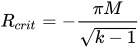
At this point Zinn began working for Fermi, constructing experimental uranium lattices.[1] To slow neutrons down requires a neutron moderator. Water was Fermi's first choice, but it tended to absorb neutrons as well as slow them. In July, Szilard suggested using carbon, in the form of graphite.[4] The critical radius of a spherical reactor was calculated to be:[5]
In order for a self-sustaining nuclear chain reaction to occur, they needed k > 1. For a practical reactor configuration, it needed to be at least 3 or 4 percent more;[5] but in August 1941 Zinn's initial experiments indicated a disappointing value of 0.87. Fermi pinned his hopes of a better result on an improved configuration, and purer uranium and graphite.[1]
1942年初頭、米国が第二次世界大戦に巻き込まれたため、アーサー・コンプトンはマンハッタン計画のプルトニウム研究チームをシカゴ大学の冶金研究所に集約した。[ 6 ]ジンは、使われなくなったスタッグ・フィールドの観客席の下に、フェルミのますます大型化する実験装置を構築するために運動選手を利用した。[ 1 ] 1942年7月、フェルミは酸化ウラン格子からak = 1.007を測定した。これにより、純粋なウランが適切なk値をもたらすという期待が高まった。[ 7 ]
1942 年 12 月までに、ジンとアンダーソンはスタッグ フィールドに新しい構成を準備しました。長さ約24 フィート (7.3 m)、幅24 フィート (7.3 m) 、高さ19 フィート (5.8 m)のこの原子炉には、 385.5 ロング トン (391.7 t)の黒鉛と46.5 ロング トン (47.2 t)のウラン金属と酸化ウランが含まれていました。[ 8 ] 1942 年 12 月 2 日の午後に実験が行われたとき、シカゴ パイル 1として知られるこの原子炉は、何事もなく臨界に達しました。[ 1 ]原子炉には放射線遮蔽がなかったため、最大出力は電球を点灯させるのに十分な 200 W のみで運転され (ただし、発電機は含まれていません)、わずか 3 か月しか運転されませんでした。米国陸軍は人口密度の高いシカゴのダウンタウン付近で事故を起こすリスクを冒したくなかったため、1943 年 2 月 28 日に停止されました。[ 8 ]
陸軍は、クック郡森林保護区の「サイトA 」として知られる1,000エーカー(400ヘクタール)をマンハッタン計画に貸し出し、また「カントリークラブ」をそこで働く100人ほどの科学者、警備員、その他に貸し出した。ジンはフェルミの下でサイトAの責任者に任命された。シカゴパイル1は解体され、今度は放射線遮蔽板を備えてサイトAで再建された。現在シカゴパイル2として知られるこの原子炉は、1943年3月20日に再び稼働した。数か月以内に、フェルミは新しい原子炉の設計を開始し、それはシカゴパイル3として知られるようになった。これはまったく異なるタイプの原子炉だった。直径わずか6フィート(1.8メートル) 、高さ9フィート(2.7メートル)と、はるかに小型だった。 120本のウラン金属棒で動力を得ており、1,200米ガロン(4,500リットル、1,000英ガロン)の重水で減速されていた。[ 8 ]再びジンが建設の責任者となり、1944年の元旦に建設が開始された。シカゴ・パイル3は1944年5月15日に臨界に達し、6月23日に300kWの最大出力で運転を開始した。[ 9 ] [ 10 ]フェルミがハンフォード・サイトへ出発すると、ジンがサイトAの唯一の責任者となった。[ 8 ]
1944年9月29日、ジンは冶金研究所所長のサミュエル・アリソンから緊急の電話を受けた。ハンフォードのB原子炉が最大出力に達した直後に停止したが、数時間後に再び稼働した。ノーマン・ヒルベリーは中性子毒が原因だと疑った。もしそうであれば、その半減期は約9.7時間である。キセノン135の半減期はそれに近いが、アルゴンヌ国立研究所やテネシー州オークリッジのX-10黒鉛原子炉では検出されていなかった。ジンはすぐにシカゴ・パイル3を最大出力に上げ、12時間以内にハンフォードの結果を裏付ける一連の測定を行った。[ 10 ]
その後数ヶ月にわたり、冶金研究所から約175名の技術者がハンフォードとロスアラモスに異動した。ジンのアルゴンヌ研究所は最小限のスタッフにまで縮小されたが、コンプトンは閉鎖を容認しなかった。[ 11 ]

On July 11, 1946, the Argonne laboratory officially became the Argonne National Laboratory, with Zinn as its first director.[8]Alvin Weinberg characterized Zinn as "a model of what a director of the then-emerging national laboratories should be: sensitive to the aspirations of both contractor and fund provider, but confident enough to prevail when this was necessary."[1]
One of the first problems confronting Zinn was that of accommodation. The Federal government had promised to restore Site A to the Cook County Forest Preserves after the war, and despite intervention from the Secretary of War, Robert P. Patterson, the most the Cook County Forest Preserves Commission would agree to was that the Argonne National Laboratory could continue to occupy a portion of the lease until a new site was found. Zinn rejected alternate sites outside the Chicago area, and the Army found a new site for the laboratory's permanent home about 5 miles (8.0 km) away in DuPage County, Illinois,[12] which became known as Site D.[8]
Under Zinn, the Argonne National Laboratory adopted slightly more progressive hiring practices than other contemporary institutions. Three African American women and seven men, six of whom had worked on the Manhattan Project, were employed in research at Argonne at a time when the Los Alamos National Laboratory had no African American scientists. Argonne also appointed women to positions of authority, with Maria Goeppert-Mayer as a section leader in the theoretical physics division, and Hoylande Young as director of the technical information division.[13]
原子力委員会( AEC)は1947年1月1日にマンハッタン計画を廃止し[ 14 ]、1948年1月1日にはアルゴンヌ国立研究所が「主に原子炉開発の問題に焦点を当てる」と発表した[ 15 ] 。ジンは、この追加責任は研究所の研究から逸脱させ、高速増殖炉の設計などの他の責任からも彼を逸らすことになると考え、これを求めなかった。彼はAECの総支配人であるキャロル・L・ウィルソンから、そのようなことはないという書面による保証さえ得ていた。そのため、彼はアルビン・ワインバーグと協力して、オークリッジ国立研究所が原子炉設計に関与し続けることを容認した[ 16 ] 。それにもかかわらず、1949年には原子炉研究が研究所の予算のほぼ半分を占め、その研究の84パーセントが機密扱いだった[ 17 ]。
ジンはアメリカ海軍の原子炉部長であるハイマン・G・リッコーバー大佐 とはあまり仲が良くなかったが、それでもアルゴンヌは原子力船舶推進の開発を支援し、[ 18 ]最終的に陸上プロトタイプのマークIと推進用原子炉のマークIIの2つの原子炉を製造した。[ 19 ]アルゴンヌで設計されたSTR(潜水艦熱原子炉)加圧水型原子炉は、最初の原子力潜水艦であるUSSノーチラスに動力を供給し、軍艦に搭載されたほぼすべての原子炉の基礎となった。[ 20 ] [ 21 ]
The other branch of reactor development at the Argonne National Laboratory, and the one closer to Zinn's heart, was the fast breeder reactor. At the time it was believed that uranium was a scarce resource, so it would be wise to make the best use of it. The breeders were designed to create more fissile material than they consumed.[1] By 1948, he had become convinced that it would be unwise to build large experimental reactors near Chicago, and the AEC acquired land around Arco, Idaho, which became an outpost of Argonne.[17] The Experimental Breeder Reactor I (EBR-I, but known at Argonne as "ZIP" — Zinn's Infernal Pile) was the first reactor to be cooled by liquid metal,[22] and the first to produce electricity.[23] It proved the breeder concept.[22] AEC Chairman Gordon Dean described it as a major milestone in nuclear history.[24]
The BORAX Experiments were a series of destructive tests of boiling water reactors conducted by Argonne National Laboratory in Idaho. The BORAX-1 test was conducted under Zinn's supervision in 1954. He had the control rods removed to demonstrate that the reactor would shut down without trouble, and it immediately blew up with a loud bang and a tall column of dark smoke, a turn of events that he had not anticipated.[25] He shouted to Harold Lichtenberg to put the control rods back in again, but Lichtenberg pointed out that one was already flying through the air. Zinn later had to testify on the experiment before the Joint Committee on Atomic Energy.[25]
1956年にアルゴンヌ国立研究所を退職した後、ジンはフロリダに移り、フロリダ州ダニーデンに本社を置く自身のコンサルティング会社、ゼネラル・ニュークリア・エンジニアリングを設立した[ 26 ]。同社は加圧水型原子炉の設計と建設に携わっていた[ 1 ] 。1964年にコンバッション・エンジニアリングに買収され、ジンは副社長兼原子力部門長に就任した[ 27 ] 。 1970年にこの職を辞したが、1986年まで取締役を務めた[ 28 ]。 1960年から1962年まで大統領科学諮問委員会の委員を務め、 1972年から1975年まで原子力委員会とその後継機関であるエネルギー研究開発局の一般諮問委員会の委員を務めた[ 27 ]。
ジンは長年にわたり、その業績に対して数々の賞を受賞しており、1956年にはAECから特別表彰、1960年には平和のための原子力賞[ 26 ] 、 1969年にはエンリコ・フェルミ賞[ 29 ] 、 1970年にはフランクリン研究所からエリオット・クレソン・メダル[ 30 ]を授与されている。1955年にはアメリカ原子力学会(ANS)の初代会長に選出された[ 31 ] 。
ジンの妻ジーンは1964年に亡くなった。[ 26 ]彼は1966年にメアリー・テレサ・プラットと結婚し、ウォーレンとロバート・ジョンソンという2人の継子を得た。[ 1 ]彼は脳卒中を起こした後、2000年2月14日にフロリダ州セーフティハーバーのミーズ・カントリーサイド病院で亡くなった。妻メアリー、息子ジョンとロバート、継子ウォーレンが遺された。ロバートはイェール大学の天文学教授になっていた。[ 26 ] [ 32 ]
1976年以来、米国原子力学会の運用・電力部門は、毎年ウォルター・H・ジン賞を授与し、「広く認知されていないものの、原子力産業に顕著かつ継続的な貢献をした」個人を表彰している。[ 33 ] [ 34 ]
{{cite journal}}: ISBN / Date incompatibility (help)