The British historian Philip Mason notes that it was inevitable that most of the sepoys and sowars from Meerut should have made for Delhi on the night of 10 May. It was a strong walled city located only forty miles away, it was the ancient capital and present seat of the nominal Mughal Emperor, and there were no British troops in garrison there, in contrast to Meerut.[36]:278 No effort was made to pursue them.
Delhi
Wood-engraving depicting the massacre of officers by insurgent cavalry at Delhi. Illustrated London News, 1857. St. James' Church, Delhi is seen in the background.Police in Delhi during the nominal rule of Bahadur Shah II, 1842, by Emily Eden
Early on 11 May, the first parties of the 3rd Cavalry reached Delhi. From beneath the windows of Emperor Bahadur Shah II's apartments in the palace, they called on the Emperor to acknowledge and lead them. He did nothing at this point, apparently treating the sepoys as ordinary petitioners, but others in the palace were quick to join the revolt. During the day, the revolt spread. British officials and dependents, Indian Christians and shop keepers within the city were killed, some by sepoys and others by crowds of rioters.[77]:71–73
The Flagstaff Tower, Delhi, where the British survivors of the rebellion gathered on 11 May 1857; photographed by Felice Beato
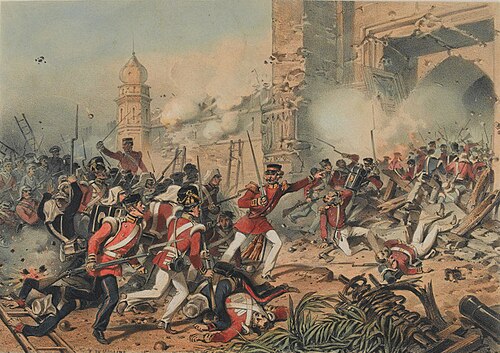
There were three battalion-sized regiments of Bengal Native Infantry stationed in or near the city. Some detachments quickly joined the rebellion, while others held back but also refused to obey orders to take action against the rebels. In the afternoon, a violent explosion in the city was heard for several miles. Fearing that the arsenal, which contained large stocks of arms and ammunition, would fall intact into rebel hands, the nine British Ordnance officers there had opened fire on the sepoys, including the men of their own guard. When resistance appeared hopeless, they blew up the arsenal. Six of the nine officers survived, but the blast killed many in the streets and nearby houses and other buildings.[78] The news of these events finally tipped the sepoys stationed around Delhi into open rebellion. The sepoys were later able to salvage at least some arms from the arsenal. A magazine 3km (1.9mi) outside Delhi, containing up to 3,000 barrels of gunpowder, was captured without resistance.
ニールは9月26日にラクナウで戦死し、懲罰措置について責任を問われることはなかったが、当時のイギリスの情報源は彼と彼の「勇敢な青い帽子」を称賛した。[ s ]イギリス軍がカンプールを奪還したとき、兵士たちはセポイの捕虜をビビガールに連れて行き、壁や床の血痕を舐めさせた。[ 123 ]その後、彼らはセポイの捕虜の大多数を絞首刑にするか、反乱に対する伝統的なムガル帝国の刑罰である「大砲で吹き飛ばす」刑に処した。セポイ自身は殺害に実際には関与していないと主張する者もいたが、彼らはそれを止めようとはせず、これはイギリス軍がカンプールから二度目に撤退した後、トンプソン大尉によって認められた。
In India and Pakistan, it has been termed as the "War of Independence of 1857" or "First War of Indian Independence"[185] but it is not uncommon to use terms such as the "Revolt of 1857". The classification of the Rebellion being "First War of Independence" is not without its critics in India.[186][187][188][189] The use of the term "Indian Mutiny" is considered by some Indian politicians[190] as belittling the importance of what happened and therefore reflecting an imperialistic attitude. Others dispute this interpretation.
In the UK and parts of the Commonwealth it is commonly called the "Indian Mutiny", but terms such as "Great Indian Mutiny", the "Sepoy Mutiny", the "Sepoy Rebellion", the "Sepoy War", the "Great Mutiny", the "Rebellion of 1857", "the Uprising", the "Mahomedan Rebellion", and the "Revolt of 1857" have also been used.[191][192][193] "The Indian Insurrection" was a name used in the press of the UK and British colonies at the time.[194]
Historiography
The Mutiny Memorial in Delhi, a monument to those killed on the British side during the fighting.
Michael Adas (1971) examines the historiography with emphasis on the four major approaches: the Indian nationalist view; the Marxist analysis; the view of the Rebellion as a traditionalist rebellion; and intensive studies of local uprisings.[195] Many of the key primary and secondary sources appear in Biswamoy Pati, ed. 1857 Rebellion.[196][197]
The sepoys did not seek to revive small kingdoms in their regions, instead they repeatedly proclaimed a "country-wide rule" of the Mughals and vowed to drive out the British from "India", as they knew it then. (The sepoys ignored local princes and proclaimed in cities they took over: Khalq Khuda Ki, Mulk Badshah Ka, Hukm Subahdar Sipahi Bahadur Ka – "the people belong to God, the country to the Emperor and authority to the Sepoy and Governor"). The objective of driving out "foreigners" from not only one's own area but from their conception of the entirety of "India", signifies a nationalist sentiment;
The mutineers, although some were recruited from outside Oudh, displayed a common purpose.[210]
150th anniversary
The National Youth rally at the National Celebration to Commemorate 150th Anniversary of the First War of Independence, 1857 at Red Fort, in Delhi on 11 May 2007Postage Stamp Commemorate 150th Anniversary of the First War of Independence, 2007Indian Postage stamp of First War of Independence-1857
The Government of India celebrated the year 2007 as the 150th anniversary of "India's First War of Independence". Several books written by Indian authors were released in the anniversary year including Amresh Mishra's "War of Civilizations", a controversial history of the Rebellion of 1857, and "Recalcitrance" by Anurag Kumar, one of the few novels written in English by an Indian based on the events of 1857.
In 2007, a group of retired British soldiers and civilians, some of them descendants of British soldiers who died in the conflict, attempted to visit the site of the Siege of Lucknow. Fears of violence by Indian demonstrators, supported by the Hindu nationalist Bharatiya Janata Party, prevented the British visitors from visiting the site.[211] Despite the protests, Sir Mark Havelock was able to make his way past police to visit the grave of his ancestor, General Henry Havelock.[212]
In popular culture
Films
Henry Nelson O'Neil's 1857 painting Eastward Ho! depicting British soldiers saying farewell to their loved ones as they embark on a deployment to India.
Light of India – A 1929 short American silent film directed by Elmer Clifton and filmed in Technicolor, depicts the rebellion.
Bengal Brigade – A 1954 film: at the outbreak of the Indian Mutiny. A British officer, Captain Claybourne (Hudson), is cashiered from his regiment over a charge of disobeying orders, but finds that his duty to his men is far from over
Maniram Dewan – A 1964 Assamese film by Sarbeswar Chakraborty, depicting the life and times of Maniram Dewan who led the revolt in Assam.[213]
Shatranj Ke Khilari – A 1977 Indian film directed by Satyajit Ray, chronicling the events just before the onset of the Revolt of 1857. The focus is on the British annexation of Oudh, and the detachment of the nobility from the political sphere in 19th-century India.
Junoon (1978 film) – Directed by Shyam Benegal, it is a critically acclaimed film about the love affair between a Pathan feudal chief and a British girl sheltered by his family during the revolt.
Mangal Pandey: The Rising (2005) – Ketan Mehta's Hindi film chronicles the life of Mangal Pandey.
The Last Cartridge, an Incident of the Sepoy Rebellion in India (1908) – A fictionalized account of a British fort besieged during the Rebellion.
Victoria & Abdul (2017) – Queen Victoria embarrasses herself by recounting to the court the one-sided account of the Indian Mutiny that Abdul had told her, Victoria's faith and trust in him are shaken and she decides he must go home. But soon after, she changes her mind and asks him to stay.[214]
Manikarnika: The Queen of Jhansi, a 2019 Hindi film chronicles the life of Rani Lakshmi Bai.
Malcolm X's autobiography The Autobiography of Malcolm X details his first encounters with atrocities in the non-British world and his reaction to the rebellion and massacres in 1857.
John Masters's novel Nightrunners of Bengal, first published by Michael Joseph in 1951 and dedicated to the Sepoy of India, is a fictionalised account of the Rebellion as seen through the eyes of a British Captain in the Bengal Native Infantry who was based in Bhowani, itself a fictionalised version of the town of Jhansi. Captain Savage and his turbulent relationship with the Rani of Kishanpur form an analogous interrelationship of the Indian people and the British and sepoy regiments at that time.
The majority of M. M. Kaye's novel Shadow of the Moon is set between 1856 and 1858, and the Rebellion is shown to greatly affect the lives of the main characters, who were inhabitants of the Residency at Lunjore (a fictional town in north India). The early chapters of her novel The Far Pavilions take place during the Rebellion, which leads to the protagonist, a child of British ancestry, being raised as a Hindu.
Indian writer Ruskin Bond's fictional novella A Flight of Pigeons is set around the Indian Rebellion of 1857. It is from this story that the film Junoon was later adapted in 1978 by Shyam Benegal.
The 1880 novel The Steam House by Jules Verne takes place in the aftermath of the Indian Rebellion of 1857.
Various folk songs in Assam, called Maniram Dewanor Geet were composed in the memory of Maniram Dewan, highlighting his role in the tea industry and the rebellion.[217]
↑"It has been roughly estimated that 6,000 of the approximately 40,000 Europeans then in India were killed."[2] White or British were labelled European in the 19th-century Censuses of India.[3]
↑"The 1857 rebellion was by and large confined to northern Indian Gangetic Plain and central India."[6]
↑"The revolt was confined to the northern Gangetic plain and central India."[7]
↑“Although the majority of the violence occurred in the northern Indian Gangetic plain and central India, recent scholarship has suggested that the rebellion also reached parts of the east and north."[8]
↑"What distinguished the events of 1857 was their scale and the fact that for a short time they posed a military threat to British dominance in the Ganges Plain."[9]
↑"The events of 1857–58 in India (are) known variously as a mutiny, a revolt, a rebellion and the first war of independence (the debates over which only confirm just how contested imperial history can become) ... "[11]
↑"Indian soldiers and the rural population over a large part of northern India showed their mistrust of their rulers and their alienation from them. ... For all their talk of improvement, the new rulers were as yet able to offer very little in the way of positive inducements for Indians to acquiesce in the rule."[14]
↑"Many Indians took up arms against the British, if for very diverse reasons. On the other hand, a very large number actually fought for the British, while the majority remained apparently acquiescent. Explanations have therefore to concentrate on the motives of those who actually rebelled."[14]
↑The cost of the rebellion in terms of human suffering was immense. Two great cities, Delhi and Lucknow, were devastated by fighting and by the plundering of the victorious British. Where the countryside resisted, as in parts of Awadh, villages were burnt. Mutineers and their supporters were often killed out of hand. British civilians, including women and children, were murdered as well as the British officers of the sepoy regiments."[14]
↑"The south, Bengal, and the Punjab remained unscathed, ..."[7]
↑"... it was the support from the Sikhs, carefully cultivated by the British since the end of the Anglo-Sikh wars, and the disinclination of the Bengali intelligentsia to throw in their lot with what they considered a backward Zamindar revolt, that proved decisive in the course of the struggle.[7]
↑"(they) generated no coherent ideology or programme on which to build a new order."[17]
↑"The events of 1857–58 in India, ... marked a major watershed not only in the history of British India but also of British imperialism as a whole."[11]
↑"Queen Victoria's Proclamation of 1858 laid the foundation for Indian secularism and established the semi-legal framework that would govern the politics of religion in colonial India for the next century. ... It promised civil equality for Indians regardless of their religious affiliation, and state non-interference in Indians' religious affairs. Although the Proclamation lacked the legal authority of a constitution, generations of Indians cited the Queen's proclamation in order to claim, and to defend, their right to religious freedom."[20]
↑The proclamation to the "Princes, Chiefs, and People of India", issued by Queen Victoria on 1 November 1858. "We hold ourselves bound to the natives of our Indian territories by the same obligation of duty which bind us to all our other subjects." [p. 2]
↑"When the governance of India was transferred from the East India Company to the Crown in 1858, she (Queen Victoria) and Prince Albert intervened in an unprecedented fashion to turn the proclamation of the transfer of power into a document of tolerance and clemency. ... They ... insisted on the clause that stated that the people of India would enjoy the same protection as all subjects of Britain. Over time, this royal intervention led to the Proclamation of 1858 becoming known in the Indian subcontinent as 'the Magna Carta of Indian liberties', a phrase which Indian nationalists such as Gandhi later took up as they sought to test equality under imperial law"[21]
↑"In purely legal terms, (the proclamation) kept faith with the principles of liberal imperialism and appeared to hold out the promise that British rule would benefit Indians and Britons alike. But as is too often the case with noble statements of faith, reality fell far short of theory, and the failure on the part of the British to live up to the wording of the proclamation would later be used by Indian nationalists as proof of the hollowness of imperial principles."[22]
↑"Ignoring ...the conciliatory proclamation of Queen Victoria in 1858, Britishers in India saw little reason to grant Indians a greater control over their own affairs. Under these circumstances, it was not long before the seed-idea of nationalism implanted by their reading of Western books began to take root in the minds of intelligent and energetic Indians."[23]
↑Units of the Army of the Madras Presidency wore blue rather than black shakoes or forage caps
↑The cost of the rebellion in terms of human suffering was immense. Two great cities, Delhi and Lucknow, were devastated by fighting and by the plundering of the victorious British. Where the countryside resisted, as in parts of Awadh, villages were burnt. Mutineers and their supporters were often killed out of hand. British civilians, including women and children, were murdered as well as the British officers of the sepoy regiments."[14]
Citations
12Tyagi, Sushila (1974). Indo-Nepalese Relations: (1858–1914). India: Concept Publishing Company. Archived from the original on 19 September 2023. Retrieved 15 September 2020.
↑Buettner, Elizabeth (2000), "Problematic spaces, problematic races: defining 'Europeans' in late colonial India", Women's History Review, 9 (2): 277–298, 278, doi:10.1080/09612020000200242, ISSN0961-2025, S2CID145297044, Colonial-era sources most commonly referred to individuals whom scholars today often describe as 'white' or 'British' as 'European' or 'English'.
123456Marriott, John (2013), The other empire: Metropolis, India and progress in the colonial imagination, Manchester University Press, p.195, ISBN978-1-84779-061-3
12Bender, Jill C. (2016), The 1857 Indian Uprising and the British Empire, Cambridge University Press, p.3, ISBN978-1-316-48345-9
1234Peers, Douglas M. (2006), "Britain and Empire", in Williams, Chris (ed.), A Companion to 19th-Century Britain, John Wiley & Sons, p.63, ISBN978-1-4051-5679-0
12345678Marshall, P. J. (2001), "1783–1870: An expanding empire", in P. J. Marshall (ed.), The Cambridge Illustrated History of the British Empire, Cambridge University Press, p.50, ISBN978-0-521-00254-7
12Adcock, C.S. (2013), The Limits of Tolerance: Indian Secularism and the Politics of Religious Freedom, Oxford University Press, pp.23–25, ISBN978-0-19-999543-1
12Taylor, Miles (2016), "The British royal family and the colonial empire from the Georgians to Prince George", in Aldrish, Robert; McCreery, Cindy (eds.), Crowns and Colonies: European Monarchies and Overseas Empires, Manchester University Press, pp.38–39, ISBN978-1-5261-0088-7, archived from the original on 19 September 2023, retrieved 30 March 2017
12Embree, Ainslie Thomas; Hay, Stephen N.; Bary, William Theodore De (1988), "Nationalism Takes Root: The Moderates", Sources of Indian Tradition: Modern India and Pakistan, Columbia University Press, p.85, ISBN978-0-231-06414-9, archived from the original on 19 September 2023, retrieved 19 September 2023
↑"Internet History Sourcebooks Project". Sourcebooks.fordham.edu. Archived from the original on 18 August 2014. Retrieved 6 February 2022.
↑Keay, John (1994). The Honourable Company: A History of the English East India Company. Scribner. ISBN978-0-02-561169-6.
↑Markovitz, Claude. A History of Modern India, 1480–1950. Anthem Press. p.271.
↑"When the Vellore sepoys rebelled". The Hindu. 6 August 2006. Archived from the original on 15 August 2016. Retrieved 23 August 2016.
12Kim A Wagner (2018). The Skull of Alum Bheg: The Life and Death of a Rebel of 1857. Oxford University Press. p.18. ISBN978-0-19-087023-2. Archived from the original on 19 September 2023. Retrieved 17 November 2021.
↑Mazumder, Rajit K. (2003), The Indian Army and the Making of the Punjab, Delhi: Permanent Black, pp.7–8, ISBN978-81-7824-059-6
↑Eric Stokes (February 1973). "The first century of British colonial rule in India: social revolution or social stagnation?". Past & Present (58). Oxford University Press: 136–160. doi:10.1093/past/58.1.136. JSTOR650259.
1234567Philip Mason, A Matter of Honour – an Account of the Indian Army, its Officers and Men, ISBN0-333-41837-9
↑Essential histories, The Indian Rebellion 1857–1858, Gregory Fremont-Barnes, Osprey 2007, p. 25.
↑From Sepoy to Subedar – Being the Life and Adventures of Subedar Sita Ram, a Native Officer of the Bengal Army, edited by James Lunt, ISBN0-333-45672-6, p. 172.
↑Hyam, Ronald (2002). Britain's Imperial Century, 1815–1914 (3rded.). Palgrave Macmillan. p.135. ISBN9780333945696.{{cite book}}: Check |isbn= value: checksum (help)
↑Headrick, Daniel R. (1981). The Tools of Empire: Technology and European Imperialism in the Nineteenth Century. Oxford University Press. p.88. ISBN978-0195028318.{{cite book}}: Check |isbn= value: checksum (help)
12Wagner, Kim A. (2010). The Great Fear of 1857: Rumours, Conspiracies and the Making of the Indian Uprising. Peter Lang. pp.28–30. ISBN9781906165277.
↑Bayly, C. A. (1988). Indian Society and the Making of the British Empire. Cambridge University Press. p.168. ISBN9780521386500.
↑Pionke, Albert D. (2004). Plots of Opportunity: Representing Conspiracy in Victorian England. Ohio State University Press. p.82. ISBN978-0-8142-0948-6.
↑Hoeber Rudolph, Susanne; Rudolph, Lloyd I. (2000). "Living with Difference in India". The Political Quarterly. 71: 20–38. doi:10.1111/1467-923X.71.s1.4.
↑Embree, Ainslie (1992). Religion and Irreligion in Victorian Society: Essays in Honor of R. K. Webb. Routledge. p.152. ISBN978-0-415-07625-8.
↑Bayly, C. A. (1996). Empire and Information: Intelligence Gathering and Social Communication in India, 1780–1870. Cambridge University Press. pp.290–291. ISBN0-521-57085-9.
↑Bayly, C. A. (2012). The Birth of the Modern World, 1780–1914. Wiley-Blackwell. p.158. ISBN978-0-631-18799-8.
↑Majumdar, R. C. (1957). The Sepoy Mutiny and the Revolt of 1857. Firma KLM. pp.45–46.
↑"Sepoy Mutiny of 1857". Postcolonial Studies @ Emory. Emory University. Archived from the original on 14 January 2013. Retrieved 26 September 2025.
↑Mollo, Boris (1981). The Indian Army. Littlehampton Book Services Ltd. p.54. ISBN978-0-7137-1074-8.
↑Aijaz Ahmad (2021). Uprising of 1857: Some Facts about Failure of Indian war of Independence. K.K. Publications. p.158. Archived from the original on 19 September 2023. Retrieved 19 March 2023.
↑Seema Alavi, The Sepoys and the Company (Delhi: Oxford University Press, 1998), p. 5.
↑Memorandum from Lieutenant-Colonel W. St. L. Mitchell (CO of the 19th BNI) to Major A. H. Ross about his troop's refusal to accept the Enfield cartridges, 27 February 1857, Archives of Project South Asia, South Dakota State University and Missouri Southern State UniversityArchived 18 August 2010 at the Wayback Machine
12"The Indian Mutiny of 1857", Col. G. B. Malleson, reprint 2005, Rupa & Co. Publishers, New Delhi.
↑Durendra Nath Sen, p. 50 Eighteen Fifty-Seven, The Publications Division, Ministry of Information & Broadcasting, Government of India, May 1957.
↑Wagner, Kim A. (2014). The Great Fear of 1857. Rumours, Conspiracies and the Making of the Indian Uprising. Dev Publishers & Distributors. p.97. ISBN978-93-81406-34-2.
↑Ikram ul-Majeed Sehgal (2002). Defence Journal: Volume 5, Issues 9–12. University of Michigan. p.37. Archived from the original on 11 April 2023. Retrieved 19 March 2023.
↑Ayesha Jalal (2008). Partisans of Allah. Harvard University Press. pp.129. ISBN978-0-674-02801-2. Nor did most Muslims share the rebels' hatred of the British, even as they deplored the more egregious excesses of colonial rule.
↑Ayesha Jalal (2008). Partisans of Allah. Harvard University Press. pp.114–. ISBN978-0-674-02801-2. During the 1857 uprising, the ulema could not agree whether to declare a jihad.
↑Ayesha Jalal (2008). Partisans of Allah. Harvard University Press. pp.122–123. ISBN978-0-674-02801-2. Maulana Muhammad Qasim Nanautawi (1833–1879), the great Deobandi scholar, fought against the British...Along with Maulana Rashid Ahmad Gangohi (1828–1905), he took up arms when he was presented with clear evidence of English injustice.
↑Ayesha Jalal (2008). Partisans of Allah. Harvard University Press. pp.130. ISBN978-0-674-02801-2. Many Muslims, including Sunni and Shia ulema, collaborated with the British.
↑Ayesha Jalal (2008). Partisans of Allah. Harvard University Press. pp.130–131. ISBN978-0-674-02801-2. Several of Nanautawi's fellow seminarians in Deoband and divines of the Ahl-i-Hadith reputed for their adherence to Sayyid Ahmad Barelvi rejected the jihad.
↑Ayesha Jalal (2008). Partisans of Allah. Harvard University Press. pp.131. ISBN978-0-674-02801-2. Maulana Sayyid Nazir Husain Dehalvi was the most influential of the Ahl-Hadith ulema in Delhi at the time of the revolt. The rebels coerced him into issuing a fatwa declaring a jihad...he ruled out armed jihad in India, on the grounds that the relationship with the British government was a contract that Muslims could not legally break unless their religious rights were infringed.
↑Zachary Nunn. The British RajArchived 13 September 2007 at the Wayback Machine
12Trevaskis, Hugh Kennedy (1928), The Land of Five Rivers: An Economic History of the Punjab from Earliest Times to the Year of Grace 1890, London: Oxford University Press, pp.216–217
↑J. W. Sherer, Daily Life during the Indian Mutiny, 1858, p. 56.
↑Andrew Ward, Our bones are scattered – The Cawnpore massacres and the Indian Mutiny of 1857, John Murray, 1996.
↑Ramson, Martin & Ramson, Edward, The Indian Empire, 1858.
↑Raugh, Harold E. (2004), The Victorians at War, 1815–1914: An Encyclopaedia of British Military, Santa Barbara: ABC-CLIO, p.89, ISBN978-1-57607-925-6, OCLC54778450
↑Upadhyay, Shreeram Prasad (1992). Indo-Nepal trade relations: a historical analysis of Nepal's trade with the British India. India: Nirala Publications. ISBN978-8185693200.
↑Essential Histories, the Indian Mutiny 1857–58, Gregory Fremont-Barnes, Osprey 2007, p. 79.
↑Lachmi Bai Rani of Jhansi, the Jeanne d'Arc of India (1901), White, Michael (Michael Alfred Edwin), 1866, New York: J.F. Taylor & Company, 1901.
↑Kaye, Sir John William (1876), A history of the Sepoy war in India, 1857–1858, archived from the original on 19 September 2023, retrieved 17 September 2012– via Google Books
↑S. B. Singh (1966). "Gaya in 1857–58". Proceedings of the Indian History Congress. 28: 379–387. JSTOR44140459.
↑Wood, Sir Evelyn (1908), The revolt in Hindustan 1857–59, archived from the original on 19 September 2023, retrieved 17 September 2012– via Google Books
↑S. Purushottam Kumar (1983). "Kunwar Singh's Failure in 1857". Proceedings of the Indian History Congress. 44: 360–369. JSTOR44139859.
↑Boyle, Robert Vicars (1858). Indian Mutiny. Brief Narrative of the Defence of the Arrah Garrison. London: W. Thacker & Co.
↑John Sergeant's Tracks of Empire, BBC4 programme.
↑Halls, John James (1860). Two months in Arrah in 1857. London: Longman, Green, Longman and Roberts.
123"Supplement to The London Gazette, October 13, 1857". No.22050. 13 October 1857. pp.3418–3422. Archived from the original on 23 December 2019. Retrieved 18 July 2016.
↑The Sepoy Revolt. A Critical Narrative, ISBN978-1-4021-7306-6, archived from the original on 19 September 2023, retrieved 17 September 2012– via Google Books
↑Smith, John Frederick (1864), John Cassell's Illustrated history of England – William Howitt, John Cassell, archived from the original on 19 September 2023, retrieved 17 September 2012– via Google Boeken
↑Sarvesh Kumar (2007). "The Revolt of 1857: 'Real Heroes of Bihar Who Have Been Dropped From Memory". Proceedings of the Indian History Congress. 68: 1454. JSTOR44145679.
12Mathur Das Ustad (1997). "The Role of Bishwanath Sahi of Lohardaga district, During the Revolt of 1857 in Bihar". Proceedings of the Indian History Congress. 58: 493–500. JSTOR44143953.
123Allen, Charles (2001). Soldier Sahibs: The Men Who Made the North-West Frontier. London: Abacus. ISBN0-349-11456-0.
↑Wagner, Kim A. (2018). The Skull of Alum Beg. The Life and Death of a Rebel of 1857. Oxford University Press. p.133. ISBN978-0-19-087023-2.
↑Butt, Saeed Ahmed (July–December 2015). "Rai Ahmad Khan Kharral (Myth or Reality)"(PDF). Journal of the Punjab University Historical Society. 28 (3). Punjab University, Lahore: 173–191. ISSN2415-5373. Archived from the original(PDF) on 16 May 2018. Retrieved 6 January 2026.
1234"Rare 1857 reports on Bengal uprisings – Times of India". The Times of India. 10 June 2009. Archived from the original on 5 January 2017. Retrieved 10 May 2016.
↑"Chittagong City". Banglapedia. Archived from the original on 30 November 2021. Retrieved 6 February 2022.
↑"Revisiting the Great Rebellion of 1857". 13 July 2014. Archived from the original on 26 June 2018. Retrieved 10 May 2016.
↑Ramanlal Kakalbhai Dharaiya (1970). Gujarat in 1857. Gujarat University. p.120. Archived from the original on 19 September 2023. Retrieved 15 January 2017.
↑Achyut Yagnik (2005). Shaping Of Modern Gujarat. Penguin Books Limited. pp.105–109. ISBN978-81-8475-185-7.
↑James Macnabb Campbell, ed. (1896). History of Gujarát. Gazetteer of the Bombay Presidency. Vol.I. Part II. GUJARÁT DISTURBANCES, 1857–1859. The Government Central Press. pp.447–449. Archived from the original on 19 September 2018. Retrieved 9 September 2017.
123Omalley L. S. S. (1909). Sambalpur. The Bengal Secretariat Book Depot, Calcutta.
↑Tyagi, Kuldeep Kumar; Kumar, Vighnesh; Bhardwaj, C. S. (7 November 2024). "Indian Resistance to the Early East India Company's Forces at Shamli". Journal of National Development. 35 (1). Ignited Minds Pvt. Ltd. ISSN0972-8309. Retrieved 9 September 2025.
↑Kumar, Suresh. "1857: Passionate Heroic Stories of Chaudhary Mohar Singh and His Companions of Muzaffarnagar"(PDF). archaeokanpur.org. Archived(PDF) from the original on 18 September 2025. Retrieved 9 September 2025.
↑"Shamli: खौफजदा अंग्रेजों ने तीन दिन पेड़ पर लटकाकर रखा था इस क्रांतिकारी का शव, हिल गई थीं ब्रिटिश हुकूमत की चूलें". Zee-Up-Uttarakhand (in Hindi). Retrieved 9 September 2025.
↑प्रजापति, पंकज (13 August 2022). क्रांतिकारी मोहर सिंह का अंग्रेजों में था खौफ, 3 दिन तक पेड़ पर लटकाकर रखा था शव. ABP News (in Hindi). Retrieved 9 September 2025.
↑Turnbull, C. M. (1970). "Convicts in the Straits Settlements 1826–1827". Journal of the Malaysian Branch of the Royal Asiatic Society. 43 (1): 100.
↑Arnold, D (1983). "White colonization and labour in nineteenth-century India". Journal of Imperial and Commonwealth History. 11 (2): 144. doi:10.1080/03086538308582635.
↑Chopra, P. N. (2003). A Comprehensive History of India. Vol.3. Sterling Publishers. p.118. ISBN978-8120725065. Archived from the original on 19 September 2023. Retrieved 3 March 2017.
↑Heather Streets (2004). Martial Races: The Military, Race and Masculinity in British Imperial Culture, 1857–1914. Manchester University Press. pp.39–. ISBN978-0-7190-6962-8. Retrieved 13 August 2013.
↑Sahib: The British Soldier in India 1750–1914Richard Holmes HarperCollins 2005.
12Nikki Christie, Brendan Christie and Adam Kidson. Britain: losing and gaining an empire, 1763–1914. p.150. ISBN978-1-4479-8534-1.
↑Mukherjee, Rudrangshu (1998). Spectre of Violence: The 1857 Kanpur Massacre. New Delhi: Penguin Books. p.175.
↑Tickell, Alex (2013). Terrorism, Insurgency and Indian-English Literature, 1830–1947. Routledge. p.92. ISBN978-1-136-61841-3. Archived from the original on 19 September 2023. Retrieved 5 September 2019.
↑Bender, J. C., "Mutiny or freedom fight", in Potter, S. J. (ed.), Newspapers and empire in Ireland and Britain, Dublin: Four Courts Press, pp.105–106.
↑Dalmia, Vasudha (2019). Fiction as History: The Novel and the City in Modern North India. State University of New York Press. p.22. ISBN978-1-4384-7607-0. Archived from the original on 19 September 2023. Retrieved 20 May 2022.
↑Rajit K. Mazumder, The Indian Army and the Making of the Punjab. (Delhi, Permanent Black, 2003), 11.
↑Bickers, Robert A.; R. G. Tiedemann (2007), The Boxers, China, and the World, Rowman & Littlefield, p.231 (at p. 63), ISBN978-0-7425-5395-8
↑W. Y. Carman, p. 107 Indian Army Uniforms – Infantry, Morgan-Grampian London 1969.
↑Authorisation contained in General Order 363 of 1858 and General Order 733 of 1859.
↑"Calcutta Monthly Journal and General Register 1837". p.60.
↑First Indian War of IndependenceArchived 25 December 2019 at the Wayback Machine 8 January 1998.
↑A number of dispossessed dynasts, both Hindu and Muslim, exploited the well-founded caste-suspicions of the sepoys and made these simple folk their cat's paw in gamble for recovering their thrones. The last scions of the Delhi Mughals or the Oudh Nawabs and the Peshwa, can by no ingenuity be called fighters for Indian freedom Hindusthan Standard, Puja Annual, 195 p. 22 referenced in the Truth about the Indian mutiny article by Dr Ganda Singh.
↑In the light of the available evidence, we are forced to the conclusion that the uprising of 1857 was not the result of careful planning, nor were there any master-minds behind it. As I read about the events of 1857, I am forced to the conclusion that the Indian national character had sunk very low. The leaders of the revolt could never agree. They were mutually jealous and continually intrigued against one another. ... In fact these personal jealousies and intrigues were largely responsible for the Indian defeat.Maulana Abul Kalam Azad, Surendranath Sen: Eighteen Fifty-seven (Appx. X & Appx. XV).
↑"The Office of Speaker Lok Sabha". Archived from the original on 12 March 2011. Retrieved 2 November 2006.
↑"Indian History – British Period – First war of Independence". Gatewayforindia.com. Archived from the original on 9 June 2019. Retrieved 6 February 2022.
↑"Il y a cent cinquante ans, la révolte des cipayes". Le Monde diplomatique. 1 August 2007. Archived from the original on 9 November 2019. Retrieved 9 January 2008.
↑"National Geographic Deutschland". 3 May 2005. Archived from the original on 3 May 2005. Retrieved 6 February 2022.
↑The Empire, Sydney, Australia, 11 July 1857, or Taranaki Herald, New Zealand, 29 August 1857.
↑Michael Adas, "Twentieth Century Approaches to the Indian Mutiny of 1857–58", Journal of Asian History, 1971, Vol. 5 Issue 1, pp. 1–19.
↑It includes essays by historians Eric Stokes, Christopher Bayly, Rudrangshu Mukherjee, Tapti Roy, Rajat K. Ray and others. Biswamoy Pati (2010), The 1857 Rebellion, Oxford University Press, ISBN978-0-19-806913-3
↑For the latest research see Crispin Bates, ed., Mutiny at the Margins: New Perspectives on the Indian Uprising of 1857: Volume I: Anticipations and Experiences in the Locality (2013).
↑Thomas R. Metcalf, "Rural society and British rule in nineteenth century India". Journal of Asian Studies 39#1 (1979): 111–119.
↑Kim A. Wagner (2010). The Great Fear of 1857: Rumours, Conspiracies and the Making of the Indian Uprising. Peter Lang. pp.xxvi–. ISBN978-1-906165-27-7. Modern Indian historiography on 1857 still seems, at least in part, to be responding to the prejudice of colonial accounts ... I see no reason to downplay, or to exaggerate, the atrocities carried out by Indians simply because such events seem to offend our post-colonial sensibilities.
↑M. Farooqui, trans (2010) Besieged: voices from Delhi 1857 Penguin Books.
↑Wagner, Kim A. (2011). "The Marginal Mutiny: The New Historiography of the Indian Uprising of 1857". History Compass. 9 (10): 760–766 [760]. doi:10.1111/j.1478-0542.2011.00799.x.
↑See also Kim A. Wagner (2010), The Great Fear Of 1857: Rumours, Conspiracies and the Making of the Indian Uprising, Peter Lang, p.26, ISBN978-1-906165-27-7
↑Sabbaq Ahmed, "Ideology and Muslim militancy in India: Selected case studies of the 1857 Indian rebellion". (PhD Dissertation, Victoria University of Wellington (NZ), 2015). onlineArchived 3 October 2018 at the Wayback Machine
↑The Indian Mutiny and Victorian Trauma by Christopher Herbert, Princeton University Press, Princeton 2007.
↑The History of the Indian Mutiny: Giving a detailed account of the sepoy insurrection in India by Charles Ball, The London Printing and Publishing Company, London, 1860.
↑V.D. Savarkar argues that the rebellion was a war of Indian independence. The Indian War of Independence: 1857 (Bombay: 1947 [1909]). Most historians have seen his arguments as discredited, with one venturing so far as to say, 'It was neither first, nor national, nor a war of independence.' Eric Stokes has argued that the rebellion was actually a variety of movements, not one movement. The Peasant Armed (Oxford: 1980). See also S. B. Chaudhuri, Civil Rebellion in the Indian Mutinies 1857–1859 (Calcutta: 1957).
↑Spilsbury, Julian (2007). The Indian Mutiny. Weidenfeld & Nicolson. pp.n2, n166. ISBN978-0-297-84651-2.
↑The communal hatred led to ugly communal riots in many parts of U.P. The green flag was hoisted and Muslims in Bareilly, Bijnor, Moradabad, and other places the Muslims shouted for the revival of Muslim kingdom." R. C. Majumdar: Sepoy Mutiny and Revolt of 1857 (pp. 2303–2331).
↑"UK India Mutiny ceremony blocked". BBC News. 24 September 2007. Archived from the original on 24 December 2019. Retrieved 16 December 2009.
↑Tripathi, Ram Dutt (26 September 2007). "Briton visits India Mutiny grave". BBC News. Archived from the original on 27 December 2019. Retrieved 16 December 2009.
↑"Maniram Dewan (মণিৰাম দেৱান) (1964)". Enajori. Archived from the original on 25 October 2021. Retrieved 25 October 2021.
↑Kaufman, Amy (28 September 2017). "Ali Fazal goes from Bollywood to Hollywood with 'Victoria & Abdul'". Los Angeles Times. Archived from the original on 4 February 2022. Retrieved 6 February 2022.
↑Chander, Romesh (2 May 2008). "A little peek into history". The Hindu. India. Archived from the original on 9 November 2012.
↑The Great Train Robbery. Ballantine Books. 1975. pp.272–275, 278, 280.
↑C. Vijayasree; Sāhitya Akādemī (2004). Writing the West, 1750–1947: Representations from Indian Languages. Sahitya Akademi. p.20. ISBN978-81-260-1944-1. Retrieved 21 April 2012.
Sources
Bandyopadhyay, Sekhara (2004), From Plassey to Partition: A History of Modern India, New Delhi: Orient Longman, p.523, ISBN978-81-250-2596-2
Bayly, Christopher Alan (1987), Indian Society and the Making of the British Empire, The New Cambridge History of India, vol.II.1, Cambridge University Press, ISBN978-0-521-38650-0
Bayly, Christopher Alan (2000), Empire and Information: Intelligence Gathering and Social Communication in India, c 1780–1870, Cambridge University Press, p.412, ISBN978-0-521-57085-5.
Bose, Sugata; Jalal, Ayesha (2004) [First published 1997], Modern South Asia: History, Culture, Political Economy (2nded.), London: Routledge, p.253, ISBN978-0-415-30787-1
Brown, Judith M. (1994), Modern India: The Origins of an Asian Democracy (2nded.), Oxford University Press, p.480, ISBN978-0-19-873113-9, archived from the original on 3 October 2008, retrieved 2 March 2008
Harris, John (2001), The Indian Mutiny, Ware: Wordsworth Editions, p.205, ISBN978-1-84022-232-6
Hasan, Farhat; Roy, Tapti (1998), "Review of Tapti Roy, The Politics of a Popular Uprising, OUP, 1994", Social Scientist, 26 (1): 148–151, doi:10.2307/3517586, JSTOR3517586
Hibbert, Christopher (1980), The Great Mutiny: India 1857, London: Allen Lane, p.472, ISBN978-0-14-004752-3
Ludden, David (2002), India And South Asia: A Short History, Oxford: Oneworld, xii, 306, ISBN978-1-85168-237-9
Marshall, P. J. (2007), The Making and Unmaking of Empires: Britain, India, and America c. 1750–1783, Oxford and New York: Oxford University Press., p.400, ISBN978-0-19-922666-5
Metcalf, Barbara D.; Metcalf, Thomas R. (2006), A Concise History of Modern India (2nded.), Cambridge University Press, p.337, ISBN978-0-521-68225-1
Metcalf, Thomas R. (1964), The Aftermath of Revolt: India, 1857–1870, Princeton University Press, LCCN63-23412
Nanda, Krishan (September 1965), "'1857 in India: Mutiny or War of Independence?' by Ainslie T. Embree", The Western Political Quarterly (Review), 18 (3): 700–701, JSTORi218739
Peers, Douglas M. (2013), India Under Colonial Rule: 1700–1885, Routledge, ISBN978-1-317-88286-2
Spear, Percival (1990) [First published 1965], A History of India, vol.2, New Delhi and London: Penguin Books, ISBN978-0-14-013836-8
Further reading
Text-books and academic monographs
Alavi, Seema (1996), The Sepoys and the Company: Tradition and Transition 1770–1830, Oxford University Press, p.340, ISBN978-0-19-563484-6.
Anderson, Clare (2007), Indian Uprising of 1857–8: Prisons, Prisoners and Rebellion, New York: Anthem Press, p.217, ISBN978-1-84331-249-9.
Greenwood, Adrian (2015), Victoria's Scottish Lion: The Life of Colin Campbell, Lord Clyde, UK: History Press, p.496, ISBN978-0-7509-5685-7, archived from the original on 21 February 2016, retrieved 26 November 2015.
Keene, Henry George (1883), Fifty-Seven. Some account of the administration of Indian Districts during the revolt of the Bengal Army, London: W.H. Allen, p.145.
Kulke, Hermann; Rothermund, Dietmar (2004), A History of India (4thed.), London: Routledge, xii, 448, ISBN978-0-415-32920-0.
Leasor, James (1956), The Red Fort, London: W. Lawrie, p.377, ISBN978-0-02-034200-7, archived from the original on 1 February 2020, retrieved 8 January 2012{{citation}}: ISBN / Date incompatibility (help).
Majumdar, R.C.; Raychaudhuri, H.C.; Datta, Kalikinkar (1967), An Advanced History of India (3rded.), London: Macmillan, p.1126.
Markovits, Claude, ed. (2004), A History of Modern India 1480–1950, London: Anthem, p.607, ISBN978-1-84331-152-2.
Metcalf, Thomas R. (1997), Ideologies of the Raj, Cambridge University Press, p.256, ISBN978-0-521-58937-6.
Mukherjee, Rudrangshu (2002), Awadh in Revolt 1857–1858: A Study of Popular Resistance (2nded.), London: Anthem, ISBN978-1-84331-075-4.
Palmer, Julian A.B. (1966), The Mutiny Outbreak at Meerut in 1857, Cambridge University Press, p.175, ISBN978-0-521-05901-5.
Ray, Rajat Kanta (2002), The Felt Community: Commonality and Mentality before the Emergence of Indian Nationalism, Oxford University Press, p.596, ISBN978-0-19-565863-7.
Robb, Peter (2002), A History of India, Basingstoke: Palgrave, p.344, ISBN978-0-333-69129-8.
Roy, Tapti (1994), The politics of a popular uprising: Bundelkhand 1857, Delhi: Oxford University Press, p.291, ISBN978-0-19-563612-3.
Stanley, Peter (1998), White Mutiny: British Military Culture in India, 1825–1875, London: Hurst, p.314, ISBN978-1-85065-330-1.
Stokes, Eric (1980), The Peasant and the Raj: Studies in Agrarian Society and Peasant Rebellion in Colonial India, Cambridge University Press, p.316, ISBN978-0-521-29770-7.
Stokes, Eric; Bayly, C.A. (1986), The Peasant Armed: The Indian Revolt of 1857, Oxford: Clarendon, p.280, ISBN978-0-19-821570-7.
Taylor, P.J.O. (1997), What really happened during the mutiny: a day-by-day account of the major events of 1857–1859 in India, Delhi: Oxford University Press, p.323, ISBN978-0-19-564182-0.
Wolpert, Stanley (2004), A New History of India (7thed.), Oxford University Press, p.530, ISBN978-0-19-516678-1.
Articles in journals and collections
Alam Khan, Iqtidar (May–June 2013), "The Wahabis in the 1857 Revolt: A Brief Reappraisal of Their Role", Social Scientist, 41 (5/6): 15–23, JSTOR23611115
Alavi, Seema (February 1993), "The Company Army and Rural Society: The Invalid Thanah 1780–1830", Modern Asian Studies, 27 (1), Cambridge University Press: 147–178, doi:10.1017/S0026749X00016097, JSTOR312880, S2CID143566845
Baker, David (1991), "Colonial Beginnings and the Indian Response: The Revolt of 1857–58 in Madhya Pradesh", Modern Asian Studies, 25 (3): 511–543, doi:10.1017/S0026749X00013913, JSTOR312615, S2CID146482671
Blunt, Alison (July 2000), "Embodying war: British women and domestic defilement in the Indian "Mutiny", 1857–8", Journal of Historical Geography, 26 (3): 403–428, doi:10.1006/jhge.2000.0236
Dutta, Sunasir; Rao, Hayagreeva (July 2015). "Infectious diseases, contamination rumours and ethnic violence: Regimental mutinies in the Bengal Native Army in 1857 India". Organizational Behavior and Human Decision Processes. 129: 36–47. doi:10.1016/j.obhdp.2014.10.004. S2CID141583862.
English, Barbara (February 1994), "The Kanpur Massacres in India in the Revolt of 1857", Past & Present (142), Oxford University Press: 169–178, doi:10.1093/past/142.1.169, JSTOR651200
Klein, Ira (July 2000), "Materialism, Mutiny and Modernization in British India", Modern Asian Studies, 34 (3), Cambridge University Press: 545–580, doi:10.1017/S0026749X00003656, JSTOR313141, S2CID143348610
Lahiri, Nayanjot (June 2003), "Commemorating and Remembering 1857: The Revolt in Delhi and Its Afterlife", World Archaeology, 35 (1), Taylor & Francis: 35–60, doi:10.1080/0043824032000078072, JSTOR3560211, S2CID159530372
Mukherjee, Rudrangshu (August 1990), "'Satan Let Loose upon Earth': The Kanpur Massacres in India in the Revolt of 1857", Past & Present (128), Oxford University Press: 92–116, doi:10.1093/past/128.1.92, JSTOR651010
Mukherjee, Rudrangshu (February 1994), "The Kanpur Massacres in India in the Revolt of 1857: Reply", Past & Present (1), Oxford University Press: 178–189, doi:10.1093/past/142.1.178, JSTOR651201
Rao, Parimala V. (3 March 2016). "Modern education and the revolt of 1857 in India". Paedagogica Historica. 52 (1–2): 25–42. doi:10.1080/00309230.2015.1133668. S2CID146864929.
Roy, Tapti (February 1993), "Visions of the Rebels: A Study of 1857 in Bundelkhand", Modern Asian Studies, 27 (1), Cambridge University Press: 205–228 (Special Issue: How Social, Political and Cultural Information Is Collected, Defined, Used and Analyzed), doi:10.1017/S0026749X00016115, JSTOR312882, S2CID144558490
Singh, Hira. (2013) "Class, Caste, Colonial Rule, and Resistance: The Revolt of 1857 in India", in Marxism and Social Movements (Brill, 2013). 299–316.
Stokes, Eric (December 1969), "Rural Revolt in the Great Rebellion of 1857 in India: A Study of the Saharanpur and Muzaffarnagar Districts", The Historical Journal, 12 (4), Cambridge University Press: 606–627, doi:10.1017/s0018246x00010554, JSTOR2638016, S2CID159820559
Washbrook, D. A. (2001). "India, 1818–1860: The Two Faces of Colonialism". In Porter, Andrew (ed.). Oxford History of the British Empire: The Nineteenth Century. Oxford and New York: Oxford University Press. pp.395–421. ISBN978-0-19-924678-6.
Historiography and memory
Bates, Crispin, ed. Mutiny at the Margins: New Perspectives on the Indian Uprising of 1857 (5 vol. Sage Publications India, 2013–14). online guideArchived 16 February 2016 at the Wayback Machine; With illustrations, maps, selected text and more.
Chakravarty, Gautam. The Indian Mutiny and the British Imagination (Cambridge University Press, 2005).
Deshpande, Prachi. "The Making of an Indian Nationalist Archive: Lakshmibai, Jhansi, and 1857". journal of Asian studies 67#3 (2008): 855–879.
Erll, Astrid (2006). "Re-writing as re-visioning: Modes of representing the 'Indian Mutiny' in British novels, 1857 to 2000"(PDF). European Journal of English Studies. 10 (2): 163–185. doi:10.1080/13825570600753485. S2CID141659712.
Frykenberg, Robert E. (2001), "India to 1858", in Winks, Robin (ed.), Oxford History of the British Empire: Historiography, Oxford and New York: Oxford University Press, pp.194–213, ISBN978-0-19-924680-9
Pati, Biswamoy (12–18 May 2007). "Historians and Historiography: Situating 1857". Economic and Political Weekly. 42 (19): 1686–1691. JSTOR4419570.
Perusek, Darshan (Spring 1992). "Subaltern Consciousness and the Historiography of the Indian Rebellion of 1857". Novel: A Forum on Fiction. 25 (3). Duke University Press: 286–301. doi:10.2307/1345889. JSTOR1345889.
Wagner, Kim A. (October 2011). "The Marginal Mutiny: The New Historiography of the Indian Uprising of 1857". History Compass. 9 (10): 760–766. doi:10.1111/j.1478-0542.2011.00799.x.
Other histories
Mishra, Amaresh. 2007. War of Civilisations: The Long Revolution (India AD 1857, 2 Vols.), ISBN978-81-291-1282-8
Ward, Andrew. Our Bones Are Scattered. New York: Holt & Co., 1996.
First person accounts and classic histories
Parag Tope, "Tatya Tope's Operation Red Lotus", Publisher: Rupa Publications India
Barter, Captain Richard The Siege of Delhi. Mutiny memories of an old officer, London, The Folio Society, 1984.
Campbell, Sir Colin. Narrative of the Indian Revolt. London: George Vickers, 1858.
Collier, Richard. The Great Indian Mutiny. New York: Dutton, 1964.
Forrest, George W.A History of the Indian Mutiny, William Blackwood and Sons, London, 1904. (4 vols)
Fitchett, W. H., B.A., LL.D., A Tale of the Great Mutiny, Smith, Elder & Co., London, 1911.
Inglis, Julia Selina, Lady, 1833–1904, The Siege of Lucknow: a Diary, London: James R. Osgood, McIlvaine & Co., 1892. Online at A Celebration of Women Writers.
Kaye, John William. A History of the Sepoy War In India (3 vols). London: W.H. Allen & Co., 1878.
Kaye, Sir John & Malleson, G. B.: The Indian Mutiny of 1857, Rupa & Co., Delhi, (1st edition 1890) reprint 2005.
Khan, Syed Ahmed (1859), Asbab-e Baghawat-e Hind, Translated as The Causes of the Indian Revolt, Allahabad, 1873
Malleson, Colonel G. B. The Indian Mutiny of 1857. New York: Scribner & Sons, 1891.
Marx, Karl & Friedrich Engels. The First Indian War of Independence 1857–1859. Moscow: Foreign Languages Publishing House, 1959.
Pandey, Sita Ram, From Sepoy to Subedar, Being the Life and Adventures of Subedar Sita Ram, a Native Officer of the Bengal Native Army, Written and Related by Himself, trans. Lt. Col. Norgate, (Lahore: Bengal Staff Corps, 1873), ed. James Lunt, (Delhi: Vikas Publications, 1970).
Raikes, Charles: Notes on the Revolt in the North-Western Provinces of India, Longman, London, 1858.
Russell, William Howard, My Diary in India in the years 1858–9, Routledge, London, 1860, (2 vols.)
Thomson, Mowbray (Capt.), The Story of Cawnpore, Richard Bentley, London, 1859.
Trevelyan, Sir George Otto, Cawnpore, Indus, Delhi, (first edition 1865), reprint 2002.
Wilberforce, Reginald G, An Unrecorded Chapter of the Indian Mutiny, Being the Personal Reminiscences of Reginald G. Wilberforce, Late 52nd Infantry, Compiled from a Diary and Letters Written on the Spot London: John Murray 1884, facsimile reprint: Gurgaon: The Academic Press, 1976.
Tertiary sources
"Indian Mutiny". Encyclopædia Britannica Online. Online. Indian Mutiny | History, Causes, Effects, Summary, & Facts | Britannica. 23 March 1998.
External links
Detailed Map: The revolt of 1857–1859, Historical Atlas of South Asia, Digital South Asia Library, hosted by the University of Chicago














 ヴィクトリア十字勲章
 インド大反乱勲章
 インド功労勲章


