
Loading article…
| フランス第一共和国のディレクトリ | |
|---|---|
| プルミエール・レピュブリック・ディレクトワール (フランス語) | |
.svg/500px-Flag_of_France_(1794%E2%80%931815,_1830%E2%80%931974,_2020%E2%80%93present).svg.png) | |
| スタイル | 「閣下」 |
| タイプ | 監督制政府 |
| 状態 | 廃止 |
| 略語 | ディレクトリ |
| シート | リュクサンブール宮殿、パリ |
| 推薦者 | 五百人評議会 |
| 任命者 | 古代の評議会 |
| 任期の長さ | 選挙日によって変動 |
| 構成文書 | 今年の憲法III |
| 前駆 | 公安委員会 |
| 形成 | 1795年10月26日/31日 |
| 廃止 | 1799年11月10日 |
| 継承 | 行政領事館 |
ディレクトリ(Directoryateとも呼ばれる、フランス語:le Directoire [ diʁɛktwaʁ]) ディレクトワール(Directoire)は、1795年10月26日(ブリュメール4日)から1799年11月、ナポレオン・ボナパルトによるブリュメール18日のクーデターで倒され、統制政府に取って代わられるまで、フランス第一共和政において5人の委員からなる統治委員会であった。主流の歴史学では、ディレクトワールという用語、フランス革命の最後の4年間と一致する期間(つまり、1795年10月26日の国民公会の解散からナポレオンのクーデターまで)を指すためにも使用される。[1]
総裁制はイギリス、オーストリア、プロイセン、ナポリ王国、ロシア、オスマン帝国などの外国連合と絶えず戦争状態にあった。総裁制はベルギーとライン川左岸を併合し、一方ナポレオン1世はイタリアの大部分を征服した。総裁制はイタリア、スイス、オランダに29の短命の姉妹共和国を設立した。征服した都市や州はフランスに巨額の資金と美術品の贈与を義務付けられ、それらはパリの新ルーブル美術館を埋め尽くすのに使われた。ナポレオン1世率いる軍はエジプト征服を試み、シリアのサン=ジャン=ダクルまで進軍した。総裁制はヴァンデ地方で王党派が起こした内戦であるヴァンデ戦争の再燃を撃退したが、 1798年のアイルランド反乱を支援してアイルランド共和国を樹立するという企ては失敗した。
総裁制の時代、フランス経済は絶え間ない危機に陥っていた。当初、国庫は空っぽで、紙幣であるアシニャットの価値はほんのわずかまで下がり、物価は高騰していた。総裁制はアシニャットの印刷を中止し、紙幣の価値を回復させたが、これが新たな危機を引き起こし、物価と賃金が下落し、経済活動が停滞した。
最初の 2 年間、総裁制はジャコバン派の 恐怖政治の行き過ぎを終わらせることに集中し、大量処刑を中止し、亡命した司祭や王党派に対する措置を緩和しました。ジャコバン派の政治クラブは 1794 年 11 月 12 日に閉鎖され、政府はジャコバン派と初期の社会主義革命家であるフランソワ ノエル バブーフ(通称「グラックスバブーフ」) が計画した武装蜂起を鎮圧しました。しかし、著名な将軍ジャン シャルル ピシュグルを含む王党派の陰謀が発覚すると、ジャコバン派が新しい評議会を主導し、教会と亡命者に対する措置を強化しました。ジャコバン派は総裁制でさらに 2 つの議席を獲得し、絶望的に分裂させました。
1799年、フランスは数回の敗北の後、ネーデルラントとスイスで勝利し、フランス軍の地位を回復したが、総裁制は総裁の一部を含むすべての政治派閥の支持を失っていた。ナポレオン1世は10月にエジプトから戻り、シエイエス神父らの依頼で1799年11月9日から10日にかけて議会クーデターを起こした。このクーデターで総裁制は廃止され、ナポレオン1世率いるフランス領事館が代わりに設置された。
背景
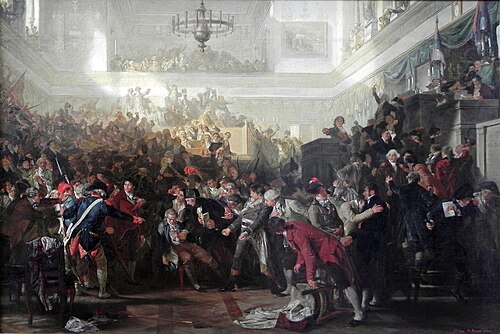
恐怖政治として知られるこの時代は、革命の熱狂を煽る手段として始まったが、すぐに個人的な不満の解決へと堕落した。1793年9月17日、容疑者法により「自由の敵」と疑われる人物の逮捕が認められた。10月10日、国民公会はマクシミリアン・ロベスピエール率いる公安委員会を最高権力者として認め、 「平和が達成される」まで憲法を停止した。[2]
記録によると、1793年9月から1794年7月までに、反革命活動の罪で約16,600人が処刑され、さらに40,000人が即決処刑されたか、裁判を待つ間に死亡したとされる。[3]最盛期には、反革命思想の兆候が少しでも見られれば容疑をかけられることがあり、ロベスピエールの支持者でさえ、ロベスピエールを排除しなければ自分たちの生存は危うくなるのではないかと恐れ始めた。7月27日、ロベスピエールとその仲間は逮捕され、翌日処刑された。[4]
1794年7月、国民公会は1795年憲法の起草委員会を設立した。ピエール・ドーヌーとボワシー・ダングラスが大部分を担当し、二院制議会を設立した。これは、立法過程を遅らせ、以前の一院制制度下での政策の乱高下を終わらせることを意図していた。代議士は間接選挙で選ばれ、総選挙権は約500万人で、3万人の選挙人、つまり人口の0.5%が予備選挙で選出された。代議士には厳格な財産資格も課されたため、保守派や穏健派の代議士の復帰が保証された。[5]
総裁局は、1795年9月24日の国民投票で採択された第3年憲法の後に設立され、 [6] 1795年10月12日から21日に行われた最初の選挙の後に構成された。 10月25日、国民公会は最後の会議を開催し、公安委員会は月末までに解散、というか消滅した。[7] 10月31日、ポール・バラスに加えて、ジャン=フランソワ・ルーベル、ルイ=マリー・ド・ラ・レヴェリエール=レポー、エティエンヌ=フランソワ・ル・トゥルヌール、エマニュエル=ジョセフ・シエイエスが理事に選ばれた。
10月末には、立法府が設立され、500人評議会[8]が法案の起草を担当し、上院である40歳以上の男性250人で構成される古代評議会が法案の審査と承認を担当した。行政権は、下院が用意した名簿から古代評議会が選出した5人の理事が5年の任期で担った。これは、行政権が1人の人物に集中するのを防ぐためであった[5] 。
ダングラスは大会に次のように書き送った。
我々は、5人のメンバーからなる執行部を組織し、毎年1人ずつ新しいメンバーを入れ替えるという、いわゆる「総督」を提案する。この執行部は、迅速かつ強固な体制を築けるほどの力を集中させるが、どのメンバーも暴君になることなど考えられないほどに分散させる。1人の首長では危険である。各メンバーは3か月間議長を務め、その間、国家元首の署名と印章を持つ。総督のメンバーをゆっくりと徐々に入れ替えることで、秩序と継続性の利点を維持し、不便さを感じることなく統一の利点を得ることができる。[9]
新憲法の起草
1789年の人間と市民の権利の宣言は前文として添付され、「社会における人間の権利は自由、平等、安全、財産である」と宣言した。[10]宗教の自由、出版の自由、労働の自由を保証したが、武装集会や政治団体の公開集会さえも禁止した。請願を提出できるのは個人または公的機関のみであった。

司法制度が改革され、裁判官の任期は短くなりました。治安判事は 2 年、地方裁判所判事は 5 年です。裁判官は選挙で選ばれ、再選も可能で、政府の他の部門からの独立性を確保しています。
新しい立法府には、五百人会議と古参会議の二院があり、それぞれ250人の議員で構成されていた。フランスの各州にある選挙議会は、合計3万人の有権者を集め、各県の選挙議会の代表者を選出し、その後、両院の議員を選出した。この立法府の議員の任期は3年で、毎年3分の1の議員が交代した。古参会議は新しい法律を発議することはできなかったが、五百人会議が提案した法律を拒否することはできた。
憲法は、議会によって選出される5人からなる総裁という独特の行政機関を設立した。[11] [12]五百人会議は秘密投票によって総裁候補者のリストを作成する必要があった。次に、古参会議が再び秘密投票によってそのリストから総裁を選んだ。憲法は総裁が少なくとも40歳以上であることを規定していた。徐々にではあるが継続的な変化を確実にするために、くじ引きで選ばれた総裁が毎年交代した。国務大臣は総裁を補佐した。これらの大臣は会議や内閣を構成せず、政府の一般的な権限も持たなかった。
新しい憲法は権力の分立を目指したもので、理事は立法や課税に関して発言権を持たず、理事や大臣はどちらの院にも所属できなかった。理事の独立性を保証するために、各理事は議会の一部によって選出され、法律に違反しない限り議会によって解任されることはなかった。[9]
1795 年の新憲法では、評議会の選挙で投票する資格を得るには、有権者は一定の最低限の財産と居住基準を満たす必要がありました。人口 6,000 人以上の町では、最低 150 日または 200 日の労働で得られる標準収入に相当する収入のある財産を所有または賃貸し、最低 1 年間その住居に住んでいなければなりませんでした。これにより、フランス人人口の大部分が除外されました。
この新制度の最大の被害者は、革命初期に主要な役割を果たしたパリ市であった。1794年8月24日、デモや国民公会への侵入に人材の大半を提供していたジャコバン派の拠点であるパリ各区の委員会が廃止された。その後まもなく、8月31日には、ダントンとロベスピエールの支配下にあったパリ市が廃止され、市は中央政府の直接管理下に置かれることになった。新憲法の適用により、第4ヴァンデミエール年19日(1795年10月11日)の法律がパリの最初の12区を創設すると、各区に1つずつ、12の新しい委員会が設立された。市は、 1790年に創設された旧パリ県に代わる新しい県、セーヌ県となった。 [13] [14]
政治情勢の変遷(1794年7月~1795年3月)

一方、まだ支配的だった国民公会の指導者たちは、左派の新ジャコバン派と右派の王党派の両方からの挑戦に対抗しようとした。1794年9月21日、恐怖政治を推進する激しい記事を書いたジャン=ポール・マラーの遺体が盛大な儀式でパンテオンに安置された一方、同じ日に穏健派の国民公会メンバーであるメルラン・ド・ティオンヴィルはジャコバン派を「無法者のたまり場」であり「ギロチンの騎士」と評した。主に中流階級の家庭出身のミュスカダンと呼ばれる若者たちがジャコバン派と急進派クラブを攻撃した。出版の新たな自由により、左派と右派からの多数の新しい新聞やパンフレットが登場した。例えば、極右に転向した極右ジャコバン派のスタニスラス・フレロンが編集した王党派の『人民弁論家』や、その対極に位置する、社会主義の初期形態を主張した元司祭のグラックス・バブーフが編集した『人民弁論家』などである。1795年2月5日、半官半民の新聞『ル・モニトゥール・ユニヴェルセル』は、恐怖政治の血なまぐさい過激行為を奨励したとしてマラーを非難した。マラーの遺体は2日後、パンテオンから撤去された。[15]恐怖政治中に指導者が処刑されたジロンド派の議員の生き残りは、1795年3月8日に国民公会に復帰した。
国民公会は、ヴァンデ県におけるカトリックと王党派の反乱を平和的に終わらせようとした。国民公会は恩赦協定に署名し、ヴァンデ県民が反乱を止めれば宗教の自由を認め、領土警備隊に武器を保持することを約束した。ボワシー・ダングラスの提案により、1795年2月21日、国民公会は宗教の自由と政教分離を正式に宣言した。[15]
外交政策
1794年7月から1795年10月の新議会選挙までの間、政府は国際平和条約を締結し、フランスの利益を確保しようとした。1795年1月、ピシュグル将軍は極寒の冬に乗じてネーデルラント連邦共和国に侵攻した。彼は1月18日にユトレヒトを占領し、2月14日にはフランス騎兵隊がデン・ヘルダーの氷に閉じ込められていたオランダ艦隊を捕獲した。オランダ政府は和平を求め、オランダ領フランドル、マーストリヒト、フェンローをフランスに割譲した。2月9日、アルプスでのフランス軍の攻勢の後、トスカーナ大公フェルディナンド3世はフランスと条約に調印した。その後まもなく、4月5日、フランスはプロイセンとバーゼル条約に調印し、フリードリヒ・ヴィルヘルム2世は戦争にうんざりし、プロイセンはフランスによるライン川西岸の占領を承認した。 1795 年 7 月 22 日、ピレネー戦争でフランス革命軍がビルバオまで進軍していたスペインとの間で「バーゼル条約」と呼ばれる平和協定が締結されました。総裁が選出された時点で、フランスに対する同盟はイギリスとオーストリアのみとなり、両国はロシアが味方につくことを期待していました。
ジャコバン派のクーデター失敗(1795年5月)とブルターニュの反乱(6月~7月)

1795年5月20日(平原暦3年1月)、ジャコバン派はパリで権力を掌握しようとした。1792年6月のダントンによる国民議会占拠に倣い、サンキュロットの暴徒がチュイルリー宮殿の国民公会の会場に侵入し、議員1人を殺害して新政府の樹立を要求した。このとき、軍は素早く会場を掃討した。侵入者側についた議員数人が逮捕された。翌日も蜂起は続き、サンキュロットは以前の蜂起と同様に市庁舎を占拠したが、効果はほとんどなく、群衆は彼らを支援するために動かなかった。3日目の5月22日、軍はフォーブール・サン・タントワーヌの労働者階級地区に進攻して占拠した。サンキュロットは武装解除され、リーダーたちは逮捕された。数日後、ロベスピエールが率いていた公安委員会の生き残ったメンバーは、カルノーと他の2人を除いて逮捕された。蜂起に参加し死刑判決を受けていた議員6人は、ギロチンにかけられる前に自殺した。[16]
1795年6月23日、ブルターニュの王党派とカトリック教徒の反乱者シューアンは、キブロン近郊で14,000人の軍隊を結成した。イギリス海軍の支援を受けて、2,000人の王党派がキブロンに上陸した。ラザール・オッシュ将軍率いるフランス軍は迅速に対応し、王党派を半島に避難させ、その後撤退させた。王党派は7月21日に降伏し、反乱者748人が銃殺刑に処された。[17]
新憲法の採択
第三年の新憲法は国民公会に提出され、1795年7月4日から8月17日にかけて議論され、1795年8月22日に正式に採択された。それは377条からなる長い文書であり、1793年の最初のフランス憲法の124条と比較すると長かった。しかし、それが発効する前でさえ、国民公会のメンバーは、自分たちが依然として議会で政府よりも優位に立つことを保証するための措置を講じていた。彼らは、最初の選挙で250人の新しい議員が選出され、一方で、次の選挙まで500人の旧国民公会のメンバーが留任することを要求した。その後、有権者による国民投票が行われた。投票者総数は少なく、500万人の有権者のうち、1,057,390人の有権者が憲法を承認し、49,978人が反対した。旧条約加盟国の3分の2が残留すべきとする提案は、205,498対108,754というはるかに小さな差で承認された。[18]
1795年10月 王党派の反乱

1795 年 9 月 23 日、第 3 年の新憲法が正式に発効したが、新評議会はまだ選出されておらず、理事もまだ選出されていなかった。王党派と立憲君主派の指導者たちは、この機会を利用して権力を掌握しようとした。彼らは、新憲法に賛成する票が圧倒的な数ではないことを理解していた。パリの有権者は、新評議会に国民公会の旧メンバーの 3 分の 2 を残すという考えに特に反対だった。パリの裕福な地区からのメンバーで中央委員会が結成され、彼らは市の中心部と、国民公会がまだ会合を開いていたチュイルリー宮殿への行進を計画し始めた。
陰謀の経験が豊富な国民公会の議員たちは、計画が進行中であることをよく知っていた。ポール・バラス率いる5人の共和派議員のグループは、正式なディレクトリの作成を見越して、すでに非公式のディレクトリを作成していた。彼らはパリ西部の国民衛兵を懸念していたが、パリの軍司令官ジャック・フランソワ・ムヌー将軍については確信が持てなかった。バラスは、側近の軍司令官で共和派として知られる人々、特にトゥーロンでイギリス軍と戦って勝利を収めていたときに知り合ったナポレオン・ボナパルトに頼ることにした。この時点で内務省軍の2等将軍であったボナパルトは、右岸の政府庁舎を防衛するよう命じられた。
武装した王党派の反乱軍は、セーヌ川の右岸と左岸に沿って2列に並んでチュイルリー宮殿に向かって行進する計画を立てていた。1795年10月5日、王党派はサブロンでジョアシャン・ミュラ副中尉の砲兵隊に、 サン・ロック教会の前ではボナパルトの兵士と砲兵隊に遭遇した。その後2時間にわたり、ボナパルトの大砲の「ぶどう弾の匂い」と兵士の銃撃が前進する列を容赦なくなぎ倒し、約400人の反乱軍を殺害して反乱を終わらせた。ボナパルトは10月16日に師団長に、10月26日に内軍総司令官に昇進した。これはフランス革命中にパリで起こった最後の反乱であった。[19]
歴史
ディレクトリが主導権を握る
1795 年 10 月 12 日から 21 日にかけて、パリでの王党派の反乱が鎮圧された直後に、新憲法で定められた新しい評議会の選挙が行われた。旧国民公会の 379 名の議員 (ほとんどが穏健な共和主義者) が新しい議会に選出された。総裁が革命を完全に放棄しないことを保証するため、評議会は総裁の議員全員が元国民公会の議員であり、ルイ 16 世の処刑に投票した国王殺害者であることを要求した。
国民会議で定められた規則により、新議会の議員の大多数、すなわち 741 人の代議員のうち 381 人は国民会議で勤務した熱心な共和主義者であったが、選出された新代議員の大部分は王党派であり、左派が 118 人、左派が 11 人であった。上院である古代人評議会のメンバーは、すべての代議員の中からくじ引きで選ばれた。
1795年10月31日、古代人会議は五百人会議が提出した候補者リストから最初の総裁を選出した。選出された一人、アベ・シエイエスは、その役職が自分の興味や性格に合わないとして辞退した。代わりに新メンバーのラザール・カルノーが選出された。 [20]
ディレクトリに選出されたメンバーは次のとおりです。
- ポール・フランソワ・ジャン・ニコラ、バラス子爵はプロヴァンス出身の小貴族の出身で、革命の使節としてトゥーロンに赴き、若きボナパルトと出会い、大尉への昇進を手配した。バラスはロベスピエールによって公安委員会から外されていた。命の危険を感じたバラスはロベスピエールの失脚を画策した。政治的陰謀の専門家であるバラスは、総裁会議で有力な人物となった。総裁会議での主要な対立者カルノーは、バラスを「信念も道徳もなく...政治では人格も決断力もない...裕福な王子の趣味をすべて備え、寛大で、壮麗で、放蕩者」と評した。[21]
- ルイ・マリー・ド・ラ・レヴェリエール=レポーは、熱烈な共和主義者で反カトリック主義者であり、ヴァレンヌへの逃亡後にルイ16世を処刑することを提案した。彼は、キリスト教に代わる新しい宗教である神慈善の設立を推進した。
- ジャン=フランソワ・リューベルは外交関係の専門家で、ポール・バラスの親しい同盟者でもあった。彼は堅固な穏健派の共和主義者で、国王の死刑に賛成したが、ロベスピエールや過激なジャコバン派にも反対していた。彼はカトリック教会に反対し、個人の自由を主張した。
- エティエンヌ=フランソワ・ル・トゥルヌールは元エンジニア大尉であり、軍事および海軍問題の専門家でした。彼はカルノー総裁の親しい同盟者でした。
- ラザール・ニコラ・マルグリット・カルノーは、アンジェリカ派によって選出されたものの辞退したシエイエス神父の跡を継いだ。カルノーは革命当初は陸軍大尉であり、国民公会に選出されると軍事委員会のメンバーとなり、ロベスピエールの熱心な反対者となった。彼は精力的で有能な管理者であり、フランス軍を再編して最初の成功を達成するのを助け、「勝利の組織者」という称号を得た。後にカルノーを陸軍大臣に任命したナポレオンは、彼を「勤勉で、何事にも誠実だが、陰謀を企てず、騙されやすい」と評した。[22]
翌日、新政府のメンバーは、以前は公安委員会が使用していたリュクサンブール宮殿の事務所に着任した。何も準備されておらず、部屋には家具もなかった。彼らはなんとか部屋を暖めるための薪と、仕事をするためのテーブルを見つけた。メンバーはそれぞれ特定の分野を担当した。リューベルは外交、カルノーとル・トゥルヌールは軍事、ラ・レヴェリエール=レポーは宗教と国民教育、バラスは内政を担当した。
古代議会はチュイルリー宮殿のかつて国民公会が使用していた建物で開かれ、一方五百人会議は宮殿の西側、チュイルリー庭園にあるかつての乗馬学校である馬場(Salle du Manège)で審議した。新議会が最初に決めたことの一つは、両院の制服を定めることだった。五百人会議は長い白いローブに青いベルト、緋色のマント、青いベロアの帽子を着用し、古代議会のメンバーは青紫色のローブ、緋色の帯、白いマント、紫色の帽子を着用した。 [23]
ギャラリー
-
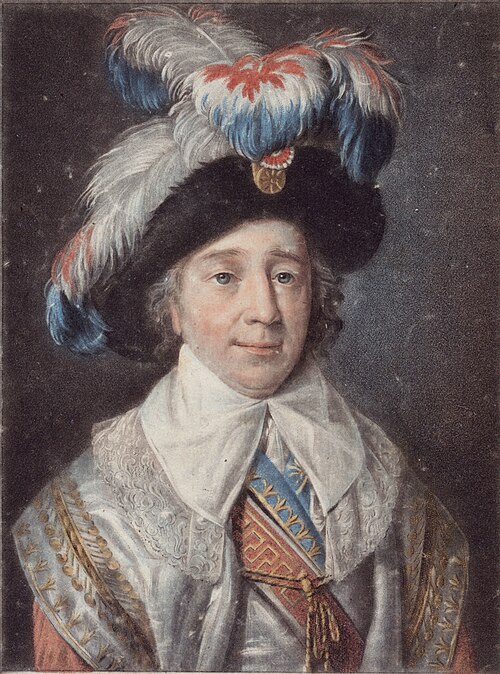 ポール・バラス(ここでは監督の礼服を着ている)は政治的陰謀の達人だった
 -

-

-

-
 ラザール・カルノーは、優れた組織者であり数学者であったが、陰謀家としては下手で、バラスの敵であった。
金融と経済
財務を監督する新しい長官、ラ・レヴェイエール=レポーは、総裁が権力を握ったときのフランスの財政状態を簡潔に描写した。「国庫は完全に空っぽで、1スーも残っていなかった。アシニヤはほとんど価値がなく、残ったわずかな価値は毎日加速度的に減少していった。翌日の最も差し迫ったニーズを満たすのに十分なお金を一晩で印刷することはできなかった。…公的収入は存在せず、国民は税金を払う習慣を失っていた。[…] 公的信用はすべて死に、すべての信頼は失われた。[…] アシニヤの価値の下落、恐ろしいほどの下落速度により、すべての公務員と役人の給与は完全に名目上の価値にまで減少した。」[24]
貨幣価値の低下は異常なインフレを伴った。総督令発布当初は紙幣価値が 2,000 ₶だったルイ・ドール(金貨)は、3,000 ₶ に、そして 5,000 ₶ に値上がりした。ワイン 1 リットルの価格は、1795 年 10 月の 2 ₶.10シリングから 10 ₶ に、そして 30 ₶ に値上がりした。1790 年に 2 ₶ だった小麦粉 1 升は、1794 年 10 月には 225 ₶ になった。[24]
新政府は、教会と貴族から没収した財産の価値に基づいてアシニヤ紙幣を印刷し続けたが、十分な速さで印刷することができなかった。1日に1億枚印刷しても、政府の必要量の3分の1しかカバーできなかった。国庫を補充するために、総裁は1795年12月に裕福な市民から6億₶の強制融資に頼った。市民は1人当たり50₶から6,000₶の支払いを要求された。

インフレと戦うため、政府は実質的な価値のある金貨や銀貨の鋳造を増やし始めた。政府は金貨をほとんど持っていなかったが、銀の備蓄は豊富で、その多くは教会や貴族から没収した銀食器、燭台、その他の物品の形での備蓄であった。政府は 7,200 万エキュを鋳造し、この銀の供給が底をつくと、フランス国外での軍事作戦、特にイタリアのボナパルト軍からの軍事作戦を通じてさらに多くの金銀を獲得した。ボナパルトは征服した各都市に金や銀を要求し、支払わない場合は都市を破壊すると脅した。
これらの措置により、インフレ率は低下した。1796年2月19日、政府はヴァンドーム広場で式典を開催し、大量のアシニヤを印刷するために使用されていた印刷機を破壊した。この成功は新たな問題を引き起こした。国には依然として24億(2,400,000,000)以上のアシニヤ(没収された財産に対する債権)が溢れており、それらの財産には今やいくらかの価値があった。アシニヤを保有する者はそれを国債と交換することができ、それを使って城、教会の建物、その他の国有財産( biens nationaux )を非常に安い価格で購入することができた。投機が横行し、パリや他の都市の財産は1日に何度も売買されるようになった。
総裁が直面したもう一つの大きな問題は、革命のきっかけとなった膨大な公的債務であった。1797年9月から12月にかけて、総裁は債務の3分の2を破産宣告し、残りの3分の1の支払いを保証することでこの問題に対処した。この結果、国債を大量に保有していた人々は破産したが、通貨は安定していた。総裁は国庫を充実させるために、住宅の暖炉と煙突の数、後には窓の数に基づいて、財産所有者に新しい税金を課した。1789年の革命の原因となったワインと塩への課税は控えたが、金銀製品、トランプ、タバコ、その他の贅沢品には新しい税金を加えた。これらの手段により、総裁は財政の比較的安定をもたらし、総裁と領事館を通じてそれが続いた。[25]
食糧供給
革命前および革命中、国民、特にパリ市民への食糧供給は、大きな経済的、政治的問題であった。この問題は、パリでの食糧暴動や国民公会への攻撃につながった。ジャコバン派の支持基盤であるパリのサンキュロットへの食糧供給を保証するため、国民公会は穀物の配給を厳しく規制し、パンやその他の必需品に最高価格を設定した。通貨価値が下落するにつれ、固定価格ではすぐに生産コストをカバーできなくなり、供給が落ち込んだ。国民公会は1794年12月24日に最高価格を廃止せざるを得なかったが、大量のパンや肉を購入し続け、パリ市民に低価格で配給した。このパリへの食糧配給は国家予算の大きな部分を費やし、その恩恵を受けていない国の他の地域から不満を招いた。1796年初頭までに、穀物供給はイタリア、さらにはアルジェリアからの配達によって補われた。輸入が増加したにもかかわらず、パリへの穀物供給は十分ではなかった。 1796年3月23日、内務省は5日分のパンを作るのに十分な小麦しかなく、肉と薪が不足していると報告した。総裁は極貧者、老人、病人、政府職員への補助金付き食糧の配給を再開せざるを得なかった。食糧不足と高価格が不満の高まりと、 1796年のグラックス兄弟の反乱(平等の陰謀)の一因となった。その後の数年間は収穫が豊かで食糧供給は大幅に改善したが、北部、西部、南東部、セーヌ川流域では供給が不安定だった。[26]
バブーフの平等の陰謀

1795年、総裁制は新たな左派の脅威に直面した。それはフランソワ・ノエル・バブーフの支持者だった。バブーフは有能な政治運動家で、グラックスという名前を名乗り、のちに「平等の陰謀」として知られる陰謀を企てた人物だった。バブーフは1789年以来、農地法に惹かれていた。農地法とは、古代ローマの兄弟ティベリウスとガイウス・グラックスが経済的平等を達成する手段として財貨を共有するという農地改革だった。ロベスピエールが失脚する頃には、彼はこれを非現実的な計画として放棄し、より複雑な計画へと移行していた。[27]バブーフは私有財産の廃止は求めず、農民は自分の土地を所有すべきだと書いたが、すべての富は平等に共有されるべきだと提唱した。つまり、能力のあるすべての市民は働くことを義務付けられ、全員が同じ収入を得るというものである。バブーフはフランス国民の大半が自治の準備ができているとは考えていなかった。そのため、国民が責任を取れるほど教育を受けるまで、自らの指導の下で独裁制を敷くことを提案した。「国民よ!」とバブーフは書いている。「呼吸し、見よ、汝の導き手、汝の守護者を認めよ。……汝の護衛は自信を持って現れる。」[28]
当初、バブーフの支持者は少なかった。彼の新聞「人民のトリビューン」の読者は、新政府から排除された中流階級の極左ジャコバン派がほとんどだった。しかし、アシニヤの価値が下がり、賃金が急激に下がり、食料価格が上昇したことで、首都の労働者階級の間でバブーフの人気が高まった。1795年10月から、彼は最も急進的なジャコバン派と同盟を組み、1796年3月29日には「平等の秘密指令部」を結成した。この指令部は、パンフレットやプラカードを通じて「人民を革命化」し、最終的には政府を打倒することを提唱した。彼は、フェリックス・ルペルティエ、ピエール=アントワーヌ・アントネル、シルヴァン・マレシャル、ジャン=ピエール=アンドレ・アマール、ジャン=バティスト・ロベール・リンデを含む空想的社会主義者と急進的なジャコバン派の同盟を結成した。平等陰謀団は斬新な方法で組織された。中心にいたのはバブーフと秘密総裁で、彼らは身元を隠し、信頼できる仲介者を介してのみ他の陰謀団のメンバーと情報を共有していた。この陰謀構造は、後にマルクス主義運動に採用された。彼の用心にもかかわらず、総裁は陰謀にエージェントを潜入させ、その行動を完全に把握していた。[29]内軍の司令官に新たに任命されたナポレオン・ボナパルトは、パリのジャコバン派の主要な集会所であるパンテオン・クラブを閉鎖するよう命じられ、1796年2月27日にそれを実行した。総裁は反乱を防ぐために他の手段も講じた。ジャコバン派が主導する地方警察である警察軍団(légion de Police)は強制的に軍の一部となり、軍は近隣地域を巡回して暴動を阻止するための機動部隊を組織した。[30]
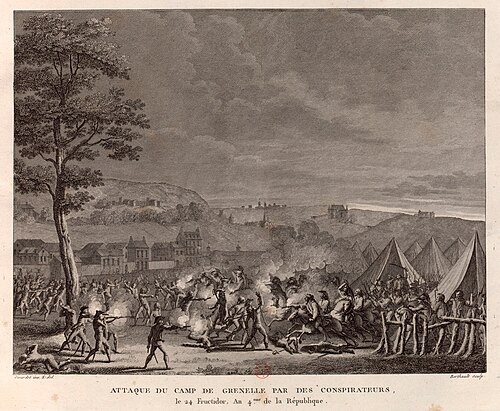
バブーフとその陰謀が実行に移される前に、彼は警察のスパイに裏切られ、1796年5月10日に隠れ家で逮捕された。彼は有能な扇動者ではあったが、非常に下手な陰謀家だった。彼の隠れ家には、陰謀の完全な記録と、陰謀者全員の名前が残されていた。この挫折にもかかわらず、陰謀は計画を進めた。1796年9月9日から10日の夜、400人から700人のジャコバン派がグルネルの第21竜騎兵連隊 ( 21e régiment de dragons ) 軍の駐屯地に行き、総裁制に対する武装蜂起を扇動しようとした。同時に、パリの労働者階級地区では、総裁制の本部であるリュクサンブール宮殿に向かって行進する戦闘員の隊列が形成された。カルノー長官は前夜、陣営の司令官から連絡を受けており、竜騎兵部隊の準備が整っていた。攻撃が10時頃に始まると、竜騎兵が突然現れ、突撃した。ジャコバン派約20名が殺害され、残りは逮捕された。戦闘員隊は何が起こったかを知り、混乱して解散した。バブーフの戦闘員とジャコバン派の広範な逮捕が続いた。ロベスピエールの失脚後中止された、夜間に容疑者を自宅で逮捕する慣行が、この機会に再開された。
逮捕されたにもかかわらず、牢獄にいたバブーフは政府と交渉できると感じていた。彼は総裁に手紙を書いた。「市民総裁たちよ、なぜあなたたちは上に立って、私と同等の力で接しないのか?あなたたちは今、私がその中心にいる大きな自信を目にした...この見方はあなたたちを震え上がらせる。」[31]バブーフの支持者たちは彼を刑務所から解放しようと何度も試みた。彼は最終的に裁判のためヴァンドームに移送された。総裁は震えなかった。告発されたジャコバン派は9月19日から10月27日まで軍事法廷で裁判にかけられた。国民公会の元代議員3人を含む30人のジャコバン派が有罪判決を受けギロチンで処刑された。バブーフとその主要な支持者たちは1797年2月20日から5月26日までヴァンドームで裁判にかけられた。2人の主要指導者、バブーフとオーギュスタン・アレクサンドル・ダルテは有罪判決を受けた。二人とも自殺を図ったが失敗し、1797年5月27日にギロチンで処刑された。しかし、その後の数か月で、総裁会議と評議会は徐々に王党派右派から離れ、左派に新たな同盟者を見つけようとした。[31] [32] [33]
戦争と外交(1796-1797)
総裁制の存続期間中の主な関心事は、イギリスとオーストリアの連合国との戦争であった。1795年10月に国民公会で定められた軍事目標は、フランスをその自然限界と宣言された範囲、すなわちピレネー山脈、ライン川、アルプス山脈、ローマ帝国時代のガリア国境まで拡大することであった。1795年、プロイセン、スペイン、ネーデルラント共和国は第一次対仏大同盟戦争から離脱し、フランスと講和したが、イギリスはオーストリア領ネーデルラントのフランス併合を拒否した。イギリスとオーストリアの他に、フランスにとって残された敵はサルデーニャ王国といくつかのイタリアの小国だけであった。オーストリアは国境を定めるために欧州会議を提案したが、総裁制はこれを拒否し、代わりにオーストリアとの直接交渉を要求した。イギリスの圧力により、オーストリアはフランスとの戦争継続に同意した。[34]
軍事を監督する長官ラザール・カルノーは、3つの軍を使ってオーストリアに対する新たな作戦を計画した。ライン川沿いのジャン=バティスト・ジュールダン将軍のサンブル=エ=ムーズ軍とドナウ川沿いのジャン・ヴィクトル・モロー将軍のライン・モーゼル軍はウィーンに進軍し、和平を主張する。3つ目の軍、王党派の反乱から政府を守ったことで驚異的なスピードで昇進したボナパルト将軍のイタリア軍は、北イタリアでオーストリアに対する陽動作戦を遂行する。ジュールダン軍はマイエンスとフランクフルトを占領したが、1796年8月14日のアンベルクの戦いでオーストリア軍に敗れ、1796年9月3日のヴュルツブルクの戦いでも再び敗れ、ライン川まで撤退せざるを得なかった。ジュールダンの支援を失ったモロー将軍も撤退を余儀なくされた。
イタリア戦役


イタリアでは話は大きく異なっていた。ボナパルトはわずか28歳であったが、総督府のパトロンであるバラスの影響で、1796年3月2日にイタリア軍の司令官に任命された。ボナパルトは7万人のオーストリア・サルデーニャ連合軍と対峙した。ボナパルトは両軍の間に軍を潜り込ませ、一連の戦闘で両軍を打ち破り、 1796年4月22日のモンドヴィの戦いでサルデーニャ軍を破り、 5月10日のローディの戦いでオーストリア軍を破った。サルデーニャ王ヴィットーリオ・アマデーオ3世は1796年5月に和平を余儀なくされ、ニースとサヴォワをフランスに割譲した。
1796年末、オーストリアはボナパルトを追い出すために2つの新しい軍隊をイタリアに派遣したが、ボナパルトは両軍を出し抜き、1796年11月17日のアルコレの戦いで最初の勝利を収め、続いて1797年1月14日のリヴォリの戦いで勝利した。彼はオーストリアにカンポ・フォルミオ条約(1797年10月)に署名するよう強制し、それによってフランソワ2世はヴェネツィアと引き換えにロンバルディアとオーストリア領ネーデルラントをフランス共和国に割譲し、帝国議会にライン川の向こうの領土を明け渡すよう促した。[35]
スペイン同盟
総裁は、スペインと同盟を組んでイギリスと大陸との通商を阻止し、イギリス船の地中海への進入を禁じようと熱望していた。1796年8月に締結された第二次サンイルデフォンソ条約により、スペインはフランスの同盟国となり、10月5日にイギリスに宣戦布告した。ジャーヴィス提督率いるイギリス艦隊は、サンビンセント岬でスペイン艦隊を破り、イギリス船の地中海への進入を保ったが、イギリスは艦隊内でのスピットヘッド号とノール号の反乱によって極度の危機に陥り、フランスによるネーデルラント征服を承認し、奪取したカリブ海とインドにあるフランス植民地を返還することを提案した。
アイルランドの不運
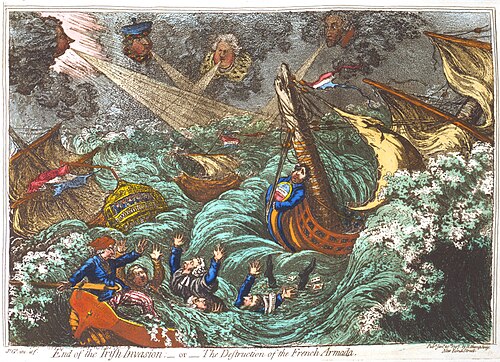
総裁政府はまた、イギリスの利益を損ない、ブルターニュの王党派反乱軍へのイギリスの支援に報いる新たな方法を模索した。1796年12月15日、44隻のフランス艦隊がブレストを出港し、オッシュ将軍率いる14,000人の遠征軍を乗せてアイルランドに向かった。遠征軍はアイルランドの反乱軍と合流し、アイルランド王国からイギリス軍を追い出すことを目指していた。しかし、艦隊はアイルランド沖で嵐に遭い、アイルランドに上陸できず、31隻の船と12,000人の生き残りの兵士を連れて母港に戻らざるを得なかった。
王党派の台頭とクーデター(1797年)
総裁制の成立後、最初の選挙は1797年3月と4月に行われ、評議会の議員の3分の1が入れ替わった。選挙は国民公会の旧メンバーにとって大敗で、216人中205人が落選した。国民公会の旧議員のうち再選されたのはわずか11人で、そのうち数人は王党派だった。[36]選挙は特に南部と西部で王党派の勝利となった。選挙後には王党派議員が約160人となり、絶対君主制への回帰を支持する議員と、英国モデルに倣った立憲君主制を望む議員に分かれた。評議会に選出された立憲君主主義者には、後に家族とともに米国に移住し、その息子のエルーテール・イレネー・デュポンが「EIデュポン・ド・ヌムール商会」(現在はデュポン)を設立したピエール・サミュエル・デュポン・ド・ヌムールなどがいた。パリやその他の大都市では左派の候補者が優勢だった。元ジャコバン派で一般軍人だったが、革命で最も成功した将軍の一人となったジャン=シャルル・ピシュグル将軍が、新しい五百人評議会の議長に選出された。外交官で、将来ルイジアナの米国への売却交渉者となるフランソワ・バルベ=マルボワが、古代人評議会の議長に選出された。
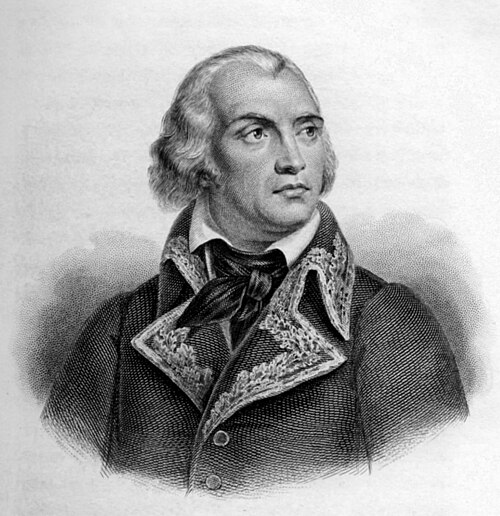
王政は厳密には合法ではなく、議員は自らを王政を名乗ることはできなかったが、すぐに王政派の新聞やパンフレットが登場し、劇場では王政支持のデモが行われ、王政派はルイ16世の処刑を悼んで黒のビロードの襟など王政派を示す衣服を身につけた。議会の王政派は政府の財政政策の変更と、宗教に対するより寛容な姿勢を要求した。国民公会の間、教会は閉鎖され、司祭は政府に宣誓することを義務付けられた。宣誓を拒否した司祭は国外追放され、戻れば死刑に処せられた。総督令の下で多くの司祭がひっそりと戻り、全国の多くの教会が再開してひっそりと礼拝を行っていた。総裁が著名な数学者で哲学者のルネ・デカルトの遺灰をパンテオンに移すことを提案したとき、元ジロンド派でジャコバン派に反対していた副総裁のルイ・セバスチャン・メルシエは、デカルトの思想が革命の恐怖政治を引き起こし、フランスの宗教を破壊したと抗議した。デカルトの遺灰は移されなかった。[37]革命中に国を離れた亡命者は、国民公会から、帰国すれば死刑にすると脅されていたが、総裁の指揮下で、彼らはひっそりと帰国し始めた。[38]


議会派の王党派と並行して、直接のつながりはないが、当時ドイツに亡命していたルイ18世をフランス王位に就けることを目的とした王党派の秘密組織が存在した。この組織は主にイギリスから資金提供を受けており、スイスに本部を置くイギリス諜報機関長ウィリアム・ウィッカムの事務所を通じて運営されていた。この組織は分裂しすぎており、警察の監視も厳重だったため、政治に影響を及ぼすことはできなかった。しかし、ウィッカムはフランス政治に決定的な影響を与えることになる接触を一つ行っていた。仲介者を通じて、当時のライン軍司令官ピシュグル将軍と交渉を行ったのである。[39]
総裁会議自体も分裂していた。カルノー、ルトゥルヌール、ラ・レヴェリエール・レポーは王党派ではなかったが、より穏健で宗教に寛容な政府を支持していた。カルノー自身は公安委員会のメンバーだったが、ジャコバン派は統制不能であり、革命は永遠に続くことはなく、今こそ終わらせるべき時だと宣言した。外交官で新メンバーのフランソワ・マリー・ド・バルテルミー侯爵が総裁会議に加わり、カルノーと同盟を組んだ。評議会の王党派は直ちに政府、特に財政面での権限拡大を要求し始め、バラスの立場を脅かした。[40]
完璧な陰謀家バラスは、ラ・レヴェリエール・レポーを味方につけ、王党派の失脚を計画し始めた。捕らえられた王党派のエージェントから受け取った手紙から、彼はピシュグル将軍がイギリスと接触したこと、そして彼が亡命中のルイ18世と接触していたことを知っていた。彼はこの情報をカルノーに伝え、カルノーは公会議に対する彼の行動を支援することに同意した。新しく陸軍大臣となったオッシュ将軍は、サンブル=エ=ムーズ軍をパリ経由でブレストへ行軍させるよう指示された。その理由は、彼らがアイルランドへの新たな遠征に出発するという口実だった。オッシュ将軍自身は7月22日に陸軍大臣を辞任した。ボナパルトの側近で同盟者のピエール・オージュロー将軍とその軍隊は8月7日にパリに到着したが、兵士が公会議の許可なしに市から12リーグ以内にいることは憲法違反であった。評議会の王党派のメンバーは抗議したが、彼らを追い払うことはできなかった。[41]
1797年9月4日、軍隊が配備され、治世第5年フルクチドール18日のクーデターが始まった。オージュロー将軍の兵士たちはピシュグル、バルテルミー、および評議会の王党派の代表議員を逮捕した。翌日、総裁会議は53県の約200人の議員の選挙を無効とした。[42] 65人の議員がギアナに移送され、42の王党派の新聞が廃刊となり、65人のジャーナリストと編集者が移送された。カルノーとバルテルミーは総裁会議から除名された。カルノーはスイスに亡命し、後に帰国して一時期、ボナパルトの陸軍大臣となった。バルテルミーとピシュグルはともにフランス領ギアナ(悪魔の島)に流刑となった。 1798 年 6 月、2 人は逃亡し、まずアメリカへ、その後イギリスへ渡りました。領事館の滞在中、ピシュグルは密かにパリに戻り、1804 年 2 月 28 日に捕らえられました。彼は 1804 年 4 月 6 日に獄中で、絞殺されたか自殺したかのどちらかで亡くなりました。
第二総督令とジャコバン派の復活
クーデターの後、エクスアンプロヴァンス、タラスコン、その他の町、特に南西部と西部で王党派による反乱が散発的に起こった。総裁会議の委員がリヨンで暗殺され、10月22日には反革命派がカルパントラの市政府を24時間掌握した。これらの短い反乱は、新政府による一連の弾圧を正当化するだけに終わった。[43]
カルノーとバルテルミーが総裁会議から退き、王党派が評議会から追放されたため、ジャコバン派が再び政権を握った。総裁会議の2つの空席には、恐怖政治時代に容疑者法の起草に携わった弁護士のメルラン・ド・ドゥエーと、詩人で内陸航行産業の専門家であったフランソワ・ド・ヌフシャトーが就任したが、その任期はわずか数ヶ月だった。新政府の12人の理事と大臣のうち8人は国王殺害者で、国民公会の議員としてルイ16世の処刑に賛成票を投じており、革命を継続する決意を固めていた。[44] [45]
中央政府と市政府から王党派の疑いのある人物が速やかに排除された。次の標的はフランスに帰国し始めた貴族の亡命者と司祭たちだった。評議会のジャコバン派は1793年の法律の施行を要求した。亡命者は15日以内にフランスを離れるよう命じられた。従わない場合は軍事委員会で裁かれ、身分証明さえあれば24時間以内に処刑されることになった。帰国した亡命者だけでなく反逆者や陰謀者も裁くため、全国に軍事委員会が設立された。1797年9月4日から1799年の総裁制終了までの間に、41人の司祭と数人の女性を含む160人が軍事法廷で死刑を宣告された。[46]
1797年10月16日、五百人会議は、貴族の政治活動を禁止する新しい法律を検討した。貴族は外国人とみなされ、政治に参加するには帰化を申請しなければならなかった。名前が挙げられた一定数の人々は、永久に政治活動を禁止され、財産を没収され、直ちに国外退去を命じられることになっていた。法律は、政府と軍の関係者には一定の例外を設けていた(バラス長官とボナパルト将軍はどちらも小貴族の出身だった)。結局、この法律に対する抵抗が大きかったため、採用されなかった。[47]
ジャコバン派が中心となった評議会はまた、政府への宣誓と、王室と無政府状態への憎悪を宣言する宣誓を拒否した司祭の追放を要求した。267人の司祭がフランス領ギアナのカイエンヌにあるフランスの流刑地に移送され、そのうち111人が生き延びてフランスに帰国した。920人がイル・ド・レ島の流刑地へ、そして120人(その大部分はベルギー人)がイル・ド・オレロン島の別の流刑地へ送られた。[48] [49]新政府は国民公会の反宗教政策を継続した。パリのノートルダム大聖堂やサン・シュルピス教会を含むいくつかの教会は、神の存在と人間の精神の不滅を信じる新しい宗教であるテオフィラントロピック寺院に改造された。日曜日の宗教行事は禁止された。フランス共和政の暦の10日週(10年)の最終日のみ、礼拝が許された。[50]その他の教会は閉鎖されたままで、鐘を鳴らすことも禁じられたが、多くの宗教儀式が個人の家で秘密裏に行われた。国民衛兵は、隠れている司祭や貴族を探すために田舎や森を捜索するために動員された。恐怖政治の時代と同様に、暴動が起こった場合に逮捕される容疑者のリストが作成された。[46]
ジャコバン派が支配する新しい総裁と政府は、報道機関も標的とした。新聞社は、発行物の写しを警察に提出し、正式な承認を得るよう義務付けられた。1797年12月17日、総裁の命令によりパリの17の新聞が閉鎖された。総裁はまた、郵便で配布されるすべての新聞や雑誌に多額の税金を課したが、ジャコバン派の出版物、科学や芸術の出版物は除外された。ジャコバン派を批判する書籍は検閲され、ルイ=マリー・プリュドムの6巻からなる「フランス革命中に犯された誤り、過失、犯罪の一般的かつ公平な歴史」 [51]は警察に押収された。総裁はまた、フランス国外から届いた手紙を開封して読むことを許可した。[52]
こうしたすべての安全対策にもかかわらず、フランスの田舎では山賊や強盗が急増し、旅行者が道路で呼び止められ、強盗に遭うことが頻繁にあった。強盗はしばしば王党派の犯行とされた。1798年1月18日、評議会は盗賊や山賊に対する新しい法律を可決し、軍事法廷で裁判にかけることを求め、フランスの道路上での強盗や強盗未遂に死刑を科すことを認可した。[53]
総裁制下での政治的弾圧と恐怖政治は実際に行われたが、ロベスピエールと国民公会の恐怖政治に比べれば規模ははるかに小さく、弾圧された人々の数は総裁制の期間中に減少した。1798年以降、フランス領ギアナに送られる政治犯はなくなり、総裁制の最終年には政治犯罪で処刑されたのは1人だけだった。[54]
1798年の選挙
1798 年の春、立法府の 3 分の 1 を新たに選出する必要があっただけでなく、フルクチドール革命で追放された議員の席も埋める必要があった。750 議席のうち 437 議席が空席だった。選挙は 4 月 9 日から 18 日の間に行われた。王党派は失格となり、穏健派は混乱に陥る一方、急進派ジャコバン派は健闘した。新しい議員が就任する前に、バラスと他の理事 (新しいジャコバン派よりも穏健派) は、選挙を審査する委員会を組織し、より過激なジャコバン派の候補者の多くを失格とし (フロレアル 6 年 22 日法律)、穏健派に置き換えた。彼らは、急進派を除いた理事候補者のリストを評議会に送った。フランソワ・ド・ヌフショートーはくじ引きで総裁会議を離れることになり、バラスは彼に代わる人物として穏健なジャコバン派のみを提案した。その候補は弁護士のジャン=バティスト・トレイルャールだった。これらの政治的策略により総裁会議の権力は確保されたが、穏健な総裁会議と評議会における急進的なジャコバン派の多数派との間の溝はさらに広がった。[55]
戦争と外交(1798)
1797年10月17日、ナポレオンはオーストリアとカンポフォルミオ条約を締結した。これはフランスの勝利であった。フランスはライン川左岸の南はケルン、ベルギー、そしてヴェネツィア共和国に属していたイオニア諸島を獲得した。オーストリアは補償としてヴェネトと旧ヴェネツィア領ダルマチアを与えられた。11月下旬から12月にかけて、ナポレオンは第2回ラシュタット会議で神聖ローマ帝国およびオーストリアとの交渉に参加し、ドイツの国境を引き直すことにした。その後、彼はパリに呼び戻され、カルノー長官とオッシュ将軍が提案したさらに野心的な計画、イギリス侵攻の指揮を執った。しかし、侵攻艦隊の準備が進められていた港を8日間視察したナポレオンは、侵攻が成功する可能性はほとんどないと確信した。船の状態は悪く、乗組員の訓練も不十分で、資金と兵站が不足していた。彼は仲間のマルモンに個人的に総督府に対する見解を伝えた。「この連中では何もできない。彼らは偉大さを何も理解していない。我々は東方計画に戻る必要がある。偉大な成果を達成できるのは、そこでのみだ。」[56]イングランド侵攻は中止され、代わりにアイルランドの蜂起を支援するというそれほど野心的でない計画が提案された(下記参照)。
姉妹共和国
1798年の総裁制は、軍隊の支援を得て、ヨーロッパに「姉妹共和国」を創設し、同じ革命的価値観と目標を共有し、フランスの自然な同盟国となることを目指した。ネーデルラント共和国(ネーデルラント七国連合共和国)では、フランス軍が総裁制と2つの選挙で選ばれた評議会という同じ制度を持つバタヴィア共和国を樹立した。ミラノでは、総裁制と評議会、およびフランス軍が共同で統治するチザルピーナ共和国が樹立された。ボナパルトに代わってイタリア軍司令官となったルイ=アレクサンドル・ベルティエ将軍は、パリの総裁制の行動を模倣し、新共和国の議会から過激すぎると考えた議員を一掃した。ジェノヴァではリグリア共和国が樹立された。ピエモンテもフランス軍によって姉妹共和国、ピエモンテ共和国にされた。トリノでは、シャルル・エマヌエーレ4世(妻のクロティルドはルイ16世の末妹)がフランスの支配から逃れ、イギリス艦隊の保護を受けてサルデーニャ島へ航海した。サヴォワでは、バルテルミー・カトリーヌ・ジュベール将軍が姉妹共和国を形成することに煩わされず、単にその州をフランスの県とした。[57]
総裁制はローマとその周囲の教皇領を統治していた教皇ピウス6世の権威も直接攻撃した。1797年12月28日のクリスマス直後、ローマで反フランス暴動が起こり、フランス軍准将マチュラン=レオナール・デュフォが暗殺された。教皇ピウス6世は迅速に行動し、1797年12月29日に総裁制に正式に謝罪したが、総裁制は謝罪を拒否した。その代わりに、ベルティエの軍隊がローマに入り、1798年2月10日に市を占領した。こうしてローマ共和国も1798年2月10日に宣言された。ピウス6世は逮捕され、トスカーナ大公国に拘留された後、1799年にフランスに連行された。バチカンの財政金3000万フランはパリに送られ、そこでボナパルトのエジプト遠征の資金として役立てられ、絵画、彫像、その他の美術品500ケースがフランスに送られ、ルーブル美術館のコレクションに加えられた。[58]
ギヨーム・ブリューヌ将軍率いるフランス軍がスイスの大部分を占領した。ヘルヴェティア共和国は1798年4月12日に宣言された。1798年8月26日、ジュネーヴは新共和国から分離され、フランスの一部となった。ベルンの財政は接収され、バチカンの財政と同様に、ナポレオン1世のエジプト遠征の資金として使われた。
新たな軍事作戦には何千人もの兵士の追加が必要だった。総督は最初の恒久的な徴兵法を承認したが、これは地方、特に正式にフランスの一部となったベルギーでは不評だった。ベルギーの地方では暴動と農民蜂起が起こった。フランス当局は騒乱の原因をベルギーの司祭に求め、数千人の司祭の逮捕と国外追放を命じた。[59]
ボナパルトのエジプト遠征(1798年5月)
フランス軍のエジプト遠征は、1797年7月3日にはシャルル・モーリス・ド・タレーラン=ペリゴールがフランス学士院への回想録で、また翌月にはタレーランからボナパルトに宛てた手紙で提案されていた。エジプト遠征の目的は3つあった。スエズ地峡を占領してイギリスからイギリス領インドへの最短ルートを遮断すること。イギリスの封鎖によりフランスでは不足していた綿花とサトウキビを生産できる植民地を設立すること。そして将来フランスがイギリス領インドを攻撃するための基地を提供すること。また、ボナパルトにとって個人的にもいくつかの利点があった。それは、不人気な総裁から距離を置きつつ、同時に世間の注目を浴び続けることができたことだった。[60]

総裁府自身は、新たな大戦争が勃発しつつある時期に、最も成功した将軍とその軍隊をヨーロッパから遠ざけることになるこの考えに熱心ではなかった。ラ・レヴェリエール・レポー長官は次のように書いている。「この考えは総裁府やその構成員から出たものではない。ボナパルトの野心と誇りは、もはや目立たず総裁府の命令に従うという考えを支持することはできなかった。」
このアイデアには、他に2つの問題があった。共和制フランスの政策は植民地化に反対であり、フランスはエジプトが属するオスマン帝国と戦争状態ではなかった。そのため、この遠征には「世界を啓蒙し、科学のための新たな宝物を得る」という追加の科学的目的が与えられた。この遠征には、21人の数学者、3人の天文学者、4人の建築家、13人の博物学者、同数の地理学者、さらに画家、ピアニスト、詩人のフランソワ=オーギュスト・パルセヴァル=グランメゾンという、著名な科学者の大規模なチームが加わった。[61]
1798年5月19日、ナパルトを乗せた200隻の船と、そのほとんどがイタリア軍の退役軍人からなる東方軍3万5千人の兵士がトゥーロンを出航した。ネルソン指揮下のイギリス艦隊は、フランス軍がコンスタンティノープルへ遠征することを予想していたが、彼らを阻止する位置にいなかった。フランス艦隊はマルタ島に短時間停泊し、島を占領したが、島政府はほとんど抵抗しなかった。ナパルト軍は7月1日にアレクサンドリア湾に上陸し、ほとんど抵抗を受けずに7月2日に同市を占領した。ナパルトはエジプト総督に手紙を書き、エジプトをマムルーク朝の圧政から解放するのが目的であると主張した。彼の軍隊は極度の暑さにもかかわらず砂漠を進軍し、 1798年7月21日のピラミッドの戦いでマムルーク軍を破った。しかし数日後の8月1日、ネルソン提督率いるイギリス艦隊が海岸に到着し、フランス艦隊は不意を突かれてナイルの戦いで壊滅した。フランス艦隊はわずか4隻しか逃れられず、ナイル川のほとりで捕虜となった。ボナパルトとその軍隊はエジプトで捕虜となった。[62]
アイルランドでの反乱の失敗(1798年8月)
アイルランドの反乱を支援するもう一つの試みは、1798年8月7日に行われた。フランス艦隊は、ジャン・ジョセフ・アマーブル・ハンバート将軍率いる遠征軍を乗せてロシュフォール=シュル=メール(ロシュフォール)を出航した。この攻撃は、ウルフ・トーン率いるアイルランド民族主義者の反乱を支援することが目的だった。トーンは時期を調整するためにフランスでナポレオン・ボナパルトと数回会談したが、アイルランド王国内の反乱は早くから始まり、フランス艦隊が到着する前の1798年7月14日に鎮圧された。フランス軍は8月22日にアイルランド北西部のキララに上陸した。フランス軍は8月24日と27日の2回の小規模な戦闘でイギリス軍を破り、ハンバートは8月27日にキャッスルバーでアイルランド共和国の樹立を宣言したが、フランス軍は1798年9月8日のバリナマックの戦いでイギリスのアイルランド総司令官コーンウォリス卿の軍隊に敗れた。フランス遠征軍の第二部隊は、第一部隊が降伏したことを知らずに、9月16日にブレストを出発した。ドニゴール湾でイギリス海軍に阻止され、フランス軍艦6隻が拿捕された。[63]
アメリカとの準戦争(1798年~1799年)
アメリカとフランスの緊張は、宣戦布告のない海戦である擬似戦争に発展した。フランスは、アメリカが、フランスをアメリカ独立戦争に引き入れた1778年の同盟条約を無視していると不満を述べた。アメリカは、フランスとイギリスの戦争では中立の立場を取ることを主張した。イギリスとのジェイ条約が1795年に発効した後、フランスはアメリカに反対するようになり、1797年までに300隻以上のアメリカ商船を拿捕した。連邦党はイギリスを支持し、ジェファーソン共和党はフランスを支持した。連邦党のジョン・アダムズ大統領は、アメリカ海軍を強化し、3隻のフリゲート艦を完成させ、さらに3隻を建造するための資金を承認し、交渉のために外交官をパリに派遣した。彼らは外務大臣タレーラン(交渉の前に賄賂を要求した)に侮辱された。XYZ事件でアメリカ国民に交渉が伝わり、アメリカ世論を怒らせた。戦争はほぼ完全に海上で行われ、主に私掠船と商船の間で戦われた。1800年、1800年条約(モルトフォンテーヌ条約)により紛争は終結した。[64]
戦争と政治危機(1799)
第二次対フランス連合

イギリスとオーストリアは、フランスが姉妹共和国を樹立したことに警戒していた。オーストリアはまずフランスに対し、新共和国の領土の一部を譲るよう要求した。総裁政府がこれを拒否すると、オーストリアはフランスに対抗する新たな軍事同盟のパートナーを探し始めた。ロシアの新皇帝パーヴェル1世はフランスの共和主義思想に極めて敵対的であり、亡命中のルイ18世に同情的であり、フランスに対抗する新たな同盟に参加する用意があった。皇帝はバルチック艦隊で海路オランダに送る2万人の軍隊を申し出た。さらに、ポーランドとトルコで戦った経験を持つ6万人の軍隊を、最高の将軍アレクサンドル・スヴォーロフの指揮下で北イタリアのオーストリア軍に加わらせた。
プロイセン王フリードリヒ・ヴィルヘルム3世は、双方から利益を得るために慎重に中立を保っていた。総裁は、ルイ16世の死刑に賛成した1789年の最も著名な革命家の一人、シエイエス神父をベルリン大使として派遣するという誤りを犯したが、彼の思想は極右で超君主主義の国王を驚かせた。フリードリヒ・ヴィルヘルムはどちらの側も支持せず中立を保ったが、これはフランスにとっての後退であった。
1798年末までに、連合軍は30万人の兵士を擁し、さらに60万人まで増員することができた。ボナパルト率いるフランス最強軍はエジプトで足止めされていた。ブリューヌ将軍はオランダに1万2千人の兵士を率い、ベルナドットはライン川に1万人、ジュールダンはドナウ軍に4万人、マッセナはスイスに3万人、シェーラーは北イタリアのアディジェ川に4万人、マクドナルド指揮下の2万7千人がナポリに駐留し、合計17万人の兵士がいた。連合軍に対抗するため、総裁は20歳から25歳の若者を新たに召集し、20万人の兵士を新たに追加するよう命じた。[65]
イタリアとスイスにおける戦争の再燃
1798年11月10日、イギリス政府とオーストリア政府は、5つの新しい姉妹共和国を制圧し、フランスを1789年の国境内に押し戻すという共通目標に同意した。そして1798年11月29日、第二次対仏大同盟戦争の初日に、ナポリ王フェルディナンドはフランス兵の守りが緩いローマへの攻撃を開始した。イギリス艦隊は3,000人のナポリ兵をトスカーナに上陸させた。しかし、シャンピオネ将軍のフランス軍は素早く反撃し、12月5日にチヴィタ・カステッラーナでチヴィタ・カステッラーナの戦いでナポリ軍を破った。翌日の1798年12月6日、フランス兵は国王カール・エマヌエーレ4世に対しても、ピエモンテから兵士を撤退させ、最後の領有地であるサルデーニャ島に撤退するよう強制した。フランス軍はナポリ王国に進軍し、フェルディナンド王は1798年12月23日にイギリスの軍艦に乗ってナポリ市を離れることを余儀なくされた。その後、1799年1月23日にナポリは占領され、1月26日にはフランスの保護下にある6番目のナポリ共和国、いわゆるパルテノペウス共和国の樹立が宣言された。
1799年春、オーストリアとの和平交渉は行き詰まり、総裁政府はドイツへの新たな攻勢を開始することを決定したが、アレクサンドル・スヴォーロフ率いるロシア軍とカール大公率いるオーストリア軍の到着により、一時的に勢力バランスが変わった。ジュールダンのドナウ軍は3月6日にライン川を渡ったが、最初はオストラフの戦いで、続いて1799年3月25日のシュトックアッハの戦いでカール大公に敗れた。ジュールダンの軍は撤退し、ジュールダン自身はパリに戻って兵士の増援を嘆願した。
第二次対仏大同盟軍はフランス占領下のイタリアに侵攻し、5回の戦闘を経て、1799年4月27日、スヴォーロフ指揮下のロシア・オーストリア連合軍がカッサーノの戦いでモローを破り、トリノとミラノを占領してチザルピーナ共和国をフランスから奪還した。その後、スヴォーロフはテリヴァでフランス軍を破った。事態を収拾するため、 7月5日にジュベールがイタリア軍の新司令官に任命されたが、8月15日のノヴィの戦いでロシア軍に敗れた。戦闘開始時にジュベール自身も心臓を撃ち抜かれ、軍は敗走した。フランスがイタリアに樹立した姉妹共和国はすぐに崩壊し、ジェノヴァだけがフランスの支配下となった。[66]
8月、ロシアとイギリスはネーデルラントで新たな戦線を開いた。8月27日、イギリス軍がデン・ヘルダーに上陸し、ロシア軍がこれに加わった。8月31日、フランスと同盟を組んだバタヴィア海軍はイギリス海軍に降伏した。フランス軍と政府が危機に瀕していると見て、ヴァンデ県とブルターニュ地方の王党派反乱の指導者たちは9月15日に集結し、新たな蜂起を準備した。[67]
長らく静穏状態にあったヴァンデ県とブルターニュ地方の王党派の反乱の生き残りの指導者たちは、新たな成功の機会を見出し、1799年9月15日に戦略を立てるために会合を開いた。イギリスに亡命していた王党派の司令官ルイ・ド・フロテは、新たな蜂起を指揮するためにフランスに戻った。[67]
ボナパルトのシリア遠征(1799年2月~5月)
イタリアとスイスのフランス軍が姉妹共和国の維持に努める一方で、ナポレオン1世はエジプトで独自の軍事行動を続けた。総督宛ての手紙の中で、エジプトへの進出は「共和制フランスと君主制ヨーロッパの軍事行動に強力な陽動を仕掛ける」ためのより広範な軍事行動の始まりに過ぎないと説明した。「エジプトは当初の計画よりもはるかに大きなものの拠点となり、同時にイスラム世界の全面蜂起を促すてことなるだろう」。この蜂起は中東からインドに至るイギリスの勢力の崩壊につながると彼は信じていた。[66]この目標を念頭に、ナポレオン1世はカイロを出発し、軍をシナイ砂漠を越えてシリアに進軍させ、現地軍が守り、沖合のイギリス艦隊が補給するオスマン帝国のサン・ジャン・ダクル港を包囲した。ナポレオン1世の長期にわたる包囲と都市襲撃の試みは失敗に終わった。彼の軍隊は疫病に襲われ、兵力は11,000人にまで減少し、オスマン帝国軍がイギリス艦隊に乗せられカイロへ航海し、街を奪還する予定であることを知った。5月17日、彼は包囲を放棄し、6月4日までにカイロに戻った。イギリス艦隊はオスマン帝国軍を上陸させたが、上陸するとすぐに1799年7月25日のアブキールの戦いでボナパルトに決定的な敗北を喫した。 [68]
イギリスによるエジプト封鎖のため、ボナパルトはフランスから6か月間何も連絡がなかった。彼は軍の補佐官の1人をトルコ政府高官と会わせ、フランスからの連絡を試みようと派遣したが、その将校はイギリス海軍に捕らえられた。パリに住んでいてフランスをよく知っていたイギリスの提督で東地中海の海軍司令官、サー・シドニー・スミスは、その将校に最近のフランスの新聞を一束渡し、ボナパルトのもとに送り返した。ボナパルトはその夜、新聞を読みながらフランスの政治的、軍事的問題を把握した。彼の命令では、いつでも帰国することが許されていた。翌日、彼はすぐにフランスに戻ることを決意した。彼は軍の指揮権をクレベール将軍に譲り、少数の上級将校とともにフリゲート艦ミュイロンに乗ってエジプトを離れた。彼はイギリスの封鎖を逃れたが、フランスに着いたのは10月9日だった。[69]
流れが変わる: フランスの成功 (1799 年 9 月)

夏の間は悲惨に見えたフランスの軍事的立場は、9月には大きく改善した。9月19日、ブリューヌ将軍はカストリクムでネーデルラントの英露連合軍に勝利した。10月18日、アルクマールでブリューヌに包囲されたヨーク公率いる英露連合軍は撤退に同意した。スイスではロシア軍が2つに分裂していた。9月25日から26日にかけて、アンドレ・マッセナ率いるスイスのフランス軍は、第二次チューリッヒの戦いでアレクサンドル・リムスキー=コルサコフ率いるロシア軍の一部を破り、スヴォーロフ率いるロシア軍の残りをアルプスを越えて「イタリア」まで悲惨な撤退に追い込んだ。スヴォーロフはオーストリア軍が自軍を支援しなかったと激怒し、皇帝に軍を戦争から撤退させるよう促した。[66]
イギリス、ロシア、オーストリアの攻勢に伴って計画されたフランス西部の王党派の反乱も失敗に終わった。シューアン派は10月14日にル・マンを、10月19日にナントを短期間占領したが、フランス軍によってすぐに追い出され、反乱は10月29日までに崩壊した。[70]
新たな経済危機
革命が始まって以来、国は猛烈なインフレに悩まされた。総裁制の頃には、教会や貴族から没収した品物の価値に基づいて発行された紙幣、アシニャットは、すでにその価値のほとんどを失っていた。物価は高騰し、政府は経費を賄うのに十分な速さで紙幣を印刷することができなかった。アシニャットの価値は、銀を含む旧体制の主要通貨単位であるリーブルの価値に対して大幅に下落した。1790年の革命当初、額面1,000₶のアシニャットは、銀900リーブルと交換できた。1795年1月、国民公会は、金による追加的な裏付けなしに、300億₶相当のアシニャットを発行することを決定した。1795年3月までに、1,000₶の価値のアシニャットでは、銀80リーブルしか買えなかった。 1796 年 2 月、総裁はアシニャットの廃止を決定し、印刷版を破棄する公開式典を開催しました。アシニャットは新しい紙幣、マンダッツテリトリオーに置き換えられました。しかし、この新しい紙幣にも実質的な裏付けがなかったため、その価値も急落しました。1797 年 2 月までに、マンダットは元の価値のわずか 1% しか価値がありませんでした。総裁は、価値を維持する金貨または銀貨の使用に戻ることを決定しました。マンダット 100 ₶ は銀貨 1 リーブルに交換されました。問題は、総裁が 3 億₶ を生産するのに十分な金と銀しか持っていなかったことです。流通するお金の不足の結果、劇的なデフレと価格の低下が起こり、投資と賃金の低下が伴いました。これは経済活動の低下と失業につながりました。[71]
新たな選挙、新たな理事、そして深刻化する政治危機

1799 年 3 月 21 日から 4 月 9 日にかけて、評議会の 315 名のメンバーを選出する新しい選挙が行われました。王党派は信用を失い、去っていました。革命を継続し強化したいと考えていた新ジャコバン派が主な勝利者でした。評議会の新しいメンバーには、ナポレオンの弟でまだ 24 歳のリュシアン・ボナパルトが含まれていました。彼は名声を頼りに、五百人評議会の議長に選出されました。
This time the Directors did not try to disqualify the Jacobins but looked for other ways to keep control of the government. It was time to elect a new member of the Directory, as Rewbell had been designated by the drawing of lots to step down. Under the Constitution, the selection of a new member of the Directory was voted by the old members of the Councils, not the newly elected ones. The candidate selected to replace him was the Abbé Sieyés, one of the major leaders of the revolution in 1789, who had been serving as Ambassador to Berlin. Sieyés had his own project in mind: He had devised a new doctrine that the power of government should be limited in order to protect the rights of the citizens. His idea was to adopt a new Constitution with a supreme court, on the American model, to protect individual rights. He privately saw his primary mission as preventing a return of Reign of Terror of 1793, a new constitution, and bringing the Revolution to a close as soon as possible, by whatever means.[72]
Once the elections were complete, the Jacobin majority immediately demanded that the Directory be made more revolutionary. The Councils began meeting on 20 May, and on 5 June they began their offensive to turn the Directors to the left. They declared the election of the Director Treilhard illegal on technical grounds and voted to replace him with Louis-Jérôme Gohier, a lawyer who had been Minister of Justice during the Convention, and who had overseen the arrest of the moderate Girondin deputies. The Jacobins in the Council then went a step further and demanded the resignation of two moderate Directors, La Revelliere and Merlin. They were replaced by two new members, Roger Ducos, a little-known lawyer who had been a member of the Committee of Public Safety, and was an ally of Barras, and an obscure Jacobin general, Jean-François-Auguste Moulin. The new Ministers named by the Directors were for the most part reliable Jacobins, though Sieyés arranged the appointment of one of his allies, Joseph Fouché, as the new Minister of Police.[73]
The Jacobin members immediately began proposing laws that were largely favorable to the sans-culottes and working class, but which alarmed the upper and middle classes. The Councils imposed a forced loan of one hundred million francs, to be paid immediately according to a graduated scale by all who paid a property tax of over three hundred francs. Those who did not pay would be classified the same as émigré nobles and would lose all civil rights. The Councils also passed a new law that called for making hostages of the fathers, mothers and grandparents of émigré nobles whose children had emigrated or were serving in rebel bands or armies. These hostages were subject to large fines or deportation in the event of assassinations or property damage caused by royalist soldiers or bandits.[72] On 27 June General Jourdan, a prominent Jacobin member of the Councils, proposed a mass draft of all eligible young men between twenty and twenty-five to raise two hundred thousand new soldiers for the army. This would be the first draft since 1793.
The new Jacobins opened a new political club, the Club du Manège, on the model of Jacobin clubs of the Convention. It opened on 6 July and soon had three thousand members, with 250 deputies, including many alumni of the Jacobins during the Reign of Terror, as well as former supporters of the ultra-revolutionary François Babeuf. One prominent member, General Jourdan, greeted the members at the club's banquet of 14 July with the toast, "to a return of the pikes'", referring to the weapons used by the sans-culottes to parade the heads of executed nobles. The club members also were not afraid to attack the Directory itself, complaining of its lavish furnishings and the luxurious coaches used by Directory members. The Directory soon responded to the provocations; Sieyés denounced the club members as a return of Robespierre's reign of terror. The Minister of Police, Fouché, closed the Club on 13 August.[74]
Bonaparte returns to France, coup d'état and the end of the Directory
Preparing the coup d'état

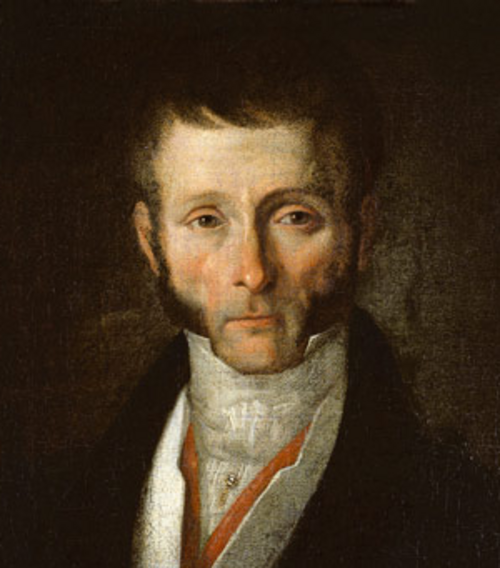
The rule that Directors must to be at least forty years old became one justification for the Coup of 18 Brumaire: the coup d'état took place on 9 November 1799, when Bonaparte was thirty years old.[75] Bonaparte returned to France, landing at the fishing village of Saint-Raphaël on 9 October 1799, and made a triumphal progression northward to Paris. His victory over the Ottoman Turks at the Battle of Abukir had been widely reported, and overshadowed the other French victories at the Second Battle of Zurich and the Battle of Bergen. Between Avignon and Paris, he was welcomed by large, enthusiastic crowds, who saw him as a saviour of the Republic from foreign enemies and the corruption of the Directory. Upon his arrival in Paris he was elected to the Institut de France for the scientific accomplishments of his expedition to Egypt. He was welcomed by royalists because he was from a minor noble family in Corsica, and by the Jacobins because he had suppressed the attempted royalist coup d'état at the beginning of the Directory. His brother Lucien, though only twenty-four years old, became a prominent figure in the Council of Five Hundred because of his name.[76]
Bonaparte's first ambition was to be appointed to the Directory, but he was not yet forty years old, the minimum age set by the Constitution, and the Director Gohier, a strict legalist, blocked that avenue. His earliest ally had been the Director Barras, but he disliked Barras because his wife Joséphine had been his mistress before she married Bonaparte, and because of charges of corruption that surrounded Barras and his allies. Bonaparte wrote later that the Jacobin director, General Jean-François-Auguste Moulin, approached Bonaparte and suggested that he lead a coup d'état, but he declined; he wished to end the Revolution, not continue it.[77] Sieyés, who had been looking for a war hero and general to assist in a coup d'état, had originally in mind General Joubert, but Joubert had been killed at the Battle of Novi in August 1799. He then approached General Jean Victor Marie Moreau, but Moreau was not interested. The first meeting between Sieyés and Bonaparte, on 23 October 1799, went badly; the two men each had enormous egos and instantly disliked each other. Nonetheless, they had a strong common interest and, on 6 November 1799, they formalized their plan.[76]
The coup d'état was carefully planned by Sieyès and Bonaparte, with the assistance of Bonaparte's brother Lucien, the diplomat and consummate intriguer Talleyrand, the Minister of Police Fouché, and the Commissioner of the Directory, Pierre François Réal. The plan called for three Directors to suddenly resign, leaving the country without an Executive. The Councils would then be told that a Jacobin conspiracy threatened the Nation; the Councils would be moved for their own security to the Château de Saint-Cloud, some 5 kilometres (3.1 mi) west of Paris, safe from the mobs of the French capital. Bonaparte would be named head of government to defend the Republic against the conspiracy; the Councils would be dissolved, and a new Constitution would be written. If the coup went well, it was simply a parliamentary maneuver; it would be perfectly legal. Bonaparte would provide security and take the part of convincing the Deputies. Fouché and Réal would assure that there would be no interference from the police or the city of Paris. Fouché proposed that the leading Jacobin deputies be arrested at the start of the coup, but Bonaparte said it would not be necessary, which later proved to be an error.[78] Shortly before the coup, Bonaparte met with the principal army commanders: Jourdan, Bernadotte, Augereau and Moreau, and informed them of the impending coup. They did not all support it, but agreed not to stand in his way. The president of the Council of Ancients was also brought into the coup, so he could play his part, and Bonaparte's brother Lucien would manage the Council of Five Hundred. On the evening of 6 November, the Councils held a banquet at the former church of Saint-Sulpice. Bonaparte attended, but seemed cold and distracted, and departed early.[79]
Coup d'état is launched (9–10 November)

Early in the morning of 9 November, army units began taking positions in Paris, and the members of the Council of Ancients were awakened and instructed to come to the Tuileries Palace for an emergency meeting. When they gathered at seven-thirty, they were told that a Jacobin conspiracy to overthrow the government had been discovered and that they should transfer their meeting the next day to the Château de Saint-Cloud, where they would be in safety. The members were asked to approve a decree to move the meeting site, and to appoint Bonaparte as commander of troops in Paris to assure their security. Alarmed, they quickly approved the decree. Bonaparte himself appeared with his staff and told them, "Citizen representatives, the Republic was about to perish. You learned of it and your decree has just saved it".[80] At eleven in the morning, the members of the Council of Five Hundred met at the Palais Bourbon and were given the same message. They agreed to move their meeting the following day to Saint-Cloud.
As planned, by the afternoon Sieyés and Roger Ducos had given their resignations. Talleyrand was assigned to win the resignation of Barras. Talleyrand was supplied with a large amount of money to offer Barras to quit; historians differ on whether he gave the money to Barras or kept it for himself. Barras, seeing the movements of soldiers outside and being assured that he could keep the great wealth he had acquired as a Director, readily agreed to leave the Directory. With three members gone, the Directory could not legally meet. The Jacobin directors Moulin and Gohier were arrested and confined to the Luxembourg Palace under the guard of General Moreau. The first day of the coup had gone exactly as planned.[80]
.png/500px-Gros_-_First_Consul_Bonaparte_(Detail).png)
On 10 November, the members of both councils were taken in a procession of carriages with a strong military escort to Saint-Cloud. 6,000 soldiers had already been assembled at the château; because their pay had repeatedly been delayed, they were particularly hostile to the members of the Chambers. Bonaparte spoke first to the Council of the Ancients, assembled in the Orangerie of the domain of Saint-Cloud, and explained that the Directory was no more. Bonaparte was received coldly, but the Council did not offer any opposition. He then moved to the Council of Five Hundred, which was already meeting under the presidency of his brother Lucien. Here he received a far more hostile reception from the Jacobin deputies. He was questioned, jeered, insulted, shouted down, and jostled. His brother was unable to restore calm, and some of the Jacobin deputies began to demand that Bonaparte be declared outside the law, as Robespierre had been. If the Council voted him outside the law, Bonaparte could be arrested and executed immediately without trial. While the deputies raged and argued, Bonaparte and his brother, escorted by a handful of soldiers, left the Orangerie, approached the unit of grenadiers of General Joachim Murat waiting impatiently outside, and told them that the deputies had tried to assassinate Bonaparte with their pens. The grenadiers charged into the hall and quickly emptied it of deputies.[80]
Bonaparte wrote his own official version of what happened, which was published in all newspapers and posted on placards on walls all over France; it vividly described how he had narrowly escaped death from the hands of "twenty Jacobin assassins" and concluded: "The majority returned freely and peacefully to the meeting hall, listened to the propositions which had been made for assuring the public safety, deliberated and prepared a beneficial resolution which should become the new law and basis of the Republic."[81]
With that event, the Directory was finished. A new government, the Consulate, was founded. According to most historians, the French Revolution was over.
French society during the Directory
Despite wars and social turmoil, the population of France continued to grow during the Directory. It was 27,800,000 in 1796, before the Directory, and had grown to 27,900,000 by 1801. Annual population growth had dropped from 16 percent in 1785, before the Revolution, to zero in 1790; but it then rebounded to 36 percent in 1795, then down to 12 percent in 1800. Part of the drop in birth rate during the Directory is attributed to the simplification of divorce, and the change in inheritance laws, which granted equal shares to all descendants. The number of young men killed in the wars during the Directory numbered 235,000 between 1795 and 1799. The high birth rate before the Revolution – together with conscription from conquered and allied states[82] – allowed Napoleon to fill the ranks of his Grande Armée during the Empire between 1804 and 1815.[83]
By the time of the Directory, French society had been dramatically restructured. Nobles and clergy, the two classes which had held most of the power before the Revolution, had disappeared. An estimated one percent of the population, mostly nobles and priests, but also many members of the upper middle class who had supported the monarchy, had emigrated. The number was even higher in border regions, such as Bas-Rhin, where 4.5 percent of the population had left.[83]
Rich and poor
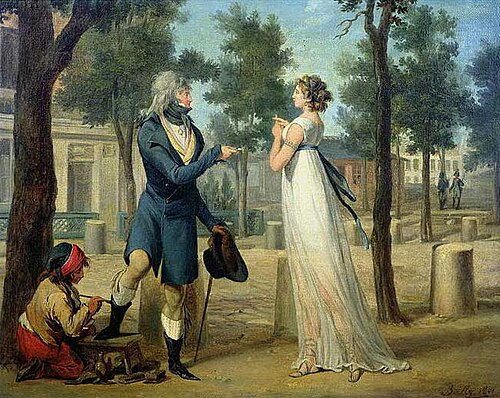
Under the Directory the middle and upper classes took a dominant position in Paris society, replacing the nobility. Enormous fortunes were made, often by providing supplies to the army or by speculation on real estate. Some parts of the middle and upper classes suffered: the abolition of the old professional guilds of lawyers and doctors brought the ruin of many members, who faced competition from anyone who wanted to use those titles. The merchants and shipowners in Bordeaux, Nantes, Marseille and other ports were ruined by the British naval blockade. Bankers took on a more prominent role, when investment was scarce.
Two new groups gained importance during the Directory. The number of government officials of all levels increased dramatically. The writer Louis-Sébastien Mercier in his Paris pendant la Révolution (1789–1798), ou Le nouveau Paris, published in 1800, wrote: "There is no one who has not complained of the insolence, or the ignorance, of the multitude of government officials employed in the bureaus to sharpen their pens and to obstruct the course of affairs. New has the bureaucracy been carried to a point so so exaggerated, so costly, to exhausting."[84]
Generals and other military officers also grew greatly in importance during the Directory and became a caste independent of the political structure. The Directory had abolished the Jacobin system of political commissioners who supervised and could overrule the military commanders. Generals like Bonaparte in Italy, Hoche in Germany and Pichegru in Alsace directed entire provinces according to their own ideas and wishes, with little interference from Paris. The soldiers of these generals were often more loyal to their generals than to the Directory, as the soldiers of Bonaparte showed during the 1799 coup d'état that ended the Directory.[85]
The working class and poor in Paris and other large cities suffered particularly from the high inflation during the first part of the Directory, which brought higher prices for bread, meat, wine, firewood and other basic commodities. In the last two years of the Directory, the problem was the opposite: with the suppression of the assignats, the money became scarce, the economy slowed, and unemployment grew. The Directory distributed scarce food items, such as cooking oil, butter and eggs, to government employees and to members of the Councils. Before the Revolution, taking care of the poor had been the responsibility of the Church. During the Directory, the government, particularly in Paris and other large cities, was forced to take over this role. To feed the Parisians and prevent food riots, the government bought flour in the countryside at market prices with its silver coins, then gave it to the bakeries, which sold it at the traditional market price of four sous a pound, which was virtually nothing. The subsidies were reduced in the last years of the Directory, paying only for bread, but they were an enormous expense for the Directory. At the beginning, the government tried to provide the standard minimum of one pound of bread a day per person, but the shortage of money reduced the daily ration to sixty grams of bread a day. The government also tried giving rice as a substitute for bread, but the poor lacked firewood to cook it.[86]
Under the Directory a system of public charity "was finally put in place with some success," with legislation passed in November 1796 establishing bureaux de bienfaisance in every commune. These were responsible for providing home relief. Funding for state hospitals was also increased, and legislation from December 1796 placed abandoned children under the state's care.[87]
Crime and corruption
Economic problems led to a large increase in crime under The Directory, particularly in the countryside. Bands of the unemployed became beggars and turned to robbery, and brigands robbed travelers along the highways. Some of the brigands were former royalists turned highwaymen. They were later celebrated in the novel of Alexander Dumas, Les Compagnons de Jéhu (The Companions of Jehu). The government did not have the money to hire more police, and the great majority of the army was occupied fighting in Italy, Switzerland and Egypt. The growing insecurity on the roads seriously harmed commerce in France. The problem of brigands and highwaymen was not seriously addressed until after a serious wave of crimes on the roads in the winter of 1797–98. The Councils passed a law calling for the death penalty for any robbery committed on the main highways or against a public vehicle, such as a coach, even if nothing was taken. If the crime was committed by more than one person, the robbers were tried by a military tribunal rather than a civilian court. The wave of highway robberies was finally stopped by Bonaparte and the Consulate, which employed special tribunals even swifter and more severe than the Directory tribunals.[88]
Corruption was another serious problem, particularly with the businessmen who provided supplies to the army and government. In one case, the Chevalier enterprise received a contract to build three large warships and two frigates at Rochefort; the company was paid in national property seized from the aristocracy and the Church, but it never constructed the ships, or even bought the materials.[89] Huge contracts for government supplies were passed from the furnishers to sub-contractors, who each paid the furnisher a fee. Sometimes contractors demanded to be paid for their services in advance in silver. They were paid, but never delivered the services, and then reimbursed the government with nearly-worthless assignats. The Directors themselves were accused of receiving money from contractors. The Minister of Finance of the Directory, Dominique-Vincent Ramel-Nogaret, was offered 100,000 francs for a bribe to give a contract by a furnisher named Langlois. Ramel refused and turned Langlois over to the police; however, some ministers and Directors, like Barras, left the government with large fortunes. The Directory was unable to escape the accusations of widespread corruption.[89]
Muscadins, Incroyables and Merveilleuses
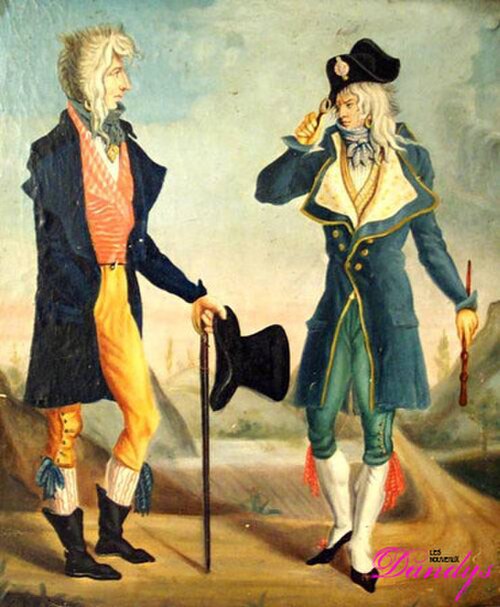
Born in reaction against the strict codes of behavior established during the Convention and the Reign of Terror, the Muscadins were fashionable young men who carried canes and sometimes, in groups, attacked sans-culottes. Following soon afterwards, the Directory had its own fashion reflecting the new social behavior and carried out by young Parisians of both sexes, from middle and upper-class families, often survivors of the excesses of the Revolution, who had lost parents and family members to the guillotine. They were called Incroyables and Merveilleuses and dressed in extravagant costumes. The men, the Incroyables, wore long hair to their shoulders, round hats with broad brims, short coats and silk culottes. Their female counterparts, the Merveilleuses, wore flowing, high-breasted transparent dresses reminiscent of the Greco-Roman era. They frequented balls called Bals des victimes and spoke in their own particular accent and vocabulary, avoiding to pronounce the letter "R", as it was the first letter of the word "Revolution".[90]
Marriage and divorce
During the Directory, almost all the structures and rules of Paris society had been swept away, but no new structures and rules had yet been created to replace them. The brothers Goncourt meticulously described the period on their Histoire de la société française pendant le Directoire. Caste and rank mattered far less; all the old titles and forms of address had disappeared, along with old customs and social conventions. Men no longer took off their hats when talking to women, and people of different ranks spoke to each other as equals. Society no longer met in private, in the houses of the nobility, but in public, at balls, restaurants and public gardens. As the Goncourts said, "social anarchy" reigned in Paris: "everyone met with everyone." Government ministers could be seen walking or dining with actresses, bankers with courtesans.[91]
"Liaisons were easy", the Goncourts reported, "marriage less so." The old system of marriages arranged between families based on fortune, profession, and social condition was less common. Marriages were no longer controlled by the church, but by the new civil code, which described marriage as "nature in action." Marriage was seen as a temporary, not a permanent state. Children born outside of marriage were given equal status concerning inheritance and other legal matters as those born to married couples. Divorce was much simpler, and could be requested by either the husband or wife. In one period of fifteen months, 5,994 civil law divorces were granted in Paris, of which 3,886 were requested by the wife. Of 1,148 divorces granted on the grounds of "incompatibility of humor", 887 were requested by the wife. The new system also led to a large increase in the number of children born outside of marriage and not wanted; in 1795 four thousand unwanted children in the Department of the Seine were turned over to foundling hospitals.[92]
The breakdown of the old system of arranged marriages led to the creation of the first newspaper where men and women could advertise themselves for suitable spouses, called the Indicateur des marriages. It also led to the establishment of the first marriage bureaus. A businessman named Liardot rented a large former mansion, brought in selected eligible young women as paying guests, and invited men seeking wives to meet them at balls, concerts and card games each given at the house each evening. The men were screened by their profession and education.[92]
Amusement – Bals des victimes, pleasure gardens, new restaurants and cafés
Although balls were not banned during the Reign of Terror,[93] after the death of Robespierre and the fall of the Jacobins, the city experienced a frenzy of dancing that lasted throughout the period of the French Directory. The Goncourt brothers reported that 640 balls took place in 1797 alone. Several former monasteries were turned into ballrooms, including the Noviciate of the Jesuits, the Monastère des Carmes (turned into a prison where 191 members of the Catholic Church — bishops, priests, monks — were massacred on 2 September 1792), the Séminaire Saint-Sulpice, and even in the former Saint-Sulpice cemetery. Some of the former palatial townhouses of the nobility were rented and used for ballrooms; the Hôtel de Longueville near the Louvre put on enormous spectacles, with three hundred couples dancing, in thirty circles of sixteen dancers each, the women in nearly transparent dresses, styled after Roman tunics. In the public balls, everyone danced with everyone; merchants, clerks, artisans and workers danced with shop women and seamstresses. In the more popular public balls, the cavaliers were charged 80 sous for admission, while women paid 12 sous. At more exclusive balls, admission was five livres.[94] Aristocrats who had survived or returned from exile held their own balls in their houses in the Faubourg Saint-Germain, where Bals des victimes ("Balls of the victims") were attended by invitees who had lost at least one parent to the guillotine.
The formal dancing of the minuet was replaced by a much more passionate new dance, the waltz, which was introduced to Paris during this time from Germany. For summer evening entertainment, Parisians began to abandon the Tuileries Gardens and the gardens of the Palais-Royal and went to the new pleasure gardens which appeared in the neighborhood between the Grands boulevards and the Palais-Royal. The most famous was the Jardin de Tivoli, also known as Folie Boutin or Grand Tivoli, located on rue Saint-Lazare. It had belonged to an aristocrat named Boutin, who was guillotined during the Reign of Terror. It was a vast garden covering 40 arpents (13,675 hectares), and could hold as many as ten thousand persons. It had alleys filled with promenaders, greenhouses, illuminations, an orchestra, dancing, a café, and fireworks at night. Other new gardens competed by adding spectacles and pageants. The Jardin des Champs-Élysées offered a pageant of costumed soldiers on horseback performing elaborate maneuvers and firing weapons. The Mousseau (now Parc Monceau) had performers dressed as American Indians dancing and fighting battles. The former Pavillon de Hanovre, which had been part of the Duke of Richelieu's residential complex, featured a terrace for dancing and dining decorated with Turkish tents, Chinese kiosks and lanterns.[95]
Many new restaurants and cafés, usually close to the twenty-three theaters, appeared in and around the Palais-Royal and the new boulevards. A new café, the Tortoni, specializing in ice creams, opened in 1795 at the corner of the boulevard des Italiens and rue Taitbout. The new restaurants in the Palais-Royal were often run by the former chefs of archbishops and aristocrats who had gone into exile. The restaurant Méot offered a menu with over one hundred dishes. Beside the Méot and Beauvilliers, under the arcades of the Palais-Royal were the restaurants and cafés such as Naudet, Robert, Véry, Foy, Huré , Berceau, Lyrique, Liberté conquise, de Chartres (now Le Grand Véfour), and du Sauvage (the last owned by the former coachman of Robespierre). In the cellars of the Palais-Royal were more popular cafés, usually with music, smaller menus at more reasonable prices. One of those, the Postal , offered a menu for just 36 sous. Many of the cafés in the cellars had orchestras; the most famous was the Café des Aveugles, with an orchestra of four blind musicians.[96]
After the Reign of Terror had ended, dining hours for upper-class Parisians returned gradually to what they had been before the Revolution, with déjeuner at midday, dinner at 6 or 7 in the evening, and supper at 2 in the morning. When the theater performances ended at 10 PM, the spectators went to the nearby cafés on the boulevards.[97]
Church and State
The Roman Catholic Church suffered significant loss of property and political influence during the French Revolution. Priests, who refused to take an oath to the Civil Constitution of the Clergy emigrated or were expelled from France under a penalty of death. Church property, from cathedrals to candlesticks, was seized and sold. Church ceremonies were banned, causing clandestine religious services to be conducted in private homes. During the Reign of Terror, at Robespierre's urging, the National Convention, on 7 May 1794, proclaimed a new religion, the Cult of the Supreme Being, which in a little over a year led to the Thermidorian Reaction, and Robespierre's downfall and execution. The Roman Catholic Church had been the official state religion during the monarchy, and the Directors were all anti-religious republicans, but the Directory, with a few exceptions, did not try to impose any particular religious views, and its policy toward priests and religious institutions changed depending upon political events.[98] After the fall of Robespierre, the repression against the Church eased and, although the policy of repression remained, many churches, especially in the provinces, re-opened, and exiled priests began to quietly return.
In November 1797, working with the new decimal-based Republican Calendar, the week of which has ten days, the Directory replaced Sundays and religious holidays with republican celebrations. The tenth day of the week, called decadi, was designated to replace Sunday. The churches still functioning with Constitutional priests were instructed to have mass on decadi, rather than on the day that would have been Sunday in the previous calendar, and decadi became the official non-working day: government employees were off, and schools, shops and markets were closed. To replace saints' and religious days, a whole series of secular holidays was created, in addition to the patriotic celebrations already in place, such as 14 July and important dates of the French Revolution. There were also special days, such as, "the day of the sovereignty of the people"; "the day of youth"; "the day of spouses"; "the day of agriculture" and "the day of the elderly". Certain churches were given new names: the cathedral Notre Dame de Paris was renamed "Temple of the Supreme Being", Saint-Étienne-du-Mont became the "Temple of Filial piety". On decadi, the constitutional priests who performed services were required to share the space with other republican religions and associations who wanted to use the buildings. Large churches were divided into sections for use by various religions.[98]
A new religion, Theophilanthropy, had been founded in 1796 by a Freemason printer-bookseller named Jean-Baptiste Chemin-Dupontès (1760–1852?).[99] It was encouraged by the Director La Révellière-Lépeaux and the Ministry of the Interior, with the state paying for its newspaper. Members believed in God and in the immortality of the soul, but not in the original sin. The sect was similar in form to Calvinism, with readings aloud of texts, hymns and sermons. With the support of the Directory, the sect was given four churches in Paris, including Saint-Roch, Saint-Sulpice and, in April 1798, Notre-Dame de Paris, as well as churches in Dijon, Poitiers and Bordeaux. Members of the sect included some prominent figures, such as General Hoche, the industrialist Éleuthère Irénée du Pont, the painter Jean-Baptiste Regnault, and the American philosopher and political activist Thomas Paine. Beginning in May 1798, however, the Directory began to withdraw support from the newly established deistic sect, which it considered too close to the Jacobins. The sect still had eighteen churches in 1799, but in 1801 it was abolished by Bonaparte.[98]
In Italy, the French army attacked the Papal States governed by the Roman Catholic Church in Italy. In February 1797, Bonaparte occupied Ancona to force Pope Pius VI to negotiate. The pope was obliged to cede Ancona and the northern part of his states, creating the French-sponsored Anconine Republic. The gold and silver in the treasury of the Vatican was taken to France to help support the French currency. Following anti-French riots in Rome in December 1797, a French army under Berthier entered Rome and proclaimed a Roman Republic. Pius VI was taken prisoner by the French Army, and transferred to Valence in France, where he was kept prisoner until his death in 1801.
Economy
Finance
Many of the economic, social and political woes during the Directory were results of the breakdown of the financial system. The principal problem was a great shortage of money with real value; that is, coins made of silver, and an excess of paper money, the value of which shrank as more and more was printed. The Directory produced only 32 million livres worth of silver-based coins in its first two years. Much of this money was hoarded, since, unlike the paper money, it had and retained real value. As a consequence, the government, to cover its costs, was forced to print millions of notes, first called assignats and then mandats, which were based on the value of property seized from the Church and the clergy. These notes declined in value as more and more were printed. When the notes became nearly worthless, the Directory first devalued them and finally gave up and stopped printing paper money. The shortage of real money in the second part of the Directory led to a new problem: shortage of credit; interest rates rose to about ten percent, double what they had been in 1789. The consequence in the last two years of the Directory was a decline in economic activity, and in wages, while prices rose. The population lost confidence in the money and in the Directory's management.[100]
The lack of credit led to the creation of a number of new private banks, and the growing importance of banks and bankers in the economy. The Caisse des comptes courants, created in June 1796, had some of the most important industrialists and financiers in France as its founders, who would later become the founders of the Banque de France. Several other new private banks followed, which concentrated the wealth of France even more in Paris. Since the nobility had gone into exile, the bankers became the new nobility of France.[101] In other words, bankers became the new aristocrats.
Transportation and commerce
The transportation system within France was another handicap to the economy. The roads and canals had not been improved or maintained since the overthrow of the monarchy. Major canals that had been started in Burgundy and in the north were unfinished. Maritime commerce was in an even worse situation as a result of the war and blockade of French ports by Britain. During the Directory, the number of French ships of more than two hundred tons was one tenth of what it had been in 1789. The conquest of Belgium, the Netherlands and Italy improved the situation somewhat: French goods could be transported on the neutral ships of these countries, and maritime traffic on the Baltic Sea to Germany became an important trade route for France. However, the British navy largely cut off the trade with the French colonies in the Caribbean, which earlier had provided sugar, cotton, indigo and coffee to France; and the entry of the fleet of Admiral Nelson into the Mediterranean Sea cut off the trade routes there. The major ports of Nantes and Marseille saw their commerce and trade routes disappear.[102]
Industry
The continual wars and fiscal crises greatly limited the expansion of French industry. The Industrial Revolution had only just begun in France. Production during the Directory had fallen below what it was in 1789. The number of workers in the silk industry in Lyon had dropped from 12,000 before 1787 to 6,500. The cotton textile industry was more successful due to the embargo against British products caused by the war. New factories and new technologies, such as mechanical looms, were introduced in Normandy and in Alsace. However, the technologies were still primitive; the steam engine had not yet arrived in French factories. The chemical industry was also advancing rapidly during the Directory; the chemist and entrepreneur Jean Antoine Claude Chaptal built a chemical factory in Montpellier, which he soon moved to Chaillot, a village west of Paris. The most effective promoter of French industry was François de Neufchâteau, who was Minister of the Interior before becoming a Director in 1797. He planned a new canal system, began work on a new road across the Pyrenees, and organized the first national industrial exposition in Paris, which opened with great success in October 1798. Once he became Consul, Bonaparte copied the idea of the industrial exposition. Despite this bright spot, French industry was primitive: without steam power, most factories in France depended upon water power, and the metallurgy industry still melted iron with wood fires, not oil.[103]
Agriculture
Agriculture was another weak spot of the French economy. While the country was essentially rural, the methods of farming had not been changed in centuries. The vast majority of farmers had small plots of land, sold little and worked essentially to produce enough food for their families. The price of grain was freed from government control under the Directory in 1797, and farmers could sell their grain at whatever price they could get. Following the Revolution in 1789, the forests had been taken away from the nobles and opened to everyone; as a result, large areas of the forests were immediately cut down, and no new trees planted to replace them. The land of the nobility and Church was taken and redistributed to peasants, but under the new inheritance laws, which gave equal shares to all sons, the size of the farm plots became smaller and smaller. Small plots were not consolidated into larger fields, as was taking place in England at the same time. Most farmers were reluctant to try new methods; they did not want to leave fields idle to recover productivity, or to grow forage crops to feed cattle. Furthermore, during the endless wars of the Directory, thousands of farmers were taken into the army, and thousands of horses and mules needed for farming were taken by the Army for the use of the cavalry and transport. Under these conditions, food shortages and famines occurred regularly in France until the time of Napoleon III.[104]
Education and science
The education system of France was in a chaotic state at the beginning of the Directory. The College of Sorbonne and most other colleges of the University of Paris, had been closed because of their close association with the Catholic Church, and did not reopen until 1808. The schools run by the Catholic Church had also been closed, and any kind of religious instruction forbidden. The government of Jacobins during the Convention created several new scientific institutions, but had concentrated on primary education, which it decreed should be obligatory and free for all young people, but there were few teachers available. By forbidding religious education, seizing the property of the Church and chasing out the clergy, they effectively closed the largest part of the educational system of the country.
At the beginning of the period, the Directory reversed the policy of obligatory and free education for all, largely because of the lack of money to pay teachers. The Directory began to create a system of central schools, with the goal of one in each department, which boys could attend from the age of twelve, with a full curriculum of sciences, history and literature. The state paid a part of the cost, while each student also paid the professor a fee. The new schools had libraries (mostly confiscated from the nobility), small botanical gardens, and museums of natural history. For the first time in French schools, French instead of Latin was the basis of education. Three of these schools were organized in Paris; two of them later became the famous Lycée Henri-IV and Lycée Charlemagne. But by the end of the Directory there were only 992 students in the three Paris schools.[105]
For primary education, each arrondissement in Paris had one school for boys and another for girls, and each commune in the country was supposed to have the same. Since the state lacked money, teachers were paid by the commune or by the students. Students would graduate after learning to read, write and count. In villages, the school was often located in the former church, and teachers were expected, as part of their duties, to carry water, clean the church, ring the bells, and, when needed, dig graves in the churchyard cemetery.[106]
The choices were greater for the children of the middle and upper middle class, as these families had tutors, or sent their children to private schools, but for much of the population, schooling was minimal. There were 56 public schools in the Seine department, which by the population should have had at least 20,000 students; but they had only between 1100 and 1200.[106]
The continual wars during the Directory also had their effect on education. Beginning in October 1797, boys in public schools were required to take part in periodic military exercises, and the Directory established five military schools, called Écoles de Mars, for a total of 15,000 students. Attendance was a requirement for entry into the higher schools of engineering and public works.
The Directory focused its attention on secondary education and especially on creating specialized higher schools for training managers, judges, doctors and engineers, for which there was an immediate and pressing need. The École Polytechnique had been founded by a member of the Directory, Lazare Carnot and the mathematician Gaspard Monge, in 1794. The school became the most prestigious engineering and public works school in France. However, by the end of the Directory there were still no law schools, and only two schools of medicine outside of Paris.
The Institut de France was also founded in 1795 by Lazare Carnot and Monge, to bring together the scientists and researchers, who previously had worked in separate academies, to share knowledge and ideas. It was divided into three large sections: physical sciences and mathematics; moral and political science; and literature and the fine arts. It organized the large party of scientists and scholars who accompanied Napoleon to Egypt, which discovered such treasures as the Rosetta Stone, which allowed the deciphering of Egyptian hieroglyphs. One of the Institut de France first members and speakers was Napoléon Bonaparte, who took the place of Carnot after the latter had been removed from the Directory and left France.
Art and culture
Painting – The Salon and the Louvre
The artists of Paris were in a difficult situation during the Directory, as their most important patrons, the aristocracy, had been executed or had emigrated; however a new wealthy class was just being formed. Before the Revolution a half-figure portrait could be commissioned from a less-known artist for three hundred livres. During the Directory, the price fell to forty-eight livres.[107] Nonetheless, the Salon took place in the Louvre in 1795 as it had since 1725, before the Revolution, and each year thereafter. The most prominent artist of the Revolution, Jacques-Louis David, closely connected with the Jacobins, was in seclusion in his studio inside the Louvre. At the end of the period, in 1799, he produced one important work, the Intervention of the Sabine Women. However, a new generation of artists, inspired by David, showed their works; François Gérard; Anne-Louis Girodet, a pupil of David, renown for his romantic paintings, particularly a 1797 painting of the prominent actress Mademoiselle Lange as Venus; Carle Vernet, the son and father of famous painters; the portrait painter and miniaturist Jean-Baptiste Isabey, known as the "painter of the kings" or "portraitist of Europe",[108] who painted Queen Marie-Antoinette and Empress Joséphine, and remained active until the Second Empire; the genre painter Louis-Léopold Boilly; Antoine-Jean Gros, a young history and landscape painter, who soon achieved fame and a government position in 1796 with a heroic portrait of Bonaparte at the Battle of Arcole; the romantic landscapes of Hubert Robert; Pierre-Paul Prud'hon, whose work combined Neoclassicism and Romanticism; and a major neoclassical sculptor from the earlier generation, Jean-Antoine Houdon, famous for his busts of George Washington and Voltaire.[107]
Making the Louvre into an art museum had first been proposed in 1747 by Étienne La Font de Saint-Yenne and supported by Denis Diderot in 1765 in the article on the Louvre in the Encyclopédie. The idea was accepted by Louis XVI who, in 1789, began work on converting the Grande Galerie of the Louvre to a museum space. The Revolution intervened, and on 27 July 1793 the Convention decreed the creation of a Museum of the Republic (Musée de la République française), which opened on 10 August 1793, the first anniversary of the storming of the Tuileries.[109]
In 1797, at the end of Bonaparte's triumphant first Italian campaign, convoys of wagons began arriving in Paris, carrying bronze horses, Greek antiquities, tapestries, marble statues, paintings and other works of art taken from Italian cities under the terms of peace agreed by the Austrians. They included works by Raphael, Leonardo da Vinci, Titian, Paolo Veronese and other masters. Other convoys arrived from the Netherlands and Flanders. The more famous works were displayed on wagons in a festive victory parade through the center of Paris. The rest was crammed, unwrapped, into the corridors, galleries and stairways of the Louvre. Work began to rebuild the Galerie d'Apollon and other galleries to provide a home for the 'newly acquired' art.[110]
- Art during the Directory
-

-
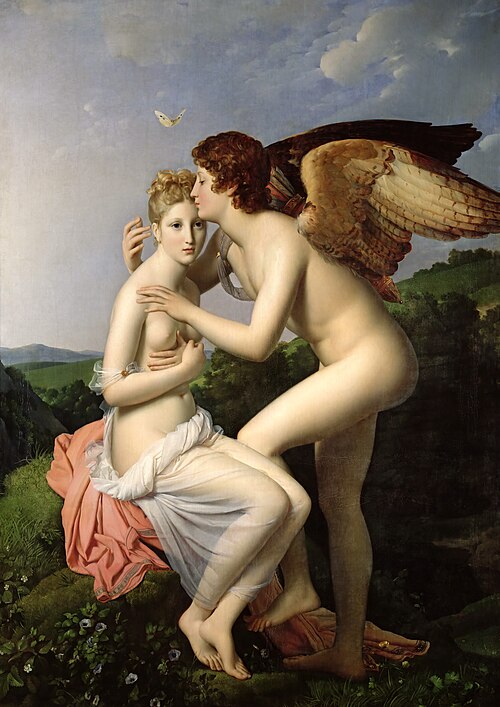 Psyche et l'Amour by François Gérard (1797), Louvre
 -

-
 The Intervention of the Sabine Women by Jacques-Louis David (1799), Louvre

Furniture and decoration – the Directoire style
.jpg/500px-thumbnail.jpg)
The Directory had no public money to spend on architecture, but the newly-wealthy upper class had abundant money to buy châteaux and town houses, and to redecorate them. The style of interior decoration, known as the Directoire style, was one of the notable contributions of the period. It was a transitional style, a compromise between the Louis XVI style and French neoclassicism. Riesener, the famous furniture designer for Louis XVI, did not die until 1806, though his clientele changed from the nobility to the wealthy new upper class. The Directory saw the first widespread use of mahogany, an imported tropical wood used in the making of furniture.[citation needed]
Literature
The Directory period produced a small number of important literary works, often very critical of the excesses of Revolution. These included Essay on the Revolutions by Chateaubriand, published in 1797, which called for a return to Christian values. At the complete opposite end of the literary scale was the last major work of the Marquis de Sade, The New Justine, published in 1797. Sade also wrote a satirical brochure mocking thinly-disguised characters resembling Bonaparte and Joséphine. Shortly after the end of the Directory, on 6 March 1801, Sade was arrested for Justine and its sequel and ended his days in the insane asylum of Charenton.[111]
Directory judged by historians
19th century
Historians generally have not been kind to the 'Age of the Directory'. Adolphe Thiers, later twice the Prime Minister and the first president of the Third Republic, wrote the first major history in French of the Revolution, in ten volumes, published between 1823 and 1827. He described the Directory this way:
One of the indispensable qualities of a government is to have good reputation that defends it against unjust attacks. When it has lost this reputation, and when people blame it for the faults of others, and even for bad luck, then it no longer has the ability to govern, and this incapacity should force it to retire. How many governments had been used up during the Revolution!... The Directory had been used up like the Committee of Public Safety before it, and the government of Napoleon that followed. All the accusations against the Directory proved not its faults but its nullity.[112]
Thiers blamed Barras, the only Director who served from the beginning to the end of the Directory, for its failure.
By a bizarre chance, but one that is seen often in the conflicts within revolutions, public opinion had indulgence for the one Director who merited it the least. Barras alone deserved all that was said of the Directory. First of all, he never worked; he left to his colleagues all the burden of business. He spoke only at decisive moments, when his voice was stronger than his courage. He occupied himself with nothing. He only concerned himself with the personnel of the government, which best suited his genius at intrigue. He took a share of all the profits of the government suppliers, and alone of the Directors deserved the accusation of corruption. Despite all of his faults, he was treated differently than the others, first of all because, unlike the other four, he was not a lawyer; and despite his laziness, his debauched habits, his bad manners, and his liaisons with the Jacobins, he alone was credited with 18 Fructidor [the downfall of Robespierre], and he gave the appearance of a man of action, more capable of governing than his colleagues... He was even treacherous toward his colleagues; because all of the criticism that he deserved himself he skillfully managed to shift exclusively onto them.[112]
The most celebrated and vivid description of French society under the Directory was written by the Goncourt brothers, Edmond and Jules, published in 1864, which described the mores, daily life, culture and preoccupations of the Parisians. Its final chapter contained the lines:
Like a guest at the end of an orgy, France was weary; weary of gods, of tribunes, of heroes, of executioners; weary of struggles, of efforts, of cries, of curses, of enthusiasms, of fevers, of intoxications, of storms, of triumphs, of agonies – France was weary of revolutions, coups d'états. constitutions, legislatures... weary of conquests, weary of being saved; weary of Belgium submissive, Italy conquered; of Germany, when all the eagles of Germany had been taken to the Invalides, but France was still not the head; France was weary of climbing into the sky, of amassing empires, of monopolizing the world; France glutted with glory; France broken, sleeping on a mattress of corpses, sleeping on a bed of laurels. France, emptied of men, of silver, of crimes, of ideas, of eloquence; France, like Mirabeau when he was dying, asking of his doctors and his descendants only one single thing: to sleep![113]
The shortest and simplest description of the entire period, from the Convention to the Empire, was given by Honoré de Balzac in 1837–43 in his novel Illusions perdues. The Spanish Jesuit diplomat Carlos Herrera tells Lucien de Rubempré: "In 1793 the French invented government by the people, which ended with an absolute emperor. So much for your national history".[114]
20th and 21st century
In 1909, Pyotr Kropotkin wrote:
The Directory was a terribly orgy of the middle classes, in which the fortunes acquired during the Revolution, especially during the Thermidorean reaction, were squandered in unbridled luxury. For if the Revolution had put in circulation eight milliards of paper-money, the Thermidorean reaction went ten times as fast in that direction, for it issued the amazing sum of thirty milliards in paper within fifteen months.[115]
In 1971, Robert Roswell Palmer wrote:
The Directory became a kind of ineffective dictatorship. It repudiated most of the assignats [paper money] and the debt but failed to restore financial confidence or stability. Guerrilla activity flared up again in the Vendée and other parts of western France. The religious schism became more acute; the Directory took severe measures toward the refractory clergy [those who would not swear allegiance to the government].[116]
In 1971, the American historians Jerome Blum, Rondo Cameron, and Thomas G. Barnes wrote:
It was a government of self-interest rather than virtue, thus losing any claim on idealism. It never had a strong base of popular support; when elections were held, most of its candidates were defeated. Historians have been quite negative on the Directory's use of military force to overturn election returns that went against them. [...] Having by this coup d'état forfeited its claim to be a constitutional government, the Directory henceforth clung to power only by such illegal acts as purges and quashed elections.[117]
In the 1970s, other historians wrote that the achievements of the Directory were minor, though it did establish administrative procedures and financial reforms that worked out well when Napoleon started using them.[118][119] It was blamed for creating chronic violence, ambivalent forms of justice, and repeated recourse to heavy-handed repression.[120]
In 1994, Isser Woloch wrote:
The Terror had left a dual legacy that made such normalcy impossible. On the one hand, massive disengagement, apathy, and cynicism about government; on the other hand, rancorous, violent hostility between the politically engaged minorities of royalists and Jacobins, between whom the directorial moderates vainly attempted to navigate. Legality became the main casualty in this situation.[121]
In 2007, Howard Brown wrote:
The four years of the Directory were a time of chronic disquiet and the late atrocities had made goodwill between parties impossible. The same instinct of self-preservation which had led the members of the Convention to claim so large a part in the new legislature and the whole of the Directory impelled them to keep their predominance. War was at the center of attention, not only for the survival of France but for the loot and forced payments into the French treasury.[122]
Leadership and composition
The Directory was officially led by a president, as stipulated by Article 141 of the Constitution of the Year III. An entirely ceremonial post, the first presidency was held by Rewbell who was chosen by lot on 2 November 1795. The directors conducted their elections privately, and appointed a new president every three months.[123] The last president was Gohier, who resigned during Brumaire after his arrest by troops under the Bonapartist general Jean Victor Marie Moreau.[124]
The following table displays all Directeurs and their dates of service:[125]
Presidents of the Directory
- November 1795-4 September 1797: Jean-François Reubell
- September 4, 1797 – December 4, 1797: Louis-Marie de La Révellière-Lépeaux
- December 4, 1797 – February 25, 1798: Paul Barras
- February 25, 1798 – May 26, 1798: Philippe-Antoine Merlin de Douai
- May 26, 1798 – November 26, 1798: Jean-François Reubell
- November 26, 1798 – May 26, 1799: Paul Barras
- May 26, 1799 – June 18, 1799: Philippe-Antoine Merlin de Douai
- June 18, 1799 – September 23, 1799: Emmanuel-Joseph Sieyès
- September 23, 1799 – November 9, 1799: Louis Gohier
Ministers
The ministers under the Directory were:[126]
See also
References
- ^ For example F. Furet and D. Richet in "French Revolution" (Macmillan, 1970)
- ^ Kennedy 2000, p. 53.
- ^ Gough 1998, p. 77.
- ^ Schama 1989, pp. 840–844.
- ^ a b Lyons 1975, pp. 18–19.
- ^ Chronicle of the French Revolutions, Longman 1989 p.495
- ^ Biard, M. (2014). Raphaël Matta-Duvignau, Gouverner, administrer révolutionnairement : le comité de Salut public (6 avril 1793 – 4 brumaire an IV): Paris, L'Harmattan, 2013. Annales historiques de la Révolution française, 378, 151–154. https://www.cairn.info/revue--2014-4-page-151.htm.
- ^ Gazette nationale ou le Moniteur universel, 1 novembre 1795, p. 4
- ^ a b Jean Tulard, Jean-François Fayard, Alfred Fierro, Histoire et dictionnaire de la Révolution française, Robert Laffont, Paris, 1998, pp. 198–199. (In French)
- ^ Tulard, Fayard & Fierro 1998, p. 702.
- ^ J. F,. Bosher, The French Revolution (1988), pp. 226–230
- ^ Gershoy, The French Revolution and Napoleon (1964) pp. 303–308
- ^ Fierro, Alfred, Histoire et dictionnaire de Paris (1996), Robert Laffont, p. 608, (French)
- ^ Loi du 19 vendémiaire, an 4. Tableau de l'emplacement des chef lieux de département, published in 1795, 15 pages [1]
- ^ a b Tulard, Fayard & Fierro 1998, p. 375.
- ^ Tulard, Fayard & Fierro 1998, p. 378.
- ^ Tulard, Fayard & Fierro 1998, p. 379.
- ^ Tulard, Fayard & Fierro 1998, p. 199.
- ^ Tulard, Fayard & Fierro 1998, p. 202.
- ^ Tulard, Fayard & Fierro 1998, pp. 204–206.
- ^ Tulard, Fayard & Fierro 1998, p. 564.
- ^ Tulard, Fayard & Fierro 1998, p. 624.
- ^ Tulard, Fayard & Fierro 1998, p. 206.
- ^ a b Tulard, Fayard & Fierro 1998, pp. 209–210.
- ^ Tulard, Fayard & Fierro 1998, pp. 209–213.
- ^ Tulard, Fayard & Fierro 1998, p. 209.
- ^ John Hall Stewart, A Documentary Survey of the French Revolution (1951) pp. 654–657
- ^ Lefebvre 1977, p. 189.
- ^ R. B. Rose, Gracchus Babeuf: The First Revolutionary Communist (Stanford University Press, 1978)
- ^ Lefebvre 1977, pp. 192–194.
- ^ a b Lefebvre 1977, p. 199.
- ^ Doyle, Oxford History, pp. 324–326
- ^ George Rude, The French Revolution: Its Causes, Its History and Its Legacy After 200 Years (1991) p. 122
- ^ Tulard, Fayard & Fierro 1998, p. 223.
- ^ Black, p. 173.
- ^ Soboul 1975, p. 505.
- ^ Lefebvre 1977, p. 212.
- ^ Furet 1996, p. 181.
- ^ Tulard, Fayard & Fierro 1998, p. 217.
- ^ Lefebvre 1977, pp. 218–219.
- ^ Tulard, Fayard & Fierro 1998, p. 392.
- ^ Tulard, Fayard & Fierro 1998, p. 393.
- ^ Lefebvre 1977, pp. 439–440.
- ^ Albert Soboul, The French Revolution (1975) p. 508
- ^ Tulard, Fayard & Fierro 1998, p. 1030.
- ^ a b Lefebvre 1977, pp. 441–442.
- ^ Lefebvre 1977, pp. 452–453.
- ^ Lefebvre 1977, p. 445.
- ^ See: Seuls les morts ne reviennent jamais : les pionniers de la guillotine sèche en Guyane française, Philippe de Ladebat, ed. Amalthée, France, 2008 – http://site.voila.fr/fructidor/page1.html Archived 22 January 2010 at the Wayback Machine
- ^ Tulard, Fayard & Fierro 1998, p. 231.
- ^ Histoire générale et impartiale des erreurs, des fautes et des crimes commis pendant la Révolution française, Faubourg Saint-Germain, Paris, 1797, (Bibliothèque nationale de France)[2]
- ^ Lefebvre 1977, p. 452.
- ^ Lefebvre 1977, pp. 449–550.
- ^ Lefebvre 1977, p. 455.
- ^ Tulard, Fayard & Fierro 1998, pp. 232–233.
- ^ Tulard, Fayard & Fierro 1998, pp. 243–244.
- ^ Tulard, Fayard & Fierro 1998, pp. 251–253.
- ^ Tulard, Fayard & Fierro 1998, p. 252.
- ^ Thys, Augustin, La persécution religieuse en Belgique sous le Directoire exécutif, 1798–99, d'après des documents inédits, Anvers, 1898, [3] (in French)
- ^ Tulard, Fayard & Fierro 1998, p. 245.
- ^ Tulard, Fayard & Fierro 1998, pp. 245–246.
- ^ Tulard, Fayard & Fierro 1998, pp. 246–247.
- ^ Tulard, Fayard & Fierro 1998, pp. 398–400.
- ^ De Conde, Alexander, The quasi-war: the politics and diplomacy of the undeclared war with France 1797–1801, Charles Scribner's Sons, New York, 1966
- ^ Tulard, Fayard & Fierro 1998, p. 256.
- ^ a b c Tulard, Fayard & Fierro 1998, p. 257.
- ^ a b Tulard, Fayard & Fierro 1998, p. 408.
- ^ Tulard, Fayard & Fierro 1998, pp. 248–249.
- ^ Thiers, Adolphe, Histoire de la Révolution française, 1839 (Ninth edition), Volume 10, Chapter XIII, Project Gutenberg digital edition
- ^ Tulard, Fayard & Fierro 1998, p. 409.
- ^ Tulard, Fayard & Fierro 1998, p. 543.
- ^ a b Lefebvre 1977, p. 719.
- ^ Tulard, Fayard & Fierro 1998, p. 241.
- ^ Lefebvre 1977, p. 684.
- ^ Tulard, Fayard & Fierro 1998, pp. 704–705.
- ^ a b Tulard, Fayard & Fierro 1998, pp. 260–261.
- ^ Lefebvre 1977, p. 723.
- ^ Tulard, Fayard & Fierro 1998, pp. 261–263.
- ^ Lefebvre 1977, pp. 723–724.
- ^ a b c Tulard, Fayard & Fierro 1998, p. 263.
- ^ Tulard, Fayard & Fierro 1998, pp. 264–265.
- ^ Brun, Jean-François in: Revue historique des armées: Les unités étrangères dans les armées napoléoniennes: un élément de la stratégie globale du Grand Empire [4]
- ^ a b Tulard, Fayard & Fierro 1998, p. 272.
- ^ Tulard, Fayard & Fierro 1998, p. 276.
- ^ Tulard, Fayard & Fierro 1998, p. 277.
- ^ Lefebvre 1977, pp. 173–174.
- ^ The A to Z of the French Revolution By Paul R. Hanson, 2007, P.64
- ^ Lefebvre 1977, pp. 449–450.
- ^ a b Lefebvre 1977, p. 508.
- ^ Tulard, Fayard & Fierro 1998, p. 884.
- ^ de Goncourt 1864, p. 178.
- ^ a b de Goncourt 1864, p. 185.
- ^ Tissier, André, Les spectacles à Paris pendant la Révolution... de la proclamation de la République à la fin de la Convention nationale (21 septembre 1792 – 26 octobre 1795), publisher: Droz, 2002, pp. 363–369 and further [5]
- ^ de Goncourt 1864, pp. 145–146.
- ^ de Goncourt 1864, pp. 213–234.
- ^ de Goncourt 1864, pp. 73–83.
- ^ de Goncourt 1864, p. 74.
- ^ a b c Lefebvre 1977, pp. 548–559.
- ^ Bibliothèque nationale de France
- ^ Lefebvre 1977, pp. 513–515.
- ^ Lefebvre 1977, pp. 515–518.
- ^ Lefebvre 1977, pp. 523–525.
- ^ Lefebvre 1977, pp. 528–531.
- ^ Lefebvre 1977, pp. 531–533.
- ^ Lefebvre 1977, pp. 561–562.
- ^ a b Lefebvre 1977, p. 564.
- ^ a b de Goncourt 1864, p. 268.
- ^ Napoléon & Empire: Jean-Baptiste Isabey (1767–1855)
- ^ Fierro 1996, p. 1004.
- ^ de Goncourt 1864, pp. 283–287.
- ^ Tulard, Fayard & Fierro 1998, p. 1081.
- ^ a b Thiers, Adolphe, Histoire de la Révolution française, Volume 10, Chapter XV, (1827). Online version on Project Gutenberg
- ^ De Goncourt, Edmond et Jules, Histoire de la société française pendant le Directoire, (1864) Flammarion, Paris
- ^ Balzac, Honoré, Illusions perdues, Gallimard, p. 629. ISBN 2-07-036062-8
- ^ Kropotkin, Pyotr Alexeyevich, The Great French Revolution, 1789–1793, chapter The 9th Thermidor, translated by N. F. Dryhurst, publisher Cosimo Classics, New York, 2009, p. 571. ISBN 978-1605206608
- ^ R.R. Palmer and Joel Colton, A History of the Modern World, 4th ed., 1971, p. 412
- ^ Jerome Blum, Rondo Cameron, and Thomas G. Barnes, The European World – A History, 2nd ed., 1970, p. 488
- ^ Hunt, Lansky and Hanson, (1979) p. 735
- ^ Martyn Lyons, France under the Directory (1975), pp. 159–173
- ^ Howard G. Brown (2007). Ending the French Revolution: Violence, Justice, and Repression from the Terror to Napoleon. U. of Virginia Press. p. 1. ISBN 978-0813927299.
- ^ Isser Woloch, In the Aftermath of the French Revolution, History Teacher, 1994, 28#1 pp. 7–11 in JSTOR
- ^ Howard G, Brown, French revolutionary studies – A Discredited Regime: The Directory and Army Contracting, in French History, Oxford University Press, 1990, 4#1 pp: 48–76.
- ^ Cheynet, Pierre-Dominique (2013). "France: Presidents of the Executive Directory: 1795–1799". Archontology.org. Retrieved 16 November 2013.
- ^ Lefebvre & Soboul, p. 199.
- ^ Cheynet, Pierre-Dominique (2013). "France: Members of the Executive Directory: 1795–1799". Archontology.org. Archived from the original on 13 October 2013. Retrieved 16 November 2013.
- ^ Muel, Léon (1891). Gouvernements, ministères et constitutions de la France depuis cent ans: Précis historique des révolutions, des crises ministérielles et gouvernementales, et des changements de constitutions de la France depuis 1789 jusqu'en 1890. Marchal et Billard. p. 47. Retrieved 3 May 2014.
Sources
- Black, Jeremy (2002). From Louis XIV to Napoleon: The Fate of a Great Power. Routledge. ISBN 9780203006382.
- Church, Clive H., The Social Basis of the French Central Bureaucracy under the Directory 1795–1799, in Past & Present No. 36, April 1967, pp. 59–72 in JSTOR.
- Devlin, Jonathan D. (1989). "A problem of royalism: General Amédée Willot and the French directory". Renaissance and Modern Studies. 33 (1): 125–143. doi:10.1080/14735788909366534. ISSN 0486-3720.
- Doyle, William (1990). The Oxford History of the French Revolution (2 ed.). Oxford University Press. pp. 318–40. ISBN 9780199252985.
- Fierro, Alfred (1996). Histoire et dictionnaire de Paris. Robert Laffont. ISBN 978-2-221-07862-4.
- Furet, François (1996). The French Revolution, 1770–1814. France: Blackwell Publishing. ISBN 978-0-631-20299-8.
- Garrioch, David (2015). La fabrique du Paris révolutionnaire. La Découverte/Poche. ISBN 978-2-7071-8534-1.
- de Goncourt, Edmond and Jules (1864). Histoire de la société française pendant le Directoire. Ernest Flammarion.
- Goodwin, A., The French Executive Directory – A Revaluation, in History, 1937, 22.87 pp. 201–218
- Gottschalk, Louis R., The Era of the French Revolution (1715–1815), Houghton Mifflin Company, 1929, pp. 280–306
- Héron de Villefosse, René (1959). Histoire de Paris. Bernard Grasset.
- Gough, Hugh (1998). The Terror in the French Revolution (2010 ed.). Palgrave. ISBN 978-0230201811.
- Hunt, Lynn, David Lansky and Paul Hanson, The Failure of the Liberal Republic in France, 1795–1799: The Road to Brumaire, in Journal of Modern History (1979) 51#4, pp. 734–759 in JSTOR; statistical profile of the different factions
- Jainchill, Andrew, The Constitution of the Year III and the Persistence of Classical Republicanism, in French Historical Studies, 2003, 26#3 pp, 399–435
- Kennedy, Michael (2000). The Jacobin Clubs in the French Revolution: 1793–1795. Berghahn Books. ISBN 978-1-57181-186-8.
- Lefebvre, Georges (1977). La France Sous Le Directoire (1795–1799) (in French). Éditions Sociales.
- Lefebvre, Georges, French Revolution from 1793–1799, Columbia University, 1964, pp. 171–211
- Lefebvre, Georges; Soboul, Albert (1965). The Directory. London: Routledge and Kegan Paul. OCLC 668426465.
- Lyon, E. Wilson, The Directory and the United States, in American Historical Review, 1938, 43#3, pp. 514–532. in JSTOR
- Lyons, Martyn (1975). France under the Directory (2008 ed.). Cambridge University Press. ISBN 978-0521099509.
- Montague, Francis Charles; Holland, Arthur William (1911). . In Chisholm, Hugh (ed.). Encyclopædia Britannica. Vol. 11 (11th ed.). Cambridge University Press. pp. 154–171.
excerpts are included in this article
- Palmer, Robert R, The Age of the Democratic Revolution: A Political History of Europe and America, 1760–1800, vol 2: The Struggle, 1964, pp. 211–262, 549–576.
- Ross, Steven T, The Military Strategy of the Directory: The Campaigns of 1799, in French Historical Studies, 1967, 5#2 pp. 170–187 in JSTOR.
- Rudé, George (1988). The French Revolution. New York: Grove Weidenfeld. ISBN 978-0802132727.
- Schama, Simon (1989). Citizens, A Chronicle of The French Revolution (2004 ed.). Penguin. ISBN 978-0-14-101727-3.
- Soboul, Albert (1975). The French Revolution, 1787–1799: From the storming of the Bastille to Napoleon. New York. pp. 477–547. ISBN 9780394712208.
- Sutherland, D.M.G., The French Revolution and Empire: The Quest for a Civic Order, 2nd ed. 2003, 430 pages, excerpts and text search pp. 263–301.
- Tulard, Jean; Fayard, Jean-François; Fierro, Alfred (1998). Histoire et Dictionnaire de la Révolution Française (in French). Robert Laffont. ISBN 978-2-221-08850-0.
- Woronoff, Denis (1984). The Thermidorean regime and the directory: 1794–1799. Cambridge University Press. ISBN 978-0-521-28917-7.
Primary sources
- Stewart, John Hall, ed. A Documentary Survey of the French Revolution (1951), pp. 654–766