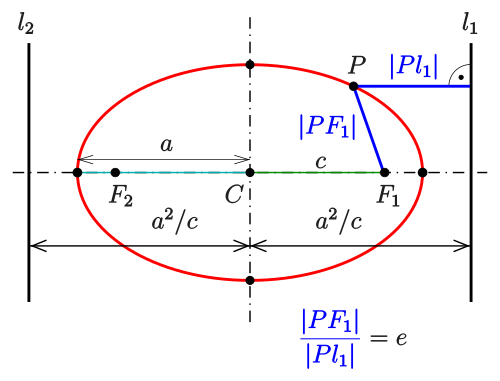
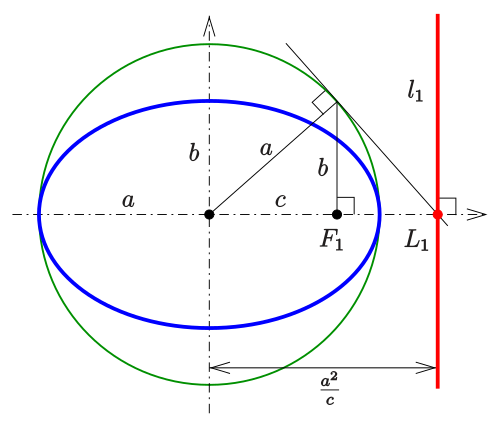
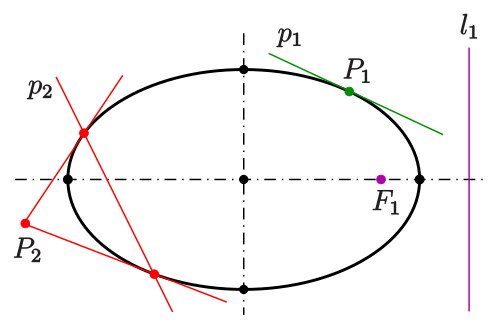
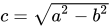
Each of the two lines parallel to the minor axis, and at a distance of from it, is called a directrix of the ellipse (see diagram).
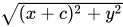
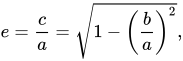
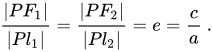
For an arbitrary point of the ellipse, the quotient of the distance to one focus and to the corresponding directrix (see diagram) is equal to the eccentricity:
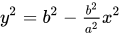
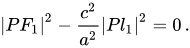
The proof for the pair follows from the fact that and satisfy the equation
The second case is proven analogously.
The converse is also true and can be used to define an ellipse (in a manner similar to the definition of a parabola):
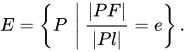
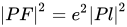
For any point (focus), any line (directrix) not through , and any real number with the ellipse is the locus of points for which the quotient of the distances to the point and to the line is that is:
The extension to , which is the eccentricity of a circle, is not allowed in this context in the Euclidean plane. However, one may consider the directrix of a circle to be the line at infinity in the projective plane.
(The choice yields a parabola, and if , a hyperbola.)
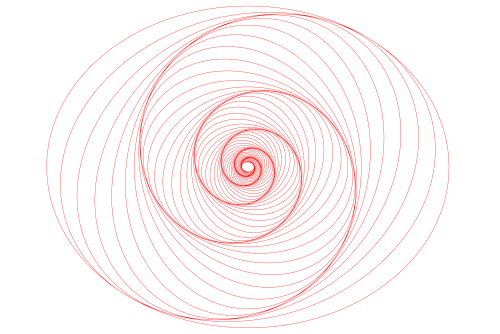
Pencil of conics with a common vertex and common semi-latus rectum
Proof
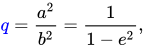
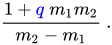
Let , and assume is a point on the curve. The directrix has equation . With , the relation produces the equations
and
The substitution yields
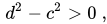
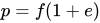
This is the equation of an ellipse (), or a parabola (), or a hyperbola (). All of these non-degenerate conics have, in common, the origin as a vertex (see diagram).
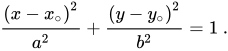
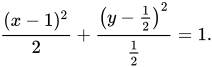
If , introduce new parameters so that , and then the equation above becomes
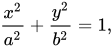
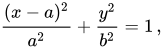
which is the equation of an ellipse with center , the x-axis as major axis, and the major/minor semi axis .
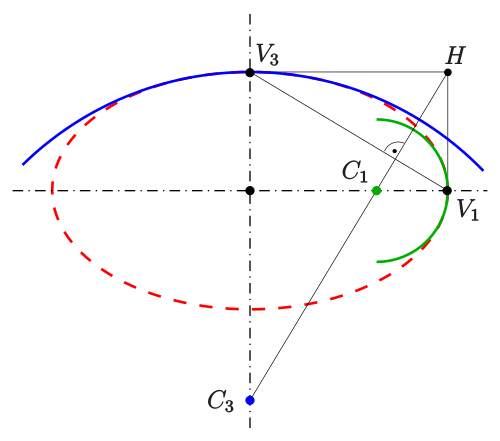
Construction of a directrix
Construction of a directrix
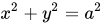
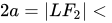
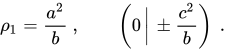
Because of point of directrix (see diagram) and focus are inverse with respect to the circle inversion at circle (in diagram green). Hence can be constructed as shown in the diagram. Directrix is the perpendicular to the main axis at point .
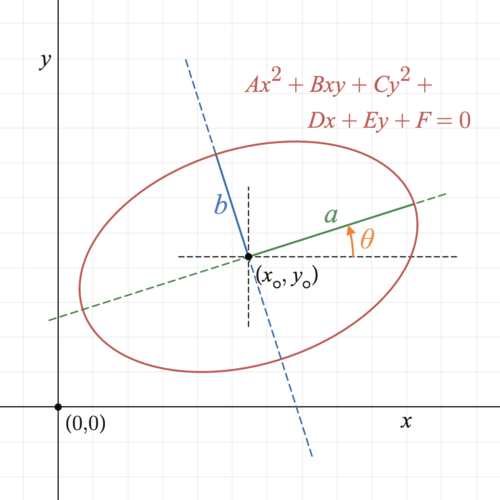
General ellipse
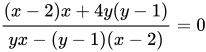
If the focus is and the directrix , one obtains the equation
(The right side of the equation uses the Hesse normal form of a line to calculate the distance .)
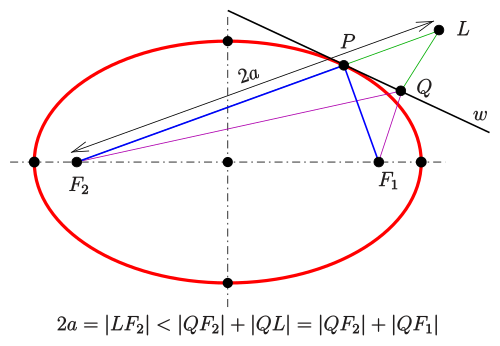
Focus-to-focus reflection property
Ellipse: the tangent line w bisects the supplementary angle L-P-F1 of the angle F1-P-F2 between the lines from point P to the foci.Rays from one focus reflect off the ellipse to pass through the other focus.
Two non-circular gears with the same elliptical outline, each pivoting around one focus and positioned at the proper angle, turn smoothly while maintaining contact at all times. Alternatively, they can be connected by a link chain or timing belt, or in the case of a bicycle the main chainring may be elliptical, or an ovoid similar to an ellipse in form. Such elliptical gears may be used in mechanical equipment to produce variable angular speed or torque from a constant rotation of the driving axle, or in the case of a bicycle to allow a varying crank rotation speed with inversely varying mechanical advantage.
Elliptical bicycle gears make it easier for the chain to slide off the cog when changing gears.[31]
An example gear application would be a device that winds thread onto a conical bobbin on a spinning machine. The bobbin would need to wind faster when the thread is near the apex than when it is near the base.[32]
In lamp-pumped solid-state lasers, elliptical cylinder-shaped reflectors have been used to direct light from the pump lamp (coaxial with one ellipse focal axis) to the active medium rod (coaxial with the second focal axis).[33]
In laser-plasma produced EUV light sources used in microchip lithography, EUV light is generated by plasma positioned in the primary focus of an ellipsoid mirror and is collected in the secondary focus at the input of the lithography machine.[34]
Statistics and finance
In statistics, a bivariate random vector is jointly elliptically distributed if its iso-density contours—loci of equal values of the density function—are ellipses. The concept extends to an arbitrary number of elements of the random vector, in which case in general the iso-density contours are ellipsoids. A special case is the multivariate normal distribution. The elliptical distributions are important in the financial field because if rates of return on assets are jointly elliptically distributed then all portfolios can be characterized completely by their mean and variance—that is, any two portfolios with identical mean and variance of portfolio return have identical distributions of portfolio return.[35][36]
Computer graphics
Drawing an ellipse as a graphics primitive is common in standard display libraries, such as the MacIntosh QuickDraw API, and Direct2D on Windows. Jack Bresenham at IBM is most famous for the invention of 2D drawing primitives, including line and circle drawing, using only fast integer operations such as addition and branch on carry bit. M. L. V. Pitteway extended Bresenham's algorithm for lines to conics in 1967.[37] Another efficient generalization to draw ellipses was invented in 1984 by Jerry Van Aken.[38]
In 1970 Danny Cohen presented at the "Computer Graphics 1970" conference in England a linear algorithm for drawing ellipses and circles. In 1971, L. B. Smith published similar algorithms for all conic sections and proved them to have good properties.[39] These algorithms need only a few multiplications and additions to calculate each vector.
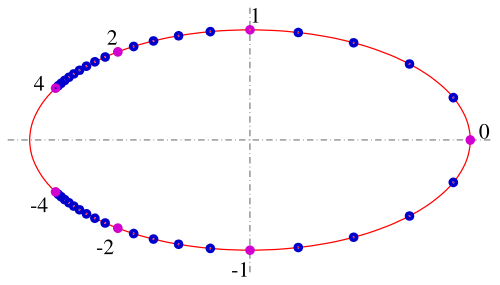
It is beneficial to use a parametric formulation in computer graphics because the density of points is greatest where there is the most curvature. Thus, the change in slope between each successive point is small, reducing the apparent "jaggedness" of the approximation.
Drawing with Bézier paths
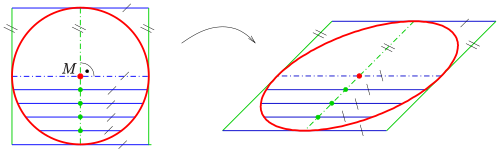
Composite Bézier curves may also be used to draw an ellipse to sufficient accuracy, since any ellipse may be construed as an affine transformation of a circle. The spline methods used to draw a circle may be used to draw an ellipse, since the constituent Bézier curves behave appropriately under such transformations.
Optimization theory
It is sometimes useful to find the minimum bounding ellipse on a set of points. The ellipsoid method is quite useful for solving this problem.
↑Apostol, Tom M.; Mnatsakanian, Mamikon A. (2012), New Horizons in Geometry, The Dolciani Mathematical Expositions #47, The Mathematical Association of America, p.251, ISBN978-0-88385-354-2
↑The German term for this circle is Leitkreis which can be translated as "Director circle", but that term has a different meaning in the English literature (see Director circle).
12"Ellipse - from Wolfram MathWorld". Mathworld.wolfram.com. 2020-09-10. Retrieved 2020-09-10.
↑Larson, Ron; Hostetler, Robert P.; Falvo, David C. (2006). "Chapter 10". Precalculus with Limits. Cengage Learning. p.767. ISBN978-0-618-66089-6.
↑Young, Cynthia Y. (2010). "Chapter 9". Precalculus. John Wiley and Sons. p.831. ISBN978-0-471-75684-2.
12Lawrence, J. Dennis, A Catalog of Special Plane Curves, Dover Publ., 1972. URL: https://archive.org/details/catalogofspecial00lawr
↑Ursu-Fischer, Nicolae (2019). "Considerations about algebraic fitting of an ellipse to scattered 2D data". Acta Techn. Napocensis. 62 (2): 257–264.
↑Strubecker, K. (1967). Vorlesungen über Darstellende Geometrie. Göttingen: Vandenhoeck & Ruprecht. p.26. OCLC4886184.
↑Bronstein&Semendjajew: Taschenbuch der Mathematik, Verlag Harri Deutsch, 1979, ISBN3871444928, p. 274.
↑Encyclopedia of Mathematics, Springer, URL: http://encyclopediaofmath.org/index.php?title=Apollonius_theorem&oldid=17516 .
↑Blake, E. M. (1900). "The Ellipsograph of Proclus". American Journal of Mathematics. 22 (2): 146–153. doi:10.2307/2369752. JSTOR2369752.
↑K. Strubecker: Vorlesungen über Darstellende Geometrie. Vandenhoeck & Ruprecht, Göttingen 1967, S. 26.
↑From Περί παραδόξων μηχανημάτων [Concerning Wondrous Machines]: "If, then, we stretch a string surrounding the points A, B tightly around the first point from which the rays are to be reflected, the line will be drawn which is part of the so-called ellipse, with respect to which the surface of the mirror must be situated." Huxley, G. L. (1959). Anthemius of Tralles: A Study in Later Greek Geometry. Cambridge, MA. pp.8–9. LCCN59-14700.{{cite book}}: CS1 maint: location missing publisher (link)
↑Al-Ḥasan's work was titled Kitāb al-shakl al-mudawwar al-mustaṭīl [The Book of the Elongated Circular Figure]. Rashed, Roshdi (2014). Classical Mathematics from Al-Khwarizmi to Descartes. Translated by Shank, Michael H. New York: Routledge. p.559. ISBN978-13176-2-239-0.
↑J. van Mannen: Seventeenth century instruments for drawing conic sections. In: The Mathematical Gazette. Vol. 76, 1992, p. 222–230.
↑E. Hartmann: Lecture Note 'Planar Circle Geometries', an Introduction to Möbius-, Laguerre- and Minkowski Planes, p. 55
↑W. Benz, Vorlesungen über Geomerie der Algebren, Springer (1973)
↑Archimedes. (1897). The works of Archimedes. Heath, Thomas Little, Sir, 1861-1940. Mineola, N.Y.: Dover Publications. p.115. ISBN0-486-42084-1. OCLC48876646.{{cite book}}: ISBN / Date incompatibility (help)
↑Ivory, J. (1798). "A new series for the rectification of the ellipsis". Transactions of the Royal Society of Edinburgh. 4 (2): 177–190. doi:10.1017/s0080456800030817. S2CID251572677.
↑Bessel, F. W. (2010). "The calculation of longitude and latitude from geodesic measurements (1825)". Astron. Nachr.331 (8): 852–861. arXiv:0908.1824. Bibcode:2010AN....331..852K. doi:10.1002/asna.201011352. S2CID118760590. English translation of Bessel, F. W. (1825). "Über die Berechnung der geographischen Längen und Breiten aus geodätischen Vermesssungen". Astron. Nachr. (in German). 4 (16): 241–254. arXiv:0908.1823. Bibcode:1825AN......4..241B. doi:10.1002/asna.18260041601. S2CID118630614.
↑Linderholm, Carl E.; Segal, Arthur C. (June 1995). "An Overlooked Series for the Elliptic Perimeter". Mathematics Magazine. 68 (3): 216–220. doi:10.1080/0025570X.1995.11996318. which cites to Kummer, Ernst Eduard (1836). "Uber die Hypergeometrische Reihe"[About the hypergeometric series]. Journal für die Reine und Angewandte Mathematik (in German). 15 (1, 2): 39–83, 127–172. doi:10.1515/crll.1836.15.39.
↑Cook, John D. (28 May 2023). "Comparing approximations for ellipse perimeter". John D. Cook Consulting blog. Retrieved 2024-09-16.
↑Ramanujan, Srinivasa (1914). "Modular Equations and Approximations to π"(PDF). Quart. J. Pure App. Math. 45: 350–372. ISBN978-0-8218-2076-6.{{cite journal}}: ISBN / Date incompatibility (help)
12Villarino, Mark B. (20 June 2005). "Ramanujan's Perimeter of an Ellipse". arXiv:math.CA/0506384. We present a detailed analysis of Ramanujan's most accurate approximation to the perimeter of an ellipse. In particular, the second equation underestimates the circumference by where is an increasing function of
↑Cook, John D. (22 September 2024). "Error in Ramanujan's approximation for ellipse perimeter". John D. Cook Consulting blog. Retrieved 2024-12-01. the relative error when b = 1 and a varies ... is bound by 4/π − 14/11 = 0.00051227….
↑Jameson, G.J.O. (2014). "Inequalities for the perimeter of an ellipse". Mathematical Gazette. 98 (542): 227–234. doi:10.1017/S002555720000125X. S2CID125063457.
↑Prasolov, V.; Solovyev, Y. (1997). Elliptic Functions and Elliptic Integrals. American Mathematical Society. pp.58–60. ISBN0-8218-0587-8.
↑Legendre's Traité des fonctions elliptiques et des intégrales eulériennes
↑Grant, George B. (1906). A treatise on gear wheels. Philadelphia Gear Works. p.72.
↑Encyclopedia of Laser Physics and Technology - lamp-pumped lasers, arc lamps, flash lamps, high-power, Nd:YAG laser
↑"Cymer - EUV Plasma Chamber Detail Category Home Page". Archived from the original on 2013-05-17. Retrieved 2013-06-20.
↑Chamberlain, G. (February 1983). "A characterization of the distributions that imply mean—Variance utility functions". Journal of Economic Theory. 29 (1): 185–201. doi:10.1016/0022-0531(83)90129-1.
↑Owen, J.; Rabinovitch, R. (June 1983). "On the class of elliptical distributions and their applications to the theory of portfolio choice". Journal of Finance. 38 (3): 745–752. doi:10.1111/j.1540-6261.1983.tb02499.x. JSTOR2328079.
↑Pitteway, M.L.V. (1967). "Algorithm for drawing ellipses or hyperbolae with a digital plotter". The Computer Journal. 10 (3): 282–9. doi:10.1093/comjnl/10.3.282.
↑Smith, L.B. (1971). "Drawing ellipses, hyperbolae or parabolae with a fixed number of points". The Computer Journal. 14 (1): 81–86. doi:10.1093/comjnl/14.1.81.
References
Besant, W.H. (1907). "Chapter III. The Ellipse". Conic Sections. London: George Bell and Sons. p.50.
Coxeter, H.S.M. (1969). Introduction to Geometry (2nded.). New York: Wiley. pp.115–9.
Meserve, Bruce E. (1983) [1959], Fundamental Concepts of Geometry, Dover Publications, ISBN978-0-486-63415-9
Miller, Charles D.; Lial, Margaret L.; Schneider, David I. (1990). Fundamentals of College Algebra (3rded.). Scott Foresman/Little. p.381. ISBN978-0-673-38638-0.
Protter, Murray H.; Morrey, Charles B. Jr. (1970), College Calculus with Analytic Geometry (2nded.), Reading: Addison-Wesley, LCCN76087042














 Quotations related to Ellipse at Wikiquote
 Media related to Ellipses at Wikimedia Commons


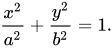


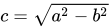

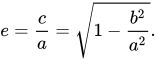











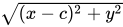


























![{\displaystyle {\begin{aligned}A&=a^{2}\sin ^{2}\theta +b^{2}\cos ^{2}\theta &B&=2\left(b^{2}-a^{2}\right)\sin \theta \cos \theta \\[1ex]C&=a^{2}\cos ^{2}\theta +b^{2}\sin ^{2}\theta &D&=-2Ax_{\circ }-By_{\circ }\\[1ex]E&=-Bx_{\circ }-2Cy_{\circ }&F&=Ax_{\circ }^{2}+Bx_{\circ }y_{\circ }+Cy_{\circ }^{2}-a^{2}b^{2}.\end{整列}}}](https://wikimedia.org/api/rest_v1/media/math/render/svg/83709b15a759e09332f42231c992ef5f97e6e2cb)
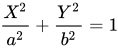


![{\displaystyle {\begin{aligned}a,b&={\frac {-{\sqrt {2{\big (}AE^{2}+CD^{2}-BDE+(B^{2}-4AC)F{\big )}{\big (}(A+C)\pm {\sqrt {(AC)^{2}+B^{2}}}{\big )}}}}{B^{2}-4AC}},\\x_{\circ }&={\frac {2CD-BE}{B^{2}-4AC}},\\[5mu]y_{\circ }&={\frac {2AE-BD}{B^{2}-4AC}},\\[5mu]\theta &={\tfrac {1}{2}}\operatorname {atan2} (-B,\,CA),\end{aligned}}}](https://wikimedia.org/api/rest_v1/media/math/render/svg/49c699db33888167e2c0c9fb5223b3b11d5124f9)





![{\displaystyle {\begin{cases}x(u)=a\,{\dfrac {1-u^{2}}{1+u^{2}}}\\[10mu]y(u)=b\,{\dfrac {2u}{1+u^{2}}}\\[10mu]-\infty <u<\infty \end{cases}}}](https://wikimedia.org/api/rest_v1/media/math/render/svg/338f80cb5063c4db7bb394618c0012575c6ae071)

![{\displaystyle u\in [0,\,1],}](https://wikimedia.org/api/rest_v1/media/math/render/svg/c61b780db9ac550dd283876e16abe9c2cccdf8c3)


![{\displaystyle [u:v]}](https://wikimedia.org/api/rest_v1/media/math/render/svg/297de5a93c52f13ef84add1d79d693fcda686176)

![{\displaystyle [u:v]\mapsto \left(a{\frac {v^{2}-u^{2}}{v^{2}+u^{2}}},b{\frac {2uv}{v^{2}+u^{2}}}\right).}](https://wikimedia.org/api/rest_v1/media/math/render/svg/fa1c21205522d70966ce62b8e324b19ec4c90f41)
![{\textstyle [1:0]\mapsto (-a,\,0).}](https://wikimedia.org/api/rest_v1/media/math/render/svg/0da12e69b8138a30dcb6cfbeeb95bd63b890f2db)










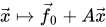


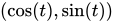





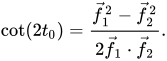











![{\displaystyle {\begin{aligned}a&={\frac {1}{2}}({\sqrt {M+2N}}+{\sqrt {M-2N}})\\[1ex]b&={\frac {1}{2}}({\sqrt {M+2N}}-{\sqrt {M-2N}})\,.\end{aligned}}}](https://wikimedia.org/api/rest_v1/media/math/render/svg/8252bcba269bad4896aef5f664a83860320d49b5)






































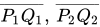



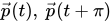

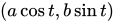


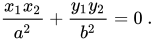








































![{\displaystyle {\begin{bmatrix}1&{\dfrac {y_{1}-y_{2}}{x_{1}-x_{2}}}\\[2ex]{\dfrac {x_{1}-x_{3}}{y_{1}-y_{3}}}&1\end{bmatrix}}{\begin{bmatrix}x_{\circ }\\[1ex]y_{\circ }\end{bmatrix}}={\begin{bmatrix}{\dfrac {x_{1}^{2}-x_{2}^{2}+y_{1}^{2}-y_{2}^{2}}{2(x_{1}-x_{2})}}\\[2ex]{\dfrac {y_{1}^{2}-y_{3}^{2}+x_{1}^{2}-x_{3}^{2}}{2(y_{1}-y_{3})}}\end{bmatrix}}.}](https://wikimedia.org/api/rest_v1/media/math/render/svg/505e489a44d7620be3ab20771d38951e0eef7409)





















![{\displaystyle x\in [-a,a],}](https://wikimedia.org/api/rest_v1/media/math/render/svg/fb19e5015712fa6f6c57d3f334266c73d7782434)

![{\displaystyle [-a,a]}](https://wikimedia.org/api/rest_v1/media/math/render/svg/50ccbcece37f9ec0a4c6d396be3a143a0b76d5c1)











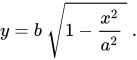



![{\displaystyle s=b\ \left[\;E\left(z\;{\Biggl |}\;1-{\frac {a^{2}}{b^{2}}}\right)\;\right]_{z\ =\ \arccos {\frac {x_{2}}{a}}}^{\arccos {\frac {x_{1}}{a}}}}](https://wikimedia.org/api/rest_v1/media/math/render/svg/b7338c6c7bf9cc8e20da6c7da90eecd93f540416)


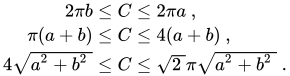


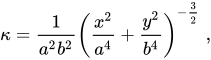



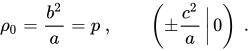



![{\displaystyle {\begin{aligned}a&={\frac {r_{a}+r_{p}}{2}}\\[2pt]b&={\sqrt {r_{a}r_{p}}}\\[2pt]\ell &={\frac {2}{{\frac {1}{r_{a}}}+{\frac {1}{r_{p}}}}}={\frac {2r_{a}r_{p}}{r_{a}+r_{p}}}.\end{aligned}}}](https://wikimedia.org/api/rest_v1/media/math/render/svg/fe971ae54d15192d057cf4ab90494745bfb3a006)


