Loading article…
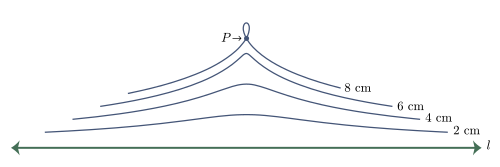
幾何学において、軌跡(複数形:loci、ラテン語で「場所、位置」の意)とは、位置が1つ以上の特定の条件を満たすか、またはそれによって決定されるすべての点(一般的には、線、線分、曲線、または曲面)の集合である。[ 1 ] [ 2 ]
ある性質を満たす点の集合は、しばしばその性質を満たす点の軌跡と呼ばれる。この表現で単数形が用いられていることは、19世紀末まで数学者が無限集合という概念を捉えていなかったことを示している。彼らは直線や曲線を点の集合としてではなく、点が存在したり移動したりする場所として捉えていたのである。
20世紀初頭まで、幾何学的形状(例えば曲線)は無限の点の集合とは考えられておらず、むしろ点が存在するか、あるいは点が移動する実体として考えられていました。そのため、ユークリッド平面上の円は、固定点である円の中心から一定の距離にある点の軌跡として定義されていました。現代数学では、同様の概念は、形状を集合として記述することによってより頻繁に再定式化されます。例えば、円は中心から一定の距離にある点の集合であると言えます。[ 3 ]
集合論的な見方とは対照的に、古い定式化では無限集合を考慮することを避けている。なぜなら、実際の無限を避けることは、初期の数学者たちの重要な哲学的立場であったからである。[ 4 ] [ 5 ]
集合論が数学全体の基盤となる普遍的な理論となった後、 [ 6 ]軌跡という用語はやや時代遅れになった。[ 7 ]それにもかかわらず、この用語は今でも広く使われており、主に簡潔な表現として、例えば次のように用いられる。
近年では、スキーム理論などの手法や、数学の基礎として集合論の代わりに圏論を用いる手法によって、軌跡を点の集合としてではなく、それ自体が対象であるという本来の定義に近い概念へと回帰している。[ 5 ]
平面幾何学の例としては、以下のようなものがあります。
軌跡の例は、数学のさまざまな分野に見られる。例えば、複素力学においては、マンデルブロ集合は複素平面の部分集合であり、多項式写像の族の連結軌跡として特徴づけることができる。
与えられた条件を満たす正しい軌跡が幾何学的形状であることを証明するには、一般的に証明を 2 つの段階に分けます。条件を満たすすべての点が与えられた形状上にあることを証明し、与えられた形状上のすべての点が条件を満たすことを証明します。[ 10 ]
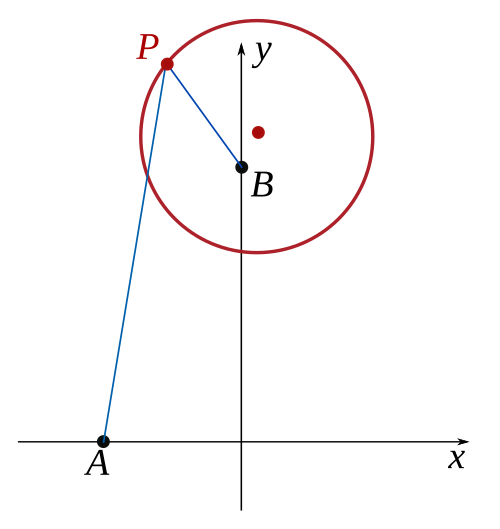
Find the locus of a point P that has a given ratio of distances k = d1/d2 to two given points.
In this example k = 3, A(−1, 0) and B(0, 2) are chosen as the fixed points.
This equation represents a circle with center (1/8, 9/4) and radius . It is the circle of Apollonius defined by these values of k, A, and B.
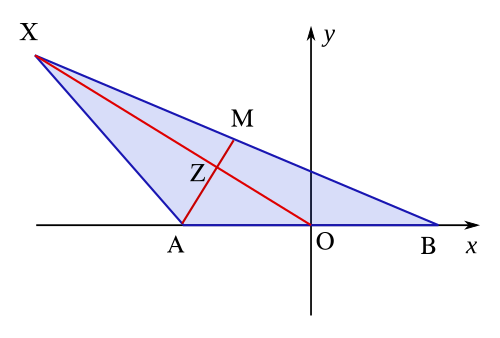
A triangle ABC has a fixed side [AB] with length c. Determine the locus of the third vertexC such that the medians from A and C are orthogonal.
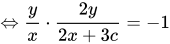
Choose an orthonormalcoordinate system such that A(−c/2, 0), B(c/2, 0). C(x, y) is the variable third vertex. The center of [BC] is M((2x + c)/4, y/2). The median from C has a slope y/x. The median AM has slope 2y/(2x + 3c).
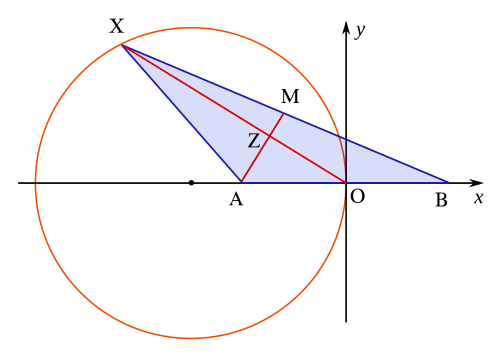
The locus of the vertex C is a circle with center (−3c/4, 0) and radius 3c/4.

A locus can also be defined by two associated curves depending on one common parameter. If the parameter varies, the intersection points of the associated curves describe the locus.
In the figure, the points K and L are fixed points on a given line m. The line k is a variable line through K. The line l through L is perpendicular to k. The angle between k and m is the parameter. k and l are associated lines depending on the common parameter. The variable intersection point S of k and l describes a circle. This circle is the locus of the intersection point of the two associated lines.
A locus of points need not be one-dimensional (as a circle, line, etc.). For example,[1] the locus of the inequality 2x + 3y – 6 < 0 is the portion of the plane that is below the line of equation 2x + 3y – 6 = 0.
{{citation}}: ISBN / Date incompatibility (help).The word locus is one that we still use today to denote the path followed by a point moving subject to stated constraints, although, since the introduction of set theory, a locus is more often thought of statically as the set of points satisfying a given collection.
the classical mathematicians carefully avoided introducing into their reasoning the 'actual infinity'.
すべての数学の基礎を提供する。
少し古風な用語の説明から始めましょう。。