February 28: Using the Reichstag fire as a pretext, the Reichstag Fire Decree is issued by President Paul von Hindenburg, nullifying many German civil liberties and paving the way for the Nazi seizure of power.[16]
March 27: Japan leaves the League of Nations over the League of Nations' Lytton Report that found that Manchuria belongs to China and that Manchukuo was not a truly independent state.
May 1: President Hindenburg and Chancellor Hitler appear before a crowd of 500,000 in Berlin as International Workers' Day is declared as "Day of National Labor" by the Nazi regime.[17][18]
May 2: Hitler outlaws trade unions.
May 15: Official formation of the Luftwaffe, the German air force built in secret in violation of the Treaty of Versailles.
May 31: The Tanggu Truce is signed between China and Japan, setting the ceasefire conditions between the two states after the Japanese occupation of Manchuria. China accedes to all Japanese demands, creating a large demilitarized zone inside Chinese territory.
June 21: All non-Nazi parties are banned in Germany.
July 14: The Nazi party becomes the official party of Germany.
August 25: Haavara Agreement: The agreement was designed to help facilitate the emigration of German Jews to Palestine.
October 5: Germany invalidates the passports of all its Jewish citizens who are reissued passports with the letter "J" stamped in red. This change was made after requests by Sweden and Switzerland who wanted a way of easily denying Jews entry into their countries.
November 9: The Nazis use von Rath's death as the pretext for the KristallnachtPogrom in Germany; thousands of Jewish shops and synagogues are smashed, looted, burned, and destroyed throughout the country.[44]
1939
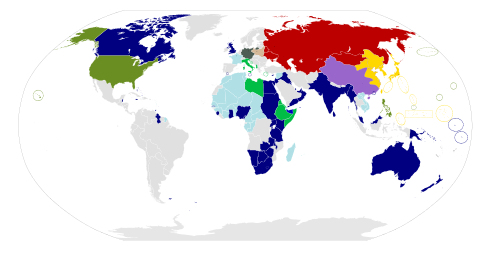
The world powers in 1939, before the start of World War II.
January 25: A uranium atom is split for the first time at Columbia University in the United States.[49]
January 27: Hitler orders Plan Z, a 5-year naval expansion programme intended to provide for a huge German fleet capable of defeating the British Royal Navy by 1944. The Kriegsmarine is given the first priority on the allotment of German economic resources. This is the first and only time the Kriegsmarine is given the first priority in the history of the Third Reich.
March 14: The Slovak Republic, a pro-German puppet state, is established.
March 15: Germany occupies and annexesBohemia and Moravia-Silesia in violation of the Munich Agreement. The Czechs do not attempt to put up any organized resistance, having lost their main defensive line with the annexation of the Sudetenland.
↑トマセヴィッチ、ジョゾ;オーティ、フィリス;ザニノヴィッチ、M.ジョージ;マクレラン、ウッドフォード;マセシッチ、ジョージ;ハルパーン、ジョエル M. (2023) [1969]. 『現代ユーゴスラビア:社会主義実験の20年』 . バークレーおよびロサンゼルス:カリフォルニア大学出版局. p. 46. ISBN9780520331112―Googleブックス経由。
↑グレイブス、マシュー (2010-05-14). 「国家周縁部における記憶と忘却:マルセイユと1934年の王殺し」 . Portal: Journal of Multidisciplinary International Studies . 7 (1). doi : 10.5130/portal.v7i1.1291 . ISSN 1449-2490 .
↑ Alexander, Martin S. (2015), Mawdsley, Evan; Ferris, John (eds.), French grand strategy and defence preparations , The Cambridge History of the Second World War, vol. 1: Fighting the War, Cambridge: Cambridge University Press, pp. 78– 106, ISBN978-1-139-85596-92021年6月15日取得
↑ Wilson, Sande John (1967). German intervention in the Spanish Civil War, 1936–1939 . University of Montana. pp. 6 & 7. 2023年7月27日取得– ScholarWorks @ University of Montana経由。
↑ Pauley, Bruce E. (1991年7月). 「ホロコーストが始まった日:ヘルシェル・グリュンシュパンのオデッセイ」 . History: Reviews of New Books . 20 (1): 37–38 . doi : 10.1080/03612759.1991.9949500 . ISSN 0361-2759 .
1 2 Rawson, Andrew (2021). Balkan Struggles: A Century of Civil War, Invasion, Communism and Genocide . Pen & Sword Military. p. 46. ISBN9781526761477―Googleブックス経由。
↑ヒギンズ、デイビッド・R. (2020).ドイツ兵対ポーランド兵:ポーランド 1939.ブルームズベリー出版. p. 6. ISBN9781472841728– Googleブックスより。イギリスとフランスによるヨーロッパでの新たな戦争を回避しようとする努力はすぐに崩壊し、3月31日、ポーランドはドイツが侵攻した場合の軍事介入について両国と合意を取り付けた。