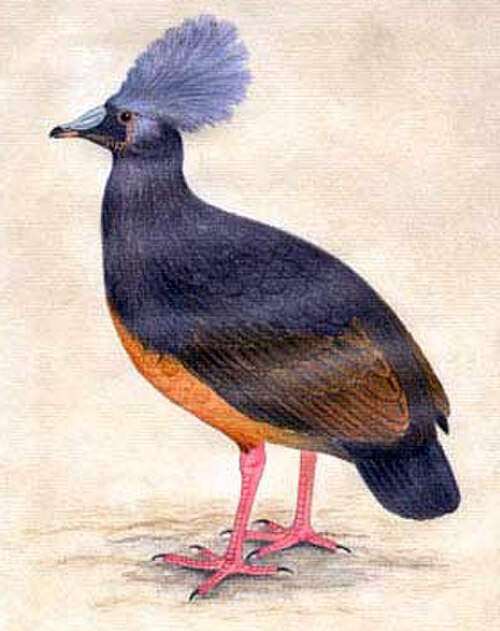
シンシナティ動物園で最後に飼育されていた鳥が死んだ1918年がこの種の絶滅日と一般的に言われているが、野生個体群がそれ以降も存続していたという確かな報告もある。2つの亜種、C. c. carolinensis(カロライナインコ、アパラチア山脈の東と南に生息、 1918年または1930年頃に絶滅)とC. c. ludovicianus(ルイジアナインコ、アパラチア山脈の西に生息、 1912年頃に絶滅)がある。
モロカイ島に生息している可能性のある場所が調査されていないため、公式には絶滅危惧種に分類されている。オアフ島( M. l. woahensis、1850年代に絶滅)、ラナイ島(基亜種M. l. lanaiensis、1930年代初頭に絶滅)、モロカイ島(M. l. rutha、1980年代に絶滅?)から3つの亜種が知られており、マウイ島(19世紀後半以前に絶滅)から4番目の亜種が存在する可能性がある。
Doubtfully distinct from the nominate subspecies of the Australian masked owl, but differed behaviorally.
Buru masked owl, Tyto sororcula cayelii (Buru, Indonesia, mid-20th century?)
A subspecies of the Moluccan masked owl last recorded in 1921; the identity of a similar bird found on Seram remains to be determined. It may still exist, as an owl matching this bird's description was encountered in August 2006.
A subspecies of the Sulawesi masked owl or a distinct species. It may possibly still exist, but the only known specimen was taken in 1938 and there have been no further records since then.
Samar bay owl, Phodilus badius riverae (Samar, Philippines, mid-20th century)
A subspecies of the Oriental bay owl or a possibly distinct species. Its taxonomy is doubtful, but the only known specimen was lost in a 1945 bombing raid, so its validity cannot be verified; no population exists on Samar today.
This subspecies of the indigo-capped hummingbird is only known from a specimen collected in Costa Rica in 1895. It is likely to have become extinct since then.
Alejandro Selkirk firecrown, Sephanoides fernandensis leyboldi (Alejandro Selkirk Island, Juan Fernández Islands, Southeast Pacific, 1908)
The nominate subspecies of Whitehead's swiftlet is only known from four specimens collected at Mount Data in 1895. Because of the lack of further records and massive habitat destruction, it is usually considered extinct. Given the size of the island, though, it may still exist.
Sangihe dwarf kingfisher, Ceyx fallax sangirensis (Sangihe, Indonesia, 1998?)
This subspecies of the Sulawesi dwarf kingfisher was last seen in 1997 but not during a thorough survey one year later; it is either close to extinction or already extinct. Sometimes it is said to occur on the Talaud Islands also, but this is erroneous.
Guadalcanal little kingfisher, Ceyx pusillus aolae (Guadalcanal, Solomon Islands,?)
There exist reports of locals that kingfishers–probably a subspecies of the chattering kingfisher (Todiramphus tutus) which is found on neighboring islands, but possibly vagrants from there–were found until around 1979 and there is a last record from 1984. Presently, no kingfishers are known to exist on Rarotonga.
Previously considered as a distinct species, then reclassified as a subspecies of the Guam kingfisher. Only seen once by scientists in 1887; the specimen taken is somewhat damaged, making identification by anything other than molecular analysis difficult. It is now thought likely that the specimen came from Guam, where the aforementioned species was distributed, rather than Miyako, which would make this subspecies invalid (it was declared invalid by the International Ornithological Congress in 2022).
This subspecies of the Madagascar pygmy kingfisher is only known from one specimen taken in 1974 in an area where most of its habitat had already been destroyed. However, there have been records of the species (or an uncertain subspecies) from near the type locality, suggesting it is likely that it may still exist.
A subspecies of the Visayan hornbill of somewhat uncertain taxonomic status (it was possibly either a distinct species or a color morph); the last confirmed report was in 1971 and it became extinct shortly thereafter.
Javan buff-rumped woodpecker, Meiglyptes tristis tristis (Java, Indonesia, c.1920?)
The nominate subspecies of the buff-rumped woodpecker became rare during the 19th century due to habitat destruction. The last confirmed record was in 1880, and it is now considered to be at least very rare.
Guadalupe red-shafted flicker, Colaptes auratus rufipileus (Guadalupe Island, East Pacific, c.1906)
A subspecies of the northern flicker (formerly considered to be a subspecies of the red-shafted flicker, as C. cafer rufipileus), it was last recorded in 1906 and not found again in both 1911 and 1922. It may be invalid. Recently, vagrant birds of a mainland red-shafted northern flicker subspecies (which one is unknown) have begun recolonizing the island as the habitat improved after the extirpation of feral goats.
Another subspecies of the white-mantled barbet, also considered extinct by some sources, but confirmed extant by researchers in Colombia.
Todd's jacamar, Brachygalba lugubris phaeonota (Brazil, late 20th century?)
A subspecies of the brown jacamar, or possibly a hybrid, a color morph or a distinct species. It may still exist, as it is only known from a remote and seldom-visited area.
Considered either a subspecies of the red kite, a distinct species, or a hybrid between the red and black kite (Milvus migrans), the validity of this taxon has recently been questioned on the basis of molecular analysis; however, hybridization and a confusing molecular phylogeny of red kite populations, coupled with the distinct phenotype of the Cape Verde birds, suggest that the taxonomic status of this form is far from resolved.
The nominate subspecies of the Nicobar sparrowhawk–a species which is itself currently classified as vulnerable–is possibly extinct. It was last reliably recorded in 1901 and, despite searches, has not been sighted after an unconfirmed record in 1977; however, the species is known for being very shy and a population may persist unrecorded.
Sangir red-and-blue lory, Eos histrio histrio (Sangir Archipelago, Indonesia, 1990s?)
The nominate subspecies of the red-and-blue lory was hybridised out of existence through crossbreeding with escaped captive individuals of its other still-existing subspecies, Challenger's red-and-blue lory (E. h. challengeri), with the last certainly distinct individuals disappearing in the 1990s or even much earlier than that.
Known only from a painting and descriptions; the nominate subspecies of the echo parakeet, with the other one being the still-existing Mauritius parakeet (P. e. echo).
Another subspecies of the black-faced pitta. Not found during recent searches; doubtful records from nearby islands, but it is also likely to have been overlooked.
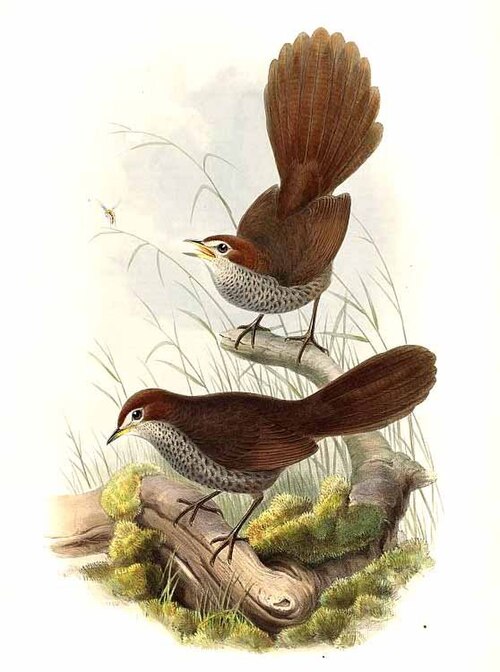
A subspecies of the scale-throated earthcreeper; it is known only from two specimens taken in the early 1950s at Puno, Peru and has not been seen or found since. It may still exist, as there is no obvious reason why it should have become extinct.
A subspecies of the stripe-crowned spinetail known only from a few specimens and not recorded since the 1950s; it may be endangered or possibly extinct.
A subspecies of the giant antpitta (or possibly of the great antpitta, in which case it would be G. excelsa lehmanni) apparently not recorded since the 1940s. It may still exist in Puracé National Natural Park, where there is plentiful habitat remaining.
A subspecies of the brown-banded antpitta recently described from a specimen collected in 1878. It has not been recorded since, despite surveys at a number of likely locations.
A subspecies of the rufous bristlebird not recorded since 1940 despite a number of surveys since then, beginning in the 1970s.
King Island brown thornbill, Acanthiza pusilla archibaldi (King Island, Australia, likely extant)
A subspecies of the brown thornbill which has only been recorded about 10 times since its discovery and is considered extinct by some authorities. The latest record comes from 2002, suggesting a population is likely to still exist, but it is very rare.
Western pied currawong, Strepera graculina ashbyi (Victoria, Australia, 1927)
This subspecies of the pied currawong has been hybridised out of existence by crossbreeding with other subspecies, which probably came into contact with it following habitat destruction in the 1830s. The last certainly distinct individuals were recorded in 1927.
Negros celestial monarch, Hypothymis coelestis rabori (Negros and possibly Sibuyan, Philippines, late 20th century?)
A subspecies of the celestial monarch; not uncommon on Negros in 1959, but not recorded since then. A single Sibuyan specimen from an unspecified locality taken in the 19th century is the only record for this island.
Hiva Oa monarch, Pomarea mendozae mendozae (Hiva Oa and Tahuata, Marquesas, late 20th century)
The nominate subspecies of the Marquesas monarch which was very rare by 1974 and not found during multiple surveys in the 1990s.
Maros cicadabird, Edolisoma tenuirostre edithae (Sulawesi, mid-20th century)
A subspecies of the common cicadabird known from a single specimen collected in 1931; quite possibly just a vagrant individual.
Cebu blackish cuckooshrike, Edolisoma coerulescens altera (Cebu, Philippines, 20th century?)
A subspecies of the blackish cuckooshrike; it may still exist, as this bird is rather unmistakable, and a 1999 record is therefore likely to be valid, though surveys since then have failed to record it.
Another subspecies of the blackish cuckooshrike; described from specimens collected in 1971, but apparently not seen since then. As few ornithologists have visited Marinduque and forest remains on the island, it is likely that it may still exist.
A subspecies of the dark-throated oriole not confirmed since 1906, though there were unconfirmed reports c. 2001, suggesting a possibility that it may still exist.
A distinct local white-with-black-markings and light brown-billed color morph of the North Atlantic raven, a subspecies of the common raven, found only on the Faroe Islands and not seen since 1902. Birds currently living on the Faroe Islands and on Iceland (the only other area in this subspecies' range) are all-black and black-billed; this still-existing color morph is named Corvus corax varius morpha typicus.
Jamaican golden swallow, Tachycineta euchrysea euchrysea (Jamaica, West Indies, c.1990?)
The nominate subspecies of the golden swallow; endemic to Jamaica. The last major roost site was destroyed in 1987 and the last confirmed sighting was in 1989. It may still exist in the Cockpit Country.
Cettiidae–cettiid warblers or typical bush warblers
Babar stubtail, Urosphena subulata advena (Babar, Indonesia, extant)
A subspecies of the Timor stubtail that has been considered extinct, but was recorded as common on Babar in 2009 and 2011.
Western Turner's eremomela, Eremomela turneri kalindei (Congo Basin, Africa, late 20th century?)
The West African subspecies of Turner's eremomela has not been recorded since the end of the 1970s, but there is unsurveyed habitat in its range where it is likely that it may still exist. Its placement in Cettiidae requires confirmation.
Acrocephalidae–acrocephalid warblers or marsh warblers, tree warblers and reed warblers
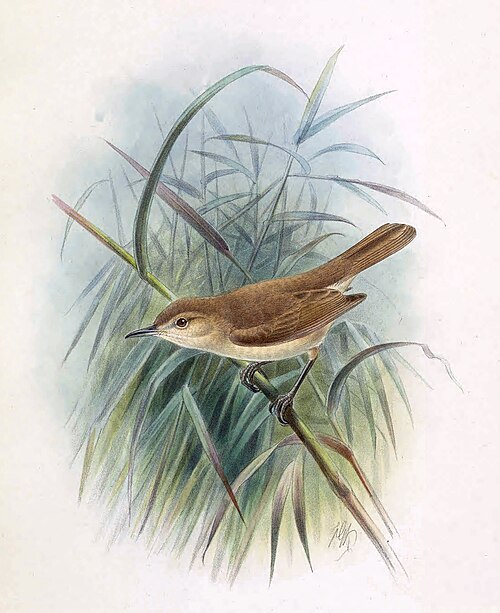
Oral tradition and some early reports mention a bird called the annañ which inhabited some of the Marshall Islands. The best match is the Nauru reed warbler; the annañ might have been an undescribed subspecies of that species or a distinct but related species of reed warbler.[79]
A subspecies of the long-legged thicketbird; it was found only once, but there was an unconfirmed sighting in 1990, suggesting that it may still exist. Its placement in Sylviidae is doubtful.
The nominate subspecies of Jerdon's babbler was last confirmed in 1941, but as there has been little fieldwork in its range and a possible sighting occurred in 1994, it is considered likely that it may still exist.
A subspecies of the white-browed crombec or possibly a distinct species. Restricted to the Lendu Plateau; it is probably rare, though unsurveyed forest remains where it is likely that it may still exist.
San Benedicto rock wren, Salpinctes obsoletus exsul (San Benedicto, Revillagigedo Islands, 1952)
A subspecies of the rock wren which became extinct c. 9:00 AM, August 1, 1952, when its island habitat was destroyed by a massive volcanic eruption.
Guadalupe Bewick's wren, Thryomanes bewickii brevicauda (Guadalupe Island, East Pacific, late 1890s?)
A subspecies of Bewick's wren. An extinction date of "1903" seems to be in error;[138] the last unquestionable record dates from 1897 and a thorough search in 1901 failed to record it.
A disputed subspecies of the Eurasian wren; it is known from a single specimen that may have been a vagrant individual and, therefore, it is possibly invalid.
Guadeloupe house wren, Troglodytes aedon guadeloupensis (Guadeloupe, West Indies, late 20th century?)
Found in 1914, 1969 and the 1970s; now very rare or already extinct. Its taxonomy is unresolved. A part of the house wren complex; other scientific names for it include T. musculus guadeloupensis and T. guadeloupensis.
Martinique house wren, Troglodytes aedon martinicensis (Martinique, West Indies, c.1890)
Last found in 1886. Its taxonomy is also unresolved. Another part of the house wren complex; other scientific names for it include T. musculus martinicensis and T. martinicensis.
A subspecies of the black-eared ground thrush or possibly a distinct species; known only from two specimens, both from 1966. It is likely that it still exists in suitable habitat, but it could already be extinct.
A subspecies of the russet-tailed thrush known from a single specimen found in 1924. It could have been wiped out by introduced feral cats, but the island is poorly known and so it should not be presumed extinct yet.
Isle of Pines solitaire, Myadestes elisabeth retrusus (Isla de la Juventud, West Indies, 20th century)
A subspecies of the Cuban solitaire. The last confirmed records were in the 1930s, with unconfirmed reports in the early 1970s.
Southern star finch, Bathilda ruficauda ruficauda (Australia, 1995)
The nominate subspecies of the star finch last recorded in 1995 and not found during later searches in the 1990s. It is not known to survive in captivity.
Fringillidae–true finches and Hawaiian honeycreepers
San Benito house finch, Haemorhous mexicanus mcgregori (San Benito, East Pacific, c.1940s)
The nominate subspecies of the Maui ʻalauahio (or, more properly, the Maui Nui ʻalauahio), it was last recorded in 1937 and was certainly extinct by 1960.
Gonâve western chat-tanager, Calyptophilus tertius abbotti (Gonâve, West Indies, c.1980?)
A subspecies of the western chat-tanager last recorded in 1977 and probably extinct.
Samaná eastern chat-tanager, Calyptophilus frugivorus frugivorus (eastern Hispaniola, West Indies, late 20th century)
The nominate subspecies of the eastern chat-tanager; the last (unconfirmed?) record was in 1982 and concerted efforts to record it ever since have failed.
The (possibly invalid) nominate subspecies of the large ground finch collected by Charles Darwin in 1835; he gave no precise location for it. A similar bird was found in 1957, but no others have been seen since then.
Saint Kitts bullfinch, Melopyrrha portoricensis grandis (St. Kitts and (prehistorically) Barbuda, West Indies, 1930)
Todos Santos rufous-crowned sparrow, Aimophila ruficeps sanctorum (Islas Todos Santos, East Pacific, 1970s?)
A subspecies of the rufous-crowned sparrow once common but not recorded during surveys in the 1970s or since then.
Santa Barbara song sparrow, Melospiza melodia graminea (Santa Barbara Island, North America, late 1960s)
A subspecies of the song sparrow last seen in 1967; it became extinct due to a severe wildfire in 1959 and subsequent predation by feral cats. Officially declared extinct by the United States Fish and Wildlife Service in 1983.
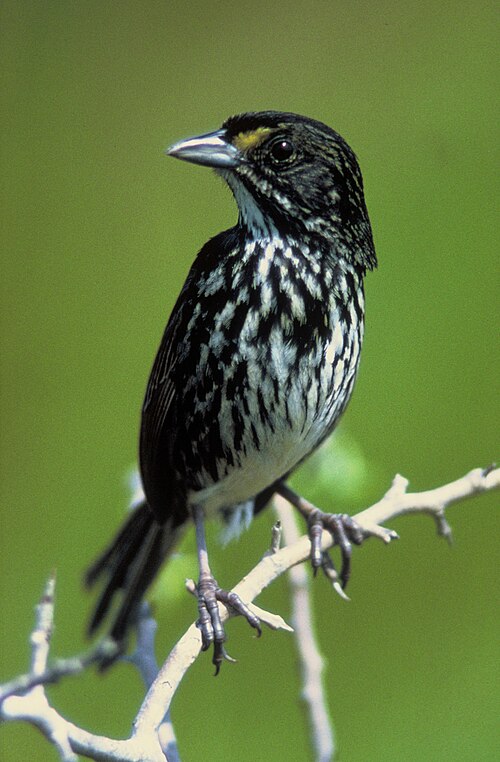
Dusky seaside sparrow, Ammospiza maritima nigrescens (Florida, North America, late 1980s)
A subspecies of the seaside sparrow last recorded in the wild in 1987.
Guadalupe spotted towhee, Pipilo maculatus consobrinus (Guadalupe Island, East Pacific, c.1900)
12Kittelberger, Kyle D.; Tanner, Colby J.; Buxton, Amy N.; Prewett, Amira; Şekercioğlu, Çağan Hakkı (2024). "Correlates of avian extinction timing around the world since 1500 CE". Avian Research. 15 100213. Bibcode:2024AvRes..1500213K. doi:10.1016/j.avrs.2024.100213.
↑"Birds Going Extinct Faster Due to Human Activities". today.duke.edu. 5 July 2006. Retrieved 20 February 2022.
12Ceballos, Gerardo; Ehrlich, Paul R. (26 September 2023). "Mutilation of the tree of life via mass extinction of animal genera". Proceedings of the National Academy of Sciences. 120 (39) e2306987120. Bibcode:2023PNAS..12006987C. doi:10.1073/pnas.2306987120. ISSN0027-8424. PMC10523489. PMID37722053.
↑"BirdLife Data Zone". datazone.birdlife.org. Retrieved 29 January 2023.
↑Extinct Birds. T. & A. D. Poyser. 2012. doi:10.5040/9781472597540.0007. ISBN978-1-4725-9754-0. Retrieved 23 May 2023.
↑Wandrag, Elizabeth; Rogers, Haldre (31 August 2017). "Guam's forests are being slowly killed off–by a snake". The Conversation. Retrieved 29 January 2023.
↑Rodda, Gordon H.; Savidge, Julie A. (2007). "Biology and Impacts of Pacific Island Invasive Species. 2. Boiga irregularis, the Brown Tree Snake (Reptilia: Colubridae) 1". Pacific Science. 61 (3): 307–324. doi:10.2984/1534-6188(2007)61[307:BAIOPI]2.0.CO;2. ISSN0030-8870.
↑Sayol, F.; Steinbauer, M. J.; Blackburn, T. M.; Antonelli, A.; Faurby, S. (4 December 2020). "Anthropogenic extinctions conceal widespread evolution of flightlessness in birds". Science Advances. 6 (49) eabb6095. Bibcode:2020SciA....6.6095S. doi:10.1126/sciadv.abb6095. ISSN2375-2548. PMC7710364. PMID33268368.
↑Cooke, Rob; Sayol, Ferran; Andermann, Tobias; Blackburn, Tim M.; Steinbauer, Manuel J.; Antonelli, Alexandre; Faurby, Søren (19 December 2023). "Undiscovered bird extinctions obscure the true magnitude of human-driven extinction waves". Nature Communications. 14 (1): 8116. Bibcode:2023NatCo..14.8116C. doi:10.1038/s41467-023-43445-2. ISSN2041-1723. PMC10730700. PMID38114469.
12Kaufman, Kenn (22 January 2021). "Ask Kenn: How Many of the World's Bird Species Have Gone Extinct? | Audubon". www.audubon.org. Archived from the original on 23 June 2021. Retrieved 14 February 2025.
↑Brattstrom, Bayard H.; Howell, Thomas R. (1 March 1956). "The Birds of the Revilla Gigedo Islands, Mexico". The Condor. 58 (2): 107–120. Bibcode:1956Condo..58..107B. doi:10.2307/1364977. ISSN1938-5129. JSTOR1364977.
↑"The IUCN Red List of Threatened Species". IUCN Red List of Threatened Species. Archived from the original on 17 January 2024. Retrieved 15 February 2025.
↑Szabo, Judit K.; Khwaja, Nyil; Garnett, Stephen T.; Butchart, Stuart H. M. (8 October 2012). Willis, Stephen G. (ed.). "Global Patterns and Drivers of Avian Extinctions at the Species and Subspecies Level". PLOS ONE. 7 (10) e47080. Bibcode:2012PLoSO...747080S. doi:10.1371/journal.pone.0047080. ISSN1932-6203. PMC3466226. PMID23056586.
↑Boehm, Mannfred M. A.; Cronk, Quentin C. B. (2021). "Dark extinction: the problem of unknown historical extinctions". Biology Letters. 17 (3) rsbl.2021.0007. Bibcode:2021BiLet..1710007B. doi:10.1098/rsbl.2021.0007. ISSN1744-957X. PMC8086982. PMID33653097.
↑Crowley, Brooke E. (2010). "A refined chronology of prehistoric Madagascar and the demise of the megafauna". Quaternary Science Reviews. 29 (19–20): 2591–2603. Bibcode:2010QSRv...29.2591C. doi:10.1016/j.quascirev.2010.06.030.
↑Wehi, Priscilla M.; Cox, Murray P.; Roa, Tom; Whaanga, Hēmi (1 August 2018). "Human Perceptions of Megafaunal Extinction Events Revealed by Linguistic Analysis of Indigenous Oral Traditions". Human Ecology. 46 (4): 461–470. Bibcode:2018HumEc..46..461W. doi:10.1007/s10745-018-0004-0. ISSN1572-9915. PMC6133014. PMID30237652.
↑Hansford, James P.; Lister, Adrian M.; Weston, Eleanor M.; Turvey, Samuel T. (2021). "Simultaneous extinction of Madagascar's megaherbivores correlates with late Holocene human-caused landscape transformation". Quaternary Science Reviews. 263 106996. Bibcode:2021QSRv..26306996H. doi:10.1016/j.quascirev.2021.106996.
↑BirdLife International (2023). "Dromaius baudinianus". IUCN Red List of Threatened Species. 2023 e.T22724449A226884412. doi:10.2305/IUCN.UK.2023-1.RLTS.T22724449A226884412.en.
↑BirdLife International (2023). "Dromaius minor". IUCN Red List of Threatened Species. 2023 e.T22728643A226828460. doi:10.2305/IUCN.UK.2023-1.RLTS.T22728643A226828460.en.
↑Herbert, John; Daugherty, Charles H. (2002). "Genetic variation, systematics and management of kiwi (Apteryx spp.)"(PDF). Some Early 1990s Studies in Kiwi. 191.
12"Crested Shelduck Tadorna Cristata Species". BirdLife DataZone. Archived from the original on 29 March 2023. Retrieved 15 February 2025.
↑del Hoyo, Josep; Collar, Nigel; Kirwan, Guy M. (4 March 2020), Billerman, Shawn M.; Keeney, Brooke K.; Rodewald, Paul G.; Schulenberg, Thomas S. (eds.), "Crested Shelduck (Tadorna cristata)", Birds of the World, Cornell Lab of Ornithology, doi:10.2173/bow.creshe1.01, retrieved 15 February 2025
↑Nowak, Eugeniusz (1 January 1984). "Über das vermutliche Brut- und Überwinterungsgebiet der Schopfkasarka,Tadorna cristata". Journal für Ornithologie (in German). 125 (1): 103–105. Bibcode:1984JOrn..125..103N. doi:10.1007/BF01652946. ISSN1439-0361.
↑Billerman, Shawn M.; Keeney, Brooke K.; Rodewald, Paul G.; Schulenberg, Thomas S., eds. (4 March 2020), "Reunion Shelduck (Alopochen kervazoi)", Birds of the World, Cornell Lab of Ornithology, doi:10.2173/bow.reushe1.01, retrieved 15 February 2025
↑"Reunion Shelduck Alopochen Kervazoi Species". BirdLife DataZone. Archived from the original on 6 September 2023. Retrieved 15 February 2025.
↑Tyrberg, Tommy (2009). "4. Holocene avian extinctions". In Turvey, Samuel (ed.). Holocene extinctions. Oxford biology. Oxford; New York: Oxford University Press. ISBN978-0-19-953509-5. OCLC310154634.
↑Cheke, A. S. (20 August 1987), "An ecological history of the Mascarene Islands, with particular reference to extinctions and introductions of land vertebrates", in Diamond, Anthony William (ed.), Studies of Mascarene Island Birds (1ed.), Cambridge University Press, pp.5–89, doi:10.1017/cbo9780511735769.003, ISBN978-0-521-25808-1, retrieved 15 February 2025
↑Kirk, David A. (1985). "Status Report on the Labrador Duck Camptorhynchus labradorius"(PDF). Committee of the Status of Endangered Wildlife in Canada.
↑BirdLife International (2023). "Camptorhynchus labradorius". IUCN Red List of Threatened Species. 2023 e.T22680418A221212367. doi:10.2305/IUCN.UK.2023-1.RLTS.T22680418A221212367.en.
↑"Labrador Duck". Massachusetts Avian Record Committee. 2026.
↑Dutcher, William (1984). "The Labrador Duck – Another Specimen, with Additional Data Respecting Extant Specimens". The Auk. 11 (1) 2.
↑Chilton, Glen (4 March 2020), Billerman, Shawn M.; Keeney, Brooke K.; Rodewald, Paul G.; Schulenberg, Thomas S. (eds.), "Labrador Duck (Camptorhynchus labradorius)", Birds of the World, Cornell Lab of Ornithology, doi:10.2173/bow.labduc.01, retrieved 15 February 2025
↑Miskelly, Colin & Forsdick, Natalie & Gill, Brian & Palma, Ricardo & Rawlence, Nicolas & Tennyson, Alan. (2022). Checklist of the Birds of New Zealand.
↑Williams, G. R.; Weller, M. W. (1974). "Unsuccessful search for the Auckland Island Merganser (Mergus australis)"(PDF). Notornis. 21 (3): 247. doi:10.63172/029994wccggz. Archived from the original(PDF) on 30 October 2007.
↑Russell, James C.; Horn, Stephen R.; Miskelly, Colin M.; Sagar, Rachael L.; Taylor, Rowley H. (2020). "Introduced land mammals and their impacts on the birds of the subantarctic Auckland Islands". Notornis. 67 (1): 247. doi:10.63172/799422ksenzu.
↑Billerman, Shawn M.; Keeney, Brooke K.; Rodewald, Paul G.; Schulenberg, Thomas S., eds. (4 March 2020), "Finsch's Duck (Chenonetta finschi)", Birds of the World, Cornell Lab of Ornithology, doi:10.2173/bow.finduc1.01, retrieved 15 February 2025
12Holdaway, Richard N.; Jones, Martin D.; Athfield, Nancy R. Beavan (2002). "Late Holocene extinction of Finsch's duck (Chenonetta finschi), an endemic, possibly flightless, New Zealand duck". Journal of the Royal Society of New Zealand. 32 (4): 629–651. Bibcode:2002JRSNZ..32..629H. doi:10.1080/03014223.2002.9517713. hdl:2292/4822. ISSN0303-6758.
↑Worthy, Trevor H.; Holdaway, Richard N.; Morris, Rod (2002). The lost world of the moa: prehistoric life of New Zealand. Life of the past. Bloomington, Ind.: Indiana University Press. ISBN978-0-253-34034-4.
12Krishnan, Anand (2022). "Pink-headed Duck (Rhodonessa caryophyllacea), version 2.0". Birds of the World. doi:10.2173/bow.pihduc1.02. ISSN2771-3105.
12"Pink-headed Duck Rhodonessa Caryophyllacea Species". BirdLife DataZone. Archived from the original on 8 December 2024. Retrieved 15 February 2025.
12Hume, Julian, ed. (1970). "A Synopsis of the Pre-human Avifauna of the Mascarene Islands"(PDF). Paleornithological Research 2013: 195–238. Retrieved 8 February 2023.
↑Mourer-Chauviré, Cécile; Ribes, Sonia; Bour, Roger (1999). "The Avifauna of Reunion Island (Mascarene Islands) at the Time of the Arrival of the First Europeans". Smithsonian Contributions to Paleobiology. 89 (1999).
↑Billerman, Shawn M.; Keeney, Brooke K.; Rodewald, Paul G.; Schulenberg, Thomas S., eds. (4 March 2020), "Amsterdam Duck (Mareca marecula)", Birds of the World, Cornell Lab of Ornithology, doi:10.2173/bow.amsduc1.01, retrieved 15 February 2025
12Olson, Storrs L.; Jouventin, Pierre (1996). "A New Species of Small Flightless Duck from Amsterdam Island, Southern Indian Ocean (Anatidae: Anas)". The Condor. 98 (1): 1–9. Bibcode:1996Condo..98....1O. doi:10.2307/1369501. ISSN1938-5129. JSTOR1369501.
↑Cheke, Anthony; Hume, Julian P. (2020). Lost Land of the Dodo: The Ecological History of Mauritius, Réunion and Rodrigues. T & AD Poyser. ISBN978-1-4729-8080-9.
12Reichel, James D.; Lemke, Thomas O. (1994). "Ecology and Extinction of the Mariana Mallard". The Journal of Wildlife Management. 58 (2): 199. doi:10.2307/3809380. JSTOR3809380.
↑Weller, Milton W. (1980). The island waterfowl (1ed.). Ames, Io: Iowa State Univ. Pr. ISBN978-0-8138-1310-3.
↑Cheesman, T. F. (1890). "On the Birds of the Kermadec Islands". Transactions and Proceedings of the Royal Society of New Zealand. 23: 216.
↑Holdaway, Richard; Worthy, Trevor H.; Tennyson, Alan J.D. (2001). "A working list of breeding birds of the New Zealand region at first human contact". New Zealand Journal of Zoology. 28: 131–132. doi:10.1080/03014223.2001.9518262.
↑Billerman, Shawn M.; Keeney, Brooke K.; Rodewald, Paul G.; Schulenberg, Thomas S., eds. (4 March 2020), "New Zealand Quail (Coturnix novaezelandiae)", Birds of the World, Cornell Lab of Ornithology, doi:10.2173/bow.nezqua1.01, retrieved 17 February 2025
123Hume, Julian P. (2017). Extinct Birds. Bloomsbury Publishing. ISBN978-1-4729-3746-9.
↑Collen, Ben; Purvis, Andy; Mace, Georgina M. (2010). "BIODIVERSITY RESEARCH: When is a species really extinct? Testing extinction inference from a sighting record to inform conservation assessment". Diversity and Distributions. 16 (5): 755–764. Bibcode:2010DivDi..16..755C. doi:10.1111/j.1472-4642.2010.00689.x. ISSN1472-4642.
↑McGowan, Philip J.K.; Kirwan, Guy M.; Sharpe, Chris (4 March 2020), Billerman, Shawn M.; Keeney, Brooke K.; Rodewald, Paul G.; Schulenberg, Thomas S. (eds.), "Himalayan Quail (Ophrysia superciliosa)", Birds of the World, Cornell Lab of Ornithology, doi:10.2173/bow.himqua1.01, retrieved 17 February 2025
12BirdLife International (2020). "Siphonorhis americana". IUCN Red List of Threatened Species. 2020 e.T22689738A178420953. doi:10.2305/IUCN.UK.2020-3.RLTS.T22689738A178420953.en.
↑Ludlow, F.; Kinnear, B. (1933). "A Contribution to the Ornithology of Chinese Turkestan — Part III". Ibis. 75 (4): 687. doi:10.1111/j.1474-919X.1933.tb03358.x.
↑Vaurie, Charles (1960). "Caprimulgidae: A New Species of Caprimulgus". American Museum Novitates. Systematic Notes on Palearctic Birds, No. 39 (1985): 1–10.
↑Schweizer, Manuel; Etzbauer, Claudia; Shirihai, Hadoram; Töpfer, Till; Kirwan, Guy M. (2020). "A molecular analysis of the mysterious Vaurie's Nightjar Caprimulgus centralasicus yields fresh insight into its taxonomic status". Journal of Ornithology. 161 (3): 635–650. Bibcode:2020JOrni.161..635S. doi:10.1007/s10336-020-01767-8.
↑Mayr, Ernst (1941). "Birds Collected During the Whitney South Sea Expedition: Notes on the Genera Halcyon, Turdus, and Eurostopodus". American Museum Novitates (1152): 6–7. hdl:2246/4778.
↑BirdLife International (2025). "Eurostopodus exul". IUCN Red List of Threatened Species. 2025 e.T22726340A250552840. doi:10.2305/IUCN.UK.2025-2.RLTS.T22726340A250552840.en.
↑BirdLife International (2025). "Aegotheles savesi". IUCN Red List of Threatened Species. 2025 e.T22689559A218292971. doi:10.2305/IUCN.UK.2025-2.RLTS.T22689559A218292971.en.
↑BirdLife International (2022). "Riccordia bracei". IUCN Red List of Threatened Species. 2022 e.T22687333A208112544. doi:10.2305/IUCN.UK.2022-2.RLTS.T22687333A208112544.en.
↑Graves, G.R.; Olson, S.L. (1987). "Chlorostilbon bracei Lawrence, an Extinct Species of Hummingbird from New Providence Island, Bahamas". The Auk. 104 (2): 296–302. doi:10.1093/auk/104.2.296.
↑Gould, John (1860). "Description of twenty-two new species of humming-birds". Proceedings of the Zoological Society of London. 28: 304–312.
↑BirdLife International (2022). "Riccordia elegans". IUCN Red List of Threatened Species. 2022 e.T22728709A208117613. doi:10.2305/IUCN.UK.2022-2.RLTS.T22728709A208117613.en.
↑Chesser, R.T.; Billerman, S.M.; Burns, K.J.; Cicero, C.; Dunn, J.L.; Hernández-Baños, B.E.; Jiménez, R.A.; Kratter, A.W.; Mason, N.A.; Rasmussen, P.C.; Remsen, J.V. Jr.; Stotz, D.F.; Winker, K. (2022). "Sixty-third supplement to the American Ornithological Society's Check-list of North American Birds". Ornithology. 139 (3) ukac020. doi:10.1093/ornithology/ukac020.
↑Weller, A.A. (1999). "On types of trochilids in The Natural History Museum, Tring II. Re-evaluation of Erythronota (?) elegans Gould 1860: a presumed extinct species of the genus Chlorostilbon". Bulletin of the British Ornithologists' Club. 119 (3): 197–202.
↑BirdLife International (2020). "Eriocnemis godini". IUCN Red List of Threatened Species. 2020 e.T22687922A182244989. doi:10.2305/IUCN.UK.2020-3.RLTS.T22687922A182244989.en.
↑BirdLife International (2021). "Amazilia alfaroana". IUCN Red List of Threatened Species. 2021 e.T119194112A178574309. doi:10.2305/IUCN.UK.2021-3.RLTS.T119194112A178574309.en.
↑BirdLife International (2024). "Nannococcyx psix". IUCN Red List of Threatened Species. 2024 e.T22728841A261985006. doi:10.2305/IUCN.UK.2024-2.RLTS.T22728841A261985006.en.
↑BirdLife International (2024). "Coua delalandei". IUCN Red List of Threatened Species. 2024 e.T22684143A261974345. doi:10.2305/IUCN.UK.2024-2.RLTS.T22684143A261974345.en.
12Olson, Storrs L. (1986). "Gallirallus sharpei (Büttikofer), nov. comb.: a valid species of rail (Rallidae) of unknown origin". Le Gerfaux. 76: 263–269.
↑BirdLife International (2025). "Hypotaenidia philippensis". IUCN Red List of Threatened Species. 2025 e.T22692425A157453571. doi:10.2305/IUCN.UK.2025-2.RLTS.T22692425A157453571.en.
↑van der Mije, Steven D; Kamminga, Pepijn; Dekker, René W.R.J. (2023). "Type specimens of non-passerines in Naturalis Biodiversity Center (Animalia, Aves)". ZooKeys (1155): 1–311. Bibcode:2023ZooK.1155....1V. doi:10.3897/zookeys.1155.98097. PMC10696600. PMID38059051.
↑Kirchman, Jeremy J.; Steadman, David W. (2007). "New Species of Extinct Rails (Aves: Rallidae) from Archaeological Sites in the Marquesas Islands, French Polynesia". Pacific Science. 61 (1): 145–163. doi:10.1353/psc.2007.0008. hdl:10125/22605.
↑Burley, David V.; Worthy, Trevor H. (2020). "Prehistoric avifaunas from the Kingdom of Tonga". Zoological Journal of the Linnean Society. 189 (3): 998–1045. doi:10.1093/zoolinnean/zlz110. Retrieved 6 January 2023.
12BirdLife International (2023). "Tribonyx hodgenorum". IUCN Red List of Threatened Species. 2023 e.T62274163A230910452. doi:10.2305/IUCN.UK.2023-1.RLTS.T62274163A230910452.en.
12Spennemann, Dirk H.R. (2006). "Extinctions and extirpations in Marshall Islands avifauna since European contact–a review of historic evidence"(PDF). Micronesica. 38 (2): 253–266.
↑"Alaotra grebe declared extinct after struggle against carnivorous fish". www.thetimes.com. 26 May 2010. Retrieved 14 February 2025.
↑Llimona, Francesc; del Hoyo, Josep; Christie, David; Jutglar, Francesc; Kirwan, Guy M. (4 March 2020), Billerman, Shawn M.; Keeney, Brooke K.; Rodewald, Paul G.; Schulenberg, Thomas S. (eds.), "Alaotra Grebe (Tachybaptus rufolavatus)", Birds of the World, Cornell Lab of Ornithology, doi:10.2173/bow.alagre1.01, retrieved 14 February 2025
↑Llimona, Francesc; del Hoyo, Josep; Christie, David; Jutglar, Francesc; Kirwan, Guy M. (4 March 2020), Billerman, Shawn M.; Keeney, Brooke K.; Rodewald, Paul G.; Schulenberg, Thomas S. (eds.), "Atitlan Grebe (Podilymbus gigas)", Birds of the World, Cornell Lab of Ornithology, doi:10.2173/bow.atigre1.01, retrieved 14 February 2025
↑LaBastille, Anne (1991). Mama Poc: An Ecologist's Account of the Extinction of a Species. W. W. Norton & Company. ISBN978-0-393-30800-6.
↑Fjeldså, J. (1993). "The decline and probable extinction of the Colombian Grebe Podiceps andinus". Bird Conservation International. 3 (3): 221–234. doi:10.1017/S0959270900000915. ISSN0959-2709.
↑Llimona, Francesc; del Hoyo, Josep; Christie, David; Jutglar, Francesc; Kirwan, Guy M. (4 March 2020), Billerman, Shawn M.; Keeney, Brooke K.; Rodewald, Paul G.; Schulenberg, Thomas S. (eds.), "Colombian Grebe (Podiceps andinus)", Birds of the World, Cornell Lab of Ornithology, doi:10.2173/bow.colgre1.01, retrieved 14 February 2025
↑"Colombian Grebe (Podiceps andinus) - BirdLife species factsheet". www.birdlife.org. Archived from the original on 24 May 2016. Retrieved 14 February 2025.
↑BirdLife International (2025). "Turnix novaecaledoniae". IUCN Red List of Threatened Species. 2025 e.T22734789A250389068. doi:10.2305/IUCN.UK.2025-2.RLTS.T22734789A250389068.en.
12"Canarian Oystercatcher Haematopus Meadewaldoi Species". BirdLife DataZone. Archived from the original on 17 March 2024. Retrieved 17 February 2025.
12Hockey, Phil (4 March 2020), Billerman, Shawn M.; Keeney, Brooke K.; Rodewald, Paul G.; Schulenberg, Thomas S. (eds.), "Canarian Oystercatcher (Haematopus meadewaldoi)", Birds of the World, Cornell Lab of Ornithology, doi:10.2173/bow.canoys1.01, retrieved 17 February 2025
↑Hockey, Philip A. R. (1 January 1987). "The influence of coastal utilisation by man on the presumed extinction of the Canarian black Oystercatcher Haematopus meadewaldoi Bannerman". Biological Conservation. 39 (1): 49–62. Bibcode:1987BCons..39...49H. doi:10.1016/0006-3207(87)90006-1. ISSN0006-3207.
123Wiersma, Popko; Kirwan, Guy M. (4 March 2020), Billerman, Shawn M.; Keeney, Brooke K.; Rodewald, Paul G.; Schulenberg, Thomas S. (eds.), "Javan Lapwing (Vanellus macropterus)", Birds of the World, Cornell Lab of Ornithology, doi:10.2173/bow.sunlap1.01, retrieved 17 February 2025
12"Javan Lapwing Vanellus Macropterus Species". BirdLife DataZone. Archived from the original on 31 May 2024. Retrieved 17 February 2025.
↑Lewis, Amy (20 April 2018). "The Eskimo Curlew Hasn't Been Seen in 55 Years. Is It Time to Declare It Extinct?". Audubon Society.
↑BirdLife International (2021). "Numenius borealis". IUCN Red List of Threatened Species. 2021 e.T22693170A178901365. doi:10.2305/IUCN.UK.2021-3.RLTS.T22693170A178901365.en.
12BirdLife International (2025). "Numenius tenuirostris". IUCN Red List of Threatened Species. 2025 e.T22693185A205993110. doi:10.2305/IUCN.UK.2025-2.RLTS.T22693185A205993110.en.
↑Gaskell, Jeremy (2000). Who Killed the Great Auk?. Oxford University Press.
↑BirdLife International (2021). "Pinguinus impennis". IUCN Red List of Threatened Species. 2021 e.T22694856A205919631. doi:10.2305/IUCN.UK.2021-3.RLTS.T22694856A205919631.en.
12Miskelly, Colin M.; Bell, Mike (2004). "An unusual influx of Snares crested penguins (Eudyptes robustus) on the Chatham Islands, with a review of other crested penguin records from the islands". Notornis. 51 (4): 235–237. doi:10.63172/271369qrepvu.
↑Millener, Philip R. (1996). "The History of the Chatham Islands' Bird Fauna of the Last 7000 Years—A Chronicle of Change and Extinction". Avian Paleontology at the Close of the 20th Century: Proceedings of the 4th International Meeting of the Society of Avian Paleontology and Evolution. Smithsonian Contributions to Paleobiology (89): 85–109. doi:10.5479/si.00810266.89.1.
12Tennyson, A.J.D.; Millener, P.R. (1994). "Bird extinctions and fossil bones from Mangere Island, Chatham Islands". Notornis. 41: 165–178. doi:10.63172/145571vmgcvo.
↑BirdLife International (2024). "Bulweria bifax". IUCN Red List of Threatened Species. 2024 e.T22728804A262268997. doi:10.2305/IUCN.UK.2024-2.RLTS.T22728804A262268997.en.
↑BirdLife International (2024). "Pterodroma rupinarum". IUCN Red List of Threatened Species. 2024 e.T22728800A262222743. doi:10.2305/IUCN.UK.2024-2.RLTS.T22728800A262222743.en.
12Tennyson, Alan J.D.; Cooper, Joanne H.; Shepherd, Lara D. (2015). "A new species of extinct Pterodroma petrel (Procellariiformes: Procellariidae) from the Chatham Islands, New Zealand"(PDF). Bulleting of the British Ornithologists' Club. 135 (3): 267–277.
↑BirdLife International (2018). "Hydrobates macrodactylus". IUCN Red List of Threatened Species. 2018 e.T22698530A132651919. doi:10.2305/IUCN.UK.2018-2.RLTS.T22698530A132651919.en.
↑BirdLife International (2023). "Urile perspicillatus". IUCN Red List of Threatened Species. 2023 e.T22696750A226827998. doi:10.2305/IUCN.UK.2023-1.RLTS.T22696750A226827998.en.
↑BirdLife International (2024). "Threskiornis solitarius". IUCN Red List of Threatened Species. 2024 e.T22728791A262272153. doi:10.2305/IUCN.UK.2024-2.RLTS.T22728791A262272153.en.
↑Mourer-Chauviré, Cécile; Bour, Roger; Ribes, Sonia (1995). "Was the solitaire of Réunion an ibis?"(PDF). Nature. 373: 568.
↑Hume, Julian P.; Cheke, Anthony S. (2004). "The white dodo of Réunion Island: unravelling a scientific and historical myth". Archives of Natural History. 31 (1): 57–59. doi:10.3366/anh.2004.31.1.57.
12del Hoyo, A.; Elliott, A.; Sargatal, D.; Christie, D.A.; de Juana, E. (2024). "New Zealand Bittern (Botaurus novaezelandiae), version 1.1". Birds of the World. Cornell Lab of Ornithology.
↑BirdLife International (2024). "Ixobrychus novaezelandiae". IUCN Red List of Threatened Species. 2024 e.T22697307A230913278. doi:10.2305/IUCN.UK.2024-2.RLTS.T22697307A230913278.en.
↑AviList Core Team (2026). "AviList: The Global Avian Checklist, v2025b". doi:10.2173/avilist.v2025b. Retrieved 30 June 2026.
↑BirdLife International (2023). "Nyctanassa carcinocatactes". IUCN Red List of Threatened Species. 2023 e.T62286255A221213270. doi:10.2305/IUCN.UK.2023-1.RLTS.T62286255A221213270.en.
↑Bartram, William (1791). Travels Through North & South Carolina, Georgia, East & West Florida, the Cherokee Country, the Extensive Territories of the Muscogulges, or Creek Confederacy, and the Country of the Chactaws; Containing An Account of the Soil and Natural Productions of Those Regions, Together with Observations on the Manners of the Indians. Philadelphia: James & Johnson. pp.149–152.
↑Harper, Francis (1936). "The Vultur sacra of William Bartram". The Auk. 53 (4): 381–392. doi:10.2307/4078256. JSTOR4078256.
↑BirdLife International (2025). "Bermuteo avivorus". IUCN Red List of Threatened Species. 2025 e.T62183030A249779181. doi:10.2305/IUCN.UK.2025-2.RLTS.T62183030A249779181.en.
↑Butchart, Stuart; Wheatley, Hannah; Lowe, Stephen; Westrip, James; Symes, Andy; Martin, Rob (2018). "Data for: Which bird species have gone extinct? A novel quantitative classification approach". Mendley Data. v1. Retrieved 29 May 2019.
↑BirdLife International (2024). "Upupa antaios". IUCN Red List of Threatened Species. 2024 e.T22728670A262288483. doi:10.2305/IUCN.UK.2024-2.RLTS.T22728670A262288483.en.
↑BirdLife International (2024). "Todiramphus cinnamominus". IUCN Red List of Threatened Species. 2024 e.T22725862A261269865. doi:10.2305/IUCN.UK.2024-2.RLTS.T22725862A261269865.en.
↑Tornito, A.J.G.; Cayanan, C.; Vetter, J.; Laut, M. (15 July 2025). "5-YEAR REVIEW: Species Reviewed: Guam kingfisher; sihek (Todiramphus cinnamomius)". U.S. Fish & Wildlife Service.
↑BirdLife International (2022). "Colaptes oceanicus". IUCN Red List of Threatened Species. 2022 e.T62322970A208124384. doi:10.2305/IUCN.UK.2022-1.RLTS.T62322970A208124384.en.
↑Olson, Storrs L. (2013). "Fossil woodpeckers from Bermuda with the description of a new species of Colaptes (Aves: Picidae)". Proceedings of the Biological Society of Washington. 126 (1): 17–24. doi:10.2988/0006-324X-126.1.17.
↑BirdLife International (2022). "Caracara lutosa". IUCN Red List of Threatened Species. 2022 e.T22728892A208124938. doi:10.2305/IUCN.UK.2022-1.RLTS.T22728892A208124938.en.
↑BirdLife International (2024). "Falco duboisi". IUCN Red List of Threatened Species. 2024 e.T22731930A262290016. doi:10.2305/IUCN.UK.2024-2.RLTS.T22731930A262290016.en.
↑BirdLife International (2024). "Anthornis melanocephala". IUCN Red List of Threatened Species. 2024 e.T22728814A246163701. doi:10.2305/IUCN.UK.2024-2.RLTS.T22728814A246163701.en.
↑Marki, Petter Z.; Jønsson, Knud A.; Irestedt, Martin; Nguyen, Jacqueline M.T.; Rahbek, Carsten; Fjeldså, Jon (2017). "Supermatrix phylogeny and biogeography of the Australasian Meliphagides radiation (Aves: Passeriformes)". Molecular Phylogenetics and Evolution. 107: 516–529. Bibcode:2017MolPE.107..516M. doi:10.1016/j.ympev.2016.12.021. hdl:10852/65203. PMID28017855.
↑BirdLife International (2024). "Zosterops albogularis". IUCN Red List of Threatened Species. 2024 e.T22714229A250085125. doi:10.2305/IUCN.UK.2024-2.RLTS.T22714229A250085125.en.
↑BirdLife International (2023). "Zosterops conspicillatus". IUCN Red List of Threatened Species. 2023 e.T103889155A231051969. doi:10.2305/IUCN.UK.2023-1.RLTS.T103889155A231051969.en.
↑Gill F, D Donsker & P Rasmussen (2026). "Sylviid babblers, parrotbills, white-eyes". IOC World Bird List v15.2.
↑BirdLife International (2022). "Zosterops saypani". IUCN Red List of Threatened Species. 2022 e.T22714043A210753487. doi:10.2305/IUCN.UK.2022-1.RLTS.T22714043A210753487.en.
↑BirdLife International (2024). "Zosterops semiflavus". IUCN Red List of Threatened Species. 2024 e.T103889951A262309629. doi:10.2305/IUCN.UK.2024-2.RLTS.T103889951A262309629.en.
↑BirdLife International (2023). "Zosterops strenuus". IUCN Red List of Threatened Species. 2023 e.T22714223A231049026. doi:10.2305/IUCN.UK.2023-1.RLTS.T22714223A231049026.en.
↑BirdLife International (2022). "Melopyrrha grandis". IUCN Red List of Threatened Species. 2022 e.T216918514A217577217. doi:10.2305/IUCN.UK.2022-2.RLTS.T216918514A217577217.en.
12Kamm, Matthew (2015). "The Life and Death of the Heath Hen". Bird Observer. 43 (1) 2.
↑Gill F, D Donsker & P Rasmussen (2026). "Pheasants, partridges, francolins". IOC World Bird List, v15.2.
↑Worthy, Trevor (2000). "New Zealand pigeon (Hemiphaga novaeseelandiae) on Raoul Island, Kermadec Group". Notornis. 47 (1): 36–38. doi:10.63172/383560hgaaii. Archived from the original on 14 September 2018. Retrieved 14 September 2018.
↑Boles, Walter; Christie, David; Pyle, Peter (2023). "Micronesian Rufous Fantail (Rhipidura versicolor), version 1.0". Birds of the World. doi:10.2173/bow.mirfan1.01. ISSN2771-3105.
↑Hume, Julian P. (2017). Extinct Birds. Bloomsbury Publishing. p.307. ISBN978-1-4729-3746-9.