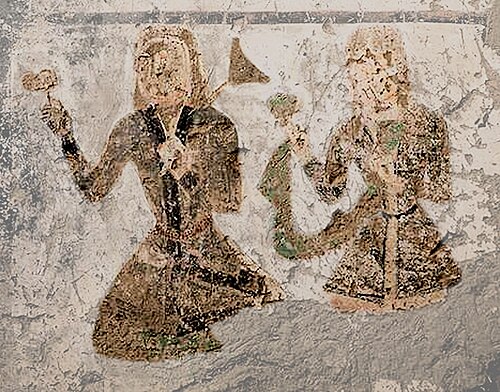
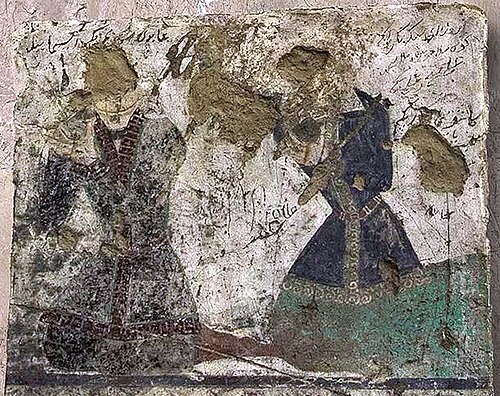
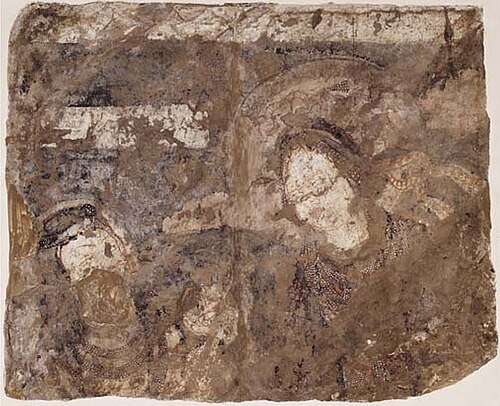
グリュンヴェーデルは多数の絵画を撤去したが、考古学的価値を保つために撤去前に記録を残し、撤去時や輸送中に破壊される恐れがあるため、切り出す前に写真やスケッチを撮るように注意した。[ 30 ]彼はキャンバスを使って絵画のかなり正確な記録を取った。例えば、グリュンヴェーデルは画家の洞窟で戦士を描いた非常に興味深い壁画を発見した経緯を語っている(207) 。それを撤去するつもりで、まず正確なスケッチを描いた。しかし、スケッチが完成すると、壁画は撤去時に崩壊し、現場に残っているわずかな断片を除いて失われてしまった。[ 31 ]全体として、第3次ドイツ遠征隊は依然として多くの絵画を撤去し、壁画を詰めた木箱約120個をベルリンに送った。[ 32 ]グリュンヴェーデルは 1912 年に探検の結果を『中国トルキスタンの考古学博物館、Bericht über Archäologische Arbeiten von 1906 bis 1907 bei Kuča, Qarašahr und in der Oase Turfan』に発表した。[ 28 ]
This evolution in style is accompanied by a change in the main themes being portrayed. In the Classical period the story of the life of the Buddha and numerous Jataka tales took center stage. Now the main accent is on the sermons of the Buddha, which typically cover the walls of the main cella, together with the appearance of side and rear corridors in which are pictured the events of the death of the Buddha, the Parinirvana.[110][111]
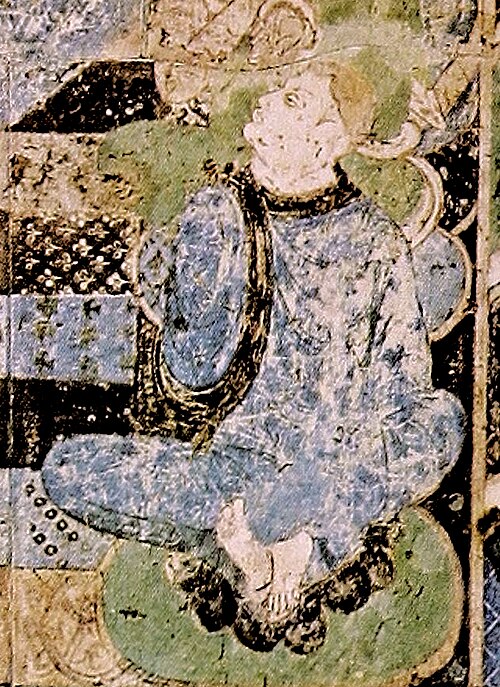
Rhie attributes the sudden variations of styles at Kizil, without much signs of internal evolution (especially in the early stages), to the sudden arrival of new groups of artists from other regions, bringing their own artistic idioms and techniques.[112] This period is also marked by the appearance of the self-portraits of painters in long tunics and highboots armed with short daggers, such as the painter of the Cave of the Statues or the several painters of the "Cave of the Painters", with often their own identifying labels in Sanskrit.[113][114] The clothing style and type of these painters has often been described as Sasanian,[63] but has recently been proposed as being rather Hephthalite, due to the similarities with the Hephthalite figures in Dilberjin Tepe, Balalyk Tepe or Bamiyan, and because the Hepthalites did control the Tarim Basin for nearly a century around this time period.[51][115]
"Cave of the statues" (Cave 77, 375–400 CE)
"Cave of the statues" (Cave 77)375–400 CE
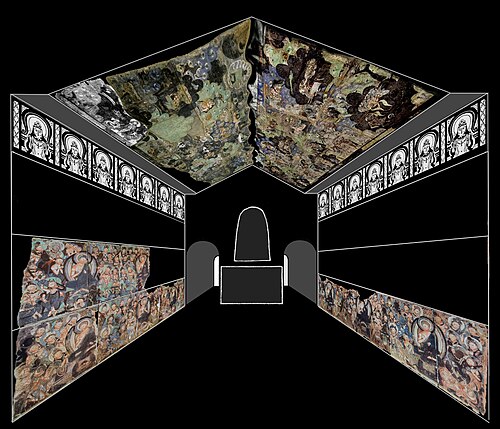
General reconstitution of the main cella and corridors (the roof collapsed in ancient times).[116] In the higher portion of the main cella, three rows of beam holes, about 1.5 meters (5 feet) apart and above the paintings, were visible, suggesting supports for decorative balconies,[117] probably holdings stucco statues of standing figures and Devatas.[118] The rather well preserved corridors and back room remain to this day.
A more recent interpretation is that the sword-bearers are actually Hephthalites, who are known to have occupied the Tarim Basin from 490 to 560 CE, precisely at the time the paintings were made.[51][173] Kucha was specifically part of their dominion between 502 and 556 CE.[176] The clothing style, the iconography and the physiognomy of the donors are said to be extremely close to those depicted in the paintings of Tokharistan (Bactria), the center of Hephthalite power, at sites such as Balalyk tepe or Dilberjin Tepe.[51][173] In particular, the coat with single folded lapel is considered as a result of Hephthalite influence, whereas traditional Kuchean coats had two lapels.[177] At present, the most prevalent opinion among academics seems to be that the Hephthalites were initially of Turkic origin.[178]
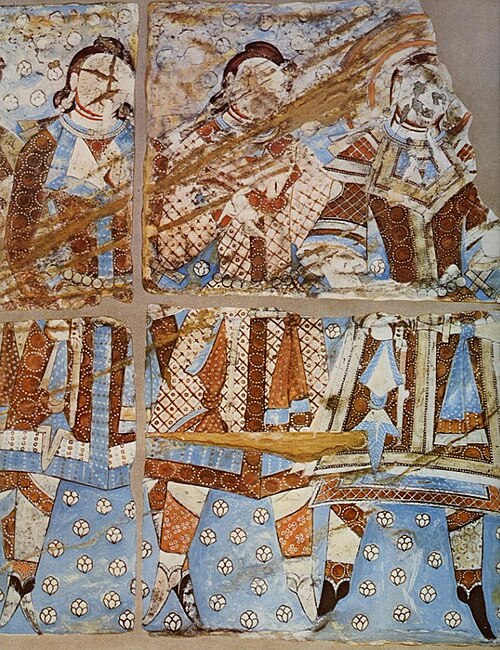
In the "Cave of the Sixteen sword bearers", the murals of the sixteen sword-bearers are located in the lateral left and right corridors around the central pillar, simulating a procession of devotees.[179] The sides of the main room are occupied by panels showing groups around seated Buddhas, while the vault is decorated with a myriad of small Buddhas with emanating flames.[179]
Cave of the 16 Sword-bearers, at the west end of the Kizil cave complex
Cave of the 16 Sword Bearers (plan)
One of the sword-bearers, in right-lapelled caftan.
Cave 8, sword-bearer detail
Swordbearer and servant
Man with a turban, from the side wall of the main cella.
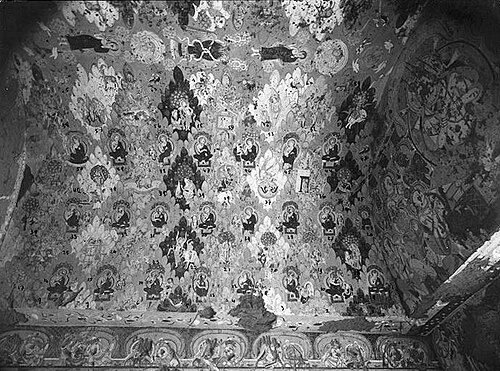
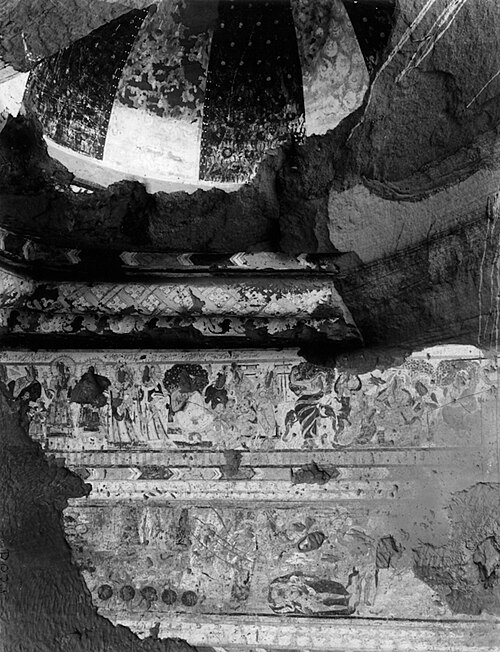
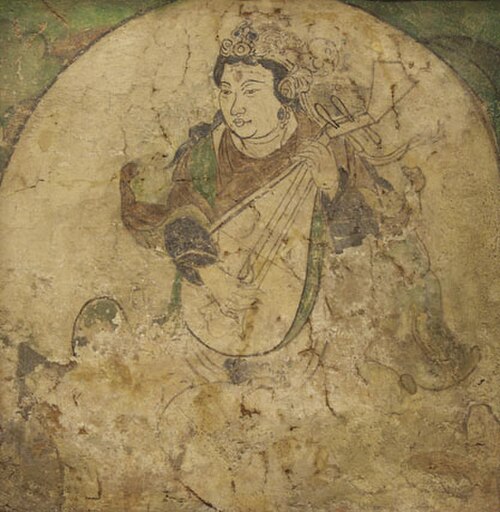
The rear corridor, forming a back-room behind the central pillar, is a barrel-vaulted rectangular room with the two corridors for side access. It was decorated by many spectacular murals, including a large mural showing the sharing of the relics, with soldiers in armour riding horses and elephants (β on the plan).[179][180] The vault was lavishly decorated with flying asparas holding musical instruments. The back wall had a depiction of the Parinirvana with a reclining image of the Buddha, and asparas flying over. The murals were photographed in black and white in-situ by Charles Nouette in September 1907, but all of them were later taken to Germany by Von Le Coq. A reconstruction of the rear corridor was recently built in the Museum für Asiatische Kunst.
Back corridor room of the Cave of the Sixteen Swordbearers, looking towards the main cella (reconstitution).
Vault decoration over the mural of "The War of the Relics": on-site photograph in 1907 by Charles Nouette, and removed color panels at the Dalhem Museum.
Mural on the inside wall of the rear corridor (β on the plan). The kings around the BrahmanaDrona, and below, soldiers on elephants and horses. War of the relics.
Armoured men on horses and elephants, in the rear corridor, War of the Relics scene (details)
Cave 181: Cave of the High Place in the Small Valley
Cave of the High Place in the Small Valley(Cave 181)
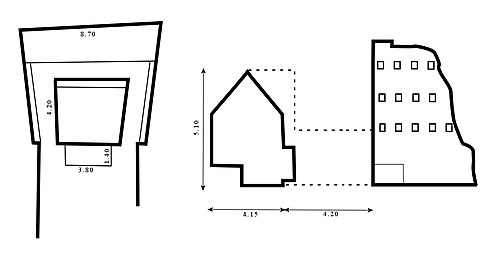
Reconstitution of Cave 181, according to the description by Grünwedel.
Entrance
Plan
The Cave of the High Place in the Small Valley (Cave 181), also called the "Highest Cave",[181] is described extensively by Albert Grünwedel, as a particularly interesting cave of the small ravine.[182] He explains that the cave is located high up on the right side of the ravine, which accounts for the fact that its murals have been preserved from the usual iconoclastic vandalism: the faces in particular are well preserved.[182] Also, the murals did not use gold foils for decoration, which reduced the incentive for theft.[182] In his plates, Grünwedel illustrates the murals of the cave, where he names the cave by its official name: Hochliegende Höhle der 2. Schlucht ("Cave of the High Place in the 2nd Valley"),[183] which is the German name for cave 181.[184]
Grünwedel explains that the structure of the cave is extremely rare, as it is not a barrel-vaulted cave: instead, the ceiling has the shape of a tent.[185] The flatness of the sides of the tent-like ceiling is the reason why Grünwedel was able to remove easily most of the ceiling paintings in large panels, something which is impossible with the strongly curved surface of a barrel-vaulted ceiling.[182] The tent-like ceiling is bordered by a row of seven bejewelled princes on each side.[182]
The side wall depict rather tumultuous scenes of the sermon of the Buddha, no fewer than eight of them, with a multitude of attendants in various attitudes and clothing.[186] The entrance wall had paintings of Tocharian donors and monks on both side.[182] Above the entrance was the usual painting of Maitreya with surrounding Devaputras.[182] The side corridors had paintings of Jataka stories, while the back corridor behind the niche had a bench or pedestal along the back wall for the display of the Parinirvana of the Buddha, with deities flying over.[182] On the opposite wall was a scene of the Cremation of the Buddha.[182] Grünwedel sent most of the murals to Germany.[182]
A headless wooden statue of a Dhyanasana Buddha, about 164cm (65 inches) tall, was found in the cave.[187]
The murals and the paintings of the ceiling are generally attributed to Cave 181,[188][189] but some authors attribute them to Cave 178 instead.[190] To add to the confusion, von Le Coq wrote in 1924 that the paintings of the ceiling actually came from barrel-vaulted Cave 184, and he claimed that Grünwedel, who accomplished the removal of the murals in 1906–1907, wrongly described the vault as being "tent-like".[191] Access to cave 181 has remained difficult, and it has also been claimed that it was never painted.[192][193]
Flat mural of the right half of the ceiling. It is about 4cm (1½ inches) thick, and weight around 400kg. Dahlem Museum.[194]
Ceiling and lunette over the entrance of Maya Cave, 224
Plan of the cave
The 3rd phase covers a period from the mid-6th century CE to the early 7th century CE. Carbon testing from this period gave dates ranging from 545 +/-75 CE to 685 +/-65 CE (i.e. a maximum range of 470–750 CE).[65] Maya Cave (n.224) is one of the famous caves from this period. Historically, the paintings of this period seem to correspond to the Turk expansion, following their uprising against the Rouran Khaganate in 552 and their subsequent territorial expansion.[47] This can also be seen the style of armour of some of the soldiers in the murals, especially with their pear-shaped helmets.[47]
Vivid colors are used, with great contrast, sometimes quite unnaturally and in a garish manner. A lot of lapis lazuli blue is incorporated in the palette of this artist.[48] Skin color or hair color are often quite unnatural.[48] Backgrounds often have plenty of flowers, fruits or leaves. Ornaments are often extravagant.[48] Again, no East-Asian influence is visible in these paintings.[48]
Māyā Cave (Third complex, cave 224, c.550–600 CE)
Maya Cave (Cave 224) of "III Anlage" is one of the most famous caves of the Third Period. It is dated to circa 550–600 CE, and possibly follows the events of the Turk uprising against the Rouran Khaganate in 552 CE and the subsequent Turk expansion.[195] The helmets of the Knights depicted in some of the murals have been said to be characteristic pear-shaped segmented helmets of the Turkic type.[195][196]
A famous mural of the Mourning of the Buddha at his Cremation appears in Maya Cave (224), from the rear passage of the cave, with various figures in ethnic costumes.[197] Three of the men among the mourners cut their forehead skin or chest with their knives, a practice of self-mutilation practiced by the Scythians.[197] One of the mourners if is thought to be a Turk.[198][199]
Mural of the Mourning of the Buddha, with various figures in ethnic costumes. Maya Cave, 224. The second figure from the right is thought to be a Turk.[198][199][200]
King Ajatasaru, His Queen, and His Minister Varshakara, Kizil, Maya Cave, (Cave 224).
Drona the Brahmin with Relics of the Buddha, Cave 224, Kizil
Knights in Kucha, following the events of 552 CE Turk uprising and the subsequent Turk expansion. 2nd half of the 6th century CE. The helmet is a characteristic pear-shaped segmented helmet of the Turkic type.[195][196]
A monk from "The First Sermon", right corridor painting.
Māyā Cave (Second complex, Cave 205, end 6th century CE)
Māyā Cave (2nd complex)(Cave 205, 600 CE)
Prince Tottika of Kucha with his wife Svayamprabhā, accompanied by two monks, Maya Cave 205, Kizil.
Entrance
Plan
Maya Cave of "II Anlage" (Cave 205) has been carbon-dated to the 6th–7th century CE.[90] The cave has an inscriptions in Sanskrit mentioning the King of Kucha Anantavarma. He is shown accompanied by two armed attendants.[201]
"When Anantavarma, the great king (maharaja?) of Kucha, saw the letter of Ilmonis, the dedication and the little container of musk, he had honor done to the Buddha."
A Prince appears with his wife in the adjacent frescoes, mentioned in a nearby inscription as the future king Tottika and his princess Swayamprabha.[202]
This cave has been rather precisely dated to the end of the 6th century CE, based on the names of the rulers found in the inscriptions, particularly King Tottika and his wife Svayamprabha (a Sanskrit name), who also appear together with Suvarnapushpa (known to have ruled 600–625 CE) and his son Suvarnadeva in the inscriptions on the walls of the Red-dome Cave.[203] The epigraphy also suggest dates later than the Cave of the Painters, with its more ancient inscription about the "painter Tutuka".[204]
Medidating Mahakasyapa in his patched robe, ceiling detail, Cave 205.[207]
The inscription in Sanskrit mentioning Anandavarman
Red-dome Cave 67: more royal dedications
Another nearby cave, the Red-domed Cave A (Cave 67) also has inscriptions mentioning a list of donors including a queen and six kings, among them Suvarnapuspa (ruled 600–625 CE) and his son Suvarnadeva (ruled 625–648 CE).[202][208][209] Also included in the inscriptions are the names of King Tottika and his wife Svayamprabha (a Sanskrit name), who also appear in the Maya Cave of the Second Group (Cave 205), suggesting proximity in time of these two caves.[203] The epigraphy also suggest dates later than the Cave of the Painters, with its more ancient inscription about the "painter Tutuka".[204]
The Red-dome cave contained a library in which were found very old manuscripts, including one of the oldest known manuscripts in Sanskrit.[33]
Plan of the Red-domed Cave A (cave 67)
View of the dome and paintings.
Princes and Princesses in the Red-domed cave
Cave 69: portrait and dedication of the king of Kucha (securely dated to 600–647 CE)
King Suvarnapushpa of Kucha (historically known, ruled 600–625 CE), Cave 69, Kizil. The dagger is similar in design to the Gyerim-ro dagger.
This period has the only known secure dating in the Kizil Caves: Cave 69 has a painting of a royal Kuchean couple with an inscription in the halo of the King: "Temple Constructed for the Benefit of Suvarnapushpa by His Son", Suvarnapuspa having ruled between 600 and 625, and his three sons died before 647 CE according to Chinese sources.[210][211][212]
When he visited Kucha in 630 CE, the Chinese monk Xuanzang received the favours of Suvarnadeva, the son and successor of Suvarna-puspa, and Hinayana king of Kucha.[213]
Xuanzang described in many details the characteristics of Kucha (屈支国 qūzhīguó, in "大唐西域记" "Tang Dynasty Account of the Western Regions"), and probably visited Kizil:[214][215] 1) "The style of writing is Indian, with some differences" 2) "They clothe themselves with ornamental garments of silk and embroidery. They cut their hair and wear a flowing covering (over their heads)" 3) "The king is of Kuchean ("屈支" qūzhī) race"[216] 4) "There are about one hundred convents (saṅghārāmas) in this country, with five thousand and more disciples. These belong to the Little Vehicle of the school of the Sarvāstivādas (Shwo-yih-tsai-yu-po). Their doctrine (teaching of Sūtras) and their rules of discipline (principles of the Vinaya) are like those of India, and those who read them use the same (originals)." 5) "About 40 li to the north of this desert city there are two convents close together on the slope of a mountain".[101]
King Suvarnapuspa and his Queen (龟兹国王与王后供养像) in Cave 69 (dated 600-647 CE per Chinese sources).[217]
Period 3: final narrative evolution
The final stage at Kizil is Period 3 of the Second Indo-Iranian Style.[54] Towards the end of its florescence, Kizil saw the emergence of the domed central pillar cave, a type of "central pillar" structure, with niche and circumambulating corridor, but with a very uncharacteristic near-cubic main cella crowned by a magnificent cupola decorated with divinities.[218] The style of painting is very refined, and can also be seen in some other caves in the region such as in Kumtura. The iconography too has evolved, with a cosmological Buddha becoming omnipresent and majestic, often surrounded by myriads of emanations of smaller Buddhas.[218] This exceptional and very refined type of cave is exemplified by Cave 123, the "Cave with the Ring-Bearing Doves".[219] It represents a final narrative evolution, in which the figures of the cosmological Buddha predominate, while secondary figures and stories take an ever-smaller role.[220]
"Cave with the Ring-Bearing Doves" (Cave 123)
Cave with the Ring-Bearing Doves(Cave 123, 600–650 CE)
The "Cave with the Ring-Bearing Doves" (Cave 123) had a type of "central pillar" structure, with niche and circumambulating corridor, but with a very uncharacteristic cubic main cella crowned by a magnificent dome decorated with divinities.[218][221] The main cella forms a square vestibule or main hall (3.42 x 3.42 meters; 12 x 12 feet) in front of the pillar forming the back wall, the vestibule being surmounted by a decorated dome. The prototype for the dome decorated with standing Buddhist deities is to be found in Group C of the caves at Bamiyan.[222] It can also be seen in some other caves in the region, such as in Kumtura.
The cave is named after a pattern of "flying geese holding a wreath" (or ring). This pattern is also known from Cave 69, which is dated to 625–647 CE because of the depiction and inscription of a historically identified king. Because of this marker, Cave 123 may be dated to the same period.[223]
Two monumental Buddha images occupy the sides of the main cella. They have full-body "mandorla" halos filled with a multitude of sitting or standing Buddhas.[224] These monumental images represent the second Great Miracle of the Sakyamuni Buddha at Shravasti.[219] The myriads of Buddhas emanating from him, each standing on a lotus, are a result of his deep meditation at Shravasti, as recounted in the Divyavadana.[219] This understanding of the Great Miracle is most prominent among the Sarvastivadin and the Mulasarvastivadin.[219] The two monumental Buddhas are surrounded by attendants, some light-skinned and some dark-skinned, and a Vajrapani.[219]
The side corridors also have similar Buddha images, but this time with a supplementary decorated band around the Buddha, which is filled with a row of ring-bearing doves, hence the name given to the cave.[224] All Buddha images are surrounded with numerous attendants, Devatas and Vajrapanis.[224]
Ring-bearing doves, Cave 123
The paintings were in great part brought to Europe by the fourth Royal prussian expedition to Central Asia of 1913–1914 led by Albert von Le Coq.[225] The cave was reconstructed in Berlin around 1928, but suffered damage during the war.[226] It has been reconstructed again recently in the Museum für Asiatische Kunst. The painting of the left side wall remains in-situ, quite damaged.[227][228]
Cave 123, as recorded by Charles Nouette in September 1907 (composite)
Decorative dome over the niche. "Cave with the Ring-Bearing Doves". Ethnological Museum of Berlin
The cave is quite outstanding and refined, either in terms of architecture and decoration, and departs from the mainstream of other caves at Kizil. Marianne Yaldiz has called it "One of Xinjiang's Mysteries".[230] Untypically, the narrative scenes are placed over the entrance, taking second position to the monumental standing Buddhas of the side wall. This is a layout which became popular farther east in Gansu.[220] In a final narrative evolution, the cave magnifies the figure of the Buddha, and gives an ever smaller role to secondary figures and stories.[220]
The Buddha with his thousand emanations
Entrance wall, Sermon of the Buddha.
Bodhisattava over the niche.
Cave 123, Dome detail.
Cave 123, Dome detail.
Other caves of the third period
The Center Cave (Cave 186), the Third to Last Cave (Cave 184) and the Third Cave from the Front (Cave 187) are also considered as representatives of this third period.[54]
A 4th period, also described as "The third style" receives strong influence from Chinese painting, a result of the artistic activity and expansion of the Tang dynasty.[231] The civilization of Kucha, with the whole Tarim Basin from Turfan to Khotan, fell to the Chinese punitive invasion of 648 CE, putting an end to the Indo-Iranian styles of Kucha.[232] Ashina She'er, the East Turkic general leading the Tang dynasty expeditionary corps, ordered the execution of eleven thousand Kuchean inhabitants by decapitation. It was recorded that "he destroyed five great towns and with them many myriads of men and women... the lands of the west were seized with terror."[233]
Two caves at Kizil have art of the Tang period: cave 43 and cave 229.[234] In nearby Kumtura and in Turfan, Chinese styles now prevailed.[232]
In 670 CE, the Tibetan Empire conquered most of the Tarim Basin, including Khotan, Kucha, Karashahr and Kashgar, which they kept until the Chinese took back the control of the area in 692.[235]
In 753 CE, the northern part of the Tarim Basin was taken over by the Turks of the Uyghur Khaganate, based in Turfan.[235][236] A new Tibetan conquest took place in 790 CE.[235] By 900 CE, the area was under Muslim domination.[235]
Texts and inscriptions
Love poem
Most of the texts known from the Tocharians are religious, except for one known love poem in Tocharian B, found in Kizil and dated circa 600 CE (manuscript B-496):[237]
"Kyzil library"
The Kyzil library had some of "the oldest copies of the Indian theatre known today" written in Sanskrit or in Tokharian B: these Indian plays, called Nāṭaka in Sanskrit literature, alternate prose and verse, music and pantomime, and also provide scenic indications so that a single performer can enact a complete play by changing attitudes and voices. These plays are at the origin of the "chantefables" or Chinese "transformation texts" called Bianwen.[242]
13th century Tibetan document about Kizil
Tibetan map of the Kizil Caves (13th century CE)
Albert Grünwedel, one of the German discovers of the Kizil Caves, found in Saint-Peterburg a 13th-century Tibetan text related to Kucha and the Kizil Caves, including a map, which describes the caves from the perspective of Tantric Buddhism.[243] According to the Tibetan text, the paintings in some of the caves were commissioned by a Tokharian (Thogar) king called "Mendre" (probably Māndhātṛ) with the advice of Anandavarman, a high-ranking monk. The king ordered an Indian artist, Naravahanadatta, and a Syrian artist, Priyaratna, with their disciples to paint the caves.[1] The neighbouring Khotanese kings Vijayavardhana and Murlimin also assisted with the painting of another cave by sending artists to the site.
The king of Thogar, called Mendre, or "the Persian" (Po-lo-si), or Anandavarma, had images painted in these caves for the followers of Buddha, by the artist and painter Mitradatta, also by Naravahanadatta, who came from a place of worship (Kultort) of the Niganthas, finally by Priyaratna who came from Syria also with their apprentices (Werkschüler). Mendre, the king, received an image of Amitabha from the emperor of China, and went into the land of blessedness (Sukhavati). A son of the emperor of China came to the castle of Mir-li, killed, according to an oath that he had made, all Jaina-Niganthas and all followers of Kalachakra and restored all the caves for the worship of Buddha (Buddha-Kultus).
The Japanese Buddhist scholar Teramoto Enga gave a rather different translation:
The Statue of Kumārajīva in front of the Kizil Caves in Kuqa County, Xinjiang, China.
King Mendre, or the King of Persia (Polosi) or Anandavarma the kings of Tukhara (覩货罗, Tokharistan)[245] had images painted in these caves for all the followers of the Buddha, by the artist and painter Mitradatta, also by Naravahanadatta, who came from a place of worship of the Niganthas, finally by Priyaratna who came from Syria (Rumakama, "Roman Empire") also with their apprentices. King Mendre and the King of Tukhara received the relics of Amitabha and went into the land of blessedness (Sukhavati). The son of the King of Tukhara called Dahuangfa (大黄发王) came to the city of Mir-li, preached the Kalachakra to all the Jaina-Niganthas and restored all the caves for the worship of Buddha.
—Teramoto Enga translation of the Tibetan text (fragment).[246]
According to a recent translation by Sam van Schaik, the text should be:
Among the Buddhists there was a Tocharian (Tho-gar) king called Men-dre, or Polosi, or Ānandavarmā. He had the caves painted by restorers and painters: Mitradatta; Naravāhanadatta from the lands of the "naked ones" (Niganthas); Priyaratna from Romakam (Byzantine Empire); and other experts in restoration. The king of the Rgya-ser and King Men-dre's bodies were taken by Amitābha and he went to the land of bliss. When the son of the great king of Rgya-ser came to the fort of Mir-li, thanks to the power of prayer, all the "naked ones" (Niganthas) were killed by the followers of Kālacakra, and all of the Buddhist caves were restored.
According to Sam van Schaik, "Mendre" could be the Indo-Greek king Menander, or the mythical king Manadhatṛ of Buddhist sources;[247] "Polosi" could be a Chinese abbreviation for king Prasenajit; "Romakam" may be the Byzantine Empire; the "naked ones" would be the Niganthas.[103]
Sculpture and murals from Mogao cave nb. 254, built during the Northern Wei period between 475 and 490 CE.[251] It is one of the earliest caves in Dunhuang, and shows parallels with the Kizil Caves (especially Cave 80), Western Indic features and Western influences.[252][251] The panel represents the Shibi Jataka.
The Kizil Caves are "the earliest representative grottoes in China".[11] The art of the Kizil Caves is thought to have influenced cave art at Dunhuang, in the Mogao Caves, as early as during the Northern Liang dynasty (421–439 CE), and pictorial arts in China thereafter.[253]
Given the importance of the Kucha region in the transmission of Buddhism into China and the evidence we have about the movement of translators such as Kumarajiva, it is reasonable to suggest that the art (and possibly the artists) of Kizil influenced the early art of the Mogao Cave complex near Dunhuang, further east along the Silk Road. The earliest of the extant Dunhuang caves (dating from the beginning of the fifth century) show distinctly "Central Asian" features in their painting, stylistically similar to what we find at Kizil. Among the subjects depicted at Kizil and Mogao in strikingly similar fashion is that of the "Cosmological Buddha", whose robe displays images connected with the phenomenal world.[101]
Decay, vandalism, dismantlement, and tourism
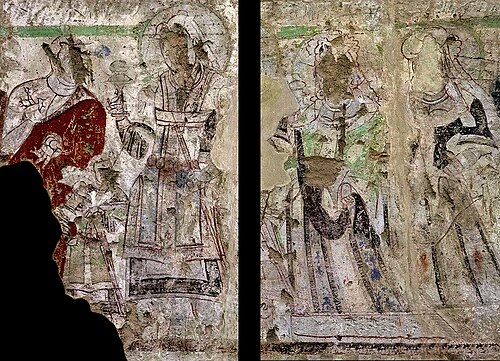
20th century vandalism: the murals of the left wall of the Cave of the Painters (Cave 207) were photographed and left in place by the German explorer Albert Grünwedel in 1912 (black and white photograph) except for the central top panel, but the rest have since been vandalized in-situ and are now almost completely destroyed as of 2019 (color photograph), with only disfigured portions remaining. This vandalism occurred during the last century.
Since their construction and decoration between the 4th and 8th centuries CE, the Kizil Caves have suffered numerous periods of religious vandalism and decay.[254]
Western archaeologists orchestrated the massive sampling on the best remaining works of art in the early 20th century.[254] Aside from their colonial outlook, one of their alleged motivations was to protect these works of arts from vandalism due to Islamic iconoclasm and the depredations of treasure hunters.[255] Most of the dismantled panels were sent to the Museum für Indische Kunst, Berlin, Germany, but many were destroyed in World War II, with only photographs or drawings remaining in the best cases.[256][84][86] A significant number of the murals were also captured by the Soviets in Berlin, and turned up recently in the Hermitage Museum.[257][161][162][163]
In more recent times, the Red Guards also contributed to the destruction of the site, and last but not least, the transformation of the site for touristic purposes since 2005 has led to the disfigurement of many caves and the irretrievable loss of archaeological knowledge.[254] Today, none of the caves can be said to have remained entirely intact, although many remain quite impressive.[258][255]
Caves 1–17 in 1912 and in 2015, with major modifications for protection and touristic accessibility.
Major Kizil caves
The caves were first named in German by Albert Grünwedel based on various individual characteristics. Many of these names have remained in English. More recently, a numbering system was adopted by the Chinese, generally based on the geographical position of the caves from West to East.
Kizil panorama, Caves 1 to 235, without 201–231, which are at the "back of the mountain" (后山, Houshan). Third German Expedition, 1906–1907.[10]
1234567Manko Namba Walter (October 1998). "Tokharian Buddhism in Kucha: Buddhism of Indo-European Centum Speakers in Chinese Turkestan before the 10th Century C.E"(PDF). Sino-Platonic Papers (85).
↑"Kezil Thousand-Buddha Grottoes". xinjiang.gov. Archived from the original on 2007-09-30. Retrieved 2007-08-05.
12"Kizil Thousand-Buddha Cave". Archived from the original on 2006-04-27. Retrieved 2007-08-05.
1234阮, 荣春 (May 2015). 佛教艺术经典第三卷佛教建筑的演进 (in Chinese). Beijing Book Co. Inc. p.184. ISBN978-7-5314-6376-4.
12Rowland, Benjamin (1975). The art of Central Asia. New York, Crown. p.154.
↑"Silk Roads: the Routes Network of Chang'an-Tianshan Corridor". UNESCO World Heritage Centre. United Nations Educational, Scientific, and Cultural Organization. Retrieved 17 Apr 2021.
1234567891011121314Rhie, Marylin Martin (15 July 2019). Early Buddhist Art of China and Central Asia, Volume 2 The Eastern Chin and Sixteen Kingdoms Period in China and Tumshuk, Kucha and Karashahr in Central Asia (2 vols). BRILL. p.645. ISBN978-90-04-39186-4.
12"SMB-digital Höhlenansicht mit Wandmalerei". www.smb-digital.de.
↑(Other than Kizil)... "The nearby site of Kumtura contains over a hundred caves, forty of which contain painted murals or inscriptions. Other cave sites near Kucha include Subashi, Kizilgaha, and Simsim." in Buswell, Robert E.; Lopez, Donald S. (24 November 2013). The Princeton Dictionary of Buddhism. Princeton University Press. p.438. ISBN978-1-4008-4805-8.
1234Vignato, Giuseppe (2006). "Archaeological Survey of Kizil: Its Groups of Caves, Districts, Chronology and Buddhist Schools". East and West. 56 (4): 359–416. ISSN0012-8376. JSTOR29757697.
123Li, Zuixiong (2010). "Deterioration and Treatment of Wall Paintings in Grottoes along the Silk Road in China and Related Conservation Efforts" in Conservation of Ancient Sites on the Silk Road(PDF). Los Angeles: The Getty Conservation Institute. p.49.
12Vignato, Giuseppe (2006). "Archaeological Survey of Kizil: Its Groups of Caves, Districts, Chronology and Buddhist Schools". East and West. 56 (4): 411. ISSN0012-8376. JSTOR29757697.
↑"Caves as Canvas: Hidden Images of Worship Along the Ancient Silk Road". Sackler Gallery. Smithsonian Institution. Archived from the original on 2003-01-03. Retrieved 2012-08-11.
12Daniel C. Waugh. "Kucha and the Kizil Caves". Silk Road Seattle. University of Washington.
123Makiko Onishi, Asanobu Kitamoto. "The Transmission of Buddhist Culture: The Kizil Grottoes and the Great Translator Kumārajīva". Archived from the original on 2009-09-21. Retrieved 2012-06-10.
↑Howard, Angela F. (1991). "In Support of a New Chronology for the Kizil Mural Paintings". Archives of Asian Art. 44: 68–83. ISSN0066-6637. JSTOR20111218.
1234567891011121314Rhie, Marylin Martin (15 July 2019). Early Buddhist Art of China and Central Asia, Volume 2 The Eastern Chin and Sixteen Kingdoms Period in China and Tumshuk, Kucha and Karashahr in Central Asia (2 vols). BRILL. pp.658 ff. ISBN978-90-04-39186-4.
↑"Caves as Canvas: Hidden Images of Worship Along the Ancient Silk Road – Architecture, Decoration, and Function". Sackler Gallery. Smithsonian Institution. Archived from the original on 2003-01-03. Retrieved 2012-08-11.
↑Rhie, Marylin Martin (15 July 2019). Early Buddhist Art of China and Central Asia, Volume 2 The Eastern Chin and Sixteen Kingdoms Period in China and Tumshuk, Kucha and Karashahr in Central Asia (2 vols). BRILL. p.707. ISBN978-90-04-39186-4.
123Zin, Monika (2013). "Buddhist Narrative Depictions in Andhra, Gandhara and Kucha – Similarities and Differences that Favour a Theory about a Lost a Gandharan School of Painting" in "Buddhism and Art in Gandhara and Kucha"(PDF). Ryokoku University. Archived from the original(PDF) on 2021-08-31. Retrieved 2021-01-02.
↑Härtel, Herbert; Yaldiz, Marianne (1982). Along the Ancient Silk Routes: Central Asian Art from the West Berlin State Museums: an Exhibition Lent by the Museum Für Indische Kunst, Staatliche Museen Preussischer Kulturbesitz, Berlin, Federal Republic of Germany. Metropolitan Museum of Art. p.40. ISBN978-0-87099-300-8.
↑Footprints of Foreign Explorers on the Silk Road. 五洲传播出版社. 2005. p.86. ISBN978-7-5085-0706-4.
↑"SMB-digital Höhlenansicht mit Wandmalereien". www.smb-digital.de.
↑"It is the merit of Kenyu Hori and Tesshin Watanabe to have discovered and first examined the cave complex of Kizil. Unfortunately, the efforts and findings of this examination have been destroyed by an earthquake that scared away the Japanese scholars, which enabled the Germans to uncover, carry away and come out with the treasures of this site a short while afterwards (Klimkeit, 1988, 38)" in Fellner, Hannes A., University of Vienna. The Expeditions to Tocharistan(PDF). p.25, note 39.{{cite book}}: CS1 maint: multiple names: authors list (link)
↑"IDP JAPANESE COLLECTIONS". idp.bl.uk. Archived from the original on 2021-10-25. Retrieved 2021-01-28.
12Hiyama, Satomi (2020). "Transmission of the "World": Sumeru Cosmology as Seen in Central Asian Buddhist Paintings Around 500 AD (Wanderung der "Welt": Sumeru-Kosmologie in zentralasiatischen buddhistischen Wandmalereien um 500 n. Chr.)". NTM Zeitschrift für Geschichte der Wissenschaften, Technik und Medizin. 28 (3): 411–429. doi:10.1007/s00048-020-00245-9. PMID32504177. S2CID219398072.
1234567891011Rhie, Marylin Martin (15 July 2019). Early Buddhist Art of China and Central Asia, Volume 2 The Eastern Chin and Sixteen Kingdoms Period in China and Tumshuk, Kucha and Karashahr in Central Asia (2 vols). BRILL. pp.655–658. ISBN978-90-04-39186-4.
↑Grünwedel, Albert. Altbuddhistische Kultstätten in Chinesisch-Turkistan: vol.1 / Page 8 (Color Image). p.2. Archived from the original on 2024-05-22. Retrieved 2021-01-28.
↑Grünwedel, Albert (1912). Altbuddhistische Kultstätten in Chinesisch-Turkistan: vol.1 / Page 163 (Color Image). pp.156–157. Archived from the original on 2024-04-12. Retrieved 2021-01-29.
12Fellner, Hannes A., University of Vienna. The Expeditions to Tocharistan(PDF). p.28.{{cite book}}: CS1 maint: multiple names: authors list (link)
12Härtel, Herbert; Yaldiz, Marianne (1982). Along the Ancient Silk Routes: Central Asian Art from the West Berlin State Museums: an Exhibition Lent by the Museum Für Indische Kunst, Staatliche Museen Preussischer Kulturbesitz, Berlin, Federal Republic of Germany. Metropolitan Museum of Art. p.41. ISBN978-0-87099-300-8.
↑Pelliot, Paul Emile (1909). Trois Ans dans la haute Asie: vol.1 / Page 13 (Color Image). pp.7–8. Archived from the original on 2024-04-19. Retrieved 2021-01-28.
↑"Mission Paul Pelliot 1906–1908. Entre le 1/9/1907 et le 3/9/1907" in "Réunion des Musées Nationaux-Grand Palais – Search Result". www.photo.rmn.fr.
↑Pelliot, Paul. Trois Ans dans la haute Asie. p.10. Archived from the original on 2021-02-04. Retrieved 2021-01-31.
↑Von Le Coq, Albert. Die Buddhistische Spätantike in Mittelasien: vol.4. Archived from the original on 2019-09-10. Retrieved 2021-01-29.
12345678910Howard, Angela F. (1991). "In Support of a New Chronology for the Kizil Mural Paintings". Archives of Asian Art. 44: 68–69. ISSN0066-6637. JSTOR20111218.
123456789Rhie, Marylin Martin (15 July 2019). Early Buddhist Art of China and Central Asia, Volume 2 The Eastern Chin and Sixteen Kingdoms Period in China and Tumshuk, Kucha and Karashahr in Central Asia (2 vols). BRILL. pp.645 ff. ISBN978-90-04-39186-4.
1234Casalini, Alice (2015). Towards a new approach to the study of the Buddhist rock monasteries of Kuča (Xinjiang)(PDF). p.69. Archived from the original(PDF) on 2021-07-25. Retrieved 2020-12-24.
↑Vignato, Giuseppe (2006). "Archaeological Survey of Kizil: Its Groups of Caves, Districts, Chronology and Buddhist Schools". East and West. 56 (4): 406–407. ISSN0012-8376. JSTOR29757697.
↑Vignato, Giuseppe (2006). "Archaeological Survey of Kizil: Its Groups of Caves, Districts, Chronology and Buddhist Schools". East and West. 56 (4): 406, note 76. ISSN0012-8376. JSTOR29757697.
↑Vignato, Giuseppe (2006). "Archaeological Survey of Kizil: Its Groups of Caves, Districts, Chronology and Buddhist Schools". East and West. 56 (4): 407, note 76. ISSN0012-8376. JSTOR29757697.
↑Ghose, Rajeshwari (2008). Kizil on the Silk Road: Crossroads of Commerce & Meeting of Minds. Marg Publications. p.39. ISBN978-81-85026-85-5.
↑"Caves as Canvas: Hidden Images of Worship Along the Ancient Silk Road – The Rediscovery of Qizil". Smithsonian Institution. Archived from the original on 2003-01-03. Retrieved 2012-08-11.
↑Kizil Thousand-Buddha Caves: Valuable Record of Buddhism Culture in XinjiangArchived 2012-07-28 at the Wayback Machine
1234567Kubik, Adam (2008). "The Kizil Caves as an terminus post quem of the Central and Western Asiatic pear-shape spangenhelm type helmets The David Collection helmet and its place in the evolution of multisegmented dome helmets, Historia i Świat nr 7/2018, 141–156". Histïria I Swiat. 7: 143–144.
123456789Hertel, Herbert (1982). Along the Ancient Silk Routes: Central Asian Art from the West Berlin State Museums. pp.48–49.
↑Ilyasov, Jangar (2001). "The Hephthalite Terracotta // Silk Road Art and Archaeology. Vol. 7. Kamakura, 2001, 187–200". Silk Road Art and Archaeology: 187–197.
↑"CHINESE-IRANIAN RELATIONS xiv. E. Iranian Art – Encyclopaedia Iranica". www.iranicaonline.org.
123456789Kageyama, Etsuko (2016). "Change of suspension systems of daggers and swords in eastern Eurasia: Its relation to the Hephthalite occupation of Central Asia"(PDF). ZINBUN. 46: 200–202.
↑Rhie, Marylin Martin (15 July 2019). Early Buddhist Art of China and Central Asia, Volume 2 The Eastern Chin and Sixteen Kingdoms Period in China and Tumshuk, Kucha and Karashahr in Central Asia (2 vols). BRILL. p.649. ISBN978-90-04-39186-4.
↑Vignato, Giuseppe (2006). "Archaeological Survey of Kizil: Its Groups of Caves, Districts, Chronology and Buddhist Schools". East and West. 56 (4): 395–396. ISSN0012-8376. JSTOR29757697.
12345678Le Coq, Albert von; Waldschmidt, Ernst (1922). Die buddhistische spätantike in Mittelasien, VII. Berlin, D. Reimer [etc.] pp.24–29.
↑"For generally accepted styles of Kucha paintings, cf. WALDSCHMIDT in LE COQ/WALDSCHMIDT 1933: 24–31." in Zin, Monika (2015). "The Case of the "Repainted Cave" (Kizil, Cave 117)"(PDF). Indo-Asiatische Zeitschrift. 19: 19, note 4. Archived from the original(PDF) on 2021-08-31. Retrieved 2021-02-08.
123Härtel, Herbert; Yaldiz, Marianne; Kunst (Germany), Museum für Indische; N.Y.), Metropolitan Museum of Art (New York (1982). Along the Ancient Silk Routes: Central Asian Art from the West Berlin State Museums: an Exhibition Lent by the Museum Für Indische Kunst, Staatliche Museen Preussischer Kulturbesitz, Berlin, Federal Republic of Germany. Metropolitan Museum of Art. p.107. ISBN978-0-87099-300-8.
↑Le Coq, Albert von. Die Buddhistische Spätantike in Mittelasien: vol.5. p.10.
1234Howard, Angela F. (1991). "In Support of a New Chronology for the Kizil Mural Paintings". Archives of Asian Art. 44: 72. ISSN0066-6637. JSTOR20111218.
1234Baumer, Christoph (18 April 2018). History of Central Asia, The: 4-volume set. Bloomsbury Publishing. p.165. ISBN978-1-83860-868-2.
12Härtel, Herbert; Yaldiz, Marianne (1982). Along the Ancient Silk Routes: Central Asian Art from the West Berlin State Museums: an Exhibition Lent by the Museum Für Indische Kunst, Staatliche Museen Preussischer Kulturbesitz, Berlin, Federal Republic of Germany. Metropolitan Museum of Art. p.48. ISBN978-0-87099-300-8.
↑"It was to the Bamian frescoes that the early style of the frescoes of Kizil -somewhat west of Kucha- was related" in Grousset 1970, p.51
12Kageyama quoting the research of S. Hiyama, “Study on the first-style murals of Kucha: analysis of some motifs related to the Hephthalite's period”, in Kageyama, Etsuko (2016). "Change of suspension systems of daggers and swords in eastern Eurasia: Its relation to the Hephthalite occupation of Central Asia"(PDF). ZINBUN. 46: 200.
1234567891011121314151617181920212223Rhie, Marylin Martin (15 July 2019). Early Buddhist Art of China and Central Asia, Volume 2 The Eastern Chin and Sixteen Kingdoms Period in China and Tumshuk, Kucha and Karashahr in Central Asia (2 vols). BRILL. pp.670–675. ISBN978-90-04-39186-4.
↑Encyclopedia of Buddhist Art. Archived from the original on 2021-10-25. Retrieved 2021-01-29.
↑Härtel, Herbert; Yaldiz, Marianne; Kunst (Germany), Museum für Indische; N.Y.), Metropolitan Museum of Art (New York (1982). Along the Ancient Silk Routes: Central Asian Art from the West Berlin State Museums: an Exhibition Lent by the Museum Für Indische Kunst, Staatliche Museen Preussischer Kulturbesitz, Berlin, Federal Republic of Germany. Metropolitan Museum of Art. p.108. ISBN978-0-87099-300-8.
12345678910Grünwedel, Albert. Altbuddhistische Kultstätten in Chinesisch-Turkistan: vol.1 / Page 108 (Color Image). pp.102 ff. Archived from the original on 2021-01-28. Retrieved 2020-12-21.
1234567891011121314151617181920212223242526272829303132Rhie, Marylin Martin (15 July 2019). Early Buddhist Art of China and Central Asia, Volume 2 The Eastern Chin and Sixteen Kingdoms Period in China and Tumshuk, Kucha and Karashahr in Central Asia (2 vols). BRILL. pp.651 ff. ISBN978-90-04-39186-4.
12Rhie, Marylin Martin (15 July 2019). Early Buddhist Art of China and Central Asia, Volume 2 The Eastern Chin and Sixteen Kingdoms Period in China and Tumshuk, Kucha and Karashahr in Central Asia (2 vols). BRILL. p.658. ISBN978-90-04-39186-4.
↑Puri, Baij Nath (1987). Buddhism in Central Asia. Motilal Banarsidass Publ. p.80. ISBN978-81-208-0372-5.
↑"俗有城郭,其城三重,中有佛塔廟千所" in the account of Kucha (龜茲國) in "晉書/卷097". zh.wikisource.org.
↑Rhie, Marylin Martin (15 July 2019). Early Buddhist Art of China and Central Asia, Volume 2 The Eastern Chin and Sixteen Kingdoms Period in China and Tumshuk, Kucha and Karashahr in Central Asia (2 vols). BRILL. p.654. ISBN978-90-04-39186-4.
↑"男女皆翦發垂項" "Men and women all cut their hair straight to the nuque" in the account of Kucha (龜茲國) in "晉書/卷097". zh.wikisource.org.
↑"The front figurine is a kneeling monk (Fig. 233) in a red, green-folded robe with short black shoes, of white, ocher-yellow-shaded body color and ocher-shorn hair. In front of him is a green vessel in the shape of a lotâ. With the left hand the monk has stuck a thick stick, a little more than arm's length, into the vessel from above and hits the stick with a small black-painted hammer to knock the vessel round. It seems that this shows that the monk pictured made and donated the sacrificial tools for our cave. Behind this monk was a kneeling painter in the same costume as the donor figures on the other side. Only remains of his head have survived." Grünwedel, Albert. Altbuddhistische Kultstätten in Chinesisch-Turkistan: vol.1 / Page 108 (Color Image). pp.102 ff. Archived from the original on 2021-01-28. Retrieved 2020-12-21.
123Rao, Heimo and Upadhyaya (1976). Reflections On Indian Art. pp.142–143.
↑Bell, Alexander Peter (2000). Didactic Narration: Jataka Iconography in Dunhuang with a Catalogue of Jataka Representations in China. LIT Verlag Münster. p.147. ISBN978-3-8258-5134-7.
↑In Chinese, 优陀羡王姻缘故事 "Story of the wedding of king Youtuoxian". The story appears in the Miscellaneous Treasures Sutra 杂宝藏经 (一一六) in "杂宝藏经卷第10优陀羡王缘(116)". sutra.foz.cn. Archived from the original on 2021-02-05. Retrieved 2021-01-27.
1234567891011Altbuddhistische Kultstätten in Chinesisch-Turkistan: vol.1 / Page 93 (Color Image). pp.87 ff. Archived from the original on 2024-05-23. Retrieved 2020-12-28.
12Reconstitution in Grünwedel, Albert (1920). Alt-Kutscha. pp.251 ff. Archived from the original on 2024-05-27. Retrieved 2020-12-28., also black and white 1912 photograph.
12Zin, Monika. "INDO-ASIATISCHE ZEITSCHRIFT – PDF Kostenfreier Download". docplayer.org: 23. Archived from the original on 2021-09-12. Retrieved 2020-12-29.
↑For a broadly similar rendering of the volume of the cave, see Miyaji, Akira (2011). "New Research on the Expeditions of Count Otani". Research Center for Buddhist Cultures in Asia: 49, image 1.
12Altbuddhistische Kultstätten in Chinesisch-Turkistan: vol.1. p.87. Archived from the original on 2021-07-25. Retrieved 2020-12-21.
1234567Rhie, Marylin Martin (15 July 2019). Early Buddhist Art of China and Central Asia, Volume 2 The Eastern Chin and Sixteen Kingdoms Period in China and Tumshuk, Kucha and Karashahr in Central Asia (2 vols). BRILL. p.683. ISBN978-90-04-39186-4.
12345678910111213141516171819202122232425262728Rhie, Marylin Martin (15 July 2019). Early Buddhist Art of China and Central Asia, Volume 2 The Eastern Chin and Sixteen Kingdoms Period in China and Tumshuk, Kucha and Karashahr in Central Asia (2 vols). BRILL. pp.646–647. ISBN978-90-04-39186-4.
123Rowland, Benjamin (1975). The art of Central Asia. New York, Crown. p.156.
12Rhie, Marylin Martin (15 July 2019). Early Buddhist Art of China and Central Asia, Volume 2 The Eastern Chin and Sixteen Kingdoms Period in China and Tumshuk, Kucha and Karashahr in Central Asia (2 vols). BRILL. pp.678 ff. ISBN978-90-04-39186-4.
↑Vignato, Giuseppe (2016). "Monastic Fingerprints – Tracing Ritual Practice in the Rock Monastery of Qizil through Archaeological Evidence"(PDF). Indo-Asiatische Zeitschrif: 22–38.
↑Reconstitution in Grünwedel, Albert (1920). Alt-Kutscha. pp.251 ff. Archived from the original on 2024-05-27. Retrieved 2020-12-28.
12Rhie, Marylin Martin (15 July 2019). Early Buddhist Art of China and Central Asia, Volume 2 The Eastern Chin and Sixteen Kingdoms Period in China and Tumshuk, Kucha and Karashahr in Central Asia (2 vols). BRILL. pp.679 ff. ISBN978-90-04-39186-4.
1234Grünwedel, Albert (1920). Alt-Kutscha. pp.II 10 – II 13. Archived from the original on 2021-12-08. Retrieved 2021-01-14.
↑"Door wall. At the bottom of W. 4 (R.) you can see three praying monks, who were inscribed with Brâhmî inscriptions, on the corresponding point of the wall section L. also three monks and one kneeling in front of them. Donor, who holds out a basket of flowers, also here were small labels with Brahmî inscriptions." in Grünwedel, Albert. Altbuddhistische Kultstätten in Chinesisch-Turkistan: vol.1 / Page 97 (Color Image). p.91. Archived from the original on 2021-01-21. Retrieved 2021-01-30.
↑Hiyama, Satomi (January 2017). "Portrait of the Royal Patronage in Kizil Cave 60 (Größte Höhle)". Indo-Asiatische Zeitschrift: 40, note 7.
123"In Kuchean iconographical convention, cartouches do not appear in narrative representations, but are most typically appended to the portraits of actual donors." in Hiyama, Satomi (January 2017). "Portrait of the Royal Patronage in Kizil Cave 60 (Größte Höhle)". Indo-Asiatische Zeitschrift: 39.
123Rhie, Marylin Martin (15 July 2019). Early Buddhist Art of China and Central Asia, Volume 2 The Eastern Chin and Sixteen Kingdoms Period in China and Tumshuk, Kucha and Karashahr in Central Asia (2 vols). BRILL. pp.681 ff. ISBN978-90-04-39186-4.
12345678910Waugh, Daniel (Historian, University of Washington). "Kizil". depts.washington.edu. Washington University. Retrieved 30 December 2020.{{cite web}}: CS1 maint: multiple names: authors list (link)
↑Zin, Monika. "Sanskrit literature and the Indian pictorial tradition in the paintings of Kucha"(PDF): 288. Archived from the original(PDF) on 2021-07-25. Retrieved 2020-12-16.{{cite journal}}: Cite journal requires |journal= (help)
123Schaik, Sam van (2020). "Fakes, Delusions, or the Real Thing? Albert Grünwedel's Maps of Shambhala". Journal of the American Oriental Society. 140 (2): 278–280. doi:10.7817/jameroriesoci.140.2.0273. ISSN0003-0279. JSTOR10.7817/jameroriesoci.140.2.0273. S2CID226673648.
↑CHANG, YUAN ZANG. THE EVOLUTION OF EARLY CHINESE BUDDHA FIGURES(PDF). p.70, Note 70 referencing Li Ruizhe, Cave Temple in Kucha (《龟兹石窟寺》), China Social Sciences Press, December 2015, p. 11.
↑"scribbled on the right side: "after this painting was done, the one who came from Rumakama (Syria), the painter Manibhadra, did these circles below" in South Asian Archaeology 1985: Papers from the Eighth International Conference of South Asian Archaeologists in Western Europe, Held at Moesgaard Museum, Denmark, 1–5 July 1985. Curzon Press. 1989. p.382. ISBN9780913215500.
↑Grunwedel, Albert. Alt-Kutscha: vol.1. p.II.31. Archived from the original on 2022-01-21. Retrieved 2020-12-22.
↑Schaik, Sam van (2020). "Fakes, Delusions, or the Real Thing? Albert Grünwedel's Maps of Shambhala". Journal of the American Oriental Society. 140 (2): 279. doi:10.7817/jameroriesoci.140.2.0273. ISSN0003-0279. JSTOR10.7817/jameroriesoci.140.2.0273. S2CID226673648.
↑Rao, Heimo and Upadhyaya (1976). Reflections On Indian Art. p.44.
↑Rao, Heimo and Upadhyaya (1976). Reflections On Indian Art. pp.144 ff.
↑Rhie, Marylin Martin (15 July 2019). Early Buddhist Art of China and Central Asia, Volume 2 The Eastern Chin and Sixteen Kingdoms Period in China and Tumshuk, Kucha and Karashahr in Central Asia (2 vols). BRILL. pp.645–680. ISBN978-90-04-39186-4.
↑Hiyama, Satomi (2018). "Untangling the textiles in the murals"(PDF). Journal of World Buddhist Cultures: 65, note 4. Archived from the original(PDF) on 2020-10-19. Retrieved 2021-02-15.
↑Rhie, Marylin Martin (15 July 2019). Early Buddhist Art of China and Central Asia, Volume 2 The Eastern Chin and Sixteen Kingdoms Period in China and Tumshuk, Kucha and Karashahr in Central Asia (2 vols). BRILL. p.668. ISBN978-90-04-39186-4.
1234Rhie, Marylin Martin (15 July 2019). Early Buddhist Art of China and Central Asia, Volume 2 The Eastern Chin and Sixteen Kingdoms Period in China and Tumshuk, Kucha and Karashahr in Central Asia (2 vols). BRILL. p.671, note 166. ISBN978-90-04-39186-4.
123"In the corner of the outside between the first statue and doorway, you can see the picture of a painter without a head, who is holding a bowl of paint. He wears a costume that exactly matches that of the painter pictures in the "Cave of the Painters"." in Altbuddhistische Kultstätten in Chinesisch-Turkistan: vol.1 / Page 99 (Color Image). p.93. Archived from the original on 2020-11-29. Retrieved 2020-12-21.
1234Kurbanov, Aydogdy (2014). "THE HEPHTHALITES: ICONOGRAPHICAL MATERIALS"(PDF). Tyragetia. 8: 329.
↑For a similar reconstruction of a Shorchuk temple see Rhie, Marylin M. (2002). Early Buddhist art of China and Central Asia. Leiden: Brill. p.Fig. 5.16e, Fig. 5. 72d. ISBN978-90-04-11499-9.
↑Grünwedel, Albert. Altbuddhistische Kultstätten in Chinesisch-Turkistan: vol.1 / Page 97 (Color Image). pp.91–92. Archived from the original on 2021-01-21. Retrieved 2021-01-30.
↑Rhie, Marylin Martin (15 July 2019). Early Buddhist Art of China and Central Asia, Volume 2 The Eastern Chin and Sixteen Kingdoms Period in China and Tumshuk, Kucha and Karashahr in Central Asia (2 vols). BRILL. p.671. ISBN978-90-04-39186-4.
12Hertel, Herbert (1982). Along the Ancient Silk Routes: Central Asian Art from the West Berlin State Museums. pp.70–72.
12Rhie, Marylin Martin (15 July 2019). Early Buddhist Art of China and Central Asia, Volume 2 The Eastern Chin and Sixteen Kingdoms Period in China and Tumshuk, Kucha and Karashahr in Central Asia (2 vols). BRILL. p.678. ISBN978-90-04-39186-4.
123456Grünwedel, Albert (1912). Altbuddhistische Kultstätten in Chinesisch-Turkistan: vol.1 / Page 98 (Color Image). pp.92–93. Archived from the original on 2021-01-28. Retrieved 2020-12-25.
↑"These sermon images are of pure Gandhara style. In their design and in their details they are closely related to the pictures to be treated below in Hohle der Maler; indeed, they seem to have been executed by the same hand." Grünwedel, Albert. Altbuddhistische Kultstätten in Chinesisch-Turkistan: vol.1 / Page 98 (Color Image). pp.92–93. Archived from the original on 2021-01-28. Retrieved 2020-12-25.
↑Rhie, Marylin Martin (15 July 2019). Early Buddhist Art of China and Central Asia, Volume 2 The Eastern Chin and Sixteen Kingdoms Period in China and Tumshuk, Kucha and Karashahr in Central Asia (2 vols). BRILL. p.673. ISBN978-90-04-39186-4.
↑References BDce-695, MIK III 9044 "俄立艾爾米塔什博物館藏克孜爾石窟壁畫". www.sohu.com.
↑Rhie, Marylin Martin (15 July 2019). Early Buddhist Art of China and Central Asia, Volume 2 The Eastern Chin and Sixteen Kingdoms Period in China and Tumshuk, Kucha and Karashahr in Central Asia (2 vols). BRILL. p.677. ISBN978-90-04-39186-4.
↑Die Buddhistische Spätantike in Mittelasien: vol.1 / Page 29 (Color Image). p.25. Archived from the original on 2021-07-25. Retrieved 2020-12-15.
123Grünwedel, Albert (1912). Altbuddhistische Kultstätten in Chinesisch-Turkistan: vol.1 / Page 97 (Color Image). pp.91–95. Archived from the original on 2021-01-21. Retrieved 2021-01-30.
12世界佛教美術圖說大辭典. Archived from the original on 2021-10-25. Retrieved 2021-01-30.
↑Altbuddhistische Kultstätten in Chinesisch-Turkistan: vol.1 / Page 99 (Color Image). p.93. Archived from the original on 2020-11-29. Retrieved 2020-12-21.
↑"世界佛教美術圖說大辭典". arts.fgs.org.tw. Archived from the original on 2021-10-25. Retrieved 2021-01-29.
12"A scene with the Buddha is crowned with a frieze of perspective dentils, scrolls, and a classical leaf-fascia which might easily have graced a Roman wall" in Boardman, John (1994). The Diffusion of Classical Art in Antiquity. Princeton University Press. pp.150–151. ISBN978-0-691-03680-9.
↑For photographs of the destructions see: "西方探险队揭取了哪些克孜尔壁画——海外克孜尔壁画现状调查_古代艺术_澎湃新闻-The Paper". www.thepaper.cn.
↑Howard, Angela; Vignato, Giuseppe (14 November 2014). Archaeological and Visual Sources of Meditation in the Ancient Monasteries of Kuča. BRILL. p.119, note 35. ISBN978-90-04-27939-1.
12345Hertel, Herbert (1982). Along the Ancient Silk Routes: Central Asian Art from the West Berlin State Museums. pp.72–74.
12Härtel, Herbert; Yaldiz, Marianne; Kunst (Germany), Museum für Indische; N.Y.), Metropolitan Museum of Art (New York (1982). Along the Ancient Silk Routes: Central Asian Art from the West Berlin State Museums: an Exhibition Lent by the Museum Für Indische Kunst, Staatliche Museen Preussischer Kulturbesitz, Berlin, Federal Republic of Germany. Metropolitan Museum of Art. p.74. ISBN978-0-87099-300-8.
12Turner, R. L. (1999). A Comparative Dictionary of the Indo-Aryan Languages. Motilal Banarsidass Publishers. p.261, entry for "Citrakara", Sanskrit and Hindu word चित्रकला. ISBN978-81-208-1665-7.
12The Tocharian equivalent would be of the form te Puñakāme paiyka "Puñakāme painted this" in "A dictionary of Tocharian B, "pik-" entry". www.win.tue.nl.
12Schopen, Gregory (31 July 2014). Buddhist Nuns, Monks, and Other Worldly Matters: Recent Papers on Monastic Buddhism in India. University of Hawaii Press. p.264. ISBN978-0-8248-7392-9.
↑About the painting in the Cave of the Statues: "These sermon images are of pure Gandhara style. In their design and in their details they are closely related to the pictures to be treated below in Hohle der Maler; indeed, they seem to have been executed by the same hand." Grunwedel, Albert. Altbuddhistische Kultstätten in Chinesisch-Turkistan: vol.1 / Page 98 (Color Image). pp.92–93. Archived from the original on 2021-01-28. Retrieved 2020-12-25.
12345678Altbuddhistische Kultstätten in Chinesisch-Turkistan: vol.1 / Page 162 (Color Image). pp.156 ff. Archived from the original on 2021-01-29. Retrieved 2020-12-29.
↑Hertel, Herbert (1982). Along the Ancient Silk Routes: Central Asian Art from the West Berlin State Museums. pp.55–56.
↑Rowland, Benjamin (1970). The Art of Central Asia. p.104. Archived from the original on 2023-01-15. Retrieved 2020-11-15.
↑Altbuddhistische Kultstätten in Chinesisch-Turkistan: vol.1 / Page 162 (Color Image). p.156. Archived from the original on 2021-01-29. Retrieved 2020-12-29.
123456789Hiyama, Satomi (2016). "Portrait of the Royal Patronage in Kizil Cave 60 (Größte Höhle)". Indo-Asiatische Zeitschrift. 20/21: 39–50.
↑Gasparini, Mariachiara (30 November 2019). Transcending Patterns: Silk Road Cultural and Artistic Interactions through Central Asian Textile Images. University of Hawaii Press. p.55. ISBN978-0-8248-7798-9.
↑Baumer, Christoph (18 April 2018). History of Central Asia, The: 4-volume set. Bloomsbury Publishing. p.99. ISBN978-1-83860-868-2.
↑Baumer, Christoph (18 April 2018). History of Central Asia, The: 4-volume set. Bloomsbury Publishing. p.484. ISBN978-1-83860-868-2.
↑"Sogdiana under its nomadic elites became the principal center of agricultural wealth and population in Central Asia." and paragraph on "The Shift of the Trade Routes" in Vaissière, Etienne de la (212). "Oxford Handbook of Late Antiquity: 5 Central Asia and the Silk Road". In S. Johnson (Ed.), Oxford Handbook of Late Antiquity, Oxford University Press, P. 142-169. Oxford University Press: 144–160.
↑Rhie, Marylin Martin (15 July 2019). Early Buddhist Art of China and Central Asia, Volume 2 The Eastern Chin and Sixteen Kingdoms Period in China and Tumshuk, Kucha and Karashahr in Central Asia (2 vols). BRILL. pp.658–665. ISBN978-90-04-39186-4.
12345Rhie, Marylin Martin (15 July 2019). Early Buddhist Art of China and Central Asia, Volume 2 The Eastern Chin and Sixteen Kingdoms Period in China and Tumshuk, Kucha and Karashahr in Central Asia (2 vols). BRILL. p.666. ISBN978-90-04-39186-4.
↑Howard, Angela F. (1991). "In Support of a New Chronology for the Kizil Mural Paintings". Archives of Asian Art. 44: 75. ISSN0066-6637. JSTOR20111218.
↑Morita, Miki (January 2015). "The Kizil Paintings in the Metropolitan Museum". Metropolitan Museum Journal. 50: 114–135. doi:10.1086/685676. ISSN0077-8958. S2CID192452454.
↑Lesbre, Emmanuelle (2001). "An Attempt to Identify and Classify Scenes with a Central Buddha Depicted on Ceilings of the Kyzil Caves (Former Kingdom of Kutcha, Central Asia)"(PDF). Artibus Asiae. 61 (2): 305–352. doi:10.2307/3249912. JSTOR3249912.
1234Rhie, Marylin Martin (15 July 2019). Early Buddhist Art of China and Central Asia, Volume 2 The Eastern Chin and Sixteen Kingdoms Period in China and Tumshuk, Kucha and Karashahr in Central Asia (2 vols). BRILL. p.691. ISBN978-90-04-39186-4.
12References BDce-888、889, MIK III 8875, now in the Hermitage Museum."俄立艾爾米塔什博物館藏克孜爾石窟壁畫". www.sohu.com (in Chinese).
12Image 16 in Yaldiz, Marianne (1987). Archèaologie und Kunstgeschichte Chinesisch-Zentralasiens (Xinjiang) (in German). BRILL. p.xv. ISBN978-90-04-07877-2.
123"The images of donors in Cave 17 are seen in two fragments with numbers MIK 8875 and MIK 8876. One of them with halo may be identified as king of Kucha." in Ghose, Rajeshwari (2008). Kizil on the Silk Road: Crossroads of Commerce & Meeting of Minds. Marg Publications. p.127, note 22. ISBN978-81-85026-85-5. "The panel of Tocharian donors and Buddhist monks, which was at the MIK (MIK 8875) disappeared during World War II and was discovered by Yaldiz in 2002 in the Hermitage Museum" page 65, note 30
1234567Le Coq, Albert von; Waldschmidt, Ernst (1922). Die buddhistische spätantike in Mittelasien, VI. Berlin, D. Reimer [etc.] pp.68–70.
12Grunwedel, Albert. Altbuddhistische Kultstätten in Chinesisch-Turkistan: vol.1 / Page 65 (Color Image). p.59. Archived from the original on 2020-11-28. Retrieved 2020-12-24.
123Rhie, Marylin Martin (15 July 2019). Early Buddhist Art of China and Central Asia, Volume 2 The Eastern Chin and Sixteen Kingdoms Period in China and Tumshuk, Kucha and Karashahr in Central Asia (2 vols). BRILL. p.692. ISBN978-90-04-39186-4.
↑Original descriptions only say the mural came from "the 5th cave east of the Cave of the Sixteen Swordbearers" in Le Coq, Albert von; Waldschmidt, Ernst (1922). Die buddhistische spätantike in Mittelasien, VI. Berlin, D. Reimer [etc.] p.68., which could technically be Cave 13, but now generally thought to be Cave 17
↑Encyclopedia of Buddhist Art. Kaohsiung: Fo Guang Shan Board. Archived from the original on 2021-07-25. Retrieved 2021-01-02.
↑Rowland, Benjamin (1975). The art of Central Asia. New York, Crown. p.155.
↑Puri, Baij Nath (1987). Buddhism in Central Asia. Motilal Banarsidass Publ. p.79. ISBN978-81-208-0372-5.
↑Rowland, Benjamin (1975). The art of Central Asia. New York, Crown. p.151.
↑Bell, Alexander Peter (2000). Didactic Narration: Jataka Iconography in Dunhuang with a Catalogue of Jataka Representations in China. LIT Verlag Münster. p.107. ISBN978-3-8258-5134-7.
↑Whitfield, Roderick; Whitfield, Susan; Agnew, Neville (15 September 2015). Cave Temples of Mogao at Dunhuang: Art History on the Silk Road: Second Edition. Getty Publications. p.55. ISBN978-1-60606-445-0.
123Kurbanov, Aydogdy (2014). "THE HEPHTHALITES: ICONOGRAPHICAL MATERIALS"(PDF). Tyragetia. 8: 324.
123MUZIO, CIRO LO (2008). "Remarks on the Paintings from the Buddhist Monastery of Fayaz Tepe (Southern Uzbekistan)". Bulletin of the Asia Institute. 22: 202, note 45. ISSN0890-4464. JSTOR24049243.
12Härtel, Herbert; Yaldiz, Marianne; Kunst (Germany), Museum für Indische; N.Y.), Metropolitan Museum of Art (New York (1982). Along the Ancient Silk Routes: Central Asian Art from the West Berlin State Museums: an Exhibition Lent by the Museum Für Indische Kunst, Staatliche Museen Preussischer Kulturbesitz, Berlin, Federal Republic of Germany. Metropolitan Museum of Art. p.168. ISBN978-0-87099-300-8.
↑"The Hephthalites had already established their sway over the people in the valley of the Oxus in the middle of the 5th century A.D. They had attained the apogic of their power in the period 502–556 A.D. when they carried their victorious armies not only to Persia but also to Kapisa, Karasahr, Kucha, Kashgar, Bai, Khoten, etc. Their territory comprised also Tash-Kourgane, Wakhan, Zebak, the valley of Chitral and Gandhara and their capital was situated at Bamian" in Wang, Bangwei; Sen, Tansen (2012). "India and China: Interactions through Buddhism and Diplomacy: A Collection of Essays by Professor Prabodh Chandra Bagchi": 105. doi:10.7135/UPO9780857288219.013.{{cite journal}}: Cite journal requires |journal= (help)
↑"The coat generally had two lapels, but in Kucha region it is also depicted with only one lapel; this type was related to the influence of the Hephthalites, who settled north of the Tian Shan range in the 5th and 6th centuries" in Maillard, Monique (1996). The dictionary of art. New York: Grove's Dictionaries. p.310. ISBN978-1-884446-00-9.
↑"The suggestion that the Hephthalites were originally of Turkic origin and only later adopted Bactrian as their administrative, and possibly native, language (de la Vaissière 2007: 122) seems to be most prominent at present." in Rezakhani, Khodadad (2017). ReOrienting the Sasanians: East Iran in Late Antiquity. Edinburgh University Press. p.135. ISBN9781474400305.
123Grünwedel, Albert. Altbuddhistische Kultstätten in Chinesisch-Turkistan: vol.1 / Page 56 (Color Image). pp.50–58. Archived from the original on 2021-01-28. Retrieved 2020-12-17.
↑For a recent photograph of the cave :第8窟 in "公众教育". www.sinowh.org.cn. and "丝绸之路上的克孜尔石窟_洞窟". www.sohu.com.
↑Rhie, Marylin M. (1999). Early Buddhist Art of China and Central Asia. BRILL. p.xl. ISBN978-90-04-12848-4.
12345678910Grünwedel, Albert (1920). Alt-Kutscha: vol.1 / Page 167 (Color Image). pp.167 ff. Archived from the original on 2021-07-26. Retrieved 2021-01-26.
↑Grünwedel, Albert (1920). Alt-Kutscha: vol.1 / Page 263 (Color Image). Archived from the original on 2021-07-25. Retrieved 2021-01-26.
12Yaldiz, Marianne (1987). Archèaologie und Kunstgeschichte Chinesisch-Zentralasiens (Xinjiang) (in German). BRILL. p.26. ISBN978-90-04-07877-2.
↑"Die Decke ist nämlich kein Tonnengewölbe, sondern zeltförmig ansteigend" ie "The ceiling is not a barrel vault, but rather rising like a tent" in Grünwedel, Albert. Alt-Kutscha: vol.1 / Page 167 (Color Image). p.167. Archived from the original on 2021-07-26. Retrieved 2021-01-26.
↑Zin, Monika (2006). "Two Rocks in the Buddha's Life Story"(PDF). East and West. 56 (4): 356. Archived from the original(PDF) on 2021-08-31. Retrieved 2021-02-09.
↑Rhie, Marylin Martin (15 July 2019). Early Buddhist Art of China and Central Asia, Volume 2 The Eastern Chin and Sixteen Kingdoms Period in China and Tumshuk, Kucha and Karashahr in Central Asia (2 vols). BRILL. p.704. ISBN978-90-04-39186-4.
↑Zin, Monika (2006). "About Two Rocks in the Buddha's Life Story"(PDF). East and West. 56 (4): 336. Archived from the original(PDF) on 2021-08-31. Retrieved 2021-02-09.
↑世界佛教美術圖說大辭典, Cave 181. Archived from the original on 2021-07-25. Retrieved 2021-02-12.
↑Von Le Coq, Albert. Die Buddhistische Spätantike in Mittelasien: vol.4 / Page 51 (Color Image). pp.17–18. Archived from the original on 2021-07-25. Retrieved 2021-02-12.
↑Vignato, Giuseppe (2006). "Archaeological Survey of Kizil: Its Groups of Caves, Districts, Chronology and Buddhist Schools"(PDF). East and West. 56 (4): 408, note 80. ISSN0012-8376. JSTOR29757697.
↑Weight and thickness given for the other side, by the Dahlem Museum "SMB-digital Vorgeburtenszenen (Jatakas) Buddhas". www.smb-digital.de.
1234Kubik, Adam (2018). "The Kizil Caves as an terminus post quem of the Central and Western Asiatic pear-shape spangenhelm type helmets The David Collection helmet and its place in the evolution of multisegmented dome helmets, Historia i Świat nr 7/2018, 141–156". Historia i Swiat. 7: 145–148.
12G, Reza Karamian; Farrokh, Kaveh; Syvänne, Ilkka; Kubik, Adam; Czerwieniec-Ivasyk, Marta; Maksymiuk, Katarzyna. Crowns, hats, turbans and helmets The headgear in Iranian history volume I: Pre-Islamic Period Edited by Katarzyna Maksymiuk & Gholamreza Karamian Siedlce-Tehran 2017. pp.1157–1163, 1247.
12Le Coq, Albert von; Waldschmidt, Ernst (1922). Die buddhistische spätantike in Mittelasien, VI. Berlin, D. Reimer [etc.] pp.80–81.
123Yatsenko, Sergey A. (2009). "Early Turks: Male Costume in the Chinese Art Second half of the 6th – first half of the 8th cc. (Images of 'Others')". Transoxiana. 14: Fig.16.
123Grünwedel, Albert (1912). Altbuddhistische Kultstätten Chinesisch Turkistan. p.180.
↑Yatsenko, Sergey (2013). "Some Observations on Depictions of Early Turkic Costume (The Silk Road, 11, 2013)". The Silk Road. 11: 72, image 7.3.
12Grünwedel translates it "When Anantavarma, the great king of Kucha, saw the letter of Ilmonis, the dedication and the little container of musk, he had honor done to the Buddha." in German in Grünwedel, Albert. Alt-Kutscha archäologische und religionsgeschichtliche Forschungen an Tempera-Gemälden aus buddhistischen Höhlen der ersten acht Jahrhunderte nach Christi Geburt. p.41. Archived from the original on 2021-01-12. Retrieved 2020-11-18.
123Lesbre, Emmanuelle (2001). "An Attempt to Identify and Classify Scenes with a Central Buddha Depicted on Ceilings of the Kyzil Caves (Former Kingdom of Kutcha, Central Asia)"(PDF). Artibus Asiae. 61 (2): 308, note 9. doi:10.2307/3249912. ISSN0004-3648. JSTOR3249912.
12Vignato, Giuseppe (2006). "Archaeological Survey of Kizil: Its Groups of Caves, Districts, Chronology and Buddhist Schools". East and West. 56 (4): 405, note 72. JSTOR29757697.
12Le Coq, Albert von; Waldschmidt, Ernst (1922). Die buddhistische spätantike in Mittelasien, VII. Berlin, D. Reimer [etc.] pp.28–33.
↑Grünwedel, Albert. Alt-Kutscha. p.41 (I29). Archived from the original on 2021-01-12. Retrieved 2020-11-18.
↑国王名为托提卡,王后名斯瓦扬普拉芭 in 霍, 旭初 (2014). 克孜尔石窟艺术模式及其对外影响, in English in Turfan revisited: the first century of research into the arts and cultures of the Silk Road. Berlin: Reimer.
↑Hiyama, Satomi (2018). "Untangling the textiles in the murals"(PDF). Journal of World Buddhist Cultures: 64, note 3. Archived from the original(PDF) on 2020-10-19. Retrieved 2021-02-15.
↑Karetzky, Patricia Eichenbaum (2000). Early Buddhist Narrative Art: Illustrations of the Life of the Buddha from Central Asia to China, Korea, and Japan. University Press of America. p.54. ISBN978-0-7618-1671-3.
↑Le Coq, Albert von; Waldschmidt, Ernst (1922). Die buddhistische spätantike in Mittelasien, VII. Berlin, D. Reimer [etc.] p.27.
↑"On the lunette of the front wall is painted a scene of the preaching of the Buddha in the Deer Park. On the left of the Buddha are painted the king and his wife; on the halo of the king is inscribed the dedication, which was interpreted by Pinault in his paper of 1994, 'Temple Constructed for the Benefit of Suvarnapousa by His Son' (this material is referred to in Kezier shiku neirong zonglu p. 2). From Chinese historical records it is known that this king reigned between the years 600 and 625, and his three sons died before 647: to date, this is the most accurate dating for the cave" in Vignato, Giuseppe (2006). "Archaeological Survey of Kizil: Its Groups of Caves, Districts, Chronology and Buddhist Schools". East and West. 56 (4): 405, note 71. ISSN0012-8376. JSTOR29757697.
↑The inscription is translated in Chinese “儿子为苏伐那·勃驶功德造寺” in 霍, 旭初 (2014). 克孜尔石窟艺术模式及其对外影响, in English in Turfan revisited: the first century of research into the arts and cultures of the Silk Road. Berlin: Reimer.
↑Zhu, Tianshu (2007). BUDDHAS AND BODHISATTVAS: EMANATORS AND EMANATED BEINGS IN THE BUDDHIST ART OF GANDHĀRA, CENTRAL ASIA, AND CHINA. p.399. Archived from the original on 2021-07-25. Retrieved 2020-12-24.
↑Beal, Samuel (2000). Si-yu-ki: Buddhist Records of the Western World: Translated from the Chinese of Hiuen Tsiang (A.D. 629). Psychology Press. p.19. ISBN978-0-415-24469-5., also available in: "Kingdom of K'iu-chi (Kucha or Kuche) [Chapter 2]". www.wisdomlib.org. 27 June 2018. Retrieved 30 December 2020.
↑""屈支国" in 大唐西域记/01 – 维基文库,自由的图书馆". zh.m.wikisource.org. Wikisource.
↑"王屈支种也" in ""屈支国" in 大唐西域记/01 – 维基文库,自由的图书馆". zh.m.wikisource.org. Wikisource.
↑Zhu, Tianshu (2007). BUDDHAS AND BODHISATTVAS: EMANATORS AND EMANATED BEINGS IN THE BUDDHIST ART OF GANDHĀRA, CENTRAL ASIA, AND CHINA. p.439. Archived from the original on 2021-07-25. Retrieved 2020-12-24.
123Howard, Angela; Vignato, Giuseppe (14 November 2014). Archaeological and Visual Sources of Meditation in the Ancient Monasteries of Kuča. BRILL. pp.128–130. ISBN978-90-04-27939-1.
12345Howard, Angela; Vignato, Giuseppe (14 November 2014). Archaeological and Visual Sources of Meditation in the Ancient Monasteries of Kuča. BRILL. pp.126 ff. ISBN978-90-04-27939-1.
123Karetzky, Patricia E. (26 April 2000). Early Buddhist Narrative Art: Illustrations of the Life of the Buddha from Central Asia to China, Korea and Japan. University Press of America. pp.38 ff. ISBN978-1-4617-4027-8.
12"Dalhem Museum Notice". 12 April 2011.
↑Rowland, Benjamin (1975). The art of Central Asia. New York, Crown. p.167.
↑Zhu, Tianshu (2007). "BUDDHAS AND BODHISATTVAS: EMANATORS AND EMANATED BEINGS IN THE BUDDHIST ART OF GANDHĀRA, CENTRAL ASIA, AND CHINA". Archived from the original on 2021-07-25. Retrieved 2020-12-24.{{cite journal}}: Cite journal requires |journal= (help)
123Howard, Angela; Vignato, Giuseppe (14 November 2014). Archaeological and Visual Sources of Meditation in the Ancient Monasteries of Kuča. BRILL. p.129. ISBN978-90-04-27939-1.
↑世界佛教美術圖說大辭典. Archived from the original on 2021-02-03. Retrieved 2021-01-29.
↑世界佛教美術圖說大辭典. Archived from the original on 2021-02-09. Retrieved 2021-01-29.
↑Reference: Fig 7 ("Cave 24") and text in the note of the previous page Le Coq, Albert von; Waldschmidt, Ernst (1922). Die buddhistische spätantike in Mittelasien, VII. Berlin, D. Reimer [etc.] pp.17–18.
↑"One of Xinjiang's Mysteries: Cave 123 in Kizil, the Cave with the Ring-Bearing Doves." by Marianne Yaldiz in Silk Road Art and Archaeology, 6, 1999/2000, 245–251
↑Morita, Miki (January 2015). "The Kizil Paintings in the Metropolitan Museum". Metropolitan Museum Journal. 50: 117. doi:10.1086/685676. ISSN0077-8958. S2CID192452454.
12Rowland, Benjamin (1975). The art of Central Asia. New York, Crown. p.169.
↑Vignato, Giuseppe (2006). "Archaeological Survey of Kizil: Its Groups of Caves, Districts, Chronology and Buddhist Schools". East and West. 56 (4): 406. ISSN0012-8376. JSTOR29757697.
1234Rowland, Benjamin (1975). The art of Central Asia. New York, Crown. p.221.
12Adams, Douglas Q.; Peyrot, Michaël; Pinault, Georges-Jean; Olander, Thomas; Rasmussen, Jens Elmegård (2013). "More Thoughts on Tocharian B Prosody" in "Tocharian and Indo-European Studies vol.14". Museum Tusculanum Press. pp.26–28. ISBN978-87-635-4066-7.
12Chrestomathie tokharienne: Textes et grammaire, Georges-Jean Pinault. Peeters, 2008.
↑Lesbre, Emmanuelle (2001). "An Attempt to Identify and Classify Scenes with a Central Buddha Depicted on Ceilings of the Kyzil Caves (Former Kingdom of Kutcha, Central Asia)"(PDF). Artibus Asiae. 61 (2): 310, note 19. doi:10.2307/3249912. JSTOR3249912.
↑Schaik, Sam Van (1 April 2020). "Fakes, Delusions, or the Real Thing? Albert Grunwedel's Maps of Shambhala". The Journal of the American Oriental Society. 140 (2): Online article excerpt. doi:10.7817/jameroriesoci.140.2.0273. ISSN0003-0279. S2CID226673648.
↑Grünwedel, Albert (1920). Alt-Kutscha. p.I10. Archived from the original on 2021-07-25. Retrieved 2020-11-20.
↑For 覩货罗 as "Tokharistan" see 冯承钧学术著作集中 (in Chinese). Beijing Book Co. Inc. June 2015. p.175. ISBN978-7-999099-49-9.
↑Approximate translation (expertise welcome) from Teramoto, Enga (1921). "The Buddhism of the Country of Shambhala according to the inscriptions in the caves of Old Kucha "古龟兹国洞窟壁文とシャンバラ国佛教""(PDF). Buddhist Studies "佛教研究". Buddhist research center of Otani University 大谷大學佛教研究會.
↑Hirayama, Satomi (2010). "The wall painting of Kizil Cave 118: the story of king Mandhatr as a new identification". Journal of the Japan Art History Society. 59.
↑"The population was called by the Greeks Tokharoi, Thaguroi; by the Romans Tochar; or Thogarii (in Sanskrit, Tukhara; in Tibetan, Thod-kar or Tho-gar; in Khotanese, Ttaugara; in Uigurian, Twghry; in Armenian, T'ukri-k'" in Diringer, David (1948). Alphabet A Key To The History Of Mankind. p.348.
↑Religions and Trade: Religious Formation, Transformation and Cross-Cultural Exchange between East and West. BRILL. 2 December 2013. p.81. ISBN978-90-04-25530-2.
↑"For the period of the fourth to eighth centuries A.D. only one region (...) was recognized to have the name toγara. (...) It was therefore the old Bactria." in Bailey, H. W. (1937). "Ttaugara". Bulletin of the School of Oriental Studies, University of London. 8 (4): 887. ISSN1356-1898. JSTOR3488482.
12Abe, Stanleyk (1990). "Art and Practice in a Fifth-Century Chinese Buddhist Cave Temple". Ars Orientalis. 20: 1–31. ISSN0571-1371. JSTOR4629399.
↑"Mogao Cave 254 莫高第254号窟 · A. Stories Behind The Dunhuang Caves 敦煌石窟背后的故事 · UW Dunhuang Project: Exhibitions". dunhuang.ds.lib.uw.edu. University of Washington.
↑Howard, Angela F. (1991). "In Support of a New Chronology for the Kizil Mural Paintings". Archives of Asian Art. 44: 69. ISSN0066-6637. JSTOR20111218.
123"The Kizil caves, says a modern critic, have “withstood vandalism by religious zealots, the sampling of large sections of murals by early 20th century European explorers, most notably Von le Coq, and desultory defacement by Red Guards..." Ghose, Rajeshwari (2008). Kizil on the Silk Road: Crossroads of Commerce & Meeting of Minds. Marg Publications. pp.63–65. ISBN978-81-85026-85-5.
12Lopez, Donald S. (15 August 1995). Curators of the Buddha: The Study of Buddhism Under Colonialism. University of Chicago Press. pp.88–89. ISBN978-0-226-49308-4.
↑"Cave of the Ring-Bearing Doves". Humboldt Forum. Retrieved 2024-10-29.
↑Lee, Sonya S. (March 2010). Surviving Nirvana: Death of the Buddha in Chinese Visual Culture. Hong Kong University Press. p.148. ISBN978-962-209-125-2.
123Yaldiz, Marianne (1987). Archèaologie und Kunstgeschichte Chinesisch-Zentralasiens (Xinjiang) (in German). BRILL. pp.26–27. ISBN978-90-04-07877-2.
123Altbuddhistische Kultstätten in Chinesisch-Turkistan: vol.1. p.43. Archived from the original on 2021-07-25. Retrieved 2020-12-21.
↑Altbuddhistische Kultstätten in Chinesisch-Turkistan: vol.1. p.50. Archived from the original on 2021-07-25. Retrieved 2020-12-21.
↑Altbuddhistische Kultstätten in Chinesisch-Turkistan: vol.1. p.59. Archived from the original on 2021-07-25. Retrieved 2020-12-21.
↑Altbuddhistische Kultstätten in Chinesisch-Turkistan: vol.1 / Page 66 (Color Image). pp.60 ff. Archived from the original on 2021-01-28. Retrieved 2020-12-22.
↑Altbuddhistische Kultstätten in Chinesisch-Turkistan: vol.1 / Page 68 (Color Image). p.62. Archived from the original on 2020-11-29. Retrieved 2020-12-22.
↑Altbuddhistische Kultstätten in Chinesisch-Turkistan: vol.1. p.63. Archived from the original on 2021-07-25. Retrieved 2020-12-21.
↑Vignato, Giuseppe (2006). "Archaeological Survey of Kizil: Its Groups of Caves, Districts, Chronology and Buddhist Schools". East and West. 56 (4): 386. ISSN0012-8376. JSTOR29757697.
1234Rhie, Marylin Martin (15 July 2019). Early Buddhist Art of China and Central Asia, Volume 2 The Eastern Chin and Sixteen Kingdoms Period in China and Tumshuk, Kucha and Karashahr in Central Asia (2 vols). BRILL. pp.666–669. ISBN978-90-04-39186-4.
↑Rhie, Marylin Martin (15 July 2019). Early Buddhist Art of China and Central Asia, Volume 2 The Eastern Chin and Sixteen Kingdoms Period in China and Tumshuk, Kucha and Karashahr in Central Asia (2 vols). BRILL. p.669. ISBN978-90-04-39186-4.
↑Rhie, Marylin Martin (15 July 2019). Early Buddhist Art of China and Central Asia, Volume 2 The Eastern Chin and Sixteen Kingdoms Period in China and Tumshuk, Kucha and Karashahr in Central Asia (2 vols). BRILL. pp.669–670. ISBN978-90-04-39186-4.
↑Altbuddhistische Kultstätten in Chinesisch-Turkistan: vol.1 / Page 85 (Color Image). pp.79 ff. Archived from the original on 2021-01-28. Retrieved 2020-12-22.
12Altbuddhistische Kultstätten in Chinesisch-Turkistan: vol.1. p.82. Archived from the original on 2021-07-25. Retrieved 2020-12-21.
↑Vignato, Giuseppe (2006). "Archaeological Survey of Kizil: Its Groups of Caves, Districts, Chronology and Buddhist Schools"(PDF). East and West. 56 (4): 385. ISSN0012-8376. JSTOR29757697.
↑Vignato, Giuseppe (2006). "Archaeological Survey of Kizil: Its Groups of Caves, Districts, Chronology and Buddhist Schools". East and West. 56 (4): 405, note 71. ISSN0012-8376. JSTOR29757697.
↑Altbuddhistische Kultstätten in Chinesisch-Turkistan: vol.1. p.91. Archived from the original on 2021-07-25. Retrieved 2020-12-21.
↑Von Le Coq, Albert. Auf Hellas Spuren in Ostturkistan: vol.1 / Page 175 (Color Image). p.Plate 39. Archived from the original on 2021-02-04. Retrieved 2021-01-30.
↑Rhie, Marylin Martin (15 July 2019). Early Buddhist Art of China and Central Asia, Volume 2 The Eastern Chin and Sixteen Kingdoms Period in China and Tumshuk, Kucha and Karashahr in Central Asia (2 vols). BRILL. p.670. ISBN978-90-04-39186-4.
123Rhie, Marylin Martin (15 July 2019). Early Buddhist Art of China and Central Asia, Volume 2 The Eastern Chin and Sixteen Kingdoms Period in China and Tumshuk, Kucha and Karashahr in Central Asia (2 vols). BRILL. p.651. ISBN978-90-04-39186-4.
↑"中国佛教协会官方网-克孜尔石窟第85窟 主室券顶及东壁 壁画局部". www.chinabuddhism.com.cn. Archived from the original on 2021-07-25. Retrieved 2021-02-13.
↑Santoro, Arcangela (2003). "Gandhāra and Kizil: The Buddha's Life in the Stairs Cave". Rivista degli studi orientali. 77 (1/4): 115–133. ISSN0392-4866. JSTOR41913238.
↑Altbuddhistische Kultstätten in Chinesisch-Turkistan: vol.1 / Page 118 (Color Image). p.112. Archived from the original on 2021-01-28. Retrieved 2020-12-22.
12Rhie, Marylin Martin (15 July 2019). Early Buddhist Art of China and Central Asia, Volume 2 The Eastern Chin and Sixteen Kingdoms Period in China and Tumshuk, Kucha and Karashahr in Central Asia (2 vols). BRILL. p.694. ISBN978-90-04-39186-4.
↑Rhie, Marylin Martin (15 July 2019). Early Buddhist Art of China and Central Asia, Volume 2 The Eastern Chin and Sixteen Kingdoms Period in China and Tumshuk, Kucha and Karashahr in Central Asia (2 vols). BRILL. p.655. ISBN978-90-04-39186-4.
↑Altbuddhistische Kultstätten in Chinesisch-Turkistan: vol.1 / Page 125 (Color Image). pp.119 ff. Archived from the original on 2020-11-29. Retrieved 2020-12-22.
↑Cave 135. Archived from the original on 2021-07-25. Retrieved 2021-02-13.
↑Rhie, Marylin Martin (15 July 2019). Early Buddhist Art of China and Central Asia, Volume 2. BRILL. p.670, note 59. ISBN9789004391864.
12Vignato, Giuseppe (2006). "Archaeological Survey of Kizil: Its Groups of Caves, Districts, Chronology and Buddhist Schools". East and West. 56 (4): 388. ISSN0012-8376. JSTOR29757697.
↑Altbuddhistische Kultstätten in Chinesisch-Turkistan: vol.1 / Page 130 (Color Image). p.124. Archived from the original on 2021-07-25. Retrieved 2020-12-22.
↑"Kizil Caves – 149 A Database for Buddhist Cave Temples in China". dsr.nii.ac.jp. Archived from the original on 2021-07-25. Retrieved 2021-02-15.
12Cave 181 is described extensively by Grünwedel (1920)Archived 2021-07-26 at the Wayback Machine. He initially describes it as a "Cave in the Ravine", which has been interpreted sometimes as the cave of the same name (Schluchthöhle, "Cave of the Ravine") on the left of the small ravine and numbered 178. However, Grunwedel's description makes it clear that the cave is high up on the right side of the ravine (together with a mapArchived 2021-07-26 at the Wayback Machine), which excludes cave 178. Further, in his plates (XXIV-XXVII), Grünwedel labels the murals of the cave as belonging to Hochliegende Höhle der 2. Schlucht (Archived 2021-07-25 at the Wayback Machine, "Cave of the High Place in the small valley"), which is the official German name he gave to cave 181 (for the German nomenclature, see ), which indeed is the highest cave of the area, and explains why most of the murals were intact when Grünwedel discovered them Archived 2021-07-26 at the Wayback Machine. This association is properly summarized by East and West (Volume 56, page 350): "Cave 181 (Hochliegende Höhle der 2. Schlucht), left side – wall, Berlin, Museum für Indische Kunst, publ .: Grünwedel 1920: pls. 26–27"
↑Vignato, Giuseppe (2006). "Archaeological Survey of Kizil: Its Groups of Caves, Districts, Chronology and Buddhist Schools"(PDF). East and West. 56 (4): 382. ISSN0012-8376. JSTOR29757697.
↑"Die Decke ist nämlich kein Tonnengewölbe, sondern zeltförmig ansteigend." in Grünwedel, Albert. Alt-Kutscha: vol.1 / Page 167 (Color Image). p.II56. Archived from the original on 2021-07-26. Retrieved 2021-01-26.
12Altbuddhistische Kultstätten in Chinesisch-Turkistan: vol.1. p.136. Archived from the original on 2021-07-25. Retrieved 2020-12-21.
↑Altbuddhistische Kultstätten in Chinesisch-Turkistan: vol.1. p.133.
↑Altbuddhistische Kultstätten in Chinesisch-Turkistan: vol.1. p.162. Archived from the original on 2021-07-25. Retrieved 2020-12-21.
↑Altbuddhistische Kultstätten in Chinesisch-Turkistan: vol.1. p.158. Archived from the original on 2021-07-25. Retrieved 2020-12-21.
↑Altbuddhistische Kultstätten in Chinesisch-Turkistan: vol.1. p.148. Archived from the original on 2021-07-25. Retrieved 2020-12-21.
↑Altbuddhistische Kultstätten in Chinesisch-Turkistan: vol.1. p.180. Archived from the original on 2021-01-28. Retrieved 2020-12-20.
↑Altbuddhistische Kultstätten in Chinesisch-Turkistan: vol.1. p.171.
↑Turner, Jane, ed. (1996). The dictionary of art. New York: Grove's Dictionaries. p.295. ISBN978-1-884446-00-9.
Bibliography
Alt-Kutscha: vol.1Archived 2020-01-27 at the Wayback Machine
Arlt, Robert; Hiyama, Satomi (2013). "Fruits of Research on the History of Central Asian Art in Berlin: The Identification of Two Sermon Scenes from Kizil Cave 206 (Fußwaschungs- höhle)". Indo-Asiatische Zeitschrift (Berlin) 17: 16–26.
Beckwith, Christopher (1993). The Tibetan Empire in Central Asia: A History of the Struggle for Great Power Among Tibetans, Turks, Arabs, and Chinese During the Early Middle Ages. Princeton University Press. ISBN0-691-02469-3.
Beckwith, Christopher I. (2009). Empires of the Silk Road: A History of Central Eurasia from the Bronze Age to the Present. Princeton University Press. ISBN978-0-691-13589-2.
Grousset, René (1970). The Empire of the Steppes: A History of Central Asia. Rutgers University Press. ISBN978-0-8135-1304-1.
Hiyama, Satomi 檜山智美 (2013) Study on the first-style murals of Kucha: Analysis of some motifs related to the Hephthalite's period クチャの第一樣式壁畫に見られるエフタル期のモチーフについて (“Kucha no daiichi yōshiki hekiga ni mirareru Efutaru ki no mochīfu ni tsuite”). In Buddhism and Art in Gandhāra and Kucha: Buddhist Culture along the Silk Road; Gandhāra, Kucha, and Turfan, Section I, edited by Miyaji Akira, pp.125–63. Kyoto: Ryukoku University.
Howard, Angela Falco; Vignato, Giuseppe (2015). Archaeological and Visual Sources of Meditation in the Ancient Monasteries of Kuca. Leiden: Brill. ISBN9789004278578.
Le Coq, Albert von (1913). Chotscho: Facsimile-Wiedergaben der wichtigsten Funde der 1. Kgl. Preuss. Expedition nach Turfan in Ostturkistan. Berlin.
(1982). Along the ancient silk routes: Central Asian art from the West Berlin State Museums. Exhibition from the Museum für Indische Kunst, Staatliche Museen Preussischer Kulturbesitz, Berlin and Federal Republic of Germany at the Metropolitan Museum of Art, New York.
Morita, Miki (2015). "The Kizil Paintings in the Metropolitan Museum" in The Metropolitan Museum Journal, vol. 50, pp.115–136.
Vignato, Giuseppe (2006). "Archaeological Survey of Kizil, Its Groups of Caves, Districts, Chronology and Buddhist Schools" in East and West (Rome) 56/4: 359–416.
Zin, Monika (2007). "The Identification of the Kizil Paintings II [3. Sudåya, 4. Brhaddyuti]" in Indo-Asiatische Zeitschrift (Berlin) 11: 43–52.
Encyclopedia of Buddhist Art 世界佛教美術圖說大辭典. FGS. Archived from the original on 2021-01-21. Retrieved 2021-01-27.
External links
Along the ancient silk routes: Central Asian art from the West Berlin State Museums, an exhibition catalog from The Metropolitan Museum of Art (fully available online as PDF), which contains material from Kizil Caves
The Oases of the Northern Tarim Basin
Revealing the Beauty of the Kizil Caves
"Sackler Gallery exhibition in 2002– Caves as Canvas: Hidden Images of Worship Along the Ancient Silk Road". Smithsonian Institution. Archived from the original on 2003-01-03. Retrieved 2012-08-11.
Kizil Paintings in the Hermitage Museum
Kizil Paintings in the Dahlem MuseumArchived 2024-12-06 at the Wayback Machine
Categories:
Buddhist caves in Xinjiang
Archaeological sites in Xinjiang
Chinese architectural history
Buddhist sites in Central Asia
Buddhist grottoes in China
Sites along the Silk Road
Major National Historical and Cultural Sites in Xinjiang



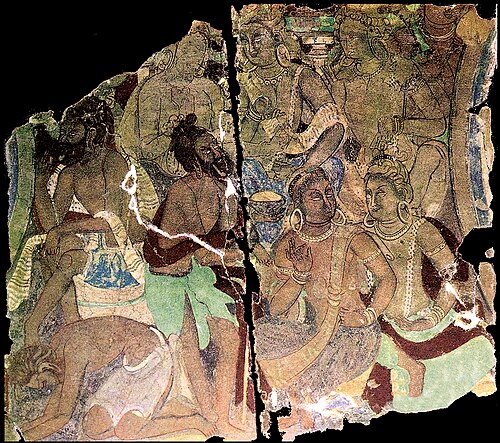


 「ローマ出身の者」)[ 103 ]の名前が登場する。 [ 101 ]壁画の右側に走り書きされた碑文には、次のように記されている。