
Loading article…
マクシミリアン・ロベスピエール | |
|---|---|
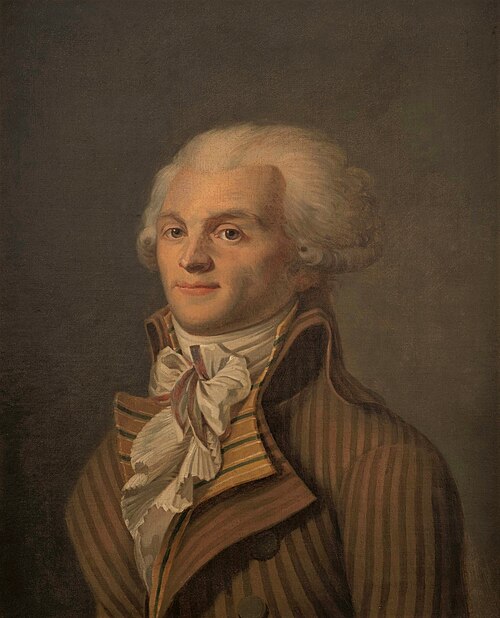 1790年頃、カルナヴァレ美術館 | |
| 公安委員会委員 | |
| 在任期間 :1793年7月27日~1794年7月27日 | |
| 先行 | トーマス=オーギュスタン・ド・ガスパリン |
| 後継者 | ジャック・ニコラ・ビヨー・ヴァレンヌ |
| 在任期間 :1793年3月25日~1793年4月3日 国防委員会委員 | |
| 第24代全国大会会長 | |
| 在任期間 :1794年6月4日~1794年6月19日 | |
| 先行 | クロード・アントワーヌ・プリュール・デュベルノワ |
| 後継者 | エリー・ラコステ |
| 在任期間 :1793年8月22日~1793年9月7日 | |
| 先行 | マリー=ジャン・エロー・ド・セシェル |
| 後継者 | ジャック・ニコラ・ビヨー・ヴァレンヌ |
| 全国大会副代表 | |
| 在任期間 :1792年9月20日~1794年7月27日 | |
| 選挙区 | パリ |
| 制憲国民議会議員 | |
| 在任期間 :1789年7月9日~1791年9月30日 | |
| 選挙区 | アルトワ |
| 国会議員 | |
| 在任期間 :1789年6月17日~1789年7月9日 | |
| 選挙区 | アルトワ |
| 第三身分の三部会副代表 | |
| 在任期間 :1789年5月6日~1789年6月16日 | |
| 選挙区 | アルトワ |
| ジャコバンクラブ会長 | |
| 在任期間 :1790年3月31日~6月3日 | |
| 在任期間 :1793年8月7日~8月28日 | |
| 個人情報 | |
| 生まれる | マクシミリアン・フランソワ・マリー・イジドール・ド・ロベスピエール 1758年5月6日フランス王国、 アルトワ州、アラス |
| 死亡 | 10 テルミドール、第 2 年 1794 年 7 月 28 日(36 歳) 革命広場、パリ、フランス |
| 死因 | ギロチンによる処刑 |
| 政党 | ザ・マウンテン(1792–1794) |
| その他の政治的 所属 | ジャコバン・クラブ(1789–1794) |
| 母校 | パリ大学 |
| 職業 |
|
| サイン |  |
マクシミリアン・フランソワ・マリー・イジドール・ド・ロベスピエール(フランス語: [maksimiljɛ̃ ʁɔbɛspjɛʁ] ; 1758年5月6日 -革命歴2年テルミドール10日、 1794年7月28日)は、フランスの弁護士、政治家であり、フランス革命における最も影響力があり、最も物議を醸した人物の一人として広く知られている。ロベスピエールは、すべての男性の投票権と国民衛兵への自由な加入のために熱心に運動した。[1] [2] [3] さらに、請願権、自衛のための武器所持の権利、大西洋奴隷貿易の廃止を主張した。[4] [5] [6]彼は急進的なジャコバン派の指導者であり、フランス第一共和政の行政機関である公安委員会の委員として有名になった。彼の遺産は、革命反対派の弾圧への実際の、あるいは認識された参加に大きく影響されているが、当時としては進歩的な見解を持っていたことでも注目される。
パリ・コミューンの主要メンバーの一人として、ロベスピエールは1792年9月初旬に国民公会の代議士に選出された。彼は左翼派閥である急進派の山岳党に加わった。しかし、三頭政治あるいは独裁制を樹立しようとしているとして批判に直面した。[7] 1793年4月、ロベスピエールは革命法を施行し反革命分子を排除することを目的としたサンキュロット軍の動員を提唱した。この呼びかけは1793年5月31日から6月2日の武装蜂起につながった。7月27日、彼は公安委員会の委員に任命された。
ロベスピエールは、山岳党が主張した政治的動機による暴力のせいで、他の人々の失望が高まっていった。国民公会のメンバーはますます彼に背を向け、テルミドール9日には告発が山積した。ロベスピエールは逮捕され、刑務所に連行された。その後数日のうちに、ロベスピエールを含む約90人が裁判なしで処刑され、テルミドール反動の始まりとなった。[8]
ロベスピエールは生前、非常に物議を醸した人物であり、その見解と政策は今も論争を呼び起こしている。[9] [10] [11]学術界と一般大衆の間では、彼の遺産と評判をめぐる議論が絶えない。[12] [13] [14]
若いころ

マクシミリアン・ド・ロベスピエールは1758年5月6日にアルトワ県アラスで洗礼を受けた。[a]父のフランソワ・マクシミリアン・バルテルミー・ド・ロベスピエールは弁護士で、1758年1月にビール醸造業者の娘ジャクリーヌ・マルグリット・カローと結婚した。4人兄弟の長男であるマクシミリアンは、その4ヵ月後に生まれた。兄弟にはシャルロット・ロベスピエール、[b]アンリエット・ロベスピエール、[c]オーギュスタン・ロベスピエールがいる。[18] [19]ロベスピエールの母親は1764年7月16日、[20] 29歳で息子を死産した後、亡くなった。シャルロットの回想録によると、母親の死は若きロベスピエールに大きな影響を与えたと考えられている。 1767年頃、理由は不明だが、父親は子供たちを残して家を出た。[d]二人の娘は父方の叔母(未婚)に育てられ、二人の息子は母方の祖父母に育てられた。[21]
幼いころから読み書きができたマクシミリアンは、わずか8歳でアラスのコレージュで教育を受け始めた。 [22] 1769年10月、司教ルイ=イレール・ド・コンジエの推薦により、パリの名門コレージュ・ルイ・ル・グランの奨学金を得た。同級生にはカミーユ・デムーランやスタニスラス・フレロンがいた。在学中、彼はローマ共和国と、キケロ、カトー、ルキウス・ユニウス・ブルートゥスの修辞術に深い尊敬の念を抱くようになった。1776年、彼は修辞学で一等賞を受賞した。
古典に対する彼の評価は、ローマの美徳、特にルソーの市民兵士の体現を志すきっかけとなった。[23] [24]ロベスピエールは、彼の著作『社会契約』で展開された政治改革に関する影響力のある哲学者の概念に惹かれた。ルソーに同調して、彼は 国民の一般意志を政治的正当性の基盤とみなした。[25]ロベスピエールの革命的美徳のビジョンと直接民主主義を通じて政治権力を確立する戦略は、モンテスキューとマブリーの思想に遡ることができる。[26] [e]ロベスピエールは偶然ルソーが亡くなる前に彼に会ったと主張する人がいる一方で、この話は作り話だと主張する人もいる。[30] [31] [32]
初期の政治
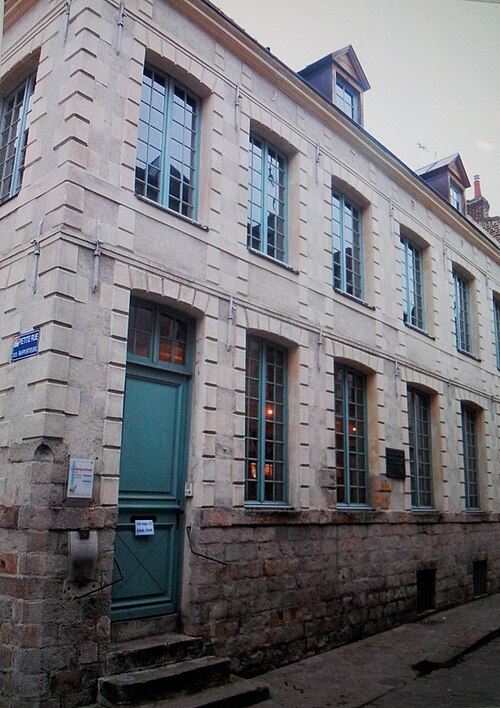
ソルボンヌ大学で3年間法律を学んでいた間、ロベスピエールは学業で優秀な成績を収め、1780年7月に卒業した時には、その並外れた学業成績と模範的な行動により600リーブルの特別賞を受賞した。 [33] 弁護士資格を得た彼は、1782年3月に地元の刑事裁判所の5人の裁判官の1人に任命された。しかし、ロベスピエールは死刑に反対していたため、死刑事件の判決を下すことに倫理的な不快感を覚え、すぐに辞職した。
ロベスピエールは1783年11月にアラスの文学アカデミーに選出された。[34]翌年、メスのアカデミーは集団懲罰について考察した論文に対して彼にメダルを授与し、文学者としての地位を確立した。[35](ピエール・ルイ・ド・ラクテルとロベスピエールが賞を分け合った。)
1786年、ロベスピエールは法の下の不平等について熱心に語り、私生児や実子が受けた侮辱を批判し、後にはlettres de cachet(裁判なしの投獄)や学界における女性の疎外などの慣行を非難した。[36]ロベスピエールの社交界は、弁護士のマルティアル・エルマン、士官で技術者のラザール・カルノー、教師のジョゼフ・フーシェなど、後の彼の活動において重要な役割を果たすことになる有力者を含むように広がった。[37]アラスのアカデミーの書記官を務めていたことから、同地方の革命的な土地測量士フランソワ・ノエル・バブーフと知り合った。


1788年8月、ルイ16世はフランスの深刻な財政および課税問題に対処するため、全州で新たな選挙を宣言し、1789年5月1日に三部会を召集した。フランス州政府の選出に関する議論に参加していたロベスピエールは、アルトワ国民への演説の中で、州議会議員による従来の選挙方式に戻ると、新たな三部会でフランス国民を適切に代表することができなくなると主張した。ロベスピエールは、自分の選挙区で1789年に『田舎の住民への告示』を通じて政治への影響力を主張し始め、地方当局を標的にして田舎の有権者の支持を集めた。[f]この動きは、国の有権者の間での彼の立場を強固なものにした。 1789年4月26日、ロベスピエールは三部会におけるフランス領フランドルを代表する16人の議員の一人としての地位を確保した。 [39] [g]
6月6日、ロベスピエールは教会の階級構造を批判する初演説を行った。[40] [41]彼の熱のこもった演説は、傍観者から「この若者はまだ経験が浅く、いつやめるべきかわからないが、他の者とは一線を画す雄弁さを持っている」というコメントを引き出しました。[42] 6月13日までに、ロベスピエールは代議士たちと連携し、代議士たちは後に国民議会を宣言し、国民の96%の代表権を主張しました。[43] 7月9日、議会はパリに移転し、新しい憲法と課税制度の審議を開始しました。7月13日、国民議会は騒乱を鎮圧するために「ブルジョア民兵」をパリに復活させることを提案しました。[44] [45]翌日、民衆は武器を要求し、オテル・デ・ザンヴァリッドとバスティーユ牢獄の両方を襲撃しました。地元の民兵は国民衛兵へと移行し、[46]最も貧しい市民は積極的な関与から遠ざかることになった。[47]法と秩序を主張するラリー=トレンダールとの議論と口論の中で、ロベスピエールは市民に「最近の自由の防衛」を思い出させたが、それは逆説的に彼らの自由へのアクセスを制限した。[48] [49] [50]
10月、ロベスピエールはルーヴェとともに、ヴェルサイユの女性行進の後、マイヤルドを支持した。[51]当初、女性抗議者グループは比較的融和的なメッセージを伝えていたが、ヴェルサイユに到着すると、より軍事的で経験豊富な男性派閥によってすぐに強化された。[52] 10月22日に制憲議会が男性の国勢調査による参政権について審議している間、ロベスピエールと選ばれた数人の議員は、投票と公職に就くための財産要件に反対した。[53] 12月から1月にかけて、ロベスピエールは特にプロテスタント、ユダヤ人、[54]アフリカ系の人々、家政婦、俳優など、疎外されたグループから注目を集めた。[55] [56]
議会で頻繁に演説を行ったロベスピエールは、人間および市民の権利宣言(1789年)に要約された理想を擁護し、 1791年憲法に概説された憲法条項を主張した。しかし、マルコム・クルックによると、彼の見解が同僚議員の間で大多数の支持を得ることはめったになかったという。[35] [57]民主主義の原則に献身していたにもかかわらず、ロベスピエールはキュロットを着続け、髪には粉をふり、カールさせ、香水をつけて、念入りに手入れした外見を保っていた。[58] [59]いくつかの記録では、彼は「神経質で、臆病で、疑い深い」と表現されている。[60] [61] スタール夫人はロベスピエールを「民主主義の原則を非常に誇張した」人物であり、「最も不条理な主張を、確信に満ちた冷静さで主張した」人物として描写した。[62] 10月にヴェルサイユ裁判所の判事に就任した。
ジャコバンクラブ
1789–1790

10月5日のヴェルサイユ女性大行進と、国王と制憲国民議会のヴェルサイユからパリへの強制移転の後、ロベスピエールは比較的裕福な住民が住むマレ地区のサントンジュ通り30番地に住んでいた。[64]彼は数か月間秘書を務めたピエール・ヴィリエと3階のアパートを共有していた。 [65]ロベスピエールは、ジャコバン・クラブとしてよく知られる新しい憲法友の会に参加していた。当初、この組織(ブルターニュ・クラブ)はブルターニュの議員のみで構成されていたが、国民議会がパリに移転した後、グループは議員以外の人々も受け入れた。これら1,200人の男性の中に、ロベスピエールは共感する聴衆を見つけた。法の下の平等はジャコバン派のイデオロギーの要であった。 10月から1月にかけて、彼は、憲法案に基づく投票権と公職就任の財産要件に関する提案に応えて、いくつかの演説を行った。これは彼が強く反対した立場であり、10月22日の演説では、ルソーから得た立場を次のように主張した。
「主権は人民にあり、人民のすべての個人にある。したがって、各個人は、自分を統治する法律の制定と、自分自身の公共の利益の管理に参加する権利を有する。そうでなければ、すべての人が権利において平等であり、すべての人が市民であるというのは真実ではない。」[66]
参政権に関する議論が続く中、ロベスピエールは1790年1月25日の演説を「フランス人はみな、美徳と才能以外のいかなる差別もなく、すべての公職に就く資格があるべきだ」という率直な主張で締めくくった。[67] 1790年3月31日、ロベスピエールは国民議会の議長に選出された。[68] 4月28日、ロベスピエールは軍法会議の将校と兵士の数を同数にすることを提案した。[69]ロベスピエールは5月11日、国民衛兵の連合体結成に全国民衛兵の協力を支持した。[70] 6月19日、国民議会の書記に選出された。7月、ロベスピエールは給与の「兄弟的平等」を要求した。[71]その年の終わりまでに、彼は極左の小集団の指導者の一人とみなされた。ロベスピエールは「30人の声」の一人だった。[72]
12月5日、ロベスピエールは国民衛兵という緊急の問題について演説した。[73] [74] [75]「個人の防衛のために武装することはすべての人の権利であり、自由と共通の祖国の存在を守るために武装することはすべての市民の権利である」。[76]ロベスピエールは国民衛兵の旗に「自由、平等、友愛」という言葉を加えることで有名なモットーを作り出した。 [h] [78] [79]
1791


1791年、ロベスピエールはほぼ1日に1回のペースで、328回の演説を行った。1月28日、ロベスピエールは議会で国民衛兵の組織について議論した。[ 80]これは3年間フランスの新聞で話題になっていた。[81] 3月初旬、地方の民兵は廃止され、パリ県はすべての一般秩序と治安に関してコミューンよりも上位に置かれた。4月27日と28日、ロベスピエールは国民衛兵を再編し、その構成員を現役市民に限定する計画に反対した。これはあまりに貴族主義的であると見なされた。[82] [83]彼は、国民衛兵を民主的な基盤の上に再編成し、勲章の使用を廃止し、軍法会議における将校と兵士の人数を同数にすることを要求した。[84]彼は、国民衛兵は自由を守る手段となり、自由に対する脅威であってはならないと感じていた。[85]同月、ロベスピエールは男子普通選挙の必要性を主張したパンフレットを出版した。[86]
5月15日、制憲議会はすべての自由な有色人種に完全かつ平等な市民権を与えると宣言した。討論でロベスピエールは「私は人々の権利を守るためにここにいると感じている。いかなる修正にも同意できず、この原則が全面的に採用されることを求める」と述べた。彼は左翼とすべての演壇から繰り返される拍手の中、演壇から降りた。[87]選挙が始まった5月16日から18日にかけて、ロベスピエールは制憲議会に出席した議員はその後の立法議会に出席できないという動議を提案し可決した。[88]この自己否定的な法令の戦術的目的は、ジャコバン派の古い指導者であるアントワーヌ・バルナーヴ、アドリアン・デュポール、アレクサンドル・ド・ラメスの野望を阻止することだった。[89]彼らはイギリスとほぼ同じような立憲君主制を作ろうとしていた。[90] [i] 5月28日、ロベスピエールはすべてのフランス人を活動的な市民と宣言し、投票資格を与えることを提案した。[86] 5月30日、彼は死刑廃止についての演説を行ったが、成功しなかった。[92]翌日、ロベスピエールは議会の活動を批判し、王権の回復を要求する演説をしたレイナル神父を攻撃した。
6月10日、ロベスピエールは警察の現状について演説し、警官の解任を提案した。[85] 1791年6月11日、彼は(代理)告発者として選出または指名された。ロベスピエールは、刑事裁判所で起訴状を準備し、弁護を確保する「公的な告発者」の役割を受け入れた。 [93] [j] 2日後、王党派のパンフレット「国王の友」は、ロベスピエールを「盗賊、反逆者、殺人者の弁護士」と表現した。[73] 6月15日、デュポールがロベスピエールとの協力を拒否した後、ペティオン・ド・ヴィルヌーヴが「暫定刑事裁判所」の議長に就任した。[96] [97]
.jpg/500px-Fusillade_du_Champ_de_Mars_(1791,_17_juillet).jpg)

ルイ16世がヴァレンヌへの逃亡に失敗した後、議会は6月25日に国王の職務を停止した。7月13日から15日にかけて、議会は国王の復権と憲法上の権利について議論した。[98]ロベスピエールは7月13日、ジャコバン・クラブで次のように宣言した。「現在のフランス憲法は君主制の共和国である。[99]したがって、現在の憲法は君主制でも共和国でもない。その両方である。」[100]
7月17日、バイーとラファイエットは集会禁止を宣言し、続いて戒厳令を敷いた。[101] [102]シャン・ド・マルスの虐殺の後、当局は多数の逮捕を命じた。ジャコバン派クラブに通っていたロベスピエールは、宿泊先のサントンジュ通りには戻らず、ローラン・ルコワントルに、チュイルリー宮殿の近くで一晩泊めてくれる愛国者を知っているかと尋ねた。ルコワントルはデュプレーの家を勧め、そこに連れて行った。[103 ] 家具職人で熱烈な崇拝者だった モーリス・デュプレーは、チュイルリー宮殿近くのサントノレ通り398番地に住んでいた。数日後、ロベスピエールはそこに永住することを決めた。[104]
ロラン夫人は、ペシオン・ド・ヴィルヌーヴ、フランソワ・ビュゾー、ロベスピエールの3人を清廉潔白な愛国者として挙げ、彼らの純粋な信念、質素な生活、賄賂の拒否を称えようとした。[105]彼は自分の意見を忠実に守り、擁護したため、「清廉潔白な」というあだ名が付けられた。[106] [107] [k]友人の外科医ジョセフ・スーベルビエル、ジョアキム・ヴィラート、[要出典]、デュプレーの娘エリザベートによると、ロベスピエールはデュプレーの長女エレオノールと婚約したが、姉シャルロットはこれを激しく否定し、弟オーギュスタンは彼女との結婚を拒否した。[108] [109] [110] [111] [要説明]
9月3日、1791年のフランス憲法が承認され、10日後には国王もこれを承認した。[112] 9月30日、議会解散の日、ロベスピエールは革命の終結を宣言し表現の自由を制限しようとしたジャン・ル・シャプリエに反対した。[113] [l]彼は、憲法が保障する表現の自由から、いかなる検査も必要としないことに成功した。「すべての人は、その思想を話し、書き、印刷し、出版する自由を有する。その著作物は、出版前に検閲や検査を受ける必要はない。」[114]ペシオンとロベスピエールは凱旋帰国した。[m] 10月16日、ロベスピエールはアラスで演説を行い、1週間後には彼が移住を希望していた小さな町ベテューヌで演説を行った。彼は日曜日に開催される憲法友の会の会合に出席した。 11月28日、彼はジャコバン派クラブに戻り、そこで勝利の歓迎を受けた。コロー・デルボワはロベスピエールに椅子を譲り、ロベスピエールはその晩議長を務めた。12月5日、彼はフランス革命の理想から生まれたユニークな組織である国民衛兵の組織化について演説した。 [115] 12月11日、ロベスピエールはついに「公衆告発者」に就任した。 [116] 1791年1月、ロベスピエールは国民衛兵だけでなく国民も武装しなければならないという考えを推進した。[117] [118]ジャコバン派は彼の演説を印刷しないことを決定した。[119]
オーストリアとの戦争に反対
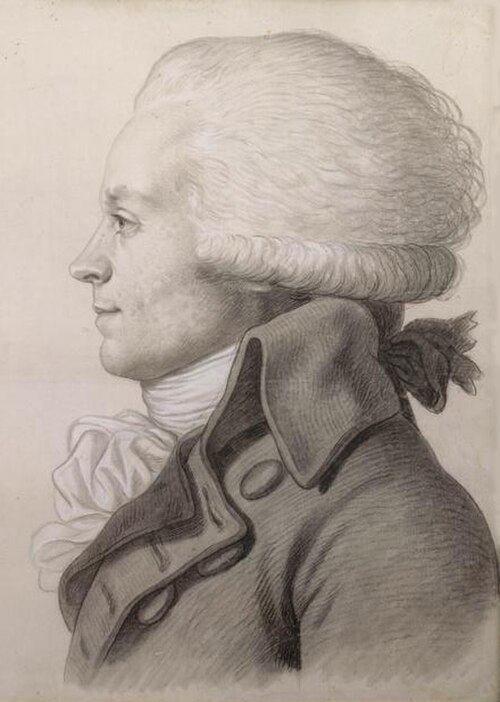

オーストリアとプロイセンによるピルニッツ宣言(1791年8月27日)は、フランス国民に対し、ルイ16世に危害を加えなければ「軍事介入」すると警告した。ブリソは立法議会の支持を集めた。ジャン=ポール・マラー、ジョルジュ・ダントン、ロベスピエールは新立法府に選出されなかったため、自己否定条例により、反対派の政治は議会外で行われることが多かった。1791年12月18日、ロベスピエールはジャコバン・クラブで宣戦布告に反対する2度目の演説を行った。[121]ロベスピエールは戦争による独裁の脅威に警告した。
彼らがカエサル、カティリヌス、クロムウェルであれば、権力を自ら掌握する。彼らが意気地のない廷臣で、善行には興味がなく、害を及ぼそうとするときには危険な者であれば、彼らは権力を主人の足元に戻し、主人の主従者となるという条件で、主人が独断的な権力を取り戻すのを手伝う。[122]
12月末、議会議長のグアデは、戦争は国家に利益をもたらし、経済を活性化させると示唆した。彼はフランスがオーストリアに宣戦布告すべきだと主張。マラーとロベスピエールはこれに反対し、勝利すれば独裁政権が生まれ、敗北すれば国王が以前の権力を取り戻すと主張した。[123]
政治家の頭に浮かぶ最も突飛な考えは、国民が外国を侵略すれば、その国の法律や憲法を採用させられると信じることだ。武装した宣教師を愛する者はいない…人権宣言は…すべての王座を同時に襲う稲妻ではない…私は、我々の革命が最終的に世界の運命に影響を与えないとは断言しない…しかし、それは今日(1792年1月2日)ではないだろう。[124]
同盟国からの反対はジロンド派をいらだたせ、戦争は両派間の大きな争点となった。ロベスピエールは1792年1月25日、ジャコバン派クラブで行われた戦争に関する3回目の演説で、「革命戦争は、王朝の防衛や国境の拡大といった伝統的な理由ではなく、不当な圧政から臣民と奴隷を解放するために戦わなければならない」と反論した。ロベスピエールは、このような戦争は反革命勢力に有利に働くだけだと主張した。なぜなら、それは人民の主権に反対する者たちの思うつぼになるからだ。カエサル主義の危険性は明らかだった。「歴史の混乱期には、将軍たちがしばしば自国の運命の裁定者になった」[125] 。ロベスピエールは、過半数を集めることができず、すでに敗北を悟っていた。それでも彼の演説は出版され、フランスのすべてのクラブとジャコバン派協会に送られた[126]。
1792 年 2 月 10 日、ロベスピエールは国家と自由を守る方法について演説したが、「戦争」という言葉は使わなかった。彼はまず、自分が提案しようとしていることはすべて合憲的であると聴衆に保証した。その後、国防を強化するというよりも、革命を守るために頼りにできる軍隊を強化するための具体的な措置を提唱した。[127]ロベスピエールは人民軍を奨励し、常に武装してルイ 16 世の立憲内閣と立法議会のフイヤン派とジロンド派にその意志を押し付けることができるようにした。 [128]ジャコバン派は、彼の演説を印刷するかどうかを決める前に検討することにした。[129] [n]
2月15日、ロベスピエールは市議会(コンセイユ・ジェネラル)に選出されなかった。 [131]同日、パリ県刑事裁判所の設置が行われた。 [132]ロベスピエールにとって、それは「公告者」という恩知らずの立場であった。陪審員が評決を下す前に法廷に立つことを許されなかった。[133]ロベスピエールは、県と地区における地方警察と連邦警察の調整を担当していた。[134]
3月26日、グアデはロベスピエールが神の摂理に頼る迷信に陥っていると非難した。[135]その直後、ロベスピエールはブリソとグアデから「人民の偶像になろうとしている」と非難された。[136]戦争に反対していたロベスピエールは、「オーストリア委員会」の秘密工作員として活動していると非難された。 [137]ジロンド派はジャコバン派内でのロベスピエールの影響力を出し抜くための戦略を立てた。[138] 4月27日、ブリソとグアデによる非難に対する演説の中で、ロベスピエールはジャコバン派を離れると脅し、一般市民として使命を続けることを望んでいると主張した。[139]
5月17日、ロベスピエールは週刊誌『憲法擁護者』の創刊号を発行した。この出版物で、彼はブリソを批判し、戦争運動に対する懐疑論を表明した。[140] [141]隣人のニコラによって印刷されたこの雑誌は、彼の演説を掲載すること、国王の政策に対する影響力に対抗すること、ジロンド派指導者の非難から彼を守ることなど、複数の目的を持っていた。[142]アルベール・ソブールにとって、その目的はパリのより広範な大衆の経済的および民主的な利益を表明し、彼らの権利を守ることであった。[143]
パリの反乱コミューン、1792年
1792年4月から7月


1792年4月20日に立法議会がオーストリアに対して宣戦布告すると、ロベスピエールは、海外で戦うためであれ、国内で専制政治を防ぐためであれ、フランス国民は武装しなければならないと述べた。 [144]孤立したロベスピエールは、将校階級と国王の政治的影響力を減らすよう働きかけることで対応した。4月23日、ロベスピエールは中央軍の司令官ラファイエット侯爵の辞任を要求した。ロベスピエールは一般兵士の福祉を主張する一方で、貴族的で王党派のミリテールと保守的な国民衛兵による将校階級の支配を緩和するため、新たな昇進を促した。 [o]彼は他のジャコバン派とともに、パリに少なくとも2万人から2万3千人の「革命軍」を創設するよう主張した。 [146] [147]都市と「自由」(革命)を守り、秩序を維持し、メンバーに民主主義と共和主義の原則を教育する。この考えは彼がジャン=ジャック・ルソーから借りたものである。[148] [149]ジャン・ジョレスによると、彼はこれをストライキ権よりも重要だと考えていた。[要出典] [84]
1792年5月29日、議会は国王派と反革命派の支持を疑い、憲兵隊を解散させた。1792年6月初旬、ロベスピエールは王政の終焉と議会の一般意志への従属を提案した。[150]王政は6月20日のデモで失敗に終わった。[151] [152]
フランス軍は戦争勃発時に壊滅的な敗北と一連の離反に見舞われたため、ロベスピエールとマラーは軍事クーデターの可能性を恐れた。[153]その一つは国民衛兵の長ラファイエットが主導したもので、6月末にジャコバン・クラブの鎮圧を主張した。ロベスピエールは公然とラファイエットを痛烈に攻撃した。
「将軍、あなたが陣営の真ん中から、これまでは我が国の敵に対しては避けていた戦争を私に宣戦布告し、あなたが買収した新聞に掲載した手紙の中で、私を軍隊、国民衛兵、そして国家の自由の敵として非難している間、私はただ将軍と議論しているだけだと思っていたが、まだフランスの独裁者、国家の調停者とは議論していない。」[154]
7月2日、議会は国王の拒否権を回避し、国民衛兵が7月14日の連邦祭典に参加することを承認した。7月11日、ジャコバン派は動揺する議会で緊急投票に勝利し、国家が危機に瀕していると宣言し、槍を持ったパリ市民全員を国民衛兵に徴兵した。 [155] 7月15日、ジャコバン派クラブのビロー=ヴァレンヌは、次の蜂起の計画を概説した。ブルボン家と「人民の敵」の追放、国民衛兵の浄化、国民公会の選挙、「国王の拒否権の人民への移譲」、最貧層の課税免除である。7月24日、「中央調整局」が設立され、各セクションは「常設」会議に参加する権利を得た。[156] [157]
7月25日、ロゴグラフによれば、カルノーは槍の使用を奨励し、すべての市民に提供した。[158] 7月29日、ロベスピエールは国王の罷免と国民公会の選出を求めた。[159] [160] 7月下旬、ブラウンシュヴァイク宣言がパリに広がり始めた。それはしばしば違法であり国家主権を侵害すると評された。その著者はしばしば疑われた。[161]
1792年8月

8月1日、議会はカルノーの提案に投票し、浮浪者を除くすべての市民に槍を配布することを強制した。[162] [163] [164] 8月3日までに、市長と47のセクションが国王の退位を要求した。8月5日、ロベスピエールは国王がガイヨン城に逃げる計画を発見したと公表した。[165]ロベスピエールの立場に同調して、パリのほぼすべてのセクションが国王の廃位を求めて結集し、断固たる最後通牒を発した。[166]ブリソは憲法の維持を強く求め、国王の廃位と新しい議会の選出の両方に反対を主張した。[167] 8月7日、ペシオンはロベスピエールに、フェデレスが首都を平定するために出発するのを支援するよう提案し、前線での彼らの方が効果的な働きを示唆した。[168]同時に、閣僚評議会は、ダントン、マラー、ロベスピエールがジャコバン・クラブに参加した場合、彼らを逮捕するよう勧告した。[169]
8月9日、いくつかの地区の委員が市庁舎に集まった。特に欠席していたのはマラー、ロベスピエール、タリアンだった。市の市議会は真夜中に解散した。フォーブール・サン=タントワーヌのサンキュロットの著名人、シュルピス・ユグナンが反乱コミューンの暫定議長に任命された。
8月10日金曜日の早朝、3万人のフェデレ(地方出身の志願兵)とサンキュロット(パリの戦闘的市民)がチュイルリー宮殿への襲撃を成功させた。[170]ロベスピエールはこれを「受動的」(投票権のない)市民の勝利とみなした。この出来事に動揺した議会は国王を停職にし、その権威を奪う国民公会の選挙を承認した。[171] 8月11日の夜、ロベスピエールはパリ・コミューンで、居住地区であるセクション・ド・ピケの代表としての地位を確保した。 [172]統治委員会は、男子普通選挙で選出された国民公会の招集を提唱し、[173]新政府を樹立してフランスを再建する任務を負わせた。カミーユ・デムーランは騒乱は終わったと信じていたが、ロベスピエールはそれが始まりに過ぎないと主張した。8月13日までに、ロベスピエールは県の強化に公然と反対した。[174]その後、ダントンは彼を司法評議会に招いた。ロベスピエールは『憲法擁護者』第12版を出版し、記録と政治的遺言となった。[175] [176]
8月16日、ロベスピエールはパリ・コミューンが承認した請願書を立法議会に提出し、特に「裏切り者」や「人民の敵」とみなされる者を処罰する任務を負った臨時革命裁判所の設立を求めた。翌日、彼はこの裁判所の判事8人のうちの1人に任命された。しかし、公平性に欠けるとして、ロベスピエールは裁判長を務めることを辞退した。[177] [p]この決定は批判を招いた。[179] [180]
プロイセン軍は8月19日にフランス国境を突破した。防衛を強化するため、パリの武装部隊はサンテールの指揮下にある国民衛兵の48個大隊に統合された。議会は、宣誓していない司祭は全員1週間以内にパリを離れ、2週間以内に国外へ出なければならないと布告した。[181] 8月28日、議会はその後2日間の夜間外出禁止令を発令した。[182]市の門は閉ざされ、国外との通信はすべて停止された。司法大臣ダントンの命令により、各部隊の委員30名が容疑者の家屋を捜索し、武器、弾薬、剣、馬車、馬を探すよう命じられた。[183] [184]「この異端審問の結果、すでに市内の刑務所や修道院に収監されていた膨大な数の政治犯に、1,000人以上の「容疑者」が追加された」。[185]マラーとロベスピエールはともにコンドルセを嫌っていた。コンドルセは「人民の敵」は国民全体に属し、国民の名において合憲的に裁かれるべきだと主張した。[186] 8月30日、ロランとグアデの暫定内務大臣は、各部署が捜索に疲れたため、コミューンの影響力を抑えようとした。議会は圧力に疲れ、コミューンを違法と宣言し、コミューン選挙の実施を提案した。[187]
ロベスピエールはもはやブリソとロランに協力する気はなかった。9月2日の日曜日の朝、国民公会の議員選挙を進めるために市庁舎に集まったコミューンのメンバーは、自分たちの議席を維持し、ロランとブリソを逮捕することに決めた。[188] [189]
全国大会
選挙

9月2日、1792年のフランス国民公会選挙が始まった。パリは防衛を組織していたが、何千人もの志願兵を動員する武器が不足していた。ダントンは議会で演説を行い、おそらくスイス人囚人について次のように述べた。「自ら出動することや武器の引き渡しを拒否する者は、死刑に処せられることを要請する。」[190] [191]彼の演説は、市民の直接行動の呼びかけとして、また外敵に対する攻撃として機能した。[192]それから間もなく、9月虐殺が始まった。[193]ロベスピエールと警察行政を担当する検察官マヌエルは、王家の安全を確認するためにタンプル監獄を訪れた。 [194]
パリでは、ジロンド派と王党派の候補者がボイコットされた。[195]ロベスピエールは、ブリソ(およびブリソ派の仲間であるペシオンとコンドルセ)がパリで選出されないことに貢献した。[196]シャルロット・ロベスピエールによると、彼女の兄はかつての友人である市長ペシオン・ド・ヴィルヌーヴと話をしなくなった。ペシオンはデムーランから顕示的消費を非難され、 [197]最終的にブリソに結集した。[198] 9月5日、ロベスピエールは国民公会の代議士に選出されたが、ダントンとコロー・デルボワがロベスピエールよりも多くの票を獲得した。[q]ロラン夫人は友人に次のように書いている。「私たちは、民衆を扇動するロベスピエールとマラーの攻撃を受けている。」[199]選挙は山岳派ジャコバン派が予想したような勝利ではなかったが、その後9か月の間に彼らは徐々に反対派を排除し、国民公会を掌握した。[200]
9月21日、ペシオンが国民公会の議長に選出された。山岳党のジャコバン派とコルドリエ派は、かつての馬場敷きの後ろの高い席に座り、山岳党(「山岳派」)と呼ばれた。その下には穏健な共和主義者であるジロンド派の「馬場」がいた。平野派の多数派は無所属(バレール、カンボン、カルノーなど)だったが、急進派の山岳派が優勢だった。[201] 9月25日と26日、バルバルーとジロンド派のラソースは、ロベスピエールが独裁政権を樹立しようとしていると非難した。[202]ロベスピエール、マラー、ダントンがフランス第一共和政を救うために三頭政治を企てているという噂が広まったが、この主張を裏付ける証拠はない。
9月30日、ロベスピエールはいくつかの法律を提唱した。結婚、出生、埋葬の登録を教会から取り消すことなどである。10月29日、ルーヴェ・ド・クヴレはロベスピエールを攻撃した。[203]彼はロベスピエールがパリの「総督府」を統治しているが、9月の虐殺を止めるために何もしなかったと非難した。それどころか、彼によると、彼はそれを利用して山岳党をもっと選出させた。 [204]より多くの票を得るために、 9月の党員に金を支払ったとされている。 [205]病弱だったロベスピエールには、1週間の返答期間が与えられた。11月5日、ロベスピエールは自身、ジャコバン・クラブ、そして支持者を擁護した。
告発者たちの言うことを信じるならば、私はジャコバン派に対して意見の専制政治を行使しているが、それは独裁政治の前兆にほかならない。第一に、意見の独裁政治が、とりわけ自由な人々の社会において何であるか私にはわからない。それは原則の自然な強制にほかならない。この強制は、原則を表明する人に属するものではなく、普遍的な理性と、その声に耳を傾けたいすべての人々に属する。それは、憲法制定議会の同僚たち、立法議会の愛国者たち、そして自由の理念を常に擁護するすべての市民に属する。ルイ16世とその同盟者たちにもかかわらず、経験が証明しているように、ジャコバン派と人民クラブの意見はフランス国民の意見であり、市民がそれを作ったわけではなく、私はそれに加わっただけである。[206]
ロベスピエールは告発者を非難し、フランス革命の最も有名な言葉の一つを議会に語った。
我々を分断する唯一の争いの目的は、あなた方が本能的に新大臣の行動を擁護し、我々が原則を擁護したこと、あなた方が権力を好み、我々が平等を好んだことにあることを、私はあなた方に思い出させようとはしません…なぜあなた方はコミューン、立法議会、パリの諸支部、州議会、そして我々を模倣したすべての者を訴追しないのですか?これらすべては革命と同じくらい違法であり、王政とバスティーユの崩壊と同じくらい違法であり、自由そのものと同じくらい違法なのです…市民よ、あなた方は革命のない革命を望みますか?私たちを鎖から解放した人々に向けたこの迫害の精神とは何ですか?[207]
ルーヴェは「マクシミリアン・ロベスピエールとその王党派(告発) 」という演説を発表した後、ジャコバン・クラブへの入会を禁じられた。[208] コンドルセはフランス革命を宗教とみなし、ロベスピエールは宗派の指導者の特徴をすべて備えていると考えていた。[209] [210] [ 211 ] [r]反対派がよく知っていたように、ロベスピエールはトリコトゥーズ(編み物師)と呼ばれるパリの女性たちの間に強力な支持基盤を持っていた。[213] [214]ムーアによれば、「彼(ロベスピエール)は、自分が役に立てそうな役職は拒否し、自分が統治できる役職に就く。目立つことができるときには現れ、他の人が舞台に立つときには姿を消す」。[215]
ルイ16世の処刑


1792年9月21日、国民公会が全会一致でフランス共和国を宣言した後、前国王に対する証拠を調査する委員会が設立され、国民公会の立法委員会は将来の裁判の法的側面を検討した。[216] 11月20日、ルイ16世と銀行家や大臣との通信を含む726件の秘密文書が発見された後、世論はルイに対して急激に不利になった。 [217]ダントン主義者のクロード・バジールの提案により、国民公会はルイ16世を国民公会の議員が裁判にかけることを決定した。 [218] 12月28日、ロベスピエールはジャコバン派クラブで国王の運命に関する演説を繰り返すよう求められた。1793年1月14日、国王は全会一致で陰謀と公安攻撃の罪で有罪となった。[219]
1月15日、国民投票の呼びかけは424票対287票でロベスピエールがリードして否決された。1月16日、国王の判決を決定する投票が始まり、ロベスピエールは国王の処刑を確実にするために熱心に働いた。ジャコバン派はジロンド派の最後の恩赦の訴えを却下することに成功した。[220] 1月20日、議員の半数が即死刑に投票した。翌日、ルイ16世はギロチンで処刑された。
国王の処刑後、ロベスピエール、ダントン、山岳党が勢力を拡大し、ジロンド派を凌駕した。[221]
1793年3月/4月
.jpg/500px-L%C3%A9on_Cogniet_-_Louis_Philippe_d'Orl%C3%A9ans,_duc_de_Chartres_(1792).jpg)
_(14757841216).jpg/500px-Histoire_de_France_populaire_depuis_les_temps_les_plus_recul%C3%A9s_jusqu'%C3%A0_nos_jours_(1867)_(14757841216).jpg)
2月24日、国民公会は最初の民衆蜂起を布告したが、これは失敗に終わり、フランスの田舎で蜂起が起こった。アンラジェ派の支援を受けた抗議者たちは、ジロンド派が騒乱と物価高騰を引き起こしたと非難した。[221] 1793年3月初旬、ヴァンデ戦争とピレネー戦争が始まった。一方、サンキュロット軍に脅かされていたオーストリア領ネーデルラントの住民は、フランスの侵略に抵抗した。[222]
3月9日の夕方、国民公会の外に群衆が集まり、脅迫の言葉を叫び、国王処刑に投票しなかった「裏切り者」議員全員の排除を要求した。1793年3月12日、臨時革命裁判所が設立され、その3日後、国民公会はフーキエ=タンヴィルを告発者に、フルーリオ=レスコをその補佐官に任命した。ロベスピエールは乗り気ではなく、それが派閥の政治的道具になるのではないかと恐れた。[223]ロベスピエールは、国民は善良で、行政官は腐敗しやすいという前提に基づかない限り、すべての制度は悪いものだと信じていた。[224]
3月11日、シャルル・フランソワ・デュムーリエはブリュッセルの議会で演説し、フランスの委員と兵士の行動について謝罪した。[225]デュムーリエはオーストリアに対し、フランス軍は国民公会の許可なしに3月末までにベルギーから撤退すると約束した。[226]彼はシャルトル公に、和平交渉、国民公会の解散、1791年のフランス憲法と立憲君主制の復活、そしてマリー・アントワネットとその子供たちの解放という彼の計画に加わるよう促した。 [227] [228]ジャコバン派の指導者たちは、フランスがデュムーリエによって実行されジロンド派の支援を受けた軍事クーデターに近づいていると確信していた。
3月25日、ロベスピエールは戦争活動を調整する総防衛委員会の25人のメンバーの1人となった。[229]ロベスピエールは、ベルギーの独裁者か国家元首になることを夢見ているデュムーリエの解任を要求し、デュムーリエは逮捕された。[230]彼は国王の親族はフランスから立ち去るべきだが、マリー・アントワネットは裁かれるべきだと要求した。[231]彼は国民公会を救うための強力な手段について語ったが、数日以内に委員会を去った。マラーはジロンド派に対するより過激な戦争アプローチを推進し始めた。[232]革命裁判所への自首を拒否したデュムーリエ将軍の離反後、山岳党はジロンド派に対して激しい戦闘を開始した。[233] 4月3日、ロベスピエールは国民公会で、この戦争は共和国を転覆させるためにデュムーリエとブリソが仕組んだゲームであると宣言した。[234]
4月6日、マクシマン・イスナールの提案とジョルジュ・ダントンの支持により、公安委員会が設置された。委員会は、プレンヌ派とダントン派の議員9名で構成され、ジロンド派とロベスピエール派は含まれていなかった。 [235]委員会の最初の行動の1つとして、ジャコバン派の会長マラーは、ジロンド派22名の追放を求めた。[236]選出されなかったロベスピエールは、議会の行動の見通しについて悲観的で、パリを守り、不忠の議員を逮捕するためにサンキュロットの軍隊を編成する必要があるとジャコバン派に伝えた。 [237]ロベスピエールによれば、政党は2つしかなかった。人民とその敵である。[238] 4月10日、ロベスピエールは演説でデュムーリエを非難した。「彼とその支持者はベルギーでアシニヤの流通を妨げ、公共財産に致命的な打撃を与えた」。[239] 1793年4月のロベスピエールの演説は、急進主義の高まりを反映している。「私は各派に、革命軍の中核を成すのに十分な規模の軍隊を召集するよう要請する。革命軍は各派からサンキュロット全員を集め、反乱者を殲滅するだろう…」[240] [241]さらなる反逆を疑ったロベスピエールは、敵との交渉を提案する者には死刑を投票するよう国民公会に要請した。[242]マラーは軍事法廷の設置と国民公会の停止を求めて投獄された。 [243] 4月15日、国民公会は再び各派の人々によって襲撃され、国王を擁護したジロンド派の排除を要求した。 4月17日まで、国民公民権宣言は1793年の最初の共和制憲法に先立つ政治文書であった。4月18日、コミューンはマラー逮捕後に国民公民権宣言に対する反乱を宣言した。4月19日、ロベスピエールは法の下の平等に関する第7条に反対し、4月22日、国民公民権は抵抗権に関する第29条を議論した。[244] 4月24日、ロベスピエールは財産権に関する4条を含む自身の宣言を発表した。[s]彼は事実上、個人の所有権に疑問を呈し、[247]累進課税とすべての国の人々の友愛を主張した。 [240]ロベスピエールは農地法に反対を表明した。
1793年5月
1793年5月1日、ジロンド派の代議士ジャック=アントワーヌ・デュロールによれば、8,000人の武装した男たちが国民公会を取り囲み、彼らが要求する緊急措置(適切な給与と食料価格の上限)が採用されなければ立ち去らないと脅した。[248] [249] 5月4日、国民公会は敵と戦うために故郷を離れた兵士と水兵の家族を支援することに同意した。ロベスピエールは階級闘争の戦略を推し進めた。[250] 5月8日と12日、ジャコバン・クラブでロベスピエールは、穀物を探し、富裕層への課税によって資金を調達し、貴族と反革命分子を打倒することを目的とする革命軍を創設する必要性を改めて述べた。彼は、公共の広場を使って武器と槍を生産すべきだと述べた。[251] 5月中旬、マラーとコミューンは公的にも秘密裏にも彼を支持した。[252]国民公会は、ジロンド派が多数を占める12人のメンバーからなる調査委員会を設置することを決定した。 [253] ル・ペール・デュシェーヌ紙の編集者ジャック・エベールは、22人のジロンド派を攻撃または殺害するよう要求した後、逮捕された。翌日、コミューンはエベールの釈放を要求した。
5月26日、1週間の沈黙の後、ロベスピエールは彼のキャリアの中で最も決定的な演説の一つを行った。[254]彼はジャコバン・クラブに「腐敗した議員たちに対する反乱に身を投じる」よう呼びかけた。[255]イナールは、国民公会はいかなる暴力にも左右されず、パリはフランスの他の地域の代表者を尊重しなければならないと宣言した。[256]国民公会はロベスピエールの意見は聞き入れないと決定した。雰囲気は極度に動揺した。議員の中には、イナールがパリで内戦を宣言する勇気があれば殺人をいとわない者もおり、大統領は議席を譲るよう求められた。
5月28日、衰弱したロベスピエールは体調不良を理由に2度も欠席したが、それでもブリソの王党主義を非難した。[257] [258]ロベスピエールは左派からの拍手を受けて国民公会を離れ、市庁舎に向かった。[232]そこで彼は国民公会の多数派に対して武装蜂起を呼びかけ、「コミューンが人民と緊密に団結しなければ、最も神聖な義務に違反することになる」と述べた。[259]午後、コミューンはパリ防衛のために2万人を含む、フランスのすべての町にサンキュロットの革命軍を創設するよう要求した。[260] [255] [261]
5月29日、ロベスピエールは国民の心を整えることに忙しかった。彼はシャルル・ジャン・マリー・バルバルーを攻撃したが、不安のために政治家としてのキャリアをあきらめかけたことを認めた。[232]パリの33の地区を代表する代表者たちは蜂起委員会を結成した。[262]彼らは蜂起状態にあると宣言し、コミューンの総会を解散し、直ちに総会を再編成して新たな宣誓を行わせた。フランソワ・アンリオがパリ国民衛兵総司令官に選出された。サン=ジュストが公安委員会に加わり、クートンが書記長となった。
翌日、ノートルダム大聖堂の警鐘が鳴らされ、市の門が閉ざされ、5 月 31 日から 6 月 2 日までの蜂起が始まった。アンリオは、警戒の合図としてポンヌフに大砲を発射するよう命じられた。午前 10 時頃、12,000 人の武装した市民が、ジロンド派議員の逮捕から国民公会を守るために現れた。
6月1日、コミューンは一日中集まり、大運動の準備に時間を費やした。反乱委員会はアンリオに「相当な武装勢力」で国民公会を包囲するよう命じた。[263]夕方、4万人の男たちが逮捕を強要するために建物を包囲した。マラーは国王の処刑に反対票を投じ、国民公会を麻痺させていた代表者たちへの攻撃を指揮した。[264] [236]コミューンは国民公会に請願することを決定した。国民公会は、危機の日には男性に武器の携行を許可し、1日ごとに報酬を支払うことを決定し、過去4日間の中断に対する労働者への補償を約束した。[265]
この結果に満足しなかったコミューンは、革命の「補足」を要求し、準備した。アンリオは、市庁舎から国立宮殿まで国民衛兵を行進させるよう申し出た(または命令された) 。[266]翌朝、武装した市民の大部隊(8万人または10万人と推定されたが、ダントンは3万人としか言わなかった)[267]が大砲で国民公会を包囲した。「武装部隊は、国民公会がコミューンが非難した議員を国民に引き渡したときにのみ撤退する」とアンリオは述べた。[268]ジロンド派は法律で保護されていると信じていたが、ギャラリーの人々は彼らの逮捕を求めた。22人のジロンド派が逮捕された。[269]
山岳党は国民公会を掌握した。[270]ジロンド派は地方に赴き、反革命に加わった。[271]
暴動の間、ロベスピエールはメモ帳に次のようなメモを書き殴っていた。
我々に必要なのは、一つの意志(il faut une volonté une)である。それは共和主義か王党派のどちらかでなければならない。共和主義であるならば、共和主義の大臣、共和主義の新聞、共和主義の議員、共和主義の政府が必要である。…内部の危険は中流階級から来る。中流階級を倒すには、国民を結集しなければならない。…国民は国民公会と同盟を結び、国民公会は国民を利用しなければならない。[272] [273]
6月3日、国民公会は亡命者たちの土地を分割し、農民に売却することを決定した。6月12日、ロベスピエールは健康上の問題により辞任する意向を発表した。[274] 7月13日、ロベスピエールは、革命思想を寄宿学校で教えるというル・ペルティエの計画を擁護した。 [275] [t]翌日、国民公会は、浴槽で殺害されたマラーの熱意と革命家としての勤勉さを急いで称賛した。ピエール=ルイ・ベンタボールに反対して、ロベスピエールは単にマラーの死の状況の調査を求めた。[277] 7月17日または22日、亡命者たちの財産は法令により没収され、所有権の証拠は集められ、焼却されなければならなかった。
-
 Journées des 31 Mai, 1er et 2 Juin 1793、州兵に囲まれた大会の彫刻。
 -
 1793 年 5 月 31 日から 6 月 2 日までのパリのサンキュロット蜂起。場面はチュイルリー宮殿の代議院前で起こった。描写にはマリー=ジャン・エロー・ド・セシェルとピエール・ヴィクチュルニアン・ヴェルニオーが描かれている。
 -

恐怖政治


地方都市がパリの過激な革命家たちに反乱を起こしたため、フランス政府は重大な内部問題に直面した。マラーとル・ペルティエが暗殺され、ロベスピエールや他の著名人たちは身の安全を恐れるようになった。コルシカ島は正式にフランスから離脱し、イギリス政府に保護を求めた。7月、フランスはヴァンデ県とブルターニュ地方の貴族蜂起、リヨン、ル・ミディ、ノルマンディー地方の連邦主義者の反乱に包囲され、ヨーロッパ全土と外国の派閥からの敵意に直面し、内戦の瀬戸際にあった。[278] [279] [280]
1793年6月と7月
6月末、ロベスピエールはジャック・ルーを外国のエージェントとして攻撃し、ルーはジャコバン・クラブから追放された。マラーが暗殺された7月13日、ロベスピエールは学校に革命的概念を導入するというルイ=ミシェル・ル・ペルティエの提案を支持すると表明した。[275]彼はまた、インフレと食糧不足の高まりを利用してパリの各地区に動乱を煽動した「アンラジェ」として知られるパリの急進派の取り組みを非難した。[5]
1793年7月27日、ロベスピエールはついにトーマス=オーギュスタン・ド・ガスパリンに代わって委員会に加わった。これはロベスピエールが戦争遂行を監督する執行部の地位に就いた二度目の任期であった。ロベスピエールは委員会で最もよく知られたメンバーとみなされていたが、委員会は階層構造なしで運営されていた。[281]
1793年8月
8月4日、国民公会は1793年フランス憲法を公布した。[u]しかし、8月末までに、反乱を起こしたマルセイユ、ボルドー、リヨンの都市は、まだ新憲法を承認していなかった。フランスの歴史家ソブールは、反乱を起こした県が承認する前に、ロベスピエールが新憲法の施行に反対したと示唆している。[283] 9月中旬までに、ジャコバン・クラブは、圧倒的多数が賛成していたにもかかわらず、一般意志が欠けているとして、憲法を公布すべきではないと提案した。[284]
8月21日、ロベスピエールは国民公会の議長に選出された。[285] 2日後の8月23日、ラザール・カルノーが委員会に任命され、臨時政府は共和国の敵に対して一斉にレヴェを導入した。クートンは、アシニヤを名目価格より安く販売した者を20年の懲役刑に処するという法律を提案した。ロベスピエールは特に公務員の徳性を確保することに関心があった。[286]彼は、連邦主義者の反乱を鎮圧するために、同じく代表であった弟のオーギュスタンと妹のシャルロットをマルセイユとニースに派遣した。[287]
1793年9月
9月4日、サンキュロットは再び国民公会を襲撃し、流通するアシニヤが前の数ヶ月間で2倍になっていたにもかかわらず、物価上昇に対するより厳しい措置を要求した。[288]彼らはまた、反革命を根絶するための恐怖体制の確立を求めた。
1793年9月5日の会議中、ロベスピエールは革命軍の組織に関する報告書を監督するために公安委員会に出席する必要があったため、議長の座をテュリオに譲った。[289]その日の会議で、国民公会は、ビローとダントンが支持したショーメットの提案に基づき、パリに6,000人の革命軍を編成することを決定した。[290]公安委員会を代表してバレールは、6,000人の有給武装部隊と1,200人の砲兵を創設する法令を提出し、すぐに可決された。この部隊は「反革命分子を鎮圧し、国民公会が定めた革命法と公安措置を執行し、規定を守る」任務を負う。[240]
犯罪を根絶し、国内の反革命を防ぐ責任を負っている治安委員会は、国家憲兵隊と金融問題の監視を開始した。国内のすべての外国人を逮捕する法令が発布された。9月8日には、偽造アシニタの流通と資本の流出を抑制するために銀行と両替所が閉鎖され、[291]外国への投資は死刑に処せられた。
9月11日、公安委員会の権限が1か月延長された。ロベスピエールはジャコバン・クラブのアンリオを支持し、 8月23日のラザール・カルノーの委員会任命に反対を表明した。その理由として、カルノーがジャコバン・クラブに所属していないことと、5月31日の事件の承認を拒否したことを挙げた。[292] [293]ロベスピエールはまた、ボルドーの陰謀に関与した指導者の処罰を求めた。
ジャック・テュリオはロベスピエールとの和解しがたい意見の相違から9月20日に辞任し、ロベスピエールの最も声高な反対者の一人となった。[294]革命裁判所は再編され、4つのセクションに分割され、常に2つのセクションが同時に活動するようになった。9月29日、委員会は特にパリに供給する地域で価格統制を導入した。 [295]歴史家オーギュスタン・コシャンによると、これらの措置により1週間以内に店が空になった。[296]
10月1日、国民公会は月末までに ヴァンデ県の「山賊」を根絶することを決議した。
1793年10月
10月3日、ロベスピエールは国民公会が2つの派閥に分裂していると感じた。人民の味方と、彼が陰謀者とみなした者たちである。[297]彼は73人のジロンド派を「有用」と弁護したが[298] 、その後20人以上が裁判にかけられた。彼は公安委員会の議席を辞退し、委員会の指示に抵抗できる安定した政府を主張したダントンを批判した。[299]数週間危篤状態にあったダントンは[300]政治から身を引いてアルシ=シュル=オーブに向かった。[301] 10月8日までに国民公会はブリソとジロンド派を逮捕することを決議した。
10月10日、国民公会は公安委員会を最高「革命政府」として公式に承認し、[302] [より詳しい情報源が必要]、この名称は12月4日に確定した。[303]憲法とその起草が圧倒的な支持を得て山岳派への支持が強まったにもかかわらず、国民公会は10月10日に将来の平和が達成されるまで憲法を無期限に停止した。[304]公安委員会は、国の経済と政治生活に関して前例のない権限を持つ戦時内閣に変貌した。しかし、立法措置については国民公会に対して責任を負い、いつでも交代できる状態であった。[305]
10月12日、エベールがマリー・アントワネットが息子と近親相姦関係にあったと告発する中、ロベスピエールはバレール、サン=ジュスト、ジョアシャン・ビラテなどの熱心な支持者たちと食事を共にした。議論の最中、ロベスピエールは明らかに激怒し、フォークで皿を割り、エベールを「愚か者」と非難した。[306] [307] [308]革命裁判所の陪審員は10月16日の午前4時に元王妃に対する判決を下し、正午にギロチンで処刑された。[309]伝えられるところによると、クルトワはベッドの下に隠してあったロベスピエールの書類の中にマリー・アントワネットの遺言書を発見した。[310]
10月25日、革命政府は不作為の非難に直面した。[311]革命軍の支援を受けた治安委員会の数名が、地方での革命に対する活発な抵抗を鎮圧するために派遣された。[312]ロベスピエールの家主モーリス・デュプレイが革命裁判所の裁判官になった。10月31日、ブリソーと他の21人のジロンド派がギロチンで処刑された。[313]
1793年11月
11月14日の朝、フランソワ・シャボはロベスピエールの部屋に押し入り、反革命と外国の陰謀の容疑で彼をベッドから引きずり出したとされる。シャボは10万リーブルのアシニャ紙幣を振りかざし、王党派の陰謀家らが票を買うために渡したと主張した。[314] [315]シャボは3日後に逮捕され、クルトワはダントンに直ちにパリに戻るよう促した。
11月25日、ミラボー伯爵の遺体がパンテオンから撤去され、ジャン=ポール・マラーの遺体に置き換えられた。[316]ロベスピエールは、ミラボーがルイ16世の最後の数か月間に密かに宮廷と共謀していたことを知り、この変更を開始した。[317] 11月末、抗議して1万人の署名を集めたリヨンの女性たちからの強い感情的な圧力を受けて、ロベスピエールはリヨンの反乱者の事件を調査し、潜在的な不正を調査するための秘密委員会の設立を提案した。
1793年12月
12月3日、ロベスピエールはジャコバン・クラブでダントンがスイスに亡命するために病気を装ったと非難した。[要出典]彼によると、ダントンは悪徳をあまりにも頻繁に示し、美徳を見せなかった。ロベスピエールは攻撃を止められた。集会はダントンへの拍手で閉会された。[318] 12月4日、革命政府法により、公安委員会の広範な権限が法典化されたことで、県および地方当局の独立性が失われた。ビローが提出し、24時間以内に施行されたこの法律は、任務に就く議員や委員の独立性に反する極端な決定であり、部門間の協調行動は違法となった。[319] 12月5日、ジャーナリストのカミーユ・デムーランが新しい雑誌「ル・ヴュー・コルドリエ」を創刊した。彼はダントンを擁護し、脱キリスト教派を攻撃し、後にロベスピエールを独裁者としてのジュリアス・シーザーになぞらえた。[320]ロベスピエールは、容疑者法に基づいていくつかの事件を調査するための司法委員会を設立するという反対提案を行った。[321] 6月2日の暴動に反対票を投じた73人の議員は、国民公会での議席を得ることを許された。[322] 12月6日、ロベスピエールは国民公会で非キリスト教化の危険性について警告し、「宗教の自由に反するあらゆる暴力や脅迫」を攻撃した。


12月12日、ロベスピエールはジャコバン派の裕福な外国人クローツをプロイセンのスパイだと非難した。 [323]ロベスピエールは「脱キリスト教主義者」を外国の敵だと非難した。免罪符党は公安委員会を攻撃し、殺人者だと非難した。[324] デムーランはロベスピエールに直接宛てて、「親愛なるロベスピエール…私の古い学校の友人…歴史と哲学の教訓を忘れないで下さい。愛は恐怖よりも強く、長続きします。」と書いた。[325] [326]
12月25日、デムーランの執拗な反論に刺激されたロベスピエールは、「革命政府の原則に関する報告書」を作成した。[321]ロベスピエールは恐怖政治の終結を求める嘆願に応え、国民公会の集団的権限、行政の中央集権化、地方当局の粛清を正当化した。彼は、甘やかしと厳格さという2つの崖を避けなければならないと述べた。18世紀の政治評論家に相談することはできなかった。彼らはこのような展開を予見していなかったからだ。彼は、政府を脅かすと思われるエベール派やダントン派などのさまざまな派閥に抗議した。[327] [328]ロベスピエールは、厳格な法制度が依然として必要であると強く信じていた。
革命政府の理論は、この政府が誕生した革命と同じくらい新しい。この理論は、革命を予測できなかった政治評論家の本や、暴君の法律書には見当たらないかもしれない...
立憲政府の目標は共和国の防衛であり、革命政府の目標は共和国の樹立である。
革命は自由がその敵に対して戦う戦争であるが、憲法は勝利した平和的な自由の体制である。
革命政府は戦争状態にあるため、並外れた活動を展開する必要がある。革命政府は、嵐のような状況下にあり、刻々と変化するため、一定の法則に従うことはできない。この政府は、急速に変化する危険に対抗するために、絶えず新たなエネルギー源を明らかにする義務がある。[329]
ロベスピエールは混乱と無政府状態を抑圧した。「政府は自らを守らなければならない」[陰謀家に対して]そして「人民の敵に対しては死を免れない」[330] [331] [332] R.R.パーマーとドナルド・C・ホッジスによれば、これは独裁政治の哲学に関する近代初の重要な声明であった。[333] [334]他の人々[誰? ]はこれを政治的不安定と陰謀の自然な結果と見ている。
1794年2月と3月
1794年2月5日の「政治道徳の原則に関する報告書」の中で、ロベスピエールは革命政府を称賛し、恐怖と美徳が必要であると主張した。
If the spring of popular government in time of peace is virtue, the springs of popular government in revolution are at once virtue and terror: virtue, without which terror is fatal; terror, without which virtue is powerless. Terror is nothing other than justice, prompt, severe, inflexible; it is therefore an emanation of virtue; it is not so much a special principle as it is a consequence of the general principle of democracy applied to our country's most urgent needs.
It has been said that terror is the principle of despotic government. Does your government therefore resemble despotism? Yes, as the sword that gleams in the hands of the heroes of liberty resembles that with which the henchmen of tyranny are armed. Let the despot govern by terror his brutalized subjects; he is right, as a despot. Subdue by terror the enemies of liberty, and you will be right, as founders of the Republic. The government of the revolution is liberty's despotism against tyranny. Is force made only to protect crime? And is the thunderbolt not destined to strike the heads of the proud?[335]
To punish the oppressors of humanity is clemency; to forgive them is barbarity.[336]
Aulard sums up the Jacobin train of thought: "All politics, according to Robespierre, must tend to establish the reign of virtue and confound vice. He reasoned thus: those who are virtuous are right; error is a corruption of the heart; error cannot be sincere; error is always deliberate."[337][338] According to the German journalist K.E. Oelsner, Robespierre behaved "more like a leader of a religious sect than of a political party. He can be eloquent but most of the time he is boring, especially when he goes on too long, which is often the case."[339]
From 13 February to 13 March 1794, Robespierre had withdrawn from active business on the Committee due to illness.[67] Robespierre seems to have suffered from acute physical and mental exhaustion, exacerbated by an austere personal regime, according to McPhee. Saint-Just was elected president of the Convention for the next two weeks. On 19 February, Robespierre decided to return to the Duplays.[340]
In early March, in a speech at the Cordeliers Club, Hébert attacked both Robespierre and Danton as being too soft. Hébert used the latest issue of Le Père Duchesne to criticise Robespierre. There were queues and near-riots at the shops and in the markets; there were strikes and threatening public demonstrations. Some of the Hébertistes and their friends were calling for a new insurrection.[341] Robespierre managed to acquire a small army of secret agents, which reported to him.[342]
A majority of the Committee decided that the ultra-left Hébertists would have to perish or their opposition within the committee would overshadow the other factions due to its influence in the Commune of Paris. Robespierre also had personal reasons for disliking the Hébertists for their "bloodthirstiness" and atheism, which he associated with the old aristocracy.[343] On the night of 13–14 March, Hébert and 18 of his followers were arrested as the agents of foreign powers. On 15 March, Robespierre reappeared in the Convention.[v] The next day, Robespierre denounced a petition demanding that all merchants should be excluded from public offices whilst the war lasted.[345] Subsequently, he joined Saint-Just in his attacks on Hébert.[346] The leaders of the "armées révolutionnaires" were denounced by the Revolutionary Tribunal as accomplices of Hébert.[347] Their armies were dissolved on 27 March. Robespierre protected Hanriot, the commander of the Paris National Guards, and Pache.[348][w] Around twenty people, including Hébert, Cloots and De Kock), were guillotined on the evening of 24 March. On 25 March, Condorcet was arrested, as he was seen as an enemy of the Revolution; he committed suicide two days later.
On 29 March, Danton met again with Robespierre privately.[353] On 30 March the two committees decided to arrest Danton and Desmoulins.[354] On 31 March, Saint-Just publicly attacked both. In the Convention, criticism was voiced against the arrests, which Robespierre silenced with "whoever trembles at this moment is guilty."[355] Legendre suggested that "before you listen to any report, you send for the prisoners, and hear them". Robespierre replied, "It would be violating the laws of impartiality to grant to Danton what was refused to others, who had an equal right to make the same demand. This answer silenced at once all solicitations in his favour."[356] No friend of the Dantonists dared speak up in case he too should be accused of putting friendship before virtue.[357]
April 1794

Danton, Desmoulins, and several others faced trial from 3 to 5 April before the Revolutionary Tribunal, presided over by Martial Herman. Described as more politically charged than criminally focused, the trial proceeded in an irregular manner.[358] Hanriot had been informed not to arrest the president and the "public accuser" of the Revolutionary Tribunal.[359] The accusations of theft, corruption, and the scandal involving the French East India Company paved the way for Danton's downfall,[360] accusing him of conspiracy with count Mirabeau, Marquis de Lafayette, the Duke of Orléans and Dumouriez.[361] In Robespierre's eyes, the Dantonists had ceased to be true patriots, instead prioritizing personal and foreign interests over the nation's welfare.[358] Following Robespierre's advice, a decree was accepted to present Saint-Just's account on Danton's alleged royalist tendencies at the tribunal, effectively ending further debates and restraining any further insults to justice by the accused.[362]
Fouquier-Tinville asked the tribunal to order the defendants who "confused the hearing" and insulted "National Justice" to the guillotine. Desmoulins struggled to accept his fate and accused Robespierre, the Committee of General Security, and the Revolutionary Tribunal. He was dragged up the scaffold by force.
On the last day of their trial, Desmoulins's wife, Lucile Desmoulins, was imprisoned. She was accused of organising a revolt against the patriots and the tribunal to free her husband and Danton. She admitted to having warned the prisoners of a course of events as in September 1792, and that it was her duty to revolt against it. Robespierre was not only his school friend but also had witnessed at their marriage in December 1790, together with Pétion and Brissot.[363][364][67] Following the executions of Danton and Desmoulins on 5 April, Robespierre had a partial withdrawal from public life. He did not reappear until 7 May. The withdrawal may have been an indication of health issues.[363]
On 1 April, Lazare Carnot proposed the provisional executive council of six ministers be suppressed and the ministries be replaced by twelve Committees reporting to the Committee of Public Safety.[365] The proposal was unanimously adopted by the National Convention and set up by Martial Herman on 8 April. On 3 April, Fouché was invited to Paris. On 9 April, he appeared in the Convention; in the evening he visited Robespierre at home. On 12 April, his report was discussed in the Convention; according to Robespierre, it was incomplete.[366] When Barras and Fréron paid a visit to Robespierre, they were received in an extremely unfriendly manner.[367] At the request of Robespierre, the Convention ordered the transfer of the ashes of Jean-Jacques Rousseau to the Panthéon.
On 22 April, Malesherbes, a lawyer who had defended the king and the deputés Isaac René Guy le Chapelier and Jacques Guillaume Thouret, four times elected president of the Constituent Assembly, were taken to the scaffold.[368] The decree of 8 May suppressed the revolutionary courts and committees in the provinces and brought all political cases for trial in the capital.[369] The police bureau, directed by Martial Herman, became a serious rival of the Committee of General Security after a month.[370] Payan, even advised Robespierre to get rid of the Committee of General Security, saying it broke the unity of action of the government.[368]
June 1794
On 10 June, Georges Couthon introduced the Law of 22 Prairial to liberate the Revolutionary Tribunals from Convention control while severely restricting suspects' ability to defend themselves. The law significantly expanded the scope of charges, criminalizing virtually any criticism of the government.[371] Legal defence was sidelined in favor of efficiency and centralisation, as all assistance for defendants before the revolutionary tribunal was outlawed.[372] The Tribunal transformed into a court of condemnation, denying suspects the right to counsel and offering only two verdicts: complete acquittal or death, often based more on jurors' moral convictions than evidence.[373][374] Within three days, 156 people were sent in batches to the guillotine, including all the members of Parlement of Toulouse.[375][376] On 11 July, shopkeepers, craftsmen, and others were temporarily released from prison due to overcrowding, with over 8,000 "suspects" initially confined by the start of Thermidor Year II, according to François Furet.[377] Paris saw a doubling of death sentences.[378]
Abolition of slavery


Robespierre's stance on abolition exhibits certain contradictions, prompting doubts about his intentions regarding slavery.[379][380][381][382]
On 13 May 1791, he opposed the inclusion of the term "slaves" in a law, vehemently denouncing the slave trade.[383] He emphasized that slavery contradicted the Declaration of the Rights of Man and of the Citizen.[382] On 15 May 1791, the Constituent Assembly granted citizenship to "all people of colour born of free parents".[384] Robespierre passionately argued in the Assembly against the Colonial Committee, which was composed predominantly of plantation owners and slaveholders in the Caribbean.[385] The colonial lobby contented that granting political rights to black individuals would lead to France losing her colonies. In response, Robespierre asserted, "We should not compromise the interests humanity holds most dear, the sacred rights of a significant number of our fellow citizens," later exclaiming, "Perish the colonies, if it will cost you your happiness, your glory, your freedom. Perish the colonies!"[383][386] Robespierre expressed fury at the assembly's decision to grant "constitutional sanction to slavery in the colonies", and advocating for equal political rights regardless of skin colour.[387] Despite the decree, the colonial whites refused to comply the decree,[388] leading them to contemplate separation from France thereafter.
Robespierre did not advocate for the immediate abolition of slavery. However, proponents of slavery in France viewed Robespierre as a "bloodthirsty innovator" and accused him of conspiring to surrender French colonies to England.[386] On 4 April 1792, Louis XVI affirmed the Jacobin decree, which granted equal political rights to free blacks and mulattoes in Saint-Domingue.[389] On 2 June 1792, the National Assembly appointed a three-man Civil Commission, led by Léger Félicité Sonthonax, to travel to Saint-Domingue and ensure the enforcement of the 4 April decree. However, the commission eventually issued a proclamation of general emancipation that included black slaves.[390] Robespierre condemned the slave trade in a speech before the Convention in April 1793.[391]
Ask a merchant of human flesh what is property; he will answer by showing you that long coffin he calls a ship... Ask a gentleman [the same] who has lands and vassals... and he will give you almost the identical ideas.
— Robespierre, "The Principles of Property", 24 April 1793.[392][6]
Babeuf urged Chaumette to spearhead efforts to persuade the Convention to adopt the seven additional articles proposed by Maximilien Robespierre on 24 April 1793, regarding the scale and scope of property rights, to be incorporated into the new Declaration of Rights.[393] On 3 June 1793, Robespierre attended a Jacobin meeting to lend support for a decree aimed at ending slavery.[394] On 4 June 1793, a delegation of sans-culottes and men of colour, led by Chaumette, presented a petition to the Convention requesting the general emancipation of the blacks in the colonies. The abolition of slavery was officially included into the Declaration of the Rights of Man and Citizen of 1793.[246] The radical 1793 constitution, championed by Robespierre and the Montagnards, was ratified in August through a national referendum. It granted universal suffrage to French men and explicitly condemned slavery. However, the French Constitution of 1793 was never put in effect.
Starting in August, former slaves in St Domingue were granted "all the rights of French citizens". In August 1793, an increasing number of slaves in St Domingue initiated a Haitian Revolution against slavery and colonial domination.[395] Robespierre, however, prioritized the rights of free people of color over those of the enslaved.[396] On 31 October 1793, slavery was officially abolished in St Domingue. Robespierre criticised the actions of the former governor of Saint-Domingue Sonthonax and Étienne Polverel, who initially had freed slaves in Haïti, but then proposed arming them.[397] Robespierre also cautioned the Committee against relying on white individuals to govern the colony.[398] In 1794 the National Convention passed a decree abolishing slavery in all the colonies.[399][400] On the day following the emancipation decree, Robespierre addressed the Convention, lauding the French as pioneers to "summon all men to equality and liberty, and their full rights as citizens". Although Robespierre mentioned slavery twice in his speech, he did not specifically reference the French colonies.[401] Despite petitions from the slaveholding delegation, the Convention resolved to fully endorse the decree. However, its implementation and application were limited to St Domingue (1793), Guadeloupe (December 1794) and French Guiana.[402][403]
The National Convention declares the abolition of negro slavery in all the Colonies; consequently it decrees that all men, without distinction of color, domiciled in the Colonies, are French citizens, and will enjoy all the rights assured by the constitution.[404]
Robespierre's stance on the decree of 16 Pluviose year II regarding the emancipation of the slaves remains a topic of contention. French historian Claude Mazauric interpreted Robespierre's cautious approach in February 1794 toward the abolition decree as an attempt to avoid controversy.[405] On 11 April 1794, the decree underwent alterations,[406] with Robespierre endorsing orders to ratify it.[407] This decree significantly bolstered the Republic's popularity among black individuals in St. Domingue, many of whom had already liberated themselves and sought military alliances to safeguard their freedom.[387] In May 1794, Toussaint Louverture aligned with the French after the Spanish declined to take actions against slavery and in repelling the English. Following the events of 9–10 Thermidor, an anti-slavery campaign emerged targeting Robespierre. Critics accused him of attempting to perpetuate slavery, despite its abolition by the Convention on 4 February 1794, following the precedent set by Sonthonax's abolition decree in August 1793 in St. Domingue.[408]
Cult of the Supreme Being


Robespierre's quest for revolutionary change extended beyond politics to his opposition to the Catholic Church and its policies, particularly clerical celibacy.[410] Despite denouncing excesses in the dechristianisation efforts of his political adversaries, he aimed to rejuvenate spirituality in France through Deist beliefs. On 6 May 1794 Robespierre announced the Committee of Public Safety's recognition of the existence of God and the immortality of the human soul. The following day, he delivered a detailed presentation to the Convention on religious and moral principles intertwined with republican ideals, introducing festivals dedicated to the Supreme Being and other virtues.[365]
On 8 June, during the "Festival of the Supreme Being," Robespierre made his public debut as a leader and Convention president, expressing his passion for virtue, nature, and deist beliefs.[411] Climaxing at the Champ de Mars, he delivered speeches emphasizing his concept of a Supreme Being devoid of religious figures like Christ or Mohammed.[412] Criticism ensued, with some accusing him of aspiring to godhood and creating a new religion, particularly after allegations of involvement in Catherine Théot's prophecy conspiracy. The Cult of the Supreme Being he championed aroused suspicion among anticlericals and political factions, leading to doubts about his grasp on reality and ultimately contributing to his downfall. According to Madame de Staël, this period marked Robespierre's decline.[413]
Downfall
May and June 1794
On 20 May, Robespierre signed Theresa Cabarrus's arrest warrant, and on 23 May, following an attempted assassination on Collot d'Herbois, Cécile Renault was arrested near Robespierre's residence with two penknives.[414] She was executed on 17 June.[415][416][417] Robespierre refused to reunite dispersed families in different prisons into common detention facilities,[418] citing security concerns after the assassination attempt.[419]
The Law of 22 Prairial, introduced on 10 June without consultation from the Committee of General Security, intensified the conflict between the two committees,[420] and led to a doubling of executions in Paris. Moderate judges were dismissed; Robespierre ensured only his supporters became judges,[421] marking the beginning of the "Great Terror". Between 10 June and 27 July, another 1,366 were executed.[422] There was widespread agreement among deputies that their parliamentary immunity, in place since 1 April 1793, had become perilous.[423]
On 11 June, Robespierre accused Fouché of leading a conspiracy and on 12 June, he appeared in the Convention to denounce his opponents for trying to turn the Montagnards against the government, claiming a conspiracy to discredit him. Facing minority opposition on 12 and 13 June, Robespierre withdrew, vowing not to return to the committee while the conflict persisted.[424] His presidency of the Convention ended on 18 June. Robespierre also censured the journalists of the Moniteur Universel.[425][419] By the end of June, Saint-Just, realizing Robespierre's political decline, was recalled hastily. Robespierre's deteriorating health and increasing irrationality[426] led to calls for more purges, ultimately losing him favor within the committees. Carnot described Saint-Just and Robespierre as "ridiculous dictators".[427][342][428]
July 1794
On 1 July, Robespierre addressed the Jacobin club, denouncing slanders against him in London and Paris.[365] He stormed out of a Committee meeting on 3 July, expressing resignation from saving the country without his involvement.[429][430] The following day, he lamented his failing health and excluded Tallien from the Jacobin club.[431] On 14 July, Robespierre had Fouché expelled.
He rarely appeared in the Convention for forty days but signed decrees by the Committee of Public Safety; he stopped working with the police bureau at the end of June.[432] Robespierre occasionally sought refuge in Maisons-Alfort, 12 km (7.5 mi) outside of Paris.[433] He walked through the fields and along the Marne river with his Danish dog. He had four friends in the revolutionary government, Couthon and Saint-Just in the Committee of Public Safety, and the painter Jacques-Louis David and Joseph Le Bas in the Committee of General Security, with whom he met privately, as they lived under the same roof.
Robespierre desired to maintain the Committee of General Security's subordination to the Committee of Public Safety, viewing them as acting as two separate governments.[434][435] Saint-Just negotiated concessions with Barère, proposing more cooperation between committees.[436][437] On 22 and 23 July, he attended a plenary session of the committees but underestimated his opponents' strength.[438] Feeling his grip on power slipping,[439] he commenced an attack in the Convention and decided to make himself clear with a new report. Robespierre was compared to Catiline; he himself preferred the virtues of Cato the Younger.[440]
On Saturday, 26 July, Robespierre reappeared at the Convention and delivered a two-hour-long speech on the villainous factions.[441] He defended himself against charges of dictatorship and tyranny and then proceeded to warn of a conspiracy against the Committee of Public Safety. Collot questioned Robespierre's motives, accusing him of seeking to become a dictator.[442] When called upon to name those whom he accused, Robespierre simply refused, except referring to Joseph Cambon, who flew to the rostrum: "One man paralyses the will of the National Convention".[443] His vehemence changed the course of the debate.[444] At length, Lecointre of Versailles arose and proposed that the speech should be printed. This motion was the signal for agitation, discussion, and resistance. The Convention decided not to have the text printed, as Robespierre's speech had first to be submitted to the two committees. It contained matters sufficiently weighty that it needed to first be examined.[445] Robespierre was surprised that his speech would be sent to the very deputies he had intended to sue. According to Saint-Just, he understood nothing of the reasons for his persecution; he knew only his misery. A bitter debate ensued until Barère forced an end to it.[446][447] According to Couthon, not his speech, but the conspiracy had to be examined. Saint-Just promised to prepare a report how to break the deadlock.
In the evening, Robespierre delivered the same speech, which he regarded as his last will, at the Jacobin Club, where it was very well received.[448] He spoke of drinking hemlock, and Jacques-Louis David cried out: "I will drink it with you." Collot d'Herbois and Billaud-Varenne were driven out because of their opposition to the printing and distribution of the text. Billaud managed to escape before he was assaulted, but Collot d'Herbois was knocked down. They set off to the Committee of Public Safety, where they found Saint-Just working. They asked him if he was drawing up their bill of indictment. Saint-Just promised to show them his speech before the session began.[449][450] Collot d'Herbois, who chaired the Convention, decided not to let him speak and to make sure he could not be heard on the next day.[451]
Gathering in secret, nine members of the two committees decided that it was all or nothing; to protect themselves, Robespierre had to be arrested. Barras said they would all die if Robespierre did not die. The crucial factor that drove them to make up their minds to join the conspiracy seems in most cases to have been emotional rather than ideological — fear of Robespierre's intentions towards them, or enmity, or revenge.[318][452][453] The Convention had lost 144 delegates in 13 months; 67 were executed, committed suicide, or died in prison. The Convention often insisted on deputies' executions as the final steps in a process of political revival through purging.[454] Now extremists and indulgents joined against him. Laurent Lecointre was the instigator of the coup.[455] He contacted Robert Lindet on the 6th, and Vadier on the 7th Thermidor. Lecointre was assisted by Barère, Fréron, Barras, Tallien, Thuriot, Courtois, Rovère, Garnier de l'Aube and Guffroy. Each one of them prepared his part in the attack. They decided that Hanriot, his aides-de-camp, Lavalette and Boulanger,[456] the public prosecutor Dumas, the family Duplay and the printer Charles-Léopold Nicolas had to be arrested first, so Robespierre would be without support.[455] (Fouché was seen as the leader of the conspiracy but hid in a garret at the rue Saint-Honoré;[457][458] little is known about his part on the actual day.)
-
 The arrest of Cécile Renaud in the courtyard of Duplay's house on 22 May 1794, etching by Matthias Gottfried Eichler after a drawing by Jean Duplessis-Bertaux.
 -
 The Committee of General Security was located in Hôtel de Brionne on the right; it gathered on the first floor. (The Tuileries Palace, which housed the Convention, is on the left).
 -
 Collot d'Herbois
 -
![On 9 Thermidor Tallien threatened in the Convention to use his dagger if the National Convention would not order the arrest of Robespierre.[459]](https://img-server.japedia.wiki/wikipedia/commons/thumb/8/8d/%D0%A2%D0%B0%D0%BB%D1%8C%D0%B5%D0%BD_%D0%BD%D0%B0_%D1%82%D1%80%D0%B8%D0%B1%D1%83%D0%BD%D0%B5_9_%D1%82%D0%B5%D1%80%D0%BC%D0%B8%D0%B4%D0%BE%D1%80%D0%B0.jpg/500px-%D0%A2%D0%B0%D0%BB%D1%8C%D0%B5%D0%BD_%D0%BD%D0%B0_%D1%82%D1%80%D0%B8%D0%B1%D1%83%D0%BD%D0%B5_9_%D1%82%D0%B5%D1%80%D0%BC%D0%B8%D0%B4%D0%BE%D1%80%D0%B0.jpg) On 9 Thermidor Tallien threatened in the Convention to use his dagger if the National Convention would not order the arrest of Robespierre.[459]
On 9 Thermidor Tallien threatened in the Convention to use his dagger if the National Convention would not order the arrest of Robespierre.[459] -
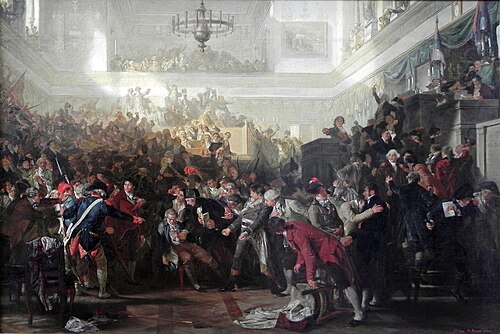 The Fall of Robespierre in the Convention on 27 July 1794
_%E2%80%93_Destailleur_Paris_tome_6,_1292_%E2%80%93_Gallica_2013_(adjusted).jpg/500px-Tuileries,_fa%C3%A7ade_regardant_la_cour_du_Carrousel_(dessin)_%E2%80%93_Destailleur_Paris_tome_6,_1292_%E2%80%93_Gallica_2013_(adjusted).jpg)

9 Thermidor


At noon, Saint-Just entered the Convention and prepared to place blame on Billaud, Collot d'Herbois, and Carnot.[460][461] After a few minutes, Tallien – having a double reason for desiring Robespierre's end, as, on the evening before, Robespierre refused to release Theresa Cabarrus – interrupted him and began the attack. LeBas attempted to speak in defence of the triumvirs (Robespierre, Saint-Just, and Couthon); he was not allowed to do so, and Billaud continued. "Yesterday, the president of the revolutionary tribunal [Dumas] openly proposed to the Jacobins that they should drive all impure men from the Convention."[x]
According to Tallien, "Robespierre wanted to attack us by turns, to isolate us, and finally he would be left one day only with the base and abandoned and debauched men who serve him". Almost thirty-five deputies spoke against Robespierre that day, most of them from the Mountain.[463] As the accusations began to pile up, Saint-Just remained silent. Robespierre rushed toward the rostrum, appealed to the Plain to defend him against the Montagnards, but his voice was shouted down. Robespierre rushed to the benches of the Left but someone cried: "Get away from here; Condorcet used to sit here". He soon found himself at a loss for words after Vadier gave a mocking impression of him referring to the discovery of a letter under the mattress of the illiterate Catherine Théot.[y]
When Robespierre, very upset, was unable to speak, Garnier shouted, "The blood of Danton chokes him!"[467] Robespierre then regained his voice: "Is it Danton you regret? [...] Cowards! Why didn't you defend him?"[468] At some time Louis Louchet called for Robespierre's arrest; Augustin Robespierre demanded to share his fate. The whole Convention agreed, including Couthon, and Saint-Just. Le Bas decided to join Saint-Just. Robespierre shouted that the revolution was lost when he descended the tribune. The five deputies were taken to the Committee of General Security and questioned.
Not long after, Hanriot was ordered to appear in the Convention; he or someone else suggested to show up only accompanied by a crowd. On horseback, Hanriot warned the sections that there would be an attempt to murder Robespierre, and mobilised 2,400 National Guards in front of the town hall.[469][470][471] What had happened was not very clear to their officers; either the Convention was closed down or the Paris Commune.[472] Around six o'clock, the city council summoned an immediate meeting to consider the dangers threatening the fatherland.[473] It gave orders to close the gates and to ring the tocsin. For the Convention, that was an illegal action without the permission of the two committees. It was decreed that anyone leading an "armed force" against the Convention would be regarded as an outlaw. The city council was in league with the Jacobins to bring off an insurrection, asking them to send over reinforcements from the galleries, "even the women who are regulars there".[214]
Arrest

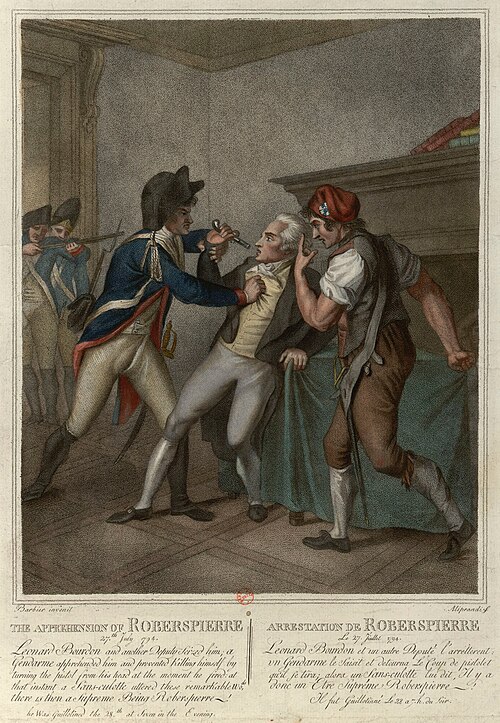


In the early evening, the five deputies were taken in a cab to different prisons; Robespierre to the Palais du Luxembourg, Couthon to "La Bourbe" and Saint-Just to the "Écossais". Augustin Robespierre was taken from Prison Saint-Lazare to La Force Prison,[474] like Le Bas, who was refused at the Conciergerie.[475][476][104] Around 8 p.m., Hanriot appeared at the Place du Carrousel in front of the Convention with forty armed men on horses,[477] but was taken prisoner. After 9 p.m., the vice-president of the Tribunal Coffinhal went to the Committee of General Security with 3,000 men and their artillery.[478] As Robespierre and his allies had been taken to a prison in the meantime, he succeeded only in freeing Hanriot and his adjutants.[479][480]
How the five deputies escaped from prison was disputed. According to Le Moniteur Universel, the jailers refused to follow the order of arrest, taken by the Convention.[459] According to Courtois[475] and Fouquier-Tinville, the police administration was responsible for any in custody or release.[481] Around 8 p.m., Robespierre was taken to the police administration on Île de la Cité, but refused to go to the Hôtel de Ville and insisted on being received in a prison.[482] He hesitated for legal reasons for possibly two hours. At around 10 p.m., the mayor sent a second delegation to go and convince Robespierre to join the Commune movement.[483] Robespierre was taken to the Hôtel de Ville.[484][485] The Convention declared the five deputies (plus the supporting members) to be outlaws. It then appointed Barras and ordered troops totaling 4,000 men to be called out.[486]
After a whole evening spent waiting in vain for action by the Commune, losing time in fruitless deliberation without supplies or instructions, the armed sections began to disperse. Around 400 men seem to have stayed on the Place de Grève, according to Courtois.[487][488] At around 2 a.m., Barras and Bourdon, accompanied by several members of the Convention, arrived in two columns. Barras deliberately advanced slowly, in the hope of avoiding conflict by a display of force.[488][486] Then Grenadiers burst into the Hôtel de Ville, followed by Léonard Bourdon and the Gendarmes.[489] Fifty-one insurgents were gathering on the first floor.[490] Robespierre and his allies withdrew to the smaller secrétariat.[491]
There are many stories about what happened next, but it seems in order to avoid capture, Augustin Robespierre took off his shoes and jumped from a broad cornice. He landed on some bayonets and a citizen, resulting in a pelvic fracture, several serious head contusions, and an alarming state of "weakness and anxiety".[492][493] LeBas handed a pistol to Robespierre, then killed himself with another pistol.[494] According to Barras and Courtois, Robespierre wounded himself when he tried to commit suicide[495][496][497] by pointing the pistol at his mouth, but the gendarme Méda prevented him from killing himself successfully.[498][499] Couthon was found lying at the bottom of a staircase. Saint-Just gave himself up without a word.[500] According to Méda, Hanriot tried to escape by a concealed staircase.[501] Most sources say that Hanriot was thrown out of a window by Coffinhal after being accused of the disaster. (According to Ernest Hamel, it is one of the many legends spread by Barère.[502]) Whatever the case, Hanriot landed in a small courtyard on a heap of glass.[472] He had strength enough to crawl into a drain where he was found twelve hours later and taken to the Conciergerie.[472] Coffinhal, who had successfully escaped, was arrested seven days later.[503][504]
Execution
Robespierre spent the remainder of the night at the antechamber of the Committee of General Security.[505] He lay on the table, his head on a pine box, his shirt stained with blood. By 5 a.m., his brother and Couthon were transported to the nearest hospital, Hôtel-Dieu de Paris.[506][507][508] However, Barras prohibited Robespierre from being taken there.[509] At ten in the morning, a military doctor was summoned and extracted some of his teeth and fragments of his broken jaw. Subsequently, Robespierre was confined to a cell in the Conciergerie.[472]
On 10 Thermidor, the Revolutionary Tribunal assembled around noon.[472] By 2 p.m., Robespierre and twenty-one "Robespierrists" faced accusations of counter-revolution and were sentenced to death under the provisions of the law of 22 Prairial, although without even a cursory hearing. At approximately 6 p.m., the condemned were conveyed in three carts to the Place de la Révolution for execution, alongside Nicolas Francois Vivier, the final president of the Jacobins, and Antoine Simon, the cobbler who served as the jailer of the Dauphin. A furious mob, hurling curses, accompanied the grim procession.
Robespierre was the tenth to ascend the platform.[472] During the preparation for his execution, the executioner Charles-Henri Sanson, dislodged the bandage securing his shattered jaw, eliciting an anguished scream until his demise.[510] Following his beheading, the crowd erupted in applause and jubilant cries, which reportedly endured for fifteen minutes.[511][512] Robespierre and his associates were interred in a mass grave at the newly established Errancis Cemetery.[z] Between 1844 and 1859 (likely in 1848), the remains of all those buried there were transferred to the Catacombs of Paris.[513]
-
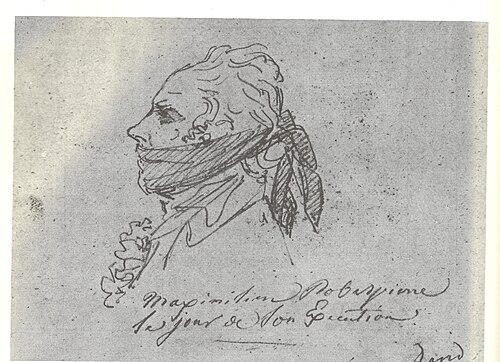 Robespierre on the day of his execution; Sketch attributed to Jacques Louis David
 -
![The execution of Couthon; the body of Adrien Nicolas Gobeau, ex-substitute of the public accuser Fouquier and member of the Commune, the first who suffered, is shown lying on the ground;[472] Robespierre (#10) is shown holding a handkerchief to his mouth. Hanriot (#9) is covering his eye, which came out of its socket when he was arrested.](https://img-server.japedia.wiki/wikipedia/commons/thumb/6/64/Execution_de_Robespierre_full.jpg/500px-Execution_de_Robespierre_full.jpg) The execution of Couthon; the body of Adrien Nicolas Gobeau, ex-substitute of the public accuser Fouquier and member of the Commune, the first who suffered, is shown lying on the ground;[472] Robespierre (#10) is shown holding a handkerchief to his mouth. Hanriot (#9) is covering his eye, which came out of its socket when he was arrested.
The execution of Couthon; the body of Adrien Nicolas Gobeau, ex-substitute of the public accuser Fouquier and member of the Commune, the first who suffered, is shown lying on the ground;[472] Robespierre (#10) is shown holding a handkerchief to his mouth. Hanriot (#9) is covering his eye, which came out of its socket when he was arrested.
Legacy and memory
Robespierre is best known for his role as a member of the Committee of Public Safety.[aa] He exerted his influence to suppress the republican Girondins to the right, the radical Hébertists to the left and the indulgent Dantonists in the centre. Though nominally all members of the committee were equally responsible, the Thermidorians held Robespierre as the most culpable for the bloodshed. For Carnot: "this monster was above all a hypocrite; it is because he knew how to seduce the people".[515] On Thuriot's proposal, the Revolutionary Tribunal was suspended and replaced by a temporary commission.[365] On 1 August, the Law of 22 Prairial was abolished. Fouquier-Tinville was arrested and not long after, solicitors were reintroduced in the courtroom. On 5 August, the Law of Suspects was disbanded;[516] the Convention decided to release all the prisoners against whom weighed no charge.
In mid-August, Courtois was appointed by the Convention to collect evidence against Robespierre, Le Bas and Saint-Just, whose report has a poor reputation, selecting and destroying papers.[517] At the end of the month, Tallien stated that all that the country had just been through was the "Terror" and that the "monster" Robespierre, the "king" of the Revolution, was the orchestrator. According to Charles Barbaroux, who visited him early August 1792, his pretty boudoir was full of images of himself in every form and art; a painting, a drawing, a bust, a relief and six physionotraces on the tables.[518] The eyewitness Helen Maria Williams attributed all the grim events to his hypocrisy and cunning. She described him as the great conspirator against the liberty of France.[519] For Samuel Coleridge, one of the authors of The Fall of Robespierre, he was worse than Oliver Cromwell.[520] For Madame de Staël: "Robespierre acquired the reputation of high democratic virtue and so was believed to be incapable of personal views. As soon as he was suspected of having them, his power was at an end."[62] Vanity was Robespierre's ruling passion according to Sir Walter Scott.[521]
In fact, a whole new political mythology was being created.[522] On 23 Thermidor, Coleridge started to write the first act of The Fall of Robespierre. Vilate, who exaggerated the numbers, raged against keeping 300,000 people in prison and trying to execute two or three hundred people every day.[523] To preach the ideals of '93 after Thermidor was to expose oneself to suspicions of Robespierrism, suspicions which had to be avoided above all others. Two contrasting legends around Robespierre developed: a critical one that held Robespierre as an irresponsible, self-serving figure whose ambitions generated widespread calamity, and a supportive one that held him as an early friend of the proletariat, about to embark on economic revolution when he fell.[524]
Robespierre's reputation has experienced several cycles of re-appraisal.[525] His name peaked in the press in the middle of the 19th century, between 1880 and 1910 and in 1940.[526] Buchez, a democratic mystic, was producing volumes in which the Incorruptible rose up as the Messiah and sacrificial being of the Revolution.[527] For Jules Michelet, he was the "priest Robespierre" and for Alphonse Aulard Maximilien was a "bigot monomaniac" and "mystic assassin".[528] For Mary Duclaux he was the "apostle of Unity" and Saint-Just a prophet.
Robespierre did not thunder like Danton or scream like Marat. But his clear, shrill voice enunciated calmly syllables that the ears of his listeners retained forever. And it is owned that, in this as in other things, Robespierre had a strange provision of the future; as a thinker at least, as a seer, he made few mistakes.[243]
His reputation peaked in the 1920s, during the Third French Republic, when the influential French historian Albert Mathiez rejected the common view of Robespierre as demagogic, dictatorial, and fanatical. Mathiez argued he was an eloquent spokesman for the poor and oppressed, an enemy of royalist intrigues, a vigilant adversary of dishonest and corrupt politicians, a guardian of the First French Republic, an intrepid leader of the French Revolutionary government, and a prophet of a socially responsible state.[529] Lenin referred to Robespierre as a "Bolshevik avant la lettre" (before the term was coined) and erected the Robespierre Monument to him in 1918.[530][531] In the Soviet Union, he was used as an example of a revolutionary figure.[532][533] However the Marxist approach that portrayed Robespierre as a hero has largely faded away.[534]
In 1941 Marc Bloch, a French historian, sighed disillusioned (a year before he decided to join the French Resistance): "Robespierrists, anti-robespierrists ... for pity's sake, just tell us who was Robespierre?"[535] According to R.R. Palmer: the easiest way to justify Robespierre is to represent the other Revolutionists in an unfavourable or disgraceful light. This was the method used by Robespierre himself.[536] Soboul argues that Robespierre and Saint-Just "were too preoccupied in defeating the interest of the bourgeoisie to give their total support to the sans-culottes, and yet too attentive to the needs of the sans-culottes to get support from the middle class".[537] For Peter McPhee, Robespierre's achievements were monumental, but so was the tragedy of his final weeks of indecision.[67] The members of the committee, together with members of the Committee of General Security, were as much responsible for the running of the Terror as Robespierre.[538] They may have exaggerated his role to downplay their own contribution, and used him as a scapegoat after his death.[539][540] J-C. Martin and McPhee interpret the repression of the revolutionary government as a response to anarchy and popular violence, and not as the assertion of a precise ideology.[541] Martin holds Tallien responsible for Robespierre's bad reputation, and that the "Thermidorians" invented the "Terror" as there is no law that proves its introduction.[542]
He is a major figure in the history of France, and a controversial subject, studied by the favorable Jacobin School and the unfavorable neo-liberal school, by "lawyers and prosecutors".[543] François Crouzet collected many interesting details from French historians dealing with Robespierre.[544] In an interview Marcel Gauchet said that Robespierre confused his private opinion and virtue.[citation needed] The sale at Sotheby's in 2011 of selected manuscripts, including speeches, draft newspaper articles, drafts of reports to be read at the Convention, a fragment of the speech of 8 Thermidor, and a letter on virtue and happiness, kept by the Le Bas family after the death of Robespierre, sparked mobilization among historians and politicians;[545] Pierre Serna published an article entitled: "We must save Robespierre!" in Le Monde,[546] and the Society of Robespierrist Studies launched a call for subscriptions, while the French Communist Party, the Socialist Party and the Radical Party of the Left alerted the French Ministry of Culture.[547]

Many historians neglected Robespierre's attitude towards the French National Guard from July 1789, and as "public accuser", responsible for the officers within the police till April 1792. He then began promoting civilian armament and the creation of a revolutionary army of 23,000 men in his periodical.[176][ab] He defended the right of revolution and promoted a revolutionary armed force.[550] Dubois-Crancé described Robespierre as the general of the Sans-culottes.[551] The revisionist historian Furet thought that Terror was inherent in the ideology of the French Revolution and was not just a violent episode. Equally important is his conclusion that revolutionary violence is connected with extreme voluntarism.[552][9] Furet was especially critical of the "Marxist line" of Albert Soboul.[553]
Indeed, he failed in his opposition to two decisions which resulted in the greatest bloodshed and dissension during the Revolution: the declaration of war on the European monarchies and the dechristianization movement. Regarding the former, Robespierre feared that initiating a war of liberation would consolidate and intensify European opposition to the Revolution and risk a possible defeat. He argued against Brissot that, even if victorious, the invading French troops would be welcomed as liberators. Further, he presciently argued that war would create the groundwork for a military dictatorship, as indeed it ultimately did. Regarding dechristianization, he saw it as a gratuitous affront to the genuine religious needs of the people, especially outside Paris, and would only drive them into the arms of the refractory clergy, which is exactly what happened with disastrous results in the Vendée.[554]
Historians in support of Robespierre have been at pains to try to prove that he was not the dictator of France in the year II.[555] McPhee stated that on several previous occasions, Robespierre had admitted that he was worn out; his personal and tactical judgment, once so acute, seem to have deserted him.
Robespierre fell ill many times: in the spring of 1790, in November 1792 (more than three weeks); in September–October 1793 (two weeks); in February/March 1794 (more than a month);[67] in April/May (about three weeks) and in June/July (more than three weeks). These illnesses not only explain Robespierre's repeated absences from committees and from the Convention during important periods, especially in 1794 when the Great Terror occurred but also the fact that his faculty of judgment deteriorated – as did his moods.[541]
The assassination attempts made him suspicious to the point of obsession.[67] There is a long line of historians "who blame Robespierre for all the less attractive episodes of the Revolution."[556] Robespierre was not part of the celebrations of the bicentenary of the revolution. Jonathan Israel is sharply critical of Robespierre for repudiating the true values of the radical Enlightenment. He argues, "Jacobin ideology and culture under Robespierre was an obsessive Rousseauiste moral Puritanism steeped in authoritarianism, anti-intellectualism, and xenophobia, and it repudiated free expression, basic human rights, and democracy."[557][558] He refers to the Girondin deputies Thomas Paine, Condorcet, Daunou, Cloots, Destutt and Abbé Gregoire denouncing Robespierre's ruthlessness, hypocrisy, dishonesty, lust for power, and intellectual mediocrity.[559] According to Jeremy Popkin, he was undone by his obsession with the vision of an ideal republic.[560] Zhu Xueqin became famous for his 1994 book titled The Demise of the Republic of Virtue: From Rousseau to Robespierre. This work has attracted countless readers and is still being read in China today.[561] For Aldous Huxley, "Robespierre achieved the most superficial kind of revolution, the political."[562] Georges Lefebvre believed Robespierre to be a "staunch defender of democracy, a determined opponent of foreign war, saviour of the Republic and man of integrity and vision. Robespierre remains as controversial as ever, two centuries after his death."[563][564]
Portrayals
Over 300 actors have portrayed Robespierre, in both French and English. Prominent examples include:[565][566][567][568][569]
- Sidney Herbert in Orphans of the Storm (1921)
- Werner Krauss in Danton (1921)
- Edmond Van Daële in Napoléon (1927)
- George Hackathorne in Captain of the Guard (1930)
- Ernest Milton in The Scarlet Pimpernel (1934)
- Henry Oscar in The Return of the Scarlet Pimpernel (1937)
- Leonard Penn in Marie Antoinette (1938)
- Richard Basehart in Reign of Terror (1949)
- Keith Anderson in the Doctor Who episode, The Reign of Terror (1964)
- Peter Gilmore as a character referred to only as "Citizen Robespierre" in Don't Lose Your Head, a Carry On spoof of The Scarlet Pimpernel (1967)
- Christopher Ellison in Lady Oscar (1979)
- Richard Morant in The Scarlet Pimpernel (1982)
- Wojciech Pszoniak in Danton (1983)
- Andrzej Seweryn in La Révolution française (1989)
- Ronan Vibert in The Scarlet Pimpernel (1999–2000)
- Guillaume Aretos in Mr. Peabody & Sherman (2014)
- Nicolas Vaude in The Visitors: Bastille Day (2016)
- Louis Garrel in One Nation, One King (2018)
- Sam Troughton in Napoleon (2023)
Bibliography
- 1785 – Discours couronné par la Société royale des arts et des sciences de Metz, sur les questions suivantes, proposeés pour sujet du prix de l'année 1784
- 1791 – Adresse de Maximilien Robespierre aux Français
- 1792–1793 – Lettres de Maximilien Robespierre, membre de la Convention nationale de France, à ses commettans
- 1794 – Lettre de Robespierre, au général Pichegru. Paris le 3 Thermidor, (21 Juillet) l'an 2 de la République Françoise = Brief van Robespierre, aan den generaal Pichegru. Parys, den 3 Thermidor, (21 July) het 2de jaar der Fransche Republiek
- 1828 – Papiers inédits trouvés chez Robespierre, Saint–Just, Payan ...: supprimés ou omis par Courtois: précédés du Rapport de ce député à la Convention Nationale. Tome premier; Tome second; Tome troisième
- 1830 – Mémoires authentiques de Maximilien de Robespierre, ornés de son portrait, et de facsimile de son écriture extraits de ses mémoirs. Tome premier; Tome deuxième
- 1912–2022 – Œuvres complètes de Maximilien Robespierre, 10 volumes, Société des études robespierristes, 1912–1967. Réimpression Société des études robespierristes, Phénix Éditions, 2000, 10 volumes. Réédition avec une nouvelle introduction de Claude Mazauric, Édition du Centenaire de la Société des études robespierristes, Éditions du Miraval, Enghien-les-Bains, 2007, 10 volumes et 1 volume de Compléments. Un onzième volume, paru en 2007, regroupe les textes omis lors de l'édition initiale.
Notes
- ^ His family has been traced back to the 15th century in Vaudricourt, Pas-de-Calais.[15]
- ^ For some time Marie Marguerite Charlotte de Robespierre was betrothed to Joseph Fouché, but he moved to Nantes where he married in September 1792.[16] Charlotte never married and died aged 74.
- ^ Baptized Henriette Eulalie Françoise de Robespierre, was educated with Charlotte at the couvent des Manarres in Tournai and died in 1780.[17]
- ^ Returning at intervals, living in Mannheim around 1770, he was buried on 6 November 1777 in the Salvatorkirche in Munich.
- ^ De Montesquieu praised the virtues of the citizen-soldier in his "Reflections on the Grandeur and Decline of the Romans" (1734).[27] In 1762 Rousseau published The Social Contract and Emile, or On Education which were both burned and banned. At the end of the Seven Years' War Mably published his "Conversations with Phocion" in Amsterdam (1763). He wished (for Classical Athens but it looks like Sparta): May our republic be a military one; may each citizen be designed to defend his fatherland; may he be exercised each day how to handle his weapons; may he learn in the town the discipline that is necessary for the camp. By such a policy you would not only educate invincible soldiers but you would give another new force to law and to civic virtues.[28][29] Rousseau and Gabriel Bonnot de Mably were both invited to submit suggestions for the reformation of Poland's unique "Golden Liberty", leading to Rousseau's Considerations on the Government of Poland (1772). In the same year Guibert defined the citizen-in-arms as virtuous by his attachment to the community (in contrast to the mercenary).
- ^ According to apocryphal Mémoires authentiques he was elected as president of the Arras Academy early 1789.[38]
- ^ The Third Estate had as many deputies as the other two orders together (in the ratio 4:4:8) on the instigation of Jacques Necker.
- ^ The first use of the motto "Liberté, égalité, et fraternité" was in Robespierre's speech "On the organisation of the National Guard" on 5 December 1790, article XVI,[77] and disseminated widely throughout France by Camille Desmoulin in his journal "Les révolutions de France et de Brabant" among the associated Societies.
- ^ They shared the general view that the "new" France would not survive repeated physical intimidation from the Paris sections, unrestrained polemics from the clubs and the press and, most important of all, the democratization of discipline in the army and navy.[91]
- ^ The public accuser may not give the first impulse to justice. These are the police officers who are responsible for receiving complaints and bringing them to the jury indictment; it is only after the jury has spoken, that begins the ministry of the accuser public.[94] The public accuser will supervise all the police officers of the department; in case of negligence on their part, he will warn them; in case of a more serious offence, he will refer them to the criminal court, which, according to the nature of the offence, will pronounce the correctional punishment determined by the law.[95]
- ^ In September 1792, his younger sister and brother joined him and lived in the front house, but within a few weeks Charlotte insisted on moving to 5 Rue Saint-Florentin because of his increased prestige and her tensions with Madame Duplay.[65]
- ^ A law restricting the rights of popular societies to undertake concerted political action passed on 29 September 1791 and by the virtue of obeying this law the moderate Feuillants embraced obsolescence. By ignoring it, the radical Jacobins emerged as the most vital political force of the French Revolution.[citation needed]
- ^ On 16 November 1791 Pétion de Villeneuve was elected mayor of Paris in a contest against Lafayette.
- ^ Under pressure from the Assembly, the king accepted several Girondin ministers into his cabinet. The French had to deal with serious inflation and Étienne Clavière was appointed as minister of finance. According to Louvet it was only due to a smear campaign by Robespierre and his followers that he was not also appointed.[130]
- ^ The selling of all sorts of positions, military or otherwise, was rampant in the courts of the Ancien Régime and so the officer corps' mass exodus from France naturally coincided with that of the aristocrats. Not all aristocrats were officers, but all officers were aristocrats.[145]
- ^ On 27 August Robespierre was elected as president of his section and explained in a letter to Le Moniteur Universel two motives. "I could not be the judge of those of which I was the adversary; but I had to remember that if they were the enemies of the fatherland, they had also declared themselves mine. This maxim, good in all circumstances, is especially applicable to this one: the justice of the people must bear a character worthy of it; it must be imposing as well as prompt and terrible.
The exercise of these new functions was incompatible with that of representative of the Commune which had been entrusted to me; it was necessary to choose; I remained at the post where I was, convinced that it was there that I should currently serve the fatherland."[178] - ^ The average age of the 24 deputies from Paris was 43. Robespierre was 34, Danton 33 and Marat 49.
- ^ On 5 February 1791 Robespierre declared: "True religion consists in punishing for the happiness of all those who disturb society."[212]
- ^ Perhaps seven?[245] On 24 April 1793, the right of association, right to work and public assistance, right to public education, right of rebellion (and duty to rebel when the government violates the right of the people), and the abolition of slavery were all written into the Declaration of the Rights of Man and Citizen of 1793.[246]
- ^ All children would be taken away from their parents and placed in a boarding school from the age of five, until the age of eleven for girls for girls, twelve for boys, and subjected to work. "The boys will be trained in addition to the handling of weapons."[276]
- ^ Four articles by Robespierre affirm the unity of the human race, universal male suffrage, the need for solidarity between the peoples, and the rejection of kings.[282]
- ^ On 16 March Robespierre was sharply critical of Amar's report, which presented the scandal around Fabre and Chabot as purely a matter of fraud. Robespierre insisted that it was a foreign plot, demanded that the report be re-written, and used the scandal as the basis for rhetorical attacks on William Pitt the Younger whom he believed was involved.[344]
- ^ On 27 March on the proposal of Barère the armée revolutionnaire, for seven months active in Paris and surroundings, was disbanded, except their artillery.[349][350][351][352] Their infantry and cavalry seem to be merged with other regiments.
- ^ Tallien went on: One wanted to destroy, to butcher the Convention, and this intention was so real, that one had organised an espionage of the representatives of the people which one wanted to butcher. It is villainous to speak of justice and virtue, when one defies them and when one only becomes enthused when one is stopped or vexed. Next Robespierre rushed to the tribune.[462]
- ^ On 9 Thermidor Vadier used a letter—supposedly found under the mattress of Théot—as an opportunity to attack Robespierre and his beliefs.[464] This letter announced to him that his mission had been prophesied in Ezekiel, that the re-establishment of religion, freed of priests, was owing to him.[465] Vadier becoming increasingly trivial was stopped by Tallien.[466]
- ^ (in French) Landrucimetieres.fr. A plaque indicating the former site of this cemetery is located at 97 rue de Monceau, Paris.
- ^ He signed 542 arrests, especially in the spring and summer of 1794. Most of the arrests came from Bertrand Barère, Lazare Carnot and Pierre Louis Prieur.[514]
- ^ In those days an issue as the 2nd United States Congress enacted Militia Acts of 1792 for the organization of state militias and the conscription of every "free able-bodied white male citizen" between the ages of 18 and 45.
References
- ^ Moore 2007, pp. 24, 53, 217.
- ^ "Maximilien Robespierre | Biography, French Revolution, Reign of Terror, Facts, & Death | Britannica". 2 May 2023. Archived from the original on 28 November 2016. Retrieved 19 September 2017.
- ^ Bosc, Yannick (March 2013). "Robespierre libéral". Annales historiques de la Révolution française (371): 95–114. doi:10.4000/ahrf.12688. ISSN 0003-4436.
- ^ O'Brien, James Bronterre (1837). The Life and Character of Maximilian Robespierre. Proving ... thaourt that Much Calumniated Person was One of the Greatest Men ... pp. 415–421. Archived from the original on 30 December 2023. Retrieved 15 August 2019.
- ^ a b "Maximilien Robespierre". Encyclopædia Britannica. 2 May 2023. Archived from the original on 28 November 2016. Retrieved 19 September 2017.
- ^ a b Jordan 2013.
- ^ Doyle, William. The Oxford History of the French Revolution. Oxford University Press.
- ^ Serna 2005, p. 370.
- ^ a b Mylonas, Nikos A., Is revolutionary violence justified? A re-examination of the Robespierre case, archived from the original on 7 April 2023, retrieved 21 January 2021
- ^ "Maximilien Robespierre, Master of the Terror by Scott McLetchie". Archived from the original on 5 December 2017. Retrieved 20 August 2019.
- ^ Gauchet, Marcel (2023). Robespierre – The man who divides us the most. Princeton University Press. ISBN 978-0-691-23495-3. Archived from the original on 18 November 2022. Retrieved 18 November 2022.
- ^ Mathiez 1927, pp. 63, 70.
- ^ Martin 2006, p. 224.
- ^ Peter McPhee, "The Robespierre Problem: An Introduction," H-France Salon, Vol 7 no, 14, 2015, page 9. online Archived 24 July 2020 at the Wayback Machine
- ^ Lavoine, A. (1914). "La famille de Robespierre et ses origines. Documents inédits sur le séjour des Robespierre à Vaudricourt, Béthune, Harnes, Hénin-Liétard, Carvin et Arras. (1452–1790)". Revue du Nord. 5 (18): 101–148. doi:10.3406/rnord.1914.1244.
- ^ "Joseph Fouché – Histoire de l'Europe". www.histoireeurope.fr. Archived from the original on 24 May 2023. Retrieved 24 May 2023.
- ^ McPhee 2012, p. 21.
- ^ Lavoine, A. (1914) La famille de Robespierre et ses origines. Documents inédits sur le séjour des Robespierre à Vaudricourt, Béthune, Harnes, Hénin-Liétard, Carvin et Arras. (1452–1790). In: Revue du Nord, tome 5, n° 18, May 1914. p. 135
- ^ McDonald, James Damian (1 January 2007). L' Immortalité de l'âme dans la conception religieuse de Maximilien Robespierre [The Immortality of the soul in Maximilien Robespierre's religious thought] (doctoral thesis) (in French). Strasbourg 2. p. 16. OCLC 494639395. Archived from the original on 16 August 2019. Retrieved 16 August 2019.
- ^ Robespierre – Architect of Terror Documentary, 27 March 2020, retrieved 16 January 2024
- ^ Scurr 2006, p. 20.
- ^ Carr 1972, p. 10.
- ^ Hippler, Thomas (2008) Citizens, soldiers and National Armies, pp. 28–45
- ^ Jenkins 2011.
- ^ Israel, Jonathan I. (2019). The Enlightenment that Failed: Ideas, Revolution, and Democratic Defeat, 1748–1830. Oxford University Press. ISBN 978-0-19-105824-0. Archived from the original on 23 April 2023. Retrieved 22 February 2023.
- ^ Sonenscher, M. (2008) Sans-Culottes, an eighteenth-century emblem in the French Revolution, p. 231
- ^ Brown, Kevin A., The Reemergence of the Citizen-Soldier in Modern Military Theory, archived from the original on 7 April 2023, retrieved 14 February 2020 – via academia.edu
- ^ Hippler, Thomas (2007). Citizens, Soldiers and National Armies: Military Service in France and Germany, 1789–1830. Routledge. ISBN 978-1134130023. Archived from the original on 23 April 2023. Retrieved 12 March 2023.
- ^ "Phocion's Conversations: or, the relation between morality and politics. Originally translated by Abbé Mably, from a Greek manuscript of Nicocles, with notes by W. Macbean". 12 March 1769. Archived from the original on 7 April 2023. Retrieved 12 March 2023.
- ^ O'Brien, James Bronterre (1837). The Life and Character of Maximilian Robespierre. Proving ... that that Much Calumniated Person was One of the Greatest Men ... p. 122. Archived from the original on 7 November 2023. Retrieved 15 August 2019.
- ^ Jordan, David P. (1989). The Revolutionary Career of Maximilien Robespierre. University of Chicago Press. pp. 32–33. ISBN 978-0-226-41037-1 – via Internet Archive.
- ^ Mazlish, Bruce (2017). The Revolutionary Ascetic: Evolution of a Political Type. Routledge. p. 86. ISBN 978-1-351-47515-0. Archived from the original on 18 March 2023. Retrieved 16 October 2022.
- ^ Scurr 2006, pp. 22, 35.
- ^ Drival, Eugène Van (1872). Histoire de l'Académie d'Arras depuis sa fondation: en 1737, jusqu'à nos jours. Typ. de A. Courtin. p. 58.
- ^ a b Leuwers, Hervé. Robespierre (Paris, Fayard, 2014; rééd. Pluriel, 2016) – extraits. p. 9. Archived from the original on 2 June 2022. Retrieved 13 April 2019 – via academia.edu.
- ^ "The Factums of Robespierre the Lawyer. Choices of Defence by Printed Legal Brief by Hervé Leuwers". Archived from the original on 6 March 2019. Retrieved 6 March 2019.
- ^ Drival, Eugène Van (1872). Histoire de l'Académie d'Arras depuis sa fondation: en 1737, jusqu'à nos jours. Typ. de A. Courtin. p. 62.
- ^ Reybaud, Charles; Robespierre, Maximilien de (1830). Mémoires authentiques de Maximilien de Robespierre. Moreau-Rosier. p. 279. Archived from the original on 7 November 2023. Retrieved 16 August 2019.
- ^ "Liste des noms et qualités de messieurs les députés et suppléants à l'Assemblée nationale". Archives Parlementaires de la Révolution Française. 8 (1): 5–34. 1875.
- ^ "'We are winning': Versailles 1789". Robespierre. 2017. pp. 62–77. doi:10.12987/9780300183672-010. ISBN 978-0-300-18367-2.
- ^ "The Project Gutenberg eBook of Life of Napoleon, Volume I., by Sir Walter Scott". Archived from the original on 24 August 2023. Retrieved 24 August 2023.
- ^ Souvenirs de Mirabeau, p. 49.
- ^ Hibbert, C. (1980) The French Revolution, p. 55
- ^ Alpaugh, M. (12 March 2014). "A Self-Defining "Bourgeoisie" in the Early French Revolution: The Milice Bourgeoise, the Bastille Days of 1789, and Their Aftermath". Journal of Social History. 47 (3): 696–720. doi:10.1093/jsh/sht108. Archived from the original on 9 April 2023. Retrieved 26 February 2020 – via academia.edu.
- ^ Rose, R. B.; Rose, Robert Barrie (1983). The Making of the Sans-culottes: Democratic Ideas and Institutions in Paris, 1789–92. Manchester University Press. ISBN 978-0719008795. Archived from the original on 27 April 2023. Retrieved 12 March 2023 – via Google Books.
- ^ Florence Devenne, « La garde Nationale; création et évolution (1789-août 1792) », Annales historiques de la Révolution française. N°283, 1990. p. 50
- ^ Rose, R. B.; Rose, Robert Barrie (12 March 1983). The Making of the Sans-culottes: Democratic Ideas and Institutions in Paris, 1789–92. Manchester University Press. ISBN 978-0719008795. Archived from the original on 7 April 2023. Retrieved 12 March 2023 – via Google Books.
- ^ Robespierre: Erinnerungen, p. 88
- ^ Mémoires authentiques de Maximilien Robespierre: ornés de son portrait et de ... by Maximilien de Robespierre, pp. 20–21
- ^ Robespierre, Maximilien (2016). Maximilien Robespierre – Oeuvres: Classcompilé n° 52 (in French). lci-eBooks. ISBN 978-2-918042-47-1. Archived from the original on 23 April 2023. Retrieved 16 October 2022.
- ^ Moore 2007, p. 38.
- ^ Alpaugh, M. (12 March 2009). "The politics of escalation in French Revolutionary protest: political demonstrations, non-violence and violence in the grandes journees of 1789". French History. 23 (3): 336–359. doi:10.1093/fh/crp055. Archived from the original on 18 March 2023. Retrieved 25 October 2020 – via academia.edu.
- ^ "Robespierre, "Speech Denouncing the New Conditions of Eligibility," 22 October 1789 – Liberty, Equality, Fraternity". chnm.gmu.edu. 22 October 1789. Archived from the original on 27 February 2017. Retrieved 26 February 2017.
- ^ Fehér, Ferenc (1990). The French Revolution and the Birth of Modernity. University of California Press. pp. 108–109. ISBN 978-0-520-07120-9. Archived from the original on 7 November 2023. Retrieved 15 August 2019 – via Google Books.
- ^ "Robespierre, "Speech Denouncing the New Conditions of Eligibility"". Liberty, Equality, Fraternity. 22 October 1789. Archived from the original on 23 January 2019. Retrieved 16 August 2019.
- ^ "Maximilien Robespierre". ehistory. Ohio State University. 1998. Archived from the original on 4 May 2019. Retrieved 16 August 2019.
- ^ Dumont, Etienne (1832). Souvenirs sur Mirabeau et sur les deux premières assemblées législatives. C. Gosselin. pp. 61–62.
- ^ "Maximilien Robespierre". Serious Science. 28 September 2016. Archived from the original on 25 March 2023. Retrieved 26 March 2023.
- ^ "George Duval (1842) Souvenirs de la terreur de 1788 à 1793, p. 4". 5 January 2024. Archived from the original on 2 December 2023. Retrieved 2 December 2023.
- ^ "The Encyclopædia Britannica: A Dictionary of Arts, Sciences, and General Literature, with New Maps and Original American Articles by Eminent Writers". Werner. 24 May 1895. Archived from the original on 23 April 2023. Retrieved 28 March 2023 – via Google Books.
- ^ McPhee, Peter (1 March 2013). "« Mes forces et ma santé ne peuvent suffire ». crises politiques, crises médicales dans la vie de Maximilien Robespierre, 1790-17941". Annales historiques de la Révolution française (371): 137–152. doi:10.4000/ahrf.12695.
- ^ a b History, Alpha (28 August 2018). "Madame de Staël on Robespierre and the CPS (1798)". Archived from the original on 7 November 2023. Retrieved 26 March 2023.
- ^ "Le club des Jacobins de Paris | Histoire et analyse d'images et oeuvres". Archived from the original on 4 August 2020. Retrieved 4 August 2020.
- ^ La Maison de Robespierre, rue de Saintonge, à Paris by Georges Michon. In: Annales historiques de la Révolution française (Jan.–Feb. 1924), pp. 64–66
- ^ a b "Charlotte Robespierre's Memoirs". 24 March 2007. Archived from the original on 30 April 2019. Retrieved 2 May 2019.
- ^ "Speech Denouncing the New Conditions of Eligibility". 22 October 1789.
- ^ a b c d e f McPhee, P. (2013). "'My Strength and My Health Are not Great Enough': Political Crises and Medical Crises in the Life of Maximilien Robespierre, 1790–1794". Annales historiques de la Révolution française. 371: 137–152. doi:10.4000/ahrf.12695.
- ^ Aulard, François-Alphonse (1897). La société des Jacobins: Mars à novembre 1794. Recueil de documents pour l'histoire du club des Jacobins de Paris (in French). Vol. 6. Librairie Jouaust. pp. 714, 717. OCLC 763671875. Archived from the original on 7 February 2019. Retrieved 19 February 2019.
- ^ Walter, G. (1961) Robespierre à la tribune, p. 206. In: Robespierre, vol. II. L'œuvre, part IV. Gallimard.
- ^ Thouret, Jacques Guillaume (1883). "Adresse de la commune et de la garde nationale d'Arras, lors de la séance du 11 mai 1790 au soir". Archives Parlementaires de la Révolution Française. 15 (1): 488–490.
- ^ William J. Murray (1986) The right-wing press in the French Revolution 1789–792 Royal Historical Society Studies in History 44, p. 107
- ^ Smith, John Stores (1848). Mirabeau: A Life-history, in Four Books. Lea and Blanchard. p. 336. Archived from the original on 30 December 2023. Retrieved 25 July 2019.
- ^ a b Poirot, Thibaut (14 May 2013). "Robespierre and War, a Question Posed as Early as 1789? by Thibaut Poirot". Annales historiques de la Révolution française. 371 (1): 115–135. doi:10.4000/ahrf.12690. Archived from the original on 26 July 2019. Retrieved 26 July 2019.
- ^ Scurr 2006, p. 227.
- ^ "Œuvres complètes de Maximilien de Robespierre, tome 6, p. 642". Archived from the original on 25 February 2021. Retrieved 29 September 2019.
- ^ The Strange History of the Right to Bear Arms in the French Revolution by Noah Shusterman, p. 9
- ^ Robespierre, Maximilien; Buisson, François (12 March 1790). "Discours sur l'organisation des Gardes nationales /". A Paris: Chez Buisson, libraire, rue Hautefeuille, no. 20 – via Internet Archive.
- ^ Dann, Otto (1988). Nationalism in the Age of the French Revolution. Bloomsbury Publishing. ISBN 978-1441151711. Archived from the original on 23 April 2023. Retrieved 12 March 2023 – via Google Books.
- ^ Gross, Jean-Pierre (1997). Fair Shares for All: Jacobin Egalitarianism in Practice. Cambridge University Press. p. 46. ISBN 978-0521526500. Archived from the original on 8 April 2023. Retrieved 24 October 2022.
- ^ Walter, G. (1961) Robespierre à la tribune, p. 220, 223. In: Robespierre, vol. II. L'œuvre, part IV. Gallimard.
- ^ "Nos offres d'Abonnement". RetroNews – Le site de presse de la BnF. Archived from the original on 8 March 2023. Retrieved 12 March 2023.
- ^ O'Brien, James Bronterre (12 March 1837). "The Life and Character of Maximilian Robespierre. Proving ... that that Much Calumniated Person was One of the Greatest Men, and One of the Purest ... Reformers that Ever Existed ... Also Containing Robespierre's Principal Discourses, Addresses, &c., with the Author's Reflections on the Principal Events and Leading Men of the French Revolution, Etc". Archived from the original on 23 April 2023. Retrieved 12 March 2023 – via Google Books.
- ^ Walter, G. (1961) Robespierre à la tribune, pp. 234, 235. In: Robespierre, vol. II. L'œuvre, part IV. Gallimard.
- ^ a b Kappelsberger, Florian (1922). "Albert Mathiez: "Robespierre" – Lecture given at the Printania room, under the auspices of Ustica, on 23 February 1922". Bulletin Communiste. Archived from the original on 2 June 2022. Retrieved 3 June 2019 – via www.academia.edu.
- ^ a b Poirot, Thibaut (14 May 2013). "Robespierre and War, a Question Posed as Early as 1789? by Thibaut Poirot". Annales historiques de la Révolution française. 371 (1): 115–135. doi:10.4000/ahrf.12690. Archived from the original on 26 July 2019. Retrieved 26 July 2019.
- ^ a b Edelstein, Melvin (2016). The French Revolution and the Birth of Electoral Democracy. Routledge. p. 48. ISBN 978-1-317-03127-7. Archived from the original on 7 November 2023. Retrieved 15 August 2019.
- ^ "Diginole: FSU's Digital Repository | DigiNole". diginole.lib.fsu.edu. Archived from the original on 14 March 2023. Retrieved 12 March 2023.
- ^ O'Brien, James Bronterre (1837). The Life and Character of Maximilian Robespierre. Proving ... that Much Calumniated Person was One of the Greatest Men ... pp. 439–446. Archived from the original on 7 November 2023. Retrieved 15 August 2019.
- ^ Linton 2013, pp. 97–99.
- ^ N. Hampson (1978) Danton, p. 44
- ^ Schama 1989, p. 575.
- ^ Linton, Marisa. "The Choices of Maximilien Robespierre". H-France Salon. Archived from the original on 7 April 2023. Retrieved 18 August 2019 – via www.academia.edu.
- ^ Doyle, William (2002). The Oxford History of the French Revolution. OUP Oxford. ISBN 978-0-19-160829-2. Archived from the original on 8 April 2023. Retrieved 12 March 2023 – via Google Books.
- ^ "02. Un discours d'installation au tribunal criminel de Paris | Criminocorpus". Archived from the original on 19 December 2021. Retrieved 19 December 2021.
- ^ Journal des États généraux convoqués par Louis XVI, 28 septembre 1791
- ^ Charavay, Étienne (1890). Assemblée électorale de Paris, 18 novembre 1790–15 juin 1791 (in French). D. Jouaust. pp. XLVI–XLV. OCLC 763860103. Archived from the original on 13 April 2019. Retrieved 16 August 2019.
- ^ L'Ami du peuple, ou le Publiciste parisien, 7 mai 1791
- ^ Robespierre, Maximilien (12 March 1830). "Mémoires authentiques de Maximilien de Robespierre: ornés de son portrait, et de fac-similé de son écriture extraits de ses Mémoires". Paris: Moreau-Rosier – via Internet Archive.
- ^ Cordeliers and Girondins: the prehistory of the republic Archived 8 April 2023 at the Wayback Machine by fr:Patrice Gueniffey. In: The Invention of the Modern Republic by Biancamaria Fontana, pp. 91–92
- ^ Walter, G. (1961) Le vaincu du neuf Thermidor, p. 36. In: Robespierre. L'œuvre, vol. II, part III. Gallimard.
- ^ Discours de Danton, p. 152
- ^ Israel 2014, p. 206.
- ^ "Rodama: a blog of 18th century & Revolutionary French trivia: Robespierre chez Duplay – No. 366 rue Saint-Honoré". 22 September 2017. Archived from the original on 30 April 2019. Retrieved 30 April 2019.
- ^ a b "Élisabeth Le Bas's Memoirs (Part III)". 13 January 2008. Archived from the original on 30 April 2019. Retrieved 30 April 2019.
- ^ Moore 2007, p. 88.
- ^ Thompson 1988, p. 174.
- ^ Bart, Jean (1 June 2015). "Hervé Leuwers, Robespierre. Paris, Fayard, 2014". Annales historiques de la Révolution française (in French) (380): 183–186. doi:10.4000/ahrf.13531. ISSN 0003-4436. Archived from the original on 24 March 2019. Retrieved 16 August 2019.
- ^ "Mémoires de Charlotte Robespierre sur ses deux frères, pp. 90–91" (PDF). Archived from the original on 25 September 2019. Retrieved 25 September 2019.
- ^ Robespierre 2006.
- ^ Hampson 1974, p. 87.
- ^ J.M. Thompson (1929) Leaders of the French Revolution, p. 192
- ^ Leuwers, Hervé. "Defence in writing. The end of the printed legal brief (France, 1788–1792) ?". Archived from the original on 7 April 2023. Retrieved 3 December 2021 – via www.academia.edu.
- ^ "Modification au préambule et à l'article ler du décret sur les sociétés populaires, lors de la séance du 30 septembre 1791". Archives Parlementaires de la Révolution Française. 31 (1): 670. 1888.
- ^ "Constitution de 1791 | Conseil constitutionnel". Archived from the original on 22 March 2023. Retrieved 22 March 2023.
- ^ Robespierre, Maximilien (1885). "Discours non prononcé de M. Robespierre sur la garde nationale, en annexe de la séance du 5 décembre 1790". Archives Parlementaires de la Révolution Française. 21 (1): 238–250.
- ^ Cabet, Étienne (12 March 1845). "1790–1792". Au Bureau du Populaire. Archived from the original on 7 April 2023. Retrieved 12 March 2023 – via Google Books.
- ^ Robespierre, Maximilien (1819). Recueil des œuvrès de Max. J. Robespierre, et de pièces pour servir à son histoire. Recueillis, 1819. pp. 26–28. Archived from the original on 19 December 2022. Retrieved 4 December 2023.
- ^ Kjærgård, Jonas Ross (6 August 2018). Reimagining Society in 18th Century French Literature: Happiness and Human ... by Jonas Ross Kjærgård. Routledge. ISBN 978-0-429-87810-7. Archived from the original on 4 December 2023. Retrieved 4 December 2023.
- ^ "Wikisource: Discours sur l'organisation des Gardes Nationales". Archived from the original on 4 December 2023. Retrieved 4 December 2023.
- ^ "Les collections – Château de Versailles". collections.chateauversailles.fr. Archived from the original on 20 December 2016. Retrieved 10 March 2020.
- ^ Hampson 1974, p. 99.
- ^ Haydon & Doyle 2006, p. 130, in "Robespierre, the war and its organization" by Forrest, A.
- ^ Moore 2007, p. 117.
- ^ Bell 2007, p. 118.
- ^ Haydon & Doyle 2006, in "Robespierre, the war and its organization" by Forrest, A.
- ^ Robespierre, Maximilien (1819). Recueil des œuvrès de Max. J. Robespierre, et de pièces pour servir à son histoire. Recueillis, 1819. p. 35. Archived from the original on 7 November 2023. Retrieved 15 August 2019.
- ^ Hampson 1974, p. 103.
- ^ Cobb, R. (1987) The People's Armies, p. 22. Yale University Press
- ^ Robespierre, Maximilien (1819). Recueil des œuvrès de Max. J. Robespierre, et de pièces pour servir à son histoire. Recueillis, 1819. p. 45. Archived from the original on 7 November 2023. Retrieved 15 August 2019.
- ^ "Arnold Heumakers Een homme de lettres in de Franse Revolutie: de 'Mémoires' van Jean-Baptiste Louvet de Couvray (1760–1797), Maatstaf. Jaargang 36". DBNL. Archived from the original on 2 October 2020. Retrieved 22 September 2020.
- ^ https://archive.org/details/installationduco00pari Municipalité de Paris. Installation du Conseil général de la commune, 24 février 1792, p. 5–6.
- ^ "Autour de la justice révolutionnaire". Archived from the original on 4 December 2021. Retrieved 4 December 2021.
- ^ Derasse, Nicolas (2007), "Les défenseurs officieux: une défense sans barreaux" [The "défenseurs officieux": a Defense without the Bar], Annales historiques de la Révolution française (in French), 350 (350): 49–67, doi:10.4000/ahrf.11230, archived from the original on 2 December 2021, retrieved 4 December 2021
- ^ Municipalité de Paris. Installation du Conseil général de la commune, 24 février 1792
- ^ Hampson 1974, pp. 180–181.
- ^ V. Aulard (1892) Jacobins, III, p. 526
- ^ Linton 2013, pp. 119–120.
- ^ Linton 2013, p. 108.
- ^ Hervé Leuwers (2014) Robespierre, p. 211
- ^ Gough, Hugh (2016). The Newspaper Press in the French Revolution. Taylor & Francis. p. 87. ISBN 978-1-317-21491-5. Archived from the original on 30 December 2023. Retrieved 15 August 2019.
- ^ Scurr 2006, p. 291.
- ^ Lang, Timothy (2018). "Rousseau and the Paradox of the Nation-State". History Open Access Publications. 2: 10, 14, 24. Archived from the original on 10 February 2019. Retrieved 9 February 2019.
- ^ Soboul 2005, in "Défenseur de la Constitution" by Mazauric, C..
- ^ I. Davidson, p. 86
- ^ "'Friends, Fellows, Citizens. and Soldiers': The Evolution of the French Revolutionary Army, 1792–1799 by William Scupham" (PDF). Archived from the original (PDF) on 12 July 2019. Retrieved 2 May 2019.
- ^ Robespierre, Maximilien de (12 March 1792). "Le Défenseur de la Constitution / par Maximilien Robespierre, député à l'assemblée constituante". Gallica. Archived from the original on 24 September 2021. Retrieved 23 September 2021.
- ^ Haydon & Doyle 2006, pp. 133–136, in "Robespierre, the war and its organization" by Forrest, A..
- ^ Snyder, Claire R. (1999). Citizen-Soldiers and Manly Warriors: Military Service and Gender in the Civic Republican Tradition. Rowman & Littlefield Publishers. pp. 46, 55. ISBN 978-0-7425-7353-6. Archived from the original on 7 November 2023. Retrieved 15 August 2019.
- ^ Everdell, William R. (15 April 2000). The End of Kings: A History of Republics and Republicans. University of Chicago Press. ISBN 978-0-226-22482-4.
- ^ Haydon & Doyle 2006, p. 162, in "Robespierre and the Terror" by Hampson, N.
- ^ Pfeiffer 1913, p. 221.
- ^ J-C. Clement (2016) Robespierre, p. ?
- ^ Thompson 1988, p. 233.
- ^ Laurent 1939, pp. 165–166, in Volume IV.
- ^ Schama 1989, p. 252.
- ^ Salvemini, Gaetano (2018). The French Revolution, 1788–1792. Borodino Books. p. 504. ISBN 978-1-78912-072-1. Archived from the original on 2 December 2023. Retrieved 15 August 2019.
- ^ Fremont-Barnes, Gregory (2007). Encyclopedia of the Age of Political Revolutions and New Ideologies, 1760–1815. Vol. A–L. Greenwood Publishing Group. p. 572. ISBN 978-0-313-33446-7. Archived from the original on 2 December 2023. Retrieved 15 August 2019.
- ^ Le Logographe, 27 juillet 1792; 1 aôut 1792; Gazette nationale ou le Moniteur universel, 2 août 1792
- ^ Davidson, Ian (2016). The French Revolution: From Enlightenment to Tyranny. Profile Books. p. viii. ISBN 978-1-84765-936-1. Archived from the original on 30 December 2023. Retrieved 27 September 2019.
- ^ N. Hampson (1988) Prelude to Terror. The Constituent Assembly and the Failure of Consensus, 1789–1791, pp. 113–114
- ^ Cross, E. (2011). "The Myth of the Foreign Enemy? The Brunswick Manifesto and the Radicalization of the French Revolution". French History. 25 (2): 188–213. doi:10.1093/fh/crr030. ISSN 0269-1191. Archived from the original on 9 April 2023. Retrieved 2 February 2020.
- ^ Dupre, Huntley (1940). Lazare Carnot, republican patriot. Foundation studies in culture, vol. 1. The Mississippi valley press. Archived from the original on 12 March 2023. Retrieved 12 March 2023 – via HathiTrust.
- ^ Le Logographe, 1 aôut 1792; Gazette nationale ou le Moniteur universel, 2 août 1792
- ^ "Collection Complète des Lois, Décrets, Ordonnances, Réglements, et Avis du Conseil-d'État". A. Guyot. 12 March 1824. Archived from the original on 23 April 2023. Retrieved 12 March 2023 – via Google Books.
- ^ Miller, Melanie Randolph (2011). Envoy to the Terror: Gouverneur Morris and the French Revolution. Potomac Books, Inc. p. 373. ISBN 978-1-61234-277-1. Archived from the original on 7 November 2023. Retrieved 15 August 2019.
- ^ Jordan, David P. (1989). The Revolutionary Career of Maximilien Robespierre. University of Chicago Press. pp. 109–110. ISBN 978-0-226-41037-1.
- ^ Hampson 1974, p. 114.
- ^ Max Gallo (2007) Robespierre, p. 169
- ^ R. Cobb, p. 150
- ^ Soboul 2005, p. 363, in "Dix Aout" by Monnier, R.
- ^ N. Hampson (1978) Danton, p. 74
- ^ Mathiez, Albert (1934). Le dix août (1931). Hachette. pp. couv.1–couv.4. Archived from the original on 4 April 2023. Retrieved 12 March 2023.
- ^ Hampson 1974, p. 120.
- ^ I. Davidson, p. 109
- ^ Jordan, David P. (1989). The Revolutionary Career of Maximilien Robespierre. University of Chicago Press. pp. 112–113. ISBN 978-0-226-41037-1.
- ^ a b Robespierre, Maximilien de (12 March 1792). "Le Défenseur de la Constitution / par Maximilien Robespierre, député à l'assemblée constituante". Gallica. Archived from the original on 24 September 2021. Retrieved 24 September 2021.
- ^ Hazan, Eric (2014). A People's History of the French Revolution.
- ^ "Gazette nationale ou le Moniteur universel". 28 August 1792. Archived from the original on 7 April 2023. Retrieved 26 June 2022 – via www.retronews.fr.
- ^ "Wikisource". Archived from the original on 21 June 2022. Retrieved 21 June 2022.
- ^ "Histoire parlementaire de la Révolution française: ou Journal des assemblées nationales, depuis 1789 jusqu'en 1815". Paulin. 12 March 1835. Archived from the original on 7 April 2023. Retrieved 12 March 2023 – via Google Books.
- ^ Le Moniteur universel, t. XIII, n° 241, du 28 aôut, p. 540
- ^ Jean Massin (1959) Robespierre,
- ^ S. Schama, p. 626
- ^ "Collection Complète des Lois, Décrets, Ordonnances, Réglements, et Avis du Conseil-d'État". A. Guyot. 5 July 1824. Archived from the original on 7 November 2023. Retrieved 7 October 2021.
- ^ Mary Duclaux (1918) A short history of France, p. 227
- ^ Israel 2014, p. 266.
- ^ Israel 2014, p. 268.
- ^ Hardman, John (1999). Robespierre. Longman. pp. 56–57. ISBN 978-0-582-43755-5. Archived from the original on 7 November 2023. Retrieved 15 August 2019.
- ^ Hampson 1974, p. 126.
- ^ "Danton (2 septembre 1792) – Histoire – Grands discours parlementaires – Assemblée nationale". www2.assemblee-nationale.fr. Archived from the original on 12 March 2023. Retrieved 12 March 2023.
- ^ Israel 2014, p. 632–633.
- ^ "He Roared" Archived 22 May 2019 at the Wayback Machine, Hillary Mantel in London Review of Books.
- ^ Charavay, Étienne (1905). Assemblée électorale de Piemel Paris 2 septembre 1792–17 frimaire an II (in French). D. Jouaust. p. xvi. OCLC 764234804. Archived from the original on 27 March 2020. Retrieved 16 August 2019.
- ^ Israel 2014, p. 272.
- ^ Assemblée électorale de Paris 17 frimaire an II (2 September 1792) (12 March 1905). Assemblée électorale de Paris 2 septembre 1792–17 frimaire an II: procès-verbaux de l'élection des députés à la Convention, du procureur général syndic et des administrateurs du département, des présidents, juges, juges suppléants et greffiers du Tribunal criminel... / publiés... par Étienne Charavay,... [et P. Mautouchet]. Archived from the original on 27 March 2020. Retrieved 27 March 2020 – via gallica.bnf.fr.
- ^ Davidson, Ian (2016). The French Revolution: From Enlightenment to Tyranny. Profile Books. ISBN 978-1847659361. Archived from the original on 7 April 2023. Retrieved 12 March 2023 – via Google Books.
- ^ Linton, Marisa (2015) 'Come and dine': the dangers of conspicuous consumption in French revolutionary politics, 1789–95. European History Quarterly, 45(4), pp. 615–637. ISSN (print) 0265-6914
- ^ "Mémoires de Charlotte Robespierre sur ses deux frères, p. 76" (PDF). Archived from the original on 25 September 2019. Retrieved 25 September 2019.
- ^ Oliver, Bette W. (2016). Jacques Pierre Brissot in America and France, 1788–1793: In Search of Better Worlds. Rowman & Littlefield. ISBN 978-1498535342. Archived from the original on 23 April 2023. Retrieved 12 March 2023 – via Google Books.
- ^ Cobban, Alfred (1946). "The Political Ideas of Maximilien Robespierre during the Period of the Convention". The English Historical Review. 61 (239): 45–80. doi:10.1093/ehr/LXI.CCXXXIX.45. JSTOR 554837.
- ^ J.F. Bernard (1973) Talleyrand: a biography, p. 106
- ^ Robespierre, Maximilien; Laponneraye, Albert; Carrel, Armand (1840). Oeuvres. Worms. p. 98. Archived from the original on 7 November 2023. Retrieved 15 August 2019.
- ^ Dart, Gregory (2005). Rousseau, Robespierre and English Romanticism. Cambridge University Press. pp. 43–46. ISBN 978-0-521-02039-8. Archived from the original on 7 November 2023. Retrieved 15 August 2019 – via Google Books.
- ^ Charavay, Étienne (1905). Assemblée électorale de Paris 2 septembre 1792–17 frimaire an II (in French). D. Jouaust. p. xxiv. OCLC 764234804. Archived from the original on 27 March 2020. Retrieved 16 August 2019.
- ^ Couvray, Jean Baptiste Louvet de (12 March 1792). "A Maximilien Robespierre et à ses royalistes (accusation)". p. 33. Archived from the original on 8 April 2023. Retrieved 12 March 2023 – via Google Books.
- ^ Robespierre 1958, pp. 83–84, in Tome IX, Discours.
- ^ Robespierre 1958, pp. 88–89, in Tome IX, Discours.
- ^ Bouloiseau, Marc (1983). The Jacobin Republic 1792–1794. Cambridge University Press. ISBN 978-0-521-28918-4. Archived from the original on 30 December 2023. Retrieved 6 September 2021.
- ^ Moore, John (12 March 1820). "The Works: With Memoirs of His Life and Writings by Robert Anderson". Stirling & Slade. Archived from the original on 23 April 2023. Retrieved 12 March 2023 – via Google Books.
- ^ Israel, Jonathan I. (2019). The Enlightenment that Failed: Ideas, Revolution, and Democratic Defeat, 1748–1830. Oxford University Press. ISBN 978-0-19-105824-0. Archived from the original on 23 April 2023. Retrieved 22 February 2023 – via Google Books.
- ^ Shusterman, Noah (2013). The French Revolution: Faith, Desire and Politics. Routledge. ISBN 978-1134455935. Archived from the original on 7 April 2023. Retrieved 12 March 2023 – via Google Books.
- ^ Walter, G. (1961) Robespierre à la tribune, p. 225. In: Robespierre, vol. II. L'œuvre, part IV. Gallimard.
- ^ Moore, John; Anderson, Robert (1820). A journal during a residence in France ... 1792. Stirling & Slade. p. 473. Archived from the original on 30 December 2023. Retrieved 15 August 2019.
- ^ a b Shusterman, N. C. (2014). "All of His Power Lies in the Distaff: Robespierre, Women and the French Revolution". Past & Present (223): 129–160. doi:10.1093/pastj/gtu001. Archived from the original on 20 October 2021. Retrieved 11 July 2019 – via www.academia.edu.
- ^ L. Moore, p. 165
- ^ Kennedy 1988, pp. 308–10.
- ^ Soboul 2005, p. 42, in "Armoir de Fer" by Grendron, F..
- ^ Perry, Sampson (12 March 1796). "An Historical Sketch of the French Revolution: Commencing with Its Predisposing Causes, and Carried on to the Acceptation of the Constitution, in 1795". H. D. Symonds. Archived from the original on 18 May 2023. Retrieved 12 March 2023 – via Google Books.
- ^ "Pierre, Louis Manuel – Base de données des députés français depuis 1789 – Assemblée nationale". Archived from the original on 5 December 2021. Retrieved 7 December 2021.
- ^ P. McPhee (2016) Liberty or Death, p. 172
- ^ a b L. Moore, p. 172
- ^ Howe, Patricia Chastain (2008). "Endgame, March–December 1793". Foreign Policy and the French Revolution. pp. 171–186. doi:10.1057/9780230616882_11. ISBN 978-1-349-37213-3.
- ^ Hampson 1974, p. 140.
- ^ Hampson 1974, p. 168.
- ^ P.C. Howe, p. 160
- ^ P.C. Howe, p. 164, 166
- ^ Dinwiddy, J. R. (1992). Radicalism and Reform in Britain, 1780–1850. A&C Black. ISBN 978-0-8264-3453-1. Archived from the original on 30 December 2023. Retrieved 17 November 2020 – via Google Books.
- ^ "P.C. Howe (1982) Foreign Policy and the French Revolution, p. 175–176". Archived (PDF) from the original on 7 June 2023. Retrieved 2 September 2019.
- ^ Long, George (12 March 1850). "France and its revolutions: a pictorial history 1789–1848". London: Charles Knight – via Internet Archive.
- ^ P.C. Howe, p. 167
- ^ Walter, G. (1961) Robespierre à la tribune, p. 280–281. In: L'œuvre, vol. II, part IV. Gallimard.
- ^ a b c Robespierre, Maximilien (12 March 1793). "Oeuvres de Maximilien Robespierre". E. Leroux. Archived from the original on 23 April 2023. Retrieved 12 March 2023 – via Google Books.
- ^ "P.C. Howe (1982) Foreign Policy and the French Revolution, p. 179–180". Archived (PDF) from the original on 7 June 2023. Retrieved 2 September 2019.
- ^ "Munsey's People Search: Page 1". Archived from the original on 28 January 2023. Retrieved 15 September 2023.
- ^ Davidson, I, p. 155–156.
- ^ a b Kennedy, Michael (2000). The Jacobin Clubs in the French Revolution, 1793–1795. Berghahn Books. p. 17. ISBN 978-1-78920-576-3. Archived from the original on 30 December 2023. Retrieved 15 August 2019.
- ^ I. Davidson, p. 157
- ^ Hampson 1974, pp. 144–146.
- ^ Wikisource: Œuvres complètes de Maximilien Robespierre. Speech of Robespierre against Brissot and the girondins Delivered to the Convention on 10 April 1793 Discours contre Brissot & les girondins Archived 26 January 2023 at the Wayback Machine
- ^ a b c Hazan, E. (2014) A People's History of the French Revolution. ISBN 978-1781685891
- ^ Robespierre 1958, pp. 358, 383, in Tome IX, Discours.
- ^ N. Hampson (1978) Danton, p. 118
- ^ a b Robinson, Agnes (2018). French History from Caesar to Waterloo. Endymion Press. ISBN 978-1531295387. Archived from the original on 8 April 2023. Retrieved 12 March 2023 – via Google Books.
- ^ Walter, G. (1961) Le vaincu du neuf Thermidor, p. 51–52, 63. In: L'œuvre, vol. II, part III. Gallimard.
- ^ Sonenscher, M. (2006) Property, community, and citizenship. In: M. Goldie & R. Wokler (Authors), The Cambridge History of Eighteenth-Century Political Thought (The Cambridge History of Political Thought, pp. 465–494). Cambridge: Cambridge University Press. doi:10.1017/CHOL9780521374224.018
- ^ a b "Maximilien Robespierre". Serious Science. Archived from the original on 25 February 2019. Retrieved 25 February 2019.
- ^ Gross, Jean-Pierre (2003). Fair Shares for All: Jacobin Egalitarianism in Practice. Cambridge University Press. ISBN 978-0521526500. Archived from the original on 23 April 2023. Retrieved 12 March 2023 – via Google Books.
- ^ Thermomètre du jour 2 mai 1793
- ^ Blanc, Jean Joseph Louis (12 March 1868). "Histoire de la Révolution française". Libr. du Figaro. Archived from the original on 23 April 2023. Retrieved 12 March 2023 – via Google Books.
- ^ Davidson, Ian, p. 159.
- ^ Robespierre 1958, pp. 490, 492, 514–515, 517, 543, in Tome IX, Discours.
- ^ Barère de Vieuzac, Bertrand; Carnot, H. (Hippolyte); David d'Angers, Pierre-Jean (12 March 1842). "Mémoires de B. Barère, membre de la Constituante, de la Convention, du Comite de salut public, et de la Chambre des représentants". Paris: J. Labitte – via Internet Archive.
- ^ Ternaux, Mortimer (1869). Histoire de la terreur, 1792–1794. Vol. 7. Michel Lévy frères. p. 266. Archived from the original on 30 December 2023. Retrieved 15 August 2019.
- ^ Israel 2014, p. 442.
- ^ a b Schama 1989, p. 722.
- ^ Ternaux, Mortimer (1869). Histoire de la terreur, 1792–1794. Vol. 7. Michel Lévy frères. p. 276. Archived from the original on 30 December 2023. Retrieved 15 August 2019.
- ^ Gazette nationale ou le Moniteur universel, 30 mai 1793, p. 3
- ^ Ellery, Eloise (12 March 1915). "Brissot de Warville: A Study in the History of the French Revolution ..." New York. Archived from the original on 8 April 2023. Retrieved 12 March 2023 – via Google Books.
- ^ Alison, Archibald (1848). History of Europe from the Commencement of the French Revolution ... W. Blackwood and sons. pp. 288–291. Archived from the original on 30 December 2023. Retrieved 15 August 2019.
- ^ Davidson, Ian, p. 160
- ^ Gazette nationale ou le Moniteur universel, 4 juin 1793, p. 1/4
- ^ Soboul 1974, p. 309.
- ^ Davidson, Ian, p. 161
- ^ Roger Dupuy (2010) La Garde nationale 1789–1872. Paris, Gallimard, ISBN 978-2-07-034716-2
- ^ Gazette nationale ou le Moniteur universel, 5 juin 1793
- ^ Popkin, Jeremy D. (2016). A Short History of the French Revolution. Routledge. pp. 66–67. ISBN 978-1-315-50892-4. Archived from the original on 30 December 2023. Retrieved 15 August 2019.
- ^ Le Républicain français, 14 septembre 1793, p. 2
- ^ de LaBédollière, Emile (1848). Histoire de la Garde nationale: récit complet de tous les faits qui l'ont distinguée depuis son origine jusqu'en 1848 (in French). H. Dumineray et F. Pallier. OCLC 944662819. Archived from the original on 24 February 2021. Retrieved 16 August 2019.
- ^ Israel 2014, p. 447.
- ^ Walter, G. (1961) Robespierre à la tribune, p. 288
- ^ C.L.R. James (1938) The Black Jacobins: Toussaint L'Ouverture, p. 138
- ^ Hampson 1974, p. 150.
- ^ Thompson, J. M. (2017). Robespierre. Vol. 2. Borodino Books. p. 428. ISBN 978-1-78720-518-5. Archived from the original on 7 November 2023. Retrieved 15 August 2019.
- ^ McPhee 2012, p. 130.
- ^ a b Baczko, Bronislaw (1994). Ending the Terror: The French Revolution After Robespierre. Cambridge University Press. p. 208. ISBN 978-0-521-44105-6. Archived from the original on 7 November 2023. Retrieved 15 August 2019.
- ^ "Morgane Guinard (2016) La Parabole du Savoir Interdit Athéisme et liberté de pensée en France au 18e siècle, p. 164" (PDF). Archived (PDF) from the original on 16 February 2023. Retrieved 16 February 2023.
- ^ Oeuvres de Robespierre, X, p. 595
- ^ Rudé 1975.
- ^ Andress, David (2004). The French Revolution and the People. A&C Black. ISBN 978-1-85285-295-5. Archived from the original on 2 December 2023. Retrieved 7 January 2022 – via Google Books.
- ^ "P.C. Howe (1982) Foreign Policy and the French Revolution, p. 172". Archived (PDF) from the original on 7 June 2023. Retrieved 2 September 2019.
- ^ Matta Duvignau, Raphael (2012). "Le Comité de salut public (6 avril 1793 – 4 brumaire an IV)". La Révolution Française (3). doi:10.4000/lrf.773.
- ^ "Aux origines d'une mémoire républicaine de Robespierre, Hervé Leuwers". PCF.fr. Archived from the original on 27 March 2019. Retrieved 7 February 2019.
- ^ Albert Soboul (1974) The French Revolution, 1787–1799: From the Storming of the Bastille to Napoleon
- ^ Hanson, Paul R. (2009). Contesting the French Revolution. John Wiley & Sons. ISBN 978-1405160834. Archived from the original on 7 April 2023. Retrieved 12 March 2023 – via Google Books.
- ^ "Maximilien, François, Marie, Isidore, Joseph de Robespierre – Base de données des députés français depuis 1789 – Assemblée nationale". www2.assemblee-nationale.fr. Archived from the original on 12 March 2023. Retrieved 12 March 2023.
- ^ Jordan, David P. (1989). The Revolutionary Career of Maximilien Robespierre. University of Chicago Press. pp. 156. ISBN 978-0-226-41037-1 – via Internet Archive.
- ^ "Augustin, Bon, Joseph de Robespierre – Base de données des députés français depuis 1789 – Assemblée nationale". www2.assemblee-nationale.fr. Archived from the original on 25 February 2021. Retrieved 9 September 2019.
- ^ Tackett, Timothy (2015). The Coming of the Terror in the French Revolution. Harvard University Press. p. 299. ISBN 978-0-674-73655-9. Archived from the original on 7 November 2023. Retrieved 15 August 2019 – via Google Books.
- ^ Cuvilliers, Vincent; Fontaine, Matthieu; Moulis, Philippe (September 2015). "Présider les séances de la Convention nationale". Annales historiques de la Révolution française (381): 129–153. doi:10.4000/ahrf.13625.
- ^ Richard T. Bienvenu (1968) The Ninth of Thermidor, p. 22; R.R. Palmer (1970) The Twelve who ruled, p. 47–51
- ^ Sargent, Thomas J.; Velde, François R. (1995). "Macroeconomic Features of the French Revolution". Journal of Political Economy. 103 (3): 474–518. doi:10.1086/261992. JSTOR 2138696. S2CID 153904650.
- ^ Walter, G. (1961) Robespierre à la tribune, p. 300
- ^ Histoire de la Revolution Française, Volume 8 by Jules Michelet, p. 60
- ^ Davidson, Ian, p. 188
- ^ Cobb, R. (1987) The People's Armies, p. 48, 52
- ^ "Les Actes du Gouvernement Révolutionnaire, p. XI" (PDF). Archived (PDF) from the original on 19 July 2021. Retrieved 9 October 2020.
- ^ Journal des débats et des décrets 3 octobre 1793
- ^ Feuille du salut public 4 octobre 1793, p. 2
- ^ Histoire de la Revolution Française, Volume 8 by Jules Michelet, pp. 33–34, 53
- ^ Feuille du salut public 4 octobre 1793, p.
- ^ "Georges Danton | French revolutionary leader". Encyclopædia Britannica. April 2023. Archived from the original on 15 June 2015. Retrieved 4 July 2019.
- ^ Hodges, Donald Clark (2003). Deep Republicanism: Prelude to Professionalism. Lexington Books. p. 94. ISBN 978-0-7391-0553-5 – via Internet Archive.
- ^ The Jacobin dictatorship Britannica.com
- ^ Kennedy, M. L. "The Jacobin Clubs in the French Revolution: 1793–1795," p. 53. Berghahn Books, New York: 2000.
- ^ Hampson 1974, p. 166.
- ^ Vilate, Joachim (1794). Causes secrètes de la Révolution du 9 au 10 thermidor (in French). pp. 12–13. OCLC 764013318. Archived from the original on 27 March 2019. Retrieved 16 August 2019.
- ^ Schama 1989, p. 799.
- ^ The French Revolution: Faith, Desire and Politics. Routledge. 2013. p. 197. ISBN 978-1-134-45593-5. Archived from the original on 7 November 2023. Retrieved 15 August 2019 – via Google Books.
- ^ LAST LETTER OF MARIE-ANTOINETTE Centre historique des Archives nationale
- ^ Chevrier, M.-R.; Alexandre, J.; Laux, Christian; Godechot, Jacques; Ducoudray, Emile (1983). "Glânes Et Documents: Sur Le Diplomate " Batave " J. Blauw". Annales historiques de la Révolution française. 55 (254): 624–635. JSTOR 41915129.
- ^ Moore 2007, p. 246.
- ^ Richard T. Bienvenu (1968) The Ninth of Thermidor, p. 23
- ^ Sanson Memoirs Vol. II p. 70
- ^ Hampson, N. (1 January 1976). "François Chabot and His Plot". Transactions of the Royal Historical Society. 26: 3. doi:10.2307/3679069. JSTOR 3679069. S2CID 263046437.
- ^ Hampson 1974, p. 203, 208–209.
- ^ Doyle, William (2002). The Oxford History of the French Revolution. Oxford University Press. p. 283. ISBN 978-0-19-925298-5.
- ^ Schama 1989, pp. 652, 656.
- ^ a b "Gazette nationale ou le Moniteur universel – Year available1793 – Gallica". gallica.bnf.fr. Archived from the original on 3 August 2020. Retrieved 15 February 2020.
- ^ Alpaugh, Micah (12 March 2015). Non-Violence and the French Revolution: Political Demonstrations in Paris, 1787–1795. Cambridge University Press. ISBN 978-1107082793. Archived from the original on 23 April 2023. Retrieved 12 March 2023 – via Google Books.
- ^ Funck, F.; Danton, G.J.; Châlier, M.J. (1843). 1793: Beitrag zur geheimen Geschichte der französischen Revolution, mit besonderer Berücksichtigung Danton's und Challier's, zugleich als Berichtigung der in den Werken von Thiers und Mignet enthaltenen Schilderungen (in German). F. Bassermann. p. 52. Archived from the original on 7 November 2023. Retrieved 16 August 2019.
- ^ a b Davidson, Ian. The French Revolution: From Enlightenment to Tyranny, p. 211
- ^ The Jacobin Clubs in the French Revolution, 1793-1795 by Michael L. Kennedy, p. 270
- ^ Soboul Albert (1980) Anacharsis Cloots, l’Orateur du genre humain. In: Annales historiques de la Révolution française, n° 239, p. 50.
- ^ Hampson 1974, p. 217.
- ^ Scurr 2006, p. 298.
- ^ Gilchrist, John Thomas (12 March 1971). "Press in the French Revolution". Ardent Media. Archived from the original on 7 April 2023. Retrieved 12 March 2023 – via Google Books.
- ^ "Maximilien Robespierre". Encyclopædia Britannica. 2 May 2023. Archived from the original on 28 November 2016. Retrieved 19 September 2017.
- ^ Construire une nouvelle catégorie politique: Robespierre et la théorie du gouvernement révolutionnaire par Hervé Leuwers, p. 12
- ^ Speeches of Maximilien Robespierre: "Report on the Principles of a Revolutionary Government", December 25, 1793.
- ^ G. Rudé (1967) Robespierre, p. 58–67
- ^ "Rousseau, Robespierre, and the French Revolution by James Read, p. 4" (PDF).
- ^ Popkin, Jeremy D. (2016). A Short History of the French Revolution. Routledge. p. 72. ISBN 978-1-315-50892-4.
- ^ R.R. Palmer, p. 264
- ^ Hodges, Donald Clark (2003). Deep Republicanism: Prelude to Professionalism. Lexington Books. pp. 91–92. ISBN 978-0739105535 – via Google Books.
- ^ Maximilien Robespierre. "On the Principles of Political Morality, February 1794". Fordham University: Modern History Sourcebook.
- ^ Dunn 2000, p. 118.
- ^ "Rousseau, Robespierre, and the French Revolution by James Read, p. 3" (PDF).
- ^ Rude, George (ed.), Robespierre, (Englewood Cliffs: Prentice-Hall, 1967), p. 136.
- ^ Hampson 1974, p. 82.
- ^ L. Jacob (1960) Hébert, Le Père Duchesne. Chef des sans-culottes, p. 326.
- ^ Davidson, Ian, p. 215
- ^ a b Moore, Barrington (1998). "Misgivings About Revolution: Robespierre, Carnot, Saint-Just". French Politics and Society. 16 (4): 17–36. JSTOR 42844797.
- ^ Matrat 1975.
- ^ Matrat, J. Robespierre Angus & Robertson 1971 p. 242
- ^ Hardman, John (1999). Robespierre. Longman. p. 135. ISBN 978-0-582-43755-5.
- ^ Scurr 2006.
- ^ Dunoyer, Alphonse (12 March 1913). "The public prosecutor of the terror, Antoine Quentin Fouquier-Tinville; tr. from the French of Alphonse Dunoyer by A. W. Evans. With a photogravure frontispiece and fourteen other illustrations". New York, G. P. Putnam's sons – via Internet Archive.
- ^ "Side-by Side Comparison of Passages from The Morning Chronicle (18 August) and Gazette Nationale ou Le Moniteur Universel (29 Ju". romantic-circles.org. 1 March 2008. Archived from the original on 4 July 2022. Retrieved 11 September 2019.
- ^ Le Moniteur Universel 28 March 1793
- ^ "Collection complète des lois, décrets d'intérêe général, traités internationaux, arrêtés, circulaires, instructions, etc". Société du Recueil Sirey. 12 March 1825 – via Google Books.
- ^ Cobb, R. (1987) The People's Armies, p. 601, 607, 611, 617
- ^ Rapport, Michael (2000). Nationality and Citizenship in Revolutionary France: The Treatment of Foreigners. Oxford University Press. p. 203. ISBN 978-0-19-154323-4.
- ^ N. Hampson (1878) Danton, p. 160–161
- ^ Schama 1989, pp. 816–817.
- ^ Thiers, Adolphe (12 March 1845). "History of the French Revolution". Vickers – via Google Books.
- ^ Annual Register, Band 36. Published by Edmund Burke, p. 118.
- ^ Linton 2013, p. 226.
- ^ a b Le Siècle, 5 février 1898, p. 5/6
- ^ Bouloiseau, Marc (1983). The Jacobin Republic 1792–1794. Cambridge University Press. ISBN 978-0521289184 – via Google Books.
- ^ W. Doyle (1990) The Oxford History of the French Revolution, pp. 272–74.
- ^ Manuel général de l'instruction primaire, 1 janvier 1911
- ^ N. Hampson (1878) Danton, p. 72–73, 163
- ^ a b "Maximilien Robespierre's False Friends by Peter McPhee" (PDF).
- ^ Jean-Joseph Gaume (1856) La Révolution, recherches historiques, Quatrième partie, Paris, Gaume frères, pp. 136–37
- ^ a b c d Hazan, E. (2014) A People's History of the French Revolution.
- ^ "Le Moniteur Universel" 13 April 1794.
- ^ McPhee, Peter (1 March 2013). "« Mes forces et ma santé ne peuvent suffire ». crises politiques, crises médicales dans la vie de Maximilien Robespierre, 1790-17941". Annales historiques de la Révolution française (371): 137–152. doi:10.4000/ahrf.12695.
- ^ a b A. Jourdan (2018) Le tribunal révolutionnaire. DOI: 10.3917/perri.boula.2018.01.0269
- ^ Thompson, J.M. Robespierre p. 505 Basil Blackwell 1988
- ^ Œuvres complètes de J. Michelet, p. 289
- ^ “The Law of 22 Prairial Year II (10 June 1794),” LIBERTY, EQUALITY, FRATERNITY: EXPLORING THE FRENCH REVOLUTION, accessed 21 June 2022, https://revolution.chnm.org/d/439.
- ^ Derasse, Nicolas (2012). "Words and Liberty: Hopes for Legal Defence During the French Revolution". Quaderni Storici. 47 (141 (3)): 745–770. JSTOR 43780153.
- ^ Gazette nationale ou le Moniteur universel, 11 juin 1794, p. 4
- ^ "Maximilien Robespierre, Master of the Terror". people.loyno.edu. Archived from the original on 5 December 2017. Retrieved 20 August 2019.
- ^ Geschichte Der Französischen Revolution von Jules Michelet, p. 119
- ^ Israel 2014, p. 570.
- ^ Furet & Ozouf 1989, p. 143.
- ^ "Le Tribunal révolutionnaire". 25 January 2023.
- ^ Piquet, Jean-Daniel (2001). "Robespierre et la liberté des noirs en l'an II d'après les archives des comités et les papiers de la commission Courtois". Annales historiques de la Révolution française (323). Journals.openedition.org: 69–91. doi:10.4000/ahrf.1822. Retrieved 10 August 2022.
- ^ BÉNOT, Yves. Robespierre, les colonies et l'esclavage. In: Robespierre. De la Nation artésienne à la République et aux Nations [Online]. Lille: Publications de l'Institut de recherches historiques du Septentrion, 1994 http://books.openedition.org/irhis/1329. ISBN 978-2905637932.
- ^ Jean-Clément Martin (2016) Robespierre, la fabrication d’un monstre, p. 115
- ^ a b H. Leuwers (2014) Robespierre, p. 178–179
- ^ a b Lamrani, Salim (30 April 2021). "Toussaint Louverture, In the Name of Dignity. A Look at the Trajectory of the Precursor of Independence of Haiti". Études caribéennes (48). doi:10.4000/etudescaribeennes.22675.
- ^ Koekkoek, René (2020). "Saint-Domingue, Rights, and Empire". The Citizenship Experiment. pp. 57–77. doi:10.1163/9789004416451_004. ISBN 978-90-04-22570-1.
- ^ Fülöp-Miller, Rene (2013). Leaders, Dreamers And Rebels – An Account Of The Great Mass-Movements Of History And Of The Wish-Dreams That Inspired Them. Read Books Ltd. ISBN 978-1-4733-8369-2.
- ^ a b McPhee 2012, pp. 86–87.
- ^ a b Doyle, William (2002). The Oxford History of the French Revolution. Oxford University Press. ISBN 978-0-19-925298-5.
- ^ I. Davidson, p. 81
- ^ "The Haitian Revolution Timeline".
- ^ René Koekkoek (2020). "The Civilizational Limits of Citizenship". The Citizenship Experiment. Brill. pp. 78–104. doi:10.1163/9789004416451_005. ISBN 978-9004416451.
- ^ "Robespierre on Property (24 April 1793)".
- ^ McPhee 2012, pp. 173–74.
- ^ Robespierre 1967, pp. 51–7
- ^ "La Révolution Française abolit l'esclavage. – l'ARBR- les Amis de Robespierre".
- ^ McPhee 2012, p. 113.
- ^ "Saint George et la Société des Amis des Noirs – Le Chevalier de Saint-George". Chevaliersaintgeorge.fr. November 2000. Retrieved 10 August 2022.
- ^ Popkin 2010, pp. 350.
- ^ Piquet, Jean-Daniel (2002). L'émancipation des noirs dans la révolution française: 1789–1795. Karthala Editions. ISBN 978-2845861619 – via Google Books.
- ^ Popkin 2010, pp. 366.
- ^ Journal des débats et des décrets, 17 Pluviôse 1794, p. 239
- ^ Popkin 2010, pp. 350–70.
- ^ "The first abolition of slavery in France and its delayed application in Reunion Island". Société de plantation, histoire et mémoires de l’esclavage à La Réunion.
- ^ "La Révolution Française abolit l'esclavage. – L'ARBR- Les Amis de Robespierre". Amis-robespierre.org. Retrieved 10 August 2022.
- ^ Gazette nationale ou le Moniteur universel, 5 février 1794
- ^ Piquet, Jean-Daniel (14 May 2013). "Nouvelles pièces sur Robespierre et les colonies en 1791". Annales historiques de la Révolution française. 371 (1). Cairn.info: 187–194. doi:10.4000/ahrf.12705. Retrieved 10 August 2022.
- ^ "Collection complète des lois, décrets, ordonnances, réglemens, avis du Conseil d'État ..." 12 March 1834 – via Google Books.
- ^ Piquet, Jean-Daniel (1 March 2001). "Robespierre et la liberté des noirs en l'an II d'après les archives des comités et les papiers de la commission Courtois". Annales historiques de la Révolution française (323): 69–91. doi:10.4000/ahrf.1822.
- ^ "Jean-Baptiste Belley et Louis Dufay: souvenir et oubli en l'an III d'une lettre à Maximilien Robespierre, " L'ami du seul peuple de Saint-Domingue… c'est-à-dire les jaunes et les noirs "". tierce.edel.univ-poitiers.fr.
- ^ P. McPhee (2013), p. 199
- ^ Scott, O. (1974) The voice of virtue, p. 107
- ^ Andress 2006, p. 308.
- ^ Robespierre: The Voice of Virtue by Otto Scott
- ^ Madame de Staël (Anne-Louise-Germaine) (1818). Considerations on the Principal Events of the French Revolution. Baldwin, Cradock, and Joy.
- ^ A Peoples' History 1793–1844 from the newspapers. The Bombay Courier, Sat 18 October 1794
- ^ Sanson, Henri (12 March 1876). "Memoirs of the Sansons: From Private Notes and Documents (1688–1847)". Chatto and Windus – via Google Books.
- ^ Naish, Camille (2013). Death Comes to the Maiden: Sex and Execution 1431–1933. Routledge. ISBN 978-1136247620 – via Google Books.
- ^ "The Edinburgh Review". A. and C. Black. 12 March 1809 – via Google Books.
- ^ Walter, G. (1961) Robespierre, p. 113. In: L'œuvre, vol. II, part III. Gallimard.
- ^ a b Macdonald, Simon; Jones, Colin (25 September 2018). "Robespierre, the Duke of York, and Pisistratus During the French Revolutionary Terror". The Historical Journal. 61 (3): 643–672. doi:10.1017/S0018246X17000267.
- ^ Matrat, J. (1971) Robespierre p. 260 Angus & Robertson
- ^ Hardman, John (1999). Robespierre. Longman. p. 146. ISBN 978-0-582-43755-5 – via Google Books.
- ^ Jean Jaurès, "The Law of Prairial and the Great Terror (Fall, year IV)", in Socialist History of the French Revolution (translated by Mitchell Abidor), Marxists.org
- ^ Linton 2013, p. 163.
- ^ Fouché, Joseph (12 March 1892). "Memoirs of Joseph Fouché, duke of Otranto, minister of the General police of France". London, W.W. Gibbings – via Internet Archive.
- ^ Perry, Sampson (12 March 1796). "An Historical Sketch of the French Revolution: Commencing with Its Predisposing Causes, and Carried on to the Acceptation of the Constitution, in 1795". H. D. Symonds – via Google Books.
- ^ Scurr 2006, p. 340.
- ^ "Lazare Carnot, French military engineer". Encyclopædia Britannica. 9 May 2023.
- ^ Memoirs by Joseph Fouché (1824)
- ^ Chronique, Éditions (2015). Petites Chroniques #14: La Révolution française — 1790 à 1794, les années sombres de la Terreur: Petites Chroniques. Éditions Chronique. ISBN 978-2366029529 – via Google Books.
- ^ Hamel, Ernest (12 March 1867). "Histoire de Robespierre: La Montagne. 1867". A. Lacroix, Verboeckhoven & c. – via Google Books.
- ^ Vilate, Joachim (1794). Causes secrètes de la Révolution du 9 au 10 thermidor (in French). p. 39. OCLC 764013318.
- ^ Robespierre by John Hardman
- ^ Robespierre. De la Nation artésienne à la République et aux Nations. Publications de l'Institut de recherches historiques du Septentrion. 2018. pp. 107–108. ISBN 978-2-905637-93-2.
- ^ Mathiez, Albert (1910). "La Politique de Robespierre et le 9 Thermidor Expliqués Par Buonarroti". Annales Révolutionnaires. 3 (4): 481–513. JSTOR 41920292.
- ^ Robespierre, Maximilien (12 March 1794). "Discours prononcé par Robespierre à la Convention nationale, dans la séance du 8 thermidor de l'an 2 de la République une et indivisible; trouvé parmi ses papiers par la commission chargée de les examiner: imprimé par ordre de la Convention nationale". Imprimerie nationale – via Google Books.
- ^ Albert Soboul (1974) The French Revolution, 1787–1799: From the Storming of the Bastille to Napoleon, pp. ?
- ^ Linton 2013.
- ^ H. Leuwers, Robespierre, p. 356
- ^ M. Linton (2006) Robespierre and the Terror, p. 27
- ^ "Œuvres de Robespierre, p. 148".
- ^ "II. His Last Speech by Maximilien Marie Isidore Robespierre. Continental Europe (380–1906). Vol. VII. Bryan, William Jennings, ed. 1906. The World's Famous Orations". www.bartleby.com. 10 October 2022.
- ^ "The Eighth of Thermidor," LIBERTY, EQUALITY, FRATERNITY: EXPLORING THE FRENCH REVOLUTION, accessed 17 January 2023, https://revolution.chnm.org/d/395.
- ^ "The Encyclopædia Britannica Or Dictionary of Arts, Sciences, and General Literature". A. and C. Black. 9 September 1842 – via Google Books.
- ^ Davidson, Ian, p. 228
- ^ Richard T. Bienvenu (1968) The Ninth of Thermidor, p. 175, 183
- ^ Hampson 1974, pp. 295–296.
- ^ Richard T. Bienvenu (1968) The Ninth of Thermidor, pp. 175–176
- ^ Schama 1989, pp. 841–42.
- ^ Hampson 1974, p. 298.
- ^ R.R. Palmer (1970), p. 375
- ^ Cobb, R. & C. Jones (1988) The French Revolution. Voices from a momentous epoch 1789–1795, p. 230
- ^ Marisa Linton, "Robespierre and the Terror," History Today, August 2006, Vol. 56, Issue 8, pp. 23–29.
- ^ Linton 2013, pp. 229, 262.
- ^ Harder, Mette (September 2015). "« Elle n'a pas même épargné ses membres ! » Les épurations de la Convention nationale entre 1793 et 1795". Annales historiques de la Révolution française (381): 77–105. doi:10.4000/ahrf.13615.
- ^ a b "Robespierre peint par lui-même". 1794.
- ^ Cobb, Richard, The people's armies: the armées révolutionnaires: instrument of the Terror in the departments, April 1793 to Floréal Year II, trans. Elliott, Marianne (New Haven, CT, and London, 1987), pp. 65–6. Google Scholar
- ^ Œuvres complètes de J. Michelet, p. 330
- ^ G. Rudé (1967) Robespierre, p. 110
- ^ a b "Gazette nationale ou le Moniteur universel – Year available1794 – Gallica". gallica.bnf.fr.
- ^ Tremblay, Jean-Marie (2 February 2005). "Albert Mathiez (1874–1932), La Révolution française: La chute de la Royauté; La Gironde et la Montagne; La Terreur". texte.
- ^ Moore 2007, p. 296.
- ^ "Session of 9 Thermidor at the National Convention".
- ^ Brunel, Françoise (1989). Thermidor: la chute de Robespierre. Editions Complexe. ISBN 978-2870272756 – via Google Books.
- ^ Andress 2006, p. 323.
- ^ Richard T. Bienvenu (1968) The Ninth of Thermidor, p. 197
- ^ R.R. Palmer (1970), p. 377
- ^ Schama 1989, pp. 842–44.
- ^ Korngold, Ralph 1941, p. 365, Robespierre and the Fourth Estate Retrieved 27 July 2014
- ^ Furet 1996, p. 150.
- ^ "Projet de procès-verbal des séances de 9, 10 et 11 thermidor par Charles Duval, p. 34". 1794.
- ^ Dupuy, Roger. La Garde nationale (Folio Histoire) (French Edition). Editions Gallimard.
- ^ a b c d e f g Sanson, Henri (1876). Memoirs of the Sansons: From Private Notes and Documents (1688–1847). Chatto and Windus. OCLC 317736774.
- ^ Richard T. Bienvenu (1968) The Ninth of Thermidor, p. 212
- ^ Baczko, Bronislaw (1994). Ending the Terror: The French Revolution After Robespierre. Cambridge University Press. p. 11. ISBN 978-0-521-44105-6.
- ^ a b Jourdan, Annie (2 May 2016). "Les journées de Prairial an II: le tournant de la Révolution?". La Révolution française. Cahiers de l'Institut d'histoire de la Révolution française (10). doi:10.4000/lrf.1591 – via journals.openedition.org.
- ^ Biard, Michel (2015). La liberté ou la mort, mourir en député, 1792–1795. Tallandier. p. 119. ISBN 979-1-02-100844-1.
- ^ Oeuvres de Robespierre, t. X, p. 603
- ^ Martel, Arnaud Louis Raoul Comte de (12 March 1879). "Fouche & Robespierre, le 9 thermidor". E. Plon – via Google Books.
- ^ Richard T. Bienvenu (1968) The Ninth of Thermidor, p. 235
- ^ "The public prosecutor of the Terror by A.Q. Fouquier-Tinville, p. 117". 1914.
- ^ Fouquier-Tinville, p. 117
- ^ Richard T. Bienvenu (1968) The Ninth of Thermidor, p. 223
- ^ Oeuvres de Robespierre, X, p. 597
- ^ Buchez, Philippe-Joseph-Benjamin (1837). Histoire parlementaire de la Révolution Française, ou journal des Assemblées Nationales, depuis 1789 jusqu'en 1815. Vol. 34. Paulin. p. 47.
- ^ Campardon, Emile (1862). Histoire du tribunal révolutionnaire de Paris: 10 mars 1793 – 31 mai 1795. p. 129.
- ^ a b Richard T. Bienvenu (1968) The Ninth of Thermidor, p. 225
- ^ Courtois, Edme Bonaventure (1796). Convention nationale. Rapport fait au nom des Comités de salut public et de sûreté générale, sur les événemens du 9 thermidor, an II. Vol. 1.
- ^ a b Sydenham, Michael J. (2006). Léonard Bourdon: The Career of a Revolutionary, 1754–1807. Wilfrid Laurier Univ. Press. p. 241. ISBN 978-0-88920-588-8.
- ^ L. Madelin (1932) De Fransche Revolutie, pp. 493, 495
- ^ Michelet, Jules (2012). Geschichte Der Französischen Revolution. BoD – Books on Demand. p. 178. ISBN 978-3-86382-476-1.
- ^ Méda, Charles-André (1825). Précis historique inédit des événemens de la soirée du 9 Thermidor An II. Baudouin. p. 394.
- ^ Lenotre, G.; Stawell, Rodolph (11 August 2019). "Robespierre's rise and fall;". London, Hutchinson – via Internet Archive.
- ^ Oeuvres de Robespierre, t. X, p. 600
- ^ R.R. Palmer (1970), p. 379
- ^ Edme Bonaventure COURTOIS, Rapport fait au nom des comités de Salut public et de Sûreté générale sur les événements du 9 thermidor an II ..., Paris, imprimerie nationale, an IV, p. 202
- ^ Powell, Burt Eardley (2019). Die Memoiren Von Barras Über Den 9. Thermidor (in German). Fb&c Limited. pp. 45, 48–50. ISBN 978-0-484-93446-6.
- ^ L. Blanc (1861) Histoire de la Révolution Française, Vol. 11, p. 270
- ^ Sanson, Henri (12 March 1876). "Memoirs of the Sansons: From Private Notes and Documents (1688–1847)". Chatto and Windus – via Google Books.
- ^ Walter, G. (1961) Robespierre, p. 478. In: Robespierre, vol. I. La Vie. Gallimard.
- ^ Linton 2013, p. 283.
- ^ C.A. Méda, p. 385
- ^ E. Hamel, p. 342
- ^ Dauban, Charles-Aimé (2012). Paris en 1794 et en 1795: histoire de la rue, du club, de la famine: composée d'après des documents inédits, particulièrement les rapports de police et les registres du Comité de salut public: avec une introduction. Editorial Maxtor. ISBN 979-1-02-080056-5 – via Google Books.
- ^ Lyons, Martyn; Lyons, Malcolm (1975). France Under the Directory. CUP Archive. ISBN 978-0-521-09950-9 – via Google Books.
- ^ "La fin tragique de Robespierre et de ses amis le 9 thermidor. – L'ARBR- Les Amis de Robespierre". www.amis-robespierre.org.
- ^ C.A. Méda, p. 386
- ^ Histoire de conjugament de Maximilien Robespierre, p. 209
- ^ E. Hamel, pp. 340, 345
- ^ Richard T. Bienvenu (1968) The Ninth of Thermidor, p. 227
- ^ Schama 1989, pp. 845–46.
- ^ Israel 2014, p. 580.
- ^ "Arrestation de Robespierre | | Page 3". levieuxcordelier.fr. Archived from the original on 3 February 2019. Retrieved 2 February 2019.
- ^ Beyern, B., Guide des tombes d'hommes célèbres, Le Cherche Midi, 2008, 377p, ISBN 978-2-7491-1350-0
- ^ Walter, G. (1961) Robespierre, p. 91–93. In: Robespierre, vol. II. L'œuvre, part III. Gallimard.
- ^ A. Forrest (1990) Soldiers of the French Revolution, p. 115
- ^ "Révolution française. Libération des suspects par ordre de la Convention Nationale du 5 août 1794 (18 thermidor An II). | Paris Musées". parismuseescollections.paris.fr.
- ^ Becker, Carl (1921). "A Letter from Danton to Marie Antoinette". The American Historical Review. 27 (1): 24–46. doi:10.2307/1836918. hdl:2027/hvd.hnxlp3. JSTOR 1836918.
- ^ Barbaroux, Charles Jean Marie (12 March 1822). "Mémoires de Charles Barbaroux, député à la Convention nationale: Avec une notice sur sa vie par Ogé Barbaroux et des éclaircissements historiques". Baudouin – via Google Books.
- ^ Williams, Helen Maria (2001). Letters Written in France. Broadview Press. ISBN 978-1551112558 – via Google Books.
- ^ Peattie, Antony (2019). The Private Life of Lord Byron. Unbound Publishing. ISBN 978-1783524273 – via Google Books.
- ^ Sir Walter Scott (1827) The Life of Napoleon Buonaparte, p. 185
- ^ Israel 2014, p. 586.
- ^ Vilate, Joachim (1794). Causes secrètes de la Révolution du 9 au 10 thermidor (in French). pp. 49, 60. OCLC 764013318.
- ^ R.R. Palmer (1970) The Twelve who Ruled, p. 383, 395
- ^ Kippur, Stephen A. (1981). Jules Michelet: A Study of Mind and Sensibility. SUNY Press. p. 143. ISBN 978-0-87395-430-3.
- ^ The many Robespierres from 1794 to the present" by Minchul Kim
- ^ R.R. Palmer (1970) The Twelve who ruled, p. 396
- ^ Duprat, Annie (2012). "Cécile Obligi, Robespierre. La probité révoltante". Annales historiques de la Révolution française (in French). 370 (370): 235–236. doi:10.4000/ahrf.12537. Retrieved 7 February 2019.
- ^ Albert Mathiez, "Robespierre: l'histoire et la légende," Annales historiques de la Révolution française (1977) 49#1 pp 3–31.
- ^ Mathiez 1920, p. 3.
- ^ Jordan 2013, p. 2.
- ^ Bean, Horak & Kapse 2014.
- ^ "BookReader – Deep Republicanism: Prelude to Professionalism (Donald C. Hodges)". bookre.org.
- ^ Haydon and Doyle, eds. Robespierre, pp 278–281.
- ^ "Man of the people".
- ^ R.R. Palmer (1970) The Twelve who ruled, p. 400
- ^ Ishay 1995, p. 65.
- ^ Linton 2013, p. 229.
- ^ Serna 2005, p. 369.
- ^ Jourdan, Annie (18 May 2017). "Robespierre, An Indecisive Revolutionary". Books and Ideas. ISSN 2105-3030.
- ^ a b Jourdan, Annie (23 July 2012). "L'épuisement de Robespierre". La Vie des idées (in French). ISSN 2105-3030.
- ^ Miller, Mary Ashburn (2011). A Natural History of Revolution: Violence and Nature in the French Revolutionary Imagination, 1789–1794. Cornell University Press. ISBN 978-0801460845. Archived from the original on 8 April 2023. Retrieved 12 March 2023 – via Google Books.
- ^ "L'inventeur de la démocratie totalitaire". L'Express. 2004.
- ^ Haydon, Colin; Doyle, William (1999). Robespierre. Cambridge University Press. ISBN 978-0521591164 – via Google Books.
- ^ [1]
- ^ Serna, Pierre (2011). "Il faut sauver Robespierre !". Le Monde.
- ^ "Mobilisation pour sauver des manuscrits de Robespierre de l'exil". Le Point. 2011.
- ^ "Neil Jaffares, dictionary of pastellist before 1800" (PDF). Archived (PDF) from the original on 9 June 2019. Retrieved 23 March 2020.
- ^ Cromer "Le secret du physoniotrace" Bulletin de la société archéologique, historique et artistique, "Le Vieux Papier", 26th year, October 1925
- ^ Revolutions, Age of (19 October 2016). "Bearing Arms and Arming Citizens in the French Revolution".
- ^ P. McPhee (2013) p. 95
- ^ Furet, 1989, p. 149. In F. Furet & M. Ozouf A Critical Dictionary of the French Revolution
- ^ Donald Sutherland, "An Assessment of the Writings of François Furet." French Historical Studies (1990) 16#4: 784–791.
- ^ Jay Eisenberg (2007) Robespierre as Hero and Villain, p. 6-7
- ^ [2] The Jacobin Clubs in the French Revolution, 1793-1795 by Michael L. Kennedy, p. 239
- ^ Peter McPhee, "The Robespierre Problem: An Introduction" H-France Salon Volume 7 (2015), Issue 14, #1 at p. 9.
- ^ Israel 2014, p. 521.
- ^ Rustow, D.A.; Attanasio, S. (2014). Freedom and Domination: A Historical Critique of Civilization. Princeton Legacy Library. Princeton University Press. p. 341. ISBN 978-1-4008-5674-9. Retrieved 10 March 2023.
- ^ Israel, Jonathan I. (2019). The Enlightenment that Failed: Ideas, Revolution, and Democratic Defeat, 1748–1830. Oxford University Press. ISBN 978-0-19-105824-0 – via Google Books.
- ^ Popkin, Jeremy D. (2016). A Short History of the French Revolution. Routledge. p. 71. ISBN 978-1-315-50892-4.
- ^ Van Dongen, Els; Chang, Yuan (2017). "After Revolution: Reading Rousseau in 1990s China". Contemporary Chinese Thought. 48: 1–13. doi:10.1080/10971467.2017.1383805. hdl:10356/143782.
- ^ Introduction to the 1946 edition of Brave New World
- ^ James Friguglietti, "Rehabilitating Robespierre: Albert Mathiez and George Lefebvre as Defenders of the Incorruptible." in Haydon and Doyle, eds. Robespierre, p 217.
- ^ Colin Haydon and William Doyle, eds. Robespierre (Cambridge University Press, 2006) p. 10.
- ^ Casey Harison, "The French Revolution on Film: American and French Perspectives." The History Teacher 38.3 (2005): 299–324. online
- ^ Leger Grindon, "Hollywood history and the French Revolution: from The Bastille to The Black Book." Velvet Light Trap (1991): 32–49.
- ^ Robert M. Maniquis, "The French Revolution and the Cinema: Problems in Filmography." Primary Sources & Original Works 1.1–2 (1992): 57–77.
- ^ Antoine de Baecque, "Robespierre au cinéma." Rencontres (2014): 271–281.
- ^ Pascal Dupuy. "La Diffusion des stéréotypes révolutionnaires dans la littérature et le cinéma anglo-saxons (1789–1989)." Annales historiques de la Révolution française (1996) pp. 511–528.
Sources
- Andress, David (2006). The Terror: The Merciless War for Freedom in Revolutionary France. Farrar, Straus, and Giroux. ISBN 978-0-374-27341-5.
- Bean, Jennifer M.; Horak, Laura; Kapse, Anupama (2014). Silent Cinema and the Politics of Space. Indiana University Press. ISBN 978-0253015075.
- Bell, David (2007). The First Total War: Napoleon's Europe and the Birth of Warfare as We Know It. Houghton Mifflin Harcourt. ISBN 978-0618349654.
- Bienvenu, Richard T. (1968) The Ninth of Thermidor: The Fall of Robespierre. Oxford University Press.
- Carr, J.L. (1972). Robespierre: The Force of Circumstance. St. Martin's Press. ISBN 978-0-09-457850-0.
- Davidson, Ian (2016) The French Revolution: From Enlightenment to Tyranny. Profile Books Ltd
- Doyle, William (2002). The Oxford History of the French Revolution. Oxford University Press. ISBN 978-0-19-160829-2.
- Dunn, Susan (2000). Sister Revolutions: French Lightning, American Light. Macmillan. ISBN 978-0571199891.
- Dunoyer, Alphonse (1913) The public prosecutor of the terror, Antoine Quentin Fouquier-Tinville. G.P. Putnam's Sons.
- Furet, François (1989). Interpreting the French Revolution. Harvard University Press. ISBN 978-0-521-28049-5. Retrieved 26 January 2014.
- Furet, François; Ozouf, Mona (1989). A Critical Dictionary of the French Revolution. Harvard University Press. ISBN 978-0-674-17728-4.
- Furet, François (1996). The French Revolution, 1770–1814. Blackwell Publishing. ISBN 0-631-20299-4.
- Hampson, Norman (1974). The Life and Opinions of Maximilien Robespierre. Duckworth. ISBN 978-0-7156-0741-1.
- Hardman, John (1999) Robespierre. Profiles in power. Longman. ISBN 978-0582437555 – via Google Books.
- Haydon, Colin; Doyle, William (2006). Robespierre. Cambridge University Press. ISBN 978-0-521-02605-5. A collection of essays covering not only Robespierre's thoughts and deeds, but also the way he has been portrayed by historians and fictional writers alike.
- "Reviewed". Archived from the original on 9 June 2007. Retrieved 31 August 2006. by Hilary Mantel in the London Review of Books, Vol. 22, No. 7, p. 30 March 2000.
- Hazan, Eric (2014) A People's History of the French Revolution. Verso. ISBN 978-1781689844
- Ishay, Micheline (1995). Internationalism and Its Betrayal. U. of Minnesota Press. ISBN 978-0816624706.
- Israel, Jonathan (2014). Revolutionary Ideas: An Intellectual History of the French Revolution from The Rights of Man to Robespierre. Princeton University Press. ISBN 978-1-4008-4999-4.
- Jenkins, Cecil (2011). A Brief History of France. Running Press. ISBN 978-0762441204.
- Jordan, David P. (2013). Revolutionary Career of Maximilien Robespierre. Simon & Schuster. ISBN 978-1-4767-2571-0.
- Kennedy, Michael L. (1988). The Jacobin clubs in the French Revolution: the Middle Years. Princeton University Press. ISBN 978-0-691-05526-8.
- Laurent, Gustave (1939). Oeuvres Completes de Robespierre (in French). Imprimerie de G. Thomas. OCLC 459859442.
- Lewes, G.H. (1849) The life of Robespierre
- Linton, Marisa (2013). Choosing Terror: Virtue, Friendship, and Authenticity in the French Revolution. Oxford University Press. ISBN 978-0-19-957630-2.
- Martin, Jean-Clément (2006). Violence et Révolution: essai sur la naissance d'un mythe national. L'univers historique (in French). Seuil. ISBN 2-02-043842-9.,
- Mathiez, Albert (1920). Un procès de corruption sous la terreur: l'affaire de la Compagnie des Indes. F. Alcan.
- Mathiez, Albert (1927). The French Revolution. Williams and Norgate.
- Matrat, Jean (1975). Robespierre: or, The tyranny of the majority. Scribner. ISBN 978-0-684-14055-1.
- McPhee, Peter (2012). Robespierre: A Revolutionary Life. Yale University Press. ISBN 978-0-300-11811-7.
- McPhee, Peter. "The Robespierre Problem: An Introduction," H-France Salon, Vol 7 no, 14, 2015, p. 9. online
- Michelet, Jules (1847) The History of the French Revolution (Charles Cocks, trans.) online
- Mignet, François (1826) History of the French Revolution, from 1789 to 1814: Volume 1. Hunt and Clarke, Tavistock Street, Covent Garden.[3]
- Moore, Lucy (2007). Liberty: The Lives and Times of Six Women in Revolutionary France. HarperCollins. ISBN 978-0-06-082526-3.
- Pfeiffer, Laura Belle (1913). The Uprising of June 20, 1792. University of Nebraska.
- Robespierre, Charlotte de (2006) [1834]. Mémoires (in French). Preface by Jean-Clément Martin, introduction by Albert Laponneraye. Nouveau Monde Éditions.
- Robespierre, Maximilien de (1958). Textes choisis. Vol. III: Novembre 1793 – Juillet 1794. Introduction et notes explicatives par Jean Poperen. Éditions sociales.
- Rudé, George F.E. (1975). Robespierre: portrait of a Revolutionary Democrat. Collins. ISBN 978-0-00-216708-6. A political portrait of Robespierre, examining his changing image among historians and the different aspects of Robespierre as an 'ideologue', as a political democrat, as a social democrat, as a practitioner of revolution, as a politician and as a popular leader/leader of revolution.
- Sanson, Henri (1876). Memoirs of the Sansons: From Private Notes and Documents (1688–1847). Chatto and Windus. OCLC 317736774
- Schama, Simon (1989). Citizens: A Chronicle of the French Revolution. Alfred A. Knopf. ISBN 978-0-394-55948-3.
- Scurr, Ruth (2006). Fatal Purity: Robespierre and the French Revolution. Macmillan. ISBN 978-0-8050-8261-6.
- Serna, Pierre (2005). La République des girouettes: 1789–1815… et au-delà: une anomalie politique, la France de l'extrême centre (in French). Éditions Champ Vallon. ISBN 978-2-87673-413-5.
- Soboul, Albert (1974). The French Revolution, 1787–1799: from the storming of the Bastille to Napoleon. Vintage Books. ISBN 978-0-394-71220-8.
- Thompson, J.M. (1988). Robespierre. B. Blackwell. ISBN 978-0-631-15504-1.
- Popkin, Jeremy D. (2010). You Are All Free: The Haitian Revolution and the Abolition of Slavery. Cambridge University Press. ISBN 978-0-521-51722-5.
- Soboul, Albert (2005). Dictionnaire historique de la Révolution française. Quadrige / PUF. ISBN 978-2130536055.
External links

Wikimedia Commons has media related to Maximilien de Robespierre.

Wikisource has original text related to this article:
Author:Maximilien Robespierre

Wikiquote has quotations related to Maximilien Robespierre.
- Works by or about Maximilien Robespierre at the Internet Archive
- An Introduction to the French Revolution and a Brief History of France (34 videos)
- The Thermidorian Reaction (Part 1/2)
- 25. The Armies of the Revolution and Dumoriez's Betrayal
- La Révolution française (film) by Richard T. Heffron (1989 dramatisation reflecting the official narrative of the Bicentenary commemorations: The French Revolution – Part 2 – English subtitles