
Loading article…

『クラヴィーア練習曲集III』(通称『ドイツ・オルガン・ミサ曲集』)は、ヨハン・セバスチャン・バッハによるオルガン曲集で、1735年から1736年にかけて作曲が開始され、1739年に出版された。バッハのオルガン作品の中で最も重要かつ大規模な作品とされており、オルガンのための作品の中でも特に音楽的に複雑で、技術的に高度な楽曲が数多く含まれている。
旋法形式、モテット様式、カノンの使用において、フレスコバルディ、パレストリーナ、ロッティ、カルダーラといったスティレ・アンティコの巨匠たちの宗教音楽に回帰している。同時に、バッハはフランス風コラールなどの近代バロック音楽形式を取り入れ、洗練させるなど、未来を見据えていた。[ 1 ]
この作品はオルガンミサ曲の形式をとっており、冒頭楽章と終結楽章(前奏曲と変ホ長調の「聖アンナ」フーガ、BWV 552)の間には、ルター派ミサの2つの部分と6つの教理問答コラールに曲をつけた21のコラール前奏曲、BWV 669~689があり、それに続いて4つの二重奏曲、BWV 802~805が続く。コラール前奏曲は、単一の鍵盤のための作品から、ペダルに2つのパートを含む6声部のフーガ前奏曲まで多岐にわたる。
このコレクションの目的は4つありました。1つ目は、バッハ自身がライプツィヒで行ったオルガンリサイタルを起点とした理想化されたオルガンプログラム。2つ目は、教会や家庭での礼拝用にルター派の教義を音楽用語に実用的に翻訳すること。3つ目は、古代から現代まであらゆる様式と語法によるオルガン音楽を網羅し、適切に国際化すること。4つ目は、これまでの音楽理論に関する論文をはるかに超えた、あらゆる形式の対位法作曲の例を示す教訓的な作品としての役割です。[ 2 ]

1736年11月25日、ゴットフリート・ジルバーマンが製作した新しいオルガンがドレスデンのフラウエン教会の中央かつ象徴的な場所に奉献された。翌週の12月1日の午後、バッハはそこで2時間のオルガンリサイタルを行い、「大喝采」を受けた。バッハはドレスデンの教会のオルガンで演奏することに慣れており、1733年以来、息子のヴィルヘルム・フリーデマン・バッハがゾフィーエン教会のオルガニストを務めていた。12月のリサイタルでバッハが初めて未発表のクラヴィーア練習曲集第3番の一部を演奏した可能性が高いと考えられている。グレゴリー・バトラーによる版画の年代測定によれば、その作曲は早くも1735年に始まった。この推測は、タイトルページに「音楽愛好家、特に音楽通のために準備された」と特別な表示があることから導き出されたものである。バッハが礼拝後に信者のためにオルガン演奏会を開く習慣があったという当時の記録や、ドレスデンの音楽愛好家の間でバッハの弟子ゴットフリート・アウグスト・ホミリウスがフラウエン教会で日曜午後に開催するオルガン演奏会に出席するというその後の伝統から、このことが示唆されている。ホミリウスのプログラムは通常、コラール前奏曲とフーガで構成されていた。バッハは後に、ジルバーマン・オルガンの音律は「今日の慣習」にはあまり適していないと不満を漏らした。 [ 3 ] [ 4 ] [ 5 ]
クラヴィーア練習曲集第3巻は、バッハの『クラヴィーア練習曲集』全4巻のうちの第3巻である。オルガン用に書かれた唯一の部分であり、他の3つの部分はチェンバロ用である。タイトルは「鍵盤練習」を意味し、同様のタイトルの論文集の長い伝統を意識したもので、ヨハン・クーナウ(ライプツィヒ、1689年、1692年)、ヨハン・フィリップ・クリーガー(ニュルンベルク、1698年)、ヴィンセント・リューベック(ハンブルク、1728年)、ゲオルク・アンドレアス・ゾルゲ(ニュルンベルク、1739年)、ヨハン・ジギスムント・ショルツェ(ライプツィヒ、1736年~1746年)などが挙げられる。バッハは1735年にクラヴィーア練習曲集II(イタリア協奏曲BWV 971とフランス風序曲BWV 831)を完成させた後、作曲を始めた。準備の遅れのため、バッハは2つの彫刻家グループを使った。43ページはライプツィヒのヨハン・ゴットフリート・クリューグナー工房の3人の彫刻家によるもので、35ページはニュルンベルクのバルタザール・シュミットによるものだった。最終的な78ページの楽譜は、1739年のミカエル祭(9月下旬)にライプツィヒで3ライヒスターラーという比較的高い価格で出版された。バッハのルター派のテーマは時代の流れに合致しており、その年にはすでにライプツィヒで3回の宗教改革200周年記念祭が開催されていた。[ 6 ]
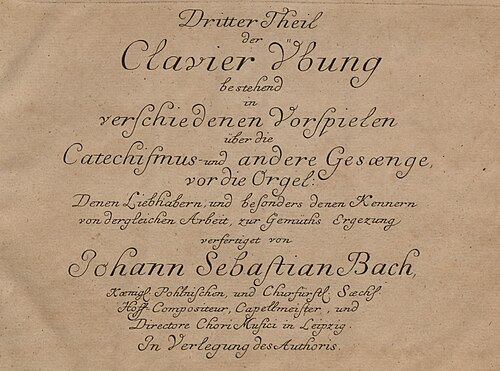
Dritter Theil der Clavier Übung bestehend in verschiedenen Vorspielen über die Catechismus- und andere Gesaenge, vor die Orgel: Denen Liebhabern, in besonders denen Kennern von dergleichen Arbeit, zur Gemüths Ergezung verfertiget von Johann Sebastian Bach, Koenigl。ポールニシェンとクールフュルシュトル。サクッ。ホフ作曲家、カペルマイスター、ライプツィヒのチョリ・ムジチ監督。 Verlegung des Authorisにて。
翻訳すると、表紙には「オルガンのためのカテキズムに基づく様々な前奏曲とその他の賛美歌からなる鍵盤練習の第三部。音楽愛好家、特にこのような作品の愛好家のために、精神の慰めとして、ポーランド王室およびザクセン選帝侯宮廷作曲家、楽長、ライプツィヒ合唱団指揮者ヨハン・セバスチャン・バッハによって準備された。著者による出版」とある。[ 7 ]
原稿を精査した結果、キリエ・グロリアとより大規模な教理問答コラール前奏曲が最初に作曲され、続いて1738年に「聖アンナ」前奏曲とフーガ、そして手引書コラール前奏曲が、最後に1739年に4つの二重唱が作曲されたことが示唆された。BWV 676を除き、すべての楽曲は新たに作曲されたものである。この作品の構成と出版は、おそらくゲオルク・フリードリヒ・カウフマンの『調和の魂の渇望』(1733~1736年)、コンラート・フリードリヒ・フルレブッシュの『音楽作品集』(1734~1735年) 、1734年から1737年の間に出版されたヒエロニムス・フロレンティヌス・クェル、ヨハン・ゴットフリート・ヴァルター、ヨハン・カスパー・フォーグラーのコラール前奏曲、さらに古い『オルガンの書』、ニコラ・ド・グリニー(1700年)、ピエール・デュマージュ(1707年)などのフランス・オルガン・ミサ曲に影響を受けたものと思われる。 [ 8 ] [ 1 ]バッハの表題ページの記述は、これらの初期の作品のいくつかに倣って、作品の特定の形式を説明し、「目利き」に訴えかけているが、これは『クラヴィーア練習曲集II』の表題ページからの唯一の逸脱である。[ 9 ]
『クラヴィーア練習曲集 III』は単なる寄せ集めではないとされているものの、それがサイクルを形成しているのか、それとも密接に関連した作品の集まりに過ぎないのかについては合意が得られていない。フランソワ・クープラン、ヨハン・カスパー・ケルル、ディートリヒ・ブクステフーデといった作曲家によるこの種のオルガン作品と同様に、教会礼拝における音楽的要求に応える形で制作された部分もある。バッハがイタリア、フランス、ドイツの音楽に言及していることから、 『クラヴィーア練習曲集 III』は、ライプツィヒのトーマス教会でバッハの前任者の一人であったエリアス・アンマーバッハによる類似の、しかしはるかに古い作品集である『タブラトゥルブッフ』の伝統に直接位置づけられる。[ 10 ]


バッハの複雑な音楽スタイルは、同時代の何人かから批判されていた。作曲家、オルガン奏者、音楽学者のヨハン・マッテゾンは「カノンの解剖学」(1722年)の中で次のように述べている。[ 11 ]
確かに、私自身も経験したことですが、芸術作品(カノンなど)の急速な進歩は、分別のある作曲家を夢中にさせ、心から密かに自分の作品に喜びを感じさせることがあります。しかし、この自己愛によって、私たちは知らず知らずのうちに音楽の真の目的から遠ざかり、人々を喜ばせることが私たちの目標であるにもかかわらず、他人のことをほとんど考えなくなってしまうのです。本来、私たちは自分の好みだけでなく、聴衆の好みにも従うべきです。私自身、取るに足らないと思える曲を作曲したことが何度もありますが、思いがけず大きな好評を得たことがあります。私はそれを心に留め、芸術性という観点から見れば大した価値はないものの、同じような曲をさらに書き続けました。
1731年までは、1725年にカンタータ「我は多くの嘆きを抱いた」(BWV 21)におけるバッハの朗読的な作風を痛烈に批判したことは有名だが、それ以外はマテゾンのバッハ評は概ね好意的だった。しかし1730年、偶然にもゴットフリート・ベンヤミン・ハンケが自身の鍵盤楽器の演奏技術について「バッハはマテゾンを袋に詰め込んで出し、また袋から出すだろう」と酷評しているのを耳にする。1731年以降、自尊心を刺激されたマテゾンは、バッハを「芸術家バッハ」と呼び、批判的な文章を書くようになった。同じ時期に、バッハの元弟子ヨハン・アドルフ・シャイベはバッハを痛烈に批判していた。1737年に彼は、バッハは「大げさで混乱した性格を与えることで作品から自然なものをすべて奪い、過剰な技巧でその美しさを覆い隠した」と書いた。[ 12 ]シャイベとマテゾンは、バッハに対してほぼ同じ攻撃の論拠を用いていた。実際、マテゾンはシャイベのバッハに対するキャンペーンに直接関与した。バッハは当時直接コメントしなかった。彼の主張は、バッハの控えめな促しを受けて、ライプツィヒ大学の修辞学教授で、音楽愛好家であり、バッハとローレンツ・クリストフ・ミツラーの友人でもあったヨハン・アブラハム・ビルンバウムによって論じられた。1738年3月、シャイベは「無視できない誤り」を理由にバッハをさらに攻撃した。

この偉大な人物は、真に博識な作曲家に求められる科学と人文科学を十分に学んでいない。哲学を学ばず、自然と理性の力を探求し認識する能力もない人物が、どうして音楽作品において欠点のない作品を生み出すことができるだろうか。批評的な観察や探求、そして修辞学や詩作と同様に音楽にも不可欠な規則にほとんど関心を払っていない人物が、どうして良質な趣味を培うために必要なあらゆる利点を得られるだろうか。それらがなければ、感動的で表現力豊かな作曲は不可能である。
1738年に出版予定の論文『完全なる楽長』 (1739年)の広告で、マテゾンはビルンバウムとのやり取りから生まれたシャイベの手紙を掲載した。その手紙の中でシャイベは、バッハの「技巧的な」対位法よりもマテゾンの「自然な」旋律を強く好むと述べていた。友人ミツラーと、マテゾンの印刷も手掛けていたライプツィヒの印刷業者クリューグナーとブライトコプフを通じて、バッハも他の人々と同じように、マテゾンの論文の内容を事前に知っていたと思われる。対位法に関して、マテゾンは次のように書いている。
3つの主題を持つ二重フーガについては、私の知る限り、私の作品『Die Wollklingende Fingerspruche, Parts I and II』以外には出版されているものはありません。しかし、謙遜のつもりで、この作品を誰にもお勧めするつもりはありません。むしろ、フーガの大家であるライプツィヒのバッハ氏が、同じような作品を出版してくれることを切に願っています。この現状は、一方では、確かな基礎を持つ対位法家たちの衰退と弱体化を如実に物語っているだけでなく、他方では、現代の無知なオルガン奏者や作曲家たちが、こうした教育的な事柄に無関心であることをも露呈しています。
バッハの個人的な反応がどうであれ、クラヴィーア練習曲集第3巻の対位法的な書法は、シャイベの批判とマテゾンのオルガニストへの呼びかけに対する音楽的な応答となった。ミズラーが上で述べた、「クラヴィーア練習曲集第3巻の特質は、宮廷作曲家の音楽を批判しようとした者たちへの強力な反論となる」という発言は、彼らの批判に対する言葉による応答であった。しかしながら、ほとんどの評論家は、バッハの記念碑的作品の主なインスピレーションは音楽、すなわちジローラモ・フレスコバルディのフィオーリ・ムジカーリのような音楽作品であり、バッハは1714年にヴァイマルで自身の個人用コピーを入手し、特に好んでいたという点で一致している。[ 8 ] [ 13 ] [ 14 ]
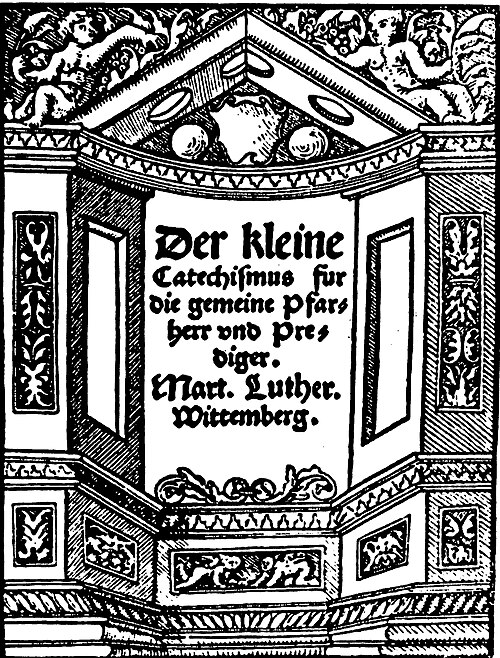
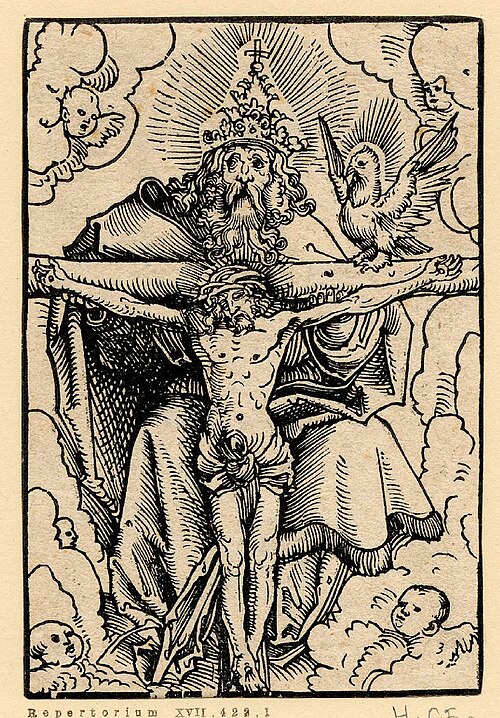
クラヴィーア練習曲集 IIIのコラール前奏曲の数21 は、フランスのオルガンミサ曲の楽章の数と一致します。ミサとカテキズムの設定は、ライプツィヒの日曜礼拝のスケジュール、つまり朝のミサと午後のカテキズムに対応しています。当時の賛美歌集では、トロペドのドイツ語キリエとドイツ語グロリアからなるルター派ミサは、聖三位一体の見出しの下にありました。オルガニストで音楽理論家のヤコブ・アドルングは1758 年に、教会のオルガニストが 2 つの日曜賛美歌「 Allein Gott in der Höh sei Ehr 」と「Wir glauben all an einen Gott」を異なる調で演奏する習慣を記録しました。バッハは「Allein Gott」で言及されている E から B ♭までの 6 つの調のうち 3 つを使用しています。オルガンは信仰に関する一連の質問と回答である教理問答試験では役割を果たしていなかったため、これらの賛美歌の存在はおそらくバッハの個人的な信仰の表明であった。しかし、ルターの小教理問答(図を参照)は十戒、信条、主の祈り、洗礼、鍵の務めと告解、聖餐式を中心としており、これらはルター自身の6つの教理問答コラールの主題と全く同じである。バッハの故郷であるドイツでは、これらの教理問答賛美歌は平日の学校集会で歌われ、日曜日にはキリエとグロリアが歌われた。ルターの賛美歌集には6つのコラールすべてが収録されている。しかし、バッハがこれらの賛美歌(グレゴリオ聖歌に由来するものもある)を、ルターが1539年にライプツィヒのトーマス教会で行った説教の200周年という特別な年に、ルター派の主要な教義への賛辞として用いた可能性の方が高い。ルター派にとっての主要なテキストは聖書、賛美歌集、教理問答であった。バッハはすでにカンタータや受難曲で数多くの聖書テキストに曲をつけており、1736年にはゲオルク・クリスティアン・シェメリと共に賛美歌集の準備を手伝い、そして1739年には教理問答の賛美歌(タイトルページの先のイラストを参照)をオルガンのコラール前奏曲として作曲した。[ 15 ]

ウィリアムズ(1980)は、バッハの個人所有の楽譜に「JS Bach 1714」と署名されているフレスコバルディの『フィオーリ・ムジカーリ』から『クラヴィーア練習曲集III』が借用した特徴として、以下の点を挙げている。
ウィリアムズ(2003)によれば、バッハはオルガン作品集に明確な典礼目的を持っており、その循環的な順序と構成は、耳では聞き取れなくても目には明らかである。当時、マニュアルフーガは平均律クラヴィーア曲集の第2巻として書かれたが、共通点があるのは最後のフーガBWV 689だけである。バッハの音楽的計画には、オルガヌム・プレヌムの作品、ミサ曲における3つのポリフォニー様式、マニュアル、トリオ・ソナタ、カテキズムのペア(カノン形式の定旋律を持つ2曲、ペダル定旋律を持つ2曲、フルオルガン用の2曲)、そして二重奏曲における自由な発明など、多数の構造がある。クラヴィーア練習曲集 IIIの中心にあるフーゲッタ BWV 681 は、バッハのクラヴィーア練習曲集の他の 3 部の中心となる曲と同様に、この曲集の後半の始まりを示す構造的な役割を果たしています。この曲は、バッハの鍵盤パルティータ第 4 巻BWV 828 (クラヴィーア練習曲集 I )の第 1 楽章、フランス風序曲 BWV 831 (クラヴィーア練習曲集 II ) の第 1 楽章、ゴールドベルク変奏曲BWV 988 (クラヴィーア練習曲集 IV ) の第 16 変奏曲(「Ouverture. a 1 Clav」と記されている)、および P200 に収録されているフーゲの技法のオリジナル手書き版のコントラプンクトゥス VII と同様に、フランス風序曲の音楽的モチーフを使用して書かれています。
礼拝での使用を想定して書かれた可能性はあるものの、バッハの後期の作品であるカノン変奏曲BWV 769、音楽の捧げ物BWV 1079、フーガの技法BWV 1080 と同様に、クラヴィーア練習曲 III の技術的な難しさは、ほとんどのルター派教会のオルガニストにとって難しすぎたであろう。実際、バッハと同時代の作曲家の多くは、幅広いオルガニストが演奏しやすいように意図的に作曲した。ゾルゲは、バッハのようなコラール前奏曲は「非常に難しく、演奏者にはほとんど使えない」ため、彼の前奏曲集(1750 年) にシンプルな 3 声部のコラールを作曲した。バッハのヴァイマール時代の元弟子であるフォーゲルは、彼のコラーレを「主に田舎の教会で演奏しなければならない人々のために」作曲した。また、ワイマールの学生であったヨハン・ルートヴィヒ・クレブスは、彼の「クラヴィア練習曲集II」(1737年)を「女性がそれほど苦労せずに演奏できるように」書いた。[ 16 ]
クラヴィーア練習曲集第3番は、ドイツ、イタリア、フランスの様式を融合させたもので、特に冒頭のプレリュード BWV 552/1 では、3 つの主題群がそれぞれフランス、イタリア、ドイツを象徴するように意図的に選ばれたように思われます (下記の BWV 552/1 の議論を参照)。これは、17 世紀後半から 18 世紀初頭のドイツにおいて、作曲家や音楽家が「混合趣味」として知られるようになった様式で作曲・演奏するという傾向を反映しています。この表現はクヴァンツによって造語されました。[ 17 ] 1730 年、バッハはライプツィヒ市議会に、今では有名な手紙「整った教会音楽のための短くも最も必要な草稿」を書いており、演奏条件だけでなく、さまざまな国の演奏様式を採用するよう圧力をかけられていることについても不満を述べています。
いずれにせよ、ドイツの音楽家がイタリア、フランス、イギリス、ポーランドなど、あらゆる国の音楽を即座に即興で演奏できる能力を期待されているというのは、少々奇妙なことだ。
1695年、ゲオルク・ムファットは『フロリレギウム・プリムム』の献辞の中で、「私は単一の様式や方法を用いる勇気はなく、むしろ様々な国での経験を通して私が成し遂げられる最も巧みな様式の融合を試みる…フランス風の様式をドイツ風やイタリア風に混ぜ合わせることで、私は戦争を始めるのではなく、おそらく全ての人々が望む統一、尊い平和への序曲を始めるのだろう」と記していた。この傾向は、バッハの批評家であるマテゾンやシャイベを含む同時代の評論家や音楽学者によって奨励され、彼らは同時代のゲオルク・フィリップ・テレマンの室内楽を称賛する際に、「ドイツの声部書法、イタリアの優雅さ、フランスの情熱が融合するのが最善である」と記した。


バッハの息子カール・フィリップ・エマヌエルは、1700年から1702年にかけてリューネブルクのミヒャエル学校で過ごした幼少期を回想し、 1754年のバッハの死亡記事『ネクロログ』に次のように記している。
そこから、当時有名だったツェレ公爵が維持し、主にフランス人で構成されていたオーケストラの演奏を頻繁に聴く機会を得て、彼はフランス式の音楽スタイルを身につける機会を得た。そのスタイルは、その地域においても当時においても、全く新しいものだった。
ブラウンシュヴァイク=リューネブルク公ゲオルク・ヴィルヘルムの宮廷オーケストラは1666年に設立され、1680年から1710年の間にドイツで人気を博したジャン=バティスト・リュリの音楽に重点を置いていた。バッハはリューネブルク近郊のダンネンベルクにある公爵の夏の別荘でこのオーケストラの演奏を聴いた可能性が高い。リューネブルクでは、バッハはヨハニス教会のオルガニスト、ゲオルク・ベームと、1701年に訪れたヨハン・フィッシャーの作品も聴いたであろう。両者ともフランス様式の影響を受けていた。[ 18 ]後にCPEバッハは『ネクロログ』の中で、「オルガンの芸術においては、ブルーンス、ブクステフーデ、そして数人の優れたフランス人オルガニストの作品を模範とした」と述べている。 1775年、彼はバッハの伝記作家ヨハン・ニコラウス・フォルケルに、父がブクステフーデ、ベーム、ニコラウス・ブルーンス、フィッシャー、フレスコバルディ、フローベルガー、ケルル、パッヘルベル、ラインケン、シュトルンクの作品だけでなく、「何人かの古くて立派なフランス人」の作品も研究していたと述べて、このことをさらに詳しく説明した。[ 19 ]
同時代の文書によれば、これらの作曲家にはボワヴァン、ニヴェール、レゾン、ダングルベール、コレット、ルベーグ、ル・ルー、デューパール、フランソワ・クープラン、ニコラ・ド・グリニー、マルシャンが含まれていたと思われる。(後者は、フォルケルの逸話によれば、鍵盤楽器の「決闘」でバッハと競うのを避けるために1717年にドレスデンから逃亡した。)[ 18 ] 1713年のヴァイマル宮廷では、熱心な音楽家であるヨハン・エルンスト王子が、ヨーロッパ旅行からイタリアとフランスの音楽を持ち帰ったと伝えられている。同時期、あるいはそれ以前に、バッハはド・グリニーの『オルガンの書』 (1699年)全巻と、ダングルベールの『クラヴサンの小品』 (1689年)の装飾表を綿密に写し取り、弟子のフォーグラーはボワヴァンの『オルガンの書』 2冊を写し取った。さらに、ヴァイマルでは、バッハは従兄弟のヨハン・ゴットフリート・ヴァルターが所蔵する膨大なフランス音楽コレクションにアクセスできたはずである。ずっと後になって、1738年にビルンバウムとシャイベがバッハの作曲様式について意見を交わした際、おそらくバッハの提案で、ビルンバウムは装飾に関連してド・グリニーとデュマージュの作品を持ち出した。冒頭の前奏曲 BWV 552/1 と中央の手鍵盤コラール前奏曲 BWV 681 に見られる「フランス風序曲」様式の要素を除けば、評論家たちは、2 つの大規模な 5 声部コラール前奏曲、Dies sind die heil'gen zehn Gebot' BWV 678 とVater unser im Himmelreich BWV 682 は、グリニーの 5 声部テクスチャーに部分的に影響を受けており、各手鍵盤に 2 声部、ペダルに 5 声部があるという点で一致している。[ 20 ] [ 21 ] [ 22 ] [ 23 ] [ 24 ]
評論家たちは、クラヴィーア練習曲第3番をバッハのオルガン作曲技法の集大成であり、同時に個人的な宗教的表明であると解釈してきた。他の後期の作品と同様に、バッハの音楽言語は、旋法であろうと慣習的であろうと、この世のものとは思えない性質を持っている。トリオ・ソナタBWV 674や677のように、明らかに長調で書かれた作品でも、曖昧な調性を持つことがある。バッハは、フーガ、カノン、パラフレーズ、定旋律、リトルネロ、モチーフの展開、さまざまな形式の対位法など、既知のすべての音楽形式で作曲した。 [ 16 ] ポリフォニックなスティレ・アンティコ作品が5曲あり(BWV 669–671、686、および552/iiの最初の部分)、パレストリーナとその追随者であるフックス、カルダーラ、ゼレンカの影響を示している。しかしバッハは、スティレ・アンティコの長い音価を採用しているにもかかわらず、例えばBWV 671のように、元のモデルを超えている。[ 16 ]
ウィリアムズ(2007)は、クラヴィーア練習曲集IIIの目的の一つはオルガンリサイタルの理想的なプログラムを提供することだと述べている。そのようなリサイタルは後にバッハの伝記作家ヨハン・ニコラウス・フォルケルによって次のように記述された。[ 25 ]
ヨハン・セバスチャン・バッハは、しばしば依頼されてオルガンを演奏する機会があったが、礼拝がない時にオルガンの前に座ると、必ず何らかの主題を選び、それをオルガン曲のあらゆる形式で演奏した。そのため、たとえ2時間以上も休憩なしで演奏したとしても、主題は常に彼の創作素材であり続けた。まず、彼はこの主題をフルオルガンによる前奏曲とフーガに用いた。次に、ストップを駆使してトリオ、カルテットなどを演奏し、常に同じ主題でその技巧を披露した。その後、コラールが続き、その旋律は3声部または4声部で、元の主題を実に多様な方法で遊び心たっぷりに取り囲んだ。最後に、フルオルガンによるフーガで締めくくった。このフーガでは、最初の主題のみを別の形で扱う場合もあれば、その性質に応じて1つまたは2つの他の主題を混ぜ合わせる場合もあった。
『クラヴィーア練習曲集III』の音楽構成は、オルガヌム・プレナムのための自由な前奏曲とフーガを挟む形で、コラール風の前奏曲と室内楽風の作品を集めたという、このパターンに則っている。
ウォルフ(1991)は、クラヴィーア練習曲集第3巻の数秘術の分析を行った。ウォルフによれば、循環的な順序がある。冒頭の前奏曲とフーガは、3つのグループの楽曲を囲んでいる。ルター派ミサのキリエとグロリアに基づく9つのコラール前奏曲、ルター派教理問答に基づく6組のコラール前奏曲、そして4つの二重唱である。各グループには独自の内部構造がある。最初のグループは3つのグループから構成されている。スティレ・アンティコによるキリエに基づく最初の3つのコラールは、パレストリーナの多声ミサを彷彿とさせ、テクスチャはますます複雑になっている。次のグループは、6 8、9 8、12 8という漸進的な拍子記号を持つキリエに基づく3つの短いヴェルセットで構成されている。ドイツのグロリアに基づく3つのトリオ・ソナタからなる第3グループでは、2つのマニュアルリター設定が、規則的な調の進行(ヘ長調、ト長調、イ長調)で2つのマニュアルとペダルのためのトリオを挟んでいます。各ペアのカテキズム・コラールは、2つのマニュアルとペダルのための設定に続いて、より小規模なマニュアルリター・フーガ・コラールがあります。12のカテキズム・コラールのグループは、さらに、中心となるグランド・プレナム・オルガヌム設定(Wir glaubenとAuf tiefer Noth)を中心にグループ化された6つのグループに2つに分けられています。デュエットは、連続する調の進行(ホ短調、ヘ長調、ト長調、イ短調)によって関連付けられています。このように、クラヴィーア練習曲集第3巻は、中心となるパターン、類似または対照的なペア、そして徐々に増大する対称性など、さまざまな構造を組み合わせています。また、全体的な数秘術的象徴性もあります。 9つのミサ曲(3×3)は、ミサにおける三位一体の3つを指し、対応するテキストでは父、子、聖霊に特に言及している。カテキズムのコラールの12という数字は、弟子の数である12という数字の教会における通常の用法への言及と見ることができる。作品全体は27曲(3×3×3)で構成され、パターンを完成させている。しかし、この構造にもかかわらず、この作品が全体として演奏されることを意図していたとは考えにくい。これは、教会演奏のためのオルガニスト向けの資料集として意図されており、二重唱は聖体拝領の伴奏として用いられる可能性があった。[ 26 ]
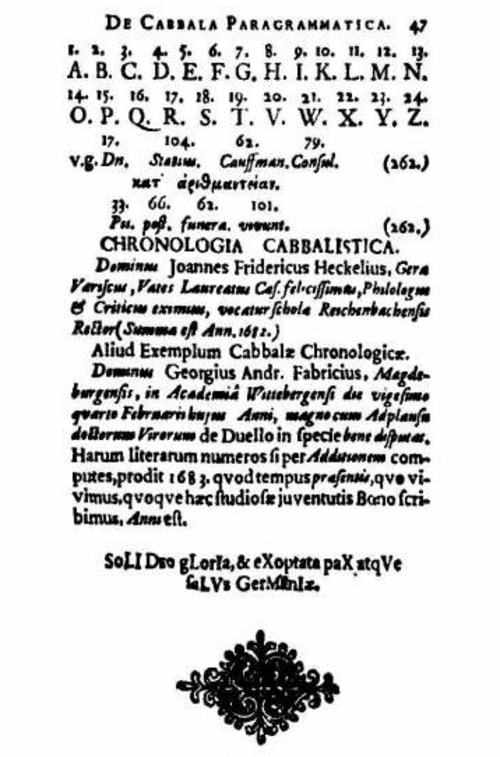
ウィリアムズ(2003)は、様々な音楽学者が指摘するクラヴィーア練習曲第3番における黄金比の出現についてコメントしている。前奏曲(205)とフーガ(117)の間の小節の分割はその一例である。フーガ自体では、3つのパートはそれぞれ36、45、36小節であるため、中間部と外側のセクションの長さの間に黄金比が現れる。中間部の中間点は、第1主題が第2主題の偽装版に対して初めて出現する点で、重要な転換点となっている。最後に、BWV 682 「天に抱く我らの父なる神」(主の祈り)では、鍵盤部とペダル部が入れ替わる重要な転換点が41小節目に現れるが、これはJS BACHの文字の数値順の合計である( IをJ、UをVと同一視するバロック時代の慣例[ 27 ]を使用)。 91小節のコラール前奏曲の56小節目の後半の終止形は、黄金比の別の例を示している。91自体は7に因数分解され、祈りを意味し、13を掛けると罪を意味する。この2つの要素、すなわち教会法と迷える魂は、音楽構造の中にも直接的に表されている。[ 28 ]

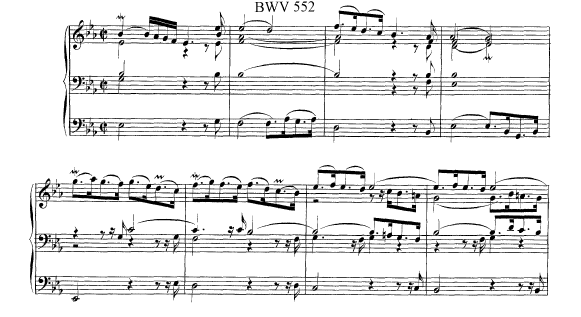
トッカータ ヘ長調 BWV 540と並んで、これはバッハのオルガン前奏曲の中で最も長い作品です。フランス風序曲(第1主題)、イタリア風協奏曲(第2主題)、ドイツ風フーガ(第3主題)の要素を組み合わせ、オルガン用に編曲されています。序曲の慣例的な付点リズムが用いられていますが、主題の交代は、ヴィヴァルディの協奏曲におけるソロとトゥッティの掛け合いよりも、オルガン曲における対照的なパッセージの伝統に由来しています。元々は協奏曲や序曲でより一般的な調であるニ長調で書かれたと考えられますが、バッハは、 1731年にマテゾンがオルガン奏者が避ける「美しく荘厳な調」と評した変ホ長調に、この曲とフーガを移調した可能性があります。また、この曲には3つの独立した主題(A、B、C)があり、時折重なり合っていますが、評論家たちはこれらを三位一体の父、子、聖霊を表していると解釈しています。三位一体への言及としては、調号に含まれる3つのフラット記号や、それに付随するフーガなどが挙げられる。
前奏曲が進むにつれて、最初の主題の再現部は典型的なヴィヴァルディの協奏曲のように短くなり、2番目の主題の再現部は単に属音に移調され、3番目の主題の再現部はより長く展開される。トッカータのようなパッセージはなく、音楽書法は当時のものとはかなり異なっている。各主題のペダルパートは異なる性格を持ち、最初の主題ではバロックの通奏低音、2番目の主題では準ピチカートの低音、3番目の主題ではスティレ・アンティコの低音で、音符は足の間で交互に演奏される。3つの主題すべてに16分音符3つが共通しており、最初の主題の1小節ではフランスの序曲に典型的な音型、2番目の主題の32小節ではイタリアのギャラント様式の反響、3番目の主題の71小節ではドイツのオルガンフーガに典型的なモチーフとなっている。3つの主題は、それぞれ国の影響を受けている。最初の主題はフランス、2番目の主題はギャラント様式のイタリア、そして3曲目はドイツ風で、北ドイツのオルガンフーガの伝統から多くの要素を取り入れている。第2主題の反響部分にフォルテとピアノの指示があることから、少なくとも2段鍵盤が必要だったことがわかる。ウィリアムズは、第1主題を第1鍵盤、第2主題と第3主題を第2鍵盤、反響部分を第3鍵盤で演奏する、3段鍵盤を想定していた可能性もあると示唆している。
最初のテーマ:父なる神
最初の主題は、フランス風序曲に見られるような、スラーで記された付点リズムで構成されている。複雑なサスペンデッド・ハーモニーを持つ5声部で書かれている。
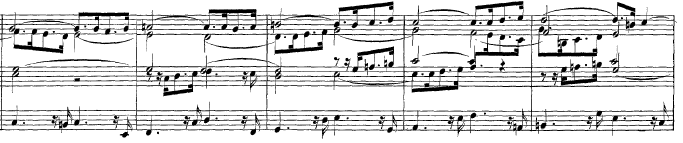
短調で演奏される主題の最初の再現部(A2)には、典型的なフランス的な和声進行が含まれている。
第二のテーマ:神の子
この主題は、神、子、慈悲深い主を表しており、ギャラント様式のスタッカートの3声和音による2小節のフレーズがあり、ピアノで指示されたエコー応答があります。
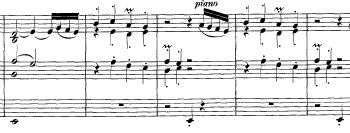
これに続いて、より装飾的なシンコペーションを用いたバージョンが演奏されるが、前奏曲の中でそれ以上発展することはない。
第三のテーマ:聖霊
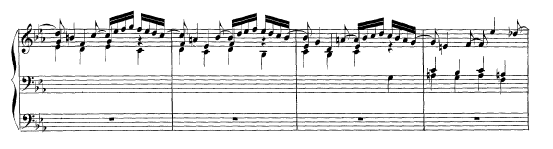
この主題は16分音符に基づく二重フーガで、「聖霊が降りてきて、炎の舌のように揺らめく」様子を表しています。北ドイツの慣習に従い、16分音符にはスラーは付いていません。最終展開部(C3)では、主題は変ホ短調に移り、楽章の終わりを予感させると同時に、前の短調のエピソードを想起させ、クラヴィーア練習曲集第3巻の後の楽章、例えば第1二重唱BWV 802などで見られる同様の効果を予感させます。古い様式の2声または3声の書法は、第1主題の和声的に複雑で現代的な書法とは対照的です。
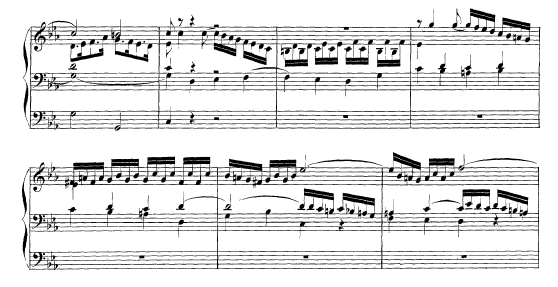
フーガの16分音符の主題は、伝統的な方法で交互に足を使う奏法を用いてペダル用に編曲されている。
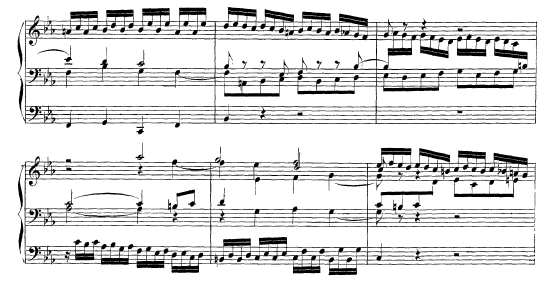

三重フーガは三位一体の象徴である。同じ主題が三つの連なったフーガに繰り返し現れるが、それぞれ異なる性格を帯びている。最初のフーガは穏やかで荘厳であり、全体を通して完全に均一な動きをしている。二番目のフーガでは主題は隠されているようで、時折その真の形が認識できる程度であり、まるで神が地上に姿を現すことを示唆しているかのようだ。三番目のフーガでは、ペンテコステの風が天から轟音を立てて吹き下ろすかのように、主題は疾走する16分音符へと変化する。
—アルベルト・シュバイツァー、ジャン=セバスチャン・バッハ、音楽詩人、1905年[ 30 ]
クラヴィーア練習曲集第3巻の終わりを飾る変ホ長調のフーガBWV 552/2 は、第1主題がウィリアム・クロフトの同名の賛美歌の旋律に似ていることから、英語圏では「聖アンナ」として知られるようになった。この旋律はバッハには知られていなかったと思われる。[ 31 ] 36小節、45小節、36小節の3つのセクションからなるフーガで、各セクションが異なる主題による独立したフーガとなっているため、三重フーガと呼ばれている。しかし、第2主題は第3セクション内で明確には示されておらず、93、99、102~104、113~114小節で強く示唆されているだけである。
3という数字
前奏曲とフーガの両方に3という数字が頻繁に登場し、多くの人がこれを三位一体を表すものと解釈してきた。アルベルト・シュヴァイツァーの記述は、3つのセクションを三位一体の3つの異なる部分と関連付ける19世紀の伝統に従っている。しかし、3という数字は他にも多くの場面で現れる。調号のフラットの数、フーガのセクションの数、各セクションの小節数(それぞれ3の倍数(3×12、3×15))、出版月(9月=09または3×3)と出版年(39または3×13)にも3という数字が見られる。3つの主題はそれぞれ前の主題から発展しているように見える。実際、音楽学者のヘルマン・ケラーは、 2番目の主題は最初の主題に「含まれている」と示唆している。楽譜には隠されているかもしれないが、これは聴き手にはより明白であり、その形状と、第 1 主題の対主題の 4 分音符の音型との類似性の両方において明らかである。同様に、第 3 主題の 16 分音符の音型は、第 1 セクションの第 2 主題と第 1 セクションの対主題に遡ることができる。[ 32 ]
フーガの形式
フーガの形式は、フローベルガーやフレスコバルディなどの17世紀の三部構成のリチェルカーレやカンツォーナの形式に合致している。第一に、主題が連続するセクションで次第に速くなるという点、第二に、ある主題が次の主題に変化するという点である。 [ 33 ] [ 34 ]バッハはまた、ニコラウス・アダム・シュトルンクやフリードリヒ・ヴィルヘルム・ツァッホウの鍵盤リチェルカーレやファンタジアに遡る、セクションによる対位法的な作曲のライプツィヒの伝統を受け継いでいると見なすこともできる。異なるセクション間のテンポの移行は自然である。第1セクションと第2セクションの2分音符は、第3セクションの付点4分音符に対応する。
被験者の情報源
多くの評論家が、第一主題と他の作曲家のフーガ主題との類似点を指摘している。スティレ・アンティコの例として、それはむしろ当時のフーガ・グラーヴェ主題に典型的な一般的な主題である可能性が高い。「静かな4 2」拍子、上昇する4度音程、狭い旋律範囲。ウィリアムズ(2003)が指摘するように、バッハ自身が1734年に出版したコンラート・フリードリヒ・フルレブッシュのフーガ主題との類似性は、バッハが聴衆を科学で惑わせようとした意図的な試みであった可能性がある。ロジャー・ウィバリー[ 35 ]は、3つのフーガ主題すべてと前奏曲の特定のパッセージの基礎が、コラール「O Herzensangst, O Bangigkeit」の最初の4つのフレーズに見出される可能性があることを示している。 BWV 552/2 の最初の 2 つのセクションは、同じ時期に書かれた平均律クラヴィーア曲集第 2 巻の変ホ長調のフーガ BWV 876/2と多くの類似点を共有しています。同じ巻の嬰ヘ短調の BWV 883 やフーガの技法のいくつかのコントラプンクティのような真の三重フーガとは異なり、バッハは BWV 552/2 で 3 つの主題すべてを組み合わせることを意図していなかった可能性がありますが、理論的には可能でした。むしろ、作品が進むにつれて、最初の主題が他の主題を通して歌い上げているのが聞こえます。時には隠され、時には第 2 セクションのようにアルトとテノールの声で静かに、そして最後に、最後のセクションでは、高音で高く、クライマックスの終結が近づくにつれて、ペダルで準オスティナートとして、2 つの上声部の下で轟きます。第 2 セクションでは、8 分音符に対して演奏されます。そして最後の部分では、流れるような16分音符のパッセージワークと対比される。フーガが進むにつれて、これはウィリアムズが「大合唱」の累積効果と呼んだものを生み出す。後の部分では、3拍子に適応するために、最初の主題はリズミカルにシンコペーションされ、音楽学者ロジャー・ブリヴァントが「おそらくどの時代のフーガにも類を見ないほどのリズムの複雑さ」と呼んだものを生み出す。
最初のセクション
第1部は、スティレ・アンティコによる静かな4拍子2拍子の5声部フーガである。対主題は四分音符で書かれている。
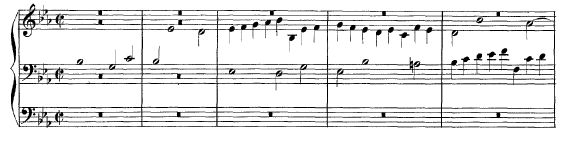
ストレッタのパッセージは2つあり、1つ目は3度(下記参照)、2つ目は6度です。
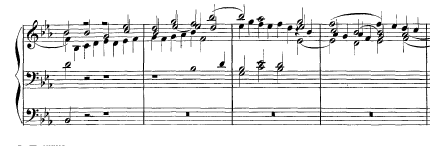
第2部
第2部は、単鍵盤による4声部の二重フーガである。第2主題は8分音符で進行し、37小節目の2拍目から始まる。
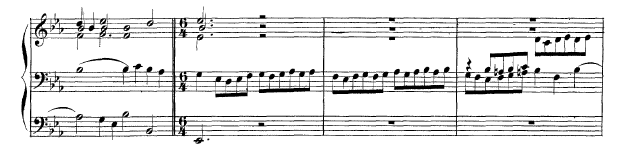
最初の主題は徐々に再登場し、まず内側の部分(44~46小節)でほのめかされる。
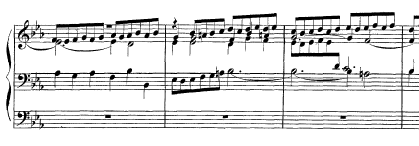
そして54小節目の高音部では
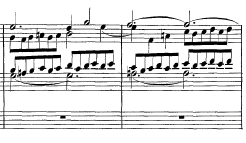
低音域から本格的な対抗主題として上昇する(59~61小節)。
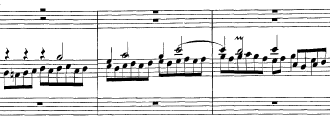
第3部
第3セクションは、フルオルガンのための5声の二重フーガです。第2セクションの前の小節は、1ミニム(ヘミオラ)の3拍として演奏され、新しい拍子を生み出します。第3主題は、ジグに似た、活気に満ちた舞曲風で、再び小節の2拍目から始まります。3拍目の4つの16分音符の特徴的なモチーフは、第1セクションの対主題と第2主題ですでに聴かれています。流れる16分音符のパッセージワークは、第2セクションの8分音符のパッセージワークを加速させたもので、時折、第2セクションのモチーフが取り入れられています。
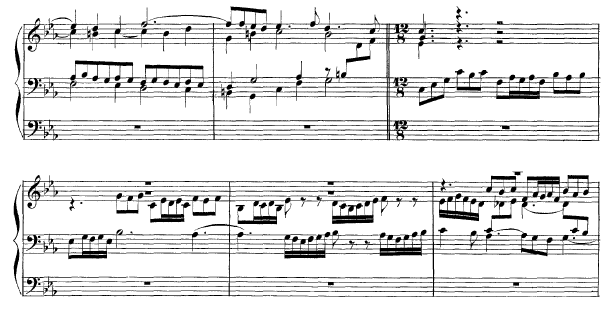
88小節目で、第3主題はソプラノパートの第1主題に融合するが、耳には完全には聞き取れない。バッハは独創的な手法で第1主題のリズムを変えず、小節をまたいでシンコペーションが効くようにしている。その後、主題は内声部に移り、そこでようやく第3主題との自然な対比が確立される。第3主題の2つの出現が、第1主題の1つの出現と完全に一致するのである。

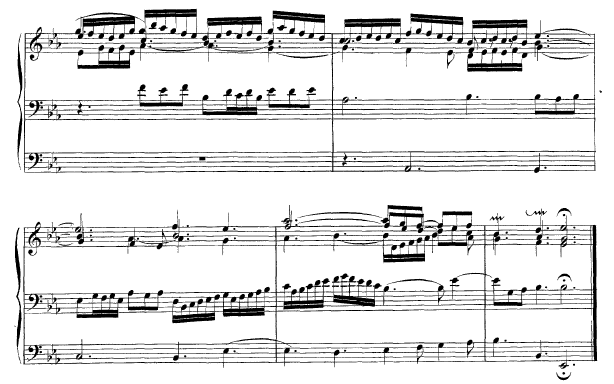
ペダルと下手部で第3主題が3度音程で最後に提示されるのを除けば、第1主題の4つの準オスティナート的なペダル提示があり、第1セクションのスティレ・アンティコ・ペダル部分を想起させる。ペダルより上では、第3主題とその16分音符の対主題が、次第に広がりと連続性をもって展開される。第1主題の最後から2番目の提示は、高音部が伸びやかに響き渡るカノンで、内声部では16分音符が下降する。クライマックスは114小節目(その2小節下)にあり、ペダルで第1主題が最後に力強く響き渡る。これは、ペダルにおける過去を振り返るスティレ・アンティコと、上声部における未来を見据えたスティレ・モデルノという独特な組み合わせによって、作品を華々しく締めくくる。ウィリアムズが述べているように、これは「音楽史上、フーガの中で最も壮大な終結」である。

これら2つのコラール(ルター派ミサ・ブレヴィスのキリエとグロリアのドイツ語版)は、ルター派教会においてミサの最初の2曲の代わりに用いられ、ライプツィヒでは礼拝の冒頭で歌われたという点で、特別な重要性を持っている。バッハはこの一連のコラールにおいて、ルター派キリスト教の教義を音楽で讃えるという課題に取り組み、それを礼拝行為と捉え、その冒頭で、会衆が毎週日曜日に歌うのと同じ祈りと賛美の賛美歌で三位一体の神に祈りを捧げたのである。
—フィリップ・スピッタ、ヨハン・セバスティアン・バッハ、1873
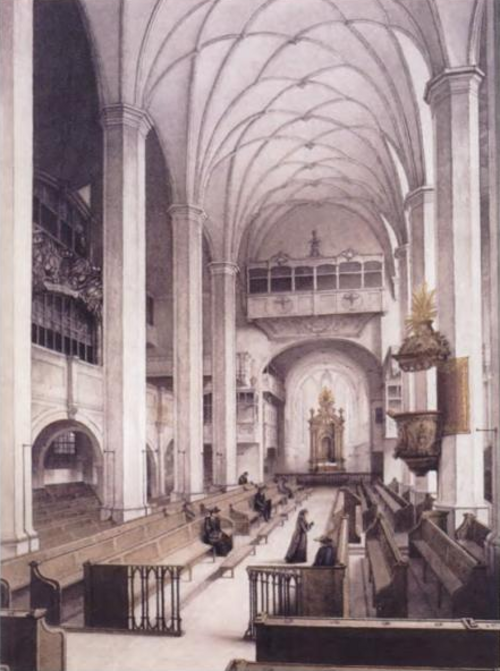
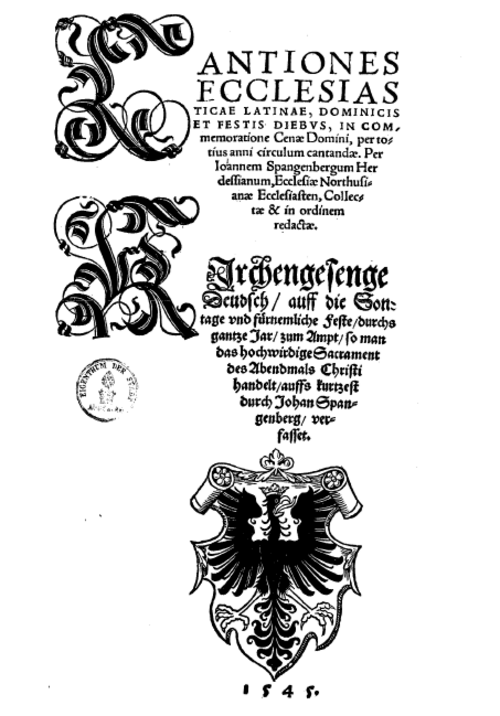
1526年、マルティン・ルターは『ドイツ・ミサ』を出版し、ラテン語が話されていない小さな町や村での使用を特に想定して、会衆賛美歌をドイツ語の口語で用いてミサを執り行う方法を説明した。その後30年間、ドイツ各地で数多くの口語賛美歌集が出版され、多くの場合、ルター、ユストゥス・ヨナス、フィリップ・メランヒトン、その他のドイツ宗教改革の人物と相談しながら作成された。1537年にニコラウス・メドラーによって編纂されたナウムブルク賛美歌集には、冒頭の「キリエ、永遠の父なる神」が収録されている。これは、比喩表現「キリエ・スムム・ボナム:キリエ・フォンス・ボニタトゥス」をルター派が翻案した数ある作品の一つである。1525年の最初の『ドイツ・ミサ』は待降節に行われたため、グロリアは含まれておらず、翌年のルターのテキストにグロリアがない理由となっている。ナウムブルクの賛美歌集にはグロリアのドイツ語版があったが、同じくグレゴリオ聖歌から編纂されたニコラウス・デキウスの1523年の賛美歌「 Allein Gott in der Höh sei Ehr」が、最終的にはドイツ全土でほぼ普遍的に採用された。この歌詞が初めて印刷物として登場したのは、改革派ヨハン・シュパンゲンベルクの1545年のマクデブルクの賛美歌集「Kirchengesenge Deudsch」である。1世紀後には、ルター派の典礼テキストと賛美歌が広く流通していた。ライプツィヒでは、バッハはゴットフリート・ヴォペリウスの「 Neu Leipziger gesangbuch (1682)」を利用できた。ルターは、礼拝において芸術、特に音楽を用いることを強く主張していた。彼はアイゼナハのゲオルゲン教会の聖歌隊で歌った。そこは後にバッハの叔父ヨハン・クリストフ・バッハがオルガニストを務め、父ヨハン・アンブロシウス・バッハが主要な音楽家の一人であり、バッハ自身も1693年から1695年の間にルターと同じラテン語学校の生徒として歌った場所である。[ 36 ] [ 37 ] [ 38 ]

キリエは、通常、日曜日にオルガンの前奏曲の後にライプツィヒで歌われました。バッハの3つの壮大なペダル・キリエ編曲は、3つの詩節に対応しています。これらは、フレスコバルディのフィオーリ・ムジカーリのスティレ・アンティコで厳密な対位法で書かれています。3つすべてに、定旋律として同じ旋律の一部があり、「父なる神」はソプラノ声部、「子なる神」は中音テノール声部(アン・タイユ)、「聖霊なる神」はペダル・バス声部で歌われます。バッハのキリエの声楽曲、例えばヘ長調のミサ曲BWV 233と共通する特徴はあるものの、非常に独創的な音楽スタイルはオルガンの演奏技術に合わせて作られており、3つのコラール前奏曲それぞれで変化しています。しかしながら、他の荘厳な教会音楽におけるグレゴリオ聖歌と同様に、バッハの作曲は、フックスの対位法に関する論文『グラドゥス・アド・パルナッスム』で述べられているように、「不変の和声規則に基づいている」 。彼の作曲の堅固さは、「信仰の揺るぎなさ」を音楽的に表現する手段であったのかもしれない。ウィリアムズ(2003)が指摘するように、「3つの楽章すべてに共通するのは、完全な終止形や連続的な反復につながることはほとんどない、ある種の滑らかな動きである。これらはどちらも、望ましい超越的なスタイルには適さないほど全音階的である」。
以下は、ルター版キリエの3つの節のテキストと、チャールズ・サンフォード・テリーによる英語訳です。[ 39 ]
カイリー、ゴット・ファーター・イン・エーヴィッヒケイト、 グロス・イスト・デイン・バルムヘルツィッヒケイト、 すべてのディン・アイン・シェプファー・ウント・レジエラー。 エライゾン! クリステ、世界のトロストと スンダー・アライン・デュ・ハスト・アーロースト。 イエス様、ゴッテス・ゾーン様、 ミトラー下は王座を守りました。 ヘルツェンス・ベギエ、 エライソンを目指してください! Kyrie, Gott heiliger Geist, tröst', stärk' uns im Glauben allermeist daß wir am letzten End' fröhlich abscheiden aus diesem Elend, eleison!
主よ、永遠に父なる神よ! 我らは汝の驚くべき恵みを崇め、 我らは汝の力を告白する、 万物を支える力を。 主よ、憐れみたまえ。 我らの唯一の希望であるキリストよ、 汝の血をもって我らのために贖いをなさった方よ。 イエスよ! 神の子よ! 我らの贖い主よ! 天上の我らの弁護者よ! 主よ、我らの必要の時にただ汝にのみ叫ぶ、 主よ、憐れみたまえ。 聖なる主よ、聖霊なる神よ! 命と光の源泉である方よ、 我らの心を信仰で支え、 我らが最後に平和のうちにこの世を去ることができるように。 主よ、憐れみたまえ。

BWV 669は、2段鍵盤とペダル鍵盤のための4/2拍子のコラール・モテットです。Gフリギア旋法による定旋律の4行は、1段鍵盤のソプラノ高音部で全音符の拍子で演奏されます。他の3つの声部(2声部は第2鍵盤、1声部はペダル鍵盤)の単一のフーガ主題は、2分音符の拍子で、定旋律の最初の2行に基づいています。作曲は厳密な対位法で、時折旋法からB ♭長調やE ♭長調に転調します。定旋律の下で演奏される場合でも、対位法の書法は非常に凝っています。多くのスティレ・アンティコの特徴としては、転回、サスペンション、ストレッタ、ダクティルの使用、そして終盤のカノーネ・シネ・パウサが挙げられます。カノーネ・シネ・パウサでは、主題が平行3度で途切れることなく展開されます。定旋律と同様に、各パートは段階的に動き、コラール前奏曲に自然な滑らかさを生み出している。
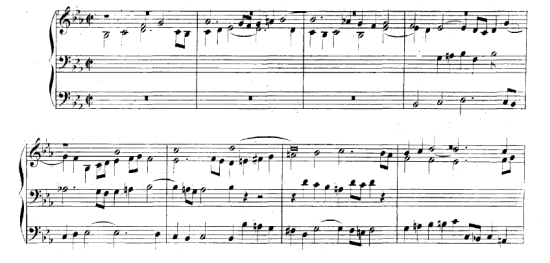

BWV 670は、2段鍵盤とペダルのための4/2拍子のコラール・モテットです。Gフリギア旋法による定旋律の4行は、テノール声部(アン・タイユ)で1段鍵盤で全音符の拍子で演奏されます。BWV 669と同様に、他の3声部(2声部は第2鍵盤、1声部はペダル)の単一のフーガ主題は、2分音符で定旋律の最初の2行に基づいています。作曲は今回も主に旋法で、アラ・ブレーヴェの厳密な対位法で、同様のスティレ・アンティコの特徴を持ち、結果として滑らかさがあります。ただし、この曲では転回形が少なく、定旋律のフレーズはより長く自由で、他の声部はより広く間隔が空いており、 6度音程のカノーネ・シネ・パウサのパッセージがあります。
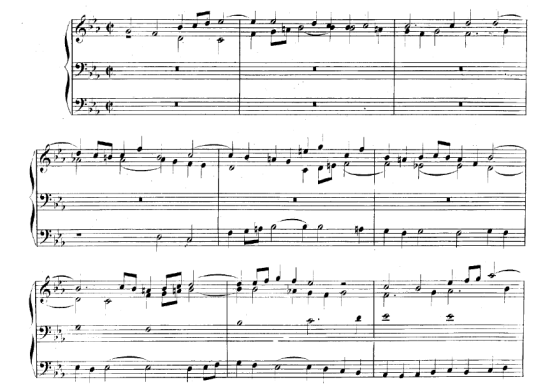

BWV 671はオルガヌム・プレヌムとペダルのためのコラール・モテットです。ベース・カントゥス・フィルムスはペダルで全音符で演奏され、その上に鍵盤で4声部(テノール、アルト、そして例外的に2つのソプラノ)が配置され、独特のテクスチャーを生み出しています。マニュアルの4声部フーガの主題はカントゥス・フィルムスの最初の2行から派生し、スティレ・アンティコの特徴である反転によって応答されます。ダクティル音型から始まり、次第に連続的で渦巻くような音階的になる上昇および下降シーケンスの8分音符モチーフは、これまでのコラール前奏曲とは一線を画しています。スティレ・アンティコの特徴としては、段階的な動きとシンコペーションが挙げられます。旋法調が全音階的になる傾向は、流れるような8分音符が突然終わる最終セクションの半音階的要素によって打ち消されます。定旋律の最後の行では、四分音符の音型が劇的で予想外の不協和音を伴いながら半音ずつ下降していく。これは、マティアス・ヴェックマンの5声部からなるコラール前奏曲「O lux beata」の最後にある、似ているが長さの短い楽節を想起させる。ウィリアムズ(2003)が示唆するように、12段階の下降する半音階は、嘆願、つまり「憐れみたまえ」という繰り返しの叫びのように聞こえる。
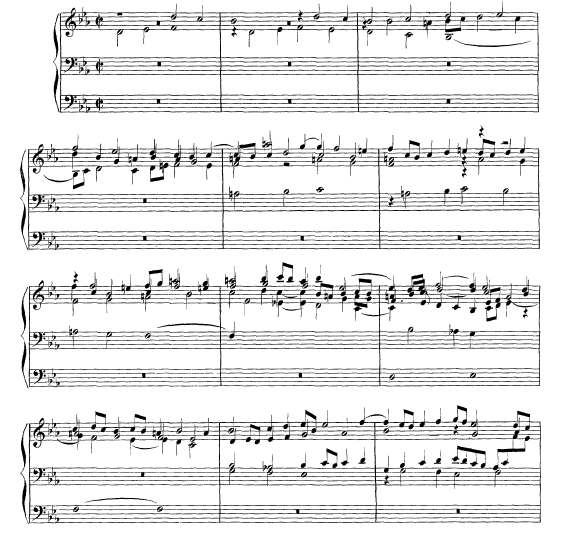


フリギア旋法は、私たちのAマイナーと同じ調であり、唯一の違いは、コラール「ああ神よ、天から見よ」 (カンタータ153)に見られるように、属和音E– G♯ –Bで終わる点です。属和音で始まり属和音で終わるこの技法は、特に協奏曲、交響曲、ソナタが完全に終結しない楽章などで、今日でも使用されています。このような終結は、何かさらに聴きたいという欲求を呼び起こします。
—ゲオルク・アンドレアス・ゾルゲ、幻想文学、1767年[ 40 ]
3つのマニュアルコラール前奏曲 BWV 672–674 は、中央ドイツで広く用いられていたコラールモテットから派生したコラールフーゲッタの伝統に則った短いフーガ作品である。バッハの叔父でアイゼナハのオルガニストであったヨハン・クリストフ・バッハは、このようなフーゲッタを44曲作曲した。フーゲッタの短さは、スペースの制約によるものと考えられている。これらは、すでに彫版されたペダルパートの楽譜の間のスペースを埋めるために、1739年の非常に遅い段階で楽譜に追加された。その長さと簡潔さにもかかわらず、フーゲッタはどれも非常に型破りで独創的であり、滑らかに流れ、時にはこの世のものとは思えないほどの甘美さを湛えている。自由に作曲されたコラール前奏曲であるため、フーガの主題とモチーフは、定旋律の各行の冒頭にゆるやかに基づいているが、それ以外では直接的に現れることはない。モチーフ自体は、バッハの後期の対位法的な作曲に典型的な繊細さと独創性をもって独立して展開されている。バット(2006)は、この組曲は、同時代のゲオルク・フリードリヒ・カウフマンが1733年に出版した『調和の魂の渇望』に収録されている「今こそ異邦人の救い主よ」の5つの手琴による編曲サイクルに触発された可能性があると示唆している。BWV 673と674は、カウフマンの2つのコラール前奏曲と同様のリズムとモチーフを使用している。
キリエは、三位一体の象徴主義に合致する一連のものとして構想されたようです。これは、3 4、6 8、9 8 という対照的な拍子記号に反映されています。また、和声的にも関連しています。すべて長調で始まり、最後の終止の前に短調に移行します。各フーゲッタの冒頭部分は、E 長三和音の異なる音で終わります。また、連続する曲の終わりと始まりの音は一致しています。ウィリアムズ (2003)がこれらのコラール・フーゲッタの「新しい超越的な性質」と呼んだものは、部分的には旋法による作曲法によるものです。Eのフリギア旋法による定旋律は、属音での主題の導入が旋法によって妨げられるため、標準的な対位法の方法には適していません。曲の始まりと終わりの音の選択によって悪化したこの作曲上の問題は、バッハが各フーゲッタで他の調を主調とすることで解決した。これは、パレストリーナの時代から16世紀半ばのリチェルカーレに遡るフリギア旋法の対位法の確立された慣習からの逸脱であった。バッハの弟子ヨハン・キルンベルガーが後に1771年に述べたように、「偉大な人物は、優れた声部書法を維持するために規則から逸脱する」。[ 41 ]

BWV 672 は 4 声部のための 32 小節のフーゲッタです。楽章はト長調で始まりますが、主要な調の中心はイ短調です。付点二分音符 (G–A–B) の主題と 8 分音符の対主題は、定旋律の最初の行から派生しており、これはいくつかの終止形と後の下降する 8 分音符の音型 (下の 8 小節) の素材にもなっています。連続する書法の一部は、平均律クラヴィーア曲集第 2 巻の変ロ長調のフーガ BWV 890/2に似ています。滑らかで甘美な響きは、ウィリアムズ (2003)が「液状化効果」と呼んだ3/4という単純な拍子記号、主題と対主題の重複における平行三度の使用から生じています。 4声部の明快な調性から、ト長調からイ短調、ニ短調、イ短調、そして最後にホ長調へと進行し、また、時折現れる半音階の柔らかな効果から、以前のコラール前奏曲BWV 671の終結部のように劇的ではなくなった。

BWV 673は、 6 /8拍子の4声部、30小節のフーゲッタです。ウィリアムズ(2003)はこれを「非常に繊細な楽章」と評しています。主題は3小節半の長さで、定旋律の最初の行から派生しています。4小節目の16分音符の音階モチーフも関連しており、曲全体を通して大きく展開されます。主題自体から取られた対主題は、オルガン小曲集のBWV 626の「イエス・キリストは我らの救い主」と同じシンコペーションの跳躍モチーフを使用しており、ブクステフーデがコラール前奏曲BuxWV 179で使用したジーグ風の音型に似ています。これは、復活したキリストが死に勝利したことを象徴していると解釈されています。前のフーゲッタとは対照的に、BWV 673 の書法は遊び心のある軽快な性質を持っているが、カントゥス・フィルムスの側面によって全体を通して支配されているとはいえ、やはり旋法的で、型破りで、独創的で、定型化されていない。フーゲッタはハ長調で始まり、ニ短調に転調し、最後のカデンツの前にイ短調に移る。平行三度と六度を含む多くのパッセージから流動性が生まれている。対位法書法の独創的な特徴としては、主題の多様な導入(ト音を除く音階のすべての音)があり、これらはストレッタとカノンで現れる。

BWV 674 は、複合9/8拍子の4 声部による 34 小節のフーゲッタです。書法は再び滑らかで独創的かつ簡潔で、 E フリギア旋法の定旋律によって形作られています。第 3 小節の 8 分音符のモチーフは、楽章全体を通して、しばしば 3 度と 6 度で繰り返され、第 1 小節の 8 分音符の主題よりも展開されています。この一定の 8 分音符のテクスチャは、グレゴリオ聖歌の最後のエレイソンへの言及かもしれません。楽章は G 長調で始まり、A 短調、そして短い間 C 長調に移り、最後に E 長調の三和音で終止する前に再び A 短調に戻ります。ウィリアムズ (1980)が説明するように、[ 28 ]「いわゆる旋法は、終止に例示され、調号によって示唆され、線の種類と模倣によって裏付けられる一種の全音階的曖昧さにあります。」

バッハはほぼ例外なく旋律を用いて天使たちの崇拝を表現し、音階のパッセージでは、天使たちが地上と天の間を昇り降りする様子を描写している。
—チャールズ・サンフォード・テリー、バッハ・コラール、1921年[ 42 ]
ライプツィヒのクルーグナー氏は、カッペルマイスター・バッハ氏の紹介で、私に推薦してくださった方でしたが、カウフマンの作品の出版を引き受けてしまったため、完成までには長い時間がかかるとのことで、お断りせざるを得ませんでした。費用も高額になるため、なおさらです。
—ヨハン・ゴットフリート・ヴァルター、1736年1月26日付の手紙[ 43 ]


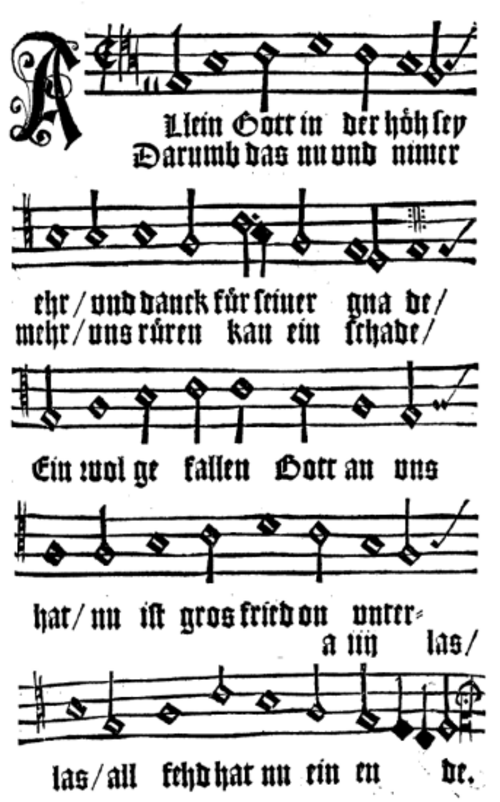
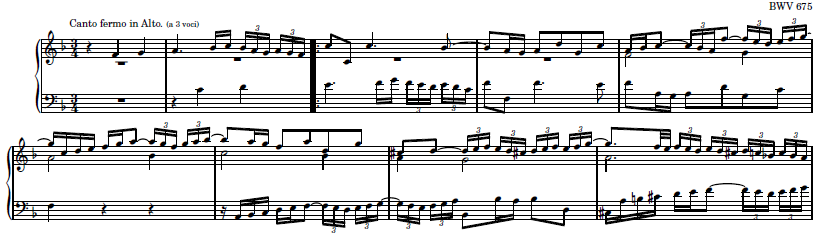
バッハのドイツのグロリア/三位一体賛美歌「Allein Gott in der Höh'」の3つの編曲は、再び三位一体を暗示している。調の連続(F、G、A)は、最初の編曲BWV 675の冒頭の音符に反響している可能性があり、拍子記号や、楽章のさまざまなセクションに割り当てられた小節数にもそれが表れている。[ 44 ] 3つのコラール前奏曲は、3つの全く異なる扱いをしている。1つ目はアルトに定旋律がある手奏トリオ、2つ目はペダルに定旋律のヒントがあるペダルトリオソナタで、バッハのオルガンのための6つのトリオソナタBWV 525-530と似たスタイル、そして最後は旋律の最初の2行から派生したテーマを持つ3声の手奏フーゲッタである。以前の評論家たちは、いくつかの曲がクラヴィーア練習曲集IIIに「ふさわしくない」と考えており、特に「ひどく酷評された」BWV 675は、ヘルマン・ケラーがバッハのヴァイマル時代に書かれた可能性があると考えていた。[ 45 ]最近の評論家たちは、3曲すべてがバッハが曲集のために採用した一般的な原則、特にその型破りさと対位法の「奇妙さ」に合致していることを確認している。ウィリアムズ(2003)とバット(2006)は、バッハの音楽言語に対する同時代の音楽家の影響の可能性を指摘している。バッハは従兄弟のヨハン・ゴットフリート・ヴァルターによるAllein Gottの8つのバージョンや、バッハのライプツィヒの印刷業者クリューグナーによって死後出版されたゲオルク・フリードリヒ・カウフマンのHarmonische Seelenlustに精通していた。 BWV 675と677には、カウフマンのギャラント様式の革新と類似点が見られます。前者は三連符と二連符の対比、後者は独立した八分音符による明確なアーティキュレーションです。BWV 675の全体的なスタイルはカウフマンの「今こそ森よ静まれ」のスタイルと比較され、BWV 676はヴァルター自身の「神はただ一人」の5番目のスタイルと比較され、BWV 677はカウフマンの「我らはただ一人の神を信じる」のフーゲッタと多くの点で共通しています。
以下は、ルター版グロリアの4節のテキストと、チャールズ・サンフォード・テリーによる英語訳です。[ 39 ]
Allein Gott in der Höh' sei Ehr' und Dank für seine Gnade、 darum daß nun und nimmermehr uns rühren kann kein Schade。 ein Wohlgefall'n Gott an uns hat, nun ist groß' Fried' ohn' Unterlaß、 all ' Fehd' hat nun ein Ende。 Wir loben, preis'n, anbeten dich für deine Ehr';ダンケン、 ダス・デュ、ゴット・ファーター・エヴィグリッヒ・ レジスト・オール・ワンケン。 ganz ungemeß'n ist deine Macht、 fort g'schieht、dein Will' hat bedacht でした。 ヘレン! おお、イエス・キリストよ、Sohn eingebor'n deines hitmlischen Vaters、 versöhner der'r、die war'n verlor'n、 du Stiller unsers Haders、 Lamm Gottes、heil'ger Herr und Gott、 nimm an die Bitt' von unsrer Not、 erbarm' dich unser aller! おお、ハイルガー・ガイスト、デュ・ ヘヒステス・ガット、デュ・アレルヘイルサムスト・トロスター、 ヴォルのトイフェルス・グヴァルト・フォルタン・ベヒュット、死ね、 イエス・キリストは 永遠に死ね、マルトと苦いトッド、すべての無知を避けてください、 ジャムルとそうではありません! ダラウフ・ヴィル・ウンス・フェルラーセン。
いと高き神にすべての栄光あれ、 そして感謝あれ、神は実に慈悲深く、 それゆえ永遠に、 いかなる悪も私たちを苦しめることはない。 神の言葉は人々に善意を告げ、 地上には再び平和が回復された、 私たちの救い主イエス・キリストを通して。 私たちは謙遜にあなたを崇拝し、賛美し、 あなたの偉大な栄光を讃えます。 父よ、あなたの王国は永遠に続き、 弱くも、一時的なものでもありません。 あなたの力はあなたの賛美のように無限であり、 あなたが語れば宇宙は従います。 そのような主のもとで私たちは幸せです。 おお、いと高き玉座に座るイエス・キリスト、 父の愛する御子 、失われた罪人はあなたによって近くに引き寄せられ、 罪と呪いは取り除かれる。 一度屠られた小羊よ、私たちの神であり主よ、 困窮する祈りに耳を傾け、 私たちすべてに憐れみをかけてください。 慰め主、聖霊なる神よ、 慰めの源よ、 サタンの力から私たちを守り、 キリストの会衆を守り、 永遠の真理を宣言し、 あらゆる悪を慈しみをもって遠ざけ、 私たちを永遠の命へと導いてください。

BWV 675は66小節からなる、上声部と下声部による2声のインヴェンションで、アルト声部に定旋律が用いられています。外側の2声部は複雑でリズミカルに難解であり、広い跳躍音程が特徴的です。一方、定旋律は2分音符と4分音符で滑らかに進行します。3 / 4拍子は、この楽章における三位一体への言及の一つと解釈されています。先行する 2 つのコラール前奏曲と同様に、明確な手鍵盤記号はなく、曖昧な「a 3」のみがある。演奏者は、単一の鍵盤で演奏するか、4フィート (1.2 m)のペダルを備えた 2 つの鍵盤で演奏するかを選択できる。唯一の難点は、28 小節目の三連符である。[ 46 ]この楽章は、セクションの小節の長さが 3 で割り切れる小節形式(AAB) である。18 小節のシュトレンには、定旋律ありとなしの 9 小節があり、30 小節のアブゲザングには、定旋律ありの 12 小節と定旋律なしの 18 小節がある。[ 47 ]インヴェンション主題は定旋律の先取りを提供し、対応する各フェーズと同じ音符と小節の長さを包含する。主題の追加のモチーフは、作品全体を通して巧妙に展開される。上昇する 3 つの開始音符、2 小節目の下降する 3 つの三連符。 3小節目の冒頭の跳躍するオクターブと、4小節目の8分音符の音型。これらは、対主題の2つのモチーフ(5小節目の末尾の3連符の音型と6小節目の冒頭の16分音符の音階)とその転回形と、絶えず変化する形で遊び心たっぷりに組み合わされている。各シュトレンとアプゲザングの終わりには、外側のパートの複雑さが軽減され、ソプラノでは単純な3連符の下降音階パッセージ、バスでは8分音符が用いられる。和声付けはバッハのライプツィヒ・カンタータに似ており、調は長調と短調の間を行き来する。

BWV 676は、2つの鍵盤楽器とペダルのためのトリオ・ソナタで、126小節の長さです。賛美歌の旋律は、定旋律、上声部の主題のパラフレーズ、そして和声の中に遍在しています。作曲様式と細部は、魅力的で優雅であり、オルガンのためのトリオ・ソナタBWV 525-530と似ています。コラール前奏曲は耳に心地よく、技術的な難しさを感じさせません。トリオ・ソナタとは異なり、定旋律の旋律線によってリトルネロ形式が規定されており、この場合、定旋律線は最後の旋律線が2番目の旋律線と同一である初期の変奏形が用いられています。この特徴と旋律線自体の長さが、BWV 676の異例の長さの理由となっています。

BWV 676の音楽形式は、以下のように分析できる。


BWV 677は、20小節からなる二重フーゲッタです。最初の5小節では、定旋律の最初の行に基づく第1主題と対主題がストレッタで奏され、5小節から7小節にかけて応答が続きます。複雑な音楽テクスチャーの独創性は、定旋律へのさりげないながらも随所に散りばめられた言及と、3小節前半の滑らかな16分音符のモチーフによって生み出されています。このモチーフは楽曲全体を通して繰り返し現れ、第1主題の独立した8分音符と対照をなしています。 
対照的な第2主題は、定旋律の第2行に基づいており、7小節目の最後の8分音符からアルトパートで始まる。 
2つの主題と16分音符のモチーフは、16小節目から終結部まで組み合わされています。音楽的な図像の例としては、冒頭の主題の短三和音と16小節目の前半の下降音階が挙げられます。これらは三位一体と天の軍勢を暗示しています。

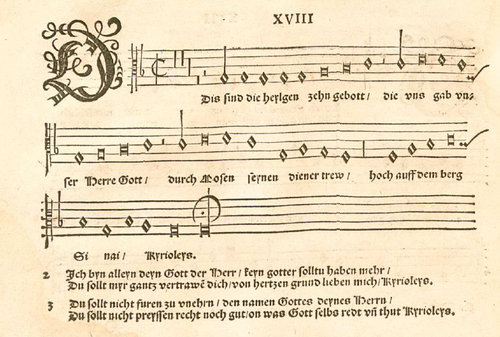
原稿を綿密に調べた結果、6つのカテキズム賛美歌を含む、ペダル付きの大規模なコラール前奏曲が最初に彫版されたことが判明した。カテキズム賛美歌のより小規模なマニュアル版と4つの二重奏曲は、残りのスペースに後から追加され、最初の5つのカテキズム賛美歌は3声部のフーガとして、最後の1つはより長い4声部のフーガとして作曲された。バッハは、この曲集の演奏しやすさを高めるために、これらの追加部分を家庭用鍵盤楽器で演奏できる曲として構想した可能性がある。しかし、単一の鍵盤楽器であっても、それらは困難を伴う。オルガニスト兼作曲家のゲオルク・アンドレアス・ゾルゲは、1750年に出版された自身のコラール前奏曲集の序文で、「ライプツィヒのバッハ氏の教理問答コラールに基づく前奏曲は、この種の鍵盤楽器作品の例であり、その名声に値する」と述べ、さらに「このような作品は非常に難しく、若い初心者や、必要な相当な熟練度を持たない人々にはほとんど使用できない」と付け加えた。[ 48 ]
以下は、チャールズ・サンフォード・テリーによる英語訳付きのルターの賛美歌の第1節のテキストです。[ 39 ]
前奏曲はト長調のミクソリディア旋法で、ト短調の変格終止で終わります。リトルネロは上声部と下声部で、上段鍵盤とペダル鍵盤で演奏され、定旋律は下段鍵盤のオクターブでカノン形式で演奏されます。リトルネロのエピソードと定旋律の5つの出現があり、十戒の数になります。各鍵盤に2つのパート、ペダル鍵盤に1つのパートというパートの配分は、ド・グリニーのオルガン楽譜集と似ていますが、バッハは右手パートにはるかに高い技術的要求を課しています。
解説者たちは、カノンを秩序を表すものと解釈しており、カノンと「法」という言葉遊びが用いられている。ルターの詩にも表現されているように、カノンの二つの声部は、キリストの新しい律法と、それが反映するモーセの古い律法を象徴するものと解釈されてきた。冒頭の上声部におけるオルガンの牧歌的な響きは、人間の堕落以前の静穏を表していると解釈されている。それに続いて罪深い放蕩の混乱が訪れ、最後に救済の静けさによって秩序が回復される。
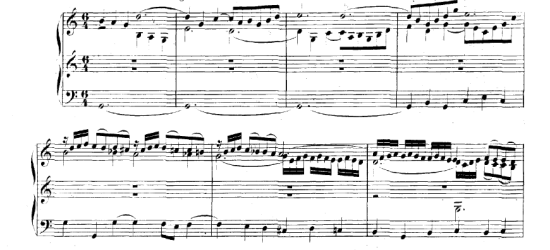
上声部とペダル部は、コラール前奏曲の冒頭のリトルネッロで導入されたモチーフに基づいた、精緻で高度に発展した幻想曲を展開する。これらのモチーフは、元の形、あるいは反転した形で繰り返し現れる。上声部には6つのモチーフがある。
そしてベースには5つ。
2つの上声部の書法はカンタータのオブリガート楽器の書法に似ており、その音楽素材はコラールとは独立している。一方、冒頭のペダルGは、定旋律の繰り返されるGの予兆として聴くことができる。その間、定旋律は第2鍵盤のオクターブでカノンで歌われる。定旋律の5番目で最後の登場は、遠い調である変ロ長調(ト短調)である。これは、第1節の終わりにあるキリエ・エレイソンの純粋さを表現しており、前奏曲を調和的に締めくくる。
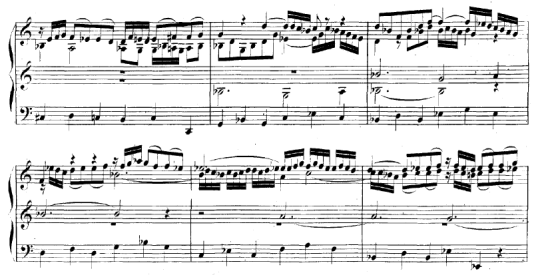
活気に満ちたジーグ風のフーゲッタは、より大きなコラール前奏曲といくつかの類似点がある。それは、ト長調のミクソリディア旋法であること、ト長調の繰り返しによるペダルポイントで始まること、主題の出現回数が10回であること(うち4回は反転)、そして曲が変格終止で終わることである。2小節目の後半のモチーフと対主題は、広範囲に展開されている。このフーゲッタの活気は、ルターが小教理問答で「主が命じられたことを喜んで行いなさい」と勧めていることを反映していると解釈されている。同様に、詩篇119篇は「主の定めを喜び」、律法を喜ぶことについて述べている。



以下は、チャールズ・サンフォード・テリーによる英語訳付きのルターの賛美歌の第1節のテキストです。[ 39 ]
4声部のコラール前奏曲は、ニ長調のドリア旋法によるフーガで、主題はルターの賛美歌の最初の行に基づいている。目立つ対主題は、ペダル・ベースで最初に聴かれる。ピーター・ウィリアムズによれば、このコラール前奏曲は、ジローラモ・フレスコバルディやジョヴァンニ・バッティスタ・バッサーニを彷彿とさせる、スティロ・アンティコ・イタリア様式で書かれている。イタリア的な要素は、上声部のフーガとオスティナートの数字付き低音を組み合わせたトリオ・ソナタ構造や、イタリア風の16分音符モチーフの全範囲を巧みに用いている点に表れている。原曲の賛美歌の冒頭のメリスマ「Wir」の5つの音符は、最初の2小節で拡張され、残りの音符は対主題に用いられる。賛美歌の長さが非常に長いためか、例外的に定旋律は用いられていない。しかし、賛美歌の残りの部分の特徴、特に音階のようなパッセージと旋律の跳躍が、この曲全体に浸透している。フーガの対主題は、ペダルに力強いストライド・バスとして、交互に足を動かす形で適応されている。その準オスティナート的な性格は、「神への確固たる信仰」を表していると一貫して解釈されてきた。ストライド・バスの旋律は、バッハがクレド楽章でよく用いたもので、例えばロ短調ミサ曲のクレドとコンフィテオルなどである。ペダルでオスティナートの対主題が現れるたびに、16分音符のブリッジング・パッセージ(8~9小節、19~20小節、31~32小節、44~45小節、64~66小節)があり、音楽は異なる調に転調し、3つの上声部は可逆対位法で演奏される。このようにして、3つの異なる旋律線は3つの声部間で自由に交換することができる。これらの非常に独創的な移行パッセージが作品にアクセントを加え、楽章全体に一貫性を与えている。追加された G♯ によってコラールの旋律を認識するのが難しくなっているが、後にテノール声部で歌われることでよりはっきりと聞き取れる。最後の手鍵盤エピソード (76~83 小節) では、オスティナートのペダル音型がテノール声部によって短時間取り上げられ、その後、楽章はペダルにおけるフーガの対主題の最後の長い再現で終了する。[ 49 ] [ 50 ] アメリカの音楽学者デイヴィッド・イヤーズリーは、コラールの前奏曲を次のように説明している。[ 51 ] 「このエネルギッシュでシンコペーションの効いた対位法は、ペダル上の反復する2小節の主題の上で展開され、リトルネロのように機能し、その繰り返し出現は長い休符によって区切られています。オスティナートは、長調と短調の両方で提示される様々な転調を通して一定のままです[...]ペダルラインの形状は、完全な対称性で上昇と下降の原型的な物語を示唆しています[...]この音型は、足の動きを教会へと力強く投影します。バッハ自身の演奏指示に従ってフルオルガン(In Organo pleno)で、適切な重厚さで録音された音で聴くと、足は真の目的を持って動きます[...] 『Wir glauben all'』はまさにオルガンで演奏される散歩のための曲です。」
ホ短調のマニュアルリター・フーゲッタは、クラヴィーア練習曲集第3巻の中で最も短い楽章であり、この曲集のちょうど中間に位置する。主題はコラールの最初の旋律を言い換えたもので、曲の後半にある2小節のパッセージは、2番目のコラールの旋律に基づいて構成され、劇的な減七の和音へと繋がる。厳密にはフランス風の序曲ではないものの、この曲集には特に付点リズムなど、フランス風の要素が取り入れられている。バッハはここで、長大な曲集の後半をフランス風の楽章で始めるという慣例に従っている(他の3巻のクラヴィーア練習曲集、平均律クラヴィーア曲集の2巻、フーガの技法の初期手稿版、音楽的犠牲の5つの番号付きカノン群と同様)。また、イタリア風のスタイルに続いて、対照的なフランス風のスタイルを用いることで、先行するコラール前奏曲を補完している。明らかにオルガン用に書かれた曲ではあるが、その様式は、フランス組曲第1番ニ短調BWV 812のチェンバロのためのジーグに最もよく似ている。


以下は、チャールズ・サンフォード・テリーによる英語訳付きのルターの賛美歌の第1節のテキストです。[ 39 ]
Vater unser im Himmelreich、 der du uns alle heissest gleich Brüder sein und dich rufen an und willst das Beten vor uns ha'n、 gib、dass nicht bet allein der Mund、 hilf、dass es geh' aus Herzensgrund。
天におられる我らの父よ、 心の中で我らすべてを 兄弟と呼び、汝に呼びかけ、 我らすべてから祈りを請うたたえる者よ、 口先だけでなく 心の奥底からも祈ることができるよう、どうか助けたまえ。
同様に、御霊も私たちの弱さを助けてくださいます。私たちはどのように祈るべきかを知らないからです。しかし、御霊ご自身が、言い表せないうめきをもって、私たちのためにとりなしてくださるのです。
—ローマ人への手紙8:26
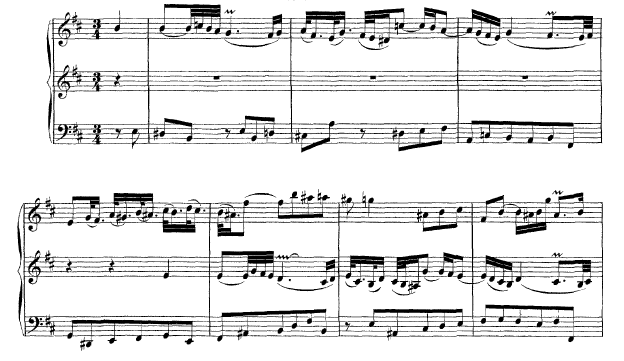
バッハのコラール前奏曲の中で、理解と演奏の両面で難解な作品として、長らく最も複雑な作品とされてきた。現代のフランス風ギャラント様式のリトルネロ・トリオ・ソナタを通して、第1節のドイツ語のコラールが、ほとんど意識されないほどに、オクターブのカノンで、各手で独奏楽器とともに演奏される。バッハは、カンタータ「わが魂のイエスよ」BWV 78の冒頭のコラール・ファンタジアで、すでにこのような複合形式を習得していた。カノンは律法への言及である可能性があり、ルターは律法への遵守を祈りの目的の一つとみなしていた。
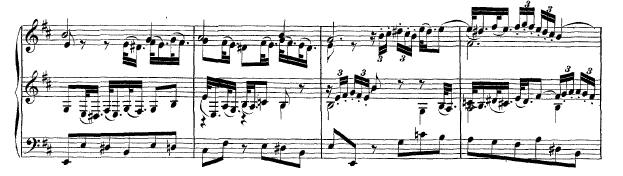
上声部のガラント様式は、ロンバルディア風のリズムと、16分音符と対をなすこともある独立した16分音符の三連符に反映されており、当時のフランスのフルート音楽に典型的なものである。下声部では、ペダルが絶えず変化するモチーフを伴う、落ち着きのない通奏低音を奏でる。技術的な面では、ドイツの音楽学者ヘルマン・ケラーがBWV 682には4段鍵盤と2人の奏者が必要だと提案したが、これは受け入れられなかった。しかし、バッハが弟子たちに強調したように、アーティキュレーションは極めて重要であり、付点音符と三連符は区別されなければならず、「音楽が非常に速い」場合にのみ一緒に演奏されるべきである。
上声部の主題は、トリオ・ソナタや協奏曲の緩徐楽章の器楽ソロのように、賛美歌を凝ったコロラトゥーラで表現したものです。その彷徨い、ため息をつくような性質は、神の保護を求める救われていない魂を表していると解釈されてきました。この主題には、前奏曲で大々的に展開される3つの重要な要素があります。3小節目のロンバルディアのリズム、5小節目と6小節目の間の半音階的な下降フレーズ、そして10小節目の独立した16分音符の三連符です。バッハは1730年代初頭にすでにロンバルディアのリズムを使用しており、特にカンタータ「Gloria in excelsis Deo, BWV 191」のロ短調ミサ曲の「 Domine Deus」の初期バージョンで使用しています。高まるロンバルディアの音型は「希望」と「信頼」を表し、苦悩に満ちた半音階は「忍耐」と「苦しみ」を表していると解釈されてきました。作品のクライマックスである41小節では、ロンバルディアのリズムがペダルへと移行するにつれて、上声部で半音階主義が極限に達する。

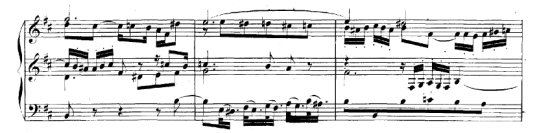
The otherworldly way in which the solo parts weave around the solo lines of the chorale, almost hiding them, has suggested to some commentators "groanings which cannot be uttered"—the mystical nature of prayer. After its first statement the ritornello recurs six times but not as a strict repeat, instead the order in which the different motifs are heard constantly changes.[52]
The manualiter chorale prelude BWV 683 in the Dorian mode of D is similar in form to Bach's earlier composition BWV 636 on the same subject from the Orgelbüchlein; the lack of a pedal part allows more freedom and integration of parts in the latter work. The cantus firmus is played without interruption in the uppermost part, accompanied by three-part counterpoint in the lower parts. The accompaniment uses two motifs: the five descending semiquavers in the first bar, derived from the fourth line of the chorale "und willst das beten von uns han" (and wishes us to pray); and the three quaver figure in the alto part in the second half of bar 5. The first motif is also inverted. The quiet and sweetly harmonious nature of the music is evocative of prayer and contemplation. Its intimate scale and orthodox style provide a complete contrast to the previous "larger" setting in BWV 682. At the beginning of each line of the chorale, the musical texture is pared down, with more voices added towards the end of the line: the long very first note of the chorale is unaccompanied. The prelude comes to a subdued conclusion in the lower registers of the keyboard.


Below is the text of the first and last verses of Luther's hymn "Christ unser Herr zum Jordan kam" with the English translation by Charles Sanford Terry:[39]
Christ unser Herr zum Jordan kam nach seines Vaters Willen, von Sanct Johann die Taufe nahm, sein Werk und Amt zu 'rfüllen, Da wollt er stiften uns ein Bad, zu waschen uns von Sünden, ersaüfen auch den bittern Tod durch sein selbst Blut und Wunden; es galt ein neues Leben. Das Aug allein das Wasser sieht, wie Menschen Wasser gießen; der Glaub im Geist die Kraft versteht des Blutes Jesu Christi; und ist vor ihm ein rote Flut, von Christi Blut gefärbet, die allen Schaden heilen tut, von Adam her geerbet, auch von uns selbst begangen.
To Jordan when our Lord had gone, His Father's pleasure willing, He took His baptism of St John, His work and task fulfilling; Therein He would appoint a bath To wash us from defilement, And also drown that cruel Death In His blood of assoilment: 'Twas no less than a new life. The eye but water doth behold, As from man's hand it floweth; But inward faith the power untold Of Jesus Christ's blood knoweth. Faith sees therein a red flood roll, With Christ's blood dyed and blended, Which hurts of all kinds maketh whole, From Adam here descended, And by ourselves brought on us.
When in the arrangement of the chorale "Christ unser Herr zum Jordan kam" an unceasing figure of flowing semiquavers makes itself heard, it needs no skilled critic of Bach's works to find in this an image of the river Jordan. Bach's real meaning, however, will not reveal itself thoroughly to him until he has read the whole poem to the last verse, in which the water of baptism is brought before the believing christian as a symbol of the atoning Blood of Christ
—Philipp Spitta, Johann Sebastian Bach, 1873
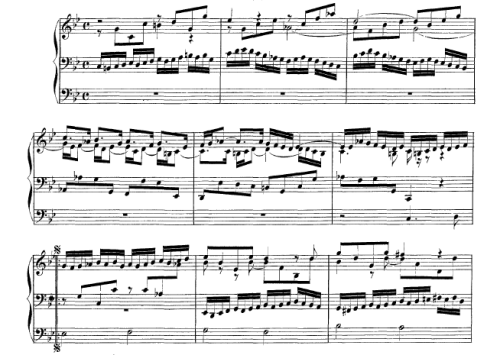
The chorale prelude Christ unser Herr zum Jordan kam BWV 684 has a trio sonata like ritornello in C minor in the three parts of the manuals with the cantus firmus in the tenor register of the pedal in the Dorian mode of C. Bach specifically stipulates two keyboards to give different sonorities to the imitative upper parts and the bass part. The undulating semiquavers in the bass, usually interpreted as representing the flowing waters of the Jordan, imitate a violine continuo, according to the model of Kauffmann's Harmonische Seelenlust. The musical content of the ritornello contains explicit allusions to the melody of the chorale, sometimes hidden in the semiquaver passage work and motifs.

The chorale prelude on baptism, "Christ unser Herr zum Jordan kam", ... represents running waters ... in the last verse of the chorale, baptism is described as a wave of salvation, stained with the Blood of Christ, which passes over humanity, removing all blemish and sin. The small version of the chorale prelude ... is a curious miniature ... four motifs come forward simultaneously: the first phrase of the melody and its inversion; and the first phrase of the melody in a faster tempo and its inversion ... Is not this the case of a very literal observation? Do we not believe that we see waves rising and falling, with the faster waves tumbling over the slower waves? And is not this musical imagery addressed more to the eye than the ear?
—Albert Schweitzer, J.S. Bach, le musicien-poète, 1905[53]

The manualiter chorale prelude BWV 685, despite being only 27 bars long and technically speaking a three-part fughetta, is a complex composition with dense fugal writing. The subject and countersubject are both derived from the first line of the cantus firmus. The compact style, imitative contrapuntal writing and sometimes capricious touches, such as repetition and the ambiguity in the number of parts, are features that BWV 685 shares with the shorter chorale preludes in Kauffmann's Harmonische Seelenlust.[54][55] The contrary motion between the parts in bar 9 harks back to the compositions of Samuel Scheidt. Williams (2003) has given a precise analysis of the fughetta:
There have been many attempts to interpret the musical iconography of BWV 685. Albert Schweitzer suggested that the subject and countersubject gave the visual impression of waves. Hermann Keller suggested that the three entries of the subject and countersubject, and the three inversions, represent the three immersions at baptism. Others have seen allusions to the Trinity in the three voices. The subject and countersubject have been seen as representing Luther's baptismal themes of Old Adam and New Man. Whatever the intended symbolism, Bach's most probable compositional aim was to produce a shorter chorale prelude contrasting musically with the preceding longer setting.
Below is the text of the first and last verses of Luther's hymn with the English translation by Charles Sanford Terry:[39]
Aus tiefer Not schrei ich zu dir, Herr Gott, erhör mein Rufen. Dein gnädig Ohren kehr zu mir und meiner Bitt sei öffne; denn so du willst das sehen an, was Sünd und Unrecht ist getan, wer kann, Herr, vor dir bleiben? Darum auf Gott will hoffen ich, auf mein Verdienst nicht bauen; auf ihn mein Herz soll lassen sich und seiner Güte trauen, die mir zusagt sein wertes Wort; das ist mein Trost und treuer Hort, das will ich allzeit harren.
Out of the depths I cry to Thee, Lord, hear me, I implore Thee! Bend down Thy gracious ear to me, Let my prayer come before Thee! If Thou rememberest each misdeed, If each should have its rightful meed, Who may abide Thy presence? And thus my hope is in the Lord, And not in mine own merit; I rest upon His faithful word To them of contrite spirit; That He is merciful and just— Here is my comfort and my trust, His help I wait with patience.
It is significant of Bach's manner of feeling that he should choose this chorale for the crowning point of his work. For it cannot be questioned that this chorale is its crowning point, from the ingenuity of the part-writing, the wealth and nobility of the harmonies, and the executive power which it requires. Even the Northern masters had never attempted to write two parts for the pedals throughout, though they had first introduced the two-part treatment of the pedals, and Bach did them full justice in this piece.
—Philipp Spitta, Johann Sebastian Bach, 1873
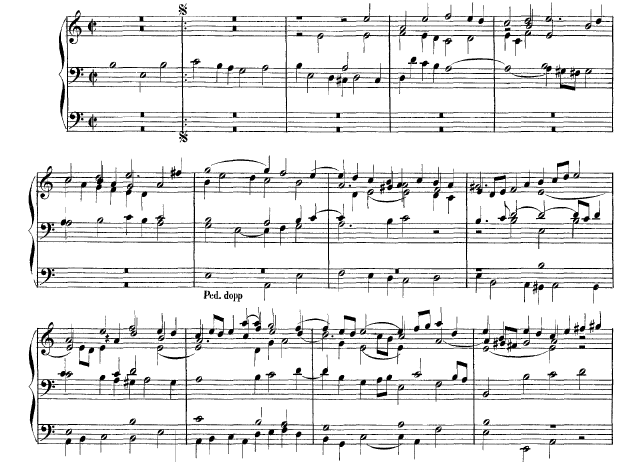


The chorale prelude Aus tiefer Not schrei ich zu dir BWV 686 is a monumental chorale motet in the phrygian mode of C. The climax of Clavier-Übung III, it is composed in the strict polyphonic stile antico of Palestrina using florid counterpoint. This is Bach's unique six-part composition for organ, if the Ricercar a 6 from the Musical Offering BWV 1079 is discounted.[56] German organ writing for double pedal (doppio pedale) can be traced back to Arnolt Schlick and Ludwig Senfl in the 16th century; to Samuel Scheidt in two settings from his Tabulatura Nova in the early 17th century; and in the baroque period to Buxtehude, Reincken, Bruhns, Tunder, Weckmann and Lübeck. In France, among the composers to have written double pedal parts were François Couperin, in his organ Mass des paroisses, and Louis Marchand.[57]
The first verse of Luther's hymn had already been set by Bach in the cantata Aus tiefer Not schrei ich zu dir, BWV 38 (1724). The fact that the setting in BWV 686 flows more easily, has more countersubjects, has more novel features and has typically organ figurations in the final section has suggested that in this case the whole of Luther's text was taken into account and that it is a purer version of the stile antico. Following the huge scale of the opening, Bach highly inventively incorporates motifs from the cantus firmus into the countersubjects of the seven sections (counting the repeat), resulting in a constantly changing musical texture. The widest range in pitch between upper and lower parts occurs exactly halfway through at bar 27. At the end of each line the cantus firmus is taken up in the left (lower) pedal, which, without break, then plays the countersubject while above the right (upper) pedal concludes the section by playing the cantus firmus in the tenor register in augmentation (i.e., with doubled note lengths).[58] The proliferation of dactyl "joy" motifs (a crotchet followed by two quavers) in the last section of the prelude reflects the optimism in the last verse.
Williams (2003) has given the following analysis of the seven sections:


This smaller manualiter setting of Aus tiefer Noth schrei' ich zu dir is a four-part chorale motet in the key of F♯ minor, with the augmented cantus firmus in the phrygian mode of E in the uppermost soprano part. The strict contrapuntal writing is denser than that of BWV 686, although it adheres less to the stile antico and has a more uniform texture. Commentators have suggested that the continual responses to the fugue subjects by their inversion signify confession followed by forgiveness. Williams (2003) has pointed out the following musical features in the seven sections of BWV 687:


Below is the full text of Luther's hymn with the English translation by Charles Sanford Terry:[39]
These grand pieces are at the same time eloquent witnesses to his depth of nature, both as a poet and as a composer. Bach always deduced the emotional character of his organ chorales from the whole hymn, and not from its first verse alone. In this way he generally obtained from the poem some leading thought, which seemed to him of particular importance, and in accordance with which he gave to the composition a poetic and musical character of its own. We must follow out his method in detail in order to have been sure that we have grasped his meaning. In the hymn for the Holy Communion, "Jesus Christus unser Heiland," the counterpoint, with its broad, ponderous progressions, may, to the superficial observer, seem unsuitable to the character of the hymn. The attentive reader of the words will, however, soon find the passage that gave rise to this characteristic musical phrase ... the fifth verse. Faith, lively and immovable, together with the solemnity of a consciousness of sin, are the two elements which constitute the emotional groundwork of the piece.
—Philipp Spitta, Johann Sebastian Bach, 1873
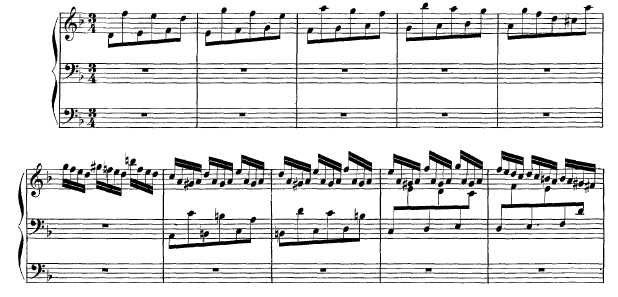
The chorale prelude Jesus Christus, unser Heiland BWV 688 is a trio sonata with the upper voices in quavers and semiquavers the manuals and the cantus firmus in minims in the pedal in the Dorian mode of G, like a Gregorian chant. The eccentric angularity of the keyboard subject with its great widening or narrowing leaps is derived from the melody. It has prompted much speculation as to its iconographic significance. "Unwavering faith" has been taken to be the underlying theme by many commentators, including Spitta and Schweitzer, who compared the unsteady theme to the vision of a sailor seeking a firm foothold on a stormy deck (un marin qui cherche un appui solide sur une planche roulante). Others have interpreted the leaping theme as representing Man's parting from and return to God; or as the "great agony" (großer Arbeit) of the sixth verse; or as the anger of God appeased by the suffering of Christ (the theme followed by its inversion); or as a reference to the treading of the winepress in the passage
"Wherefore art thou red in thine apparel, and thy garments like him that treadeth in the winefat? I have trodden the winepress alone; and of the people there was none with me: for I will tread them in mine anger, and trample them in my fury; and their blood shall be sprinkled upon my garments, and I will stain all my raiment."
from Isaiah 63:2–3, signifying victory over the Cross. It has similarly been suggested that the semiquaver passages are a reference to the flowing wine-blood of the communion. Visually, the quaver theme might contain a cross motif and might form an elongated Christogram on the Greek letters iota and chi in certain sections of the score.
Whatever the religious significance, the musical development from the motifs is ingenious and subtle, constantly varying. The material in the semiquaver codetta (bar 6) of the fugue subject and of the countersubject (bars 7–9) is used and developed extensively throughout BWV 688, sometimes in inverted form. The theme itself is transformed in all sorts of ways, including inversion, reflection, reversal and syncopation, the variety increased by how the two upper voices combine. Once started, the semiquaver figures form a moto perpetuo. At some points, they contain hidden versions of the quaver fugue subject; but as the work progresses, they gradually simplify to scale passages. Even the ending is unconventional, with a simulated ritardando in the last bars with the pedal silent. The chorale prelude is thus composed from a few organic motifs heard already in the first few bars. The unprecedented novelty and musical originality of such a self-generated composition might have been Bach's main intention.
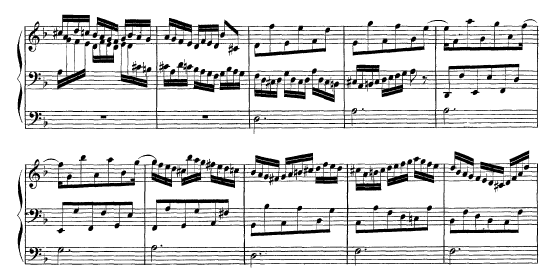

Improvising fugues was part of the organist's stock in trade ... The present fugue is an almost unimaginably transfigured version of this genre, which Bach also resuscitated and handled less radically elsewhere in the Clavierübung. It must also be one of the most dramatic, in the sense of eventful, fugues Bach ever wrote. The drama begins in a mood of sobriety and pain and ends in transcendence.
—Joseph Kerman, The Art of Fugue: Bach Fugues for Keyboard, 1715–1750
The last manualiter four-part chorale prelude, Jesus Christus, unser Heiland BWV 689 in C minor, is marked "Fuga super Jesus Christus, unser Heyland" in the 1739 print. In contrast to the previous fughettas in the previous five manualiter settings of the catechism hymns, it is a long and complex fugue of great originality, a tour de force in the use of stretti. The fugue subject is derived from the first line of the chorale. In order to facilitate the stretti which underlie the whole conception of BWV 689, Bach chose to transform the modal melody by sharpening the fourth note from a B♭ to a B♮, a modification already found in 17th-century hymnbooks. This change also allowed Bach to introduce dissonances, imbuing the work with what the French organist and musicologist Norbert Dufourcq called "tormented chromaticism".[60] The quaver countersubject and its inversions are used and developed throughout the fugue. It resembles some of Bach's other keyboard fugues, in particular the antepenultimate fugue in B♭ minor BWV 891/2 of the second book of The Well-Tempered Clavier, composed at roughly the same time.
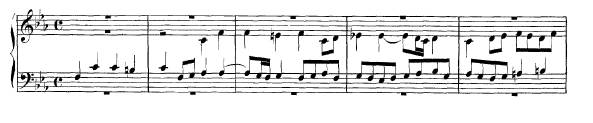
The inversion of the countersubject in bar 5, omitting the first note, plays a significant role later in the fugue (bar 30):
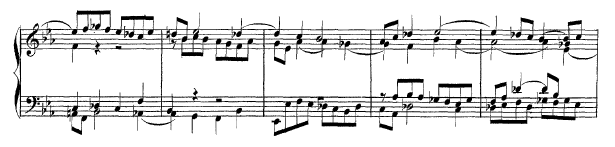
The stretti occur at intervals of varying length; in addition to the fugue subject, there are also imitations and stretti both for the semiquaver figure in the subject (and its inversions) and the figure above derived from the countersubject. Williams (2003) has given the following summary of the stretti for the fugue subject:
The last entry of the fugue subject in the tenor voice gives the impression of the return of a conventional cantus firmus; the coda over the tenor's sustained F is built on the motifs of the countersubject. The different types of stretti result in a large variety of harmonisations of the theme and musical textures throughout the chorale prelude.

Kerman (2008) has given a detailed analysis of BWV 689 from the perspective of Bach's keyboard fugues:

The four duetti BWV 802–805, in the successive tonalities of E minor, F major, G major and A minor, were included at a fairly late stage in 1739 in the engraved plates for Clavier-Übung III. Their purpose has remained a source of debate. Like the beginning prelude and fugue BWV 552 they are not explicitly mentioned on the title page and there is no explicit indication that they were intended for organ. However, as several commentators have noted,[61] at a time when Bach was busy composing counterpoint for the second book of The Well-Tempered Clavier and the Goldberg Variations (Clavier-Übung IV) using a very wide harpsichord range, Bach wrote the duets to lie comfortably in the range C to c″″′ in Helmholtz pitch notation (C2 to C6 in scientific pitch notation), so within the relatively narrow compass of almost every organ of the time. The pieces can nevertheless be played on any single keyboard, such as a harpsichord or fortepiano.
The use of the term duetto itself is closest to that given in the first volume of the Critica Musica (1722) of Johann Mattheson: a piece for two voices involving more than just "imitation at the unison and the octave". It was Mattheson's view that "a composer's true masterpiece" could rather be found in "an artful, fugued duet, more than a many-voiced alla breve or counterpoint". In choosing the form of the compositions, which go considerably beyond his Two part inventions BWV 772–786, Bach might have been making a musical contribution to the contemporary debates on the theory of counterpoint, already propounded in the tracts of Friedrich Wilhelm Marpurg and of Johann Fux, whose Gradus ad Parnassum had been translated by Bach's friend Mizler. Yearsley (2002) has suggested that it may have been a direct response to the ongoing argument on musical style between Birnbaum and Scheibe: Bach combines the simple and harmonious styles advocated by his critics Mattheson and Scheibe with a more modern chromatic and often dissonant style, which they regarded as "unnatural" and "artificial". Despite many proposed explanations—for example as accompaniments to communion, with the two parts possibly signifying the two sacramental elements of bread and wine—it has never been determined whether Bach attached any religious significance to the four duets; instead it has been considered more likely that Bach sought to illustrate the possibilities of two-part counterpoint as fully as possible, both as a historical account and "for the greater glory of God".[62]
The first duet in E minor is a double fugue, 73 bars long, in which all the musical material is invertible, i.e. can be exchanged between the two parts. The first subject is six bars long broken up into one bar segments. It is made up of one bar of demisemiquaver scales leading into four bars where the theme becomes angular, chromatic and syncopated. In the sixth bar a demisemiquaver motif is introduced that is developed later in the duet in a highly original way; it also serves as a means of modulation after which the parts interchange their roles. The contrasting second subject in quavers with octave leaps is a descent by a chromatic fourth. The harmonies between the two chromatic parts are similar to those in the A minor prelude BWV 889/1 from the second book of The Well-Tempered Clavier, presumed to have been composed at roughly the same time.
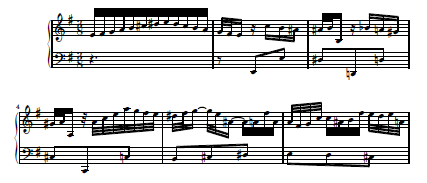
BWV 802 has been analysed as follows:
The A section of the F major Duetto is everything that Scheibe could have asked for—and that is not enough for Bach, who moves here far beyond the clarity and unity of the F major invention. Without the B section the Duetto is the perfect work of 1739, completely in and of its time. In its entirety however the piece is a perfect blasphemy—a powerful refutation indeed of the progressive shibboleths of naturalness and transparency.
—David Yearsley, Bach and the meanings of counterpoint
The second duet in F major BWV 803 is a fugue written in the form of a da capo aria, in the form ABA. The first section has 37 bars and the second 75 bars, so that with repeats there are 149 bars. There is a sharp contrast between the two sections, which Yearsley (2002) has suggested might have been Bach's musical response to the acrimonious debate on style being conducted between Scheibe and Birnbaum at the time of composition. Section A is a conventional fugue in the spirit of the Inventions and Sinfonias, melodious, harmonious and undemanding on the listener—the "natural" cantabile approach to composition advocated by both Mattheson and Scheibe.
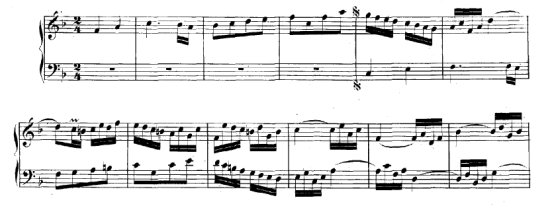
Section B is written in quite a different way. It is severe and chromatic, mostly in minor keys, with dissonances, strettos, syncopation and canonic writing—all features frowned upon as "artificial" and "unnatural" by Bach's critics. Section B is divided symmetrically into segments of 31, 13 and 31 bars. The first subject of section A is heard again in canon in the minor key.
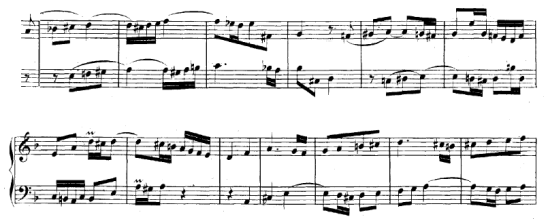
The character of the first subject undergoes a complete transformation, from bright and effortless simplicity to dark and strained complexity: the strettos in the first subject produce unusual augmented triads; and a new chromatic countersubject emerges in the central 13-bar segment (which begins in bar 69, the fifth bar below).
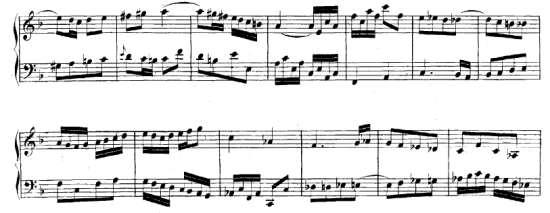
The musical structure of Section A is as follows:
The musical structure of Section B is as follows:
The third duet BWV 804 in G major, 39 bars long, is the simplest of the four duetti. Light and dance-like, it is the closest in form to Bach's Two Part Inventions, of which it most closely resembles the last, No.15 BWV 786. The bass accompaniment in detached quavers of the subject does not appear in the upper part and is not developed.

With very little modulation or chromaticism, the novelty of BWV 804 lies in the development of the semiquaver passagework.
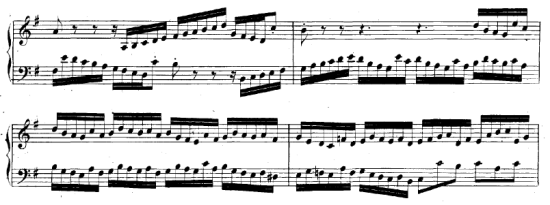
Apart from a contrasting middle section in E minor, the tonality throughout is resolutely that of G major. The use of broken chords recalls the writing in the first movements of the sixth trio sonata for organ BWV 530 and the third Brandenburg Concerto BWV 1048.
BWV 804 has the following musical structure:
BWV 805 is a fugue in strict counterpoint in the key of A minor, 108 bars long. The 8 bar subject starts in minims with a second harmonic half in slow quavers. Bach introduced further "modern" elements in the semitone drops in the subject and later motifs (bars 4 and 18). Although all entries of the subject are either in A minor (tonic) or E minor (dominant), Bach adds chromaticism by flattening notes in the subject and sharpening notes during modulating passages. Despite being a rigorous composition with carefully devised invertible counterpoint, i.e. with parts that can be interchanged, in parts its style is similar to that of the bourée from the Overture in the French style, BWV 831 from Clavier-Übung II. There are three episodes which move between different keys and combine three new pairs of motifs, either 2 bars, 4 bars or 8 bars long, in highly original and constantly changing ways. The first episode starts in bar 18 below with the first pair of new motifs, the upper one characterised by an octave drop:
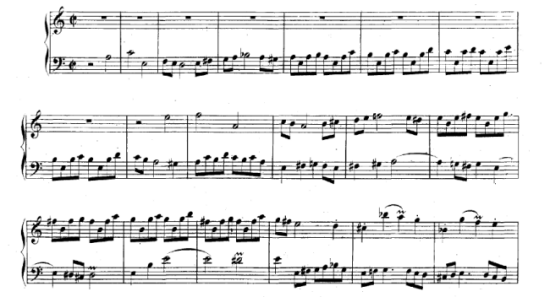
At the end of the first episode, the second harmonious pair of motifs is introduced:

The third pair of motifs, which allows significant modulation, appears for the first time in the second half of the second episode and is derived from the second half of the subject and countersubject:

The musical structure of BWV 805 has been analysed as follows:
Finally, Mr. ——— is the most eminent of the Musikanten in ———. He is an extraordinary artist on the clavier and on the organ, and he has until now encountered only one person with whom he can dispute the palm of superiority. I have heard this great man play on various occasions. One is amazed at his ability, and one can hardly conceive how it is possible for him to achieve such agility, with his fingers and with his feet, in the crossings, extensions, and extreme jumps that he manages, without mixing in a single wrong tone, or displacing his body by any violent movement. This great man would be the admiration of whole nations if he had more amenity, if he did not take away the natural element in his pieces by giving them a turgid and confused style, and if he did not darken their beauty by an excess of art.
—Johann Adolf Scheibe, 1737


In 1737, two years before the publication of Clavier-Übung III, Johann Adolf Scheibe had made the above notoriously unfavourable comparison between Bach and another composer of the time, now identified as Georg Frideric Handel. His comments represented a change in contemporary musical aesthetics: he advocated the simpler and more expressive galant style, which after Bach's death in 1750 would be further developed during the classical period, in preference to fugal or contrapuntal writing, which by then was considered old-fashioned and out-moded, too scholarly and conservative. Although Bach did not actively participate in the ensuing debate on musical styles, he did incorporate elements of this modern style in his later compositions, in particular in Clavier-Übung III. Bach's musical contributions, however, could only be properly assessed at the beginning of the 19th century, when his works became more widely available: up until then much of his musical output—in particular his vocal works—was relatively little known outside Leipzig.
From 1760 onwards a small group of ardent supporters became active in Berlin, keen to preserve his reputation and promulgate his oeuvre. The group centred around his son Carl Philipp Emanuel Bach, who in 1738 at the age of 24 had been appointed court harpsichordist at Potsdam to Frederick the Great, then crown prince before his accession to the throne in 1740. C.P.E. Bach remained in Berlin until 1768, when he was appointed Kapellmeister in Hamburg in succession to Georg Philipp Telemann. (His brother Wilhelm Friedemann Bach moved to Berlin in 1774, although not to general acclaim, despite his accomplishments as an organist.) Other prominent members of the group included Bach's former pupils Johann Friedrich Agricola, court composer, first director of the Royal Opera House in Berlin and collaborator with Emanuel on Bach's obituary (the Nekrolog, 1754), and more significantly Johann Philipp Kirnberger.
Kirnberger became Kapellmeister to the court in 1758 and music teacher of Frederick's niece, Anna Amalia. Not only did Kirnberger build up a large collection of Bach's manuscripts in the Amalien-Bibliothek, but with Friedrich Wilhelm Marpurg he promoted Bach's compositions through theoretical texts, concentrating in particular on counterpoint with a detailed analysis of Bach's methods. The first of the two volumes of Marpurg's Treatise on fugue (Abhandlung von der Fuge, 1753–1754) cites the opening segment of the six-part fugal chorale prelude Aus tiefer Noth BWV 686 as one of its examples. Kirnberger produced his own extensive tract on composition Die Kunst des reinen Satzes in der Musik (The true principles for the practice of harmony), twenty years later, between 1771 and 1779. In his treatise Marpurg had adopted some of the musical theories on the fundamental bass of Jean-Philippe Rameau from his Treatise on Harmony (1722) in explaining Bach's fugal compositions, an approach which Kirnberger rejected in his tract:
Rameau filled this theory with so many things that had no rhyme or reason that one must certainly wonder how such extravagant notions can have found belief and even champions among us Germans, since we have always had the greatest harmonists among us, and their manner of treating harmony was certainly not to be explained according to Rameau's principles. Some even went so far that they preferred to deny the soundness of a Bach in his procedure with respect to the treatment and progression of chords, rather than admit that the Frenchman could have erred.
This led to an acrimonious dispute in which both claimed to speak with Bach's authority.[63] When Marpurg made the tactical error of suggesting that, "His famous son in Hamburg ought to know something about this, too," Kirnberger responded in the introduction to the second volume of his tract:
Moreover, what Mr. Bach, Capellmeister in Hamburg, thinks of the excellent work of Mr. Marpurg, is shown by some passages from a letter that this famous man has written to me: "The behaviour of Mr. Marpurg towards you is execrable." Further: "You may loudly proclaim that my basic principles and those of my late father are anti-Rameau."
Through Bach's pupils and family, copies of his keyboard works were disseminated and studied throughout Germany; the diplomat Baron van Swieten, Austrian envoy to the Prussian court from 1770 to 1777 and afterwards patron of Mozart, Haydn and Beethoven, was responsible for relaying copies from Berlin to Vienna. The reception of the works was mixed, partly because of their technical difficulty: composers like Mozart, Beethoven and Rust embraced these compositions, particularly The Well-Tempered Clavier; but, as Johann Adam Hiller reported in 1768, many amateur musicians found them too hard ("Sie sind zu schwer! Sie gefallen mir nicht").[64]
Twenty-one prints of the original 1739 edition of Clavier-Übung III survive today. Because of its high price, this edition did not sell well: even 25 years later in 1764, C.P.E. Bach was still trying to dispose of copies. Because of changes in popular tastes after Bach's death, the publisher Johann Gottlob Immanuel Breitkopf, son of Bernhard Christoph Breitkopf, did not consider it economically viable to prepare new printed editions of Bach's works; instead he retained a master copy of Clavier-Übung III in his large library of original scores from which handwritten copies (hand-exemplar) could be ordered from 1763 onwards. A similar service was provided by the musical publishers Johann Christoph Westphal in Hamburg and Johann Carl Friedrich Rellstab in Berlin.[65]

Before 1800, there are very few reports of performances of Bach's works in England or of manuscript copies of his work. In 1770, Charles Burney, the musicologist and friend of Samuel Johnson and James Boswell, had made a tour of France and Italy. On his return in 1771 he published a report on his tour in The Present State of Music in France and Italy. Later that year in a letter to Christoph Daniel Ebeling, the music critic engaged in translating this work into German, Burney made one of his first references to Bach:
A long & laboured Fugue, recte et retro in 40 parts, may be a good Entertainment for the Eyes of a Critic, but can never delight the Ears of a Man of Taste. I was no less surprised than pleased to find Mr. C.P.E. Bach get out of the trammels of Fugues & crowded parts in which his father so excelled.
It was, however, only in the following year, during his tour of Germany and the Low Countries, that Burney received a copy of the first book of The Well-Tempered Clavier from C. P. E. Bach in Hamburg; according to his own reports, he was only to become familiar with its contents over thirty years later. He reported on his German tour in The Present State of Music in Germany, the Netherlands and United Provinces in 1773. The book contains the first English account of Bach's work and reflects the views commonly held at the time in England. Burney compared the learned style of Bach unfavourably with that of his son, whom he had visited:
How he formed his style, where he acquired all his taste and refinement, would be difficult to trace; he certainly neither inherited nor adopted them from his father, who was his only master; for that venerable musician, though unequalled in learning and contrivance, thought it so necessary to crowd into both hand all the harmony he could grasp, that he must inevitably have sacrificed melody and expression. Had the sone chosen a model, it would certainly have been his father, whom he highly reverenced; but as he has ever disdained imitation, he must have derive from nature alone, those fine feelings, that variety of new ideas, and selection of passages, which are so manifest in his compositions.
Burney summarised the musical contributions of J.S. Bach as follows:
Besides many excellent compositions for the church, this author produced Ricercari, consisting of preludes, fugues, upon two, three and four subjects; in Modo recto & contrario and in every one of the twenty-four keys. All the present organ-players of Germany are formed upon his school, as most of those on the harpsichord, clavichord and piano forte are upon that of his son, the admirable Carl. Phil. Emanuel Bach; so long known by the name of Bach of Berlin, but now music-director at Hamburg.

As it is known that at the time Burney knew hardly any of Bach's compositions, it appears that his opinions of Bach came second-hand: the first sentence was almost certainly lifted directly from the French translation of Marpurg's Treatise on fugue, to which he had referred earlier in the book for biographical details; and in 1771 he had acquired Scheibe's writings through Ebeling. In Germany Burney's book was not well received, infuriating even his friend Ebeling: in a passage that he changed in later editions, he had repeated without attribution comments from a letter of Louis Devisme, British plenipotentiary in Munich, that, "if innate genius exists, Germany is certainly not the seat of it; though it must be allowed, to be that of perseverance and application." Once aware of the offence this might cause to Germans, Burney had marked with pencil the offending passages in the copy of his daughter Fanny Burney, when in 1786 she became lady-in-waiting to Queen Charlotte, wife of George III. Later that year, to Fanny's horror, the Queen requested that Fanny show her copy to her daughter Princess Elizabeth. The book was viewed by both the King and Queen, who accepted Fanny's hastily invented explanations of the markings; she similarly managed to excuse herself when Princess Elizabeth later read all the marked passages assuming them to be Fanny's favourites.[66]
Burney was aware of George III's preference for Handel when in 1785 he wrote in his account of the 1784 Handel Commemoration that "in his full, masterly and excellent organ-fugues, upon the most natural and pleasing subjects, he has surpassed Frescobaldi, and even Sebastian Bach, and others of his countrymen, the most renowned for abilities in this difficult and elaborate species of composition." His account was translated into German by Hiller. Writing anonymously in the Allgemeine Deutsche Bibliothek in 1788, C.P.E. Bach angrily responded that "there is nothing to be seen but partiality, and of any close acquaintance with the principal works of J.S. Bach for organ we find in Dr. Burney's writings no trace." Undeterred by such comments in 1789, a year after C.P.E. Bach's death, Burney echoed Scheibe's earlier comparison of Bach and Handel when he wrote in his General History of Music:[67]
The very terms of Canon and Fugue imply restraint and labour. Handel was perhaps the only great Fughuist, exempt from pedantry. He seldom treated barren or crude subjects; his themes being almost always natural and pleasing. Sebastian Bach, on the contrary, like Michel Angelo in painting, disdained facility so much, that his genius never stooped to the easy and graceful. I never have seen a fugue by this learned and powerful author upon a motivo, that is natural and chantant; or even an easy and obvious passage, that is not loaded with crude an difficult accompaniments.
Burney reflected the English predilection for opera when he added:
If Sebastian Bach and his admirable son Emmanuel, instead of being music-directors in commercial cities, had been fortunately employed to compose for the stage and public of great capitals, such as Naples, Paris, or London, and for performers of the first class, they would doubtless have simplified their style more to the level of their judges; the one would have sacrificed all unmeaning art and contrivance, and the other have been less fantastical and recherché; and both, by writing a style more popular, would have extended their fame, and been indisputably the greatest musicians of the eighteenth century.
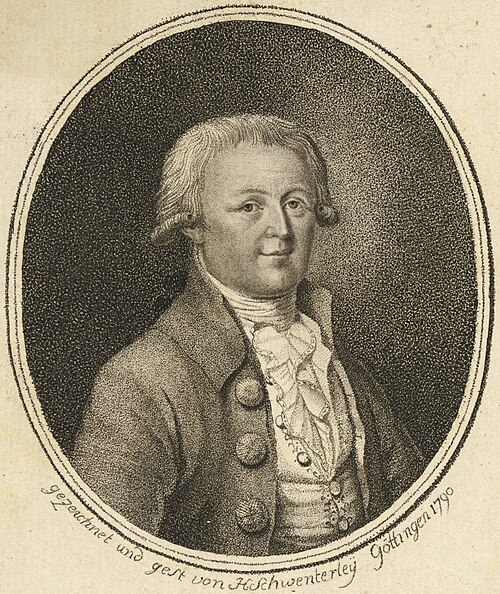

Johann Nikolaus Forkel, from 1778 the director of music in the University of Göttingen, was another promoter and collector of Bach's music. An active correspondent with both of Bach's sons in Berlin, he published the first detailed biography of Bach in 1802, Bach: On Johann Sebastian Bach's Life, Art and Works: For Patriotic Admirers of True Musical Art, including an appreciation of Bach's keyboard and organ music and ending with the injunction, "This man, the greatest orator-poet that ever addressed the world in the language of music, was a German! Let Germany be proud of him! Yes, proud of him, but worthy of him too!" In 1779, Forkel published a review of Burney's General History of Music in which he criticized Burney for dismissing German composers as "dwarves or musical ogres" because "they did not skip and dance before his eyes in a dainty manner"; instead he suggested it was more appropriate to view them as "giants".[68]
Among his criticisms of Bach in the 1730s, Scheibe had written, "We know of composers who see it as an honour to be able to compose incomprehensible and unnatural music. They pile up musical figures. They make unusual embellishments. ... Are these not truly musical Goths!" Until the 1780s, the use of the word "gothic" in music was pejorative. In his entry for "harmony" in the influential Dictionnaire de Musique (1768), Jean-Jacques Rousseau, a fierce critic of Rameau, described counterpoint as a "gothic and barbaric invention", the antithesis of the melodic galante style. In 1772, Johann Wolfgang von Goethe gave a fundamentally different view of "gothic" art that would achieve widespread acceptance during the classical-romantic movement. In his celebrated essay on the cathedral in Strasbourg, where he was a student, Goethe was one of the first writers to connect gothic art with the sublime:
The first time I went to the minster I was full of the common notions of good taste. From hearsay I respected the harmony of mass, the purity of forms, and I was the sworn enemy of the confused caprices of Gothic ornament. Under the term gothic, like the article in a dictionary, I threw together all the synonymous misunderstandings, such as undefined, disorganized, unnatural, patched-together, tacked on, overloaded, which had gone through my head. ... How surprised I was when I was confronted by it! The impression which filled my soul was whole and large, and of a sort that—since it was composed of a thousand harmonizing details—I could relish and enjoy, but by no means identify and explain. ... How often have I returned from all sides, from all distances, in all lights, to contemplate its dignity and magnificence. It is hard on the spirit of man when his brother's work is so sublime that he can only bow and worship. How often has the evening twilight soothed with its friendly quiet my eyes, tired-out with questing, by blending the scattered parts into masses which now stood simple and large before my soul, and at once my powers unfolded rapturously to enjoy and understand.
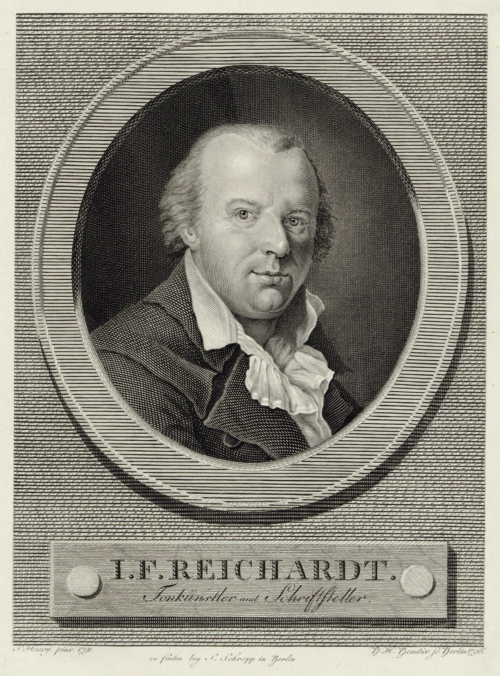
In 1782, Johann Friedrich Reichardt, since 1775 the successor to Agricola as Capellmeister in the court of Frederic the Great, quoted this passage from Goethe in the Musicalisches Kunstmagazin to describe his personal reactions to the instrumental fugues of Bach and Handel. He prefaced his eulogy with a description of Bach as the greatest counterpuntalist ("harmonist") of his age:
There has never been a composer, not even the best and deepest of the Italians, who so exhausted all the possibilities of our harmony as did J. S. Bach. Almost no suspension is possible that he did not make use of, and he employed every proper harmonic art and every improper harmonic artifice a thousand times, in earnest and in jest, with such boldness and individuality that the greatest harmonist, if called upon to supply a missing measure in the theme of one of his greatest works, could not be entirely sure of having supplied it exactly as Bach had done. Had Bach had the high sense of truth and the deep feeling for expression that animated Handel, he would have been far greater even than Handel himself; but as it is, he is only much more erudite and industrious.
The unfavourable comparison to Handel was removed in a later reprinting in 1796, following adverse anonymous remarks in the Allgemeine Deutsche Bibliothek. Reichardt's comparison between Bach's music and the Gothic cathedral would often be repeated by composers and music critics. His student, the writer, composer and music critic E.T.A. Hoffmann, saw in Bach's music "the bold and wonderful, romantic cathedral with all its fantastic embellishments, which, artistically swept up into a whole, proudly and magnificently rise in the air". Hoffmann wrote of the sublime in Bach's music—the "infinite spiritual realm" in Bach's "mystical rules of counterpoint".[69]
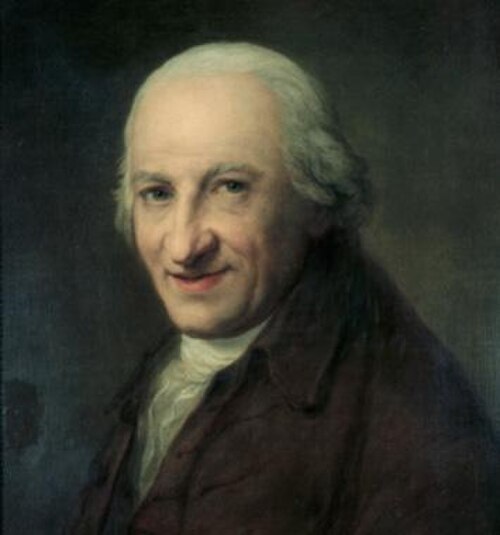
Another musician in C.P.E. Bach's circle was his friend Carl Friedrich Christian Fasch, son of the violinist and composer Johann Friedrich Fasch, who, on the death of Kuhnau in 1722, had turned down the post, later awarded to Bach, of kantor at the Thomaskirche, where he himself had been trained. From 1756 Carl Fasch shared the role of harpsichord accompanist to Frederick the Great at Potsdam with C.P.E. Bach. He briefly succeeded Agricola as director of the Royal Opera in 1774 for two years. In 1786. the year of Frederick the Great's death, Hiller organised a monumental performance in Italian of Handel's Messiah in a Berlin cathedral, recreating the scale of the 1784 London Handel Commemoration described in Burney's detailed account of 1785. Three years later in 1789, Fasch started an informal group in Berlin, formed from singing students and music lovers, that met for rehearsals in private homes. In 1791, with the introduction of a "presence book", it became officially known as the Sing-Akademie zu Berlin and two years later was granted its own rehearsal room in the Royal Academy of Arts in Berlin. As a composer, Fasch had learnt the old methods of counterpoint from Kirnberger and, like the Academy of Ancient Music in London, his initial purpose in founding the Sing-Akademie was to revive interest in neglected and rarely performed sacred vocal music, particularly that of J.S. Bach, Graun and Handel. The society subsequently built up an extensive library of baroque music of all types, including instrumental music.[70]


Despite Burney's antipathy towards Bach prior to 1800, there was an "awakening" of interest in the music of Bach in England, spurred on by the presence of émigré musicians from Germany and Austria, trained in the musical tradition of Bach. From 1782 Queen Charlotte, a dedicated keyboard player, had as music teacher the German-born organist Charles Frederick Horn; and in the same year Augustus Frederic Christopher Kollmann was summoned by George III from the Electorate of Hanover to act as organist and schoolmaster at the Royal German Chapel at St James's Palace. It is probable that they were instrumental in acquiring for her in 1788 a bound volume from Westphal of Hamburg containing Clavier-Übung III in addition to both books of The Well-Tempered Clavier. Other German musicians moving in royal circles included Johann Christian Bach, Carl Friedrich Abel, Johann Christian Fischer, Frederick de Nicolay, Wilhelm Cramer and Johann Samuel Schroeter.
More significant for the 19th-century English Bach revival was the presence of a younger generation of German-speaking musicians in London, well versed in the theoretical writings of Kirnberger and Marpurg on counterpoint but not dependent on royal patronage; these included John Casper Heck (c.1740 – 1791), Charles Frederick Baumgarten (1738–1824) and Joseph Diettenhofer (c.1743 – c.1799). Heck in particular promoted fugues in his treatise "The Art of Playing the Harpsichord" (1770), describing them later as "a particular stile of music peculiar to the Organ than the Harpsichord"; in his biographical entry for Bach in the 1780s in the Musical Library and Universal Magazine, he gave examples of counterpoint from Bach's late period (Canonic Variations, The Art of Fugue). Diettenhofer prepared A Selection of Ten Miscellaneous Fugues, including his own completion of the unfinished Contrapunctus XIV BWV 1080/19 from The Art of Fugue; prior to their publication in 1802 these were "tried at the Savoy Church, Strand before several Organists and eminent Musicians ... who were highly gratified and recommended their Publication." The enthusiasm of these German musicians was shared by the organist Benjamin Cooke and his student the organist and composer John Wall Calcott. Cooke knew them through the Royal Society of Musicians and had himself published a version of The Art of Fugue. Calcott corresponded with Kollmann about the musical theories of the Bach school. In 1798, he was one of the founding members of the Concentores Society, a club with a limited membership of twelve professional musicians, dedicated to composition in counterpoint and the stile antico.[71]
But it is only at his organ that he appears to be at his most sublime, most audacious, in his own element. Here he knows neither limits nor goals and works for centuries to come.
—Robert Schumann, Neue Zeitschrift, 1839
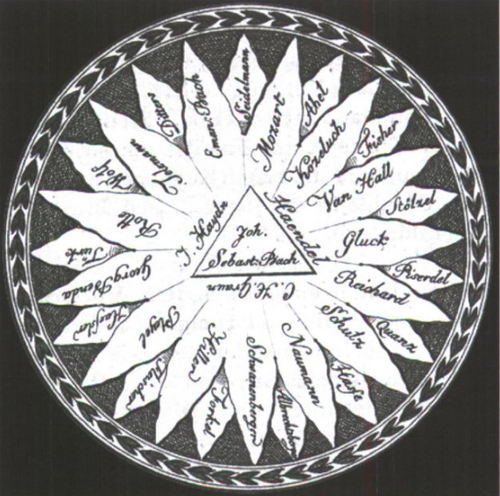
A new printed "movable type" edition of Clavier-Übung III, omitting the duets BWV 802–805, was produced by Ambrosius Kühnel in 1804 for the Bureau de Musique in Leipzig, his joint publishing venture with Franz Anton Hoffmeister that later became the music publishing firm of C.F. Peters. Previously in 1802 Hoffmeister and Kühnel and had published a collection of Bach's keyboard music, including the Inventions and Sinfonias and both books of The Well-Tempered Clavier, with Johann Nikolaus Forkel acting as advisor. (The first prelude and fugue BWV 870 from The Well-Tempered Clavier II was published for the first time in 1799 by Kollmann in London. The whole of Book II was published in 1801 in Bonn by Simrock, followed by Book I; slightly later Nägeli came out with a third edition in Zürich.) Hoffmeister and Kühnel did not take up Forkel's suggestion of including in their fifteenth volume the four duets BWV 802–805, which were only published by Peters much later in 1840. Nine of the chorale preludes BWV 675–683 were printed in the four volume Breitkopf and Härtel collection of chorale preludes prepared between 1800 and 1806 by Johann Gottfried Schicht. Forkel and Kollmann corresponded during this period: they shared the same enthusiasm for Bach and the publication of his works. When Forkel's biography of Bach appeared in Germany in 1802, his publishers Hoffmeister and Kühnel wished to have control over translations into English and French. No complete authorized English translation was produced at the time. In 1812, Kollmann used parts of the biography in a long article on Bach in the Quarterly Musical Register; and an unauthorized anonymous English translation was published by Boosey & Company in 1820.[72]
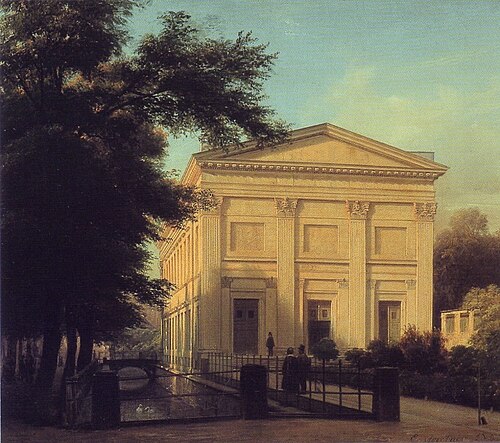
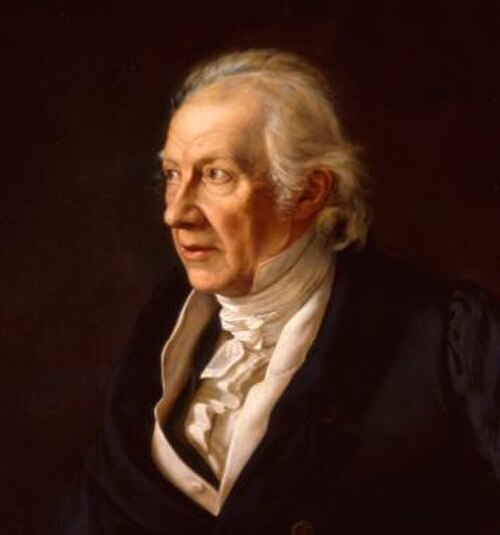
In Berlin, on the death of Fasch in 1800, his assistant Carl Friedrich Zelter took over as the director of the Sing-Akademie. The son of a mason, he himself had been brought up as a master mason, but had cultivated his musical interests in secret, eventually taking composition classes with Fasch. He had been linked to the Sing-Akademie for years and had acquired a reputation as one of the foremost experts on Bach in Berlin. In 1799, he started a correspondence with Goethe on the aesthetics of music, particularly the music of Bach, which was to last until both friends died in 1832. Although Goethe had a late training in music, he considered it an essential element in his life, arranging concerts at his home and attending them elsewhere. In 1819, Goethe described how the organist from Berka, Heinrich Friedrich Schütz, trained by Bach's student Kittel, would serenade him for hours with the music of the masters, from Bach to Beethoven, so that Goethe could acquaint himself with music from a historical perspective. In 1827, he wrote:
On this occasion I recalled the good organist of Berka; for it was there, in perfect repose without extraneous disturbance, that I first formed an impression of your great maestro. I said to myself, it is as if the eternal harmony were conversing with itself, as it may have done in God's breast before the creation of the world; that is the way it move deep within me, and it was if I neither possessed or needed ears, nor any other sense—least of all, the eyes.
Commenting in the same year on Bach's writing for the organ, Zelter wrote to Goethe:
The organ is Bach's own peculiar soul, into which he breathes immediately the living breath. His theme is the feeling just born, which, like the spark from the stone, invariably springs forth, from the first chance pressure of the foot upon the pedals. Thus by degrees he warms to his subject, till he has isolated himself, and feels alone, and then an inexhaustible stream passes out into the ocean.
Zelter insisted on the pedals as the key to Bach's organ writing: "One might say of old Bach, that the pedals were the ground-element of the development of his unfathomable intellect, and that without feet, he could never have attained his intellectual height."[73]


Zelter was instrumental in building up the Sing-Akademie, broadening their repertoire to instrumental music and encouraging the growing library, another important repository for Bach manuscripts. Zelter had been responsible for Mendelssohn's father Abraham Mendelssohn becoming a member of the Sing-Akademie in 1796. As a consequence, one of the major new forces behind the library became Sara Levy, the great-aunt of Felix Mendelssohn, who had assembled one of the most-important private collections of 18th-century music in Europe. An accomplished harpsichordist, Sara Levy's teacher had been Wilhelm Friedemann Bach and she had been a patroness of C.P.E. Bach, circumstances which gave her family close contacts with Bach and resulted in his music enjoying a privileged status in the Mendelssohn household. Felix's mother Lea, who had studied under Kirnberger, gave him his first music lessons. In 1819, Zelter was appointed as the composition teacher of Felix and his sister Fanny; he taught counterpoint and music theory according to the methods of Kirnberger. Felix's piano teacher was Ludwig Berger, a pupil of Muzio Clementi, and his organ teacher was August Wilhelm Bach (unrelated to J.S. Bach), who had himself studied musical theory under Zelter. A.W. Bach was organist of the Marienkirche, Berlin, which had an organ built in 1723 by Joachim Wagner. Mendelssohn's organ lessons were conducted on the Wagner organ, with Fanny present; they commenced in 1820 and lasted for less than two years. It is probable that he learnt some of J. S. Bach's organ works, which had remained in the repertoire of many Berlin organists; his choice would have been limited, because at that stage his pedal technique was still rudimentary.[74]
In autumn 1821 the twelve-year-old Mendelssohn accompanied Zelter on a trip to Weimar, stopping on the way in Leipzig where they were shown the cantor's room in the choir school of the Thomaskirche by Bach's successor Schicht. They stayed two weeks in Weimar with Goethe, to whom Mendelssohn played extensively on the piano each day. All Mendelssohn's music lessons stopped by summer 1822 when his family left for Switzerland. In the 1820s, Mendelssohn visited Goethe four more times in Weimar, the last time being in 1830, a year after his resounding success in reviving Bach's St Matthew Passion in Berlin, with the collaboration of Zelter and members of the Sing-Akademie. On this last trip, again by way of Leipzig, he stayed two weeks in Weimar and had daily meetings with Goethe, by then in his eighties. He later gave an account to Zelter of a visit to the church of St Peter and St Paul where Bach's cousin Johann Gottfried Walther had been organist and where his two eldest sons had been baptized:[75]
One day Goethe asked me if I would not care to pay a compliment to craftsmanship and call on the organist, who might let me see and hear the organ in the town church. I did so, and the instrument gave me great pleasure ... The organist gave me the choice of hearing something learned or for the people ... so I asked for something learned. But it was not much to be proud of. He modulated around enough to make one giddy, but nothing unusual came of it; he made a number of entries, but no fugue was forthcoming. When my turn came, I let loose with the D minor toccata of Bach and remarked that this was at the same time something learned and for the people too, at least some of them. But see, I had hardly started to play when the superintendent dispatched his valet downstairs with the message that this playing had to be stopped right away because it was a weekday and he could not study with that much noise going on. Goethe was very much amused by this story.


In 1835, Mendelssohn was appointed director of the Gewandhaus Orchester in Leipzig, a post he held until his death in 1847 at the age of 38. He soon met other Bach enthusiasts including Robert Schumann, one year his junior, who had moved to Leipzig in 1830. Having been taught piano by J.G. Kuntsch, organist at the Marienkirche in Zwickau, Schumann seems to have started developing a deeper interest in Bach's organ music in 1832. In his diary he recorded sightreading the six organ fugues BWV 543–548 for four hands with Clara Wieck, the twelve-year-old daughter of his Leipzig piano teacher Friedrich Wieck and his future wife. Schumann later acknowledged Bach as the composer who had influenced him most. In addition to collecting his works, Schumann started with Friedrich Wieck a new fortnightly music magazine, the Neue Zeitschrift für Musik, in which he promoted the music of Bach as well as that of contemporary composers, such as Chopin and Liszt. One of the main contributors was his friend Carl Becker, organist at the Peterskirche and in 1837 the Nikolaikirche. Schumann remained as editor-in-chief until 1843, the year in which Mendelssohn became the founding director of the Leipzig Conservatory. Schumann was appointed professor for piano and composition at the conservatory; other appointments included Moritz Hauptmann (harmony and counterpoint), Ferdinand David (violin) and Becker (organ and music theory).[76]

One of Mendelssohn's regrets since 1822 was that he had not had sufficient opportunity to develop his pedal technique to his satisfaction, despite having given public organ recitals. Mendelssohn explained later how difficult gaining access to organs had already been back in Berlin: "If only people knew how I had to plead and pay and cajole the organists in Berlin, just to be allowed to play the organ for one hour—and how ten times during such an hour I had to stop for this or that reason, then they would certainly speak differently." Elsewhere, on his travels, he had only sporadic opportunities to practice, but not often on pedalboards matching the standard of those in northern Germany, especially in England. The English organist Edward Holmes commented in 1835 that Mendelssohn's recitals in St Paul's Cathedral "gave a taste of his quality which in extemperaneous performance is certainly of the highest kind ... he has not we believe kept up that constant mechanical exercise of the instrument which is necessary to execute elaborate written works." In 1837, despite having performed the St Anne prelude and fugue in England to great acclaim, on his return to Germany Mendelssohn still felt dissatisfied, writing that, "This time I have resolved to practice the organ her in earnest; after all, if everyone takes me for an organist, I am determined, after the fact, to become one." It was only in the summer of 1839 that an opportunity arose when he spent six weeks on holiday in Frankfurt. There he had daily access to the pedal piano of his wife Cécile's cousin Friedrich Schlemmer and, probably through him, access to the organ in the Katharinenkirche built in 1779–1780 by Franz and Philipp Stumm.[77]


August 1840 saw the fruits of Mendelssohn's labour: his first organ recital in the Thomaskirche. The proceeds from the concert were to go towards a statue of Bach in the vicinity of the Thomaskirche. Most of the repertoire in the concert had been played by Mendelssohn elsewhere, but nevertheless as he wrote to his mother, "I practised so much the previous eight days that I could barely stand on my own two feet and walked along the street in nothing but organ passages." The concert was wholly devoted to Bach's music, except for an improvised "free fantasy" at the end. In the audience was the elderly Friedrich Rochlitz, founding editor of the Allgemeine musikalische Zeitung, a journal that had promoted the music of Bach: Rochlitz is reported to have declared afterwards, "I shall depart now in peace, for never shall I hear anything finer or more sublime." The recital started with the St Anne prelude and fugue BWV 552. The only chorale prelude was Schmücke dich, o liebe Seele BWV 654 from the Great Eighteen Chorale Preludes, a favourite of both Mendelssohn and Schumann. Until that time very few of these or the shorter chorale preludes from the Orgelbüchlein had been published. Mendelssohn prepared an edition of both sets that was published in 1844 by Breitkopf and Härtel in Leipzig and by Coventry and Hollier in London. At about the same time the publishing house of Peters in Leipzig produced an edition of Bach's complete organ works in nine volumes edited by Friedrich Konrad Griepenkerl and Ferdinand Roitzsch. The E flat prelude and fugue BWV 552 appears in Volume III (1845), the chorale preludes BWV 669–682, 684–689 in Volume VI and VII (1847) and BWV 683 in Volume V (1846) with chorale preludes from the Orgelbüchlein.[77]

In 1845, while Robert was recovering from a nervous breakdown and a few months prior to the completion of his piano concerto, the Schumanns rented a pedalboard to place under their upright piano. As Clara recorded at the time, "On April 24th we got on hire a pedal-board to attach below the pianoforte, and we had great pleasure from it. Our chief object was to practice organ playing. But Robert soon found a higher interest in this instrument and composed some sketches and studies for it which are sure to find high favour as something quite new." The pedalflügel base on which the piano was placed had 29 keys connected to 29 separate hammers and strings encased at the rear of the piano. The pedal board was manufactured by the same Leipzig firm of Louis Schöne that had provided the grand pedal piano in 1843 for the use of students at the Leipzig Conservatory. Before composing any of his own fugues and canons for organ and pedal piano, Schumann had made a careful study of Bach's organ works, of which he had an extensive collection. Clara Schumann's Bach book, an anthology of organ works by Bach, now in the archives of the Riemenschneider Bach Institute, contains the whole of Clavier-Übung III, with detailed analytic markings by Robert Schumann. On the centenary of Bach's death in 1850, Schumann, Becker, Hauptmann and Otto Jahn founded the Bach Gesellschaft, an institution dedicated to publishing, without any editorial additions, the complete works of Bach through the publishers Breitkopf and Härtel. The project was completed in 1900. The third volume, devoted to keyboard works, contained the Inventions and Sinfonias and the four parts of the Clavier-Übung. It was published in 1853, with Becker as editor.[78]
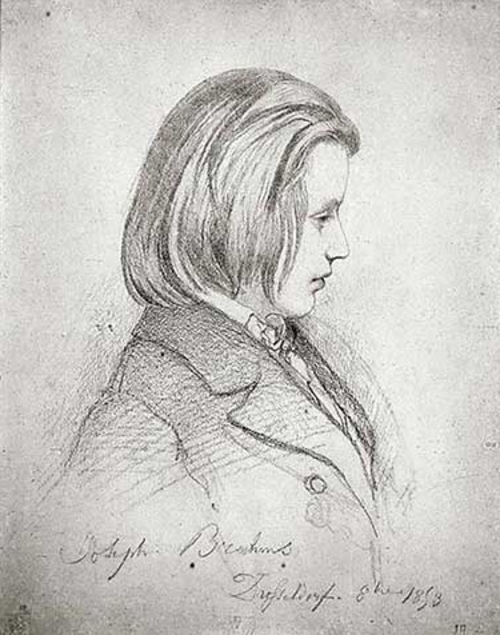

At the end of September 1853, having been recommended by the violinist and composer Joseph Joachim, the twenty-year-old Johannes Brahms appeared on the doorstep of the Schumann's home in Düsseldorf, staying with them until early November. Like Schumann, perhaps even more so, Brahms was deeply influenced by Bach's music. Shortly after his arrival he gave a performance on the piano of Bach's organ toccata in F BWV 540/1 in the house of Joseph Euler, a friend of Schumann. Three months after Brahms' visit, Schumann's mental state deteriorated: after a suicide attempt, Schumann committed himself to the sanitorium in Endenich near Bonn, where, after several visits from Brahms, he died in 1856. From its inception, Brahms subscribed to the Bach-Gesellschaft, of which he became an editor in 1881. An organist himself and a scholar of early and baroque music, he carefully annotated and analysed his copies of the organ works; he made a separate study of Bach's use of parallel fifths and octaves in his organ counterpoint. Brahms' Bach collection is now preserved in the Gesellschaft der Musikfreunde in Vienna, of which he became musical director and conductor in 1872. In 1875, he conducted a performance in the Musikverein of an orchestral arrangement by Bernhard Scholz of the prelude in E flat BWV 552/1. In 1896, a year before he died, Brahms composed his own set of eleven chorale preludes for organ, Op.122. Like Schumann, who turned to Bach counterpoint as a form of therapy in 1845 during his recovery from mental illness, Brahms also viewed Bach's music as salutory during his final illness. As Brahms' friend and biographer Max Kalbeck reported:[79]
He complained about his situation and said 'It's lasting so long.' He also told me that he was not able to listen to any music. The piano remained closed: he could only read Bach, that was all. He pointed to the piano, where on the music stand, which stood on top of the closed cover, lay a score of Bach.


Max Reger was a composer whose dedication to Bach has been described as a "monomaniacal identification" by the musicologist Johannes Lorenzen: in letters he frequently referred to "Allvater Bach". During his life, Reger arranged or edited 428 of Bach's compositions, including arrangements of 38 organ works for piano solo, piano duet or two pianos, starting in 1895. At the same time he produced a large number of his own organ works. Already in 1894, the organist and musicologist Heinrich Reimann, reacting to modernist trends in German music, had encouraged a return to the style of Bach, stating that, "Beyond this style there is no salvation ... Bach becomes for that reason the criterion of our art of writing for the organ." In 1894–1895 Reger composed his first suite for organ in E minor which was published in 1896 as his Op.16 with a dedication "To the Memory of Johann Sebastian Bach". The original intention was a sonata in three movements: an introduction and triple fugue; an adagio on the chorale Es ist das Heil uns kommen her; and a passacaglia. In the final version, Reger inserted an intermezzo (a scherzo and trio) as the third movement and expanded the adagio to contain a central section on the Lutheran hymns Aus tiefer Not and O Haupt voll Blut und Bunden. In 1896, Reger sent a copy of the suite to Brahms, his only contact. In the letter he asked permission to dedicate a future work to Brahms, to which he received the reply, "Permission for that is certainly not necessary, however! I had to smile, since you approach me about this matter and at the same time enclose a work whose all-too-bold dedication terrifies me!" The overall form of the suite follows the scheme of the eighth organ sonata Op.132 (1882) of Joseph Rheinberger and the symphonies of Brahms. The final passacaglia was a conscious reference to Bach's organ passacaglia in C minor BWV 582/1, but has clear affinities with the last movements of both Rheinberger's sonata and Brahms' fourth symphony. The second movement is an adagio in ternary form, with the beginning of the central section directly inspired by the setting of Aus tiefer Not in the pedaliter chorale prelude BWV 686 of Clavier-Übung III, paying homage to Bach as a composer of instrumental counterpoint. It has a similarly dense texture of six parts, two of them in the pedal. The outer sections are directly inspired by the musical form of the chorale prelude O Mensch, bewein dein Sünde groß BWV 622 from the Orgelbüchlein.[80] The suite was first performed in the Trinity Church, Berlin in 1897 by the organist Karl Straube, a student of Reimann. According to a later account by one of Straube's students, Reimann had described the work as "so difficult as to be almost unplayable", which had "provoked Straube's virtuosic ambition, so that he set about mastering the work, which placed him before utterly new technical problems, with unflagging energy." Straube gave two further performances in 1898, in the cathedral at Wesel, where he had recently been appointed organist, and prior to that in Frankfurt, where he met Reger for the first time. In 1902, Straube was appointed organist at the Thomaskirche and in the following year cantor; he became the main proponent and performer of Reger's organ works.[81]
The people who did attend appeared very much delighted, & some of them (especially the Visitors from Norwich) were good Judges, & of course tickled with such a Row as we gave them upon the most magnificent Organ I have yet heard, & I think in which you would agree with me. Your MS. Music Book has been of special Service to us: the triple fugue in E♭ was received with the same kind of Wonder that people express when they see an Air Balloon ascend for the first time: Smith I believe planted two or three Spies to watch the Effects of such Sound upon their Countenance, & consequently Mind.
—Samuel Wesley, 18 July 1815, letter to Vincent Novello reporting on a performance of BWV 552/2 at St Nicholas Church, Great Yarmouth[82]


Apart from prevailing musical tastes and the difficulty in acquiring manuscript copies, a fundamental difference between the design of English and German organs made Bach's organ output less accessible to English organists, namely the absence of pedalboards. Handel's principal works for organ, his organ concertos Op. 4 and Op. 7, with the possible exception of op.7 No.1, all appear to have been written for a single manual chamber organ. Until the 1830s, most church organs in England did not have separate pedal pipes and before that the few organs that had pedalboards were all pull-downs, i.e. pedals that operated pipes connected to the manual stops. Pedalboards rarely contained more than 13 keys (an octave) or exceptionally 17 keys (an octave and a half). Pull-down pedalboards became more common from 1790 onwards. The pedaliter chorale preludes in Clavier-Übung III require a 30-key pedalboard, going from CC to f. It is for this reason that the Bach awakening in England started with clavier compositions being played on the organ or organ compositions being adapted either for piano duet or for two (or sometimes three) players at an organ. The newfound interest in Bach's organ music, as well as the desire to reproduce the grand and thunderous choral effects of the 1784 Handel Commemoration, eventually influenced organ builders in England. By the 1840s, after a series of experiments with pedals and pedal pipes starting around 1800 (in the spirit of the Industrial Revolution), newly constructed and existing organs started to be fitted with dedicated diapason pipes for the pedals, according to the well-established German model. The organ in St Paul's Cathedral commissioned in 1694 from Father Smith and completed in 1697, with a case by Christopher Wren, had exceptionally already been fitted with a 25-key pedalboard (two octaves C-c') of pull-down German pedals in the first half of the 18th century, probably as early as 1720, on the recommendation of Handel. By the 1790s, these had been linked to separate pedal pipes, described with detailed illustrations in Rees's Cyclopædia (1819). The four-manual "monster" organ in Birmingham Town Hall, constructed in 1834 by William Hill, had three sets of pedal pipes connected to the pedalboard, which could also be operated independently by a two-octave keyboard to the left of the manual keyboards. Hill's experiment of installing gigantic 32-foot pedal pipes, some currently still present, was only partially successful, as their scale did not permit them to sound properly.[83]




The organist, composer and music teacher Samuel Wesley (1766–1837) played a significant role in awakening interest in Bach's music in England, mostly in the period 1808–1811. After a lull in his own career, in the first half of 1806 he made a hand copy of Nägeli's Zürich edition of The Well-Tempered Clavier. In early 1808 Wesley visited Charles Burney in his rooms in Chelsea where he played for him from the copy of Book I of the '48' that Burney had received from C.P.E. Bach in 1772. As Wesley later recorded, Burney "was very delighted ... and expressed his Wonder how much abstruse Harmony & such perfect & enchanting Melody could have been so marvelously united!" Wesley subsequently consulted Burney, now a convert to the music of Bach, on his project to publish his own corrected transcription, stating, "I believe I can fairly securely affirm that mine is now the most correct copy in England." This project was eventually undertaken in with Charles Frederick Horn, published in four installments between 1810 and 1813. In June 1808 after a concert the Hanover Square Rooms during which Weseley performed some excerpts from the '48', he commented that, "this admirable Musick might be played into Fashion; you see I have only risked one modest Experiment, & it has electrified the Town just in the way that we wanted." Further concerts took place there and in the Surrey Chapel with Benjamin Jacob, a fellow organist with whom Wesley corresponded copiously an effusively about Bach. The musicologist and organist William Crotch, another advocate of Bach, lectured on Bach in 1809 in the Hanover Square Rooms prior to publishing his edition of the E major fugue BWV 878/2 from The Well-Tempered Clavier II. In the introduction, after commenting that Bach fugues were "very difficult of execution, profoundly learned and highly ingenious", he described their "prevailing style" as "the sublime". By 1810, Wesley had stated his intention to perform the E flat fugue BWV 552/2 from Clavier-Übung III in St. Paul's Cathedral. In 1812, in the Hanover Square Rooms he performed an arrangement of the E flat prelude for organ duet and orchestra with the arranger Vincent Novello, founder of the music publishing firm Novello & Co, that would later bring out an English edition of Bach's complete organ works. In 1827, the E flat fugue had been arranged for organ or piano duet by Jacob and was even performed by three players two years later on the organ in St. James, Bermondsey, where the pedal could be played on a supplementary keyboard. It had also been used for auditions for organists: Wesley's son Samuel Sebastian Wesley himself played it in 1827, when seeking employment (unsuccessfully). The chorale preludes from Clavier-Übung III were also performed during this period: in his letters to Benjamin, Wesley mentions in particular Wir glauben BWV 680, which had become known as the "giant fugue", because of the striding figure in the pedal part. By 1837, pedal technique on the organ had developed sufficiently in England that the composer and organist Elizabeth Stirling (1819–1895) could give concerts in St Katherine's, Regent's Park and St. Sepulchre's, Holborn containing several of the pedaliter chorale preludes (BWV 676, 678, 682, 684) as well as the St Anne Prelude BWV 552/1.[84] (These were the first public recitals in England by a female organist; in 1838 she performed BWV 669–670 and the St Anne fugue BWV 552/2 at St Sepulchre's.) In the same year Wesley and his daughter were invited to the organ loft of Christ Church, Newgate for a Bach recital by Felix Mendelssohn. As Mendelssohn recorded in his diary,
Old Wesley, trembling and bent, shook hands with me and at my request sat down at the organ bench to play, a thing he had not done for many years. The frail old man improvised with great artistry and splendid facility, so that I could not but admire. His daughter was so moved by the sight of it all that she fainted and could not stop crying and sobbing.
A week later, Mendelssohn played the St Anne prelude and fugue BWV 552 on the organ in Birmingham Town Hall. Prior to the concert, he confided in a letter to his mother:
Ask Fanny, dear Mother, what she would say if I were to play in Birmingham the Bach organ prelude in E flat major and the fugue that stands at the end of the same volume. I think she will grumble at me, but I think I would be right all the same. The prelude especially would be very acceptable to the English, I would think, and both in the prelude and in the fugue one can show off the piano, pianissimo, and the whole range of the organ—and it is not a dull piece either in my view!

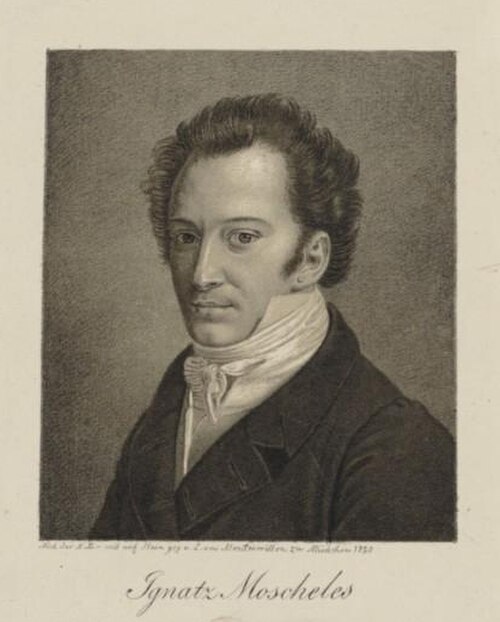
Wesley died the following month. Mendelssohn made a total of 10 visits to Britain, the first in 1829, the last in 1847. His first visit, when he stayed with his friend the pianist and composer Ignaz Moscheles, had been a resounding success and Mendelssohn had been embraced by all strata of British musical society. On his fourth trip to Britain in 1833 he was accompanied by his father and heard the seventeen-year-old pianist-composer William Sterndale Bennett performing his first piano concerto. A musical prodigy like Mendelssohn, at the age of 10 Sterndale Bennett had entered the Royal Academy of Music, where he had been taught by Crotch. He was also an accomplished organist, familiar with the works of Bach. (After brief appointments as organist, he subsequently practised on the organ in Hanover Square Rooms, later surprising his son with his mastery of the harder pedal passages on a pedal-piano.) Mendelssohn immediately invited him to Germany. Reportedly when Sterndale Bennett asked to go as his student, Mendelssohn replied, "No, no, you must come to be my friend." Sterndale Bennett eventually visited Leipzig for 6 months from October 1836 to June 1837. There he made friends with Schumann, who became his soul mate and drinking partner. Sterndale Bennett made only two further trips to Germany during the lifetimes of Mendelssohn and Schumann, in 1838–1839 and 1842, although he retained their friendship and helped arrange Mendelssohn's visits to Britain. He became a firm proponent of Bach, organising concerts of his chamber music in London. He was one of the founders in 1849 of the original Bach Society in London, devoted to the performance and collection of Bach's works, principally choral. In 1854, he staged the first performance in England of the St. Matthew Passion in the Hanover Square Rooms.[85]
Already in 1829, Mendelssohn had become friends with Thomas Attwood, who had studied with Mozart and since 1796 had been organist of St Paul's Cathedral. Through Attwood Mendelssohn gained access to the organ at St Paul's, which was suitable for Bach, despite the unusual alignment of the pedalboard. In 1837, however, during a recital at St Paul's, just before playing to Wesley, the air supply to the organ had suddenly been interrupted; in a later account, that he had to retell annoyingly often, Mendelssohn related that George Cooper, the sub-organist,
ran off like a madman, quite red with anger, was a way a little while, and finally returned with the news that during the performance the organ-blower—on the instructions from the beadle, who had not been able to get people to leave the church and was forced to stay on longer against his will—had left the bellows, locked the door to them and left ... Shame! Shame! was called out from all sides. Three or four clerics appeared and tore into the beadle furiously in front of all the people, threatening him with dismissal.
Cooper's son, also called George, became the next sub-organist at St Paul's. He promoted the organ music of Bach and in 1845 produced the first English edition of the chorale prelude Wir glauben BWV 680 from Clavier-Übung III, published by Hollier & Addison, which he dubbed the "Giant Fugue" because of its striding pedal part. In the second half of the 19th century, this became the best-known of all the pedaliter chorale preludes from Clavier-Übung III and was republished separately several times by Novello in organ anthologies at an intermediate level.[86]
Mendelssohn's eighth visit occurred in 1842 after the accession of Queen Victoria to the throne. Her husband Prince Albert was a keen organist and, under his influence, the music of Bach started to be performed at royal concerts. On the second of his two invitations to Buckingham Palace, Mendelssohn improvised on Albert's organ and accompanied the queen in two songs by Fanny and himself. Between these two visits, he once more performed the St Anne prelude and fugue, this time before an audience of 3,000 in Exeter Hall in a concert organized by the Sacred Harmonic Society. In London there were few church organs with German pedal boards going down to CC: those which did included St. Paul's Cathedral, Christ Church, Newgate and St. Peter's, Cornhill, where Mendelssohn frequently performed solo recitals. During his last visit in 1847, he once more entertained Victoria and Albert in Buckingham Palace in May before playing a few days later the prelude and fugue on the name of "BACH" BWV 898 on the barely functional organ in Hanover Square Rooms during one of the Ancient Concerts organized by Prince Albert, with William Gladstone in the audience.[87]


In the late 1840s and early 1850s, organ building in England became more stable and less experimental, taking stock of traditions in Germany and innovations in France, particularly from the new generation of organ builders such as Aristide Cavaillé-Coll. One of the main names in organ building in England in the second half of the 19th century was Henry Willis. The manner in which the organ for St. George's Hall, Liverpool was planned and constructed marks the transition from what Nicholas Thistlethwaite calls the "insular movement" of the 1840s to the adoption of the established German system. Planning formally started on the organ in 1845: the main advisor to Liverpool Corporation was Samuel Sebastian Wesley, son of Samuel Wesley and an accomplished organist, particularly of Bach. He worked in consultation with a panel of university professors of music, who often disagreed with his eccentric suggestions. When Wesley tried to argue about the range of manual keyboards, justifying himself by the possibility of playing octaves with the left hand, he was reminded by the professors that the use of octaves was more common among pianists than first-rate organists and moreover that when he had been organist at Leeds Parish Church, "the dust on the half-dozen lowest keys on the GG manuals remained undisturbed for months." Willis was commissioned to build the organ only in 1851, after he had impressed the committee with the organ for Winchester Cathedral he had on display at The Crystal Palace during the Great Exhibition. The completed organ had four manual keyboards and a thirty key pedalboard, with 17 sets of pedal pipes and a range from CC to f. The instrument had unequal temperament and, as Wesley had stipulated, the air supply came from two large underground bellows powered by an eight horse-power steam engine. Among the innovations introduced by Willis were the cylindrical pedal-valve, the pneumatic lever and the combination action, the latter two features being adopted widely by English organ builders in the second half of the 19th century. The organ was inaugurated in 1855 by William Thomas Best, who later that year was appointed resident organist, attracting crowds of thousands to hear his playing. In 1867, he had the organ retuned to equal temperament. He remained in his post until 1894, giving performances elsewhere in England, including at the Crystal Palace, St James's Hall and the Royal Albert Hall. The St Anne prelude and fugue BWV 552 was used by Best to start off the series of Popular Monday Concerts at St James's Hall in 1859; and later in 1871 to inaugurate the newly built Willis organ in the Royal Albert Hall, in the presence of Queen Victoria.[88]
One day I was passing by the small rooms on the first floor of the Maison Érard, reserved only for great pianists, for their practice and lessons. At the time the rooms were all empty, except one, from which could be heard the great Triple-Prelude in E flat by Bach played remarkably well on a pedalier. I listened, riveted to the spot by the expressive, crystal-clear playing of a little old man, frail in appearance, who, without seeming to suspect my presence, continued the piece right to the end. Then, turning to me: 'Do you know this music?' he asked. I replied that, as an organ pupil in Franck's class at the Conservatoire, I could scarcely ignore such a fine work. 'Play me something' he added, giving up the piano stool for me. Although somewhat over-awed, I managed to play quite cleanly the C Major Fugue ... Without comment he returned to the piano saying 'I am Charles-Valentin Alkan and I'm just preparing for my annual series of six 'Petits Concerts' at which I play only the finest things'.
—Vincent D'Indy, 1872[89]
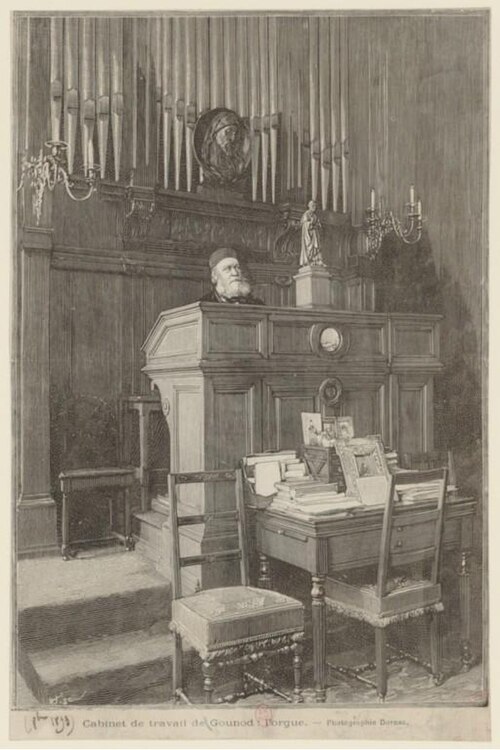

In France, the Bach revival was slower to take root. Before the late 1840s, after the upheaval caused by the French Revolution, Bach was rarely performed in public concerts in France and it was preferred that church organists play operatic arias or popular airs instead of counterpoint. One exception was a public performance in the Paris Conservatoire in December 1833, repeated two years later in the Salons Pape, of the opening allegro of Bach's concerto for three harpsichords BWV 1063, played on pianos by Chopin, Liszt and Hiller. Berlioz later described their choice as "stupid and ridiculous", unworthy of their talents. Charles Gounod, having won the Prix de Rome in 1839, spent three years in the Villa Medici in Rome, where he developed a passionate interest in the polyphonic music of Palestrina. He also met Mendelssohn's sister Fanny, herself an accomplished concert pianist and by then married to the artist Wilhelm Hensel: Gounod described her as "an outstanding musician and a woman of superior intelligence, small, slender, but gifted with an energy which showed in her deep-set eyes and in her burning look". In response Fanny noted in her diary that Gounod was "passionately fond of music in a way I have rarely seen before." She introduced Gounod to the music of Bach, playing from memory fugues, concertos and sonatas for him on the piano. At the end of his stay in 1842, the twenty-five-year-old Gounod had become a confirmed Bach devotee. In 1843, after a seven-month stay in Vienna, with a letter of introduction from Fanny, Gounod spent 4 days with her brother in Leipzig. Mendelssohn played Bach for him on the organ of the Thomaskirche and conducted a performance of his Scottish Symphony by the Gewandhaus orchestra, specially convened in his honour. Back in Paris, Gounod took up an appointment as organist and music director in the Église des Missions Étrangères on the rue de Bac, on condition that he would be allowed to have autonomy over the music: Bach and Palestrina figured strongly in his repertoire. When churchgoers initially objected to this daily diet of counterpoint, Gounod was confronted by the Abbé, who eventually yielded to Gounod's conditions, although not without commenting "What a terrible man you are!"[90]
In the late 1840s and 1850s a new school of organist-composers emerged in France, all trained in the organ works of Bach. These included Franck, Saint-Saëns, Fauré and Widor. In the aftermath of the French Revolution, there had already been a revival of interest in France in choral music of the baroque and earlier periods, particularly of Palestrina, Bach and Handel: Alexandre-Étienne Choron founded the Institution royale de musique classique et religieuse in 1817. After the July Revolution and Choron's death in 1834, direction of the institute, renamed the "Conservatoire royal de musique classique de France", was taken over by Louis Niedermeyer and took his name as the École Niedermeyer. Along with the Conservatoire de Paris, it became one of the main training grounds for French organists. The Belgian composer and musicologist François-Joseph Fétis, a contemporary and colleague of Choron in Paris, shared his interest in early and baroque music. Fétis exerted a similar influence in Brussels, where he was appointed director of the Royal Conservatory of Brussels in 1832, a position he held until his death in 1871.[91]


At the same time, French organ builders most notably Aristide Cavaillé-Coll were starting to produce new series of organs, which with their pedalboards, were designed both for the music of Bach as well as modern symphonic compositions. The change in traditions can be traced back to the inauguration in 1844 of the organ for St Eustache, built by Doublaine and Callinet. The German organ virtuoso Adolf Friedrich Hesse was invited with five Parisians to demonstrate the new instrument. As part of his recital Hesse played Bach's Toccata in F major, BWV 540/1, allowing the Parisian audience to hear pedal technique far beyond what was known in France at that time. While impressed by his pedal playing, French commentators at the time gave Hesse mixed praise, one remarking that, while he might be the "king of the pedal ... he thinks of nothing but power and noise, his playing astonishes, but does not speak to the soul. He always seems to be the minister of an angry God who wants to punish." Another commentator, however, who had heard Hesse playing Bach on the organ at an industrial exhibition beforehand, noted that "if the organ of the Doublaine-Callinet firm is perfect from bottom to top, Monsieur Hesse is a complete organist from head to feet." The new organ had a short life: it was destroyed by fire from a falling candle in December 1844.[92]
Two Belgian organist-composers, Franck and Jacques-Nicolas Lemmens, participated in the inauguration in 1854 of the new organ at St Eustache. Lemmens had studied with Hesse and Fétis; already in the early 1850s he had started giving public concerts in Paris, featuring Bach's organ music and using the brilliant foot technique he had learnt in Germany. At the same time Lemmens had published 18 installments of an organ manual for the use of "organistes du culte catholique", giving a complete introduction to the Bach tradition of organ playing, henceforth adopted in France.[92]
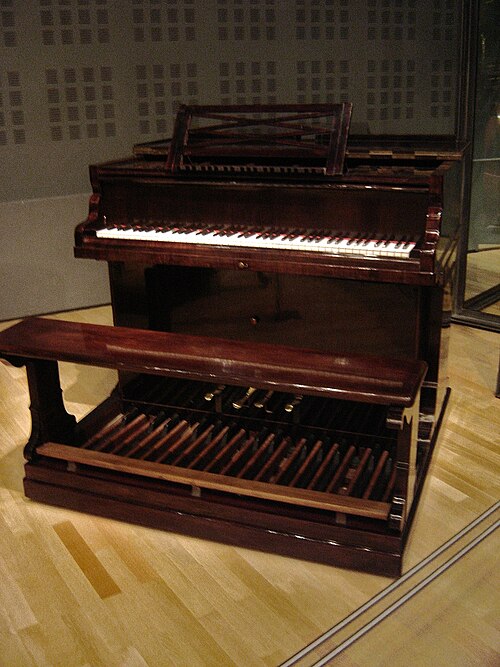

In 1855, the piano firm Érard introduced a new instrument, the pedal piano (pédalier), a grand piano fitted with a full German-style pedalboard. The French composer, organist and virtuoso pianist Charles Valentin Alkan and Lemmens gave concerts on it, including performances of Bach's toccatas, fugues and chorale preludes for organ. In 1858, Franck, a friend of Alkan, acquired a pédalier for his private use. Alkan, a devotee of Bach and one of the first subscribers to the Bach Gesellschaft, composed extensively for the pédalier, including in 1866 a set of twelve studies for pedalboard alone. In the 1870s, Alkan, by that time a recluse, returned to give a series of public Petits Concerts each year in the Salle Érard using their pédalier: Alkan's repertoire included the St Anne prelude as well as several chorale preludes.[93]
There were further indications of changes in taste in France: Saint-Saëns, organist at the Madeleine from 1857 to 1877, refused to perform operatic arias as part of the liturgy, on one occasion replying to such a request, "Monsieur l'Abbé, when I hear from the pulpit the language of the Opéra Comique, I will play light music. Not before!" Saint-Saëns was nevertheless reluctant to use Bach's music in services. He regarded the preludes, fugues, toccatas and variations as virtuosic pieces for concert performance; and the chorale preludes as too Protestant in spirit for inclusion in a Catholic mass. The St Anne prelude and fugue was often used by Saint-Saëns for inaugurating Cavaillé-Coll organs; in Paris; he played for the inaugurations at St Sulpice (1862), Notre Dame (1868), Trinité (1869), the chapel in Versailles (1873) and the Trocadéro (1878).[94]

The last two decades of the 19th century saw a revival of interest in Bach's organ music in France. There were public concerts on the new Cavaillé-Colle organ in the concert hall or Salle des Fêtes of the old Palais du Trocadéro, built for the third Paris exhibition in 1878. Organized by the organist Alexandre Guilmant, a pupil of Lemmens, in conjunction with Eugène Gigout, these started as six free concerts during the exhibition. Attracting huge crowds—the concert hall could seat 5,000 with sometimes an extra 2,000 standing—the concerts continued until the turn of the century. Guilmant programmed primarily the organ music of the two composers whom he referred to as "musical giants", Bach and Handel, still mostly unknown to these mass audiences, as well as the works of older masters such as Buxtehude and Frescobaldi. The St Anne prelude and fugue featured in the concerts, Saint-Saëns playing it in one of the first in 1879 and Guilmant again in 1899, in a special concert to mark the twentieth anniversary of the series. The concerts represented a new fin de siècle cult of Bach in France. It was not without its detractors: the music critic Camille Bellaigue (1858–1930) described Bach in 1888 as a "first-rate bore":[91]
Of all the great musicians, the greatest, that is to say he without whom music itself would not exist, the founder, the patriarch, the Abraham, the Noah, the Adam of music, Johann Sebastian Bach, is the most tedious. ... How many times, crushed under these four-square merciless rhythms, lost amid this algebra of sound, this living geometry, smothered by the answers of these interminable fugues, one wants to close one's ears to this prodigious counterpoint ...
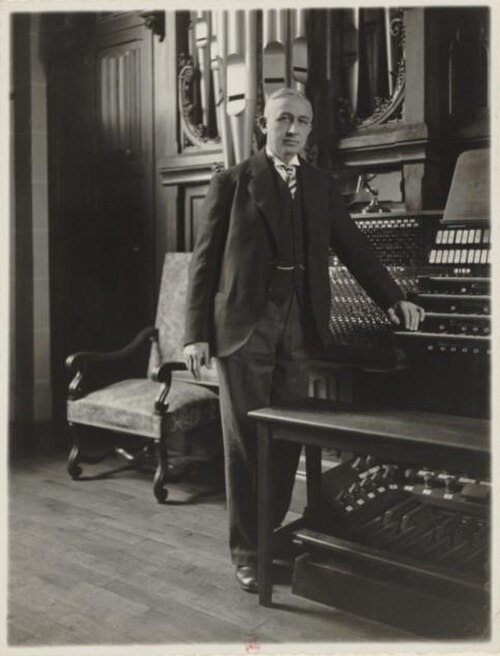
The chorale preludes of Bach were late to enter the French organ repertoire. César Franck, although only known to have performed one work by Bach in public, often set chorale preludes (BWV 622 and BWV 656) as examination pieces at the Conservatoire de Paris in the 1870s and 1880s. It was Charles-Marie Widor, Franck's successor on his death in 1890, who introduced the chorale preludes as a fundamental part of organ teaching there, where Bach's other organ works already provided the foundation stone. Widor believed that the music of Bach represented
the emotion of the infinite and exalted, for which words are an inadequate expression, and which can find proper utterence only in art ... it tunes the soul to a state in which we can grasp the truth and oneness of things, and rise above everything that is paltry, everything that divides us.
Unlike Saint-Saëns and his own teacher Lemmens, Widor had no objection to playing Bach organ music because of its Lutheran associations: "What speaks through his works is pure religious emotion; and this is one and the same in all men, in spite of the national and religious partitions in which we are born and bred." His student, the blind composer and organist, Louis Vierne later recalled:[95]
At the reopening of the class at the beginning of 1892, there occurred an event of considerable importance to our artistic development. I mean the discovery of Bach's chorale preludes. I mean "discovery", and this is not an exaggeration, as you may judge for yourselves. At the first class in performance, Widor remarked with some surprise that since his arrival at the Conservatoire not one of us had brought in one of the celebrated chorales. For my part I was acquainted with three of them, published in Braille for the edition Franck had prepared for our school. They had seemed to me to have no technical difficulties and I had paid no further attention to them. My classmates did not even know that they existed. On looking through the music cabinet where there were several books in the Richault edition, we discovered three volumes, two of preludes and fugues and one of chorale preludes, the latter completely untouched, its leaves uncut. The Maître spent the entire class playing these pieces to us, and we were bowled over. The most overwhelming parts of the giant's organ works were suddenly revealed to us. We set to work on them at once, and for three months nothing else was heard in class. We all played chorale preludes at the examination in January, and the surprise of the jury was no less great than our own had been. Upon leaving the hall I heard Ambroise Thomas remark to Widor, "What music! Why didn't I know about that forty years ago? It ought to be the Bible of all musicians, and especially of organists.
On Widor's recommendation, Guilmant succeeded him as professor of organ in the conservatory in 1896. In 1899, he installed a three manual Cavaillé-Coll organ in his home in Meudon, where he gave lessons to a wide range of pupils, including a whole generation of organists from the United States. Among his French students were Nadia Boulanger, Marcel Dupré and Georges Jacob. Dupré started lessons with Guilmant at the age of eleven, later becoming his successor at the conservatoire. In two celebrated series of concerts at the conservatoire in 1920 and at the Palais du Trocadéro the following year, Dupré performed the complete organ works of Bach from memory in 10 concerts: the ninth concert was devoted entirely to the chorale preludes from Clavier-Übung III. Dupré also taught in Meudon, having acquired Guilmant's Cavaillé-Coll organ in 1926. The funeral service for Guilmant at his home in 1911, prior to his burial in Paris, included a performance by Jacob of Aus tiefer Noth BWV 686.[96]
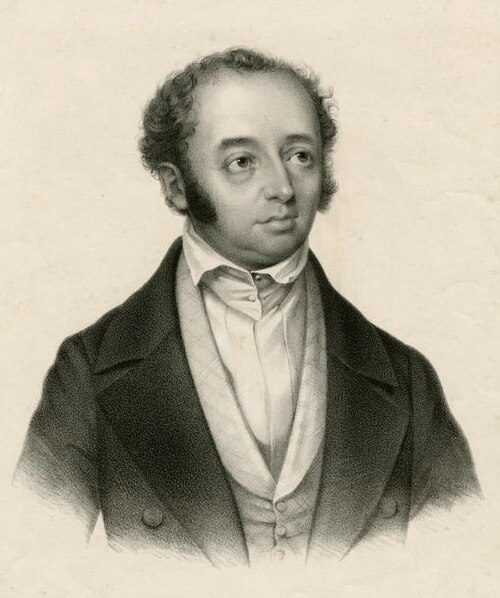


Piano
Orchestra
Chamber ensembles

