
Loading article…

単語ボードゲーム 「スクラブル」の異なる言語版では、アルファベットの各文字の出現頻度が言語ごとに異なるため、タイルの文字の分布が異なります。原則として、文字が珍しいほど、その文字に与えられるポイントが高くなります。
ほとんどの言語では100枚のタイルのセットが使用されています。これは、当初98枚のタイルが配布されていたのに、後に2枚の空白のタイルが追加されたことによるものです。トーナメントプレイでは、ゲームを一時停止してゲームに残っているタイルを数えることは許容されますが、残っているタイルの数をいつでも言及することは許容されません。[1]フレンドリープレイ中にタイルを数えるためのオンラインツールがいくつかあります。[2]
公式版
このセクションに記載されている Scrabble エディションは、Hasbro (北米向け) またはMattel (その他の世界向け) によって正式にライセンスされています。
英語(原文)
英語版のスクラブルには 100 個の文字タイルが含まれており、次の分布になっています。
- 空白のタイル 2 枚 (得点 0 点)
- 1ポイント:E ×12、A ×9、I ×9、O ×8、N ×6、R ×6、T ×6、L ×4、S ×4、U ×4
- 2点:D ×4、G ×3
- 3ポイント:B ×2、C ×2、M ×2、P ×2
- 4点:F ×2、H ×2、V ×2、W ×2、Y ×2
- 5ポイント:K ×1
- 8点:J ×1、X ×1
- 10ポイント:Q ×1、Z ×1
合計ポイント数は 187 です。発音区別符号(スペイン語から借用した単語の「ñ」など) は無視されます。
アルフレッド・バッツがこのゲームを発明したとき、彼は当初、文字のさまざまな配分を試しました。 [ 3]よく知られている話では、バッツはニューヨークタイムズの一面を研究して精巧な表を作成し、文字の配分の最終的な選択を行ったと言われています。[4]
2004 年にスーパー スクラブルが発売されました。米国およびカナダ以外での国際配布については、マテルのライセンスに基づき、Leisure Tends の Tinderbox Games が製造しています。また、米国およびカナダ国内での配布については、ハズブロのライセンスに基づき、Winning Moves が製造しています。このセットは 200 枚のタイルで構成されています。
- 空白のタイル 4 枚 (得点 0 点)
- 1ポイント:E ×24、A ×16、O ×15、T ×15、I ×13、N ×13、R ×13、S ×10、L ×7、U ×7
- 2点:D ×8、G ×5
- 3点:C ×6、M ×6、B ×4、P ×4
- 4点:H ×5、F ×4、W ×4、Y ×4、V ×3
- 5ポイント:K ×2
- 8点:J ×2、X ×2
- 10ポイント:Q ×2、Z ×2
スーパー スクラブルには、 2 つの標準的な英語セットを組み合わせた場合よりも上線が引かれた文字が多く、下線が引かれた文字が少なくなっています。
アフリカーンス語
アフリカーンス語版では次の 102 個のタイルが使用されています。
- 空白のタイル 2 枚 (得点 0 点)
- 1ポイント: E ×16、A ×9、I ×8、N ×8、D ×6、O ×6、R ×6、S ×6、T ×6
- 2点:G ×4、H ×3、L ×3
- 3点:K ×3、W ×3
- 4点:M ×2、U ×2、Y ×2
- 5ポイント:P ×2、V ×2
- 8点:B ×1、F ×1
- 10ポイント:J ×1
1953 年頃、プロダクション アンド マーケティング カンパニーは、南アフリカのヨハネスブルグにある民間企業 Leon Toys に、スクラブルの製造と生産のライセンスを供与していました。英語版のスクラブルのほかに、同社は「スクラブル」のアフリカーンス語訳である Krabbel という名前で、このゲームの最初のアフリカーンス語版も生産しました。この言語のゲーム セットには、次の 100 枚のタイルが含まれていました。
- 空白のタイル 2 枚 (得点 0 点)
- 1ポイント: E ×15、A ×9、I ×8、N ×7、O ×6、S ×6、T ×6、 R ×5、L ×4、U ×2
- 2点:D ×6、G ×4
- 3ポイント:B ×2、P ×2、M ×1
- 4点:H ×3、F ×2、V ×2、W ×2、Y ×2
- 5点:K ×3
- 8ポイント:J ×1
アフリカーンス語の原語と標準語の両方に、文字C、Q、X、Zは存在しません。まれにしか使用されないXとZ は、空白を使用して表される場合がありますが、アフリカーンス語では使用されず、いくつかの借用語でのみ使用される文字CとQは、空白を使用して表されない場合があります。[引用が必要]
アラビア語
アラビア語版では、次の 100 個のタイルを使用します。
- 空白のタイル 2 枚 (得点 0 点)
- 1 ポイント: ﺍ ×8、ﻝ ×4、ﺝ ×4、ﺡ ×3、ﺥ ×3、ﻡ ×3、ﻥ ×3、ﻩ ×3、ﻭ ×3、ي ×3
- 2点: ﺏ ×4、ﺕ ×4、ﺭ ×3、ﺩ ×3、ﺱ ×3、ﺙ ×3、
- 3 点: ﻑ ×3、ﻕ ×3、ﺫ ×3、ﺵ ×3、ﺯ ×3
- 4点: ﺹ ×3、ﺽ ×3、ﻉ ×3、ﻙ ×3、ﻁ ×2、
- 5ポイント:ﻅ ×2
- 6 ポイント: ﺉ ×2
- 8点:ﻍ ×2、ﺀ ×2
- 10ポイント:ﺃ ×2、ﺅ ×2、
アラビア文字には最大 4 つの形式がありますが、スクラブルのタイルは孤立形式を使用します。一部のセットでは、標準的な現代アラビア語ではないアラビア語ベースのアルファベットに見られるように、点のないyeh ( alif maqsura ) が ى 使用されることがあり、文字heには、一部のアラビア語ベースのアルファベットのように、文字の孤立形式であるウルドゥー語のように、末尾の形式 ھ (heh doachashmee) が表示されることがあります。単語を構成する際に孤立形式を使用するパターンは、アラビア語のクロスワードや Scrabble3D ペルシア語スクラブル セットにも見られ、アラビア文字が互いに接続されていないまれな状況の 1 つです。合字 لا は、ل と ا の 2 つの個別のタイルとしてプレイされます。
ブルガリア語
キリル文字を使用するブルガリア語のスクラブル セットでは、次の 102 個のタイルが使用されます。
- 空白のタイル 2 枚 (得点 0 点)
- 1点:А ×9、О ×9、Е ×8、И ×8、Т ×5、Н ×4、П ×4、Р ×4、С ×4
- 2点:В ×4、В ×4、М ×4、Б ×3、К ×3、Л ×3
- 3ポイント:Г ×3、Ъ ×2
- 4点:Ж ×2、З ×2
- 5点:У ×3、Ч ×2、Я ×2、Й ×1、Х ×1
- 8点:Ц ×1、Ш ×1、Ю ×1
- 10ポイント:Ф ×1、Щ ×1、Ь ×1
カタロニア語

カタロニア語版では次の 100 個のタイルを使用します。
- 空白のタイル 2 枚 (得点 0 点)
- 1ポイント:E ×13、A ×12、I ×8、R ×8、S ×8、N ×6、O ×5、T ×5、L ×4、U ×4
- 2ポイント:C ×3、D ×3、M ×3
- 3ポイント:B ×2、G ×2、P ×2
- 4点:F ×1、V ×1
- 8点:H ×1、J ×1、Q ×1、Z ×1
- 10点:Ç ×1、L・L ×1、NY ×1、X ×1
それでも、セディーユÇ ( ce trencada )付きのC 、二重音のL ( ela geminada )を表す合字L·L 、二重音字NYには特別な牌がある。K、W、Y は外来語でのみ使用され、Yの場合は二重音字NYとなるため存在しない。 空白はK、W、Y を表すために使用できないため、二重音字NY を形成するためにN牌の後に空白牌を置くことは許可されておらず、KとW を含む外来語は単に使用されない。 公式ルールではQ牌は1文字として扱われるが、通常カタロニアのプレイヤーはQ牌をQU二重音字のように使用し、すべてのカタロニア・スクラブル・クラブは事実上のルールを使用している。[5] Ç は別の牌であるが、他の発音区別符号は無視される。
スーパースクラブルと同じ21x21のボードを使用するカタロニア語のスクラブルのクローンがあります。[6] [7]これには次の200枚のタイルが含まれており、カタロニア語のQの後には必ずUが付くため、QタイルがQUダイグラフに置き換えられ、2つの特別なタイル、 ÇとL·Lの価値が増加しています。
- ワイルド(アスタリスク)タイル 5 個で 0 ポイント
- 1ポイント:E ×27、A ×25、S ×19、I ×17、R ×16、N ×12、O ×10、T ×10、L ×8、U ×6
- 2点:M ×7、C ×5、D ×5
- 3ポイント:B ×3、G ×3、P ×3
- 4点:F ×2、V ×2
- 8点:H ×2、J ×2、QU ×2、Z ×2
- 10ポイント:NY ×2、X ×2
- 12ポイント:Ç ×2
- 15ポイント:L·L ×1
クロアチア語
クロアチア語のスクラブル セットでは、次の 103 個のタイルが使用されます。
- 空白のタイル 2 枚 (得点 0 点)
- 1ポイント:A ×11、I ×10、E ×9、O ×9、N ×6、R ×5、S ×5、T ×5、J ×4、U ×4
- 2点:K ×3、M ×3、P ×3、V ×3
- 3ポイント:D ×3、G ×2、L ×2、Z ×2、B ×1、C ×1
- 4点:Č ×1、H ×1、LJ ×1、NJ ×1、Š ×1、Ž ×1
- 5ポイント:Ć ×1
- 8点:F ×1
- 10ポイント:DŽ ×1、Đ ×1
クロアチア語ではQ、W、X、Y は使用されない文字なので、含まれません。DŽの代わりにDやŽ を使用したり、LJやNJの代わりにJの前でLやN を使用したりすることはできません。
チェコ語
チェコ語セットでは、次の 100 個のタイルを使用します。
- 空白のタイル 2 枚 (得点 0 点)
- 1ポイント: O ×6、A ×5、E ×5、N ×5、I ×4、S ×4、T ×4、V ×4、D ×3、K ×3、L ×3、P ×3、R ×3
- 2点: C ×3、H ×3、Í ×3、M ×3、U ×3、Á ×2、J ×2、Y ×2、Z ×2
- 3点:B ×2、É ×2、Ě ×2
- 4点:○ ×2、○ ×2、○ ×2、○ ×1、○ ×1、○ ×1
- 5ポイント:F ×1、G ×1、Ú ×1
- 6ポイント:Ň ×1
- 7ポイント:Ó ×1、Ť ×1
- 8ポイント:Ď ×1
- 10ポイント:X ×1
QとW は外来語でのみ使用されるため含まれていませんが、 Q と W は空白で表すことができます。[8] Xも外来語でのみ使用されますが、 QとWよりも頻繁に使用されるため、含まれています。二重文字CH はこの版には登場せず、空白(ジョーカー)で表すことができません。[9] CH は代わりに 2 つの異なる文字 C と H として使用されます。
1993年以前は、チェコの公式スクラブルは存在しませんでした。[10]代わりに、 1970年代に作成されたPismenkovkaと呼ばれるスクラブルのクローンがあり、 CHタイルが含まれていました。[11] Pismenkovkaセットには次のタイルが含まれています。
- 空白のタイル 2 枚 (得点 0 点)
- 1ポイント:A ×6、O ×6、E ×5、S ×5、I ×4、K ×4、L ×4、R ×4、N ×3、P ×3、T ×3、V ×3、Y ×3
- 2点: M ×3、U ×3、Á ×2、B ×2、D ×2、Í ×2、J ×2
- 3ポイント:C ×2、H ×2、Š ×2、Z ×2
- 4点:Č ×2、CH ×2、Ø ×2、ý ×2
- 5点:Ě ×2、É ×1、Ů ×1、Ý ×1
- 6点:×× 1、×× 1、×× 1
- 8点:Ď ×1、F ×1、G ×1
- 10ポイント:Ó ×1、X ×1
もともとこのセットにはXタイルは含まれておらず(借用語でのみ使用されるため)、代わりに7番目のOタイルが含まれていました。[12]
KrisKros Klasikも同様の分布ですが、4つのTタイルと2つのXタイルが含まれています。[13]
デンマーク語
デンマーク語のスクラブル セットでは、次の 100 個のタイルが使用されます。
- 空白のタイル 2 枚 (得点 0 点)
- 1ポイント: E ×9、A ×7、N ×6、R ×6
- 2ポイント:D ×5、L ×5、O ×5、S ×5、T ×5
- 3点:B ×4、I ×4、K ×4、F ×3、G ×3、M ×3、U ×3、V ×3
- 4点:H ×2、J ×2、P ×2、Y ×2、Æ ×2、Ø ×2、Å ×2
- 8ポイント:C ×2、X ×1、Z ×1
この分布にはQとW がありません。これらは非常にまれで、外来語にのみ出現します。C、X、Zも外来語にのみ出現しますが、それほどまれではないため、含めました。QとW は空白で演奏できます。
オランダ語
オランダ語版は次の 102 枚のタイルで構成されています。
- 空白のタイル 2 枚 (得点 0 点)
- 1ポイント:E ×18、N ×10、A ×6、O ×6、I ×4
- 2ポイント:D ×5、R ×5、S ×5、T ×5
- 3点:G ×3、K ×3、L ×3、M ×3、B ×2、P ×2
- 4点:U ×3、F ×2、H ×2、J ×2、V ×2、Z ×2
- 5点:C ×2、W ×2
- 8ポイント:X ×1、Y ×1
- 10ポイント:Q ×1
1998 年 3 月以前は、オランダ語版とフラマン語版の間に違いがありました。オランダ語版には、4 ポイントの価値があるIJタイルが 2 つありました。さらに、 F タイルは 1 つだけ、 Sタイルは4 つしかありませんでした。フラマン語版にはIJタイルはなく、上記のとおりでした。オランダ語版は現在、フラマン語版と一致しています。IJ文字の代わりに、 IとJの組み合わせが使用されています。
1998年3月以前の別のオランダ語版は、これらの100枚のタイルで構成されており、めったに使用されない文字Yは含まれていませんでした。[15]
- 空白のタイル 2 枚 (得点 0 点)
- 1ポイント:E ×16、N ×8、A ×6、O ×6、I ×4
- 2ポイント:D ×5、R ×5、S ×5、T ×5
- 3点:K ×3、L ×3、M ×3、P ×3、B ×2、G ×2
- 4点:U ×4、F ×2、H ×2、J ×2、V ×2、IJ ×2、Z ×2
- 5点:C ×2、W ×2
- 8ポイント:X ×1
- 10ポイント:Q ×1
オリジナルのオランダ語版は次の 102 枚のタイルで構成されていました。
- 空白のタイル 2 枚 (得点 0 点)
- 1ポイント:E ×18、N ×10、A ×6、I ×6、O ×6、R ×6、T ×6、D ×5、S ×3
- 2点:G ×4、H ×3、L ×3
- 3ポイント:B ×2、C ×2、M ×2、P ×2
- 4点:J ×2、K ×2、U ×2、V ×2、W ×2
- 5ポイント:F ×1
- 6ポイント:Z ×2
- 8ポイント:X ×1、Y ×1
- 10ポイント:Q ×1
エストニア語
エストニア語版は次の 102 枚のタイルで構成されています。
- 空白のタイル 2 枚 (得点 0 点)
- 1ポイント:A ×10、E ×9、I ×9、S ×8、T ×7、K ×5、L ×5、O ×5、U ×5
- 2点:D ×4、M ×4、N ×4、R ×2
- 3ポイント:G ×2、V ×2
- 4点:H ×2、J ×2、P ×2、Õ ×2、B ×1
- 5ポイント:Ä ×2、Ü ×2
- 6ポイント:Ö ×2
- 8点:F ×1
- 10点:Š ×1、Z ×1、Ž ×1
C、Q、W、X、Y は、外国語でのみ使用され、正式なアルファベットの一部ではないため存在しません。 F 、 Š 、 Z 、 Ž も存在しないと考えられますが、借用語を演奏できるようにするために含まれています。
フェロー語
2010年に「Krossorðaspæl」として作成されたフェロー語版[16]は、次の102枚のタイルで構成されています。
- 空白のタイル 2 枚 (得点 0 点)
- 1ポイント:A ×10、I ×10、E ×7、N ×7、R ×7、T ×7、S ×5、U ×5
- 2点:Ð ×4、G ×4、K ×4、L ×4、V ×4
- 3ポイント:M ×3
- 4点:D ×2、F ×2、H ×2、O ×2
- 5ポイント:Á ×1
- 6点:B ×1、Í ×1、J ×1、Ó ×1、Ú ×1
- 7点:Y ×1、Ø ×1
- 8 点: P ×1、Ý ×1、Æ ×1
以前の非公式のフェロー語版は、次の106枚のタイルで構成されていました。[17]
- 空白のタイル 2 枚 (得点 0 点)
- 1ポイント:A ×11、I ×10、N ×8、R ×8、T ×7、E ×6、S ×5、U ×5
- 2点:G ×4、K ×4、L ×4、M ×4、V ×4
- 3点:Ð ×3、O ×3、F ×2、H ×2
- 4点:B ×2、D ×2
- 5点:Í ×1、J ×1、P ×1、Y ×1
- 6点:Á ×1、Ó ×1、Ø ×1
- 8 ポイント: Æ ×1、Ú ×1
- 10ポイント:Ý ×1
C、Q、W、X、Z は現代の標準フェロー語では使用されていないため、存在しません。
フィンランド語
フィンランド語のセットでは、次の 101 個のタイルが使用されます。
- 空白のタイル 2 枚 (得点 0 点)
- 1ポイント:A ×10、I ×10、N ×9、T ×9、E ×8、S ×7
- 2点:K ×5、L ×5、O ×5、Ä ×5
- 3ポイント:U ×4、M ×3
- 4点:H ×2、J ×2、P ×2、R ×2、V ×2、Y ×2
- 7ポイント:D ×1、Ö ×1
- 8点:B ×1、F ×1、G ×1、W ×1
- 10ポイント:C ×1
この分布にはQ、Š、X、Z、Ž、Å が欠けているが、これらはフィンランド語にはほとんど存在しない。W はもともと分布には存在しなかったが、2019年までに追加された。 [18] B、C、F、G(二重音字NGの外側)、Wもフィンランド語には存在しないと主張されているが、借用語に使用され、 Fは一部の西部方言で 使用されているため含まれている。
2019 年以前は、W がなく 100 個のタイルを使用した分布が使用されていました。
- 空白のタイル 2 枚 (得点 0 点)
- 1ポイント:A ×10、I ×10、N ×9、T ×9、E ×8、S ×7
- 2点:K ×5、L ×5、O ×5、Ä ×5
- 3ポイント:U ×4、M ×3
- 4点:H ×2、J ×2、P ×2、R ×2、V ×2、Y ×2
- 7ポイント:D ×1、Ö ×1
- 8点:B ×1、F ×1、G ×1
- 10ポイント:C ×1
Alfapet (元々はスウェーデンの Scrabble の名前) と呼ばれるバリエーションには、108 個のタイルが含まれています。
- 空白のタイル 2 枚 (得点 0 点)、黒のタイル 2 枚 (得点 0 点)、左向き矢印 2 枚、右向き矢印 2 枚
- 1ポイント:A ×9、I ×9、T ×9、N ×8、E ×7、S ×7、K ×6、L ×6、O ×6
- 2点:M ×5、U ×5、Ä ×5、P ×4、R ×4、V ×4
- 3点:H ×3、J ×3、Y ×3
- 4点:D ×2、Ö ×2、G ×1
- 6点:B ×1、F ×1
- 8点:C ×1
以前の Alfapet の配布は次のとおりでした。
- 空白のタイル 2 枚 (得点 0 点)、黒のタイル 2 枚 (得点 0 点)、左向き矢印 2 枚、右向き矢印 2 枚
- 1ポイント:A ×10、T ×10、I ×8、N ×8、E ×7、S ×7、Ä ×6
- 2ポイント:D ×5、K ×5、L ×5、O ×5、R ×5、U ×5、M ×4
- 3ポイント:B ×3、G ×3
- 4点:F ×2、H ×2、J ×2、P ×2、V ×2、Ö ×2
- 8点:C ×2、Y ×2
フランス語
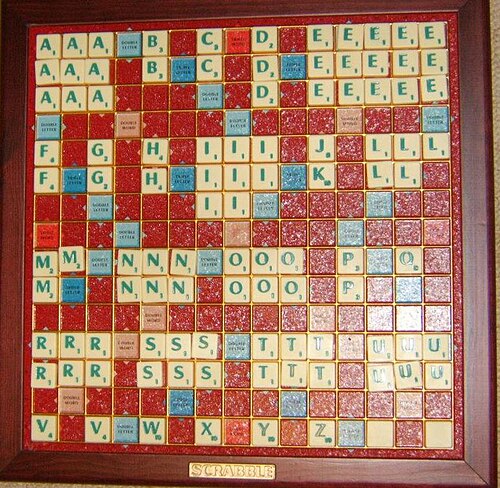
フランス語版の Scrabble には、次の 102 個のタイルが含まれています。
- 空白のタイル 2 枚 (得点 0 点)
- 1ポイント:E ×15、A ×9、I ×8、N ×6、O ×6、R ×6、S ×6、T ×6、U ×6、L ×5
- 2ポイント:D ×3、M ×3、G ×2
- 3ポイント:B ×2、C ×2、P ×2
- 4点:F ×2、H ×2、V ×2
- 8ポイント:J ×1、Q ×1
- 10ポイント:K ×1、W ×1、X ×1、Y ×1、Z ×1
発音区別符号は無視されます。
ドイツ語
ドイツ語版のスクラブルには 102 個の文字タイルが含まれており、次の分布になっています。
- 空白のタイル 2 枚 (得点 0 点)
- 1ポイント:E ×15、N ×9、S ×7、I ×6、R ×6、T ×6、U ×6、A ×5、D ×4
- 2点:H ×4、G ×3、L ×3、O ×3
- 3ポイント:M ×4、B ×2、W ×1、Z ×1
- 4点:C ×2、F ×2、K ×2、P ×1
- 6ポイント:Ä ×1、J ×1、Ü ×1、V ×1
- 8ポイント:Ö ×1、X ×1
- 10ポイント:Q ×1、Y ×1
現在の 102 枚のタイルのセットより前は、ドイツ語セットには 119 枚のタイルが含まれていました。タイルのプールのサイズが大きくなったため、プレイヤーは標準の 7 枚ではなく、一度に 8 枚のタイルをラックに置くことができました。この大きなセットの文字の分布は次のとおりです。
- 空白のタイル 2 枚 (得点 0 点)
- 1ポイント:E ×16、N ×10、I ×9、S ×8、R ×7、A ×6、D ×6、U ×6
- 2点:H ×5、T ×5、C ×4、L ×4、O ×4、G ×3、W ×2
- 3ポイント:M ×4、F ×3、B ×2、K ×2、Z ×2
- 4点:P ×1、V ×1
- 5ポイント:Ü ×1
- 6ポイント:Ä ×1、J ×1
- 8ポイント:Ö ×1、X ×1
- 10ポイント:Q ×1、Y ×1
Selchow & Righter 社が制作した外国語版として販売されているドイツ語セットには、次の分布の 100 枚のタイルが含まれていました。
- 空白のタイル 2 枚 (得点 0 点)
- 1ポイント:E ×12、I ×8、N ×7、A ×6、S ×6、R ×5、T ×5、O ×3、U ×3
- 2点:C ×4、D ×4、H ×4、G ×3、L ×3、Ä ×1、Ö ×1、Ü ×1
- 3点:M ×3、B ×2、F ×2、K ×2、P ×2
- 4点:Z ×3、V ×2、W ×2
- 8ポイント:J ×1
- 10ポイント:Q ×1、X ×1、Y ×1
1950 年代半ば、ドイツのバイエルン州ピディングの木製玩具会社 J. Schowanek KG. は、James Brunot の生産およびマーケティング会社からライセンスを受け、異なる 100 タイルの配分による最初のドイツ語版を製造しました。
- 空白のタイル 2 枚 (得点 0 点)
- 1ポイント:E ×14、I ×8、N ×8、A ×6、R ×6、S ×6、T ×6、O ×3、U ×3
- 2点:D ×4、G ×3、L ×3、Ä ×1、Ö ×1、Ü ×1
- 3点:H ×3、M ×3、B ×2、C ×2、F ×2、K ×2、P ×2
- 4点:V ×2、W ×2
- 8ポイント:J ×1、Y ×1、Z ×1
- 10ポイント:Q ×1、X ×1
2008 年、マテルのライセンス製品であるスーパー スクラブルのドイツ版がゲーム出版社Piatnikから発売されました。このセットは次の 200 枚のタイルで構成されています。
- 空白のタイル 4 枚 (得点 0 点)
- 1ポイント:E ×29、N ×17、S ×14、I ×11、R ×11、T ×12、U ×12、A ×10、D ×8
- 2点:H ×8、G ×6、L ×6、O ×6
- 3ポイント:M ×8、B ×4、W ×2、Z ×2
- 4点:C ×4、F ×4、K ×4、P ×2
- 6ポイント:Ä ×2、J ×2、Ü ×2、V ×2
- 8ポイント:Ö ×2、X ×2
- 10ポイント:Q ×2、Y ×2
下線は、現在の言語セットの 102 個のタイルを単純に 2 倍にした場合よりも、その文字のタイルが 1 つ少ない分布になっていることを示しています。

準文字ß (Eszett)は公式配布では使用されていないことに注意。これは、2017年以前のドイツ語標準正書法では大文字版が正式に存在せず、文字自体がスイスやリヒテンシュタインでは使用されていないためである。代わりに、この文字はSSに置き換えられる。ただし、ウムラウトÄ、Ö、Üはプレイ中にAE、OE、UEに置き換えてはならない(ドイツのクロスワードでは通常、ßもSSに置き換えられる)。一部の外国語に出現する可能性のあるその他の発音区別符号は無視される(é = E、œ = OEなど)。[19]
ギリシャ語
ギリシャ語版のスクラブルには 104 個のタイルが含まれています。
- 空白のタイル 2 枚 (得点 0 点)
- 1点:Α ×12、Ο ×9、Ε ×8、Ι ×8、Τ ×8、Η ×7、Σ ×7、Ν ×6
- 2点:Ρ ×5、Κ ×4、Π ×4、Υ ×4
- 3点:Λ ×3、Μ ×3、Ω ×3
- 4点:Γ ×2、Δ ×2
- 8点:Β ×1、Φ ×1、Χ ×1
- 10点:Ζ ×1、Θ ×1、Ξ ×1、Ψ ×1
ヘブライ語
スクラブルブランドの所有者またはライセンシーによって、 4 つの異なるヘブライ語の配布が発行されました。これらのセットでは、末尾の文字ך、ם、ן、ף、ץは使用できず、通常の形式が使用されます。
ヘブライ語の最新版は、2008 年にマテルUKの子会社であるJW Spear & Sonsによって出版され、 100 枚のタイルが次のように配布されました。
- 空白のタイル 2 枚 (得点 0 点)
- 1 ポイント: Õ ×12、Ù ×10、Ô ×8、 ê ×8、è ×8
- 2点: × 6、 × 6、 ×6、× 6、× 6
- 3 点: × 4、× 4
- 4点:× 3、× 3
- 5点:× 3、× 2、× 2
- 8点:× 2、× 1 、×1、× 1、× 1、 ×1、 × 1、× 1
1980 年代後半に JW Spear & Sons 社が Spears Games レーベルで制作したバージョンには、次の 104 枚のタイルが含まれています。
- 空白のタイル 2 枚 (得点 0 点)
- 1 点: Õ ×12、Ù Ø ×10、ê ê ×9、Ô ×8、 è ×8
- 2点: × 6、 × 6、 ×6、× 6、× 6
- 3 点: × 4、× 4、× 4
- 4点:× 3、× 3、×3、× 3
- 5点:× 2、× 2、× 2
- 8点: × 2、× 1、× 1、× 1
1977 年、JW Spear & Sons 社は、נא-שבץ™ (ヘブライ語で「スクラブル」) という商標名で、オリジナルの 97 タイルのヘブライ語版を出版しました。
- 空白のタイル 2 枚 (得点 0 点)
- 1 ポイント: Õ ×12、Ø Ø ×10、Ô ×9、ê ê ×8、è ×8
- 2 点: × 6、× 6、 ×6、× 6
- 3 点: × 4、× 4、× 3
- 4点:× 3、× 3
- 5点:× 2、× 2、×2 、× 2、× 2
- 8点: × 1、× 1、 ×1、× 1、 ×1、 × 1、× 1
ちょうど 2 年前の 1975 年に、Selchow & Righter 社は、次の 98 タイルの配布でヘブライ語の外国語版をリリースしました。
- 空白のタイル 2 枚 (得点 0 点)
- 1 ポイント: Õ ×12、Ù ×10、ê ê ×9、Ô Ø ×8、è ×8
- 2 点:、 × 6、× 6、 ×6、× 6
- 3 点: × 4、× 4、 ×4、× 4
- 4点:× 3、× 3
- 5点:× 2、× 2、×2 、× 2、× 2
- 8点: × 1、× 1、 ×1、× 1、 ×1、 × 1、× 1
ハンガリー語
ハンガリー語セットでは次の 100 個のタイルを使用します。
- 空白のタイル 2 枚 (得点 0 点)
- 1ポイント:A ×6、E ×6、K ×6、T ×5、Á ×4、L ×4、N ×4、R ×4、I ×3、M ×3、O ×3、S ×3
- 2点:B ×3、D ×3、G ×3、Ó ×3
- 3点:É ×3、H ×2、SZ ×2、V ×2
- 4点:F ×2、GY ×2、J ×2、Ö ×2、P ×2、U ×2、Ü ×2、Z ×2
- 5点:C ×1、Í ×1、NY ×1
- 7点:CS ×1、Ő ×1、Ú ×1、Ű ×1
- 8ポイント:LY ×1、ZS ×1
- 10ポイント:TY ×1
ハンガリー語ではあまり使われないDZとDZS にはタイルがなく、また、拡張ハンガリー語アルファベットの一部として借用語でのみ使用されるQ、 W、 X、 Y (二重音字「GY」、「LY」、「NY」、「TY」以外)にもタイルはありません。空白をQ、 W、 X、 Yとして使用することはできますが、 DZやDZSとして使用することはできません。 DタイルとZタイルを組み合わせてDZを作ったり、 D、 Z、 SまたはDとZSを組み合わせてDZSを作ったりすることはできません。つまり、これらの 2 文字を含む単語はプレイできないということです。 G、 L、 N、 Tの前に空白( Yなど)を使用してGY、 LY、 NY、 TYを作ることもできません。 [要出典]
アイスランド語
2016年、マテル社からライセンスを受けたTinderboxゲームは、以下の104個のタイルを使用したアイスランド語セットを制作した。[20] [21]
- 空白のタイル 2 枚 (得点 0 点)
- 1ポイント:A ×10、 N ×8、R ×8、I ×7、E ×6、S ×6、U ×6、T ×5
- 2点:Ð ×4、G ×4、L ×4
- 3点:M ×4、F ×3、K ×3、
- 4点:Á ×2、D ×2、 H ×2、Í ×2、O ×2、V ×2
- 5ポイント:Þ ×1
- 6 点: B ×1、J ×1、Ó ×1、Y ×1、Æ ×1
- 8点:É ×1、P ×1、Ú ×1、Ö ×1
- 9ポイント:Ý ×1
- 10ポイント:X ×1
2016年初頭、アイスランド語の文字分布を改善する必要性が認識され、スクラブルブランドとは独立したKraflaという名前でセットが制作され、販売されました。その年から、このバージョンはアイスランドのスクラブルクラブのトーナメントや全国選手権で認可されています。人気のあるオンラインクロスワードゲームウェブサイトであるNetskrafl(「ネットスクラブル」の意)[22]は、Kraflaの配布をサポートしています。Kraflaには次の100枚のタイルがあります。
- 空白のタイル 2 枚 (得点 0 点)
- 1ポイント:A ×11、R ×8、I ×7、N ×7、S ×7
- 2点:T ×6、U ×6、L ×5、Ð ×4、K ×4、M ×3
- 3点:E ×3、F ×3、G ×3、Á ×2、Ó ×2
- 4点:Æ ×2、H ×1、Í ×1、Ú ×1
- 5点:B ×1、D ×1、O ×1、P ×1、V ×1、Ý ×1
- 6点:J ×1、Y ×1、Ö ×1
- 7 ポイント: É ×1、 Þ ×1
- 10ポイント:X ×1
2016 年以前は、アイスランド語セットでは次の 104 個のタイルが使用されていました。
- 空白のタイル 2 枚 (得点 0 点)
- 1ポイント:A ×10、I ×8、N ×8、R ×7、E ×6、S ×6、U ×6、T ×5
- 2点:Ð ×5、G ×4、K ×3、L ×3、M ×3
- 3点:F ×3、O ×3、H ×2、V ×2
- 4点:Á ×2、D ×2、Í ×2、Þ ×1
- 5ポイント:J ×1、Æ ×1
- 6点:B ×1、É ×1、Ó ×1
- 7ポイント:Y ×1、Ö ×1
- 8ポイント:P ×1、Ú ×1
- 9ポイント:Ý ×1
- 10ポイント:X ×1
元々、このセットには 6 個ではなく 7 個の E があったため、タイルは 105 個ありました。
C、Q、W はアイスランド語では使用されていないため、すべてのディストリビューションに存在しません。Zも1970 年代以降廃止されているため、すべてのセットに存在しません。
インドネシア語
インドネシア語セットでは以下の100個のタイルが使用される: [23]
- 空白のタイル 2 枚 (得点 0 点)
- 1ポイント:A ×19、N ×9、E ×8、I ×8、T ×5、U ×5、R ×4、O ×3、S ×3
- 2点:K ×3、M ×3
- 3ポイント:D ×4、G ×3
- 4点:L ×3、H ×2、P ×2
- 5点:B ×4、Y ×2、F ×1、V ×1
- 8点:C ×3、W ×1
- 10ポイント:J ×1、Z ×1
Q、およびX は、外来語にのみ存在し、非常にまれであるため、含まれていません。F、V、およびZも外来語にのみ存在しますが、それほどまれではないため、含まれています。
アイルランド語
2010年に作成されたアイルランド語セット[24]では、次の100個のタイルが使用されています。
- 空白のタイル 2 枚 (得点 0 点)
- 1ポイント:A ×13、H ×10、I ×10、N ×7、R ×7、E ×6、S ×6
- 2点:C ×4、D ×4、L ×4、O ×4、T ×4、G ×3、U ×3
- 4点:Á ×2、F ×2、Í ×2、M ×2
- 8点:É ×1、Ó ×1、Ú ×1
- 10ポイント:B ×1、P ×1
J、K、Q、V、W、X、Y、Zは標準的なアイルランド語のアルファベットには属さないため存在しませんが、借用語では時々使用されます。
Scrabble3Dが公式セットと共に提案した代替セット[25]には、次の100枚のタイルが含まれることが提案されました。
- 空白のタイル 2 枚 (得点 0 点)
- 1ポイント:A ×13、I ×10、N ×6、R ×6、E ×5、L ×5、O ×5、Í ×4、S ×4、T ×4
- 2点:Á ×4、C ×3、Ċ ×3、D ×3、M ×3、G ×2
- 3点:F ×2、Ó ×2、Ṫ ×1
- 4点:U ×2、Ḃ ×1、Ḋ ×1、É ×1、Ġ ×1、Ú ×1
- 5ポイント:B ×1、Ṁ ×1
- 8点:P ×1、Ṡ ×1
- 10ポイント:Ḟ ×1、Ṗ ×1
H はこのセットに含まれていないことに注意してください。これは、H が母音で始まる単語の先頭にのみ使用され、このセットの規則に違反しているためです。注: このセットでは古い綴り法を使用しています。新しい綴り法では、ドット付きの文字は、ドットのない文字の二重字に置き換えられ、その後に H が続きます。
その後まもなく、Scrabble3Dディストリビューションは大幅な改訂を受けました[25](まだ100個のタイルが残っています)。
- 空白のタイル 2 枚 (得点 0 点)
- 1点:A ×11、I ×8、Á ×5、Í ×5 、L ×5、 N ×5、R ×5、E ×4、O ×4、S ×4
- 2 点:C ×3、Ċ ×3、D ×3、G ×3、M ×3、Ó ×3、T ×3、Ú ×3
- 3点:B ×2、Ḃ ×2、É ×2、Ṫ ×2、U ×2
- 4点:Ḋ ×1、F ×1、Ġ ×1
- 5ポイント:Ṁ ×1
- 8点:P ×1、Ṡ ×1
- 10ポイント:Ḟ ×1、Ṗ ×1
H はこのセットに含まれていないことに注意してください。これは、H が母音で始まる単語の先頭にのみ使用され、このセットの規則に違反しているためです。注: このセットでは古い綴り法を使用しています。新しい綴り法では、ドット付きの文字は、ドットのない文字の二重字に置き換えられ、その後に H が続きます。
イタリア語
イタリア語版のスクラブルでは、プレイヤーが自分の番でタイルを交換するときに、相手に自分の番をパスするよう要求できるという特別なルールが適用されています。両プレイヤーは 1 ゲームにつき 1 回ずつチャンスがあります。セットは次の 120 枚のタイルで構成されています。
- 空白のタイル 2 枚 (得点 0 点)
- 1ポイント:O ×15、A ×14、I ×12、E ×11
- 2ポイント:C ×6、R ×6、S ×6、T ×6
- 3ポイント:L ×5、M ×5、N ×5、U ×5
- 5点:B ×3、D ×3、F ×3、P ×3、V ×3
- 8ポイント:G ×2、H ×2、Z ×2
- 10ポイント:Q ×1
発音区別符号は無視されます。J、K、W、X、Y の文字は標準のイタリア語アルファベットには存在しないため省略されますが、借用語では時々使用されます。ただし、空白を使用して、これらの 5 つの欠落文字を表すことはできます。
1980年代以前、イタリアのスクラブルは「スカラパローラ」と呼ばれていました[26]。セットには以下の120枚のタイルが含まれていました。
- 空白のタイル 2 枚 (得点 0 点)
- 1ポイント:A ×13、E ×13、I ×13、O ×13
- 2ポイント:N ×6、R ×6、S ×6、T ×6
- 3ポイント:L ×5、M ×5、 U ×5
- 4点:C ×4、V ×4
- 5点:B ×3、D ×3、G ×3、P ×3
- 8点:F ×2、H ×2、Z ×2
- 10ポイント:Q ×1
スカラベオはイタリア版スクラブルで、母国ではオリジナルのゲームよりも人気がある。17×17のボードでプレイされ、以下の130枚のタイルを使用する。 [27]
- スカラベタイル 2 枚 (ワイルドカード) 0 ポイント
- 1ポイント:A ×12、E ×12、I ×12、O ×12、C ×7、R ×7、S ×7、T ×7
- 2ポイント:L ×6、M ×6、N ×6
- 3ポイント:P ×4
- 4点:B ×4、D ×4、F ×4、G ×4、U ×4、V ×4
- 8点:H ×2、Z ×2
- 10ポイント:Q ×2
1948年、セルコウ&ライター社はイタリア語版の外国語版を以下の120枚のタイルでリリースした。[28]
- 空白のタイル 2 枚 (得点 0 点)
- 1ポイント:A ×10、E ×10、I ×10、O ×10、R ×7、S ×7、T ×7
- 2ポイント:C ×6、N ×6、L ×5
- 3点:M ×5、D ×4、P ×4
- 4点:B ×4、F ×4、G ×4、U ×4、V ×4
- 8点:Z ×3、H ×2
- 10ポイント:Q ×2
1976年までに分布はスカラパローラに合わせて変更された。[29]
ラテン
ラテン語のスクラブル セットには、言語の権威 4 名によって開発された 4 種類があります。
公式の配分は「ケンブリッジ大学やその他の学者、ケンブリッジ・スクールズ・クラシックス・プロジェクトと共同で」行われた。この配分ではUとVが区別され、半母音のVは5倍の得点を獲得する。[30]
- 空白のタイル 2 枚 (得点 0 点)
- 1ポイント:E ×11、I ×11、A ×9、R ×9、S ×8、T ×7、U ×7、N ×6
- 2点:M ×5、O ×5、C ×4
- 3点:D ×3
- 4点:L ×2、P ×2
- 5ポイント:B ×2、V ×2
- 6ポイント:F ×1、G ×1、X ×1
- 10ポイント:H ×1、Q ×1
トロント大学中世研究センターが開発した 2 番目の分布では、次の 100 個のタイルが使用されています。
- 空白のタイル 2 枚 (得点 0 点)
- 1ポイント:E ×12、A ×9、I ×9、V ×9、S ×8、T ×8、R ×7、O ×5
- 2点:C ×4、M ×4、N ×4、D ×3、L ×3
- 3ポイント:Q ×3
- 4点:B ×2、G ×2、P ×2、X ×2
- 8点:F ×1、H ×1
トロント大学中世研究センターが開発したラテン語古文書学の第 2 の分布の拡張では、次の 120 個のタイルを使用します。
- 空白のタイル 3 枚 (得点 0 点)
- 1ポイント:E ×12、A ×9、I ×9、V ×9、S ×8、T ×8、R ×7、O ×5
- 2点:C ×4、M ×4、N ×4、D ×3、L ×3、± 2、± 1 、 ± 1、± 1 、 ×1、アイ×1、アイ×1
- 3 点: Q ×3、& ×2、Ↄ ×1、ſt ×1、V̄ ×1
- 4点:B ×2、G ×2、P ×2、X ×2
- 5ポイント:ct ×1、Ꝑ ×1、Ꝝ ×1
- 6ポイント:Ꝓ ×1、P̄ ×1
- 8点:F ×1、H ×1
- 10ポイント:Y ×1
Ↄの点数は不明ですが、3 だと考えられています。 Ↄは con を表し、単語の最初の牌としてのみ使用できます。Ꝝは rum を表し、;は is または us を表し、単語の最後の牌としてのみ使用できます。Ę (e caudata) はæとも書かれ、ae を表します。Ē はem または en を表します。&はet を表します。Ī はim または in を表します。œ はoe を表します。Ꝑ はper を表し、P̄ はprae を表します。Ꝓ はpro を表します。V̄ はvm または vn (当時は U がなかったため) を表します。W は、同時に作成されたĘ / æやœとは異なり、ラテン語には vv の二重音字がないため牌を持たないことに注意してください。ıı は2 つの小数点、つまり ii、v、または n を表します。ııı は3 つのミニムを表します: iii、iv、in、vi、ni、または m。
3番目の分布は次のとおりです。[31]
- 空白のタイル 2 枚 (得点 0 点)
- 1ポイント:E ×12、I ×12、V ×10、A ×9、T ×8、S ×7、N ×6、R ×6、M ×5、O ×5、L ×3
- 2点:D ×3、P ×3
- 3点:C ×4、B ×2
- 4点:Q ×2、F ×1、G ×1、H ×1
- 8ポイント:X ×1
しかし、このセットでは、ルールによれば、空白をYとして使用すると10 ポイント、空白をZとして使用すると15 ポイント、空白をKとして使用すると20 ポイントになります。これらの文字は借用語でのみ使用されるため、ポイントが非常に高くなります。K の 20 ポイントは、世界中のどのスクラブル スコア分布でも、文字の最高ポイント値として知られています。
Vの代わりにUを使用し、Yを含む4番目の分布は次のようになります。[32]
- 空白のタイル 2 枚 (得点 0 点)
- 1ポイント:E ×10、 A ×9、I ×9、S ×9、T ×9、U ×9
- 2ポイント:M ×6、N ×6、O ×6、R ×6
- 3点:C ×4、D ×4、L ×4、P ×4
- 8点:B ×2、F ×2、G ×2、H ×2、Q ×2
- 10ポイント:X ×1、Y ×1
Y は、ラテン語では珍しいため、最初のセットの古文書拡張と第 4 セットを除くすべてのセットに存在しません。KとZはラテン語では珍しいため、すべてのセットに存在しません。一方、J は、ラテン語では珍しいため 3 番目のセットには含まれていない 3 番目のセットを除くすべてのセットで I と別個とは見なされません。Wも、古代には存在せず、現代の借用語でのみ使用されるため、すべてのセットに存在しません。
ラトビア語
ラトビア語セットでは以下の104個のタイルが使用されています: [33]
- 空白のタイル 2 枚 (得点 0 点)
- 1ポイント:A ×11、I ×9、S ×8、E ×6、T ×6、R ×5、U ×5
- 2点:Ā ×4、K ×4、M ×4、N ×4、L ×3、P ×3
- 3ポイント:D ×3、O ×3、V ×3、Z ×2
- 4点:Ē ×2、Ī ×2、J ×2
- 5ポイント:B ×1、C ×1、G ×1
- 6点:×× 1、×× 1、×× 1
- 8 ポイント: Ļ ×1、Ž ×1
- 10点:Č ×1、F ×1、Ģ ×1、H ×1、Ķ ×1
Q、W、Xは現代ラトビア語では使用されていないため、存在しません。Y はラトビア語の特定の方言でのみ使用されているため、存在しません。FとH は借用語にのみ存在しますが、標準ラトビア語の一部と見なされるため、含まれています。
リトアニア語
リトアニア語セットでは、次の 104 個のタイルを使用します。
- 空白のタイル 2 枚 (得点 0 点)
- 1ポイント:I ×13、A ×12、S ×8、O ×6、T ×6、E ×5、N ×5、R ×5、K ×4、U ×4
- 2ポイント:D ×3、L ×3、M ×3、B ×1
- 3ポイント:P ×3
- 4点:Ė ×2、G ×2、J ×2、V ×2
- 5ポイント:Š ×1、Y ×1
- 6ポイント:Ų ×1、Ž ×1
- 8点: Ą ×1、Č ×1、Į ×1、Ū ×1
- 10ポイント:C ×1、Ę ×1、F ×1、H ×1、Z ×1
Q、W、X の文字はリトアニア語では使用されないため、含まれていません。FとH は借用語にのみ存在しますが、標準リトアニア語の一部と見なされるため、含まれています。

古い非公式の KrisKros Klasik の配布は次のとおりです。
- 空白のタイル 2 枚 (得点 0 点)
- 1ポイント:I ×11、A ×9、R ×9、E ×6、L ×6、S ×6、O ×5、T ×5、U ×5、N ×4、Ą ×1
- 2点:K ×4、D ×3、M ×3、P ×3、B ×2、G ×2、Ę ×1
- 3点:Ė ×2、Š ×2、Ų ×1
- 4点:J ×2、Į ×1、V ×1、Ž ×1
- 5ポイント:Ū ×1、Z ×1
- 6ポイント:Y ×1
- 7ポイント:C ×1、Č ×1
- 10ポイント:F ×1、H ×1
マダガスカル語
マダガスカル語セットでは以下の102個のタイルが使用されています: [34]
- 空白のタイル 2 枚 (得点 0 点)
- 1ポイント:A ×20、O ×14、N ×13、I ×11、T ×6、K ×5、E ×4、S ×4、Y ×4
- 2点:F ×2、M ×2、V ×2
- 3ポイント:D ×2、L ×2
- 4点:B ×2、P ×2
- 6ポイント:H ×1、J ×1、R ×1、Z ×1
- 10ポイント: G ×1
C、Q、U、W 、 Xはマダガスカル語では使用されない文字なので存在しません。発音区別符号は無視されます。
マレー語
マレー語セットでは次の 100 個のタイルを使用します。
- 空白のタイル 2 枚 (得点 0 点)
- 1ポイント:A ×19、N ×8、E ×7、I ×7、K ×6、U ×6、M ×5、R ×5、T ×5
- 2ポイント:L ×4、S ×4
- 3ポイント:G ×4、B ×3、D ×3
- 4点:H ×2、O ×2、P ×2
- 5ポイント:J ×1、Y ×1
- 8点:C ×1、W ×1
- 10ポイント:F ×1、Z ×1
Q、V、X は外来語にのみ存在するため存在しません。FとZも同様ですが、この 2 つはそれほど珍しくありません。
ノルウェー語
ノルウェー語版の Scrabble では、次の 100 個のタイルが使用されます。
- 空白のタイル 2 枚 (得点 0 点)
- 1ポイント:E ×9、A ×7、N ×6、R ×6、S ×6、T ×6、D ×5、I ×5、L ×5
- 2点:F ×4、G ×4、K ×4、O ×4、M ×3
- 3ポイント:H ×3
- 4点:B ×3、U ×3、V ×3、J ×2、P ×2、Å ×2
- 5ポイント:Ø ×2
- 6点:Y ×1、Æ ×1
- 8ポイント:W ×1
- 10ポイント:C ×1
Q、X、Zの文字は、非常にまれで、外国語にしか現れないため、含まれていません。これらの文字と、いくつかのノルウェー語の単語で使用されている外国語の文字「Ä」、「Ö」、「Ü」は、空白で遊ぶことができます。CとWも外国語にしか現れませんが、それほどまれではないため、[35]含めました。
研磨

ポーランド語版のスクラブルでは以下の100枚のタイルが使用されている: [36]
- 空白のタイル 2 枚 (得点 0 点)
- 1ポイント:A ×9、I ×8、E ×7、O ×6、N ×5、Z ×5、R ×4、S ×4、W ×4
- 2点:Y ×4、C ×3、D ×3、K ×3、L ×3、M ×3、P ×3、T ×3
- 3点:B ×2、G ×2、H ×2、J ×2、× 2、U ×2
- 5点:Ą ×1、Ę ×1、F ×1、Ó ×1、Ś ×1、Ż ×1
- 6ポイント:Ć ×1
- 7ポイント:Ń ×1
- 9ポイント:Ź ×1
このセットは 2000 年から使用されています。その年より前は、わずかに異なる構成が使用されていました。Źは7 ポイント、Fは 4 ポイントで、F が 2 つ、A が 8 つありました。
ポーランドのオンラインスクラブルゲームであるLiterakiでは、同じ分布を使用していますが、タイルの最大ポイント数は5です。 [37]
Alexander [年要] はスウェーデンのゲームAlfapetをベースにした Scriba をリリースしました。このディストリビューションには 108 個のタイルが含まれています: [38]
- 空白タイル 3 枚 (得点 0 点)、黒点タイル 2 枚 (得点 0 点)、矢印タイル 3 枚 (得点 0 点)
- 1ポイント:A ×7、E ×6、I ×6、O ×5
- 2点:T ×5、Z ×5、B ×4、N ×4、P ×4、R ×4、S ×4、Y ×4、D ×3、L ×3、M ×3、W ×3
- 3点:C ×3、F ×3、H ×3、K ×3、U ×2
- 4点:G ×3、J ×2、× 2
- 6点:Ó ×2、Ą ×1、Ś ×1
- 7ポイント:Ć ×1
- 8点:± ×1、×× 1、 ×× 1、×× 1
Q、V、Xの文字は常に欠落している(外国語で使用されているため)。空白のタイルは、インターネットスクラブルクラブを除いて、これらを表すために使用することはできません。[39] [ 40] [41]
ポルトガル語
ポルトガル語版のスクラブルには 120 個のタイルが含まれています。
- 空白のタイル 3 枚 (得点 0 点)
- 1ポイント:A ×14、E ×11、I ×10、O ×10、S ×8、U ×7、M ×6、R ×6、T ×5
- 2点:D ×5、L ×5、C ×4、P ×4
- 3点:N ×4、B ×3、Ç ×2
- 4点:F ×2、G ×2、H ×2、V ×2
- 5ポイント:J ×2
- 6ポイント:Q ×1
- 8ポイント:X ×1、Z ×1
Çは別のタイルですが、他の発音区別符号は無視されます。 K、W、Yはポルトガル語の借用語にのみ存在し、2009 年までは公式文字でもなかったため、存在しません。
ルーマニア語
ルーマニア語版のスクラブルでは以下の100枚のタイルが使用されている: [42]
- 空白のタイル 2 枚 (得点 0 点)
- 1ポイント:I ×11、A ×10、E ×9、T ×7、N ×6、R ×6、S ×6、C ×5、L ×5、U ×5
- 2点:O ×5、P ×4
- 3点:D ×4
- 4点:M ×3、F ×2、V ×2
- 5点:B ×2
- 6ポイント:G ×2
- 8点:H ×1、Z ×1
- 10ポイント:J ×1、X ×1
更新版ではいくつかの修正が適用されました。以前は、Bの価値は8で、Oの価値は1でした。[43]
オリジナル (1982 年) の配布では、次の 100 個のタイルが使用されました。
- 空白のタイル 2 枚 (得点 0 点)
- 1ポイント:A ×11、I ×10、E ×9、R ×7、T ×7、N ×6、U ×6、C ×5、O ×5、S ×5、L ×4
- 2点:D ×4、P ×4
- 4ポイント:M ×3
- 8点:F ×2、V ×2
- 9点:B ×2、G ×2
- 10ポイント:H ×1、J ×1、X ×1、Z ×1
発音区別符号は無視されるため、たとえばÂ はAとして再生されます。どちらの分布にもK、Q、W、Y は存在しません。これらは外来語でのみ使用されるためです。ただし、これらの文字を表すために空白を使用することはできます。文字Xも外来語といくつかのネイティブ語でのみ使用されますが、[引用が必要]それほど珍しくはないため、ここに含めます。
ロシア
キリル文字を使用するロシア語のスクラブル セットには、次の分布を使用する 104 個のタイルが含まれています。
- 空白のタイル 2 枚 (得点 0 点)
- 1点:О ×10、А ×8、Е ×8、И ×5、Н ×5、Р ×5、С ×5、Т ×5、В ×4
- 2点:Д ×4、К ×4、Л ×4、П ×4、У ×4、М ×3
- 3点:Б ×2、Г ×2、Ь ×2、Я ×2、Ё ×1
- 4ポイント:Ы ×2、Й ×1
- 5点:З ×2、Ж ×1、Х ×1、Ц ×1、Ч ×1
- 8点:Ш ×1、Э ×1、Ю ×1
- 10点:Ф ×1、Щ ×1、Ъ ×1
旧ソ連の配布は 126 個のタイルで構成され、次のとおりでした。
- 空白のタイル 2 枚 (得点 0 点)
- 1点:О ×11、Е ×10、И ×10、А ×9、Н ×6、Р ×6、Т ×6、В ×5、С ×5
- 2点:Д ×4、К ×4、Л ×4、М ×4、П ×4、У ×4
- 3点:Я ×4、 Б ×3、Г ×3、Ё ×3、 Ь ×2
- 4点:Ы ×2、Й ×2
- 5点:Ж ×2、З ×2、Х ×1、Ц ×1、Ч ×1
- 8点:Ш ×1、Э ×1、Ю ×1
- 10点:Ф ×1、Щ ×1、Ъ ×1
1954年、セルコウ&ライトラーはロシア語版[44] [より詳しい情報源が必要]をリリースし、124タイルの分布は以下の通りであった。
- 空白のタイル 2 枚 (得点 0 点)
- 1点:О ×12、Е ×10、И ×10、А ×9、Н ×6、Р ×6、Т ×6、В ×5、С ×5
- 2点:Д ×4、К ×4、Л ×4、М ×4、П ×4、У ×4
- 3点:Я ×4、 Б ×3、Г ×3、Ь ×2
- 4点:Ы ×2、Й ×2
- 5点:Ж ×2、З ×2、Х ×1、Ц ×1、Ч ×1
- 8点:Ш ×1、Э ×1、Ю ×1
- 10点:Ф ×1、Щ ×1、Ъ ×1
このディストリビューションにはЁタイルがありません。
もう一つのロシア語版は Эрудит (Erudit) と呼ばれ、131 枚のタイルがあり、Ё タイルは存在しません。
- 空白のタイル 3 枚 (得点 0 点)
- 1点:А ×10、И ×8、О ×10、Е ×9、Н ×8
- 2点:К ×6、П ×6、Р ×6、С ×6、В ×5、Д ×5、М ×5、Т ×5、Й ×4、Л ×4
- 3点:Б ×3、Г ×3、У ×3、Я ×3
- 5 points: Ж ×2, З ×2, Х ×2, Ч ×2, Ы ×2, Ь ×2
- 10 points: Ф ×1, Ц ×1, Ш ×1, Щ ×1, Ъ ×1, Э ×1, Ю ×1
In Erudit, only nominative singular and pluralia tantum nouns are allowed.
Scottish Gaelic
Scottish Gaelic-language editions of Scrabble, created in 2023,[45] use these 100 tiles:
- 2 blanks (scoring 0 points)
- 1 point: A ×12, H ×12, I ×9, E ×6, D ×5, R ×5, S ×4
- 2 points: B ×4, C ×4, G ×4, L ×4, M ×4, N ×4, O ×4, U ×4
- 4 points: À ×2, F ×2, T ×2
- 6 points: È ×2, Ù ×2
- 8 points: Ì ×1, Ò ×1
- 10 points: P ×1
Á, É, and Ó are absent since they are now mostly obsolete in the Scottish Gaelic language. J, K, Q, V, W, X, Y, and Z are absent since they are not used in the Scottish Gaelic language.
Scrabble3D originally planned to use these 104 tiles in an unofficial distribution, planned earlier:[46]
- 2 blank tiles (scoring 0 points)
- 1 point: A ×14, E ×9, I ×9, N ×4, O ×4, R ×4, S ×4
- 2 points: CH ×4, D ×4, DH ×4, L ×4, U ×3, BH ×2
- 3 points: C ×3, G ×3, T ×3, TH ×3, B ×2, M ×2
- 4 points: NN ×2
- 5 points: À ×2, GH ×2, F ×1, FH ×1, MH ×1
- 6 points: È ×1, Ì ×1, Ò ×1, P ×1, Ù ×1
- 8 points: LL ×1, RR ×1
- 10 points: NG ×1
The distribution was modified a bit (Dropping NG due to its rarity, adding more A, E, and I tiles, and changing the number of tiles to 100).
Scottish Gaelic-language sets used by Scrabble3D use these 100 tiles:[47]
- 2 blank tiles (scoring 0 points)
- 1 point: A ×15, I ×11, E ×10, N ×4, O ×4, R ×4, S ×4, PH ×1, SH ×1
- 2 points: CH ×3, D ×3, DH ×3, L ×3, U ×2, BH ×1
- 3 points: C ×3, G ×3, T ×3, TH ×3, B ×2, M ×2
- 4 points: NN ×1
- 5 points: À ×1, F ×1, FH ×1, GH ×1, MH ×1
- 6 points: È ×1, Ì ×1, Ò ×1, P ×1, Ù ×1
- 8 points: LL ×1, RR ×1
H is absent from both Scrabble3D sets because it is almost exclusively used in lenited consonants.
Slovak
Slovak-language sets use these 100 tiles:
- 2 blank tiles (scoring 0 points)
- 1 point: A ×9, O ×9, E ×8, I ×5, N ×5, R ×4, S ×4, T ×4, V ×4
- 2 points: M ×4, D ×3, K ×3, L ×3, P ×3
- 3 points: J ×2, U ×2
- 4 points: B ×2, Á ×1, C ×1, H ×1, Y ×1, Z ×1
- 5 points: Č ×1, Í ×1, Š ×1, Ý ×1, Ž ×1
- 7 points: É ×1, Ľ ×1, Ť ×1, Ú ×1
- 8 points: Ď ×1, F ×1, G ×1, Ň ×1, Ô ×1
- 10 points: Ä ×1, Ĺ ×1, Ó ×1, Ŕ ×1, X ×1
Q, W, Ě, Ö, Ř, and Ü are absent because they are only used in loanwords, but may be represented with a blank. The letter X is also only used in loanwords, but it is not so rare, so it is included. The digraphs CH, DZ, and DŽ, although considered single letters in the Slovak alphabet, are played as pairs of letters.
Since 2013, a new 112-tile set was introduced, including the letters Q and W:
- 2 blank tiles (scoring 0 points)
- 1 point: O ×10, A ×9, E ×8, I ×6, N ×5, S ×5, V ×5, T ×4
- 2 points: R ×5, K ×4, L ×4, D ×3, M ×3, P×3, U ×3, Á ×2, B ×2, J ×2, Y ×2, Z ×2
- 3 points: C ×1, Č ×1, É ×1, H ×1, Í ×1, Š ×1, Ú ×1, Ý ×1, Ž ×1
- 4 points: Ť ×1
- 5 points: Ľ ×1
- 6 points: F ×1, G ×1
- 7 points: Ň ×1, Ô ×1
- 8 points: Ä ×1, Ď ×1, Ó ×1
- 9 points: Ĺ ×1, Ŕ ×1, X ×1
- 10 points: Q ×1, W ×1
Slovenský spolok Scrabble does not recommend using this new version, because the letters and their point values do not correspond to their frequency in Slovak.
Arguably the Q and W tiles should still not be included, but the manufacturer decided to, so that loanwords can be played. In the tournament rules for accepted words, however, there are only a few words with W (not including their inflections) and almost none with Q.[48] Some players play these two just as two more blanks, or they just remove them from the set altogether.
Slovenian
Slovenian-language sets use these 100 tiles:
- 2 blank tiles (scoring 0 points)
- 1 point: E ×11, A ×10, I ×9, O ×8, N ×7, R ×6, S ×6, J ×4, L ×4, T ×4
- 2 points: D ×4, V ×4
- 3 points: K ×3, M ×2, P ×2, U ×2
- 4 points: B ×2, G ×2, Z ×2
- 5 points: Č ×1, H ×1
- 6 points: Š ×1
- 8 points: C ×1
- 10 points: F ×1, Ž ×1
Q, W, X and Y are absent, because Slovenian does not use those letters.
Spanish
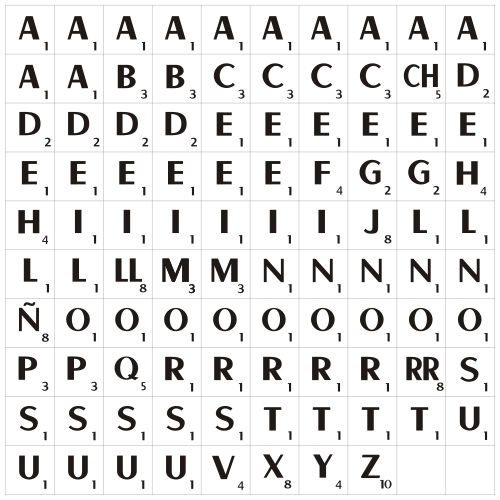
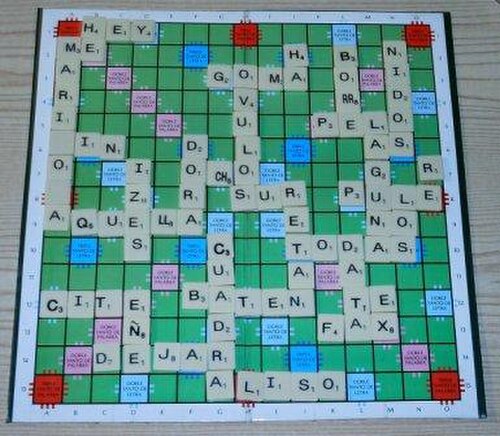
Spanish-language sets sold outside North America use these 100 tiles:
- 2 blank tiles (scoring 0 points)
- 1 point: A ×12, E ×12, O ×9, I ×6, S ×6, N ×5, R ×5, U ×5, L ×4, T ×4
- 2 points: D ×5, G ×2
- 3 points: C ×4, B ×2, M ×2, P ×2
- 4 points: H ×2, F ×1, V ×1, Y ×1
- 5 points: CH ×1, Q ×1
- 8 points: J ×1, LL ×1, Ñ ×1, RR ×1, X ×1
- 10 points: Z ×1
Stress accents and diaereses are disregarded. The letters K and W are absent since these two letters are only used in words of foreign origin. According to FISE (Federación Internacional de Scrabble en Español) rules, a blank cannot be used to represent K or W; loanwords containing them are simply not playable.
Using one C and one H tile in place of the CH tile, two L tiles for the LL tile, or two R tiles for the RR tile is also not allowed in Spanish Scrabble.[49]
Spanish-language sets sold within North America (known as Scrabble – Edición en Español) use - including "K" and "W" but without "CH" - these 103 tiles:
- 2 blank tiles (scoring 0 points)
- 1 point: A ×11, E ×11, O ×8, S ×7, I ×6, U ×6, N ×5, L ×4, R ×4, T ×4
- 2 points: C ×4, D ×4, G ×2
- 3 points: B ×3, M ×3, P ×2
- 4 points: F ×2, H ×2, V ×2, Y ×1
- 6 points: J ×2
- 8 points: K ×1, LL ×1, Ñ ×1, Q ×1, RR ×1, W ×1, X ×1
- 10 points: Z ×1
Stress accents are still disregarded.
Spanish-language sets sold within Latin America under the name Escarbar (a Spanish word for Scrabble) - including "K" and "CH" but without "RR" and "W" - use these 108 tiles [citation needed]:
- 2 blank tiles (scoring 0 points)
- 1 point: E ×12, A ×9, I ×9, O ×8, N ×6, R ×6, T ×6, L ×4, S ×4, U ×4, Ñ ×3
- 2 points: D ×4, G ×3, B ×2
- 3 points: C ×2, M ×2, P ×2
- 4 points: CH ×4, LL ×3, F ×2, H ×2, V ×2, Y ×2
- 5 points: K ×1
- 8 points: J ×1, X ×1
- 10 points: Q ×1, Z ×1
An unofficial practice in some variants of Spanish Scrabble is the permit of words with QU to be played with the Q and with or without the following U. This variant practice eliminates the Q-without-U difficulty that may otherwise occur.
Swedish

Swedish-language Scrabble sets (until 1990 sold in Sweden as Alfapet, but that became a different game) use these 100 tiles:
- 2 blank tiles (scoring 0 points)
- 1 point: A ×8, R ×8, S ×8, T ×8, E ×7, N ×6, D ×5, I ×5, L ×5
- 2 points: O ×5, G ×3, K ×3, M ×3, H ×2
- 3 points: F ×2, V ×2, Ä ×2
- 4 points: U ×3, B ×2, P ×2, Å ×2, Ö ×2
- 7 points: J ×1, Y ×1
- 8 points: C ×1, X ×1
- 10 points: Z ×1
Å, Ä and Ö have separate tiles; other diacritics like that on É are ignored (except Ü). Q and W, found only in loanwords, are absent but can be played with a blank. Ü and Æ require a blank, and as of 2010 only occur in one and three playable words respectively: müsli and three forms of Laestadianism (læstadianism in Swedish).
Originally (starting in 1954), Swedish Scrabble sets (called Alfa-pet, made by the Swedish company Alga, since 1983 a member of the BRIO Group) used a slightly different distribution:
- 2 blank tiles (scoring 0 points)
- 1 point: T ×9, A ×8, R ×8, S ×8, E ×7, N ×6, D ×5, I ×5, L ×5
- 2 points: O ×5, G ×3, K ×3, M ×3, H ×2
- 3 points: F ×2, V ×2, Ä ×2
- 4 points: U ×3, B ×2, P ×2, Å ×2, Ö ×2
- 7 points: J ×1, Y ×1
- 8 points: X ×1
- 10 points: C ×1
Note that Z was absent in this distribution as it is almost exclusively used in loanwords. However, it could be played with a blank.
Between 1956 and 1961, the makers of Alfa-pet revised the distribution, altering the number of tiles for the letters B, E, N, O, P, S, and U. The letter C was reduced in value to 5 and the X was increased to 10:
- 2 blank tiles (scoring 0 points)
- 1 point: E ×10, N ×9, T ×9, A ×8, R ×8, S ×6, D ×5, I ×5, L ×5
- 2 points: O ×4, G ×3, K ×3, M ×3, H ×2
- 3 points: F ×2, V ×2, Ä ×2
- 4 points: U ×2, Å ×2, Ö ×2, B ×1, P ×1
- 5 points: C ×1
- 7 points: J ×1, Y ×1
- 10 points: X ×1
Circa 1961, the hyphen was dropped from the game's name, and the original Swedish distribution of the game had been restored. Sometime in the 1980s, produced under BRIO's subsidiary, Joker, the number of Ts in the set were reduced by one and an 8-point Z tile was added.
In 2002, under the ownership of Mattel and its brand name Scrabble, the Swedish language set tile values of the C and Z were changed, respectively, to 8 and 10.
Though Alga had lost its license to Mattel Europa in the early 1990s in the production of the game, the company held onto its ownership of the name Alfapet. subsequently it produced a different yet similar crossword board game. Played on a different grid layout, this game is played with a distribution which contains these 120 tiles, with Q but not W:
- 2 blank tiles (scoring 0 points), 2 black tiles (scoring 0 points), 2 left-pointing arrows, 2 right-pointing arrows
- 1 point: A ×9, R ×9, E ×8, S ×8, D ×7, L ×7, N ×7, T ×7, I ×6
- 2 points: O ×5, G ×4
- 3 points: H ×3, K ×3, M ×3, P ×3, U ×3
- 4 points: B ×2, F ×2, V ×2, Å ×2, Ä ×2, Ö ×2
- 8 points: C ×2, Y ×2, J ×1
- 10 points: Q ×1, X ×1, Z ×1
The black tile may be put in front of a word to create another word adjacent to the black tile and thus diagonally away from the original word. The arrows lets the player change the direction of a word anywhere between the first and last letter of the word, and are always placed under letters. Anyway, Q is only used in loanwords in modern Swedish, so it is included.
Turkish
Turkish-language sets use these 100 tiles (including distinct dotted and dotless I tiles):
- 2 blank tiles (scoring 0 points)
- 1 point: A ×12, E ×8, İ ×7, K ×7, L ×7, R ×6, N ×5, T ×5
- 2 points: I ×4, M ×4, O ×3, S ×3, U ×3
- 3 points: B ×2, D ×2, Ü ×2, Y ×2
- 4 points: C ×2, Ç ×2, Ş ×2, Z ×2
- 5 points: G ×1, H ×1, P ×1
- 7 points: F ×1, Ö ×1, V ×1
- 8 points: Ğ ×1
- 10 points: J ×1
Since the letters Â, Î, and Û are considered modified versions of their base forms in Turkish, they are played as A, İ, and U, respectively. The letters Q, W, and X are not used in Turkish and therefore do not appear in the set. Blanks may not represent these letters.
(See a completed Turkish Scrabble board:)
Ukrainian
Optimum Ukrainian-language Scrabble sets, which use Cyrillic letters, contain 104 tiles using this distribution:
- 2 blank tiles (scoring 0 points)
- 1 point: О ×10, А ×8, И ×7, Н ×7, Е ×5, І ×5, Т ×5, Р ×5, В ×4
- 2 points: К ×4, С ×4, М ×4, Д ×3, Л ×3, П ×3
- 3 points: У ×3
- 4 points: З ×2, Я ×2, Б ×2, Г ×2,
- 5 points: Ч ×1, Х ×1, Й ×1, Ь ×1
- 6 points: Ж ×1, Ї ×1, Ц ×1, Ш ×1
- 7 points: Ю ×1
- 8 points: Є ×1, Ф ×1, Щ ×1
- 10 points: Ґ ×1, ' ×1
The apostrophe sign is also included, even though it is not a letter in the Ukrainian alphabet.
Welsh
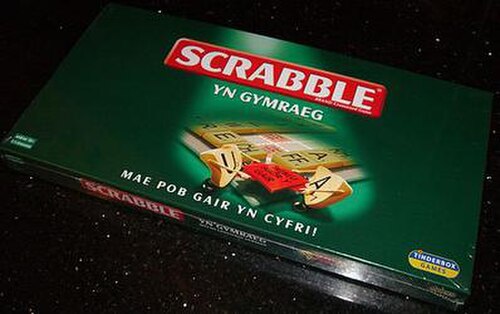
Welsh-language Scrabble sets, created in 2005,[50] use these 105 tiles:
- 2 blank tiles (scoring 0 points)
- 1 point: A ×10, E ×8, N ×8, I ×7, R ×7, Y ×7, D ×6, O ×6, W ×5, DD ×4
- 2 points: F ×3, G ×3, L ×3, U ×3
- 3 points: S ×3, B ×2, M ×2, T ×2
- 4 points: C ×2, FF ×2, H ×2, TH ×2
- 5 points: CH ×1, LL ×1, P ×1
- 8 points: J ×1
- 10 points: NG ×1, RH ×1
Since there are specific tiles for the digraphs that are considered to be separate letters in Welsh orthography (such as DD), it is not permissible to use the individual letters to spell these out. Diacritics on letters are ignored.
The polygraphs MH, NGH, NH and PH also exist in Welsh, but they are omitted because they are used almost exclusively in mutated words, which the rules disallow. K, Q, V, X and Z do not exist in Welsh. J does not exist in traditional Welsh either, but it is included as it is used in some borrowed words.
Unofficial editions
Scrabble editions listed in this section are not created or licensed by Hasbro or Mattel.
Anglo-Saxon
The Anglo-Saxon editions use these 101 tiles:[51]
- 2 blank tiles (scoring 0 points)
- 1 point: E ×14, N ×9, A ×8, O ×6, R ×6, D ×5, S ×5, G ×4, H ×4, I ×4, L ×4
- 2 points: F ×3, M ×3, T ×3, W ×3
- 3 points: Æ ×3, C ×3, U ×3
- 4 points: Ð ×2, Þ ×2, Y ×2
- 5 points: B ×1
- 8 points: P ×1
- 10 points: X ×1
Anglo-Saxon uses the letter K, but it only occurs in one word (kyning, usually written cyning) and loanwords, so there is no tile for it. Anglo-Saxon uses the letter Z, but it is a very rare spelling of TS, and is used in loanwords for the sound of Z in modern English, so there is no tile for it. J, V, and Q are only used in loanwords. Anglo-Saxon uses the letter Ƿ, but it was replaced by W in this set because it can be easily confused with P. Anglo-Saxon also uses the letter Ȝ, but it is a typographic variant of G, so that is used instead.
Armenian
Armenian-language editions use the following 146 tiles.[52] The board is 17x17 instead of 15x15. This version is called ԲԱՌ ԽԱՂ (bar khagh, meaning words game).
- 3 blank tiles (scoring 0 points)
- 1 point: Ա (a) ×18, Ե (ye / e) ×10, Ի (i) ×10, Ո (vo / o) ×8, Կ (k) ×7, Ն (n) ×7, Ս (s) ×6
- 2 points: Տ (t) ×5, Ր (r) ×5, Ւ (w) ×5, Է (ė) ×4, Հ (h) ×4, Մ (m) ×4, Յ (y) ×4, Պ (p) ×4
- 3 points: Լ (l) ×4, Բ (b) ×3, Գ (g) ×3, Դ (d) ×3, Ք (k') ×3, Վ (v) ×2
- 4 points: Խ (kh) ×2, Շ (sh) ×2, Ռ (ṙ) ×2
- 5 points: Թ (t') 2, Ծ (ts) ×2, Ղ (gh) ×2, Ց (ts') ×2
- 6 points: Զ (z) ×1, Ճ (ch) ×1, Չ (ch') ×1, Ջ (j) ×1
- 8 points: Ժ (zh) ×1, Ձ (dz) ×1, Փ (p') ×1, Օ (ȯ) ×1
- 10 points: Ը (ë) ×1, Ֆ (f) ×1
Notice that this distribution lacks և, another Armenian letter, because it lacks a capital letter. However, it can be formed as a ligature of ե/Ե and ւ/Ւ.
Bambara
Bambara-language Scrabble sets use these 106 tiles:[34]
- 2 blank tiles (scoring 0 points)
- 1 point: A ×15, E ×6, Ɛ ×6, I ×6, K ×6, L ×6, N ×6, O ×6, B ×5, M ×5
- 2 points: U ×5, S ×4, Y ×4, R ×3
- 3 points: Ɔ ×3, D ×2, T ×2
- 4 points: F ×2, G ×2, W ×2
- 8 points: J ×2, C ×1, Ɲ ×1
- 10 points: H ×1, Ŋ ×1, P ×1, Z ×1
The uncommon digraphic letters sh (sometimes represented with the IPA symbol ʃ; a regional variant of s) and kh (only used in loanwords) are absent as they are now considered obsolete.[53] [54] [55] The Latin alphabetic letters Q, V, and X are also absent because these letters are not used in Bambara.
Basque
Basque-language Euskarbel sets use these 100 tiles.[56]
- 2 blank tiles (scoring 0 points)
- 1 point: A ×14, E ×12, I ×9, N ×8, O ×6, T ×6, U ×6
- 2 points: K ×5, R ×5
- 3 points: D ×4
- 4 points: B ×3, Z ×3
- 5 points: G ×2, H ×2, L ×2, S ×2
- 8 points: J ×1, M ×1, P ×1, RR ×1, TS ×1, TX ×1, TZ ×1
- 10 points: F ×1, X ×1
Diacritical marks are ignored. Ñ is part of the Basque language but used so infrequently that it has no tile. C, Q, V, W and Y are absent because they are only used in loanwords. Digraphs can be formed with two tiles.
Bicolano
Dama nin Tataramon, an independently produced Bicolano language variant of Scrabble, uses these 102 tiles:
- 2 blank tiles (scoring 0 points)
- 1 point: A ×16, I ×12, N ×8, O ×8, M ×5, S ×5, T ×5, U ×5
- 2 points: G ×4, K ×3, R ×3
- 3 points: NG ×6, L ×3, P ×3
- 4 points: B ×3, D ×3
- 5 points: W ×2, Y ×2
- 8 points: E ×2, H ×2
The games uses the Abakada alphabet; hence the foreign letters of the present Filipino alphabet, C, F, J, Q, V, X, Z, and even Ñ, are absent. None of these letters can be played with a blank. Also, N and G being played in place of NG is not allowed.
Breton
Breton-language Scrabble sets, created in 2008 as Skrabell, use these 100 tiles:[57]
- 2 - (hyphen) tiles scoring 0 points
- 1 point: E ×14, A ×12, N ×9, R ×7, O ×6, T ×5, U ×5, I ×4, L ×4
- 2 points: D ×4
- 3 points: G ×3, S ×3, V ×3, H ×2
- 4 points: B ×2, K ×2, M ×2, Z ×2, ZH ×2, CH ×1, C'H ×1
- 5 points: P ×1
- 10 points: F ×1, J ×1, W ×1, Y ×1
C, Q, and X are absent because they are only used in loanwords or, in the case of C, the digraphs CH and C'H. However, these letters can be played with a blank. Diacritical marks are ignored.
Cornish
Cornish-language Scrabble sets use these 100 tiles.[58]
- 2 blank tiles (scoring 0 points)
- 1 point: E ×11, A ×10, O ×7, R ×7, S ×7, N ×6
- 2 points: Y ×7, L ×5, D ×4, H ×4, T ×4, C ×3, G ×3
- 3 points: U ×3, W ×3, I ×2
- 4 points: B ×2, K ×2, M ×2, P ×2
- 5 points: V ×2
- 6 points: F ×1
- 7 points: Q ×1
J has no tile because it is only used in a few native words (jy/je, bleujen) and in loanwords from English or French. X and Z have no tiles because these letters are only used in loanwords. This set uses the Standard Written Form with alternative spellings allowed. Apostrophes and diacritical marks are ignored. Any grammatical form may be used. This set was created by Ian Jackson in September 2018.
Dakelh
Dakelh-language Scrabble sets use these 100 tiles:[59]
- 2 blank tiles (scoring 0 points)
- 1 point: H ×10, U ×10, N ×8, A ×7, I ×7, L ×7, O ×7, T ×7, ʼ ×7
- 2 points: E ×5, S ×5
- 3 points: D ×4, Z ×3
- 4 points: K ×2
- 5 points: G ×2, Y ×2
- 7 points: W ×1
- 8 points: B ×1
- 10 points: C ×1, J ×1, M ×1
The letters F, P, R, and V, which are used only in loanwords in Dakelh and are very infrequent, are absent. The letters Q and X are also absent because these letters are not used in Dakelh.
Dakota
Dakota-language Scrabble sets use these 100 tiles:[60]
- 2 blank tiles (scoring 0 points)
- 1 point: A ×12, I ×10, E ×8, K ×6, Ŋ ×6, O ×6, T ×6, P ×4, U ×4
- 2 points: C ×3, H ×3
- 3 points: W ×3, Y ×3, D ×2, N ×2, S ×2
- 4 points: Ġ ×2, J ×2, M ×2, Ṡ ×2, Z ×2
- 5 points: Ḣ ×2
- 6 points: G ×1
- 8 points: B ×1, C̣ ×1, Ḳ ×1
- 10 points: P̣ ×1, Ṭ ×1
F, L, Q, R, V, X are absent since Dakota does not use these letters.
Esperanto
Esperanto Scrabble exists as an Internet game[61] and as a commercially produced custom set.[62]
Esperanto-language sets use these 100 tiles:
- 2 blank tiles (scoring 0 points).
- 1 point: A ×8, E ×8, I ×8, O ×8, N ×6, R ×6, S ×6, L ×4, T ×4, U ×4
- 2 points: K ×4, M ×4, D ×3, J ×3, P ×3
- 3 points: F ×2, G ×2, Ĝ ×2, V ×2
- 4 points: B ×2, Ĉ ×2, C ×1, Ŝ ×1
- 5 points: Z ×1
- 8 points: H ×1, Ŭ ×1
- 10 points: Ĥ ×1, Ĵ ×1
The original Esperanto set used these 120 tiles:[63]
- 2 blank tiles (scoring 0 points).
- 1 point: A ×13, I ×11, E ×9, N ×9, O ×7, T ×6
- 2 points: L ×6, R ×6, S ×6, M ×5, K ×4
- 3 points: D ×3, J ×3, P ×3, U ×3
- 4 points: F ×2, G ×2, V ×2
- 5 points: B ×3, Ŝ ×2
- 6 points: Ĝ ×2, Ŭ ×1
- 7 points: Ĉ ×2, Z ×2
- 8 points: C ×2
- 9 points: H ×1
- 10 points: Ĵ ×2, Ĥ ×1
Q, W, X, and Y are not present in either set, since Esperanto does not use those letters.
Galician
Galician-language sets use these 100 tiles:[64]
- 1 point: A ×12, E ×10, O ×9, R ×8, S ×7, I ×6, L ×6, N ×6, C ×5, T ×4
- 2 points: D ×3, U ×3
- 3 points: M ×4, B ×2, P ×2
- 4 points: G ×2, V ×1
- 5 points: F ×1, H ×1, X ×1
- 6 points: Z ×1
- 7 points: Ñ ×1, Q ×1
- 8 points: K ×1
- 9 points: W ×1, Y ×1
- 10 points: J ×1
Stress accents and diaereses are disregarded. This is called Letrad@s.GZ[check spelling] (originally Scrabble.GZ). J, K, W, and Y are officially non-existent in Galician, but they are included here as they are sometimes used in borrowed words. Blanks do not exist in this game.
Gwichʼin
Gwichʼin-language editions of Scrabble contain 200 letter tiles, in the following distribution:[65]
- 4 blank tiles (scoring 0 points)
- 1 point: ʼ ×19, I ×17, A ×12, N ×9, T ×8, H ×7, Ą ×5, E ×2, Ę ×1, Į ×1, O ×1, Ǫ ×1, U ×1, Ų ×1
- 2 points: AA ×8, CH ×7, EE ×7, ĄĄ ×4, II ×4, ĘĘ ×1, ĮĮ ×1, OO ×1, ǪǪ ×1, TH ×1, UU ×1, ŲŲ ×1
- 3 points: AII ×4, AĮĮ ×4, D ×4, G ×4, K ×4, R ×4, Y ×4, S ×1, TTH ×1, W ×1
- 4 points: TS ×6, L ×2, Ł ×2, TR ×2, DH ×1, GH ×1, KH ×1, SH ×1
- 5 points: J ×2, TŁ ×2, V ×2, Z ×1
- 6 points: GW ×4, ZH ×4, DR ×1, KW ×1
- 7 points: DL ×2, DDH ×1, KHW ×1, SHR ×1
- 8 points: DZ ×1
- 9 points: ZHR ×1
- 10 points: B ×1, F ×1, M ×1
Grave accents are ignored. Digraphs and trigraphs can be played with multiple tiles. GHW, ND, NH, NJ, and RH are not included, as these digraphs and trigraphs are very rare in Gwichʼin. C, P, Q, and X are also absent because these letters are not used in Gwichʼin, or, in the case of C, outside the digraph CH. Arguably B, F, and M are not used in Gwichʼin either, but they are included as these letters are used for borrowed words.
Haitian Creole
Haitian Creole-language editions of Scrabble contain these 100 tiles:[66][67]
- 2 blank tiles (scoring 0 points)
- 1 point: A ×9, N ×9, E ×8, I ×6
- 2 points: È ×4, K ×4, L ×4, M ×4, O ×4, OU ×4, P ×4, S ×4, T ×4, Y ×4
- 3 points: D ×3
- 4 points: B ×3, CH ×2, F ×2, G ×2, J ×2, Ò ×2, R ×2, V ×2, W ×2
- 7 points: Z ×1
- 8 points: À ×1, UI ×1
- 10 points: H ×1
X has no tile as it is only used in loanwords in Haitian Creole. C, Q and U are absent, since they are not used in Haitian Creole, or, in the case of C, outside the digraph CH, and U outside the digraphs OU and UI.
Hausa
Hausa-language Scrabble sets use these 114 tiles:[68]
- 2 blank tiles (scoring 0 points)
- 1 point: A ×14, I ×9, N ×8, D ×6, K ×6, S ×6, U ×6, Y ×6
- 2 points: M ×5
- 3 points: B ×4, E ×4, H ×4, R ×4, T ×4, W ×4
- 4 points: G ×3, L ×3, O ×3
- 5 points: C ×2, F ×2, J ×2
- 7 points: Ɗ ×1, Ƙ ×1, Z ×1
- 8 points: Ɓ ×1
- 9 points: TS ×1, '×1
- 10 points: 'Y×1
This version is made for Hausa in Nigeria. In Niger, a Ƴ tile would be used instead of a 'Y tile. P has no tile, as it is only used in loanwords in Hausa and is very infrequent. SH has no tile because it is not a letter in all Hausa alphabets. R̃, which was created to distinguish the two R phonemes, has no tile as the phonemes are not always distinguished by Hausa speakers. Q, V, and X have no tiles because these letters are not used at all in Hausa.
Hawaiian
There is no official Hawaiian-language edition of Scrabble, but one suggested version contains these 100 tiles:[69]
- 5 blank tiles (scoring 0 points)
- 1 point: A ×21
- 2 points: K ×20, O ×11
- 3 points: I ×8, N ×8
- 4 points: E ×6
- 5 points: U ×5
- 6 points: H ×5
- 7 points: L ×4
- 8 points: M ×3, P ×3
- 9 points: W ×1
B, C, D, F, G, J, Q, R, S, T, V, X, Y, and Z have no tiles as they are not used in Hawaiian. For the sake of the geocache this is connected to, the distribution had to be modified a bit. For example, there should be A ×28 , E ×7, K ×11, and U ×6. The diacritical marks and the okina ' are ignored.
Igbo
Igbo-language sets use these 134 tiles, and a 19×19-tile board:[70]
- 4 blank tiles (scoring 0 points)
- 1 point: A ×8, E ×8, I ×8, Ị ×8, O ×8, Ọ ×8, U ×8, Ụ ×8
- 2 points: D ×6, R ×6, T ×6
- 3 points: B ×5, M ×5
- 4 points: F ×4, N ×4, K ×3, S ×3
- 5 points: G ×4, H ×3, L ×3
- 6 points: W ×4, P ×3
- 7 points: Y ×2
- 10 points: C ×1, J ×1, Ṅ ×1, V ×1, Z ×1
While C is only used in the digraph CH, the C was likely included because the CH is played with a C and an H. It is unknown if a blank can be used to represent CH. Q and X are not included as these letters are not used in Igbo.
IPA English
IPA sets use these 106 tiles:[71]
- 2 blank tiles (scoring 0 points)
- 1 point: ə ×7, n ×7, ɪ ×6, l ×6, s ×6, t ×6, k ×5, ɹ ×5, d ×4, i ×4, m ×4, ɛ ×3, z ×3
- 2 points: ɑ ×3, æ ×3, b ×2, oʊ ×2, p ×2
- 3 points: aɪ ×2, eɪ ×2, f ×2, ɡ ×2, ɔ ×2, v ×2
- 4 points: h ×1, ŋ ×1, ʃ ×1, u ×1, w ×1
- 5 points: dʒ ×1, j ×1, tʃ ×1
- 8 points: aʊ ×1, ɔɪ ×1, θ ×1, ʊ ×1
- 10 points: ð ×1, ʒ ×1
ɒ and a are not included as they are allophones of ɑ in varieties of English that have the father–bother merger, including most of the United States. e is an allophone of eɪ. ɫ is an allophone of l. ɱ is an allophone of m. o is an allophone of oʊ. ɾ and r are allophones of ɹ. ʌ, ɜ, ɚ and ɝ are allophones of ə. ʍ is an allophone of w. ʔ is not considered a phoneme in English. The affricates ts and dz do not have their own tiles, and so must be formed with two. But for a few exceptional cases, the sounds ɐ, β, ʙ, ɓ, c, cʼ, ɕ, ç, ɗ, ɖ, ɘ, ɣ, ɤ, ɠ, ɢ, ʛ, ħ, ʜ, ɦ, ɥ, ɧ, ɨ, ɟ, ʄ, ʝ, kʼ, ɭ, ɬ, ɮ, ʟ, ɯ, ɰ, ɲ, ɳ, ɴ, ø, ɵ, œ, ɶ, pʼ, q, qʼ, ɻ, ɽ, ɺ, ʀ, ʁ, ʂ, tʼ, ʈ, ʉ, ʋ, ⱱ, x, χ, y, ʏ, ʎ, ʐ, ʑ, ʡ, ʕ, and ʢ, ǀ, ǁ, ǃ, ʘ, and ǂ are not used in American English. An extended version has 1 ʙ worth 14, 1 ʛ worth 12, 1 ħ worth 9, 1 kʼ worth 11, 1 ɮ worth 11, 1 ɲ worth 13, 1 ʉ worth 11, 1 ⱱ worth 11, 1 ǃ worth 16, and 1 ʘ worth 18.
An alternative by Scrabble3D has this distribution (no combinations):[72]
- 1 point: ɪ ×8, ə ×7, t ×6, n ×5, s ×5, d ×4, k ×4, ɫ ×4, r ×4, ɛ ×3, ɝ ×3, i ×3, m ×3, p ×3, z ×3, æ ×2
- 2 points: b ×2, e ×2, ʊ ×2
- 3 points: a ×2, ɑ ×2, f ×2, ɡ ×2, ŋ ×2, ɔ ×2, o ×2, ʃ ×2, v ×2
- 4 points: u ×1, w ×1, ʒ ×1
- 5 points: h ×1, j ×1
- 8 points: θ ×1
- 10 points: ð ×1
Japanese Hiragana
The Japanese Hiragana Scrabble set uses these 100 tiles:[73]
- 2 blank tiles (scoring 0 points)
- 1 point: い (I) ×4, う (U) ×4, か (KA) ×4, し (SHI) ×4, た (TA) ×4, て (TE) ×4, と (TO) ×4, の (NO) ×4, ん (N/N') ×4
- 2 points: き (KI) ×3, く (KU) ×3, こ (KO) ×3, つ (TSU) ×3, な (NA) ×3, に (NI) ×3, は (HA) ×3, よ (YO) ×3, れ (RE) ×3
- 3 points: あ (A) ×2, け (KE) ×2, す (SU) ×2, せ (SE) ×2, も (MO) ×2, り (RI) ×2, る (RU) ×2, わ (WA) ×2, ら (RA) ×1
- 4 points: さ (SA) ×1, そ (SO) ×1, ち (CHI) ×1, ま (MA) ×1
- 5 points: お (O) ×1, ひ (HI) ×1, ふ (FU) ×1, ゆ (YU) ×1
- 6 points: ほ (HO) ×1, め (ME) ×1, や (YA) ×1
- 8 points: え (E) ×1, へ (HE) ×1, み (MI) ×1
- 10 points: ね (NE) ×1, む (MU) ×1, ろ (RO) ×1
- 12 points: ぬ (NU) ×1
The obsolete letters ゐ (WI) and ゑ (WE), the letter を (WO) now exclusively used as a grammatical particle, and the lengthener ー have no tiles.
In this version, words are played as collated in the dictionary:
- Modified letters with the diacritics ゛ and ゜, as well as the small letters (ぁぃぅぇぉっゃゅょゎ) are played using the unmodified letter: e.g. ディスコ (disuko "disco") is played with the tiles ていすこ (te i su ko).
- In addition, lengtheners are played by doubling the previous tile's vowel: e.g. ラーメン (rāmen ramen noodles) is played with the tiles らあめん (ra a me n).
- These modifications are applied per word; that is, theoretically, the same tile つ can validly stand for づ horizontally, and っ vertically:
- The words played are 言葉遣い (ことばづかい kotobazukai) and 悪化 (あっか akka). The player is allowed to extend vertically into 扱う (あつかう atsukau).
This version was created by a student from Japan, and is not in wide circulation.
A larger, more popular set by Scrabble3D uses these 214 tiles:[74][75][76]
- 2 blank tiles (scoring 0 points)
- 1 point: う (U) ×10, ん (N) ×9, い (I) ×8
- 2 points: し (SHI) ×6, く (KU) ×5, き (KI) ×5, か (KA) ×5, ょ (Small YO) ×5, り (RI) ×5, る (RU) ×5
- 3 points: じ (JI) ×4, こ (KO) ×4, つ (TSU) ×4, ゅ (Small YU) ×4, ち (CHI) ×4, せ (SE) ×4, た (TA) ×4, け (KE) ×3, と (TO) ×3, す (SU) ×3, さ (SA) ×3, て (TE) ×3, が (GA) ×3, っ (Small TSU) ×3
- 4 points: ま (MA) ×3, な (NA) ×3, お (O) ×3, み (MI) ×3, あ (A) ×3, え (E) ×3, に (NI) ×3, ら (RA) ×3, は (HA) ×3, れ (RE) ×3, の (NO) ×3, そ (SO) ×3, め (ME) ×3, ひ (HI) ×3, ど (DO) ×3, ゃ (Small YA) ×3
- 5 points: も (MO) ×2, だ (DA) ×2, わ (WA) ×2, ふ (FU) ×2, げ (GE) ×2, ぶ (BU) ×2, よ (YO) ×2, ぎ (GI) ×2, ば (BA) ×2, や (YA) ×2, ほ (HO) ×2, ご (GO) ×2, ろ (RO) ×2, む (MU) ×2, び (BI) ×2, ぼ (BO) ×2, ね (NE) ×2
- 6 points: で (DE) ×2, ぐ (GU) ×2, ぜ (ZE) ×2, ゆ (YU) ×2, ざ (ZA) ×2, ず (ZU) ×2
- 8 points: へ (HE) ×1, べ (BE) ×1, ぞ (ZO) ×1
- 10 points: を (WO) ×1, ぱ (PA) ×1
- 15 points: づ (DZU) ×1, ぬ (NU) ×1, ぽ (PO) ×1, ぷ (PU) ×1, ぴ (PI) ×1, ぺ (PE) ×1, ぢ (DJI) ×1
In this version, words are played as they are written in all-kana text, and 9 tiles are played at a time. That is, in the 214-tile variant, the word ヨーロッパ (yōroppa "Europe") is played with the tiles よ, blank, ろ, っ, and ぱ (there is no tile for ー), while in the 100-tile variant, it is played as よ, お, ろ, つ, and は.
The obsolete letters ゐ and ゑ, letters only used in loanwords ぇ, ゎ, ぃ, ぁ, ぅ, and ぉ, along with the lengthener ー, have no tiles (with the first three letters and the lengthener being playable with a blank). Blank tiles may be played as standalone diacritics ゛ and ゜.
Japanese Romaji
Japanese Romaji Scrabble sets use these 102 tiles:[77]
- 2 blank tiles (scoring 0 points)
- 1 point: A ×12, U ×12, I ×11, O ×10, N ×7
- 2 points: K ×6, S ×6, E ×5, H ×4, R ×4, T ×4
- 3 points: M ×3, - ×2
- 4 points: G ×2, Y ×2
- 5 points: B ×2, D ×2
- 6 points: J ×1, Z ×1
- 8 points: F ×1, P ×1, W ×1
- 10 points: C ×1
L, Q and X are absent as they do not exist in Japanese. V, which exists only in loanwords, is absent because of its rare frequency. It can be used for a blank with 20 points reward for each play. - represents long vowel. Romaji scrabble games consist of all 3 scripts used in Japanese language - Hiragana, Katakana and Kanji in romanized form.
- 2 blank tiles (scoring 0 points)
- 1 point: U ×13, A ×12, I ×12, O ×10, N ×7
- 2 points: K ×6, S ×6, E ×5, R ×4, T ×4
- 3 points: H ×4, M ×3
- 4 points: G ×2, Y ×2
- 5 points: B ×2, D ×2
- 6 points: J ×1, Z ×1
- 8 points: F ×1, P ×1, W ×1
- 10 points: C ×1
This version does not use the long vowel "-". For instance, 東京(Tokyo) is played as "toukyou", 優秀(excellent) is played as "yuushuu" and ユース(youth) is played as "yuusu".
Scrabble3D has a different distribution, released earlier:[78]
- 2 blank tiles (scoring 0 points)
- 1 point: O ×12, U ×12, A ×11, I ×11, N ×10, E ×5
- 2 points: H ×5, K ×5, S ×5, T ×5
- 3 points: R ×3, Y ×2
- 4 points: B ×2, G ×2
- 5 points: M ×2, P ×2
- 6 points: J ×1, Z ×1
- 8 points: D ×1, W ×1, (- ×1)
- 10 points: C ×1, F ×1
The - for long vowels is optional (not in the standard set). V has no tile, but can be played with a blank.
One board game (Romeo) has a different distribution, released earlier:
- 2 blank tiles (scoring 0 points)
- 1 point: A ×12, N ×12, I ×10, O ×10, U ×7, E ×6
- 2 points: K ×5, S ×5, T ×5
- 3 points: H ×3, R ×3
- 4 points: B ×2, G ×2, M ×2, Y ×2, Z ×2
- 5 points: CH ×1, D ×1, J ×1
- 8 points: F ×1, W ×1
- 10 points: P ×1
In this version, note that C has no tile as it is used exclusively in the digraph CH.
Klingon
Klingon-language sets use these 100 tiles:[79]
- 2 blank tiles (scoring 0 points)
- 1 point: ʼ ×10, a ×10, e ×8, ɪ ×8, o ×6, u ×6, H ×5
- 2 points: j ×5, m ×5, D ×4, v ×4
- 3 points: l ×3, b ×2, ch ×2, gh ×2, n ×2, q ×2, S ×2
- 4 points: p ×2, t ×2
- 5 points: w ×2, y ×2
- 6 points: Q ×1, r ×1
- 8 points: tlh ×1
- 10 points: ng ×1
The letter tiles may show Klingon symbols (pIqaD), their renderings in the English alphabet, or both.
An older Klingon distribution by a different manufacturer (which is also not official) uses these 102 tiles (the first game was missing the blanks):[80]
- 2 blank tiles (scoring 0 points)
- 1 point: a ×11, e ×8, ɪ ×8, o ×8, ʼ ×6, H ×6, u ×6, m ×3, v ×3
- 2 points: l ×4, D ×3, gh ×3, j ×3, S ×3, r ×2
- 3 points: b ×5, t ×3, q ×2
- 4 points: ch ×2, n ×2, p ×2, w ×2, y ×2
- 8 points: Q ×1
- 10 points: ng ×1, tlh ×1
These versions are separate from Hasbro's own licensed "Star Trek Scrabble" game, in which players can receive bonus points by playing Klingon words using standard English-language tiles.
L33t
Marketed as L33t Tiles by the now defunct Wiremelon, LLC, editions of an English-L33tspeak variant of Scrabble contain 103 letter tiles in the following distribution:[81][82][83]
- 2 asterisk [*] tiles (scoring 0 points)
- 1 point: E ×6, N ×6, R ×6, A ×4, I ×4, L ×4, O ×4, U ×4, T ×3, S ×2
- 2 points: 3 ×6, 1 ×5, 4 ×5, D ×4, 0 ×4, G ×3, Z ×3, 7 ×3
- 3 points: X ×4, B ×2, C ×2, M ×2, P ×2
- 4 points: F ×2, H ×2, V ×2, W ×2, Y ×2
- 5 points: K ×1
- 6 points: J ×1
- 10 points: Q ×1
Lojban
Lojban-language sets use these 160 tiles:[84]
- 3 blank tiles (scoring 0 points)
- 1 point: I ×4, R ×4, L ×3, N ×3, U ×3, A ×2, C ×2, E ×2, M ×2, S ×2, T ×2, 'A ×2, 'E ×2, 'I ×2
- 2 points: B ×2, D ×2, G ×2, J ×2, K ×2, P ×2, 'O ×2, 'U ×2, O ×1, Y ×1, CI ×1, KA ×1, LA ×1, LI ×1, MA ×1, NA ×1, RA ×1, RI ×1, SE ×1
- 3 points: F ×1, V ×1, X ×1, Z ×1, BA ×1, CA ×1, DA ×1, GA ×1, JI ×1, KU ×1, MI ×1, NI ×1, NU ×1, PA ×1, RE ×1, RU ×1, SA ×1, SI ×1, TA ×1, TE ×1, TI ×1, XA ×1
- 4 points: BI ×1, CE ×1, CU ×1, DE ×1, DI ×1, DU ×1, FA ×1, GU ×1, JA ×1, JU ×1, KE ×1, KI ×1, LE ×1, LU ×1, MU ×1, NE ×1, NO ×1, PE ×1, PI ×1, RO ×1, SU ×1, TO ×1, TU ×1, VA ×1, VI ×1
- 5 points: BE ×1, BO ×1, BU ×1, CY ×1, DY ×1, FE ×1, FI ×1, FU ×1, GE ×1, GI ×1, JE ×1, JY ×1, KO ×1, KY ×1, LO ×1, ME ×1, MO ×1, NY ×1, PO ×1, PU ×1, RY ×1, SO ×1, SY ×1, TY ×1, VE ×1, XE ×1, ZA ×1, ZU ×1, ZY ×1
- 6 points: BY ×1, CO ×1, DO ×1, FO ×1, FY ×1, GY ×1, LY ×1, MY ×1, PY ×1, VO ×1, VY ×1, XI ×1, XU ×1
- 7 points: JO ×1, ZE ×1
- 8 points: XY ×1, ZI ×1
- 10 points: GO ×1, VU ×1
The combination XO is absent as it is only used in 7 words (binxo, ganxo, jerxo, sirxo, xogji, xotli, and xo'u). The combination ZO is absent as it is only used in 7 words (brazo, kinzo, zo'a, zo'e, zo'i, zo'o, and zo'u). The combination 'Y is absent as it is only used in 1 word (.y'y). The letter . occurs in Lojban, but it is so infrequent that it has no tile. Blanks can be used to represent any of the above letters (including .) and digrams (including XO, ZO, and 'Y). The letter ' occurs in Lojban, but only in digrams and never as one letter. The letters H, Q, and W are absent, because these letters are not used in Lojban.
Lojban-language sets in the 1990s (which include lujvo) use these 100 tiles:
- 2 blank tiles (scoring 0 points)
- 1 point: A ×10, I ×10, Y ×8, N ×7, R ×7, U ×6, E ×5
- 2 points: L ×4, O ×4, S ×4, T ×4, ' ×4
- 3 points: C ×3, J ×3, K ×3, M ×3
- 4 points: B ×2, D ×2, F ×2, G ×2, P ×2
- 6 points: V ×1, X ×1
- 9 points: Z ×1
Lojban-language sets in the 1990s (which do not include lujvo) use these 100 tiles:
- 2 blank tiles (scoring 0 points)
- 1 point: A ×12, I ×12, U ×8, N ×7, E ×6, R ×5, ' ×4
- 2 points: O ×5, C ×4, L ×4, S ×4, T ×4
- 3 points: D ×3, J ×3, K ×3, M ×3
- 5 points: B ×2, F ×2, G ×2, P ×2
- 8 points: V ×1
- 9 points: X ×1
- 10 points: Z ×1
Y is absent because it is very rare outside lujvo.
Māori
Māori-language sets (known as Scramble) use these 225 tiles:
- 3 blank tiles (scoring 0 points)
- 1 point: A ×25, I ×25, O ×25, U ×20
- 2 points: E ×15, R ×15, T ×15, K ×12, N ×12, W ×12
- 3 points: H ×10, M ×10, P ×10
- 4 points: NG ×10
- 5 points: WH ×6
Diacritical marks are ignored. B, C, D, F, G, J, L, Q, S, V, X, Y, and Z are absent because these letters are not used in Māori, or, for G, outside the NG digraph.
Another version, called Kuputupu, uses these 102 tiles:[85]
- 2 blank tiles (scoring 0 points)
- 1 point: A ×13, E ×10, I ×10, U ×10, O ×9
- 2 points: R ×7, T ×7, K ×5
- 3 points: N ×7, H ×5
- 4 points: P ×5
- 5 points: M ×5, W ×4
- 10 points: G ×3
Macedonian
Macedonian-language sets[86] use these 106 tiles.
- 2 blank tiles (worth 0 points)
- 1 point: А ×12, Е ×9, И ×9, О ×7, Р ×7, Н ×6, Т ×5, С ×5
- 2 points: К ×4, Л ×4, В ×4, П ×4
- 3 points: У ×3, Д ×3, М ×3
- 4 points: З ×2, Б ×2, Г ×2
- 5 points: Ч ×1, Ц ×1, Ј ×1, Ш ×1
- 6 points: Ж ×1, Ф ×1, Њ ×1
- 8 points: Х ×1
- 10 points: Ѓ×1, Ѕ ×1, Љ×1, Ќ ×1, Џ ×1
The diacritics Ѐ and Ѝ are ignored, as they are only used as grammatical particles and played as Е and И respectively.
Math
Math sets use these 100 tiles:
- 2 blank tiles (scoring 0 points)
- 1 point: = ×18, 1 ×8, 2 ×7
- 2 points: 0 ×6, 3 ×6, 4 ×6
- 3 points: 5 ×6, 6 ×6, 8 ×5, + ×3, − ×3
- 4 points: 7 ×5, 9 ×5, × ×3, ÷ ×3
- 5 points: √ ×2
- 6 points: ² ×1
- 7 points: ³ ×1
- 8 points: ! ×1
- 9 points: ^ ×1
- 10 points: . ×1, ∜ ×1
To play, you have to put in a correct equation on the board.[87]
Math sets previously used these 120 tiles:[88]
- 3 blank tiles (scoring 0 points)
- 0 points: = ×18
- 1 point: 1 ×10
- 2 points: 2 ×8, 4 ×7, 5 ×7
- 3 points: 0 ×6
- 4 points: 3 ×7, 6 ×7, 8 ×6, 9 ×6
- 5 points: 7 ×6
- 6 points: + ×4, − ×4, × ×4
- 7 points: ÷ ×3, √ ×3
- 8 points: . ×3
- 9 points: ^ ×1
- 10 points: ! ×1, ² ×1, ³ ×1, ∜ ×1, ∞ ×1, < ×1, > ×1
Na'vi
Na'vi language sets use these 100 tiles:[89]
- 2 blank tiles (scoring 0 points)
- 1 point: A ×12, E ×8, L ×6, N ×6, T ×6, Y ×6, O ×5, U ×5, I ×4, R ×4
- 2 points: Ì ×4, ʼ ×4, Ä ×3, S ×3
- 3 points: K ×3, M ×3, P ×3
- 4 points: F ×2, G ×2, V ×2, W ×2
- 5 points: H ×1
- 8 points: X ×3
- 10 points: Z ×1
Note that B, D, J, Q, and C (which is a rare alternative spelling of the digraph TS) have no tiles because these letters are not used in Na'vi. Note that G is only used in the NG digraph (and is also a rare alternative spelling of that digraph), and X is only used in the KX, PX, and TX digraphs. You cannot use a blank to represent the digraphs KX, LL, NG, PX, RR, TS, TX, or the diphthongs AW, AY, EW, or EY (which are sometimes considered as digraphs). This set was created by LearnNa'vi.org. Shortly after, the idea of revising the set to have the digraphs as single tiles (removing the G and X tiles) was proposed, but that has not taken effect so far.
Nuxalk
The Nuxalk-language edition uses these 212 tiles:[90]
- 1 point: A ×25, S ×20, T ×12, I ×10, K ×10, LH ×9, M ×9, TS ×8, U ×8
- 2 points: L ×7, N ×7, Q ×6, Qʼ ×6, Y ×6, TLʼ ×5, X ×5
- 3 points: AA ×4, C ×4, CW ×4, Kʼ ×4, KW ×4, P ×4, Tʼ ×4, TSʼ ×4, XW ×4
- 4 points: KWʼ ×4, W ×4, QW ×3, UU ×2
- 5 points: QWʼ ×3, II ×2
- 7 points: Pʼ ×2
- 9 points: H ×2
- 11 points: 7 ×2
The letters B, D, E, F, G, J, O, R, V and Z are not used in Nuxalk and therefore have no tiles. The 7 is included in the set because it is an actual letter in Nuxalk. It is used to replace ' if you don't have a tile ending with '. Arguably H and 7 do not exist in Nuxalk, but they are included as they are used for borrowed words, or in the case of 7, optionally at the beginning of a word.
Occitan
The Occitan-language edition, called "E-scrabbl'òc", uses these 102 tiles:
- 2 blank tiles (scoring 0 points)
- 1 point: A ×15, E ×10, R ×8, S ×8, I ×7, N ×7, T ×7, O ×6
- 2 points: L ×4, M ×4, U ×4, C ×3
- 4 points: G ×3, B ×2, D ×2, P ×2
- 6 points: V ×2, F ×1, H ×1
- 10 points: J ×1, Q ×1, X ×1, Z ×1
K, W, and Y are absent because they are only used in loanwords. It is unknown if blanks can be used to represent K, W, or Y.[91]

Old Church Slavonic
No Scrabble version of Old Church Slavonic exists, but a user on Quora suggested the following 134-tile distribution on a 19×19 board, much like the Igbo distribution shown earlier in this article.:[92]
- 2 blank tiles (worth 0 points)
- 1 point: А ×10, С ×9, Ъ ×8, И ×7, О ×7, Н ×6, Р ×6, Т ×6, Ь ×6
- 2 points: Д ×5, Є ×5, Л ×4, В ×4, К ×4
- 3 points: М ×3, Ѣ ×3, Ѥ ×3
- 4 points: Б ×2, Г ×2, Ꙁ ×2, П ×2, Ꙑ ×2
- 5 points: Ж ×1, Ꙗ ×1, Ѩ ×1
- 6 points: Ц ×1, Ч ×1, Ѫ ×1, Ѧ ×1
- 7 points: Х ×1, У ×1
- 8 points: І ×1, Ш ×1, Ю ×1
- 9 points: Щ ×1, Ѡ ×1
- 10 points: Ꙃ ×1, Ф ×1, Ѭ ×1, Ѯ ×1, Ѱ ×1, Ѳ ×1, Ѵ ×1
The letters Ѡ, Ѯ, Ѱ, Ѳ and Ѵ are only used as numerals and in Greek loanwords and optional when it comes to playing. Ѡ is only used in one native Slavic word - "ѡтъ" (from). У's high value is due to it only appearing after О and forming the digraph Ѹ, which has no tile and must be formed with two. Ꙃ and Ꙁ can also be represented by the more modern Ѕ and З respectively. Я is absent due to it being a shorthand form of Ꙗ. Ы is represented with its archaic form Ꙑ. Й is also absent due to being interchangeable with И until shortly after the Russian spelling reform of 1917, being a form of И and not an actual letter in its own right. Е and Э are also interchangeable with Є and its iotated form.
Persian
Persian-language editions, which use Arabic letters, use the following 102 tiles:[93]
- 2 blank tiles (scoring 0 points)
- 1 point: ﺍ ×9, ی ×8, ﺭ ×7, ﻡ ×7, ﺕ ×6, ﻥ ×6, ﺩ ×4, ﺵ ×4, ﻝ ×4, ﻭ ×4, ﻩ ×4, ﺏ ×3, ﺱ ×3, ک ×3
- 2 points: ﺯ ×2, ﻑ ×2
- 3 points: ﺝ ×2, ﺥ ×2, ﻕ ×2
- 4 points: پ ×2, ﺡ ×2, ﻉ ×2, گ ×2
- 6 points: آ ×1, چ ×1, ﺹ ×1, ﻁ ×1, ﻍ ×1
- 8 points: ﺫ ×1, ژ ×1, ﺽ ×1
- 10 points: ﺙ ×1, ﻅ ×1
Although Persian letters have up to four forms, Scrabble tiles use the isolated form. The pattern of using the isolated forms in composing words is also found in the Arabic Scrabble set and in Arabic crosswords and is one of the rare situations when Arabic letters are not connected to each other. This set was created by Scrabble3D.[93]
Pinyin
In the word game PinyinPal, a Pinyin version, these 100 tiles are used:
- 2 blank tiles (scoring 0 points)
- 1 point: A ×13, I ×13, N ×13, U ×8, G ×7, H ×7, O ×6
- 2 points: E ×5, Y ×3, Z ×3
- 3 points: C ×2, D ×2, J ×2, L ×2, S ×2, X ×2
- 4 points: B ×1, F ×1, M ×1, P ×1, Q ×1, T ×1
- 5 points: W ×1
- 8 points: K ×1, R ×1
- 10 points: V ×1
The V is used to represent Ü. Diacritical marks are ignored. The digraphic letters ZH, CH and SH have no tiles. Instead, they are played putting a Z, C or S tile in front of an H tile.
Serbian
Serbian-language sets use these 102 tiles:
- 2 blank tiles (scoring 0 points)
- 1 point: А ×11, И ×9, Е ×8, О ×8, Н ×6, Р ×6, С ×5, Т ×5, У ×4, Д ×3
- 2 points: В ×4, К ×4, М ×4, Л ×3, П ×3
- 3 points: З ×2, Ј ×2
- 4 points: Б ×2, Г ×2
- 5 points: Њ ×1, Ц ×1, Ч ×1, Ш ×1
- 7 points: Ћ ×1, Х ×1,
- 8 points: Ж ×1, Љ ×1
- 10 points: Ђ ×1, Ф ×1, Џ ×1
Tagalog
Salitaan, an independently produced Tagalog language variant of Scrabble, uses these 155 tiles:
- 3 blank tiles (scoring 0 points)
- 1 point: A ×27, I ×17, N ×13, U ×9, L ×8, T ×8, M ×7, S ×7
- 2 points: K ×6, O ×6
- 3 points: P ×5
- 4 points: G ×7, B ×5
- 5 points: NG ×5, H ×4, R ×3
- 8 points: D ×3, E ×3, Y ×3
- 10 points: W ×1
The games uses the Abakada alphabet; hence the foreign letters of the present Filipino alphabet, C, F, J, Q, V, X, Z, and even Ñ, are absent. None of these letters can be played with a blank. N and G being played in place of NG is allowed.
Tamil
There are two Tamil language sets: an easy version, which plays some combining vowel signs separately, and a difficult version, which plays all letters with vowel signs as individual tiles. The set for the easy version uses these 1000 tiles:
- 1 point: ா ×85, க ×57, த ×48, ம் ×41, ப ×36, ை ×35, வ ×31, ச ×29, ர ×28, ல் ×26, ம ×25, ெ ×24, ே ×22, ட ×18, ய ×18, ல ×17, ன் ×17, தி ×17, கு ×15, டு ×15, ன ×12, ரு ×11, து ×10
- 2 points: த் ×23, க் ×22, ட் ×15, ப் ×15, ர் ×13, அ ×10, டி ×10, வி ×10, பு ×10, ந ×9, சி ×9, ள ×8, ரி ×8, ற ×7, கி ×7, பி ×7, று ×7, ள் ×6
- 3 points: ண் ×9, ங் ×8, ந் ×8, ற் ×7, மு ×6, இ ×4, உ ×4, யி ×3, ளி ×3
- 4 points: ண ×7, ச் ×7, ஆ ×3, மி ×3, றி ×3, வு ×3, எ ×2
- 5 points: சு ×7, ய் ×5, லி ×4, ழ ×3, நி ×3, னி ×3, ஒ ×1, ழ் ×1
- 6 points: ணி ×3, ழி ×2, லு ×2, ழு ×2, யு ×1, ளு ×1
- 7 points: கூ ×2, ஏ ×1, னு ×1
- 8 points: ஞ் ×4, பூ ×3, மூ ×2, ஐ ×1, வ் ×1, நீ ×1, மீ ×1, வீ ×1, நூ ×1
- 9 points: ஈ ×1, ஊ ×1, ஓ ×1, கீ ×1, சீ ×1, தீ ×1, பீ ×1, ணு ×1, சூ ×1, தூ ×1, யூ ×1
- 10 points: ஃ ×1, ஞ ×1, டீ ×1, ணீ ×1, யீ ×1, ரீ ×1, லீ ×1, ளீ ×1, றீ ×1, னீ ×1, நு ×1, டூ ×1, ணூ ×1, ரூ ×1, லூ ×1, வூ ×1, ளூ ×1, றூ ×1, னூ ×1
The set for the difficult version uses these 1000 tiles:
- 1 point: ம் ×49, த ×42, க ×40, ல் ×32, ப ×23, ர ×23, ன் ×20, வ ×20, தி ×20, ச ×19, டு ×18, ம ×17, கு ×17, ர் ×16, ய ×14, கா ×13, ரு ×13, ட ×12, து ×12
- 2 points: த் ×27, க் ×26, ட் ×18, ப் ×18, டி ×12, வி ×12, பு ×12, அ ×11, ல ×10, சி ×10, ரி ×10, ன ×9, பா ×9, பி ×9, வா ×8, கி ×8, று ×7, ள் ×7
- 3 points: ங் ×10, ண் ×10, ச் ×9, ந் ×9, ற் ×8, சு ×8, தா ×7, மு ×7, சா ×6, மா ×6, டை ×6, லை ×6, இ ×5, உ ×5, ள ×5, கை ×5, கொ ×5
- 4 points: ண ×6, ய் ×5, ரா ×5, லி ×5, ந ×4, ற ×4, நா ×4, யா ×4, ளி ×4, ஆ ×3, மி ×3, றி ×3, வு ×3, செ ×3, வெ ×3, எ ×2
- 5 points: ணி ×4, நி ×3, யி ×3, ழி ×3, னி ×3, ழு ×3, ரை ×3, கோ ×3, போ ×3,டா ×2, லா ×2, வே ×2, வை ×2, ளை ×2, பொ ×2
- 6 points: ஞ் ×4, பூ ×3, ழ ×2, லு ×2, கூ ×2, பெ ×2, தே ×2, சை ×2, தை ×2, மை ×2, றை ×2, னை ×2, ஒ ×1, ழ் ×1, ளு ×1
- 7 points: ஏ ×1, னா ×1, சீ ×1, யு ×1, மூ ×1, தெ ×1, நெ ×1, சே ×1, பே ×1, மே ×1, ணை ×1, சொ ×1, தொ ×1, சோ ×1, தோ ×1
- 8 points: ஊ ×1, ணா ×1, தீ ×1, நீ ×1, மீ ×1, வீ ×1, னு ×1, தூ ×1, கெ ×1, மெ ×1, கே ×1, பை ×1, ழை ×1, மொ ×1, மோ ×1
- 9 points: ஈ ×1, ஓ ×1, வ் ×1, ஞா ×1, ளா×1, கீ ×1, பீ ×1, ணு ×1, சூ ×1, நூ ×1, நே ×1, நோ ×1, யோ ×1, ரோ ×1
- 10 points: ஐ ×1, ழா ×1, றா ×1, ரீ ×1, நு ×1, யூ ×1, ரூ ×1, யெ ×1, யே ×1, ரே ×1, லே ×1, யை ×1, நொ ×1, லோ ×1
- 11 points: ஞ ×1, டீ ×1, லீ ×1, னோ×1, கௌ ×1
- 12 points: ணீ ×1, யீ ×1, டூ ×1, சௌ×1, பௌ ×1
- 13 points: ஃ ×1, னீ ×1, ரெ ×1, லெ ×1, மௌ ×1
- 14 points: ஔ ×1, லூ ×1, டே ×1, ரொ ×1, டோ ×1
- 15 points: வூ ×1, னே ×1, நை ×1, வோ×1, தௌ ×1
- 16 points: ளூ ×1, னூ ×1, டெ ×1, ளெ ×1, வொ ×1
- 17 points: ணூ ×1, ணெ ×1, டொ ×1, ளோ×1, றோ ×1
- 18 points: ளீ ×1, றூ ×1, னெ ×1, லொ ×1, ணோ ×1
- 19 points: றீ ×1, ணே ×1, ளே ×1, றே ×1, யொ ×1
- 20 points: றெ ×1, ளொ ×1, றொ ×1, னொ ×1, வௌ ×1
Tamil scrabble is played on a 45×45 board (or a 15×15×15 board in 3D), and 20 tiles are on a rack at a time (but can be lowered to as low as 15 for experts).[94][95] Note that ங, ஙா, ஙி, ஙீ, ஙு, ஙூ, ஙெ, ஙே, ஙை, ஙொ, ஙோ, ஙௌ, ஞி, ஞீ, ஞு, ஞூ, ஞெ, ஞே, ஞை, ஞொ, ஞோ, ஞௌ, டௌ, ணொ, ணௌ, நௌ, யௌ, ரௌ, லௌ, ழீ, ழூ, ழெ, ழே, ழொ, ழோ, ழௌ, ளௌ, றௌ and னௌ have no tiles because they are very rare in Tamil; these letters can still be played with a blank. Also, ஸ், ஸ, ஸா, ஸி, ஸீ, ஸு, ஸூ, ஸெ, ஸே, ஸை, ஸொ, ஸோ, ஸௌ, ஜ், ஜ, ஜா, ஜி, ஜீ, ஜு, ஜூ, ஜெ, ஜே, ஜை, ஜொ, ஜோ, ஜௌ, ஷ், ஷ, ஷா, ஷி, ஷீ, ஷு, ஷூ, ஷெ, ஷே, ஷை, ஷொ, ஷோ, ஷௌ, ஹ், ஹ, ஹா, ஹி, ஹீ, ஹு, ஹூ, ஹெ, ஹே, ஹை, ஹொ, ஹோ, ஹௌ, க்ஷ், க்ஷ, க்ஷா, க்ஷி, க்ஷீ, க்ஷு, க்ஷூ, க்ஷெ, க்ஷே, க்ஷை, க்ஷொ, க்ஷோ, க்ஷௌ and ஶ்ரீ have no tiles because these are only used in Sanskrit loanwords; these letters can still be played with a blank. ஶ், ஶ, ஶா, ஶி, ஶீ, ஶு, ஶூ, ஶெ, ஶே, ஶை, ஶொ, ஶோ and ஶௌ have no tiles because these are only used in very few Sanskrit loanwords, but can still be played with a blank. Tamil Scrabble can be also played with smaller boards with smaller letter sets (with as low as 15 tiles on the rack, depending on the set) or with larger boards with larger letter sets.
Toki Pona
The Toki Pona edition, called musi nimi leko, uses these 100 tiles:[96]
- 2 blank tiles (worth 0 points)
- 1 point: A ×14, I ×10, N ×10, E ×9, K ×8, O ×8
- 2 points: L ×7, S ×6, U ×6, P ×5
- 3 points: M ×4, T ×4
- 4 points: J ×3
- 6 points: W ×3
- 10 points: Y ×1
The letters B, C, D, F, G, H, Q, R, V, X and Z are not included, as Toki Pona does not use those letters. The letter Y is not part of the standard Toki Pona alphabet, but appears in the joke word yupekosi;[97] the game accepts also the two-letter word yu. Words can be played backwards because of asymmetrical Toki Pona syllable structure.[98]
An earlier, unreleased beta version with 80 tiles is shown below, without the Y:[citation needed]
- 2 blank tiles (worth 0 points)
- 1 point: A ×16, I ×12, N ×10
- 2 points: E ×8, L ×8
- 3 points: O ×5, S ×4
- 4 points: P ×3, K ×3
- 5 points: U ×3
- 8 points: M ×2, T ×2
- 10 points: J ×1, W ×1
Tswana
The Tswana editions use these 102 tiles:[99]
- 2 blank tiles (scoring 0 points)
- 1 point: A ×16, E ×12, O ×10, L ×7, G ×6, N ×6, T ×6
- 2 points: I ×5, S ×5
- 3 points: K ×4, M ×4
- 5 points: B ×3, H ×3, R ×3, D ×2, W ×2
- 8 points: F ×1, P ×1, U ×1, Y ×1
- 10 points: J ×1, Š ×1
The letters C, Q, V, X, and Z have no tiles as these letters are rarely used in Tswana. However, they can still be played with a blank. Note that Ê and Ô have no tiles because these are now usually written without the circumflex.
Prior to December 4, 2016, Tswana versions used a slightly different set using 104 tiles. There was no Š tile, there were 11 O's and 9 L's, the S was worth only 1 point, and the B was worth only 4 points.[100]
Tuvan
Tuvan-language Scrabble sets, which use Cyrillic letters, use these 125 tiles:[101]
- 1 blank tile (scoring 0 points)
- 1 hyphen tile (scoring 0 points)
- 1 point: А ×12, Р ×8, Ы ×8, Н ×7, Д ×6, Е ×6, Л ×6, Г ×5, К ×5, Т ×5, И ×4, У ×4
- 2 points: М ×3, О ×3, П ×3, С ×3, Ү ×3, Ч ×3, Ш ×2
- 3 points: АА ×2, Б ×2, З ×2, Й ×2, Ң ×2, Э ×2
- 4 points: В ×1, Ж ×1, Ө ×1, Х ×1, ЭЭ ×1
- 5 points: ОО ×1, УУ ×1, ЫЫ ×1, Я ×1
- 6 points: ИИ ×1, ӨӨ ×1, ҮҮ ×1
- 8 points: Ъ ×1
- 10 points: Ё ×1, Ю ×1
The distribution lacks four letters used only in loanwords: Ф, Ц, Щ, and Ь.
Vietnamese
Vietnamese editions, called Vietboard, use these 209 tiles:[102]
- 6 blank tiles (scoring 0 points)
- 1 point: N ×20, H ×14, T ×13, A ×6, E ×6, I ×6, O ×6, U ×6, Á ×1, À ×1, Ã ×1, Ạ ×1, Ả ×1, Ă ×1, Ắ ×1, Ằ ×1, Ẳ ×1, Ặ ×1, Ẵ ×1, Â ×1, Ấ ×1, Ầ ×1, Ẩ ×1, Ậ ×1, Ẫ ×1, É ×1, È ×1, Ẻ ×1, Ẹ ×1, Ẽ ×1, Ê ×1, Ề ×1, Ế ×1, Ể ×1, Ệ ×1, Ễ ×1, Í ×1, Ì ×1, Ĩ ×1, Ỉ ×1, Ị ×1, Ó ×1, Ò ×1, Ỏ ×1, Ọ ×1, Õ ×1, Ô ×1, Ố ×1, Ồ ×1, Ổ ×1, Ộ ×1, Ỗ ×1, Ơ ×1, Ớ ×1, Ờ ×1, Ở ×1, Ợ ×1, Ỡ ×1, Ú ×1, Ù ×1, Ủ ×1, Ụ ×1, Ũ ×1, Ư ×1, Ứ ×1, Ừ ×1, Ử ×1, Ự ×1, Ữ ×1, Ý ×1, Ỳ ×1, Ỹ ×1, Ỷ ×1, Ỵ ×1
- 2 points: C ×7, G ×7, M ×7
- 4 points: B ×5, D ×5, Đ ×5, L ×5
- 5 points: K ×4, P ×3, R ×3
- 8 points: S ×2, X ×2, Y ×2
- 10 points: Q ×2, V ×2
Note that F, J, W, and Z have no tiles because these letters are not used in Vietnamese. 8 tiles are on a rack instead of the standard 7.[103]
Volapük
Volapük language sets use these 90 tiles:[citation needed]
- 2 blank tiles (worth 0 points)
- 1 point: N ×10, A ×10, I ×8, E ×8, L ×8, S ×6, O ×5
- 2 points: D ×4, M ×4, T ×4, Ä ×4
- 3 points: Ö ×3, U ×3, B ×2, F ×2, P ×2
- 4 points: Ü ×2, K ×2, R ×2
- 5 points: V ×1, Y ×1
- 6 points: C ×1, G ×1
- 8 points: Z ×1, H ×1
- 10 points: J ×1
The letters Q, W and X have no tiles due to their infrequency in Volapük, but they can be played with a blank. The alternate forms Ꞛ, Ꞝ and Ꞟ are replaced by Ä, Ö and Ü respectively.
Zhuyin
Zhuyin Chinese-language editions of Scrabble use these 100 tiles:[104]
- 2 blank tiles (scoring 0 points)
- 1 point: ㄧ (I) ×13, ㄨ (U) ×10
- 4 points: ㄉ (D) ×8, ㄜ (E) ×5, ㄢ (AN) ×5, ㄥ (ENG) ×5,
- 5 points: ㄐ (J) ×4, ㄚ (A) ×4, ㄠ (AO) ×4, ㄣ (EN) ×3
- 6 points: ㄊ (T) ×3, ㄌ (L) ×3, ㄏ (H) ×3, ㄕ (SH) ×3, ㄅ (B) ×2, ㄒ (X) ×2, ㄓ (ZH) ×2, ㄩ (Ü) ×2, ㄟ (EI) ×2, ㄤ (ANG) ×2
- 7 points: ㄍ (G) ×2, ㄛ (O) ×2, ㄡ (OU) ×2, ㄞ (AI) ×1
- 8 points: ㄇ (M) ×1, ㄋ (N) ×1, ㄑ (Q) ×1, ㄖ (R) ×1, ㄗ (Z) ×1, ㄝ (Ê) ×1
The letters ㄘ (C), ㄔ (CH), ㄈ (F), ㄎ (K), ㄆ (P), and ㄙ (S) are used in Zhuyin, but so infrequently that they have no tiles.
References
- ^ "Official Scrabble Association tournament rules for counting tiles". Archived from the original on 2007-09-27.
- ^ "Scrabble tile counter". wordfind.com. Archived from the original on 2015-02-06. Retrieved 2015-02-06.
- ^ Whitehill, Bruce (19 February 2011). "Scrabble". The Big Game Hunter. Archived from the original on 18 January 2014. Retrieved 8 December 2013.
- ^ "Scrabble History - Making of the Classic American Board Game". Archived from the original on 18 July 2019. Retrieved 13 March 2020.
- ^ "NORMES GENERALS". III Campionat Mundial d'Scrabble (in Catalan). 29 April 2009. Archived from the original on 6 March 2016. Retrieved 28 August 2009.
- ^ "scrabble.jpg" (JPEG). Archived from the original on 2015-02-09. Retrieved 2015-02-09.
- ^ esqueimada (May 22, 2008). "Superscrabble...en diferido". Club de Scrabble(R) Queimada en Castellano. Archived from the original on 2016-03-04.
- ^ "ČAS: Slovník". www.gtoal.com (in Slovak). Archived from the original on 2015-09-24. Retrieved 2015-02-08.
- ^ "HLÁSKOVACÍ TABULKA". Archived from the original on 2016-10-31. Retrieved 2017-04-21.
- ^ "Czech Scrabble". gtoal.com. Archived from the original on 2018-12-30. Retrieved 2023-05-23.
- ^ "Pismenkovka". Archived from the original on May 6, 1998. Retrieved 2015-11-13.
- ^ "Old Pismenkovka". Archived from the original on April 21, 1999. Retrieved 2015-11-13.
- ^ "hra Kris Kros klasik". www.rappa.eu. Archived from the original on 2021-11-12. Retrieved 2021-11-12.
- ^ "Dutch letter distribution before 1998". 23 November 2021. Archived from the original on 1 February 2022. Retrieved 23 November 2021.
- ^ Dutch Scrabble
- ^ "Faroese Scrabble board game box".[permanent dead link]
- ^ "Faroese Scrabble Set" (JPEG). Photobucket. Archived from the original on 2015-11-17. Retrieved 2015-11-12.
- ^ "Scrabble -sanapelin arvostelu > Lautapeliopas". Lautapeliopas (in Finnish). 1 August 2009. Archived from the original on 21 August 2020. Retrieved 28 August 2020.
- ^ "Official German Scrabble rules, rule 2" (PDF). scrabble.de (in German). Archived from the original (PDF) on 5 December 2018.
- ^ "Skrafl endurútgefið á Íslandi". 18 December 2016. Archived from the original on 1 February 2022. Retrieved 11 October 2020.
- ^ Unknown. "Untitled photograph". Archived from the original on 29 January 2017.
- ^ "Netskrafl". Netskrafl. Archived from the original on 2019-11-09. Retrieved 2019-11-12.
- ^ "Jual Limited Scrabble Bahasa Indonesia Dan Inggris di Lapak lachery". Bukalapak. Archived from the original on 2022-02-02. Retrieved 2020-10-29.
- ^ "Word play as Gaeilge: Irish Scrabble now available". The Irish Times.
- ^ a b "Scrabble3D". Scrabble3D - Forum. Archived from the original on October 19, 2014. Retrieved October 13, 2014.
- ^ "Scalaparola". BoardGameGeek. Archived from the original on 2022-02-01. Retrieved 2020-11-05.
- ^ "scarabeo-variante-italienne-du-scrabble.jpeg" (JPEG). Archived from the original on 2015-01-05. Retrieved 2015-01-04.
- ^ "Italiana Italy VINTAGE GAME Italian Scrabble Selchow & Righter FOREIGN EDITION | #1826273080". Worthpoint. Archived from the original on 2020-10-08. Retrieved 2020-10-05.
- ^ "Italian Scrabble game Foreign Edition 1976 Selchow & Righter | Etsy". Archived from the original on 2022-02-06. Retrieved 2020-10-05.
- ^ "Scrabble in Latin". 13 May 2011. Archived from the original on 11 November 2021. Retrieved 11 November 2021.
- ^ Hendry, Michael. "Latin Scrabble I: Introduction | Curculio – Michael Hendry". Archived from the original on 2010-09-21. Retrieved 2014-10-16.
- ^ "A Note on Scrabble in Latin". The Classical Outlook. 78 (2): 58–59. Winter 2001.
- ^ "Latvian Scrabble tiles (Scrabble Latviski)" (JPEG). Archived from the original on 2021-03-08. Retrieved 2020-09-13.
- ^ a b "Eliot Scrabble Dictionaries". Eliot- OpenSource Scrabble Software. Archived from the original on 2015-11-24. Retrieved 2015-11-11.
- ^ Trost, Stefan. "Alphabet and Character Frequency: Norwegian (Norsk)". www.sttmedia.com. Archived from the original on 2023-02-09. Retrieved 2023-02-09.
- ^ "Reguły gry". Polska Federacja Scrabble (in Polish). Archived from the original on 9 June 2020. Retrieved 16 June 2020.
- ^ "Literaki - zasady gry". KURNIK (in Polish). Archived from the original on 16 June 2020. Retrieved 16 June 2020.
- ^ "Scriba - Instrukcja Gry". Archived from the original on 2 February 2017. Retrieved 23 March 2020.
- ^ "Polska Federacja Scrabble :: Słownik : Zasady dopuszczalności słów". www.pfs.org.pl. Archived from the original on 2020-10-29. Retrieved 2020-10-01.
- ^ "Internet Scrabble Club". www.isc.ro. Archived from the original on 2022-02-01. Retrieved 2020-10-01.
- ^ "Internet Scrabble Club". www.isc.ro. Archived from the original on 2022-02-01. Retrieved 2020-10-01.
- ^ "Distributia literelor la Scrabble in diverse limbi partea a doua". mosgerila.com (in Romanian). Archived from the original on 2016-03-04. Retrieved 2014-12-07.
- ^ David Webb (2017-06-02). "Dweebovision 530 Berlin 2017 - YouTube". youtube.com. Archived from the original on 2020-12-02. Retrieved 2018-02-03.
- ^ "Vintage Russian Scrabble Board Game Foreign Edition Selchow & Righter 1954 | #3183763851". WorthPoint.com. Retrieved May 23, 2023.
Vintage Russian Scrabble Board Game Foreign Edition Selchow & Righter 1954.
- ^ "Scrabble launches first-ever Gaelic board ahead of World Championships". 20 November 2023.
- ^ "Scrabble3D". Archived from the original on August 31, 2013. Retrieved May 16, 2017.
- ^ "Scrabble3D". Archived from the original on October 19, 2014. Retrieved October 13, 2014.
- ^ "Some W-words are: alweg, bowle, jawa, lawrencium, show, spyware, swing, twist, waltz, watt, weber, and whisky. A Q-word is: squash.". Archived from the original on 2016-03-05. Retrieved 2016-01-04.
- ^ "Modalidad Clásica - Reglamento Juego". Federación Internacional de Scrabble en Español. Archived from the original on 2018-02-23. Retrieved 2018-02-26.
- ^ "Welsh score big with double-L Scrabble". 5 October 2005.
- ^ "The Old English Scrabble Project". Wicked Day. 21 September 2010. Archived from the original on 2015-11-17. Retrieved 2015-11-08.
- ^ "Armenian Scrabble at BoardGameGeek". Archived from the original on 23 September 2015. Retrieved 24 August 2013.
- ^ "Bambara alphabet, pronunciation, and language - Omniglot". Archived from the original on 2017-04-22. Retrieved 2017-04-15.
- ^ Enguehard, Chantal; Mangeot, Mathieu (2014). "Computerization of African languages-French dictionaries". arXiv:1405.5893 [cs.CL].
- ^ "Beyond Niamey". 25 November 2014. Archived from the original on 2017-04-16. Retrieved 2017-04-15.
- ^ "Basque » The Basque letter set". Scrabble3D - Forum. Archived from the original on 2021-02-25. Retrieved 2020-09-27.
- ^ "Diwan Breizh". Archived from the original on October 13, 2008. Retrieved October 13, 2014.
- ^ "Cornish Scrabble (remove the x in the url)" (PDF).[permanent dead link]
- ^ "Carrier Scrabble® - Scrabble® in Dakelh". www.ydli.org. Archived from the original on 2016-03-04. Retrieved 2014-11-14.
- ^ "Dakotah Scrabble". Smithsonian Learning Lab. Archived from the original on 2021-03-09. Retrieved 2019-09-11.
- ^ "Skrablo: Regularo". skrablo.ikso.net (in Esperanto). Archived from the original on 2021-08-04. Retrieved 2020-09-13.
- ^ "Home | Creative Trophies and Gifts". Creative Trophies and Gifts. Archived from the original on 2015-08-12. Retrieved 2014-11-14.
- ^ "Skrablo: Regularo kaj bezonatajxoj". Archived from the original on 1997-11-09.
- ^ Bernardo, Guillermo de; Cerdeira-Pena, Ana; Pedreira, Oscar; Places, Ángeles S.; Seco, Diego (2009). "SCRABBLE.GZ: A Web-Based Collaborative Game to Promote the Galician Language". 2009 Second International Conferences on Advances in Computer-Human Interactions. pp. 142–147. doi:10.1109/ACHI.2009.12. ISBN 978-1-4244-3351-3. S2CID 18564102.
- ^ "Gwichʼin Scrabble" (PDF). Archived (PDF) from the original on 2021-03-07. Retrieved 2018-04-09.
- ^ Hebblethwaite, Benjamin (2009). "Scrabble as a tool for Haitian Creole literacy: Sociolinguistic and orthographic foundations" (PDF). Journal of Pidgin and Creole Languages. 24 (2). doi:10.1075/jpcl.24.2.03heb. Archived (PDF) from the original on 2021-04-14. Retrieved 2020-11-24.
- ^ "Create Scrabble-Like Game Tiles". Archived from the original on August 3, 2013. Retrieved August 11, 2013.
- ^ "Dystrybucja fonemów hausa w świetle reguł gry w Scrabble (in Polish)" (PDF). Jaśmina Zarzycka. Archived (PDF) from the original on 2019-11-10. Retrieved 2019-11-10.
- ^ "Hawaiian Scrabble". Geocaching.com. Archived from the original on 2016-04-13. Retrieved 2015-11-09.
- ^ "Igbo Scrabble board" (JPEG). Archived from the original on 2021-02-24. Retrieved 2019-09-17.
- ^ "All Things Linguistic". All Things Linguistic. Archived from the original on 2021-02-24. Retrieved 2020-09-27.
- ^ "English dictionaries » english-phonetic.dic". Scrabble3D - Forum. Archived from the original on 2021-03-05. Retrieved 2020-09-27.
- ^ "jscrabble_rulebook.pdf" (PDF). Official Rulebook – 公式ルールブック - Google Docs (in Japanese). Archived from the original on 2021-03-16. Retrieved 2017-05-16.
- ^ "Japanese Hiragana Letter Distribution" (TXT). Archived from the original on 2017-08-07. Retrieved 2017-05-07.
- ^ "More languages » Japanese/Hiragana". Scrabble3D - Forum (in German). Archived from the original on 2017-08-07. Retrieved 2017-08-06.
- ^ "RE: Japanese Scrabble - 2". Scrabble3D - Forum (in German). Archived from the original on 2017-06-11. Retrieved 2017-08-06.
- ^ "Japanese Romaji Scrabble". Imgur. Archived from the original on 2016-10-09. Retrieved 2016-10-08.
- ^ "More languages » Japanese Romaji Scrabble". Scrabble3D - Forum. Archived from the original on 2020-03-18. Retrieved 2019-11-14.
- ^ "Scrabble – Klingon Language Wiki". klingon.wiki. Archived from the original on 2020-12-01. Retrieved 2020-09-27.
- ^ "SweCon 2004 -- DS67 away mission report". www.lillsjon.net. Archived from the original on 2021-01-26. Retrieved 2020-10-17.
- ^ "L33t $(rabbl3". WonderHowTo. 26 April 2010. Archived from the original on 2015-11-17. Retrieved 2015-11-13.
- ^ "L33t Tiles: Rules and Alternative Games booklet" (PDF). boardgamegeek. Archived (PDF) from the original on 2021-03-08. Retrieved 2017-04-13.
- ^ "Official L33t Tiles Dictionary" (PDF). Archived (PDF) from the original on 2017-04-14. Retrieved 2017-04-13.
- ^ "Lojban Scrabble". Lojban.org. Archived from the original on 2015-11-17. Retrieved 2015-11-13.
- ^ "Māori Kuputupu game" (JPEG).
- ^ "Scrabble and Macedonian Letter Frequencies".
- ^ "RE: Math scrabble implemented - 2". Scrabble3D - Forum. Archived from the original on 2023-03-20. Retrieved 2023-05-23.
- ^ "RE: Math scrabble implemented - 2". Scrabble3D - Forum. Archived from the original on 2021-05-13. Retrieved 2020-09-23.
- ^ "Na'vi Scrabble!". Archived from the original on 2020-10-17. Retrieved 2020-10-15.
- ^ "Nuxalk Scrabble Set". Imgur. Archived from the original on 2015-11-17. Retrieved 2015-11-13.
- ^ "Archived copy". Archived from the original on 2022-02-01. Retrieved 2020-09-23.
{{cite web}}: CS1 maint: archived copy as title (link) - ^ https://qr.ae/p2OhBL
- ^ a b "Scrabble3D auf Persisch » Das persische Buchstabenset von Scrabble3D". Scrabble3D - Forum. Archived from the original on 2020-03-18. Retrieved 2019-11-14.
- ^ "Tamil Scrabble - 2". Scrabble3D. Archived from the original on 2020-10-24. Retrieved 2020-09-13.
- ^ "Tamil Scrabble - 3". Scrabble3D. Archived from the original on 2020-10-24. Retrieved 2020-09-13.
- ^ https://scratch.mit.edu/projects/719577193/editor/.
{{cite web}}: Missing or empty|title=(help) - ^ yupekosi
- ^ game of musi nimi leko
- ^ "The design of Setswana Scrabble". Retrieved 16 April 2021.
- ^ "Setswana Scrabble". 21 August 2013. Retrieved 17 July 2017.
- ^ Voinov, Vitaly (2010). "Words Should Be fun: Scrabble as a tool for language preservation in Tuvan and to other local languages". Language Documentation & Conservation. 4. University of Hawai'i press: 213–230. hdl:10125/4480.
- ^ "Vietboard". GitHub. Archived from the original on 11 April 2022. Retrieved 10 May 2021.
- ^ "Vietnamese word game". 2 September 2020. Archived from the original on 11 May 2021. Retrieved 11 May 2021.
- ^ 「Zhuyin Scrabble」。Jasonkb Scrabble。2016年10月2日時点のオリジナルよりアーカイブ。2016年9月29日閲覧。
外部リンク
- Spear's が発行したスプレッドシート。
- これらの言語での Scrabble の詳細については、Wordgame Programmers サイトをご覧ください。