Loading article…
| 大麻 | |
|---|---|
.jpg/500px-Hampa_Cannabis_sativa_L._(n%C3%A4rbild).jpg) 開花した大麻植物のクローズアップ | |
| 発音 |
|
| 供給源植物 | 大麻、大麻インディカ、大麻ルデラリス[a] |
| 植物の部分 | 花と果実 |
| 地理的起源 | 中央アジアまたは南アジア |
| 有効成分 | テトラヒドロカンナビノール、カンナビジオール、カンナビノール、テトラヒドロカンナビバリン |
| 主な生産者 | アフガニスタン、カナダ、中国、コロンビア、インド、ジャマイカ、レバノン、メキシコ、モロッコ、オランダ、パキスタン、パラグアイ、スペイン、タイ、トルコ、イギリス、アメリカ |
| 法的地位 |
|
大麻[b]は、マリファナ[c] 、 ウィード、ポット、ヘンプなどとも呼ばれ、大麻植物から作られる化学的に均一でない薬物です。中央アジアまたは南アジア原産の大麻植物は、娯楽目的および幻覚目的の両方で薬物として、また何世紀にもわたってさまざまな伝統医学で使用されてきました。テトラヒドロカンナビノール(THC)は大麻の主な精神活性成分で、この植物に含まれる483の既知の化合物の1つであり、カンナビジオール(CBD)などの少なくとも65種類の他のカンナビノイドが含まれています。大麻は、喫煙、気化、食品への使用、または抽出物として使用できます。
大麻には、多幸感、精神状態や時間感覚の変化、集中力の低下、短期記憶障害、身体動作(バランス感覚や微細精神運動制御)の障害、リラックス、食欲増進など、さまざまな精神的・身体的影響がある。喫煙した場合は数分以内に効果が現れ、摂取した場合は最大 90 分かかる(経口摂取した薬物は消化・吸収されるため)。効果は使用量に応じて 2 ~ 6 時間持続する。高用量では、精神的影響として不安、妄想(関係観念を含む)、幻覚、パニック、被害妄想、精神病などが生じる可能性がある。大麻の使用と精神病のリスクには強い関連があるが、因果関係の方向については議論がある。身体的影響としては、心拍数の増加、呼吸困難、吐き気、妊娠中に大麻を使用した母親から生まれた子供の行動上の問題などがあり、短期的な副作用としては口渇や充血もある。長期的な副作用としては、依存症、思春期に常用し始めた人の精神能力の低下、 [4]慢性咳嗽、呼吸器感染症への感受性、カンナビノイド充血症候群などがあげられる。
大麻は主に娯楽や医療用薬物として使用されますが、精神的な目的で使用されることもあります。2013 年には、1 億 2,800 万~2 億 3,200 万人が大麻を使用していました (15 歳~65 歳の世界人口の 2.7%~4.9%)。大麻は世界で最も一般的に使用されている主に違法な薬物であり、ザンビア、米国、カナダ、ナイジェリアの成人の間で最も多く使用されています。1970 年代以降、違法大麻の効力は増加しており、THC レベルは上昇し、CBD レベルは低下しています。
大麻植物は少なくとも紀元前3千年紀から栽培されており、紀元前500年頃には中央アジアのパミール高原で精神活性効果のために喫煙されていたという証拠がある。14世紀以来、大麻は法的規制の対象となっている。大麻の所持、使用、栽培は20世紀以来ほとんどの国で違法となっている。2013年、ウルグアイは大麻の娯楽目的使用を合法化した最初の国となった。他の国では、カナダ、ジョージア、ドイツ、ルクセンブルク、マルタ、メキシコ、南アフリカ、タイが合法化している。米国では、大麻の娯楽目的使用は24の州、3つの準州、コロンビア特別区で合法化されているが、連邦法では依然として違法である。オーストラリアでは、オーストラリア首都特別区でのみ合法化されている。
語源
大麻はスキタイ語です。[5] [6] [7]古代ギリシャ人は、スキタイ人の葬儀で大麻が消費されていたのを見て、大麻の使用について知りました。[6]アッカド語では、大麻はqunubu(𐎯𐎫𐎠𐎭𐏂 )として知られていました。[6]この単語はヘブライ語にqaneh bosem(קָנֶהבֹּשׂם )として採用されました。[6]
用途
医学

医療用大麻、または医療用マリファナは、病気の治療や症状の改善を目的とした大麻の使用を指しますが、合意された単一の定義はありません(例:大麻由来のカンナビノイドや合成カンナビノイドも使用されます)。 [8] [9] [10]医薬品としての大麻の厳密な科学的研究は、生産制限や多くの政府によって違法薬物に分類されているという事実によって妨げられています。[11]大麻は、化学療法中の吐き気や嘔吐を軽減したり、 HIV/AIDS患者の食欲を改善したり、慢性疼痛や筋肉のけいれんを治療したりするために使用できることを示唆する証拠がいくつかあります。その他の医療用途での使用に関する証拠は、安全性や有効性について結論を導くには不十分です。[12] [13] [14]化学療法誘発性の吐き気や嘔吐、神経障害性疼痛、多発性硬化症の治療に大麻またはその誘導体を使用することを支持する証拠があります。エイズ消耗症候群、てんかん、関節リウマチ、緑内障に対するその使用を支持する証拠は低いレベルにある。 [15]
医療用大麻の使用は、カナダ、 [16] ベルギー、オーストラリア、オランダ、ニュージーランド、[17] [18]スペイン、および米国の多くの州を含む限られた地域でのみ合法です。この使用には通常処方箋が必要であり、流通は通常、現地の法律で定められた枠組み内で行われます。[15]
レクリエーション
DEA の行政法主任判事フランシス・ヤングによると、「大麻は人類が知る治療効果のある物質の中で最も安全なものの 1 つです」。[19]大麻の影響下にある状態は通常、「ハイ」状態と呼ばれます。[20]大麻の摂取には精神活性作用と生理学的作用の両方があります。[21]「ハイ」な体験は、使用者の大麻使用経験や摂取した大麻の種類などによって大きく異なります。[22] : p647 大麻を吸うと、数分以内に多幸感を覚えることがあります。[23] : p104 知覚や気分の主観的変化は別として、最も一般的な短期的な身体的および神経学的影響には、心拍数の増加、食欲増進、短期記憶および作業記憶の障害、精神運動協調の障害などがあります。[24] [25]
大麻を摂取することで得られるその他の望ましい効果としては、リラクゼーション、意識的知覚の全般的な変化、感覚の認識の向上、性欲の増加[26]、および時間と空間の知覚の歪みなどがあります。高用量では、身体イメージの変化、聴覚および/または視覚の錯覚、擬似幻覚、および多シナプス反射の選択的障害による運動失調などの効果があります。[要出典]場合によっては、大麻は離人症[27] [28]や現実感喪失などの解離状態を引き起こす可能性があります。[29]
スピリチュアル
インド亜大陸では、ヴェーダ時代から大麻はいくつかの宗教で神聖な地位を占めており、エンテオジェン(宗教的、シャーマニズム的、または精神的な文脈で使用される化学物質)として機能してきました[30]。インド亜大陸における大麻の神聖な地位に関する最も古い報告は、紀元前1400年頃に書かれたと推定されるアタルヴァ・ヴェーダにあります。 [31] ヒンドゥー教の神シヴァは大麻の使用者として描かれており、「バンガの神」として知られています。[32] :p19
現代文化では、大麻の精神的な使用は、大麻を聖餐や瞑想の助けとして使うラスタファリ運動の信奉者によって広められました。 [31]
消費
消費形態

Wikibooks Cookbookにはレシピ/モジュールがあります
- 大麻
大麻を摂取する方法は多種多様で、THCAを熱で脱炭酸してTHCに変換する方法が含まれる。 [33] [34]一般的な方法には以下のものがある。
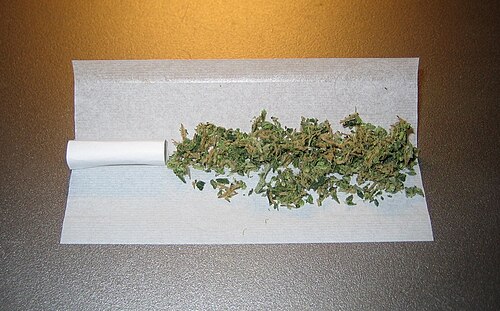
- 喫煙は、小さなパイプ、ボング(水筒を備えた携帯用水ギセル)、紙で包まれたジョイント、タバコの葉で包まれたブラントなどからカンナビノイド(「煙」)を燃やして吸入することである。 [35]
- 気化とは、様々な形態の大麻を165~190℃(329~374℉)に加熱し、[36]植物材料を燃焼させることなく有効成分を蒸気状にすることである( THCの沸点は大気圧下で157℃(315℉)である)。[37]
- 食用大麻は、バターや焼き菓子など、さまざまな食品に材料として加えられます。インドでは、飲料「バン」としてよく消費されています。
- 大麻茶はTHCの親油性の性質に注意して作られ、THCはわずかに水に溶ける(1リットルあたり2.8mg)ため[38] 、飽和脂肪に大麻が含まれていることが多い。[39]
- 大麻チンキは、グリーンドラゴンとも呼ばれ、アルコール入りの 大麻濃縮物です。
- カプセルには、通常大麻オイルが含まれており、その他の栄養補助食品は、2018年にカナダで約220種類が承認されました。[16]
国別の消費量
2013年には、1億2800万~2億3200万人が大麻を使用した(15歳から65歳までの世界人口の2.7%~4.9%)。[41]大麻はこれまでで最も広く使用されている違法薬物であり、[42]ザンビア、米国、カナダ、ナイジェリアの成人の使用が最も多い(2018年現在[update])。[43]
アメリカ合衆国
1973年から1978年の間に、11の州でマリファナが非犯罪化されました。[44] 2001年にネバダ州はマリファナの所持を軽犯罪に軽減し、2012年以降、他のいくつかの州でもマリファナが非犯罪化され、さらには合法化されました。[44]
2018年の調査では、米国人のほぼ半数がマリファナを試したことがあり、16%が過去1年間に使用し、11%が過去1か月間に使用したことが示されました。[45] 2014年の調査では、米国の大学生の毎日のマリファナ使用は、記録が始まった1980年以来最高レベルに達し、2007年の3.5%から2014年には5.9%に増加し、毎日のタバコの使用を上回りました。[46]
米国では、マリファナを使用する男性は女性の2倍以上であり、18~29歳の人は65歳以上の人よりも6倍多く使用しています。[47] 2015年には、米国の人口の44%が生涯でマリファナを試したことがあり、これは過去最高であり、2013年の38%、1985年の33%から増加しています。[47]
アメリカ合衆国におけるマリファナの使用は世界平均の3倍だが、他の西側民主主義国と同程度である。アメリカの12年生の44%が少なくとも1回はマリファナを試したことがあり、初使用年齢は16歳が一般的で、アルコールの初使用年齢と同程度だが、他の違法薬物の初使用年齢よりは低い。[42]
2022年のギャラップ社の世論調査では、アメリカ人は初めてタバコよりもマリファナを吸っているという結論が出ました。[48]
副作用
短期

急性の悪影響としては、不安やパニック、注意力や記憶力の低下、精神病症状のリスク増加、[d]明確な思考の喪失、事故リスク増加などがある。[51] [52] [53]大麻は人の運転能力を低下させ、THCは自動車事故に巻き込まれたドライバーの血液中に最も頻繁に検出された違法薬物であった。体内にTHCが含まれている人は、大麻やアルコールを使用していない人よりも事故の原因となる可能性が3倍から7倍高いが、THCは酩酊状態から数日から数週間血流中に留まるため、必ずしも原因ではない。[54] [55] [e]
すぐに現れる望ましくない副作用としては、短期記憶の低下、口渇、運動能力の低下、目の充血、[58]めまい、疲労感、嘔吐などがあります。[13]使用者の中には急性精神病の発作を経験する人もいますが、これは通常6時間後に治まりますが、まれにヘビーユーザーの場合は症状が何日も続くことがあります。[59]
合法化により、特に食用大麻から子供が大麻にさらされる割合が増加しました。子供に対するTHCの毒性と致死性は不明ですが、子供は脳症、低血圧、人工呼吸器を必要とするほどの重度の呼吸抑制、傾眠、昏睡のリスクがあります。[60] [61]
死亡
大麻の使用と心血管疾患による死亡との関連を示す明確な証拠はないが、2019年のレビューでは、大麻は心血管系に負担をかける可能性があるため、突然死の場合、報告不足の寄与因子または直接的な原因である可能性があると指摘されている。一部の死亡は、カンナビノイド悪阻症候群に起因するとも言われている。[62]大麻の使用と自殺には関連性があり、特に若年層でその傾向が強い。[63]
オレゴン州とアラスカ州の救急医療部門に対する16か月間の調査で、急性大麻中毒で入院していた成人が死亡したという報告が見つかりました。[64]
長期的

心理的影響
2015年のメタ分析では、大麻を断つ期間が長いほど障害の程度は小さいものの、大麻使用者では回想記憶と将来記憶の両方が障害されていることが判明した。著者らは、大麻使用に関連する障害の一部は可逆的であるが、すべてではないと結論付けた。 [66] 2012年のメタ分析では、ほとんどの認知領域における障害が急性中毒期間を超えて持続するが、被験者が25日以上断薬した研究では明らかではなかったことが判明した。[67]大麻が認知に及ぼす長期的な影響については質の高い研究はほとんど行われておらず、結果は概して一貫していない。[68]さらに、有意な知見の効果サイズは概して小さかった。[67]あるレビューでは、ほとんどの認知機能は大麻使用によって損なわれなかったが、実行機能に残存障害が発生したと結論付けた。[69]実行機能の障害は、高齢者層で最も一貫して見られ、これは大麻への多量曝露、または青少年の大麻使用に関連する発達的影響を反映している可能性がある。[70]あるレビューでは、自己申告による大麻使用と知能指数(IQ)の関係を調べた3つの前向きコホート研究が見つかった。大麻のヘビーユーザーを最も多く追跡した研究では、IQは7~13歳から38歳の間に低下したと報告されている。学業成績の低下と早期退学の発生率の増加は、どちらも大麻使用と関連していたが、因果関係は確立されていない。[71]大麻使用者は、処理効率の低下と一致して、タスク関連脳領域の活動が増加した。[72]
生活の質の低下は大麻の大量使用と関連しているが、その関係はタバコや他の物質の場合よりも一貫しておらず弱い。[73]しかし、因果関係の方向性は不明である。[73]
大麻の長期的な影響は明らかではない。[13]記憶や認知の問題、依存症のリスク、若者の統合失調症のリスクなどが懸念されている。 [12]
神経画像
白質と灰白質の全体的な異常は大麻使用と一貫して関連しているわけではないが、[74]海馬容積の減少は一貫して見られる。 [75] 扁桃体の異常は時々報告されているが、所見は一貫していない。[76] [77] [78]
大麻の使用は、背外側前頭前皮質などのタスク関連領域の動員の増加と関連しており、これは処理効率の低下による代償活動を反映していると考えられている。[78] [77] [79]大麻の使用は、 CB1受容体のダウンレギュレーションとも関連している。ダウンレギュレーションの程度は累積的な大麻曝露と関連しており、1か月の禁欲後には元に戻る。[ 71] [80] [81]慢性的な大麻の使用がヒトの脳内のグルタミン酸代謝物のレベルを低下させる可能性があるという証拠は限られている。 [82]
大麻依存症
DSM-IV(1994)の基準によると、マリファナを試した人の約9%が最終的に依存症になる。[15] 2013年のレビューでは、毎日の使用は10〜20%の依存症率に関連していると推定されています。[12]大麻依存症のリスクが最も高いのは、学業成績の悪さ、幼少期および青年期の逸脱行動、反抗的であること、親との関係が悪いこと、または親が薬物やアルコールの問題を抱えていたことのある人です。[83]毎日使用する人の約50%は、使用を中止すると離脱症状(つまり依存症)を経験し、睡眠障害、イライラ、不快感、渇望を特徴とします。[71]大麻の離脱症状はアルコールの離脱症状ほど深刻ではありません。[84]
DSM-Vの基準によると、大麻にさらされた人の9%が大麻使用障害を発症するのに対し、コカインでは20%、アルコールでは23% 、ニコチンでは68%である。DSM-Vの大麻使用障害は、大麻の乱用と依存に関するDSM-IVの基準に渇望を加えたもので、法的トラブルに関する基準は含まれていない。[71]
精神科
臨床的観点から見ると、大麻(またはカンナビノイド)の使用に関連する精神疾患については、一時的かつ非持続的な精神病反応と、統合失調症に似た長期にわたる持続性障害という2つの重要な考え方が存在します。前者は正式には急性大麻関連精神病症状(CAPS)として知られています。[85]
疫学的レベルでは、大麻の使用と精神病のリスク増加および精神病の早期発症との間には用量反応関係が存在する。 [86] [87] [88] [89] [90]疫学的関連性は強固であるが、因果関係を証明する証拠は不足している。[91]
大麻はうつ病のリスクも高める可能性があるが、結論を出すには研究が不十分である。[92] [88]大麻の使用は不安障害のリスク増加と関連しているが、因果関係は確立されていない。[93]
2019年のレビューでは、統合失調症、精神病、その他の精神障害の治療に大麻を使用することの安全性と有効性を判断するには研究が不十分であることが判明しました。[94] [95]別の研究では、思春期の大麻は、後の人生でうつ病や自殺行動を発症するリスクの増加と関連していることがわかりましたが、不安には影響がありませんでした。[96]
物理的な
マリファナへの多量かつ長期的な暴露は、身体的、精神的、行動的、社会的健康上の影響を及ぼす可能性がある。マリファナは「肝臓(特にC型肝炎の併存)、肺、心臓、血管の疾患に関連している可能性がある」。[97] 2014年のレビューでは、大麻の使用はアルコールの使用よりも害が少ない可能性があるが、問題のある飲酒の代わりに大麻を使用することを推奨するのは、さらなる研究がなければ時期尚早であることが判明した。[98] 2015年から2019年の間に実施されたさまざまな調査では、大麻の使用者の多くが、処方薬(オピオイドを含む)、アルコール、タバコの代わりに大麻を使用していることがわかった。アルコールやタバコの代わりに大麻を使用している人のほとんどが、後者の物質の摂取を減らすか、またはやめていた。[99]
カンナビノイド過嘔吐症候群(CHS)は、一部の慢性大麻使用者に見られる重篤な症状で、24~48時間にわたって制御不能な嘔吐が繰り返される。CHSによる死亡例が4件報告されている。[100] [101]
限られた数の研究で、大麻喫煙が呼吸器系に与える影響が検討されている。 [102]慢性的に大麻を大量に喫煙すると、呼吸器感染症、[103]咳、痰の生成、喘鳴、および慢性気管支炎の他の症状と関連している。[51]入手可能な証拠は、大麻使用と慢性閉塞性肺疾患との因果関係を支持していない。[104]大麻の短期使用は気管支拡張と関連している。[105]大麻使用のその他の副作用には、カンナビノイド悪阻症候群(CHS)があり、これは繰り返し起こる吐き気、腹痛、および嘔吐を伴う症状である。[106]
大麻の煙には何千もの有機・無機化合物が含まれています。このタールにはタバコの煙に含まれるものと化学的に類似した物質が含まれています。[ 107]また、大麻の煙には50種類以上の発がん性物質が確認されており、 [108]ニトロソアミン、反応性アルデヒド、ベンズ[a]ピレンを含む多環芳香族炭化水素が含まれています。 [109]大麻の煙は、タバコの煙よりも深く吸い込まれます。[110] 2015年現在[update]、大麻の喫煙ががんのリスク増加と関連しているかどうかについてはコンセンサスがありません。[111]大麻の軽度および中等度の使用は、肺がんや上気道がんのリスクを増加させないと考えられています。これらのがんを引き起こすという証拠は、長期にわたる大量使用に関してはまちまちです。一般的に、定期的な大麻の喫煙者は、タバコに比べて肺の合併症のリスクがはるかに低いです。[112] 2015年のレビューでは、大麻の使用と精巣胚細胞腫瘍(TGCT)、特に非精上皮腫TGCTの発症との間に関連性があることが判明しました。[113] 2015年の別のメタアナリシスでは、生涯の大麻使用と頭頸部がんのリスクとの間に関連性は見つかりませんでした。[114]気化器を使用したり、錠剤の形でTHCを摂取したり、大麻食品を摂取したりする場合、燃焼生成物は存在しません。[115]
大麻が心血管疾患に寄与する可能性があるという懸念があるが[116]、2018年時点では[update]この関係性の証拠は不明である。[117]大麻は、心血管リスク因子があることが知られているタバコやアルコール、コカインなどの薬物と併用されることが多いため、これらの事象の研究は複雑である。[118]大麻を喫煙すると、摂取後60分間は心筋梗塞のリスクが4.8倍に増加することも示されている。 [119]
大麻が血栓の治療に使用される処方薬の抗凝固作用を妨げるという予備的な証拠がある。[120] 2019年現在、大麻の抗炎症作用と鎮痛作用のメカニズムは定義されておらず、大麻を医薬品として使用するための政府の規制承認や臨床実践はない。[95][update]
救急外来受診
大麻使用に関連する救急室(ER)入院は2012年から2016年にかけて大幅に増加し、12~17歳の青少年のリスクが最も高かった。[121]合法化後のコロラド州のある医療センターでは、ER入院患者の約2%が大麻使用者と分類された。これらの使用者の4分の1の症状は部分的に大麻に起因しており(患者449,031人中合計2567人)、他の薬物が関与している場合もあった。これらの大麻入院のうち、4分の1は急性精神疾患によるもので、主に自殺念慮、うつ病、不安症によるものだった。さらに症例の3分の1はカンナビノイド悪阻症候群を含む胃腸の問題によるものだった。[122]
米国保健福祉省によると、2011年に大麻使用に関連した緊急治療室への受診は455,000件に上った。この統計には、患者が最近の大麻使用によって引き起こされた、またはそれに関連した症状の治療を受けた受診も含まれる。薬物使用は緊急治療室受診に「関連」している必要があるが、受診の直接の原因である必要はない。違法薬物による緊急治療室受診の大半は複数の薬物が関係していた。[123] 129,000件のケースでは、大麻が唯一の関連薬物であった。[123] [15]
生殖に関する健康
薬理学
作用機序
THCはCB1受容体の部分作動薬であるのに対し、CBDはCB1受容体の拮抗薬である。[125] [126] CB1受容体は主に脳と一部の末梢組織に存在し、CB2受容体は主に末梢組織に存在するが、神経グリア細胞にも発現している。[127] THCはCB1受容体に対する作動薬として作用し、用量依存的に二次メッセンジャーシステム(アデニル酸シクラーゼ)を阻害することで気分や認知機能を変化させると考えられている。
THCはCB1受容体の活性化を介して間接的にドーパミン放出を増加させ、向精神作用を生み出す。[128] CBDはμ-およびδ-オピオイド受容体のアロステリックモジュレーターとしても作用する。[129] THCはグリシン受容体の効果も増強する。[130]これらの作用が大麻の効果に寄与するかどうか、またどのように寄与するかは不明である。[131]
薬物動態
カンナビノイドは脂溶性が高いため、体内に長期間留まります。[132] THCを1回投与した後でも、体内に検出可能なレベルのTHCが数週間以上(投与量と評価方法の感度によって異なります)検出される場合があります。[132]研究者は、これがマリファナの効果の重要な要因であると示唆しており、おそらくカンナビノイドが体内、特にニューロンの脂質膜に蓄積する可能性があるためです。[133]
化学
化学組成
大麻の主な精神活性成分はテトラヒドロカンナビノール(THC)で、これは熱を加えることでテトラヒドロカンナビノール酸(THCA)の脱炭酸によって生成されます。生の葉は、カンナビノイドがカルボン酸の形をしているため精神活性ではありません。[要出典] THCは、この植物に含まれる483の既知の化合物の1つであり、[134]少なくとも65の他のカンナビノイドを含み、[135]カンナビジオール(CBD)などです。[53]
体液中の検出
THC とその主要(不活性)代謝物であるTHC-COOHは、薬物使用検査プログラムまたは交通犯罪やその他の犯罪の法医学的調査の一環として、クロマトグラフィー技術を使用して血液、尿、毛髪、口腔液、または汗で測定できます。 [59]このような分析から得られる濃度は、能動的な使用と受動的な曝露、使用からの経過時間、および使用の程度または期間を区別するのに役立ちます。ただし、これらのテストでは、医療目的での許可された大麻喫煙と許可されていない娯楽目的の喫煙を区別することはできません。[136]市販のカンナビノイド免疫アッセイは、生理学的検体でマリファナの存在を検査する際の最初のスクリーニング方法としてよく使用されますが、THC とその代謝物との交差反応の程度は異なります。[137]尿には主に THC-COOH が含まれますが、毛髪、口腔液、汗には主に THC が含まれます。 [59]血液には両方の物質が含まれる可能性があり、相対的な量は使用の最近性と程度によって異なります。 [ 59 ]
デュケノワ・レヴィン試験は現場でのスクリーニング検査として一般的に使用されていますが、さまざまな物質が偽陽性を示すことが示されているため、大麻の存在を明確に確認することはできません。 [138]ジョン・ジェイ刑事司法大学の研究者は、食事中の亜鉛サプリメントが尿中のTHCやその他の薬物の存在を隠すことができると報告しました。[139]しかし、ユタ大学医学部の研究者が2013年に実施した研究では、自己投与した亜鉛が尿薬物検査で偽陰性を引き起こす可能性を否定しています。[140]
品種と系統
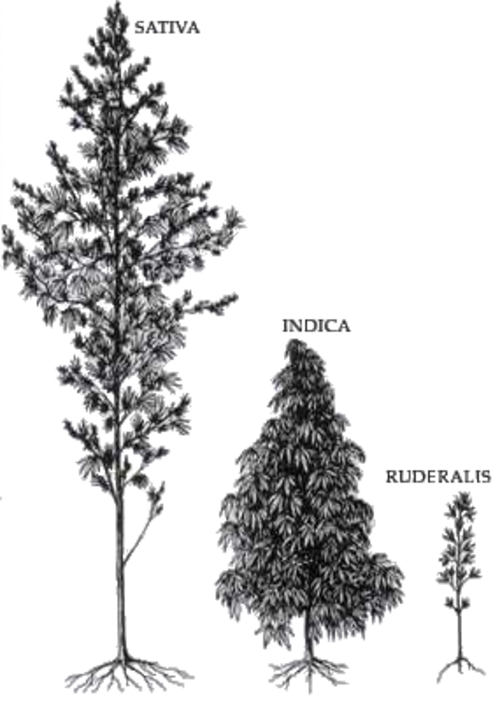
CBDは5-HT 1A受容体作動薬であり、抗不安作用があるかどうかを調べるために研究が行われている。 [141]サティバ種はより刺激的な精神活性作用があり、インディカ種はより鎮静作用があり身体に高揚感を与えるとよく言われる。[142]しかし、研究者はこれに異論を唱えている。[143]
2015年のレビューでは、CBDとTHCの比率が高い大麻株の使用は、CBDとTHCの比率が低い大麻と比較して、妄想や幻覚などの陽性症状が大幅に少なく、認知機能が向上し、精神病を発症するリスクが低く、病気の発症年齢が遅くなることがわかった。[144]
精神活性成分
国連薬物犯罪事務所(UNODC)によると、「大麻のサンプルに含まれるTHCの量は、一般的に大麻の効力の尺度として使用されます。」[145]大麻製品の主な3つの形態は、花/果実、樹脂(ハシシ)、およびオイル(ハッシュオイル)です。UNODCは、大麻には5%のTHCが含まれることが多く、樹脂には「最大20%のTHCが含まれる場合があります」、そして「大麻オイルには60%を超えるTHCが含まれる場合があります」と述べています。[145]
研究によると、1970年代以降、違法大麻の効力は大幅に増加しており、THCレベルは上昇し、CBDレベルは低下している。[146] [147] [148]しかし、THC含有量の増加によって人々がより多くのTHCを消費するようになったのか、それとも大麻の効力に基づいて使用者が調整しているのかは不明である。THC含有量が多いほど、タール摂取量が少なくなる可能性が高い。同時に、押収されたサンプルのCBDレベルは低下しているが、これはTHCレベルを高めたいという欲求と、人工照明を使用して屋内で栽培する違法栽培者が増えたためである。これは検出を回避するのに役立つが、植物のCBD生産を減らす。[149]
オーストラリアの国立大麻予防情報センター(NCPIC)は、雌の大麻植物の芽(果序)にはTHCの濃度が最も高く、次に葉が続くと述べています。茎と種子には「はるかに低いTHCレベル」があります。 [150]国連は、葉に含まれるTHCは芽の10分の1、茎に含まれるTHCは100分の1であると述べています。[145]
英国では大麻規制の見直しにより、政府は大麻をクラスCからクラスBの薬物に戻した。その理由として、効力の高い大麻の出現が挙げられている。警察が押収したサンプルの70~80%はスカンクだと考えられている[151](スカンクはあらゆる種類のハーブ大麻と間違われることがあるが)。[152] [153] ハシシやハッシュオイルなどの抽出物には、効力の高い大麻の果実よりもTHCが多く含まれているのが一般的である。[154]
混入大麻と合成カンナビノイド
合成カンナビノイドを混ぜた麻の芽(または低効力大麻の芽)が2020年に大麻のストリートドラッグとして販売され始めた。[155] [156] [157] [158]
大麻の短期的な効果は、ヘロインやフェンタニルなどのオピオイド系薬物が混入されている場合に変化する可能性がある。[159]添加された薬物は、過剰摂取の危険性が増すにもかかわらず、精神活性作用を高め、重量を増やし、収益性を高めることを目的としている。[160] [f]
準備
-
 乾燥した花のつぼみ(マリファナ)
 -
 キーフ1グラム
 -
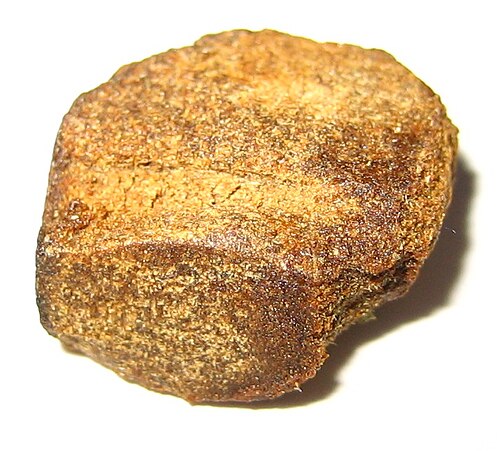 ハシシ
ハシシ -
 ハッシュオイル
 -
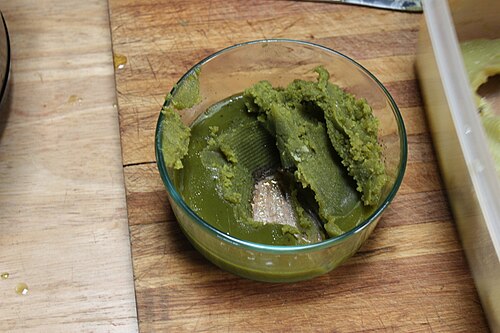 インフュージョン(乳製品バター)
.jpg/500px-Kief_(yellow).jpg)
マリファナ
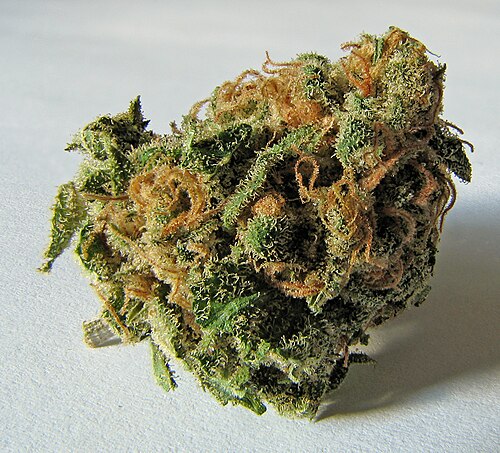
マリファナまたはマリファナ(ハーブ大麻)[162]は、雌の大麻植物の乾燥した花と果実、およびその下にある葉と茎で構成されています。[163] [164] [165] [166]これは最も広く消費されている形態であり、[166] 3%から20%のTHCを含み、[167]最大33%のTHCを含むという報告もあります。[168]これは、他のすべての製剤の原料です。ハーブ大麻と産業用ヘンプは同じ種に由来し、精神活性成分(THC)を含みますが、それらは独自の生化学的組成と用途を持つ異なる系統です。ヘンプはTHCの濃度が低く、CBDの濃度が高く、精神活性効果は低くなります。[169] [170]
キーフ
キーフはトリコーム(毛状突起)を豊富に含んだ粉末で、[171]大麻植物の葉、花、果実からふるいにかけられ、粉末の形で摂取するか、圧縮してハシシのケーキを作ることができます。[172]「キフ」という言葉は、快楽を意味するアラビア語の口語 「كيف kēf / kīf」に由来しています。[173]
ハシシ

ハシシ(別名ハシーシュ、ハシシャ、または単にハッシュ)は、大麻の果実、花、葉から剥がれた毛状突起や細かい物質であるキーフを圧縮して作られる濃縮樹脂ケーキまたはボールです。 [174]または、植物の表面から樹脂を削り取り、ボール状に丸めて作られます。純度と採取した品種の種類によって、色は黒から黄金色までさまざまです。[175]口から摂取することも、喫煙することもできますが、蒸発させる、つまり「ベイプ」することもできます。[176]「ロジンハッシュ」という用語は、熱と圧力によって得られる高品質の無溶剤製品を指します。[177]
チンキ剤
Cannabinoids can be extracted from cannabis plant matter using high-proof spirits (often grain alcohol) to create a tincture, often referred to as "green dragon".[32]: p17 Nabiximols is a branded product name from a tincture manufacturing pharmaceutical company.[178]
Hash oil
Hash oil is a resinous matrix of cannabinoids obtained from the cannabis plant by solvent extraction,[179] formed into a hardened or viscous mass.[180] Hash oil can be the most potent of the main cannabis products because of its high level of psychoactive compound per its volume, which can vary depending on the plant's mix of essential oils and psychoactive compounds.[181] Butane and supercritical carbon dioxide hash oil have become popular in recent years.[182]
Infusions
There are many varieties of cannabis infusions owing to the variety of non-volatile solvents used.[183] The plant material is mixed with the solvent and then pressed and filtered to express the oils of the plant into the solvent. Examples of solvents used in this process are cocoa butter, dairy butter, cooking oil, glycerine, and skin moisturizers. Depending on the solvent, these may be used in cannabis foods or applied topically.[184]
Marihuana prensada
Marihuana prensada ('pressed marijuana') is a cannabis-derived product widespread among the lower classes of South America,[185] especially from the 90s. Locally it is known as "paraguayo" or "paragua", since its main producer is Paraguay.[186] Marijuana is dried and mixed with binding agents that make it toxic and highly harmful to health.[187] It is cut into the shape of bricks (ladrillos) and sold for a low price in Argentina, Brazil, Chile, Peru, Venezuela, and even the United States.[188]
History
Ancient history
.png/500px-Jirzankal_Cemetery_map_(Cannabis_site).png)
Cannabis is indigenous to Central or South Asia[189] and its uses for fabric and rope dates back to the Neolithic age in China and Japan.[190][191] It is unclear when cannabis first became known for its psychoactive properties. The oldest archeological evidence for the burning of cannabis was found in Romanian kurgans dated 3,500 BC, and scholars suggest that the drug was first used in ritual ceremonies by Proto-Indo-European tribes living in the Pontic-Caspian steppe during the Chalcolithic period, a custom they eventually spread throughout Western Eurasia during the Indo-European migrations.[192][193] Some research suggests that the ancient Indo-Iranian drug soma, mentioned in the Vedas, sometimes contained cannabis. This is based on the discovery of a basin containing cannabis in a shrine of the second millennium BC in Turkmenistan.[194]
Cannabis was known to the ancient Assyrians, who discovered its psychoactive properties through the Iranians.[195] Using it in some religious ceremonies, they called it qunubu (meaning "way to produce smoke"), a probable origin of the modern word cannabis.[196] The Iranians also introduced cannabis to the Scythians, Thracians and Dacians, whose shamans (the kapnobatai – "those who walk on smoke/clouds") burned cannabis infructescences to induce trance.[197] The plant was used in China before 2800 BC, and found therapeutic use in India by 1000 BC, where it was used in food and drink, including bhang.[198][199]

Cannabis has an ancient history of ritual use and has been used by religions around the world. It has been used as a drug for both recreational and entheogenic purposes and in various traditional medicines for centuries.[200][201][162] The earliest evidence of cannabis smoking has been found in the 2,500-year-old tombs of Jirzankal Cemetery in the Pamir Mountains in Western China, where cannabis residue were found in burners with charred pebbles possibly used during funeral rituals.[202][203] Hemp seeds discovered by archaeologists at Pazyryk suggest early ceremonial practices like eating by the Scythians occurred during the 5th to 2nd century BC, confirming previous historical reports by Herodotus.[204] It was used by Muslims in various Sufi orders as early as the Mamluk period, for example by the Qalandars.[205] Smoking pipes uncovered in Ethiopia and carbon-dated to around c. AD 1320 were found to have traces of cannabis.[206]
Modern history
Cannabis was introduced to the New World by the Spaniards in 1530–1545.[207][208][209] Following an 1836–1840 travel in North Africa and the Middle East, French physician Jacques-Joseph Moreau wrote on the psychological effects of cannabis use; he founded the Paris' Club des Hashischins in 1844.[210] In 1842, Irish physician William Brooke O'Shaughnessy, who had studied the drug while working as a medical officer in Bengal with the East India Company, brought a quantity of cannabis with him on his return to Britain, provoking renewed interest in the West.[211] Examples of classic literature of the period featuring cannabis include Les paradis artificiels (1860) by Charles Baudelaire and The Hasheesh Eater (1857) by Fitz Hugh Ludlow.

Cannabis was criminalized in some countries beginning in the 14th century and was illegal in most countries by the middle of the 20th century. The colonial government of Mauritius banned cannabis in 1840 over concerns on its effect on Indian indentured workers;[212] the same occurred in Singapore in 1870.[213] In the United States, the first restrictions on sale of cannabis came in 1906 (in the District of Columbia).[214] Canada criminalized cannabis in The Opium and Narcotic Drug Act, 1923,[215] before any reports of the use of the drug in Canada, but eventually legalized its consumption for recreational and medicinal purposes in 2018.[16]
In 1925, a compromise was made at an international conference in The Hague about the International Opium Convention that banned exportation of "Indian hemp" to countries that had prohibited its use, and requiring importing countries to issue certificates approving the importation and stating that the shipment was required "exclusively for medical or scientific purposes". It also required parties to "exercise an effective control of such a nature as to prevent the illicit international traffic in Indian hemp and especially in the resin".[216][217] In the United States in 1937, the Marihuana Tax Act was passed,[218] and prohibited the production of hemp in addition to cannabis.

In 1972, the Dutch government divided drugs into more- and less-dangerous categories, with cannabis being in the lesser category. Accordingly, possession of 30 grams (1.1 oz) or less was made a misdemeanor.[219] Cannabis has been available for recreational use in coffee shops since 1976.[220] Cannabis products are only sold openly in certain local "coffeeshops" and possession of up to 5 grams (0.18 oz) for personal use is decriminalized, however: the police may still confiscate it, which often happens in car checks near the border. Other types of sales and transportation are not permitted, although the general approach toward cannabis was lenient even before official decriminalization.[221][222][223]
In Uruguay, President Jose Mujica signed legislation to legalize recreational cannabis in December 2013, making Uruguay the first country in the modern era to legalize cannabis. In August 2014, Uruguay legalized growing up to six plants at home, as well as the formation of growing clubs (Cannabis social club), and a state-controlled marijuana dispensary regime.
As of 17 October 2018[update], when recreational use of cannabis was legalized in Canada, dietary supplements for human use and veterinary health products containing not more than 10 parts per million of THC extract were approved for marketing; Nabiximols (as Sativex) is used as a prescription drug in Canada.[16]
The United Nations' World Drug Report stated that cannabis "was the world's most widely produced, trafficked, and consumed drug in the world in 2010", and estimated between 128 million and 238 million users globally in 2015.[224][225]
Culture, legality and economics
Culture

Cannabis has been one of the most used psychoactive drugs in the world since the late 20th century, following only tobacco and alcohol in popularity.[227] According to Vera Rubin, the use of cannabis has been encompassed by two major cultural complexes over time: a continuous, traditional folk stream, and a more circumscribed, contemporary configuration.[228] The former involves both sacred and secular use, and is usually based on small-scale cultivation: the use of the plant for cordage, clothing, medicine, food, and a "general use as an euphoriant and symbol of fellowship."[228][229] The second stream of expansion of cannabis use encompasses "the use of hemp for commercial manufacturers utilizing large-scale cultivation primarily as a fiber for mercantile purposes"; but it is also linked to the search for psychedelic experiences (which can be traced back to the formation of the Parisian Club des Hashischins).[229]
Legality

Legal
Illegal but decriminalized
Illegal but often unenforced
Illegal
See also countries that have legalized medical use of cannabis.
Since the beginning of the 20th century, most countries have enacted laws against the cultivation, possession or transfer of cannabis.[230] These laws have had an adverse effect on cannabis cultivation for non-recreational purposes, but there are many regions where handling of cannabis is legal or licensed. Many jurisdictions have lessened the penalties for possession of small quantities of cannabis so that it is punished by confiscation and sometimes a fine, rather than imprisonment, focusing more on those who traffic the drug on the black market.
In some areas where cannabis use had been historically tolerated, new restrictions were instituted, such as the closing of cannabis coffee shops near the borders of the Netherlands,[231] and closing of coffee shops near secondary schools in the Netherlands.[232] In Copenhagen, Denmark in 2014, mayor Frank Jensen discussed possibilities for the city to legalize cannabis production and commerce.[233]
Some jurisdictions use free voluntary treatment programs and/or mandatory treatment programs for frequent known users. Simple possession can carry long prison terms in some countries, particularly in East Asia, where the sale of cannabis may lead to a sentence of life in prison or even execution. Political parties, non-profit organizations, and causes based on the legalization of medical cannabis and/or legalizing the plant entirely (with some restrictions) have emerged in such countries as China and Thailand.[234][235]
In December 2012, the U.S. state of Washington became the first state to officially legalize cannabis in a state law (Washington Initiative 502) (but still illegal by federal law),[236] with the state of Colorado following close behind (Colorado Amendment 64).[237] On 1 January 2013, the first cannabis "club" for private marijuana smoking (no buying or selling, however) was allowed for the first time in Colorado.[238] The California Supreme Court decided in May 2013 that local governments can ban medical cannabis dispensaries despite a state law in California that permits the use of cannabis for medical purposes. At least 180 cities across California have enacted bans in recent years.[239]
On 30 April 2024, the United States Department of Justice announced it would move to reclassify cannabis from a Schedule I to a Schedule III controlled substance.[240][241]
In December 2013, Uruguay became the first country to legalize growing, sale and use of cannabis.[242] After a long delay in implementing the retail component of the law, in 2017 sixteen pharmacies were authorized to sell cannabis commercially.[243] On 19 June 2018, the Canadian Senate passed a bill and the Prime Minister announced the effective legalization date as 17 October 2018.[16][244] Canada is the second country to legalize the drug.[245]
In November 2015, Uttarakhand became the first state of India to legalize the cultivation of hemp for industrial purposes.[246] Usage within the Hindu and Buddhist cultures of the Indian subcontinent is common, with many street vendors in India openly selling products infused with cannabis, and traditional medical practitioners in Sri Lanka selling products infused with cannabis for recreational purposes and well as for religious celebrations.[247] Indian laws criminalizing cannabis date back to the colonial period. India and Sri Lanka have allowed cannabis to be taken in the context of traditional culture for recreational/celebratory purposes and also for medicinal purposes.[247]
On 17 October 2015, Australian health minister Sussan Ley presented a new law that will allow the cultivation of cannabis for scientific research and medical trials on patients.[248]
On 17 October 2018, Canada legalized cannabis for recreational adult use[249] making it the second country in the world to do so after Uruguay and the first G7 nation.[250] This legalization comes with regulation similar to that of alcohol in Canada, age restrictions, limiting home production, distribution, consumption areas and sale times.[251] Laws around use vary from province to province including age limits, retail structure, and growing at home.[249] The Canadian Licensed Producer system aims to become the Gold Standard in the world for safe and secure cannabis production,[252] including provisions for a robust craft cannabis industry where many expect opportunities for experimenting with different strains.[253]
As the drug has increasingly been seen as a health issue instead of criminal behavior, cannabis has also been legalized or decriminalized in: Czech Republic,[254] Colombia,[255][256] Ecuador,[257][258][259] Portugal,[260] South Africa[261] and Canada.[16] Medical marijuana was legalized in Mexico in mid-2017 and legalized for recreational use in June 2021.[262][263][264]
Germany legalized cannabis for recreational use in April 2024.[265]
Legal status by country
As of 2022, Uruguay and Canada are the only countries that have fully legalized the cultivation, consumption and bartering of recreational cannabis nationwide.[266][267] In the United States, 24 states, 3 territories, and the District of Columbia have legalized the recreational use of cannabis – though the drug remains illegal at the federal level.[268] Laws vary from state to state when it comes to the commercial sale. Court rulings in Georgia and South Africa have led to the legalization of cannabis consumption, but not legal sales. A policy of limited enforcement has also been adopted in many countries, in particular Spain and the Netherlands where the sale of cannabis is tolerated at licensed establishments.[269][270] Contrary to popular belief, cannabis is not legal in the Netherlands,[271] but it has been decriminalized since the 1970s. In 2021, Malta was the first European Union member to legalize the use of cannabis for recreational purposes.[272] In Estonia, it is only legal to sell cannabis products with a THC content of less than 0.2%, although products may contain more cannabidiol.[273] Lebanon has recently become the first Arab country to legalize the plantation of cannabis for medical use.[274]
Penalties for illegal recreational use ranges from confiscation or small fines to jail time and even death.[275] In some countries citizens can be punished if they have used the drug in another country, including Singapore and South Korea.[276][277]
Economics
Production

Sinsemilla (Spanish for "without seed") is the dried, seedless (i.e. parthenocarpic) infructescences of female cannabis plants. Because THC production drops off once pollination occurs, the male plants (which produce little THC themselves) are eliminated before they shed pollen to prevent pollination, thus inducing the development of parthenocarpic fruits gathered in dense infructescences. Advanced cultivation techniques such as hydroponics, cloning, high-intensity artificial lighting, and the sea of green method are frequently employed as a response (in part) to prohibition enforcement efforts that make outdoor cultivation more risky.
"Skunk" refers to several named strains of potent cannabis, grown through selective breeding and sometimes hydroponics. It is a cross-breed of Cannabis sativa and C. indica (although other strains of this mix exist in abundance). Skunk cannabis potency ranges usually from 6% to 15% and rarely as high as 20%. The average THC level in coffee shops in the Netherlands is about 18–19%.[278]
The average levels of THC in cannabis sold in the United States rose dramatically between the 1970s and 2000.[279] This is disputed for various reasons, and there is little consensus as to whether this is a fact or an artifact of poor testing methodologies.[279] According to Daniel Forbes writing for slate.com, the relative strength of modern strains are likely skewed because undue weight is given to much more expensive and potent, but less prevalent, samples.[280] Some suggest that results are skewed by older testing methods that included low-THC-content plant material such as leaves in the samples, which are excluded in contemporary tests. Others believe that modern strains actually are significantly more potent than older ones.[279]
The main producing countries of cannabis are Afghanistan,[281] Canada,[282] China, Colombia,[283] India,[281] Jamaica,[281] Lebanon,[284] Mexico,[285] Morocco,[281] the Netherlands, Pakistan, Paraguay,[285] Spain,[281] Thailand, Turkey, the United Kingdom,[286] and the United States.[281]
Price
The price or street value of cannabis varies widely depending on geographic area and potency.[287] Prices and overall markets have also varied considerably over time.
- In 1997, cannabis was estimated to be overall the number four value crop in the US, and number one or two in many states, including California, New York, and Florida. This estimate is based on a value to growers of ~60% of retail value, or $3,000 per pound ($6,600/kg).[288]
- In 2006, cannabis was estimated to have been a $36 billion market.[289] This estimate has been challenged as exaggerated.[42] The UN World Drug Report (2008) estimated that 2006 street prices in the US and Canada ranged from about US$8.8 to $25 per gram (approximately $250 to $700 per ounce), depending on quality.[290] Typical U.S. retail prices were $10–15 per gram (approximately $280–420 per ounce).
- In 2017, the U.S. was estimated to constitute 90% of the worldwide $9.5 billion legal trade in cannabis.[291]
After some U.S. states legalized cannabis, street prices began to drop. In Colorado, the price of smokable buds (infructescences) dropped 40 percent between 2014 and 2019, from $200 per ounce to $120 per ounce ($7 per gram to $4.19 per gram).[292]
The European Monitoring Centre for Drugs and Drug Addiction reports that typical retail prices in Europe for cannabis varied from €2 to €20 per gram in 2008, with a majority of European countries reporting prices in the range €4–10.[293]
Cannabis as a gateway drug
The gateway hypothesis states that cannabis use increases the probability of trying "harder" drugs. The hypothesis has been hotly debated as it is regarded by some as the primary rationale for the United States prohibition on cannabis use.[294][295] A Pew Research Center poll found that political opposition to marijuana use was significantly associated with concerns about the health effects and whether legalization would increase cannabis use by children.[296]
Some studies state that while there is no proof for the gateway hypothesis,[297] young cannabis users should still be considered as a risk group for intervention programs.[298] Other findings indicate that hard drug users are likely to be poly-drug users, and that interventions must address the use of multiple drugs instead of a single hard drug.[299] Almost two-thirds of the poly drug users in the 2009–2010 Scottish Crime and Justice Survey used cannabis.[300]
The gateway effect may appear due to social factors involved in using any illegal drug. Because of the illegal status of cannabis, its consumers are likely to find themselves in situations allowing them to acquaint with individuals using or selling other illegal drugs.[301][302] Studies have shown that alcohol and tobacco may additionally be regarded as gateway drugs;[303] however, a more parsimonious explanation could be that cannabis is simply more readily available (and at an earlier age) than illegal hard drugs.[citation needed] In turn, alcohol and tobacco are typically easier to obtain at an earlier age than is cannabis (though the reverse may be true in some areas), thus leading to the "gateway sequence" in those individuals, since they are most likely to experiment with any drug offered.[294]
A related alternative to the gateway hypothesis is the common liability to addiction (CLA) theory. It states that some individuals are, for various reasons, willing to try multiple recreational substances. The "gateway" drugs are merely those that are (usually) available at an earlier age than the harder drugs. Researchers have noted in an extensive review that it is dangerous to present the sequence of events described in gateway "theory" in causative terms as this hinders both research and intervention.[304]
In 2020, the National Institute on Drug Abuse released a study backing allegations that marijuana is a gateway to harder drugs, though not for the majority of marijuana users.[305] The National Institute on Drug Abuse determined that marijuana use is "likely to precede use of other licit and illicit substances" and that "adults who reported marijuana use during the first wave of the survey were more likely than adults who did not use marijuana to develop an alcohol use disorder within 3 years; people who used marijuana and already had an alcohol use disorder at the outset were at greater risk of their alcohol use disorder worsening. Marijuana use is also linked to other substance use disorders including nicotine addiction."[305] It also reported that "These findings are consistent with the idea of marijuana as a "gateway drug". However, the majority of people who use marijuana do not go on to use other, "harder" substances. Also, cross-sensitization is not unique to marijuana. Alcohol and nicotine also prime the brain for a heightened response to other drugs and are, like marijuana, also typically used before a person progresses to other, more harmful substances."[305]
Research
Research on cannabis is challenging since the plant is illegal in most countries.[306][307][308][309][310] Research-grade samples of the drug are difficult to obtain for research purposes, unless granted under authority of national regulatory agencies, such as the US Food and Drug Administration.[311]
There are also other difficulties in researching the effects of cannabis. Many people who smoke cannabis also smoke tobacco.[312] This causes confounding factors, where questions arise as to whether the tobacco, the cannabis, or both that have caused a cancer. Another difficulty researchers have is in recruiting people who smoke cannabis into studies. Because cannabis is an illegal drug in many countries, people may be reluctant to take part in research, and if they do agree to take part, they may not say how much cannabis they actually smoke.[313]
See also
- Cannabis rights
- Glossary of cannabis terms
- List of books about cannabis
- List of celebrities who own cannabis businesses
References
Footnotes
- ^ Pure varieties of C. ruderalis are rarely used for recreational purposes.[1]
- ^ /ˈkænəbɪs/[2]
- ^ /ˌmærəˈwɑːnə/[3]
- ^ Psychotic episodes are well-documented and typically resolve within minutes or hours, while symptoms may last longer.[49] The use of a single joint can temporarily induce some psychiatric symptoms.[50]
- ^ A 2016 review also found a statistically significant increase in crash risk associated with marijuana use, but noted that this risk was "of low to medium magnitude."[56] The increase in risk of motor vehicle crash for cannabis use is between 2 and 3 times relative to baseline, whereas that for comparable doses of alcohol is between 6 and 15 times.[57]
- ^ Advocates of legalizing marijuana for recreational use, such as former Illinois state Senator Heather Steans, say that legalizing it would help reduce such hazardous added drugs: "Over 95 percent are buying it on the black market. You don't know what you're buying. It's not a safe product. We've seen it laced with rat poison, fentanyl, all sorts of things. It's funding the cartels and other criminal activity."[161]
Citations
- ^ Cervantes, Jorge (2006). Marijuana Horticulture: The Indoor/Outdoor Medical Grower's Bible (5th ed.). Van Patten Publishing. pp. 12. ISBN 9781878823236.
- ^ "cannabis noun – Definition, pictures, pronunciation and usage notes | Oxford Advanced Learner's Dictionary at OxfordLearnersDictionaries.com". www.oxfordlearnersdictionaries.com. Retrieved 10 November 2022.
- ^ "marijuana noun – Definition, pictures, pronunciation and usage notes | Oxford Advanced Learner's Dictionary at OxfordLearnersDictionaries.com". www.oxfordlearnersdictionaries.com. Retrieved 18 April 2019.
- ^ Shrivastava, Amresh; Johnston, Megan; Tsuang, Ming (2011). "Cannabis use and cognitive dysfunction". Indian Journal of Psychiatry. 53 (3): 187–191. doi:10.4103/0019-5545.86796. ISSN 0019-5545. PMC 3221171. PMID 22135433.
- ^ Gray, Stephen (9 December 2016). Cannabis and Spirituality: An Explorer's Guide to an Ancient Plant Spirit Ally. Simon and Schuster. p. 69. ISBN 978-1-62055-584-2.
Cannabis is called kaneh bosem in Hebrew, which is now recognized as the Scythian word that Herodotus wrote as kánnabis (or cannabis).
- ^ a b c d Riegel, A.; Ellens, J.H. (2014). Seeking the Sacred with Psychoactive Substances: Chemical Paths to Spirituality and to God [2 volumes]. Psychology, Religion, and Spirituality. Bloomsbury Publishing. p. 80. ISBN 979-8-216-14310-9. Retrieved 3 June 2024.
- ^ Duncan, Perry M. (17 September 2020). Substance Use Disorders: A Biopsychosocial Perspective. Cambridge University Press. p. 441. ISBN 978-0-521-87777-0.
Cannabis is a Scythian word (Benet 1975).
- ^ Murnion B (December 2015). "Medicinal cannabis". Australian Prescriber. 38 (6): 212–15. doi:10.18773/austprescr.2015.072. ISSN 0312-8008. PMC 4674028. PMID 26843715.
- ^ "What is medical marijuana?". National Institute of Drug Abuse. July 2015. Retrieved 19 April 2016.
The term medical marijuana refers to using the whole unprocessed marijuana plant or its basic extracts to treat a disease or symptom.
- ^ Backes M (2014). Cannabis Pharmacy: The Practical Guide to Medical Marijuana. Hachette Books. p. 46. ISBN 978-1-60376-334-9.
- ^ "Release the strains". Nature Medicine. 21 (9): 963. September 2015. doi:10.1038/nm.3946. PMID 26340110.
- ^ a b c Borgelt LM, Franson KL, Nussbaum AM, Wang GS (February 2013). "The pharmacologic and clinical effects of medical cannabis". Pharmacotherapy. 33 (2): 195–209. CiteSeerX 10.1.1.1017.1935. doi:10.1002/phar.1187. PMID 23386598. S2CID 8503107.
- ^ a b c Whiting PF, Wolff RF, Deshpande S, Di Nisio M, Duffy S, Hernandez AV, Keurentjes JC, Lang S, Misso K, Ryder S, Schmidlkofer S, Westwood M, Kleijnen J (23 June 2015). "Cannabinoids for Medical Use: A Systematic Review and Meta-analysis". JAMA. 313 (24): 2456–73. doi:10.1001/jama.2015.6358. hdl:10757/558499. PMID 26103030.
- ^ Jensen B, Chen J, Furnish T, Wallace M (October 2015). "Medical Marijuana and Chronic Pain: a Review of Basic Science and Clinical Evidence". Current Pain and Headache Reports. 19 (10): 50. doi:10.1007/s11916-015-0524-x. PMID 26325482. S2CID 9110606.
- ^ a b c d Volkow ND, Baler RD, Compton WM, Weiss SR (June 2014). "Adverse health effects of marijuana use". The New England Journal of Medicine. 370 (23): 2219–27. doi:10.1056/NEJMra1402309. PMC 4827335. PMID 24897085.
- ^ a b c d e f "Health products containing cannabis or for use with cannabis: Guidance for the Cannabis Act, the Food and Drugs Act, and related regulations". Government of Canada. 11 July 2018. Retrieved 19 October 2018.
- ^ Ainge Roy, Eleanor (11 December 2018). "New Zealand passes laws to make medical marijuana widely available". The Guardian. Retrieved 20 January 2019.
- ^ Schulz, Chris (30 June 2022). "You can get actual weed from the doctor now". The Spinoff.
- ^ "Information on Cannabis Safety". Americans for Safe Access.
- ^ Ernest Small (2016). Cannabis: A Complete Guide. CRC Press. ISBN 978-1-315-35059-2.
- ^ Onaivi ES, Sugiura T, Di Marzo V (2005). Endocannabinoids: The Brain and Body's Marijuana and Beyond. Taylor & Francis. p. 58. ISBN 978-0-415-30008-7.
- ^ Curran, H. Valerie; Morgan, Celia J.A. (2014). "Desired and Undesired Effects of Cannabis on the Human Mind and Psychological Well-Being". In Pertwee, Roger G. (ed.). Handbook of Cannabis. Oxford University Press.
- ^ Ashton, C.Heather (2001). "Pharmacology and Effects of Cannabis: A Brief Review". British Journal of Psychiatry. 178 (2): 101–06. doi:10.1192/bjp.178.2.101. PMID 11157422. S2CID 15918781.
- ^ Mathre ML, ed. (1997). Cannabis in Medical Practice: A Legal, Historical, and Pharmacological Overview of the Therapeutic Use of Marijuana. University of Virginia Medical Center. pp. 144–. ISBN 978-0-7864-8390-7.
- ^ Riedel G, Davies SN (2005). "Cannabinoid function in learning, memory and plasticity". Cannabinoids. Handbook of Experimental Pharmacology. Vol. 168. pp. 445–77. doi:10.1007/3-540-26573-2_15. ISBN 978-3-540-22565-2. PMID 16596784.
- ^ Osborne GB, Fogel C (2008). "Understanding the motivations for recreational marijuana use among adult Canadians" (PDF). Substance Use & Misuse. 43 (3–4): 539–72, discussion 573–79, 585–87. doi:10.1080/10826080701884911. PMID 18365950. S2CID 31053594.
- ^ "Medication-Associated Depersonalization Symptoms". Medscape.
- ^ Shufman E, Lerner A, Witztum E (April 2005). "[Depersonalization after withdrawal from cannabis usage]" (PDF). Harefuah (in Hebrew). 144 (4): 249–51, 303. PMID 15889607. Archived from the original (PDF) on 30 April 2005.
- ^ Johnson BA (February 1990). "Psychopharmacological effects of cannabis". British Journal of Hospital Medicine. 43 (2): 114–16, 118–20, 122. PMID 2178712.
- ^ Souza RS, Albuquerque UP, Monteiro JM, de Amorim EL (2008). "Brazilian Archives of Biology and Technology – Jurema-Preta (Mimosa tenuiflora [Willd.] Poir.): a review of its traditional use, phytochemistry and pharmacology". Brazilian Archives of Biology and Technology. 51 (5): 937–47. doi:10.1590/S1516-89132008000500010.
- ^ a b Courtwright D (2001). Forces of Habit: Drugs and the Making of the Modern World. Harvard University Press. ISBN 978-0-674-00458-0.
- ^ a b Iversen LL (2000). The Science of Marijuana. Oxford University Press. ISBN 978-0-19-515110-7.
- ^ Golub A (2012). The Cultural/Subcultural Contexts of Marijuana Use at the Turn of the Twenty-First Century. Routledge. p. 82. ISBN 978-1-136-44627-6.
- ^ "Why Does Cannabis Have to be Heated?". patriotcare.org.
- ^ Tasman A, Kay J, Lieberman JA, First MB, Maj M (2011). Psychiatry. John Wiley & Sons. p. 9. ISBN 978-1-119-96540-4.
- ^ Rosenthal E (2002). Ask Ed: Marijuana Gold: Trash to Stash. Perseus Books Group. p. 15. ISBN 978-1-936807-02-4.
- ^ "Cannabis and Cannabis Extracts: Greater Than the Sum of Their Parts?" (PDF). Cannabis-med.org. Archived from the original (PDF) on 22 June 2017. Retrieved 7 April 2014.
- ^ Dronabinol from PubChem
- ^ Gieringer D, Rosenthal E (2008). Marijuana medical handbook: practical guide to therapeutic uses of marijuana. QUICK AMER Publishing Company. p. 182. ISBN 978-0-932551-86-3.
- ^ "Annual prevalence of use of drugs, by region and globally, 2016". World Drug Report 2018. United Nations Office on Drugs and Crime. 2018. Retrieved 7 July 2018.
- ^ "Status and Trend Analysis of Illict [sic] Drug Markets" (PDF). World Drug Report 2015. p. 23. Retrieved 26 June 2015.
- ^ a b c Caulkins JP, Hawken A, Kilmer B, Kleiman MA (2012). Marijuana Legalization: What Everyone Needs to Know. Oxford University Press. p. 16. ISBN 978-0199913732.
- ^ "UNODC Statistics Online". data.unodc.org. Retrieved 9 September 2018.
- ^ a b Joshua CD (2015). "The business of getting high: head shops, countercultural capitalism, and the marijuana legalization movement". The Sixties. 8: 27–49. doi:10.1080/17541328.2015.1058480. hdl:11603/7422. S2CID 142795620.
- ^ "6 facts about marijuana". 22 November 2018. Retrieved 24 September 2020.
- ^ "Daily marijuana use among college students highest since 1980". The University Record.
- ^ a b McCarthy, Justin (22 July 2015). "More Than Four in 10 Americans Say They Have Tried Marijuana". Gallup.
- ^ "For the first time, Americans are smoking more marijuana than cigarettes, poll finds". cbsnews.com.
- ^ "Sativex Oral Mucosal Spray Public Assessment Report. Decentralized Procedure" (PDF). United Kingdom Medicines and Healthcare Products Regulatory Agency. p. 93. Retrieved 7 May 2015.
There is clear evidence that recreational cannabis can produce a transient toxic psychosis in larger doses or in susceptible individuals, which is said to characteristically resolve within a week or so of absence (Johns 2001). Transient psychotic episodes as a component of acute intoxication are well-documented (Hall et al 1994)
- ^ Hunt, Katie (17 March 2020). "Single cannabis joint linked with temporary psychiatric symptoms, review finds". CNN. Retrieved 21 March 2020.
- ^ a b Hall W, Solowij N (November 1998). "Adverse effects of cannabis". Lancet. 352 (9140): 1611–16. doi:10.1016/S0140-6736(98)05021-1. PMID 9843121. S2CID 16313727.
- ^ Oltmanns T, Emery R (2015). Abnormal Psychology. New Jersey: Pearson. p. 294. ISBN 978-0205970742.
- ^ a b D'Souza DC, Sewell RA, Ranganathan M (October 2009). "Cannabis and psychosis/schizophrenia: human studies". European Archives of Psychiatry and Clinical Neuroscience. 259 (7): 413–31. doi:10.1007/s00406-009-0024-2. PMC 2864503. PMID 19609589.
- ^ Abuse, National Institute on Drug. "Does marijuana use affect driving?". www.drugabuse.gov. Retrieved 18 December 2019.
- ^ Li MC, Brady JE, DiMaggio CJ, Lusardi AR, Tzong KY, Li G (4 October 2011). "Marijuana use and motor vehicle crashes". Epidemiologic Reviews. 34 (1): 65–72. doi:10.1093/epirev/mxr017. PMC 3276316. PMID 21976636.
- ^ Rogeberg O, Elvik R (August 2016). "The effects of cannabis intoxication on motor vehicle collision revisited and revised". Addiction. 111 (8): 1348–59. doi:10.1111/add.13347. PMID 26878835.
- ^ Hall W (January 2015). "What has research over the past two decades revealed about the adverse health effects of recreational cannabis use?" (PDF). Addiction. 110 (1): 19–35. doi:10.1111/add.12703. PMID 25287883.
- ^ Hall W, Pacula RL (2003). Cannabis Use and Dependence: Public Health and Public Policy. Cambridge University Press. p. 38. ISBN 978-0-521-80024-2.
- ^ a b c d Barceloux DG (2012). "Chapter 60: Marijuana (Cannabis sativa L.) and synthetic cannabinoids". Medical Toxicology of Drug Abuse: Synthesized Chemicals and Psychoactive Plants. John Wiley & Sons. pp. 910–. ISBN 978-1-118-10605-1. Retrieved 14 July 2013.
- ^ Wong, Kei U.; Baum, Carl R. (November 2019). "Acute Cannabis Toxicity". Pediatric Emergency Care. 35 (11): 799–804. doi:10.1097/PEC.0000000000001970. ISSN 0749-5161. PMID 31688799. S2CID 207897219.
- ^ Claudet, Isabelle; Le Breton, Mathilde; Bréhin, Camille; Franchitto, Nicolas (April 2017). "A 10-year review of cannabis exposure in children under 3-years of age: do we need a more global approach?". European Journal of Pediatrics. 176 (4): 553–56. doi:10.1007/s00431-017-2872-5. ISSN 1432-1076. PMID 28210835. S2CID 11639790.
- ^ Drummer OH, Gerostamoulos D, Woodford NW (May 2019). "Cannabis as a cause of death: A review". Forensic Sci Int. 298: 298–306. doi:10.1016/j.forsciint.2019.03.007. PMID 30925348. S2CID 87511682.
- ^ Shamabadi A, Ahmadzade A, Pirahesh K, Hasanzadeh A, Asadigandomani H (December 2023). "Suicidality risk after using cannabis and cannabinoids: An umbrella review". Dialogues Clin Neurosci. 25 (1): 50–63. doi:10.1080/19585969.2023.2231466. PMC 10334849. PMID 37427882.
- ^ Takakuwa KM, Schears RM (February 2021). "The emergency department care of the cannabis and synthetic cannabinoid patient: a narrative review". Int J Emerg Med (Review). 14 (1): 10. doi:10.1186/s12245-021-00330-3. PMC 7874647. PMID 33568074.
- ^ Nutt D, King LA, Saulsbury W, Blakemore C (March 2007). "Development of a rational scale to assess the harm of drugs of potential misuse". Lancet. 369 (9566): 1047–53. doi:10.1016/s0140-6736(07)60464-4. PMID 17382831. S2CID 5903121.
- ^ Schoeler T, Kambeitz J, Behlke I, Murray R, Bhattacharyya S (January 2016). "The effects of cannabis on memory function in users with and without psychotic disorder: findings from a combined meta-analysis". Psychological Medicine. 46 (1): 177–88. doi:10.1017/S0033291715001646. PMID 26353818. S2CID 23749219.
- ^ a b Schreiner AM, Dunn ME (October 2012). "Residual effects of cannabis use on neurocognitive performance after prolonged abstinence: a meta-analysis". Experimental and Clinical Psychopharmacology. 20 (5): 420–29. doi:10.1037/a0029117. PMID 22731735. S2CID 207618350.
Therefore, results indicate evidence for small neurocognitive effects that persist after the period of acute intoxication...As hypothesized, the meta-analysis conducted on studies eval- uating users after at least 25 days of abstention found no residual effects on cognitive performance...These results fail to support the idea that heavy cannabis use may result in long-term, persistent effects on neuropsychological functioning.
- ^ Gonzalez R, Carey C, Grant I (November 2002). "Nonacute (residual) neuropsychological effects of cannabis use: a qualitative analysis and systematic review". Journal of Clinical Pharmacology. 42 (S1): 48S–57S. doi:10.1002/j.1552-4604.2002.tb06003.x. PMID 12412836. S2CID 37826919.
- ^ Crean RD, Crane NA, Mason BJ (March 2011). "An evidence based review of acute and long-term effects of cannabis use on executive cognitive functions". Journal of Addiction Medicine. 5 (1): 1–8. doi:10.1097/ADM.0b013e31820c23fa. PMC 3037578. PMID 21321675.
Cannabis appears to continue to exert impairing effects in executive functions even after 3 weeks of abstinence and beyond. While basic attentional and working memory abilities are largely restored, the most enduring and detectable deficits are seen in decision-making, concept formation and planning.
- ^ Broyd SJ, van Hell HH, Beale C, Yücel M, Solowij N (April 2016). "Acute and Chronic Effects of Cannabinoids on Human Cognition-A Systematic Review". Biological Psychiatry. 79 (7): 557–67. doi:10.1016/j.biopsych.2015.12.002. PMID 26858214. S2CID 9858298.
- ^ a b c d Curran HV, Freeman TP, Mokrysz C, Lewis DA, Morgan CJ, Parsons LH (May 2016). "Keep off the grass? Cannabis, cognition and addiction" (PDF). Nature Reviews. Neuroscience. 17 (5): 293–306. doi:10.1038/nrn.2016.28. hdl:10871/24746. PMID 27052382. S2CID 1685727. Archived from the original (PDF) on 22 September 2017. Retrieved 27 December 2018.
- ^ Ganzer F, Bröning S, Kraft S, Sack PM, Thomasius R (June 2016). "Weighing the Evidence: A Systematic Review on Long-Term Neurocognitive Effects of Cannabis Use in Abstinent Adolescents and Adults". Neuropsychology Review. 26 (2): 186–222. doi:10.1007/s11065-016-9316-2. PMID 27125202. S2CID 4335379.
- ^ a b Goldenberg M, IsHak WW, Danovitch I (January 2017). "Quality of life and recreational cannabis use". The American Journal on Addictions. 26 (1): 8–25. doi:10.1111/ajad.12486. PMID 28000973. S2CID 40707053.
- ^ Hampton WH, Hanik I, Olson IR (2019). "[Substance Abuse and White Matter: Findings, Limitations, and Future of Diffusion Tensor Imaging Research]". Drug and Alcohol Dependence. 197 (4): 288–298. doi:10.1016/j.drugalcdep.2019.02.005. PMC 6440853. PMID 30875650.
Given that [the human] central nervous system is an intricately balanced, complex network of billions of neurons and supporting cells, some might imagine that extrinsic substances could cause irreversible brain damage. Our review paints a less gloomy picture of the substances reviewed, however. Following prolonged abstinence, abusers of alcohol (Pfefferbaum et al., 2014) or opiates (Wang et al., 2011) have white matter microstructure that is not significantly different from nonusers. There was also no evidence that the white matter microstructural changes observed in longitudinal studies of cannabis, nicotine, or cocaine were completely irreparable. It is therefore possible that, at least to some degree, abstinence can reverse effects of substance abuse on white matter. The ability of white matter to "bounce back" very likely depends on the level and duration of abuse, as well as the substance being abused.
- ^ Yücel, M; Lorenzetti, V; Suo, C; Zalesky, A; Fornito, A; Takagi, M J; Lubman, D I; Solowij, N (January 2016). "Hippocampal harms, protection and recovery following regular cannabis use". Translational Psychiatry. 6 (1): e710–. doi:10.1038/tp.2015.201. PMC 5068875. PMID 26756903.
- ^ Rocchetti M, Crescini A, Borgwardt S, Caverzasi E, Politi P, Atakan Z, Fusar-Poli P (November 2013). "Is cannabis neurotoxic for the healthy brain? A meta-analytical review of structural brain alterations in non-psychotic users". Psychiatry and Clinical Neurosciences. 67 (7): 483–92. doi:10.1111/pcn.12085. PMID 24118193. S2CID 8245635.
- ^ a b Batalla A, Bhattacharyya S, Yücel M, Fusar-Poli P, Crippa JA, Nogué S, Torrens M, Pujol J, Farré M, Martin-Santos R (2013). "Structural and functional imaging studies in chronic cannabis users: a systematic review of adolescent and adult findings". PLOS ONE. 8 (2): e55821. Bibcode:2013PLoSO...855821B. doi:10.1371/journal.pone.0055821. PMC 3563634. PMID 23390554.
The most consistently reported brain alteration was reduced hippocampal volume which was shown to persist even after several months of abstinence in one study and also to be related to the amount of cannabis use Other frequently reported morphological brain alterations related to chronic cannabis use were reported in the amygdala the cerebellum and the frontal cortex...These findings may be interpreted as reflecting neuroadaptation, perhaps indicating the recruitment of additional regions as a compensatory mechanism to maintain normal cognitive performance in response to chronic cannabis exposure, particularly within the prefrontal cortex area.
- ^ a b Weinstein A, Livny A, Weizman A (2016). "Brain Imaging Studies on the Cognitive, Pharmacological and Neurobiological Effects of Cannabis in Humans: Evidence from Studies of Adult Users". Current Pharmaceutical Design. 22 (42): 6366–79. doi:10.2174/1381612822666160822151323. PMID 27549374.
1) The studies reviewed so far demonstrated that chronic cannabis use has been associated with a volume reduction of the hippocampus...3) The overall conclusion arising from these studies is that recent cannabis users may experience subtle neurophysiological deficits while performing on working memory tasks, and that they compensate for these deficits by "working harder" by using additional brain regions to meet the demands of the task.
- ^ Blest-Hopley G, Giampietro V, Bhattacharyya S (May 2018). "Residual effects of cannabis use in adolescent and adult brains – A meta-analysis of fMRI studies" (PDF). Neuroscience and Biobehavioral Reviews. 88: 26–41. doi:10.1016/j.neubiorev.2018.03.008. PMID 29535069. S2CID 4402954.
This may reflect the multitude of cognitive tasks employed by the various studies included in these meta-analyses, all of which involved performing a task thereby requiring the participant to reorient their attention and attempt to solve the problem at hand and suggest that greater engagement of this region indicates less efficient cognitive performance in cannabis users in general, irrespective of their age.
- ^ Parsons LH, Hurd YL (October 2015). "Endocannabinoid signalling in reward and addiction". Nature Reviews. Neuroscience. 16 (10): 579–94. doi:10.1038/nrn4004. PMC 4652927. PMID 26373473.
- ^ Zehra A, Burns J, Liu CK, Manza P, Wiers CE, Volkow ND, Wang GJ (March 2018). "Cannabis Addiction and the Brain: a Review". Journal of Neuroimmune Pharmacology. 13 (4): 438–52. doi:10.1007/s11481-018-9782-9. PMC 6223748. PMID 29556883.
- ^ Colizzi M, McGuire P, Pertwee RG, Bhattacharyya S (May 2016). "Effect of cannabis on glutamate signalling in the brain: A systematic review of human and animal evidence". Neuroscience and Biobehavioral Reviews. 64: 359–81. doi:10.1016/j.neubiorev.2016.03.010. PMID 26987641. S2CID 24043856.
- ^ Hall W, Degenhardt L (October 2009). "Adverse health effects of non-medical cannabis use". Lancet. 374 (9698): 1383–91. doi:10.1016/s0140-6736(09)61037-0. PMID 19837255. S2CID 31616272.
- ^ Subbaraman MS (2014). "Can cannabis be considered a substitute medication for alcohol?". Alcohol and Alcoholism. 49 (3): 292–98. doi:10.1093/alcalc/agt182. PMC 3992908. PMID 24402247.
- ^ Schoeler, Tabea; Baldwin, Jessie R.; Martin, Ellen; Barkhuizen, Wikus; Pingault, Jean-Baptiste (3 June 2024). "Assessing rates and predictors of cannabis-associated psychotic symptoms across observational, experimental and medical research". Nature Mental Health. 2 (7): 865–876. doi:10.1038/s44220-024-00261-x. ISSN 2731-6076. PMC 11236708. PMID 39005547.
- ^ Leweke FM, Mueller JK, Lange B, Rohleder C (April 2016). "Therapeutic Potential of Cannabinoids in Psychosis". Biological Psychiatry. 79 (7): 604–12. doi:10.1016/j.biopsych.2015.11.018. PMID 26852073. S2CID 24160677.
Epidemiological data indicate a strong relationship between cannabis use and psychosis and schizophrenia beyond transient intoxication with an increased risk of any psychotic outcome in individuals who had ever used cannabis
- ^ Marconi A, Di Forti M, Lewis CM, Murray RM, Vassos E (September 2016). "Meta-analysis of the Association Between the Level of Cannabis Use and Risk of Psychosis". Schizophrenia Bulletin. 42 (5): 1262–69. doi:10.1093/schbul/sbw003. PMC 4988731. PMID 26884547.
- ^ a b Moore TH, Zammit S, Lingford-Hughes A, Barnes TR, Jones PB, Burke M, Lewis G (July 2007). "Cannabis use and risk of psychotic or affective mental health outcomes: a systematic review" (PDF). Lancet. 370 (9584): 319–28. doi:10.1016/S0140-6736(07)61162-3. PMID 17662880. S2CID 41595474.
- ^ Semple DM, McIntosh AM, Lawrie SM (March 2005). "Cannabis as a risk factor for psychosis: systematic review". Journal of Psychopharmacology. 19 (2): 187–94. doi:10.1177/0269881105049040. PMID 15871146. S2CID 44651274.
- ^ Large M, Sharma S, Compton MT, Slade T, Nielssen O (June 2011). "Cannabis use and earlier onset of psychosis: a systematic meta-analysis". Archives of General Psychiatry. 68 (6): 555–61. doi:10.1001/archgenpsychiatry.2011.5. PMID 21300939.
- ^ McLaren JA, Silins E, Hutchinson D, Mattick RP, Hall W (January 2010). "Assessing evidence for a causal link between cannabis and psychosis: a review of cohort studies". The International Journal on Drug Policy. 21 (1): 10–19. doi:10.1016/j.drugpo.2009.09.001. PMID 19783132.
The contentious issue of whether cannabis use can cause serious psychotic disorders that would not otherwise have occurred cannot be answered based on the existing data
- ^ Lev-Ran S, Roerecke M, Le Foll B, George TP, McKenzie K, Rehm J (March 2014). "The association between cannabis use and depression: a systematic review and meta-analysis of longitudinal studies". Psychological Medicine. 44 (4): 797–810. doi:10.1017/S0033291713001438. PMID 23795762. S2CID 36763290.
- ^ Kedzior KK, Laeber LT (May 2014). "A positive association between anxiety disorders and cannabis use or cannabis use disorders in the general population – a meta-analysis of 31 studies". BMC Psychiatry. 14: 136. doi:10.1186/1471-244X-14-136. PMC 4032500. PMID 24884989.
- ^ Black, Nicola; Stockings, Emily; Campbell, Gabrielle; Tran, Lucy T.; Zagic, Dino; Hall, Wayne D.; Farrell, Michael; Degenhardt, Louisa (December 2019). "Cannabinoids for the treatment of mental disorders and symptoms of mental disorders: a systematic review and meta-analysis". The Lancet. Psychiatry. 6 (12): 995–1010. doi:10.1016/S2215-0366(19)30401-8. PMC 6949116. PMID 31672337.
- ^ a b VanDolah, Harrison J.; Bauer, Brent A.; Mauck, Karen F. (September 2019). "Clinicians' Guide to Cannabidiol and Hemp Oils". Mayo Clinic Proceedings. 94 (9): 1840–51. doi:10.1016/j.mayocp.2019.01.003. PMID 31447137.
- ^ Gobbi, Gabriella; Atkin, Tobias; Zytynski, Tomasz; Wang, Shouao; Askari, Sorayya; Boruff, Jill; Ware, Mark; Marmorstein, Naomi; Cipriani, Andrea; Dendukuri, Nandini; Mayo, Nancy (13 February 2019). "Cannabis Use in Adolescence and Risk of Depression, Anxiety, and Suicidality in Young Adulthood". JAMA Psychiatry. 76 (4): 426–34. doi:10.1001/jamapsychiatry.2018.4500. PMC 6450286. PMID 30758486.
- ^ Gordon AJ, Conley JW, Gordon JM (December 2013). "Medical consequences of marijuana use: a review of current literature". Current Psychiatry Reports. 15 (12): 419. doi:10.1007/s11920-013-0419-7. PMID 24234874. S2CID 29063282.
- ^ Subbaraman MS (8 January 2014). "Can cannabis be considered a substitute medication for alcohol?". Alcohol and Alcoholism. 49 (3): 292–98. doi:10.1093/alcalc/agt182. PMC 3992908. PMID 24402247.
- ^ Armentano, Paul (5 February 2019). "Marijuana access is associated with decreased use of alcohol, tobacco and other prescription drugs". The Hill.
- ^ Nourbakhsh, Mahra; Miller, Angela; Gofton, Jeff; Jones, Graham; Adeagbo, Bamidele (2019). "Cannabinoid Hyperemesis Syndrome: Reports of Fatal Cases". Journal of Forensic Sciences. 64 (1): 270–74. doi:10.1111/1556-4029.13819. ISSN 1556-4029. PMID 29768651. S2CID 21718690.
- ^ Rudavsky, Shari. "He loved weed. Then the vomiting began. Months later, he died". USA Today. Retrieved 2 August 2021.
- ^ Maisto S, Galizio M, Connors G (2014). Drug Use and Abuse. Cengage Learning. p. 278. ISBN 978-1-305-17759-8.
- ^ "Commonly Abused Drugs Charts: Marijuana (Cannabis)". National Institute on Drug Abuse, US National Institutes of Health. 22 July 2019. Retrieved 20 January 2020.
- ^ Owen KP, Sutter ME, Albertson TE (February 2014). "Marijuana: respiratory tract effects". Clinical Reviews in Allergy & Immunology. 46 (1): 65–81. doi:10.1007/s12016-013-8374-y. PMID 23715638. S2CID 23823391.
- ^ Tetrault JM, Crothers K, Moore BA, Mehra R, Concato J, Fiellin DA (February 2007). "Effects of marijuana smoking on pulmonary function and respiratory complications: a systematic review". Archives of Internal Medicine. 167 (3): 221–28. doi:10.1001/archinte.167.3.221. PMC 2720277. PMID 17296876.
- ^ Sorensen CJ, DeSanto K, Borgelt L, Phillips KT, Monte AA (March 2017). "Cannabinoid Hyperemesis Syndrome: Diagnosis, Pathophysiology, and Treatment-a Systematic Review". Journal of Medical Toxicology. 13 (1): 71–87. doi:10.1007/s13181-016-0595-z. PMC 5330965. PMID 28000146.
- ^ Hashibe M, Straif K, Tashkin DP, Morgenstern H, Greenland S, Zhang ZF (April 2005). "Epidemiologic review of marijuana use and cancer risk". Alcohol. 35 (3): 265–75. doi:10.1016/j.alcohol.2005.04.008. PMID 16054989.
- ^ "Does smoking cannabis cause cancer?". Cancer Research UK. 20 September 2010. Archived from the original on 29 July 2012. Retrieved 9 January 2013.
- ^ Tashkin, Donald (March 1997). "Effects of marijuana on the lung and its immune defenses". UCLA School of Medicine. Retrieved 23 June 2012.
- ^ Gates P, Jaffe A, Copeland J (July 2014). "Cannabis smoking and respiratory health: consideration of the literature". Respirology. 19 (5): 655–62. doi:10.1111/resp.12298. PMID 24831571. S2CID 29423964.
- ^ Huang YH, Zhang ZF, Tashkin DP, Feng B, Straif K, Hashibe M (January 2015). "An epidemiologic review of marijuana and cancer: an update". Cancer Epidemiology, Biomarkers & Prevention. 24 (1): 15–31. doi:10.1158/1055-9965.EPI-14-1026. PMC 4302404. PMID 25587109.
- ^ Tashkin DP (June 2013). "Effects of marijuana smoking on the lung". Annals of the American Thoracic Society. 10 (3): 239–47. doi:10.1513/annalsats.201212-127fr. PMID 23802821. S2CID 20615545.
- ^ Gurney J, Shaw C, Stanley J, Signal V, Sarfati D (November 2015). "Cannabis exposure and risk of testicular cancer: a systematic review and meta-analysis". BMC Cancer. 15 (1): 897. doi:10.1186/s12885-015-1905-6. PMC 4642772. PMID 26560314.
- ^ de Carvalho MF, Dourado MR, Fernandes IB, Araújo CT, Mesquita AT, Ramos-Jorge ML (December 2015). "Head and neck cancer among marijuana users: a meta-analysis of matched case-control studies". Archives of Oral Biology. 60 (12): 1750–55. doi:10.1016/j.archoralbio.2015.09.009. PMID 26433192.
- ^ Loflin M, Earleywine M (2015). "No smoke, no fire: What the initial literature suggests regarding vapourized cannabis and respiratory risk". Canadian Journal of Respiratory Therapy. 51 (1): 7–9. PMC 4456813. PMID 26078621.
- ^ Riecher-Rössler A (2014). Comorbidity of Mental and Physical Disorders. Karger Medical and Scientific Publishers. p. 88. ISBN 978-3-318-02604-7.
- ^ Ravi D, Ghasemiesfe M, Korenstein D, Cascino T, Keyhani S (February 2018). "Associations Between Marijuana Use and Cardiovascular Risk Factors and Outcomes: A Systematic Review". Annals of Internal Medicine. 168 (3): 187–94. doi:10.7326/M17-1548. PMC 6157910. PMID 29357394.
- ^ Thomas G, Kloner RA, Rezkalla S (January 2014). "Adverse cardiovascular, cerebrovascular, and peripheral vascular effects of marijuana inhalation: what cardiologists need to know". The American Journal of Cardiology. 113 (1): 187–90. doi:10.1016/j.amjcard.2013.09.042. PMID 24176069.
- ^ Franz CA, Frishman WH (9 February 2016). "Marijuana Use and Cardiovascular Disease". Cardiology in Review. 24 (4): 158–62. doi:10.1097/CRD.0000000000000103. PMID 26886465. S2CID 205566342.
- ^ Greger, Jessica; Bates, Vernice; Mechtler, Laszlo; Gengo, Fran (2020). "A review of cannabis and interactions with anticoagulant and antiplatelet agents". The Journal of Clinical Pharmacology. 60 (4): 432–38. doi:10.1002/jcph.1557. PMID 31724188. S2CID 208019237.
- ^ Shen, Jay J.; Shan, Guogen; Kim, Pearl C.; Yoo, Ji Won; Dodge-Francis, Carolee; Lee, Yong-Jae (2019). "Trends and Related Factors of Cannabis-Associated Emergency Department Visits in the United States: 2006–2014". Journal of Addiction Medicine. 13 (3): 193–200. doi:10.1097/ADM.0000000000000479. ISSN 1932-0620. PMID 30418337. S2CID 53286585.
- ^ Shelton, Shelby K.; Mills, Eleanor; Saben, Jessica L.; Devivo, Michael; Williamson, Kayla; Abbott, Diana; Hall, Katelyn E.; Monte, Andrew A. (2020). "Why do patients come to the emergency department after using cannabis?". Clinical Toxicology. 58 (6): 453–59. doi:10.1080/15563650.2019.1657582. ISSN 1556-9519. PMC 7073292. PMID 31526057.
- ^ a b "National Estimates of Drug-Related Emergency Department Visits" (PDF). Drug Abuse Warning Network. U.S. Department of Health and Human Services. 2011. Retrieved 8 May 2015.
- ^ Hayer S, Mandelbaum AD, Watch L, Ryan KS, Hedges MA, Manuzak JA, Easley CA, Schust DJ, Lo JO (July 2023). "Cannabis and Pregnancy: A Review". Obstet Gynecol Surv. 78 (7): 411–428. doi:10.1097/OGX.0000000000001159. PMC 10372687. PMID 37480292.
- ^ Bow, Eric (2016). "The Structure–Function Relationships of Classical Cannabinoids: CB1/CB2 Modulation". Perspectives in Medicinal Chemistry. 8: 17–39. doi:10.4137/PMC.S32171. PMC 4927043. PMID 27398024.
- ^ Thomas, A (2007). "Cannabidiol displays unexpectedly high potency as an antagonist of CB1 and CB2 receptor agonists in vitro". Br J Pharmacol. 150 (5): 613–623. doi:10.1038/sj.bjp.0707133. PMC 2189767. PMID 17245363.
- ^ Wilson RI, Nicoll RA (April 2002). "Endocannabinoid signaling in the brain". Science. 296 (5568): 678–82. Bibcode:2002Sci...296..678W. doi:10.1126/science.1063545. PMID 11976437. S2CID 21573145.
- ^ Oleson EB, Cheer JF (August 2012). "A brain on cannabinoids: the role of dopamine release in reward seeking". Cold Spring Harbor Perspectives in Medicine. 2 (8): a012229. doi:10.1101/cshperspect.a012229. PMC 3405830. PMID 22908200.
- ^ Kathmann M, Flau K, Redmer A, Tränkle C, Schlicker E (February 2006). "Cannabidiol is an allosteric modulator at mu- and delta-opioid receptors". Naunyn-Schmiedeberg's Archives of Pharmacology. 372 (5): 354–61. doi:10.1007/s00210-006-0033-x. PMID 16489449. S2CID 4877869.
- ^ Hejazi N, Zhou C, Oz M, Sun H, Ye JH, Zhang L (March 2006). "Delta9-tetrahydrocannabinol and endogenous cannabinoid anandamide directly potentiate the function of glycine receptors". Molecular Pharmacology. 69 (3): 991–97. doi:10.1124/mol.105.019174. PMID 16332990. S2CID 21801428.
- ^ Xiong W, Cheng K, Cui T, Godlewski G, Rice KC, Xu Y, Zhang L (May 2011). "Cannabinoid potentiation of glycine receptors contributes to cannabis-induced analgesia". Nature Chemical Biology. 7 (5): 296–303. doi:10.1038/nchembio.552. PMC 3388539. PMID 21460829.
- ^ a b Hall W, Pacula RL (2003). Cannabis Use and Dependence: Public Health and Public Policy. Cambridge University Press. p. 15. ISBN 978-0-521-80024-2.
- ^ Hollister LE, et al. (March 1986). "Health aspects of cannabis". Pharma Review. 38 (38): 1–20. PMID 3520605. Archived from the original on 15 April 2013. Retrieved 17 February 2011.
- ^ Russo EB (2013). Cannabis and Cannabinoids: Pharmacology, Toxicology, and Therapeutic Potential. Routledge. p. 28. ISBN 978-1-136-61493-4.
- ^ Newton DE (2013). Marijuana: a reference handbook. Santa Barbara, Calif.: ABC-CLIO. p. 7. ISBN 9781610691499.
- ^ Baselt RC (2008). Disposition of Toxic Drugs and Chemicals in Man. Biomedical Publications. pp. 1513–18. ISBN 978-0-9626523-7-0.
- ^ Shaw LM, Kwong TC (2001). The Clinical Toxicology Laboratory: Contemporary Practice of Poisoning Evaluation. Amer. Assoc. for Clinical Chemistry. p. 51. ISBN 978-1-890883-53-9.
- ^ "The Non-Specificity of the Duquenois-Levine Field Test for Marijuana". ResearchGate.
- ^ Venkatratnam A, Lents NH (July 2011). "Zinc reduces the detection of cocaine, methamphetamine, and THC by ELISA urine testing". Journal of Analytical Toxicology. 35 (6): 333–40. doi:10.1093/anatox/35.6.333. PMID 21740689.
- ^ Lin CN, Strathmann FG (10 July 2013). "Elevated urine zinc concentration reduces the detection of methamphetamine, cocaine, THC and opiates in urine by EMIT". Journal of Analytical Toxicology. 37 (9): 665–69. doi:10.1093/jat/bkt056. PMID 23843421.
- ^ Joy JE, Watson SJ, Benson JA (1999). Marijuana and Medicine: Assessing The Science Base. Washington, D.C.: National Academy of Sciences Press. doi:10.17226/6376. ISBN 978-0-585-05800-9. PMID 25101425.
- ^ Elliott S. "The Ultimate Guide on Indicas vs. Sativas". Herb. Retrieved 22 June 2018.
- ^ Piomelli D, Russo EB (2016). "The Cannabis sativa Versus Cannabis indica Debate: An Interview with Ethan Russo, MD". Cannabis and Cannabinoid Research. 1 (1): 44–46. doi:10.1089/can.2015.29003.ebr. PMC 5576603. PMID 28861479.
- ^ Iseger TA, Bossong MG (March 2015). "A systematic review of the antipsychotic properties of cannabidiol in humans". Schizophrenia Research. 162 (1–3): 153–61. doi:10.1016/j.schres.2015.01.033. PMID 25667194. S2CID 3745655.
- ^ a b c "Why Does Cannabis Potency Matter?". United Nations Office on Drugs and Crime. 29 June 2009.
- ^ "Cannabis strength soars over past half century". ScienceDaily. 16 November 2020.
- ^ ElSohly MA, Mehmedic Z, Foster S, Gon C, Chandra S, Church JC (2016). "Changes in Cannabis Potency Over the Last 2 Decades (1995–2014): Analysis of Current Data in the United States". Biological Psychiatry. 79 (7): 613–619. doi:10.1016/j.biopsych.2016.01.004. PMC 4987131. PMID 26903403.
- ^ Cascini F, Aiello C, Di Tanna G (March 2012). "Increasing delta-9-tetrahydrocannabinol (Δ-9-THC) content in herbal cannabis over time: systematic review and meta-analysis". Current Drug Abuse Reviews. 5 (1): 32–40. doi:10.2174/1874473711205010032. PMID 22150622. S2CID 24350419.
- ^ Smith D (17 January 2014). "Cannabis and memory loss: dude, where's my CBD?". The Guardian.
- ^ "Cannabis Potency". National Cannabis Prevention and Information Centre. Archived from the original on 6 December 2011. Retrieved 13 December 2011.
- ^ "BBC: Cannabis laws to be strengthened. May 2008 20:55 UK". BBC News. 7 May 2008. Retrieved 20 September 2010.
- ^ Di Forti M, Morgan C, Dazzan P, Pariante C, Mondelli V, Marques TR, Handley R, Luzi S, et al. (December 2009). "High-potency cannabis and the risk of psychosis". The British Journal of Psychiatry. 195 (6): 488–91. doi:10.1192/bjp.bp.109.064220. PMC 2801827. PMID 19949195.
- ^ Hope, Christopher (6 February 2008). "Use of extra strong 'skunk' cannabis soars". The Daily Telegraph. London. Archived from the original on 10 January 2022.
- ^ Doweiko H (2011). Concepts of Chemical Dependency. Cengage Learning. p. 124. ISBN 978-1-133-17081-5.
- ^ "Fake Hanf: Ein Drogentrend schwappt in die Schweiz – was du darüber wissen musst". watson.ch (in German).
- ^ "Fake Hanf: Tödliches Marihuana hat bereits 61 Menschen getötet". watson.ch (in German).
- ^ "Fake Hanf mit synthetischen Cannabinoiden besprüht". drugcom (in German).
- ^ "Tödlicher Fake Hanf – Chemisch behandelte Hanfblüten – niemand kann sie erkennen". Schweizer Radio und Fernsehen (SRF) (in German). 14 August 2020.
- ^ "Growing Array of Street Drugs Now Laced with Fentanyl", MedPageToday, 17 July 2018
- ^ "Is the opioid epidemic now the fentanyl epidemic?" Archived 18 December 2018 at the Wayback Machine, The Baltimore Sun, 7 December 2018
- ^ "Medical officials oppose effort to legalize recreational use of marijuana", State Journal-Register, (Springfield, IL), 15 December 2018
- ^ a b Spanish Word Histories and Mysteries: English Words That Come From Spanish. Houghton Mifflin Harcourt. 2007. p. 142. ISBN 978-0-547-35021-9.
- ^ Potter G, Bouchard M, Decorte T (2013). World Wide Weed: Global Trends in Cannabis Cultivation and its Control (revised ed.). Ashgate Publishing, Ltd. p. 17. ISBN 978-1-4094-9438-6.
- ^ Hall W, Pacula RL (2003). Cannabis Use and Dependence: Public Health and Public Policy. Cambridge University Press. p. 13. ISBN 978-0-521-80024-2.
- ^ United Nations Office on Drugs and Crime (2009). Recommended Methods for the Identification and Analysis of Cannabis and Cannabis Products. United Nations Publications. p. 15. ISBN 978-92-1-148242-3.
- ^ a b Houck MM (2015). Forensic Chemistry. Elsevier Science. p. 131. ISBN 978-0-12-800624-5.
- ^ Adler PA, Adler P, O'Brien PK (2012). Drugs and the American Dream: An Anthology. John Wiley & Sons. pp. 330–. ISBN 978-0-470-67027-9.
- ^ Mosher CJ, Akins SM (2013). Drugs and Drug Policy: The Control of Consciousness Alteration. Sage Publications. p. 17. ISBN 978-1-4833-2188-2.
- ^ "Hemp Facts". Naihc.org. Archived from the original on 27 November 2012. Retrieved 9 January 2013.
- ^ Earleywine, Mitch (2002). Understanding Marijuana: A New Look at the Scientific Evidence. Oxford University Press. p. 3. ISBN 978-0-19-988143-7.
- ^ Rosenthal E (2002). Ask Ed: Marijuana Gold: Trash to Stash. QUICK AMER Publishing Company. p. 116. ISBN 978-0-932551-52-8.
- ^ "Kief". Cannabisculture.com. 9 March 2005. Archived from the original on 5 June 2009. Retrieved 2 January 2010.
- ^ Bukszpan D (2012). Is That a Word?: From AA to ZZZ, the Weird and Wonderful Language of SCRABBLE. Chronicle Books. p. 94. ISBN 978-1-4521-0824-7.
- ^ "Hashish". dictionary.reference.com.
- ^ Slade, Desmond; Mehmedic, Zlato; Chandra, Suman; ElSohly, Mahmoud (2012). "Is cannabis becoming more potent?". In Castle, David; Murray, Robin M.; Cyril D'Souza, Deepak (eds.). Marijuana and Madness (Second Edition). Cambridge University Press. p. 35.
- ^ Goldberg R (2012). Drugs Across the Spectrum (7th ed.). Cengage Learning. p. 255. ISBN 978-1-133-59416-1.
- ^ Alchimia Blog, Rosin Hash
- ^ Cohen JA, Rudick RA (2011). Multiple Sclerosis Therapeutics. Cambridge University Press. p. 670. ISBN 978-1-139-50237-5.
- ^ King LA (2009). Forensic Chemistry of Substance Misuse: A Guide to Drug Control. Royal Society of Chemistry. p. 78. ISBN 978-0-85404-178-7.
- ^ "Dabs – marijuana's explosive secret". Cnbc.com. 24 February 2014. Retrieved 28 February 2014.
- ^ World Drug Report. United Nations Publications. 2009. p. 98. ISBN 9789211482409.
- ^ Alison Hallett for Wired. 20 February 2013 Hash Oil is Blowing Up Across the U.S. – Literally
- ^ Kintz P (2014). Toxicological Aspects of Drug-Facilitated Crimes. Elsevier Science. p. 141. ISBN 978-0-12-416969-2.
- ^ McDonough E (2012). The Official High Times Cannabis Cookbook: More Than 50 Irresistible Recipes That Will Get You High. Chronicle Books. p. 17. ISBN 978-1-4521-0133-0.
- ^ Sociedad de Psiquiatría y Neurología de la infancia y la Adolescencia (2016). Marihuana: Consensos y evidencias sobre su impacto en la salud (in Spanish). Editorial Forja. p. 35. ISBN 9789563382600. Retrieved 17 July 2021.
- ^ Trejos Rosero, Luis Fernando (2016). Fronteras: fuentes de conflicto y cooperación (in Spanish). Luis Fernando Trejos Rosero, Universidad del Norte. Departamento de Ciencia Política y Relaciones Internacionales. Barranquilla, Colombia. pp. 111. ISBN 978-958-741-689-3. OCLC 979988717.
{{cite book}}: CS1 maint: location missing publisher (link) - ^ Stuardo, S. (5 September 2015). "Marihuana prensada: El lado negro de la hierba canábica". BioBioChile (in Spanish). Retrieved 17 June 2021.
- ^ Wicht, J. J. (1991). Por un Perú mejor: exposiciones y debates del Primer Programa de Alta Especialización para Parlamentarios (in Spanish). Universidad del Pacífico. Centro de Investigación, Asociación Acción y Pensamiento Democrático (Lima, Peru), Konrad-Adenauer-Stiftung. Internationales Institut. p. 206. Retrieved 17 June 2021.
{{cite book}}: CS1 maint: location missing publisher (link) - ^ ElSohly MA (2007). Marijuana and the Cannabinoids. Springer. p. 19. ISBN 978-1-59259-947-9.
- ^ Stafford PG, Bigwood J (1992). Psychedelics Encyclopedia. Ronin Publishing. p. 157. ISBN 978-0-914171-51-5.
- ^ Barber EJ (1992). Prehistoric Textiles: The Development of Cloth in the Neolithic and Bronze Ages with Special Reference to the Aegean. Princeton University Press. p. 17.
- ^ Anthony, David W. (2007). The Horse, the Wheel, and Language: How Bronze-Age Riders from the Eurasian Steppes Shaped the Modern World. Princeton University Press. p. 362. ISBN 978-0-691-05887-0.
- ^ Ellens, J. Harold (2014). Seeking the Sacred with Psychoactive Substances: Chemical Paths to Spirituality and to God. ABC-CLIO. pp. 24, 31. ISBN 978-1440830884.
- ^ Rudgley R (1998). "Soma". The Encyclopedia of Psychoactive Substances. Little, Brown and Company. ISBN 978-0-349-11127-8.
- ^ Franck M (1997). Marijuana Grower's Guide. Red Eye Press. p. 3. ISBN 978-0-929349-03-9.
- ^ Rubin VD (1976). Cannabis and Culture. Campus Verlag. p. 305. ISBN 978-3-593-37442-0.
- ^ Cunliffe BW (2001). The Oxford Illustrated History of Prehistoric Europe. Oxford University Press. p. 405. ISBN 978-0-19-285441-4.
- ^ Schultes, Richard Evans (1976). Hallucinogenic Plants. Illustrated by Elmer W. Smith. New York: Golden Press. p. 34. ISBN 978-0-307-24362-1.
- ^ Staelens, Stefanie (10 March 2015). "The Bhang Lassi Is How Hindus Drink Themselves High for Shiva". Vice.com. Retrieved 10 August 2017.
- ^ Vij (2012). Textbook Of Forensic Medicine And Toxicology: Principles And Practice. Elsevier India. p. 672. ISBN 978-81-312-1129-8.See also article on Marijuana as a word.
- ^ Shorter Oxford English Dictionary (6th ed.), Oxford University Press, 2007, ISBN 978-0-19-920687-2
- ^ Ren M, Tang Z, Wu X, Spengler R, Jiang H, Yang Y, Boivin N (June 2019). "The origins of cannabis smoking: Chemical residue evidence from the first millennium BCE in the Pamirs". Science Advances. 5 (6): eaaw1391. Bibcode:2019SciA....5.1391R. doi:10.1126/sciadv.aaw1391. PMC 6561734. PMID 31206023.
- ^ Donahue, Michelle (12 June 2019). "Earliest evidence for cannabis smoking discovered in ancient tombs". National Geographic. Archived from the original on 13 June 2019.
- ^ Walton RP (1938). Marijuana, America's New Drug Problem. JB Lippincott. p. 6.
- ^ Taymiyya I (2001). Le haschich et l'extase (in French). Beyrouth: Albouraq. ISBN 978-2-84161-174-4.
- ^ Rubin V (1975). Cannabis and Culture. Walter de Gruyter. pp. 77–. ISBN 978-3-11-081206-0.
Cannabis Smoking in 13th-14th Century Ethiopia: Chemical Evidence
- ^ Booth, Martin (2004). Cannabis: A History. Picador. p. 38.
- ^ David E. Newton (2017). Marijuana: A Reference Handbook, 2nd Edition. p. 325.
- ^ Eileen Konieczny, Lauren Wilson (2018). Healing with CBD.
- ^ Pilkington, Mark (27 July 2005). "Clouds of smoke". The Guardian. Retrieved 10 November 2022.
- ^ Iversen LL (2007). The Science of Marijuana. Oxford University Press. pp. 110–. ISBN 978-0-19-988693-7.
- ^ A Collection of the Laws of Mauritius and Its Dependencies. By the authority of the Government. 1867. pp. 541–.
- ^ Bunyapraphatsōn N (1999). Medicinal and poisonous plants. Backhuys Publishers. p. 169. ISBN 978-90-5782-042-7.
- ^ "Statement of Dr. William C. Woodward". Drug library. Retrieved 20 September 2010.
The District of Columbia law, insofar as it relates to Cannabis, is a part of an act passed by Congress in 1906 entitled "An act to regulate the practice of pharmacy and the sale of poisons in the District of Columbia, and for other purposes", approved May 17, 1906, and originally published as 34 Statutes, 175, which is now to be found in the District Code, section 191 and following. It limits the sale of Cannabis, its derivatives and its preparations to pharmacists and persons who are authorized assistants to pharmacists.
- ^ The Opium and Narcotic Drug Act, 1923, S.C. 1923, c. 22
- ^ Willoughby WW (1925). "Opium as an international problem". Baltimore: The Johns Hopkins Press. Retrieved 20 September 2010.
- ^ Opium as an international problem: the Geneva conferences – Westel Woodbury Willoughby at Google Books
- ^ Pub. L. 75–238, 50 Stat. 551, enacted August 2, 1937
- ^ Booth M (2004). Cannabis: A History. Picador. p. 338. ISBN 978-0-312-42494-7.
- ^ Michael Tonry (2015). Crime and Justice. A Review of Research. Vol. 44. University of Chicago Press. pp. 261–. ISBN 978-0-226-34102-6.
- ^ Use drop-down menu on site to view Netherlands entry.), Eldd.emcdda.europa.eu, archived from the original on 7 May 2010, retrieved 17 February 2011
- ^ Drugs Policy in the Netherlands, Ukcia.org, archived from the original on 2 August 2017, retrieved 17 February 2011
- ^ "Amsterdam Will Ban Tourists from Pot Coffee Shops". Atlantic Wire. 27 May 2011. Archived from the original on 28 May 2011. Retrieved 23 June 2011.
- ^ Dockterman E (29 June 2012). "Marijuana Now the Most Popular Drug in the World". Time NewsFeed. Time Inc. Retrieved 16 March 2013.
- ^ "Factsheet". World Drug Report 2017. United Nation Office on Drugs and Crime (UNODC).
- ^ Ayyagari S (2007). ""Hori Hai": A Festival of Colours!! (review)". Asian Music. 38 (2). Johns Hopkins University Press: 151–53. doi:10.1353/amu.2007.0029. S2CID 192201145.
- ^ Rubin, 1975. p. 1
- ^ a b Rubin, 1975. p. 3
- ^ a b Rubin, 1975. p. 4
- ^ Levinson D (2002). Encyclopedia of Crime and Punishment. Sage Publications. p. 572. ISBN 978-0-7619-2258-2.
- ^ "Many Dutch coffee shops close as liberal policies change, Exaptica". Expatica.com. 27 November 2007. Archived from the original on 29 April 2011. Retrieved 20 September 2010.
- ^ "43 Amsterdam coffee shops to close door", Radio Netherlands, Friday 21 November 2008 Archived 2 December 2008 at the Wayback Machine
- ^ O'Sullivan F (3 March 2014). "Why the Mayor of Copenhagen Wants to Get Into the Marijuana Business". Bloomberg.com. Retrieved 23 January 2018.
- ^ Johnston I (5 January 2014). "As cannabis is widely legalised, China cashes in on an unprecedented boom". Independent. Retrieved 23 January 2018.
- ^ Liljas P (3 June 2017). "Could Thailand, which gave world the bong, legalise cannabis for medicinal use? After failed war on drugs, attitudes have softened". Post Magazine. Retrieved 23 January 2018.
- ^ "Marijuana goes legal in Washington state amid mixed messages". Reuters. 7 December 2012. Archived from the original on 24 September 2015. Retrieved 14 December 2012.
- ^ Duke A (8 November 2012). "2 states legalize pot, but don't 'break out the Cheetos' yet". CNN.com. Retrieved 2 January 2013.
- ^ "Marijuana clubs ring in new year in Colorado as legalized pot smoking begins". Abcnews.go.com. 1 January 2013. Retrieved 2 January 2013.
- ^ Mintz H (6 May 2013). "Medical pot: California Supreme Court allows cities to ban weed dispensaries". Marin Independent Journal. Archived from the original on 2 November 2013.
- ^ "US drug control agency will move to reclassify marijuana in a historic shift, AP sources say". AP News. 30 April 2024. Retrieved 30 April 2024.
- ^ "Biden administration plans to drastically change federal rules on marijuana". USA TODAY. Retrieved 30 April 2024.
- ^ Baker V (11 December 2013). "Marijuana laws around the world: what you need to know". The Guardian.
- ^ Castaldi, Malena (19 July 2017). "Uruguay pharmacies start selling cannabis straight to consumers". Reuters. Montevideo.
- ^ Scotti, Monique (20 June 2018). "Marijuana to be legal in Canada starting October 17, Trudeau confirms".
- ^ Sapra, Bani (20 June 2018). "Canada becomes second nation in the world to legalize marijuana". CNN.
- ^ "Uttarakhand To Become First Indian State To Legalise Cannabis Cultivation". Indiatimes. 27 November 2015. Retrieved 12 March 2017.
- ^ a b "South Asia Regional Profile Report" (PDF). UNODC.
- ^ Alchimia Blog, Medical marijuana news, December 2015
- ^ a b Butler, Patrick (17 October 2018). "Cannabis is legal in Canada – here's what you need to know". CBC. Retrieved 1 November 2018.
- ^ Sapra, Bani (20 June 2018). "Canada becomes second nation in the world to legalize marijuana". CNN. Retrieved 1 November 2018.
- ^ "Cannabis Act (S.C. 2018, c. 16)". Justice Canada. Government of Canada. Archived from the original on 25 March 2022. Retrieved 24 November 2018.
- ^ "This Application Seems Rigorous. Are All These Hoops Necessary?". LicensedProducersCanada.com. 5 July 2018. Retrieved 1 November 2018.
- ^ "Will Craft Cannabis Growers in Canada Succeed Like Craft Brewers?". LicensedProducersCanada.com. October 2018. Retrieved 1 November 2018.
- ^ Parliament of the Czech Republic (1998), Explanatory Report to Act No. 112/1998 Coll., which amends the Act No. 140/1961 Coll., the Criminal Code, and the Act No. 200/1990 Coll., on misdemeanors (in Czech), Prague
{{citation}}: CS1 maint: location missing publisher (link) "Podle čl. 36 Jednotné úmluvy o omamných látkách ze dne 31. března 1961 (č. 47/1965 Sb.) se signatáři zavazují k trestnímu postihu tam uvedených forem nakládání s drogami včetně jejich držby. Návrh upouští od dosavadní beztrestnosti držby omamných a psychotropních látek a jedů pro svoji potřebu. Dosavadní beztrestnost totiž eliminuje v řadě případů možnost postihu dealerů a distributorů drog." - ^ Castaneda JG (31 March 2012). "The summit of muted intentions". aljazeera.com.
- ^ "Congreso aprobó, en último debate, uso medicinal de la marihuana". 25 May 2016.
- ^ "Dosis máximas de droga para consumo ya están vigentes" Archived 24 June 2013 at the Wayback Machine at El Comercio.com.
- ^ "Ecuador: Aprueban tenencia de drogas para consumo" Archived 25 June 2013 at the Wayback Machine at El Nuevo Herald
- ^ "Ecuador could regulate the drug industry". Archived from the original on 24 June 2013.
- ^ "Drug policy profiles – Portugal" (PDF). 1 June 2011. Retrieved 5 February 2017.
- ^ Lindeque, Mia. "Dagga users celebrate following ConCourt ruling on private use". Retrieved 3 November 2018.
- ^ Williams, Sean (28 April 2019). "Mexico Aims to Legalize Recreational Marijuana Before October". The Motley Fool. Retrieved 29 April 2019.
- ^ Vélez, Manuel (17 October 2009). "Ley de Narcomenudeo". El Pensador. Archived from the original on 27 March 2012.
- ^ "Mexico marijuana: Top court decriminalises recreational use of cannabis". BBC News. 28 June 2021. Archived from the original on 20 January 2024.
- ^ "Germany becomes largest EU country to legalize cannabis for recreational use". Le Monde.fr. 1 April 2024. Retrieved 19 April 2024.
- ^ Ross, Selena (6 June 2018). "All eyes on Canada as first G7 nation prepares to make marijuana legal". The Guardian. Retrieved 10 July 2018.
- ^ Sapra, Bani (20 June 2018). "Canada becomes second nation in the world to legalize marijuana". CNN.
- ^ "Marijuana Overview". National Conference of State Legislatures. Retrieved 29 August 2019.
- ^ Smith, Tasha (5 June 2018). ""New Amsterdam" No More? Spain's Cannabis Clubs Fight to Stay Open". Merry Jane. Retrieved 23 August 2018.
- ^ Haines, Gavin (21 February 2017). "Everything you need to know about marijuana smoking in the Netherlands". The Telegraph. Archived from the original on 10 January 2022. Retrieved 22 July 2018.
- ^ "The Legal Situation of Cannabis in the Netherlands". 20 May 2020. Archived from the original on 18 June 2020. Retrieved 2 June 2020.
- ^ Bubola, Emma (15 December 2021). "Malta Becomes First E.U. Country to Legalize Marijuana". The New York Times. Archived from the original on 28 December 2021.
- ^ Massa, Silja (29 June 2019). "Kevytkannabis saapui Viroon – Suomalaisturistin ei kannata ostaa tuliaisiksi Virossa laillisia tuotteita". Yle (in Finnish). Retrieved 25 September 2022.
- ^ "Lebanon legalizes cannabis farming for medicinal use". Reuters. 21 April 2020.
- ^ "Is Weed Legal in Japan? And Other Vacation Info for Cannabis Users". 6 February 2020.
- ^ "Here are the absolute worst places on earth to be caught with weed". thegrowthop.
- ^ "Bong arm of the law: South Korea says it will arrest citizens who smoke weed in Canada". TheGuardian.com. 23 October 2018.
- ^ "World Drug Report 2006". United Nations Office on Drugs and Crime. Ch. 2.3.
- ^ a b c Turco, Bucky (25 September 2017). "Why is Weed Getting More Potent". Gizmodo.
- ^ Forbes D (19 November 2002). "The Myth of Potent Pot". Slate.com.
- ^ a b c d e f United Nations. "World Drug Report 2013" (PDF). United Nations Office on Drugs and Crime. Retrieved 13 December 2014.
- ^ "Medical Use of Marijuana". Health Canada. Retrieved 12 January 2015.
- ^ "New Colombia Resources Inc Subsidiary, Sannabis, Produces First Batch of Medical Marijuana Based Products in Colombia to Fill Back Orders". prnewswire.com (Press release). PR Newswire. Retrieved 12 January 2015.
- ^ Moussaoui R (25 November 2013). "Lebanon cannabis trade thrives in shadow of Syrian war". AFP.
- ^ a b Garelli SL (25 November 2008). "Mexico, Paraguay top pot producers, U.N. report says". CNN International. Retrieved 28 September 2013.
- ^ Jackman, Robert (12 January 2019). "How Britain became the world's largest exporter of medical marijuana". The Spectator. Retrieved 27 December 2019.
- ^ "Cannabis: Wholesale, street prices and purity levels" (PDF). UNODC.org. 2005. Retrieved 9 January 2013.
- ^ "Report on U.S. Domestic Marijuana Production". NORML. Archived from the original on 26 December 2009. Retrieved 2 January 2010.
- ^ "Marijuana Called Top U.S. Cash Crop". 2008 ABCNews Internet Ventures. 20 December 2006.
- ^ United Nations Office on Drugs and Crime (2008). World drug report (PDF). United Nations Publications. p. 268. ISBN 978-92-1-148229-4.
- ^ Sharma, Rakesh (25 June 2019). "How Federal Legalization Could Transform The US Cannabis Market". Investopedia. Retrieved 24 July 2019.
- ^ Hughes, Trevor (23 May 2019). "As marijuana prices drop, growers push 'organic' cannabis – with a higher price tag". USA Today. Retrieved 24 July 2019.
- ^ European Monitoring Centre for Drugs and Drug Addiction (2008). Annual report: the state of the drugs problem in Europe (PDF). Luxembourg: Office for Official Publications of the European Communities. p. 38. ISBN 978-92-9168-324-6. Archived from the original (PDF) on 25 April 2013. Retrieved 1 July 2009.
- ^ a b "RAND study casts doubt on claims that marijuana acts as a "gateway" to the use of cocaine and heroin". RAND Corporation. 2 December 2002. Archived from the original on 4 November 2006.
- ^ "Public Views of Marijuana – Legalization, Decriminalization, Concerns". Pew Research Center for the People and the Press. 2 April 2014.
- ^ Mosher CJ, Akins S (2007). Drugs and Drug Policy: The Control of Consciousness Alteration. Sage Publications. p. 18. ISBN 978-0-7619-3007-5.
- ^ Saitz R (18 February 2003). "Is marijuana a gateway drug?". Journal Watch. 2003 (218): 1. Archived from the original on 10 July 2003.
- ^ Degenhardt L, Coffey C, Carlin JB, Moran P, Patton GC (August 2007). "Who are the new amphetamine users? A 10-year prospective study of young Australians". Addiction. 102 (8): 1269–79. doi:10.1111/j.1360-0443.2007.01906.x. PMID 17624977.
- ^ "3 The Experience of Drug Users". 2009/10 Scottish Crime and Justice Survey: Drug Use. The Scottish Government. 21 January 2011. Retrieved 5 November 2013.
- ^ Morral AR, McCaffrey DF, Paddock SM (December 2002). "Reassessing the marijuana gateway effect". Addiction. 97 (12): 1493–504. doi:10.1046/j.1360-0443.2002.00280.x. PMID 12472629. S2CID 2833456.
- ^ "Marijuana Policy Project – FAQ". Archived from the original on 22 June 2008.
- ^ Torabi MR, Bailey WJ, Majd-Jabbari M (September 1993). "Cigarette smoking as a predictor of alcohol and other drug use by children and adolescents: evidence of the "gateway drug effect"". The Journal of School Health. 63 (7): 302–06. doi:10.1111/j.1746-1561.1993.tb06150.x. PMID 8246462.
- ^ Vanyukov MM, Tarter RE, Kirillova GP, Kirisci L, Reynolds MD, Kreek MJ, Conway KP, Maher BS, Iacono WG, Bierut L, Neale MC, Clark DB, Ridenour TA (June 2012). "Common liability to addiction and "gateway hypothesis": theoretical, empirical and evolutionary perspective". Drug and Alcohol Dependence (Review). 123 (Suppl 1): S3–17. doi:10.1016/j.drugalcdep.2011.12.018. PMC 3600369. PMID 22261179.
- ^ a b c "Marijuana Research Report:Is marijuana a gateway drug?". National Institute on Drug Abuse. July 2020. Retrieved 7 November 2020.
- ^ "Marijuana Research: Current restrictions on marijuana research are absurd". Scientific American. 22 November 2004. Archived from the original on 7 November 2010. Retrieved 15 January 2013.
- ^ Ponto LL (May 2006). "Challenges of marijuana research". Brain. 129 (Pt 5): 1081–83. doi:10.1093/brain/awl092. PMID 16627464.
- ^ Jha A (31 May 2012). "Ecstasy and cannabis should be freely available for study, says David Nutt". The Guardian. Retrieved 15 January 2013.
- ^ "Medical Marijuana Policy in the United States". Stanford.edu. 15 May 2012. Retrieved 15 January 2013.
- ^ Conaboy C (19 October 2012). "Research into marijuana's medical benefits limited; scientists cite challenge of studying an illegal drug". Boston Globe. Archived from the original on 21 October 2012. Retrieved 15 January 2013.
- ^ "FDA and Cannabis: Research and Drug Approval Process". US Food and Drug Administration. 14 January 2020. Retrieved 21 January 2020.
- ^ Peters EN, Budney AJ, Carroll KM (August 2012). "Clinical correlates of co-occurring cannabis and tobacco use: a systematic review". Addiction. 107 (8): 1404–17. doi:10.1111/j.1360-0443.2012.03843.x. PMC 3377777. PMID 22340422.
- ^ "Does smoking cannabis cause cancer?". Cancer Research UK (CRUK). 30 August 2017. Archived from the original on 19 December 2013. Retrieved 26 December 2013.
External links

Look up Appendix:Cannabis slang in Wiktionary, the free dictionary.
 Media related to Cannabis at Wikimedia Commons
- The dictionary definition of marijuana at Wiktionary