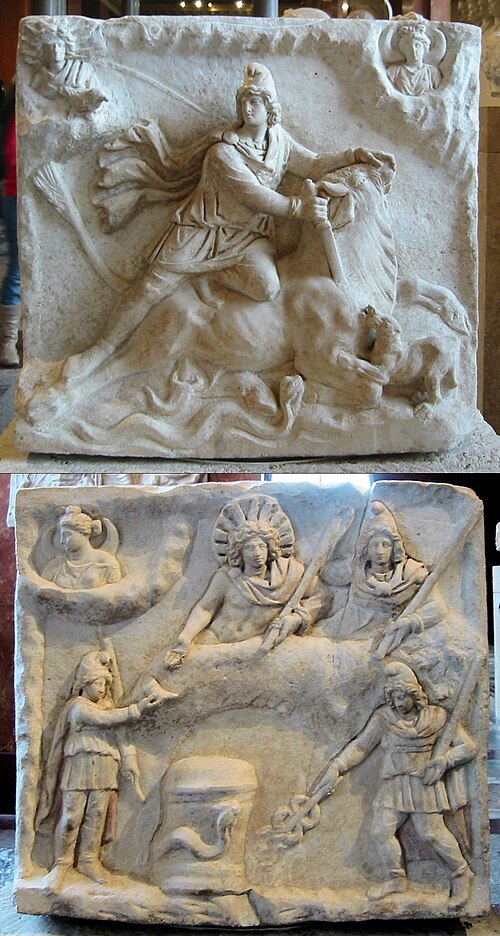
現代の歴史家は、これらの名前が同じ神を指しているかどうかについて異なる見解を持っている。ジョン・R・ヒネルズは、ミトラ/ミトラ/ミトラスを複数の異なる宗教で崇拝されている単一の神として記述している。[ 21 ]デイビッド・ウランシーは、牛殺しのミトラスは紀元前1世紀に崇拝され始めた新しい神であり、古い名前が付けられたと考えている。[ m ]
一部の描写では、中央の牡牛殺しの場面は、左、上、右に一連の補助的な場面で囲まれており、ミトラスの物語の出来事が描かれている。岩から生まれたミトラス、水の奇跡、牡牛狩りと乗馬、ひざまずくソルとの出会い、ソルとの握手、ソルと牡牛の部位の食事を共にすること、そして戦車に乗って天に昇ることなどである。[ 26 ]ローマのサンタ・プリスカ・ミトラエウムの漆喰のイコンのように、神が英雄的に裸で描かれている場合もある。[ s ]
ミトラ教の聖典や儀式の直接の記録はほとんど残っていない。[ o ]前述の誓約と教理問答、そして4世紀のエジプトのミトラ教典礼として知られる文書を除いては。この文書がミトラ教の文書であるかどうかは、フランツ・キュモンを含む学者によって疑問視されている。[ x ] [ 48 ]ミトラ教の建物の壁は一般的に白く塗られており、それが残っている場所では、落書きが大量に残っている傾向がある。そして、これらはミトラ教の記念碑の碑文とともに、ミトラ教の文書の主な情報源となっている。[ 49 ]
入口には通常ナルテックスまたは前室があり、その他にも貯蔵や食事の準備のための補助的な部屋がしばしばあります。現存するミトラエウムは、ミトラ教の聖なる空間の建築構造の実際の物理的な遺構を示しています。ミトラエウムは現代の造語であり、ミトラ教徒は聖なる建造物をスペレウムまたはアントルム(洞窟)、クリプタ(地下通路または回廊)、ファヌム(聖なる場所または神聖な場所)、あるいはテンプルム(神殿または聖なる空間)と呼んでいました。[ aa ]
背教者ユリアヌスの『カエサレス』の一節には「ミトラスの戒律」への言及がある。[ af ]テルトゥリアヌスは著書『軍冠について』の中で、軍隊のミトラス教徒は、差し出された冠を拒否するミトラス教の入信儀式に基づいて、祝祭用の冠を着用することを公式に免除されていたと記録している。なぜなら「彼らの唯一の冠はミトラスだった」からである。[ 70 ]
クリミア半島のケルチ近郊で、雄牛の上にナイフを構える人物を描いた小さなテラコッタ板5枚が発掘された。ベスコフとクラウスは紀元前1世紀後半、[ ak ]ベックは紀元前50年~紀元後50年と年代を定めている。これらがミトラス神の描写であるとすれば、最古のタウロクトニー(雄牛を屠る儀式)である可能性がある。[ al ]
牛殺しの人物像はフリギア帽をかぶっているが、ベックとベスコウによれば、それ以外は一般的な牛殺しの描写とは異なっている。これらの遺物をミトラ教の秘儀と結びつけないもう一つの理由は、これらの銘板のうち最初のものが女性の墓で発見されたことである。[ am ]
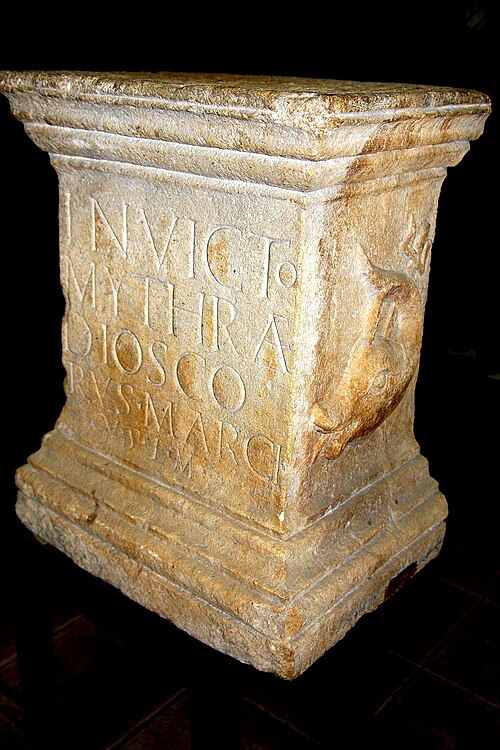
ローマのエスクイリーノ丘にあるサンティ・ピエトロ・エ・マルチェリーノ教会近くの祭壇または石板には、おそらく西暦80年から100年の間に、T.フラウィウス・ヒギヌスという名の解放奴隷の皇帝によって二言語の碑文が刻まれていた。これはソル・インヴィクトゥス・ミトラスに捧げられたものである。[ an ]
CM Daniels によると、[ 78 ]カルヌントゥム碑文はドナウ川流域で発見された最古のミトラ教の奉納碑文であり、ドナウ川流域はイタリアとともにミトラ教が最初に根付いた 2 つの地域の 1 つです。[ ao ] ローマ以外で年代が特定できる最古のミトラ教神殿は西暦 148 年に遡ります。[ ap ]カエサレア・マリティマのミトラ教神殿はパレスチナで唯一のもので、年代は推定されています。[ aq ]
歴史家ディオ・カッシウス(2世紀から3世紀)は、ネロ帝の治世中にアルメニア王ティリダテス1世がローマを公式訪問した際に、ミトラスの名が語られた経緯を記している。(ティリダテスはパルティア王ヴォノネス2世の息子で、西暦66年にネロ帝によって戴冠されたことで、パルティアとローマの戦争の終結が確定した。)ディオ・カッシウスは、ティリダテスが戴冠式に臨む際、ローマ皇帝に「ミトラスとして」彼を敬うと述べたと記している。[ 92 ]ロジャー・ベックはこの出来事が、ローマでミトラ教が民衆宗教として台頭する一因となった可能性があると考えている。[ as ]
ミトラスに関する研究は、1894年から1900年にかけてフランス語で原典テキストと記念碑の図版をまとめた2巻の著作『Textes et monuments figurés relatifs aux mystères de Mithra 』 (フランス語:ミトラスの秘儀に関するテキストと図解された記念碑)を出版したフランツ・キュモンに始まる。[ 105 ]この著作の一部を英語に翻訳したものが1903年に『The Mysteries of Mithra』というタイトルで出版された。[ 106 ]
キュモンの理論は、1971年に開催された第1回ミトラ教研究国際会議で、ジョン・R・ヒネルズとRL・ゴードンから厳しい批判を受けた。[ av ]ジョン・ヒネルズはイラン起源説を完全に否定することはしなかったが、[ 110 ]次のように書いている。「彼の再構築はもはや成り立たないと結論づけざるを得ない。イランの資料から何の裏付けも得られず、現存する文献に示されているその伝統の思想と実際には矛盾している。何よりも、それは実際のローマの図像と一致しない理論的な再構築である。」[ aw ]
考古学者ルイス・M・ホプフェは、ローマ領シリアにはミトラ教の神殿が3つしかないのに対し、西方地域にはそれよりはるかに多いことを指摘している。彼は次のように書いている。「考古学によれば、ローマのミトラ教はローマを中心地としていた…ミトラ教として知られる完全に発展した宗教はローマで始まり、兵士や商人によってシリアにもたらされたようだ。」[ az ]
At some of the mithraeums that have been found below churches, such as the Santa Prisca Mithraeum and the San Clemente Mithraeum, the ground plan of the church above was made in a way to symbolize Christianity's domination of Mithraism.[136] The cult disappeared earlier than that of Isis. Isis was still remembered in the Middle Ages as a pagan deity, but Mithras was already forgotten in late antiquity.[4](p 171)
According to Cumont, the imagery of the tauroctony was a Graeco-Roman representation of an event in Zoroastrian cosmogony described in a 9th-century Zoroastrian text, the Bundahishn. In this text the evil spirit Ahriman (not Mithra) slays the primordial creature Gavaevodata, which is represented as a bovine.[bj] Cumont held that a version of the myth must have existed in which Mithras, not Ahriman, killed the bovine. But according to Hinnells, no such variant of the myth is known, and that this is merely speculation: "In no known Iranian text [either Zoroastrian or otherwise] does Mithra slay a bull."[138](p 291)
David Ulansey finds astronomical evidence from the mithraeum itself.[139] He reminds us that the Platonic writer Porphyry wrote in the 3rdcenturyCE that the cave-like temple Mithraea depicted "an image of the world"[bk] and that Zoroaster consecrated a cave resembling the world fabricated by Mithras.[bl] The ceiling of the Caesarea Maritima Mithraeum retains traces of blue paint, which may mean the ceiling was painted to depict the sky and the stars.[141]
Beck has given the following celestial composition of the Tauroctony:[142]
Several celestial identities for the Tauroctonous Mithras (TM) himself have been proposed. Beck summarizes them in the table below.[143]
Early Christian apologists noted similarities between Mithraic and Christian rituals, but nonetheless took an extremely negative view of Mithraism: they interpreted Mithraic rituals as evil copies of Christian ones.[148][149] For instance, Tertullian wrote that as a prelude to the Mithraic initiation ceremony, the initiate was given a ritual bath and at the end of the ceremony, received a mark on the forehead. This mark on the forehead may have likely been the Latin letter, "M", which stood for the name of their messianic god-king Mithras. Tertullian also described these rites as a diabolical counterfeit of the baptism and chrismation of Christians.[150]Justin Martyr contrasted Mithraic initiation communion with the Eucharist:[151]
Wherefore also the evil demons in mimicry have handed down that the same thing should be done in the Mysteries of Mithras. For that bread and a cup of water are in these mysteries set before the initiate with certain speeches you either know or can learn.[152]
Ernest Renan suggested in 1882 that, under different circumstances, Mithraism might have risen to the prominence of modern-day Christianity. Renan wrote: "If the growth of Christianity had been arrested by some mortal malady, the world would have been Mithraic".[153][bn] This theory has since been contested. Leonard Boyle wrote in 1987 that "too much ... has been made of the 'threat' of Mithraism to Christianity",[155] pointing out that there are only fifty known mithraea in the entire city of Rome. J.A.Ezquerra holds that since the two religions did not share similar aims, there was never any real threat of Mithraism taking over the Roman world.[bo] Mithraism had backing from the Roman aristocracy during a time when their conservative values were seen as under attack during the rising tides of Christianity.[157]
↑ "After this, Celsus, desiring to exhibit his learning in his treatise against us, quotes also certain Persian mysteries, where he says: 'These things are obscurely hinted at in the accounts of the Persians, and especially in the mysteries of Mithras, which are celebrated among them...'"Chapter24: "After the instance borrowed from the Mithraic mysteries, Celsus declares that he who would investigate the Christian mysteries, along with the aforesaid Persian, will, on comparing the two together, and on unveiling the rites of the Christians, see in this way the difference between them".[10]
↑ "For most of the twentieth century, the major problem addressed by scholarship on both Roman Mithraism and the Iranian god Mithra was the question of continuity."[1]
↑ It is therefore highly likely that it was in the context of Mithridates' alliance with the Cilician pirates that there arose the synchretistic link between Perseus and Mithra which led to the name Mithras (a Greek form of the name Mithra) being given to the god of the new cult. — D. Ulansey (1991)[9](p 90)
↑ ...Mithra is the next most important deity and may even have occupied a position of near equality with Ahura Mazde. He was associated with the Sun, and in time the name Mithra became a common word for "Sun". Mithra functioned preeminently in the ethical sphere; he was the god of the covenant, who oversaw all solemn agreements that people made among themselves ... In later times Mithra gave his name to Mithraism, a mystery religion.[12]
↑ Cumont's ... argument was straightforward and may be summarized succinctly: The name of the god of the cult, Mithras, is the Latin (and Greek) form of the name of an ancient Iranian god, Mithra; in addition, the Romans believed that their cult was connected with Persia (as the Romans called Iran); therefore we may assume that Roman Mithraism is nothing other than the Iranian cult of Mithra transplanted into the Roman Empire. — D. Ulansey (1991)[9](p 8)
↑ Quoting from Gordon:[14](p 160) "The usual western nominative form of Mithras' name in the mysteries ended in -s, as we can see from the one authentic dedication in the nominative, recut over a dedication to Sarapis (463, Terme de Caracalla), and from occasional grammatical errors such as deo inviato Metras (1443). But it is probable that Euboulus and Pallas, at least, used the name 'Mithra' as an indeclinable [foreign word] (ap. Porphyry, De abstinentia II.56 and IV.16)."[14]
↑ India's sacred literature refers to him since the hymns of the Rig Veda. But it was in Iran where Mithras rose to the greatest prominence: Rebounding after the reforms of Zarathustra, Mithras became one of the great gods of the Achaemenian emperors and to this very day he is worshipped in India and Iran by Parsees and Zarathustrians.[16]
↑ The name Mithras comes from a root mei- (which implies the idea of exchange), accompanied by an instrumental suffix. It was therefore a means of exchange, the 'contract' which rules human relations and is the basis of social life. In Sanskrit, mitra means 'friend' or 'friendship', like mihr in Persian. In Zend, mithra means precisely the 'contract', which eventually became deified, following the same procedure as Venus, the 'charm' for the Romans. We find him invoked with Varuna in an agreement concluded circa
↑ ... the intimate alliance between the pirates and Mithridates Eupator, named after Mithra and mythically descended from Perseus, led to the pirates adopting the name Mithras for the new god. — D. Ulansey (1991)[9](p 94)
↑ "The theory that the complex iconography of the characteristic monuments (of which the oldest belong to the second century A.C.) could be interpreted by direct reference to Iranian religion is now widely rejected; and recent studies have tended greatly to reduce what appears to be the actual Iranian content of this "self consciously 'Persian' religion", at least in the form which it attained under the Roman empire. Nevertheless, as the name Mithras alone shows, this content was of some importance; and the Persian affiliation of the Mysteries is acknowledged in the earliest literary reference to them.[22]
12 ... we possess virtually no theological statements either by Mithraists themselves or by other writers. — Clauss (2000)[4](p xxi)
↑English tauroctony is an adaption of the Greek word tauroktónos (ταυροκτόνος, "bull killing").
↑ "Although the iconography of the cult varied a great deal from temple to temple, there is one element of the cult's iconography which was present in essentially the same form in every mithraeum and which, moreover, was clearly of the utmost importance to the cult's ideology; namely the so-called tauroctony, or bull-slaying scene, in which the god Mithras, accompanied by a series of other figures, is depicted in the act of killing the bull." — D. Ulansey (1991)[9](p 6)
↑"The god's right leg, appearing on the left as one faces the tauroctony, is nearly always straight as it pins the bull's hoof to the ground, while his left leg, which is usually resting on the back or flank of the bull, is bent at the knee with his foot often partially obscured beneath the folds of his tunic. Anyone familiar with the cult's iconography will immediately recognize this awkward and possibly unnatural posture as a typical or even essential aspect of the tauroctony. The remarkable consistency of this particular feature is underscored by comparison with the subtle variability of others..." — Z. Mazur (c.2011)[23]
↑The figure of Mithras himself is usually attired in an oriental costume of Phrygian cap, tunica manicata (a long-sleeved tunic), anaxyrides (eastern style trousers), and a cape, though in some cases, he is depicted heroically nude or even, in a unique example from Ostia, in what seems to be a Greek chiton. Like the general trend in Graeco-Roman art, most if not all tauroctony scenes, regardless of the medium they were executed in, were painted, and the different items of Mithras' clothing was usually colored in either blue or red, often, as in the painting at Marino, with most of the costume in red with only the inside of the cape being blue and star-speckled. The bull was often white, sometimes wearing the dorsuale, the Roman sacrificial band in reds or browns, while the torchbearers could be depicted in a variety of colors with reds and greens being the most common. — Bjørnebye (2007).[27]:chapter: The Mithraic icon in fourth century Rome: The composition of the Mithraic cult icon
↑ The discovery of a large quantity of tableware as well as animal remains in a pit outside the newly excavated mithraeum at Tienen, Belgium, has also attracted new attention to the topic of Mithraic processions and large-scale feasts, begging a re-examination of the secrecy of the cult and its visibility in local society ... provides evidence for large-scale, semi-public feasts outside of the mithraeum itself, suggesting that each mithraeum might have had a far larger following than its relative size would imply. — Bjørnebye (2007).[27](pp 12,36)
↑The extant mithraea present us with actual physical remains of the architectural structures of the sacred spaces of the Mithraic cult. While the Mithraists themselves never used the word mithraeum as far as we know, but preferred words like speleum or antrum (cave), crypta (underground hallway or corridor), fanum (sacred or holy place), or even templum (a temple or a sacred space), the word mithraeum is the common appellation in Mithraic scholarship and is used throughout this study. — Bjørnebye (2007).[27]:chapter: The mithraea as buildings
↑ Whilst the majority of the Oriental cults accorded to women a considerable role in their churches, and sometimes even a preponderating one, finding in them ardent supporters of the faith, Mithra forbade their participation in his Mysteries and so deprived himself of the incalculable assistance of these propagandists. The rude discipline of the order did not permit them to take the degrees in the sacred cohorts, and, as among the Mazdeans of the Orient, they occupied only a secondary place in the society of the faithful. Among the hundreds of inscriptions that have come down to us, not one mentions either a priestess, a woman initiate, or even a donatress.[67]
↑ ... Moreover, not a single woman is listed: The repeated attempts to show that women might belong to the cult are wishful thinking (Piccottini, 1994).[68]
↑ Porphyry moreover seems to be the only writer who makes reference to women initiates into the service and rites of Mithra, and his allusion is perhaps due to a misunderstanding.... The participation of women in the ritual was not unknown in the Eastern cults, but the predominant military influence in Mithraism seems to render it unlikely in this instance.[2]
↑ "Justin's charge does at least make clear that Mithraic commandments did exist."[4](pp 144–145)
↑ "Traditionally there are two geographical regions where Mithraism first struck root in the Roman empire: Italy and the Danube. Italy I propose to omit, as the subject needs considerable discussion, and the introduction of the cult there, as witnessed by its early dedicators, seems not to have been military. Before we turn to the Danube, however, there is one early event (rather than geographical location) which should perhaps be mentioned briefly in passing. This is the supposed arrival of the cult in Italy as a result of Pompey the Great's defeat of the Cilician pirates, who practised 'strange sacrifices of their own ... and celebrated certain secret rites, amongst which those of Mithra continue to the present time, having been first instituted by them'.
Suffice it to say that there is neither archaeological nor allied evidence for the arrival of Mithraism in the West at that time, nor is there any ancient literary reference, either contemporary or later. If anything, Plutarch's mention carefully omits making the point that the cult was introduced into Italy at that time or by the pirates."[78](p 250)
↑ "Another possible piece of evidence is offered by five terracotta plaques with a tauroctone, found in Crimea and taken into the records of Mithraic monuments by Cumont and Vermaseren. If they are Mithraic, they are certainly the oldest known representations of Mithras tauroctone; the somewhat varying dates given by Russian archaeologists will set the beginning of the 1stcenturyCE as a terminus ad quem, which is also said to have been confirmed by the stratigraphic conditions."[81](p 14)
Note20 cites the book as Blawatsky & Kolchelenko (1966).[82]
↑...the area [the Crimea] is of interest mainly because of the terracotta plaques from Kerch (five, of which two are in CIMRM[35] as numbers11 and 12): These show a bull-killing figure and their probable date (second half of 1stcenturyBCE to first half of 1stcenturyCE) would make them the earliest tauroctonies – if it is Mithras that they portray. Their iconography is significantly different from that of the standard tauroctony (e.g. in the Attis-like exposure of the god's genitals).[83]
↑ "The plaques are typical Bosporan terracottas ... At the same time it must be admitted that the plaques have some strange features which make it debatable if this is really Mithra(s). Most striking is the fact that his genitals are visible as they are in the iconography of Attis, which is accentuated by a high anaxyrides. Instead of the tunic and flowing cloak he wears a kind of jacket, buttoned over the breast with only one button, perhaps the attempt of a not so skillful artist to depict a cloak. The bull is small and has a hump and the tauroctone does not plunge his knife into the flank of the bull but holds it lifted. The nudity gives it the character of a fertility god and if we want to connect it directly with the Mithraic mysteries it is indeed embarrassing that the first one of these plaques was found in a woman's tomb."[81](p 15)
"He is grasping one of the bull's horns with his left hand, and wrenching back its head; the right arm is raised to deliver the death-blow. So far, this god must be Mithras. But in sharp contrast with the usual representations [of Mithras], he is dressed in a jacket-like garment, fastened at the chest with a brooch, which leaves his genitals exposed – the iconography typical of Attis."[4](p 156)
↑ CIMRM[35]362 a, b = el l, VI 732 = Moretti, lGURI 179:
Soli | Invicto Mithrae | T . Flavius Aug. lib. Hyginus | Ephebianus | d.d."
but the Greek title is just "Helioi Mithrai" (ʽΗλιωι Μιθραι). The name "Flavius" for an imperial freedman dates it between 70–136CE. The Greek section refers to a pater of the cult named Lollius Rufus, evidence of the existence of the rank system at this early date.[14]
↑ "I sometimes permit myself to say that, if Christianity had not carried the day, Mithraicism would have become the religion of the world. It had its mysterious meetings: its chapels, which bore a strong resemblance to little churches. It forged a very lasting bond of brotherhood between its initiates: it had a Eucharist, a Supper..." — Renan (2004)[154]
↑ "Many people have erroneously supposed that all religions have a sort of universalist tendency or ambition. In the case of Mithraism, such an ambition has often been taken for granted and linked to a no less questionable assumption, that there was a rivalry between Mithras and Christ for imperial favour. ... If Christianity had failed, the Roman empire would never have become Mithraist."[156]
↑ "Mithraism proselytized energetically to the west, and for a time presented a formidable challenge to Christianity; but it is not yet known how far, or how effectively, it penetrated eastward. A Mithraeum has been uncovered at the Parthian fortress-town of Dura-Europos on the Euphrates; but Zoroastrianism itself may well have been a barrier to its spread into Iran proper."[158]
↑ A useful topographic survey, with map, by F.Coarelli (1979) lists 40actual or possible mithraea (the latter inferred from find-spots, with the sensible proviso that a mithraeum will not necessarily correspond to every find). Principally from comparisons of size and population with Ostia, Coarelli calculates that there will have been in Rome "not less than 680–690" mithraea in all ....[8]
↑ Today more than four hundred locations of Mithraic worship have been identified in every area of the Roman Empire. Mithraea have been found as far west as Britain and as far east as Dura-Europas. Between the second and fourth centuries C.E. Mithraism may have vied with Christianity for domination of the Roman world.[5](p 147)
12... the study of Mithraism is also of great important for our understanding of what Arnold Toynbee has called the 'Crucible of Christianity', the cultural matrix in which the Christian religion came to birth out of the civilization of the ancient Mediterranean. For Mithraism was one of Christianity's major competitors in the Roman Empire ... No doubt Renan's statement is somewhat exaggerated. — D. Ulansey (1991)[9](pp 3–4)
1 2 3コアレリ、フィリッポ。ベック、ロジャー。ヴォルフガング・ハーセ (1984)。Aufstieg und niedergang der römischen welt [ローマ世界の興亡] (ドイツ語)。ウォルター・デ・グルイテル。 p. 202以降ISBN978-3-11-010213-02011年3月20日に取得。
↑クセノフォン。『キュロスの教育』7.5.53。Liddell, Henry George; Scott, Robert (編) 『Μίθρας』ギリシャ語-英語辞典、タフツ大学、2023年1月24日時点のオリジナルよりアーカイブ済み 、2023年1月24日取得– perseus.tufts.edu経由。
↑ Thieme, Paul (1960 年 10 月〜 12 月). 「ミタンニ条約の『アーリア人』の神々」. Journal of the American Oriental Society . 80 (4): 301– 317. doi : 10.2307/595878 . JSTOR 595878 .
↑ヒンネルズ、ジョン R. (1990). 「序論:問われた質問と問われるべき質問」。ヒンネルズ、ジョン R. (編) 『ミトラ教研究』所収。ローマ:L'Erma di Bretschneider。p. 11。この神は、ヒンドゥー教(ミトラとして)、イランのゾロアスター教とマニ教(ミトラとして)、ローマ帝国(ミトラスとして)の4 つの異なる宗教で崇拝されている点で独特である。
↑ Hinnells, JR (1976). 「カウテスとカウトパテスの図像:データ」ミトラ教研究ジャーナル1 : 36–67 .See alsoMalandra, William W. "Cautes and Cautopates". Encyclopædia Iranica.
123Griffith, Alison (1996). "Mithraism". L'Ecole Initiative. Archived from the original on 27 April 2004. Retrieved 2 April 2004.
1234Bjørnebye, Jonas (2007). Hic locus est felix, sanctus, piusque benignus: The cult of Mithras in fourth century Rome (PhD thesis).
↑Klauck, Hans-Josef; McNeil, Brian (December 2003). The Religious Context of Early Christianity: A guide to Graeco-Roman religions. T & T Clark Ltd. pp.146ff. ISBN978-0-567-08943-4. Retrieved 4 September 2011.
↑Beck, Roger (2006). The Religion of the Mithras Cult in the Roman Empire. Oxford, UK: Oxford University Press. p.21. ISBN978-0-19-814089-4. Often, the mithraeum was embellished elsewhere with secondary exemplars of the tauroctony, and there also seem to have been small portable versions, perhaps for private devotion.
12345678Beck, Roger (2004). "In the place of the lion: Mithras in the tauroctony". Beck on Mithraism: Collected works with new essays. Ashgate Publishing. pp.270–276. ISBN978-0-7546-4081-3. Archived from the original on 14 April 2023. Retrieved 23 February 2023.
12Beck, Roger (2007). The Religion of the Mithras Cult in the Roman Empire. London, UK: Oxford University Press. pp.27-28. ISBN978-0-19-921613-0.
1234Vermaseren, M.J. (1951). "The miraculous birth of Mithras". In Gerevich, László (ed.). Studia Archaeologica. Brill. pp.93–109. Retrieved 4 October 2011.
↑Vermaseren, M.J. (1951). Gerevich, László (ed.). Studia Archaeologica. Brill. p.108. Retrieved 4 October 2011.
↑Commodian. Instructiones. 1.13. The unconquered one was born from a rock, if he is regarded as a god.See also the image of "Mithras petra genetrix Terme", inset above.
↑ Jackson, Howard M. (1985年7月). 「ローマのミトラ教におけるレオントケファリンの意味と機能」. Numen . 32 (1): 17–45 . doi : 10.1163/156852785X00148 . S2CID 144419653 .
1 2 3 Barnett, RD (1975). "[タイトルなし]". In Hinnells, John R. (編). Mithraic Studies . International Congress of Mithraic Studies. Vol. II. Manchester, UK: Manchester University Press. pp. 467–468 .
1 2ベック、ロジャー・B. (2004). 「キュモンのマスターナラティブ」 .ベックのミトラ教論:新エッセイを含む著作集. オールダーショット:アシュゲート. p. 28. ISBN0-7546-4081-72023年5月4日にオリジナルからアーカイブされました。2023年2月23日に取得。
↑フェルマセレン、マールテン・ジョゼフ。ファン・エッセン、カレル・クラウディウス(1965年)。ローマのサンタ・プリスカ教会のミトラエウムでの発掘。ブリル。 p. 238 . 2011 年4 月 3 日に取得。
↑ Healy, Patrick J. 編 (1909). "Firmicus Maternus" . Catholic Encyclopedia . New York, NY: Robert Appleton Company. 2017年7月2日にオリジナルからアーカイブ済み。2011年4月8日にnewadvent.org経由で取得。
↑ Beck, Roger (2000). "ミトラスの秘儀における儀式、神話、教義、入信:カルト容器からの新たな証拠". The Journal of Roman Studies . 90 (90): 145– 180. doi : 10.2307/300205 . JSTOR 300205 . S2CID 161475387 .
↑Martin, Luther H. (2004). "Ritual competence and Mithraic ritual". In Wilson, Brian C. (ed.). Religion as a Human Capacity: A festschrift in honor of E.Thomas Lawson. BRILL. p.257.
↑Cumont, Franz (1903). The Mysteries of Mithras. p.173. Retrieved 6 July 2011.
↑cited in Gordon, Richard (2005). "Mithraism". In Jones, Lindsay (ed.). Encyclopedia Of Religion. Vol.9 (2nded.). Thomas Gale, Macmillan Reference USA. p.6090.
↑David, Jonathan (2000). "The Exclusion of women in the Mithraic Mysteries: Ancient or modern?". Numen. 47 (2): 121–141. doi:10.1163/156852700511469.
123Grenet, Franz (2016). "Mithra: ii. Iconography in Iran and Central Asia". Encyclopædia Iranica (onlineed.). Retrieved 19 May 2016.
↑Vermaseren, M.J. (1963). Mithras: the Secret God. London, UK: Chatto and Windus. p.29.
↑Vermaseren, M.J. (1956). Corpus inscriptionum et monumentorum religionis mithriacae. The Hague: Martinus Nijhoff. CIMRM29. Head of a beardless Mithras in Phrygian cap, point of which is missing.
↑Vermaseren, M.J. (1956). Corpus inscriptionum et monumentorum religionis mithriacae. The Hague: Martinus Nijhoff. CIMRM 28. The gods are represented in a sitting position on a throne and are: Apollo-Mithras (see below); Tyche-Commagene; Zeus-Ahura-Mazda; Antiochus himself and finally Ares-Artagnes.
↑Vermaseren, M.J. (1956). Corpus inscriptionum et monumentorum religionis mithriacae. The Hague: Martinus Nijhoff. CIMRM32, verse55.
↑Beck, Roger. "On Becoming a Mithraist New Evidence for the Propagation of the Mysteries". In Leif E. Vaage; etal. (eds.). Religious Rivalries in the Early Roman Empire and the Rise of Christianity. p.182. The origins and spread of the Mysteries are matters of perennial debate among scholars of the cult.
↑ブラワツキー、W.コルチェレンコ、G. (1966)。メル ノワールの専門家ミトラのカルト。ライデン。 p. 14以降。{{cite book}}: CS1メンテナンス: 場所の発行元が見つかりません (リンク)
↑ベック、ロジャー (1984)。「フランツ・キュモン以来のミトラ教」。Aufsteig und Niedergang der romischen Welt [ローマ世界の上昇と下降]。宗教ハイデントゥム: Römische Götterkulte、Orientalische Kulte in der Römischen Welt。 Vol. II. p. 2019.4.17 2023年4月14日のオリジナルからアーカイブ。2022 年8 月 6 日に取得- Google ブックス経由。
1 2ホップフェ、ルイス M. (1994). 「ローマのミトラ教の起源に関する考古学的証拠」。ホップフェ、ルイス M. (編) 『古代の石の発掘:H. ニール リチャードソンを偲ぶエッセイ』。アイゼンブラウンズ。pp. 147–158。
↑ローブ、D. マギー (1932)。Scriptores Historiae Augustae: Commodus。pp. IX.6: Sacra Mithriaca homicidio vero poluit,cum imlic aliquid ad speciem timoris vel dici vel fingi soleat「彼はミトラ教の儀式を実際の殺人で冒涜した。ただし、ミトラ教では単に恐怖の印象を与えるようなことを言ったりふりをしたりするのが慣習であった。」
↑ Vermaseren, MJ (1965). The Excavations in the Mithraeum of the Church of Santa Pricsa in Rome . Brill. p. 115. 2011年4月3日取得。平面図は、教会の内陣がミトラ教神殿の前室Vの上にあり、後陣がカウテスとカウトパテスの壁龕を含む主ホールWの最初の部分を覆っていることを明確に示している。キリストがミトラ教を「支配下」に置いていることを具体的に表現したこの配置の象徴性は、見過ごすことはできない。同じことはサン・クレメンテ教会にも当てはまる。
↑ Legge, Francis (1950). Forerunners and Rivals of Christianity: Being studies in religious history from 330 B.C. – 330 A.D. 2011年4月12日取得。
↑レナン、E. (1882)。Marc-Aurele et la fin du monde Antique [マルクス・アウレリウスとアンティーク世界の終わり] (フランス語)。フランス、パリ。 p. 579 .危険な状況に直面して、キリスト教徒は、病気の死、ミトリアスのクロワッサンスを食べます。{{cite book}}: CS1メンテナンス: 場所の発行元が見つかりません (リンク)
↑ Ezquerra, JA (2008). Romanising Oriental Gods: Myth, salvation and ethics in the cults of Cybele, Isis and Mithras . Translated by Gordon, R. Brill. pp. 202–203 . ISBN978-90041329312023年5月4日にオリジナルからアーカイブされました。2023年2月23日にGoogleブックス経由で取得しました。
↑ボイス、メアリー (2001) [1979].ゾロアスター教徒:その宗教的信念と慣習. ラウトレッジ. p. 99. ISBN978-0-415-23902-82011年3月17日に取得。
↑ Vermaseren, MJ (1965). The Excavations in the Mithraeum of the Church of Santa Pricsa in Rome . Brill. p. 9. 2011年9月4日取得。このミトラ教神殿は1934年に発見された…彼らはキリスト教の最も恐るべき敵対者の1人の聖域を発見した。
クラウス、マンフレッド (1992)。カルトレス・ミトラエ。 Die Anhängerschaft des Mithras-Kultes [ミトラ教会。ミトラ教の信者]。ハイデルベルクのアルティストリッシェ・ベイトラーゲと碑文研究院、vol. 10. シュトゥットガルト: シュタイナー、ISBN3-515-06128-2。
フランツ・キュモント(1894–1896)。ミステール・ド・ミスラ関連のテキストと記念碑:パブ。 avec une の紹介批評– Archive.org 経由。2巻で出版されており、まだ価値があります。1は紹介文です。 Vol. 2は一次データの集合です。
Kaper、Olaf E.、「Mithras im ptolemäischen Ägypten」、Peter C. Bol、Gabriele Kaminski、Caterina Maderna (編)、Fremdheit-Eigenheit: Ägypten、Griechenland und Rom : Austausch und Verständnis (2004)。プレステル。
イスラエル、メンデス、カンポス。「Elementos de continuidad entre elculto del dios Mithra en Oriente y Occidente 」 [東と西のミトラ神崇拝の間の連続性の要素]。2020年10月4日のオリジナルからアーカイブ。2011 年6 月 11 日に取得- Google 翻訳経由。