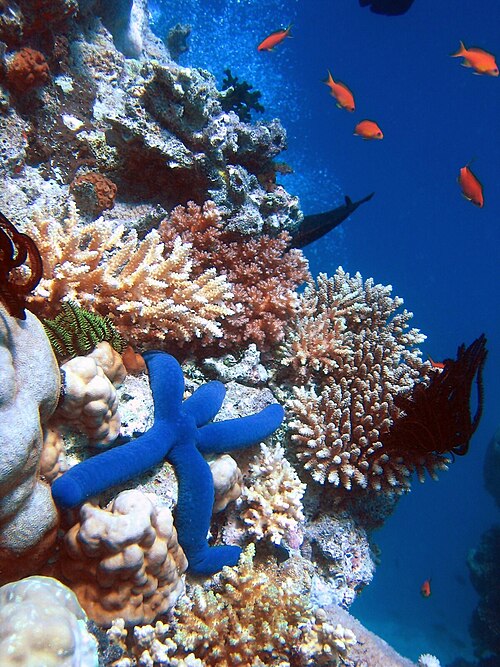
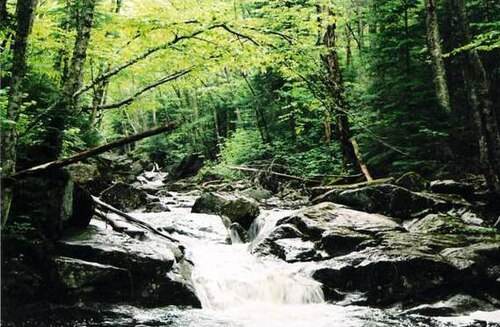
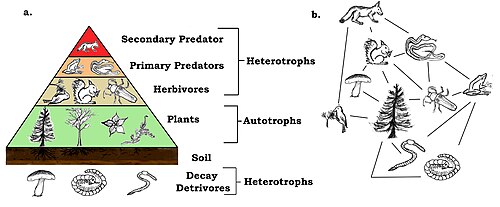
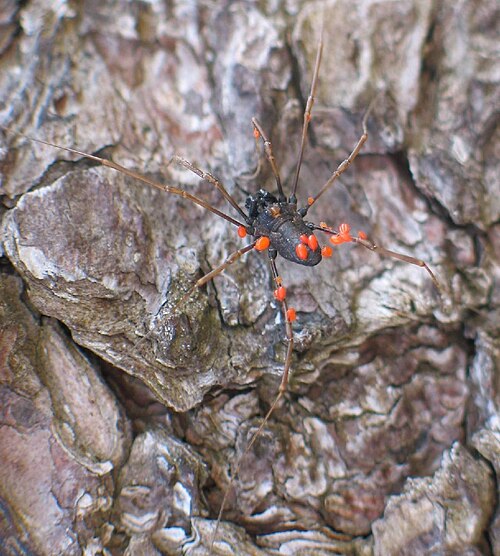
Complexity is understood as a large computational effort needed to assemble numerous interacting parts. Global patterns of biological diversity are complex. This biocomplexity stems from the interplay among ecological processes that influence patterns at different scales, such as transitional areas or ecotones spanning landscapes. Complexity stems from the interplay among levels of biological organization as energy, and matter is integrated into larger units that superimpose onto the smaller parts.[76]:209 Small scale patterns do not necessarily explain larger ones, as in Aristotle's expression "the sum is greater than the parts".[77][78][E] "Complexity in ecology is of at least six distinct types: spatial, temporal, structural, process, behavioral, and geometric."[79]:3 From these principles, ecologists have identified emergent and self-organizing phenomena that operate at different environmental scales of influence, ranging from molecular to planetary, and these require different explanations at each integrative level.[38][80]
Holism
Holism is a critical part of the theory of ecology. Holism addresses the biological organization of life that self-organizes into layers of emergent whole systems that function according to non-reducible properties. This means that higher-order patterns of a whole functional system, such as an ecosystem, cannot be predicted or understood by a simple summation of the parts.[81] "New properties emerge because the components interact, not because the basic nature of the components is changed."[39]:8
これは、ヘッケルのオリジナルの定義のコピーです (原文: Haeckel, E. (1866) Generelle Morphologie der Organismen. Allgemeine Grundzige derorganischen Formen- Wissenschaft, mechanisch begriindet durch die von Charles Darwin Reformirte Descendenz-Theorie. 2 vols. Reimer, Berlin.) を翻訳し、Stauffer より引用しました。 (1957年)。
↑ Liere, Heidi; Jackson, Doug; Vandermeer, John; Wilby, Andrew (20 September 2012). "コーヒー栽培生態系における生態学的複雑性:空間的不均一性、個体群の持続性、および生物的防除" . PLOS ONE . 7 (9) e45508. Bibcode : 2012PLoSO...745508L . doi : 10.1371/journal.pone.0045508 . PMC 3447771 . PMID 23029061 .
↑ Steward TA Pickett; Jurek Kolasa; Clive G. Jones (1994). Ecological Understanding: The Nature of Theory and the Theory of Nature . San Diego: Academic Press. ISBN978-0-12-554720-8。
↑ Nachtomy, Ohad; Shavit, Ayelet; Smith, Justin (2002). "ライプニッツ的生物、入れ子構造の個体、および選択の単位". Theory in Biosciences . 121 (2): 205– 230. doi : 10.1007/s12064-002-0020-9 . S2CID 23760946 .
↑ Tierney, Geraldine L.; Faber-Langendoen, Don; Mitchell, Brian R.; Shriver, W. Gregory; Gibbs, James P. (2009). "森林生態系の生態学的健全性のモニタリングと評価" (PDF) . Frontiers in Ecology and the Environment . 7 (6): 308– 316. Bibcode : 2009FrEE....7..308T . doi : 10.1890/070176 . 2010年12月29日にオリジナル(PDF)からアーカイブ済み。 2010年2月1日に取得。
↑ Qiu, J. & Mitchell, M. (2024).実際の景観における生物多様性と生態系サービスの関連性の理解。景観生態学、39、188。https ://doi.org/10.1007/s10980-024-01980-3
↑ Ceballos, G.; Ehrlich, PR (2002). "Mammal population losses and the extinction crisis" (PDF) . Science . 296 (5569): 904– 907. Bibcode : 2002Sci...296..904C . doi : 10.1126/science.1069349 . PMID 11988573 . S2CID 32115412 . 2011年7月20日にオリジナル(PDF)からアーカイブ済み。 2010年3月16日に取得。
↑ Palumbi, Stephen R. ; Sandifer, Paul A.; Allan, J. David; Beck, Michael W.; Fautin, Daphne G.; Fogarty, Michael J.; Halpern, Benjamin S.; Incze, Lewis S.; Leong, Jo-Ann; et al. (2009). "海洋生態系サービスを持続させるための海洋生物多様性の管理" (PDF) . Frontiers in Ecology and the Environment . 7 (4): 204– 211. Bibcode : 2009FrEE....7..204P . doi : 10.1890/070135 . hdl : 1808/13308 . 2010年6月11日にオリジナル(PDF)からアーカイブ済み。
↑ Wilcove , DS; Wikelski, M. (2008). "Going, going, gone: Is animal migration disappearing" . PLOS Biology . 6 (7) e188. doi : 10.1371/journal.pbio.0060188 . PMC 2486312. PMID 18666834 .
1 2ハモンド、 H. (2009).地球の冠における生態系全体の維持:北方林のための生態系に基づく保全計画。スロカンパーク、ブリティッシュコロンビア州:シルバ森林財団。p. 380。ISBN978-0-9734779-0-02009年12月5日にオリジナルからアーカイブされました。 2010年1月31日に取得。
↑ Whittaker, RH; Levin, SA; Root, RB (1973). "Niche, habitat, and ecotope" (PDF) . The American Naturalist . 107 (955): 321– 338. Bibcode : 1973ANat..107..321W . doi : 10.1086/282837 . S2CID 84504783 . 2012年9月5日にオリジナル(PDF)からアーカイブ済み。
↑ Beyer, Hawthorne L.; Haydon, Daniel T.; Morales, Juan M.; Frair, Jacqueline L.; Hebblewhite, Mark; Mitchell, Michael; Matthiopoulos, Jason (2010). "The interpretation of habitat preference metrics under use–availability designs" . Philosophical Transactions of the Royal Society B. 365 ( 1550): 2245–2254 . doi : 10.1098/rstb.2010.0083 . PMC 2894962. PMID 20566501 .
↑ Laland, KN; Odling-Smee, FJ; Feldman, MW (1999). "ニッチ構築の進化的帰結と生態学への影響" . Proceedings of the National Academy of Sciences . 96 (18): 10242– 10247. Bibcode : 1999PNAS ... 9610242L . doi : 10.1073/pnas.96.18.10242 . PMC 17873. PMID 10468593 .
↑Hastings, Alan; Byers, James E.; Crooks, Jeffrey A.; Cuddington, Kim; Jones, Clive G.; Lambrinos, John G.; Talley, Theresa S.; Wilson, William G. (2007). "Ecosystem engineering in space and time". Ecology Letters. 10 (2): 153–164. Bibcode:2007EcolL..10..153H. doi:10.1111/j.1461-0248.2006.00997.x. PMID17257103. S2CID44870405.
↑Jones, Clive G.; Lawton, John H.; Shachak, Moshe (1994). "Organisms as ecosystem engineers". Oikos. 69 (3): 373–386. Bibcode:1994Oikos..69..373J. doi:10.2307/3545850. JSTOR3545850.
↑Palmer, M.; White, P. S. (1994). "On the existence of ecological communities"(PDF). Journal of Vegetation Sciences. 5 (2): 279–282. Bibcode:1994JVegS...5..279P. doi:10.2307/3236162. JSTOR3236162. Archived from the original(PDF) on 5 September 2012.
↑Prentice; I. C.; Harrison, S. P.; Leemans, R.; Monserud, R. A.; Solomon, A. M. (1992). "Special paper: A global biome model based on plant physiology and dominance, soil properties and climate"(PDF). Journal of Biogeography. 19 (2): 117–134. Bibcode:1992JBiog..19..117P. doi:10.2307/2845499. JSTOR2845499. Archived(PDF) from the original on 20 December 2022. Retrieved 11 December 2022.
↑Turnbaugh, Peter J.; Ley, Ruth E.; Hamady, Micah; Fraser-Liggett, Claire M.; Knight, Rob; Gordon, Jeffrey I. (2007). "The human microbiome project". Nature. 449 (7164): 804–810. Bibcode:2007Natur.449..804T. doi:10.1038/nature06244. PMC3709439. PMID17943116.
↑DeLong, E. F. (2009). "The microbial ocean from genomes to biomes"(PDF). Nature. 459 (7244): 200–206. Bibcode:2009Natur.459..200D. doi:10.1038/nature08059. hdl:1721.1/69838. PMID19444206. S2CID205216984. Archived from the original(PDF) on 18 July 2011. Retrieved 14 January 2010.
↑Igamberdiev, Abir U.; Lea, P. J. (2006). "Land plants equilibrate O2 and CO2 concentrations in the atmosphere"(PDF). Photosynthesis Research. 87 (2): 177–194. Bibcode:2006PhoRe..87..177I. doi:10.1007/s11120-005-8388-2. PMID16432665. S2CID10709679. Archived from the original(PDF) on 3 March 2016.
↑Lovelock, J.E.; Margulis, L. (1974). "Atmospheric homeostasis by and for the biosphere: the gaia hypothesis". Tellus A. 26 (1–2): 2–10. Bibcode:1974Tell...26....2L. doi:10.3402/tellusa.v26i1-2.9731. S2CID129803613.
123Lovelock, J. (2003). "The living Earth". Nature. 426 (6968): 769–770. Bibcode:2003Natur.426..769L. doi:10.1038/426769a. PMID14685210. S2CID30308855.
12345678Odum, E. P.; Barrett, G. W. (2005). Fundamentals of Ecology. Brooks Cole. p.598. ISBN978-0-534-42066-6. Archived from the original on 28 July 2020. Retrieved 6 January 2020.
↑Waples, R. S.; Gaggiotti, O. (2006). "What is a population? An empirical evaluation of some genetic methods for identifying the number of gene pools and their degree of connectivity". Molecular Ecology. 15 (6): 1419–1439. doi:10.1111/j.1365-294X.2006.02890.x. PMID16629801. S2CID9715923. Archived from the original on 25 October 2019. Retrieved 10 August 2019.
123Turchin, P. (2001). "Does population ecology have general laws?". Oikos. 94 (1): 17–26. Bibcode:2001Oikos..94...17T. doi:10.1034/j.1600-0706.2001.11310.x. S2CID27090414.
12Vandermeer, J. H.; Goldberg, D. E. (2003). Population Ecology: First Principles. Woodstock, Oxfordshire: Princeton University Press. ISBN0-691-11440-4.
↑Berryman, A. A. (1992). "The origins and evolution of predator-prey theory". Ecology. 73 (5): 1530–1535. Bibcode:1992Ecol...73.1530B. doi:10.2307/1940005. JSTOR1940005. S2CID84321947.
↑Anderson, D. R.; Burnham, K. P.; Thompson, W. L. (2000). "Null hypotheses testing: Problems, prevalence, and an alternative"(PDF). J. Wildl. Manage. 64 (4): 912–923. doi:10.2307/3803199. JSTOR3803199. Archived from the original(PDF) on 2 June 2013. Retrieved 4 August 2012.
↑Johnson, J. B.; Omland, K. S. (2004). "Model selection in ecology and evolution"(PDF). Trends in Ecology and Evolution. 19 (2): 101–108. CiteSeerX10.1.1.401.777. doi:10.1016/j.tree.2003.10.013. PMID16701236. Archived(PDF) from the original on 14 October 2012.
↑Levins, R. (1969). "Some demographic and genetic consequences of environmental heterogeneity for biological control". Bulletin of the Entomological Society of America. 15 (3): 237–240. doi:10.1093/besa/15.3.237. Archived from the original on 8 April 2022. Retrieved 19 November 2020.
↑Levins, R. (1970). "Extinction". In Gerstenhaber, M. (ed.). Some Mathematical Questions in Biology. American Mathematical Soc. pp.77–107. ISBN978-0-8218-1152-8. Archived from the original on 18 March 2015. Retrieved 27 June 2015.
↑Smith, M. A.; Green, D. M. (2005). "Dispersal and the metapopulation paradigm in amphibian ecology and conservation: Are all amphibian populations metapopulations?". Ecography. 28 (1): 110–128. Bibcode:2005Ecogr..28..110A. doi:10.1111/j.0906-7590.2005.04042.x.
↑Hanski, I. (1998). "Metapopulation dynamics"(PDF). Nature. 396 (6706): 41–49. Bibcode:1998Natur.396...41H. doi:10.1038/23876. S2CID4405264. Archived from the original(PDF) on 31 December 2010.
↑Nebel, S. (2010). "Animal migration". Nature Education Knowledge. 10 (1): 29. Archived from the original on 16 July 2011.
↑Clark, J. S.; Fastie, C.; Hurtt, G.; Jackson, S. T.; Johnson, C.; King, G. A.; Lewis, M.; Lynch, J.; Pacala, S.; etal. (1998). "Reid's paradox of rapid plant migration"(PDF). BioScience. 48 (1): 13–24. doi:10.2307/1313224. JSTOR1313224. Archived(PDF) from the original on 6 July 2011.
↑Dingle, H. (18 January 1996). Migration: The Biology of Life on the Move. Oxford University Press. p.480. ISBN0-19-509723-8. Archived from the original on 18 March 2015. Retrieved 27 June 2015.
1 2 Johnson, MT; Strinchcombe, JR (2007). "An emerging synthesis between community ecology and evolutionary biology". Trends in Ecology and Evolution . 22 (5): 250– 257. Bibcode : 2007TEcoE..22..250J . doi : 10.1016/j.tree.2007.01.014 . PMID 17296244 .
↑Oksanen, L. (1991). "Trophic levels and trophic dynamics: A consensus emerging?". Trends in Ecology and Evolution. 6 (2): 58–60. Bibcode:1991TEcoE...6...58O. doi:10.1016/0169-5347(91)90124-G. PMID21232425.
↑Loehle, C.; Pechmann, Joseph H. K. (1988). "Evolution: The missing ingredient in systems ecology". The American Naturalist. 132 (9): 884–899. Bibcode:1988ANat..132..884L. doi:10.1086/284895. JSTOR2462267. S2CID85120393.
↑Ulanowicz, R. E.; Kemp, W. Michael (1979). "Toward canonical trophic aggregations"(PDF). The American Naturalist. 114 (6): 871–883. Bibcode:1979ANat..114..871U. doi:10.1086/283534. hdl:1834/19829. JSTOR2460557. S2CID85371147. Archived(PDF) from the original on 1 November 2018. Retrieved 10 August 2019.
↑Li, B. (2000). "Why is the holistic approach becoming so important in landscape ecology?". Landscape and Urban Planning. 50 (1–3): 27–41. Bibcode:2000LUrbP..50...27L. doi:10.1016/S0169-2046(00)00078-5.
↑Polis, G. A.; Strong, D. R. (1996). "Food web complexity and community dynamics"(PDF). The American Naturalist. 147 (5): 813–846. Bibcode:1996ANat..147..813P. doi:10.1086/285880. S2CID85155900. Archived from the original(PDF) on 20 July 2011.
↑Thompson, R. M.; Hemberg, M.; Starzomski, B. M.; Shurin, J. B. (2007). "Trophic levels and trophic tangles: The prevalence of omnivory in real food webs"(PDF). Ecology. 88 (3): 612–617. Bibcode:2007Ecol...88..612T. doi:10.1890/05-1454. PMID17503589. Archived from the original(PDF) on 15 August 2011.
↑Fischer, J.; Lindenmayer, D. B.; Manning, A. D. (2006). "Biodiversity, ecosystem function, and resilience: ten guiding principles for commodity production landscapes"(PDF). Frontiers in Ecology and the Environment. 4 (2): 80–86. doi:10.1890/1540-9295(2006)004[0080:BEFART]2.0.CO;2. ISSN1540-9295. Archived from the original(PDF) on 6 July 2011. Retrieved 2 February 2010.
↑Libralato, S.; Christensen, V.; Pauly, D. (2006). "A method for identifying keystone species in food web models"(PDF). Ecological Modelling. 195 (3–4): 153–171. Bibcode:2006EcMod.195..153L. doi:10.1016/j.ecolmodel.2005.11.029. Archived from the original(PDF) on 19 May 2012.
↑Paine, R. T. (January 1969). "A Note on Trophic Complexity and Community Stability". The American Naturalist. 103 (929): 91–93. Bibcode:1969ANat..103...91P. doi:10.1086/282586. S2CID83780992.
↑Estes, James A.; Burdin, Alexander; Doak, Daniel F. (26 January 2016). "Sea otters, kelp forests, and the extinction of Steller's sea cow". Proceedings of the National Academy of Sciences. 113 (4): 880–885. doi:10.1073/pnas.1502552112. ISSN0027-8424. PMC4743786. PMID26504217.
↑Stuart-Fox, D.; Moussalli, A. (2008). "Selection for social signalling drives the evolution of chameleon colour change". PLOS Biology. 6 (1) e25. doi:10.1371/journal.pbio.0060025. PMC2214820. PMID18232740.
↑Karban, R. (2008). "Plant behaviour and communication". Ecology Letters. 11 (7): 727–739. Bibcode:2008EcolL..11..727K. doi:10.1111/j.1461-0248.2008.01183.x. PMID18400016.
↑Tinbergen, N. (1963). "On aims and methods of ethology"(PDF). Zeitschrift für Tierpsychologie. 20 (4): 410–433. Bibcode:1963Ethol..20..410T. doi:10.1111/j.1439-0310.1963.tb01161.x. Archived(PDF) from the original on 9 June 2011.
↑Hamner, W. M. (1985). "The importance of ethology for investigations of marine zooplankton". Bulletin of Marine Science. 37 (2): 414–424. Archived from the original on 7 June 2011.
12Strassmann, J. E.; Zhu, Y.; Queller, D. C. (2000). "Altruism and social cheating in the social amoeba Dictyostelium discoideum". Nature. 408 (6815): 965–967. Bibcode:2000Natur.408..965S. doi:10.1038/35050087. PMID11140681. S2CID4307980.
↑Sakurai, K. (1985). "An attelabid weevil (Euops splendida) cultivates fungi". Journal of Ethology. 3 (2): 151–156. Bibcode:1985JEtho...3..151S. doi:10.1007/BF02350306. S2CID30261494.
↑Anderson, J. D. (1961). "The courtship behaviour of Ambystoma macrodactylum croceum". Copeia. 1961 (2): 132–139. doi:10.2307/1439987. JSTOR1439987.
↑"Behavioral Ecology". International Society for Behavioral Ecology. Archived from the original on 10 April 2011. Retrieved 15 April 2011.
↑Gould, Stephen J.; Vrba, Elizabeth S. (1982). "Exaptation – a missing term in the science of form". Paleobiology. 8 (1): 4–15. Bibcode:1982Pbio....8....4G. doi:10.1017/S0094837300004310. S2CID86436132.
1234Wilson, Edward. O. (2000). Sociobiology: The New Synthesis (25th anniversaryed.). President and Fellows of Harvard College. ISBN978-0-674-00089-6. Archived from the original on 18 March 2015. Retrieved 27 June 2015.
↑Adrian G Palacios, Francisco Bozinovic; Bozinovic (2003). "An "enactive" approach to integrative and comparative biology: Thoughts on the table". Biology Research. 36 (1): 95–99. doi:10.4067/S0716-97602003000100008. hdl:10533/174736. PMID12795209.
↑Reuven Dukas (1998). "§1.3 Why study cognitive ecology?". In Reuven Dukas (ed.). Cognitive Ecology: The Evolutionary Ecology of Information Processing and Decision Making. University of Chicago Press. p.4. ISBN978-0-226-16932-3. Archived from the original on 18 March 2015. Retrieved 27 June 2015.
↑Reuven Dukas; John M. Ratcliffe (2009). "Introduction". In Reuven Dukas; John M. Ratcliffe (eds.). Cognitive Ecology II. University of Chicago Press. pp.1 ff. ISBN978-0-226-16937-8. Archived from the original on 18 March 2015. Retrieved 27 June 2015. Cognitive ecology focuses on the ecology and evolution of "cognition" defined as the neuronal processes concerned with the acquisition, retention, and use of information....we ought to rely on ecological and evolutionary knowledge for studying cognition.
↑ Sherman, PW; Lacey, EA; Reeve, HK; Keller, L. (1995). "The eusociality continuum" (PDF) . Behavioral Ecology . 6 (1): 102– 108. doi : 10.1093/beheco/6.1.102 . PMID 21237927 . 2011年7月19日にオリジナル(PDF)からアーカイブ済み。
↑ Wilson, DS; Wilson, EO (2007). "社会生物学の理論的基盤の再考". The Quarterly Review of Biology . 82 (4): 327–348 . doi : 10.1086/522809 . PMID 18217526 . S2CID 37774648 .
↑ Herre, EA; Knowlton, N.; Mueller, UG; Rehner, SA (1999). "共生関係の進化:対立と協力の間の道を探る" (PDF) . Trends in Ecology and Evolution . 14 (2): 49– 53. doi : 10.1016/S0169-5347(98)01529-8 . PMID 10234251 . 2009年9月20日にオリジナル(PDF)からアーカイブ済み。
↑ Gilbert, FS (1990). Insect life cycles: Genetics, evolution, and co-ordination . New York: Springer-Verlag. p. 258. ISBN0-387-19550-52020年8月1日にオリジナルからアーカイブされました。2020年1月6日に取得。
↑ Kiers, ET; van der Heijden, MGA (2006). "アーバスキュラー菌根共生における相互安定性:進化的協力の仮説の探求" (PDF) . Ecology . 87 (7): 1627– 1636. doi : 10.1890/0012-9658(2006)87 [ 1627:MSITAM ] 2.0.CO ; 2 . ISSN 0012-9658 . PMID 16922314 . 2009年10月16日にオリジナル(PDF)からアーカイブ済み。 2009年12月31日に取得。
1 2 Parenti, LR; Ebach, MC (2009). Comparative Biogeography: Discovering and Classifying Biogeographical Patterns of a Dynamic Earth . London: University of California Press. ISBN978-0-520-25945-42015年9月11日にオリジナルからアーカイブされました。2015年6月27日に取得。
1 2 Wiens, JJ; Donoghue, MJ (2004). "歴史的生物地理学、生態学、および種の豊富さ" (PDF) . Trends in Ecology and Evolution . 19 (12): 639– 644. doi : 10.1016/j.tree.2004.09.011 . PMID 16701326 . 2010年6月1日にオリジナルからアーカイブ済み。
↑ Morrone, JJ; Crisci, JV (1995). "歴史的生物地理学:方法論入門". Annual Review of Ecology and Systematics . 26 (1): 373–401 . Bibcode : 1995AnRES..26..373M . doi : 10.1146/annurev.es.26.110195.002105 . S2CID 55258511 .
↑ Svenning, Jens-Christian; Condi, R. (2008). "Biodiversity in a warmer world". Science . 322 (5899): 206– 207. Bibcode : 2008Sci...322..206S . doi : 10.1126/science.1164542 . PMID 18845738 . S2CID 27131917 .
↑ Landhäusser, Simon M.; Deshaies, D.; Lieffers, VJ (2009). "Disturbance facilitates rapid range expansion of aspen into higher elevations of the Rocky Mountains under a warming climate". Journal of Biogeography . 37 (1): 68– 76. doi : 10.1111/j.1365-2699.2009.02182.x . S2CID 82859453 .
↑ Rieseberg, L. (編). "分子生態学".分子生態学. Wiley. doi : 10.1111/(ISSN)1365-294X .
↑ Avise, J. (1994). Molecular Markers, Natural History and Evolution . Kluwer Academic Publishers. ISBN0-412-03771-82015年3月18日にオリジナルからアーカイブされました。2015年6月27日に取得。
↑ Morgan Ernest, SK; Enquist, Brian J.; Brown, James H.; Charnov, Eric L.; Gillooly, James F.; Savage, Van M.; White, Ethan P.; Smith, Felisa A.; Hadly, Elizabeth A.; Haskell, John P.; Lyons, S. Kathleen; Maurer, Brian A.; Niklas, Karl J.; Tiffney, Bruce (2003). "Thermodynamic and metabolic effects on the scaling of production and population energy use" (PDF) . Ecology Letters . 6 (11): 990– 995. Bibcode : 2003EcolL...6..990E . doi : 10.1046/j.1461-0248.2003.00526.x . 2011年6月8日にオリジナル(PDF)からアーカイブされました。2009年9月6日に取得しました。
↑ Wills, C.; Bada, J. (2001). 『生命の火花:ダーウィンと原始スープ』ケンブリッジ、マサチューセッツ州:Perseus Publishing. ISBN978-0-7382-0493-2。
1 2 Goldblatt, Colin; Lenton, Timothy M.; Watson, Andrew J. (2006). "大気酸素の双安定性と大酸化" (PDF) . Nature . 443 (7112): 683– 686. Bibcode : 2006Natur.443..683G . doi : 10.1038/nature05169 . PMID 17036001 . S2CID 4425486 . 2011年8月20日にオリジナル(PDF)からアーカイブ済み。
↑Catling, D. C.; Claire, M. W. (2005). "How Earth's atmosphere evolved to an oxic state: A status report"(PDF). Earth and Planetary Science Letters. 237 (1–2): 1–20. Bibcode:2005E&PSL.237....1C. doi:10.1016/j.epsl.2005.06.013. Archived from the original(PDF) on 10 October 2008. Retrieved 6 September 2009.
1234Kormondy, E. E. (1995). Concepts of Ecology (4thed.). Benjamin Cummings. ISBN0-13-478116-3.
1234Cronk, J. K.; Fennessy, M. S. (2001). Wetland Plants: Biology and Ecology. Washington, D.C.: Lewis Publishers. ISBN1-56670-372-7. Archived from the original on 18 March 2015. Retrieved 27 June 2015.
↑Evans, D. H.; Piermarini, P. M.; Potts, W. T. W. (1999). "Ionic transport in the fish gill epithelium"(PDF). Journal of Experimental Zoology. 283 (7): 641–652. Bibcode:1999JEZ...283..641E. doi:10.1002/(SICI)1097-010X(19990601)283:7<641::AID-JEZ3>3.0.CO;2-W. Archived from the original(PDF) on 26 June 2010. Retrieved 9 December 2009.
↑Swenson, N. G.; Enquist, B. J. (2008). "The relationship between stem and branch wood specific gravity and the ability of each measure to predict leaf area". American Journal of Botany. 95 (4): 516–519. Bibcode:2008AmJB...95..516S. doi:10.3732/ajb.95.4.516. PMID21632377. S2CID429191.
↑ Gartner, Gabriel EA; Hicks, James W.; Manzani, Paulo R.; et al. (2010). "ヘビの系統発生、生態、心臓の位置" (PDF) . Physiological and Biochemical Zoology . 83 (1): 43– 54. Bibcode : 2010PhyBZ..83...43G . doi : 10.1086/648509 . hdl : 11449/21150 . PMID 19968564 . S2CID 16332609 . 2011年7月16日にオリジナルからアーカイブ済み。
↑ Lenton, TM; Watson, A. (2000). "Redfield revisited. 2. What regulates the oxygen content of the atmosphere" . Global Biogeochemical Cycles . 14 (1): 249–268 . Bibcode : 2000GBioC..14..249L . doi : 10.1029/1999GB900076 .
↑ Reinhardt, L.; Jerolmack, D.; Cardinale, BJ; Vanacker, V.; Wright, J. (2010). "Dynamic interactions of life and its landscape: Feedbacks at the interface of geomorphology and ecology" (PDF) . Earth Surface Processes and Landforms . 35 (1): 78– 101. Bibcode : 2010ESPL...35...78R . doi : 10.1002/esp.1912 . S2CID 14924423 . 2015年3月17日にオリジナル(PDF)からアーカイブ済み。 2015年1月2日に取得。
1 2 3 Stauffer, RC (1957). "Haeckel, Darwin and ecology". The Quarterly Review of Biology . 32 (2): 138– 144. doi : 10.1086/401754 . S2CID 84079279 .
1 2 Egerton, FN (2001). "生態学の歴史: 初期ギリシャ起源" (PDF) . Bulletin of the Ecological Society of America . 82 (1): 93– 97. 2012年8月17日にオリジナル(PDF)からアーカイブ済み。 2010年9月29日に取得。
↑ Benson, Keith R. (2000). "自然史からの生態学の出現". Endeavour . 24 (2): 59–62 . doi : 10.1016/S0160-9327(99)01260-0 . PMID 10969480 .
↑ Sober, E. (1980). "進化、個体群思考、本質主義".科学哲学. 47 (3): 350– 383. doi : 10.1086/288942 . JSTOR 186950 . S2CID 170129617 .
↑ Forbes, S. (1887). "The lake as a microcosm" (PDF) . Bulletin of the Scientific Association . Peoria, IL: 77– 87. 2011年9月27日にオリジナル(PDF)からアーカイブ済み。 2009年12月22日に取得。
1 2 Kingsland, S. (2004). "生態学の知的挑戦を伝える:歴史的展望" (PDF) . Frontiers in Ecology and the Environment . 2 (7): 367– 374. doi : 10.1890/1540-9295(2004)002 [ 0367:CTICOE ] 2.0.CO ; 2 . ISSN 1540-9295 . 2011年8月10日にオリジナル(PDF)からアーカイブ済み。
↑ Rosenzweig, ML (2003). "和解生態学と種の多様性の未来" . Oryx . 37 (2): 194– 205. doi : 10.1017/s0030605303000371 . S2CID 37891678 .