
Loading article…
物理学、特に放射測定で測定される場合、放射エネルギーは電磁放射[ 1 ]と重力放射のエネルギーです。エネルギーとしてのSI単位はジュール(J)です。放射エネルギーの量は、放射束(または電力)を時間に関して積分することによって計算できます。放射エネルギーを表す記号Qeは、文献全体でよく使用されます(「e」は「energetic」の略で、測光量との混同を避けるため)。放射測定以外の物理学の分野では、電磁エネルギーはEまたはWを使用して参照されます。この用語は、電磁放射が光源から周囲の環境に放出される場合に特に使用されます。この放射は人間の目に可視または不可視の場合があります。[ 2 ] [ 3 ]
「放射エネルギー」という用語は、放射測定、太陽エネルギー、暖房、照明の分野で最も一般的に使用されていますが、他の分野(電気通信など)でも使用されることがあります。ある場所から別の場所へ電力を伝送する現代のアプリケーションでは、「放射エネルギー」は、電磁波のエネルギー(波の特性)ではなく、電磁波そのものを指すために使用されることがあります。過去には、「電気放射エネルギー」という用語も使用されていました。[ 4 ]
「放射エネルギー」という用語は、重力波にも適用されます。[ 5 ] [ 6 ]例えば、これまで観測された最初の重力波は、約5.3 × 10⁻⁶のエネルギーを放出したブラックホールの衝突によって発生しました。47ジュールの重力波エネルギー。 [ 7 ]
Because electromagnetic (EM) radiation can be conceptualized as a stream of photons, radiant energy can be viewed as photon energy – the energy carried by these photons. Alternatively, EM radiation can be viewed as an electromagnetic wave, which carries energy in its oscillating electric and magnetic fields. These two views are completely equivalent and are reconciled to one another in quantum field theory (see wave-particle duality).[8]
EM radiation can have various frequencies. The bands of frequency present in a given EM signal may be sharply defined, as is seen in atomic spectra, or may be broad, as in blackbody radiation. In the particle picture, the energy carried by each photon is proportional to its frequency. In the wave picture, the energy of a monochromatic wave is proportional to its intensity. This implies that if two EM waves have the same intensity, but different frequencies, the one with the higher frequency "contains" fewer photons, since each photon is more energetic.
When EM waves are absorbed by an object, the energy of the waves is converted to heat (or converted to electricity in case of a photoelectric material). This is a very familiar effect, since sunlight warms surfaces that it irradiates. Often this phenomenon is associated particularly with infrared radiation, but any kind of electromagnetic radiation will warm an object that absorbs it. EM waves can also be reflected or scattered, in which case their energy is redirected or redistributed as well.
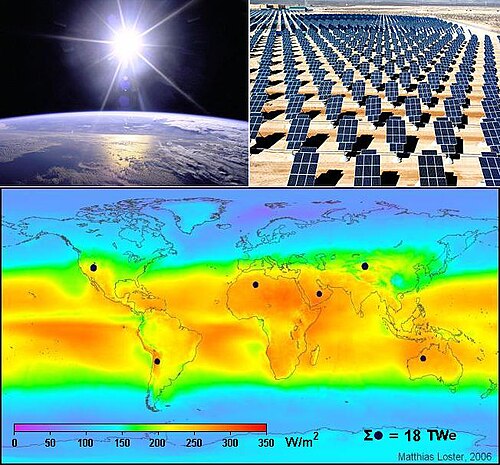
Radiant energy is one of the mechanisms by which energy can enter or leave an open system.[9][10][11] Such a system can be man-made, such as a solar energy collector, or natural, such as the Earth's atmosphere. In geophysics, most atmospheric gases, including the greenhouse gases, allow the Sun's short-wavelength radiant energy to pass through to the Earth's surface, heating the ground and oceans. The absorbed solar energy is partly re-emitted as longer wavelength radiation (chiefly infrared radiation), some of which is absorbed by the atmospheric greenhouse gases. Radiant energy is produced in the sun as a result of nuclear fusion.[12]
放射エネルギーは放射暖房に使用されます。[ 13 ]赤外線ランプで電気的に発生させることも、太陽光から吸収して水を温めることもできます。熱エネルギーは、温かい要素(床、壁、天井パネル)から放出され、空気を直接温めるのではなく、室内の人やその他の物を温めます。そのため、部屋は快適に見えるものの、従来の暖房方式の建物よりも空気温度が低くなる場合があります。
放射エネルギーのさまざまな応用が考案されている。[ 14 ]これらには、処理と検査、分離と選別、制御媒体、および通信媒体が含まれる。これらの応用の多くは、放射エネルギー源と、その放射に反応して放射の何らかの特性を表す信号を提供する検出器を伴う。放射エネルギー検出器は、入射放射エネルギーに対して、電位または電流の流れの増加または減少、あるいは写真フィルムの露光などの他の知覚可能な変化として反応する。