The nervous tissue found in the brain, spinal cord, and periphery comprises an extraordinarily complex biological system that largely defines many of the unique traits of individuals. As with any highly complex system, however, even small perturbations to its environment can lead to significant functional disruptions. Properties leading to the susceptibility of nervous tissue include a high surface area of neurons, a high lipid content which retains lipophilic toxins, high blood flow to the brain inducing increased effective toxin exposure, and the persistence of neurons through an individual's lifetime, leading to compounding of damages.[21] As a result, the nervous system has a number of mechanisms designed to protect it from internal and external assaults, including the blood brain barrier.
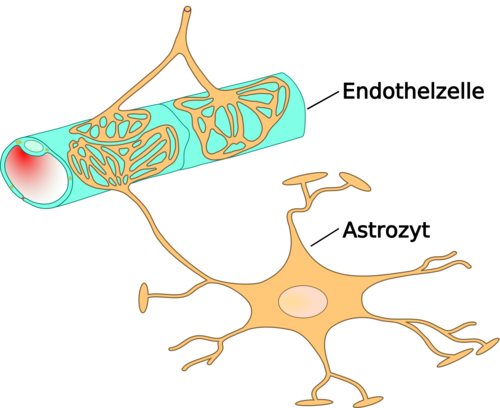
The blood–brain barrier (BBB) is one critical example of protection which prevents toxins and other adverse compounds from reaching the brain.[22] As the brain requires nutrient entry and waste removal, it is perfused by blood flow. Blood can carry a number of ingested toxins, however, which would induce significant neuron death if they reach nervous tissue. Thus, protective cells termed astrocytes surround the capillaries in the brain and absorb nutrients from the blood and subsequently transport them to the neurons, effectively isolating the brain from a number of potential chemical insults.[22]
Astrocytes surrounding capillaries in the brain to form the blood brain barrier
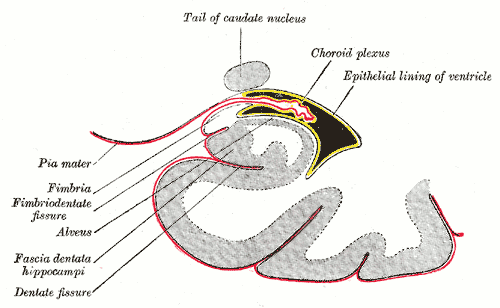
This barrier creates a tight hydrophobic layer around the capillaries in the brain, inhibiting the transport of large or hydrophilic compounds. In addition to the BBB, the choroid plexus provides a layer of protection against toxin absorption in the brain. The choroid plexuses are vascularized layers of tissue found in the third, fourth, and lateral ventricles of the brain, which through the function of their ependymal cells, are responsible for the synthesis of cerebrospinal fluid (CSF).[23] Importantly, through selective passage of ions and nutrients and trapping heavy metals such as lead, the choroid plexuses maintain a strictly regulated environment which contains the brain and spinal cord.[22][23]
Choroid plexus
疎水性で小さいこと、またはアストロサイトの機能を阻害することによって、特定の神経毒を含む一部の化合物は脳に侵入して重大な損傷を引き起こすことができます。現代では、科学者や医師は神経毒の特定と治療という課題に直面しており、その結果、神経毒性学の研究と臨床研究の両方への関心が高まっています。[ 24 ]臨床神経毒性学は主に急成長している分野ですが、多くの環境神経毒の特定において大きな進歩があり、750から1000の既知の潜在的に神経毒性のある化合物の分類につながっています。[ 21 ]一般的な環境で神経毒を見つけることの極めて重要なため、米国環境保護庁(EPA)は化合物の神経毒性効果をテストおよび決定するための特定のプロトコルを開発しました(USEPA 1998)。さらに、 in vitroシステムは、過去のより一般的なin vivoシステムよりも大幅に改善されているため、使用が増加しています。改善の例としては、扱いやすく均一な環境、および全身代謝の汚染効果の排除が挙げられます。[ 24 ]しかし、in vitroシステムでは、BBB形成における支持アストロサイトとニューロンの相互作用など、神経系の複雑さを適切に再現することが困難であるため、問題が生じている。[ 25 ] in vitroで試験する際に神経毒を決定するプロセスをさらに複雑にしているのは、in vivoではin vitroのようにニューロンを化合物に直接曝露することができない可能性があるため、神経毒性と細胞毒性を区別することが難しい場合があることである。さらに、細胞の化学物質に対する反応は、神経毒と細胞毒の区別を正確に伝えるものではない可能性があり、酸化ストレスや骨格の変化などの症状はどちらに対しても発生する可能性がある。[ 26 ]
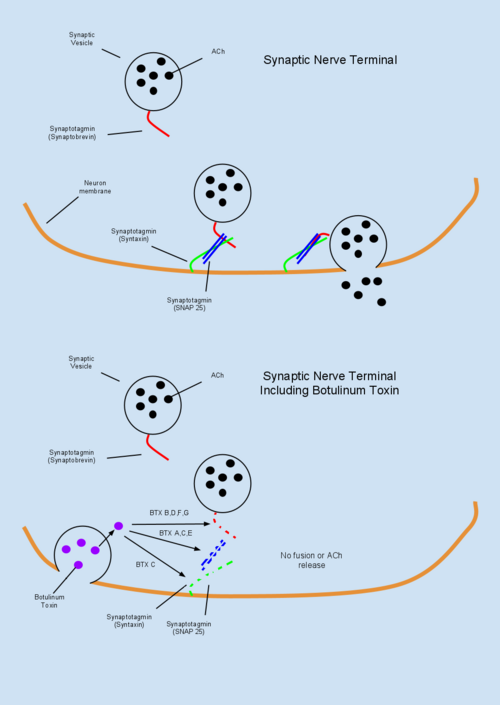
Botulinum toxin (BTX) is a group of neurotoxins consisting of eight distinct compounds, referred to as BTX-A,B,C,D,E,F,G,H, which are produced by the bacterium Clostridium botulinum and lead to muscular paralysis.[67] A notably unique feature of BTX is its relatively common therapeutic use in treating dystonia and spasticity disorders,[67] as well as in inducing muscular atrophy[11] despite being the most poisonous substance known.[18] BTX functions peripherally to inhibit acetylcholine (ACh) release at the neuromuscular junction through degradation of the SNARE proteins required for ACh vesicle-membrane fusion.[35] As the toxin is highly biologically active, an estimated dose of 1μg/kg body weight is sufficient to induce an insufficient tidal volume and resultant death by asphyxiation.[13] Due to its high toxicity, BTX antitoxins have been an active area of research. It has been shown that capsaicin (active compound responsible for heat in chili peppers) can bind the TRPV1 receptor expressed on cholinergic neurons and inhibit the toxic effects of BTX.[18]
1 2 3 Widmaier, Eric P.、Hershel Raff、Kevin T. Strang、および Arthur J. Vander (2008) Vander's Human Physiology: the Mechanisms of Body Function.' ボストン: McGraw-Hill Higher Education.
↑ Radio, Nicholas M.; Mundy, William R. (2008). "Developmental Neurotoxicity Testing in Vitro: Models for Assessing Chemical Effects on Neurite Out-growth" . NeuroToxicology . 29 (3): 361– 376. Bibcode : 2008NeuTx..29..361R . doi : 10.1016/j.neuro.2008.02.011 . PMID 18403021 .
1 2 3 Chowdhury, FR; Ahasan, HA M. Nazmul; Rashid, AK M. Mamunur; Mamun, A. Al; Khaliduzzaman, SM (2007). "テトロドトキシン中毒:53症例の臨床分析、ネオスチグミンの役割、短期転帰". Singapore Medical Journal . 48 (9): 830–33 . PMID 17728964 .
↑ Griffith, Harold R.; Johnson, G. Enid (1942). "The Use Of Curare In General Anesthesia" . Anesthesiology . 3 (4): 418– 420. doi : 10.1097/00000542-194207000-00006 . S2CID 71400545 .
Adams, Michael E.; Olivera, Baldomero M. (1994). "神経毒:新たな研究技術の概要". Trends in Neurosciences . 17 (4): 151–55 . doi : 10.1016/0166-2236(94)90092-2 . PMID 7517594 . S2CID 3984106 .
Arnon, Stephen S. ; Schechter, Robert; Inglesby, Thomas V.; Henderson, Donald A.; Bartlett, John G.; Ascher, Michael S.; Eitzen, Edward; Fine, Anne D.; Hauer, Jerome; Layton, Marcelle; Lillibridge, Scott; Osterholm, Michael T.; O'Toole, Tara; Parker, Gerald; Perl, Trish M.; Russell, Philip K.; Swerdlow, David L.; Tonat, Kevin (2001). "Botulinum Toxin as a Biological Weapon". The Journal of the American Medical Association . 285 (8): 1059– 069. doi : 10.1001/jama.285.8.1059 . PMID 11209178 .
Aschner, M.; Aschner, J. (1990). "水銀神経毒性:血液脳関門輸送のメカニズム". Neuroscience & Biobehavioral Reviews . 14 (2): 169–76 . doi : 10.1016/s0149-7634(05)80217-9 . PMID 2190116 . S2CID 8777931 .
Banks, William A.; Kastin, Abba J. (1989). "アルミニウム誘発性神経毒性:血液脳関門における膜機能の変化". Neuroscience & Biobehavioral Reviews . 13 (1): 47– 53. doi : 10.1016/s0149-7634(89)80051-x . PMID 2671833 . S2CID 46507895 .
Baum-Baicker, Cynthia (1985). 「適度なアルコール摂取の健康上の利点:文献レビュー」Drug and Alcohol Dependence 15 (3): 207–27 . doi : 10.1016/0376-8716(85)90001-8 . PMID 4028954 .
Beckman, JS (1990). "ペルオキシナイトライトによる見かけ上のヒドロキシルラジカル生成:一酸化窒素とスーパーオキシドによる内皮損傷への影響" . Proceedings of the National Academy of Sciences . 87 (4): 1620– 624. Bibcode : 1990PNAS...87.1620B . doi : 10.1073/pnas.87.4.1620 . PMC 53527 . PMID 2154753 .
Bergamini, Carlo M.; Gambetti, Stefani; Dondi, Alessia; Cervellati, Carlo (2004). "酸素、活性酸素種、および組織損傷". Current Pharmaceutical Design . 10 (14): 1611–626 . doi : 10.2174/1381612043384664 . PMID 15134560 .
Bisset, Norman G (1992). 「新世界の戦争と狩猟毒。パート1. クラーレの初期の歴史に関する注記」。民族薬理学ジャーナル。36 (1): 1– 26。doi : 10.1016 / 0378-8741(92)90056 - w。PMID 1501489。
Blanco, Ana M.; Valles, Soraya L.; Pascual, Maria; Guerri, Consuelo (2005). "培養アストロサイトにおけるエタノール誘発性炎症メディエーターおよび細胞死の誘導におけるTLR4/I型IL-1受容体シグナル伝達の関与" . The Journal of Immunology . 175 (10): 6893– 899. doi : 10.4049/jimmunol.175.10.6893 . PMID 16272348 .
Bleich, S (2003). 「アルコール依存症患者における脳萎縮の新たな危険因子としての高ホモシステイン血症」Neuroscience Letters . 335 (3): 179– 82. doi : 10.1016/s0304-3940(02)01194-1 . PMID 12531462 . S2CID 33032529 .
Bonfoco E (1995). "アポトーシスとネクローシス:皮質細胞培養におけるN-メチル-D-アスパラギン酸または一酸化窒素/スーパーオキシドによる軽度および重度の障害によってそれぞれ誘発される2つの異なる事象" . Proceedings of the National Academy of Sciences . 92 (16): 7162– 166. Bibcode : 1995PNAS...92.7162B . doi : 10.1073/pnas.92.16.7162 . PMC 41299 . PMID 7638161 .
Choi, D (1988). "カルシウムを介した神経毒性:特定のチャネルタイプとの関係と虚血性損傷における役割". Trends in Neurosciences . 11 (10): 465–69 . doi : 10.1016/0166-2236(88)90200-7 . PMID 2469166 . S2CID 36909560 .
Choi, DW; Rothman, SM (1990). 「低酸素虚血性神経細胞死におけるグルタミン酸神経毒性の役割」Annual Review of Neuroscience 13 ( 1): 171– 82. doi : 10.1146/annurev.neuro.13.1.171 . PMID 1970230 .
Choi, Dennis W (1987). 「グルタミン酸神経毒性のイオン依存性」 . The Journal of Neuroscience . 7 (2): 369–79 . doi : 10.1523/JNEUROSCI.07-02-00369.1987 . PMC 6568907 . PMID 2880938 .
Choi, Dennis W.; Maulucci-Gedde, Margaret; Kriegstein, Arnold R. (1987). "皮質細胞培養におけるグルタミン酸神経毒性" . The Journal of Neuroscience . 7 (2): 357–68 . doi : 10.1523/JNEUROSCI.07-02-00357.1987 . PMC 6568898 . PMID 2880937 .
Hensley, K (1994). "ペプチドによるフリーラジカル生成に基づくβアミロイド凝集と神経毒性のモデル:アルツハイマー病との関連性" . Proceedings of the National Academy of Sciences . 91 (8): 3270– 274. Bibcode : 1994PNAS...91.3270H . doi : 10.1073/pnas.91.8.3270 . PMC 43558 . PMID 8159737 .
Jacob, Reed B.; McDougal, Owen M. (2010). "コノトキシンMスーパーファミリー:レビュー" . Cellular and Molecular Life Sciences . 67 (1): 17– 27. doi : 10.1007/s00018-009-0125-0 . PMC 3741454 . PMID 19705062 .
Jevtovic-Todorovic, Vesna; Hartman, Richard E.; Izumi, Yukitoshi; Benshoff, Nicholas D.; Dikranian, Krikor; Zorumski, Charles F.; Olney, John W.; Wozniak, David F. (2003). "一般的な麻酔薬への早期曝露は、発達中のラット脳に広範な神経変性と持続的な学習障害を引き起こす" . The Journal of Neuroscience . 23 (3): 876– 82. doi : 10.1523/JNEUROSCI.23-03-00876.2003 . PMC 6741934 . PMID 12574416 .
Jones, K (1973). 「慢性アルコール依存症の母親から生まれた子供の奇形パターン」The Lancet . 301 (7815): 1267– 271. doi : 10.1016/s0140-6736(73)91291-9 . PMID 4126070 .
King, Steven W.; Savory, John; Wills, Michael R.; Gitelman, HJ (1981). "アルミニウムの臨床生化学". Critical Reviews in Clinical Laboratory Sciences . 14 (1): 1– 20. doi : 10.3109/10408368109105861 . PMID 7016437 .
Konopacka, Agnieszka; Konopacki, Filip A.; Albrecht, Jan (2009). "Protein Kinase G Is Involved in Ammonia-induced Swelling of Astrocytes". Journal of Neurochemistry . 109 : 246– 51. doi : 10.1111/j.1471-4159.2009.05802.x . PMID 19393034 . S2CID 42719321 .
Liu, Yuan; McDermott, Suzanne; Lawson, Andrew; Aelion, C. Marjorie (2010). "妊娠中の母親の住居付近で採取された土壌サンプル中のヒ素、水銀、鉛の濃度と子供の精神遅滞および発達遅延との関係" . International Journal of Hygiene and Environmental Health . 213 (2): 116– 23. Bibcode : 2010IJHEH.213..116L . doi : 10.1016/j.ijheh.2009.12.004 . PMC 2836425 . PMID 20045663 .
Lorenzo, A (1994). "β-アミロイド神経毒性は線維形成を必要とし、コンゴーレッドによって阻害される" . Proceedings of the National Academy of Sciences . 91 (25): 12243– 2247. Bibcode : 1994PNAS...9112243L . doi : 10.1073/pnas.91.25.12243 . PMC 45413 . PMID 7991613 .
Schlesinger, Edward B (1946). "Curare:その治療効果とその生理学的根拠のレビュー". The American Journal of Medicine . 1 (5): 518–30 . doi : 10.1016/0002-9343(46)90073-3 . PMID 21001466 .
Siebler, M.; Koller, H.; Schmalenbach, C.; Muller, H. (1988). "培養ラット海馬および中隔領域ニューロンにおけるGABA活性化塩化物電流は、クラーレおよびアトロピンによって阻害される。". Neuroscience Letters . 93 ( 2– 3): 220– 24. doi : 10.1016/0304-3940(88)90085-7 . PMID 2468110 . S2CID 10645685 .
Simpson, LL (1986). 「ボツリヌス毒素と破傷風毒素の分子薬理学」。Annual Review of Pharmacology and Toxicology . 26 (1): 427–53 . doi : 10.1146/annurev.pharmtox.26.1.427 . PMID 3521461 .
Soroceanu, Liliana; Gillespie, Yancey; Khazaeli, MB; Sontheimer, Harold (1998). 「原発性脳腫瘍の標的化におけるクロロトキシンの使用」Cancer Research . 58 (21): 4871– 879. PMID 9809993 .
Spencer PS、Schaumburg HH、Ludolph AC (編) (2000) 実験および臨床神経毒性学。オックスフォード大学出版局、オックスフォード、pp. 1310。
Stanfield, Peter R (1983). 「テトラエチルアンモニウムイオンと興奮性細胞のカリウム透過性」. Reviews of Physiology, Biochemistry and Pharmacology . 97 : 1–49 . doi : 10.1007/bfb0035345 . ISBN978-3-540-11701-8PMID 6306751
Stewart I、Seawright AA、Shaw GR (2008) 「家畜、野生哺乳類、鳥類におけるシアノバクテリア中毒の概要」(PDF)。シアノバクテリアによる有害藻類ブルーム:科学の現状と研究ニーズ。実験医学と生物学の進歩。第619巻、 613~ 637ページ。doi : 10.1007 /978-0-387-75865-7_28。ISBN978-0-387-75864-0PMID 18461786 .
Taffe, MA; Kotzebue, RW; Crean, RD; Crawford, EF; Edwards, S.; Mandyam, CD (2010). "表紙より: 青年期の非ヒト霊長類におけるアルコール摂取による海馬神経新生の長期的な減少" . Proceedings of the National Academy of Sciences . 107 (24): 11104– 1109. Bibcode : 2010PNAS..10711104T . doi : 10.1073/pnas.0912810107 . PMC 2890755 . PMID 20534463 .
Widmaier, Eric P.、Hershel Raff、Kevin T. Strang、Arthur J. Vander (2008) Vander's Human Physiology: the Mechanisms of Body Function. Boston: McGraw-Hill Higher Education.
Williamson, Lura C.; Halpern, Jane L.; Montecucco, Cesare; Brown, JE; Neale, Elaine A. (1996). "無傷のニューロンにおけるクロストリジウム神経毒素と基質タンパク質分解" . The Journal of Biological Chemistry . 271 (13): 7694–699 . doi : 10.1074/jbc.271.13.7694 . PMID 8631808 .