
Loading article…
医療倫理は、臨床医学の実践と関連する科学研究を分析する倫理の応用分野です。 [1]医療倫理は、専門家が混乱や対立が生じた場合に参照できる一連の価値観に基づいています。これらの価値観には、自律性の尊重、非危害、善行、正義が含まれます。[2]こうした信条により、医師、ケア提供者、家族は治療計画を立て、同じ共通目標に向かって取り組むことができます。[3]これら4つの価値観は、重要性や関連性の順にランク付けされておらず、すべてが医療倫理に関する価値観を包含しています。[4]ただし、困難な医療状況に最善の道徳的判断を適用する目的で、一部の道徳的要素が他の要素に優先するような、倫理システムの階層化が必要になる対立が生じる場合があります。[5]医療倫理は、強制治療や強制入院に関する決定に特に関連しています。
行動規範はいくつかある。ヒポクラテスの誓いは医療従事者の基本原則について論じている。[5]この文書は紀元前5世紀に遡る。[6]ヘルシンキ宣言(1964年)とニュルンベルク綱領(1947年)はどちらも医療倫理に貢献した2つのよく知られた、高く評価されている文書である。医療倫理の歴史におけるその他の重要な出来事としては、 1973年のロー対ウェイド事件[なぜ? ]と1960年代の血液透析の発展が挙げられる。現在では血液透析は利用可能であるが、患者を治療するための透析装置の数は限られているため、どの患者を治療し、どの患者を治療しないか、そしてそのような決定を下す際にどのような要素を使用するかという倫理的な問題が生じている。[7]最近では、遺伝子編集を利用して病気を治療、予防、治癒することを目的とした遺伝子編集の新技術が、医療や治療への応用、および将来の世代への社会的影響について重要な道徳的問題を提起している。[8] [9]
この分野は歴史を通じて発展と変化を続けてきましたが、世界中のあらゆる文化的、宗教的背景において、公平でバランスのとれた道徳的な思考に焦点が当てられてきました。[10] [11]医療倫理の分野には、臨床現場における実践的な応用と、哲学、歴史、社会学の学術研究の両方が含まれます。
医療倫理には、安楽死、患者の守秘義務、インフォームドコンセント、医療における利益相反などの紛争に関連する善行、自律性、正義が含まれます。[12] [13] [14]さらに、医療倫理と文化は相互に関連しており、異なる文化では倫理的価値の実践方法が異なり、家族の価値を重視し、自律性の重要性を軽視することもあります。このため、病院やその他の医療現場では、文化に敏感な医師や倫理委員会の必要性が高まっています。 [10] [11] [15]
医療倫理関係
医療倫理では、関係を次の方向で定義します。
医療従事者 — 患者;
医療従事者 — 健康な人(親族)
医療従事者 — 医療従事者。
医療倫理には、医療上の守秘義務、医療過誤、医原病、医師と患者の義務 に関する規定が含まれます。
医療倫理は生命倫理と密接に関連しているが、これらは同一の概念ではない。生命倫理の科学は医療倫理の発展の継続の中で進化的に生まれたため、より広範囲の問題を扱っている。[16]
医療倫理も法律に関連しています。しかし、倫理と法律は同一の概念ではありません。多くの場合、倫理は法律が定めるよりも高い行動基準を意味します。 [17]
歴史

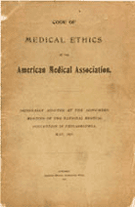
医療倫理という言葉が初めて使われたのは1803年、イギリスの作家で医師のトーマス・パーシバルが医療施設内の医療従事者の要件と期待を記した文書を出版したときまで遡る。倫理規定はその後1847年に改訂され、パーシバルの言葉に大きく依存した。[18] 1903年、1912年、1947年と長年にわたり、原文は改訂された。[18]医療倫理の実践は世界中で広く受け入れられ、実践されている。[4]
歴史的に見ると、西洋の医療倫理は、古代の医師の義務に関するガイドラインであるヒポクラテスの誓いや、初期のキリスト教の教えにまで遡ることができます。最初の医療倫理規定である『医道法典』は、 5世紀、東ゴート族のキリスト教徒の王テオドリック大王の治世中に出版されました。中世および近世初期には、この分野は、イスハーク・イブン・アリー・アル=ルハーウィー(医療倫理に関する最初の本である『医師の行為』を著した)、イブン・スィーナーの『医学大典』 、ムハンマド・イブン・ザカリヤ・アル=ラーズィー(西洋ではラーズィーとして知られる)などのイスラムの学問、マイモニデスなどのユダヤ教の思想家、トマス・アクィナスなどのローマ・カトリックのスコラ思想家、およびカトリックの道徳神学の事例指向分析(詭弁学)に負っています。こうした知的伝統はカトリック、イスラム教、ユダヤ教の医療倫理に引き継がれています。
18 世紀と 19 世紀になると、医療倫理はより自覚的な議論として登場しました。イギリスでは、医師で著述家のトーマス・パーシバルが最初の近代的な医療倫理規定を作成しました。彼は 1794 年に規定をまとめた小冊子を作成し、1803 年にはその拡張版を書き上げ、その中で「医療倫理」と「医療法学」という表現を作り出しました。[19]しかし、医師の診察に関するパーシバルのガイドラインは、在宅医師の評判を過度に保護していると考える人もいます。ジェフリー・バーラントはそのような批評家の 1 人で、パーシバルの医師の診察規定は、医師コミュニティの反競争的で「ギルド」的な性質の初期の例としていると考えています。[20] [21]さらに、19世紀半ばから20世紀にかけて、かつてはより親密であった医師と患者の関係は目立たなくなり、親密さも薄れ、時には医療過誤につながり、その結果、国民の信頼は低下し、意思決定権は父権主義的な医師モデルから、患者の自律性と自己決定を重視する今日のモデルに移行しました。[22]
1815年、英国議会は薬剤師法を可決しました。この法律により、薬剤師協会の免許のもと、当時の薬剤師に義務的な見習い制度と正式な資格が与えられました。これが英国における医療専門職の規制の始まりでした。
1847年、アメリカ医師会は最初の倫理規定を採択したが、これは主にパーシヴァルの研究に基づいたものであった。[23]世俗化されたこの分野はカトリックの医療倫理から多くを借用したが、20世紀にはジョセフ・フレッチャーなどの思想家によって明確にリベラルなプロテスタントのアプローチが明確に示された。1960年代と1970年代には、リベラル理論と手続き的正義に基づいて、医療倫理の議論の多くが劇的な変化を遂げ、主に生命倫理へと再構成された。[24]
医療倫理に関する有名な訴訟としては以下のようなものがあります。
- アルバート・クリグマンの皮膚科学実験
- 深い睡眠療法
- 医師の裁判
- グリーンバーグ対マイアミ小児病院研究所
- ヘンリエッタ・ラックス
- チェスター・M・サウサムの癌注射研究
- 人体への放射線実験
- ジェシー・ゲルシンガー
- ムーア対カリフォルニア大学理事会
- 精神衛生の改善を目的とした身体部分の外科的切除
- 黒人アメリカ人に対する医学実験
- ミルグラム実験
- 放射性ヨウ素実験
- モンスター研究
- プルトニウム注入
- デイヴィッド・ライマー事件
- スタンフォード監獄実験
- タスキーギ梅毒実験
- ウィローブルック州立学校
- ヤノマミ族の血液サンプル採取
1970年代以降、現代医学における倫理の影響力の高まりは、人体実験を評価するための機関審査委員会の利用の増加、病院倫理委員会の設立、臨床倫理学者の役割の拡大、多くの医学部のカリキュラムへの倫理の統合に見て取れます。[25]
COVID-19(新型コロナウイルス感染症
2019年12月、COVID-19ウイルスが世界中の公衆衛生に対する脅威として出現し、その後数年間にわたって現代の医療倫理に関する新たな研究に火をつけた。例えば、中国の武漢でCOVID-19が最初に発見されて以来[26] 、2020年半ばまでに世界的に拡大して以来、オープンサイエンスの原則を採用するよう求める声が研究コミュニティを支配した。[27]一部の学者は、研究グループ間の継続的なコミュニケーション、研究結果の公共政策への迅速な反映、科学的プロセスの一般市民への透明性などのオープンサイエンスの原則が、ウイルスの影響を食い止める唯一の解決策であると信じていた。しかし、他の学者は、これらの介入はスピードを優先して安全性を無視し、研究資金を無駄に使用し、一般市民の混乱を招く可能性があると警告した。[27]これらの慣行の欠点には、 COVID-19の治療薬としてヒドロキシクロロキンとアジスロマイシンを使用することをめぐる資源の浪費と国民の混乱(後にこの組み合わせはCOVID-19の生存率に影響を与えず、顕著な心毒性の副作用を伴ったことが示された[28])、およびCOVID -19ワクチンが開発され一般に利用可能になったスピードに起因する一種のワクチン躊躇などがある。 [29]しかし、オープンサイエンスにより、マスクの着用や社会的距離の確保などの命を救う公的介入の迅速な実施、感染率と死亡率を大幅に低下させた複数のワクチンとモノクローナル抗体の急速な開発、パンデミックの深刻さに関する国民の認識の向上、手洗いなどのCOVID-19感染に対する日常的な予防行動の説明も可能になった。[27]
COVID-19 倫理の影響を受けるその他の注目すべき医療分野は次のとおりです。
- 特に集中治療室では、重症患者の流入に対応するための人工呼吸器やベッドが不足しており、資源の配給が行われました。 [30]
- 医療従事者用のPPEが不足しており、患者のケア中に感染のリスクが高まっている。[31]
- パンデミックの間中、医療従事者とエッセンシャルワーカーに大きな負担がかかった[32]
- 学校の閉鎖とオンライン授業の増加は、インターネットへのアクセスが限られている家庭にとって問題をもたらした。[33]
- 健康格差の拡大により、パンデミックは世界中の他の人口統計よりもBIPOCと障害者コミュニティに大きな影響を与えています。 [34]
- COVID-19関連の外国人嫌悪に関連して、アジア系アメリカ人、特に中国系アメリカ人に対するヘイトクライムが増加している。[ 35]
- 企業、オフィス、レストランの閉鎖により失業が増加し、経済不況が生じた。[36]
- ワクチン接種への躊躇[29 ]
- マスク着用や社会的距離の確保を拒否することで感染率が上昇する。[37]
- 診療所や病院がCOVID-19患者で溢れかえっていたため、必須ではない医療処置の中止、日常的なケアの延期、遠隔医療への転換が行われた。 [38]
COVID-19 の倫理は、この段落で説明されているよりもはるかに多くの医療と社会の領域に及びます。これらの原則のいくつかは、2022 年 9 月 12 日現在も続いているパンデミックが終わるまで発見されない可能性があります。
価値観
医療倫理を分析する際によく使われる枠組みは、トム・ボーチャムとジェームズ・チルドレスが教科書『生物医学倫理の原理』で提唱した「4つの原則」アプローチである。このアプローチでは、適用範囲に注意しながら、互いに判断し比較検討すべき4つの基本的な道徳原則が認識されている。4つの原則は以下のとおりである。[39]
- 自律性の尊重– 患者は治療を拒否したり選択したりする権利を有する。[40]
- 善行– 医師は患者の最善の利益のために行動すべきである。[40]
- 非害悪– 害の原因にならないこと。また、「有用性」 – 害よりも善を促進すること。[40]
- 正義– 限られた医療資源の分配と、誰がどのような治療を受けられるかの決定に関わる。[40]
自律性
自律の原則は、「オートス(自己)」と「ノモス(規則)」に分けられ、個人の自己決定権をとらえている。[22]これは、個人が自由に個人的な事柄について情報に基づいた決定を下す能力を社会が尊重することに根ざしている。社会の価値観が、医療の質を医療従事者ではなく患者とその家族にとって重要な成果の観点から定義するように変化したため、自律性はより重要になった。[22]自律性の重要性の高まりは、医療における「父権主義」の伝統に対する社会的反応と見ることができる。 [22] [41]患者の自律性を支持する歴史的に過度な父権主義に対する反発が、一部の患者の成果に悪影響を与えるようなソフトな父権主義の適切な使用を妨げているのではないかと疑問視する人もいる。[42]
自律性の定義は、個人が合理的で影響を受けない決定を下す能力です。したがって、自律性は健康な心身の一般的な指標であると言えます。多くの末期疾患の進行は、さまざまな方法と程度で自律性の喪失を特徴としています。たとえば、脳を攻撃する慢性で進行性の病気である認知症は、記憶喪失を引き起こし、合理的思考の低下を引き起こし、ほとんどの場合、自律性の喪失につながります。[43]
精神科医や臨床心理士は、人生の終わりに患者の生死に関わる決定を下す能力を評価するよう求められることが多い。せん妄や臨床的うつ病などの精神疾患を持つ人は、人生の終わりに決定を下す能力がない可能性がある。これらの人の場合、その状態を考慮して治療を拒否する要請がなされることがある。明確な事前指示がない限り、精神的能力を欠く人は、その人の最善の利益に従って治療される。これには、その人を最もよく知る人々が関与し、能力を失っていなければその人がどのような決定を下していたかを評価することが含まれる。[44]人生の終わりに決定を下す精神的能力を持つ人は、治療が寿命を縮める可能性があることを理解した上で治療を拒否することができる。精神科医や心理学者が意思決定を支援するために関与することがある。[45]
慈善活動
善行とは、他人の幸福を促進する行為を指します。医療の文脈では、これは患者とその家族の最大の利益となる行為を行うことを意味します。[2]しかし、どのような行為が実際に患者を助けるのかという正確な定義は不明確です。
ジェームズ・チルドレスとトム・ボーチャムは『生物医学倫理の原理』 (1978年)の中で、善行を医療倫理の中核的価値の1つとしている。エドマンド・ペレグリーノなどの学者は、善行こそが医療倫理の唯一の基本原則であると主張している。彼らは、治癒が医療の唯一の目的であるべきであり、美容整形や安楽死などの行為は極めて非倫理的でヒポクラテスの誓いに反すると主張している。[要出典]
非害悪
非危害の概念は、「まず、害を与えないこと」というフレーズ、またはラテン語のprimum non nocereに体現されています。多くの人が、これが主な、または第一の考慮事項であるべきだと考えています (したがってprimum )。つまり、患者に害を与えないことは、患者に良いことをすることよりも重要であり、これは医師が行うヒポクラテスの誓いの一部です。[46]これは、熱心な医師が、患者に害を与えないことを十分に評価せずに、良いと信じる治療法を使用する傾向があるためです。その結果、患者に多くの害が与えられました。「治療は成功したが、患者は死亡した」ということわざがあります。害を与えないことが、良いことをすることよりも重要であるだけでなく、治療が患者に害を及ぼす可能性がどの程度あるかを知ることも重要です。したがって、医師は、有害であるとわかっている薬を処方しないというだけでなく、治療が有害である可能性が低いことがわかっている場合、または少なくとも患者がリスクと利点を理解しており、可能性のある利点が可能性のあるリスクを上回る場合を除いて、薬を処方する(または患者を治療する)べきではありません。
しかし、実際には、多くの治療には何らかの危害のリスクが伴います。状況によっては、例えば治療しなければ重大な結果になるような絶望的な状況では、治療しないことのリスクも危害をもたらす可能性が高いため、患者に危害を与える可能性が高い危険な治療が正当化されます。したがって、無害の原則は絶対的なものではなく、善行(良いことを行うこと)の原則とバランスが取れています。2つの原則が一緒になった効果は、しばしば二重の効果を生み出すからです(次のセクションでさらに説明します)。採血や薬物の注射などの基本的な行為でさえ、患者の体に危害をもたらします。安楽死も、医師による治療の結果として患者が死亡するため、善行の原則に反します。
二重の効果
二重効果とは、一つの行為によって生じる2種類の結果を指し、[47]医療倫理では、通常、善行と無害行の複合効果としてみなされます。[48]
この現象のよく引用される例は、死にゆく患者に対するモルヒネやその他の鎮痛剤の使用である。このようなモルヒネの使用は、患者の痛みや苦しみを和らげるという有益な効果をもたらす可能性があるが、同時に呼吸器系の不活性化によって患者の寿命を縮めるという悪影響も及ぼす可能性がある。[49]
人権の尊重
人権時代は、人権の促進を任務とする1945年の国連の設立とともに始まった。世界人権宣言(1948年)は、人権を定義した最初の主要文書であった。医師は患者の人権と人間としての尊厳を保護する倫理的義務を負っているため、人権を定義する文書の出現は医療倫理に影響を及ぼした。[50]現在、ほとんどの医療倫理規定は患者の人権の尊重を義務付けている。
欧州評議会は、ヨーロッパにおける法の支配と人権の遵守を推進しています。欧州評議会は、欧州人権およびバイオメディカル条約(1997 年)を採択し、加盟 47 か国に統一された医療倫理規定を作成しました。この条約は、国際人権法を医療倫理に適用します。この条約は、子供を含む、同意できない人々の身体の完全性に対する特別な保護を規定しています。
第5条に基づき同意能力を有しない者に対して臓器または組織の摘出を行うことはできない。[51]
2013年12月現在、この条約は欧州評議会の加盟国29か国によって批准または加入されている。[52]
国連教育科学文化機関(ユネスコ) も、人権と人間の尊厳の保護を推進しています。ユネスコによると、「宣言は、批准の対象とならない規範を定義するもう 1 つの手段です。勧告と同様に、宣言は、国家コミュニティが最大限の権威を与え、可能な限り幅広い支持を与えることを希望する普遍的な原則を規定しています。」ユネスコは、医療倫理における国際人権法の適用を推進するために、 「人権とバイオメディカルに関する世界宣言(2005 年)」を採択しました。この宣言は、無能力者に対する人権の特別な保護を規定しています。
科学的知識、医療行為、関連技術の応用と発展においては、人間の脆弱性が考慮されるべきである。特に脆弱な個人や集団は保護されるべきであり、そのような個人の人格の尊厳は尊重されるべきである。[53]
連帯
アングロサクソン社会に見られる社会正義に関連する個人主義的な自律性と個人の人権の基準は、コミュニティ、普遍的な福祉、すべての人に平等に医療を提供したいという利他的な願いに焦点を当てたヨーロッパの医療観に近い連帯の概念と衝突し、またそれを補完することもできます。[ 54]米国では個人主義的で利己的な医療規範が支持されているのに対し、ヨーロッパ諸国を含む他の国々では、コミュニティと個人的なサポートに対する尊重の意識が無料の医療に関連してより強く支持されています。[54]
医学における曖昧さの受容

正常性の概念、つまり病気、異常、痛みの状態とは対照的に人間の生理学的基準があるという考え方は、医療の実践に悪影響を及ぼす思い込みや偏見につながる。[55]正常性は曖昧であり、医療における曖昧性とそのような曖昧性の受け入れは、より謙虚な医療を実践し、複雑で時には異常な通常の医療事例を理解するために必要であることを認識することが重要である。[55]したがって、哲学と臨床的善行における中心的概念に関する社会の見解は、曖昧性を医療の実践における中心的な役割として採用しながら、疑問視され再検討されなければならない。[55]
紛争
善行と無害行の間
善行は非危害と衝突する可能性がある。医療従事者が「まず、害を与えない」アプローチと「まず、善を行う」アプローチのどちらかを選択する場合である。例えば、手術のリスクと利点のバランスがわからず、それを推定しなければならない場合に手術を行うかどうかを決定する場合などである。善行を非危害などの他の原則よりも下位に置く医療従事者は、標準的なケアを満たしており、追加のサービスを提供する道徳的義務がないと感じる場合は、患者を限られた量以上助けないことを決定する可能性がある。ヤングとワグナーは、一般的に、歴史的にも哲学的にも、善行は非危害(「まず、善を行う」であって「まず、害を与えない」ではない)よりも優先されると主張した。[1]
自律性と善行/無害化の間
医療専門家が患者の最善の利益になると考える推奨に患者が同意しない場合、自律性が善行と衝突する可能性があります。患者の利益が患者の福祉と衝突する場合、さまざまな社会がさまざまな方法で衝突を解決します。一般的に、西洋医学では、医療チームが患者が自分の最善の利益のために行動していないと考える場合でも、精神的に有能な患者が自分で決定を下すという希望を尊重します。ただし、他の多くの社会では、自律性よりも善行を優先します。精神的に無能力または精神障害があると判断された人は、強制的に治療を受ける場合があります。
例としては、患者が宗教的または文化的見解などの理由で治療を望まない場合が挙げられる。安楽死の場合、患者または患者の親族が患者の生命を終わらせることを望む場合がある。また、心気症や美容整形手術の場合のように、患者が不必要な治療を希望する場合もある。この場合、医師は、医学的に不必要な潜在的リスクに対する患者の希望と、その問題に関する患者の情報に基づく自律性とのバランスを取る必要がある場合がある。患者の自己決定権を尊重することを拒否すると医師と患者の関係に悪影響を与えるため、医師は自律性を優先したい場合がある。
臓器提供は、時には興味深いシナリオを引き起こすことがあります。患者が心拍停止ドナー(NHBD)に分類され、生命維持装置で心拍を回復できず、現在は無益とみなされているものの、脳死には至っていないというシナリオです。患者をNHBDに分類すると、非治療的集中治療の対象になる可能性があり、その場合、治療は提供される臓器を保存するためだけに行われ、ドナーの生命を保存するためのものではありません。これは倫理的な問題を引き起こす可能性があります。健康な臓器を提供したいというドナーの希望を尊重することは自律性の尊重であると考える人がいる一方で、植物状態の間に無益な治療を続けることは患者と患者の家族に対する悪行であると考える人もいます。このプロセスを世界的に慣習的な手段にすることは、死という自然なプロセスとそれに伴うものを非人間化し、奪ってしまうのではないかと懸念する人もいます。
自律性と善意の間の矛盾を解決する際には、十分な情報に基づいた意思決定を行う個人の能力が問題となる場合があります。代理医療意思決定者の役割は、自律性の原則の延長です。
一方、自律性と善行/無害性は重なり合うこともあります。たとえば、患者の自律性が侵害されると、住民の医療サービスに対する信頼が低下し、結果として助けを求める意欲が低下し、善行を実行できなくなる可能性があります。
自律性と善行/無害性の原則は、医療上の決定を行う際に、患者の親族や医師、全人口、経済問題への影響も含むように拡大される可能性があります。
安楽死
アメリカの医師の間では、無危害原則が安楽死の実施を排除するかどうかについて意見の相違がある。安楽死は現在、ワシントンDC、カリフォルニア州、コロラド州、オレゴン州、バーモント州、ワシントン州で合法である。[56]世界には、医師による死の幇助(PAD)の問題に関する法律を変えるために運動している様々な組織がある。そのような組織の例としては、米国のヘムロック協会や英国の尊厳死運動がある。 [57]これらのグループは、患者が自分で決められるだけの意識があり、代替医療の可能性を知っており、自らの命を絶つことを進んで求めたか、そうする手段へのアクセスを要求した場合にのみ、医師に患者の命を絶つ権利が与えられるべきだと考えている。
この議論は世界の他の地域では異論がある。例えば、ルイジアナ州では、人の命を絶つための助言や手段の提供は犯罪行為とみなされ、重罪として起訴される可能性がある。[58]州裁判所では、この犯罪は過失致死罪に匹敵する。[59]ミシシッピ州とネブラスカ州でも同じ法律が適用されている。[60]
インフォームドコンセント
インフォームドコンセントとは、患者が推奨される治療に関する情報を受け取り、自分の治療についてよく考えた上で自発的に決定できる権利のことである。[61]インフォームドコンセントを与えるためには、患者は自分の治療に関して決定を下す能力があり、治療の性質と目的、すべての選択肢と代替案の負担、リスク、潜在的利益など、治療の推奨に関する関連情報を提示されなければならない。[62]この情報を受け取って理解した後、患者は治療に同意するか拒否するかについて、十分な情報に基づいた決定を下すことができる。[63]医療上の緊急事態や患者の無能力の場合など、特定の状況では、インフォームドコンセントの必要性に例外が生じることがある。[64]インフォームドコンセントの倫理的概念は臨床研究の場にも当てはまる。研究に参加するすべての人間は、参加するかどうかを決定するために必要な研究試験のすべての関連側面について十分な情報を得た上で、研究に参加することを自発的に決定しなければならない。[65]インフォームドコンセントは倫理的かつ法的義務である。処置、治療、研究への参加の前に適切な同意が得られなかった場合、提供者は暴行やその他の不法行為の責任を問われる可能性があります。[66]米国では、インフォームドコンセントは連邦法と州法の両方によって規定されており、インフォームドコンセントを取得するための具体的な要件は州によって異なります。[67]
機密保持
守秘義務は、医師と患者の間の会話によく適用されます。[68]この概念は、一般に患者-医師秘匿特権として知られています。法的保護により、医師は法廷で宣誓した場合でも、患者との会話の内容を明かすことができません。
米国では、1996年の医療保険の携行性と責任に関する法律(HIPAA )[69]、特にプライバシー規則、およびHIPAAよりも厳しい州法によって守秘義務が課せられています。しかし、長年にわたって規則の例外が数多く設けられてきました。たとえば、多くの州では、医師が銃創を警察に、酩酊状態のドライバーを陸運局に報告することを義務付けています。また、性感染症の診断を受けた患者が配偶者に診断内容を明かすことを拒否した場合や、未成年の患者の妊娠中絶を患者の両親に知らせずに行う場合も、守秘義務が問われます。米国の多くの州では、未成年者の中絶について親に通知することを規定する法律があります。[70] [71]一部の国では、精神保健に従事する人は、患者から危険にさらされていると思われる人に警告する義務があります。 [72]
伝統的に、医療倫理では守秘義務は医療行為において比較的譲れない原則であるとみなされてきた。最近では、ジェイコブ・アペルのような批評家が、多くの場合柔軟性が必要であることを認めた、より微妙なアプローチで守秘義務を規定すべきだと主張している。[12]
プライマリケアの倫理においては、医師が同じ家族やコミュニティの多くの患者を治療し、また、プライマリヘルスケアで通常収集される膨大な医療データベースから第三者が情報を要求することが多いため、機密保持は重要な問題です。
プライバシーとインターネット
医療研究者がディスカッションボードや掲示板などのオンライン環境で研究活動を行うことが増えており、いくつかのガイドラインは存在するものの、インフォームドコンセントやプライバシーの要件が適用されていないのではないかと懸念されている。[73]
しかし、情報開示の問題が浮上している。研究者は論点を論じるために原典から引用したいが、患者の身元が秘密にされていない場合、これは悪影響を及ぼす可能性がある。引用やサイトに関するその他の情報は患者の身元を特定するために利用される可能性があり、研究者は、サイトのメンバー、ブロガーなどがこの情報をゲームの「手がかり」として利用し、サイトを特定しようとしたケースを報告している。 [74 ]一部の研究者は、研究対象とは異なる病状について議論するなど、さまざまな「重度の偽装」方法を採用している。 [74] [75] [76]
医療機関のウェブサイトには、オンライン訪問者の個人医療記録が、製薬会社、職業記録、保険会社の手に渡り、販売され、金銭化されることから保護する責任がある。オンラインで診断結果が提供されると、患者は、国の一部の地域の医師が製薬会社の直接のサービスを受けており、診断は特許権が残っている薬と同じくらい便利だと考えていると信じるようになる。[77]医師と製薬会社は、患者の関与をほとんどまたは全く伴わないこれらの薬の販売コストを下げるために、検索エンジンのトップ10のランクを競っていることが判明している。[78]
インターネット医療プラットフォームの拡大に伴い、オンライン開業医の正当性とプライバシーの説明責任は、電子パパラッチ、オンライン情報ブローカー、産業スパイ、従来の医療コードの外で営利目的で活動する無認可の情報提供者など、特有の課題に直面しています。米国医師会(AMA)は、医療ウェブサイトには、オンライン訪問者の医療プライバシーを確保し、患者記録が保険会社、雇用主、マーケティング担当者の手に渡り、販売および収益化されるのを防ぐ責任があると述べています。[40] 医療、ビジネス慣行、コンピューターサイエンス、電子商取引が急速に統合されてこれらのオンライン診断ウェブサイトが作成されているため、医療システムの倫理的機密保持基準を維持するための取り組みも遅れを取らないようにする必要があります。今後数年間、保健福祉省は、医療保険の携行性と説明責任に関する法律(HIPAA)に基づいて、患者の電子医療記録(EMR)のオンラインプライバシーとデジタル転送を合法的に保護することに向けて取り組むと述べています。[41]今後は、医療上の機密性と患者データに関する最高の倫理基準が維持されるように、メタバースヘルスケアプラットフォームを含むデジタルヘルスエコシステムに関して、強力なガバナンスと説明責任のメカニズムを検討する必要があるだろう。[79]
管理、解決、執行
英国では、医療倫理は医師や外科医の研修の一部となっており[80] 、倫理原則を無視した医師は、医師審判所の決定により医療行為を禁止される可能性がある[81 ] 。32
病院内で適切な倫理的価値観が適用されていることを保証するために、効果的な病院認定には、医師の誠実さ、利益相反、研究倫理、臓器移植倫理などに関する倫理的配慮が考慮されることが求められます。
ガイドライン
ヘルシンキ宣言の歴史と必要性については多くの文献がある。医療倫理を含む研究に関する最初の行動規範はニュルンベルク綱領であった。この文書は1997年に導入されたためナチスの戦争犯罪と大きな関係があり、そのため実践を規制する上で大きな違いはなかった。この問題が宣言の作成を要求した。ニュルンベルク綱領とヘルシンキ宣言の間には、書き方を含めていくつかの大きな違いがある。ニュルンベルク綱領は非常に簡潔に書かれ、説明も簡単だった。ヘルシンキ宣言は徹底した説明を念頭に置いて書かれており、多くの具体的な解説が含まれている。[82]
英国では、英国医師会が「優良医療慣行」声明の形で明確で現代的な全般的な指針を提供している。[83]倫理に関する問題については、英国医師が医療保護協会やいくつかの大学の学部などの他の組織に相談することが多い。
倫理委員会
多くの場合、単純なコミュニケーションだけでは紛争を解決するのに十分ではなく、複雑な問題を決定するには 病院の倫理委員会を招集する必要があります。
これらの団体は主に医療専門家で構成されていますが、哲学者、一般人、聖職者も含まれる場合があります。実際、世界の多くの地域では、バランスを保つために彼らの存在は必須であると考えられています。
米国、欧州、オーストラリアにおけるそのような機関の予想される構成については、次のとおりである。[84]
米国の勧告では、研究倫理委員会(REB)は、少なくとも1人の科学者、1人の非科学者、および機関に所属していない1人の人物を含む5人以上の委員で構成されるべきであると示唆されている。 [85] REBには、法律、実務基準、職業行動規範に精通した人々が含まれるべきである。[85]検討中のプロトコルで必要な場合は、身体障害者に関する特別な委員を置くことが推奨されている。
欧州臨床品質管理フォーラム (EFGCP) は、REB には、生物医学研究の経験を共有し、研究が実施される機関から独立した 2 人の現役医師、1 人の一般人、1 人の弁護士、看護師や薬剤師などの医療従事者 1 人が含まれることを推奨しています。定足数には幅広い年齢層の男女が含まれ、地域社会の文化的構成を反映することが推奨されています。
The 1996 Australian Health Ethics Committee recommendations were entitled, "Membership Generally of Institutional Ethics Committees". They suggest a chairperson be preferably someone not employed or otherwise connected with the institution. Members should include a person with knowledge and experience in professional care, counseling or treatment of humans; a minister of religion or equivalent, e.g. Aboriginal elder; a layman; a laywoman; a lawyer and, in the case of a hospital-based ethics committee, a nurse.
The assignment of philosophers or religious clerics will reflect the importance attached by the society to the basic values involved. An example from Sweden with Torbjörn Tännsjö on a couple of such committees indicates secular trends gaining influence.
Cultural concerns
Cultural differences can create difficult medical ethics problems. Some cultures have spiritual or magical theories about the origins and cause of disease, for example, and reconciling these beliefs with the tenets of Western medicine can be very difficult. As different cultures continue to intermingle and more cultures live alongside each other, the healthcare system, which tends to deal with important life events such as birth, death and suffering, increasingly experiences difficult dilemmas that can sometimes lead to cultural clashes and conflict. Efforts to respond in a culturally sensitive manner go hand in hand with a need to distinguish limits to cultural tolerance.[10]
Culture and language
As more people from different cultural and religious backgrounds move to other countries, among these, the United States, it is becoming increasingly important to be culturally sensitive to all communities in order to provide the best health care for all people.[11] Lack of cultural knowledge can lead to misunderstandings and even inadequate care, which can lead to ethical problems. A common complaint patients have is feeling like they are not being heard, or perhaps, understood.[11] Preventing escalating conflict can be accomplished by seeking interpreters, noticing body language and tone of both yourself and the patient as well as attempting to understand the patient's perspective in order to reach an acceptable option.[11]
Some believe most medical practitioners in the future will have to be or greatly benefit from being bilingual. In addition to knowing the language, truly understanding culture is best for optimal care.[86] Recently, a practice called 'narrative medicine' has gained some interest as it has a potential for improving patient-physician communication and understanding of patient's perspective. Interpreting a patient's stories or day-to-day activities as opposed to standardizing and collecting patient data may help in acquiring a better sense of what each patient needs, individually, with respect to their illness. Without this background information, many physicians are unable to properly understand the cultural differences that may set two different patients apart, and thus, may diagnose or recommend treatments that are culturally insensitive or inappropriate. In short, patient narrative has the potential for uncovering patient information and preferences that may otherwise be overlooked.
Medical humanitarianism
In order to address the underserved, uneducated communities in need of nutrition, housing, and healthcare disparities seen in much of the world today, some argue that we must fall back on ethical values in order to create a foundation to move towards a reasonable understanding, which encourages commitment and motivation to improve factors causing premature death as a goal in a global community.[13] Such factors – such as poverty, environment and education – are said to be out of national or individual control and so this commitment is by default a social and communal responsibility placed on global communities that are able to aid others in need.[13] This is based on the framework of 'provincial globalism,' which seeks a world in which all people have the capability to be healthy.[13]
One concern regarding the intersection of medical ethics and humanitarian medical aid is how medical assistance can be as harmful as it is helpful to the community being served. One such example being how political forces may control how foreign humanitarian aid can be utilized in the region it is meant to be provided in. This would be congruous in situations where political strife could lead such aid being used in favor of one group over another. Another example of how foreign humanitarian aid can be misused in its intended community includes the possibility of dissonance forming between a foreign humanitarian aid group and the community being served.[87] Examples of this could include the relationships being viewed between aid workers, style of dress, or the lack of education regarding local culture and customs.[88]
Humanitarian practices in areas lacking optimum care can also pause other interesting and difficult ethical dilemmas in terms of beneficence and non-maleficence. Humanitarian practices are based upon providing better medical equipment and care for communities whose country does not provide adequate healthcare.[89] The issues with providing healthcare to communities in need may sometimes be religious or cultural backgrounds keeping people from performing certain procedures or taking certain drugs. On the other hand, wanting certain procedures done in a specific manner due to religious or cultural belief systems may also occur. The ethical dilemma stems from differences in culture between communities helping those with medical disparities and the societies receiving aid. Women's rights, informed consent and education about health become controversial, as some treatments needed are against societal law, while some cultural traditions involve procedures against humanitarian efforts.[89] Examples of this are female genital mutilation (FGM), aiding in reinfibulation, providing sterile equipment in order to perform procedures such as FGM, as well as informing patients of their HIV positive testing. The latter is controversial because certain communities have in the past outcast or killed HIV positive individuals.[89]
Healthcare reform and lifestyle
Leading causes of death in the United States and around the world are highly related to behavioral consequences over genetic or environmental factors.[90] This leads some to believe true healthcare reform begins with cultural reform, habit and overall lifestyle.[90] Lifestyle, then, becomes the cause of many illnesses and the illnesses themselves are the result or side-effect of a larger problem.[90] Some people believe this to be true and think that cultural change is needed in order for developing societies to cope and dodge the negative effects of drugs, food and conventional modes of transportation available to them.[90] In 1990, tobacco use, diet, and exercise alone accounted for close to 80 percent of all premature deaths and continue to lead in this way through the 21st century.[90] Heart disease, stroke, dementia, and diabetes are some of the diseases that may be affected by habit-forming patterns throughout our life.[90] Some believe that medical lifestyle counseling and building healthy habits around our daily lives is one way to tackle health care reform.[90]
Other cultures and healthcare
Buddhist medicine
Buddhist ethics and medicine are based on religious teachings of compassion and understanding[91] of suffering and cause and effect and the idea that there is no beginning or end to life, but that instead there are only rebirths in an endless cycle.[10] In this way, death is merely a phase in an indefinitely lengthy process of life, not an end. However, Buddhist teachings support living one's life to the fullest so that through all the suffering which encompasses a large part of what is life, there are no regrets. Buddhism accepts suffering as an inescapable experience, but values happiness and thus values life.[10] Because of this, suicide and euthanasia, are prohibited. However, attempts to rid oneself of any physical or mental pain and suffering are seen as good acts. On the other hand, sedatives and drugs are thought to impair consciousness and awareness in the dying process, which is believed to be of great importance, as it is thought that one's dying consciousness remains and affects new life. Because of this, analgesics must not be part of the dying process, in order for the dying person to be present entirely and pass on their consciousness wholesomely. This can pose significant conflicts during end of life care in Western medical practice.[10]

Chinese medicine
In traditional Chinese philosophy, human life is believed to be connected to nature, which is thought of as the foundation and encompassing force sustaining all of life's phases.[10] Passing and coming of the seasons, life, birth and death are perceived as a cyclic and perpetual occurrences that are believed to be regulated by the principles of yin and yang.[10] When one dies, the life-giving material force referred to as ch'i, encompassing both body and spirit, rejoins the material force of the universe and cycles on with respect to the rhythms set forth by yin and yang.[10]
Because many Chinese people believe that circulation of both physical and 'psychic energy' is important to stay healthy, procedures which require surgery, as well as donations and transplantations of organs, are seen as a loss of ch'i, resulting in the loss of someone's vital energy supporting their consciousness and purpose in their lives. Furthermore, a person is never seen as a single unit but rather as a source of relationship, interconnected in a social web.[10] Thus, it is believed that what makes a human one of us is relatedness and communication and family is seen as the basic unit of a community.[10][15] This can greatly affect the way medical decisions are made among family members, as diagnoses are not always expected to be announced to the dying or sick, the elderly are expected to be cared for and represented by their children and physicians are expected to act in a paternalistic way.[10][15] In short, informed consent as well as patient privacy can be difficult to enforce when dealing with Confucian families.[10]
Furthermore, some Chinese people may be inclined to continue futile treatment in order to extend life and allow for fulfillment of the practice of benevolence and humanity.[10] In contrast, patients with strong Daoist beliefs may see death as an obstacle and dying as a reunion with nature that should be accepted, and are therefore less likely to ask for treatment of an irreversible condition.[10]
Islamic culture and medicine
Some believe Islamic medical ethics and framework remain poorly understood by many working in healthcare. It is important to recognize that for people of Islamic faith, Islam envelops and affects all aspects of life, not just medicine.[92] Because many believe it is faith and a supreme deity that hold the cure to illness, it is common that the physician is viewed merely as help or intermediary player during the process of healing or medical care.[92]
In addition to Chinese culture's emphasis on family as the basic unit of a community intertwined and forming a greater social construct, Islamic traditional medicine also places importance on the values of family and the well-being of a community.[15][92] Many Islamic communities uphold paternalism as an acceptable part of medical care.[92] However, autonomy and self-rule is also valued and protected and, in Islamic medicine, it is particularly upheld in terms of providing and expecting privacy in the healthcare setting. An example of this is requesting same gender providers in order to retain modesty.[92] Overall, Beauchamp's principles of beneficence, non-maleficence and justice[2] are promoted and upheld in the medical sphere with as much importance as in Western culture.[92] In contrast, autonomy is important but more nuanced. Furthermore, Islam also brings forth the principles of jurisprudence, Islamic law and legal maxims, which also allow for Islam to adapt to an ever-changing medical ethics framework.[92]
Conflicts of interest

Physicians should not allow a conflict of interest to influence medical judgment. In some cases, conflicts are hard to avoid, and doctors have a responsibility to avoid entering such situations. Research has shown that conflicts of interests are very common among both academic physicians[93] and physicians in practice.[94][95]
Referral
Doctors who receive income from referring patients for medical tests have been shown to refer more patients for medical tests.[96] This practice is proscribed by the American College of Physicians Ethics Manual.[97] Fee splitting and the payments of commissions to attract referrals of patients is considered unethical and unacceptable in most parts of the world.[citation needed]
Vendor relationships
Studies show that doctors can be influenced by drug company inducements, including gifts and food.[14] Industry-sponsored Continuing Medical Education (CME) programs influence prescribing patterns.[98] Many patients surveyed in one study agreed that physician gifts from drug companies influence prescribing practices.[99] A growing movement among physicians is attempting to diminish the influence of pharmaceutical industry marketing upon medical practice, as evidenced by Stanford University's ban on drug company-sponsored lunches and gifts. Other academic institutions that have banned pharmaceutical industry-sponsored gifts and food include the Johns Hopkins Medical Institutions, University of Michigan, University of Pennsylvania, and Yale University.[100][101]
Treatment of family members
The American Medical Association (AMA) states that "Physicians generally should not treat themselves or members of their immediate family".[102] This code seeks to protect patients and physicians because professional objectivity can be compromised when the physician is treating a loved one. Studies from multiple health organizations have illustrated that physician-family member relationships may cause an increase in diagnostic testing and costs.[103] Many doctors still treat their family members. Doctors who do so must be vigilant not to create conflicts of interest or treat inappropriately.[104][105] Physicians that treat family members need to be conscious of conflicting expectations and dilemmas when treating relatives, as established medical ethical principles may not be morally imperative when family members are confronted with serious illness.[103][106]
Sexual relationships
Sexual relationships between doctors and patients can create ethical conflicts, since sexual consent may conflict with the fiduciary responsibility of the physician.[107] Out of the many disciplines in current medicine, there are studies that have been conducted in order to ascertain the occurrence of Doctor-Patient sexual misconduct. Results from those studies appear to indicate that certain disciplines are more likely to be offenders than others. Psychiatrists and obstetrician-gynecologists, for example, are two disciplines noted for having a higher rate of sexual misconduct.[108] The violation of ethical conduct between doctors and patients also has an association with the age and sex of doctor and patient. Male physicians aged 40–59 years have been found to be more likely to have been reported for sexual misconduct; women aged 20–39 have been found to make up a significant portion of reported victims of sexual misconduct.[109] Doctors who enter into sexual relationships with patients face the threats of losing their medical license and prosecution. In the early 1990s, it was estimated that 2–9% of doctors had violated this rule.[110] Sexual relationships between physicians and patients' relatives may also be prohibited in some jurisdictions, although this prohibition is highly controversial.[111]
Futility
In some hospitals, medical futility is referred to as treatment that is unable to benefit the patient.[112] An important part of practicing good medical ethics is by attempting to avoid futility by practicing non-maleficence.[112] What should be done if there is no chance that a patient will survive or benefit from a potential treatment but the family members insist on advanced care?[112] Previously, some articles defined futility as the patient having less than a one percent chance of surviving. Some of these cases are examined in court.
Advance directives include living wills and durable powers of attorney for health care. (See also Do Not Resuscitate and cardiopulmonary resuscitation) In many cases, the "expressed wishes" of the patient are documented in these directives, and this provides a framework to guide family members and health care professionals in the decision-making process when the patient is incapacitated. Undocumented expressed wishes can also help guide decisions in the absence of advance directives, as in the Quinlan case in Missouri.
"Substituted judgment" is the concept that a family member can give consent for treatment if the patient is unable (or unwilling) to give consent themselves. The key question for the decision-making surrogate is not, "What would you like to do?", but instead, "What do you think the patient would want in this situation?".
Courts have supported family's arbitrary definitions of futility to include simple biological survival, as in the Baby K case (in which the courts ordered a child born with only a brain stem instead of a complete brain to be kept on a ventilator based on the religious belief that all life must be preserved).
Baby Doe Law establishes state protection for a disabled child's right to life, ensuring that this right is protected even over the wishes of parents or guardians in cases where they want to withhold treatment.
See also
- Applied ethics
- Bioethics
- The Citadel
- Clinical Ethics
- Clinical governance
- Do not resuscitate
- Empathy
- Ethical code
- Ethics of circumcision
- Euthanasia
- Evidence-based medical ethics
- Fee splitting
- Hastings Center
- Healthcare in India
- Hippocratic Oath
- Health insurance
- Human radiation experiments
- Islamic bioethics
- Jewish medical ethics
- Joint Commission International, JCI
- MacLean Center for Clinical Medical Ethics
- Medical Code of Ethics
- Medical Law International
- Medical law
- Medical torture
- Military medical ethics
- Nursing ethics
- Patient abuse
- Philosophy of Healthcare
- Political abuse of psychiatry
- Project MKULTRA
- Research ethics consultation
- Resources for clinical ethics consultation
- Right to health
- Seven Sins of Medicine
- U.S. patients' bill of rights
- UN Principles of Medical Ethics
- Unethical human experimentation
- World Medical Association
Reproductive medicine
- Abortion / Abortion debate
- Eugenics
- Gene splicing
- Human cloning
- Human genetic engineering
- Human trafficking
Medical research
- Animal testing
- Children in clinical research
- CIOMS Guidelines
- Clinical Equipoise
- Clinical research ethics
- Declaration of Geneva
- Declaration of Helsinki
- Declaration of Tokyo
- Ethical problems using children in clinical trials
- First-in-man study
- Good clinical practice
- Health Insurance Portability and Accountability Act
- Institutional Review Board
- Nuremberg Code
- Research ethics consultation
- Universal Declaration of Human Rights
References
- ^ a b Young, Michael; Wagner, Angela (2023), "Medical Ethics", StatPearls, Treasure Island (FL): StatPearls Publishing, PMID 30570982, retrieved 2023-11-24
- ^ a b c Beauchamp, J. (2013). "Principles of Biomedical Ethics". Principles of Biomedical Ethics. 7.
- ^ Weise, Mary (2016). "Medical Ethics Made Easy". Professional Case Management. 21 (2): 88–94. doi:10.1097/ncm.0000000000000151. PMID 26844716. S2CID 20134799.
- ^ a b "Bioethic Tools: Principles of Bioethics". depts.washington.edu. Archived from the original on 2017-05-10. Retrieved 2017-03-21.
- ^ a b Berdine, Gilbert (2015-01-10). "The Hippocratic Oath and Principles of Medical Ethics". The Southwest Respiratory and Critical Care Chronicles. 3 (9): 28–32–32. doi:10.12746/swrccc.v3i9.185. ISSN 2325-9205.
- ^ Riddick, Frank (Spring 2003). "The Code of Medical Ethics of the American Medical Association". The Ochsner Journal. 5 (2): 6–10. PMC 3399321. PMID 22826677.
- ^ Butler, Catherine R.; Mehrotra, Rajnish; Tonelli, Mark R.; Lam, Daniel Y. (2016-04-07). "The Evolving Ethics of Dialysis in the United States: A Principlist Bioethics Approach". Clinical Journal of the American Society of Nephrology. 11 (4): 704–709. doi:10.2215/CJN.04780515. ISSN 1555-9041. PMC 4822659. PMID 26912540.
- ^ "Safeguarding the future of human gene editing". login.proxylib.csueastbay.edu. Retrieved 2019-03-19.
- ^ Veit, Walter (2018). "Procreative Beneficence and Genetic Enhancement". KRITERION – Journal of Philosophy. 32 (11): 1–8. doi:10.13140/RG.2.2.11026.89289.
- ^ a b c d e f g h i j k l m n o Coward, Harold G. (1999). A Cross-Cultural Dialogue on Health Care Ethics. Canada: Waterloo, Ont : Wilfrid Laurier university Press. pp. 119–126. ISBN 9780889208551.
- ^ a b c d e Brow, Julie A. (June 2002). "When culture and medicine collide". The Dental Assistant. 71 (3): 26, 28, 36. PMID 12078071.
- ^ a b Appel, JM. Must My Doctor Tell My Partner? Rethinking Confidentiality In the HIV Era, Medicine and Health Rhode Island, Jun 2006
- ^ a b c d Prah Ruger, Jennifer (October 2014). "Good medical ethics, justice and provincial globalism". J Med Ethics. 41 (1): 103–106. doi:10.1136/medethics-2014-102356. JSTOR 43283237. PMID 25516948.
- ^ a b Güldal D, Semin S (2000). "The influences of drug companies' advertising programs on physicians". Int J Health Serv. 30 (3): 585–95. doi:10.2190/GYW9-XUMQ-M3K2-T31C. PMID 11109183. S2CID 36442226.
- ^ a b c d Ahmed, Furqaan (August 2013). "Are medical ethics universal or culture specific". World Journal of Gastrointestinal Pharmacology and Therapeutics. 4 (3): 47–48. doi:10.4292/wjgpt.v4.i3.47. PMC 3729866. PMID 23919215.
- ^ World Medical Association, It was written by John R. Williams, Director of Ethics, WMA (2003-2006) (2015). Medical Ethics Manual (3rd ed.). ISBN 978-92-990079-0-7.
{{cite book}}: CS1 maint: multiple names: authors list (link) CS1 maint: numeric names: authors list (link) - ^ С.в, Вековшинина; Л, Кулиниченко В.; В.н, Коваленко (2003-10-30). "СУЧАСНА МЕДИЧНА ЕТИКА: ВІД ГІППОКРАТА ДО БІОЕТИКИ | Український Медичний Часопис". СУЧАСНА МЕДИЧНА ЕТИКА: ВІД ГІППОКРАТА ДО БІОЕТИКИ | Український Медичний Часопис (in Ukrainian).
- ^ a b Riddick, Frank (2003). "The Code of Medical Ethics of the American Medical Association". The Ochsner Journal. 5 (2): 6–10. PMC 3399321. PMID 22826677.
- ^ "Codes of Ethics: Some History, Center for the Study of Ethics in the Professions at IIT". Archived from the original on February 6, 2012.
- ^ Berlant, Jeffrey (1976). Jeffrey Lionel Berlant, Profession and monopoly, A study ofmedicine in the United States and Great Britain, Berkeley and London, University of California Press, 1975, 8vo, pp. Xi, 337, £9.60. Vol. 20. p. 342. doi:10.1017/s0025727300023012. ISBN 978-0-520-02734-3. PMC 1081816.
{{cite book}}:|journal=ignored (help) - ^ Percival, Thomas (1849). Medical ethics. John Henry Parker. pp. 49–57 esp section 8 p. 52.
medical ethics.
- ^ a b c d Will, Jonathan F. (June 2011). "A Brief Historical and Theoretical Perspective on Patient Autonomy and Medical Decision Making". Chest. 139, 6 (6): 1491–1497. doi:10.1378/chest.11-0516. PMID 21652559.
- ^ "Percival". Archived from the original on 2006-07-04. Retrieved 2007-10-16.
- ^ Walter, Klein eds. The Story of Bioethics: From seminal works to contemporary explorations.
- ^ Lakhan SE, Hamlat E, McNamee T, Laird C (2009). "Time for a unified approach to medical ethics". Philosophy, Ethics, and Humanities in Medicine. 4 (3): 13. doi:10.1186/1747-5341-4-13. PMC 2745426. PMID 19737406.
- ^ "Chinese researchers reveal draft genome of virus implicated in Wuhan pneumonia outbreak". www.science.org. Retrieved 2022-09-13.
- ^ a b c Besançon, Lonni; Peiffer-Smadja, Nathan; Segalas, Corentin; Jiang, Haiting; Masuzzo, Paola; Smout, Cooper; Billy, Eric; Deforet, Maxime; Leyrat, Clémence (2021-06-05). "Open science saves lives: lessons from the COVID-19 pandemic". BMC Medical Research Methodology. 21 (1): 117. doi:10.1186/s12874-021-01304-y. ISSN 1471-2288. PMC 8179078. PMID 34090351.
- ^ Cavalcanti, Alexandre B.; Zampieri, Fernando G.; Rosa, Regis G.; Azevedo, Luciano C.P.; Veiga, Viviane C.; Avezum, Alvaro; Damiani, Lucas P.; Marcadenti, Aline; Kawano-Dourado, Letícia; Lisboa, Thiago; Junqueira, Debora L. M.; de Barros e Silva, Pedro G.M.; Tramujas, Lucas; Abreu-Silva, Erlon O.; Laranjeira, Ligia N. (2020-11-19). "Hydroxychloroquine with or without Azithromycin in Mild-to-Moderate Covid-19". New England Journal of Medicine. 383 (21): 2041–2052. doi:10.1056/NEJMoa2019014. ISSN 0028-4793. PMC 7397242. PMID 32706953.
- ^ a b Trogen, Brit; Pirofski, Liise-anne (2021-05-14). "Understanding vaccine hesitancy in COVID-19". Med. 2 (5): 498–501. doi:10.1016/j.medj.2021.04.002. ISSN 2666-6359. PMC 8030992. PMID 33851144.
- ^ Morley, Georgina; Grady, Christine; McCarthy, Joan; Ulrich, Connie M. (May 2020). "Covid-19: Ethical Challenges for Nurses". Hastings Center Report. 50 (3): 35–39. doi:10.1002/hast.1110. PMC 7272859. PMID 32410225.
- ^ Binkley, Charles E.; Kemp, David S. (June 2020). "Ethical Rationing of Personal Protective Equipment to Minimize Moral Residue During the COVID-19 Pandemic". Journal of the American College of Surgeons. 230 (6): 1111–1113. doi:10.1016/j.jamcollsurg.2020.03.031. ISSN 1072-7515. PMC 7195046. PMID 32278727.
- ^ Schneider, Matthias; Altersberger, Martin; Binder, Christina; Hengstenberg, Christian; Binder, Thomas (January 2021). "The COVID-19 burden for health care professionals: Results of a global survey". European Journal of Internal Medicine. 83: 96–98. doi:10.1016/j.ejim.2020.11.011. PMC 7659805. PMID 33221130.
- ^ Tan, Wanli (2021-07-30). "School closures were over-weighted against the mitigation of COVID-19 transmission: A literature review on the impact of school closures in the United States". Medicine. 100 (30): e26709. doi:10.1097/MD.0000000000026709. ISSN 0025-7974. PMC 8322504. PMID 34397701.
- ^ "COVID-19 Cases and Deaths by Race/Ethnicity: Current Data and Changes Over Time". KFF. 2022-08-22. Retrieved 2022-09-13.
- ^ Gover, Angela R.; Harper, Shannon B.; Langton, Lynn (2020). "Anti-Asian Hate Crime During the COVID-19 Pandemic: Exploring the Reproduction of Inequality". American Journal of Criminal Justice. 45 (4): 647–667. doi:10.1007/s12103-020-09545-1. ISSN 1066-2316. PMC 7364747. PMID 32837171.
- ^ Fairlie, Robert (2020). "The impact of COVID-19 on small business owners: Evidence from the first three months after widespread social-distancing restrictions". Journal of Economics & Management Strategy. 29 (4): 727–740. doi:10.1111/jems.12400. ISSN 1058-6407. PMC 7461311. PMID 32904856.
- ^ Taylor, Steven; Asmundson, Gordon J. G. (2021-02-17). Capraro, Valerio (ed.). "Negative attitudes about facemasks during the COVID-19 pandemic: The dual importance of perceived ineffectiveness and psychological reactance". PLOS ONE. 16 (2): e0246317. Bibcode:2021PLoSO..1646317T. doi:10.1371/journal.pone.0246317. ISSN 1932-6203. PMC 7888611. PMID 33596207.
- ^ Johnson, Candice C.; Aldea, Mirela A. (2021-04-03). "Ethical Considerations for Telepsychotherapy and the Management of High-Risk Patients During Coronavirus 2019 (COVID-19): Challenges and Practice Considerations". Ethics & Behavior. 31 (3): 193–204. doi:10.1080/10508422.2020.1870979. ISSN 1050-8422. S2CID 232171376.
- ^ Gillon, R (1994). "Medical ethics: four principles plus attention to scope". British Medical Journal. 309 (184): 184–188. doi:10.1136/bmj.309.6948.184. PMC 2540719. PMID 8044100.
- ^ a b c d "Principles of Bioethics | UW Department of Bioethics & Humanities". depts.washington.edu. Retrieved 18 January 2021.
- ^ Murgic, L.; Hébert, P.C.; Sovic, S.; Pavlekovic, G. (2015). "Paternalism and autonomy: views of patients and providers in a transitional (post-communist) country". BMC Medical Ethics. 16 (65): 65. doi:10.1186/s12910-015-0059-z. PMC 4589086. PMID 26420014.
- ^ Pollard, B. J. (1993). "Autonomy and paternalism in medicine". The Medical Journal of Australia. 159 (11–12): 797–802. doi:10.5694/j.1326-5377.1993.tb141355.x. PMID 8264472. S2CID 34104608.
- ^ Burla, Claudia (2014). "Alzheimer, Dementia and the living will: a proposal". Medicine, Health Care and Philosophy. 17 (3): 389–395. doi:10.1007/s11019-014-9559-8. PMC 4078222. PMID 24737537.
- ^ "Assessing mental capacity". BMA. Archived from the original on 2018-05-25. Retrieved 2018-05-24.
- ^ Ryan CJ (2010). "Ethical issues, part 2: ethics, psychiatry, and end-of-life issues". Psychiatr Times. 27 (6): 26–27.[permanent dead link]
- ^ Jotterand, Fabrice (2005-01-01). "The Hippocratic Oath and Contemporary Medicine: Dialectic Between Past Ideals and Present Reality?". The Journal of Medicine and Philosophy. 30 (1): 107–128. doi:10.1080/03605310590907084. ISSN 0360-5310. PMID 15814370.
- ^ Medical.Webends.com > Double effect Archived 2010-09-05 at the Wayback Machine Retrieved September 2010
- ^ Page 424 in:Tefferi, Ayalew (2001). Primary hematology. Totowa, NJ: Humana Press. ISBN 978-0-89603-664-2. [1]
- ^ Randall F (2008). "Ethical issues in cancer pain management". In Sykes N, Bennett MI & Yuan C-S (ed.). Clinical pain management: Cancer pain (2nd ed.). London: Hodder Arnold. pp. 93–100. ISBN 978-0-340-94007-5.
- ^ World Medical Association. "Principal features of medical ethics" (PDF). www.wma.net. Archived from the original (PDF) on 4 March 2016. Retrieved 3 November 2015.
- ^ Article 20(1). European Convention on Human Rights and Biomedicine Archived 2013-11-09 at the Wayback Machine (1997). Adopted at Oviedo, 4 April 1997.
- ^ Table of Ratifications and Accessions Archived 2013-12-03 at the Wayback Machine.
- ^ UNESCO. Universal Declaration on Bioethics and Human Rights Archived 2017-10-10 at the Wayback Machine. Adopted by the UNESCO General Conference at Paris, 19 October 2005.
- ^ a b ter Meulen, Ruud (March 2015). "Solidarity and justice in Health Care. A critical analysis of their relationship". Journal of Philosophy. 43: 1–20 – via Diametros.
- ^ a b c Reynolds, Joel Michael (July 2018). "Renewing Medicine's basic concepts: on ambiguity". Philosophy, Ethics, and Humanities in Medicine. 13 (1): 8. doi:10.1186/s13010-018-0061-4. PMC 6032601. PMID 29973289 – via GALE.
- ^ "Physician-Assisted Suicide Fast Facts". CNN. 26 November 2014. Retrieved 19 January 2021.
- ^ "Member organizations – The World Federation of Right to Die Societies". 25 October 2020. Retrieved 19 January 2021.
- ^ "Louisiana Euthanasia Laws". Findlaw. Retrieved 19 January 2021.
- ^ "Assisted Suicide Laws in the United States | Patients Rights Council". Retrieved 19 January 2021.
- ^ Keown, John (2002). "Euthanasia, Ethics and Public Policy: an Argument against Legislation". Protest ebrary.[dead link]
- ^ Shah, Parth; Thornton, Imani; Turrin, Danielle; Hipskind, John E. (2021), "Informed Consent", StatPearls, Treasure Island (FL): StatPearls Publishing, PMID 28613577, retrieved 2021-11-23
- ^ "Informed Consent". American Medical Association. Retrieved 2021-11-23.
- ^ "Informed Consent". American Medical Association. Retrieved 2021-11-23.
- ^ Cocanour, Christine S. (2017-12-01). "Informed consent—It's more than a signature on a piece of paper". The American Journal of Surgery. 214 (6): 993–997. doi:10.1016/j.amjsurg.2017.09.015. ISSN 0002-9610. PMID 28974311.
- ^ Manti, Sara; Licari, Amelia (2018-06-01). "How to obtain informed consent for research". Breathe. 14 (2): 145–152. doi:10.1183/20734735.001918. ISSN 1810-6838. PMC 5980471. PMID 29875834.
- ^ "informed consent". LII / Legal Information Institute. Retrieved 2021-11-23.
- ^ "Informed-consent laws vary from state to state". The Journal of the American Dental Association. 136 (11): 1571. 2005-11-01. doi:10.14219/jada.archive.2005.0091. ISSN 0002-8177.
- ^ "Confidentiality". The Medic Portal. 2 December 2020. Retrieved 19 January 2021.
- ^ "Confidentiality and HIPAA – Fundamentals". MSD Manual Consumer Version. Retrieved 19 January 2021.
- ^ "Legislative News, Studies and Analysis – National Conference of State Legislatures". www.ncsl.org. Archived from the original on 2010-02-24.
- ^ "National Conference of State Legislatures > Abortion Laws > Parental Involvement in Minors' Abortions". Webarchive.loc.gov. Archived from the original on 2009-04-29. Retrieved 2018-05-24.
- ^ Tribbensee, Nancy E.; Claiborn, Charles D. (2003). "Confidentiality in psychotherapy and related contexts". In O'Donohue, William T.; Ferguson, Kyle E. (eds.). Handbook of professional ethics for psychologists: issues, questions, and controversies. Thousand Oaks, CA: Sage Publications, Inc. pp. 287–300. ISBN 978-0-7619-1188-3. OCLC 50519066.
- ^ Eysenbach G, Till JE (2001). "Ethical issues in qualitative research on internet communities". BMJ. 323 (7321): 1103–05. doi:10.1136/bmj.323.7321.1103. PMC 59687. PMID 11701577.
- ^ a b Bruckman A (2002). "Studying the amateur artist: A perspective on disguising data collected in human subjects research on the Internet". Ethics and Information Technology. 4 (3): 217–31. doi:10.1023/A:1021316409277. S2CID 42078525.
- ^ Turkle S (1994). "Constructions and Reconstructions of Self in Virtual Reality". Mind, Culture, and Activity. 1 (3): 158–67. doi:10.1080/10749039409524667.
- ^ Turkle S (1997). "Multiple subjectivity and virtual community at the end of the Freudian century". Sociological Inquiry. 67 (1): 72–84. doi:10.1111/j.1475-682X.1997.tb00430.x.
- ^ Rains S. A. Bosch L. A. Privacy and Health in the Information Age: A Content Analysis of Health Web Site Privacy Policy Statements. Health Communication. 2009 Vol. 24 s.l.
- ^ "Pr News Now -". Archived from the original on 2008-12-02. Retrieved 2008-09-14. La Puma, J.; Priest, E. R. (2007). "Physicians Competing for TopTen Search Engine Placements Find Success Inexpensive". JAMA: The Journal of the American Medical Association. 267 (13): 1810–12. doi:10.1001/jama.267.13.1810. PMID 1545466.
- ^ Curtis, Caitlin; Brolan, Claire E (2023-01-16). "Health care in the metaverse". Medical Journal of Australia. 218 (1): 46. doi:10.5694/mja2.51793. ISSN 0025-729X. PMC 10952226. PMID 36437589. S2CID 254042167.
- ^ Stirrat, G. M.; Johnston, C.; Gillon, R.; Boyd, K. (2010-01-01). "Medical ethics and law for doctors of tomorrow: the 1998 Consensus Statement updated". Journal of Medical Ethics. 36 (1): 55–60. doi:10.1136/jme.2009.034660. hdl:10536/DRO/DU:30099570. ISSN 0306-6800. PMID 20026695. S2CID 44260966.
- ^ Sanctions Guidance. Medical Practitioners Tribunal Service. 2020.
- ^ Goodyear, Michael D.E (2007). "The Declaration of Helsinki". British Medical Journal. 335 (7621): 624–5. doi:10.1136/bmj.39339.610000.BE. PMC 1995496. PMID 17901471. ProQuest 1777992607.
- ^ "Good medical practice – GMC". Gmc-uk.org. Archived from the original on 2008-12-21. Retrieved 2018-05-24.
- ^ [2][permanent dead link]
- ^ a b Nichols, Andrea S. (2016). "Research Ethics Committees (RECS)/Institutional Review Boards (IRBS) and the Globalization of Clinical Research: Can Ethical Oversight of Human Subjects Research be Standardized?". Washington University Global Studies Law Review. 15 (2): 351–379. ISSN 1546-6981. Retrieved 19 January 2021.
- ^ Franz, Berkeley; Murphy, John W. (2018). "reconsidering the role of language in medicine". Philosophy, Ethics, and Humanities in Medicine. 13:5 (1): 5. doi:10.1186/s13010-018-0058-z. PMC 5987615. PMID 29871701.
- ^ Wisnewski, Jeremy (December 2015). "Perceiving Sympathetically: Moral Perception, Embodiment, and Medical Ethics". Journal of Medical Humanities. 36 (4): 309–319. doi:10.1007/s10912-015-9349-1. PMID 26164290. S2CID 207195592.
- ^ Asgary, Ramin; Junck, Emily (2013). "New trends of short-term humanitarian medical volunteerism: professional and ethical considerations". Journal of Medical Ethics. 39 (10): 625–631. doi:10.1136/medethics-2011-100488. PMID 23236086. S2CID 21597816.
- ^ a b c Sheather, Julian; Shah, Tejshri (March 2011). "Ethical dilemmas in medical humanitarian practice: cases for reflection from Medecins Sans Frontieres". Journal of Medical Ethics. 37 (3): 162–165. doi:10.1136/jme.2010.038448. JSTOR 23034666. PMID 21084354.
- ^ a b c d e f g Katz, David L. (October 2013). "Lifestyle is the medicine, culture is the spoon: the covariance of proposition and preposition". American Journal of Lifestyle Medicine. 8: 5: 301–305. doi:10.1177/1559827614527720. S2CID 73288613.
- ^ Kalra, Sanjay; Priya, Gagan; Grewal, Emmy; Aye, Than Than; Waraich, B.K.; SweLatt, Tint; Khun, Touch; Phanvarine, Menh; Sutta, Sun; Kaush, Uditha; Ruder, Sundeep; Kalra, Bharti (2018). "Lessons for the Health-care Practitioner from Buddhism". Indian Journal of Endocrinology and Metabolism. 22 (6): 812–817. doi:10.4103/ijem.IJEM_286_17. PMC 6330872. PMID 30766824.
- ^ a b c d e f g Yasar, Mustafa (August 2013). "Islam and the four principles of medical ethics". Medical Ethics. 40 : 7 (7): 479–483. JSTOR 43283046.
- ^ Bekelman JE, Li Y, Gross CP (2003). "Scope and impact of financial conflicts of interest in biomedical research: a systematic review". JAMA. 289 (4): 454–65. doi:10.1001/jama.289.4.454. PMID 12533125.
- ^ Ross JS, Lackner JE, Lurie P, Gross CP, Wolfe S, Krumholz HM (2007). "Pharmaceutical company payments to physicians: early experiences with disclosure laws in Vermont and Minnesota". JAMA. 297 (11): 1216–23. doi:10.1001/jama.297.11.1216. PMID 17374816.
- ^ Palmer, N.; Braunack-Mayer, A.; Rogers, W.; Provis, C.; Cullity, G. (2006). "Conflicts of interest in divisions of general practice". Journal of Medical Ethics. 32 (12): 715–717. doi:10.1136/JME.2005.014811. PMC 2563353. PMID 17145912.
- ^ Swedlow A, Johnson G, Smithline N, Milstein A (1992). "Increased costs and rates of use in the California workers' compensation system as a result of self-referral by physicians". N Engl J Med. 327 (21): 1502–6. doi:10.1056/NEJM199211193272107. PMID 1406882.
- ^ Jordan, M. C. (1998). "Ethics manual. Fourth edition. American College of Physicians". Ann Intern Med. 128 (7): 576–94. doi:10.1001/archinte.128.4.576. PMID 9518406. Archived from the original on 2007-02-02.
- ^ Wazana A (2000). "Physicians and the pharmaceutical industry: is a gift ever just a gift?". JAMA. 283 (3): 373–80. doi:10.1001/jama.283.3.373. PMID 10647801.
- ^ Blake R, Early E (1995). "Patients' attitudes about gifts to physicians from pharmaceutical companies". J Am Board Fam Pract. 8 (6): 457–64. PMID 8585404.
- ^ LA Times, "Drug money withdrawals: Medical schools review rules on pharmaceutical freebies" Archived 2007-03-12 at the Wayback Machine, posted 2/12/07, accessed 3/6/07
- ^ JH Medicine Policy on Interaction with Industry Archived 2011-12-05 at the Wayback Machine effective date July 1, 2009, accessed July 20, 2011
- ^ American Medical Association Journal of Ethics May 2012, Volume 14, Number 5: 396–397
- ^ a b Chen FM, Feudtner C, Rhodes LA, Green LA (2001). "Role conflicts of physicians and their family members: rules but no rulebook". Western Journal of Medicine. 175 (4): 236–239. doi:10.1136/ewjm.175.4.236. PMC 1071568. PMID 11577049.
- ^ La Puma J, Stocking C, La Voie D, Darling C (1991). "When physicians treat members of their own families. Practices in a community hospital". N Engl J Med. 325 (18): 1290–4. doi:10.1056/NEJM199110313251806. PMID 1922224.
- ^ La Puma J, Priest E (1992). "Is there a doctor in the house? An analysis of the practice of physicians' treating their own families". JAMA. 267 (13): 1810–2. doi:10.1001/jama.267.13.1810. PMID 1545466.
- ^ Weintraub, B. Health Information and Libraries. "Medline search requests by physicians relating to their own health or to the health of members of their family." Vol 2 (1991), no.2. p88-91. [3]
- ^ Pérez, S. G.; Gelpi, R. J.; Rancich, A. M. (1 December 2006). "Doctor–patient sexual relationships in medical oaths". Journal of Medical Ethics. 32 (12): 702–705. doi:10.1136/jme.2005.014910. PMC 2563341. PMID 17145909.
- ^ Collier, Roger (March 2016). "When the doctor-patient relationship turns sexual". Canadian Medical Association Journal. 188 (4): 247–248. doi:10.1503/cmaj.109-5230. PMC 4771530. PMID 26858353.
- ^ AbuDagga, Azza; Wolfe, Sidney M.; Carome, Michael; Oshel, Robert E. (February 2016). "Cross-Sectional Analysis of the 1039 U.S. Physicians Reported to the National Practitioner Data Bank for Sexual Misconduct, 2003–2013". PLOS ONE. 11 (2): e0147800. Bibcode:2016PLoSO..1147800A. doi:10.1371/journal.pone.0147800. PMC 4739584. PMID 26840639.
- ^ Gartrell N, Milliken N, Goodson W, Thiemann S, Lo B (1992). "Physician-patient sexual contact. Prevalence and problems". West J Med. 157 (2): 139–43. PMC 1011231. PMID 1441462.
- ^ JM Appel. May Physicians Date Their Patients' Relatives? Rethinking Sexual Misconduct & Disclosure After Long v. Ostroff, Medicine & Health, Rhode Island, May 2004
- ^ a b c Baumann, Antoine; Audibert, Gerard; Guibert Lafaye, Caroline; Puybasset, Louis; Mertes, Paul-Michel; Claudot, Frédérique (January 26, 2013). "Elective Non-therapeutic Intensive Care and the Four Principles of Medical Ethics". Medical Ethics. 39 (3): 139–142. doi:10.1136/medethics-2012-100990. JSTOR 43282683. PMID 23355225. S2CID 42035179.
Sources
- Beauchamp, Tom L., and Childress, James F. 2001. Principles of Biomedical Ethics. New York: Oxford University Press.
- Bioethics introduction at the Wayback Machine (archived 2007-07-03)
- Brody, Baruch A. 1988. Life and Death Decision Making. New York: Oxford University Press.
- Curran, Charles E. "The Catholic Moral Tradition in Bioethics" in Walter and Klein (below).
- Epstein, Steven (2009). Inclusion: The Politics of Difference in Medical Research. University of Chicago Press. ISBN 978-0-226-21310-1.
- Fletcher, Joseph Francis (1954). Morals and Medicine: The Moral Problems of: The Patient's Right to Know the Truth, Contraception, Artificial Insemination, Sterilization, Euthanasia. Boston: Beacon.
- Hastings Center (1984). The Hastings Center's Bibliography of Ethics, Biomedicine, and Professional Responsibility. OCLC 10727310.
- Kelly, David (1979). The Emergence of Roman Catholic Medical Ethics in North America. New York: The Edwin Mellen Press. See especially chapter 1, "Historical background to the discipline."
- Sherwin, Susan (1992). No Longer Patient: Feminist Ethics and Health Care. Philadelphia: Temple University Press. OCLC 23654449.
- Veatch, Robert M. (1988). A Theory of Medical Ethics. New York: Basic Books. OCLC 7739374.
- Walter, Jennifer; Eran P. Klein, eds. (2003). The story of bioethics: from seminal works to contemporary explorations. Georgetown University Press. OCLC 51810892.
- Tauber, Alfred I. (1999). Confessions of a Medicine Man. Cambridge: MIT Press. OCLC 42328600.
- Tauber, Alfred I. (2005). Patient autonomy and the ethics of responsibility. Cambridge: MIT Press. OCLC 59003635.
- «Législation, éthique et déontologie», Bruxelles: Editions de Boeck Université, 2011, Karine Brehaux (in French), ISBN 978-2-84371-558-7.
Further reading
- Percival, Thomas (2014-07-17). Medical Ethics. Cambridge University Press. doi:10.1017/cbo9781107360518. ISBN 978-1-108-06722-5.
- Sam Kean (2021). The Icepick Surgeon: Murder, Fraud, Sabotage, Piracy, and Other Dastardly Deeds Perpetrated in the Name of Science. Little, Brown and Company. ISBN 978-0316496506.
- Veatch, Robert M. (1997). Medical ethics. Sudbury, Mass.: Jones and Bartlett Publishers. ISBN 978-0-86720-974-7. OCLC 34772350.
- Zima, Tomas; Weisstub, David N., eds. (2023). Medical Research Ethics: Challenges in the 21st Century. Philosophy and Medicine. Vol. 132. Cham: Springer International Publishing. doi:10.1007/978-3-031-12692-5. ISBN 978-3-031-12691-8. ISSN 0376-7418. S2CID 255723919.
External links

The Wikibook Internal Medicine has a page on the topic of: Medical ethics
- Bioethics at Curlie
- Global health ethics at World Health Organization
- Health Care Ethics article in the Internet Encyclopedia of Philosophy