Loading article…
| |
| 通貨 | ハンガリーフォリント(HUF) |
|---|---|
| 暦年 | |
業界団体 | 欧州連合、OECD、AIIB、WTO |
国グループ | |
| 統計 | |
| 人口 | 9,994,993 (2024) [3] |
| 国内総生産 |
|
| GDP順位 | |
GDP成長率 |
|
一人当たりGDP |
|
一人当たりGDPランキング | |
セクター別GDP | |
| |
| 0.90% [7] | |
貧困ライン以下の人口 |
|
| 29.0最低(2023年)[10] | |
 42点/100点(2023年)[12](76位) 42点/100点(2023年)[12](76位) | |
労働力 |
|
職業別労働力 |
|
| 失業 |
|
平均総給与 | 月額1,456ユーロ |
| 月額1,002 ユーロ | |
主な産業 | 鉱業、冶金、建設資材、食品加工、電子機器、繊維、化学薬品、医薬品、自動車、情報技術 |
| 外部の | |
| 輸出 | 1257.5億ドル(2017年)[18] |
輸出品 |
|
主な輸出相手国 |
|
| 輸入 | 1156.3億ドル(2017年)[18] |
輸入品 |
|
主な輸入相手国 |
|
FDIストック |
|
| 43.9億ドル(2017年推定)[5] | |
対外債務総額 | 1,381 億ドル (2017 年 12 月 31 日推定) [5] |
| 財政 | |
| |
| |
| 収益 | GDPの44.0%(2019年)[19] |
| 経費 | GDPの46.1%(2019年)[19] |
| 経済援助 | |
| |
| 280億ドル (2017年12月31日推定) [5] | |
特に記載のない限り、すべての値は米ドルで表記されます。 | |
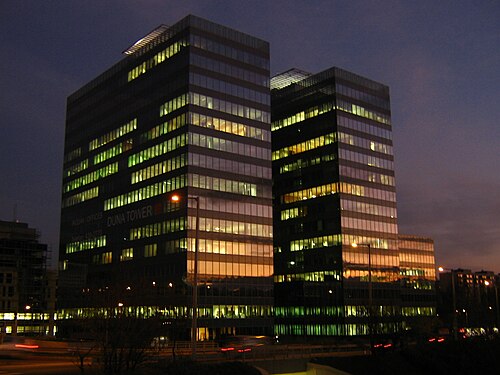



ハンガリーの経済は
発展途上であり、[1] 高所得の 混合経済であり、経済複雑性指数によると9番目に複雑な経済にランクされています。 [26] ハンガリーは経済協力開発機構(OECD)の加盟国であり、非常に高い人間開発指数と熟練労働力を持ち、ジニ係数による所得格差は世界で22番目に低い。ハンガリーの経済は、年間生産高2650億3700万ドルで世界第53位の経済大国( IMFの測定では188カ国中)であり、[27]購買力平価で測定した一人当たりGDPでは世界第41位です。ハンガリーは輸出志向の市場経済であり、対外貿易を重視しているため、世界で35番目に輸出量の多い国です。ハンガリーは2015年に1000億ドル以上の輸出があり、90億300万ドルの高水準の貿易黒字を計上した。そのうち79%は欧州連合(EU)向けで、21%はEU域外との貿易だった。[28]ハンガリーの生産能力の80%以上は民間所有であり、全体の39.1%が課税されており、これが国の福祉経済の資金となっている。支出面では、家計消費がGDPの主な構成要素で全体の50%を占め、次いで総固定資本形成が22%、政府支出が20%となっている。[29]
ハンガリーは、中央および東ヨーロッパで外国直接投資を誘致する主要国の一つであり続けています。2015年のハンガリーの対内直接投資は1198億ドルで、ハンガリーは海外に500億ドル以上を投資しています。[30] 2015年現在、ハンガリーの主要貿易相手国は、ドイツ、オーストリア、ルーマニア、スロバキア、フランス、イタリア、ポーランド、チェコ共和国でした。[31]主要産業には、食品加工、医薬品、自動車、情報技術、化学、冶金、機械、電気製品、観光(2014年にハンガリーは1210万人の海外観光客を迎えました)があります。[32]ハンガリーは、中央および東ヨーロッパ最大の電子機器生産国です。電子機器の製造と研究は、この国の革新と経済成長の主な原動力の一つです。過去20年間で、ハンガリーはモバイルテクノロジー、情報セキュリティ、および関連ハードウェア研究の主要な中心地にも成長しました。[33]ハンガリーの雇用率 は2017年1月に68.7%となり、 [34]雇用構造は脱工業化経済の特徴を示している。就労者の推定63.2%がサービス部門で働いており、工業が29.7%、農業が7.1%を占めている。失業率は2017年9月から11月にかけて3.8%となり、[35]大不況時の11%から低下した。ハンガリーは4億4800万人以上の消費者を代表する欧州単一市場の一部である。いくつかの国内商業政策は、欧州連合加盟国間の協定とEUの法律によって決定されている。
ハンガリーの大企業は、ブダペスト証券取引所に上場されているハンガリーの株価指数であるBUXに含まれています。よく知られている企業には、Graphisoft、Magyar Telekom、MKB Bank、MOL Group、Opus Global、OTP Bank、RÁBA Automotive Group、Gedeon Richter、Zwack Unicumなどがあります。ハンガリーには、多くの自動車産業のサプライヤーやテクノロジーの新興企業など、専門の中小企業も多数あります。[36]
ブダペストはハンガリーの金融とビジネスの中心地です。首都は重要な経済の中心地であり、グローバリゼーションと世界都市研究ネットワークの調査ではアルファワールド都市に分類されており、ヨーロッパで2番目に急速に発展している都市経済です。市の一人当たりGDPは前年の2014年と比較して2.4%増加し、雇用は4.7%増加しました。[37] [38]国レベルでは、ブダペストはハンガリーのビジネスにとって主要な都市であり、国民所得の39%を占めています。市の2015年の都市部総生産は1000億ドルを超え、欧州連合で最大の地域経済の1つとなっています。[39] [40]ブダペストは、プライスウォーターハウスクーパースによって測定された世界のトップ100都市にも含まれています。エコノミスト・インテリジェンス・ユニットによる世界都市競争力ランキングでは、ブダペストはテルアビブ、リスボン、モスクワ、ヨハネスブルグなどよりも上位にランクされています。[41] [42]
ハンガリーは自国通貨ハンガリー・フォリント(HUF)を維持しているが、公的債務を除いて経済はマーストリヒト基準を満たしている。公的債務対GDP比は2019年で66.4%とEU平均を大幅に下回っている。ハンガリー国立銀行はオーストリア=ハンガリー帝国の解体後、1924年に設立された。現在は物価安定に注力しており、インフレ目標は3%である。[43]
ハンガリー経済の歴史

アルパード時代
封建制の時代、土地は経済の重要な要素でした。新しい経済社会秩序により、土地の私有化が起こりました。土地には、王室、教会、世俗の私有地の 3 つの形態があります[要説明] 。アルパード王朝の王室地は、部族の土地から発展したものです[要説明] 。
世俗的な私有地の起源は、部族の共有地の征服にまで遡ります[説明が必要]。これは、次第に社会を統括するようになり、リーダーとなる人々の私有地を超えて成長しました。
しかし、建国以来、王からの贈与は世俗の私有財産の枠を倍増させる要因にもなった。この組織は、聖ステファノ1世によって与えられた古代の土地と所有物、そして王からの寄進という2つの要素を持つ封建領地を発展させた。ベーラ3世は、収入一覧によると当時のヨーロッパの君主の中で最も裕福であったが、一覧の信頼性は疑問視されている。後者の直系相続人によって与えられた無制限の権利は、所有者に対してほぼ国王に戻された。1351年に法律が改正され、貴族の所有物の自由な処分が廃止された。貴族が相続した土地を売却することは禁じられた。
カルパティア盆地は、大規模な家畜の放牧よりも農業に適していたため、農業の割合が着実に増加しました。11 世紀と 12 世紀には、自然農法と土壌改良耕作システムが融合し、家畜を放牧し、肥料を与えられた土地を枯渇するまで利用しました。農業に最も重要な道具は、鋤と牛でした。
アンジュー時代
近代


第二次世界大戦前のハンガリー経済は、主に農業と小規模製造業が中心であった。ハンガリーはヨーロッパで戦略的な位置にあり、天然資源が比較的少ないため、伝統的に外国貿易に依存してきた。例えば、ハンガリー最大の自動車メーカーであるマゴモビル(マゴシックスのメーカー)は、合計で数千台を生産した。[44] 1920年代初頭には繊維産業が急速に拡大し始め、1928年にはハンガリーの外国貿易で最も重要な産業となり、その年には6千万ペンゴ以上の価値のある繊維製品を輸出した。MÁVAGなどの企業はインドや南米に機関車を輸出しており、同社の機関車601号機は当時 ヨーロッパで最大かつ最強の機関車であった。
戦後のハンガリー共産主義
1940 年代後半から、共産党政府は産業の国有化を開始しました。最初は、従業員 100 人以上の工場のみが国有化されましたが、後にこの制限は 10 人にまで引き下げられました。農業では、政府は集団化のプログラムを成功裏に開始しました。1950 年代初頭から、ますます多くの新しい工場が建設されました。この急速で強制的な工業化は、より自給自足の経済を奨励する取り組みの一環として、標準的なスターリン主義のパターンに従ったものでした。ほとんどの経済活動は、国有企業または協同組合と国営農場によって行われました。1968 年、スターリン主義の自給自足主義は「新経済メカニズム」に置き換えられ、ハンガリーは外国貿易に再び開放され、市場の機能に制限のある自由が与えられ、限られた数の中小企業がサービス部門で営業できるようになりました。
ハンガリーは旧東側諸国の中で最も自由で経済的に進んだ経済を享受していたが、1970年代には農業と工業の両方が投資不足に悩まされ始め、ハンガリーの純対外債務は主に消費者補助金と採算の取れない国営企業により、1973年の10億ドルから1993年には150億ドルへと大幅に増加した。経済停滞に直面して、ハンガリーは合弁事業法を可決し、所得税を導入し、国際通貨基金(IMF)と世界銀行に加盟することで、さらなる自由化を選択しました。1988年までに、ハンガリーは2層銀行システムを開発し、共産主義後の時代の野心的な市場志向の改革への道を開いた重要な企業法を制定しました。
市場経済への移行(1990-1995)

共産主義の崩壊後、旧東側諸国は一党独裁の中央計画経済から複数党制の市場経済へと移行しなければならなかった。ソ連の崩壊により、東側諸国は商品市場とソ連からの補助金の両方で大きな損失を被った。[45]たとえばハンガリーは「東欧と中央ヨーロッパの輸出市場の約 70% を失った」。ハンガリーの対外市場の喪失により「採算が取れず、救済不可能な工場がすべて閉鎖されたため、80 万人の失業者が出た」。 [46 ]共産主義崩壊後にハンガリーに大きな影響を与えたソ連の補助金のもう 1 つの形態は、社会福祉プログラムの喪失である。補助金の不足と支出削減の必要性から、ハンガリーでは支出を抑えるために多くの社会プログラムを削減しなければならなかった。その結果、ハンガリーの多くの人々は市場経済への移行中に信じられないほどの苦難を経験した。ハンガリーの企業に対する民営化と減税の後、失業率は1991年に突然12%に上昇した(1990年には1.7%だった)。その後、2001年まで徐々に減少した。経済成長は、1991年に-11.9%に落ち込んだ後、1990年代末まで年平均4.2%で徐々に増加した。新しい市場経済の安定化に伴い、ハンガリーは外国投資の増加を経験し、[47] [48]「1989年以来の累計外国直接投資は600億ドル以上」となった。[49]
1990~94 年のアンタル政権は、価格と貿易の自由化措置、税制の改革、市場ベースの銀行システムの導入など、市場改革に着手した。しかし、1994 年までに、政府の過剰支出と民営化への消極的な姿勢の代償がはっきりと見えてきた。消費者補助金の削減により、食品、医薬品、輸送サービス、エネルギーの価格が上昇した。旧ソ連圏への輸出の減少と工業生産の縮小により、GDP は急激に低下した。失業率は 1993 年に約 12% に急上昇した。対外債務負担は欧州でも最も高い水準で、年間輸出収入の 250% に達し、予算と経常収支の赤字は GDP の 10% に近づいた。通貨切り下げ(輸出を支援するため)は、賃金の物価スライドなど、効果的な安定化策を講じずに行われたため、極めて高いインフレ率を引き起こし、1991 年には 35% に達し、1994 年まで若干減少したが、1995 年に再び上昇した。1995 年 3 月、ジュラ・ホルン首相率いる政府は、債務の削減、経常収支赤字の削減、公共支出の縮小を目的として、緊縮財政プログラムを実施し、国有企業の積極的な民営化と輸出促進の為替制度を導入した。1997 年末までに、公共部門の連結赤字は GDP の 4.6% に減少し、公共部門の支出は GDP の 62% から 50% 未満に減少した。経常収支赤字は GDP の 2% に減少し、政府債務は年間輸出収入の 94% にまで減った。[要出典]

ハンガリー政府はもはや IMF の金融支援を必要とせず、同基金に対する債務を全額返済した。その結果、ハンガリーは有利な借入条件を享受している。ハンガリーの外貨建て国債は、すべての主要格付け機関から投資適格格付けを受けているが、最近、ハンガリーはムーディーズ、S&P によって格下げされ、フィッチでは引き続きネガティブな見通しとなっている。1995 年、ハンガリーの通貨フォリント (HUF) はすべての経常勘定取引で交換可能となり、 1996 年のOECD加盟後はほぼすべての資本勘定取引でも交換可能となった。1995 年以来、ハンガリーはフォリントを通貨バスケット (米ドルが 30%) に固定し、バスケットに対する中心レートは事前に発表されたレート (当初は月 0.8%) で切り下げられ、フォリントは現在完全に変動相場制となっている。政府の民営化プログラムは1998年に予定通り終了し、現在ではGDPの80%が民間部門によって生み出されており、[13]金融機関の70%、産業の66%、通信の90%、貿易部門の50%は外国人所有者によって支配されている。[要出典]

ハンガリーのGDPは1990年から1993年にかけて約18%減少し、1996年までわずか1~1.5%の成長にとどまったが、1997年には輸出が好調だったためGDP成長率は4.4%にまで上昇し、他のマクロ経済指標も同様に改善した。これらの成功により、政府は1996年と1997年に、完全積立年金制度の導入(チリの年金制度を一部モデルに大幅な修正を加えたもの)、高等教育の改革、国庫の創設など、主要な構造改革に集中することができた。残された経済課題としては、財政赤字とインフレの削減、安定した対外収支の維持、税制、医療、地方自治体の財政構造改革の完了などがある。近年、ハンガリーの経済政策の最重要目標は、2004年後半に加盟した欧州連合への加盟準備である。
1989年の政権交代以前は、ハンガリーの貿易の65%はコメコン諸国との貿易だった。1997年末までに、ハンガリーは貿易の多くを西側諸国にシフトした。現在、EU諸国との貿易が全体の80%を占めている。[50]ハンガリーにとってドイツは最も重要な貿易相手国である。米国はハンガリーにとって6番目に大きな輸出市場となり、ハンガリーは米国にとって72番目に大きな輸出市場にランクされている。両国間の二国間貿易は1997年に46%増加し、10億ドルを超えた。米国はハンガリーに最恵国待遇、一般特恵関税制度、海外民間投資公社保険、輸出入銀行へのアクセスを与えた。[要出典]
ハンガリーは、1989 年以来約 180 億ドルの外国直接投資 (FDI) を受けており、旧ソ連を含む中央および東ヨーロッパの FDI の 3 分の 1 以上を誘致しています。このうち約 60 億ドルはアメリカ企業によるものです。外国資本は、熟練した比較的安価な労働力、税制優遇措置、近代的なインフラ、優れた通信システムによって誘致されています。[引用が必要]
2006年までにハンガリーの経済見通しは悪化した。賃金の伸びは他の地域諸国と同程度だったが、この伸びは主に政府支出の増加によるものだった。その結果、財政赤字はGDPの10%以上に膨れ上がり、インフレ率は6%を超えると予測された。クリントン政権の経済学者ヌリエル・ルービニは「ハンガリーはいつ事故が起きてもおかしくない」と述べた。[51]
ハンガリーの民営化
1990年1月、民営化の第一歩を担う国家民営化庁(SPA、Állami Vagyonügynökség )が設立された。ハンガリーの対外債務は212億ドルに上り、政府は国有財産を国民に無償で分配するのではなく売却することを決定した。[52]ポピュリスト団体は、複数の企業の経営陣が買い手を探し、売却条件について交渉する権利を有し、企業を「盗む」行為を行ったとして、SPAを攻撃した。不満のもう1つの理由は、国が多額の税制優遇措置や環境投資を行っていたことであり、その費用は企業の売却価格を上回ることもあった。企業買収とともに、外国人投資家は多くの「グリーンフィールド投資」を開始した。[52]
1990年から1994年まで中道右派のハンガリー民主フォーラム政権は、農業協同組合を分割し、機械と土地を元組合員に与えることで、農業協同組合を廃止することを決定した。[53]政府はまた、1948年に国有化される前に土地を所有していた人々にバウチャーを提供する補償法を導入した。これらの人々(またはその子孫)は、バウチャーを農業協同組合が以前所有していた土地と交換することができ、農業協同組合はこの目的のために土地の一部を放棄することを余儀なくされた。[53]
1990年から1994年にかけて小規模な店舗や小売業が民営化されたが、テスコ、コーラ、イケアなどの外国小売企業によるグリーンフィールド投資はより大きな経済的影響を与えた。[52]国営通信会社マタフ、国営石油ガス複合企業MOLグループ、電力供給・生産会社MVMグループなど多くの公益事業も民営化された。[54]
ほとんどの銀行は外国投資家に売却されたが、最大の銀行である国立貯蓄銀行(OTP)はハンガリー人の所有のままであった。株式の20%〜20%は外国の機関投資家に売却され、社会保障機関に寄付され、5%は従業員が購入し、8%はブダペスト証券取引所で公開された。[55]
1995年以降のハンガリーの経済


1995年になると、ハンガリーの財政指標は悪化した。外国投資が減少し、経済見通しに関する外国人アナリストの判断も下がった。[56]輸入品の需要が高いため、ハンガリーは貿易赤字も大きく[57] 、予算赤字も膨らみ、 IMFとも合意に達することができなかった。[56] [58] 1か月以上財務大臣 が不在だった後、首相のホルン・ギュラは1995年3月1日、ラヨシュ・ボクロスを財務大臣に任命した。彼は1995年3月12日、一連の緊縮財政措置(「ボクロス・パッケージ」)を導入した。その主要点は、フォリントの1回限りの9%の切り下げ、定常的なスライド切り下げの導入、エネルギー源を除くすべての商品への8%の追加関税、公共部門の賃金上昇の制限、民営化の簡素化と加速であった。この政策には、高等教育や歯科医療の無料化の廃止、所得や資産に応じた家族手当、育児手当、出産手当の削減、医薬品補助金の引き下げ、退職年齢の引き上げなど、福祉削減も含まれていた。
これらの改革は投資家の信頼を高めただけでなく[59]、IMFと世界銀行からも支持された[60] 。しかし、ハンガリー国民からは広く歓迎されなかった。ボクロスは人気のマイナス記録を打ち破った。国民の9%が彼を「重要な政治的地位」に就かせたいと望んでいた[61]のに対し、改革が「国の財政を大幅に改善する」と確信したのはわずか4%だった[56]。
1996年、財務省は完全に国が支援する年金制度に代わる新しい年金制度を導入した。社会保障を50%、積立金を50%とする民間の年金貯蓄口座が導入された。[60]
2006年、フェレンツ・ギュルチャーニ首相は「緊縮財政なしの経済改革」を公約に掲げて再選された。しかし、2006年4月の選挙後、ギュルチャーニ率いる社会党連合は、2008年までに財政赤字をGDPの3%に削減することを目的とした緊縮財政策を発表した。[62]
緊縮財政政策により、ハンガリーの経済は2007年に減速した。[62]
大不況
大不況の間、ハンガリーは輸出の減少、国内消費の減少、固定資産の蓄積の影響を受け、同国は史上最悪の経済収縮の一つとなる-6.4%という深刻な不況に陥った。
2008年10月27日、ハンガリーは金融の安定と投資家の信頼の回復を目指し、250億ドルの救済パッケージについてIMFおよびEUと合意した。 [63]
危機の不確実性のため、銀行は融資を減らし、投資の減少につながった。これに加えて価格意識と破産への恐怖が消費の落ち込みを招き、失業が増加し、消費がさらに減少した。インフレは大幅に上昇しなかったが、実質賃金は減少した。[64]
ユーロとスイスフランがフォリント建てで以前よりも価値が高まったという事実は、多くの人々に影響を与えた。デイリー・テレグラフ紙によると、「統計によると、ハンガリーの住宅ローンと自動車ローンの60%以上が外貨建てである」という。[65] 2010年にヴィクトル・オルバーン首相率いるフィデス党の新政権が誕生した後、ハンガリーの銀行は外貨建て住宅ローンをフォリント建てに転換することを余儀なくされた。[66]新政府はまた、130億ドルの民間年金基金資産を国有化し、政府の債務残高の補填に充てられるようにした。[67]
2008年以降のハンガリー経済の不況
2011年には税率の低下とGDP成長率の緩やかな1.7%を記録し、経済は回復の兆しを見せた。[68]
2011年11月から2012年1月にかけて、3つの主要格付け機関はすべてハンガリーの債務を非投資投機的格付け、いわゆる「ジャンク債」に格下げした。[69] [70] [71]これは、ハンガリー国立銀行の独立性に疑問を抱かせる政治的変化が一因となっている。[72] [69] [70]
欧州委員会のジョゼ・マヌエル・バローゾ委員長は、ヴィクトル・オルバーン首相に書簡を送り、政治介入を認める中央銀行の新規制はハンガリーの利益を「深刻に損なう」ため、財政支援策に関する協議を延期すると述べた。オルバーン首相は「合意に達しなくても、我々は依然として自立する」と返答した。[66]
欧州委員会は2012年1月17日にハンガリーに対する訴訟手続きを開始した。手続きはそれぞれハンガリーの中央銀行法、裁判官と検察官の定年、およびデータ保護局の独立性に関するものである。[73] [74]その翌日、オルバーンは書簡で、違反訴訟で提起された問題に対する解決策を見つける意欲を示した。[75] 1月18日、彼はハンガリーの件も扱った欧州議会の全体会議に出席した。彼は「ハンガリーは欧州の原則に基づいて刷新され、再編された」と述べた。彼はまた、欧州連合が提起した問題は「容易に、単純に、そして非常に迅速に」解決できると述べた。彼はさらに、欧州委員会の異議はハンガリーの新憲法に影響を与えなかったと付け加えた。[76] [77]
2012年の緩やかな景気後退の後、GDPは2014年から再び上昇し、委員会の2015年冬季予測に基づくと3.3%に加速すると予測された。よりダイナミックな経済パフォーマンスは、緩やかに成長する国内需要に起因し、総固定資本形成の成長を支えた。しかし、この急増(2014年上半期の3.8%)は、EU基金の吸収強化や中小企業向け融資を補助する中央銀行の成長資金スキームなどの一時的な措置と要因によってのみ達成された。[78]成長の基礎は2015年も大幅に変化せず、政府はEU資金移転を支援し、経済活性化のための中央銀行融資が適度に成功したことで、GDPの順調な成長が促進された。
コロナ禍におけるハンガリー経済とその後
ハンガリーのGDP、一人当たりGDP、生活水準、賃金は、新型コロナウイルス感染症のパンデミックが始まるまで着実に上昇していましたが、ヨーロッパの他の国々と同様に、上記の統計は急落しました。GDPは1,550億ドルに減少し、GDP PPPは3,220億ドルに減少し、一人当たりGDPは15,855ドルに、インフレ率はわずかに上昇して4.54%となりました。
国家債務は大幅に増加し、債務対GDP比は以前の60~65%から約80%となった。
国は大きな打撃を受け、失業率もロックダウンが停止した2021年まで平均より高かった。GDP、一人当たりGDP、GDP PPP、失業率、国家債務はすべてコロナ前の値まで回復した。[要出典]一方、インフレ率は記録的なレベルまで上昇し、2022年12月には24.5%に達し、ヨーロッパで最も高かった。[79]
物理的特性
天然資源
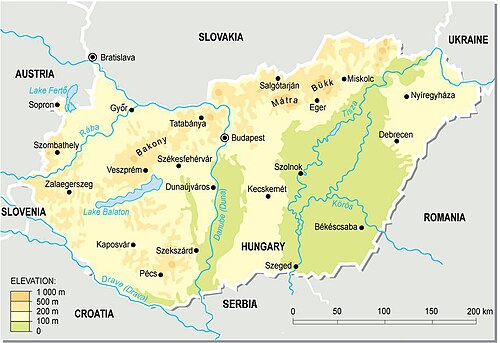
ハンガリーの総陸地面積は 93,030 km 2で、水面面積は 690 km 2であり、合計するとヨーロッパの面積の 1% を占めます。
ハンガリーの国土の約 75% は平野です。国土のさらに 20% は標高が最大 400 メートルの丘陵地帯で、残りの 5% は高地と水面です。
ハンガリーの面積の4分の3を占める2つの平原は、大ハンガリー平原と小ハンガリー平原である。ハンガリーの最も重要な天然資源は耕作地である。国土全体の約83%が耕作に適しており、[80]このうち75%(国土の約50%)が耕作地で覆われており、これは他のEU諸国と比較して際立った割合である。[80]ハンガリーには、さらなる産業発展に必要なエネルギーと原材料の豊富な国内資源が不足している。
国土の 19% は森林に覆われています。森林は主に北ハンガリー山脈、トランスダヌビア山脈、アルポカリャなどの丘陵地帯にあります。森林の構成は多様で、ほとんどがオークやブナですが、他にモミ、ヤナギ、アカシア、プラタナスなどがあります。

ハンガリーの地下水資源はヨーロッパでも最大級である。そのためハンガリーには小川や温泉、薬効のある温泉やスパが豊富にあり、2003年時点で30℃以上の水温の湧く泉が1250ヶ所ある。[81]ハンガリーの飲料水の90%は主にこのような水源から汲み上げられている。[82]
ハンガリーの主要河川はドナウ川とティサ川です。ドナウ川は、ドイツ、オーストリア、スロバキア、セルビア、ルーマニアの一部も流れています。ハンガリー国内では、418 km にわたって航行可能です。ティサ川は、国内で 444 km にわたって航行可能です。ハンガリーには 3 つの大きな湖があります。最大のバラトン湖は、長さ 78 km、幅 3~14 km、面積 592 km 2です。バラトン湖は、中央ヨーロッパ最大の湖で、観光地やレクリエーション エリアとして賑わっています。浅瀬は夏には海水浴に適しており、冬には凍った表面でウィンター スポーツの場となります。より小さな水域には、フェイェール県のヴェレンツェ湖(26 km 2 ) や、ハンガリー国内の フェルテー湖(82 km 2 ) などがあります。
国内の水は危険にさらされている。流入する水よりも流出する水の方が多いからだ。2022年には、ヨーロッパ全土に影響を及ぼしている深刻な干ばつにより、ヴェレンツェ湖、バラトン湖、ドナウ川、ティサ川などが危険にさらされている。前述の川の流れは19世紀後半に変更されており、大規模な洪水を防ぎ水上輸送を助けた一方で、大規模な農作物の散水をサポートできないなどの欠点があり、2022年の干ばつを悪化させている。アルフォルド水道システムの大規模な改革と再構築が必要だが、2022年時点では政府からそのような計画は発表されていない。
インフラストラクチャー
輸送
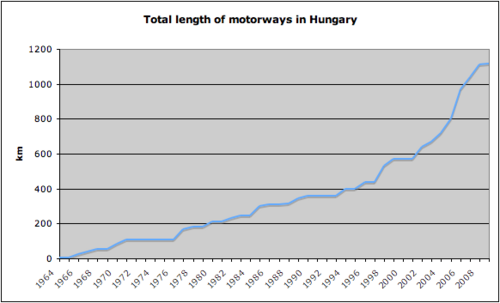
ハンガリーには 31,058 km の道路と1,118 km の高速道路があります。高速道路の総延長は過去 10 年間で倍増しており、最も長い (106) km の高速道路は 2006 年に建設されました。ブダペストは高速道路でオーストリア、スロバキア、スロベニア、クロアチア、ルーマニア、セルビアの国境に直接つながっています。
ハンガリーは位置と地理的特徴から、複数の交通回廊がハンガリーを横断しています。汎ヨーロッパ回廊IV、V、Xと、ヨーロッパルートE60、E71、E73、E75、E77がハンガリーを通過します。放射状の道路網のおかげで、これらすべてのルートはブダペストに接続しています。

ハンガリーには国際空港が5つ、国内線が4つ、軍用空港が4つ、民間空港が数か所ある。最大の空港はブダペストの南東の境界に位置するブダペスト・フェリヘジ国際空港(BUD)である。2008年には、同空港の到着客は3,866,452人、出発客は3,970,951人であった。[83]
2006年、ハンガリーの鉄道網は全長7,685kmに達し、そのうち2,791kmが電化されていた。
公共事業
ハンガリーのすべての集落で電気が利用できます。
パイプラインによるガス供給は2873の集落で利用可能で、これは全体の91.1%にあたる。[84] 2009年1月に起きたウクライナのパイプラインの停止によるガス不足を回避するため、[85]ハンガリーはナブッコとサウスストリームの両パイプラインプロジェクトに参加している。ハンガリーには戦略的なガス埋蔵量もあり、最新の埋蔵量は12億立方メートルで、2009年10月に開放された。[86]
2008年には、94.9%の世帯に水道が通っていました。[87]人々に健康的な水を供給するのは地方自治体の責任ですが、[88]ハンガリー政府と欧州連合は、水道や下水道を開発したい人に補助金を出しています。[89]これらの補助金のおかげで、住宅全体の71.3%が下水道に接続されており、2000年の50.1%から増加しています。[90]
インターネットの普及率はここ数年で大幅に上昇しており、インターネット接続を持つ世帯の割合は2005年の22.1%(うちブロードバンド49%)から2008年には48.4%(うちブロードバンド87.3%)に上昇した。[91]
経済運輸省は、図書館、学校、文化センターなどの公共スペースに「eHungaryポイント」を設置し、ハンガリーのすべての人にインターネットアクセスを提供することを目的としたeHungaryプログラムを導入しました。[92]このプログラムには、「専門家が電子情報、サービス、知識の効果的な使用について国民を支援するサービスであるeCounsellorネットワークの導入」も含まれています。[93]
セクター
2022年にハンガリーで登録された企業数が最も多い部門はサービス業で273,851社、次いで金融、保険、不動産・小売業がそれぞれ113,153社、87,237社となっている。[94]
農業
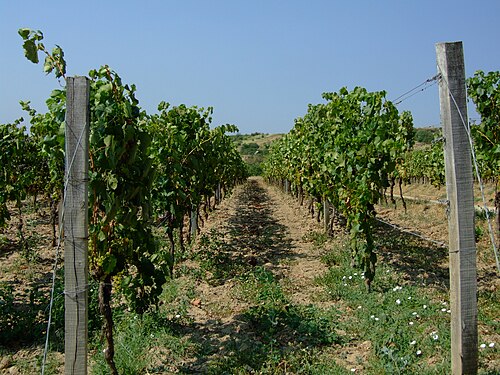
2008年の農業はGDPの4.3%を占め[95]、食品産業とともに労働力の約7.7%を占めた。[96]これら2つの数字は主要な農業生産のみを表している。関連事業と合わせると、農業はGDPの約13%を占める。[80]ハンガリーの農業は実質的に自給自足であり、伝統的な理由から輸出志向である。[80]農業関連の輸出は全体の20~25%を占める。ハンガリーの全陸地面積の約半分が耕作地であり、この比率は他のEU加盟国の中でも際立っている。[80]これは、大陸性気候やハンガリーの国土の約半分を占める平野など、この国にとって有利な条件によるものである。最も重要な作物は、小麦、トウモロコシ、ヒマワリ、ジャガイモ、テンサイ、キャノーラ、および多種多様な果物(特にリンゴ、桃、ナシ、ブドウ、スイカ、プラムなど)である。ハンガリーには、世界的に有名な白のデザートワイン「トカイ」や赤ワイン「ブルズ・ブラッド」などを生産するワイン産地がいくつかあります。もう一つの世界的に有名な伝統的なアルコール飲料は、フルーツブランデーの「パーリンカ」です。
ハンガリーでは主に牛、豚、鶏、羊が飼育されています。家畜には、ホルトバージ国立公園の主要な観光名所であるハンガリー灰色牛が含まれます。この国の食文化の重要な構成要素はフォアグラで、約33,000人の農家がフォアグラ産業に従事しています。ハンガリーはフォアグラの世界第2位の生産国であり、最大の輸出国(主にフランスへの輸出)でもあります。
ハンガリーの農業と料理のもう一つの象徴はパプリカ(甘口と辛口の両方)です。ハンガリーは世界有数のパプリカ生産国で、セゲドとカロチャが生産の中心地です。
Hungary produced, in 2018, 7.9 million tons of maize (15th largest producer in the world); 5.2 million tons of wheat; 1.8 million tons of sunflower seed (8th largest producer in the world); 1.1 million tons of barley; 1 million tons of rapeseed (14th largest producer in the world); 941 thousand tons of sugar beet, which is used to produce sugar and ethanol; 674 thousand tons of apple; 539 thousand tons of grape; 330 thousand tons of potato; 330 thousand tons of triticale; in addition to smaller productions of other agricultural products.[97]
Health care

Hungary has a tax-funded universal healthcare system, organized by the state-owned National Healthcare Fund (Hungarian: Országos Egészségbiztosítási Pénztár (OEP)). Health insurance is not directly paid for by children, mothers or fathers with baby, students, pensioners, people with socially poor background, handicapped people (including physical and mental disorders),[98] priests and other church employees.[99] Health in Hungary can be described with a rapidly growing life expectancy and a very low infant mortality rate (4.9 per 1,000 live births in 2012).[100] Hungary spent 7.4% of the GDP on health care in 2009 (it was 7.0% in 2000), lower than the average of the OECD. Total health expenditure was 1,511 US$ per capita in 2009, 1,053 US$ governmental-fund (69.7%) and 458 US$ private-fund (30.3%)[101] but has now risen to 2047 US$ per capita (as per 2018 data), roughly a 33% increase total, with the government funding 1439 US$ (70.3%) of the total versus the private funding 608 US$ (29.7%).[102] This amount totals to 6.6% of the country's total GDP, roughly a percent decrease overall.[103]
Industry
The main sectors of Hungarian industry are heavy industry (mining, metallurgy, machine and steel production), energy production, mechanical engineering, chemicals, food industry and automobile production. The industry is leaning mainly on processing industry and (including construction) accounted for 29.32% of GDP in 2008.[104] Due to the sparse energy and raw material resources, Hungary is forced to import most of these materials to satisfy the demands of the industry. Following the transition to market economy, the industry underwent restructuring and remarkable modernization. The leading industry is machinery, followed by chemical industry (plastic production, pharmaceuticals), while mining, metallurgy and textile industry seemed to be losing importance in the past two decades. In spite of the significant drop in the last decade, food industry is still giving up to 14% of total industrial production and amounts to 7–8% of the country's exports.[105]
Nearly 50% of energy consumption is dependent on imported energy sources. Gas and oil are transported through pipelines from Russia forming 72% of the energy structure, while nuclear power produced by the nuclear power station of Paks accounts for 53,6%.
Automobile production

Hungary is a favoured destination of foreign investors of automotive industry resulting in the presence of General Motors (Szentgotthárd), Magyar Suzuki (Esztergom), Mercedes-Benz (Kecskemét), BMW (Debrecen), BYD (Szeged), and Audi factory (Győr) in Central Europe.
_%E2%80%93_Frontansicht,_10._M%C3%A4rz_2012,_D%C3%BCsseldorf.jpg/500px-Mercedes-Benz_B_180_BlueEFFICIENCY_(W_246)_%E2%80%93_Frontansicht,_10._M%C3%A4rz_2012,_D%C3%BCsseldorf.jpg)
17% of the total Hungarian exports comes from the exports of Audi, Opel and Suzuki. The sector employs about 90,000 people in more than 350 car component manufacturing companies.[107]
Audi has built the largest engine manufacturing plant of Europe (third largest in the world) in Győr becoming Hungary's largest exporter with total investments reaching over €3,300 million until 2007.[108] Audi's workforce assembles the Audi TT, the Audi TT Roadster and the A3 Cabriolet in Hungary.[108] The plant delivers engines to carmakers Volkswagen, Skoda, Seat and also to Lamborghini.[108]
Daimler-Benz invests €800 million ($1.2 billion) and creates up to 2,500 jobs at a new assembly plant in Kecskemét, Hungary[109] with capacity for producing 100,000 Mercedes-Benz compact cars a year.[110]
Opel produced 80,000 Astra and 4,000 Vectra cars from March 1992 until 1998 in Szentgotthárd, Hungary.[111] Today, the plant produces about half million engines and cylinder heads a year.[111]
BMW announced in 2018, that it will build a car factory near Debrecen, that will produce around 150, 000 cars per yeaer. [112]
In 2021 BYD announced its plan to build a car factory near Szeged as its first European factory.[113]
Battery production
Hungary is rapidly becoming a significant player in the battery production industry. The country has attracted substantial investments, including a new gigafactory by the Chinese company Contemporary Amperex Technology Co. Limited (CATL) in Debrecen. This factory is expected to produce 100 gigawatt hours (GWh) of battery capacity annually by the end of the decade, enough to equip a million electric vehicles.[114]
Services
The tertiary sector accounted for 64% of GDP in 2007 and its role in the Hungarian economy is steadily growing due to constant investments into transport and other services in the last 15 years. Located in the heart of Central-Europe, Hungary's geostrategic location plays a significant role in the rise of the service sector as the country's central position makes it suitable and rewarding to invest.
The total value of imports was 68.62 billion euros, the value of exports was 68.18 billion euros in 2007. The external trade deficit decreased by 12.5% since the previous year, easing down from 2.4 billion to 308 million euros in 2007. In the same year, 79% of Hungary's export and 70% of the imports were transacted inside the EU.[115]
Tourism

Tourism employs nearly 150 thousand people and the total income from tourism was 4 billion euros in 2008.[116] One of Hungary's top tourist destinations is Lake Balaton, the largest freshwater lake in Central Europe, with a number of 1.2 million visitors in 2008. The most visited region is Budapest, the Hungarian capital attracted 3.61 million visitors in 2008.
Hungary was the world's 24th most visited country in 2011.[117] The Hungarian spa culture is world-famous, with thermal baths of all sorts and over 50 spa hotels located in many towns, each of which offer the opportunity of a pleasant, relaxing holiday and a wide range of quality medical and beauty treatments.
Currency
The currency of Hungary is the Hungarian forint (HUF, Ft) since 1 August 1946. A forint consists of 100 fillérs; however, since these have not been in circulation since 1999, they are only used in accounting.
There are six coins (5, 10, 20, 50, 100, 200)[118] and six banknotes (500, 1000, 2000, 5000, 10,000 and 20,000).[119] The 1 and 2 Forint coins were withdrawn in 2008, yet prices remained the same as stores follow the official rounding scheme[120] for the final price. The 200 Forint note was withdrawn on 16 November 2009.[121]
The fulfillment of the Maastricht criteria
1 Current EU member states that have not yet adopted the Euro, candidates and official potential candidates.
² No more than 1.5% higher than the 3 best-performing EU member states.
³ No more than 2% higher than the 3 best-performing EU member states.
4 Formal obligation for Euro adoption in the country EU Treaty of Accession or the Framework for membership negotiations.
5 Values from May 2008 report.[126] To be updated each year.
Socioeconomic characteristics
Human capital

Education in Hungary is free and compulsory from the age of 5 to 16.[127] The state provides free pre-primary schooling for all children, 8 years of general education and 4 years of upper secondary level general or vocational education.[127] Higher education system follows the three-cycle structure and the credit system of the bologna process.[127] Governments aim to reach European standards and encourage international mobility by putting emphasis on digital literacy, and enhancing foreign language studies: all secondary level schools teach foreign languages and at least one language certificate is needed for the acquisition of a diploma.[127] Over the past decade, this resulted in a drastic increase in the number of people speaking at least one foreign language.[128]
Hungary's most prestigious universities are:
- Semmelweis University with five schools (medical school, dentistry, pharmacy, nursing and physical education).
- Eötvös Loránd University (Eötvos Loránd Tudományegyetem, or ELTE, which is among the top 500 universities in the world[129])
- Budapest University of Technology and Economics (Budapesti Műszaki és Gazdaságtudományi Egyetem, or BME) BME is considered the oldest Institutes of Technology of university rank and structure in the world. Established 1782.
- Corvinus University of Budapest (Budapesti Corvinus Egyetem, or BCE)
- Central European University (Közép-európai Egyetem, or CEU)
- University of Pécs (Pécsi Tudományegyetem, or PTE)
- University of Miskolc (Miskolci Egyetem or ME)
- University of Szeged (Szegedi Tudományegyetem or SZTE) In 2010, the QS World University Rankings put the University of Szeged as 451st–500th among universities globally.
- University of Debrecen (Debreceni Egyetem or DE)
Financial sources for education are mainly provided by the state (making up 5.1–5.3% of the annual GDP).[127] In order to improve the quality of higher education, the government encourages contributions by students and companies. Another important contributor is the EU.[127]
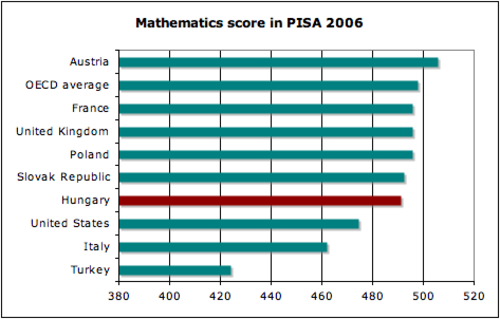
The system has weaknesses, the most important being segregation and unequal access to quality education.[127] The 2006 PISA report concluded that while students from comprehensive schools did better than the OECD average, pupils from vocational secondary schools did much worse.[130] Another problem is of the higher education's: response to regional and labour market needs is insufficient.[127] Government plans include improving the career guidance system and establishing a national digital network that will enable the tracking of jobs and facilitate the integration into the labour market.[127]
Brain drain
Hungary has one of the highest levels of citizen emigration inside the EU,[131] particularly among young people. Of those immigrating 44% are under 30 and 77% are under 40. Most who leave the country and migrate to western or central Europe.[131] Current immigration is exceedingly high, with 239,924 Hungarians immigrating abroad since 2010,[132][131] peaking in 2015. Young women tend to be one of the main groups emigrating.[133] The increase in immigration coincides with the Fidesz party coming to power in 2010.[131] Common destination countries include Germany, Austria, and the United Kingdom.[131][132]
Common reasons for immigrating include low wages when compared to the rest of the EU.[134] According to the Hungarian Central Statistical Office the number of Hungarian students enrolled in university decreased by 25% from 2003 to 2013, roughly a third of those immigrating are college graduates leading to brain drain.[135] Compounding this is that the Hungarian Forint tends to be less stable then the Euro and often suffers from high levels of inflation.[136][137] Other than economic reasons, familial, social, and educational factors also contribute.[138][139] The high rate of immigration coupled with low birth rates (1.59 births per woman) results in Hungary's aging and decreasing population.[140][141]
Social stratification
As most post-communist countries, Hungary's economy is affected by its social stratification in terms of income and wealth, age, gender and racial inequalities.[142]

Hungary's Gini coefficient of 0.269[143] ranks 11th in the world.[144] The graph on the right shows that Hungary is close in equality to the world-leader Denmark. The highest 10% of the population gets 22.2% of the incomes.[143] According to the business magazine Napi Gazdaság, the owner of the biggest fortune, 300 billion HUF, is Sándor Demján.[145] On the other hand, the lowest 10% gets 4% of the incomes. Considering the standard EU indicators (Percentage of the population living under 60% of the per capita median income), 13% of the Hungarian population is stricken by poverty.[146] According to the Human Development Report, the country's HPI-1 value is 2.2% (3rd among 135 countries),[147] and its HDI value is 0.879 (43rd out of 182).[147]
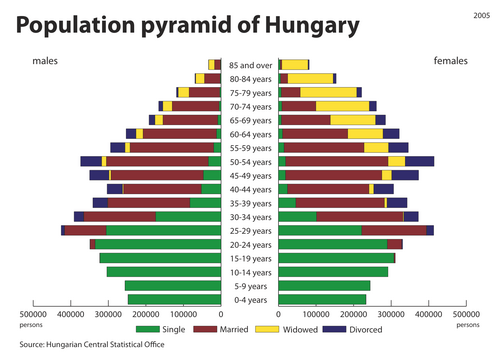
The fertility rate in Hungary, just like in many European countries, is very low: 1.34 children/women (205th in the world)[148] Life expectancy at birth is 73.3 years.,[148] while the expected number of healthy years is 57.6 for females and 53.5 for males. The average life expectancy overall is 73.1 years.[149]
Hungary's GDI (gender-related development index) value of 0.879[147] is 100% of its HDI value (3rd best in the world).[147] 55.5% of the female population (between 15 and 64) participate in the labour force, and the ratio of girls to boys in primary and secondary education is 99%.[148]
Ethnic inequality, which strikes primarily Roma in Hungary, is a serious problem. Although the definition of the Roma identity is controversial,[150] qualitative studies prove that the Roma employment rate decreased significantly following the fall of Communism:[151] due to the tremendous layoffs of unskilled workers[152] during the transition years, more than one-third of Roma were excluded from the labour market.[153] Therefore, this ethnic conflict is inherently interconnected with the income inequalities in the country[154] – at least two-thirds of the poorest 300,000 people in Hungary are Romas.[154] Furthermore, ethnic discrimination is outstandingly high, 32% of Romas experience discrimination when looking for work.[155] Consequently, new Roma entrants to the labour market are rarely able to find employment,[153] which creates a motivation deficit and further reinforces segregation and unemployment.[156]
Institutional quality
Twenty years after the change of the regime, corruption remains a severe issue in Hungary.[157] According to Transparency International Hungary, almost one-third of top managers claim they regularly bribe politicians.[157] Most people (42%) in Hungary think that the sector most affected by bribery is the political party system.[158] Bribery is common in the healthcare system in the form of gratitude payment–92% of all people think that some payment should be made to the head surgeon conducting a heart operation or an obstetrician for a child birth.[159]
Another problem is the administrative burden: in terms of the ease of doing business, Hungary ranks 47th out of 183 countries in the world.[160] The five days' time[148] required to start a new business ranks 29th, and the country is 122nd concerning the ease of paying taxes.[161]
In accordance with the theory of the separation of powers, the judicial system is independent from the legislative and the executive branches.[162] Consequently, courts and prosecutions are not influenced by the government. However, the legal system is slow and overburdened, which makes proceedings and rulings lengthy and inefficient.[163] Such a justice system is hardly capable of prosecuting corruption and protecting the country's financial interests.[157]
Unemployment in Hungary
State participation
Monetary policy
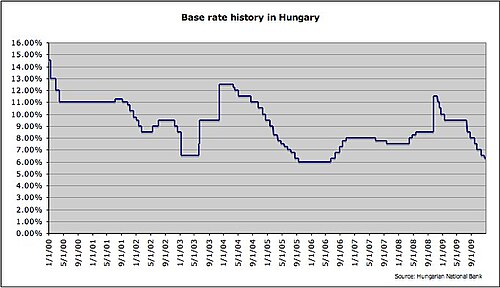

The Hungarian organization responsible for controlling the country's monetary policy is the Hungarian National Bank (Hungarian: Magyar Nemzeti Bank, MNB) which is the central bank in Hungary.[164] According to the Hungarian Law of National Bank (which became operative in 2001. – LVIII. Law about The Hungarian National Bank[165]), the primary objective of MNB is to achieve and maintain price stability. This aim is in line with the European and international practice.
Price stability means achieving and maintaining a basically low, but positive inflation rate. This level is around 2–2.5% according to international observations, while the European Central Bank "aims at inflation rates of below, but close to 2% over the medium term".[166] Since Hungary is in the process of catching up (Balassa-Samuelson effect), the long-term objective is a slightly higher figure, around 2.3–3.2%.[167] Therefore, the medium term inflation target of the Hungarian National Bank is 3%.[168]
Concerning the exchange rate system, the floating exchange rate system is in use since 26 February 2008, as a result of which HUF is fluctuating in accordance with the effects of the market in the face of the reference currency, the euro.
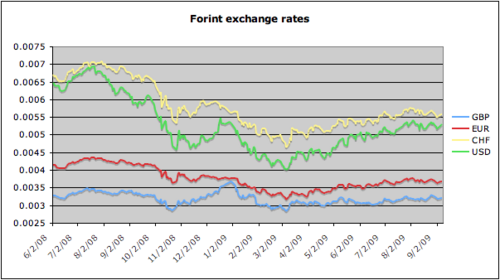
The chart on the right shows forint exchange rates for the British pound (GBP), euro (EUR), Swiss franc (CHF), and the U.S. dollar (USD) from June 2008 to September 2009. It indicates that a relatively strong forint weakened during the Great Recession, and that its value increased afterwards.
Compared to the euro the forint was at peak on 18 June 2008 when 1000 Ft was €4.36 and €1 was 229.11Ft. The forint was worth the least on 6 March 2009; this day 1000 Ft was €3.16 and €1 was 316Ft).
Compared to USD, most expensive/cheapest dates are 22 June 2008 and 6 March 2009 with 1000HUF/USD rates 6.94 and 4.01 respectively.
On 24 March 2015 the Euro was at 299.1450 and USD was at 274.1650,
Fiscal policy
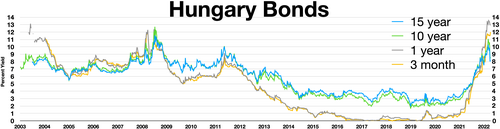
15 year
10 year
1 year
3 month
In Hungary, state revenue makes up 44% and expenditure makes up 45% of the GDP which is relatively high compared to other EU members.[169] This can be traced back to historical reasons such as socialist economic tradition as well as cultural characteristics that endorse paternalist behaviour on the state's part, meaning that people have a habitual reflex that make them call for state subsidies.[170] Some economists[who?] dispute this point, claiming that expenditure ran up to today's critical amount from 2001, during two left-wing government cycles.[169]
Along with joining the EU the country undertook the task of joining the Eurozone as well. Therefore, the Maastricht criteria which forms the condition of joining the Eurozone acts as an authoritative guideline to Hungarian fiscal politics. Although there has been remarkable progress, recent years' statistics still point at significant discrepancies between the criteria and fiscal indices. The target date for adapting the Euro has not been fixed, either.
General government deficit has shown a drastic decline to −3.4% (2008) from −9.2% (2006).[171] According to an MNB forecast however, until 2011, the deficit will by a small margin fall short of the 3.0% criterion.[172]
Another criterion that is found lacking is the ratio of gross government debt to GDP which, since 2005, exceeds the allowed 60%.[173] According to an ESA95 figure, in 2008 the ratio increased from 65.67% to 72.61%, which primarily results from the requisition of an IMF-arranged financial assistance package.[174]
Hungary's balance of payments on its current account has been negative since 1995, around 6–8% in the 2000s[175] reaching a negative peak 8.5% in 2008.[175][176]
Tax system
In Hungary, the 1988 reform of taxes introduced a comprehensive tax system which mainly consists of central and local taxes, including a personal income tax, a corporate income tax and a value added tax.[177] Among the total tax income the ratio of local taxes is solely 5% while the EU average is 30%.[178] Until 2010, the taxation of an individual was progressive, determining the tax rate based on the individual's income: with earning up to 1,900,000 forints a year, the tax was 18%, the tax on incomes above this limit was 36% since 1 July 2009.[179]
Based on the new one-rate tax regime introduced January 2011, the overall tax rate for all income-earnings bands has been 16%. According to the income-tax returns of 2008, 14,6% of taxpayers was charged for 64,5% of the total tax burdens.[180] Before the new corporate income tax regime, the corporate tax was fixed at 16% of the positive rateable value, with an additional tax called solidarity tax of 4%, the measure of which is calculated based on the result before tax of the company (the solidarity tax has been in use since September, 2006). The actual rateable value might be different is the two cases. From January 2011, under the new corporate income tax regime the tax rate was divided into two parts (i) corporations having income before tax below 500 million HUF (appr. USD 2.5 million) was lowered to 10% and (ii) 16% remained for all other companies until 2013. After this, the unified corporate income tax rate will be 10%, irrespectively from the size of the net income before tax. In January 2017, corporate tax was unified at a rate of 9% – the lowest in the European Union. The rate of value added tax in Hungary is 27%, the highest in Europe, since 1 January 2012.[181]
Miscellaneous data
The following table shows the main economic indicators in 1980–2021. Inflation under 2% is in green.[182]
Households with access to fixed and mobile telephony Quick facts – Telecommunication market in Hungary – Hungarian Statistical office (3Q 2011) [permanent dead link]
- number of households – 4,001,976 (October 2011)
- number of landline telephones – 2,884,000 (October 2011)
- landline telephones / households – 72.1% (October 2011)
- landline telephones / inhabitants – 28.9% (October 2011)
- number of mobile telephone subscriptions – 11,669,000 (October 2011)
- mobile telephone subscriptions / inhabitants (Mobile telephone penetration) – 117.1% (December 2011)
Broadband penetration rate
- number of fixed broadband – 2,111,967 (October 2011)
- number of mobile broadband – 1,872,178 (October 2011)
- fixed broadband per households – 52.8% (December 2011)
- mobile broadband per households – 43.4% (January 2012)
Individuals using computer and internet[183]
- computer – 65% (2009)
- internet – 62% (2009)
External relations
Hungary joined the European Union on 05/01/2004 after a successful referendum[184] among the EU-10. The EU's free trade system helps Hungary, as it is a relatively small country and thus needs export and import.
After the accession to the EU, Hungarian workers could immediately go to work to Ireland, Sweden and the United Kingdom. Other countries imposed restrictions.[185]
In 2007, 25% of all exports of Hungary were of high technology, which is the 5th largest ratio in the European Union after Malta, Cyprus, Ireland, and the Netherlands. The EU10 average was 17.1% and the Eurozone average was 16% in 2007.[148]
See also


- List of Hungarian counties by GDP
- List of Hungarians by net worth
- Taxation in Hungary
- Science and technology in Hungary
- Education in Hungary
- List of Hungarian companies
- Budapest Stock Exchange
- Budapest metropolitan area
- Hungarian National Bank
- Economy of Europe
- Economy of the European Union
References
- ^ a b "World Economic Outlook Database Groups and Aggregates Information April 2024". IMF.org. International Monetary Fund. Retrieved 21 April 2024.
- ^ "World Bank Country and Lending Groups". datahelpdesk.worldbank.org. World Bank. Retrieved 29 September 2019.
- ^ "Hungary Population (2024) - Worldometer". www.worldometers.info.
- ^ a b c d e f "World Economic Outlook database: April 2024". IMF.org. International Monetary Fund. Retrieved 21 April 2024.
- ^ a b c d e f g h "The World Factbook". Central Intelligence Agency. Retrieved 18 January 2019.
- ^ "Inflation rate of Hungary, 2024". European commission.
- ^ "EN". Mnb.hu. Retrieved 8 October 2017.
- ^ "Poverty headcount ratio at national poverty lines (% of population) – Hungary". data.worldbank.org. World Bank. Retrieved 2 December 2021.
- ^ "People at risk of poverty or social exclusion". ec.europa.eu. Eurostat.
- ^ "Gini coefficient of equivalised disposable income – EU-SILC survey". ec.europa.eu/eurostat. Eurostat.
- ^ a b "Human Development Report 2023/2024" (PDF). United Nations Development Programme. 13 March 2024. Archived (PDF) from the original on 13 March 2024. Retrieved 28 April 2024.
- ^ "Corruption Perceptions Index". Transparency International. 30 January 2024. Archived from the original on 30 January 2024. Retrieved 15 July 2024.
- ^ a b "Employment and activity by sex and age, age group 15–64". ec.europa.eu/eurostat. Eurostat. Retrieved 3 December 2021.
- ^ "Employment rate by sex, age group 20-64". ec.europa.eu/eurostat. Eurostat. Retrieved 20 July 2024.
- ^ "About Hungary". Hungarian Investment Promotion Agency. Retrieved 23 May 2017.
- ^ "Unemployment by sex and age – monthly average". appsso.eurostat.ec.europa.eu. Eurostat. Retrieved 30 November 2021.
- ^ "Unemployment rate by age group". appsso.eurostat.ec.europa.eu. Eurostat. Retrieved 30 November 2021.
- ^ a b ".In January–December 2017 The value of exports amounted to EUR 100.6 billion (HUF 31,103 billion) and that of imports to EUR 92.5 billion (HUF 28,602 billion). EUR/USD was 1,25x100.6 and 92.5". Hungarian Central Statistical Office.
- ^ a b c d e f "Euro area and EU27 government deficit both at 0.6% of GDP" (PDF). ec.europa.eu/eurostat. Eurostat. Retrieved 28 April 2020.
- ^ "Archived copy" (PDF). Archived (PDF) from the original on 25 December 2017. Retrieved 25 December 2017.
{{cite web}}: CS1 maint: archived copy as title (link) - ^ "Archived copy" (PDF). Archived (PDF) from the original on 20 April 2017. Retrieved 25 December 2017.
{{cite web}}: CS1 maint: archived copy as title (link) - ^ "S&P upgrades Hungary in surprise gift to PM Orban". Reuters. 16 September 2016. Retrieved 13 January 2017.
- ^ "Moody's upgrades Hungary's government bond ratings to Baa3; stable outlook". 4 November 2016. Retrieved 13 January 2017.
- ^ "Fitch Upgrades Hungary to 'BBB'; Outlook Stable". 10 November 2017. Retrieved 23 January 2018.
- ^ "Scope affirms Hungary's credit ratings at BBB with Stable Outlook". 26 January 2024. Retrieved 27 January 2024.
- ^ "World Bank Country Classification". Retrieved 30 September 2014.
- ^ "Hungary". International Monetary Fund. Retrieved 6 September 2015.
- ^ "External trade surplus was EUR 604 million in December". Hungarian Central Statistical Office. 10 March 2016. Retrieved 10 March 2016.
- ^ "GDP – composition, by end use". CIA World Factbook. 2016. Archived from the original on 12 February 2018. Retrieved 11 March 2016.
- ^ "Hungary". CIA World Factbook. 2016. Retrieved 11 March 2016.
- ^ "Export Partners of Hungary". CIA World Factbook. 2016. Archived from the original on 12 February 2018. Retrieved 11 March 2016.
- ^ Tourism Highlights 2015 Edition. World Tourism Organization. 10 March 2016. doi:10.18111/9789284416899. ISBN 9789284416899.
- ^ "Electronics". HIPA. Archived from the original on 15 March 2016. Retrieved 11 March 2016.
- ^ "In the period of July–September 2017, the average number of employed people was 4,451 thousand, 60 thousand more than a year earlier. The employment rate of people aged 15–64 increased to 68.7%". KSH. Retrieved 26 October 2017.
- ^ "In the period of September–November 2017, the average number of unemployed people was 178 thousand, 30 thousand fewer than a year earlier, and the unemployment rate decreased by 0.7 percentage point to 3.8%". Hungarian Central Statistical Office. Retrieved 4 January 2018.
- ^ "Top – Hungary". startupRANKING. Retrieved 10 March 2016.
- ^ "BUDAPEST EUROPE'S SECOND FASTEST-DEVELOPING URBAN ECONOMY, STUDY REVEALS – The study examines the development of the world's 300 largest urban economies, ranking them according to the pace of development". Brookings Institution. 23 January 2015. Archived from the original on 10 October 2017. Retrieved 8 March 2016.
- ^ "The World According to GaWC 2010". lboro.ac.uk. 13 April 2010. Retrieved 12 May 2014.
- ^ Istrate, Emilia. "Global MetroMonitor | Brookings Institution". Brookings.edu. Archived from the original on 5 June 2013. Retrieved 10 June 2013.
- ^ "Hungary's GDP (IMF, 2016 est.) is $265.037 billion x 39% = $103,36 billion". Portfolio online financial journal. Archived from the original on 3 March 2016. Retrieved 10 June 2013.
- ^ "Benchmarking global city competitiveness" (PDF). Economist Intelligence Unit. 2012. Archived from the original (PDF) on 9 July 2014. Retrieved 12 May 2014.
- ^ "ukmediacentre.pwc.com". PricewaterhouseCoopers. Archived from the original on 31 May 2013. Retrieved 12 May 2014.
- ^ "Monetary Policy". Hungarian National Bank. Retrieved 10 March 2016.
- ^ G.N. Georgano Cars: Early and Vintage, 1886–1930. (London: Grange-Universal, 1985)
- ^ "Warum die UdSSR nicht in die DDR einmarschierte". 3 October 2015. Retrieved 18 February 2020.
- ^ Spaller, Endre. "The Political and Economic Transition in Hungary". Medi(t)ations, (re)conciliations: Conflict Resolution and European Integration (PDF). Bratislava. pp. 85–90.
- ^ Megginson, William L.; Netter, Jeffry M. (2001). "From State to Market: A Survey of Empirical Studies on Privatization". Journal of Economic Literature. 39 (2): 321–389. doi:10.1257/jel.39.2.321. hdl:10419/154955.
- ^ Mihályi, P. (2001). "Foreign Direct Investment in Hungary – the Post-Communist Privatisation Story Re-Considered" (PDF). Acta Oeconomica. 51: 107–129. doi:10.1556/AOecon.51.2000-2001.1.5. S2CID 154331929.
- ^ "CIA – The World Factbook – Hungary". 28 March 2023.
- ^ Stalker, Peter (2010). A guide to countries of the world. Oxford paperback reference. Oxford university press. ISBN 978-0-19-958072-9.
- ^ Lynch, David J. (23 June 2006). "Hungary faces enormous economic hurdles". USA Today. Retrieved 5 December 2008.
- ^ a b c Iván Major (2003). Privatization in Hungary and its Aftermath. Edward Elgar Publishing. ISBN 978-1-84064-613-9. Retrieved 5 January 2010.
- ^ a b B. Vizvári; Zs. Bacsi (2 June 2003). "Structural Problems in Hungarian Agriculture After the Political Turnover". Journal of Central European Agriculture. Retrieved 5 January 2010.
- ^ Árpád Kovács. "Privatisation in Hungary (1990–2000)" (PDF). Archived from the original (PDF) on 7 June 2011. Retrieved 5 January 2010.
- ^ Anna Canning; Paul Hare. "Political Economy of Privatization in Hungary: A Progress Report" (PDF). Edinburgh: Department of Economics, Heriot-Watt University. Archived from the original (PDF) on 3 October 2011. Retrieved 5 January 2010.
- ^ a b c "Hungarian Finance Minister Lajos Bokros Explains His Package". The World Bank. Retrieved 12 November 2009.
- ^ "External trade by groups of countries in HUF (1991–2003)". KSH. Retrieved 12 November 2009. [dead link]
- ^ "Viták kereszttüzében: a Bokros-csomag (The Bokros Package in the Crossfire)" (in Hungarian). Világgazdaság Online. 15 December 2008. Archived from the original on 16 March 2010. Retrieved 12 November 2009.
- ^ "Background Note: Hungary". Bureau of Public Affairs: Electronic Information and Publications Office. June 2009. Retrieved 12 November 2009.
- ^ a b Mitchell A. Orenstein (2008). Privatizing pensions: the transnational campaign for social security reform. Princeton University Press. ISBN 978-0-691-13697-4. Retrieved 12 November 2009.
- ^ "Romló közhangulat, stabilizálódó Fidesz-előny (Deteriorating Public Morale, Fidesz's Advantage Stabilizing" (in Hungarian). Medián. 14 February 2007. Archived from the original on 16 February 2007. Retrieved 12 November 2009.
- ^ a b Inc, IBP (11 September 2015). Hungary Investment and Business Guide Volume 1 Strategic and Practical Information. Lulu.com. ISBN 978-1-5145-2857-0.
{{cite book}}:|last=has generic name (help) - ^ Kate Connolly; Ian Traynor (29 October 2008). "Hungary receives rescue package, with strings attached". The Guardian. Retrieved 18 January 2010.
- ^ "Economy and Society, January–March 2009" (PDF). Hungarian Central Statistical Office. Retrieved 18 January 2010.
- ^ Damien Mc Elroy (26 February 2009). "Global Financial Crisis: Hungary". The Daily Telegraph. London. Retrieved 18 January 2010.
- ^ a b Zoltan Simon (30 December 2011). "Hungary's Bailout Chance Wanes as Lawmakers Snub IMF, EU Over Central Bank". Bloomberg. Retrieved 30 December 2011.
- ^ Zoltan Simon (22 December 2011). "Hungary Top Court May Rule on Pension Fund Nationalization Case". Bloomberg. Retrieved 30 December 2011.
- ^ "Hungary GDP grows 1.4% yr/yr in Q4, up 1.7% in 2011". BBJ. Archived from the original on 29 March 2012. Retrieved 15 February 2012.
- ^ a b "Hungary borrowing costs rise on junk downgrade". BBC. 22 December 2011. Retrieved 27 December 2011.
- ^ a b "Hungary: playing chicken". The Guardian. 25 December 2011. Retrieved 27 December 2011.
- ^ "Third ratings agency gives Hungary a junk credit rating". BBC. 6 January 2012. Retrieved 9 January 2012.
- ^ Terminal Risks for Independent Fiscal Institutions: Lessons from IFIs in Hungary and Venezuela. Social Science Research Network (SSRN). Accessed 18 July 2017.
- ^ Barroso says unwillingness of Hungary to make changes pushes EC to act against Budapest Archived 18 January 2012 at the Wayback Machine, Politics.hu, 17 January 2012; accessed 21 January 2012
- ^ EU opens legal action against Hungary over new laws, BBC News, 17 January 2012; accessed 21 January 2012
- ^ Orbán says Hungary ready to cooperate to resolve EU infringement issues Archived 26 November 2013 at the Wayback Machine, Politics.hu, 18 January 2012; accessed 21 January 2012
- ^ Orbán tells European Parliament disputes a natural result of Hungarian government's “magnificent” efforts Archived 26 November 2013 at the Wayback Machine, Politics.hu, 18 January 2012; accessed 21 January 2012
- ^ Hungary PM Orbán fights back in European Parliament, BBC News, 18 January 2012; accessed 21 January 2012
- ^ Commission Staff Working Document: Country Report Hungary 2015 including an in-depth review on the prevention and correction of macroeconomic imbalances http://ec.europa.eu/europe2020/pdf/csr2015/cr2015_hungary_en.pdf
- ^ "Drivers of Inflation: Hungary". IMF. Retrieved 13 July 2023.
- ^ a b c d e "The Hungarian agriculture and food industry in figures" (PDF). Ministry of Agriculture and Rural Development. 2008. p. 5. Archived from the original (PDF) on 21 July 2011. Retrieved 31 December 2009.
- ^ "A hévízfeltárás, -termelés, -hasznosítás alakulása (Figures of the Exploration, Production, and Utilization of Thermal Springs)" (in Hungarian). Hungarian Ministry of Environment and Water. Archived from the original on 3 July 2007. Retrieved 18 January 2010.
- ^ "Magyarország természetföldrajzi adottságai (Geographical Properties of Hungary)" (in Hungarian). Retrieved 18 January 2010.
- ^ "Traffic of Budapest/Ferihegy Airport". Hungarian Central Statistical Office. Retrieved 18 January 2010. [dead link]
- ^ "Több villamosenergiát, de kevesebb gázt fogyasztott a lakosság (People Use more Electricity but Less Gas)" (in Hungarian). Hungarian News Agency Corp. 8 November 2009. Retrieved 18 January 2010. [permanent dead link]
- ^ Krisztina Than; Balazs Koranyi (7 January 2009). "Hungary receives no gas via Ukraine, industry suffers". Reuters. Archived from the original on 1 February 2013. Retrieved 18 January 2010.
- ^ "Átadták a biztonsági földgáztárolót Algyőn (Security Gas Reserve Opened in Algyő)" (in Hungarian). Hungarian News Agency Corp. 1 October 2009. Archived from the original on 10 May 2010. Retrieved 18 January 2010.
- ^ "Settlements and dwellings with public water supply". Hungarian Central Statistical Office. Retrieved 18 January 2010. [dead link]
- ^ Ibolya Gazdag; János Rémai. "Hungarian National Wastewater Program". Hungarian Ministry of Transport, Communication, and Water Management. Archived from the original on 21 July 2011. Retrieved 18 January 2010.
- ^ "Hungary: Water & Wastewater Industry". 18 February 2009. Archived from the original on 20 January 2013. Retrieved 18 January 2010.
- ^ "Settlements and dwellings with public sewerage". Hungarian Central Statistical Office. Retrieved 18 January 2010. [dead link]
- ^ "ICT usage in households and by individuals". Hungarian Central Statistical Office. Retrieved 18 January 2010. [dead link]
- ^ "eHungary Program 2.0" (PDF). Hungarian Ministry of Economy and Transport. Archived from the original (PDF) on 28 August 2008. Retrieved 18 January 2010.
- ^ Marianna Posfai (8 January 2008). "eHungary". Retrieved 18 January 2010.
- ^ "Industry Breakdown of Companies in Hungary". HitHorizons.
- ^ "Value and distribution of gross value added by industries". Hungarian Central Statistical Office. 2009. Retrieved 31 December 2009. [dead link]
- ^ "Number of employed persons by industries". Hungarian Central Statistical Office. 2009. Retrieved 31 December 2009. [dead link]
- ^ "FAOSTAT". www.fao.org.
- ^ "Nemzeti Egészségbiztosítási Alapkezelő" (PDF).
- ^ "Figyelő online -Társadalom – Dőzsölők és szűkölködők – Miből gazdálkodnak az egyházak?". Figyelő.hu. Archived from the original on 17 April 2015. Retrieved 3 March 2015.
- ^ "STADAT – 1.1. Népesség, népmozgalom (1949– )". Retrieved 3 March 2015.
- ^ "Newsroom". Retrieved 3 March 2015.
- ^ "Hungary – OECD Data". theOECD. Retrieved 23 September 2019.
- ^ "Health resources – Health spending – OECD Data". theOECD. Retrieved 23 September 2019.
- ^ "Elemzői reakciók az ipari termelési adatra (Analysts' Reaction on Industrial Production Data)" (in Hungarian). 7 April 2009. Archived from the original on 27 February 2012. Retrieved 18 January 2010.
- ^ "Food Industry". Archived from the original on 13 July 2011. Retrieved 18 January 2010.
- ^ "Mercedes Attacks BMW From Hungary With New Facility". The Washington Post. Archived from the original on 22 July 2013. Retrieved 29 March 2012.
- ^ "Automotive Industry". Archived from the original on 13 July 2011. Retrieved 18 January 2010.
- ^ a b c "The automotive industry in Hungary – Engine of growth". The Hungarian Investment and Trade Development Agency. Archived from the original on 13 July 2011. Retrieved 27 December 2009.
- ^ "Germany: Daimler Selects Plant Site". The New York Times. 19 June 2008. Retrieved 27 December 2009.
- ^ Koranyi, Balazs; Erica Billingham (27 October 2008). "Daimler sticks to Hungary investment despite crisis". Reuters. Retrieved 27 December 2009.
- ^ a b "15 éves az első magyar Opel (First Hungarian Opel Reaching Age of 15)". General Motors Corporation (in Hungarian). 8 March 2007. Archived from the original on 5 January 2010. Retrieved 2 January 2010.
- ^ Privátbankár.hu (31 July 2018). "Óriási bejelentés: Debrecen mellett épít autógyárat a BMW". Privátbankár.hu (in Hungarian). Retrieved 24 July 2024.
- ^ "Itt a nagy BYD-bejelentés, Szeged autógyártási fellegvár lesz". Infostart.hu (in Hungarian). 22 December 2023. Retrieved 24 July 2024.
- ^ "Hungary's big bet on batteries — and its costs – DW – 03/31/2023". dw.com. Retrieved 24 July 2024.
- ^ "Statisztikai Tükör (Statistical Mirror)" (PDF). Hungarian Central Statistical Office. 26 March 2008. Retrieved 18 January 2010.
- ^ "Táblamelléklet (Tables)" (PDF). Hungarian Central Statistical Office. Retrieved 18 January 2010.
- ^ "UNWTO World Tourism Barometer" (PDF). World Tourism Organization. January 2013. Archived from the original (PDF) on 19 August 2008. Retrieved 3 January 2013.
- ^ "Hungarian Forint coins". Hungarian National Bank. 2009. Archived from the original on 3 January 2010. Retrieved 19 November 2009.
- ^ "Hungarian Forint banknotes". Hungarian National Bank. 2009. Archived from the original on 8 November 2009. Retrieved 19 November 2009.
- ^ "Hungarian Forint rounding". Hungarian National Bank. 2009. Archived from the original on 21 February 2009. Retrieved 19 November 2009.
- ^ "Withdrawn banknotes and coins". Hungarian National Bank. 2009. Archived from the original on 4 March 2010. Retrieved 19 November 2009.
- ^ "Inflation".
- ^ www.ksh.hu/gyorstajekoztatok#/en/document/krm1912
- ^ "Hungary Government Debt to GDP". ec.europa.eu.
- ^ "MNB.hu". www.mnb.hu.
- ^ "Convergence Report May 2008" (PDF). Retrieved 20 September 2009.
- ^ a b c d e f g h i Ministry of Education and Culture (2008). Education in Hungary (PDF). Department for EU Relations. pp. 19–20, 25–28, 36. ISBN 978-963-87399-5-7. Archived from the original (PDF) on 2 June 2010. Retrieved 25 November 2009.
- ^ Endre Sík (2005). "Foreign Language Speakers in Hungary" (in Hungarian). Tárki Ltd. Archived from the original on 18 July 2011. Retrieved 25 November 2009.
- ^ "2009 World University Rankings". QS Intelligence Unit. Archived from the original on 17 October 2009. Retrieved 25 November 2009.
- ^ The Programme for International Student Assessment (PISA). OECD. 2006. pp. 33–34. ISBN 978-92-64-04000-7. Retrieved 25 November 2009.
- ^ a b c d e Mayo, Alexa (1 January 2021). "Does the emigration of skilled labor from Hungary merit being called a brain drain?". Honors Theses and Capstones.
- ^ a b "Hungarian Emigration | IOM Hungary". hungary.iom.int.
- ^ Czibere, Ibolya; Schranz, Edit (3 May 2020). "The Migration of Career-Starter Hungarian Graduate Women to the Countries of the European Union". Social Sciences. 9 (5): 62. doi:10.3390/socsci9050062. hdl:2437/299377.
- ^ Személyi, László; Csanády, Márton (3 June 2011). "Some Sociological Aspects of Skilled Migration from Hungary". Social Analysis: 27–46. ProQuest 1418299852 – via ProQuest.
- ^ Zrt, HVG Kiadó (15 October 2014). "Négy nyomasztó grafikon a kivándorlásról". hvg.hu.
- ^ https://www.reuters.com/markets/europe/hungarys-orban-says-central-bank-money-supply-cuts-are-too-drastic-2023-03-09/ [bare URL]
- ^ "No fruit, ham a luxury: Hungary food prices spike most in EU". AP News. 21 April 2023.
- ^ "Endangered democracy: the struggles of youth in Orban's Hungary". France 24. 8 November 2023.
- ^ "Young Hungarians weigh migration option as election nears". Reuters.
- ^ Plous, Eliza (1 January 2011). "Brain Drain Out Of Hungary And Its Inhibitors". Capstone Collection.
- ^ "Investors feel the impact of Hungary's brain drain". Reuters.
- ^ Júlia Varga, "Returns to education in Hungary." Acta Oeconomica 47.1/2 (1995): 203–215 online.
- ^ a b "Distribution of income or consumption" (PDF). World Bank. 2007. Retrieved 21 December 2009.
- ^ "A Dollar A Day – Poverty Overview – Gini Coefficient Map". Archived from the original (swf) on 19 October 2012. Retrieved 21 December 2009.
- ^ "Richest Hungarian continues to get richer". 20 June 2008. Archived from the original on 6 March 2009. Retrieved 21 December 2009.
- ^ "National Programme for the European Year for Combating Poverty and Social Exclusion". Ministry of Social Affairs and Labour. p. 2. Archived from the original on 21 July 2011. Retrieved 21 December 2009.
- ^ a b c d "Human Development Report 2009 – Hungary". United Nations Development Programme. 2009. Archived from the original on 12 October 2009. Retrieved 21 December 2009.
- ^ a b c d e "Key Development Data & Statistics". World Bank. Retrieved 21 December 2009.
- ^ "Healthy life years at birth by gender". Eurostat. 2007. Retrieved 21 December 2009.
- ^ Gábor Kertesi; Kábor Kézdi. "Roma Employment in Hungary After the Post-Communist Transition" (PDF). Budapest. Archived from the original (PDF) on 12 June 2011. Retrieved 27 December 2009.
- ^ "Inequality and discrimination in employment". 21 January 2008. Retrieved 27 December 2009.
- ^ Gábor Kertesi; Gábor Kézdi (2005). "Roma children in the transformational recession – Widening ethnic schooling gap and Roma poverty in post-communist Hungary". Budapest. Retrieved 27 December 2009.
- ^ a b Gábor Kertesi (2005). "Roma foglalkoztatás az ezredfordulón (Roma Employment on the Turn of Millennium)" (PDF) (in Hungarian). Budapest. Archived from the original (PDF) on 16 July 2011. Retrieved 27 December 2009.
- ^ a b Béla Janky (2005). "The Income Situation of Gypsy Families" (PDF). Budapest: TÁRKI. Archived from the original (PDF) on 18 July 2011. Retrieved 27 December 2009.
- ^ "Data in Focus Report: The Roma" (PDF). European Union Fundamental Rights Agency. 2009. Archived from the original (PDF) on 1 April 2010. Retrieved 27 December 2009.
- ^ "A Hernád-völgyi romák munkaerőpiaci felzárkóztatása – A program helyszínének bemutatása (Convergence of Roma Employment in the Hernád Valley–Introducing the Setting of the Program)" (in Hungarian). Budapest: Autonómia Alapítvány. Archived from the original on 5 April 2009. Retrieved 27 December 2009.
- ^ a b c "Hungary: Corruption continues". Organized Crime and Corruption Reporting Project. 16 December 2008. Retrieved 3 January 2010.
- ^ Riaño, Juanita; Hodess, Robin; Evans, Alastair (16 December 2008). "Global Corruption Barometer 2009". Transparency International. p. 8. Archived from the original on 7 June 2009. Retrieved 3 January 2010.
- ^ "Doing Business 2010 – Hungary" (PDF). Washington, D.C.: The World Bank. 2009. Archived from the original (PDF) on 2 October 2009. Retrieved 3 January 2010.
- ^ "Paying Taxes 2010 – The Global Picture" (PDF). 2009. Retrieved 3 January 2010.
- ^ "Background Note: Hungary". U.S. Department of State. June 2009. Retrieved 3 January 2010.
- ^ Ina Mimireva (29 October 2009). "Hungary Investment Climate 2009". EUbusiness. Retrieved 3 January 2010.
- ^ "Main page". www.mnb.hu.
- ^ "Törvények és OGY határozatok (Laws and Decrees)" (in Hungarian). Retrieved 18 January 2010.
- ^ "Monetary policy". Retrieved 18 January 2010.
- ^ Gergely Kiss; Judit Krekó (2004). "The Optimal Rate of Inflation in Hungary". Hungarian National Bank. Retrieved 1 November 2009. [permanent dead link]
- ^ "Közlemény a középtávú inflációs cél kitűzéséről (Announcement on Mid-term Inflation Plans)" (in Hungarian). Hungarian National Bank. 25 August 2005. Archived from the original on 16 November 2008. Retrieved 18 January 2010.
- ^ a b "A gazdasági növekedés dinamizálásának lehetősége az államháztartási kiadások csökkentése mellett (Possibilities of Boosting Economic Growth while Decreasing Public Deficit)" (PDF) (in Hungarian). Attila Bartha et al. 10 March 2009. Archived from the original (PDF) on 21 July 2011. Retrieved 18 January 2010.
- ^ "Interjú Gere Ádámmal, a Hayek Társaság elnökével (Interview with Adam Gere, Chairman of Hayek Institute)" (in Hungarian). hetek.hu. 2003. Retrieved 31 October 2009.
- ^ "Főbb makrogazdasági jelzőszámok (Main Macroeconomic Indicators)" (in Hungarian). Ministry of Finance. 2009. Archived from the original (xls) on 15 February 2010. Retrieved 31 October 2009.
- ^ "Quarterly Report on Inflation". Hungarian National Bank. August 2009. Archived from the original on 19 September 2015. Retrieved 31 October 2009.
- ^ "Introducing the Euro: convergence criteria". Europa.eu. 7 December 2006. Retrieved 31 October 2009.
- ^ "IMF, EU, and World Bank Line Up $25 Billion for Hungary". IMF Survey Magazine. 28 October 2008. Retrieved 31 October 2009.
- ^ a b "Összefoglaló makroökonómiai adatok (Summary of Macroeconomic Indicators)" (in Hungarian). Hungarian National Bank. 2009. Archived from the original (xls) on 2 January 2010. Retrieved 31 October 2009.
- ^ Dánel Baksa; et al. (18 August 2009). "Elemzés a makrogazdasági kilátásokról és a költségvetési kockázatokról (Essay on the Macroeconomic Outlook and Fiscal Risks)" (PDF) (in Hungarian). Budget Council. Archived from the original (PDF) on 4 November 2009. Retrieved 18 January 2010.
- ^ Mihály Hőgye. "Reflection on the Hungarian Tax System and Reform Steps" (PDF). Archived from the original (PDF) on 5 October 2011. Retrieved 18 January 2010.
- ^ "Adózás (Taxation)" (in Hungarian). Archived from the original on 22 September 2010. Retrieved 18 January 2010.
- ^ "Short summary on the taxation of individuals". Tax and Financial Control Administration. 1 July 2009. Archived from the original on 6 January 2010. Retrieved 18 January 2010.
- ^ "Az adózók 24 százléka vall minimálbért (24% of Taxpayers Claim They're on Minimum Wage)" (in Hungarian). Hungarian News Agency Corp. 2 September 2009. Retrieved 18 January 2010.
- ^ "Deloitte Tax News » Hungary: Corporate Income Tax and VAT changes 2012". Deloittetax.at. 1 January 2012. Retrieved 2 April 2012.
- ^ "Report for Selected Countries and Subjects". imf.org. Retrieved 30 September 2023.
- ^ "IT and telecommunications in Central and Eastern Europe". Ceeitandtelecom.com. Archived from the original on 11 October 2013. Retrieved 2 April 2012.
- ^ "Referendum on the accesion [sic] to the European Union 2003". National Election Office. 12 April 2003. Archived from the original on 13 August 2009. Retrieved 18 January 2010.
- ^ "EU free movement of labour map". London: BBC. 17 April 2009. Retrieved 18 January 2010.
External links

Wikimedia Commons has media related to Economy of Hungary.
- Economy at the Hungarian Central Statistical Office
- Ministry for National Economy – Leading economy news Archived 6 May 2017 at the Wayback Machine
- Central Bank of Hungary – Leading finance news
- Hungary profile at the CIA World Factbook
- Hungarian economy profile at The World Bank
- Hungarian economy profile at the Organisation for Economic Co-operation and Development
- Hungarian economy profile at the International Monetary Fund