
Loading article…


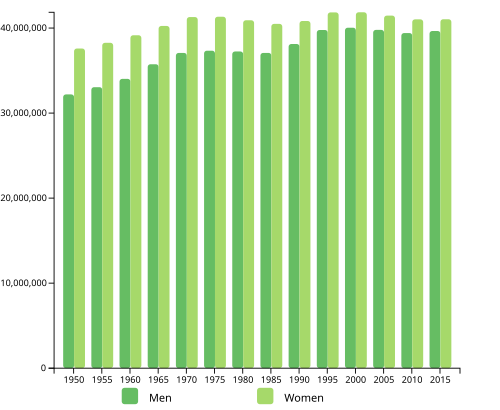
ドイツの人口統計は、ドイツ連邦統計局によって監視されています。最新のデータによると、ドイツの人口は 83,467,117 人 (2025 年 12 月 31 日) [ 1 ]で、欧州連合で最も人口の多い国であり、世界で 19 番目に人口の多い国となっています。合計特殊出生率は 2025 年に 1.32 と評価されており[ 9 ] 、人口置換水準の 2.1 を大幅に下回っています。ドイツは 1980 年代以降、世界で最も低い出生率の 1 つです。約 1.3 ~ 1.4 [ 10 ]出生率が低いため、ドイツでは 1972 年以降毎年出生数よりも死亡数が多く記録されており[ 11 ]、これは、移民がなければドイツの人口が 54 年連続で減少したことを意味します。しかし、移民のおかげで、過去半世紀で人口は実際には約500万人増加しました。2025年には、外国出身者の数は約31%でした。[ 12 ]このカテゴリーには、外国人、帰化市民、東欧からのドイツ系帰還者、および上記のすべての人々の子供が含まれます。
20世紀初頭まで、ドイツもまた大規模な移民国家でした。19世紀には、ドイツ帝国の市民500万人以上が米国に移住し、20世紀初頭には、ドイツはさらに200万人を米国に、そしてかなりの数をラテンアメリカ、カナダ、東ヨーロッパに失いました。しかし、第二次世界大戦後、約1400万人のドイツ系住民が旧ドイツ帝国の東部諸州や東ヨーロッパの他の地域から追放されたため、移民が移民を上回り始めました。このうち約1200万人が現在のドイツにたどり着き、数十万人がオーストリアや他の国に定住し、数十万人が亡くなりました。1950年以降、特に東側諸国の終焉の頃、そして主に旧ソ連、ポーランド、ルーマニアから、東ヨーロッパのドイツ系住民約450万人が帰国しました。[ 13 ] [ 14 ]
西ドイツへの大規模な移民は、1950年代から1970年代初頭にかけての経済奇跡の時代に始まりました。当時、ドイツは労働力不足に陥り、トルコ、イタリア、スペインなどの南ヨーロッパ諸国から一時的に外国人労働者として受け入れていました。外国人労働者法の自由化により、多くの人々が西ドイツに滞在し、生活を築くことができました。ドイツは20世紀末にかけて、ドイツ再統一、ユーゴスラビア紛争からの難民流入、多数のトルコ国民による亡命申請などにより、再び大規模な移民の波に見舞われました。次の大規模な移民の波は、2011年の欧州連合の東方拡大後に始まりました。東ヨーロッパの人々はビザなしでドイツに住み、働くことができるようになったためです。 2015年の欧州移民危機の間、ドイツは絶対数でも他のEU加盟国と比較しても、多数の難民を受け入れました。同国では2015年に476,649人、2016年に745,545人の亡命希望者が記録され、その後減少傾向にある。[ 15 ]
ドイツは、教育水準、技術開発、経済生産性において世界最高水準を誇っています。第二次世界大戦終結以来、大学に進学する学生数は3倍以上に増加し、職業訓練校や技術学校は世界最高水準にあります。2018年の1人当たりの所得は約40,883ユーロで、[ 16 ]ドイツは概ね中流階級の社会です。しかし、貧困の中で暮らす子どもの数は大幅に増加しています。1965年には75人に1人の子どもが福祉受給者でしたが、2007年には6人に1人に増加しました。これらの子どもたちは相対的貧困の中で暮らしていますが、必ずしも絶対的貧困の中にいるわけではありません。[ 17 ]毎年何百万人ものドイツ人が海外旅行に出かけます。社会福祉制度は、国民皆保険、失業手当、児童手当、その他の社会プログラムを提供しています。 1990年代、ドイツの高齢化と経済の低迷は福祉制度に大きな負担をかけ、政府は物議を醸した広範な緊縮財政改革プログラム「アジェンダ2010」を採用するに至った。その中には、ハルツ構想として知られる労働市場改革も含まれていた。
第二次世界大戦中の国境変動と追放の後、中央・東ヨーロッパおよび旧東部領土出身のドイツ人は、戦後のドイツへと西へ移動した。ドイツ分割時には、多くの東ドイツ出身者が政治的・経済的な理由から西ドイツへ逃れた。ドイツ再統一後も、経済的な理由から、東部の新州から西部の旧州への移住が続いている。
ドイツ連邦共和国とドイツ民主共和国は、人口動態に関して異なる道をたどった。ドイツ民主共和国の政治は出生奨励主義的であったのに対し[ 18 ]、連邦共和国の政治は補償主義的であった。
東ドイツの出生率は西ドイツよりも高かった。人口政策はその理由の一つに過ぎない。東ドイツの女性は「人生の選択肢」が少なかった。若くして母親になることが期待されていた。国が資金提供する無料の保育サービスはすべての母親が利用できた。[ 19 ]
注:ベルリンは2002年と2008年には東ドイツに含まれています。出典:Kreyenfeld (2002)、Kreyenfeld et al. (2010)、HFD Germany (2010) [ 20 ]
ベルリンの壁崩壊以来、約170万人が新連邦州(東側)を離れ、これは人口の12%に相当する。[ 21 ]そのうち35歳未満の女性の割合が不均衡に高かった。[ 22 ]
1990年以降、東ドイツの合計特殊出生率(TFR)は1994年には0.772まで低下した。これは「人口ショック」によるものとされている。人々は子供の数が減っただけでなく、東ドイツ崩壊後には結婚や離婚する可能性も低くなった。旧東ドイツ市民の人生における選択肢が増えたため、若年での出産は魅力が薄れ、第一子出産年齢が急激に上昇した。[ 19 ]
その後数年間、東ドイツの合計特殊出生率(TFR)は再び上昇し始め、1997年には1.0、2004年には1.3を超え、2007年には西ドイツのTFR(1.37)に達した。2010年には、東ドイツの出生率(1.459)は西ドイツ(1.385)を明らかに上回り、ドイツ全体のTFRは1990年以来の最高値である1.393に上昇したが[ 23 ] [ 24 ]、それでも自然置換率2.1や共産主義時代の出生率をはるかに下回っていた。2016年には、東ドイツは1.64、西ドイツは1.60であった[ 25 ] 。
1989年から2009年の間に、児童数の減少により約2,000校が閉鎖された。[ 21 ]
一部の地域では、20歳から30歳までの女性の数が30%以上減少しています。[ 21 ] 2004年には、18歳から29歳までの年齢層(家族を始める上で統計的に重要な年齢層)では、新しい連邦州(ベルリンを含む東部)では男性100人に対して女性はわずか90人でした。
2007年まで、連邦共和国の家族政策は補償型であり、貧しい家庭は裕福な家庭よりも多くの家族手当(Erziehungsgeldなど)を受け取っていた。2007年にいわゆるElterngeldが導入された。Christoph Butterweggeによれば、Elterngeldは「高学歴の女性に子供を多く産むよう促す」ことを目的としていたが、貧しい家庭はElterngeldによって不利になり、今では中流階級よりも低い児童手当しか受け取っていない。[ 26 ]非常に裕福な人々(年間25万ユーロ以上を稼ぐ人々)と福祉受給者はElterngeldの支給を受けていない。[ 27 ]
2013年には、以下の最新の動向が注目されました。[ 28 ]
新しい連邦州では、大学卒の女性の出生率が、大学卒でない女性の出生率よりも高くなっています。価値観の優先順位の違いや、東部諸州における保育サービスの充実などが、考えられる理由として議論されています。[ 29 ]
2019年、非営利のオーストリア経済研究所とベルテルスマン財団は、人口動態の経済的影響に関する研究を発表した。研究者らは、 2040年までに一人当たりの所得が3,700ユーロ減少すると想定している。 [ 30 ]

ドイツの現代の人口統計は、かつては国家が義務付けた一連の完全な国勢調査によっても測定されており、最新のものは1987年に実施された。再統一後、ドイツ当局は小規模国勢調査に頼っている。世界人口レビューによる人口統計。[ 31 ]再統一後のドイツ国民のプライバシーの懸念のため、ドイツはEUが義務付けた2011年のドイツ国勢調査まで定期的な国勢調査を実施しなかった。この要件は大きな反対を受けた。EUの要件に従い、ドイツは現在も10年ごとに国勢調査を実施し続けている。[ 32 ]

合計特殊出生率は、女性一人当たりの出生児数です。これは、全期間にわたってかなり良好なデータに基づいています。出典:Our World In DataおよびGapminder Foundation。[ 34 ]
出典:Our World In Dataおよび国連。


出典:国連世界人口予測[ 38 ]
出生時の平均余命
平均年齢:


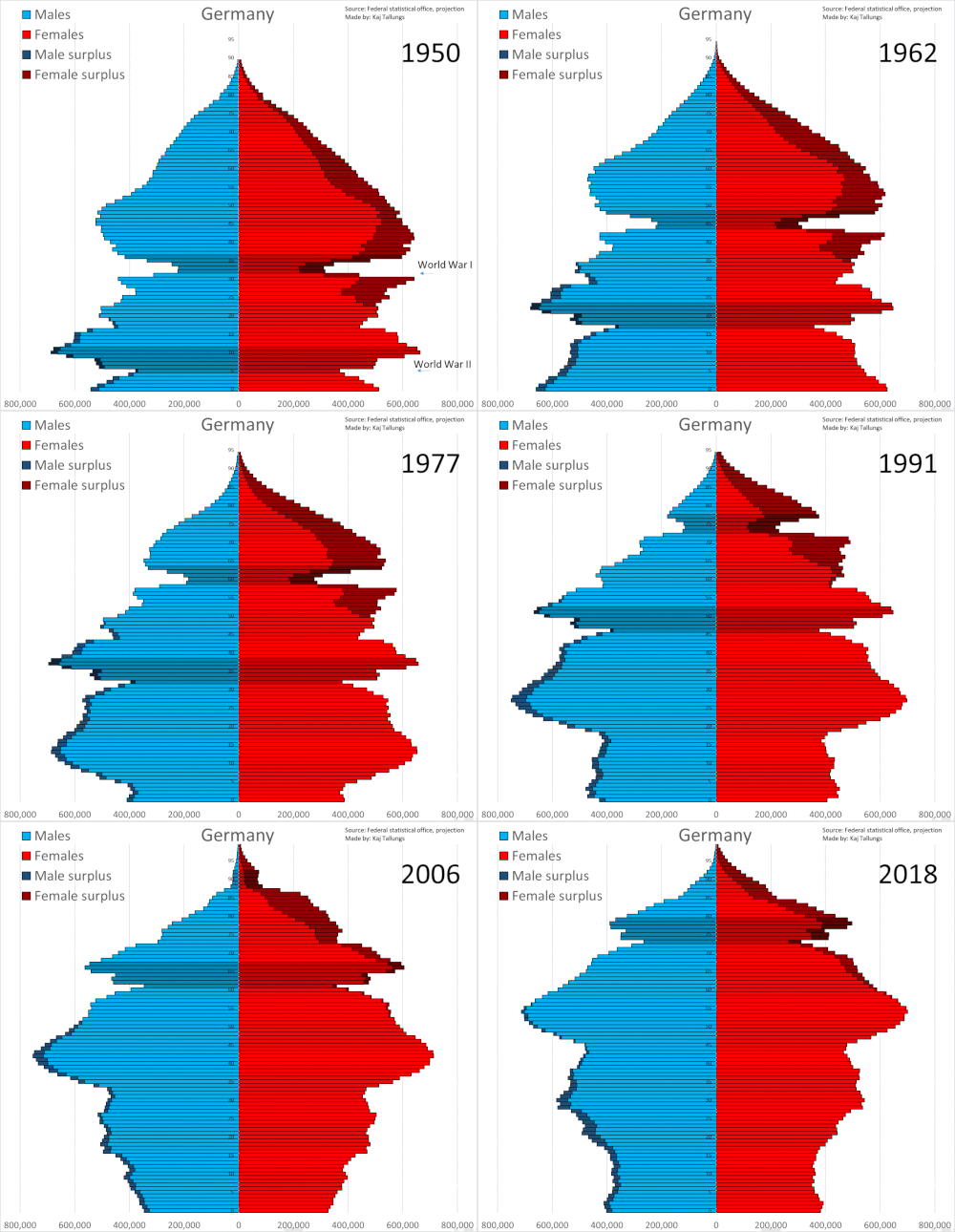

1817年以降の人口統計。[ 39 ] [ 40 ]ドイツの領土変更は、1866年(北ドイツ連邦の設立)、1871年(ドイツ統一とアルザス=ロレーヌの併合)、1918/1919年、1921/1922年、1945/1946年、および1990年に発生した。死亡データは、両世界大戦に関して若干の不正確さがある可能性がある。
ドイツの人口動態における注目すべき出来事:
– (e) = 推定値。改訂予定。
2023年には、500,670人(72.25%)の子供がドイツ国籍の母親から生まれ、96,422人(13.91%)の子供が欧州市民権(トルコを除く)の母親から生まれ、95,897人(13.84%)の子供がその他の国籍の母親から生まれた。
2011年のデータソース: 2011年から2021年の人口( 2011年の欧州連合国勢調査に基づく)[ 47 ] 2022年からの人口(2022年のドイツ国勢調査に基づく)[ 48 ]出生数[ 49 ]出生数、死亡数、自然人口変動[ 50 ]死亡数[ 51 ]合計特殊出生率[ 52 ]人口に関する最新ニュース[ 53 ]
* – 両年とも同日時点での推定値。
ドイツでは、ほとんどの出産は婚姻関係の中で行われています。2019年の778,080人の出生のうち、258,835人が未婚の両親から生まれており[ 60 ]、これは子供の約33%、つまり3分の1が婚外子であり、3分の2が婚姻関係の中で生まれていることを意味します。この未婚出産の割合は長年増加傾向にあり、2010年には33%に達し、1990年の2倍以上になりました[ 61 ]。しかし、近年は停滞、あるいは減少傾向にあります[ 62 ] 。
2008年に実施されたミクロゼンサス調査では、40歳から75歳のドイツ人女性の子供の数は、彼女の教育達成度と密接に関連していることが明らかになった。[ 63 ]西ドイツでは、高等教育を受けた女性の無子率が最も高く、26%が子供がいないと回答した。この割合は、中等教育を受けた女性では16%、義務教育のみを受けた女性では11%に低下した。しかし、東ドイツでは、同年齢層で最も教育を受けた女性の9%、中等教育を受けた女性の7%が無子であり、義務教育のみを受けた女性の12%が無子であった。
東西間の出生率の差は、東ドイツが「教育を受けた母親制度」を実施し、教育水準の高い女性の間で第一子出産を積極的に奨励したことに起因します。東ドイツは、教育を受けた女性は皆「少なくとも一人の子どもを社会主義に捧げるべきだ」というプロパガンダを流布し、教育水準の高い国民が親になることに対して経済的な報酬を与えることで、この制度を推進しました。政府は特に学生に対し、大学在学中に親になるよう説得を試み、かなりの成功を収めました。1986年には、大学卒業を控えた女性の38%が少なくとも一人の子どもの母親であり、さらに14%が妊娠中でした。また、大学卒業を控えた男性の43%が少なくとも一人の子どもの父親でした。ベルリンの壁崩壊後、出生率、特に教育を受けた層の出生率は急激に低下しました。現在では、大学卒業を控えた学生のうち親であるのはわずか5%です。
2008年当時、西ドイツの40歳から75歳の母親は、教育水準が高いほど大家族を持つ可能性が低かった。
出典: [ 64 ]
2008年に東ドイツに住んでいた母親にも同じことが言えた。
出典: [ 64 ]
2011年には、東ドイツでこの傾向が逆転し、高学歴の女性の割合が他の人口よりもやや高くなった。[ 65 ]
宗教を持たないと答えた人は、キリスト教徒だと自認する人よりも子供が少ない傾向があり、保守的なキリスト教徒はリベラルなキリスト教徒よりも子供が多いことも研究で明らかになった。[ 66 ] [ 67 ]
2005年にドイツ西部ノルトライン=ヴェストファーレン州でHDZが行った調査によると、科学者の間では子どもがいないことが特に蔓延していることが明らかになった。この調査では、同州で働く女性科学者の78%、男性科学者の71%が子どもがいないことが示された。[ 68 ]
ドイツにおけるホームレス問題は深刻な社会問題であり、約67万8000人が影響を受けていると推定されている[ 69 ]。そのうち約37万2000人は、自治体の難民シェルターなどの公共サービスによって収容されている[ 70 ] 。 2017年時点で、国内のホームレス人口は2014年以降150%増加している[ 71 ]。ホームレス人口のうち約2万2000人は子供であると報告されている[ 69 ] 。
さらに、この国はホームレスに関する統計を連邦レベルでまだ公表していないが、これは継続的かつ広範囲にわたる問題である。[ 72 ]
ドイツは国民の民族や人種に関するデータは収集していませんが、個人の出生時の出身グループに関するデータは収集しています。[ 73 ]連邦統計局は、移民の背景を持つ人を、1949年以降に現在のドイツ連邦共和国の地域に移住したすべての人、ドイツで生まれたすべての外国人、およびドイツに移住した親またはドイツで外国人として生まれた親の少なくとも1人がドイツ国民としてドイツで生まれたすべての人と定義しています。ここで提示されている数値は、この定義のみに基づいています。
2010年には、ドイツには18歳未満の子どもがいる世帯が230万世帯あり、そのうち少なくとも片方の親が外国にルーツを持っていた。これは、未成年の子どもがいる世帯全体の810万世帯の29%を占めていた。 移民の背景を持つ人口に関する詳細な情報を収集し始めたマイクロセンサスが開始された2005年と比較すると 、移民世帯の割合は2パーセントポイント上昇した。[ 74 ] 2019年には、5歳未満の子どもの40%が移民の背景を持っていた。[ 75 ]
移民の背景を持つ家族のほとんどは、ドイツ西部に住んでいます。2010年、旧西ドイツ領では、全家族に占める移民家族の割合は32%でした。この数字は、新州(ベルリンを含む)の15%の2倍以上でした。[ 74 ]東ドイツは、西ドイツに比べて移民の割合がはるかに低くなっています。これは、東ドイツがそれほど多くの外国人労働者を受け入れなかったことと、東ドイツの経済が西ドイツほど好調ではなく、最近まで失業率が高かったためです。しかし、近年、難民(およびドイツ帰還者)がケーニヒシュタイナー・シュリュッセルによって分配されるため、東ドイツでは移民の背景を持つ人の数が増加しています。そのため、ドイツの各州は、人口と経済規模に応じて同じ数の難民を受け入れなければなりません。 2019年には、移民背景を持つ人々のうち1903万6千人(89.6%)が西ドイツ(ベルリンを除く)に居住しており、これは同地域の人口の28.7%に相当する。一方、移民背景を持つ人々のうち101万6千人(4.8%)が東部諸州に居住しており、これは同地域の人口の8.2%に相当する。また、移民背景を持つ人々のうち119万4千人(5.6%)がベルリンに居住しており、これは同地域の人口の33.1%に相当する。[ 75 ]
2019年には、あらゆる年齢層のドイツ人の26%(2008年の18.4%から増加)とドイツの子供の39%(2008年の30%から増加)が、少なくとも片方の親が外国生まれでした。少なくとも片方の親が外国生まれのドイツ人の平均年齢は35.6歳(2008年の33.8歳から増加)でしたが、両親がドイツ生まれのドイツ人の平均年齢は47.3歳(2008年の44.6歳から増加)でした。[ 75 ] [ 76 ]
2022年には、15歳未満の年齢層の41%が移民の背景を持ち、15歳から49歳の年齢層の36%が移民の背景を持ち、50歳以上の年齢層の19%が移民の背景を持っていた。[ 77 ]
ドイツにおける移民系の人々のうち、最も多いのはトルコ、ポーランド、ロシアを祖先の出身地とする人々である。
2022年現在背景別の人口構成は以下のとおりでした。




他に4つの大きな集団は、それぞれの地域に何世紀にもわたって住んでいるため、 「国民的少数民族」( nationale Minderheiten )と呼ばれています。デンマーク人、フリース人、ロマとシンティ、ソルブ人です。デンマーク人の少数民族(政府資料によると約5万人)は、最北端の州であるシュレースヴィヒ=ホルシュタインにいます。東フリース人と北フリース人は、シュレースヴィヒ=ホルシュタインの西海岸とニーダーザクセンの北西部に住んでいます。彼らは、ドイツからオランダ北部まで広がるより広いコミュニティ(フリース人)の一部です。ソルブ人は、スラヴ民族で、約6万人(政府資料によると)がザクセン州とブランデンブルク州のラウジッツ地方に住んでいます。彼らは、7世紀以来ドイツ中部および東部に居住していたスラブ人の最後の生き残りであり、伝統を守り続け、より広範なドイツ民族に完全に同化されなかった人々である。
第二次世界大戦まで、ポーランド人は少数民族の1つとして認められていました。1924年、ドイツ在住ポーランド人連合は、ドイツ国内のすべての少数民族間の協力を、ドイツ国内少数民族協会という包括的な組織の下で開始しました。連合のメンバーの中には、ドイツ最東端(現在のポーランド)のポーランド人コミュニティが、第一次世界大戦後に新たに設立されたポーランド国家に加わることを望む者もいました。[ 83 ]ドイツによるポーランド侵攻以前から、ポーランド少数民族の反ナチス指導者たちは強制収容所に送られ、一部はピアシニツァ虐殺地で処刑されました。ドイツ在住ポーランド人の少数民族としての権利は、1940年2月27日のヘルマン・ゲーリングの第二次世界大戦布告によって剥奪され、彼らの財産は没収されました。
戦争終結後、ドイツ政府はポーランド系住民に対する民族的少数派の権利を再導入しなかった。その理由は、かつてポーランド系住民が居住していたドイツ領がポーランドとソ連に併合され、これらの地域に居住していたドイツ系住民(かつては多数派)のほぼ全員が国外へ逃亡するか、強制的に追放されたためである。ドイツとポーランドが混在していた地域が失われたことで、ドイツ政府はその後、ドイツ領に残った地域に居住するポーランド系住民を、他の民族集団と同様に、最近移住してきた人々として扱うようになった。一方、ポーランドに住むドイツ人は民族的少数派として認められ、ポーランド議会に議席を与えられている。しかしながら、ポーランドに住むドイツ人の圧倒的多数は、かつてドイツ領であった地域に居住していたこと、あるいは何世紀にもわたるコミュニティに暮らしていたことなどから、現在居住している土地と何世紀にもわたる歴史的なつながりを持っていることは言うまでもない。対照的に、現代ドイツに住むポーランド人のほとんどは最近の移民であるが、19世紀、あるいは18世紀から存在するコミュニティもいくつか存在する。古くからのポーランド系ドイツ人コミュニティの一部からの抗議や、ドイツが現在、少数民族保護枠組み条約の署名国であるにもかかわらず、ドイツはこれまで、歴史的にドイツとポーランドの文化が混在していた地域(かつて少数民族の権利が存在していた地域)のほぼすべてがもはやドイツの一部ではないこと、そして現在ドイツに住むポーランド人の大多数が最近の移民であるという事実に基づき、民族的ポーランド人の少数民族の権利を再導入することを拒否してきた。
ロマの人々は中世からドイツに住んでいます。彼らはナチスによって迫害され、ドイツに住んでいた数千人のロマがナチス政権によって殺害されました。現在、彼らはドイツ全土に散らばっており、主に大都市に住んでいます。ドイツ政府は統計で彼らを「移民の背景を持たない人々」として数えているため、正確な人数を推定するのは困難です。同化したシンティやロマも多数います。ドイツ内務省が示した曖昧な数字は約7万人です。古くからドイツに住んでいるロマの人々とは対照的に、彼らの大多数はドイツ国籍を持っておらず、移民または難民として分類されています。

第二次世界大戦後、1400万人のドイツ系住民がドイツ東部地域および旧ドイツ帝国領外の故郷から追放された。多くの都市や数百万戸のアパートが破壊されたドイツ残存地域において、これらの故郷からの帰還民を受け入れ、社会に統合することは、戦後の占領地域およびその後のドイツ諸邦における重要な取り組みであった。
1960年代以降、ポーランド人民共和国とソビエト連邦(特にカザフスタン、ロシア、ウクライナ)からドイツ系住民がドイツに移住してきた。ペレストロイカの時代、そしてソビエト連邦の崩壊後、移民の数は大幅に増加した。これらの移民の中には、複数の民族的背景を持つ者もいる。1987年から2001年までの10年間で、旧ソ連諸国から合計1,981,732人のドイツ系住民が、100万人以上の非ドイツ系親族とともにドイツに移住した。しかし、1997年以降は、移民の中で、スラブ系住民またはスラブ系とゲルマン系の混血の人々が、ゲルマン系のみの人々を上回った。現在ドイツに住んでいる旧ソ連とのつながりを持つ人の総数は約400万から450万人(ドイツ人、スラブ人、ユダヤ人、および混血の人々を含む)で、そのうち50%以上がドイツ系である。[ 84 ] [ 85 ]
ドイツは現在、ヨーロッパで3番目にユダヤ人人口が多い国である。2004年には、旧ソ連諸国からドイツに移住したユダヤ人の数はイスラエルに移住したユダヤ人の数の2倍に達し、1991年以降の流入総数は10万人を超えている。 [ 86 ]ユダヤ人は、ドイツユダヤ人中央評議会(Zentralrat der Juden in Deutschland)を通じて、ドイツの公共生活において発言権を持っている。旧ソ連出身のユダヤ人の中には、混血の人もいる。今日、ドイツの総人口の0.1%未満がユダヤ人である。
2019年には、アフリカ移民の背景を持つ人々として定義される黒人アフリカ系ドイツ人の数は少なくとも529,000人と増加傾向にあった。 [ 75 ]そのうち40万人以上がサハラ以南アフリカの国の市民権を持ち、[ 87 ]残りはドイツ市民である。彼らのほとんどはベルリンとハンブルクに住んでいる。北アフリカのチュニジアとモロッコ出身の多くの人々がドイツに住んでいる。彼らは少数派グループのメンバーと見なされているが、大部分は自分たちを「アフリカ系ドイツ人」とは考えておらず、ドイツ国民からもそのように認識されていない。しかし、ドイツは民族や人種に関する統計を取っていない。したがって、アフリカ系のドイツ人の正確な数は不明である。
ドイツ最大の東アジア系少数民族は、ドイツ在住の中国人(189,000人) [ 75 ] とベトナム人(188,000人) [ 75 ]で、その多くはベルリンやドイツ東部に居住している。また、ドイツには約35,000人の日本人が居住している[ 88 ] 。南アジアや東南アジアからの移民グループも存在する。ドイツには約163,000人のインド人と124,000人のパキスタン人が居住している[ 75 ] 。さらに、約30,000人のフィリピン人と20,000人以上のインドネシア人がドイツに居住している[ 88 ]。
いわゆるガストアルバイターの子孫の多くはドイツに住んでいる。ガストアルバイターは主にトルコ、イタリア、ギリシャ、スペイン、モロッコ、ポルトガル、旧ユーゴスラビア、チュニジア、チリから来た。1990年の統一まで旧東ドイツが存在していた時代には、ベトナム、モンゴル、北朝鮮、アンゴラ、モザンビーク、キューバも含まれていた。 [ 89 ]しかし、(社会主義)ドイツ民主共和国(東ドイツ)では、外国人労働者は男女別の寮に滞在していた。[ 90 ]女性の外国人労働者は、滞在中に妊娠してはならないという契約書に署名しなければならなかった。それでも妊娠した場合は、強制堕胎または国外追放に直面した。 [ 91 ]これは、今日、少数民族の大多数が西ドイツに住んでいる理由の1つであり、ベトナム人などの少数民族が最も特異な人口ピラミッドを持っている理由の1つでもあります。ベトナム系ドイツ人の2世のほぼ全員が1989年以降に生まれています。


2023年末時点で、ドイツに居住する外国人の中で最も一般的なグループは以下のとおりでした。[ 95 ]
このリストには、ドイツ国籍を持つ非ドイツ系住民および居住資格を持たない外国人は含まれていません。

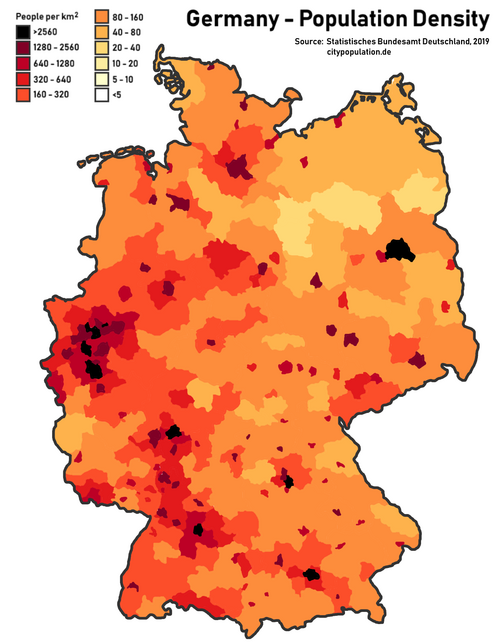
2020年12月時点で推定8320万人の人口を抱えるドイツは、ロシアに次いでヨーロッパで2番目に人口の多い国であり、人口規模では世界で19番目に大きい国である。人口密度は1平方キロメートルあたり233人である。[96]
ドイツは、総称してLänderと呼ばれる16 の州で構成されています。[ 97 ]面積と人口の違いにより、これらの州の区分は、特に都市州( Stadtstaaten ) とより広い領土を持つ州 ( Flächenländer ) の間で異なります。地域行政の目的で、バーデン=ヴュルテンベルク州、バイエルン州、ヘッセン州、ノルトライン=ヴェストファーレン州の 4 つの州は、合計 19 の行政区( Regierungsbezirke ) で構成されています。2019 年現在、ドイツは市町村レベルで 400 の地区( Kreise ) に分割されており、これらは 294 の農村地区と 106 の都市地区で構成されています。

Germany officially has eleven metropolitan regions. In 2005, Germany had 82 cities with more than 100,000 inhabitants.
The United Nations Population Fund lists Germany as host to the third-highest number of international migrants worldwide, behind the United States and Saudi Arabia.[93] The largest ethnic group of non-German origin are the Turkish. Since the 1960s, West and later reunified Germany has attracted immigrants primarily from Southern and Eastern Europe as well as Turkey, many of whom (or their children) have acquired German citizenship over time. While most of these immigrants initially arrived as guest workers, changes to guest worker legislation allowed many to stay and to build lives in Germany.
Germany had signed special visa agreements with several countries in times of severe labour shortages or when particular skills were deficient within the country. During the 1960s and 1970s, agreements were signed with the governments of Turkey, Yugoslavia, Italy and Spain to help Germany overcome its severe labour shortage.
As of 2012, after Germany fully legalized visa-free immigrants from the eastern states of the EU, the largest sources of net immigration to Germany were other European countries, most importantly Poland, Romania, Bulgaria, Hungary, Italy, Spain, and Greece; notably, in the case of Turkey, German Turks moving to Turkey slightly outnumbered new immigrants in 2012,[100] however, in recent years there are more Turkish immigrants in Germany than emigrants again, including illegal Turkish migrants.
In 2015, there was a large increase in asylum applications following the 2015 refugee crisis, mainly due to the violent conflicts in Syria, Iraq and Afghanistan: 476,649 asylum applications were counted that year.[101] This number went up to even 745,545 in 2016 and began to decline after it.[15]
In 2022, some 23.8 million people in Germany, or 28.7% of the population have migrant background.[102]
Following the 2022 Russian invasion of Ukraine, over 1.06 million refugees from Ukraine were recorded in Germany as of April 2023.[103]

Responsibility for educational oversight in Germany lies primarily with the individual federated states. Since the 1960s, a reform movement has attempted to unify secondary education into a Gesamtschule (comprehensive school); several West German states later simplified their school systems to two or three tiers. A system of apprenticeship called Duale Ausbildung ("dual education") allows pupils in vocational training to learn in a company as well as in a state-run vocational school.[104]
Optional kindergarten education is provided for all children between three and six years old, after which school attendance is compulsory for at least nine years, depending on the state. Primary education usually lasts for four years and public schools are not stratified at this stage.[104] In contrast, secondary education includes three traditional types of schools focused on different levels of academic ability: the Gymnasium enrols the most academically promising children and prepares students for university studies; the Realschule for intermediate students lasts six years; the Hauptschule prepares pupils for vocational education.[105]
In addition Germany has a comprehensive school known as the Gesamtschule. While some German schools such as the Gymnasium and the Realschule have rather strict entrance requirements, the Gesamtschule does not have such requirements. They offer college preparatory classes for the students who are doing well, general education classes for average students, and remedial courses for those who aren't doing that well. In most cases students attending a Gesamtschule may graduate with the Hauptschulabschluss, the Realschulabschluss or the Abitur depending on how well they did in school. The percentage of students attending a Gesamtschule varies by Bundesland. In 2007 the State of Brandenburg more than 50% of all students attended a Gesamtschule,[106] while in the State of Bavaria less than 1% did.
The general entrance requirement for university is Abitur, a qualification normally based on continuous assessment during the last few years at school and final examinations; however there are a number of exceptions, and precise requirements vary, depending on the state, the university and the subject. Germany's universities are recognised internationally; in the Academic Ranking of World Universities (ARWU) for 2008, six of the top 100 universities in the world are in Germany, and 18 of the top 200.[107] Nearly all German universities are public institutions, tuition fees in the range of €500 were introduced in some states after 2006, but quickly abolished again until 2014.
Over 99% of those of age 15 and above are estimated to be able to read and write. However, a growing number of inhabitants are functionally illiterate. The young are much more likely to be functionally illiterate than the old. According to a study done by the University of Bremen in cooperation with the "Bundesverband Alphabetisierung e.V.", 10% of youngsters living in Germany are functionally illiterate and one quarter are able to understand only basic level texts.[109] Illiteracy rates of youngsters vary by ethnic group and parents' socioeconomic class.
The life expectancy in Germany is 81.1 years (78.7 years males, 83.6 years females, 2020 est.).[110]As of 2024, the principal cause of death was cardiovascular disease, at 33.7%, followed by malignant tumours, at 23.7%.[111]As of 2008, about 82,000 Germans had been infected with HIV/AIDS and 26,000 had died from the disease (cumulatively, since 1982).[112] According to a 2005 survey, 27% of German adults are smokers.[112] A 2009 study shows Germany is near the median in terms of overweight and obese people in Europe.[113]

The national constitutions of 1919 and 1949 guarantee freedom of faith and religion; earlier, these freedoms were mentioned only in state constitutions. The modern constitution of 1949 also states that no one may be discriminated against due to their faith or religious opinions. A state church does not exist in Germany (see Freedom of religion in Germany).[114]
According to a 1990s poll by Der Spiegel, 45% of Germans believe in God, and a quarter in Jesus Christ.[115] According to the Eurobarometer Poll 2010, 44% of German citizens responded that "they believe there is a God", 25% responded that "they believe there is some sort of spirit or life force" and 27% responded that "they don't believe there is any sort of spirit, God or life force". 4% gave no response.[116]
Christianity is the largest religion in Germany, comprising roughly half of the country's population.[117][118][119]
Smaller religious groups (less than 1%) include Judaism, Buddhism and Hinduism.[120][117]
The two largest churches, the Roman Catholic Church and the Protestant Church in Germany (EKD), have lost significant number of adherents. In 2023 the Catholic Church accounted for 24%[117][118][121] and the Evangelical Church for 21.9%[117][118][122] of the population. Orthodox Church has 1.5% and other Christian churches and groups summed up to 1% of the population.[117][120] Since the reunification of Germany, the number of non-religious people has grown and an estimated 46.2% of the country's population are not affiliated with any church or religion.[117][118][120][119]
The other religions make up to less than 1% of the population.[120]Buddhism has around 200,000 adherents (0.2%), Judaism has around 200,000 adherents (0.2%), Hinduism 90,000 (0.1%), Sikhism 75,000 (0.1%) and Yazidis religion (45,000–60,000).[123] All other religious communities in Germany have fewer than 50,000 (<0.1%) adherents.
Protestantism is concentrated in the north and east and Roman Catholicism is concentrated in the south and west. According to the last nationwide census, Protestantism is more widespread among the population with German citizenship; there are slightly more Catholics total because of the Catholic immigrant population (including such groups as Poles and Italians).[125] The former Pope, Benedict XVI, was born in Bavaria. Non-religious people, including atheists and agnostics are especially numerous in the former East Germany and major metropolitan areas.[126]
Of the roughly 4 million Muslims, most are Sunnis and Alevites from Turkey, but there are a small number of Shi'ites and other denominations.[127][128] 1.5% of the country's overall population declare themselves Orthodox Christians,[117] with Serbs, Greeks, Romanians, Ukrainians and Russians being the most numerous.[129] Germany has Europe's third-largest Jewish population (after France and the United Kingdom).[130] In 2004, twice as many Jews from former Soviet republics settled in Germany as in Israel, bringing the total Jewish population to more than 200,000, compared to 30,000 prior to German reunification. Large cities with significant Jewish populations include Berlin, Frankfurt and Munich.[131] Around 250,000 active Buddhists live in Germany; 50% of them are Asian immigrants.[132]
Census results were as follows:
German is the only official and most widely spoken language. Standard German is understood throughout the country.
Since 2017, the Federal Statistical Office of Germany included a new question regarding the language spoken at home in the micro-census, a large sample survey that yearly covers approximately 1% of the German population living in private households.[134] In recent years, there has been a noticeable decline in the number and proportion of people in Germany who speak only German at home, accompanied by a corresponding increase in the use of other languages or multilingual households. This can be attributed to the increasing size of the Germans with a migration background and the decreasing size of the population without a migration background.[135]
The following table provides the results of the 2024 microcensus, using 2022 census data as the basis for the projection, regarding the languages spoken at home.[136] After German (81.34%), the most spoken languages were Turkish (2.61%), Russian (2.27%), Arabic (1.70%), English (1.26%) and Polish (1.19%), each with more than one million people speaking them in their homes.

Danish, Low German, Low Rhenish, the Sorbian languages (Lower Sorbian and Upper Sorbian), and the two Frisian languages, Saterfrisian and North Frisian, are officially recognized and protected as minority languages by the European Charter for Regional or Minority Languages in their respective regions. With speakers of Romany living in all parts of Germany, the federal government has promised to take action to protect the language. Until now, only Hesse has followed Berlin's announcement, and agreed on implementing concrete measures to support Romany speakers.
Germany is a strong supporter of the Charter, as evidenced by things like the 2022 report from the Secretary General of the Council of Europe specifically naming Germany as an example of how to incorporate minority languages in State media.[137][138] Still, Germany—like many other signatories of the Charter—has room for improvement in its implementation of the Charter.[139]

German dialects – some quite distinct from the standard language – are used in everyday speech, especially in rural regions. Many dialects, for example the Upper German varieties, are to some degree cultivated as symbols of regional identity and have their own literature, theaters and some TV programming. While speaking a dialect outside its native region might be frowned upon, in their native regions some dialects can be spoken by all social classes. Nevertheless, partly due to the prevalence of Standard German in media, the use of dialects has declined over the past century, especially in the younger population.
The social status of different German dialects can vary greatly. The Alemannic and Bavarian dialects of the south are positively valued by their speakers and can be used in almost all social circumstances. The Saxonian and Thuringian dialects have less prestige and are subject to derision. While Bavarian and Alemannic have kept much of their distinctiveness, the Middle German dialects, which are closer to Standard German, have lost some of their distinctive lexical and grammatical features and tend to be only pronunciation variants of Standard German.
Although Low Saxon is officially recognized as a language on its own, little official action has been taken to foster the language. Historically one third of Germany's territory and population was Low Saxon speaking. No data has ever been collected on the actual number of speakers, but today the number of speakers is around 5 million. Despite this relatively high number of speakers there is very little coverage in the media (mostly on NDR TV, no regular programming) and very little education in or on the language. The language is not fixed as part of the school curriculum, and Low Saxon is used as a medium of instruction in only one school in the whole of Germany (as a "model project" in primary school alongside education in Standard German). As a consequence the younger generation refused to adopt the native language of their parents. Language prevalence dropped from more than 90% (depending on the exact region) in the 1930s to less than 5% today. This accounts for a massive intergenerational gap in language use. Older people regularly use the language and take private initiatives to maintain the language, but the lack of innovative potential of the younger generation hinders language maintenance. The language also has its own literature (around 150 published books every year) and there are many theatres (mostly amateur dramatics, but some professional ones, such as Ohnsorg-Theater).
Use of Low Saxon is mainly restricted to use among acquaintances, such as family members, neighbours and friends. A meeting of a village council can be held almost completely in Low Saxon if all participants know each other (as long as written protocols are written in Standard German), but a single foreigner can make the whole meeting switch to Standard German.
The Low Saxon dialects differ in their status too. There is a north–south gradient in language maintenance. The southern dialects of Westfalian, Eastfalian and Brandenburgish have had much stronger speaker losses than the northern coastal dialects of Northern Low Saxon. While Eastfalian has lost speakers to Standard German, Westfalian has lost speakers both to Standard German and to the Standard German-based regiolect of the Rhine-Ruhr area. Brandenburgish speakers mostly switched to the Standard German-based regiolect of Berlin. Brandenburgish has been almost completely replaced by the Berlin regiolect. Northern Low Saxon speakers switched mostly to pure Standard German.
English is the most common foreign language and is almost universally taught at the secondary level; it is also taught at elementary level in some states. Other commonly-taught languages are French, Italian, Spanish and Russian. Dutch is taught in states bordering the Netherlands, and Polish in the eastern states bordering Poland.[140]Latin and Ancient Greek are part of the classical education syllabus offered in many secondary schools.
According to a 2004 survey, two-thirds of Germany's citizens have at least basic knowledge of English. About 20% consider themselves to be competent speakers of French, followed by speakers of Russian (7%), Italian (6.1%), and Spanish (5.6%). The relatively high number of Russian speakers is a result of immigration from the former Soviet Union to Germany for almost 10 consecutive years, plus its having been learned in school by many older former East Germans as compulsory first foreign language.
{{cite web}}: CS1 maint: bot: original URL status unknown (link)Demnach leben in Deutschland zwischen 3,8 und4,3 Millionen Muslime [. . .] beträgt der Anteil der Muslime an der Gesamtbevölkerungzwischen 4,6 und 5,2 Prozent. Rund 45 Prozent der in Deutschland lebenden Muslime sind deutsche Staatsangehörige, rund 55 Prozent haben eine ausländische Staatsangehörigkeit.
Der Anteil der Sunniten unter den in den Haushalten lebenden Muslimen beträgt 74 Prozent


