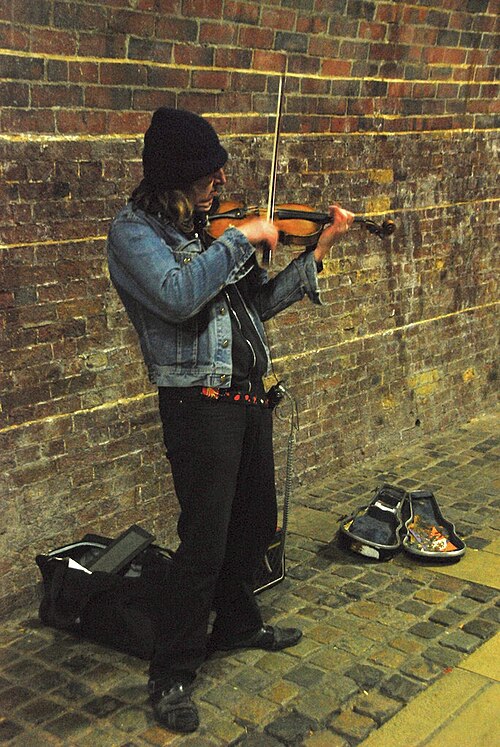
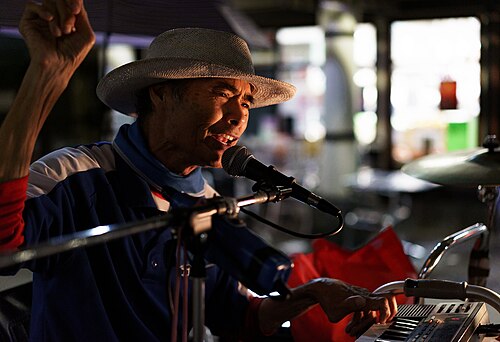
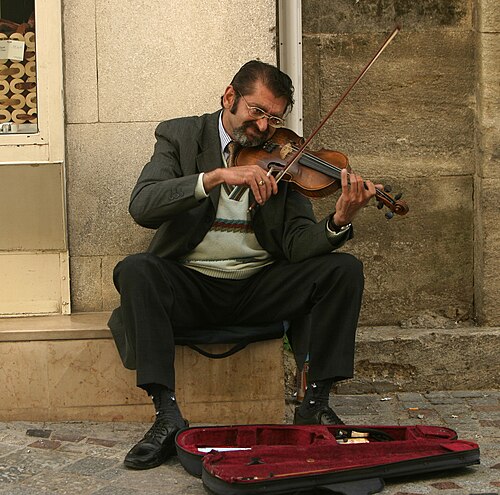
A busker in south London. Their violin case is open nearby to accept donations from passers by.
Street performance or busking is the act of performing in public places for gratuities. In many countries, the rewards are generally in the form of money but other gratuities such as food, drink or gifts may be given. Street performance is practiced all over the world and dates back to antiquity. People engaging in this practice are called street performers or buskers.
The term busking was first noted in the English language around the middle 1860s in the United Kingdom. The verb to busk, from the word busker, comes from the Spanish root word buscar, with the meaning "to seek".[1] The Spanish word buscar in turn evolved from the Indo-European word *bhudh-skō ("to win, conquer").[2] It was used for many street acts, and was the title of a famous Spanish book about one of them, El Buscón.
In London, busking is prohibited in the entire area of the City of London. The London Underground provides busking permits for up to 39 pitches across 25 central London stations.[22] Most London boroughs do not license busking, but they have optional powers, under the London Local Authorities Act 2000, if there is sufficient reason to do so. Where these powers have not been adopted, councils can rely on other legislation including the Environmental Protection Act 1990 to deal with noise nuisance from buskers and the Highways Act 1980 to deal with obstructions. Camden Council is currently looking into further options to control the problem of nuisance buskers and the playing of amplified music to the detriment of local residents and businesses.[23] The Westminster City Council banned busking in Leicester Square, previously a popular location, following a 2025 court ruling that busking was a "nuisance" and their repetitive performances were "psychological torture".[24]
Buskers may find themselves targeted by thieves due to the very open and public nature of their craft. Buskers may have their earnings, instruments or props stolen. One particular technique that thieves use against buskers is to pretend to make a donation while actually taking money out instead, a practice known as "dipping" or "skimming". George Burns described his days as a youthful busker this way:[25]
Sometimes the customers threw something in the hats. Sometimes they took something out of the hats. Sometimes they took the hats.
Josephine Baker started street dancing to make money and was recruited for the St. Louis Chorus vaudeville show at the age of 15, which started her dancing career.
Joshua Bell, a noted classical violinist, posed as a busker in the L'Enfant Plaza Metro station in Washington, D.C. at rush hour in 2007, as part of a feature in The Washington Post. In the 45 minutes that Bell played, only seven people out of over a thousand who passed by stopped to watch, and he took in just over $32. Gene Weingarten later won a Pulitzer Prize for the story.[28]
Catfish the Bottleman a well-known busker from Sydney, Australia, so inspired Van McCann of Catfish and the Bottlemen that he named his band after him. He watched him perform as a child and said that it was his first memory of music.[29]
Mike Doughty, former singer for Soul Coughing, released Busking, which contains 12 tracks from a 2007 busking performance in the 14th Street subway station in New York City.[30]
Newton Faulkner has been known to busk and video footage of him busking has been made available on YouTube, including a full acoustic cover of Queen's "Bohemian Rhapsody".
Benjamin Franklin, the American inventor and statesman, was a street performer. He composed songs, poetry and prose about current events and went out in public and performed them. He would then sell printed copies of them to the public. He was dissuaded from busking by his father who convinced him it was not worth the stigmas that some people attach to it. It was this experience that helped form his beliefs in free speech, which he wrote about in his journals.[3]
G4, the British popera quartet, performed as buskers across London during their college days.[31][32]
T. Rexのメンバーであるマーク・ボランとスティーヴ・ペレグリン・トゥックは、トラック・レコードにエレクトリック機材を没収され、バンドメンバー2人が脱退した後、1967年の夏にハイドパークで路上ライブを行ったのが、アコースティックギターとボンゴのデュオとしての初演奏だった。このアコースティック編成で、彼らは3枚のアルバムをリリースすることになる。
↑ (Krickeberg 1983: 62. Smith, Murray (1996). Traditions, Stereotypes, and Tactics:: A History of Musical Buskers in Toronto . cjtm.icaap.org; Canadian Journal for Traditional Music . 2010-06-10 に取得。
↑ Berger v. Seattle, C03-3238JLR (PDF)。判決、米国ワシントン州西部地区連邦地方裁判所(シアトル)、2004年4月22日。2010年6月11日取得。
↑metrowebukmetro (24 February 2008). "X Factor star tops classical charts". Archived from the original on 10 October 2013. Retrieved 12 September 2016.
↑"Mark Goffeney — There's No Business Like Toe Business". ABILITY Magazine. 2010. Archived from the original on 22 July 2022. Retrieved 2 September 2023.
↑Alex Vadukul (16 July 2020). "It's a Tough Time to Be a Street Musician With a 900-Pound Piano". The New York Times. Retrieved 6 November 2021.
↑From Busker To Billionaire: How Guy Laliberté Achieved Success EvanCarmichael.com.
↑Modern Blues Harmonica (6 March 2007). "Satan and Adam – Harlem, 1987 (in U2's Rattle and Hum)". Archived from the original on 7 November 2021. Retrieved 12 September 2016– via YouTube.
↑A Night At The OperaArchived 10 May 2015 at the Wayback Machine QueenZone.com Retrieved 23 January 2013
↑Hansen, Liane (22 September 2002). "The Subterranean World of Peter Mulvey". Weekend Edition. National Public Radio. Retrieved 13 June 2010.
↑"Natalia Paruz, musical saw Player". subwaymusicblog.com (Vimeo). 15 March 2011. Retrieved 9 April 2011.
↑"Red Elvises". San Antonio. November 2023. Retrieved 25 January 2024.
↑"After Years Underground, a Subway Singer Gets the Spotlight" by Susan Hartman, The New York Times, 16 September 2016
↑Parton, Chris (19 July 2012). "Old Crow Medicine Show Carries Traditional Country New Album, Carry Me Back, Takes a Somber Approach". CMT News. Archived from the original on 22 July 2012. Retrieved 25 September 2012.
123Ewbank and Hildred, Rod Stewart: The New Biography, pp. 24–28.