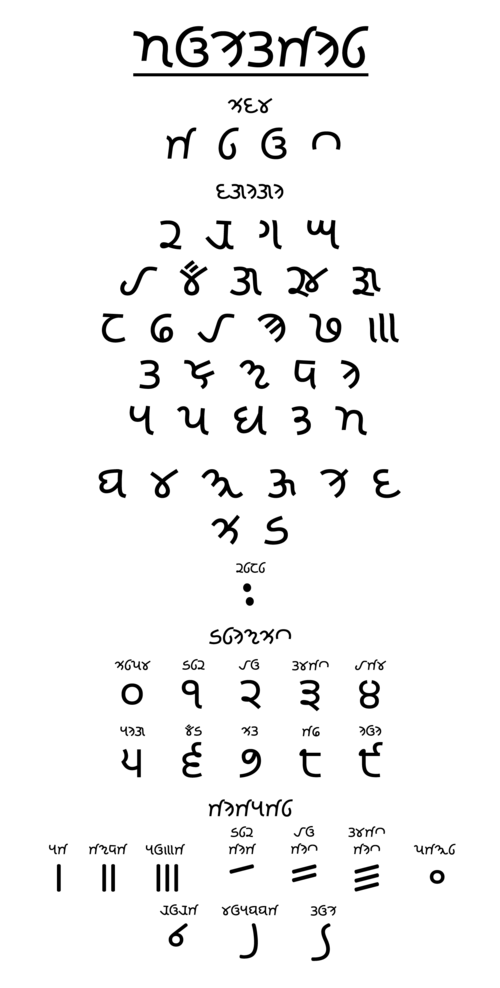
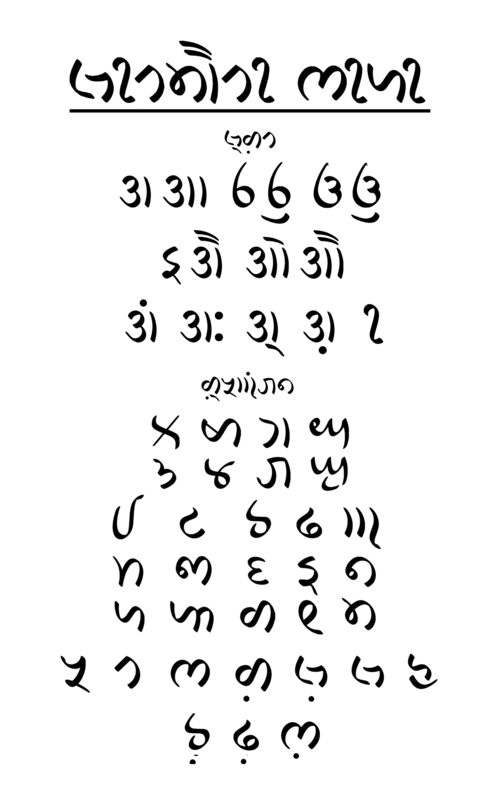
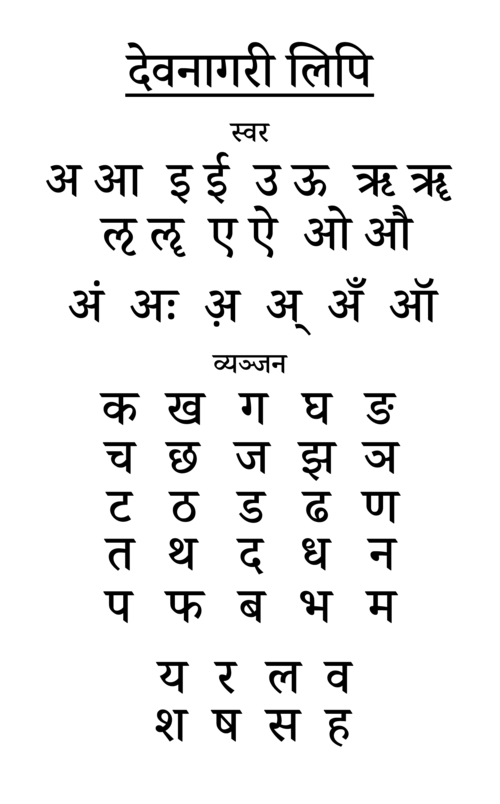
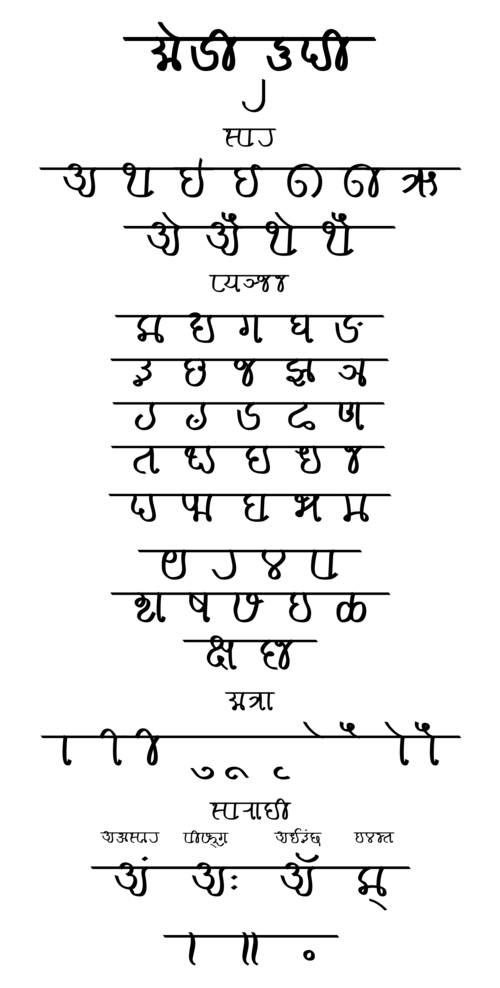
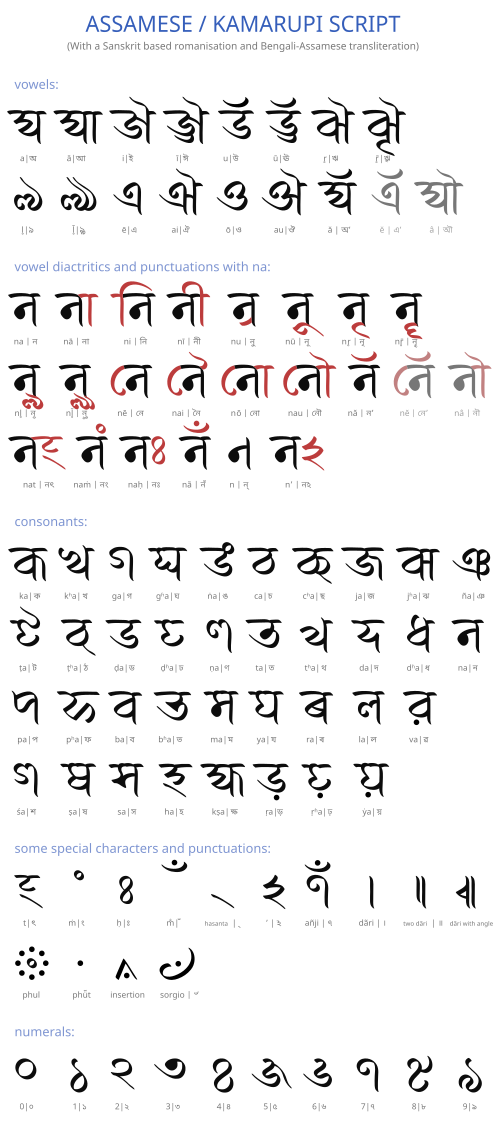
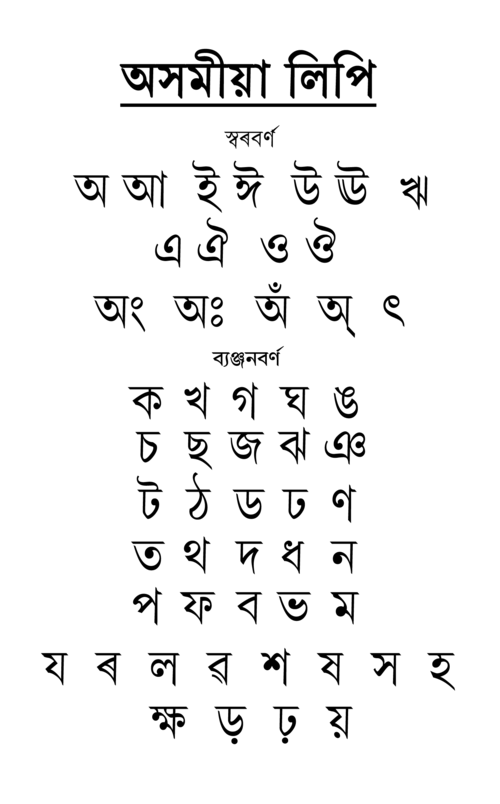
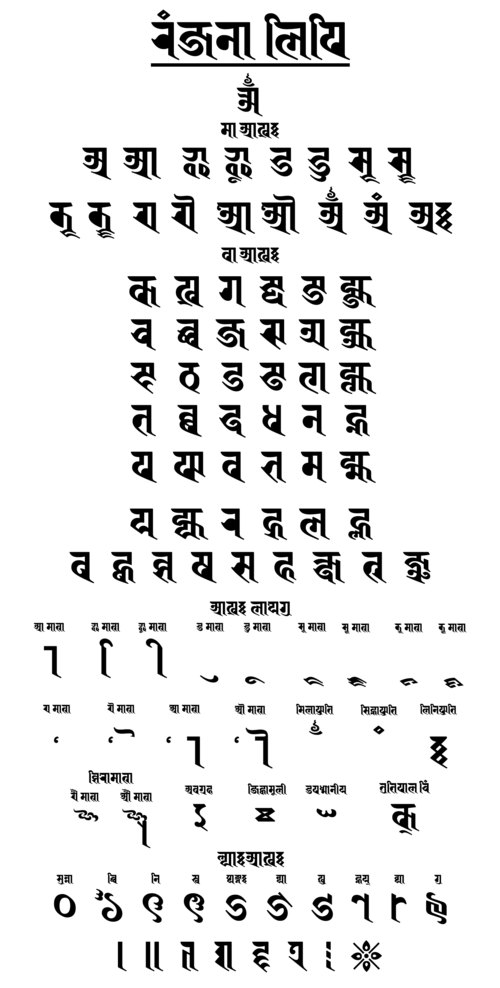
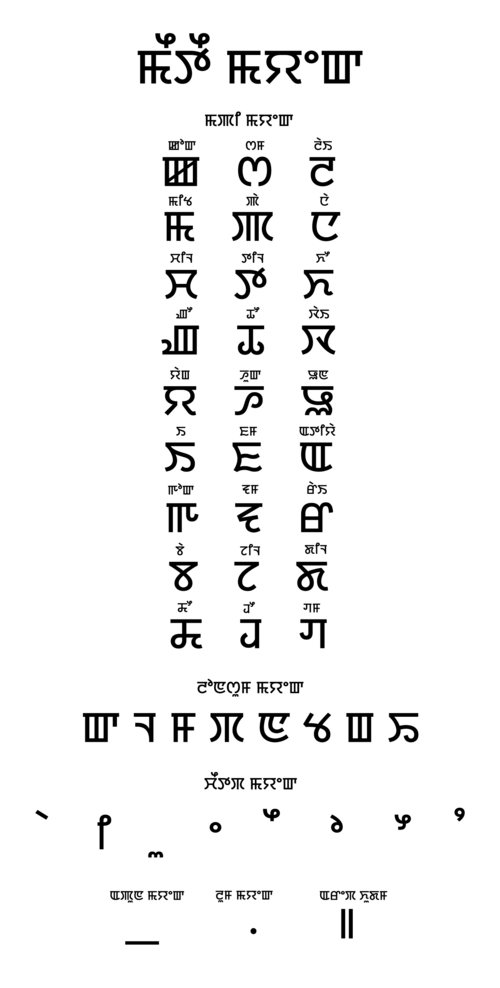
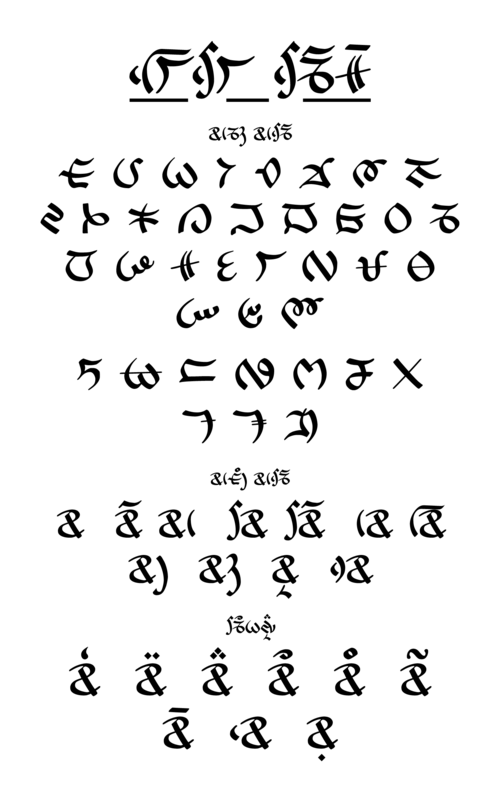
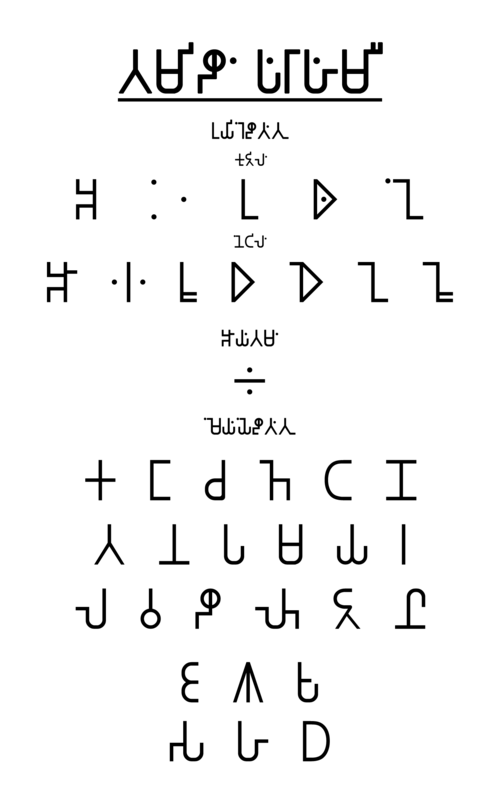
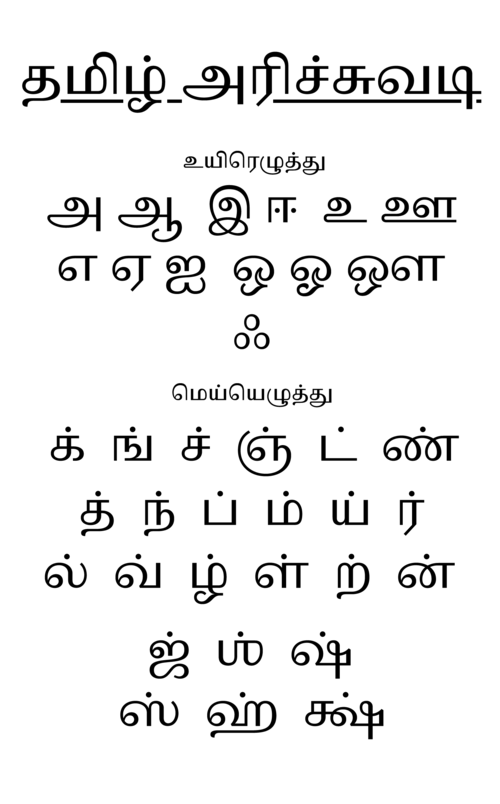
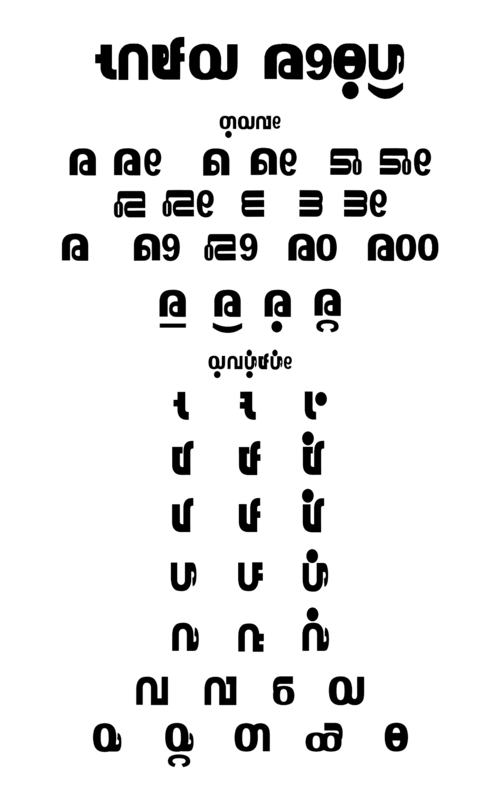
Below are comparison charts of several of the major Indic scripts, organised on the principle that glyphs in the same column all derive from the same Brahmi glyph. Accordingly:
The charts are not comprehensive. Glyphs may be unrepresented if they are later inventions not derived from any Brahmi character.
The pronunciations of glyphs in the same column may not be identical. The pronunciation row is only representative; the International Phonetic Alphabet (IPA) pronunciation is given for Sanskrit where possible, or another language if necessary.
This list tries to include characters of same origins, not same sounds.
Notes
↑In Bengali, র is pronounced as rô, but it was originally va, which is still used for the wa sound in Mithilakshar, and modern Assamese ৱ (wabbô) was derived from middle Assamese র (wô). Compare with জ (ja) য (ya) and য় (ẏ) which are pronounced as jô, jô and e̯ô in Bengali and zô, zô and yô in Assamese, respectively. য is related to Devanagari य (ya), and it is still pronounced ya in Mithilakshar. Since their sounds shifted, the dots were added to keep the original sounds.
12345678910111213141516Modified forms of these letters are or were used for distinctions made in local language; these distinctions are not made for Sanskrit and Pali.
123456789Modified forms of these letters are or were used for distinctions made in Thai; these distinctions are not made for Sanskrit and Pali in the Thai script.
1234567891011121314These letters are obsolete, but were used mainly for Sanskrit and Pali in the Lao script.
1234567891011121314Letters used in Old Javanese. They are now obsolete, but are used for honorifics in contemporary Javanese.
↑Invented new character to represent the Arabic letter خ.
↑Invented new character. Actually to represent the Arabic letter ش, which has similar pronunciation with śa.
Vowels
Vowels are presented in their independent form on the left of each column, and in their corresponding dependent form (vowel sign) combined with the consonant k on the right. A glyph for ka is an independent consonant letter itself without any vowel sign, where the vowel a is inherent.
Notes
↑Only used by Sanskrit grammarians, and does not actually occur outside of a small handful of self-referential terms (e.g. its Sanskrit name, ॡकारl̥̄kāra).
↑includes supplementary vowels not in contemporary use
123456Tibetan, Lepcha, Limbu, New Tai Lue, Thai and Lao scripts do not have independent vowel forms. For syllables starting with a vowel sound, a "zero" consonant is used.
↑When used to write their own languages, Khmer can have either an a or an o as the inherent vowel, following the rules of its orthography.
↑シェリア、ショバナ・ラクシュミ (1997)。メイテイ の 文法。デ・グルイテル。 p. 355.ISBN3-11-014321-6KS SinghとManoharanによる文字分類では、Meithei Mayekはチベット文字群に属し、グプタ・ブラーフミー文字に由来する。
↑ダッタ、アマレシュ (1987)。インド文学百科事典。サヒティア・アカデミ。 p. 142.ISBN978-81-260-1803-1インパールのムトゥア博物館に所蔵されているウラコンタウバ(568-653)とアヤンバ(821-910)の硬貨は、古代マニプリ文字が初期に存在していた証拠を示している。