
Loading article…
| アルジェリア戦争 ゲッレ・ダルジェリー | ||||||||||
|---|---|---|---|---|---|---|---|---|---|---|
| 冷戦とアフリカの脱植民地化の一部 | ||||||||||
 アルジェリアにおけるフランスの戦争のコラージュ | ||||||||||
| ||||||||||
| 交戦国 | ||||||||||
| ||||||||||
| 指揮官とリーダー | ||||||||||
|
| |||||||||
| 強さ | ||||||||||
|
30万人が特定 4万人の民間支援 |
| 3,000(OAS) | ||||||||
| 死傷者と損失 | ||||||||||
|
|
| ||||||||
アルジェリア人の死者総数は約150万人(アルジェリアの歴史学者の推定)[24
| ||||||||||
.svg/500px-Variant_flag_of_the_GPRA_(1958-1962).svg.png)



アルジェリア戦争(アルジェリア革命、アルジェリア独立戦争とも呼ばれる)[注 1]は、1954年から1962年にかけてフランスとアルジェリア民族解放戦線(FLN)との間で起こった主要な武力紛争であり、この紛争によりアルジェリアはフランスからの独立を勝ち取った。[29]重要な脱植民地化戦争であったこの紛争は、ゲリラ戦と戦争犯罪を特徴とする複雑な紛争であった。この紛争は、異なるコミュニティ間およびコミュニティ内の内戦にも発展した。 [30]戦争は主にアルジェリアの領土で発生し、フランス本土にも波紋を呼んだ。
1954年11月1日、トゥーサン・ルージュ(「赤い諸聖人の日」)の最中にFLNのメンバーによって事実上開始されたこの紛争は、フランスで深刻な政治危機を引き起こし、第四共和制(1946年~1958年)の崩壊と、強化された大統領制による第五共和制の成立につながった。フランス軍が用いた残忍な方法はアルジェリアで人々の心をつかむことができず、フランス本土の支持を失い、海外でのフランスの威信を失墜させた。[31] [32]戦争が長引くにつれ、フランス国民は徐々に反フランスに転じ[33]、米国を含むフランスの主要同盟国の多くは、フランス支持からアルジェリアに関する国連の議論への棄権へと切り替えた。[34]アルジェリアや他のいくつかの都市で独立を支持する大規模なデモが起こり(1960年) [35] [36]、国連が独立の権利を認める決議を採択した後、[37] 第五共和政の初代大統領シャルル・ド・ゴールはFLNとの一連の交渉を開始することを決定した。交渉は1962年3月にエビアン協定に調印して終了した。 1962年4月8日に国民投票が行われ、フランスの有権者はエビアン協定を承認した。最終結果は、この協定の批准に91%が賛成し[38] 、7月1日に協定はアルジェリアで2度目の国民投票にかけられ、99.72%が独立に賛成し、反対はわずか0.28%だった。[39]
計画されたフランス軍の撤退は国家危機を招いた。これにはドゴールに対する数々の暗殺未遂や軍事クーデターの試みも含まれていた。前者のほとんどはフランス領アルジェリアを支持するフランス軍人によって主に結成された地下組織である秘密軍事組織(OAS)によって実行され、計画された独立を阻止するためにアルジェリアと祖国の両方で多数の爆破事件と殺人を犯した。
この戦争でアルジェリア人40万人から150万人[40] [24] [22]、フランス軍2万5600人[15] 、ヨーロッパ人538人 から6000人が死亡した。戦争中に犯された戦争犯罪には民間人の虐殺、強姦、拷問が含まれ、フランス軍は8000以上の村を破壊し、200万人以上のアルジェリア人を強制収容所に移送した。[41] [42] 1962年の独立後、90万人のヨーロッパ系アルジェリア人(ピエ・ノワール)はFLNの報復を恐れて数か月以内にフランスに逃れた。フランス政府はこれほど膨大な数の難民を受け入れる準備ができておらず、フランス国内で混乱を引き起こした。フランスのために働いていたアルジェリア系ムスリムの大半は武装解除され、フランスとアルジェリアの当局間の協定で彼らに対していかなる措置も取れないとされていたため、取り残された。[43]しかし、特にフランス軍の補助兵として働いていたハルキ族は裏切り者とみなされ、多くが誘拐され拷問を受けた後、FLNやリンチ集団によって殺害された。15] : 537 [44]約2万のハルキ族の家族(約9万人)がフランスに逃れることができ、中には命令に反して行動したフランス人将校の助けも受けた。今日、彼らとその子孫はフランス在住のアルジェリア人人口のかなりの部分を占めている。[要出典]
背景
アルジェリアの征服

アルジェを占領する決定は、 1830年1月にシャルル10世とその大臣らによってなされた。侵攻は、バルバリア海賊の活動とキリスト教徒の捕虜や奴隷の身代金、およびマルセイユ商人がアルジェの王への負債の支払いを拒否したことへの反応として、1827年にすでに議論されていた。しかし、1830年初頭までに、真の動機は、ますます権威主義的になる国王に敵対するフランス世論を、外国征服によってそらし、和らげることであった。[45]
フランス軍は領事への侮辱を口実に、 1830年6月にアルジェを攻撃し占領した。その後数年で征服は内陸部へと広がった。[15]アルジェリアの初代総督となったビュゴー元帥の指揮による征服は暴力的で、現地の支配者であるデイの権力を弱めるために「焦土作戦」が取られ、虐殺、集団強姦、その他の残虐行為が行われた。[46] [47]征服の最初の30年間で、およそ300万人のアルジェリア人のうち50万人から100万人が殺害された。[48] [49] 1830年から1851年までのフランスの損失は、戦闘で3,336人が死亡し、病院で死亡した92,329人であった。[50]
1834年、アルジェリアはフランスの軍事植民地となった。1848年の憲法により、アルジェリアはフランスの不可欠な一部であると宣言され、アルジェ、オラン、コンスタンティーヌの3つの県に分割された。その後、多くのフランス人や他のヨーロッパ人(スペイン人、イタリア人、マルタ人など)がアルジェリアに定住した。
第二帝政(1852年~1871年)のもと、1865年7月14日の議会で先住民法典が施行された。この法律により、イスラム教徒は完全なフランス国籍を申請できるようになったが、これは個人的な問題でシャリーア法に従う権利を放棄することを意味し、広く棄教とみなされていたため、申請者はほとんどいなかった。その第1条には次のように規定されていた。
先住イスラム教徒はフランス人であるが、イスラム法の適用を受け続ける。陸軍(armée de terre)と海軍(armée de mer)への入隊は認められる。アルジェリアでの行事や民間の雇用に招集されることもある。要求に応じてフランス国民の権利を享受することが認められることもあるが、その場合、フランスの政治法と民事法の適用を受ける。[51]

1870年以前には、イスラム教徒による要求は200件未満、ユダヤ系アルジェリア人による要求は152件であった。[52] 1865年の法令は1870年のクレミュー法令によって修正され、アルジェリアの3つの県のいずれかに住むユダヤ人にフランス国籍が付与された。1881年、先住民法典によって差別が公認され、先住民に対する特定の罰則が設けられ、彼らの土地の押収または没収が組織化された。[52]
第二次世界大戦後、1944年3月7日の法令により権利の平等が宣言され、その後1946年5月7日のラミーヌ・ギュイエ法(フランス領および海外県のすべての国民にフランス国籍を付与)および1946年憲法によって確認された。1947年9月20日の法律により、すべてのアルジェリア国民にフランス国籍が付与されたが、イスラム教徒としての身分を放棄する必要はなかった。[53] [疑わしい–議論する]
アルジェリアはフランスにとって特異な存在でした。なぜなら、19 世紀にフランスが獲得した他のすべての海外領土とは異なり、アルジェリアはフランスの不可分の一部とみなされ、法的にもそのように分類されていたからです。
アルジェリアのナショナリズム
イスラム教徒とヨーロッパ系アルジェリア人はともに第二次世界大戦に参加し、フランスのために戦った。アルジェリアのイスラム教徒はティライユール(このような連隊は1842年にはすでに創設されていた[54])やスパヒとして、フランス人入植者はズアーブやアフリカ猟兵として従軍した。ウッドロウ・ウィルソン米大統領が1918年に採択した14か条の第5原則は「すべての植民地の権利主張を自由かつ偏見なく、完全に公平に調整すること。その際、主権に関するすべての問題を決定するにあたり、関係する住民の利益は、その称号が決定される政府の正当な権利主張と同等の重みを持つべきであるという原則を厳格に遵守すること」とされていた。ウレマと呼ばれるアルジェリアの知識人の中には、独立、あるいは少なくとも自治と自治を求める気持ちを育み始めた者もいた[55]。
こうした状況の中で、アブドゥル・カディルの孫であるハリド・イブン・ハシムは、20世紀前半のフランスに対する抵抗運動の先頭に立って、フランス共産党の指導委員会のメンバーでもあった。1926年に彼はエトワール・ノール・アフリカン(「北アフリカの星」)を設立し、翌年、同じく共産党員で、同党傘下の労働組合である統一労働総同盟(CGTU)のメンバーでもあったメッサリ・ハッジがこれに加わった。[56]
北アフリカの星は1928年に共産党から離脱し、1929年にパリの要求により解散した。アルジェリア国民の不満が高まる中、第三共和制(1871年 - 1940年)はいくつかの要求を認め、人民戦線は1936年にブルーム=ヴィオレッタ提案を開始した。これは少数のイスラム教徒にフランス国籍を与えることで先住民法典を啓蒙するものだった。ピエ・ノワール(ヨーロッパ系アルジェリア人)はこれに激しく抗議し、北アフリカ党もこれに反対したため、同提案は放棄された。独立派の同党は1937年に解散し、その指導者らは解散した連盟を違法に再結成したとして告発され、1937年にメッサリ・ハッジがアルジェリア人民党(PPA)を設立した。同党はもはや完全な独立ではなく広範な自治権のみを主張した。この新しい政党は1939年に解散した。ヴィシー政権下で、フランス政府はユダヤ人のフランス国籍を抑圧するためにクレミュー法令を廃止しようとしたが、この措置は実行されなかった。[要出典]
一方、民族主義指導者フェルハト・アッバースは1938年にアルジェリア人民同盟(Union populaire algérienne )を設立した。1943年、アッバースはアルジェリア人民宣言( Manifeste du peuple algérien)を執筆した。 1945年5月8日のセティフとゲルマの虐殺(フランス軍とピエ・ノワールの暴徒が6,000人から30,000人のアルジェリア人を殺害)後に逮捕された アッバースは、1946年にアルジェリア宣言民主同盟(UDMA)を設立し、議員に選出された。 1954年に設立された民族解放戦線(FLN)は、フランス政府に対する武装闘争を行うために武装組織「民族解放軍」を創設した。第一次インドシナ戦争でフランス軍に従軍した多くのアルジェリア兵士は、フランスと戦うベトナム人に強い共感を持ち、その経験を生かしてALNを支援した。[58] [59]
フランス領インドシナを失ったばかりのフランスは、特にフランス法では植民地ではなくフランス本土の一部とみなされていた、最も古く最も近い主要植民地において、次の植民地戦争に負けないと決意していた。[60]
戦争年表
戦闘の始まり

1954年11月1日の早朝、FLNのマキザール(ゲリラ)は、トゥーサンルージュ(赤い諸聖人の日)として知られるようになる日に、アルジェリア全土で軍事施設と民間施設を攻撃した。カイロから、FLNは、ジャーナリストのモハメド・アイシャウイが書いた1954年11月1日の宣言を放送し、アルジェリアのイスラム教徒に「イスラムの原則の枠組みの中で、主権、民主主義、社会主義を有するアルジェリア国家の再建」のための国民的闘争に参加するよう呼びかけた。これは、わずか数か月前にインドシナにおけるフランスのテテ帝国の清算を完了したばかりの、フランス首相ピエール・メンデス(急進社会党)の反応であり、5年間のフランス政策の方向性を決定づけた。彼は国民議会で「国家の国内平和、共和国の統一と一体性を守ることに関しては、妥協は許されない。アルジェリアの各県はフランス共和国の一部である。これらは長い間フランス領であり、永久にフランス領である。...これらとフランス本土との間に分離は考えられない」と宣言した。当初、 1945 年 5 月 8 日のセティフ虐殺や第二次世界大戦前の独立運動にもかかわらず、ほとんどのアルジェリア人は相対的な現状維持を支持していた。メッサリ・ハッジが FLN を結成して過激化した一方で、フェルハト・アッバスはより穏健な選挙戦略を維持した。紛争開始時のフェラガ(独立運動家) は 500 人に満たなかった。[61]アルジェリア国民が過激化したのは、フランスが支援する「赤い手」グループのテロ行為がきっかけだった。このグループはマグレブ地域(モロッコ、チュニジア、アルジェリア)全域の反植民地主義者を標的とし、例えば1952年にはチュニジアの活動家ファルハト・ハシェドを殺害した。[61]
フリナ
.jpg/500px-National_Liberation_Army_Soldiers_(7).jpg)

FLNの蜂起は、武装蜂起を主な行動方針として採用するかどうかという問題を民族主義グループに提示した。戦争の最初の年、フェルハト・アッバースのアルジェリア宣言民主同盟(UDMA)、ウラマー、アルジェリア共産党(PCA) は、FLNに対して友好的な中立を保った。当初蜂起に協力する動きを見せなかった共産主義者は、後にFLNへの浸透を試みたものの、FLNの指導者たちは党の支援を公然と否定した。1956年4月、アッバースはカイロに飛び、正式にFLNに加わった。この行動により、過去にUDMAを支持していた多くのエボルエが参加することになった。AUMAもまた、その威信をフルに使ってFLNを支援した。ベンジェルールと統合支持派の穏健派は、フランスと反乱軍の仲介役を務める努力をすでに断念していた。
MTLDの崩壊後、ベテラン民族主義者のメッサリ・ハッジは左翼の アルジェリア国民運動(MNA)を結成した。MNA は FLN と同様の暴力革命と完全独立の政策を主張したが、FLN と対抗することを目指していた。その後、FLN の軍事部門である国民解放軍(ALN) はアルジェリアにおける MNA のゲリラ活動を一掃し、メッサリ・ハッジの運動はそこで持っていた弱い影響力を失った。しかし、MNA は Union Syndicale des Travailleurs Algériens (アルジェリア労働者組合) を通じてフランスの多くのアルジェリア人労働者の支持を維持した。FLN はまた、MNA に対抗するためにフランスで強力な組織を設立した。フランスでは独立戦争の年月を通じて 2 つの反乱グループの間で「カフェ戦争」が繰り広げられ、約 5,000 人の死者を出した。

政治面では、FLNは寄付を通じてアルジェリア大衆に独立運動の目的を支持するよう説得し、強制しようと努めた。FLNの影響を受けた労働組合、職業団体、学生や女性の団体が、国民のさまざまな層の意見を導くために設立されたが、ここでも暴力的な強制が広く用いられた。マルティニーク出身の精神科医でFLNの指導的政治理論家となったフランツ・ファノンは、民族解放を達成するために暴力を用いることを洗練された知的に正当化した。 [62] [要ページ]カイロでは、アハメド・ベン・ベラが、フランスにとって受け入れられるイスラム教徒コミュニティの独立した代表者で、体制内で妥協や改革が達成される可能性のある、潜在的な有能な対話者を粛清するよう命じた。
FLNの影響力が地方に広がるにつれ、内陸部の多くのヨーロッパ人農民(ピエ・ノワールと呼ばれる)は、その多くが19世紀にイスラム教徒コミュニティから奪われた土地に住んでいたが[63]、土地を売却し、アルジェや他のアルジェリアの都市に避難した。いくつかの町や都市でアルジェリアのイスラム教徒による血なまぐさい無差別虐殺や爆破事件が相次いだ後、フランスのピエ・ノワールと都市部のフランス人は、フランス政府に、非常事態宣言、政治犯罪に対する死刑、すべての分離主義者の告発、そして最も不吉なことに、警察、軍隊、準軍事組織による「報復」の報復作戦の呼びかけなど、より厳しい対抗措置を要求し始めた。警察当局の消極的な協力を得て無許可で活動していたコロン自警団は、イスラム教徒コミュニティ内のFLNメンバーと疑われる者に対してラトンネード(文字通りネズミ狩り、ラトンはアルジェリアのイスラム教徒を軽蔑する人種差別的な用語)を実行した。
1955年までに、アルジェリアの植民地コミュニティ内の効果的な政治活動グループは、パリから派遣された総督の多くに、軍事力では紛争を解決できないと説得することに成功した。大きな成功は、ジャック・スーステルの転向であった。スーステルは1955年1月に総督としてアルジェリアに赴き、平和回復を決意した。かつては左翼で、1955年までに熱心なドゴール主義者となったスーステルは、イスラム教徒の経済状況を改善することを目的とした野心的な改革プログラム(スーステル計画)を開始した。
フィリップヴィル虐殺後
FLN はアジアの民族主義グループと同様の戦術を採用し、フランスは FLN が都市部に進出した 1955 年まで、直面している課題の深刻さに気付かなかった。独立戦争における重要な分岐点は、 1955 年 8 月にフィリップヴィル(現在はスキクダとして知られている)の町の近くで FLN がピエ ノワールの民間人を虐殺したことである。この作戦の前、FLN の方針は軍と政府関連の標的のみを攻撃することだった。しかし、コンスタンティンウィラヤ/ 地域の司令官は、劇的なエスカレーションが必要であると判断した。FLN とその支持者による 123 人の殺害 (フランス人 71 人を含む) [64]は老女や乳児も含まれており、ジャック スーステルは衝撃を受け、反乱軍に対するより厳しい制圧策を求めた。フランス当局は、スーステルが「厳しい」報復であったと認めた報復で 1,273 人のゲリラが死亡したと発表した。その後、FLNは1万2000人のイスラム教徒が殺害されたと主張した。[15] : 122 スーステルの弾圧は、アルジェリア国民がFLNに結集する初期の原因となった。[64]フィリップヴィルの後、スーステルはより厳しい措置を宣言し、全面戦争が始まった。1956年、フランス系アルジェリア人のデモにより、フランス政府は改革を行わなかった。
スーステルの後継者で社会主義者のロベール・ラコスト総督は、アルジェリア議会を廃止した。ラコストは、ピエ・ノワールが多数を占める議会が自身の政権の妨げになっていると考え、法令によってアルジェリアの統治を引き受けた。彼はフランス軍の作戦強化を支持し、増大する政治的暴力に対処するため、フランス法の下では合法性が疑わしい譲歩である例外的な警察権を軍に与えた。同時に、ラコストはアルジェリアに一定の自治権と地方分権政府を与えるための新しい行政構造を提案した。アルジェリアはフランスの不可分の一部であり続ける一方で、5つの地区に分割され、各地区には単一の候補者名簿から選出される地域議会が設置されることとなった。1958年まで、アルジェリアの各地区を代表する議員は、フランス国民議会によるこの法案の可決を遅らせることができた。
1956 年 8 月と 9 月、アルジェリア国内で活動する FLN ゲリラの指導者 (一般に「内部派」として知られている) は、運動の政治活動と軍事活動を同期させるための正式な政策立案機関を組織するために会合した。FLN の最高権限は、34 名の委員からなるアルジェリア革命国民評議会 (Conseil National de la Révolution Algérienne、CNRA) にあり、その中で 5 名の調整執行委員会 ( Comité de Coordination et d'Exécution、CCE) が執行部を構成していた。ベン ベラを含む、チュニジアとモロッコに拠点を置く FLN 正規軍の指導者 (「外部派」) は会議が開催されていることを知っていたが、偶然か「内部派」側の意図的な行動かで出席できなかった。
1956年10月、フランス空軍は、アハメド・ベン・ベラ、モハメド・ブディアフ、モハメド・キダール、ホシーン・アイト・アハメドを乗せたチュニス行きのモロッコのDC-3飛行機を迎撃し、アルジェに着陸させた。ラコステはFLNの外部政治指導者を逮捕し、戦争が続く間投獄した。この行動により、残りの反乱軍指導者たちは態度を硬化させた。
フランスは、エジプトのガマール・アブドゥル・ナセル大統領によるFLNへの物質的・政治的支援に反対した。フランスの一部アナリストは、これが革命の主な支えであると信じていた。この姿勢は、1956年11月のスエズ危機の際にフランスがスエズ運河を奪取しようとする試みに参加するよう説得する要因となった。
1957年、内部と外部の亀裂が広がるにつれ、FLNへの支持は弱まった。流れを止めるため、FLNは執行委員会を拡大し、アッバスやベン・ベラなどの投獄された政治指導者をメンバーに加えた。また、共産党とアラブ連合国のメンバーを説得し、停戦交渉のためフランス政府に外交圧力をかけさせた。1957年、フランス軍がFLNメンバーと疑われる人物から情報を引き出すために日常的に拷問を行っていたことがフランス国内で周知の事実となった。[65] ル・モンド紙編集長のユベール・ブーヴ・メリーは、1957年3月13日付の紙面で次のように宣言した。「これからは、フランス国民は、オラドゥールの破壊やゲシュタポによる拷問を10年前と同じ言葉で非難する権利はないということを知らなければならない。」[65]メディアの注目を集めたもう一つの事件は、非合法化されたアルジェリア共産党のメンバーであり、[66]アルジェ大学の数学教授で、FLNメンバーの疑いがあったモーリス・オーダンの殺害である。 彼は1957年6月にフランス軍に逮捕された。[65]オーダンは拷問を受けて殺害され、遺体は発見されなかった。[65]オーダンはアルジェリア人ではなくフランス人であったため、フランス軍の拘留中に「失踪」したことで、彼の未亡人が歴史家ピエール・ヴィダル=ナケの助けを借りて、夫の死の責任者を起訴するよう断固として求めたため、この事件は有名になった。 [65]
アルジェ出身の実存主義作家、哲学者、劇作家のアルベール・カミュは、コンバット紙に拷問の使用に反対する論説を書き、少なくとも民間人に手を出さないよう双方を説得しようとしたが、失敗した。FLNは彼を愚か者とみなし、一部のピエ・ノワールは彼を裏切り者とみなした。しかし、ノーベル文学賞を受賞したときのスピーチで、カミュは、急進的な選択に直面したら最終的には自分のコミュニティを支持すると述べた。この発言により、彼は左翼知識人の間での地位を失った。1960年に彼が自動車事故で亡くなったとき、普通の事故(すぐに解決する事件)という公式見解は、少なからぬ観察者に疑問を残した。彼の未亡人は、カミュは控えめではあったが、人生の最後の数年間はフランス領アルジェリアの熱烈な支持者だったと主張した。[要出典]
アルジェの戦い
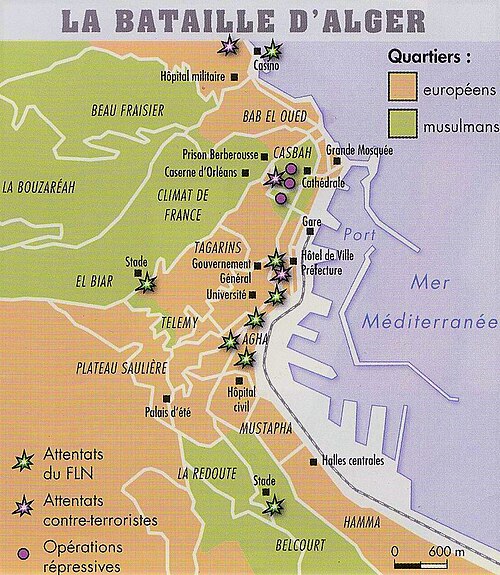
FLNは、自らの闘争に対する国内外の関心を高めるため、紛争を都市部に持ち込み、全国規模のゼネストを呼びかけ、公共の場所に爆弾を仕掛けることを決定した。最も顕著な例は、1956年9月30日にジャミラ・ブイレドとゾーラ・ドリフを含む3人の女性が、エールフランスのダウンタウンのオフィスを含む3か所に同時に爆弾を仕掛けたことから始まったアルジェの戦いである。FLNは1957年春に銃撃と爆破を実行し、民間人の死傷者を出し、当局の激しい対応を招いた。
ジャック・マス将軍は、市内の秩序を回復し、テロリストを見つけて排除するために必要と思われるあらゆる手段を使うよう指示された。彼は空挺部隊を使って攻撃を阻止し、その後数か月でアルジェの FLN のインフラを破壊した。しかし FLN は、フランス領アルジェリアの中心部を攻撃し、都市部のイスラム教徒の間で要求に対する大衆の反応を集める能力を示すことに成功していた。拷問の使用、厳格な移動制御、カドリラージュと呼ばれる夜間外出禁止令、すべての権限が軍の下にあることなど、アルジェの戦いで軍が勝利するために使用した残忍な方法が公表されたため、フランスではアルジェリアにおけるフランスの役割に疑問が生じていた。当初は「鎮圧」または「治安維持作戦」であったものが、拷問を伴う 植民地戦争に変わった。
ゲリラ戦
1956年から1957年にかけて、FLNはゲリラ戦理論に従ってヒット・アンド・ラン戦術をうまく適用しました。この一部は軍事目標に向けられましたが、フランス当局を支持または奨励しているとみなされる人々に対するテロ活動にかなりの金額が投入されました。その結果、女性や子供を含むすべての人に対してサディスティックな拷問や残忍な暴力行為が行われました。待ち伏せと夜襲を専門とし、優れたフランス軍の火力との直接の接触を避けた内部勢力は、軍のパトロール、軍の野営地、警察署、植民地の農場、鉱山、工場、輸送機関、通信施設を標的にしました。交戦が中断されると、毛沢東の理論に従って、ゲリラは田舎の住民と合流しました。
アルジェリアの両コミュニティに恐怖と不安をうまく煽ったものの、革命家の威圧的な戦術は、イスラム教徒の大部分がフランスの植民地支配に反抗するようまだ奮い立たせていないことを示唆していた。しかし、徐々にFLNはオーレス、カビリー、コンスタンティーヌ周辺、アルジェとオランの南のその他の山岳地帯の特定の地域で支配権を獲得した。これらの地域でFLNは、税金と食糧を徴収し、人材を募集することができた、単純だが効果的な(多くの場合は一時的)軍事政権を確立した。[67]しかし、大きな固定された拠点を保持することはできなかった。
有能な野戦指揮官が戦場で、また離反や政治的粛清によって失われたことで、FLN は困難に直面した。さらに、戦争初期の権力闘争により、特にオーレス県のウィラヤットの指導部が分裂した。将校の中には、自分の領地を作り、指揮下の部隊を使って古い恨みを晴らし、FLN 内の軍事ライバルとの私戦に加わる者もいた。
フランスの反乱鎮圧作戦
アルジェの軍司令部からの苦情にもかかわらず、フランス政府は何ヶ月もの間、アルジェリアの状況が制御不能であり、公式には鎮圧作戦とみなされていたものが戦争に発展したことを認めたがらなかった。1956年までに、アルジェリアには40万人以上のフランス軍が駐留していた。植民地部隊と外人部隊のエリート空挺部隊が攻撃的な対反乱戦闘作戦の矢面に立ったが、約17万人のイスラム教徒のアルジェリア人もフランス正規軍に従軍し、そのほとんどは志願兵であった。フランスはまた、ヘリコプターを含む空軍と海軍の部隊をアルジェリア戦域に派遣した。空飛ぶ救急車と貨物運搬車としての運用に加えて、フランス軍は逃亡するFLNゲリラ部隊を追跡し殲滅するために、初めてヘリコプターを地上攻撃の役割に使用した。フランスもナパーム弾を使用した。[68]
フランス軍は、1955年に創設された特別行政部(Section Administrative Spécialisée、SAS)を通じて、アルジェリア地方の行政において重要な役割を再開した。SASの任務は、イスラム教徒の住民と接触し、地方に「フランスの存在」を主張することで、その地方における民族主義の影響力を弱めることである。ケピス・ブルー(青い帽子)と呼ばれるSAS将校は、ハルキと呼ばれる忠実なイスラム教徒の非正規部隊の募集と訓練も行っていた。ショットガンで武装し、FLNと同様のゲリラ戦術を使用するハルキは、最終的にFLN活動家を上回る約18万人の志願兵を擁し[10] 、反乱鎮圧戦争の理想的な手段であった。
ハルキは主に、フランス人将校が指揮するアルジェリア人のみの部隊、または混成部隊の従来型編成で使用されました。その他の用途としては、ベトナム戦争で米国が実施したキット・カーソン・スカウトに似た、フランス大隊に所属する小隊または小規模の部隊がありました。3 つ目の用途は情報収集の役割で、情報収集を支援する小規模な疑似作戦がいくつか行われたと報告されています。 [69]米国の軍事専門家ローレンス・E・クライン氏は、「これらの疑似作戦の範囲は、時間的にも範囲的にも非常に限られていたようだ。...疑似作戦が最も広範に使用されたのは、1957年の『アルジェの戦い』のときだった。アルジェで秘密工作員を雇ったフランスの主要な雇用主は、心理戦部門である第五局だった。『第五局』は『転向した』FLNメンバーを広く利用し、そのようなネットワークの1つは、第10空挺連隊のポール・アラン・レジェ大尉が運営していた。拷問や家族への脅迫によってフランス軍のために働くよう『説得』されたこれらの工作員は、FLN幹部と混ざり合い、有罪を示す偽造文書を流し、裏切りの偽の噂を広め、不信感を煽った」と述べた。 ...混乱し疑念を抱いたFLN幹部の間で喉を裂いたり内臓をえぐり出す狂乱が勃発し、1957年4月から9月にかけてナショナリストがナショナリストを虐殺し、フランスの仕事を代わりにやった。」[70]しかし、この種の作戦には組織化された秘密部隊ではなく、個人の工作員が関与していた。
しかし、1956年12月、フランスの国内諜報機関DSTによって組織化された疑似ゲリラ部隊が1つ作られた。対テロリスト集団であるフランス・アルジェリア抵抗組織(ORAF)は、政治的妥協の望みを潰す目的で偽旗テロ攻撃を実行することを使命としていた。 [71]しかし、インドシナと同様に、「フランスはFLNと戦う現地のゲリラ集団の育成に注力した」ようで、その1つはフランス軍の装備を受けて南アトラス山脈で戦った。 [72]
FLN はフランス軍に対して、フォース K という 1,000 人のアルジェリア人からなるグループを結成し、フランス軍に対して擬似ゲリラ戦略をとったこともあった。彼らはフランスのゲリラとしてフォース K に志願入隊した。しかし、メンバーのほとんどは元々 FLN のメンバーであったか、入隊後に FLN に転向させられた。部隊が展示した FLN メンバーとされる死体は、実際には FLN に殺害された反体制派や他のアルジェリア人グループのメンバーのものだった。フランス軍は最終的にこの戦争の策略に気づき、フォース K メンバーを追跡しようとした。しかし、約 600 人が脱出に成功し、武器や装備を持って FLN に加わった。[72] [15] : 255–7
1957 年後半、アルジェリア駐留フランス軍の指揮官ラウル・サラン将軍は、カドリャージュ(格子状の監視) システムを導入し、国土をいくつかの地区に分割し、各地区に担当地域での反乱軍の鎮圧を担当する部隊を常駐させた。サランの手法により、FLN のテロ行為は大幅に減少したが、多数の部隊が固定的な防御に縛られた。サランは、チュニジアとモロッコからの侵入を制限するために、厳重に巡回された障壁システムも構築した。最もよく知られているのは、フランスの国防大臣アンドレ・モリスにちなんで名付けられたモリス線で、チュニジア国境の 320 キロメートルにわたって、電気柵、有刺鉄線、地雷で構成されていた。国境の戦いでの容赦ない衝突にもかかわらず、ALN はこれらの防衛線を突破できなかった。[要出典]

フランス軍司令部は、ゲリラをかくまったり、物資を供給したり、あるいは何らかの形でゲリラに協力していると疑われる村々に対して、容赦なく集団責任の原則を適用した。機動部隊が到達できない村々は空爆の対象となった。洞窟やその他の遠隔の隠れ場所に逃げたFLNゲリラは追跡され、追い詰められた。あるエピソードでは、降伏して洞窟群から撤退することを拒否したFLNゲリラが、フランス外人部隊の先駆者部隊によって対処された。彼らは火炎放射器や爆発物を持っていなかったため、各洞窟をレンガで塞ぎ、住民を窒息死させただけだった。[73]
アルジェリアの辺境の農場や村落すべてを統制するのは不可能だと考えたフランス政府は、反乱軍への援助を防ぐため、村全体を含む農村住民の大部分を軍の監視下にあるキャンプに集結させるプログラムも開始した。再編成プログラムが実施された3年間(1957~60年)で、200万人以上のアルジェリア人[28]が主に山岳地帯の村から追放され、平野部に再定住したが、そこでは以前の経済・社会制度を再建することは困難であった。要塞化された村落の生活環境は劣悪だった。フランス軍によって焼き払われなかった数百の村落では、果樹園や耕作地が手入れ不足で荒廃していた。こうした住民移転により、食料や労働力の供給源として利用していたFLNゲリラが辺境の村を利用できなくなったが、避難させられた村人たちの強い憤りも引き起こした。移住による社会的、経済的混乱は、一世代後も感じられた。[要出典]同時に、フランスは農民に資金、仕事、住宅を提供することで民間人の支持を得ようとした[42]
フランス軍は1958年末に戦術を転換し、四肢連射への依存から機動部隊を投入してFLN拠点に対する大規模な捜索破壊作戦を展開した。1959年、サランの後継者モーリス・シャール将軍は反乱軍の大規模な抵抗を鎮圧したように見えたが、政治的な展開がすでにフランス軍の成功を上回っていた。[要出典]
第四共和政の崩壊
度重なる内閣危機により、第四共和制の本質的な不安定さに注目が集まり、軍隊とピエ・ノワールの間で、アルジェリアの安全が政党政治によって損なわれているのではないかという懸念が高まった。軍司令官たちは、反乱を鎮圧するための軍事活動を支援する政府の政治的取り組みが不十分で無能であると感じ、苛立ちを募らせた。1954 年のインドシナのような大失敗が再び起こり、政府はまたもや性急な撤退を命じ、政治的便宜のためにフランスの名誉を犠牲にするだろうという感情が広まった。1946 年以来公職に就いていなかったド・ゴールこそ、国民を結集しフランス政府に指示を与えることができる唯一の公人であると多くの人が考えていた。
スーステルは総督の任期を終えるとフランスに戻り、軍やピエ・ノワールとの緊密な関係を保ちながら、ド・ゴールの復権を支援する組織を組織した。1958年初頭までに、彼はクーデターを組織し、反体制派の軍将校とピエ・ノワールを同調的なドゴール派と結集させた。5月13日の夜、マスー将軍率いる軍政がアルジェで権力を掌握し、その後5月危機として知られるようになった。サラン将軍は、民政当局に代わって結成された公安委員会の指揮を執り、フランス大統領ルネ・コティがド・ゴールを国民統一政府の長に任命し、「アルジェリアの放棄」を防ぐための特別な権限を与えるようにという軍政の要求を強く主張した。
5月24日、アルジェリア軍団のフランス空挺部隊がコルシカ島に上陸し、無血作戦でフランス領島を占領した。その後、アルジェリアではパリの占領とフランス政府の打倒を目的とした「復活作戦」の準備が進められた。「復活作戦」は、以下の3つのシナリオのいずれかが発生した場合に実行されることになっていた。ド・ゴールがフランス議会で指導者として承認されない場合、ド・ゴールが権力を握るために軍事支援を要請する場合、あるいは共産主義勢力がフランスで権力を握ろうとしていると思われる場合。ド・ゴールは5月29日、復活作戦開始予定の15時間前に、賛成329票、反対224票でフランス議会で承認された。これは、1958年までに第四共和政はアルジェリアでフランス軍からいかなる支援も受けておらず、民政問題でもフランス軍の言いなりになることを示していた。 1958年のフランスにおける文民と軍の関係における力関係の決定的な変化と武力の脅威が、フランスでド・ゴールが権力に復帰する主な要因となった。
ドゴール
市民権に関係なく、多くの人々がドゴールの政権復帰を敵対行為を終わらせるために必要な突破口として歓迎した。1958 年 6 月 4 日のアルジェリア訪問で、ドゴールは「Je vous ai compris」(「私はあなたの言うことを理解しました」)と宣言し、すべての住民に計算高く曖昧で幅広い感情的な訴えをかけた。ドゴールは、モスタガネムで歓声を上げる群衆に向かって「 Vive l'Algérie française 」(「フランス領アルジェリア万歳」)と叫んで、前政権の優柔不断さに不満を抱いていた黒人や職業軍人の希望を高めた。同時に、彼はイスラム教徒の状況を改善するために、経済、社会、政治の改革を提案した。しかし、ドゴールは後に、当時からアルジェリアの状況の結末について深い悲観を抱いていたことを認めた。一方、彼はアルジェリア国民の中に、FLNや「ウルトラス」(コロンブスの過激派)に汚染されていない「第三の勢力」を探し、その勢力を通じて解決策が見つかるかもしれないと考えていた。
ドゴールは直ちに委員会を任命し、翌年初めに宣言されるフランス第五共和制の新憲法を起草した。アルジェリアはこれに加盟するが、その不可欠な一部となることはない。女性を含むすべてのイスラム教徒が初めて選挙人名簿に登録され、1958年9月に行われる新憲法に関する国民投票に参加した。
ドゴールの取り組みは、イスラム教徒からの支持低下によってFLNを脅かした。FLNはこれに対抗して、チュニスにアッバース大統領率いる亡命政府、アルジェリア共和国臨時政府(GPRA)を設立した。国民投票の前にアッバース大統領はGPRAへの国際的支援を求めてロビー活動を行い、モロッコ、チュニジア、中国、その他のアフリカ、アラブ、アジアの国々はすぐにGPRAを承認したが、ソ連は承認しなかった。
1959 年 2 月、ド ゴールは新設された第 5 共和政の大統領に選出された。彼は 10 月にコンスタンチンを訪問し、戦争を終わらせ、フランスと密接に結びついたアルジェリアを創設する計画を発表した。ド ゴールは反乱軍指導者に対し、敵対行為を止めて選挙に参加するよう呼びかけたが、彼らは断固として拒否した。「アルジェリアの停戦問題は単なる軍事問題ではない」と GPRA のアッバスは述べた。「これは本質的に政治的な問題であり、交渉はアルジェリア問題全体を網羅しなければならない」。進行中だった秘密協議は中断された。
1958年から1959年にかけて、フランス軍はアルジェリアで軍事的支配権を獲得し、勝利に最も近づいた。1959年7月下旬、ジュメル作戦中、1954年にディエンビエンフーで戦ったエリート空挺部隊を率いたビジェール大佐はジャーナリストのジャン・ラルテギに次のように語った。 (出典)
我々は自分たちのために戦争をしているのではない。植民地主義的な戦争をしているのでもない。ビジェールは上着を着ていない(彼は制服をはだけて見せている)し、私の将校たちもそうである。我々は今ここで彼らのために、進化のために、これらの人々の進化を見るために戦っている。そしてこの戦争は彼らのためのものだ。我々は彼らの自由を守っている。私の意見では、西洋の自由を守っているのと同じだ。我々はここにいる大使、十字軍であり、まだ話すことができ、代弁することができるために頑張っている。
— ビガード大佐(1959年7月)
しかし、この時期フランスでは、紛争に対する国民の反対が高まっており、特に当時国内で最も強力な政治勢力の一つでアルジェリア革命を支持していたフランス共産党が反対の姿勢を強めていた。徴兵や予備役兵士の親族数千人が損失と苦痛を被った。拷問や軍によるイスラム教徒への無差別な残虐行為が明らかになると、広く嫌悪感が広がり、かなりの支持層が民族解放の原則を支持した。1959年までに、現状維持は不可能であり、フランスはアルジェリアに独立を与えるか、イスラム教徒との真の平等を認めるかのどちらかしかなかったことは明らかだった。ド・ゴールは顧問にこう語った。「もし彼らを統合し、アルジェリアのアラブ人とベルベル人全員がフランス人だとみなされるなら、生活水準がはるかに高いフランスに彼らが定住するのをどうして阻止できるだろうか。私の村はもはやコロンベ・レ・ドゥ・エグリーズではなく、コロンベ・レ・ドゥ・モスクと呼ばれるだろう」。[74]
フランスにアルジェリアの独立を認めるよう求める国際的圧力も高まっていた。1955年以来、国連総会は毎年アルジェリア問題を審議しており、FLNの立場は支持を集めていた。軍隊の人員の半分を拘束する植民地戦争の解決にフランスが頑固な姿勢を見せていることも、北大西洋条約機構の同盟国にとって懸念材料だった。1959年9月16日の声明で、ドゴールは立場を劇的に転換し、3番目の望ましい解決策として「自決」という言葉を発した。彼は、それが正式にフランスと提携したアルジェリアにおける多数決につながると予想していた。チュニスでアッバースは、ドゴールの声明が和解の根拠として受け入れられる可能性があることを認めたが、フランス政府はGPRAをアルジェリアのイスラム教徒コミュニティの代表として認めることを拒否した。
バリケードの週

学生リーダーのピエール・ラガイヤルドとジャン=ジャック・スジーニ、カフェオーナーのジョセフ・オルティス、弁護士のジャン=バティスト・ビアッジが率いるアルジェのヨーロッパ義勇軍( Unités Territoriales )の一部部隊は、ドゴールが彼らを裏切ったと確信し、1960年1月24日からアルジェリアの首都で蜂起を起こした。この蜂起はフランスでは「バリケード週間」として知られるウルトラスは、マスー将軍の支援を受けると誤って信じていた。蜂起命令は第5局のジャン・ガルド大佐によって出された。軍、警察、支援者が傍観する中、民間人のピエ・ノワールは路上にバリケードを築き、政府の建物を占拠した。アルジェリア軍の責任者であるモーリス・シャール将軍はアルジェを包囲すると宣言したが、反乱軍への発砲は禁止した。しかし、ラフェリエール通りでの銃撃で暴徒6人が死亡した。
1960年1月29日、パリでドゴールはテレビ演説で無力な軍隊に忠誠を誓うよう呼びかけ、アルジェリア政策に対する国民の支持を集めた。
私はフランスの名において、次の決定を下した。アルジェリア人は自らの運命を自由に選択できる。停戦か反乱軍の完全鎮圧か、いずれにせよ、われわれが戦闘を終わらせ、長期にわたる宥和政策の後、国民が利害関係を認識し、われわれのおかげで政治、経済、社会、教育、その他の分野で必要な進歩を実感したとき、アルジェリア人は自分たちがどうありたいかをわれわれに告げるだろう。アルジェリアのフランス人よ、アルジェリア人に自由選択権を与えれば、フランスとドゴールはあなたたちを見捨て、アルジェリアから撤退し、反乱軍に引き渡すだろうと嘘つきや陰謀家が言うのをどうして聞けるというのか。われわれの兵士全員に言う。あなたたちの任務には曖昧さも解釈も含まれない。アルジェリアからフランスを追い出し、この国に悲惨で不毛な独裁政治を押し付けようとする反乱軍を一掃しなければなりません...。最後に、フランスに語りかけます。さて、さて、私の愛する古い国よ、私たちはここで再び深刻な試練に直面しています。国民が私に与えた負託と、私が20年間体現してきた国家の正当性により、何が起ころうとも、皆様に私を支持していただくようお願いします。[75]
軍の大半は彼の呼びかけに従い、アルジェの包囲は2月1日にラガイヤルドがアルジェリア駐留フランス軍のシャル将軍の指揮下に降伏したことで終了した。多くの過激派指導者が投獄されたり他の地域に移送されたりして失われたが、フランス領アルジェリアの過激派はひるまなかった。パリの刑務所に送られ、その後仮釈放されたラガイヤルドはスペインに逃亡した。そこで彼は、密かに入国していた別のフランス軍将校ラウル・サラン、およびジャン=ジャック・スシニとともに、フランス領アルジェリアのための戦いを続ける目的で、1960年12月3日に秘密軍事組織(OAS)を結成した。非常に組織化され、十分な武装を備えた OAS は、戦争の交渉による解決と自決に向けた動きが勢いを増すにつれ、アルジェリア人と政府支持派のフランス国民の両方に対するテロ活動を強化した。フランスに対する FLN の反乱に加えて、2 つのコミュニティ内の過激派間の内戦と、アルジェリアのウルトラスとフランス政府間の内戦が起こった。
ピエール・ラガイヤルドの他に、ジャン=バティスト・ビアッジも投獄され、アラン・ド・セリニーが逮捕され、ジョセフ・オルティスのFNFとリオネル・シャッサン将軍のMP-13は解散された。ド・ゴールはまた、親仏派すぎると考えられていたジャック・スーステルを排除し、 RTF(フランスのテレビ放送)を辞めたルイ・テレノワールに情報大臣を与えるなど、政府を改造した。外国人部隊のメンバーだったピエール・メスメールが国防大臣に任命され、反乱を命じた心理戦部門である第五局を解散した。これらの部隊は、拷問の使用を含む反革命戦争の原則を理論化していた。インドシナ戦争(1947年 - 1954年)の間、ロジェ・トランキエやリオネル=マックス・シャッサンなどの将校は毛沢東の戦略ドクトリンに感銘を受け、国民に戦いの支持を説得する知識を身につけた。将校たちは当初、対ゲリラ訓練準備センター(アルゼウ)で訓練を受けた。ジャック・シャバン=デルマはこれに、マルセル・ビジェール大佐が指揮するアルジェリアのフィリップヴィルにある破壊戦争ジャンヌ・ダルク訓練センターを加えた。フランス軍将校の蜂起は、政府による2度目の裏切りとみなされたことによるもので、1度目はインドシナ戦争(1947年 - 1954年)であった。ある面ではディエンビエンフー守備隊は大都市の支援を受けずに犠牲となり、指揮官デ・カストリー将軍には「事件を静かに自然消滅させる」よう命令が下された(「laissez mourir l'affaire d'elle même en sérénité」[76])。
学生労働組合UNEFが徴兵兵の戦争参加に反対したことから、1960 年 5 月に脱退が起こり、元ジューヌ・ナシオンおよび MP13 のメンバーであったドミニク・ヴェネール、フランソワ・ドルシヴァル、アラン・ド・ブノワ(1980 年代に「新右翼」運動を理論化することになる) を中心に、国民学生連盟 ( FEN 、国民主義学生連盟) が結成された。その後、FEN は「 60 年代宣言」を発表した。
1960年6月、パリでフランス領アルジェリア国民戦線(FNAF)が結成された。メンバーは、ド・ゴールの元秘書官ジャック・スーステル、クロード・デュモン、ジョルジュ・ソージュ、イヴォン・ショタール、ジャン=ルイ・ティクシエ=ヴィニャンクール(後に1965年の大統領選挙に出馬)、ジャック・イゾルニ、ヴィクトール・バルテルミー、フランソワ・ブリニョー、ジャン=マリー・ル・ペンであった。1960年12月に別の過激な反乱が起こり、ド・ゴールはFNAFを解散させた。
拷問の使用と戦争に反対する121宣言[77]の発表後、戦争に反対する人々は、労働者インターナショナル(SFIO)フランス支部、急進社会党、労働組合フォース(FO) 、フランスキリスト労働者連合、UNEFなどの労働組合を含む民主左翼集会(Rassemblement de la gauche démocratique)を結成し、ユルト派に対抗してドゴールを支援した。
戦争の終結
ドゴールは1961年1月8日、アルジェリアの自決に関する最初の国民投票を招集し、投票者の75%(フランスとアルジェリアの両方)がこれを承認し、ドゴール政権はFLNとの秘密の和平交渉を開始した。アルジェリアの各県では自決に69.51%が賛成した。[78] 1961年3月に始まった交渉は、ドゴールがはるかに小規模なアルジェリア民族運動(MNA)の参加を主張し、FLNがこれに反対したため決裂した。[79]この時までにMNAはほぼ壊滅しており、FLNははるかに強力な運動であったため、フランスは最終的にFLNが一時退席した後、MNAを交渉から除外せざるを得なかった。[79] : 88
1961年4月の将軍たちのクーデターは、アルジェリア戦争に対する政府の姿勢の転換点となった。ドゴールを退陣させるためのクーデターを主導したのは、ラウル・サラン将軍、アンドレ・ゼレール将軍、モーリス・シャール将軍、エドモン・ジュオー将軍だった。[79] : 87–97 空挺部隊と外人部隊だけがクーデターに参加し、空軍、海軍、陸軍の大半はドゴール将軍に忠誠を誓ったが、ある時、ドゴールはフランスのテレビに出演し、普段は高慢な態度の「フランス人諸君、フランス人諸君、私を助けたまえ!」と国民の支持を求めた。[79] : 89 ドゴールは今や、これまでのどのフランス政府もそうしようとしなかったピエ・ノワール派を見捨てる用意ができていた。軍はクーデターによって信用を失い、フランスがアルジェリアに介入する間ずっと政治的に目立たなかった。米州機構は戦争の残りの期間、 ピエ・ノワール軍の主要な旗手となることになっていた。
FLNとの会談は1961年5月にエビアンで再開された。何度かの失敗を経て、フランス政府は1962年3月18日に停戦発効を決定した。会談での主な難題は、ドゴールがアルジェリアの沿岸地域のみに独立を認め、石油とガスが豊富なサハラ砂漠にしがみつく一方、FLNはアルジェリア全土を領有するという決定を下したことだった。[79]会談中、ピエ・ノワール族とイスラム教徒のコミュニティは、爆撃、銃撃、喉切り、暗殺を好んで行う小規模な内戦を繰り広げた。[79] : 90 カナダの歴史家ジョン・ケアンズは、毎日のように「殺人が無差別に行われ」、両コミュニティが「暴走」しているように見えると書いている。[79] : 90
1961年6月29日、ドゴールはテレビで戦闘は「事実上終了した」と発表し、その後フランス軍とFLNの間に大きな戦闘はなかった。1961年夏、米州機構とFLNは内戦に突入したが、イスラム教徒が多数を占めた。[79] : 90 ドゴールにサハラの領有権を放棄するよう圧力をかけるため、FLNは1961年秋、フランス在住のアルジェリア人によるデモを組織したが、フランス警察はこれを鎮圧した。[79] : 91 1961年10月17日のデモで、モーリス・パポンは攻撃を命じ、アルジェリア人の虐殺につながった。1962年1月10日、FLNはアルジェリアの米州機構に圧力をかけるため「総攻撃」を開始し、ピエ・ノワール人コミュニティへの一連の攻撃を行った。[79] : 91 1962年2月7日、米州機構は文化大臣アンドレ・マルローのアパートで爆弾を仕掛け、暗殺を企てた。マルローの殺害は失敗に終わったが、隣のアパートにいた4歳の少女が爆弾の破片で視力を失った。[80]この事件は、米州機構に対するフランスの世論を大きく変えるきっかけとなった。
1962年2月20日、アルジェリア全土に独立を認める和平協定が成立した。[79] : 87 最終的な形では、エビアン協定により、ピエ・ノワール人は3年間にわたりアルジェリア人と同等の法的保護を受けることができた。これらの権利には、財産の尊重、公共の問題への参加、および幅広い市民的および文化的権利が含まれていた。しかし、その期間の終了時には、すべてのアルジェリア居住者はアルジェリア市民になるか、または外国人として分類され、それに伴う権利を失うことが義務付けられていた。この協定により、フランスは独立後もアルジェリアに軍事基地を設置することができ(レガネの核実験場、メルス・エル・ケビールの海軍基地、ブー・スフェールの空軍基地を含む)、アルジェリアの石油に関して特権を持つこともできた。
OASは、十分な数のイスラム教徒が殺されればピエ・ノワール人に対する大虐殺が勃発し、フランス軍が政府に銃口を向けるようになると期待し、エビアン協定を妨害する派手なテロ攻撃キャンペーンを開始した。 [79] : 87 OASがアルジェのカスバに迫撃砲弾を投げ込むなど十分に挑発したにもかかわらず、FLNは報復攻撃を行わないよう命令を出した。[79] : 87 1962年の春、OASはFLNとフランス政府の両方に対する戦争の資金を調達するために銀行強盗に手を染め、彼らを追い詰めるためにパリから派遣された特別部隊を爆撃した。[79] : 93 国民議会でエビアン協定に反対票を投じたのはわずか80人の議員だった。ケアンズは、ジャン=マリー・ル・ペンのドゴールに対する激しい非難は「実質的な支持者も建設的な考えもない三流の扇動者による伝統的な暴言に過ぎない」と書いた。[79]
停戦後、ピエ・ノワール族と彼らをかつて保護していたフランス軍との間に緊張が高まった。3月20日に米州機構がフランス軍を待ち伏せ攻撃した後、2万人の憲兵と兵士がアルジェのピエ・ノワール族が多数を占めるバブ・エル・ウェド地区を占拠するよう命令された。 [15] : 524 1週間後、第4ティライユール連隊(フランス人将校を含む80%がイスラム教徒の部隊)[81]のフランス兵がアルジェでピエ・ノワール族のデモ参加者に発砲し、 50人から80人の民間人を殺害した。[82]これら3件の事件による死傷者は合計でピエ・ノワール族326人とフランス軍人110人が死傷した。[15] : 524–5 1962年3月26日の虐殺を目撃したジャーナリスト、ヘンリー・タナーは、その様子を次のように描写している。「銃撃が止むと、通りには死体で散乱していた。男性だけでなく女性も、死んだり、負傷したり、瀕死の状態だったりした。黒い舗道は、まるで火で漂白されたかのように灰色に見えた。くしゃくしゃになったフランス国旗が血の海に横たわっていた。割れたガラスや空薬莢がいたるところに散乱していた」。[79] : 94 ショックを受けたピエ・ノワールの多くは、自分たちはもうフランス人ではないと叫んだ。[79] : 95 ある女性は、撃ち殺される前に「撃つのを止めて!なんてことだ、私たちはフランス人だ…」と叫んだ。[ 79] : 95 この虐殺はピエ・ノワールのコミュニティに大きな憤りをもたらし、米州機構への支持が急増するきっかけとなった。[79] : 95
1962年4月に行われたアルジェリア独立に関する2回目の国民投票では、フランスの有権者の91パーセントがエビアン協定を承認した。1962年7月1日、アルジェリアの有権者650万人のうち約600万人が投票した。投票はほぼ全会一致で、独立に賛成5,992,115票、反対16,534票で、ピエ・ノワール族とハルキ族のほとんどは逃亡するか棄権した。[83]ド・ゴールは7月3日にアルジェリアの独立を宣言した。しかし、臨時行政機関は、フランスがアルジェリアに侵攻して132年目にあたる7月5日を国家独立の日と宣言した。
停戦からアルジェリアに関するフランスの国民投票までの3か月間、OASは新たなキャンペーンを開始した。OASはFLNによる停戦の重大な違反を誘発しようとしたが、攻撃は協定を執行するフランス軍と警察、そしてイスラム教徒にも向けられた。これはアルジェリアが8年間の残忍な戦争で目撃した中で最も無差別な虐殺であった。OASの工作員は3月に平均1日120発の爆弾を爆発させ、病院や学校などを標的とした。1962年6月7日、OASはアルジェ大学図書館を焼き払った。この文化的破壊はイスラム諸国によって追悼され、悲劇的な出来事を記念する切手が発行された。これにはアルジェリア、エジプト、イラク、ヨルダン、クウェート、リビア、サウジアラビア、シリア、イエメンが含まれていた。[84]
1962 年の夏、ピエ・ノワール族がフランスに殺到しました。1 年以内に、ユダヤ人コミュニティのほぼ全員を含む 140 万人の難民がこの脱出に加わりました。 1962年7月5日の独立宣言にもかかわらず、最後のフランス軍は1967年までメルス・エル・ケビール海軍基地を離れなかった。(エビアン協定によりフランスは15年間軍事駐留を続けることが認められていたため、1967年の撤退は予定より大幅に早まった。 [15])ケアンズは1962年にパリから書いた手紙の中で次のように宣言している。「いくつかの点で、昨年は最悪だった。緊張はかつてないほど高まった。少なくともフランス国内の幻滅はかつてないほど大きくなった。そのすべての無分別な残酷さは、かつてないほどばかばかしく野蛮だった。1961年の希望に満ちた春から1962年3月18日の停戦まで続いたこの昨年は、シャドーボクシング、偽りの脅迫、降伏、殺人ヒステリーの季節だった。フランス領アルジェリアはひどい死を遂げた。その苦しみは、ヨーロッパの記録と同じくらい醜いパニックと残虐行為で特徴づけられた。帝国主義が示すものは何もなかった。1962年の春、帝国の不幸な死体は依然として震え、暴れ回り、兄弟殺しで自らを汚していた。少なくとも7年半に及ぶ帝国の死のエピソード全体は、植民地主義の歴史全体の中でおそらく最も哀れで汚らしい出来事であった。紛争のもつれた網の中で重要な人物がどのようにして良い結果を得たのかは想像しがたい。誰も紛争に勝てず、誰もそれを支配しなかった。" [79] : 87
FLN主導のアルジェリア戦争の国際化戦略
戦争当初、アルジェリア側は軍事的弱点を政治外交闘争で補う必要があった。当時のフランスとFLNの非対称的な紛争では、勝利は極めて困難に思われた。 [85]
アルジェリア革命は11月1日の蜂起から始まった。このとき、FLNはフランス軍と軍事施設に対する一連の攻撃を組織し、アルジェリア国民に革命への参加を呼びかける声明を発表した。この最初の運動の影響は限定的だった。事件は特にフランスのマスコミによってほとんど報道されず(ル・モンド紙に2つの新聞コラム、レックスプレス紙に1つのコラムが掲載されたのみ)、蜂起はほぼ鎮静化した。しかし、フランスの内務大臣 フランソワ・ミッテランは600人の兵士をアルジェリアに派遣した。
さらに、戦争が始まった当初、FLN は軍事的に弱かった。1954 年に結成され、メンバーは少なく、同盟国の ALN も未発達で、装備も訓練も不十分な 3,000 人の兵士しかおらず、フランス軍と張り合うことができなかった。民族主義勢力も内部分裂に悩まされていた。
1954年の声明で宣言されたように、FLNは大規模な戦争を避けて紛争を国際化し、政治的、外交的に訴えてフランスと世界の世論に影響を与える戦略を展開した。[86]この政治的側面はアルジェリアにおけるFLNの正当性を強化するものであり、アルジェリアは他の植民地とは異なり、正式にフランス本土の一部として組み込まれていたため、なおさら必要であった。フランスの対抗戦略は、対外的なイメージを維持するために、紛争を国内に留め、厳密にフランス的なものに留めることを目指した。FLNは成功し、紛争は急速に国際的になり、冷戦の緊張と第三世界の出現に巻き込まれた。
まず、FLNはアメリカ主導の西側陣営とソ連主導の共産主義陣営の間の緊張を利用した。FLNは共産主義者から物質的支援を求め、アメリカがアルジェリアの独立を支持するよう煽り、アルジェリアを西側に留めようとした。さらに、FLNはフランスとアメリカ、ソ連と毛沢東の中国など、各陣営内の緊張を利用した。植民地化に反対していたアメリカは、フランスにアルジェリアの独立を迫ることに全力を注いだ。[87]
第二に、FLNは第三世界の支援を当てにすることができた。第二次世界大戦後、脱植民地化の波の中で多くの新しい国家が作られた。1945年には国連に51か国あったが、1965年までに117か国になった。これによって国連における勢力均衡がひっくり返り、最近脱植民地化された国々が今や大きな影響力を持つ多数派となった。新しい国家のほとんどは第三世界運動の一部であり、二極化した世界における第三の非同盟の道を宣言し、国家の再生と近代化を支持して植民地主義に反対した。[88]彼らはアルジェリア紛争に懸念を抱き、国際舞台でFLNを支持した。例えば、1954年の最初の蜂起の数日後、ラジオ・ユーゴスラビア(第三世界主義者)はアルジェリアの闘争を声高に支持し始めた。[89] 1955年のバンドン会議はFLNをアルジェリアの代表として国際的に承認した。[90]第三世界の国々は国連総会でアルジェリア紛争を取り上げました。[91]フランス政府はますます孤立していきました。
アルジェの戦いでアルジェリア民族運動(FLN)が大きく弱体化した後、同組織は海外からの直接支援をより多く受け入れざるを得なくなった。中国からの財政的・軍事的支援により、ALNは2万人規模に再建された。[91] ソ連は中国と競争し、フルシチョフはアルジェリアの反乱に対する精神的支援を強化したため、米国は反発を余儀なくされた。[91] 1958年、アルジェリア共和国臨時政府(PGAR)が樹立され、フランスとの交渉を行う公式代表を任命した。[92]緊迫した交渉は3年間続き、最終的にアルジェリアに有利に進んだ。PGARは第三世界と共産圏の支援を受けていたが、フランスには同盟国がほとんどなかった。国連、米国、そして戦争に疲れた国民の圧力を受け、フランスは最終的にエビアン協定で譲歩した。マシュー・コネリーによれば、この国際化戦略は、ヤセル・アラファトのパレスチナ解放機構やネルソン・マンデラのアフリカ民族会議など他の革命グループのモデルとなった。[90]
女性の役割

アルジェリア戦争中、女性はさまざまな役割を担った。積極的に参加したイスラム教徒女性の大半は、民族解放戦線(FLN)側で活動した。フランス軍はイスラム教徒とフランス人の両方の女性を戦争に参加させたが、彼女たちはアルジェリア側の女性ほど完全に統合されておらず、同じ範囲の任務を課せられていなかった。戦後の退役軍人登録によると、紛争に関わった女性の総数は11,000人であるが、報告不足のためこの数は大幅に多かった可能性がある。[93]
革命における都市部の女性と農村部の女性の経験は大きく異なっていた。全体の勢力の約20%を占める都市部の女性は、何らかの教育を受けており、通常は自らの意志でFLN側に入ることを選んだ。[94]一方、残りの80%を占める農村部の女性の多くは文盲であったが、FLNの活動に関する地理的な位置から、近接性と力強さが相まって紛争に巻き込まれることが多かった。[94]
反乱の過程で、女性はさまざまな分野で活動した。「女性は戦闘員、スパイ、資金集め、看護師、洗濯係、料理人として積極的に参加した」[95]「女性は輸送、通信、管理などの分野で男性の戦闘員を支援した」[93] : 223 女性の関与の範囲には、戦闘員と非戦闘員の両方の役割が含まれる可能性がある。エヴェリン・サフィール・ラヴァレットは、 FLN の地下新聞のパンフレット配布者として革命に大きく貢献した。女性の仕事のほとんどは非戦闘員だったが、頻度は少ないが暴力行為の方が注目された。実際には、「マキの農村地域の農村女性支援ネットワーク」[96] が参加者の圧倒的多数を占め、女性戦闘員は少数派だった。
アルジェリアの女性革命家が関与した最も有名な事件は、おそらく1956年のミルクバーカフェ爆破事件だろう。この事件では、ゾーラ・ドリフとヤセフ・サアディが3つの爆弾を仕掛けた。1つはアルジェのモーリタニアビルにあるエールフランスのオフィスに仕掛けられたが[97]、不発に終わり、1つはミシュレ通りのカフェテリアに、もう1つはミルクバーカフェに仕掛けられ、若い女性3人が死亡、大人と子供が多数負傷した[98] 。 アルジェリア共産党員のレイモンド・ペシャールは当初、爆破事件の共犯者として告発され、植民地当局から逃亡を余儀なくされた[99] 。しかし、1957年9月、ドリフとサアディは逮捕され、バルバロッサ刑務所で20年の重労働を宣告された[100]。ドリフは1962年のアルジェリア独立記念日にシャルル・ド・ゴールによって恩赦を受けた[101]。
ピエ・ノワール族とハルキス族の脱出
ピエ・ノワール人(先住のミズラヒ系ユダヤ人とセファルディ系ユダヤ人を含む)とハルキ族は、1962年にアルジェリアの総人口の13%を占めていた。彼らの運命には多くの共通点があったが、わかりやすくするために、ここでは各グループの脱出を別々に説明する。
ピエ・ノワール

ピエ・ノワール(文字通り「黒い足」)は、何世代にもわたってアルジェリアに住んでいたヨーロッパ系の住民(ほとんどがカトリック教徒)を指す用語である。1962年以降に同様に移住した土着のマグレブ系ユダヤ人も含む用語として使われることもある。ヨーロッパ人は1830年以降、地中海西部全域(特にフランス、スペイン、イタリア、マルタ)からの移民としてアルジェリアに到着した。ユダヤ人は数回に分けて到着し、紀元前600年やローマ時代に来た者もおり、マグレブ系ユダヤ人またはベルベル系ユダヤ人と呼ばれている。マグレブ系ユダヤ人の人口は、1492年にスペインから追放されたセファルディ系ユダヤ人に圧倒され、 16世紀を通じてスペイン異端審問から逃れてきたマラーノ人難民によってさらに強化された。アルジェリア系ユダヤ人は、 1871年の クレミュー法令以降、大部分がフランス国籍を取得した。
1959 年、ピエ・ノワールの数は 1,025,000 人 (85% がヨーロッパ系キリスト教徒、15% がアルジェリア先住民のマグレブ系とセファルディ系ユダヤ人) で、アルジェリア総人口の 10.4% を占めていた。1962 年のわずか数か月の間に、そのうち 900,000 人が国外に逃亡した。これは国民投票前の 3 分の 1 にあたり、第二次世界大戦以来最大の人口移動となった。ピエ・ノワールに対する FLN のメッセージで使用されたモットーは「スーツケースか棺桶か」(「La valise ou le cercueil 」) であり、これは数年前にピエ・ノワールの「ウルトラス」がヨーロッパ共同体を彼らのハードコア路線に結集させるときに最初に作ったスローガンを再利用したものである。
フランス政府は、これほどの大規模な脱出は予想していなかったと主張し、最大で25万から30万人が一時的にフランス本土に入国する可能性があると見積もった。フランスへの移住については何も計画されておらず、到着後、多くは路上や放棄された農場で寝泊まりしなければならなかった。兵士を含む少数のピエ・ノワールは、抗議のため、また1世紀以上にわたるヨーロッパの存在の痕跡を残さないようにするための必死の象徴的な試みとして、出発前に財産を破壊したが、彼らの所有物と家屋の大部分はそのまま残され、放棄された。パニックに陥った大勢の人々は、フランス行きの船の空きを待って、アルジェリアの港の埠頭で数週間キャンプをした。約10万人のピエ・ノワールが残留を選んだが、そのほとんどは、オランの公共の場所への機関銃撃など、彼らに対する残された敵意のために、1960年代と1970年代に徐々に去っていった。[102]
ハルキス

The so-called Harkis, from the Algerian-Arabic dialect word harki (soldier), were indigenous Muslim Algerians (as opposed to European-descended Catholics or indigenous Algerian Maghrebi Jews) who fought as auxiliaries on the French side. Some of these were veterans of the Free French Forces who participated in the liberation of France during World War II or in the Indochina War. The term also came to include civilian indigenous Algerians who supported a French Algeria. According to French government figures, there were 236,000 Algerian Muslims serving in the French Army in 1962 (four times more than in the FLN), either in regular units (Spahis and Tirailleurs) or as irregulars (harkis and moghaznis). Some estimates suggest that, with their families, the indigenous Muslim loyalists may have numbered as many as 1 million.[103][104]
In 1962, around 90,000 Harkis took refuge in France, despite French government policy against this. Pierre Messmer, Minister of the Armies, and Louis Joxe, Minister for Algerian Affairs, gave orders to this effect.[105] The Harkis were seen as traitors by many Algerians, and many of those who stayed behind suffered severe reprisals after independence. French historians estimate that somewhere between 50,000 and 150,000 Harkis and members of their families were killed by the FLN or by lynch mobs in Algeria, often in atrocious circumstances or after torture.[15]: 537 The abandonment of the "Harkis" both the lack of recognition of those who died defending French Algeria and the neglect of those who escaped to France, remains an issue that France has not fully resolved—although the government of Jacques Chirac made efforts to recognize the suffering of these former allies.[106]
Death toll

Death toll estimates vary. Algerian historians and the FLN estimated that nearly eight years of revolution caused 1.5 million Algerian deaths.[24][107][108] Some other French and Algerian sources later put the figure at approximately 960,000 dead, while French officials and historians estimated it at around 350,000,[109][110] but this was regarded by many[who?] as an underestimate. French military authorities listed their losses at nearly 25,600 dead (6,000 from non-combat-related causes) and 65,000 wounded. European-descended civilian casualties exceeded 10,000 (including 3,000 dead) in 42,000 recorded violent incidents. According to French official figures during the war, the army, security forces and militias killed 141,000 presumed rebel combatants.[15]: 538 But it is still unclear whether this includes some civilians.
More than 12,000 Algerians died in internal FLN purges during the war. In France, an additional 5,000 died in the "café wars" between the FLN and rival Algerian groups. French sources also estimated that 70,000 Muslim civilians were killed, or abducted and presumed killed, by the FLN.[15]: 538
Martin Evans citing Gilert Meyinier implies at least 55,000 to up to 60,000 non-Harki Algerian civilians were killed during the conflict without specifying which side killed them.[21] Rudolph Rummel attributes at least 100,000[22] deaths in what he calls democide to French repression; and estimates an additional to 50,000 to 150,000 democides committed by Algerian independence fighters.[23] 6,000 to 20,000 Algerians were killed[57] in the 1945 Sétif and Guelma massacre which is considered by some historians to have been a cause of the war.[111]
Horne estimated Algerian casualties during the span of eight years to be around 1 million.[112][113] Uncounted thousands of Muslim civilians died in French Army ratissages, bombing raids, or vigilante reprisals. The war uprooted more than 2 million Algerians, who were forced to relocate in French camps or to flee into the Algerian hinterland, where many thousands died of starvation, disease, and exposure. One source estimates 300,000 Algerians civilians perished of starvation, depredation, and disease inside and outside the camps.[114]
In addition, large numbers of Harkis were murdered when the FLN settled accounts after independence,[6]: 13 with 30,000 to 150,000 killed in Algeria in post-war reprisals.[15]: 538
Lasting effects in Algerian politics
After Algeria's independence was recognised, Ahmed Ben Bella quickly became more popular and thereby more powerful. In June 1962, he challenged the leadership of Premier Benyoucef Ben Khedda; this led to several disputes among his rivals in the FLN, which were quickly suppressed by Ben Bella's rapidly growing support, most notably within the armed forces. By September, Bella was in de facto control of Algeria and was elected premier in a one-sided election on September 20, and was recognised by the U.S. on September 29. Algeria was admitted as the 109th member of the United Nations on October 8, 1962. Afterward, Ben Bella declared that Algeria would follow a neutral course in world politics; within a week he met with U.S. President John F. Kennedy, requesting more aid for Algeria with Fidel Castro and expressed approval of Castro's demands for the abandonment of Guantanamo Bay. Bella returned to Algeria and requested that France withdraw from its bases there. In November, his government banned political parties, providing that the FLN would be the only party allowed to function overtly. Shortly thereafter, in 1965, Bella was deposed and placed under house arrest (and later exiled) by Houari Boumédiènne, who served as president until his death in 1978. Algeria remained stable, though in a one-party state, until a violent civil war broke out in the 1990s.
For Algerians of many political factions, the legacy of their War of Independence was a legitimization or even sanctification of the unrestricted use of force in achieving a goal deemed to be justified. Once invoked against foreign colonialists, the same principle could also be turned with relative ease against fellow Algerians.[115] The FLN's struggle to overthrow colonial rule and the ruthlessness exhibited by both sides in that struggle were mirrored 30 years later by the passion, determination, and brutality of the conflict between the FLN government and the Islamist opposition. The American journalist Adam Shatz wrote that much of the same methods employed by the FLN against the French such as "the militarization of politics, the use of Islam as a rallying cry, the exaltation of jihad" to create an essentially secular state in 1962, were used by Islamic fundamentalists in their efforts to overthrow the FLN regime in the 1990s.[74]
Atrocities and war crimes
French atrocities and use of torture

Massacres and torture were frequent from the beginning of the colonization of Algeria, which started in 1830.[49] Atrocities committed against Algerians by the French army during the war included indiscriminate shootings into civilian crowds (such as during the Paris massacre of 1961), execution of civilians when rebel attacks occurred,[116] bombings of villages suspected of helping the FLN,[42] rape,[117] disembowelment of pregnant women,[118] imprisonment without food in small cells (some of which were small enough to impede lying down),[119] throwing detainees from helicopters and into the sea with concrete on their feet, and burying people alive.[120][121][122][123] Torture methods included beatings, mutilations, burning, hanging by the feet or hands, torture by electroshock, waterboarding, sleep deprivation and sexual assaults.[117][120][124][125][126]
During the war, the French military relocated entire villages to centres de regroupements (regrouping centres), which were built for forcibly displaced civilian populations, in order to separate them from FLN guerrilla combatants. Over 8,000 villages were destroyed.[41][42][127] Over 2 million Algerians were resettled in regrouping internment camps, with some being forced into labour.[27][128]
A notable instance of rape was that of Djamila Boupacha, a 23-years old Algerian woman who was arrested in 1960, accused of attempting to bomb a cafe in Algiers. Her confession was obtained through torture and rape. Her subsequent trial affected French public opinion about the French army's methods in Algeria after publicity of the case by Simone de Beauvoir and Gisèle Halimi.[129]
Torture was also used by both sides during the First Indochina War (1946–54).[130][92][131] Claude Bourdet denounced acts of torture in Algeria on 6 December 1951, in the magazine L'Observateur, rhetorically asking, "Is there a Gestapo in Algeria?". D. Huf, in his seminal work on the subject, argued that the use of torture was one of the major factors in developing French opposition to the war.[132] Huf argued, "Such tactics sat uncomfortably with France's revolutionary history, and brought unbearable comparisons with Nazi Germany. The French national psyche would not tolerate any parallels between their experiences of occupation and their colonial mastery of Algeria." General Paul Aussaresses admitted in 2000 that systematic torture techniques were used during the war and justified them. He also recognized the assassination of lawyer Ali Boumendjel and the head of the FLN in Algiers, Larbi Ben M'Hidi, which had been disguised as suicides.[133] Marcel Bigeard, who called FLN activists "savages", claimed torture was a "necessary evil".[134][135] To the contrary, General Jacques Massu denounced it, following Aussaresses's revelations and, before his death, pronounced himself in favor of an official condemnation of the use of torture during the war.[136]
Bigeard's justification of torture has been criticized by Joseph Doré, archbishop of Strasbourg, Marc Lienhard, president of the Lutheran Church of Augsbourg Confession in Alsace-Lorraine, and others.[137] In June 2000, Bigeard declared that he was based in Sidi Ferruch, a torture center where Algerians were murdered. Bigeard qualified Louisette Ighilahriz's revelations, published in the Le Monde newspaper on June 20, 2000, as "lies". An ALN activist, Louisette Ighilahriz had been tortured by General Massu.[138] However, since General Massu's revelations, Bigeard has admitted the use of torture, although he denies having personally used it, and has declared, "You are striking the heart of an 84-year-old man." Bigeard also recognized that Larbi Ben M'Hidi was assassinated and that his death was disguised as a suicide.
In 2018 France officially admitted that torture was systematic and routine.[139][140][141]
-
 Algerian woman sexually abused by the French Army
 -
![Camp de Thol, one of the French concentration camps for Algerians used during the war[142]](https://img-server.japedia.wiki/wikipedia/commons/thumb/9/97/Photo_de_l%27infirmerie_et_des_locaux_disiplinaire_du_camp_de_Thol.jpg/500px-Photo_de_l%27infirmerie_et_des_locaux_disiplinaire_du_camp_de_Thol.jpg) Camp de Thol, one of the French concentration camps for Algerians used during the war[142]
Camp de Thol, one of the French concentration camps for Algerians used during the war[142] -
![Marcel Bigeard's troops were accused of practicing "death flights", whose victims were called crevettes Bigeard (fr), "Bigeard shrimp".[143]](https://img-server.japedia.wiki/wikipedia/commons/thumb/e/ec/General_Marcel_Bigeard_young.jpg/500px-General_Marcel_Bigeard_young.jpg) Marcel Bigeard's troops were accused of practicing "death flights", whose victims were called crevettes Bigeard (fr), "Bigeard shrimp".[143]
Marcel Bigeard's troops were accused of practicing "death flights", whose victims were called crevettes Bigeard (fr), "Bigeard shrimp".[143] -
 "Gégène", a device used by the French forces to generate electricity; electrodes would then be attached to the victim's body parts for electric torture.
![Camp de Thol, one of the French concentration camps for Algerians used during the war[142]](https://img-server.japedia.wiki/wikipedia/commons/thumb/9/97/Photo_de_l'infirmerie_et_des_locaux_disiplinaire_du_camp_de_Thol.jpg/500px-Photo_de_l'infirmerie_et_des_locaux_disiplinaire_du_camp_de_Thol.jpg)
Algerian use of terror
Specializing in ambushes and night raids to avoid direct contact with superior French firepower, the internal forces targeted army patrols, military encampments, police posts, and colonial farms, mines, and factories, as well as transportation and communications facilities. At first, the FLN targeted only Muslim officials of the colonial regime; later, they coerced, maimed, or killed village elders, government employees, and even simple peasants who refused to support them. Throat slitting and decapitation were commonly used by the FLN as mechanisms of terror.[15]: 134–5 Some other atrocities were committed by the more militant sections of the FLN as collective reprisals against the pieds-noirs population in response to French repression. The more extreme cases occurred in places like the town of Al-Halia, where some European residents were raped and disemboweled, while children had been murdered by slitting their throats or banging their heads against walls.[144]
During the first two and a half years of the conflict, the guerrillas killed an estimated 6,352 Muslim and 1,035 non-Muslim civilians.[15]: 135
Historiography

Although the opening of the archives of the Ministry of Foreign Affairs after a 30-year lock-up enabled some new historical research on the war, including Jean-Charles Jauffret's book, La Guerre d'Algérie par les documents (The Algerian War According to the Documents), many remain inaccessible.[145] The recognition in 1999 by the National Assembly permitted the Algerian War to enter the syllabi of French schools. In France, the war was known as "la guerre sans nom" ("the war without a name") while it was being fought. The government variously described the war as the "Algerian events", the "Algerian problem" and the "Algerian dispute"; the mission of the French Army was "ensuring security", "maintaining order" and "pacification" but was never described as fighting a war. The FLN were referred to as "criminals", "bandits", "outlaws", "terrorists" and "fellagha" (a derogatory Arabic word meaning "road-cutters" but often mistranslated as "throat-cutters" in reference to the FLN's frequent method of execution, which made people wear the "Kabylian smile" by cutting their throats, pulling their tongues out, and leaving them to bleed to death).[146] After reports of the widespread use of torture by French forces started to reach France in 1956–57, the war become commonly known as la sale guerre ("the dirty war"), a term that is still used today and reflects the very negative memory of the war in France.[146]: 145
Lack of commemoration
As the war was officially a "police action", no monuments were built for decades to honour the about 25,000 French soldiers killed in the war, and the Defense Ministry refused to classify veterans as veterans until the 1970s.[65]: 219 When a monument to the Unknown Soldier of the Algerian War was erected in 1977, French President Valéry Giscard d'Estaing, in his dedication speech, refused to use the words war or Algeria but instead used the phrase "the unknown soldier of North Africa".[65]: 219 A national monument to the French war dead was not built until 1996 and, even then spoke only of those killed fighting in Afrique du nord and was located in a decrepit area of Paris rarely visited by tourists, as if to hide the monument.[65]: 226 Further adding to the silence were the vested interests of French politicians. François Mitterrand, the French president 1981 to 1995, had been the Interior Minister from 1954 to 1955 and the Justice Minister from 1955 to 1957, when he had been deeply involved in the repression of the FLN, and it was only after Mitterrand's death in 1996, that his French Socialist Party started to become willing to talk about the war and, even then, remained very guarded about his role.[65]: 232 Likewise, de Gaulle had promised in the Évian Agreements that the pieds-noirs could remain in Algeria, but after independence, the FLN freely violated the accords and led to the entire pied-noir population fleeing to France, usually with only the clothes they were wearing, as they had lost everything they had in Algeria, a circumstance further embarrassing the defeated nation.[65]: 232
English-language historiography
One of the first books about the war in English, A Scattering of Dust by the American journalist Herb Greer in 1962, depicted very favorably the Algerian struggle for independence.[147][148] Most work in English in the 1960s and 1970s were the work of left-wing scholars, who were focused on explaining the FLN as a part of a generational change in Algerian nationalism and depicted the war as a reaction to intolerable oppression and/or an attempt by the peasants, impoverished by French policies, to improve their lot.[147]: 222–5 One of the few military histories of the war was The Algerian Insurrection, by the retired British Army officer Edgar O'Ballance, who wrote with unabashed admiration for French high command during the war and saw the FLN as a terrorist group. O'Ballance concluded that the tactics which won the war militarily for the French lost the war for them politically.[147]: 225–6
In 1977, the British journalist Alistair Horne published A Savage War of Peace, regarded by some authors as the leading book written on the subject in English, though written from a French, rather than Algerian perspective.[147]: 226 Fifteen years after the end of the war, Horne was accused of not being concerned about "right or wrong" but rather about "cause and effect".[147]: 217–35 Living in Paris at the time of the war, Horne had condemned French intervention during the Suez Crisis and the French bombing of the Tunisian village of Sakiet Sidi Youssef in 1958. He'd argued that the "inflexibility" of the FLN had won Algeria independence, creating a sense of Algerian national identity, and leading the Front to rule over authoritarian but "progressive" FLN regime.[147]: 217–35
In a 1977 column published in The Times Literary Supplement reviewing the book A Savage War of Peace, Iraqi-born British historian Elie Kedourie attacked Horne as an "apologist for terrorism" and accused him of engaging in the "cosy pieties" of bien-pensants. Kedorie condemned the Western intellectuals who excuse terrorism when committed by Third World revolutionaries.[147]: 217–35 Kedourie claimed that far from a mass movement, the FLN were a "small gang" of "murderous intellectuals" who used brutal, terrorist tactics against the French citizens and military, and against any Muslim loyal to the French. He further claimed that the Front had been beaten by 1959.[147]: 217–235 Kedourie charged that de Gaulle had cynically sacrificed the colons and the harkis, as he had chosen to disregard his constitutional oath as president to protect all Frenchmen and ensure that "the French withdrew and handed over power to the only organized body of armed men who were on the scene – a civilized government, thus, acting for all the world like the votary of some Mao or Ho, in the barbarous belief that legitimacy comes from the power of the gun".[147]: 227
In 1992, American historian John Ruedy, the focus of whose research was the history of the Maghreb and French colonialism in Algeria, published Modern Algeria: Origins and Development of a Nation.[147]: 232–3 Ruedy wrote that under French rule the traditional social structure had been so completely destroyed that when the FLN launched its independence struggle in 1954, the only way of asserting one's interests was through "the law of the gun", which explains why the FLN was so violent not only in regards to its enemies but also within the movement. The FLN, thus, according to Ruedy, formed the basis of an "alternative political culture", based on "brute force" that has persisted ever since.[147]: 233
In film
Before the war, Algeria was a popular setting for French films; the British professor Leslie Hill having written: "In the late 1920s and 1930s, for instance, North Africa provided film-makers in France with a ready fund of familiar images of the exotics, mingling, for instance, the languid eroticism of Arabian nights with the infinite and hazy vistas of the Sahara to create a powerful confection of tragic heroism and passionate love."[146]: 147 During the war itself, French censors banned the entire subject of the war.[146]: 147–8 Since 1962, when film censorship relating to the war eased, French films dealing with the conflict have consistently portrayed the war as a set of conflicting memories and rival narratives (which ones being correct are left unclear), with most films dealing with the war taking a disjointed chronological structure in which scenes before, during and after the war are juxtaposed out of sequence with one film critic referring to the cinematic Algeria as "an ambiguous world marked by the displacements and repetitions of dreams".[146]: 142–58 The consistent message of French films dealing with the war is that something horrible happened, but what happened, who was involved and why are left unexplained.[146]: 142–158 Atrocities, especially torture by French forces are acknowledged, the French soldiers who fought in Algeria were and are always portrayed in French cinema as the "lost soldiers" and tragic victims of the war who are more deserving of sympathy than the FLN people they tortured, which are almost invariably portrayed as vicious, psychopathic terrorists, an approach to the war that has raised anger in Algeria.[146]: 151–6
Reminders
From time to time, the memory of the Algerian War surfaced in France. In 1987, when SS-Hauptsturmführer Klaus Barbie, the "Butcher of Lyon", was brought to trial for crimes against humanity, graffiti appeared on the walls of the banlieues, the slum districts in which most Algerian immigrants in France live, reading: "Barbie in France! When will Massu be in Algeria!".[65]: 230 Barbie's lawyer, Jacques Vergès, adopted a tu quoque defence that asked the judges "is a crime against humanity is to be defined as only one of Nazis against the Jews or if it applies to more seriously crimes... the crimes of imperialists against people struggling for their independence?". He went on to say that nothing that his client had done against the French Resistance that was not done by "certain French officers in Algeria" who, Vergès noted, could not be prosecuted because of de Gaulle's amnesty of 1962.[65]: 230 In 1997, when Maurice Papon, a career French civil servant was brought to trial for crimes against humanity for sending 1600 Jews from Bordeaux to be killed at Auschwitz in 1942, it emerged over the course of the trial that on 17 October 1961, Papon had organized a massacre of between 100 and 200 Algerians in central Paris, which was the first time that most French had ever heard of the massacre.[65]: 231 The revelation that hundreds of people had been killed by the Paris Sûreté was a great shock in France and led to uncomfortable questions being raised about what had happened during the Algerian War.[65]: 231 The American historian William Cohen wrote that the Papon trial "sharpened the focus" on the Algerian War but not provide "clarity", as Papon's role as a civil servant under Vichy led to misleading conclusions in France that it was former collaborators who were responsible for the terror in Algeria, but most of the men responsible, like Guy Mollet, General Marcel Bigeard, Robert Lacoste, General Jacques Massu and Jacques Soustelle, had actually all been résistants in World War II, which many French historians found to be very unpalatable.[65]: 231
On 15 June 2000, Le Monde published an interview with Louisette Ighilahriz, a former FLN member who described in graphic detail her torture at the hands of the French Army and made the sensational claim that the war heroes General Jacques Massu and General Marcel Bigeard had personally been present when she was being tortured for information.[65]: 233 What made the interview very touching for many French people was that Ighilahriz was not demanding vengeance but wished to express thanks to Dr. François Richaud, the army doctor who extended her much kindness and who, she believed, saved her life by treating her every time she was tortured. She asked if it were possible for her to see Dr. Richaud one last time to thank him personally, but it later turned out that Dr. Richaud had died in 1997.[65]: 233 As Ighilahriz had been an attractive woman in her youth, university-educated, secular, fluent in French and fond of quoting Victor Hugo, and her duties in the FLN had been as an information courier, she made for a most sympathetic victim since she was a woman who did not come across as Algerian.[65]: 234 William Cohen commented that had she been an uneducated man who had been involved in killings and was not coming forward to express thanks for a Frenchman, her story might not had resonated the same way.[65]: 234 The Ighiahriz case led to a public letter signed by 12 people who been involved in the war to President Jacques Chirac to ask October 31 be made a public day of remembrance for victims of torture in Algeria.[65]: 234
In response to the Ighilahriz case, General Paul Aussaresses gave an interview on 23 November 2000 in which he candidly admitted to ordering torture and extrajudicial executions and stated he had personally executed 24 fellagha. He argued that they were justified, as torture and extrajudicial executions were the only way to defeat the FLN.[65]: 235 In May 2001, Aussaresses published his memoirs, Services spéciaux Algérie 1955–1957, in which presented a detailed account of torture and extrajudicial killings in the name of the republic, which he wrote were all done under orders from Paris; that confirmed what had been long suspected.[65]: 239 As a result of the interviews and Aussaresses's book, the Algerian War was finally extensively discussed by the French media, which had ignored the subject as much as possible for decades, but no consensus emerged about how to best remember the war.[65]: 235 Adding to the interest was the decision by one war veteran, Georges Fogel, to come forward to confirm that he had seen Ighiahriz and many others tortured in 1957, and the politician and war veteran Jean Marie Faure decided in February 2001 to release extracts from the diary that he had kept and showed "acts of sadism and horror" that he had witnessed.[65]: 235 The French historian Pierre Vidal-Naquet called that a moment of "catharsis" that was "explainable only in near-French terms: it is the return of the repressed".[65]: 235–6
In 2002, Une Vie Debout: Mémoires Politiques by Mohammed Harbi, a former advisor to Ben Bella, was published in which Harbi wrote: "Because they [the FLN leaders] weren't supported at the moment of their arrival on the scene by a real and dynamic popular movement, they took power of the movement by force and they maintained it by force. Convinced that they had to act with resolution in order to protect themselves against their enemies, they deliberately chose an authoritarian path."[74]
Continued controversy in France
The Algerian War remains a contentious event. According to the historian Benjamin Stora, one of the leading historians on the war, memories concerning the war remain fragmented, with no common ground to speak of:
There is no such thing as a history of the Algerian War; there is just a multitude of histories and personal paths through it. Everyone involved considers that they lived through it in their own way, and any attempt to understand the Algerian War globally is immediately rejected by protagonists.[149]
Even though Stora has counted 3,000 publications in French on the war, there still is no work produced by French and Algerian authors co-operating with each other. Although according to Stora, there can "no longer be talk about a 'war without a name', a number of problems remain, especially the absence of sites in France to commemorate" the war. Furthermore, conflicts have arisen on an exact commemoration date to end the war. Although many sources as well as the French state place it on 19 March 1962, the Évian Agreements, others point out that massacres of harkis and the kidnapping of pieds-noirs took place later. Stora further points out, "The phase of memorial reconciliation between the two sides of the sea is still a long way off."[149] That was evidenced by the National Assembly's creation of the law on colonialism on 23 February 2005 that asserted that colonialism had overall been "positive".
Alongside a heated debate in France, the February 23, 2005, law had the effect of jeopardising the treaty of friendship that President Chirac was supposed to sign with President Abdelaziz Bouteflika, which was no longer on the agenda. Following that controversial law, Bouteflika has talked about a cultural genocide, particularly referring to the 1945 Sétif massacre. Chirac finally had the law repealed by a complex institutional mechanism.
Another matter concerns the teaching of the war as well as of colonialism and decolonization, particularly in French secondary schools.[150] Hence, there is only one reference to racism in a French textbook, one published by Bréal publishers for terminales students, those passing their baccalauréat. Thus, many are not surprised that the first to speak about the Paris massacre of 1961 were music bands, including hip-hop bands such as the famous Suprême NTM (les Arabes dans la Seine) or politically-engaged La Rumeur. Indeed, the Algerian War is not even the subject of a specific chapter in the textbook for terminales[145] Henceforth, Benjamin Stora stated:
As Algerians do not appear in an "indigenous" condition, and their sub-citizens status, as the history of nationalist movement, is never evoked as their being one of great figures of the resistance, such as Messali Hadj and Ferhat Abbas. They neither emerge nor are being given attention. No one is explaining to students what colonization has been. We have prevented students from understanding why the decolonization took place.[145]
Socioeconomic situation of French Algerians
In Metropolitan France in 1963, 43% of French Algerians lived in bidonvilles (shanty towns).[151] Thus, Azouz Begag, the delegate Minister for Equal Opportunities, wrote an autobiographic novel, Le Gone du Chaâba, about his experiences while living in a bidonville in the outskirts of Lyon. It is impossible to understand the third-generation of Algerian immigrants to France without recalling the bicultural experience. An official parliamentary report on the "prevention of criminality", commanded by Interior Minister Philippe de Villepin and made by the deputy Jacques-Alain Bénisti, claimed, "Bilingualism (bilinguisme) was a factor of criminality" (sic[152]). Following outcries, the definitive version of the report finally made bilingualism an asset, rather than a fault.[153]
French recognition of historical use of torture
After having denied or downplayed its use for 40 years, France has finally recognized its history of torture, but there was never an official proclamation about it. General Paul Aussaresses was sentenced following his justification of the use of torture for "apology of war crimes". As they occurred during wartime, France claimed torture to be isolated acts, instead of admitting its responsibility for the frequent use of torture to break the insurgents' morale, not, as Aussaresses had claimed, to "save lives" by gaining short-term information which would stop "terrorists".[154] The state now claims that torture was a regrettable aberration because of the context of the exceptionally-savage war. However, academic research has proved both theses to be false. "Torture in Algeria was engraved in the colonial act; it is a 'normal' illustration of an abnormal system", wrote Nicolas Bancel, Pascal Blanchard and Sandrine Lemaire, who discussed the phenomena of "human zoos".[155] From the enfumades (slaughter by smoke inhalation) of the Darha caves in 1844 by Aimable Pélissier to the 1945 riots in Sétif, Guelma and Kherrata, the repression in Algeria used the same methods. Following the Sétif massacres, other riots against the European presence occurred in Guelma, Batna, Biskra, and Kherrata that resulted in 103 deaths among the pieds-noirs. The suppression of the riots officially saw 1,500 other deaths, but N. Bancel, P. Blanchard and S. Lemaire estimate the number to be between 6,000 and 8,000.[156]
INA archives
Note: concerning the audio and film archives from the Institut national de l'audiovisuel (INA), see Benjamin Stora's comments on their politically-oriented creation.[149]
- Cinq Colonnes à la une, Rushes Interview Pied-Noir, ORTF, July 1, 1962.
- Cinq Colonnes à la une, Rétrospective Algérie, ORTF, June 9, 1963 (concerning these INA archives, see also Benjamin Stora's warning about the conditions of creation of these images).
Contemporary publications
- Trinquier, Roger. Modern Warfare: A French View of Counterinsurgency, 1961.
- Leulliette, Pierre, St. Michael and the Dragon: Memoirs of a Paratrooper, Houghton Mifflin, 1964.
- Galula, David, Counterinsurgency Warfare: Theory and Practice, 1964.
- Jouhaud, Edmond. O Mon Pays Perdu: De Bou-Sfer a Tulle. Paris: Librarie Artheme Fayard, 1969.
- Maignen, Etienne Treillis au djebel – Les Piliers de Tiahmaïne Yellow Concept, 2004.
- Derradji, Abder-Rahmane, The Algerian Guerrilla Campaign Strategy & Tactics, The Edwin Mellen Press, New York, 1997.
- Feraoun, Mouloud, Journal 1955–1962, University of Nebraska Press, 2000.
- Pečar, Zdravko, Alžir do nezavisnosti. Beograd: Prosveta; Beograd: Institut za izučavanje radničkog pokreta, 1967.
Other publications
English-language
- Aussaresses, General Paul. The Battle of the Casbah, New York: Enigma Books, 2010, ISBN 978-1-929631-30-8.
- Horne, Alistair (1978). A Savage War of Peace: Algeria 1954–1962. Viking. ISBN 978-0-670-61964-1.
- Maran, Rita (1989). Torture: The Role of Ideology in the French-Algerian War, New York: Prager Publishers.
- Windrow, Martin. The Algerian War 1954–62. London: Osprey Publishing, 1997. ISBN 1-85532-658-2.
- Arslan Humbaraci. Algeria: a revolution that failed. London: Pall mall Press Ltd, 1966.
- Samia Henni: Architecture of Counterrevolution. The French Army in Northern Algeria, gta Verlag, Zürich 2017. ISBN 978-3-85676-376-3.
- Pečar, Zdravko, Algeria to Independence. Currently being translated into English by Dubravka Juraga at: Zdravko Pečar: Alžir do nezavisnosti.
French language
Translations may be available for some of these works. See specific cases.
- Benot, Yves (1994). Massacres coloniaux, La Découverte, coll. "Textes à l'appui", Paris.
- Jauffret, Jean-Charles. La Guerre d'Algérie par les documents (first tome, 1990; second tome, 1998; account here).
- Rey-Goldzeiguer, Annie (2001). Aux origines de la guerre d'Algérie, La Découverte, Paris.
- Robin, Marie-Monique. Escadrons de la mort, l'école française,453 pages. La Découverte (15 September 2004). Collection: Cahiers libres. (ISBN 2-7071-4163-1) (Spanish transl.: Los Escuadrones De La Muerte/ the Death Squadron), 539 pages. Sudamericana; Édition: Translatio (October 2005) (ISBN 950-07-2684-X).
- Mekhaled, Boucif (1995). Chroniques d'un massacre. 8 mai 1945. Sétif, Guelma, Kherrata, Syros, Paris, 1995.
- Slama, Alain-Gérard (1996). La Guerre d'Algérie. Histoire d'une déchirure, Gallimard, coll. "Découvertes Gallimard" (n° 301), Paris.
- Vidal-Naquet, Pierre. La Torture sous la République (1970) and many others, more recent (see entry).
- Roy, Jules (1960). "La guerre d'Algérie" ("The War in Algeria", 1961, Grove Press).
- Etienne Maignen. Treillis au djebel- Les Piliers de Tiahmaïne Yellow Concept 2004.
- Gilbert Meynier. Histoire intérieure du FLN 1954–1962 Fayard 2004.
Films

- Jamila, the Algerian (1958). Egyptian film by Youssef Chahine; about Djamila Bouhired.
- Le Petit Soldat by Jean-Luc Godard (1960). Banned until 1963 because some scenes contained torture. The title translates to "The Little Soldier".
- Octobre à Paris by Jacques Panijel (1961). The title translates to "October in Paris".
- Muriel (film) by Alain Resnais (1962). "Muriel" is a character's name.
- Commando (1962 film)
- Lost Command by Mark Robson (film director) (1966). The French title, Les Centurions, translates to "The Centurions".
- The Battle of Algiers by Gillo Pontecorvo (1966). It was banned in France for five years.
- Elise ou la vraie vie by Michel Drach (1970).
- Avoir 20 ans dans les Aurès by René Vautier (1972).
- La Guerre d'Algérie, a documentary film by Yves Courrière (1972). The title translates to "The Algerian War".
- R.A.S by Yves Boisset (1973)
- Wild Reeds by André Téchiné (1994)
- "Deserter" by Martin Huberty (2002)
- La Trahison by Philippe Faucon (2005). Adapted from a novel by Claude Sales on the presence of Muslim soldiers in the French Army. The title translates to, "The Treason".
- Nuit noire by Alain Tasma (2005). On the Paris massacre of 1961. The title translates to "Black Night".
- Caché by Michael Haneke (2005) On the Paris massacre of 1961. The movie is often known in English by its French name's translation, "Hidden".
- Harkis by Alain Tasma (2006). The title refers to ethnically Algerian French military auxiliaries.
- Mon colonel by Laurent Herbier (2007). The title translates to "My Colonel".
- L'Ennemi Intime by Florent Emilio Siri (2007). Scenario by Patrick Rotman which depicts the use of Napalm.[68]
- Cartouches Gauloises by Mehdi Charef (2007)
- Balcon sur la mer by Nicole Garcia (2010). About the adult lives of two children who survive the siege of Oran. The title translates to, "Balcony on the Ocean".
- Outside the Law by Rachid Bouchareb (2010)
- La Valise ou le Cercueil (2011). French documentary film.
- Ce que le jour doit à la nuit by Alexandre Arcady (2012)
- Far from Men by David Oelhoffen (2014). Based on the short story The Guest, by Albert Camus.
See also
.svg/500px-Africa_(orthographic_projection).svg.png)


- Adolfo Kaminsky (b. 1925), famous forger who worked for FLN, draft dodgers, etc., to make false ID
- Cameroon War
- France and weapons of mass destruction
- Frantz Fanon
- History of the Armée de l'Air in the colonies (1939–1962)
- Independence Day (Algeria)
- Manifesto of the 121
- Mokrani Revolt
- List of French governors of Algeria
- Year of Africa
Notes
References
- ^ Alec G. Hargreaves (2005). Memory, Empire, and Postcolonialism: Legacies of French Colonialism. Lexington Books. p. 1. ISBN 978-0-7391-0821-5.
The death knell of the French empire was sounded by the bitterly fought Algerian war of independence, which ended in 1962.
- ^ "The French defeat in the war effectively signaled the end of the French Empire". Jo McCormack (2010). Collective Memory: France and the Algerian War (1954–1962).
- ^ Paul Allatson; Jo McCormack (2008). Exile Cultures, Misplaced Identities. Rodopi. p. 117. ISBN 978-90-420-2406-9.
The Algerian War came to an end in 1962, and with it closed some 130 years of French colonial presence in Algeria (and North Africa). With this outcome, the French Empire, celebrated in pomp in Paris in the Exposition coloniale of 1931 ... received its decisive death blow.
- ^ Yves Beigbeder (2006). Judging War Crimes And Torture: French Justice And International Criminal Tribunals And Commissions (1940–2005). Martinus Nijhoff Publishers. p. 35. ISBN 978-90-04-15329-5.
The independence of Algeria in 1962, after a long and bitter war, marked the end of the French Empire.
- ^ France's Colonial Legacies: Memory, Identity and Narrative. University of Wales Press. 15 October 2013. p. 111. ISBN 978-1-78316-585-8.
The difficult relationship which France has with the period of history dominated by the Algerian war has been well documented. The reluctance, which ended only in 1999, to acknowledge 'les évenements' as a war, the shame over the fate of the harki detachments, the amnesty covering many of the deeds committed during the war and the humiliation of a colonial defeat which marked the end of the French empire are just some of the reasons why France has preferred to look towards a Eurocentric future, rather than confront the painful aspects of its colonial past.
- ^ a b Windrow, Martin; Chappell, Mike (1997). The Algerian War 1954–62. Osprey Publishing. p. 11. ISBN 9781855326583.
- ^ Ottaway, David; Ottaway, Marina (25 March 2022). Algeria: The Politics of a Socialist Revolution. Univ of California Press. ISBN 978-0-520-35711-2. Archived from the original on 26 March 2023. Retrieved 27 December 2022.
- ^ Stora, Benjamin (2004). Algeria 1830-2000: A Short History. Cornell University Press. p. 101. ISBN 0-8014-8916-4.
- ^ General Faivre, Les combatants musulmans de la guerre d'Algérie, L'Harmattan, 1995, p.125
- ^ a b Major Gregory D. Peterson, The French Experience in Algeria, 1954–62: Blueprint for U.S. Operations in Iraq, p.33
- ^ "Algérie : Une guerre d'appelés". Le Figaro. 19 March 2012. Archived from the original on 29 September 2017. Retrieved 16 June 2017.
- ^ Travis, Hannibal (2013). Genocide, Ethnonationalism, and the United Nations: Exploring the Causes of Mass Killing Since 1945. Routledge. p. 137.
- ^ Martin S. Alexander; Martin Evans; J. F. V. Keiger (2002). "The 'War without a Name', the French Army and the Algerians: Recovering Experiences, Images and Testimonies". Algerian War and the French Army, 1954-62: Experiences, Images, Testimonies (PDF). Palgrave Macmillan. p. 6. ISBN 978-0333774564. Archived (PDF) from the original on 8 April 2021. Retrieved 11 August 2020.
The Algerian Ministry of War Veterans gives the figure of 152,863 FLN killed.
- ^ Katherine Draper (2013). "Why a War Without a Name May Need One: Policy-Based Application of International Humanitarian Law in the Algerian War" (PDF). Texas International Law Journal. 48 (3): 576. Archived from the original (PDF) on 7 November 2016.
The Algerian Ministry of War Veterans calculates 152,863 Front de Libération Nationale (FLN) deaths (French sources), and although the death toll among Algerian civilians may never be accurately known estimate of 1,500,000 to 2,000,000 were killed.
- ^ a b c d e f g h i j k l m n o p q r Horne, Alistair (1978). A Savage War of Peace: Algeria 1954–1962. New York Review of Books. p. 358. ISBN 9781590172186.
- ^ Beigbeder, Yves (1 September 2006). Judging War Crimes and Torture: French Justice and International Criminal Tribunals and Commissions (1940-2005). BRILL. p. 198. ISBN 978-90-474-1070-6. Archived from the original on 21 May 2024. Retrieved 5 April 2024.
- ^ "Déclaration de M. Emmanuel Macron, président de la République, sur le 60ème anniversaire des accords d'Évian et la guerre d'Algérie, à Paris le 19 mars 2022". Archived from the original on 1 December 2022. Retrieved 19 December 2022.
- ^ Stapleton, T.J. (2013). A Military History of Africa. ABC-CLIO. pp. 1–272. ISBN 9780313395703. Archived from the original on 21 May 2024. Retrieved 13 January 2017.
- ^ Encyclopedia of Violence, Peace and Conflict: Po – Z, index. 3, Academic Press, 1999 (ISBN 9780122270109, lire en ligne [archive]), p. 86.
- ^ Crandall, R., America's Dirty Wars: Irregular Warfare from 1776 to the War on Terror, Cambridge University Press, 2014 (ISBN 9781139915823, lire en ligne [archive]), p. 184.
- ^ a b From "Algeria: War of independence". Mass Atrocity Endings. Archived from the original on 14 May 2021. Retrieved 6 July 2017.:
He also argues that the least controversial of all the numbers put forward by various groups are those concerning the French soldiers, where government numbers are largely accepted as sound. Most controversial are the numbers of civilians killed. On this subject, he turns to the work of Meynier, who, citing French army documents (not the official number) posits the range of 55,000–60,000 deaths. Meynier further argues that the best number to capture the harkis deaths is 30,000. If we add to this, the number of European civilians, which government figures posit as 2,788.
Meynier's work cited was: Meynier, Gilbert (15 May 2024). "Histoire intérieure du FLN. 1954–1962". Revue d'Histoire Moderne & Contemporaine. 50–4 (4): 205–206. doi:10.3917/rhmc.504.0205. Archived from the original on 13 August 2016. Retrieved 6 July 2017.
- ^ a b c Rummel, Rudolph J. "STATISTICS OF DEMOCIDE Chapter 14 THE HORDE OF CENTI-KILO MURDERERS Estimates, Calculations, And Sources". Table 14.1 B; row 664. Archived from the original on 17 February 2021. Retrieved 13 November 2019.
- ^ a b Rummel, Rudolph J. "STATISTICS OF DEMOCIDE Chapter 14 THE HORDE OF CENTI-KILO MURDERERS Estimates, Calculations, And Sources". Table 14.1 B; row 694. Archived from the original on 17 February 2021. Retrieved 13 November 2019.
- ^ a b c d "France remembers the Algerian War, 50 years on". 16 March 2012. Archived from the original on 7 December 2017. Retrieved 15 May 2022.
- ^ Cutts, M.; Office of the United Nations High Commissioner for Refugees (2000). The State of the World's Refugees, 2000: Fifty Years of Humanitarian Action. Oxford University Press. p. 38. ISBN 9780199241040. Archived from the original on 21 May 2024. Retrieved 13 January 2017. Referring to Evans, Martin. 2012. Algeria: France's Undeclared War. New York: Oxford University Press.
- ^ Hobson, Faure L. (2009). "The Migration of Jews from Algeria to France: An Opportunity for French Jews to Recover Their Independence in the Face of American Judaism in Postwar France?". Archives Juives. 42 (2): 67–81. doi:10.3917/aj.422.0067. Archived from the original on 13 October 2022. Retrieved 23 February 2021.
- ^ a b SACRISTE Fabien, « Les « regroupements » de la guerre d'Algérie, des « villages stratégiques » ? », Critique internationale, 2018/2 (N° 79), p. 25-43. DOI : 10.3917/crii.079.0025. URL : https://www.cairn.info/revue-critique-internationale-2018-2-page-25.htm Archived 16 May 2022 at the Wayback Machine
- ^ a b "Algeria – The Revolution and Social Change". countrystudies.us. Archived from the original on 3 November 2016. Retrieved 13 January 2017.
- ^ Matthew James Connelly (2002). A Diplomatic Revolution: Algeria's Fight for Independence and the Origins of the Post-cold War Era. Oxford University Press. pp. 263–277. ISBN 978-0-19-514513-7.
The Algerians' victory enabled the French to become free--free from their colonial charges, and free from the United States....... Although France was obviously eager to get out, it had to accept the terms of its defeat.
Robert Malley (20 November 1996). The Call From Algeria: Third Worldism, Revolution, and the Turn to Islam. University of California Press. p. 81. ISBN 978-0-520-91702-6.Then, in 1962, came the FLN's victory in Algeria, a defining moment in the history of the Third Worldism, for the battle had lasted so long, had been so violent, and had been won by a movement so acutely aware of its international dimension.
Ruud van Dijk; William Glenn Gray; Svetlana Savranskaya (13 May 2013). Encyclopedia of the Cold War. Routledge. p. 16. ISBN 978-1-135-92311-2.During this war of independence, Algeria was at the center of world politics. The FLN's victory made the country one of the most prominent in the Third World during the 1960s and 1970s.
- ^ Guy Pervillé, Pour une histoire de la guerre d´Algérie, chap. "Une double guerre civile", Picard, 2002, pp.132–139
- ^ Keith Brannum. "The Victory Without Laurels: The French Military Tragedy in Algeria (1954–1962)" (PDF). University of North Carolina Asheville. Archived from the original (PDF) on 26 October 2014.
- ^ Irwin M. Wall (20 July 2001). France, the United States, and the Algerian War. University of California Press. pp. 68–69. ISBN 9780520925687.
- ^ Benjamin Stora (2004). Algeria, 1830-2000: A Short History. Cornell University Press. p. 87. ISBN 0-8014-8916-4.
- ^ Mathilde Von Bulow (22 August 2016). West Germany, Cold War Europe and the Algerian War. Cambridge University Press. p. 170. ISBN 978-1-107-08859-7.
- ^ Stora, Benjamin (2004). Algeria, 1830-2000: A Short History. Cornell University Press. ISBN 978-0801489167.
- ^ Pervillé, G. (2012). Les accords d'Evian (1962): Succès ou échec de la réconciliation franco-algérienne (1954–2012). Armand Colin. ISBN 9782200281977. Retrieved 13 January 2017.
- ^ "Document officiel des Nations Unies". un.org. Archived from the original on 27 June 2020. Retrieved 13 January 2017.
- ^ "référendum 1962 Algérie". france-politique.fr. Archived from the original on 4 July 2017. Retrieved 13 January 2017.
- ^ "Proclamation des résultats du référendum d'autodétermination du 1er juillet 1962" (PDF). Journal Officiel de l'État Algérien. 6 July 1962. Archived (PDF) from the original on 31 December 2018. Retrieved 8 April 2009.
- ^ "Ombres et lumières de la révolution algérienne". Le Monde diplomatique (in French). 1 November 1982. Archived from the original on 29 September 2017. Retrieved 9 February 2018.
- ^ a b Kevin Shillington (2013). Encyclopedia of African History 3-Volume Set. Routledge. p. 60. ISBN 978-1-135-45670-2. Archived from the original on 26 March 2023. Retrieved 28 October 2022.
The Algerian war for independence had lasted eight years. More than 8,000 villages had been destroyed in the fighting. Some three million people were displaced, and more than one million Algerians and some 10,000 colons lost their lives.
- ^ a b c d Abdelkader Aoudjit (2010). The Algerian Novel and Colonial Discourse: Witnessing to a Différend. Peter Lang. p. 179. ISBN 9781433110740. Archived from the original on 28 March 2024. Retrieved 4 August 2021.
From 1957 to 1960 more than two million Algerians were thus relocated, leaving behind their houses. crops, and livestock, and over 800 villages were destroyed.
- ^ Évian accords, Chapitre II, partie A, article 2
- ^ See http://www.aljazeera.com/news/2015/05/qa-happened-algeria-harkis-150531082955192.html Archived 7 November 2017 at the Wayback Machine and Pierre Daum's "The Last Taboo: Harkis Who Stayed in Algeria After 1962". November 2017
- ^ Philip Mansel, Paris Between Empires - Monarchy and Revolutions 1814–1852, St. Martin's Press, New York, 2003 (2001), pp. 231–232.
- ^ Olivier Le Cour Grandmaison (June 2001). "Torture in Algeria: Past Acts That Haunt France – Liberty, Equality and Colony". Le Monde diplomatique. Archived from the original on 2 June 2020. Retrieved 17 January 2007. (quoting Alexis de Tocqueville, Travail sur l'Algérie in Œuvres complètes, Paris, Gallimard, Bibliothèque de la Pléiade, 1991, pp 704 and 705.(in English and French)
- ^ Schaller, Dominik J. (2010). "Genocide and Mass Violence in the 'Heart of Darkness': Africa in the Colonial Period". In Bloxham, Donald; Moses, A. Dirk (eds.). The Oxford Handbook of Genocide Studies. Oxford University Press. p. 356. ISBN 978-0-19-923211-6.
- ^ Jalata, Asafa (2016). Phases of Terrorism in the Age of Globalization: From Christopher Columbus to Osama bin Laden. Palgrave Macmillan US. pp. 92–3. ISBN 978-1-137-55234-1. Archived from the original on 28 March 2024. Retrieved 7 December 2017.
Within the first three decades, the French military massacred between half a million to one million from approximately three million Algerian people.
- ^ a b Kiernan, Ben (2007). Blood and Soil: A World History of Genocide and Extermination from Sparta to Darfur. Yale University Press. pp. 364–ff. ISBN 978-0-300-10098-3.
In Algeria, colonization and genocidal massacres proceeded in tandem. From 1830 to 1847, its European settler population quadrupled to 104,000. Of the native Algerian population of approximately 3 million in 1830, about 500,000 to 1 million perished in the first three decades of French conquest.
- ^ Bennoune, Mahfoud (22 August 2002). The Making of Contemporary Algeria, 1830-1987. Cambridge University Press. ISBN 9780521524322. Archived from the original on 28 March 2024. Retrieved 7 December 2017.
- ^ "L'indigène musulman est français; néanmoins il continuera à être régi par la loi musulmane. Il peut être admis à servir dans les armées de terre et de mer. Il peut être appelé à des fonctions et emplois civils en Algérie. Il peut, sur sa demande, être admis à jouir des droits de citoyen français; dans ce cas, il est régi par les lois civiles et politiques de la France" (article 1 of the 1865 Code de l'indigénat)
- ^ a b le code de l'indigénat dans l'Algérie coloniale Archived 2007-03-14 at the Wayback Machine, Human Rights League (LDH), March 6, 2005 – URL accessed on January 17, 2007 (in French)
- ^ Gianluca P. Parolin, Citizenship in the Arab World: Kin, Religion and Nation, Amsterdam University Press, 2009, pp. 94–95
- ^ les tirailleurs, bras armé de la France coloniale Archived 2007-03-14 at the Wayback Machine, Human Rights League (LDH), August 25, 2004 – URL accessed on January 17, 2007 (in French)
- ^ "Interpretation of President Wilson's Fourteen Points". Archived from the original on 1 May 1997. Retrieved 21 January 2020.
- ^ Lane, A. Thomas (1 December 1995). Biographical Dictionary of European Labor Leaders. Greenwood Publishing Group. ISBN 9780313264566.
- ^ a b Peyroulou, Jean-Pierre (21 March 2008). "Le cas de Sétif-Kherrata-Guelma (Mai 1945)". Violence de masse et Résistance - Réseau de recherche. Archived from the original on 9 April 2018. Retrieved 13 November 2019.
- ^ Ngoc H. Huynh (5 January 2016). "The Time-Honored Friendship: A History of Vietnamese-Algerian Relations (1946-2015) Relations (1946-2015)". University of Pennsylvania. Archived from the original on 10 August 2020. Retrieved 26 May 2020.
- ^ "UQAM | Guerre d'Indochine | ALGERIAN WAR". Archived from the original on 25 July 2020. Retrieved 26 May 2020.
- ^ "Colonial Empires after the War/Decolonization | International Encyclopedia of the First World War (WW1)". Archived from the original on 9 May 2015. Retrieved 21 January 2020.
- ^ a b "Alger-Bagdad", account of Yves Boisset's film documentary, La Bataille d'Algers (2006), in Le Canard enchaîné, January 10, 2007, n°4498, p.7
- ^ Frantz Fanon (1961). Wretched of the Earth. François Maspero.
- ^ Hussey, Andrew (27 January 2013). "Algiers: a city where France is the promised land – and still the enemy". The Guardian. Retrieved 21 July 2013.
Meanwhile, Muslim villages were destroyed and whole populations forced to move to accommodate European farms and industry. As the pieds-noirs grew in number and status, the native Algerians, who had no nationality under French law, did not officially exist.
- ^ a b Number given by the Archived February 19, 2007, at the Wayback Machine Préfecture du Gers, French governmental site – URL accessed on February 17, 2007
- ^ a b c d e f g h i j k l m n o p q r s t u v w x y Cohen, William (2002). "The Algerian War, the French State and Official Memory". Réflexions Historiques. 28 (2): 219–239. JSTOR 41299235.
- ^ "'My father was tortured and murdered in Algeria. At last France has admitted it'". TheGuardian.com. 16 September 2018.
- ^ Paul, Christopher; Clarke, Colin P.; Grill, Beth; Dunigan, Molly (2013), "Algerian Independence, 1954–1962: Case Outcome: COIN Loss", Paths to Victory, Detailed Insurgency Case Studies, RAND Corporation, pp. 75–93, ISBN 978-0-8330-8109-4, JSTOR 10.7249/j.ctt5hhsjk.16, archived from the original on 21 March 2023, retrieved 21 March 2023
- ^ a b Benjamin Stora, "Avoir 20 ans en Kabylie", in L'Histoire n°324, October 2007, pp.28–29 (in French)
- ^ Pimlott, John (1985). "The French Army: From Indochina to Chad, 1946–1984". In Beckett, Ian F. W.; Pimlott, John (eds.). Armed Forces & Modern Counter-Insurgency. New York: St Martin's Press. p. 66. ISBN 978-0-312-04924-9.
- ^ Alexander, Martin S.; Kieger, J. F. V. (2002). "France and the Algerian War: Strategy, Operations, and Diplomacy". Journal of Strategic Studies. 25 (2): 6–7. doi:10.1080/01402390412331302635. S2CID 154354671.
- ^ Roger Faligot and Pascal Krop, DST, Police Secrète, Flammarion, 1999, p. 174
- ^ a b Cline, Lawrence (2005). Pseudo Operations and Counterinsurgency: Lessons From Other Countries (PDF). Strategic Studies Institute. p. 8. ISBN 978-1584871996. Archived from the original (PDF) on 16 November 2016. Retrieved 14 February 2007.
- ^ Leulliette, Pierre (1964). St. Michael and the Dragon: Memoirs of a Paratrooper. Houghton Mifflin.
- ^ a b c Shatz, Adam (21 November 2002). "The Torture of Algiers". Algeria-Watch. Archived from the original on 15 May 2018. Retrieved 25 October 2016.
- ^ French: "J'ai pris, au nom de la France, la décision que voici: les Algériens auront le libre choix de leur destin. Quand d'une manière ou d'une autre – conclusion d'un cessez-le-feu ou écrasement total des rebelles – nous aurons mis un terme aux combats, quand, ensuite, après une période prolongée d'apaisement, les populations auront pu prendre conscience de l'enjeu et, d'autre part, accomplir, grâce à nous, les progrès nécessaires dans les domaines, politique, économique, social, scolaire, etc., alors ce seront les Algériens qui diront ce qu'ils veulent être. ... Français d'Algérie, comment pouvez-vous écouter les menteurs et les conspirateurs qui vous disent qu'en accordant le libre choix aux Algériens, la France et De Gaulle veulent vous abandonner, se retirer de l'Algérie et vous livrer à la rébellion? ... Je dis à tous nos soldats: votre mission ne comporte ni équivoque, ni interprétation. Vous avez à liquider la force rebelle qui veut chasser la France de l'Algérie et faire régner sur ce pays sa dictature de misère et de stérilité. ... Enfin, je m'adresse à la France. Eh bien! mon cher et vieux pays, nous voici donc ensemble, encore une fois, face à une lourde épreuve. En vertu du mandat que le peuple m'a donné et de la légitimité nationale que j'incarne depuis vingt ans (sic), je demande à tous et à toutes de me soutenir quoi qu'il arrive".
- ^ "Accueil – CVCE Website - French Army audio archives". ena.lu. Archived from the original on 23 October 2006. Retrieved 4 February 2017.
- ^ Jean-Paul Sartre; Henri Curiel; et al. "Declaration on the Right to Insubordination in the War in Algeria by 121 French citizens - Manifeste des 121, transl. in English". marxists.org. Archived from the original on 20 November 2019. Retrieved 13 January 2017.
- ^ "Référendum sur l'autodétermination en Algérie". Université Perpignan. Archived from the original on 26 July 2011. Retrieved 5 September 2011.
- ^ a b c d e f g h i j k l m n o p q r s t Cairns, John (1962). "Algeria: The Last Ordeal". International Journal. 17 (2 Spring): 87–88. doi:10.1177/002070206201700201. S2CID 144891906.
- ^ Shepard, Todd The Invention of Decolonization: The Algerian War and the Remaking of France Ithaca: Cornell University Press, 2008 page 183.
- ^ Montagnon, Pierre (2012). L'Armee d' Afrique. Pygmalion. pp. 425–426. ISBN 978-2-7564-0574-2.
- ^ Horne, Alistair (1978). A Savage War of Peace. New York : Viking Press. p. 525. ISBN 978-0-670-61964-1.
- ^ "Proclamation des résultats du référendum d'autodétermination du 1er juillet 1962" (PDF). Journal Officiel de l'État Algérien. 6 July 1962. Archived (PDF) from the original on 31 December 2018. Retrieved 8 April 2009.
Total d'inscrits dans les 15 départements : 6.549.736 — Votants : 6.017.800 — Blancs ou nul : 25.565 — Suffrages exprimés : 5.992.115 — OUI : 5.975.581 — NON : 16.534
- ^ Eberhart, George M. "Biblio-Philately: Libraries and Librarians on World Postage Stamps." American Libraries, vol. 13, no. 6, 1982, pp. 382–386.
- ^ Stora, Benjamin (1993). Histoire de la guerre d'Algérie. La Découverte.
- ^ Frank, Robert (2012). "L'arme secrète du FLN. Comment de Gaulle a perdu la guerre d'Algérie, de Matthew Connelly. Paris, Payot, traduit de l'anglais par François Bouillot". Monde(s). 1: 159–174. doi:10.3917/mond.121.0159.
- ^ Bouchène, Abderrahmane (2014). "La Guerre d'Algérie, facteur de changement du système international" de Jeffrey James Byrne dans Histoire de l'Algérie à la période coloniale. La Découverte.
- ^ Westad, Odd Warne (2007). La guerre froide globale. Payot.
- ^ Kadri, Aïssa (2015). La guerre d'Algérie revisitée : nouvelles générations, nouveaux regards. Karthala.
- ^ a b Connelly, Matthew (2002). A diplomatic revolution : Algeria's fight for independence and the origins of the post-cold war era. Oxford University Press.
- ^ a b c Bouchène, Abderrahmane (2014). "L'action internationale du FLN" of Jeffrey James Byrne in Histoire de l'Algérie à la période coloniale. La Découverte.
- ^ a b Benjamin Stora, La torture pendant la guerre d'Algérie
- ^ a b De Groot, Gerard; Peniston-Bird, Corinna (2000). A Soldier and a Woman: Sexual Integration in the Military. Longman. p. 247. ISBN 9780582414396.
- ^ a b Lazreg, Marnia. The Eloquence of Silence. London: Routledge, 1994 p. 120
- ^ Turshen, Meredith. "Algerian Women in the Liberation Struggle and the Civil War: From Active Participants to Passive Victims". Social Research Vol. 69 No. 3 (Fall 2002) p. 889-911, p.890
- ^ Vince, Natalya "Transgressing Boundaries: Gender, Race, Religion and 'Fracaises Musulmannes during Algerian War of Independence." French Historical Studies. Vol. 33 No. 3 (Summer 2010) pp. 445–474, p.445
- ^ Vlazna, Vacy (9 November 2017). "Inside the Battle of Algiers: Memoir of a Woman Freedom Fighter – Book Review". Palestine Chronicle. Archived from the original on 28 July 2020. Retrieved 7 May 2020.
- ^ Drif, Zohra (2017). Inside the Battle of Algiers: Memoir of a Woman Freedom Fighter. Just World Books. ISBN 978-1682570753.
- ^ Drew, Allison (1 November 2014). We Are No Longer in France: Communists in Colonial Algeria. Oxford University Press. ISBN 9781847799203.
- ^ Whaley Eager, Paige (2016). From Freedom Fighters to Terrorists: Women and Political Violence. Routledge. p. 109. ISBN 978-1317132288.
- ^ Rohlof, Caroline (2012). "Reality and Representation of Algerian Women: The Complex Dynamic of Heroines and Repressed Women". Illinois Wesleyan University. Archived from the original on 6 May 2021. Retrieved 28 July 2020.
- ^ "Alger Panse Ses Plaies". ina.fr. Archived from the original on 19 April 2007. Retrieved 13 January 2017.
- ^ Philippe Denoix, "Harkis" in Encyclopædia Universalis, 2010
- ^ General Maurice Faivre, Les combattants musulmans de la guerre d'Algérie: des soldats sacrifiés, Editions L'Harmattan, 1995, p.124
- ^ On 19 March 1962 Joxe ordered attempts by French officers to transfer Harkis and their families to France to cease, followed by a statement that "the Auxiliary troops landing in the Metropolis in deviation from the general plan will be sent back to Algeria".
- ^ "Chirac hails Algerians who fought for France", The Telegraph 26 September 2001
- ^ "France returns Algerian remains as nations mend ways". www.aa.com.tr. Archived from the original on 1 December 2020. Retrieved 23 November 2020.
- ^ "France admits torture during Algeria's war of independence". www.aljazeera.com. Archived from the original on 1 December 2020. Retrieved 23 November 2020.
- ^ Guy Pervillé, La Guerre d'Algérie, PUF, 2007, p. 115.
- ^ Voir « Mémoire et histoire de la guerre d'Algérie, de part et d'autre de la Méditerranée » Archived 22 April 2022 at the Wayback Machine, Guy Pervillé, page 157-68 in Confluences Méditerranée (No. 19), automne 1996.
- ^ Morgan, Ted (31 January 2006). My Battle of Algiers. HarperCollins. p. 17. ISBN 978-0-06-085224-5.
- ^ Alistair Horne (2012). A Savage War of Peace Algeria 1954-1962. Pan Macmillan. ISBN 978-1-4472-3343-5.
It was undeniably and horribly savage , bringing death to an estimated one million Muslim Algerians and the expulsion from their homes of approximately the same number of European settlers.
- ^ David P. Forsythe (2009). Encyclopedia of Human Rights. OUP USA. p. 37. ISBN 978-0-19-533402-9.
Alistair Horne estimates one million Algerians and twenty thousand French were casualties of the war.
- ^ Clayton, Anthony (2001). Frontiersmen: Warfare In Africa Since 1950. p. 34.
- ^ Githens-Mazer, Jonathan (2009). "The Blowback of Repression and the Dynamics of North African Radicalization". International Affairs. 85 (5): 1015–1029 [pp. 1022–1023]. doi:10.1111/j.1468-2346.2009.00844.x.
- ^ Hannibal, Travis (2013). Genocide, Ethnonationalism, and the United Nations: Exploring the Causes of Mass Killing Since 1945. Routledge. p. 137. ISBN 9780415531252.
- ^ a b Jens Hanssen; Amal N. Ghazal (2020). The Oxford Handbook of Contemporary Middle Eastern and North African History. Oxford University Press. p. 261. ISBN 978-0-19-165279-0.
- ^ Marnia Lazreg (1994). The Eloquence of Silence: Algerian Women in Question. Routledge. p. 122. ISBN 9781134713301.
Reports of French soldiers, especially members from the French Legion, cutting up pregnant women's bellies were not uncommon during the war
- ^ Pierre VIDAL-NAQUET (20 November 2014). Les crimes de l'armée française: Algérie, 1954-1962. La Découverte. p. 118. ISBN 978-2-7071-8309-5.
- ^ a b "Prise de tête Marcel Bigeard, un soldat propre ?". L'Humanité (in French). 24 June 2000. Archived from the original on 25 June 2005. Retrieved 15 February 2007.
- ^ Film testimony Archived 2008-11-28 at the Wayback Machine by Paul Teitgen, Jacques Duquesne and Hélie Denoix de Saint Marc on the INA archive website [dead link]
- ^ Henri Pouillot, mon combat contre la torture Archived 2007-10-20 at the Wayback Machine, El Watan, 1 November 2004.
- ^ Des guerres d'Indochine et d'Algérie aux dictatures d'Amérique latine, interview with Marie-Monique Robin by the Ligue des droits de l'homme (LDH, Human Rights League), 10 January 2007. Archived 30 September 2007 at the Wayback Machine
- ^ THE FRENCH ARMY AND TORTURE DURING THE ALGERIAN WAR (1954–1962), Raphaëlle Branche, Université de Rennes, 18 November 2004
- ^ Horne, Alistair (1977). A Savage War of Peace: Algeria 1954-1962. New York Review (published 2006). pp. 198–200. ISBN 978-1-59017-218-6.
- ^ Text published in Vérité Liberté n°9 May 1961.
- ^ Hill, J.N.C. (2009). Identity in Algerian Politics: The Legacy of Colonial Rule. Lynne Rienner Publishers. ISBN 978-1-58826-608-8.
- ^ Bernardot, Marc (2008). Camps d'étrangers (in French). Paris: Terra. p. 127. ISBN 9782914968409.
- ^ Beauvoir, Simone de (15 July 2012). Political Writings. University of Illinois Press. p. 272. ISBN 9780252036941. Archived from the original on 23 October 2022. Retrieved 23 October 2022.
- ^ Mohamed Harbi, La guerre d'Algérie
- ^ Raphaëlle Branche, La torture et l'armée pendant la guerre d'Algérie, 1954–1962, Paris, Gallimard, 2001 See also The French Army and Torture During the Algerian War (1954–1962) Archived 2007-10-20 at the Wayback Machine, Raphaëlle Branche, Université de Rennes, 18 November 2004 (in English)
- ^ David Huf, Between a Rock and a Hard Place: France and Algeria, 1954–1962
- ^ "L'accablante confession du général Aussaresses sur la torture en Algérie". Le Monde. 3 May 2001. Archived from the original on 4 September 2015. Retrieved 12 February 2007.
- ^ "Guerre d'Algérie: le général Bigeard et la pratique de la torture". Le Monde. 4 July 2000. Archived from the original on 19 February 2010.
- ^ Torture Bigeard: " La presse en parle trop " Archived June 24, 2005, at the Wayback Machine, L'Humanité, May 12, 2000 (in French)
- ^ La torture pendant la guerre d'Algérie / 1954 – 1962 40 ans après, l'exigence de vérité Archived 2007-02-09 at the Wayback Machine, AIDH
- ^ Guerre d'Algérie: Mgr Joseph Doré et Marc Lienhard réagissent aux déclarations du général Bigeard justifiant la pratique de la torture par l'armée française Archived 2007-11-05 at the Wayback Machine, Le Monde, July 15, 2000 (in French)
- ^ "Le témoignage de cette femme est un tissu de mensonges. Tout est faux, c'est une manoeuvre", Le Monde, June 22, 2000 (in French) Archived February 19, 2010, at Archive-It
- ^ "France admits systematic torture during Algeria war for first time". The Guardian. 13 September 2018. Archived from the original on 17 May 2023. Retrieved 14 September 2018.
- ^ Genin, Aaron (30 April 2019). "France Resets African Relations: a Potential Lesson for President Trump". The California Review. Archived from the original on 1 May 2019. Retrieved 1 May 2019.
- ^ Samuel, Henry (15 September 2018). "France may have apologised for atrocities in Algeria, but the war still casts a long shadow". The Telegraph. ISSN 0307-1235. Archived from the original on 1 May 2019. Retrieved 1 May 2019.
- ^ Arthur Grosjean (10 March 2014). "Internement, emprisonnement et guerre d'indépendance algérienne en métropole : l'exemple du camp de Thol (1958-1965)". Criminocorpus. Revue d'Histoire de la justice, des crimes et des peines (in French). doi:10.4000/criminocorpus.2676. S2CID 162123460. Archived from the original on 7 November 2022. Retrieved 7 November 2022.
- ^ Michael Burleigh (2013). Small Wars, Faraway Places - Global Insurrection and the Making of the Modern World, 1945-1965. Penguin. p. 226. ISBN 9781101638033. Archived from the original on 23 October 2022. Retrieved 23 October 2022.
- ^ Gannon, James (2008). Military Occupations in the Age of Self-Determination: The History Neocons Neglected. Praeger Security International. p. 48. ISBN 9780313353826.
- ^ a b c Colonialism Through the School Books – The hidden history of the Algerian war Archived 22 April 2019 at the Wayback Machine, Le Monde diplomatique, April 2001 (in English and French)
- ^ a b c d e f g Dine, Philip (2000). France At War In the Twentieth Century A la recherche du soldat perdu: Myth, Metaphor and Memory in the French Cinema of the Algerian War. Berghahan Books. p. 144.
- ^ a b c d e f g h i j k Brett, Michael (1994). "Anglo-Saxon Attitudes: The Algerian War of Independence in Retrospect". The Journal of African History. 35 (2): 220–1. doi:10.1017/S0021853700026402. S2CID 154576215.
- ^ Greer, Herb (1962). A Scattering of Dust. Hutchinson.
- ^ a b c Bringing down the barriers – people's memories of the Algerian War Archived July 5, 2007, at the Wayback Machine, interview with Benjamin Stora published on the Institut national de l'audiovisuel archive website (in English)
- ^ McCormack, J. (2004). "Terminale history class: teaching about torture during the Algerian war". Modern & Contemporary France. 12 (1): 75–86. doi:10.1080/0963948042000196379. S2CID 145083214.
- ^ "Français, histoire - Écoles, collège". Archived from the original on 17 February 2001. Retrieved 19 February 2007.
- ^ Rapport préliminaire de la commission prévention du groupe d'études parlementaire sur la sécurité intérieure – Sur la prévention de la délinquance Archived 8 December 2006 at the Wayback Machine, presided by the deluty Jacques-Alain Bénisti, October 2004 (in French)
- ^ Analyse de la version finale du rapport Benisti Archived 2007-08-25 at the Wayback Machine, Ligue des droits de l'homme (LDH, Human Rights League), and Final version of the Bénisti report given to Interior Minister Nicolas Sarkozy (in French)
- ^ The French Army and Torture during the Algerian War (1954–1962) Archived 2008-12-11 at the Wayback Machine, Raphaëlle Branche, Université de Rennes, 18 November 2004 (in English)
- ^ "Torture in Algeria: Past Acts That Haunt France – False memory" Archived 26 December 2019 at the Wayback Machine, Le Monde diplomatique, June 2001 (in English and French)
- ^ Bancel, Blanchard and Lemaire (op.cit.) quote **Boucif Mekhaled, Chroniques d'un massacre. 8 mai 1945. Sétif, Guelma, Kherrata, Syros, Paris, 1995 **Yves Benot, Massacres coloniaux, La Découverte, coll. "Textes à l'appui", Paris, 1994
- Annie Rey-Goldzeiguer, Aux origines de la guerre d'Algérie, La Découverte, Paris, 2001.
- ^ Shapiro, Michael J. (1 August 2008). "Slow Looking: The Ethics and Politics of Aesthetics: Jill Bennett, Empathic Vision: Affect, Trauma, and Contemporary Art (Stanford, CA: Stanford University Press, 2005); Mark Reinhardt, Holly Edwards, and Erina Duganne, Beautiful Suffering: Photography and the Traffic in Pain (Chicago, IL: University of Chicago Press, 2007); Gillo Pontecorvo, director, The Battle of Algiers (Criterion: Special Three-Disc Edition, 2004)". Millennium: Journal of International Studies. 37: 181–197. doi:10.1177/0305829808093770.
Sources
- Library of Congress Country Study of Algeria
Further reading
- Bradby, David (October 1994). "Images of the Algerian War on the French Stage 1988-1992". Theatre Journal. 46 (3): 375–384. doi:10.2307/3208613. JSTOR 3208613.
- Clayton, Anthony (1994). The wars of French decolonization. Modern wars in perspective. London ; New York: Longman. ISBN 978-0-582-09802-2.
- Dine, Philip (1994). Images of the Algerian War: French fiction and film, 1954-1992. Oxford [England] : New York: Clarendon Press ; Oxford University Press. ISBN 978-0-19-815875-2.
- Galula, David (2006) [1963]. Pacification in Algeria, 1956-1958. Santa Monica, CA: RAND Corporation. ISBN 978-0-8330-3920-0. OCLC 227297246.
- Horne, Alistair (1978). A savage war of peace: Algeria 1954-1962. New York: Viking Press. ISBN 978-0-670-61964-1.
- LeJeune, John (July 2019). "Revolutionary Terror and Nation-Building: Frantz Fanon and the Algerian Revolution". Journal for the Study of Radicalism. 13 (2): 1–44. doi:10.14321/jstudradi.13.2.0001. ISSN 1930-1189.
- McDougall, James (2017). "The Impossible Republic: The Reconquest of Algeria and the Decolonization of France, 1945–1962". The Journal of Modern History. 89 (4): 772–811. doi:10.1086/694427. ISSN 0022-2801. S2CID 148602270.
- McDougall, James (2006). History and the culture of nationalism in Algeria. Cambridge Middle East studies. Cambridge, UK ; New York: Cambridge University Press. ISBN 978-0-521-84373-7. OCLC 61879728.
- McDougall, James (2017). A history of Algeria (1 ed.). Cambridge: Cambridge University press. ISBN 978-0-521-85164-0.
- Sartre, Jean-Paul (1968). On genocide.: And a summary of the evidence and the judgments of the International War Crimes Tribunal. Boston: Beacon Press. OL 5629332M.
- Shepard, Todd (2006). The invention of decolonization: the Algerian War and the remaking of France. Ithaca (N.Y.): Cornell university press. ISBN 978-0-8014-4360-2.
- Shrader, Charles R. (1999). The first helicopter war: logistics and mobility in Algeria, 1954-1962. Westport (Conn.): Praeger. ISBN 978-0-275-96388-0.
Primary sources
- Camus, Albert (1961). Resistance, Rebellion, and Death.
- Gaulle, Charles de (1971). Memoirs of Hope: Renewal and Endeavor. Simon and Schuster. ISBN 978-0-671-21118-9.
- Maier, Charles S. (1968). The thirteenth of May: the advent of De Gaulle's Republic. New York : Oxford University Press.
- Servan-Schreiber, Jean Jacques (1957). Lieutenant in Algeria. Knopf.
External links
Wikimedia Commons has media related to Algerian War.
- Algerian War Reading
- Algerian Independence Archive at marxists.org
- The short film French President Charles De Gaulle and the Six-Year War (1960) is available for free viewing and download at the Internet Archive.
- Algeria celebrates 50 years of independence – France keeps mum RFI English