
Loading article…
プエルトリケニョス・エン・エスタドス・ウニドス | |
|---|---|
 | |
| 総人口 | |
 5,905,178人(2022年)[1] 5,905,178人(2022年)[1]米国人口の1.78%(2022年)[1] | |
| 人口の多い地域 | |
| 大多数はフロリダ州と米国北東部 (ニューヨーク州、ペンシルベニア州、ニュージャージー州、コネチカット州、マサチューセッツ州)に集中して いるが、東部ではロードアイランド州、デラウェア州、メリーランド州、バージニア州、ノースカロライナ州、ジョージア州、中西部ではオハイオ州、イリノイ州、ウィスコンシン州、南西部ではテキサス州、西部ではカリフォルニア州、ハワイ州など、国内の他の地域にも少数が居住している。[2] | |
| 言語 | |
| プエルトリコのスペイン語、アメリカ英語、スパニッシュ | |
| 宗教 | |
| キリスト教(カトリック教会とプロテスタント) | |
| 関連民族 | |
| タイノ族、ヨーロッパ人、アフリカ人、白人ラテンアメリカ人、アフリカ系ラテンアメリカ人、ムラート、メスティーソ、ラテン系アメリカ人、白人プエルトリコ人、黒人プエルトリコ人、ドミニカ系アメリカ人、キューバ系アメリカ人。 |
在米プエルトリコ人[3] [4](スペイン語:Puertorriqueños en Estados Unidos)は、プエルトリコ系アメリカ人(スペイン語:puertorriqueño-americanos、[5] [6] puertorriqueño-estadounidenses)[7] [8]あるいは米国のプエルトリコ人とも曖昧に呼ばれ、米国本土50州とコロンビア特別区に居住し、米国未編入領土のプエルトリコで生まれたか、同国に家族の祖先を持つプエルトリコ人である。[9] [10]
プエルトリコは米国の領土であるため、島内および米国本土に住むプエルトリコ人全員が米国市民権を有する。米国のヒスパニック系人口の9.3%を占めるプエルトリコ人は、メキシコ人に次いで全国で2番目に多いヒスパニック系グループであり、米国の全人口の1.78%を占める。[1]米国本土のプエルトリコ人は、米国最大のカリブ海系出身者グループでもあり、地理的にカリブ海地域を起源とする人々の3分の1以上を占める。[11] 2020年の国勢調査では、米国に住むプエルトリコ人の数は560万人であったが、2022年の推計ではプエルトリコ人の人口は591万人となっている。[1] [12] [13]
新たな移住傾向にもかかわらず、ニューヨーク都市圏は米国本土におけるプエルトリコ人の最大の人口および文化の中心地であり続け、オーランド都市圏は2番目に大きなコミュニティを抱えている。「ニューヨリカン」という造語は、ニューヨーク市周辺に住むプエルトリコ人とその子孫を指す。米国本土のプエルトリコ人人口の大部分は、北東部とフロリダに住んでいる。
身元

プエルトリコ人は19世紀からアメリカ本土に移住しており、1898年(島の領土がスペインからアメリカに移譲された後)から移住を続けており、政治的および社会的権利を主張し、文化遺産を保護するための集団的な社会的擁護活動の長い歴史を持っています。米国で最もプエルトリコ人が集中しているニューヨーク市では、1920年代にプエルトリコ人が選挙公職に立候補し始め、 1937年に初めてニューヨーク州議会にプエルトリコ人から選出されました。[14]
この長い歴史から、重要なプエルトリコの組織が生まれてきました。[15] ASPIRAは1961年にニューヨーク市で設立され、現在では米国最大の全国的なラテン系非営利団体の一つとなっています。[16]また、ワシントンDCの全米プエルトリコ連合、全米プエルトリコフォーラム、プエルトリコ家族研究所、ボリクア大学、ニューヨーク市立大学ハンター校プエルトリコ研究センター、プエルトリコ法律擁護教育基金、全米プエルトリコ女性会議、ニューヨークプエルトリコ女性連盟などもあります。

プエルトリコ政府は、米国内のプエルトリコ人コミュニティと長い関わりの歴史を持っています。[17] 1930年7月、プエルトリコ労働省はニューヨーク市に雇用サービスを設立しました。[18]プエルトリコ労働省の一部である移民局(「コモンウェルスオフィス」として知られています)は1948年に設立され、1950年代末までに米国内の115の都市と町で活動していました。[19]
米国本土のプエルトリコ人のアイデンティティの強さは、いくつかの要因によって支えられている。これには、島と米国本土の間の大規模な循環型移住、プエルトリコ政府が米国本土とのつながりを促進する長い伝統、米国における人種的・民族的偏見と差別の継続的な存在、そして高い居住および学校隔離が含まれる。[20] [21] [22]米国内のプエルトリコ人を米国の他のラテン系コミュニティと区別する注目すべき属性は、プエルトリコ人は他のラテン系と比較して軍隊への入隊率が最も高い、プエルトリコ人は他のどのラテン系グループよりも英語が堪能である可能性が高い、プエルトリコ人は他の民族グループと結婚する可能性が高く、他のどのラテン系グループよりも黒人と結婚する可能性がはるかに高い、などの事実である。[23] [24] [25] [26] [27] [28] [29] [30] [31]
移住の歴史
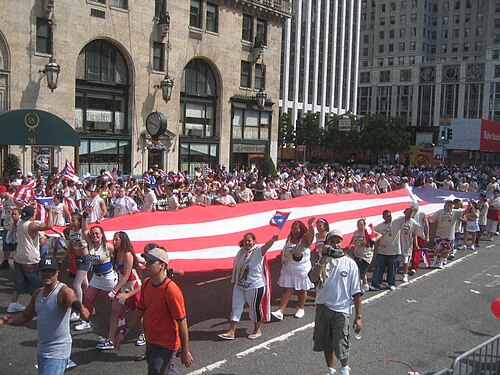
19世紀には、米国東海岸の港とプエルトリコの間で貿易が行われていた。船舶記録によると、多くのプエルトリコ人が米国とプエルトリコを行き来する船に乗っていた。彼らの多くはニューヨーク、ニュージャージー、コネチカット、マサチューセッツなどの場所に定住した。アメリカ南北戦争が勃発すると、一部のプエルトリコ人は軍隊に加わった。しかし、プエルトリコ人は依然としてスペイン国民であったため、スペイン人として登録された。[32]
スペイン統治下でも、プエルトリコ人は米国に定住した。19世紀に本土に来たのは主に政治亡命者だった。[33] 1898年以来、プエルトリコは米国の「島嶼領有地」および「非編入地域」であり、最初の半世紀は米国将軍と本土の非プエルトリコ系公務員によって統治され、本土と島の間の移住パターンを促進した。米西戦争の終結後、米国へのプエルトリコ人労働者の大規模な流入が始まった。1898年の勝利により、米国はスペインからプエルトリコを獲得し、それ以来主権を維持している。1917年のジョーンズ・シャフロス法により、すべてのプエルトリコ人は米国市民となり、移民障壁から解放された。プエルトリコ人のアメリカ本土への大規模な移住は20世紀初頭から後半にかけて最大規模であったが、[34] 21世紀初頭に再び増加した。
プエルトリコに対する米国の政治的、経済的介入は、「米国企業の手に富を集中させ、労働者を追放することによって」移民の条件を作り出した。[35]政策立案者は「人口を減らすために植民地化計画と契約労働プログラムを推進した。米国の雇用主は、多くの場合政府の支援を受けて、米国やその他の目的地への低賃金労働者の供給源としてプエルトリコ人を募集した。」[36]
プエルトリコ人は、より賃金の高い仕事を求めて、最初はニューヨーク市に移住し、その後シカゴ、フィラデルフィア、ボストンなどの他の都市に移住しました。[37]しかし、近年では、プエルトリコからニューヨークやニュージャージーへの移住が著しく再燃しており、プエルトリコ人にとっては、主に経済的および文化的な考慮から、明らかに多因子的な魅力があります。[38] [39]ニューヨーク市都市圏のプエルトリコ人人口は、2010年の1,177,430人から、2016年の国勢調査推定1,494,670人に増加しており、[40]アメリカ大陸でかなりの差をつけて、プエルトリコ系アメリカ人にとって最大の大都市圏および文化の中心地としての地位を維持しています。
ニューヨーク市では、アッパーマンハッタンのイーストハーレム、サウスブロンクス、ブルックリンのブッシュウィック、ウィリアムズバーグなどの地区が、米国内のプエルトリコ人と最も関連していることが多い。しかし、北フィラデルフィア東部のいくつかの地区、特にフェアヒルは、米国内でプエルトリコ人の集中度が最も高い地区の1つであり、フェアヒルは他の大都市の地区と比較して最も高い。[41]
ニューヨーク市
- ニューヨリカン
-
-

-

-

-

-
-

-

_(cropped).jpg/500px-Council_Member_Melissa_Mark-Viverito_(6217502867)_(cropped).jpg)
.jpg/500px-Neil_deGrasse_Tyson_in_June_2017_(cropped).jpg)
1950年代から1980年代にかけて、多数のプエルトリコ人がニューヨーク、特にブルックリン、ブロンクス、マンハッタンのスパニッシュハーレムやロイサイダ地区に移住した。このコミュニティの基盤は労働者の募集だった。1960年には、米国本土のプエルトリコ人の約70%がニューヨーク市に住んでいた。[42]彼らは友人や家族を含むソーシャルネットワークを頼りに、他の人々が定住し、仕事を見つけ、コミュニティを築くのを手助けした。
長い間、スパニッシュ・ハーレム(イースト・ハーレム)とロイサイダ(ローワー・イースト・サイド)が市内の2大プエルトリコ人コミュニティであったが、1960年代から1970年代にかけて、イースト・ハーレムに近いブロンクスや、ウィリアムズバーグ橋を経由してローワー・イースト・サイドに近いブルックリンに、主にプエルトリコ人の居住区が出現し始めた。ニューヨーク市の5つの行政区すべてに大きなプエルトリコ人コミュニティがある。
都心部のプエルトリコ人を研究してきた人類学者フィリップ・ブルゴワは、 「ニューヨークがグローバル都市に変貌したことにより、プエルトリコ人コミュニティは社会的疎外によって貧困の犠牲になった」と述べている。 [43]イーストハーレムとニューヨーク市全体のプエルトリコ人人口は、米国の都市のすべての移民グループの中で最も貧しいままである。1973年の時点で、「イーストハーレムのプエルトリコ人移民の約46.2%が連邦貧困ライン以下の生活を送っていた」。[44]しかし、より裕福なプエルトリコ系アメリカ人の専門家は、ロングアイランドやウエストチェスター郡、ニュージャージー州、コネチカット州の郊外地域に移住している。
ニューヨーク市は1980年代にフリースタイルミュージックのメッカにもなり、プエルトリコのシンガーソングライターはその中で重要な役割を果たしました。 [45]プエルトリコのポピュラー音楽への影響は21世紀にも続いており、ジェニファー・ロペスなどの大物アーティストも参加しています。[46]
フィラデルフィア
2010年の米国国勢調査によると、フィラデルフィアには推定121,643人のプエルトリコ系アメリカ人が住んでおり、2000年の91,527人から増加している。2010年現在、これはフィラデルフィアの総人口の8%、市内のラテン系アメリカ人人口の75%を占めている。プエルトリコ人は市内で最大のラテン系グループであり、プエルトリコ以外では、フィラデルフィアは現在約15万人と推定され、2番目に多いプエルトリコ系人口を抱えている。[47] 2010年以降、フィラデルフィアはシカゴに代わってプエルトリコ系人口が2番目に多い都市となり、シカゴの人口はわずかに減少したのに対し、フィラデルフィアはこれまで以上に増加を続けており、プエルトリコ系人口が2番目に多いだけでなく、最も急速に増加している都市の1つでもある。[48]最も信頼できる米国国勢調査局を含むほとんどの情報源は、2010年の時点でプエルトリコ人がフィラデルフィアのラテン系人口の70〜80%を占めていると推定しています。[49] [50]他の情報源によると、プエルトリコ人がフィラデルフィアのラテン系人口に占める割合は90%と高く、64%と低いものもあります。[51] [52] [53] [54]
シカゴ
.jpg/500px-Division_Street_(Paseo_Boricua).jpg)
プエルトリコ人は、20世紀初頭に裕福な家庭から大学に進学するために初めてやって来た。1930年代には、35番街とミシガン通りのあたりに飛び地があった。1950年代には、ダウンタウンのすぐ北西に、ホテルの職場の近く、かつては工場があった場所に、ラ・クラークとラ・マディソンと呼ばれる2つの小さなバリオが出現した。これらのコミュニティは、スラム街の一掃の一環として市によって追い出された。1968年、コミュニティグループのヤング・ローズが抗議とデモを行い、低所得者向け住宅への投資を要求していくつかの施設の建物を占拠した。[55] フンボルト・パークは、シカゴで最大のプエルトリコ人コミュニティの1つであり、「リトル・プエルトリコ」またはパセオ・ボリクアとして知られている。[56] [57]
オーランド
オーランドとその周辺地域には1980年代からかなりの数のプエルトリコ人が住んでいるが、フロリダ全体にも常にかなりの数のプエルトリコ人が住んでいる。フロリダ中央部のプエルトリコ人コミュニティの成長に大きく貢献したのは、プエルトリコで従業員を大量に採用したウォルト・ディズニー・ワールドだった。フロリダ中央部のプエルトリコ人人口は2000年代初頭から急増し始め、2010年代には加速し、プエルトリコ系ニューヨーク人(ニューヨリカン)の多くがフロリダに移住し、島生まれのプエルトリコ人に加わった。[58]
この時期、1990年代から2000年代初頭にかけて、プエルトリコから米国本土への移住パターンは全体的に変化し始め、ニューヨーク市に代わって、プエルトリコからオーランドへの移住先は圧倒的に多くなりました。プエルトリコ人はオーランド周辺に広く分布していますが、最も集中しているのはキシミー、ポインシアナ、オセオラ郡のその他の多くの地域など南部で、プエルトリコ人が人口の大半を占めています。[59] [60]
米国在住プエルトリコ人の人口統計
1950年には、約25万人のプエルトリコ人が「米国本土」、つまり米国のいずれかの州に住んでいた。2012年3月には、その数は約150万人に増加した。つまり、米国本土に住む500万人のプエルトリコ人のうち、3分の1弱がこの島で生まれたことになる。[12] [13]プエルトリコ人は、メキシコ系に次いで米国で2番目に多いラテン系グループでもある。[61]
州別の人口
各州の人口と比較して
州別のプエルトリコ人人口は、州/準州の人口全体に対するプエルトリコ人であると自認する州人口の割合を示しており、次の表に示されています。
2010年から2020年の間にプエルトリコ人の増加が最も大きかった10州は、フロリダ(306,330人のプエルトリコ人増加)、テキサス(99,886人)、ペンシルベニア(90,507人)、マサチューセッツ(46,152人)、ノースカロライナ(43,117人)、オハイオ(38,296人)、ジョージア(37,022人)、コネチカット(35,372人)、バージニア(30,887人)、ニュージャージー(25,178人)でした。他のほとんどの州では緩やかな増加が見られました。ただし、ニュージャージー州は、カリフォルニア、ハワイ、イリノイとともに、過去数十年よりも成長が鈍化しました。2020年の国勢調査でプエルトリコ人の人口が減少したのはニューヨークだけです。[63]北東部諸州から南大西洋諸州、特にフロリダ州に移住する米国生まれのプエルトリコ人が目立っているが、少数ながらバージニア州、ノースカロライナ州、ジョージア州にも多くの人が移住している。[65]北東回廊は依然としてプエルトリコ人の主要な移住先であるが、米国全土、特に南部でも人口が増加している。[23] [67] 2010年から2017年にかけて、フロリダ州のプエルトリコ人人口は84万7000人から112万人に増加し、約30万人増加したため、フロリダ州はニューヨーク州に代わってプエルトリコ人人口が最も多い州となった。テキサス州やオハイオ州など、国内の他の多くの地域でもプエルトリコ人が大幅に増加している。[68]
ニューヨークとニュージャージーのプエルトリコ人人口は比較的停滞しているものの、北東部の他の地域、特にペンシルベニアとローワーニューイングランド(マサチューセッツ、コネチカット、ロードアイランド)では引き続き非常に高い増加が見られています。ペンシルベニアは過去10〜15年間でプエルトリコ人の数的増加率が2番目に大きく、2010年から2017年の間に11万人以上増加しており、フロリダに次ぐ増加数です。コネチカットは米国内でプエルトリコ人の割合が最も高く、2010年から2017年(マリア事件以前)にかけて、その割合は約1.1パーセントポイント上昇しており、これは他のどの州よりも1パーセンタイルの増加率が高く、現在、州民の8パーセント以上がプエルトリコ系で、2番目に高い割合を3パーセントポイント近く上回っています。人口300万人未満の小規模州の中では、ロードアイランド州がプエルトリコ人の数の増加率が最も高い州です。[69]ニューヨークはプエルトリコからの移住者にとって依然として比較的人気のある目的地ですが、以前ほどではありませんが、前述のようにフロリダやその他の北東部の州では人口増加が大きくなっています。しかし、人口増加の停滞の大部分は、ニューヨークから去るプエルトリコ人とニューヨークに移住するプエルトリコ人の数が同数であることによるもので、現在他州に住んでいるプエルトリコ系の人々の多くはもともとニューヨーク市周辺出身です。
プエルトリコ人は米国のヒスパニック/ラテン系人口の 9 パーセントを占めるが、プエルトリコ人がヒスパニック/ラテン系人口のはるかに大きな割合を占める州もいくつかある。例えば、コネチカット州では同州のラテン系人口の 46.3 パーセントがプエルトリコ系であり、ペンシルバニア州ではプエルトリコ系がラテン系人口の 43.5 パーセントを占めている。プエルトリコ人がラテン系コミュニティの著しく大きな割合を占めるその他の州としては、マサチューセッツ州 (全ヒスパニックの 35.2 パーセントを占める)、ニューハンプシャー州 (30.9 パーセント)、デラウェア州 (27.2 パーセント)、オハイオ州 (25.6 パーセント)、ニューヨーク州 (25.3 パーセント)、ニュージャージー州 (22.9 パーセント)、ロードアイランド州 (22.4 パーセント)、フロリダ州 (各州全ヒスパニック/ラテン系人口の 20.3 パーセント) などがある。[63] [64]プエルトリコ人が最大のヒスパニック/ラテン系グループである米国の州は、ニューヨーク、ニュージャージー、ペンシルベニア、コネチカット、マサチューセッツ、ニューハンプシャー、ハワイでした。[64] 2020年現在、プエルトリコ人の割合が全国平均(1.6%)より高い米国の州は、コネチカット(8.0%)、フロリダ(5.3%)、ニューヨーク(5.0%)、ニュージャージー(4.9%)、マサチューセッツ(4.5%)、ロードアイランド(3.8%)、ペンシルベニア(3.6%)、ハワイ(3.1%)、デラウェア(2.9%)です。[69]
歴史的に、プエルトリコ人はニューヨーク都市圏で最大のヒスパニック/ラテン系グループであったが、生活費の高騰により同地域のプエルトリコ人人口は減少し始め、その代わりに他のラテン系グループの増加により全体的なラテン系人口が多様化し始めた。同時期に、プエルトリコ人人口は国内の他の多くの地域で増加しており、大規模なラテン系コミュニティがある地域では、プエルトリコ人がヒスパニック/ラテン系の大多数を占めている。オーランド周辺のフロリダ州中部、タンパとジャクソンビル地域の一部、特にハートフォードとスプリングフィールド周辺のニューイングランド南西部、フィラデルフィア地域やアレンタウンなどのさまざまな小規模都市圏を含む南ジャージーと東ペンシルベニア、ロチェスター、バッファロー、クリーブランドの都市圏を含むニューヨーク州西部からオハイオ州北東部にかけての地域。[69]特にオハイオ州北東部とニューヨーク州西部のヒスパニック/ラテン系人口は、80~90%がプエルトリコ人である傾向があります。 [65]しかし、フロリダ州中部とニューイングランド南西部(コネチカット州とマサチューセッツ州西部)は、これらの地域全体の総人口に占めるプエルトリコ人の割合が最も高い地域です。[65]
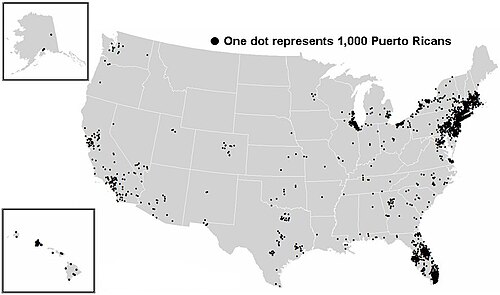
全国のプエルトリコ人人口と比較すると
州別のプエルトリコ人人口。米国全体のプエルトリコ人人口に対する各州のプエルトリコ人居住者の割合を示しています。

プエルトリコ人が伝統的な州から非伝統的な州へとこのように移動しているにもかかわらず、北東部は人口密度と人口の両面で優位を保ち続けています。
プエルトリコ人の人口が最も多いのは、以下の大都市圏です(出典:2020年ACS 5年推計):[70]
- ニューヨーク-北ニュージャージー-ロングアイランド、NY-NJ-PA MSA – 1,173,031
- フロリダ州オーランド-キシミー-サンフォード MSA – 386,706
- フィラデルフィア-カムデン-ウィルミントン、PA-NJ-DE-MD MSA – 278,515
- マイアミ-フォートローダーデール-ポンパノビーチ、フロリダ州 MSA – 225,998
- シカゴ-ジョリエット-ネイパービル、イリノイ州-インディアナ州-ウィスコンシン州 MSA – 207,526
- タンパ-セントピーターズバーグ-クリアウォーター、フロリダ州 MSA – 201,587
- ボストン-ケンブリッジ-クインシー、マサチューセッツ州-ニューハンプシャー州 MSA – 136,015
- ハートフォード-イーストハートフォード-ミドルタウン、コネチカット州 MSA – 120,494
- スプリングフィールド、マサチューセッツ州 MSA – 105,545
- ニューヘブン・ミルフォード、コネチカット州 MSA – 90,996
プエルトリコ人の人口が最も多いコミュニティ
プエルトリコ人の人口が最も多い米国のコミュニティトップ25(出典:2020年国勢調査)[71]
- ニューヨーク市、ニューヨーク州– 595,627
- ペンシルベニア州フィラデルフィア– 127,114
- イリノイ州シカゴ– 93,193
- マサチューセッツ州スプリングフィールド– 58,994
- フロリダ州オーランド– 41,105
- ハートフォード、コネチカット州– 37,751
- オハイオ州クリーブランド– 34,127
- ペンシルバニア州アレンタウン– 33,531
- ニューアーク、ニュージャージー州– 33,171
- フロリダ州ジャクソンビル– 33,137
- ニューヨーク州ロチェスター– 32,437
- ペンシルバニア州レディング– 29,732
- ブリッジポート、コネチカット州– 28,855
- ウォーターベリー、コネチカット州– 28,840
- ミルウォーキー、ウィスコンシン州– 28,518
- ボストン、マサチューセッツ州– 27,985
- バッファロー、ニューヨーク州– 27,895
- フロリダ州ポインシアナ– 27,092
- フロリダ州タンパ– 26,355
- マサチューセッツ州ウースター– 25,880
- キシミー、フロリダ州– 25,572
- ニューブリテン、コネチカット州– 24,978
- デルトナ、フロリダ州– 23,073
- ニュージャージー州ジャージーシティ– 21,600
- ニューヘイブン、コネチカット州– 21,067
プエルトリコ人の割合が高いコミュニティ
プエルトリコ人の割合が総人口に占める割合が最も高い米国の上位25のコミュニティ(人口5,000人以上)(出典:国勢調査2020)[71]
- マサチューセッツ州ホリヨーク– 45.8%
- フロリダ州ブエナベンチュラレイクス– 42.2%
- フロリダ州ポインシアナ– 39.0%
- マサチューセッツ州スプリングフィールド– 37.8%
- フロリダ州アザレアパーク– 34.8%
- コネチカット州ニューブリテン– 33.6%
- ペンシルバニア州レバノン– 32.3%
- フロリダ州キシミー– 32.2%
- ウィリアムティック、コネチカット州– 31.4%
- ペンシルバニア州レディング– 31.2%
- ハートフォード、コネチカット州– 31.1%
- マサチューセッツ州サウスブリッジ– 30.4%
- ニューヨーク州ダンケルク– 30.1%
- フロリダ州セントクラウド– 29.5%
- ニュージャージー州カムデン– 28.9%
- メドウウッズ、フロリダ州– 27.8%
- ニュージャージー州ヴァインランド– 27.5%
- ペンシルベニア州ランカスター– 26.6%
- フロリダ州ユニオンパーク– 26.7%
- ペンシルバニア州アレンタウン– 26.6%
- アムステルダム、ニューヨーク– 26.2%
- ウォーターベリー、コネチカット州– 25.2%
- フロリダ州デルトナ– 24.6%
- メリデン、コネチカット州– 23.9%
- ペンシルベニア州ヨーク– 23.1%
プエルトリコ人居住者の割合が最も高い10の大都市(人口20万人以上)は次のとおりです(2020年国勢調査):[71]
- ニューヨーク州ロチェスター– 15.3%
- フロリダ州オーランド– 13.3%
- マサチューセッツ州ウースター– 12.5%
- ニューアーク、ニュージャージー州– 10.6%
- ニューヨーク州バッファロー– 10.0%
- ニューヨーク州ヨンカーズ– 9.5%
- オハイオ州クリーブランド– 9.1%
- ペンシルベニア州フィラデルフィア– 7.9%
- ニュージャージー州ジャージーシティ– 7.2%
- フロリダ州タンパ– 6.8%
2000年以前の分散
他のグループと同様に、米国内のプエルトリコ人コミュニティでは「分散」というテーマが長い歴史を刻んできた。[72]最近の人口動態の動向は、一見すると米国内のプエルトリコ人人口がますます分散しているように見える。デュアニーはこのプロセスを「再構成」と表現し、米国全土におけるこのコミュニティの「国民化」と呼んだ。[73]
ニューヨーク市は、20 世紀のほとんどの期間、米国内のプエルトリコ人コミュニティの中心地でした。しかし、こうした居住地の変化が単なる人口分散として特徴付けられるかどうかは明らかではありません。今日のプエルトリコ人の居住地は、ニューヨーク市、シカゴ、マサチューセッツ州、コネチカット州、ニュージャージー州のいくつかの都市のような場所に比べて、それほど集中していません。
2000 年以降の移住傾向

ニューヨーク州は、 2006年以降プエルトリコ系アメリカ人の純移住を再開しており、1990年から2000年の間にプエルトリコ系人口が減少した唯一の州であったことから劇的な逆転を見せている。ニューヨーク州のプエルトリコ系人口は依然として米国最大であり、米国国勢調査局の推定によると、2010年の1,070,558人から2013年には1,103,067人に増加している。

2006 年以降のプエルトリコ人移住の傾向は非常に複雑です。2006 年から 2012 年の間に、ニューヨーク州はプエルトリコ (本土全体の 31%) および本土の他の地域 (州間移動の 20%) からのプエルトリコ人移住者を、絶対数で他のどの米国の州よりも多く受け入れましたが、米国全体では南部の移住者数が最も多くなりました。[67]また、数十年前の最初の移住パターンとは異なり、この2回目の大規模なプエルトリコ系アメリカ人のニューヨーク州および周辺州への移住は、ニューヨーク市だけでなく、ニューヨーク州外、特にニュージャージー州北部を含む市周辺の郊外地域への移動によって推進されており、2010年から2016年の間にニューヨーク市都市圏は、2010年の1,177,430人から2016年の1,494,670人へと、どの都市圏よりも多くのプエルトリコ系アメリカ人を追加で獲得しました。[40]
フロリダ州では、2010年から2013年の間にニューヨーク州よりも大きな増加が見られ、2010年の847,550人から2013年には987,663人へと増加しました。 [74]プエルトリコからの移住が顕著で、シカゴやニューヨークからもフロリダへの移住がありました。 [67]しかし、フロリダへのプエルトリコ人の移住のほとんどは、オーランド周辺の州中央部への移住です。オーランドと、それほどではないがフィラデルフィアとタンパでは、2010年から2013年の間にプエルトリコ人の人口が大幅に増加し、現在では国内で最も急速にプエルトリコ人人口が増加している都市の一つとなっています。ピュー研究所によると、2000年以降に島から到着したプエルトリコ人は、以前の移住者よりも裕福ではなく、世帯収入が低く、貧困に陥る可能性が高いです。[67] 2017年9月にハリケーン・マリアがプエルトリコを襲い、島のインフラが壊滅した後、家族のつながりを前提とすると、ニューヨーク、フロリダ、ニュージャージーがプエルトリコ人の米国本土への移住先として最も可能性の高い3つの州になると予想されました。[75]
2017年9月のハリケーン・マリア以来、約40万人[要出典]のプエルトリコ人が島を離れ、永久的または一時的に米国本土に移住しており、そのうちほぼ半数[要出典]がフロリダ州のみに移住し、特にオーランドとマイアミの大都市圏、そして少数ながらタンパとジャクソンビルに移住した。残りの半数は国中に散らばっているが、ほとんどはフィラデルフィア、ニューヨーク、ボストン、シカゴ、クリーブランドの大都市圏と米国北東部の多数の小都市に移住した。2017年の米国本土のプエルトリコ人総人口は550万人だった。[要出典]ハリケーン・マリアによる移住ブームと出生数を考慮すると、米国のプエルトリコ人人口は2018年時点で580万人と推定されている。[76]プエルトリコの人口減少が米国本土のプエルトリコ人人口の増加につながったのは、ハリケーン・マリアやその他の最近の自然災害、および島の経済衰退の結果である。[要出典]しかし、それ以来多くのプエルトリコ人が戻ってきているが、プエルトリコの人口減少を逆転させるには十分ではない。[要出典]
キリーン(テキサス州)、コロンバス(ジョージア州)、バージニア州ハンプトン・ローズ都市圏などの軍事都市に住むプエルトリコ人の数も増加している。 [77]
集中

居住地の分離は、米国内のプエルトリコ人人口集中地域に多く見られる現象である。黒人は米国内で最も居住地が分離されているグループであるが、2002年の調査では、米国内のプエルトリコ人は米国のラテン系の中で最も分離されていることが示されている。[78]
- コネチカット州ブリッジポート(スコア73)
- ハートフォード、コネチカット州 (70)
- ニューヨーク市 (69)
- ペンシルベニア州フィラデルフィア (69)
- ニューアーク、ニュージャージー州 (69)
- オハイオ州クリーブランド・ロレイン・エリリア(68)
米国在住のプエルトリコ人は、いわゆる「ボストン・ニューヨーク・フィラデルフィア・ワシントン回廊」と東海岸沿いのフロリダに偏って集中している。1956年に地理学者ジーン・ゴットマンによって「メガロポリス」と名付けられた米国北東回廊は、世界最大かつ最も裕福な都市回廊であり、「富の中心地...国家経済の鼓動が最も激しく、権力の座がしっかりと確立されている地域」と表現されている。[79] ボストンには世界クラスの主要大学が集中し、この回廊全体に広がっているため、経済とメディアの力、そして国際的な政治力はニューヨーク市、そして連邦政府の所在地であるワシントンDCにあり、これも主要な世界的権力の中心となっている。
セグメンテーション
ラテン系人口の相対的な規模の変化は、米国内のプエルトリコ人コミュニティの役割も変えました。[80]そのため、多くの長い歴史を持つプエルトリコの機関は、非プエルトリコ系ラテン系の人々のためにサービスと擁護を提供するために、その使命を改訂し(場合によっては名称を変更し)、
人種
2010年の米国国勢調査によれば、米国内のプエルトリコ人のうち、約53.1%が白人、約8.7%が黒人、約0.9%がアメリカインディアン、約0.5%がアジア人、36.7%が混血またはその他の人種であると自認している。[64]プエルトリコ人の半数以上が白人であると自認しているものの、人口の大部分は多民族で構成されており、ほとんどのプエルトリコ人は程度の差こそあれ混血であり、通常は白人のヨーロッパ系/北アフリカ人、黒人の西アフリカ人、先住民の タイノ族の血統である。[82] [83] [84] [85] [86]平均的なゲノム全体の個人の祖先の割合は、ヨーロッパ系が56%、西アフリカ系が28%、ネイティブアメリカンが16%と推定されている。[85]しかし、プエルトリコ人の中にも(純粋またはほぼ純粋な)黒人と白人が相当数存在する。 [87]歴史的に、スペインとアメリカの統治下でプエルトリコは白人化の過程を経ており、特に島にはRegla del Sacarのような法律があり、主にヨーロッパ系の混血の人々は「白人」に分類されていました(米国のワンドロップルールの反対)。 [83] [88] [89] [90]
プエルトリコ人は平均して、ヨーロッパ人、北アフリカ人、西アフリカ人、ネイティブアメリカンの遺伝的影響を受けている。[91]この島はラテンアメリカのほとんどの国よりも三元混血の度合いが高い。国勢調査に基づく642人のプエルトリコ人のサンプルのDNAの最近の研究では、現代のプエルトリコ人のほぼ全員が3つの祖先集団(タイノ人、ヨーロッパ人、アフリカ人)の混血子孫であることが実証された。この研究によると、東部のプエルトリコ人の平均は54.7%がヨーロッパ人、31.8%がアフリカ人、13.5%がネイティブアメリカンで、西部のプエルトリコ人の平均は68.5%がヨーロッパ人、15.9%がアフリカ人、15.6%がネイティブアメリカンである。この研究で記録された最も高い先住民の祖先はほぼ40%であった。[92]
文化
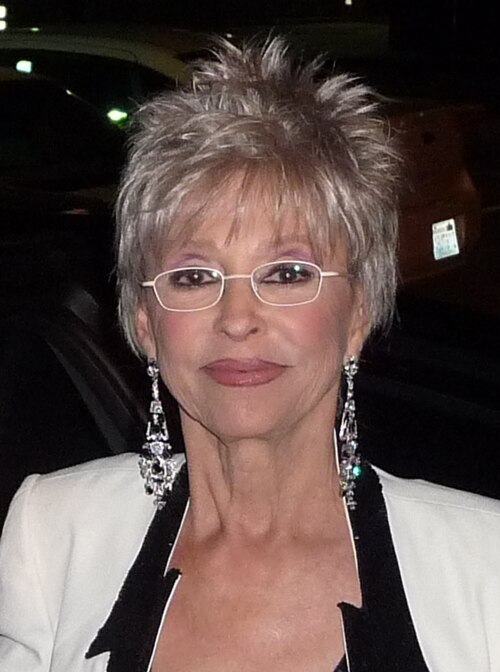
プエルトリコ文化はスペイン、タイノ、西アフリカの文化が融合したもので、近年は米国や近隣のラテンアメリカ、カリブ諸国の影響も受けています。プエルトリコは米国領土であるため、プエルトリコの人々は米国文化に最も多く接しており、米国本土のプエルトリコ人は主要なラテン系グループの中で最も「米国化」されている傾向があります。ただし、プエルトリコ生まれの移民第 1 世代はより伝統的である傾向があり、米国本土で生まれたプエルトリコ系の人々には、伝統的なプエルトリコ文化と米国本土の文化が融合する傾向があります。
言語
プエルトリコのスペイン語は、主にスペイン南部とカナリア諸島で話されているスペイン語から派生したものです。また、タイノ語や西アフリカのさまざまな言語など、多くの言語の影響も顕著に受けています。他のカリブ海地域のスペイン語と非常によく似ています。
米国に住む5歳以上のプエルトリコ人のうち、約83%が英語を流暢に話し、そのうち53%はスペイン語と英語のバイリンガルであり、他の30%は英語のみ流暢に話し、スペイン語はあまり流暢ではない。残りの17%はスペイン語のみ流暢に話し、英語を「あまり上手ではない」と報告し、英語はあまり流暢ではないと報告している。一方、ラテン系全体では34%がそう報告している。[69] [93] 2014年の世論調査によると、米国本土に住むプエルトリコ人の20%が自宅でスペイン語を話し、78%がスペイン語ではなく英語で世論調査に回答することを選択した。これは、世論調査を受けた他のラテン系グループよりも大幅に高い。[94]
ニューヨークに住むプエルトリコ人の第一世代と第二世代の多くは、地元のニューヨーク英語とプエルトリコのスペイン語の影響が混ざった「ニューヨリカン英語」を話します。一方、米国の他の都市に住むプエルトリコ人の多くも同様の英語アクセントを話します。よりアメリカ化したプエルトリコ人は、スペイン語の痕跡がほとんどないか全くない地元の英語アクセントを話し、黒人アメリカ人や同化したイタリア系アメリカ人を含む他の地元のグループと似た発音をします。
宗教
米国在住のプエルトリコ人の大多数はキリスト教を信仰している。カトリック教徒が最も多いが、多数のプロテスタント宗派の信者も相当数いる。米国在住のプエルトリコ人人口は、プエルトリコの人口よりもプロテスタントが占める割合が高い。プエルトリコのカトリック教徒の中には、ヨルバ語とカトリックの混合宗教であるサンテリアを固く信仰している者もいる。無宗教の者も少数いる。米国在住のプエルトリコ人のうち、特にフィラデルフィアやニューヨークの都心部では、ごく少数のプエルトリコ人が他の宗教を信仰している。
スポーツ
米国在住のプエルトリコ人の間で最も人気のあるスポーツは野球とボクシングですが、アメリカンフットボールやバスケットボールなどのスポーツも根強い人気があります。ロベルト・クレメンテやヘクター・カマチョはプエルトリコのスポーツ界の伝説的な人物です。最近プロスポーツ選手として頭角を現した米国在住のプエルトリコ人にはカーメロ・アンソニーやビクター・クルーズなどがいます。
音楽
-2_(48696671561)_(cropped).jpg/500px-TIFF_2019_jlo_(1_of_1)-2_(48696671561)_(cropped).jpg)
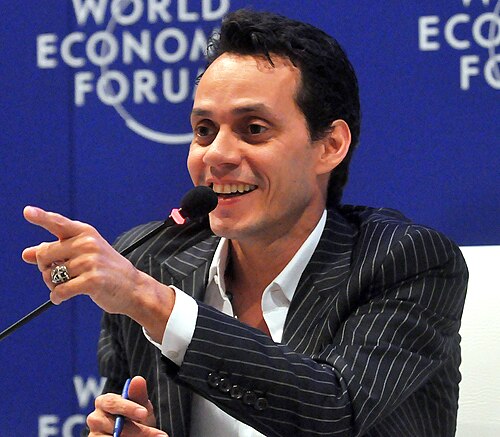
サルサ、レゲトン、バチャータ、メレンゲ、ラテンポップ、ラテントラップは、多くのアメリカ在住プエルトリコ人の間で最も人気のある音楽ジャンルです。しかし、後から来たのではなく、子供の頃からアメリカで育った年長のプエルトリコ人は、通常、1980年代と1990年代のラテンフリースタイルやヒップホップを好みます。ポップ、ロック、ヒップホップ、R&B、レゲエ、ダンス、ハウス、テクノ、ボレロ、バラード、ヘビーメタルなどの他の音楽ジャンルは、主に英語を母国語とする多くのプエルトリコ人の間で人気があります。ボンバ、プレナ、ヒバロも、多くのアメリカ在住プエルトリコ人の間で大きな音楽人口とコミュニティがあり、主にクリスマスなどのお祝いのときに演奏されます。ニューヨークのプエルトリコ人は、1960年代と1970年代にはブーガルーやサルサ、1980年代にはヒップホップ、ラテンハウス、ラテンフリースタイルなど、多くのジャンルの形成に貢献しましたが、通常は他の民族グループの協力を得ていました。米国で人気ミュージシャンとして登場したプエルトリコ人には、マーク・アンソニー、ジェニファー・ロペス、ビッグ・パンなどがいます。
異人種間の結婚
プエルトリコ人の異人種間結婚率は38.5%で、米国のラテン系グループの中で最も高い。[95]プエルトリコ人の異人種間結婚率と出産率は、非常に類似した文化を持ち、米国人口が多く、通常同じ地域に住んでいる別のカリブ海ラテン系グループであるドミニカ系アメリカ人との間で最も高い。アフリカ系アメリカ人、ユダヤ系アメリカ人、イタリア系アメリカ人、メキシコ系アメリカ人、キューバ系アメリカ人、トリニダード系アメリカ人、ハイチ系アメリカ人、ジャマイカ系アメリカ人など他のグループとの間でも比較的高い割合となっている。[96]
貢献
米国で生まれ育ったプエルトリコ人は数多く、政府、軍、テレビ、音楽、スポーツ、芸術、法執行機関、モデル、教育、ジャーナリズム、宗教、科学などの分野で注目すべき文化的貢献を果たしてきた。その一方で、ニューヨークとプエルトリコの文化的つながりは強い。2017年9月、ハリケーン・マリアがプエルトリコに甚大な被害をもたらした後、ニューヨーク州知事 アンドリュー・クオモはサンファンへの救援代表団を率い、[97]プエルトリコの電力網の復旧を支援するためにニューヨーク電力公社の技術者を派遣した。[98]その後、2018年9月、ハリケーン発生から1年目に、クオモ知事はニューヨーク人とプエルトリコ人の間に共有される深い文化的つながりに言及し、ハリケーン・マリアの犠牲者を追悼するニューヨーク州公式記念碑をマンハッタンのバッテリーパークシティに建設する計画を発表した。[99]ハリケーン・マリア記念碑は2021年3月26日にマンハッタン南部で公開されました。[100]
社会経済
所得
.jpg/500px-Melanie_martinez_(cropped).jpg)
米国のプエルトリコ人コミュニティは、大部分が貧困層であり、米国の都市部の下層階級の一部であると特徴付けられることが多い。過去50年ほどにわたる研究や報告書では、このコミュニティの貧困率の高さが記録されている。[101]しかし、21世紀初頭の状況は、大きな社会経済的進歩と、経済力が増大しているコミュニティも示している。[102]プエルトリコ人が主に居住する中流階級の地域は、オーランド、タンパ、およびその郊外を含むフロリダ州中部全域に見られる。 [103]かなりの数の中流階級のプエルトリコ人は、フィラデルフィア都市圏、北フィラデルフィア北部、特にオルニー・ジュニアータ・ローンクレスト周辺、ニュージャージー州カムデン郡のカムデン市外、ニューヨーク市都市圏、特にブロンクス区東部とウェストチェスター郡、マイアミとボストンの多くの郊外、ニュージャージー州全域とニューイングランド南部にも見られます。裕福なプエルトリコ人は、北東部と中西部の伝統的なプエルトリコ人居住地と、南部と西部の進歩的なサンベルト都市の両方で、米国全土に散在しています。[104]
ラテン系市場とプエルトリコへの送金
プエルトリコ人の米国内総収入は、米国における大規模で成長を続けるラテン系市場の大きな部分を占めており、メディアや企業部門からの注目が高まっています。ここ 10 年ほどの間に、大企業は、長い間無視されてきた黒人やラテン系のいわゆる「都市市場」を発見しました。これにより、ラテン系市場に特化したマーケティング会社、コンサルタント、出版物の小規模産業が生まれました。[要出典]
これによって生じる重要な疑問の1つは、米国在住のプエルトリコ人がプエルトリコに経済的にどの程度貢献しているかということである。プエルトリコ計画委員会は、1963年の送金総額は6,600万ドルと推定している。[105]
プエルトリコの経済に対する米国内のプエルトリコ人コミュニティの貢献の全体は不明だが、明らかに大きなものである。ラテン系移民による母国への送金と投資の役割は、メキシコなどの国が経済開発計画においてこれらの移民からの多額の資金をより有効に活用する戦略を策定する中で、ここ数年で大きな注目を集めるレベルに達している。[106]
米国のコミュニティと島内居住者の所得格差は他のラテンアメリカ諸国ほど大きくなく、プエルトリコ人の二世とその親族との直接的なつながりは、直接的な金銭的支援にはあまり役立たない。プエルトリコにまだ居住しているプエルトリコ人の多くは、米国内に住んでいる家族に送金もしている。[要出典]
性別

2002 年の米国在住プエルトリコ人男性の平均収入は 36,572 ドルでしたが、女性の平均収入は 30,613 ドルで、男性の 83.7 パーセントでした。ラテン系、白人、アジア系すべてのグループと比較すると、米国在住プエルトリコ人女性は、同じ人種・民族グループの男性と同等の収入に近づいています。さらに、米国在住プエルトリコ人女性の収入は白人女性の 82.3 パーセントでしたが、米国在住プエルトリコ人男性の収入は白人男性の 64.0 パーセントに過ぎませんでした。
米国在住のプエルトリコ人女性は、ドミニカ人女性(58.7%)、中南米人女性(68.4%)よりも白人女性と所得が同等に近いが、キューバ人女性(86.2%)、「その他のラテン系」(87.2%)、黒人女性(83.7%)、アジア人女性(107.7%)よりは低い。
米国在住のプエルトリコ人男性は、他の人種・民族グループの男性に比べて弱い立場にありました。彼らは、ドミニカ人男性 (62.3%) や中南米人男性 (58.3%) よりも白人男性と同等の所得水準に近かったです。黒人男性 (65.5%) と同等の所得水準に非常に近かったものの、米国在住のプエルトリコ人男性は、メキシコ人 (68.3%)、キューバ人 (75.9%)、その他のラテン系 (75.1%)、アジア人 (100.7%) より低い所得水準でした。
学歴
アメリカ国内のプエルトリコ人は、他のラテン系アメリカ人と同様に、高校中退率の長期的問題に悩まされており、その結果、教育達成度が比較的低くなっています。[15]
ピュー・ヒスパニック・センターによれば、プエルトリコではラテン系住民の20%以上が学士号を取得しているが、2012年3月時点で米国内のプエルトリコ人のうち学士号を取得しているのはわずか16%である。[61]
社会問題
米国国勢調査の数字によると、プエルトリコ人の人口は、米国のすべての民族グループの中で最も貧困率と投獄率が高い。[107]プエルトリコ人コミュニティは、米国で最も隔離された民族グループの一つでもある。[108] [109] [110] [111]米国内のプエルトリコ人コミュニティは、特にニューヨークやフィラデルフィアなどの都市で、アフリカ系アメリカ人コミュニティと提携し、団結した力として、20世紀中期から後半にかけてのコミュニティにおける人種差別と権利剥奪と戦ってきた。[112] [113] [114]多くの場合、大部分が貧困であると認識されているが、前述のように、経済力が高まっている証拠がある。[102] [115]
政治参加
.jpg/500px-Aida_Alvarez_in_1999_(11B).jpg)

プエルトリコ人コミュニティは、ほぼ1世紀にわたって、米国の政治機関で自らの利益を代表するために組織化されてきました。[116]ニューヨーク市では、プエルトリコ人が公職に立候補し始めたのは1920年代です。1937年、彼らはニューヨーク州議会に最初の政府代表であるオスカー・ガルシア・リベラを選出しました。[117]マサチューセッツ州では、プエルトリコ人のネルソン・マーセドがマサチューセッツ州下院議員に選出された最初のラテン系アメリカ人となり、州全体で公職に就いた最初のラテン系アメリカ人となりました。[118]
There are three Puerto Rican members of the United States House of Representatives: Democrats Alexandria Ocasio-Cortez of New York, Ritchie Torres of New York and Nydia Velázquez of New York, complementing the one Resident Commissioner elected to that body from Puerto Rico. Puerto Ricans have also been elected as mayors in three major cities: Miami, Hartford and Camden. Luis A. Quintana, born in Añasco, Puerto Rico, was sworn in as the first Latino mayor of Newark, New Jersey in November 2013, assuming the unexpired term of Cory Booker, who vacated the position to become a U.S. Senator from New Jersey.[119]
On June 26, 2018, Alexandria Ocasio-Cortez, a Puerto Rican millennial, won the Democratic primary in New York's 14th congressional district covering parts of The Bronx and Queens in New York City, defeating the incumbent, Democratic Caucus Chair Joe Crowley, in what has been described as the biggest upset victory in the 2018 midterm election season.[120] Ocasio-Cortez is a member of the Democratic Socialists of America and has been endorsed by various politically progressive organizations and individuals.[121] She is the youngest woman ever elected to Congress.[122]
There are various ways in which stateside Puerto Ricans have exercised their influence. These include protests, campaign contributions and lobbying and voting. Compared to the United States, voter participation by Puerto Ricans in Puerto Rico is very large.[citation needed] However, many see a paradox in that this high level of voting is not echoed stateside.[123] There, Puerto Ricans have had persistently low voter registration and turnout rates, despite the relative success they have had in electing their own to significant public offices throughout the United States.
To address this problem, the government of Puerto Rico has, since the late 1980s, launched two major voter registration campaigns to increase the level of voter participation of stateside Puerto Rican. While Puerto Ricans have traditionally been concentrated in the Northeast, coordinated Latino voter registration organizations such as the Southwest Voter Registration Education Project and the United States Hispanic Leadership Institute (based in the Midwest), have not concentrated in this region and have focused on the Mexican-American voter. The government of Puerto Rico has sought to fill this vacuum to insure that stateside Puerto Rican interests are well represented in the electoral process, recognizing that the increased political influence of stateside Puerto Ricans also benefits the island.
This low level of electoral participation is in sharp contrast with voting levels in Puerto Rico, which are much higher than that not only of this community, but also the United States as a whole.[124]
Voter participation has historically been higher in Puerto Rico itself than among Stateside Puerto Ricans.[125][126] The reasons for the differences in Puerto Rican voter participation have been an object of much discussion, but relatively little scholarly research.[127] An estimated 58% of Stateside Puerto Ricans support the Democratic party and say they think the party represents them well, while 36% think that way of the Republican party.[128]
Voter statistics

When the relationship of various factors to the turnout rates of stateside Puerto Ricans in 2000 is examined, socioeconomic status emerges as a clear factor.[129] For example, according to the Census:
- Income: the turnout rate for those with incomes less than $10,000 was 37.7 percent, while for those earning $75,000 and above, it was 76.7 percent.
- Employment: 36.5 percent of the unemployed voted, versus 51.2 percent for the employed. The rate for those outside of the labor force was 50.6 percent, probably reflecting the disproportionate role of the elderly, who generally have higher turnout rates.
- Union membership: for union members it was 51.3 percent, while for nonunion members it was 42.6 percent.
- Housing: for homeowners it was 64.0 percent, while it was 41.8 percent for renters.
There were a number of other socio-demographic characteristics where turnout differences also existed, such as:
- Age: the average age of voters was 45.3 years, compared to 38.5 years for eligible nonvoters.
- Education: those without a high school diploma had a turnout rate of 42.5 percent, while for those with a graduate degree, it was 81.0 percent.
- Birthplace: for those born stateside it was 48.9 percent, compared to 52.0 percent for those born in Puerto Rico.
- Marriage status: for those who were married it was 62.0 percent, while those who were never married managed 33.0 percent.
- Military service: for those who ever served in the US military, the turnout rate was 72.1 percent, compared to 48.6 percent for those who never served.
Notable people
See also


- Cultural diversity in Puerto Rico
- Demographics of Puerto Rico
- 51-star flag
- History of women in Puerto Rico
- History of Puerto Ricans
- Latino Americans
- Latinos in New Jersey
- Index of Puerto Rico-related articles
- List of Puerto Ricans
- List of Puerto Rican-American communities
- Puerto Rican cuisine
- Puerto Rican culture
- Puerto Rican immigration to Hawaii
- Puerto Rican people
- Military history of Puerto Rico
- National Register of Historic Places listings in Puerto Rico
- Nuyorican
- Nuyorican movement
- Nuyorican Poets Café
- Outline of Puerto Rico
- Puerto Rican citizenship
- Teatro Puerto Rico
- Young Lords
Notes
- ^ Percentage of the state population that identifies itself as Puerto Rican relative to the state/territory" population as a whole.
- ^ Percentage of Puerto Rican residents in each state relative to the Puerto Rican population in the United States as a whole. Puerto Rican population in the U.S. according to the 2010 U.S. Census: 4,623,716
References
- ^ a b c d "B03001 HISPANIC OR LATINO ORIGIN BY SPECIFIC ORIGIN - United States - 2022 American Community Survey 1-Year Estimates". U.S. Census Bureau. July 1, 2022. Retrieved September 15, 2022.
- ^ "1960 Census: Detailed tables" (PDF). Census.gov. February 14, 2019. pp. 103–104. Retrieved June 10, 2023.
- ^ Atlas of Stateside Puerto Ricans: Abridged Edition without Maps. Angelo Falcon. Puerto Rico Federal Affairs Administration. ca. 2002. Page 3. Retrieved December 13, 2013.
- ^ Promociones SMS y Dibella Entertainment firman al puertorriqueño americano Christopher "Golden" Galeano. BOXEOMUNDIAL.COM. Posted on August 29, 2013.
- ^ La Reforma social: Lessons from the War and the Peace Conference Reforma Social: Revista mensual de cuestiones sociales, Volumes 20–21. p232.
- ^ Yonquis y yanquis salvajes. José Luis Alonso de Santos and César Oliva. p20. Ediciones Castalia. 2012.
- ^ Isabela. Wagner Ortega González. p123. Editorial de la Universidad de Costa Rica. 2005.
- ^ Boxeo Telemundo Regresa el 21 de Junio a las 11:35PM/10:35C con una Segunda Temporada que incluye a Orlanda Cruz y una pelea por el titulo mundial. Archived March 23, 2014, at the Wayback Machine Telemundo Press Release. June 10, 2013.
- ^ "Stateside". Collins Online Dictionary. Glasgow, Scotland: HarperCollins Publishers. 2019. Retrieved September 6, 2019.
- ^ Five million Puerto Ricans now living in the mainland U.S. Archived December 18, 2013, at the Wayback Machine Caribbean Business. June 27, 2013. Vol 41. Issue 24. Retrieved December 13, 2013.
- ^ "Table 1. First, Second, and Total Responses to the Ancestry Question by Detailed Ancestry Code: 2000". U.S. Census Bureau. Retrieved June 9, 2013.
- ^ a b Llorente, Elizabeth (June 21, 2013). "Salvadorans Overtaking Cubans As Third-Largest Hispanic Group In The U.S." FoxNews.com. Retrieved January 20, 2017.
- ^ a b "1.5 million Dominicans live in the U.S.: Pew study". dominicantoday.com. June 20, 2013. Archived from the original on June 24, 2013. Retrieved January 20, 2017.
- ^ Falcón in Jennings and Rivera 1984: 15–42
- ^ a b Nieto 2000
- ^ Pantoja 2002: 93–108
- ^ Duany 2002: Ch. 7
- ^ Chenault 1938: 72
- ^ Lapp 1990
- ^ Manuel Ortiz (1993). The Hispanic Challenge: Opportunities Confronting the Church. InterVarsity Press. Page 37.
- ^ Luis o. Reyes. Mending the Puerto Rican Education Pipeline in New York City. Centro Journal: volume xxv, number ii. Posted in fall 2012.
- ^ Duany, Jorge (November 24, 2023). "Mobile Livelihoods: The Sociocultural Practices of Circular Migrants between Puerto Rico and the United States". The International Migration Review. 36 (2): 355–388. doi:10.1111/j.1747-7379.2002.tb00085.x. JSTOR 4149457. S2CID 144040223.
- ^ a b "Chapter 1: Puerto Ricans on the U.S. Mainland". Pewhispanic.org. August 11, 2014. Retrieved October 14, 2017.
- ^ English Proficiency Lower Among Mexicans Than Puerto Ricans in U.S. Education Week. Posted by Mary Ann Zehr on September 21, 2009.
- ^ Sharon M. Lee and Barry Edmonston (June 2015). New Marriages, New Families: U.S. Racial and Hispanic Intermarriage Archived March 3, 2016, at the Wayback Machine. Population Bulletin. Vol. 60, No. 2.
- ^ Nancy S. Landale, R. Salvador Olopesa, and Christina Bradatan. Hispanic Families in the United States: Family Structure and Process in an Era of Family change.
- ^ Jeffrey S. Passel, Wendy Wang and Paul Taylor. 755 Marrying Out – Pew Research Center: Marrying Out. One-in-Seven New U.S. Marriages is Interracial or Interethnic Archived January 31, 2016, at the Wayback Machine. RELEASED June 4, 2010.
- ^ Nathan Glazer (1997/Fourth printing: 2003). We are All Multiculturalists Now. Harvard University Press. Page 129.
- ^ Multiracial population Orlando grows: Multiracial population. Posted by Jeff Kunerth, Orlando Sentinel (June 21, 2011).
- ^ Pamo, Maitri (December 6, 2012). "How interracial relationships shape the Latino community". Being Latino Online Magazine. Archived from the original on November 2, 2014.
- ^ "Explorations in Black and Tan". IMDiversity. Posted on October 16, 2012, by Carol Amoruso, Hispanic American Village Editor.
- ^ "The Puerto Rican Diaspora: historical perspectives"; By Carmen Teresa Whalen, Víctor Vázquez-Hernandez; page 176; Publisher: Temple University Press; ISBN 978-1-59213-413-7; ISBN 1-59213-413-0
- ^ Thernstrom, Stephan; Orlov, Ann; Handlin, Oscar, eds. (1980). "Puerto Ricans". Harvard Encyclopedia of American Ethnic Groups. Harvard University Press. p. 859. ISBN 0674375122. OCLC 1038430174.
- ^ Clara E. Rodríguez; Introduction by Joseph Monserrat. "Puerto Ricans: Immigrants and Migrants" (PDF). Americans All. Retrieved October 27, 2014.
- ^ Padilla, Elena. 1992. Up From Puerto Rico. New York: Columbia University Press.
- ^ Whalen, Carmen Teresa; Vázquez-Hernández, Victor (2005). Puerto Rican Diaspora: Historical Perspectives. Philadelphia: Temple University Press.
- ^ "Cleveland city, Ohio: ACS Demographic and Housing Estimates: 2006–2008". Factfinder.census.gov. Archived from the original on February 11, 2020. Retrieved July 8, 2010.
- ^ Cindy Y. Rodriguez (March 22, 2014). "Why more Puerto Ricans are living in mainland U.S. than in Puerto Rico". CNN. Retrieved March 22, 2014.
- ^ Dolores Prida (June 8, 2011). "The Puerto Ricans are coming!". New York Daily News. Retrieved March 22, 2014.
- ^ a b "SELECTED POPULATION PROFILE IN THE UNITED STATES 2016 American Community Survey 1-Year Estimates". United States Census Bureau. Archived from the original on February 14, 2020. Retrieved September 22, 2017.
- ^ 2010 Census New York, NY 10029. Zip-codes.com.
- ^ "1960 Census: Population, Puerto Ricans in the United States" (PDF). Census.gov. February 14, 2019. p. 7. Retrieved June 10, 2023.
- ^ Bourgois, Philippe. In Search of Respect: Selling Crack in El Barrio. New York: Cambridge University Press. 2003
- ^ Salas, Leonardo. "From San Juan to New York: The History of the Puerto Rican". America: History and Life. 31: 1990.
- ^ Joey Gardner. "The History of Freestyle Music". Reproduced with permission of Tommy Boy Music & Timber! Records. Retrieved December 4, 2012.
- ^ "López, Jennifer – Music of Puerto Rico". Copyright 2006, Evan Bailyn, All rights reserved. Retrieved December 4, 2012.
- ^ "Explore Census Data".
- ^ Bureau, U.S. Census. "American FactFinder – Results". Factfinder2.census.gov. Archived from the original on February 12, 2020. Retrieved May 30, 2017.
{{cite web}}:|last=has generic name (help) - ^ Bureau, U.S. Census. "American FactFinder – Results". Factfinder2.census.gov. Retrieved October 14, 2017.
{{cite web}}:|last=has generic name (help)[permanent dead link] - ^ Vázquez-Hernández, p. 88.
- ^ "Looking for Work in the Global Economy: An Introduction" (PDF). Temple.edu. Retrieved October 1, 2017.
- ^ "The new era of Latino politics". Axisphilly.org. Archived from the original on February 8, 2014. Retrieved October 14, 2017.
- ^ "Latinos have region's highest poverty rate". Articles.philly.com. Retrieved October 14, 2017.
- ^ "Puerto Ricans in the United States: Past, Present and Future" (PDF). Archived from the original (PDF) on October 26, 2014. Retrieved October 16, 2014.
- ^ "Young Lords in Lincoln Park collection, RHC-65". Grand Valley State University. Retrieved January 20, 2017.
- ^ "The Division Street Business Development Association Welcomes You!". paseoboricua.org. 2016. Archived from the original on February 1, 2017. Retrieved January 20, 2017.
- ^ "Humboldt Park". thechicagoneighborhoods.com. Archived from the original on October 27, 2016. Retrieved January 20, 2017.
- ^ "Puerto Rico's Exodus Begins with a Trickle into Orlando". Politico. September 29, 2017.
- ^ "Census Bureau: Puerto Rican population in Orange, Osceola jumps 12.5% after Hurricane Maria". September 27, 2019.
- ^ "Mapping Florida's Puerto Rican Population". April 26, 2019.
- ^ a b "Puerto Rico's population exodus is all about jobs". USA Today. March 11, 2012.
- ^ Carmen Teresa Whalen; Víctor Vázquez-Hernández (2005). "The Puerto Rican Diaspora: Historical Perspectives" (PDF). Temple University Press. p. 3. Archived from the original (PDF) on November 5, 2013. Retrieved December 3, 2013.
- ^ a b c d "Detailed Races and Ethnicities in the United States and Puerto Rico: 2020 Census".
- ^ a b c d e "2010 Census". Medgar Evers College. Archived from the original on June 11, 2010. Retrieved April 13, 2010.
- ^ a b c d e "QT-P10 Hispanic or Latino by Type: 2010, Census Summary File 1". U.S. Census Bureau. Retrieved January 22, 2012. [permanent dead link]
- ^ "Hispanic Origin: U.S., Regions, Divisions, States, Puerto Rico: 2000". Census.gov. Retrieved November 30, 2023.
- ^ a b c d D’Vera Cohn; Eileen Patten; Mark Hugo Lopez (August 11, 2014). "Puerto Rican Population Declines on Island, Grows on U.S. Mainland". Pew Research Center. Retrieved August 29, 2015.
However, New York has been the single biggest state magnet for migrants: According to a Pew Research Center analysis of U.S. Census Bureau data, among Puerto Ricans between 2006–2012, 31% of moves from the island to the mainland and 20% of moves from one state to another state were to the Empire State.
- ^ "Hundreds of Puerto Rican Kids Arrive in Northeast Ohio, with More on the Way". November 20, 2017.
- ^ a b c d "DP05: ACS DEMOGRAPHIC AND HOUSING ESTIMATES: 2013 American Community Survey 1-Year Estimates". U.S. Census Bureau. Retrieved January 20, 2017.
- ^ "Explore Census Data". data.census.gov. Retrieved November 30, 2023.
- ^ a b c "Explore Census Data". data.census.gov. Retrieved November 30, 2023.
- ^ Rivera-Batz and Santiago 1996: 131–135; Maldonado 1997 :Ch. 13; Briggs 2002: Ch. 6
- ^ Duany 2002: Ch. 9
- ^ "Geographies: State – ACS Demographic and Housing Estimates 2013 American Community Survey 1-Year Estimates". United States Census Bureau. Retrieved October 27, 2014.
- ^ Alexandre Tanzi and Wei Lu (October 9, 2017). "New York and Florida Would Be Top States for Puerto Rican Migration". Bloomberg L.P. Retrieved October 22, 2017.
- ^ "Diáspora puertorriqueña en Estados Unidos: Su población y evolución histórica (Puerto Rican diaspora in the United States; its population and historical evolution)". EnciclopediaPR. October 11, 2021. Retrieved January 26, 2023.
- ^ "Fort Hood's Killeen, Texas: A Puerto Rican Enclave in the American Southwest". Fox News. December 25, 2016.
- ^ Baker 2002: Ch. 7 and Appendix 2
- ^ Shaw 1997: 551
- ^ De Genova and Ramos-Zayas 2003
- ^ "The Hispanic Population: 2010 Census Brief" (PDF). Census.gov. Retrieved November 16, 2012.
- ^ Martínez Cruzado, Juan C. (2002). "The Use of Mitochondrial DNA to Discover Pre-Columbian Migrations to the Caribbean: Results for Puerto Rico and Expectations for the Dominican Republic" (PDF). The Journal of Caribbean Amerindian History and Anthropology. ISSN 1562-5028. Archived from the original (PDF) on June 22, 2004. Retrieved September 25, 2006.
- ^ a b Falcón in Falcón, Haslip-Viera and Matos-Rodríguez 2004: Ch. 6
- ^ "DP-1: Profile of General Demographic Characteristics: Census 2000 Summary File 1 (SF 1) 100-Percent Data". U.S. Census Bureau. Retrieved January 20, 2017.
- ^ a b Tang, H; Choudhry, S; Mei, R; Morgan, M; Rodriguez-Cintron, W; Burchard, EG; Risch, NJ (2007). "Recent genetic selection in the ancestral admixture of Puerto Ricans". Am. J. Hum. Genet. 81 (3): 626–33. doi:10.1086/520769. PMC 1950843. PMID 17701908.
The average genomewide individual ancestry proportions have been estimated as .56, .28, and .16, for European, West African and Native American, respectively
- ^ Bonilla C, Shriver MD, Parra EJ, Jones A, Fernández JR (2004). "Ancestral proportions and their association with skin pigmentation and bone mineral density in Puerto Rican women from New York city" (PDF). Hum. Genet. 115 (1): 57–68. doi:10.1007/s00439-004-1125-7. PMID 15118905. S2CID 13708800. Retrieved May 30, 2008.[dead link]
- ^ "Ancestry in Puerto Rico". FindArticles.com – CBSi.[dead link]
- ^ Loveman, Mara; Jeronimo O. Muniz (2007). "How Puerto Rico Became White: Boundary Dynamics and Intercensus Racial Reclassification". American Sociological Review. 72 (6): 915–939. CiteSeerX 10.1.1.563.9069. doi:10.1177/000312240707200604. S2CID 144405526.
- ^ Kinsbruner, Jay (1996). Not of Pure Blood: The Free People of Color and Racial Prejudice in Nineteenth-century Puerto Rico. Duke University Press. p. 22. ISBN 978-0-8223-1842-2. Retrieved January 20, 2017.
- ^ (Spanish) Real Cédula de 1789 "para el comercio de Negros". Proyecto Ensayo Hispánico. Retrieved July 20, 2007
- ^ Tang, H; Choudhry, S; Mei, R; Morgan, M; Rodriguez-Cintron, W; Burchard, EG; Risch, NJ (2007). "Recent genetic selection in the ancestral admixture of Puerto Ricans". Am. J. Hum. Genet. 81 (3): 626–33. doi:10.1086/520769. PMC 1950843. PMID 17701908.
- ^ Via, Marc; Gignoux, Christopher R.; Roth, Lindsey A.; Fejerman, Laura; Galanter, Joshua; Choudhry, Shweta; Toro-Labrador, Gladys; Viera-Vera, Jorge; Oleksyk, Taras K.; Beckman, Kenneth; Ziv, Elad (January 31, 2011). "History Shaped the Geographic Distribution of Genomic Admixture on the Island of Puerto Rico". PLOS ONE. 6 (1): e16513. Bibcode:2011PLoSO...616513V. doi:10.1371/journal.pone.0016513. ISSN 1932-6203. PMC 3031579. PMID 21304981.
- ^ Hispanics of Puerto Rican Origin in the United States, 2011. Posted by Anna Brown and Eileen Patten.
- ^ "English Only? For Mainland Puerto Ricans, The Answer Is Often 'Yes'". NPR.org. Retrieved May 7, 2018.
- ^ Aquino, Gabriel Puerto Rican Intermarriages: The Intersectionality of Race, Gender, Class and Space State University of New York at Albany, ProQuest Dissertations Publishing, 2011
- ^ "American FactFinder – Results". Archived from the original on February 14, 2020.
- ^ Adam Shrier; Glenn Blain; Rich Schapiro (September 22, 2017). "Cuomo says Puerto Rico faces 'long road' to recovery after assessing Maria's damage to island with relief workers". New York Daily News. Retrieved September 22, 2017.
- ^ "N.Y. Power Company Sends Crew to Aid Puerto Rico After Hurricane". Reuters and U.S. News & World Report. September 22, 2017. Retrieved September 27, 2017.
- ^ Tanay Warerkar (September 20, 2018). "Hurricane Maria memorial will be built in Battery Park City". Retrieved September 20, 2018.
New Yorkers have always had a deep connection with our brothers and sisters in Puerto Rico and this memorial will show that this country loves and respects our fellow Americans in Puerto Rico and we will never allow what happened to happen again.
- ^ "Hurricane Maria Memorial Designed By Segundo Cardona, Antonio Martorell Unveiled In NYC". March 26, 2021. Retrieved March 28, 2021.
- ^ Baker 2002
- ^ a b Rivera-Batiz and Santiago 1996
- ^ The Orlando Ricans: overlapping identity discourses among middle-class Puerto Ricans Immigrants MIDDLE-CLASS PUERTO RICAN IMMIGRANTS. Posted by DUANY, JORGE (April 2010). Information of article is based in the Centro Journal (Spring2010, Vol. 22 Issue 1, p84).
- ^ Varsovia Fernandez leads the booming Greater Philadelphia Latino community in Empowerment. Posted by Susana G Baumann. Latinasinbusiness.us
- ^ Senior and Watkins in Cordasco and Bucchioni 1975: 162–163
- ^ DeSipio, et al. 2003
- ^ Dominicans, Puerto Ricans Face The Highest Levels Of Poverty Among Hispanics In The United States. The Huffington Post. Posted on February 21, 2013.
- ^ William Goldsmith, Edward Blakely (second edition: 2010). Separate Societies: Poverty and Inequality in U.S. Cities. Temple University Press, Philadelphia, Pennsylvania. Page 135.
- ^ PRRAC: "American Apartheid: Segregation and the Making of the Underclass Archived December 8, 2014, at the Wayback Machine." Posted by Douglas Massey (September 1992), issue of Poverty & Race.
- ^ Rosenblum, D; Castrillo, FM; Bourgois, P; Mars, S; Karandinos, G; Unick, GJ; Ciccarone, D (2014). "Urban segregation and the US heroin market: A quantitative model of anthropological hypotheses from an inner-city drug market". International Journal of Drug Policy. 25 (3): 543–555. doi:10.1016/j.drugpo.2013.12.008. PMC 4062603. PMID 24445118.
- ^ Dan W. Dodson. The North, too, has segregation problems. Ascd.org
- ^ Remember The Young Lords? Neither Does The NYPD, Which Is Odd... Archived August 14, 2014, at the Wayback Machine. HBO Now. Posted by Gothamist in News on August 12, 2014, 1:15 pm.
- ^ New York State Association of Black and Puerto Rican Legislators.
- ^ Andrés Torres, José Emiliano Velázquez (1998). The Puerto Rican Movement: Voices from the Diaspora. Page 212. Temple University Press, Philadelphia.
- ^ New York's Puerto Ricans Split in Economic Success. Published By Sam Roberts (December 28, 1993). New York Times.
- ^ Centro de Estudios Puertorriqueños 2003; Jennings and Rivera 1984
- ^ Falcón in Jennings and Rivera 1984: Ch. 2
- ^ Susan Diesenhouse (November 21, 1988). "From Migrant to State House in Massachusetts". The New York Times.
- ^ Ted Sherman (November 4, 2013). "Luis Quintana sworn in as Newark's first Latino mayor, filling unexpired term of Cory Booker". The Star-Ledger. Retrieved November 10, 2013.
- ^ Seitz-Wald, Alex (June 26, 2018). "High-ranking Democrat ousted in stunning primary loss to newcomer Alexandria Ocasio-Cortez". NBC News. Retrieved September 20, 2018.
- ^ "Bernie Sanders weighs in on Ocasio-Cortez's victory". MSNBC. June 27, 2018. Retrieved September 20, 2018.
- ^ Remnick, David (September 20, 2018). "Alexandria Ocasio-Cortez's Historic Win and the Future of the Democratic Party". The New Yorker.
- ^ Falcón in Heine 1983: Ch. 2; Camara-Fuertes 2004
- ^ Camara-Fuertes 2004
- ^ "Opinion | Why do Puerto Ricans vote much less often after moving to the mainland?". NBC News. October 13, 2020.
- ^ "Voter turnout among Puerto Ricans rising, not necessarily because of Hurricane Maria: Experts". ABC News.
- ^ Falcón in Heine 1983: Ch. 2
- ^ "1. Hispanics' views of the U.S. Political parties". September 29, 2022.
- ^ Vargas-Ramos examines this relationship for Puerto Ricans in New York City in Centro de Estudios Puertorriqueños 2003: 41–71
Bibliography
- Acosta-Belén, Edna, et al. (2000). "Adíos, Borinquen Querida": The Puerto Rican Diaspora, Its History, and Contributions (Albany, NY: Center for Latino, Latin American and Caribbean Studies, State University of New York at Albany).
- Acosta-Belén, Edna, and Carlos E. Santiago (eds.) (2006). Puerto Ricans in the United States: A Contemporary Portrait (Boulder: Lynne Rienner Publishers).
- Baker, Susan S. (2002). Understanding Mainland Puerto Rican Poverty (Philadelphia: Temple University Press).
- Bell, Christopher (2003). Images of America: East Harlem (Portsmouth, NH: Arcadia).
- Bendixen & Associates (2002). Baseline Study on Mainland Puerto Rican Attitudes Toward Civic Involvement and Voting (Report prepared for the Puerto Rico Federal Affairs Administration, March–May).
- Bourgois, Philippe. In Search of Respect: Selling Crack in El Barrio. New York: Cambridge University Press. 2003
- Braschi, Giannina (1994). Empire of Dreams. New Haven: Yale University Press.
- Braschi, Giannina (1998). Yo-Yo Boing! Pittsburgh: Latin American Literary Review Press.
- Briggs, Laura (2002). Reproducing Empire (Berkeley: University of California Press).
- Camara-Fuertes, Luis Raúl (2004). The Phenomenon of Puerto Rican Voting (Gainesville: University Press of Florida).
- Cayo-Sexton, Patricia. 1965. Spanish Harlem: An Anatomy of Poverty. New York: Harper and Row
- Centro de Estudios Puertorriqueños (2003), Special Issue: "Puerto Rican Politics in the United States," Centro Journal, Vol. XV, No. 1 (Spring).
- Census Bureau (2001). The Hispanic Population (Census 2000 Brief) (Washington, DC: U.S. Bureau of the Census, May).
- Census Bureau (2003). 2003 Annual Social and Economic (ASEC) Supplement: Current Population Survey, prepared by the Bureau of the Census for the Bureau of Labor Statistics (Washington, D.C.: U.S. Bureau of the Census).
- Census Bureau (2004a). Global Population Profile: 2002 (Washington, D.C.: International Programs Center [IPC], Population Division, U.S. Bureau of the Census) (PASA HRN-P-00-97-00016-00).
- Census Bureau (2004b). Ancestry: 2000 (Census 2000 Brief) (Washington, D.C.: U.S. Bureau of the Census).
- Chenault, Lawrence R. (1938). The Puerto Rican Migrant in New York City: A Study of Anomie (New York: Columbia University Press).
- Constantine, Consuela (1992). "Political Economy of Puerto Rico, New York". The Economist. Vol. 28.
- Cortés, Carlos (ed.)(1980). Regional Perspectives on the Puerto Rican Experience (New York: Arno Press).
- Cruz Báez, Ángel David, and Thomas D. Boswell (1997). Atlas Puerto Rico (Miami: Cuban American National Council).
- Christenson, Matthew (2003). Evaluating Components of International Migration: Migration Between Puerto Rico and the United States (Working Paper #64, Population Division, U.S. Bureau of the Census).
- Del Torre, Patricia (2012). "Los grandes protagonistas de Puerto Rico: Caras 2012, Editorial Televisa Publishing International: Special edition on Jennifer Lopez, Calle 13, Giannina Braschi, Ricky Martin, et al.
- Cordasco, Francesco and Eugene Bucchioni (1975). The Puerto Rican Experience: A Sociological Sourcebook (Totowa, NJ: Littlefied, Adams & Co.).
- Dávila, Arlene (2004). Barrio Dreams: Puerto Ricans, Latinos, and the Neoliberal City (Berkeley: University of California Press).
- De Genova, Nicholas and Ana Y. Ramos-Zayas (2003). Latino Crossings: Mexicans, Puerto Ricans, and the Politics of Race and Citizenship (New York: Routledge).
- de la Garza, Rodolfo O., and Louis DeSipio (eds) (2004). Muted Voices: Latinos and the 2000 Elections (Lanham: Rowman & Littlefield Publishers, Inc.).
- DeSipio, Louis, and Adrian D. Pantoja (2004). "Puerto Rican Exceptionalism? A Comparative Analysis of Puerto Rican, Mexican, Salvadoran and Dominican Transnational Civic and Political Ties" (Paper delivered at The Project for Equity Representation and Governance Conference entitled "Latino Politics: The State of the Discipline," Bush Presidential Conference Center, Texas A&M University in College Station, TX, April 30 – May 1, 2004)
- DeSipio, Louis, Harry Pachon, Rodolfo de la Garza, and Jongho Lee (2003). Immigrant Politics at Home and Abroad: How Latino Immigrants Engage the Politics of Their Home Communities and the United States (Los Angeles: Tomás Rivera Policy Institute)
- Dolan, Jay P., ed. Puerto Rican and Cuban Catholics in the U.S., 1900-1965 (Volume 2, "Notre Dame History of Hispanic Catholics in the U.S." series), (University of Notre Dame Press, 1994).
- Duany, Jorge (2002). The Puerto Rican Nation on the Move: Identities on the Island and in the United States (Chapel Hill: University of North Carolina Press).
- Falcón, Angelo (2004). Atlas of Stateside Puerto Ricans (Washington, DC: Puerto Rico Federal Affairs Administration).
- Puerto Ricans: Thirty Years of Progress & Struggle, Puerto Rican Heritage Month 2006 Calendar Journal (New York: Comite Noviembre). (2006).
- Fears, Darry (2004). "Political Map in Florida Is Changing: Puerto Ricans Affect Latino Vote," Washington Post (Sunday, July 11, 2004): A1.
- Fitzpatrick, Joseph P. (1996). The Stranger Is Our Own: Reflections on the Journey of Puerto Rican Migrants (Kansas City: Sheed & Ward).
- Gottmann, Jean (1957). "Megalopolis or the Urbanization of the Northeastern Seaboard," Economic Geography, Vol. 33, No. 3 (July): 189–200.
- Grosfoguel, Ramón (2003). Colonial Subjects: Puerto Ricans in a Global Perspective (Berkeley: University of California Press).
- Haslip-Viera, Gabriel, Angelo Falcón, and Felix Matos-Rodríguez (eds) (2004). Boricuas in Gotham: Puerto Ricans in the Making of Modern New York City, 1945–2000 (Princeton: Marcus Weiner Publishers).
- Heine, Jorge (ed.) (1983). Time for Decision: The United States and Puerto Rico (Lanham, MD: The North-South Publishing Co.).
- Hernández, Carmen Dolores (1997). Puerto Rican Voices in English: Interviews with Writers (Westport, CT: Praeger).
- Jennings, James, and Monte Rivera (eds) (1984). Puerto Rican Politics in Urban America (Westport: Greenwood Press).
- Lapp, Michael (1990). Managing Migration: The Migration Division of Puerto Rico and Puerto Ricans in New York City, 1948–1968 (Doctoral Dissertation: Johns Hopkins University).
- Maldonado, A.W. (1997). Teodoro Moscoso and Puerto Rico’s Operation Bootstrap (Gainesville: University Press of Florida).
- Mencher, Joan. 1989. Growing Up in Eastville, a Barrio of New York. New York: Columbia University Press.
- Meyer, Gerald. (1989). Vito Marcantonio: Radical Politician 1902–1954 (Albany: State University of New York Press).
- Mills, C. Wright, Clarence Senior, and Rose Kohn Goldsen (1950). The Puerto Rican Journey: New York's Newest Migrants (New York: Harper & Brothers).
- Moreno Vega, Marta (2004). When the Spirits Dance Mambo: Growing Up Nuyorican in El Barrio (New York: Three Rivers Press).
- Nathan, Debbie (2004). "Adios, Nueva York," City Limits (September/October 2004).
- Negrón-Muntaner, Frances (2004). Boricua Pop: Puerto Ricans and the Latinization of American Culture (New York: New York University Press).
- Negrón-Muntaner, Frances and Ramón Grosfoguel (eds) (1997). Puerto Rican Jam: Essays on Culture and Politics (Minneapolis: University of Minnesota Press).
- Nieto, Sonia (ed.) (2000). Puerto Rican Students in U.S. Schools (Mahwah, NJ: Lawrence Erlbaum Associates).
- Padilla, Elena. 1992. Up From Puerto Rico. New York: Columbia University Press.
- Pérez, Gina M. (2004). The Near Northwest Side Story: Migration, Displacement, & Puerto Rican Families (Berkeley: University of California Press).
- Pérez y González, María (2000). Puerto Ricans in the United States (Westport: Greenwood Press).
- Ramos-Zayas, Ana Y. (2003). National Performances: The Politics of Class, Race, and Space in Puerto Rican Chicago (Chicago: University of Chicago Press).
- Ribes Tovar, Federico (1970). Handbook of the Puerto Rican Community (New York: Plus Ultra Educational Publishers).
- Rivera Ramos. Efrén (2001). The Legal Construction of Identity: The Judicial and Social Legacy of American Colonialism in Puerto Rico (Washington, DC: American Psychological Association).
- Rivera-Batiz, Francisco L., and Carlos E. Santiago (1996). Island Paradox: Puerto Rico in the 1990s (New York: Russell Sage Foundation).
- Rodriguez, Clara E. (1989). Puerto Ricans: Born in the U.S.A. (Boston: Unwin Hyman).
- Rodríguez, Clara E. (2000). Changing Race: Latinos, the Census, and the History of Ethnicity in the United States (New York: New York University Press).
- Rodríguez, Victor M. (2005). Latino Politics in the United States: Race, Ethnicity, Class and Gender in the Mexican American and Puerto Rican Experience (Dubuque, IW: Kendall/Hunt Publishing Company) (Includes a CD)
- Safa, Helen (1990). "The Urban Poor of Puerto Rico: A Study in Development and Inequality". Anthropology Today. 24: 12–91.
- Salas, Leonardo (1990). "From San Juan to New York: The History of the Puerto Rican". America: History and Life. 31.
- Sánchez González, Lisa (2001). Boricua Literature: A Literary History of the Puerto Rican Diaspora (New York: New York University Press).
- Shaw, Wendy (1997). "The Spatial Concentration of Affluence in the United States," The Geographical Review 87 (October): 546–553.
- Torres, Andres. (1995). Between Melting Pot and Mosaic: African Americans and Puerto Ricans in the New York Political Economy (Philadelphia: Temple University Press).
- Torres, Andrés and José E. Velázquez (eds) (1998). The Puerto Rican Movement: Voices from the Diaspora (Philadelphia: Temple University Press).
- Vargas and Vatajs -Ramos, Carlos. (2006). Settlement Patterns and Residential Segregation of Puerto Ricans in the United States, Policy Report, Vol. 1, No. 2 (New York: Centro de Estudios Puertorriqueños, Hunter College, Fall).
- Wakefield, Dan. Island in the City: The World of Spanish Harlem. New York: Houghton Mifflin. 1971. Ch. 2. pp. 42–60.
- Whalen, Carmen Teresa (2001). From Puerto Rico to Philadelphia: Puerto Rican Workers and Postwar Economics (Philadelphia: Temple University Press).
- Whalen, Carmen Teresa, and Víctor Vázquez-Hernández (eds.) (2006). The Puerto Rican Diaspora: Historical Perspectives (Philadelphia: Temple University Press).
External links
- Puerto Rican Americans
- Origins of the Young Lords
- US Puerto Ricans.org Re/envisioning the Diaspora
- Boricuation Cultural Foundation
- Centro De Estudios Puertorriquenos/Hunter College
- Lincoln Park Puerto Rican Oral Histories/Grand Valley State University