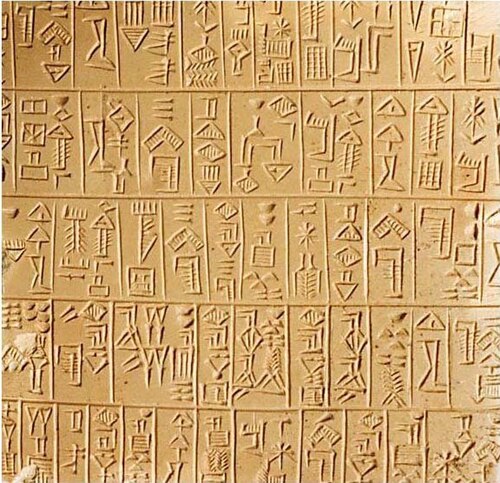
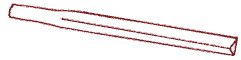
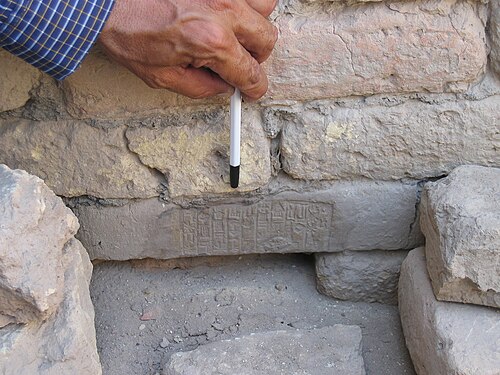
記号の目録は、既存の記号を組み合わせて複合記号を作ることで拡張された。複合記号は、元の2つの記号の意味の組み合わせから意味を導き出す場合もあれば(例:𒅗 ka「口」と𒀀 a 「水」を組み合わせて𒅘 nag̃「飲む」という記号、正式にはKA×Aを形成。 中国語の複合表意文字を参照)、一方の記号が意味を示し、もう一方の記号が発音を示す場合もある(例:𒅗 ka 「口」は𒉣 nun 「王子」という記号と組み合わせて、𒅻 nundum 「唇」という単語、正式にはKA×NUNを表す。 中国語の音意味複合語を参照)。[ 29 ]
The Sumerians used a base-60 numerical system. A number, such as "70", would be represented with the digit for "60" (𒁹) and the digit for "10" (𒌋): 𒁹𒌋. It's important to mention that the number for "60" is the same as the number for "1";[5] the reason this number isn't read as "11" is because of the order of the numbers: 60 then 10, not 10 then 60.
Usage
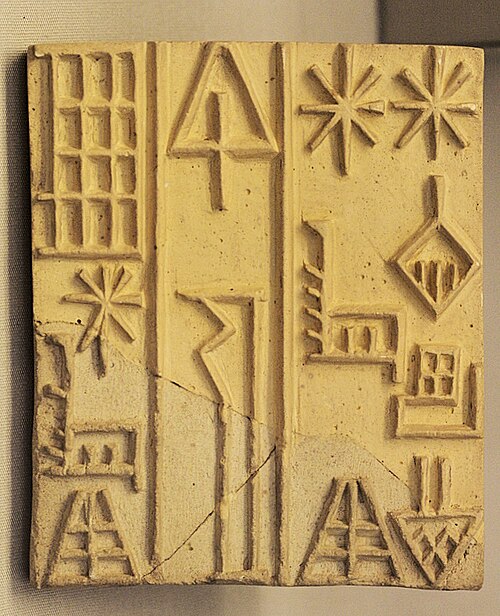
An example: King Shulgi foundation tablet(c. 2094–2047 BC)
Foundation tablet of king Shulgi (c. 2094–2047 BC), for the Temple of Nimintabba in Ur. ME 118560 British Museum.[13][5] Inscription "For his Lady Nimintabba, Shulgi the mighty man, King of Ur and King of Sumer and Akkad, has built her Temple":[5] Traditional cuneiforms were written vertically, but modern transcription is based on the "rotated" script adopted in the 2nd millennium BC.
Cuneiform script was used in many ways in ancient Mesopotamia. Besides the well-known clay tablets and stone inscriptions, cuneiform was also written on wax boards.[53] One example from the 8th century BC was found at Nimrud. The wax contained toxic amounts of arsenic.[54] It was used to record laws, like the Code of Hammurabi. It was also used for recording maps, compiling medical manuals, and documenting religious stories and beliefs, among other uses. In particular it is thought to have been used to prepare surveying data and draft inscriptions for Kassite stone kudurru.[55][56] Studies by Assyriologists like Claus Wilcke[57] and Dominique Charpin[58] suggest that cuneiform literacy was not reserved solely for the elite but was common for average citizens.
According to the Oxford Handbook of Cuneiform Culture,[59] cuneiform script was used at a variety of literacy levels: average citizens needed only a basic, functional knowledge of cuneiform script to write personal letters and business documents. Citizens with a higher degree of literacy put the script to more technical use, listing medicines and diagnoses and writing mathematical equations. Scholars held the highest literacy level of cuneiform and mostly focused on writing as a complex skill and an art form.
Modern usage
Cuneiform is occasionally used nowadays as inspiration for logos.
Cuneiform ama-gi, literally "return to the mother", loosely translated as "liberty", is the logo of Liberty Fund.[60]
Proto-cuneiform[62] in proposal phase. The latest proposal, L2/25-221, is nearing adoption.[63]
The final proposal for Unicode encoding of the script was submitted by two cuneiform scholars working with an experienced Unicode proposal writer in June 2004.[64] The base character inventory is derived from the list of Ur III signs compiled by the Cuneiform Digital Library Initiative of UCLA based on the inventories of Miguel Civil, Rykle Borger (2003) and Robert Englund. Rather than opting for a direct ordering by glyph shape and complexity, according to the numbering of an existing catalog, the Unicode order of glyphs was based on the Latin alphabetic order of their "last" Sumerian transliteration as a practical approximation. Once in Unicode, glyphs can be automatically processed into segmented transliterations.[65]
Corpus
A map showing the locations of all known provenanced cuneiform inscriptions. Cuneiform Inscriptions Geographical Site Index v1.5, November 2022, from Uppsala University.
↑Cuneiform: Irving Finkel & Jonathan Taylor bring ancient inscriptions to life. The British Museum. June 4, 2014.
↑Jagersma, Abraham Hendrik (2010). A descriptive grammar of Sumerian(PDF) (Thesis). Faculty of the Humanities, Leiden University. p.15. In its fully developed form, the Sumerian script is based on a mixture of logographic and phonographic writing. There are basically two types of signs: word signs, or logograms, and sound signs, or phonograms.
123Kimball, Sara E.; Slocum, Jonathan. "Hittite Online". The University of Texas at Austin Linguistics Research Center. Early Indo-European OnLine. 2 The Cuneiform Syllabary. Hittite is written in a form of the cuneiform syllabary, a writing system in use in Sumerian city-states in Mesopotamia by roughly 3100 BC and used to write a number of languages in the ancient Near East until the first century BC
123456789101112131415161718192021222324Olson, David R.; Torrance, Nancy (2009). The Cambridge Handbook of Literacy. Cambridge University Press. ISBN978-0-521-86220-2.
↑"The origins of writing". The British Museum. Archived from the original on March 11, 2022. Retrieved May 10, 2022.
↑Huehnergard, John (2004). "Akkadian and Eblaite". Cambridge Encyclopedia of the World's Ancient Languages. Cambridge University Press. p.218. ISBN978-0-521-56256-0. Connected Akkadian texts appear c. 2350 and continue more or less uninterrupted for the next two and a half millennia...
↑Archi, Alfonso (2015). "How the Anitta text reached Hattusa". Saeculum: Gedenkschrift für Heinrich Otten anlässlich seines 100. Geburtstags. Wiesbaden: Harrassowitz. ISBN978-3-447-10365-7. The existence of the Anitta text demonstrates that there was not a sudden and total interruption in writing but a phase of adaptation to a new writing.
↑Cartwright, Hugo. "Permutation Space Closeness of Ordered Sets".
12Hunger, Hermann, and Teije de Jong, "Almanac W22340a from Uruk: The latest datable cuneiform tablet.", Zeitschrift für Assyriologie und vorderasiatische Archäologie 104.2, pp. 182–194, 2014
123"Cuneiform Tablets: Who's Got What?", Biblical Archaeology Review, 31 (2), 2005, archived from the original on July 15, 2014
↑Streck, Michael P. (2010). "Großes Fach Altorientalistik. Der Umfang des keilschriftlichen Textkorpus". Mitteilungen der Deutschen Orientgesellschaft 142(PDF) (in German). pp.57–58.
↑ Bennison-Chapman, Lucy E. "Reconsidering 'Tokens': The Neolithic Origins of Accounting or Multifunctional, Utilitarian Tools?." Cambridge Archaeological Journal 29.2 (2019): 233–259.
↑Overmann, Karenleigh A. The Material Origin of Numbers: Insights from the Archaeology of the Ancient Near East, Piscataway, New Jersey, US: Gorgias Press, 2019
↑Denise Schmandt-Besserat, "An Archaic Recording System and the Origin of Writing." Syro Mesopotamian Studies, vol. 1, no. 1, pp. 1–32, 1977
↑Denise Schmandt-Besserat, An Archaic Recording System in the Uruk-Jemdet Nasr Period, American Journal of Archaeology, vol. 83, no. 1, pp. 19–48, (Jan. 1979)
↑ Robert K. Englund, "Proto-Cuneiform Account-Books and Journals", in Michael Hudson and Cornelia Wunsch, eds., Creating Economic Order: Record-keeping, Standardization and the Development of Accounting in the Ancient Near East (CDL Press: Bethesda, Maryland, USA) pp. 23–46, 2004
↑Green, M. and H. J. Nissen (1987). Zeichenliste der Archaischen Texte aus Uruk. ATU 2. Berlin
↑Englund, R. K. (1998). "Texts from the Late Uruk Period". In: Mesopotamien: Späturuk-Zeit und Frühdy- nastische Zeit (Orbis Biblicus et Orientalis 160/1). Ed. by P. Attinger and M. Wäfler. Fribourg, Switzerland / Göttingen, 15–217
↑ Born, L., & Kelley, K. (2021). A Quantitative Analysis of Proto-Cuneiform Sign Use in Archaic Tribute. Cuneiform Digital Library Bulletin, 006
↑Monaco, Salvatore F., "Proto-cuneiform And Sumerians", Rivista Degli Studi Orientali, vol. 87, no. 1/4, pp. 277–282, 2014
↑Iorwerth Eiddon Stephen Edwards, et al., The Cambridge Ancient History (3rd ed. 1970) pp. 43–44.
↑Barraclough, Geoffrey; Stone, Norman (1989). The Times Atlas of World History. Hammond. p.53. ISBN978-0-7230-0304-5.
1234Foxvog, Daniel A. Introduction to Sumerian grammar(PDF). p.12. Archived(PDF) from the original on January 3, 2017
↑Mémoires (in French). Mission archéologique en Iran. 1900. p.53.
↑Taylor, Jon, "Temporality on Clay Tablets: When the Component Parts of a Cuneiform Document Were Committed to Clay", Erasing and Rewriting in Manuscript Cultures: Practices of Text Obliteration and Manuscript Reuse in a Global Perspective, edited by Michele Cammarosano, De Gruyter, pp. 115-160, 2026
↑ Michel, Cécile, et al., "Deciphering 4000-year-old cuneiform letters hidden in clay envelopes using a mobile X-ray computed tomography scanner", npj Heritage Science, 2026
123Khačikjan, Margaret. The Elamite language (1998). p.1.
↑Daniels, Peter; Bright, William (1996). The World's Writing Systems. Oxford University Press. p.146. ISBN978-0-19-507993-7.
12Козлова, Н. В.; Касьян, А. С.; Коряков, Ю. Б. (2010). "Клинопись". Языки мира: Древние реликтовые языки Передней Азии (in Russian): 197–222.
↑For the original inscription: Rawlinson, H. C. Cuneiform inscriptions of Western Asia(PDF). p.3, column 2, line 98. For the transliteration in Sumerian an-szar2-du3-a man kur_ an-szar2{ki}: "CDLI-Archival View". cdli.ucla.edu. For the translation: Luckenbill, David. Ancient Records of Assyria and Babylonia Volume II(PDF). p.297. For the Assyrian pronunciation: Quentin, A. (1895). "Inscription Inédite du Roi Assurbanipal: Copiée Au Musée Britannique le 24 Avril 1886". Revue Biblique (1892-1940). 4 (4): 554. ISSN1240-3032. JSTOR44100170.
↑Frye, Richard N. "History of Mesopotamia". Encyclopædia Britannica. Retrieved December 11, 2020. The use of cuneiform in government documents ceased sometime during the Achaemenian period, but it continued in religious texts until the 1st century of the Common era.
↑Geller, Marckham (1997). "The Last Wedge". Zeitschrift für Assyriologie und vorderasiatische Archäologie. 87 (1): 43–95. doi:10.1515/zava.1997.87.1.43. S2CID161968187.
↑Windfuhr, G. L.: "Notes on the old Persian signs", page 1. Indo-Iranian Journal, 1970.
↑Schmitt, R. (2008), "Old Persian", in Roger D. Woodard (ed.), The Ancient Languages of Asia and the Americas (illustrateded.), Cambridge University Press, p.77, ISBN978-0-521-68494-1
12Watkins, Lee; Snyder, Dean (2003), The Digital Hammurabi Project(PDF), The Johns Hopkins University, archived(PDF) from the original on July 14, 2014
↑Sayce, Rev. A. H., "The Archaeology of the Cuneiform Inscriptions", Second Edition-revised, Society for Promoting Christian Knowledge, London, Brighton, New York, 1908 (Reprint – ISBN978-1-108-08239-6)
↑"DPa". Livius. April 16, 2020. Retrieved March 19, 2023.
↑"XPe". Livius. September 24, 2020. Retrieved March 19, 2023.
↑"Site officiel du musée du Louvre". cartelfr.louvre.fr.
↑Wallis Budge, Ernest Alfred (1884). Babylonian Life and History. Religious Tract Society. p.94.
↑Cf. The Cylinder of Antiochus I from the Ezida temple in Borsippa (BM 36277), p.4 by M. Stol and R.J. van der Spek and Antiochus I 01 by The Royal Inscriptions of Babylonia online (RIBo) Project. The transliteration here differs slightly from these sources by rendering the determinative for male personal names 𒁹 with the Sumerian reading of the sign DIŠ, whereas it is more commonly transcribed with the conventional letter M today. The spellings 𒂍𒊕𒅍 (É.SAG.ÍL) and 𒂍𒍣𒁕 (É.ZI.DA) can also be read phonetically in Akkadian (as they are in the second source), because the names themselves have been borrowed into Akkadian with their Sumerian pronunciations. Conversely, the sign 𒆗, which may have the phonetic value dan in Akkadian, was nevertheless originally a Sumerian logogram KAL 'strong'. Finally, 𒅇 (ù) was the word for 'and' not only in Akkadian, but also in Sumerian.
↑Kudrinski, Maksim. "Hittite heterographic writings and their interpretation" Indogermanische Forschungen, vol. 121, no. 1, pp. 159–176, 2016
↑Veldhuis, Niek (September 22, 2011), "Levels of Literacy", in Radner, Karen; Robson, Eleanor (eds.), The Oxford Handbook of Cuneiform Culture, Oxford University Press, pp.68–89, doi:10.1093/oxfordhb/9780199557301.013.0004, ISBN978-0-19-955730-1, retrieved March 4, 2025
↑Zimmermann, Lynn-Salammbô (2023), "Knocking on Wood: Writing Boards in the Kassite Administration", Journal of Ancient Near Eastern History, vol. 10, no. 2, pp. 177–237
↑Cammarosano, Michele, Katja Weirauch, Feline Maruhn, Gert Jendritzki, and Patrick L. Kohl (2019), "They Wrote on Wax. Wax Boards in the Ancient Near East", Mesopotamia, vol. 54, pp. 121–180
↑Zimmermann, Lynn-Salammbô (2022), "Wooden Wax-Covered Writing Boards as Vorlage for kudurru Inscriptions in the Middle Babylonian Period", Journal of Ancient Near Eastern History, pp. 53–106
↑"The World's Oldest Writing". Archaeology. 69 (3). May 2016. Archived from the original on April 27, 2016. Retrieved September 18, 2016– via Virtual Library of Virginia.
↑Wilcke, Claus (2000). Wer las und schrieb in Babylonien und Assyrien (in German). Munich: Verlag der Bayerischen Akademie der Wissenschaften. ISBN978-3-7696-1612-5.
↑Charpin, Dominique (2004). "Lire et écrire en Mésopotamie: Une affaire dé spécialistes?"Comptes rendus de l'Académie des Inscriptions et Belles Lettres, pp. 481–501.
↑Veldhuis, Niek (2011). Radner, Karen; Robson, Eleanor (eds.). "Levels of Literacy". The Oxford Handbook of Cuneiform Culture. doi:10.1093/oxfordhb/9780199557301.001.0001. hdl:10261/126580. ISBN978-0-19-955730-1.
↑"Our Logo". libertyfund.org. Liberty Fund. Retrieved May 14, 2020. The cuneiform inscription that serves as Liberty Fund's logo and as a design element in our books is the earliest-known written appearance of the word 'freedom' (amagi), or 'liberty'. It is taken from a clay document written about 2300 B.C. in the Sumerian city-state of Lagash.
↑"Cuneiform and Hieroglyphs", in The Unicode® Standard Version 16.0 – Core Specification, September 10, 2024
↑Robin Leroy, Anshuman Pandey, and Steve Tinney, "Archaic cuneiform numerals", L2/24-210R, 2024-10-23
↑Steve Tinney, Anshuman Pandey, "Proposal to Encode Proto-Cuneiform in Unicode", L2/25-221, 2025-09-11
↑Everson, Michael; Feuerherm, Karljürgen; Tinney, Steve (June 8, 2004). "Final proposal to encode the Cuneiform script in the SMP of the UCS".
↑Gordin S, Gutherz G, Elazary A, Romach A, Jiménez E, Berant J, et al. (2020) "Reading Akkadian cuneiform using natural language processing". PLoS ONE 15(10): e0240511. https://doi.org/10.1371/journal.pone.0240511
123456789Bertman, Stephen (2005). Handbook to Life in Ancient Mesopotamia. Oxford University Press. ISBN978-0-19-518364-1.
↑Pinches, T. G.; Finkel, I. L. (1984). "Neo-Babylonian and Achaemenid Economic Texts from the Sippar Collection of the British Museum". Journal of the American Oriental Society. 104 (4). American Oriental Society: 745–752. doi:10.2307/601904. ISSN0003-0279. JSTOR601904.
↑Ellermeier, Friedrich., and Margret. Studt. Sumerisches Glossar. Vol. 3, T. 6, Handbuch Assur / Friedrich Ellmermeier; Margret Studt. Hardegsen bei Göttingen: Selbstverl. Ellermeier, 2003. Print. Theologische und orientalistische Arbeiten aus Göttingen, 4.
↑"The Hittite cuneiform tablets from Bogazköy". UNESCO Memory of the World Programme. Retrieved August 21, 2025.
↑"Persepolis Fortification Archive". The Oriental Institute of the University of Chicago. Archived from the original on September 29, 2016. Retrieved September 18, 2016.
↑Lauinger, Jacob (January 1, 2007). Archival practices at Old Babylonian/Middle Bronze Age Alalakh (Level VII) (Thesis). University of Chicago. Archived from the original on July 14, 2014.
↑Moorey, P. R. S. (1992). A Century of Biblical Archaeology. Westminster Knox Press. ISBN978-0-664-25392-9.
Bibliography
Adkins, Lesley, Empires of the Plain: Henry Rawlinson and the Lost Languages of Babylon, New York, St. Martin's Press (2003) ISBN978-0-312-33002-6
Bogacz, Bartosz; Mara, Hubert (June 30, 2022). "Digital Assyriology—Advances in Visual Cuneiform Analysis". Journal on Computing and Cultural Heritage. 15 (2): 1–22. doi:10.1145/3491239. S2CID248843112.
R. Borger, Assyrisch-Babylonische Zeichenliste, 2nd ed., Neukirchen-Vluyn (1981)
Burnouf, E. (1836). "Mémoire sur deux Inscriptions Cunéiformes trouvées près d'Hamadan et qui font partie des papiers du Dr Schulz", [Memoir on two cuneiform inscriptions [that were] found near Hamadan and that form part of the papers of Dr. Schulz], Imprimerie Royale, Paris.
Cammarosano, M. (2017–2018) "Cuneiform Writing Techniques", cuneiform.neocities.org (with further bibliography)
Michel, Cécile, "Identifying Missing Evidence in an Abundant Cuneiform Corpus", Missing Evidence in the Study of Ancient Cultures: Methodological Reflections and Case Studies on Fragmentary Sources, edited by Cécile Michel, Michael Friedrich and Jorrit Kelder, De Gruyter, pp.119–146, 2026
Charvát, Petr. "Cherchez la femme: The SAL Sign in Proto-Cuneiform Writing". La famille dans le Proche-Orient ancien: réalités, symbolismes et images: Proceedings of the 55e Rencontre Assyriologique Internationale, Paris, edited by Lionel Marti, University Park, USA: Penn State University Press, 2021, pp.169–182
Dahl, J. L., "The early development of the cuneiform writing system, and its regional adaptation", in National Museum of World Writing Academic Series, National Museum of World Writing, pp.285–318, 2025
A. Deimel (1922), Liste der archaischen Keilschriftzeichen ("LAK"), WVDOG 40, Berlin.
A. Deimel (1925–1950), Šumerisches Lexikon, Pontificum Institutum Biblicum.
Borger, Rykle (2004). Dietrich, Manfried[in German]; Loretz, Oswald[in German] (eds.). Mesopotamisches Zeichenlexikon[Mesopotamian Signs' List]. Alter Orient und Altes Testament (in German). Vol.305. Münster: Ugarit Verlag. ISBN978-3-927120-82-2.
Robert K. Englund and Rainer M.Boehmer, "Archaic Administrative Texts from Uruk – The Early Campaigns", (ATU Bd. 5), Berlin: Gebr. Mann Verlag 1994 ISBN 978-3786117452
Robert K. Englund, Roger J. Matthews, "Proto-Cuneiform Texts from Diverse Collections", Berlin: Gebr. Mann 1996 ISBN 978-3786118756
A. Falkenstein, Archaische Texte aus Uruk, Berlin-Leipzig (1936)
E. Forrer, Die Keilschrift von Boghazköi, Leipzig (1922)
J. Friedrich, Hethitisches Keilschrift-Lesebuch, Heidelberg (1960)
Jean-Jacques Glassner, The Invention of Cuneiform, English translation, Johns Hopkins University Press (2003), ISBN978-0-8018-7389-8.
Hayes, John L. (2000). A Manual of Sumerian Grammar and Texts. Aids and Research Tools in Ancient Near Eastern Studies. Vol.5 (2ded.). Malibu: Undena Publications. ISBN978-0-89003-197-1.
Heeren (1815) "Ideen über die Politik, den Verkehr und den Handel der vornehmsten Volker der alten Welt", vol. i. pp.563 seq., translated into English in 1833.
DSpace Hershkovitz, Yehonatan, "The Adaptation Process of Cuneiform in the Old Babylonian Period", Dissertation, Harvard University, 2023
Kramer, Samuel Noah (1981). "Appendix B: The Origin of the Cuneiform Writing System". History Begins at Sumer: Thirty-Nine Firsts in Man's Recorded History (3d reviseded.). Philadelphia: University of Pennsylvania Press. pp.381–383. ISBN978-0-8122-7812-5.
Lassen, Christian (1836) Die Altpersischen Keil-Inschriften von Persepolis. Entzifferung des Alphabets und Erklärung des Inhalts. [The Old-Persian cuneiform inscriptions of Persepolis. Decipherment of the alphabet and explanation of its content.] Eduard Weber, Bonn, (Germany)
Lewenstein, Or, et al, "A Large-Scale Dataset of Annotated Cuneiform Sign Images for Digital Palaeography", Journal of Open Humanities Data 12.1, 2026
Mittermayer, Catherine; Attinger, Pascal (2006). Altbabylonische Zeichenliste der Sumerisch-Literarischen Texte. Orbis Biblicus et Orientalis. Vol.Special Edition. Academic Press Fribourg. ISBN978-3-7278-1551-5.
O. Neugebauer, A. Sachs (eds.), Mathematical Cuneiform Texts, New Haven (1945)
Ouyang, Xiaoli, and Christine Proust, "Place-Value Notations in the Ur III Period: Marginal Numbers in Administrative Texts", Cultures of Computation and Quantification in the Ancient World: Numbers, Measurements, and Operations in Documents from Mesopotamia, China and South Asia. Cham: Springer International Publishing, pp.267–356, 2023
Patri, Sylvain, "La perception des consonnes hittites dans les langues étrangères au XIIIe siècle." Zeitschrift für Assyriologie und vorderasiatische Archäologie, 99(1): 87–126, 2009 doi:10.1515/ZA.2009.003.
Prichard, James Cowles (1844). "Researches Into the Physical History of Mankind", 3rd ed., vol IV, Sherwood, Gilbert and Piper, London.
Philippe Quenet, "The Diffusion of the Cuneiform Writing System in Northern Mesopotamia: The Earliest Archaeological Evidence", Iraq, vol. 67, no. 2, pp.31–40, 2005
Rattenborg, Rune, Smidt, Gustav Ryberg, Johansson, Carolin, Melin-Kronsell, Nils and Nett, Seraina, "The Archaeological Distribution of the Cuneiform Corpus: A Provisional Quantitative and Geospatial Survey", Altorientalische Forschungen, vol. 50, no. 2, pp.178–205, 2003
Rawlinson, Henry (1847) "The Persian Cuneiform Inscription at Behistun, decyphered and translated; with a Memoir on Persian Cuneiform Inscriptions in general, and on that of Behistun in Particular", The Journal of the Royal Asiatic Society of Great Britain and Ireland, vol. X. JSTOR25581217
Smidt, Gustav Ryberg, Carolin Johansson, Nils Melin-Kronsell, Seraina Nett, and Rune Rattenborg, "CIGS-AE: A Quantitative Index of Cuneiform Inscriptions", Cuneiform Digital Library Notes 2024 (2), 2024
Y. Rosengarten, Répertoire commenté des signes présargoniques sumériens de Lagash, Paris (1967)
Chr. Rüster, E. Neu, Hethitisches Zeichenlexikon (HZL), Wiesbaden (1989)
Ronald Herbert Sack, Cuneiform Documents from the Chaldean and Persian Periods, (1994) ISBN978-0-945636-67-0
Nikolaus Schneider, Die Keilschriftzeichen der Wirtschaftsurkunden von Ur III nebst ihren charakteristischsten Schreibvarianten, Keilschrift-Paläographie; Heft 2, Rom: Päpstliches Bibelinstitut (1935)
Wolfgang Schramm, Akkadische Logogramme, Goettinger Arbeitshefte zur Altorientalischen Literatur (GAAL) Heft 4, Goettingen (2003), ISBN978-3-936297-01-0.
F. Thureau-Dangin, Recherches sur l'origine de l'écriture cunéiforme, Paris (1898).
External links
R-CNN based PolygonalWedge Detection Learned from Annotated 3D Renderings and Mapped Photographs of Open Data Cuneiform Tablets – 2023 – Stötzner, Ernst et al.
AI: Researchers develop automatic text recognition for ancient cuneiform tablets
Cuneiform Digital Library Initiative
Tablet Collections, Cornell University
Finding aid to the Columbia University Cuneiform Collection at Columbia University. Rare Book & Manuscript Library
The Cuneiform Wide Web: From Card Catalogues to Digital Assyriology – Shai Gordin and Avital Romach – ANE Today – Oct 2022Archived November 11, 2022, at the Wayback Machine
A sign list by Assyriologist Kateřina Šašková, featuring Ur III and Neo-Assyrian cuneiform shapes, their composition and pronunciations