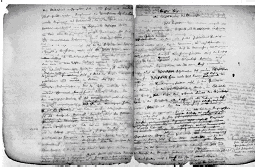
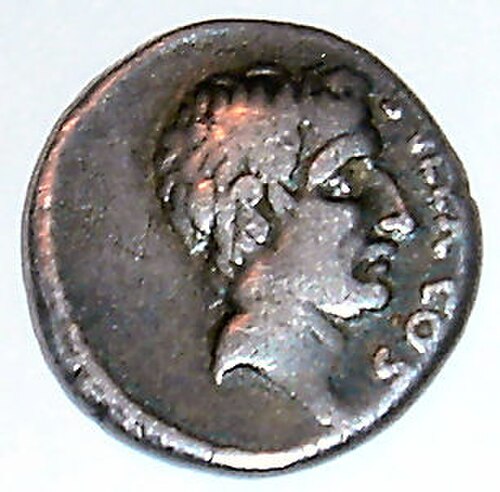
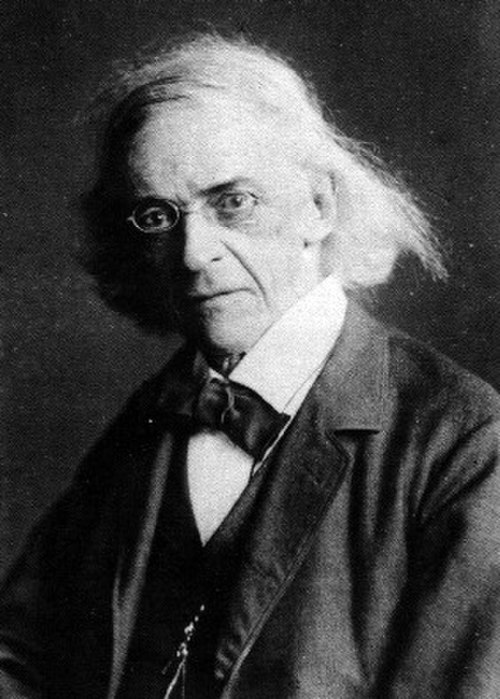
A notebook used by Theodore Mommsen for his Römische Geschichte or The History of Rome
The History of Rome (German: Römische Geschichte) is a multi-volume history of ancient Rome written by Theodor Mommsen (1817–1903). Originally published by Reimer & Hirzel, Leipzig, as three volumes during 1854–1856, the work dealt with the Roman Republic. A subsequent book was issued which concerned the provinces of the Roman Empire. In 1992, a further book on the Empire, reconstructed from lecture notes, was published. The initial three volumes won widespread acclaim upon publication; indeed, "The Roman History made Mommsen famous in a day."[1] Still read and qualifiedly cited, it is the prolific Mommsen's most well-known work. The work was specifically cited when Mommsen was awarded the Nobel Prize.[2]
Writing the History followed Mommsen's earlier achievements in the study of ancient Rome. He had not himself designed to write a history, but the opportunity presented itself in 1850 while at the University of Leipzig where Mommsen was a thirty-two-year-old special Professor of Law. "Invited to give a public lecture while at Leipzig, I delivered an address on the Gracchi. Reimer and Hirzel, the publishers, were present, and two days later they asked me to write a Roman History for their series."[3] Having been dismissed from the University for revolutionary activities, Mommsen would accept the publishing proposal "partly for my livelihood, and partly because the work greatly appeals to me."[4]
The contemporary English translations were the work of William Purdie Dickson, then the Professor of Divinity at the University of Glasgow. The first three German volumes (which contained five 'books') were published during 1862 to 1866 by R. Bentley & Son, London.[21] Over several decades Prof. Dickson prepared further English editions of this translation, keeping pace with Mommsen's revisions in German.[22] All told, close to a hundred editions and reprints of the English translation have been published.[23][24]
In 1958 selections from the final two 'books' of the three-volume History were prepared by Dero A. Saunders and John H. Collins for a shorter English version.[25] The content was chosen to highlight Mommsen's telling of the social-political struggles over several generations leading to the fall of the Republic.[26] Provided with new annotations and a revised translation, the book presents an abridgment revealing the historical chronology. With rigor Mommsen is shown narrating the grave political drama and illuminating its implications; the book closes with his lengthy description of the new order of government adumbrated by Julius Caesar.[27]
With regard to Mommsen's 1885 "fifth volume" on the Roman provinces, Prof. Dr. Dickson immediate began to supervise its translation. In 1886 it appeared as The Provinces of the Roman Empire. From Caesar to Diocletian.[28]
Mommsen's missing fourth volume was reconstructed from student notes and published in 1992 under the title Römische Kaisergeschichte. It was soon translated into English by Clare Krojzl as A History of Rome under the Emperors.[29]
Review of contents
The Republic
With exceptions, Mommsen in his Römische Geschichte (1854–1856) narrates a straight chronology of historic events and circumstances. Often strongly worded, he carefully describes the political acts taken by the protagonists, demonstrates the immediate results, draws implications for the future, while shedding light on the evolving society that surround them. The chronology of the contents of his five 'books' (in his first three volumes) are in brief:
Moreover, the annual change of consuls (the two Roman chief executives) began to adversely impact the consistent management of its armed forces, and to weaken their effectiveness, especially in the era following the Punic Wars. Eventually it led to the prolongation of military commands in the field; hence, Roman army generals became increasingly independent, and they led soldiers personally loyal to them.[39] These military leaders began to acquire the ability to rule better than the ineffective civil institutions. In short, the civil power's political capabilities were not commensurate with the actual needs of the Roman state. As Rome's strength and reach increased, the political situation developed in which an absolute command structure imposed by military leaders at the top might, in the long run, in many cases be more successful and cause less chaos and hardship to the citizenry than the corrupt and incompetent rule by the oligarchy of quarreling old families who de facto controlled the government.[40] Such was his purpose when the conservative Optimate, the noble and Roman general Sulla (138–78), seized state power by military force; yet he sought without permanent success to restore the Senate nobility to its former power.[41]
Political instability soon returned, social unrest being the disagreeable norm. The conservative renovation of the Republic's institutions was abandoned and taken apart. Eventually the decisive civil war victory of the incomparable Julius Caesar (100–44), followed by his executive mastery and public-minded reforms, appeared as the necessary and welcome step forward toward resolution of the sorry and bloody débâcle at Rome. This, in the dramatic narrative of Theodore Mommsen.[42][43][44]
Mommsen's expertise in Roman studies was acknowledged by his peers as being both wide and deep, e.g., his direction of the ancient Latin inscriptions project,[49] his work on ancient dialects of Italy,[50] the journal he began devoted to Roman coinage,[51] his multivolume Staatsrecht on the long history of constitutional law at Rome,[52][53] his volumes on Roman criminal law, the Strafrecht.[54] His bibliography lists 1500 works.[55][56]
The Provinces
The Provinces of the Roman Empire (1885, 1886) contains thirteen chapters, namely: Northern Italy, Spain, Gaul, Germany, Britain, the Danube, Greece, Asia Minor, the Euphrates and Parthia, Syria and the Nabataeans, Judaea, Egypt, and the Africa provinces. Generally, each chapter describes the economic geography of the region and its people, before addressing how the Imperial regime adapted to its peculiarities. Regarding the North, military administration is often stressed; while in the East, the focus is more on culture and history.
A quarter of the way into his short "Introduction" to the Provinces Mommsen comments on the decline of Rome, the capital city: "The Roman state of this epoch resembles a mighty tree, the main stem of which, in the course of its decay, is surrounded by vigorous offshoots pushing their way upward."[57] These shoots being the provinces he here describes.
Mommsen's missing fourth volume, as reconstructed by Barbara Demandt and Alexander Demandt from lecture notes, was published as Römische Kaisergeschichte in 1992. Thus appearing many years after third volume (1856), and the fifth (1885). It contains three sections of roughly equal size.
The first section is arranged chronologically by emperor: Augustus (44 BC-AD 14); Tiberius (14–37); Gaius Caligula (37–41); Claudius (41–54); Nero (54–68); The Year of Four Emperors (68–69); Vespasian (69–79).
The chapters of the second section are entitled: General Introduction; Domestic Politics I; Wars in the West; Wars on the Danube; Wars in the East; Domestic Politics II.
The third section: General Introduction; Government and Society; A History of Events [this the longest subsection, arranged by emperors]: Diocletian (284–305); Constantine (306–337); The sons of Constantine (337–361); Julian and Jovian (355–364); Valentinian and Valens (364–378); From Theodosius to Alaric (379–410).[58]
This rescued work contains a great wealth of material, in which one follows in the footsteps of a master historian. Yet, perhaps because of its nature as reconstructed student lecture notes, it more often lacks the fine points of literary composition and style, and of course the narrative drive of the original three volumes.[59] Nonetheless it is well to remember that the students involved here in taking the lecture notes were themselves quite accomplished people, and one listener and recorder was already a mature father.[60]
Roman portraits
Several writers have remarked on Mommsen's ability to interpret personality and character.[61][62] The following highlights are drawn from Mommsen's renderings of figures of ancient Rome, namely: Hannibal, Scipio Africanus, the Gracchi brothers, Marius, Drusus, Sulla, Pompey, Cato, Caesar, and Cicero.
His exalted social position also remained fundamentally ambivalent. Allied to the aristocracy by his consular ancestry and through Sulla, he disliked Sulla personally and worked against the Sullan constitution, and his family gens was of recent vintage and not fully accepted by the nobility. Pompey maintained links to the Populares and joined Caesar in the triumvirate. Yet, to the contrary, he was well suited to associate with the senate oligarchy because his "dignified outward appearance, his solemn formality, his personal bravery, his decorous private life, his want of all initiative" and his "mediocrity, so characteristic of the genuine Optimate". An "affinity" existed, "subsisted at all times between Pompeius, [the] burgesses and the senate." Pompeius, however, refused to fit in. "[S]eized with giddiness on the height of glory which he had climbed with dangerous rapidity and ease", he began to compare himself to Alexander the Great, and far above any senator. "His political position was utterly perverse." He was conflicted; "deeply indignant when persons and laws did not bend unconditionally before him" he nonetheless "trembled at the mere thought of doing anything unconstitutional." His "much agitated life passed joylessly away in a perpetual inward contradiction." Pompey for Mommsen was the "most tiresome and most starched of all artificial great men." He died before his wife and son, when one of his old soldiers stabbed him from behind as he stepped ashore in Egypt. "Of all pitiful parts there is none more pitiful than that of passing for more than one really is."[77]
Moderns may be able to see both sides of the issue, however, as an historian might. Indeed, there exists a great difference in context between, say, an American, and a German historian of the 1850s, where during 1848 citizens had made a rather spontaneous, incoherent effort to move German politics toward a free and unified country: it was crushed by the nobility.[133][134]
The philosopher R. G. Collingwood (1889–1943) developed a nuanced view of history in which each person explores the past in order to create his or her own true understanding of that person's unique cultural inheritance. Although objectivity remains crucial to the process, each will naturally draw out their own inner truth from the universe of human truth. This fits the stark limitations on each individual's ability to know all sides of history. To a mitigated extent these constraints work also on the historian. Collingwood writes:
"This does not reduce history to something arbitrary or capricious. It remains genuine knowledge. How can this be, if my thoughts about Julius Caesar differ from Mommsen's? Must not one of us be wrong? No, because the object differs. My historical [object] is about my own past, not about Mommsen's past. Mommsen and I share in a great many things, and in many respects we share in a common past; but in so far as we are different people and representatives of different cultures and different generations we have different pasts. ... [O]ur views of Julius Caesar must differ, slightly perhaps, but perceptibly. This difference is not arbitrary, for I can see—or ought to be able to see—that in his place, apart (once more) from all questions of error, I should have come to his conclusions."[135]
A modern historian of ancient Rome echoes the rough, current consensus of academics about this great and controversial figure, as he concludes his well-regarded biography of Julius Caesar: "When they killed him his assassins did not realise that they had eliminated the best and most far-sighted mind of their class."[136][137][138]
The 1911 Encyclopædia Britannica, a well-regarded reference yet nonetheless "a source unsparingly critical", summarizes: "Equally great as antiquary, jurist, political and social historian, Mommsen lived to see the time when among students of Roman history he had pupils, followers, critics, but no rivals. He combined the power of minute investigation with a singular faculty for bold generalization and the capacity for tracing out the effects of thought on political and social life."[152]
The British historian G. P. Gooch, writing in 1913, eleven years after Mommsen's Nobel prize, gives us this evaluation of his Römisches Geschichte: "Its sureness of touch, its many-sided knowledge, its throbbing vitality and the Venetian colouring of its portraits left an ineffaceable impression on every reader." "It was a work of genius and passion, the creation of a young man, and is as fresh and vital to-day as when it was written."[153] About The History of Rome another British historian Arnold J. Toynbee in 1934 wrote, at the beginning of his own 12-volume universal history, "Mommsen wrote a great book, [Römisches Geschichte], which certainly will always be reckoned among the masterpieces of Western historical literature."[154]
↑G. P. Gooch, History and Historians in the Nineteenth Century (London: Longmans, Green 1913, 4th impr. 1928) at 456.
↑"Facts on the Nobel Prize in Literature: Awarded for a particular literary work:" While the Nobel Prize in Literature is for a writer's life work, there are nine Literature Laureates for whom the Swedish Academy singled out a specific work for particular recognition. "Theodor Mommsen in 1902: 'the greatest living master of the art of historical writing, with special reference to his monumental work, A history of Rome'" http://www.nobelprize.org/nobel_prizes/literature/shortfacts.html.
↑G. P. Gooch, History and Historians in the Nineteenth Century (1913, 1928) at 456, quoting Mommsen's letter to the novelist Freytag.
↑Cf., Alexander Demandt, "Introduction" at 1–35, 1, in Mommsen, A History of Rome under the Emperors (London: Routledge 1996).
↑Sauders and Collins, "Introduction" at 1–17, 5–6, to their edition of Mommsen, The History of Rome (New Haven: Meridian Books 1958).
↑Gooch, History and Historians in the Nineteenth Century (1913, 1928) at 456, quoting Mommsen's correspondence to Henzen.
↑On a different note, Mommsen would marry Marie Reimer, the daughter of his Leipzig publisher; together they had sixteen children. T. Wiedemann, "Mommsen, Rome, and the German "Kaiserreich" 36–47, at 44, in Mommsen, A History of Rome under the Emperors (1992; 1996).
↑Mommsen, Römische Geschichte, 3 volumes (Leipzig: Reimer & Hirsel 1854–1856). Although published in three volumes, this part of the History Mommsen organised into five "books".
↑Sauders & Collins, "Introduction" 1–17, at 5–6, to their truncated edition of Mommsen, The History of Rome (New Haven: Meridian Books 1958).
↑W. P. Dickson, "Preface by the Translator" (1894) at v–x, viii, to Mommsen's A History of Rome, volume one (1854; 1862; reprint by The Free Press/The Falcon's Wing Press, Glencoe IL, 1957).
↑Alexander Demandt, "Introduction" 1–35, at 1, in Mommsen, A History of Rome under the Emperors (London: Routledge 1996).
↑The 1880 fire at Mommsen's home office, due to a gas explosion, has been proposed as the reason for no volume four, but Alexander Demandt dismisses such speculation. A. Demandt, "Introduction" 1–35, at 7, 22–23, in Mommsen, A History of Rome under the Emperors (1992; London: Routledge 1996). There has been much scholarly discussion about the fate of the 'missing' fourth volume. Cf., A. Demandt, "Introduction" at 1–13 ("Why no volume IV?"), in Mommsen (1992; 1996).
↑Mommsen (1885; London: Macmillan 1909; reprint New York 1996) at 4–5.
↑Theodore Mommsen, Römische Kaisergeschichte (München: C.H.Beck'sche 1992), edited by B. and A. Demandt; translated as A History of Rome under the Emperors (London: Routledge 1996).
↑ヌミスマティックのためのツァイシュリフト;加えて、モムセン自身による古代ローマの貨幣に関する大著『 Über das Römische Münzwesen』(1850 年)。モムセンは、コイン、標準分銅、古代ローマ人が使用していたアルファベットから、彼らの主な影響はエトルリア文明ではなくギリシャ文明であると主張しました。 WP Allen、「Theodor Mommsen」445–465、448、North American Review、v.112 (1870)。
↑ Barthold Georg Niebuhr、 Romische Geschichte (ベルリン 1811–1833);後にレオンハルト・シュミッツによってRomische Geschichte, von dem ersten punische Kreig bis zum tode Constantine として編集されました(ベルリン: Realschulbuchh 1844)。
↑ Lily Ross Taylor , Party politics in the age of Caesar (University of California 1949) 8–14 ページ、注 18–54 は 187–193 ページを参照。特に 10–12 ページおよび脚注 51 の歴史家を参照。
1 2 Taylor, Party politics in the age of Caesar (University of California 1949) at 12.
↑Lily Ross Taylor, Party politics in the age of Caesar (University of California 1949) at 12, where the comparison between ancient Rome and Mommsen's Germany is expressly noted and drawn out.
↑Some see an analogy not between ancient Rome and Mommsen's Germany, but Rome and the modern West. In 1931 Egon Friedell summed it up: "Crassus becomes a speculator in the manner of Louis Philippe, the brothers Gracchus are Socialist leaders, and the Gauls are Indians, etc." Friedell, Kulturgeschichte der Neuzeit (1931), at III: 270.
12Carr, Edward Hallett (1961). What is History. New York: Knopf. pp.43–44. OCLC397273.
↑Mommsen quoted in G. P. Gooch, History and Historians in the Nineteenth Century (London: Longmans, Green 1913) at 457.
↑See discussion here above in section "Novel style".
↑Carr, What is History? (New York: Random House/Vintage 1961) at 43.
↑Collingwood's essay here explicates Croce's Teoria e Storia della Storiografia (Bari 1917). Collingwood (1921, 1965) at 5.
↑R. G. Collingwood, "Croce's Philosophy of History" in The Hibbert Journal, XIX: 263–278 (1921), collected in his Essays on a Philosophy of History (University of Texas 1965) at 3–22, 11.
↑Carr, Edward Hallett (1961). What is History. New York: Knopf. pp.43–44. OCLC397273. Other historians mentioned by Carr (at 48) include: Trevelyan, Namier, and Meinecke.
↑R. G. Collingwood, "Croce's Philosophy of History" in The Hibbert Journal, XIX: 263–278 (1921), collected in his Essays on a Philosophy of History (University of Texas 1965) at 3–22, 11.
↑参照、Rudolph Stadelmann、 Sozial und politische Geschichte der Revolution von 1848 (München: F. Bruckman 1948, 2d ed. 1970)、翻訳は「 1848 年ドイツ革命の社会政治史」 (オハイオ大学 1975)。