Two succulent plant genera, Euphorbia and Astrophytum, are only distantly related, but the species within each have converged on a similar body form.
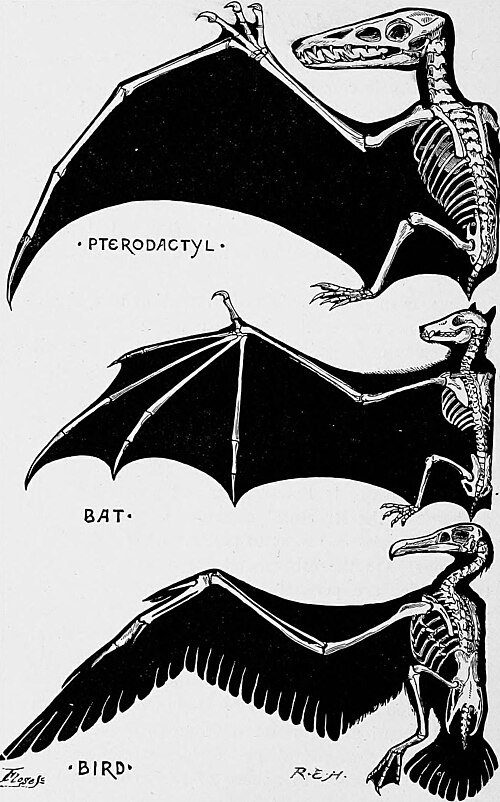
Convergent evolution is the independent evolution of similar features in species of different lineages. Convergent evolution creates analogous structures that have similar form or function but were not present in the last common ancestor of those groups. The cladistic term for the same phenomenon is homoplasy. The recurrent evolution of flight is a classic example, as flying insects, birds, pterosaurs, and bats have independently evolved the useful capacity of flight. Functionally similar features that have arisen through convergent evolution are analogous, whereas homologous structures or traits have a common origin but can have dissimilar functions. Bird, bat, and pterosaur wings are analogous structures, but their forelimbs are homologous, sharing an ancestral state despite serving different functions.
The opposite of convergent evolution is divergent evolution, where related species evolve different traits. Convergent evolution is similar to parallel evolution, which occurs when two independent species evolve in the same direction and thus independently acquire similar characteristics; for instance, gliding frogs have evolved in parallel from multiple types of tree frog.
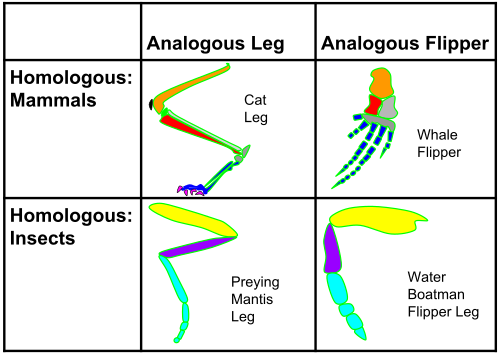
Homology and analogy in mammals and insects: on the horizontal axis, the structures are homologous in morphology, but different in function due to differences in habitat. On the vertical axis, the structures are analogous in function due to similar lifestyles but anatomically different with different phylogeny.[a]
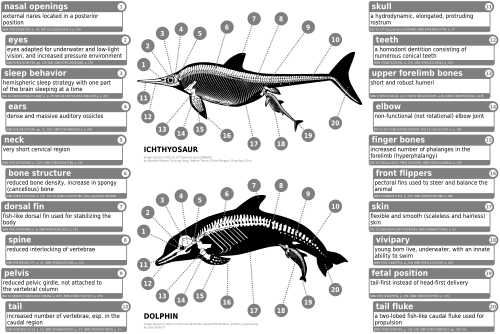
In morphology, analogous traits arise when different species live in similar ways and/or a similar environment, and so face the same environmental factors. When occupying similar ecological niches (that is, a distinctive way of life) similar problems can lead to similar solutions.[1][2][3] The British anatomist Richard Owen was the first to identify the fundamental difference between analogies and homologies.[4]
In his 1989 book Wonderful Life, Stephen Jay Gould argued that if one could "rewind the tape of life [and] the same conditions were encountered again, evolution could take a very different course."[6]Simon Conway Morris disputes this conclusion, arguing that convergence is a dominant force in evolution, and given that the same environmental and physical constraints are at work, life will inevitably evolve toward an "optimum" body plan, and at some point, evolution is bound to stumble upon intelligence, a trait presently identified with at least primates, corvids, and cetaceans.[7]
Distinctions
Cladistics
In cladistics, a homoplasy is a trait shared by two or more taxa for any reason other than that they share a common ancestry. Taxa which do share ancestry are part of the same clade; cladistics seeks to arrange them according to their degree of relatedness to describe their phylogeny. Homoplastic traits caused by convergence are therefore, from the point of view of cladistics, confounding factors which could lead to an incorrect analysis.[8][9][10][11]
Atavism
It can be difficult to tell whether a trait has been lost and then re-evolved convergently, or whether a gene has simply been switched off and then re-enabled later. Such a re-emerged trait is called an atavism. From a mathematical standpoint, an unused gene (selectively neutral) has a steadily decreasing probability of retaining potential functionality over time. The time scale of this process varies greatly in different phylogenies; in mammals and birds, there is a reasonable probability of a gene's remaining in the genome in a potentially functional state for around 6 million years.[12]
Parallel vs. convergent evolution
Evolution at an amino acid position. In each case, the left-hand species changes from having alanine (A) at a specific position in a protein in a hypothetical ancestor, and now has serine (S) there. The right-hand species may undergo divergent, parallel, or convergent evolution at this amino acid position relative to the first species.
When two species are similar in a particular character, evolution is defined as parallel if the ancestors were also similar, and convergent if they were not.[b] Some scientists have argued that there is a continuum between parallel and convergent evolution,[13][14][15][16] while others maintain that despite some overlap, there are still important distinctions between the two.[17][18]
When the ancestral forms are unspecified or unknown, or the range of traits considered is not clearly specified, the distinction between parallel and convergent evolution becomes more subjective. For instance, the striking example of similar placental and marsupial forms is described by Richard Dawkins in The Blind Watchmaker as a case of convergent evolution, because mammals on each continent had a long evolutionary history prior to the extinction of the dinosaurs under which to accumulate relevant differences.[19]
Many proteins share analogous structural elements that arose independently across different genomes. There are several examples of convergent protein motifs sharing similar arrangements of structural elements.[20] Whole protein structures too have arisen through convergent evolution.[21]
Protease active sites
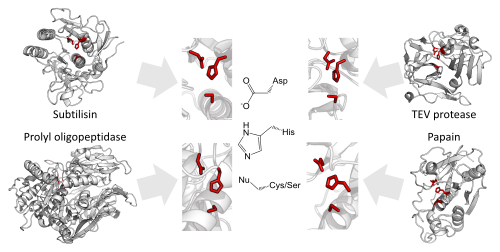
The enzymology of proteases provides some of the clearest examples of convergent evolution. These examples reflect the intrinsic chemical constraints on enzymes, leading evolution to converge on equivalent solutions independently and repeatedly.[5][22]
Serine and cysteine proteases use different amino acid functional groups (alcohol or thiol) as a nucleophile. To activate that nucleophile, they orient an acidic and a basic residue in a catalytic triad. The chemical and physical constraints on enzyme catalysis have caused identical triad arrangements to evolve independently more than 20 times in different enzyme superfamilies.[5]
Threonine proteases use the amino acid threonine as their catalytic nucleophile. Unlike cysteine and serine, threonine is a secondary alcohol (i.e. has a methyl group). The methyl group of threonine greatly restricts the possible orientations of triad and substrate, as the methyl clashes with either the enzyme backbone or the histidine base. Consequently, most threonine proteases use an N-terminal threonine in order to avoid such steric clashes. Several evolutionarily independent enzyme superfamilies with different protein folds use the N-terminal residue as a nucleophile. This commonality of active site but difference of protein fold indicates that the active site evolved convergently in those families.[5][23]
Cone snail and fish insulin
Conus geographus produces a distinct form of insulin that is more similar to fish insulin protein sequences than to insulin from more closely related molluscs, suggesting convergent evolution,[24] though with the possibility of horizontal gene transfer.[25]
Ferrous iron uptake via protein transporters in land plants and chlorophytes
Distant homologues of the metal ion transporters ZIP in land plants and chlorophytes have converged in structure, likely to take up Fe2+ efficiently. The IRT1 proteins from Arabidopsis thaliana and rice have extremely different amino acid sequences from Chlamydomonas's IRT1, but their three-dimensional structures are similar, suggesting convergent evolution.[26]
Na+,K+-ATPase and Insect resistance to cardiotonic steroids
Many examples of convergent evolution exist in insects in terms of developing resistance at a molecular level to toxins. One well-characterized example is the evolution of resistance to cardiotonic steroids (CTSs) via amino acid substitutions at well-defined positions of the α-subunit of Na+,K+-ATPase (ATPalpha). Variation in ATPalpha has been surveyed in various CTS-adapted species spanning six insect orders.[27][28][29] Among 21 CTS-adapted species, 58 (76%) of 76 amino acid substitutions at sites implicated in CTS resistance occur in parallel in at least two lineages.[29] 30 of these substitutions (40%) occur at just two sites in the protein (positions 111 and 122). CTS-adapted species have also recurrently evolved neo-functionalized duplications of ATPalpha, with convergent tissue-specific expression patterns.[27][29]
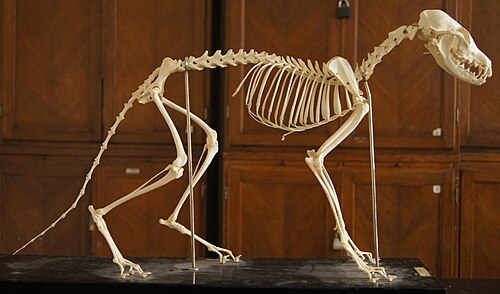
Birds and bats have homologous limbs because they are both ultimately derived from terrestrial tetrapods, but their flight mechanisms are only analogous, so their wings are examples of functional convergence. The two groups have independently evolved their own means of powered flight. Their wings differ substantially in construction. The bat wing is a membrane stretched across four extremely elongated fingers and the legs. The airfoil of the bird wing is made of feathers, strongly attached to the forearm (the ulna) and the highly fused bones of the wrist and hand (the carpometacarpus), with only tiny remnants of two fingers remaining, each anchoring a single feather. So, while the wings of bats and birds are functionally convergent, they are not anatomically convergent.[3][47] Birds and bats also share a high concentration of cerebrosides in the skin of their wings. This improves skin flexibility, a trait useful for flying animals; other mammals have a far lower concentration.[48] The extinct pterosaurs independently evolved wings from their fore- and hindlimbs, while insects have wings that evolved separately from different organs.[49]
Flying squirrels and sugar gliders are much alike in their mammalian body plans, with gliding wings stretched between their limbs, but flying squirrels are placentals while sugar gliders are marsupials, widely separated within the mammal lineage from the placentals.[50]
Insect mouthparts show many examples of convergent evolution. The mouthparts of different insect groups consist of a set of homologous organs, specialised for the dietary intake of that insect group. Convergent evolution of many groups of insects led from original biting-chewing mouthparts to different, more specialised, derived function types. These include, for example, the proboscis of flower-visiting insects such as bees and flower beetles,[52][53][54] or the biting-sucking mouthparts of blood-sucking insects such as fleas and mosquitos.
Angiosperm phylogeny of orders based on classification by the Angiosperm Phylogeny Group. The figure shows the number of inferred independent origins of C3-C4 photosynthesis and C4 photosynthesis in parentheses.
Phylogenetic reconstruction and ancestral state reconstruction proceed by assuming that evolution has occurred without convergence. Convergent patterns may, however, appear at higher levels in a phylogenetic reconstruction, and are sometimes explicitly sought by investigators. The methods applied to infer convergent evolution depend on whether pattern-based or process-based convergence is expected. Pattern-based convergence is the broader term, for when two or more lineages independently evolve patterns of similar traits. Process-based convergence is when the convergence is due to similar forces of natural selection.[77]
Pattern-based measures
Earlier methods for measuring convergence incorporate ratios of phenotypic and phylogenetic distance by simulating evolution with a Brownian motion model of trait evolution along a phylogeny.[78][79] More recent methods also quantify the strength of convergence.[80] One drawback to keep in mind is that these methods can confuse long-term stasis with convergence due to phenotypic similarities. Stasis occurs when there is little evolutionary change among taxa.[77]
Distance-based measures assess the degree of similarity between lineages over time. Frequency-based measures assess the number of lineages that have evolved in a particular trait space.[77]
Process-based measures
Methods to infer process-based convergence fit models of selection to a phylogeny and continuous trait data to determine whether the same selective forces have acted upon lineages. This uses the Ornstein–Uhlenbeck process to test different scenarios of selection. Other methods rely on an a priori specification of where shifts in selection have occurred.[81]
See also
Breeding back – A form of selective breeding to recreate the traits of an extinct species, but the genome will differ from the original species
Carcinisation– Evolution of crustaceans into crab-like forms
↑ Collin, R.; Cipriani, R. (2003). "Dolloの法則と貝殻の巻き方の再進化" . Proceedings of the Royal Society B . 270 (1533): 2551– 2555. doi : 10.1098/rspb.2003.2517 . PMC 1691546 . PMID 14728776 .
↑ Arendt, J.; Reznick, D. (2008年1月). 「収斂と並行性の再考:適応の遺伝学について何が分かったか?」. Trends in Ecology & Evolution . 23 (1): 26–32 . Bibcode : 2008TEcoE..23...26A . doi : 10.1016/j.tree.2007.09.011 . PMID 18022278 .
↑ Waters, Jonathan M.; McCulloch, Graham A. (2021). "車輪の再発明?反復進化における遺伝子流動、選別、収束の役割の再評価". Molecular Ecology . 30 (17): 4162–4172 . Bibcode : 2021MolEc..30.4162W . doi : 10.1111/mec.16018 . ISSN 1365-294X . PMID 34133810. S2CID 235460165 .
↑ Bohutínská, Magdalena; Peichel, Catherine L. (2024年4月) 「分岐時間が反復適応中の遺伝子再利用を形作る」 . Trends in Ecology & Evolution . 39 (4): 396– 407. Bibcode : 2024TEcoE..39..396B . doi : 10.1016/j.tree.2023.11.007 . PMID 38155043 .
↑ Pearce, T. (2011年11月10日). 「進化における収束と並行性:ネオ・グールド的説明」 . The British Journal for the Philosophy of Science . 63 (2): 429–448 . doi : 10.1093/bjps/axr046 .
↑Cheng, H.; Kim, B-H.; Grishin, N. V. (September 2008). "MALISAM: a database of structurally analogous motifs in proteins". Nucleic Acids Research. 36 (Database issue): 211–217. doi:10.1093/nar/gkm698. PMC2238938. PMID17855399.
↑Wright, E. S. (January 2025). "Tandem repeats provide evidence for convergent evolution to similar protein structures". Genome Biology and Evolution. 17 (2) evaf013. doi:10.1093/gbe/evaf013. PMC11812678. PMID39852593.
↑Dodson, G.; Wlodawer, A. (September 1998). "Catalytic triads and their relatives". Trends in Biochemical Sciences. 23 (9): 347–52. doi:10.1016/S0968-0004(98)01254-7. PMID9787641.
↑Ekici, O. D.; Paetzel, M.; Dalbey, R. E. (December 2008). "Unconventional serine proteases: variations on the catalytic Ser/His/Asp triad configuration". Protein Science. 17 (12): 2023–37. doi:10.1110/ps.035436.108. PMC2590910. PMID18824507.
↑Safavi-Hemami, Helena; Gajewiak, Joanna; Karanth, Santhosh; etal. (10 February 2015). "Specialized insulin is used for chemical warfare by fish-hunting cone snails". Proceedings of the National Academy of Sciences. 112 (6): 1743–1748. Bibcode:2015PNAS..112.1743S. doi:10.1073/pnas.1423857112. PMC4330763. PMID25605914.
↑Martin, J. P.; Fridovich, I. (1981). "Evidence for a natural gene-transfer from the ponyfish to its bioluminescent bacterial symbiont Photobacter leiognathi — the close relationship between bacteriocuprein and the copper-zinc superoxide-dismutase of teleost fishes". Journal of Biological Chemistry. 256 (12): 6080–6089. doi:10.1016/S0021-9258(19)69131-3. PMID6787049.
1 2 3 Yang, L.; Ravikanthachari, N; Mariño-Pérez, R; et al. (2019). "直翅目昆虫のカルデノリド不感受性の進化における予測可能性" . Philosophical Transactions of the Royal Society of London, Series B . 374 (1777) 20180246. doi : 10.1098/rstb.2018.0246 . PMC 6560278 . PMID 31154978 .
↑ Liu, Zhen; Qi, Fei-Yan; Zhou, Xin; Ren, Hai-Qing; Shi, Peng (2014). "Parallel Sites Implicate Functional Convergence of the Hearing Gene Prestin among Echolocating Mammals" . Molecular Biology and Evolution . 31 (9): 2415– 2424. doi : 10.1093/molbev/msu194 . ISSN 1537-1719 . PMID 24951728 .
↑Foote, Andrew D.; Liu, Yue; Thomas, Gregg W. C.; etal. (March 2015). "Convergent evolution of the genomes of marine mammals". Nature Genetics. 47 (3): 272–275. doi:10.1038/ng.3198. PMC4644735. PMID25621460.
↑Hu, Yibo; Wu, Qi; Ma, Shuai; Ma, Tianxiao; Shan, Lei; Wang, Xiao; Nie, Yonggang; Ning, Zemin; Yan, Li (January 2017). "Comparative genomics reveals convergent evolution between the bamboo-eating giant and red pandas". Proceedings of the National Academy of Sciences of the United States of America. 114 (5): 1081–1086. Bibcode:2017PNAS..114.1081H. doi:10.1073/pnas.1613870114. PMC5293045. PMID28096377.
↑Feigin, Charles Y.; Newton, Axel H.; Doronina, Liliya; etal. (January 2018). "Genome of the Tasmanian tiger provides insights into the evolution and demography of an extinct marsupial carnivore". Nature Ecology & Evolution. 2 (1): 182–192. doi:10.1038/s41559-017-0417-y. PMID29230027.
↑Partha, Raghavendran; Chauhan, Bharesh K; Ferreira, Zelia; etal. (October 2017). "Subterranean mammals show convergent regression in ocular genes and enhancers, along with adaptation to tunneling". eLife. 6 e25884. doi:10.7554/eLife.25884. PMC5643096. PMID29035697.
↑Sackton, T.B.; Grayson, P.; Cloutier, A.; etal. (5 April 2019). "Convergent regulatory evolution and loss of flight in paleognathous birds". Science. 364 (6435): 74–78. Bibcode:2019Sci...364...74S. doi:10.1126/science.aat7244. PMID30948549. S2CID96435050.
↑"How do analogies evolve?". University of California Berkeley. Archived from the original on 2 April 2017. Retrieved 26 January 2017.
↑Zhu, X. G.; Long, S. P.; Ort, D. R. (2008). "What is the maximum efficiency with which photosynthesis can convert solar energy into biomass?". Current Opinion in Biotechnology. 19 (2): 153–159. doi:10.1016/j.copbio.2008.02.004. PMID18374559. Archived from the original on 1 April 2019. Retrieved 29 December 2018.
↑Kadereit, G.; Borsch, T.; Weising, K.; Freitag, H (2003). "Phylogeny of Amaranthaceae and Chenopodiaceae and the Evolution of C4 Photosynthesis". International Journal of Plant Sciences. 164 (6): 959–86. Bibcode:2003IJPlS.164..959K. doi:10.1086/378649. S2CID83564261.
↑Ireland, Hilary, S.; etal. (2013). "Apple SEPALLATA1/2 -like genes control fruit flesh development and ripening". The Plant Journal. 73 (6): 1044–1056. Bibcode:2013PlJ....73.1044I. doi:10.1111/tpj.12094. PMID23236986.{{cite journal}}: CS1 maint: multiple names: authors list (link)
↑Heuvelink, Ep (2005). Tomatoes. CABI. p.72. ISBN978-1-84593-149-0. Archived from the original on 1 April 2019. Retrieved 17 December 2016.
↑Lorts, C.; Briggeman, T.; Sang, T. (2008). "Evolution of fruit types and seed dispersal: A phylogenetic and ecological snapshot"(PDF). Journal of Systematics and Evolution. 46 (3): 396–404. doi:10.3724/SP.J.1002.2008.08039 (inactive 3 July 2025). Archived from the original(PDF) on 18 July 2013.{{cite journal}}: CS1 maint: DOI inactive as of July 2025 (link)
↑Lengyel, S.; Gove, A. D.; Latimer, A. M.; Majer, J. D.; Dunn, R. R. (2010). "Convergent evolution of seed dispersal by ants, and phylogeny and biogeography in flowering plants: a global survey". Perspectives in Plant Ecology, Evolution and Systematics. 12 (1): 43–55. Bibcode:2010PPEES..12...43L. doi:10.1016/j.ppees.2009.08.001.
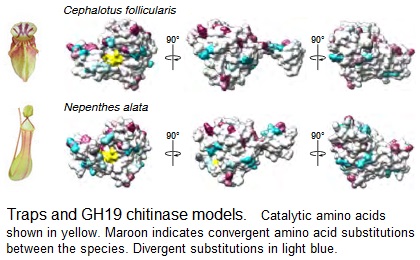
↑Fukushima, K; Fang, X; etal. (2017). "Genome of the pitcher plant Cephalotus reveals genetic changes associated with carnivory". Nature Ecology & Evolution. 1 (3): 0059. Bibcode:2017NatEE...1...59F. doi:10.1038/s41559-016-0059. hdl:2031/2d3c8107-c0b8-4276-a6e2-7cc27356e599. PMID28812732.
123Stayton, C. Tristan (2015). "The definition, recognition, and interpretation of convergent evolution, and two new measures for quantifying and assessing the significance of convergence". Evolution. 69 (8): 2140–2153. Bibcode:2015Evolu..69.2140S. doi:10.1111/evo.12729. PMID26177938. S2CID3161530.
↑Stayton, C. Tristan (2008). "Is convergence surprising? An examination of the frequency of convergence in simulated datasets". Journal of Theoretical Biology. 252 (1): 1–14. Bibcode:2008JThBi.252....1S. doi:10.1016/j.jtbi.2008.01.008. PMID18321532.
↑Muschick, Moritz; Indermaur, Adrian; Salzburger, Walter (2012). "Convergent Evolution within an Adaptive Radiation of Cichlid Fishes". Current Biology. 22 (24): 2362–2368. Bibcode:2012CBio...22.2362M. doi:10.1016/j.cub.2012.10.048. PMID23159601.
↑ Arbuckle, Kevin; Bennett, Cheryl M.; Speed, Michael P. (2014年7月) 「収斂進化の強さの単純な尺度」 . Methods in Ecology and Evolution . 5 (7): 685–693 . Bibcode : 2014MEcEv...5..685A . doi : 10.1111/2041-210X.12195 .
↑ Ingram, Travis; Mahler, D. Luke (2013年5月1日). "SURFACE: 段階的赤池情報量規準を用いたオルンシュタイン・ウーレンベックモデルの適合による比較データからの収斂進化の検出" . Methods in Ecology and Evolution . 4 (5): 416– 425. Bibcode : 2013MEcEv...4..416I . doi : 10.1111/2041-210X.12034 . S2CID 86382470 .









 ウィキメディア・コモンズにある収斂進化に関連するメディア