Loading article…
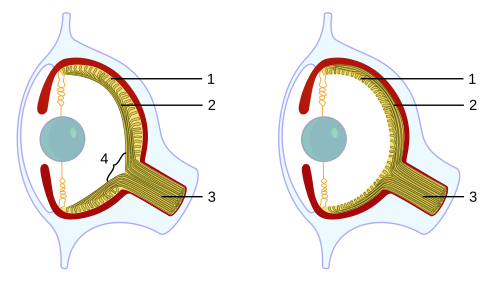
Cephalopods, as active marine predators, possess sensory organs specialized for use in aquatic conditions.[1] They have a camera-type eye which consists of an iris, a circular lens, vitreous cavity (eye gel), pigment cells, and photoreceptor cells that translate light from the light-sensitive retina into nerve signals which travel along the optic nerve to the brain.[2] For the past 140 years, the camera-type cephalopod eye has been compared with the vertebrate eye as an example of convergent evolution, where both types of organisms have independently evolved the camera-eye trait and both share similar functionality. Contention exists on whether this is truly convergent evolution or parallel evolution.[3] Unlike the vertebrate camera eye, the cephalopods' form as invaginations of the body surface (rather than outgrowths of the brain), and consequently the cornea lies over the top of the eye as opposed to being a structural part of the eye.[4] Unlike the vertebrate eye, a cephalopod eye is focused through movement, much like the lens of a camera or telescope, rather than changing shape as the lens in the human eye does. The eye is approximately spherical, as is the lens, which is fully internal.[5]
Cephalopods' eyes develop in such a way that they have retinal axons that pass over the back of the retina, so the optic nerve does not have to pass through the photoreceptor layer to exit the eye and do not have the natural physiological blind spot of vertebrates.[2]
The crystallins used in the lens appear to have developed independently from vertebrate crystallins, suggesting a homoplasious origin of the lens.[6]
ほとんどの頭足類は、眼球の全体的な位置を非常に細かく制御できる複雑な眼外筋系を備えています。タコは、瞳孔の向きを常に水平に保つ自律神経反応を持っています。[ 1 ]
イカやタコ、そしておそらくコウイカなど、いくつかの種類の頭足類は、偏光の方向を識別できる目を持っています。この感度は、隣接する光受容体の直交配置によるものです。(頭足類は、他の軟体動物と同様に、桿状体と呼ばれる受容体細胞を持っています。)対照的に、脊椎動物の目は、桿体と錐体のオプシンが半ランダムに配置されているため、通常は偏光の違いに鈍感です。そのため、目は光のeベクトル軸のどの方向にも等しく敏感です。頭足類の目のオプシンは直交配置のため、光のeベクトル軸に適切に整列すると最も高い光吸収を示し、偏光の違いに敏感になります。[ 7 ] この能力の正確な機能は証明されていませんが、獲物の検出、ナビゲーション、そしておそらく体色を変える頭足類間のコミュニケーションのためであると仮説が立てられています。[ 7 ] [ 8 ]
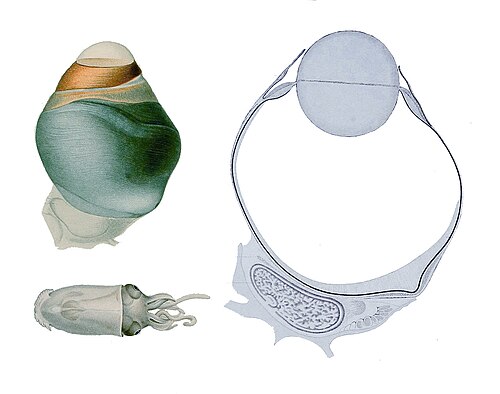

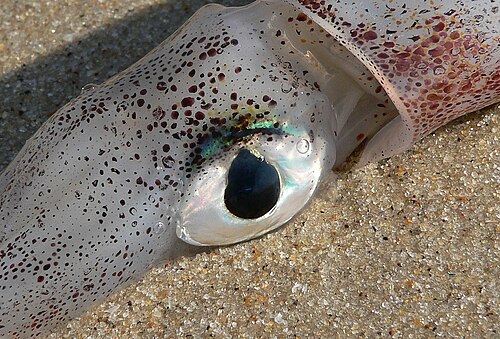
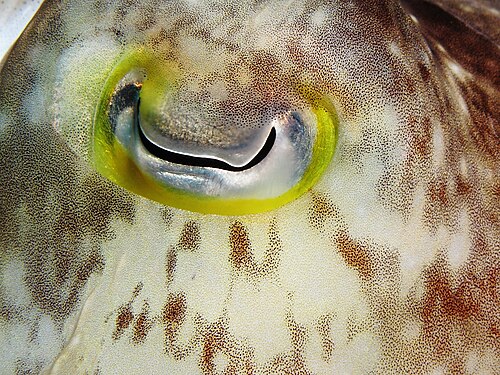

頭足類と脊椎動物におけるカメラ眼の進化が平行進化なのか収斂進化なのかについては、ほぼ解決済みではあるものの、依然として意見の相違が存在する。現在の見解では、両者の類似したカメラ型眼は収斂進化したとされている。
並行進化だと主張する人々は、この眼の発達に必要な遺伝情報を持つ共通祖先が存在した証拠があると述べている。これは、眼の発達に関わる遺伝子Pax6を持つ左右相称動物がすべて存在することからも明らかである。[ 9 ]
Those supporting a convergent evolution state that this common ancestor would have preceded both cephalopods and vertebrates by a significant margin. The common ancestor with the expression for camera-type eye would have existed approximately 270 million years before the evolution of camera-type eye in cephalopods and approximately 110 to 260 million years before the evolution of camera-type eye in vertebrates.[10] Another source of evidence for this is the differences of expression due to independent variants of Pax6 arising in both cephalopods and vertebrates. Cephalopods contain five variants of Pax6 in their genomes which independently arose and are not shared by vertebrates, although they allow for a similar gene expression when compared to the Pax6 of vertebrates.[11]
The main medical use emerging in this field is for research on eye development and ocular diseases. New research studies on ocular gene expression are being performed using cephalopod eyes due to the evidence of their convergent evolution with the analogous human eye. These studies replace the previous Drosophila studies for gene expression during eye development as the most accurate, although Drosophila studies remain the most common. The conclusion that they are analogous lends credibility to their comparison for medical use in the first place, since the trait in both would have been shaped through natural selection by similar pressures in similar environments; meaning there would be similar expression of ocular disease in both organisms’ eyes.[2]
An advantage of cephalopod eye experimentation is that cephalopods can regenerate their eyes due to their ability to re-enable their developmental processes, which allows studies of the same cephalopod to continue past one trial sample when studying the effects of disease. This also permits for a more complex study concerning how regeneration may be conserved in cephalopod genomes and if it may be somewhat conserved in the human genome alongside the genes expressing for the camera eye.[2]
{{cite journal}}: CS1 maint: 数値名: 著者リスト (リンク)