
Loading article…
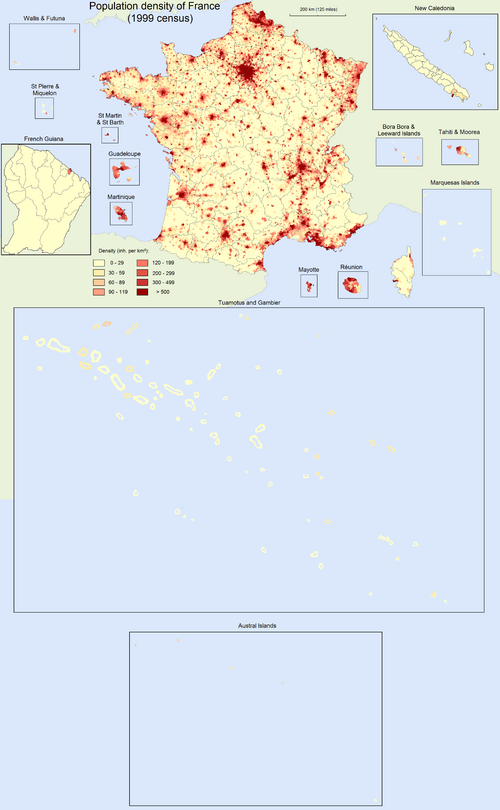


フランスの人口統計は、国立人口統計研究所(INED)と国立統計経済研究所(INSEE)によって監視されています。2026年1月1日現在、フランス本土には66,792,845人が居住し、海外フランスには2,289,151人が居住しており[注1 ] 、フランス共和国の総人口は69,081,996人です[ 1 ] 。 2010年代から2017年まで、フランスの人口は 3年ごとに100万人増加し、平均年間増加数は34万人、つまり+0.6%でした[ 7 ] 。
フランスは歴史的にヨーロッパで最も人口の多い国でした。中世には、ヨーロッパの総人口の4分の1以上がフランス人でした。[ 8 ] 17世紀までに、これはわずかに減少して5分の1になりました。19世紀初頭までに、ドイツやロシアなどの他のヨーロッパ諸国がフランスに追いつき、人口で追い越しました。第二次世界大戦後のベビーブームにより、他のヨーロッパ諸国と同様に、フランスの人口は急増しました。
INSEEによると、2004年から毎年20万人の移民がフランスに入国している。そのうち2人に1人はヨーロッパ生まれで、3人に1人はアフリカ生まれである。2009年から2012年にかけて、フランスに移住するヨーロッパ人の数は急増したが(年間12%増)、この割合は2022年まで着実に減少し、アフリカからの移民数の増加に取って代わられた。[ 9 ] [ 10 ] [ 11 ]
フランスの出生率は、一時的に低下した後、1990年代に回復し始め、2014年頃までは人口置換水準に近い水準でした。2006年のINSEEの調査によると、自然増加は年間約30万人で、「30年以上到達していない」水準でした。[ 12 ] 2024年の合計特殊出生率は1.59(フランス本土)で、[ 13 ]フランスは欧州連合の中で平均以上の出生率を誇る国の1つですが、[ 14 ] [ 15 ] [ 16 ]現在は人口置換水準からは程遠い水準です。
2021年のフランスの合計特殊出生率は1.82で、7.7%は女性にとって4人目以降の子供だった。
2010年にフランス本土で生まれた80万2000人の赤ちゃんのうち、80.1%は両親がフランス人、13.3%は片親がフランス人、6.6%は両親がフランス人以外であった。[ 17 ] [ 18 ] [ 19 ]
2006年から2008年の間に、フランスで生まれた新生児の約22%は、少なくとも1人の外国生まれの祖父母を持っていた(9%は他のヨーロッパの国で生まれ、8%はマグレブで生まれ、2%は世界の他の地域で生まれた)。[ 20 ]フランス政府は1978年に人種と民族的出自に関する国勢調査を禁止した。[ 21 ]


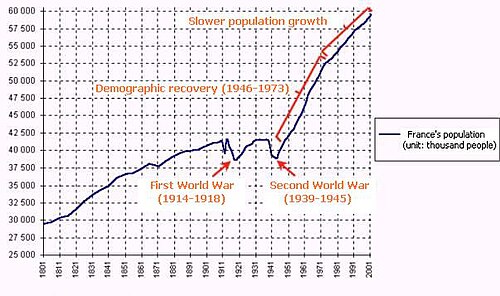
1800年頃から、フランスの人口の歴史的推移はヨーロッパでは異例であった。ヨーロッパの他の国々とは異なり、フランスでは19世紀と20世紀前半に人口の大幅な増加は見られなかった。フランスの出生率は、 18世紀後半から相続法によって相続人の間で財産が均等に分配されるようになったこともあり、ヨーロッパの他の国々よりもはるかに早く減少した。フランスの人口の多さは、ナポレオンに大軍のための兵士をほぼ無限に供給したが、出生率は18世紀後半に低下し始めた。[ 22 ]そのため、19世紀の人口増加は非常に緩やかで、急速に人口が増加しているドイツとイギリスに囲まれたフランスでは、20世紀前半に人口増加がほぼゼロとなり、最低水準に達した。19世紀のフランスの人口増加の緩やかさは、同国の非常に低い移民率にも反映されている。
フランスの人口は1871年から1911年の間にわずか8.6%しか増加しなかったのに対し、ドイツは60%、イギリスは54%増加した。[ 23 ]
フランスでは普仏戦争での敗北後、人口増加の遅さに対する懸念が始まった。1890年代の4年間、死亡者数が出生者数を上回った。1896年にフランス人口増加のための国民同盟(ANAPF)が結成され、大家族の親のためにコニャック・ジェイ賞などの賞が創設された。エミール・ゾラの1899年の小説『出生率低下』は、当時の出生率に対する懸念を象徴している。フランスは第一次世界大戦で男性の労働人口の10%を失った。130万人のフランス人の死者と、戦争で父親になるはずだった男性が出生しなかったことによるさらに多くの出生が、フランスの人口を300万人減少させ、出生率低下を国民的な関心事にした。1920年までにANAPFの会員数は4万人となり、同年7月には中絶と避妊を厳しく規制する新法が制定された。[ 22 ] [ 23 ]
ANAPFは大家族の親に投票権を与えることを提案し、他国での女性参政権が誕生率の低下を招いたという認識が、第二次世界大戦前に女性に投票権を与える提案を否決するのに役立った。1920年から1923年にかけての短いベビーブームの後、誕生率は再び低下し、1930年代後半の平時で過去最低を記録した。この10年間の「空虚な時代」には、第一次世界大戦中の出生不足のため、徴兵される新兵の数が減少した。1935年からは死亡数が出生数を上回り、マスコミは国の人口減少について広く議論した。左派も右派も出生促進政策を支持し、フランス共産党でさえ1936年に避妊反対法と中絶反対法への反対を撤回し、党首のモーリス・トレーズは「家族と子供の保護」を提唱した。[ 22 ] [ 23 ]
1938年11月と1939年7月に制定された新しい法律、家族法典は、大家族に十分な経済的インセンティブを提供し、6人の子供を持つ家族の収入を倍増させた。ヴィシー政府はこの法律を承認し、戦後のフランス共和国臨時政府と同様に、その国家モットーである「労働、家族、祖国」の一環として施行した。[ 23 ] [ 22 ] [ 24 ]また、フランスは主にイタリア、ポーランド、スペインなどの他のヨーロッパ諸国からの移民を奨励した。(実際、出生率の低さ、国内生まれの人口の停滞または減少、そしてヨーロッパの他の地域からの移民の目的地としての役割を考えると、第二次世界大戦前のフランスの状況は今日のドイツの状況と似ていなかった。)
フランスでは1945年以降ベビーブームが起こり、長年の低出生率の記録が覆されました。[ 22 ] [ 26 ]しかし、1930年代の政府の出生奨励政策では、フランスでしばしば「奇跡」と表現されたこの急激な回復を説明することはできません。また、これは西欧世界でも異例でした。戦後、他の西欧諸国でもベビーブームがありましたが、フランスのベビーブームははるかに強く、他のほとんどの西欧諸国よりも長く続きました(米国は数少ない例外の1つでした)。1950年代と1960年代、フランスの人口は年間1%増加しました。これはフランス史上最高の増加率であり、18世紀や19世紀の高い増加率よりもさらに高いものでした。
1975年以降、フランスの人口増加率は大幅に低下したが、それでもヨーロッパの他の国々よりわずかに高く、19世紀末や20世紀前半と比べるとはるかに高い。21世紀最初の10年間、フランスの人口増加率はヨーロッパで最も高く、アイルランド共和国だけがそれに匹敵した。アイルランド共和国も、最近までヨーロッパの他の国々と比較して歴史的に停滞、あるいは減少傾向にあった。しかし、フランスの人口増加率は、主にアメリカ合衆国の純移民率が高いため、依然としてアメリカ合衆国より低い。
以下では、フランスの過去、現在、そして将来の人口規模を、ヨーロッパおよび世界の他の地域と比較します。すべての記述は、現代の国境で理解されるフランスを対象としており、これは他の国々にも当てはまります。歴史家は、フランスは少なくともカール大帝とフランク王国時代から19世紀まで、ヨーロッパで最も人口の多い国であったと示唆しています。近代以前の人口統計は、公式な集計が行われていなかったため、歴史的な推定値です。
上記のリストでは、トルコはヨーロッパの国とはみなされていません。トルコは1992年まではフランス本土よりも人口が少なかったのですが、2024年にはフランス、イギリス、ドイツよりも人口が多くなりました。 [ 28 ]
特に明記されていない限り、人口統計データはCIAワールドファクトブックに基づいています。
ご注意ください:
出典: [ 30 ]


1818年から1950年までのフランス本土における平均寿命。出典: Our World In Data。
死亡率:人口1,000人あたり9.6人(2021年推計)


1740年から2021年までのフランス本土の年齢構成。出典:ルイ・アンリとイヴ・ブラヨ。[ 31 ] [ 35 ]


フランスは他のヨーロッパ諸国と比べて出生率が高く、1990年代初頭に過去最低を記録した後、再び上昇傾向にある。
下の表は、女性の出生地別の平均子供数を示しています。移民女性とは、フランス国外で生まれ、出生時にフランス国籍を持っていなかった女性のことです。[ 40 ]
2021年には人口1,000人あたり11.8人の出生があった。合計特殊出生率(INSEE [ 13 ]による2020年のデータ)は女性1人あたり1.83人の出生であった。

合計特殊出生率は、女性一人当たりの出生児数です。これは、全期間にわたってかなり良好なデータに基づいています。出典:Our World In DataおよびGapminder Foundation。[ 43 ]
2006年から2008年の間にフランスで生まれた新生児の約22%は、少なくとも1人の外国生まれの祖父母を持っていた(9%は他のヨーロッパの国で生まれ、8%はマグレブで生まれ、2%は世界の他の地域で生まれた)。[ 20 ]
2022年現在、フランスの新生児の32.4%は少なくとも片方の親が外国生まれで、28.5%は少なくとも片方の親がヨーロッパ(EU 28)以外で生まれている(海外領土で生まれた親はフランス生まれとみなされる)。[ 17 ] [ 19 ]
下の表は、両親の出生地別に、フランス本土で生まれた子供の数を示しています。
2022年現在、フランスの新生児の74.0%は両親ともにフランス国籍、14.4%は片親がフランス国籍、11.5%は両親がフランス国籍以外であった。[ 17 ] [ 44 ]
以下の表は、両親の国籍別に、フランス本土で生まれた子供の数を示しています。

フランスの人口は2025年から2030年の間に7000万人に達し、2050年から2060年の間にドイツを追い抜くと予測されている。2060年にはフランスの人口が7560万人、ドイツの人口が7100万人となる見込みである。一方、イギリスは2030年までにフランスを追い抜くと予測されている。2080年までに、フランスの人口は7880万人に達すると推定されている(海外県を含むが、海外領土は含まない)。
フランス本土と海外県のユーロスタットのデータ: [ 45 ]

以下の人口動態統計はフランス本土に関するものであり、海外領土、海外領土、ニューカレドニアは含まれていません。出典: [ 46 ] [ 47 ] [ 48 ] [ 49 ] [ 1 ]
フランスの人口動態における注目すべき出来事:
互換性を確保するため、すべてのデータはフランス本土に関するものです。
2025年時点で、新生児421,871人(65.5%)は両親ともにフランス生まれ、15.1%は片親が外国生まれ、19.4%は両親ともに外国生まれでした。同年、新生児461,422人(71.7%)は両親ともにフランス国籍、14.7%は片親がフランス国籍、片親が外国国籍、13.7%は両親ともに外国国籍でした。[ 51 ]
INSEEは、両親の詳細な出生地に基づいて、フランス本土で生存して生まれた個人を数えています。[ 57 ]
注:2010年には、国籍を申告していない外国人が何人かいました 。父親:17,536人、母親:3,754人。


2020年には、フランスで合計154,581件の結婚がありました。[ 58 ]
近年、フランスでは共同体主義がより広まっている。ラ・クルヌーヴ、サルセル、トゥールーズ・ル・ミライユなどの郊外地域は、ほぼサハラ以南アフリカや北アフリカ出身者のみで構成されている。ル・コルビュジエ、アイヨー、カンディリスなどの建築家によって建設されたこれらの住宅プロジェクトは、共同体ゲットーとなっている。[ 59 ]
15歳から24歳までの若年層の失業率:
注:フランス国外(海外県を含む)で生まれた人は、国籍(フランス人か外国人か)に関わらず移民と呼ばれます。フランス国籍を持たない人は、出生地(フランス国内か国外か)に関わらず外国人と呼ばれます。
宗教に基づく最後の国勢調査は、第三共和政が始まった1872年に行われた。その後、ヴィシー政権の反ユダヤ主義的な国勢調査を除いて、フランス政府は人々の宗教や民族に関するデータの収集を中止した。[ 61 ] 1978年には、人種、宗教、労働組合、政治的・哲学的意見に関する個人データの収集を禁止する法律が制定された。[ 62 ]しかし、現在、この国の民族的・人種的人口統計に関する推定は行われている。
Some organizations, such as the Representative Council of Black Associations of France (French: Conseil représentatif des associations noires de France, CRAN), have argued in favour of the introduction of data collection on minority groups but this has been resisted by other organizations and ruling politicians,[63][64] often on the grounds that collecting such statistics goes against France's secular principles and harks back to Vichy-era identity documents.[65] During the 2007 presidential election, however, Nicolas Sarkozy, polled on the issue, stated that he favoured the collection of data on ethnicity.[66] Part of a parliamentary bill that would have permitted the collection of data for the purpose of measuring discrimination was rejected by the Conseil Constitutionnel in November 2007.[67]
However, that law does not concern surveys and polls, which are free to ask those questions if they wish. The law also allows for an exception for public institutions such as the INED or the INSEE whose job it is to collect data on demographics, social trends and other related subjects, on condition that the collection of such data has been authorized by the National Commission for Computer-stocked data and Freedom (CNIL) and the National Council of Statistical Information (CNIS).[68]
The modern ethnic French are the descendants of Celts, Iberians, Ligurians, Italic peoples (including Romans), and Greeks in southern France,[69][70] later mixed with large groups of Germanic peoples arriving at the end of the Roman Empire such as the Franks, Burgundians, Alamanni, and Goths,[71]Moors and Saracens in the south,[72][73][74][75][76][77][78] and Scandinavians, Vikings, who became, by mixing with the local population, the Normans and settled mostly in Normandy in the 9th century.[79]
However, genome-wide analyses of both ancient and present-day DNA indicate that the genetic make-up of modern French populations is overwhelmingly derived from groups already living in Gaul during the Late Bronze and Iron Ages; post-Roman inputs from Germanic, Scandinavian, North-African or other peoples account for only minor fractions, invalidating the notion of any massive later admixture.[80][81][82]
In 1960 there was approximately 500,000 'coloured' people present in France, constituting 1.2% of the population.[83] In 2004, French conservative think-tank Institut Montaigne estimated that there were 51 million (85%) people of European ethnic origin, 6 million (10%) North African people, 2 million (3.5%) West African and Central African peoples and 1 million (1.5%) people of Asian origin in Metropolitan France, including all generations of immigrant descendants.[84] TIME magazine in 2009 estimated that there was an estimated range of 4 to 7 million Arabs, 3 to 5 million Africans, 1.5 million Asians and around 600,000 Jewish people.[85] Solis, a marketing company, estimated the numbers for ethnic minorities (immigrants and 2nd generation) in France in 2009 as 3.26 million Maghrebis (5.23%), 1.83 million black people (2.94%) (1.08 million West Africans and 757,000 French from French West Indies), and 250,000 Turkish (0.71%).[86][87]
In 2015, Michèle Tribalat released a paper estimating population of ethnic minorities in France in 2011 to constitute 30% if ancestry retracted to 3 generations but with age limit of 60. 15% were of other European origin and another 15% rest.[88]
Newly released figures from France’s national statistical agency, which pulled census data from 2019–2020, revealed that nearly one-third of children aged four years and below are of non-European origin, a number which stands in sharp contrast with those recorded in older generations.
The data, published by the National Institute of Statistics and Economic Studies (INSEE), indicates that among those aged four and below living in ordinary housing (all residences excluding those for students, the elderly, and asylum seekers) in metropolitan France, 41.6% were born outside of France themselves, or are descendants of non-French parents or grandparents, with 29.6% having origins outside of Europe.
By comparison, a mere 7.6% of 60 to 64-year-olds and 3.1% of those over the age of 80 were of non-European origin over three generations, meaning they themselves, their parents, or grandparents were born outside of Europe.
Figures also revealed that 16.2% of all children aged four and below living in France are of Maghreb descent—a term used to describe the predominately Arab regions of northwest Africa, including Morocco, Libya, Algeria, Mauritania, and Tunisia. One in ten children in the same age group in France are immigrants or are the children of immigrants from elsewhere in Europe, with 7.3% having originated from sub-Saharan Africa, 4% from Asia, and 1.7% from the rest of the world.
The Paris region is a magnet for immigrants, hosting one of the largest concentrations of immigrants in Europe. As of 2006, about 45% of people (6 million) living in the region were either immigrant (25%) or born to at least one immigrant parent (20%).[89]
Of European ethnic groups not indigenous to France, the most numerous are people of Italian family origin and it is estimated that about 5 million citizens (8% of the population) are at least partly of Italian origin if their parentage is retraced over three generations.[90] This is due to waves of Italian immigration, notably during the late 19th century and early 20th century. Other large European groups of non-native origin are Spaniards, Portuguese, Romanians, Poles, and Greeks. Also, due to more recent immigration, between five and six million people of Maghrebi origin[91] and approximately 800,000 Turks inhabit France.[92][93]
An influx of Maghrebi Jews immigrated to France in the 1950s and after the Algerian War due to the decline of the French empire. Subsequent waves of immigration followed the Six-Day War, when some Moroccan and Tunisian Jews settled in France. Hence, by 1968, Maghrebi Jews were about 500,000 and the majority in France. As the majority of these new immigrants were already culturally French they needed little time to adjust to French society. Black people come from both the French overseas territories (French Guiana, Guadeloupe, Martinique, Réunion, and former colony Haiti) and Sub-Saharan Africa (especially Côte d'Ivoire, Mali, and Senegal). France has the largest black population in Europe.
There is a substantial Romani population in France. There is approximately 400,000 Roma living in France.[94]
Since the 19th century, France has continued being a country of immigration. During the Trente Glorieuses (1946–1975), the country's reconstruction and steady economic growth led to the labor-immigration of the 1960s, when many employers found manpower in villages located in Southern Europe and North Africa. In 2008, the French national institute of statistics INSEE estimated that 11.8 million foreign-born immigrants and their direct descendants (second generation) lived in France representing 19% of the country's population. About 5.5 million are of European origin and 4 million of Maghrebi origin.[95][96]
Immigration to France exceeded 200,000 in recent years, as shown in table below.[98]
In the 20th century, France experienced a high rate of immigration from other countries. The immigration rate was particularly high during the 1920s and 1930s. France was the European country which suffered the most from World War I, with respect to the size of its population, losing 1.3 million young men out of a total population of 40 million. France was also at the time the European country with the lowest fertility rate, which meant that the country had a very hard time recovering from the heavy losses of the war. France had to open its doors to immigration, which was the only way to prevent population decline between the two world wars.[99]
At the time, France was the only European country to permit mass immigration. The other major European powers, such as the UK or Germany, still had high fertility rates, so immigration was seen as unnecessary, and it was also undesirable to the vast majority of their populations. The majority of immigrants in the 1920s came from Italy and Poland, though from the 1930s, some also came from elsewhere in southern and eastern Europe, and the first wave of colonial French subjects from Africa and Asia. This mass immigration was ended and partially reversed by the economic problems of the 1930s.[100] By the end of the Spanish Civil War, some half-million Spanish Republican refugees had crossed the border into France.[101]
Local populations often opposed immigrant manpower, leading to occasional outbursts of violence. The most violent was a pogrom against Italian workers who worked in the salt evaporation ponds of Peccais, erupted in Aigues-Mortes in 1893, killing at least nine and injuring hundreds on the Italian side.[102]
After World War II, the French fertility rate rebounded considerably, as noted above, but economic growth in France was so high that new immigrants had to be brought into the country. Most immigrants were Portuguese as well as Arabs and Berbers from North Africa. The first wave arrived in the 1950s, but the major arrivals happened in the 1960s and 1970s. One million European pieds-noirs also migrated from Algeria in 1962 and the following years during the chaotic independence of Algeria.[103] France has over three million French of Algerian descent, a small percentage of whom are third-or fourth-generation French.
French law facilitated the immigration of thousands of French settlers (colons in French language), ethnic or national French from former colonies of North and West Africa, India and Indochina, to mainland France. 1.6 million European pieds noirs settlers migrated from Algeria, Tunisia and Morocco.[104] In the 1970s, over 30,000 French settlers left Cambodia during the Khmer Rouge regime as the Pol Pot government confiscated their farms and land properties. However, after the 1973 energy crisis, laws limiting immigration were passed. In addition, the country's birth rate dropped significantly during this time.
Between 1956 and 1967, about 235,000 Sephardic North African Jews from Algeria, Tunisia and Morocco also immigrated to France because of the decline of the French colonial empire and following the Six-Day War. Hence, by 1968, Sephardic North African Jews were the majority of the Jews in France. As the new immigrants were already culturally French, they needed little time to adjust to French society.[105]
In the late 1970s, the end of high economic growth in France caused immigration policies to be considerably tightened, starting with laws by Charles Pasqua passed in 1986 and 1993. New immigrants were allowed only through the family reunion schemes (wives and children moving to France to live with husbands or fathers already living in France), or as asylum seekers. Illegal immigration thus developed as immigration policy became more rigid. In 2006, The French Ministry of the Interior estimated clandestine immigrants in France amounted to anywhere between 200,000 and 400,000 and expected between 80,000 and 100,000 people to enter the country illegally each year.[106]
The Pasqua laws are a significant landmark in the shift in France's immigration policy through the course of the 20th century. They are a sign of the securitization aspect of immigration, giving more power to the police, allowing them to perform random identity checks and deport immigrants without legal papers. The rise in anti-immigration sentiments was reinforced by a series of terrorist bombs in Paris in 1986, linked to Muslim immigrants in France.[107]
Tightening immigration laws, as well as notions of "zero immigration", reflected national views that arose within the discussion around immigrant family reunification and national identity. Institut français des relations internationales (IFRI) immigration expert, Christophe Bertossi, states that stigmatized as both a challenge to social cohesion and a "burden" for the French economy, family immigration is increasingly restricted and constructed as a racial issue. The "immigration choisie" policy strives consequently to select migrants according to their profile, skills and, still indirectly, origins.[108][109]
Nonetheless, immigration rates in the 1980s and 1990s were much lower than in the 1960s and 1970s, especially compared to other European countries. The regions of emigrations also widened, with new immigrants now coming from sub-Saharan Africa and Asia. In the 1970s, a small but well-publicized wave of Chilean and Argentine political refugees from their countries' dictatorships found asylum in France.
Ethnic Vietnamese started to become a visible segment of society after the massive influx of refugees after the end of the Vietnam War in 1975. The expulsions of ethnic Chinese from Vietnam in the 1970s led to a wave of immigration and the settlement of the high-rise neighbourhood near the Porte d'Italie, where the Chinatown of Paris is located. Located in the 13th arrondissement, the area contains many ethnic Chinese inhabitants.[110]
According to the distinguished French historian of immigration Gérard Noiriel, in 1989 one third of the population currently living in France was of "foreign" descent.[111]
According to Michèle Tribalat, researcher at INED, there were, in 1999, approximately 14 million persons of foreign ancestry (about a quarter of the population), defined as either immigrants or people with at least one immigrant parent or grandparent. Half of them were of European ancestry (including 5.2 million from South Europe (Italy, Spain, Portugal and former Yugoslavia)). The rest were from Maghreb (3 million), Sub-Saharan Africa (680,000), Turkey (320,000) and other parts of the world (2.5 million).[112] Immigrants from the Maghreb are commonly referred to as beur, a verlan slang term derived from the word arabe (French for Arab).[113]
The large-scale immigration from Islamic countries has sparked controversy in France. Nevertherless, according to Justin Vaïsse, in spite of challenges and setbacks like the riots in November 2005, in Parisian suburbs, where many immigrants live secluded from society with very few capabilities to live in better conditions, the integration of Muslim immigrants is happening as part of a background evolution[114] and recent studies confirmed the results of their assimilation, showing that "North Africans seem to be characterized by a high degree of cultural integration reflected in a relatively high propensity to exogamy" with rates ranging from 20% to 50%.[115] According to Emmanuel Todd, the relatively high exogamy among French Algerians can be explained by the colonial link between France and Algeria.[116][117] One illustration of this growing resentment and job insecurity can be drawn from related events, such as the 2005 riots, which ensued in former President Chirac declaring a state of emergency.[118] Massive demonstrations to express frustration over unemployment took place in March 2009.[119] The importance of integration was brought to the forefront of the political agenda in Sarkozy's 2007 presidential campaign. Upon being elected, he symbolically created the French Ministry of Immigration, Integration, National Identity and Codevelopment. Integration is one of the pillars of its political aims.[120]
In 2014, the National Institute of Statistics (INSEE is its acronym in French) published a study, according to which the numbers of Spanish, Portuguese and Italians in France had doubled between 2009 and 2012.
According to the French Institute, the increase due to the euro area crisis pushed up the number of Europeans in France.[9] Statistics on Spanish immigrants in France show a growth of 107% between 2009 and 2012, from 5300 to 11,000 people.[9][123]
Of 229,000 foreigners in France in 2012, nearly 8% were Portuguese, British 5%, Spanish 5%, Italians 4%, Germans 4%, Romanians 3%, Belgians 3% and Dutch 2%.[9]
With the increase of Spanish, Portuguese and Italians in France, in 2012 46% of immigrants were European, while the percentage for Francophone African immigrants reached 30%, of which Moroccans were 7%, Algerians 7%, and Tunisians 3%. Meanwhile, 14% of all immigrants who settled in France in that year were from Asian countries: 3% from China, 2% from Turkey, 10% from America and Oceania, Americans and Brazilians accounting for 2% each.[9]
As of 2008, the French national institute of statistics INSEE estimated that 11.8 million foreign-born immigrants and their direct descendants (limited to second-generation born in France) lived in France representing 19% of the country's population. More than 5.5 million are of European origin and about 4 million of Maghrebi origin (20% of Algerian origin and 15% of Moroccan or Tunisian origin). Immigrants aged 18 to 50 count for 2.7 million (10% of population age 18–50) and 5 million for all ages (8% of population). The second-generation immigrants aged 18 to 50 make up 3.1 million (12% of 18–50) and 6.5 million for all ages (11% of population).[95][96] Without considering citizenship at birth, people not born in metropolitan France and their direct descendants made up 30% of the population aged 18–50 in metropolitan France as of 2008.[124]
The region with the largest proportion of immigrants is the Île-de-France (Greater Paris), where 40% of immigrants live. Other important regions are Rhône-Alpes (Lyon) and Provence-Alpes-Côte d'Azur (Marseille). The most important individual countries of origin as of 2007 were Algeria (702,000), Morocco (645,000), Portugal (576,000), Italy (323,000), Spain (262,000) and Turkey (234,000). However, immigration from Asia (especially China), as well as from Francophone Sub-Saharan Africa (Senegal, Mali) is gaining in importance.
42% of the immigrants are from Africa (30% from Maghreb and 12% from Francophone Sub-Saharan Africa), 38% from Europe (mainly from Portugal, Italy and Spain), 14% from Asia and 5% from America and Oceania.[96] Outside Europe and North Africa, the highest rate of immigration is from Vietnam, Cambodia and Senegal.
The following table shows immigrants and second-generation immigrants by origin as of 2008 according to a study published by Insee in 2012. Third-generation immigrants, illegal immigrants, as well as ethnic minorities like black people from the French overseas territories residing in metropolitan France (800,000), Roms (500,000) or people born in Maghreb with French citizenship at birth (1 million Maghrebi Jews, Harkis and pieds-noirs) and their descendants, who are French by birth and not considered as immigrants or immigrant descendants, are not taken into account.[125]
Net migration rate 1.06 migrant(s)/1,000 population (2021 est.) Country comparison to the world: 61st
Immigrants by country of birth as of 2022:[127]
In 2004, a total of 140,033 people immigrated to France. Of them, 90,250 were from Africa and 13,710 from Europe.[128] In 2005, immigration levels fell slightly to 135,890.[129] The European Union allows free movement between the member states. While the UK (along with Ireland and Sweden and non-EU members Norway and Switzerland) did not impose restrictions, France put in place controls to curb Eastern European migration.
As at 1 January 2006, INSEE estimated that there were 3.5 million foreigners living in metropolitan France. Two out of five foreigners are from Portugal, Algeria or Morocco. Thus, EU nationals immigrating to France account for 1.2 million people, and 1.1 million people are from the three Maghreb countries of Morocco, Algeria and Tunisia. Immigrants are concentrated in Île-de-France, Rhone-Alpes, Provence and Côte d'Azur regions, accounting for 60% of the total immigrant population. Furthermore, there appears to be a lower rate of immigrants arriving from the EU since 1975 as opposed to an increase in African immigrants.[130]
In the first decade of the 21st century, the net migration rate was estimated to be 0.66 migrants per 1,000 population a year.[131] This is a very low rate of immigration compared to other European countries, the United States or Canada. Since the beginning of the 1990s, France has been attempting to curb immigration, first with the Pasqua laws, followed by both right-wing and socialist-issued laws. This trend is also demonstrated in anti-immigrant sentiments among the public. For example, the Pew Research Center in Washington, D.C. conducted a public opinion poll in February 2004 among French nationals. This poll measured the extent of support for restricting immigration among French nationals, by age cohort. 24% of individuals 18 to 29 were restricting immigration, with 33% of individuals 30 to 49 and 53% for both 50 to 64 and 65 and over.[132] Nearly nine years later, a January 2013 poll conducted in France by Ipsos found that 70% of respondents said that there were "too many immigrants in France".[133]
The immigration rate is currently lower than in other European countries such as United Kingdom and Spain; however, some say it is unlikely that the policies in themselves account for such a change. Again, as in the 1920s and 1930s, France stands in contrast with the rest of Europe. Back in the 1920s and 1930s, when other European countries had a high fertility rate, France had a low fertility rate and opened its doors to immigration to avoid a population decline. Today, it is the rest of Europe that has very low fertility rates, and countries like Germany or Spain avoid population decline only through immigration. In France, however, the fertility rate is still fairly high for European standards. It is, in fact, the highest in Europe after Ireland (the EU) and Albania (perhaps higher than Ireland's) and so most population growth is due to natural increase, unlike in the other European countries.[134]
The difference in immigration trends is also because the labour market in France is currently less dynamic than in other countries such as the UK, Ireland or Spain. One reason for this could be France's relatively high unemployment, which the country has struggled to reduce for the past two decades. There is also a parallel dynamic between immigration and unemployment. Immigrants tend to be subjected to higher rates of unemployment. In 2008, the immigrant unemployment rate in France was a startling 13%, twice as high as for the national population (6%).[135] One can further analyse the trend in relation to education. In the ministry's 2010 report on professional inclusion for immigrants, 19.6% of immigrants without any education were unemployed while 16.1% of immigrants who had graduated high school were unemployed. Only 11.4% of immigrants with an undergraduate degree or higher were unemployed.[136]
For example, according to the UK Office for National Statistics, between July 2001 and July 2004, the population of the UK increased by 721,500 inhabitants, of which 242,800 (34%) was due to natural increase, 478,500 (66%) to immigration.[137] According to the INSEE, between January 2001 and January 2004 the population of Metropolitan France increased by 1,057,000 inhabitants of which 678,000 (64%) was due to natural increase, 379,500 (36%) from immigration.[138]
The latest 2008 demographic statistics have been released, and France's birth and fertility rates have continued to rise. The fertility rate increased to 2.01 in 2012[37] and, for the first time, surpasses the fertility rate of the United States.[139]
Americans total more than 100,000[140] permanent residents in France, Canadians 11,931,[141] followed by Latin Americans, a growing subgroup, the most numerous of which are Brazilians, at 44,622,[142] followed by Colombians, at 40,000, Venezuelans, at 30,000,[143] Peruvians, at 22,002,[144] Argentineans, at 11,899,[145] and Chileans, 15,782.[146]
In 2014 The National Institute of Statistics (INSEE, for its acronym in French) published a study, according to which has doubled the number of Spanish immigrants, Portuguese and Italians in France between 2009 and 2012.
According to the French Institute, the increase due to the euro area crisis pushed up the number of Europeans installed in France.[9]
Statistics on Spanish immigrants in France show a growth of 107% between 2009 and 2012, i.e. in this period went from 5300 to 11,000 people.[123]
Of the total of 229,000 foreigners in France in 2012, nearly 8% were Portuguese, British 5%,[9] Spanish 5%, Italians 4%, Germans 4%, Romanians 3%, 3% Belgians.[9]
With the increase of Spanish, Portuguese and Italian in France, the weight of European immigrants arrived in 2012 to 46%, while this percentage for African reached 30%, with a presence in Morocco (7%), Algeria (7%) and Tunisia (3%).
Meanwhile, 14% of all immigrants who settled in France that year were from Asian countries: 3% of China and 2% in Turkey, while in America and Oceania constitute 10% of Americans and Brazilians accounted for higher percentage, 2% each.[9]
People of Maghrebi origin form the largest ethnic group in the country after those of European origin.
According to Michèle Tribalat, a researcher at INED, there were 3.5 million people of Maghrebi origin (with at least one grandparent from Algeria, Morocco or Tunisia) living in France in 2005 corresponding to 5.8% of the total French metropolitan population (60.7 million in 2005).[147] Maghrebis have settled mainly in the industrial regions in France, especially in the Paris region. Many famous French people like Edith Piaf,[148]Isabelle Adjani, Arnaud Montebourg, Alain Bashung, Dany Boon and many others have Maghrebi ancestry.
Below is a table of population of Maghrebi origin in France, numbers are in thousands:
In 2005, the percentage of young people under 18 of Maghrebi origin (at least one immigrant parent) was about 7% in Metropolitan France, 12% in Greater Paris and above 20% in French département of Seine-Saint-Denis.[149][150]
According to other sources, between 5 and 6 million people of Maghrebin origin live in France corresponding to about 7–9% of the total French metropolitan population.[151]
As mentioned above, the French Ministry of Immigration, Integration, National Identity and Codevelopment was created immediately following the appointment of Nicolas Sarkozy as president of France in 2007. Immigration has been a relevant political dimension in France's agenda in recent years. Sarkozy's agenda has sharpened the focus placed on integration of immigrants living in France as well as their acquisition of national identity. The state of immigration policy in France is fourfold. Its pillars of immigration policy are to regulate migratory flows in and out of France, facilitate immigrants' integration and promote French identity, honor the French tradition's principle of welcoming political asylum and promote solidarity within the immigrant population (principle of co-development).[152] In its 2010 Budget report, the Ministry of Immigration declared it would fund €600 million for its immigration policy objectives, a figure representing 60 million more than in 2009 (otherwise an 11.5% increase from 2009 figures).[136]
In July 2006, President Sarkozy put into effect a law on immigration based upon the notion of "chosen immigration",[153] which allows immigration into France to a restricted field of employment sectors, notably the hotel and restaurant industries, construction and seasonal employment. The following summer of 2007, Sarkozy amended the law to require the acquisition of the French language as a pre-condition. According to Christophe Bertossi, immigration expert in France's Institut français des relations internationales (IFRI), "there is a dominant trend in the French policy to stem family migration, notably conditioned after the 2007 law by a minimum level of French language tested and by the demonstration that he/she endorses the main French constitutional principles".[154]
Despite Sarkozy's law, immigration from former colonies in the Maghreb and West Africa would end up steadily increasing under the presidencies of Nicolas Sarkozy, François Hollande and Emmanuel Macron.[155]
France, along with other EU countries, have still not signed their agreement to the United Nations Convention on the Protection of the Rights of All Migrant Workers and Members of Their Families of 1990.[156] This convention is a treaty to protect migrant workers' rights, in recognition of their human rights.
Alternative policies have been discussed in formulating immigration policy, such as a quota system. At the beginning of 2008, as the government was rethinking its orientation on immigration policy with the creation of the new ministry, the idea of a quota system was introduced as a possible alternative. In early 2008, a proposal was made to Parliament to decide each year how many immigrants to accept, based on skill and origin. However, this quota policy contradicts the French Constitution. A commission was formed in February 2008 to study how the Constitution could be changed to allow for a quota system. The main difficulty is the origin principle of establishing a quota "constituting a breach in the universalistic ideology of the French Republic".[108]
On 18 January 2008, the government published a list of 150 job titles that were encountering difficult supply of labour.[157] Most immigrants living in France today are reported to cover the following sectors: agriculture, service to persons in need (childcare, the elderly), construction, education, health and services to businesses.[158] Thus, the government is seeking to match immigrants with the economic makeup of France. The current administration could also seek to integrate migrants and their families through education and training, making them more competitive in the job market. To tackle critical labour shortages, France also decided to participate in the EU Blue Card.
Therefore, the outlook towards immigrants in France is shifting as unemployment continues to dominate the political agenda, along with political incentives to strengthen French national identity. Recent incidents, such as the 2005 civil unrest and Romani repatriation have shed light on France's immigration policies and how these are viewed globally, especially in congruence or discontinuity with the EU. A longitudinal study has been conducted since March 2010 to provide qualitative research regarding the integration of new immigrants.[159] The report is being finalized at the end of December 2010 and will be most relevant to provide insight into further immigration policy analysis for the French government.
French is the only official language of France, and is constitutionally required to be the language of government and administration. There is a rising cultural awareness of the regional languages of France, which enjoy no official status. These regional languages include the Langues d'oïl, Occitan, Franco-Provençal, Corsican, Catalan, Basque, Breton, Germanic languages like Alsatian, and several languages spoken in Overseas France. Immigrant groups from former French colonies and elsewhere have also brought their own languages.
France has not collected religious or ethnic data in its censuses since the beginning of the Third Republic.[67][161] France guarantees freedom of faith and religion via the 1789 Declaration of the Rights of Man and of the Citizen and by the principle of laïcité (or "freedom of conscience") enforced by the 1880s Jules Ferry laws and the 1905 law on the Separation of the Churches and the State. France does not have a state religion.
Church attendance is fairly low, and the proportion of the population that is not religious has grown over the past century. A 2011 IFOP survey found that 44% of the French people did not believe in God, contrasted to 20% in 1947.[162] Another IFOP survey of 18–30 year-olds in 2020 found that 36% agree with the statement that "Religion represents something very important in my daily life."[163]
Christianity is the largest religion in France, comprising roughly half of the population. France's predominant faith has been Catholicism since the early Middle Ages.[164] According to a poll conducted in 2009 for the French Catholic magazine La Croix, 64% of the population is Catholic and 3.1% is Protestant.[165]
Islam is the 2nd largest religion in France. A 2016 survey held by Institut Montaigne and IFOP found that 5.6% of the French population had an Islamic background, while 5.3% declared they were Muslims by faith.[166]
The other religions make up less than 5% of the population. As of 2015, Buddhism has around 1 million adherents, Judaism has around 500,000 adherents, with approximately 40% identifying as Sephardic, 26% as Ashkenazi, and 14% as a mix from both communities. Jehovah's Witnesses estimate they have approximately 120,000 members. Orthodox Christians number between 80,000 and 100,000; most are associated with the Greek or Russian Orthodox Churches. The Church of Scientology estimates it has 45,000 members. The Church of Jesus Christ of Latter-day Saints (Mormons) estimates its membership at 36,000 in metropolitan France and 22,000 in overseas departments and territories. According to the Sikh community, there are 30,000 Sikhs, with the largest concentration in the Parisian suburbs.[167]
The following is a list of the twenty largest aires urbaines (metropolitan areas) in France, based on their population at the 2015 census. Population at the 2006 census is indicated for comparison.
Between 2006 and 2011, Toulouse, Rennes, Montpellier, Nantes, Bordeaux and Lyon had the fastest-growing metropolitan areas in France.
The 1978 law that bans collecting ethnic data has roots in France's shame over collaboration with the Nazis during the second world war, when Jews were marked with yellow stars and sent to death camps.
{{cite web}}: CS1 maint: archived copy as title (link){{cite web}}: CS1 maint: bot: original URL status unknown (link){{cite web}}: CS1 maint: bot: original URL status unknown (link){{cite web}}: CS1 maint: archived copy as title (link){{cite web}}: CS1 maint: bot: original URL status unknown (link){{cite web}}: CS1 maint: archived copy as title (link){{cite web}}: CS1 maint: archived copy as title (link){{cite web}}: CS1 maint: bot: original URL status unknown (link){{cite web}}: CS1 maint: bot: original URL status unknown (link){{cite web}}: CS1 maint: bot: original URL status unknown (link){{cite web}}: CS1 maint: bot: original URL status unknown (link)