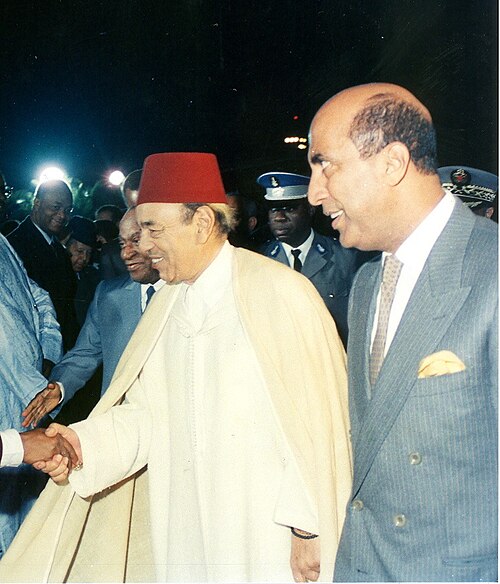
March 1, 1961: Peace Corps established by U.S. President KennedyMarch 3, 1961: Hassan II becomes new King of MoroccoMarch 8, 1961: Scotland's Holy Loch begins hosting American nuclear missile submarine
Uganda became self-governing by holding its first general elections a year in advance of full independence. With 90% of the 1.3 million eligible voters participating, the Democratic Party, led by Benedicto Kiwanuka, won 43 of the 81 seats in the National Assembly. The Uganda People's Congress received more votes overall, but won only 35 seats.[1]
Algerian nationalist leader Ferhat Abbas announced in Rabat, Morocco, that the FLN had agreed to French President Charles de Gaulle's proposal to begin peace talks on Algerian independence. By then, the Algerian War was in its seventh year.[3]
At the age of 79, artist Pablo Picasso married 35-year-old Jacqueline Roque. The two would remain together until his death in 1973.[4]
Twenty-two coal miners were killed in an underground explosion at the Viking Coal Company near Terre Haute, Indiana.[5]
Died:Pudge Wyman, 65, American pro football player credited with the first NFL touchdown. Wyman played for the Rock Island Independents in their 45–0 win over the Muncie Flyers on October 3, 1920.
At a press conference at Andrews Air Force Base, spokesmen for the U.S. Air Force Research and Development command announced that they had developed an atomic clock "so accurate that its biggest error would not exceed one second in 1271 years", and, at 62 pounds (28kg), light enough that it could be used on aircraft in place of the existing system of crystal oscillators. Conventional atomic clock units, though more accurate, weighed over 600 pounds (270kg) and were impractical for flight.[18]
The crash of a U.S. Air Force Boeing KB-50 refueling plane killed all ten men on board.[19]
The phrase "affirmative action" was first used to refer to a governmental requirement to promote equal opportunity by giving preferences in order to remedy prior discrimination. President Kennedy used the term with the issuance of Executive Order 10925.[20] The original context was in Section 301 of the order, providing that federal government contracts include a provision that "The contractor will take affirmative action to ensure that applicants are employed, and that employees are treated during employment, without regard to their race, creed, color, or national origin."[21]
The British soap opera Coronation Street was fully networked by ITV, with a new schedule of Monday and Wednesday evenings at 19:30.
The successful test firing of the engines of a Titan I missile, as it stood inside the underground SLTF (Silo Test Launch Facility) at California's Vandenberg Air Force Base, demonstrated that a missile could be successfully and safely fired, before launch, within a missile silo. An actual launch from the silo would not take place until May 3.[23]
Flying a North American X-15 airplane, U.S. Air Force Captain Robert White became the first person to travel faster than Mach 4, reaching Mach 4.43, or 2,650 miles per hour (4,260km/h).[24] White would become the first person to break Mach 5 on June 23, and Mach 6 on November 9.[25]
Redstone launch vehicle number 5 was delivered to Cape Canaveral for the Mercury-Redstone Booster Development flight that would be launched on March 24 as the last space shot before the launch of the first U.S. astronaut, Alan Shepard, on Mercury 3.[9]
Max Conrad, "the Flying Grandfather", circumnavigated the Earth in 8 days, 18 hours and 49 minutes, setting a new world record for a light airplane, breaking the previous mark, set in 1959, of 25 days.[27]
Mercury spacecraft number 10 was accepted and delivered to the McDonnell altitude test facility on March 31, 1961, for an orbital-flight environmental test.[9]
Sputnik 9 was launched by the USSR from Baikonur LC1, carrying "Ivan Ivanovich" (the nickname for a mannequin cosmonaut), the dog Chernushka, some mice, and a guinea pig. The spaceship made several orbits of the Earth at an average altitude of 135 miles (217km), and then was recovered. NASA spokesman George M. Law said that the test showed that the Russians were "about ready to put a man up" into outer space.[28]
An underground fire killed 71 Japanese coal miners at the Ueda Mine Company at Kawara, Fukuoka Prefecture, in Japan's worst coal mine disaster since World War II.[29]
The first definite proof that a signal could be sent to Venus and returned to Earth, using radar astronomy, was made by the Jet Propulsion Laboratory. Transmission was sent from the Goldstone Tracking Station in California at a 2,388 megacycle frequency, traveling 35 million miles to Venus and then back to Earth, in a little more than six minutes. Signals had been bounced off of Venus before, but never received back clearly enough to be "immediately detectable".[30]
Died:Sir Walter Womersley, 1st Baronet, 83, British M.P.; as Minister of Pensions from 1939 to 1945, he was the only British government minister to hold the same post throughout World War II.
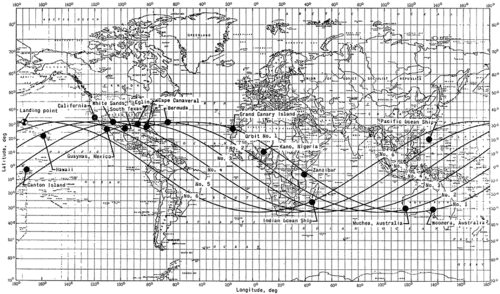
The Space Task Group advised the Goddard Space Flight Center that for all Mercury orbital missions, beginning with Mercury-Atlas 3, trajectory data would be required for postflight analysis.[9]
Mercury spacecraft No. 10 was withdrawn from the flight program and was allocated to a ground test simulating orbital flight environmental conditions at the McDonnell plant site.[9]
Albert DeSalvo was arrested in Cambridge, Massachusetts, while trying to break into a house. Confessing to be a sexual predator who had been nicknamed "the Measuring Man", DeSalvo spent a year in jail. For 18 months following his release, thirteen local women were sexually assaulted and murdered. DeSalvo, arrested later in 1964, confessed to being the "Boston Strangler".[54]
Israel staged a dress rehearsal for a military parade in the Israeli-occupied part of Jerusalem, in which heavy military armament took part. Following a complaint by Jordan about the display of military might, the Mixed Armistice Commission decided that "this act by Israel is a breach of the General Armistice Agreement".
Died:Susanna M. Salter, 101, first woman mayor in the United States; in 1887, she had been elected to a two-year term as mayor of the small town of Argonia, Kansas, after being placed on the ballot as a prank.
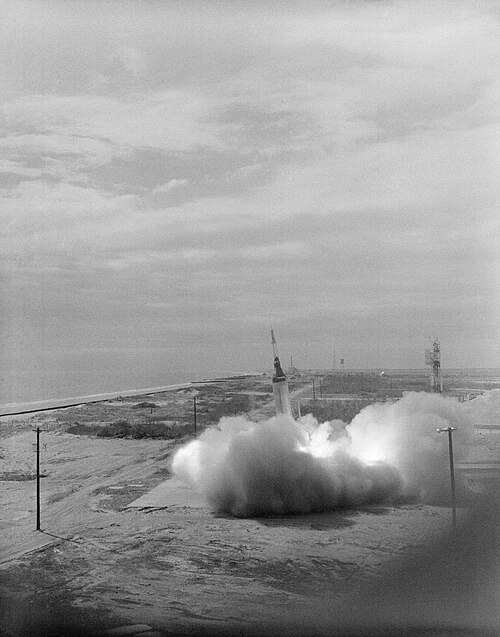
Little Joe 5A, the sixth in the series of Little Joe missions, was launched from Wallops Island to demonstrate the structural integrity of the spacecraft and escape system during an escape maneuver initiated at the highest dynamic pressure anticipated during an Atlas launch for orbital flight. LJ-5A lifted off normally, but 19 seconds later the escape tower fired prematurely, a situation resembling the Little Joe 5 flight in November 1960. The signal to initiate the abort maneuver was given, and the launch vehicle-adapter clamp ring was released, but the spacecraft remained on the launch vehicle since the escape motor was already expended. The separation was effected by using the retrorockets, but this command was transmitted before the flight had reached its apex, where separation had been planned. Therefore, the separation was rather violent. The parachutes deployed at about 40,000 feet (12,000m), and after recovery it was found that the spacecraft had incurred only superficial structural damage. This spacecraft was used for the subsequent Little Joe 5B flight test. Test objectives of LJ-5A were not met.[9]
Tornadoes swept through four districts of East Pakistan (now Bangladesh), killing more than 250 people. The dead included 32 people who had taken refuge in a Catholic church in Dacca after attending Sunday mass.[55]
Died:Ada Cornaro, 79, Argentinian tango dancer and actress
Phase III of testing of the Mercury spacecraft airdrop program was conducted and lasted for four weeks, until April 13. Primary objectives of the drops were to study further the spacecraft suitability and flotation capability after water impact. Six drops were made, but later (April 24–28, 1961) the tests were extended for two additional drops to monitor hard-surface landing effects.[9]
↑ Isserman, Maurice ; Weaver, Stewart (2010). Fallen Giants: A History of Himalayan Mountaineering from the Age of Empire to the Age of Extremes . Yale University Press . p. 352.
↑ヒギンボサム、A. (2019).チェルノブイリの真夜中:世界最大の原子力災害の知られざる物語. ニューヨーク:サイモン&シュスター. p. 416. ISBN9781501134630。
↑ Sawyers, June Skinner 編 (2006). Read the Beatles: Classic and New Writings on the Beatles, Their Legacy, and Why They Still Matter . Penguin . pp. xxi– xxii.