
Loading article…
キングスクロス | |
|---|---|
| ロンドン キングスクロス | |
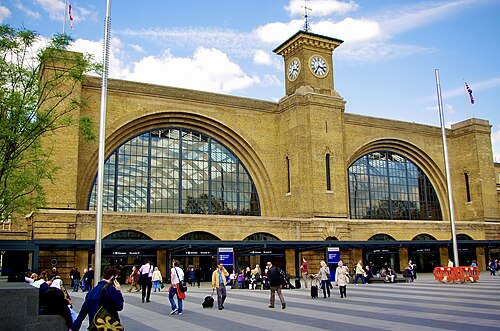 2014年に修復されたキングスクロス駅の正面 | |
  キングスクロス ロンドン中心部のキングスクロスの位置 | |
| 位置 | キングスクロス |
| 地方自治体 | ロンドン・カムデン区 |
| 管理者 | ネットワークレール |
| 所有者 | ネットワークレール |
| 駅コード | KGX、QQK ( IATA ) |
| DfT カテゴリ | あ |
| プラットフォーム数 | 11 (0~10の番号) |
| アクセス可能 | はい |
| 運賃ゾーン | 1 |
| オーエスアイ | キングスクロスセントパンクラス .svg/500px-Underground_(no_text).svg.png) ロンドン セント・パンクラス ロンドン ユーストン .svg/500px-Overground_roundel_(no_text).svg.png) [1] [1] |
| 自転車駐輪場 | はい – プラットフォーム 0、1、8、9、駐車場ラック |
| トイレ設備 | はい |
| ナショナルレールの年間入退社 | |
| 2018–19 |  3464万6千人[2] 3464万6千人[2] |
| – インターチェンジ |  271万1千人[2] 271万1千人[2] |
| 2019–20 | 3253万2千人[2] |
| – インターチェンジ | 241万2千人[2] |
| 2020–21 | 466万8千人[2] |
| – インターチェンジ | 43万[2] |
| 2021–22 | 2047万6千人[2] |
| – インターチェンジ | 142万2千人[2] |
| 2022–23 | 2328万7千人[2] |
| – インターチェンジ | 169万4千人[2] |
| 鉄道会社 | |
| 元の会社 | グレートノーザン鉄道 |
| 事前グループ化 | グレートノーザン鉄道 |
| グループ化後 | ロンドン・アンド・ノース・イースタン鉄道 |
| 重要な日付 | |
| 1852年10月14日 | オープン |
| その他の情報 | |
| 外部リンク |
|
| 座標 | 北緯51度31分51秒 西経0度07分24秒 / 北緯51.5309度 西経0.1233度 / 51.5309; -0.1233 |
 ロンドン交通ポータル ロンドン交通ポータル | |
キングス・クロス駅はロンドン・キングス・クロスとも呼ばれ、ロンドン中心部の端、カムデン・ロンドン特別区にある旅客鉄道のターミナル駅です。ロンドン駅群に属し、英国で最も利用者数の多い駅の1つであり、ヨークシャー・アンド・ザ・ハンバー、イングランド北東部、スコットランドへ向かうイースト・コースト本線の南端です。キングス・クロス駅に隣接しているのは、ヨーロッパ大陸へ向かうユーロスターのロンドン終着駅であるセント・パンクラス・インターナショナルです。両本線駅の下にはロンドン地下鉄のキングス・クロス・セント・パンクラス駅があり、これらを合わせると英国最大かつ最も利用者数の多い交通ハブの1つを形成しています。
駅は1852年、イーストコースト本線を収容するため、グレート・ノーザン鉄道によりロンドン中心部の北端にあるキングス・クロスに開業された。郊外路線に対応するため急速に成長し、19世紀には数回にわたって拡張された。1923年にビッグ・フォー・グループの一員として、ロンドン・アンド・ノース・イースタン鉄道の所有となり、フライング・スコッツマンなどの有名なサービスやマラードなどの機関車が導入された。駅舎は1970年代に再開発され、レイアウトが簡素化されて電化された郊外サービスが提供され、高速インターシティ125の主要ターミナルとなった。2018年現在、キングス・クロスからの長距離列車は、ロンドン・ノース・イースタン鉄道によってエディンバラ・ウェイバリー、リーズ、ニューカッスル まで運行されている。他の長距離列車運行会社には、ハル・トレインズやグランド・セントラルなどがある。さらに、グレート・ノーザン鉄道は、北ロンドン、ハートフォードシャー、ケンブリッジシャー、ノーフォーク周辺で郊外通勤列車を運行しています。 [update]
20世紀後半、駅の周辺はみすぼらしく下品な雰囲気で知られるようになり、その結果、いくつかの映画の舞台として使われました。21世紀には、オリジナルの屋根の修復を含む大規模な再開発が行われ、駅はハリーポッターの本や映画、特に架空のプラットフォーム9との関連でよく知られるようになりました。+3 ⁄ 4。
場所と名前
駅はロンドン内環状道路のユーストン・ロード東端、ペントンビル・ロード、グレイ・イン・ロード、ヨーク・ウェイの交差点の隣、現在のカムデン・ロンドン特別区に位置している。すぐ西、パンクラス・ロードの反対側にはセント・パンクラス鉄道駅がある。[ 3 ] 30、59、73、91、205、390、476を含むいくつかのロンドンバス路線が駅の前または横を通っている。[ 4 ]
King's Crossはアポストロフィの有無にかかわらず綴られる。King 's Crossはネットワークレールとロンドン地下鉄の駅の標識、地下鉄の路線図、ネットワークレールの公式ウェブページで使用されている。[5] Kings Crossはナショナルレールのウェブサイトでも使用されている。[6]アポストロフィは初期の地下鉄の路線図にはほとんど見られなかったが、1951年以降は一貫して使用されている。 [7] Kings X、Kings +、London KXはスペースが限られた文脈で使用される略語である。ナショナルレールの駅コードはKGXである。[8]
駅のレイアウト
駅には現在11のプラットホームがあり、東から西に0番から10番まで番号が付けられている。9番線と10番線は短いプラットホームで、0番から8番線とは分離されている。2021年までは東から西に0番から11番まで番号が付けられた12のプラットホームがあったが、大規模な線路改修に伴い、10番線は使用されなくなり、11番線は10番に再ラベルされた。[9]
歴史
初期の歴史
キングス・クロス地区はかつてバトル・ブリッジという村で、フリート川の古代の渡河地点だった。フリート川はもともとブロード・フォード、後にブラッドフォード・ブリッジと呼ばれていた。川は現在のパンクラス通りの西側を流れていたが、1825年に地下に迂回された。[10]「バトル・ブリッジ」という名前は、ローマ人とブーディカ率いるケルト系ブリテン ・イケニ族との間で大規模な戦いが行われた場所であるという伝説にちなんでいる。民間伝承によると、キングス・クロスはブーディカの最後の戦いの場であり、いくつかの情報源によると彼女はプラットフォームの下に埋葬されているという。[11]プラットフォーム9と10が可能性として挙げられている。[11] [12]ブーディカの幽霊は、プラットフォーム8から10付近の駅の下の通路にも出没すると報告されている。[13]
グレートノーザン鉄道(1850年~1923年)

キングス・クロス駅は、グレート・ノーザン鉄道(GNR)のロンドン終着駅として1851年から1852年にかけて建設され、ロンドンで5番目に建設されたターミナル駅であった。[14]この駅は、1850年にこの路線がロンドンに到着した際に急いで建設されたメイデン・レーン(現在のヨーク・ウェイ)の隣にある仮駅の代わりとなり、 [15] 1850年8月7日に開業した。[16]
駅の名前は、その地域に建てられ、1845年に解体されたジョージ4世の記念碑であるキングスクロスビルに由来している。 [17]建設現場は天然痘病院の跡地であった。
駅の計画は、ロンドン郊外のグレート・ノーザン鉄道の最初の20マイル(32 km)を建設する常駐技師、ジョージ・ターンブルの指揮の下、1848年12月に作成された。 [18] [19]駅の詳細設計は、トーマス・キュービット(ブルームズベリー、ベルグレイヴィア、オズボーン・ハウスの建築家)の兄弟であるルイス・キュービットと、サー・ウィリアム・キュービット( 1851年に建てられた水晶宮の主任技師で、グレート・ノーザン鉄道とサウス・イースタン鉄道の顧問技師であった)によって行われた。設計は、2つの大きなアーチ型の列車庫と、背後のアーチを映すように設計された南端のレンガ造りの構造物から構成されていた。[20]その主な特徴は、高音、中音、低音のベルを備えた高さ112フィート(34 m)の時計塔で、[21]大きさは、1825年に建てられたモスクワ乗馬アカデミーの長さ200ヤード(180メートル)に触発され、[22]建設された全長は268ヤード(245メートル)になりました。[14] [a]
_p138_-_King's_Cross_Station_(plan).jpg/500px-DISTRICT(1888)_p138_-_King's_Cross_Station_(plan).jpg)
当時イギリス最大の駅であったこの駅は、1852年10月14日に開業した。 [14]当初は到着ホームと出発ホームが1つずつあり(現在の1番線と8番線)、その間のスペースは客車の側線として使用されていた。[15]プラットフォームは数回再設計されている。 1972年に1番から8番まで番号が付けられた。[23] 2010年と2021年に駅は再度再構成され、現在は0番から10番まで番号が付けられた11のプラットフォームがある。[24] 1850年にホーンジー、1856年にホロウェイロード、 1859年にウッドグリーン、1861年にセブンシスターズロード(現在のフィンズベリーパーク)の駅が開業し、郊外の交通が急速に増加した。ミッドランド鉄道のヒッチンとベッドフォード経由のレスター行きの列車は、1858年2月1日にキングスクロスから運行を開始した。 [25] 1862年にさらにプラットフォームが追加され、2番はフルレングスであったが、3番は駅の北端に階段状に設けられた。[26] 1866年に、メトロポリタン鉄道を経由してファリンドンでロンドン・チャタム・アンド・ドーバー鉄道に接続され、ハーンヒル経由でサウスロンドンへの貨物および旅客サービスが開始された。[27]メインビルの西側には、1972年時点で9番線から11番線を収容し、当初は「キングス・クロス本線(ローカル)駅」として知られていた別の郊外駅が1875年8月に開業した。その後、1878年2月1日にメトロポリタン線と接続された。 [28]増加する交通需要に対応するため、1893年12月18日に2つのプラットフォーム(現在の5番線と6番線)が開業した。すべてのプラットフォームを接続するために、列車庫の途中に鉄製の歩道橋が建設された。[29] 1880年までに、キングス・クロスの交通の半分は郊外からの交通であった。[30][update]
開業当初の大きなボトルネックとなったのは、駅のすぐ北にあるリージェンツ運河の下にあるガス工場トンネルで、上り線と下り線がそれぞれ1本ずつしかなかった。貨物ヤードに行くには平面線路を横切らなければならなかったため、商業輸送はさらに妨げられていた。[27]貨物輸送の立体交差は1877年8月に開通した斜橋の建設によって実現され、2番目と3番目のガス工場トンネルはそれぞれ1878年と1892年に開通した。[31]
1881年9月15日、駅の北にあるコペンハーゲントンネルの入り口付近で、信号手のミスにより軽機関車と石炭列車が衝突した。1名が死亡、もう1名が重傷を負った。 [32]悪天候によりトンネルが時折浸水した。1901年7月には、駅の運行が4時間以上停止する事故が発生したが、これはロンドンの他のターミナルでは発生しなかった。[33]
第一次世界大戦中、大量の高性能爆薬が旅客列車で駅に運ばれたにもかかわらず、キングス・クロス駅は被害を受けなかった。敵機が上空を飛行する場合に備えて、可能な限り列車はトンネル内に停車した。[34]
ロンドン・アンド・ノース・イースタン鉄道(1923年~1948年)
.jpg/500px-Morning_rush_from_King's_Cross_(CJ_Allen,_Steel_Highway,_1928).jpg)
キングス・クロス駅は、1921年の鉄道法に従ってロンドン・アンド・ノース・イースタン鉄道(LNER)の所有となった。LNERは、現在の8番線ホームの下にあるトイレや更衣室など、さまざまな設備の改善を行った。[35]ガス工場トンネルを通る線路は1922年から1924年の間に改造され、信号システムが改善されたことで、増加するローカル列車の管理が容易になった。[36]
キングス・クロス駅には、エディンバラ行きのフライング・スコッツマンなど、数多くの有名な列車が運行されている。 [37]グレズリーA3と、その後流線型のA4パシフィック蒸気機関車は、1930年代から1966年まで急行列車を運行していた。[38]これらの中で最も有名なのはマラードで、1938年に記録された時速126マイル(203 km/h)という蒸気機関車の世界速度記録を保持している。[39]
キングス・クロス駅は第二次世界大戦中、民間人輸送と並んで多数の兵士の輸送も行っていた。機関車の不足により、列車1本あたり2,000人もの乗客を収容する必要があった。1941年5月11日日曜日の早朝、駅の西側、当時10番線だったプラットホームに1,000ポンド(450kg)の爆弾2発が落下し、プラットホームの新聞列車が損傷、総合事務所、切符売り場、バーが破壊され、屋根の大部分が崩落した。12人が死亡した。[40]
1945年2月4日、リーズとブラッドフォード行きの旅客列車がガスワークストンネルで立ち往生し、引き返して駅で脱線した。2人が死亡、25人が負傷した。運行は2月23日まで完全に復旧しなかった。[41] [42]
イギリス鉄道(1948年~1996年)

1948年1月1日の国有化に伴い、キングス・クロス駅はイギリス国鉄東部地域の管理下に入った。1950年代に蒸気機関車が段階的に廃止された際にディーゼル機関車が導入された。1963年6月までに本線の全列車がディーゼル機関車に切り替えられた。[40]プラットホーム番号は1972年に再編され、1番(東)から14番(西)まで連続して走るようになった。1970年代には、コペンハーゲン・トンネル近くの貨物用の古い高架道路を再利用し、ガス工場のトンネルを通る路線数を6本から4本に減らすことで、線路レイアウトが簡素化された。同時に、グレート・ノーザン郊外電化プロジェクトの一環として、郊外サービスに対応するために25kVの架空線を設置して電化が開始された。[43]工事は1977年4月3日に完了し、キングスクロスからハートフォード、ウェリンガーデンシティ、ロイストンまで電気サービスが開始されました。[44] [45]
ヴィクトリア線の建設とキングスクロス駅での乗り換えは、イギリス国鉄にとって駅を近代化する好機とみなされた。[46]駅の正面には、社内で設計されたメインの旅客用コンコースとチケットオフィスを含む1階建ての増築部分が1972年に建設された。一時的なものだったが、40年後もまだ残っており、グレードIに指定されている元の駅のファサードを覆い隠していた。[47]増築部分が建設される前は、ファサードは小さなショップのテラスの後ろに隠れていた。増築部分は2012年後半に取り壊され、[48]ルイス・キュービットの建築が姿を現した。その場所には75,000平方フィート(7,000 m 2)のキングスクロス広場が作られ、2013年9月26日に一般公開された。[49]
1973年9月10日、IRA暫定派の爆弾が午後12時24分に受付ホールで爆発し、大きな被害と6人の負傷者(重傷者も含む)が出た。重さ3ポンド(1.4キログラム)の爆弾は、群衆の中に逃げ込んだ若者によって警告なしに投げ込まれ、捕まらなかった。[50]
キングスクロス駅はパディントン駅と並んでロンドンのインターシティ125高速列車の終着駅であった。1982年までにキングスクロス駅を出発するほぼすべての長距離列車は125であった。この列車は人気を博し、駅のコンコースには出発する列車に乗るために定期的に列ができていた。[51]
1987年のキングス・クロス火災は、本線駅とロンドン地下鉄ピカデリー線プラットホームを結ぶ木製エスカレーターの機械室で発生した。エスカレーターが燃え、地下鉄駅の大部分が火災に見舞われ、31人が死亡し、煙が本線駅に広がった。[52]
1987年、イギリス鉄道は英仏海峡トンネルを通る国際列車用の4つのプラットフォームと、キングス・クロスの下にテムズリンク列車用の4つのプラットフォームを備えた新しい駅を建設することを提案した。6年間の設計作業の後、計画は放棄され、国際ターミナルはセント・パンクラスに建設された。[30]
イギリス国鉄は1985年から1991年にかけて、イーストコースト本線のリーズとエディンバラまでの電化を完了し、急行列車用に電気式のインターシティ225車両を導入した。この車両は1989年10月2日にキングスクロスとリーズの間で、1991年7月8日にエディンバラまで運行を開始した。[53] [54]
民営化(1996年~現在)

民営化以前、キングスクロス地区は荒廃した建物と正面玄関前の売春で有名だった。1990年代に大規模な清掃が行われ、10年代末までに駅の雰囲気は大幅に改善された。[30]
1996年の英国鉄道の民営化に伴い、駅への急行サービスはグレート・ノース・イースタン鉄道(GNER)に引き継がれた。同社はキングス・クロス駅からの長距離列車に使用されていた英国鉄道マーク4 「マラード」車両を改修し、 2003年には女王とエディンバラ公の臨席のもと、新デザインの列車の運行開始式が行われた。[55]
GNERは2005年にフランチャイズの再入札に成功したが、翌年に返上した。[56] ナショナル・エクスプレス・イーストコーストは、列車が管理契約に基づいて運行される暫定期間の後、2007年後半にフランチャイズを引き継いだ。[57] 2009年、ナショナル・エクスプレスはイーストコーストの子会社に資金を提供する意思がなくなったことが発表され、フランチャイズは国有化され、11月にイーストコーストに引き渡された。 [58] 2015年3月にフランチャイズは再民営化され、ヴァージン・トレインズ・イーストコーストに引き継がれた。[59] 2017年11月、運輸大臣のクリス・グレイリングは、運行会社による路線の損失を受けて、予定より3年早い2020年にイーストコーストのフランチャイズを早期終了すると発表した。ECMLサービスの現在のプロバイダーはロンドン・ノース・イースタン鉄道である。[60] [61]
復元

2005年にネットワークレールが発表した5億ポンドの修復計画は、 2007年にカムデンロンドン自治区議会によって承認されました。 [63]この計画には、元のアーチ型の列車小屋の屋根を修復して再ガラス張りにすること、駅の正面にある1972年の拡張部分を撤去して屋外広場に置き換えることが含まれていました。[62] [64]
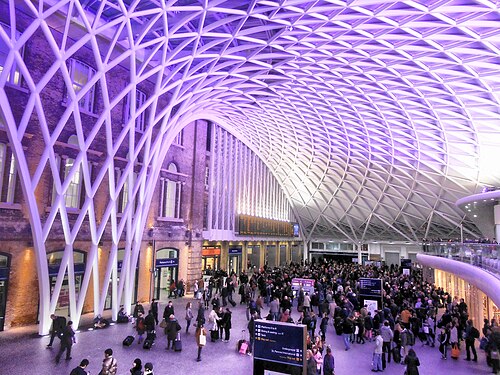
新しい半円形の出発コンコースは2012年3月に一般公開されました。[65] [66]駅の西側、グレートノーザンホテルの裏に位置し、ジョン・マカスランが設計し、ヴィンチの一部であるテイラー・ウッドロー・コンストラクションが施工しました。[67]これにより、大幅に増加する乗客の流れに対応し、駅の都市間、郊外、地下セクション間の統合が強化されます。建築家によると、屋根はヨーロッパで最も長い単一スパンの駅構造であり、半円形の構造は半径59ヤード(54メートル)で、2,000枚を超える三角形の屋根パネルがあり、その半分はガラスです。[62]

キングス・クロス駅とセント・パンクラス駅の間と背後の土地は、キングス・クロス・セントラルとして再開発されており、約2,000戸の新築住宅、5,000,000平方フィート(464,500平方メートル)のオフィス、新しい道路が建設される。[68]修復では、西側で失われたオフィスの代わりに改装されたオフィスが駅の東側にオープンし、その下に0番の新しいプラットフォームが2010年5月20日にオープンした。[69]ディーゼル列車は通常、環境上の理由からこのプラットフォームを使用することはできない。[70]この修復プロジェクトは、 2013年に欧州連合文化遺産賞/ヨーロッパ・ノストラ賞を受賞した。 [71] [72]
2021年10月、ルモはスティーブニッジ、ニューカッスル、モーペス経由でエディンバラ・ウェイヴァリーへの運行を開始した。[73] [74] [75]
改造
2018年1月、駅とそのアプローチの改修工事のため、駅の半分が2020年1月から3月までの3か月間閉鎖されることが発表されました。費用は2億3,700万ポンドと見込まれています。これには、線路の合理化、駅のアプローチへの第3トンネルの再開、および10番線ホームの閉鎖が含まれます。 [76] [77] 2021年6月、ネットワークレールは工事の完了を示すタイムラプスビデオを公開しました。[78]
事故と事件
キングス・クロスでは長年にわたり多くの旅客列車事故が発生している。最も深刻な事故は1945年2月4日のキングス・クロス鉄道事故で2人が死亡、25人が負傷した[41] [42]と、1881年9月15日のガスワークストンネルでの衝突で1人が死亡、もう1人が重傷を負った[32] 。最も最近の事故は2015年9月17日で、旅客列車が緩衝装置に衝突し14人が負傷した。[79] [80]鉄道従業員が死亡または負傷した事故も数多く発生している。[81]
1979年11月5日、マーティン・アレンがキングス・クロス駅で友人たちに別れを告げているところを目撃された。彼はピカデリー線のホームへ向かったが、その後姿を現すことはなかった。 [ 82]この駅は、アンドリュー・ゴスデンが2007年9月14日に行方不明になる前に最後に目撃された場所でもある。彼はドンカスターからこの駅で、物議を醸す不可解な状況下で列車に乗っていた。 [83]
その他の駅
キングスクロスヨークロード

1863年から、キングス・クロスの一部は中間駅だった。敷地の東端にあるキングス・クロス・ヨーク・ロード駅には、フィンズベリー・パークからの郊外列車が停車し、急カーブで勾配の急なヨーク・ロード・トンネルを通って、ファリンドン、バービカン、ムーアゲート行きのシティ・ワイドンド線と合流した。反対方向では、ムーアゲートからの列車はホテル・カーブを経由してワイドンド線から出て、[25]本線レベルまで上がる16番線(後に14番線に改番)に出た。ムーアゲート行きとムーアゲート発の列車は、 1976年11月からノーザン・シティ線経由で迂回された。駅は1977年3月5日に完全に閉鎖されるまで、時折使用された。[84]
グレートノーザン墓地駅
グレートノーザン墓地駅は、ガスワークストンネルの北口のすぐ東に建設され、市とニューサウスゲート墓地を結んでいた。1861年に開業したが、7マイル(11 km)しか走らなかったため利益は出ず、2年後に閉鎖された。[85]
サービス
この駅は、イングランド東部、ヨークシャー、イングランド北東部、スコットランド東部および北部への都市間路線の列車を運行しており、ケンブリッジ、ピーターバラ、ハル、ドンカスター、リーズ、ブラッドフォード、ヨーク、ミドルスブラ、サンダーランド、ニューカッスル、エディンバラ、グラスゴー、アバディーン、インヴァネスなどの主要都市や町とつながっています。2018年6月以降、これらの主要路線はステージコーチとヴァージンから引き継いで政府の管理下にあります。[86]
鉄道サービス
キングス クロスからは 5 つの鉄道運行会社(TOC) が運行しています。
ロンドン・ノース・イースタン鉄道
ロンドン・ノース・イースタン鉄道はイースト・コースト本線に沿って高速都市間サービスを運行している。[87]標準的なオフピークサービスのパターンは以下のとおりである。
- リンカーンまたはヨーク行き1tph (交互)
- リーズまで2tph 、そのうち1tp2hはウェスト・ヨークシャーまで延長されます。
- ニューカッスル経由でエディンバラ・ウェイバリーまで1tph(高速サービス)
- エディンバラ・ウェイバリーまたはニューカッスル行きの1tph(準高速サービス)で、途中のほとんどの駅に停車します。
ゴヴィア・テムズリンク鉄道
ゴヴィア・テムズリンク鉄道は、テムズリンクとグレートノーザンのブランドで、北ロンドン、ハートフォードシャー、ケンブリッジシャー、西ノーフォークへの郊外サービスを運営しています。[88]
- レッチワース・ガーデンシティまで2tph 、ケンブリッジまで1tph延長
ピーク時はスティーブニッジ経由でピーターバラまで2tph (急行サービス)
ハル・トレインズ
ハル・トレインズは、イースト・コースト本線を経由して、ハル行きの都市間列車を平日1日5本、ビバリー行きの都市間列車を平日1日2本運行している。[ 89 ]ファーストグループの他の鉄道会社とは異なり、ハル・トレインズはオープンアクセス契約に基づいて運行しており、フランチャイズTOCではない。[90]
グランドセントラル
Grand Central operates inter-city services to Bradford Interchange and Sunderland along the East Coast Main Line and is an open-access operator. On 23 May 2010, it began services to Bradford Interchange via Halifax, Brighouse, Mirfield, Wakefield, Pontefract and Doncaster[91] The service had originally been due to begin in December 2009.[92][93]
On Monday–Friday, there are four trains per day to Bradford Interchange (of which two will call at Pontefract Monkhill) and five trains per day to Sunderland.
Lumo
Lumo, another FirstGroup open access operator, operates five services per day to Edinburgh via Newcastle and Morpeth. Two of the daily services also call to pick up passengers at Stevenage.[94]
Routes
London Underground station

King's Cross station shares a London Underground station with neighbouring St Pancras station. King's Cross St Pancras tube station is served by more lines than any other station on the London Underground. In 2023, King's Cross St Pancras was the most used station on the system, with 72.12 million passengers entering and exiting the station.[95] It is in Travelcard Zone 1 and caters for both King's Cross and the neighbouring St Pancras railway station.
The station opened as part of the first section of Metropolitan Railway project on 10 January 1863; the first part of the Underground to open.[96][97] A separate station for the Great Northern, Piccadilly and Brompton Railway (now the Piccadilly line) opened on 15 December 1906,[97][98] with the City & South London Railway (now the Northern line) opening on 12 May 1907.[97][99] The Metropolitan line platforms were moved to their current location in 1941.[97]
The Victoria line platforms were opened on 1 December 1968.[97][100] A major expansion to accommodate High Speed 1 at St Pancras opened in November 2009.[101]
In popular culture
In fiction
The station is mentioned in Chapter 2 of E.M. Forster's 1910 novel Howards End, where it suggests "infinity" to the eldest Schlegel daughter, Margaret, and contrasted with the "facile splendours" of St. Pancras.[102] In the Reverend Wilbert Awdry's 1957 children's book The Eight Famous Engines, Gordon the Big Engine undertakes a journey to London, hoping to reach King's Cross, but ends up at St Pancras instead.[103]
In the 1994 children's book The Secret of Platform 13 by Eva Ibbotson. Platform 13 of King's Cross Station in London has been closed for years. Changes to the platform always result in failure for mysterious reasons. The reason is that the platform hides a gump, described as an "opening that opens once every nine years for nine days". The gump leads to the Island, a wonderful mythical paradise filled with both normal and magical creatures.

King's Cross features in the Harry Potter books, by J. K. Rowling, as the starting point of the Hogwarts Express. The train uses a secret Platform 9+3⁄4 accessed through the brick wall barrier between platforms 9 and 10.[104] In fact, platforms 9 and 10 are in a separate building from the main station and are separated by two intervening tracks.[105] Instead, the brick roof-support arches between platforms 4 and 5 were redressed by the film crew and used to represent a brick wall that does not exist between the real platforms 9 and 10.[106]
Within King's Cross, a cast-iron "Platform 9+3⁄4" plaque was erected in 1999, initially in a passageway connecting the main station to the platform 9–11 annexe. Part of a luggage trolley was installed below the sign: the near end of the trolley was visible, but the rest had disappeared into the wall. The location quickly became a popular tourist spot amongst Harry Potter fans.[107] The sign and a revamped trolley, complete with luggage and bird cage, were relocated in 2012, following the development of the new concourse building, and are now sited next to a Harry Potter merchandise shop. Because of the temporary buildings obscuring the façade of the real King's Cross station until 2012, the Harry Potter films showed St. Pancras in exterior station shots instead.[107]
When The Wizarding World of Harry Potter at Universal Orlando Resort expanded to Universal Studios Florida, the Wizarding Worlds in both Diagon Alley at Universal Studios Florida and Hogsmeade at Universal's Islands of Adventure were connected with the Hogwarts Express.[108][109] The Universal Studios Florida station is based on King's Cross station and Platform 9+3⁄4, including a quarter-scale replica of the façade of King's Cross as the entrance to the station and it was opened on 8 July 2014 alongside Harry Potter and the Escape from Gringotts replacing the Jaws ride and the Amity Island themed area based on the Jaws franchise which was permanently closed on 2 January 2012.[110]
In film
The station, its surrounding streets and the railway approach feature prominently in the 1955 Ealing comedy film The Ladykillers.[111] In the story, a gang robs a security van near the station after planning in a house overlooking the railway. When they fall out, members of the gang are dropped into passing goods wagons from the parapet of the Copenhagen Tunnel north of the station.[112]
The 1986 crime drama film Mona Lisa is set around King's Cross. At the time, the downmarket and seedy area surrounding the station, coupled with urban decay, made it an ideal location. Subsequent early 1990s tabloid coverage of crime and prostitution around King's Cross referred back to the film.[113]
Pet Shop Boys released a song titled "King's Cross" on the 1987 album Actually and the station was extensively filmed in for the group's 1988 feature film It Couldn't Happen Here. The band's singer Neil Tennant said that the station was a recognisable landmark coming into London, attempting to find opportunities away from the high unemployment areas of Northeast England at the time. The song was primarily about "hopes being dashed" and "an epic nightmare".[114] The group subsequently asked filmmaker Derek Jarman to direct a background video for "King's Cross" for their 1989 tour, which featured a black and white sequence of juddery camera movements around the local area.[115] Despite the song's reference to "dead and wounded on either side", it was actually released a few months before the King's Cross fire.
Monopoly
King's Cross station is a square on the British Monopoly board. The other three stations in the game are Marylebone, Fenchurch Street and Liverpool Street, and all four were LNER termini at the time the game was being designed for the British market in the mid-1930s.[116]
References
Notes
- ^ Lewis Cubitt was also responsible for the design of the Great Northern Hotel (see below).
Citations
- ^ "Out of Station Interchanges" (XLSX). Transport for London. 16 June 2020. Retrieved 5 November 2020.
- ^ a b c d e f g h i j "Estimates of station usage". Rail statistics. Office of Rail Regulation. Please note: Some methodology may vary year on year.
- ^ "King's Cross Station". Google Maps. Archived from the original on 24 October 2019. Retrieved 25 March 2017.
- ^ "Central London Bus Map" (PDF). Transport for London. Archived from the original (PDF) on 13 March 2017. Retrieved 6 March 2017.
- ^ "London King's Cross". Network Rail. Retrieved 1 April 2024.
- ^ "London Kings Cross (KGX)". National Rail. Retrieved 31 March 2024.
- ^ Badsey-Ellis, Antony (November 2008). "The Underground and the apostrophe" (PDF). Underground News. London Underground Railway Society. Archived from the original (PDF) on 4 March 2016. Retrieved 21 February 2014.
- ^ "National Rail station codes CSV". Archived from the original on 6 November 2021. Retrieved 29 July 2015.
- ^ Buddoo, Nadine (29 June 2021). "Future of Rail | How engineers uncrossed the track at King's Cross". New Civil Engineer. Retrieved 15 December 2023.
- ^ Walter H Godfrey; W McB. Marcham, eds. (1952). Survey of London: Battle Bridge Estate. Vol. 24, the Parish of St Pancras Part 4: King's Cross Neighbourhood. London: London County Council. pp. 102–113. Retrieved 27 January 2017.
- ^ a b "Dig uncovers Boudicca's brutal streak". The Observer. 3 December 2000. Retrieved 27 January 2017.
- ^ "Historical Notes: Boadicea's bones under Platform 10". The Independent. 14 July 1999. Retrieved 27 January 2017.
- ^ Johnson, Marguerite (2012). Boudicca. A&C Black. ISBN 978-1-853-99732-7.
- ^ a b c Weinreb et al. 2010, p. 463.
- ^ a b Jackson 1984, p. 76.
- ^ Butt, R.V.J. (1995). The Directory of Railway Stations. Yeovil: Patrick Stephens. p. 134. ISBN 1-85260-508-1. R508.
- ^ Thornbury, Walter (1878). "Highbury, Upper Holloway and King's Cross". Old and New London. 2. London: 273–279. Retrieved 5 January 2017.
- ^ Diaries of George Turnbull (Chief Engineer, East Indian Railway Company) held at the Centre of South Asian Studies at Cambridge University, England.
- ^ Page 87 of George Turnbull, C.E. 437-page memoirs published privately 1893, scanned copy held in the British Library, London on compact disk since 2007.
- ^ Jackson 1984, pp. 76–77.
- ^ Jackson 1984, p. 77.
- ^ Young, John (1977). Great Northern suburban. David & Charles. p. 15. ISBN 978-0-715-37477-1.
- ^ "History – King's Cross station". Network Rail. Archived from the original on 6 January 2017. Retrieved 5 January 2017.
- ^ "Why is there a platform 0 at King's Cross". Londonist. June 2016. Archived from the original on 1 January 2020. Retrieved 12 May 2020.
- ^ a b Jackson 1984, p. 78.
- ^ Jackson 1984, pp. 78–79.
- ^ a b Jackson 1984, p. 79.
- ^ Jackson 1984, p. 80.
- ^ Jackson 1984, p. 84.
- ^ a b c Simmons & Biddle 1997, p. 290.
- ^ Jackson 1984, pp. 81, 83.
- ^ a b "Inquests". The Times. No. 30305. London. 21 September 1881. col D, p. 10.
- ^ Jackson 1984, p. 83.
- ^ Jackson 1984, p. 87-8.
- ^ Jackson 1984, p. 89.
- ^ Jackson 1984, p. 88.
- ^ Christopher 2013, p. 47.
- ^ Sharpe 2009, p. 73.
- ^ Sharpe 2009, p. 57.
- ^ a b Jackson 1984, p. 90.
- ^ a b "Report on the Accident at King's Cross on 4th February 1945". Railways Archive. Retrieved 17 September 2015.
- ^ a b Jackson 1984, p. 93.
- ^ "Your NEW Electric Railway, The Great Northern Suburban Electrification" (PDF). British Railways. 1973. Archived (PDF) from the original on 9 October 2022. Retrieved 18 March 2014.
- ^ Jackson 1984, pp. 348–349.
- ^ Gourvish & Anson 2004, p. 93.
- ^ Jackson 1984, p. 91.
- ^ Historic England. "Kings Cross Station (Grade I) (1078328)". National Heritage List for England. Retrieved 27 January 2015.
- ^ Johnson, Marc (12 November 2012). "King's Cross 'temporary' extension torn down after 40 years". Rail.co. Retrieved 30 December 2012.
- ^ "King's Cross Square opens to the public". BBC News. Retrieved 27 September 2013.
- ^ "On This Day: 10 September 1973: Bomb blasts rock Central London". BBC News. Retrieved 27 February 2007.
- ^ Jackson 1984, p. 350.
- ^ "On This Day: 18 November 1987: King's Cross station fire 'kills 27'". BBC News. Retrieved 1 April 2012.
- ^ Shirres, David. "ECML: Electrification as it used to be". Rail Engineer. Archived from the original on 11 January 2018. Retrieved 10 January 2018.
- ^ "Back to the future as history made with east coast rail icons". National Railway Museum. Retrieved 10 January 2018.
- ^ Memorandum by Great North Eastern Railway (GNER) (FOR 115) (Report). GNER. October 2003. Retrieved 19 January 2017.
- ^ "GNER to surrender top train route". BBC News. 15 December 2006. Retrieved 18 October 2012.
- ^ "National Express wins rail route". BBC News. 14 August 2007. Retrieved 1 July 2009.
- ^ "East Coast rail change confirmed". BBC News. 5 November 2009. Retrieved 6 December 2023.
- ^ "Stagecoach and Virgin win East Coast mainline (ECML) rail franchise". BBC News. 27 November 2014. Retrieved 11 January 2018.
- ^ Elder, Bryce (29 November 2017). "Stagecoach soars after government intervenes on contract". Financial Times. Archived from the original on 10 December 2022. Retrieved 2 December 2017.
- ^ Topham, Gwyn (29 November 2017). "East Coast rail 'bailout' could cost taxpayers hundreds of millions". The Guardian. Retrieved 2 December 2017.
- ^ a b c Long, Kieran (14 March 2012). "All change at King's Cross". Evening Standard. p. 34.
- ^ "Planning Application – 2006/3387/P". London Borough of Camden. Archived from the original on 7 October 2011. Retrieved 10 August 2011.
- ^ "Network Rail unveils look for King's Cross square". Rail. Peterborough. 10 August 2011. p. 14.
- ^ Silvester, Katie (14 March 2012). "New concourse set to open at King's Cross". Rail Professional.
- ^ "What's changing at King's Cross?". Network Rail. 2012.
- ^ "London King's Cross western concourse opens". Railway Gazette International. London. 19 March 2012. Archived from the original on 22 March 2012. Retrieved 1 April 2012.
- ^ "Kings Cross place plan". London Borough of Camden. Retrieved 20 January 2017.
- ^ "Zero Hour for King's Cross as transport Secretary Opens New Platform 0". Network Rail. Retrieved 20 January 2017.
- ^ Marsh, Phil (July 2010). Pigott, Nick (ed.). "King's Cross Platform Zero opens". The Railway Magazine. 156 (1311). London: 7. ISSN 0033-8923.
- ^ "Awards". Europa Nostra.
- ^ "Winners of 2013 EU Prize for Cultural Heritage / Europa Nostra Awards announced" (Press release). European Commission.
- ^ Applications for the East Coast Main Line Office of Rail & Road 12 May 2016
- ^ First Group to run Edinburgh to London budget rail service BBC News 12 May 2016
- ^ VTEC and FirstGroup granted East Coast Main Line paths Archived 12 December 2017 at the Wayback Machine Railway Gazette International 12 May 2016
- ^ "Exclusive: Plans unveiled for £237m King's Cross remodelling". Rail Magazine (843): 6. 3 January 2018. Retrieved 5 January 2018.
- ^ Buddoo, Nadine (29 June 2021). "Future of rail: how engineers uncrossed the track at King's Cross". New Civil Engineer. London. Retrieved 19 August 2023.
- ^ "Morgan Sindall/Network Rail: Kings Cross - Worker Safety and Time Lapse Video". WCCTV.
- ^ "Govia Thameslink King's Cross rail crash: Five hurt". BBC News. 17 September 2015. Retrieved 17 September 2015.
- ^ "Collision with buffer stops at King's Cross 17 September 2015" (PDF). Rail Accident Investigation Branch. 4 August 2016. Archived (PDF) from the original on 9 October 2022.
- ^ "King's Cross accidents". Railway Work, Life & Death. 10 October 2022. Retrieved 12 March 2024.
- ^ "Martin Allen mystery: how case of London teenager missing for 35 years". Evening Standard. 14 May 2015. Retrieved 24 February 2019.
- ^ Clifton, Jamie; McMahon, James (30 August 2018). "The Strange Disappearance of Andrew Gosden". Vice. Retrieved 24 February 2019.
- ^ Jackson 1984, p. 348.
- ^ Parsons, Brian (2018). The Evolution of the British Funeral Industry in the 20th Century. Emerald Publishing Limited. p. 109. ISBN 978-1-787-43630-5.
- ^ "East Coast train line back under public control". BBC News. 23 June 2018. Retrieved 24 June 2018.
- ^ "Timetables". London: London North Eastern Railway. Retrieved 24 June 2018.
- ^ "Latest train timetables". First Capital Connect. Archived from the original on 4 August 2014. Retrieved 26 March 2013.
- ^ "Hull Trains timetable" (PDF).
- ^ "London King's Cross Station". Hull Trains. Retrieved 6 March 2017.
- ^ "Grand Central launches West Riding service". Modern Railways. London. June 2010. p. 7.
- ^ Drury, Colin (19 August 2009). "London rail link blow: Service will be delayed until May". Halifax Evening Courier. Archived from the original on 22 August 2009. Retrieved 21 August 2009.
- ^ "Next stop – Mirfield". York: Grand Central. 2011. Archived from the original on 10 January 2012. Retrieved 18 December 2011.
- ^ "Our Timetable". Lumo. 2022. Retrieved 9 February 2022.
- ^ "Station Usage Data" (XLSX). Usage Statistics for London Stations, 2021. Transport for London. 12 July 2022. Retrieved 7 September 2022.
- ^ Day & Reed 2008, p. 14.
- ^ a b c d e Rose 2016.
- ^ Wolmar 2004, p. 181.
- ^ Day & Reed 2008, p. 47.
- ^ Menear 1983, p. 112.
- ^ "King's Cross St. Pancras Tube station doubles in size as state-of-the-art ticket hall opens". Transport for London. 27 November 2009. Retrieved 12 March 2017.
- ^ "E.M. Forster's draft of Howards End". British Library. Archived from the original on 16 March 2017. Retrieved 15 March 2017.
- ^ Awdry, Rev. W. (1957). The Eight Famous Engines. Kaye and Ward.
- ^ "Platform 93/4 at King's Cross Station". King's Cross (official website). Archived from the original on 2 February 2018. Retrieved 25 January 2017.
- ^ "King's Cross – Station Guide" (PDF). Network Rail. Archived from the original (PDF) on 5 February 2009. Retrieved 3 May 2009.
- ^ "Harry Potter London locations". The Magician. Archived from the original on 7 February 2018. Retrieved 24 October 2018.
- ^ a b "London's 18 Most Magical Harry Potter Sites". MSN.
- ^ Hill, Jim (14 March 2014). "Universal Orlando Will Use Lifelike Animation and Live Special Effects to Recreate Harry Potter's journey aboard the Hogwarts Express". Huffington Post.
- ^ MacDonald, Brady (30 May 2014). "A double dose of Harry Potter coming to Universal Orlando". Los Angeles Times.
- ^ Veness, Simon (19 June 2014). "Inside Harry Potter's Diagon Alley, Universal Studios". The Telegraph. London. Archived from the original on 27 July 2015. Retrieved 2 July 2015.
a one-fourth scale replica of King's Cross station
- ^ Martin, Andrew (2014). Belles and Whistles: Journeys Through Time on Britain's Trains. Profile Books. p. 173. ISBN 978-1-782-83025-2.
- ^ Glinert, Ed (2012). The London Compendium. Penguin. p. 882. ISBN 978-0-718-19204-4.
- ^ Campkin 2013, p. 112.
- ^ Campkin 2013, p. 84.
- ^ Campkin 2013, p. 85.
- ^ Moore 2003, p. 159.
Sources
- "Stations Run by Network Rail". Network Rail. Retrieved 23 August 2009.
- "London Kings Cross (KGX)". National Rail Enquiries. National Rail. Retrieved 31 January 2016.
- Campkin, Ben (2013). Remaking London: Decline and Regeneration in Urban Culture. I.B.Tauris. ISBN 978-0-857-73416-7.
- Christopher, John (2013). King's Cross Station Through Time. Amberley Publishing. ISBN 978-1-445-62359-7.
- Day, John R.; Reed, John (2008) [1963]. The Story of London's Underground (10th ed.). Capital Transport. ISBN 978-1-85414-316-7.
- Gourvish, Terry; Anson, Mike (2004). British Rail 1974–1997 : From Integration to Privatisation. Oxford University Press. ISBN 978-0-19926-909-9.
- Jackson, Alan A. (1984) [1969]. London's Termini. London: David & Charles. ISBN 0-330-02747-6.
- Menear, Laurence (1983). London's underground stations: a social and architectural study. Midas. ISBN 978-0-859-36124-8.
- Moore, Tim (2003). Do Not Pass Go. Vintage. ISBN 978-0-099-43386-6.
- Rose, Douglas (2016) [1980]. The London Underground, A Diagrammatic History (9th ed.). Douglas Rose/Capital Transport. ISBN 978-1-85414-404-1.
- Sharpe, Brian (2009). The Flying Scotsman: The Legend Lives on. Casemate Publishers. ISBN 978-1-845-63090-4.
- Simmons, Jack; Biddle, Gordon (1997). The Oxford Companion to British Railway History. Oxford University Press. ISBN 978-019-211697-0.
- Weinreb, Ben; Hibbert, Christopher; Keay, Julia; Keay, John (2010). The London Encyclopedia. Pan MacMillan. ISBN 978-1-4050-4924-5.
- Wolmar, Christian (2004). The Subterranean Railway: How the London Underground Was Built and How It Changed the City Forever. Atlantic Books. ISBN 1-84354-023-1.
External links
- History of Kings Cross, at the LNER Encyclopedia
- Pictures of the new concourse opened in March 2012 (Evening Standard website)
- "Article on new colour light signals, 1933". NZETC. 1933.
Video links

Wikimedia Commons has media related to London King's Cross railway station.
- 1935, Demonstration run of 'Silver Jubilee' to Grantham
- 1944, Retirement of driver Duddington Archived 19 January 2013 at archive.today
- 1938, Stirling Single special train