
Loading article…

ガズィ(またはgazi / ˈ ɡ æ z i / ;アラビア語: غازي ghāzī [ ɣaːˈziː ]、pl. ghuzāt ) は、ガズワ( غَزْو [ ɣazw ] ) - 「カーフィール」とみなした人々に対する軍事遠征または襲撃に参加した個人です。初期のイスラム文学は、イスラムの預言者ムハンマドが率いる遠征隊をガズワとして特徴づけています。後に、トルコ軍の指揮官たちは征服戦争を指すためにこの言葉を使用しました。[ 1 ]
ロシアとコーカサスのイスラム教徒との間の戦争の文脈では、1785年から1791年にかけてのシェイク・マンスールによるロシアの拡張に対する抵抗から始まり、 ghazwaという言葉は通常gazavat(ロシア語:газават )の形で現れる。[ 2 ]
英語圏の文学では、 ghazwという単語はしばしば「razzia」と表記されるが、これはマグレブ・アラビア語からフランス語を経由して借用されたものである。
現代トルコ語では、 gaziという言葉は退役軍人を指すほか、(称号として)エルトゥールル(エルトゥールル・ガーズィー)やオスマン1世(オスマン・ガーズィー)などのトルコ系イスラム教徒の英雄を指す。[ 3 ] [ 4 ]
イスラム以前のベドウィン文化では、ガズワ[a]は、正面衝突を避け、略奪や襲撃、通常は家畜の略奪を重視する、盗賊行為に近い限定的な戦争形態でした(家畜略奪を参照)。ウマイヤ朝時代のベドウィン詩人アル=クタミは、よく引用される詩句を書いています。「我々の仕事は、敵、隣人、そして兄弟を襲撃することである。もし襲撃する相手が兄弟以外に見つからない場合は。」[ 5 ] [ 6 ]ウィリアム・モンゴメリー・ワットは、ムハンマドがこの絶え間ない内戦を敵に向けることが有益だと考え、それを戦争戦略の基礎としたと仮説を立てました。 [ 7 ]ワットによれば、有名なバドルの戦いは、そのようなラッジアの1つとして始まりました。[ 8 ]戦争の一形態として、ラッツィアはイベリアのキリスト教国がタイファ諸国との関係において模倣した。[ 9 ]おおよその同義語および類似の戦術は、イベリアのカヴァルガダと英仏のシュヴォーシェである。[ 10 ]
razziaという言葉は、フランス植民地時代には特に西アフリカや中央アフリカの人々から略奪や奴隷化を行う襲撃を指す言葉として使われ、トゥアレグ族が行っていた場合はrezzouとも呼ばれていました。この言葉はアルジェリア・アラビア語のġaziyaから借用され、後に略奪行為全般を指す比喩的な言葉となり、動詞形はrazzierとなりました。[ 11 ]

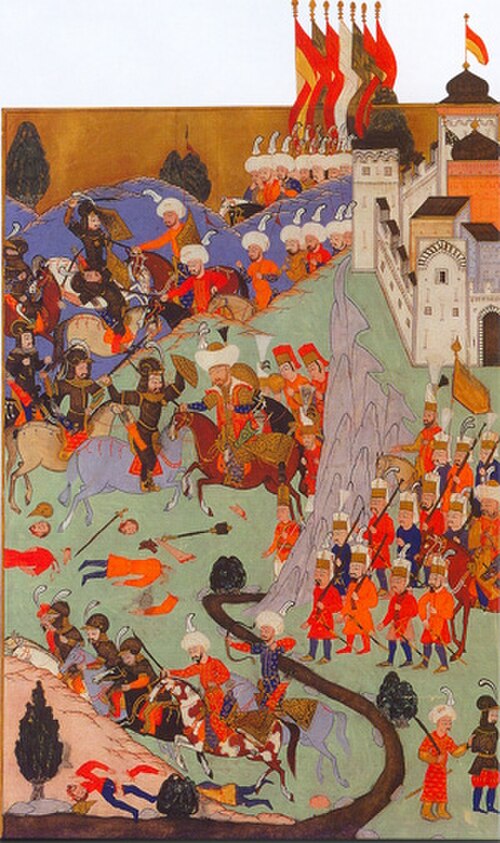
Ghazi (Arabic: غازي, ġāzī) is an Arabic word, the active participle of the verb ġazā, meaning 'to carry out a military expedition or raid'; the same verb can also mean 'to strive for' and Ghazi can thus share a similar meaning to Mujahid or "one who struggles". The verbal noun of ġazā is ġazw or ġazawān, with the meaning 'raiding'. A derived singulative in ġazwah refers to a single battle or raid. The term ghāzī dates to at least the Samanid period, where he appears as a mercenary and frontier fighter in Khorasan and Transoxiana. Later, up to 20,000 of them took part in the Indian campaigns of Mahmud of Ghazni.
Ghāzī warriors depended upon plunder for their livelihood, and were prone to brigandage and sedition in times of peace. The corporations into which they organized themselves attracted adventurers, zealots and religious and political dissidents of all ethnicities. In time, though, soldiers of Turkic ethnicity predominated, mirroring the acquisition of Mamluks, Turkic ghilman in the Mamluk retinues and guard corps of the caliphs and emirs and in the ranks of the ghazi corporation, some of whom would ultimately rise to military and later political dominance in various Muslim states.
In the west, Turkic ghāzīs made continual incursions along the Byzantine frontier zone, finding in the akritai (akritoi) their Greek counterparts. After the Battle of Manzikert these incursions intensified, and the region's people would see the ghāzī corporations coalesce into semi-chivalric fraternities, with the white cap and the club as their emblems. The height of the organizations would come during the Mongol conquest when many of them fled from Persia and Turkistan into Anatolia.
As organizations, the ghazi corporations were fluid, reflecting their popular character, and individual ghāzī warriors would jump between them depending upon the prestige and success of a particular emir, rather like the mercenary bands around western condottiere. It was from these Anatolian territories conquered during the ghazw that the Ottoman Empire emerged, and in its legendary traditions it is said that its founder, Osman I, came forward as a ghāzī thanks to the inspiration of Shaikh Ede Bali.
In later periods of Islamic history the honorific title of ghāzī was assumed by those Muslim rulers who showed conspicuous success in extending the domains of Islam, and eventually the honorific became exclusive to them, much as the Roman title imperator became the exclusive property of the supreme ruler of the Roman state and his family.
The Ottomans were probably the first to adopt this practice, and in any case the institution of ghazw reaches back to the beginnings of their state:
Ottoman historian Ahmedi in his work explain the meaning of Ghazi:[13]
A Ghazi is the instrument of the religion of Allah, a servant of God who purifies the earth from the filth of polytheism. The Ghazi is the sword of God, he is the protector and the refuge of the believers. If he becomes a martyr in the ways of God, do not believe that he has died, he lives in beatitude with Allah, he has eternal life.
The first nine Ottoman chiefs all used Ghazi as part of their full throne name (as with many other titles, the nomination was added even though it did not fit the office), and often afterwards. However, it never became a formal title within the ruler's formal style, unlike Sultan ul-Mujahidin, used by Sultan Murad Khan II Khoja-Ghazi, 6th Sovereign of the House of Osman (1421–1451), styled 'Abu'l Hayrat, Sultan ul-Mujahidin, Khan of Khans, Grand Sultan of Anatolia and Rumelia, and of the Cities of Adrianople and Philippolis.
Because of the political legitimacy that would accrue to those bearing this title, Muslim rulers vied amongst themselves for preeminence in the ghāziya, with the Ottoman Sultans generally acknowledged as excelling all others in this feat:
Ghazi was also used as a title of honor in the Ottoman Empire, generally translated as the Victorious, for military officers of high rank, who distinguished themselves in the field against non-Moslem enemies; thus it was conferred on Osman Pasha after his famous defence of Plevna in Bulgaria[14] and on Mustafa Kemal Pasha (later known as Atatürk) for leading the victory in the Battle of the Sakarya.[15]
Some Muslim rulers (in Afghanistan) personally used the subsidiary style Padshah-i-Ghazi.
Ghazwah, which literally means "campaigns", is typically used by biographers to refer to all the Prophet's journeys from Medina, whether to make peace treaties and preach Islam to the tribes, to go on ʽumrah, to pursue enemies who attacked Medina, or to engage in the nine battles.[16]
Muhammad participated in 27 Ghazwa. The first Ghazwa he participated in was the Invasion of Waddan in August 623,[17][18] he ordered his followers to attack a Quraysh caravan.[17]
When performed within the context of Islamic warfare, the ghazw's function was to weaken the enemy's defenses in preparation for his eventual conquest and subjugation. Because the typical ghazw raiding party often did not have the size or strength to seize military or territorial objectives, this usually meant sudden attacks on weakly defended targets (e.g. villages) with the intent of demoralizing the enemy and destroying material which could support their military forces. Though Islam's rules of warfare offered protection to non-combatants such as women, monastics and peasants in that they could not be slain, their property could still be looted or destroyed, and they themselves could be abducted and enslaved (Cambridge History of Islam, p. 269):
A good source on the conduct of the traditional ghazw raid are the medieval Islamic jurists, whose discussions as to which conduct is allowed and which is forbidden in the course of warfare reveal some of the practices of this institution. One such source is Averroes' Bidāyat al-Mujtahid wa-Nihāyat al-Muqtasid (translated in Peters, Jihad in Classical and Modern Islam: A Reader, Chapter 4).
19 世紀、ロシアの軍事作戦に抵抗していた北カフカスのイスラム教徒の戦士たちは、ロシア正教の侵略に対してガザワト(聖戦と理解される)を宣言した。確かなことは分かっていないが、ダゲスタンのイスラム学者ムハンマド・アル=ヤラギがこの聖戦のイデオロギーの提唱者であったと考えられている。1825 年、ヤラグ村のウラマー会議でロシア人に対するガザワトが宣言された。最初の指導者はガジ・ムハンマドで、彼の死後、イマーム・シャミルが最終的にそれを引き継いだ。[ 19 ]
2015年11月のパリ同時多発テロの後、イスラム国は自らの行動を「ガズワ」と呼んだと言われている。[ 20 ]
現代のトルコでは、ガジは退役軍人を指す言葉として使われている。[ 21 ]トルコでは9月19日が退役軍人の日として祝われている。[ 22 ]
ガーズィーという称号を与えられた人物の例としては、以下のような人物が挙げられる。

語で聖戦は
ガザヴァト
と呼ばれ、1700 年代後半のロシアによるチェチェン侵攻は、1 世紀にわたる
ガザヴァト
の始まりとなった。この抵抗闘争はスーフィーの宗教指導者、シェイク、イマームによって率いられ、彼らの戦士部隊はムリドと呼ばれた。
アル・アブワのガズワ* その後、サファールのアル・アブワで、アッラーの使徒のガズワが(起こりました)、アッラーのご加護がありますように(AC623年8月)
ラビー・アル=アウワル月の12日にメディナに到着してから約12か月後、彼はワッダンまで遠征に出かけた。