
Loading article…

Winnie-the-Pooh (also known as Edward Bear, Pooh Bear or simply Pooh) is a fictional anthropomorphicteddy bear created by the English author A. A. Milne and the English illustrator E. H. Shepard. Winnie-the-Pooh first appeared by name in a children's story commissioned by London's Evening News for Christmas Eve 1925. The character is inspired by a stuffed toy that Milne had bought for his son Christopher Robin in Harrods department store, and a bear named Winnie they had viewed at London Zoo.
The first collection of stories about the character is the book Winnie-the-Pooh (1926), and this was followed by The House at Pooh Corner (1928). Milne also included a poem about the bear in the children's verse book When We Were Very Young (1924) and many more in Now We Are Six (1927). All four volumes were illustrated by E. H. Shepard. The stories are set in and around the Hundred Acre Wood, which was inspired by Five Hundred Acre Wood in Ashdown Forest in East Sussex—situated 30 miles (48 km) south of London—where the Londoner Milne's country home was located.
The Pooh stories have been translated into many languages, including Alexander Lenard's Latin translation, Winnie ille Pu, which was first published in 1958 and in 1960 became the only Latin book ever to be featured on The New York Times Best Seller list.[1] The original English manuscripts are held at the Wren Library in Trinity College, Cambridge (Milne's alma mater), to which he had bequeathed the works.[2] The first Pooh book was ranked number 7 on the BBC's The Big Read poll.[3]
1961年、ウォルト・ディズニー・カンパニーは、A・A・ミルンの遺族 とライセンス代理人のスティーブン・スレシンジャー社から、くまのプーさんの物語に関する特定の映画やその他の権利のライセンスを取得し、ハイフンなしの「Winnie the Pooh」という名前でプーさんの物語を映画化し、最終的に同社で最も成功したフランチャイズの一つとなった一連の作品を制作しました。人気の高い映画化作品では、英語ではスターリング・ホロウェイ、ハル・スミス、ジム・カミングス、ロシア語ではエフゲニー・レオーノフがプーさんの声を担当しています。

A.A.ミルンは、息子のクリストファー・ロビン・ミルンが所有していたテディベアにちなんで、キャラクターを「くまのプーさん」と名付けました。クリストファー・ロビンは、この息子をモデルにしたキャラクターです。一方、シェパードは、クリストファー・ロビンのクマではなく、自分の息子の「グラウラー」という名前のテディベアをモデルにプーさんのイラストを描きました。[ 5 ]クリストファー・ミルンの残りのおもちゃ、ピグレット、イーヨー、カンガ、ルー、ティガーは、ミルンの物語に組み込まれました。[ 6 ] [ 7 ]さらに、オウルとラビットという2人のキャラクターは、ミルンの想像力によって作られました。ゴーファーは、ディズニーが制作した映画のために作られました。
1947年、おもちゃはミルンの米国出版社の管理下で米国に渡り、1987年までその出版社が保管していた。その後、出版社はおもちゃをニューヨーク公共図書館に寄贈した。それ以来、おもちゃはニューヨーク市のニューヨーク公共図書館本館に展示されている。[ 8 ] [ 9 ] [ 10 ]

In 1921, Milne bought his son Christopher Robin the toy bear from Harrods department store.[11][12] Christopher Robin had named his toy bear Edward, then Winnie, after a Canadian black bearWinnie that he often saw at London Zoo, and Pooh, a friend's pet swan they had encountered while on holiday.[13][14][15] The bear cub was purchased from a hunter for C$20 by Canadian Lieutenant Harry Colebourn in White River, Ontario, while en route to England during the First World War.[16] Colebourn, a veterinary officer with the Fort Garry Horse cavalry regiment, named the bear Winnie after his adopted hometown in Winnipeg, Manitoba.[17][18] Winnie was surreptitiously brought to England with her owner, and gained unofficial recognition as The Fort Garry Horse regimental mascot. Colebourn left Winnie at the London Zoo while he and his unit were in France; after the war she was officially donated to the zoo, as she had become a much-loved attraction there.[19] Pooh the swan appears as a character in its own right in When We Were Very Young.

In the first chapter of Winnie-the-Pooh, Milne offers this explanation of why Winnie-the-Pooh is often simply known as "Pooh":
But his arms were so stiff … they stayed up straight in the air for more than a week, and whenever a fly came and settled on his nose he had to blow it off. And I think – but I am not sure – that that is why he is always called Pooh.
American writer William Safire surmised that the Milnes' invention of the name "Winnie the Pooh" may have also been influenced by the haughty character Pooh-Bah in Gilbert and Sullivan's The Mikado (1885).[20]
A bronze sculpture of Winnie as a young cub, created by Lorne McKean, was unveiled at London Zoo in September 1981 by Christopher Robin.[21] The skull of Winnie is displayed at the Hunterian Museum in London, the location of anatomical exhibits of the Royal College of Surgeons of England, with a 2015 examination of the skull showing that she suffered from chronic periodontitis, an inflammation and loss of connective tissues supporting or surrounding the teeth, which can be caused by poor diet, such as the honey Christopher Robin spoon fed her.[22]
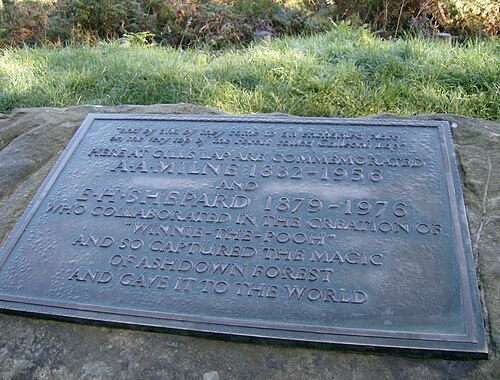
The Winnie-the-Pooh stories are set in Ashdown Forest, East Sussex, England. The forest is an area of tranquil open heathland on the highest sandy ridges of the High Weald Area of Outstanding Natural Beauty situated 30 miles (50 km) south-east of London. In 1925 Milne, a Londoner, bought a country home a mile to the north of the forest at Cotchford Farm, near Hartfield. According to Christopher Robin Milne, while his father continued to live in London "...the four of us – he, his wife, his son and his son's nanny – would pile into a large blue, chauffeur-driven Fiat and travel down every Saturday morning and back again every Monday afternoon. And we would spend a whole glorious month there in the spring and two months in the summer."[23] From the front lawn the family had a view across a meadow to a line of alders that fringed the River Medway, beyond which the ground rose through more trees until finally "above them, in the faraway distance, crowning the view, was a bare hilltop. In the centre of this hilltop was a clump of pines." Most of his father's visits to the forest at that time were, he noted, family expeditions on foot "to make yet another attempt to count the pine trees on Gill's Lap or to search for the marsh gentian". Christopher added that, inspired by Ashdown Forest, his father had made it "the setting for two of his books, finishing the second little over three years after his arrival".[24]
物語に登場する多くの場所は、森の中やその周辺の実際の場所と関連付けることができます。クリストファー・ミルンは自伝の中で「プーさんの森とアッシュダウンの森は同じです」と書いています。例えば、架空の「100エーカーの森」は実際には500エーカーの森でした。ガレオンズ・リープはギルズ・ラップの目立つ丘の頂上から着想を得ており、ギルズ・ラップのすぐ北にある木立は、クリストファー・ロビンの魔法の場所になりました。なぜなら、その円形の木が63本なのか64本なのか、誰も数えることができなかったからです。[ 25 ]
EH シェパードが描いた『クマのプーさん』の挿絵に描かれた風景は、アッシュダウンの森の独特な風景に直接インスピレーションを得たもので、そこにはヒース、エニシダ、ワラビ、シラカバが生い茂る高く開けた荒野が広がり、丘の頂上には松の木が点在している。シェパードの挿絵の多くは実際の風景と一致するため、ある程度の芸術的自由が許されている。シェパードが描いた松の木やその他の森の風景のスケッチは、ロンドンのヴィクトリア・アンド・アルバート博物館に所蔵されている。 [ 26 ]
プースティックスというゲームは、もともとクリストファー・ロビン・ミルンと彼の父親が、コッチフォード農場近くのポージングフォードの森にあるミルブルック川にかかる木製の歩道橋で遊んでいたものです。 [ 27 ] [ 28 ]物語の中で、プーは他のキャラクター、クリストファー・ロビン、ティガー、イーヨーと一緒にこのゲームをします。[ 29 ]この場所は現在観光名所となっており、近くの森で集めた棒を使ってそこでゲームをするのが伝統となっています。[ 27 ] [ 30 ] 1999年に歩道橋を架け替える必要が生じた際、建築家は本に載っているシェパードの図面を主な資料として使用し、元の橋のオリジナルのスタイルを維持しました。[ 31 ]

クリストファー・ロビンのテディベアは、エドワードという名前で、A.A.ミルンの詩「テディベア」の中でキャラクターとして初登場し、1924年2月13日号のパンチ誌に掲載された(E.H.シェパードも前週にパンチ誌に掲載された漫画に同様のクマを登場させていた[ 32 ])。同じ詩は、ミルンの児童詩集『ぼくたちがとても小さかったころ』(1924年11月6日)にも掲載された[ 33 ] 。クマのプーさんは、1925年12月24日、ロンドンの新聞イブニング・ニュースが依頼して掲載したクリスマス物語の中で初めて名前で登場した。イラストはJ.H.ダウドが担当した[ 34 ]。
プーさんの物語の最初のコレクションは、『クマのプーさん』という本に収録されています。イブニング・ニュースのクリスマス物語は、この本の最初の章として再掲載されました。冒頭では、プーさんは実はクリストファー・ロビンのエドワード・ベアで、少年が名前を変えたのだと説明されています。プーさんは、ロンドン動物園のウィニーという名前のアメリカクロクマにちなんで名付けられました。ウィニーという名前は、飼い主がカナダのウィニペグ出身だったことに由来しています。この本は、ミルンの以前の児童書の出版社であるイギリスのメシュエン社、アメリカのEPダットン社、カナダのマクレランド&スチュワート社によって1926年10月に出版されました。[ 35 ]この本は、批評的にも商業的にもすぐに成功を収めました。[ 36 ]児童文学作家で文芸評論家のジョン・ロウ・タウンゼントは、 『クマのプーさん』とその続編『プー横丁の家』を「1920年代のイギリスにおける目覚ましい成功」と評し、その軽快で読みやすい文章を称賛しました。 [ 37 ]
The original drawing of Pooh was based not on Christopher Robin's bear, but on Growler, the teddy bear belonging to Shepard's son Graham, according to James Campbell, husband of Shepard's great-granddaughter. When Campbell took over Shepard's estate in 2010, he discovered many drawings and unpublished writings, including early drawings of Pooh, that had not been seen in decades. Campbell said, "Both he and A. A. Milne realised that Christopher Robin's bear was too gruff-looking, not very cuddly, so they decided they would have to have a different bear for the illustrations."[38] Campbell said Shepard sent Milne a drawing of his son's bear and that Milne "said it was perfect". Campbell also said Shepard's drawings of Christopher Robin were based partly on his own son.[38]

In the Milne books, Pooh is naive and slow-witted, but he is also friendly, thoughtful, and steadfast. Although he and his friends agree that he is "a bear of very little brain", Pooh is occasionally acknowledged to have a clever idea, usually driven by common sense. These include riding in Christopher Robin's umbrella to rescue Piglet from a flood, discovering "the North Pole" by picking it up to help fish Roo out of the river, inventing the game of Poohsticks, and getting Eeyore out of the river by dropping a large rock on one side of him to wash him towards the bank.

Pooh is also a talented poet and the stories are frequently punctuated by his poems and "hums". Although he is humble about his slow-wittedness, he is comfortable with his creative gifts. When Owl's house blows down in a windstorm, trapping Pooh, Piglet and Owl inside, Pooh encourages Piglet (the only one small enough to do so) to escape and rescue them all by promising that "a respectful Pooh song" will be written about Piglet's feat. Later, Pooh muses about the creative process as he composes the song.

プーは食べ物が大好きで、特に蜂蜜(彼は「hunny」と綴ります)が好きですが、練乳やその他の食べ物も大好きです。友達を訪ねると、おやつを勧めてもらいたいという気持ちと、直接的に頼むのは失礼だという気持ちが葛藤します。イーヨーの誕生日に蜂蜜の壺をプレゼントするつもりでしたが、プレゼントを届けに行く途中で蜂蜜を食べてしまい、代わりに「物を入れるのに便利な壺」をイーヨーにプレゼントします。ラビットがティガーを「跳ね返らせないように」している最中に、プーとピグレットが森で迷子になったとき、プーは家から蜂蜜の壺の「呼び声」を頼りに家に帰り着きます。プーは午前11時頃に「ちょっとしたもの」を食べるのが習慣になっています。数週間前に家の時計が「11時5分前で止まってしまった」ので、いつでもプーのおやつタイムになります。
プーはとても社交的です。クリストファー・ロビンの次に一番仲の良い友達はピグレットで、プーはたいていどちらか一方、または両方と時間を過ごします。しかし、プーは他の動物たちのところにも頻繁に訪れ、仲間を求めるだけでなく、おやつや詩の朗読相手を探していることもよくあります。プーは心優しいので、イーヨーに親切にしようとわざわざ出かけ、誕生日プレゼントを持って行ったり、家を建ててあげたりしますが、イーヨーからはほとんど軽蔑されるばかりです。エンターテインメント・ウィークリーのデバン・コガンは、プーとパディントンベアの類似点を「パンツを履いていない、とても礼儀正しいイギリスのクマ2匹」と指摘し、「どちらのクマも優しさと誠実さという哲学を共有している」と付け加えています。[ 39 ]
公認続編『Return to the Hundred Acre Wood』は2009年10月5日に出版された。著者のデイヴィッド・ベネディクタスは、ミルンのキャラクター設定を発展させたが、変更はしていない。マーク・バージェスによるイラストはシェパードのスタイルである。[ 40 ]

Another authorised sequel, Winnie-the-Pooh: The Best Bear in All the World, was published by Egmont in 2016. The sequel consists of four short stories by four leading children's authors, Kate Saunders, Brian Sibley, Paul Bright, and Jeanne Willis. Illustrations are by Mark Burgess.[41]The Best Bear in All The World sees the introduction of a new character, Penguin, which was inspired by a long-lost photograph of Milne and his son Christopher with a toy penguin.[42][43]
In 2016, Winnie-the-Pooh Meets the Queen was published to mark the 90th anniversary of Milne's creation and the 90th birthday of Queen Elizabeth II. It sees Pooh meet the Queen at Buckingham Palace.[44]
In 2021, marking a century since Milne bought the stuffed toy from Harrods department store for his son Christopher Robin that would inspire Milne to create the character, Winnie-the-Pooh: Once There Was a Bear, the first prequel to Milne's books and poetry about the bear, was authorised by the estates of Milne and Shepard.[11] Inspired by the real life of Christopher Robin, it is written by children's writer Jane Riordan in the style of Milne, with illustrations by Mark Burgess emulating the drawings of Shepard.[11] It sees Winnie-the-Pooh exploring Harrods as well as visit London's Natural History Museum and London Zoo, before leaving London and going back to the Hundred Acre Wood.[11]
On 6 January 1930, Stephen Slesinger purchased US and Canadian merchandising, television, recording, and other trade rights to the Winnie-the-Pooh works from Milne for a $1,000 advance and 66% of Slesinger's income.[45] By November 1931, Pooh was a $50 million-a-year business.[46] Slesinger marketed Pooh and his friends for more than 30 years, creating the first Pooh doll, record, board game, puzzle, US radio broadcast (on NBC), animation, and motion picture.[47]
プーさんと仲間たちが初めてカラーで登場したのは1932年で、スレシンジャーがプーさんを今や馴染み深い赤いシャツ姿で描き、RCAビクターのピクチャーレコードに登場した。パーカー・ブラザーズは1933年にAAミルンの「クマのプーさんゲーム」を発表し、ここでもプーさんは赤いシャツを着ていた。1940年代には、アグネス・ブラッシュがプーさんがシャツを着た最初のぬいぐるみを作った。[ 48 ] [ 49 ]

1953年にスレシンジャーが亡くなった後、彼の妻であるシャーリー・スレシンジャー・ラスウェルが自らキャラクターの開発を続けた。1961年、彼女はスティーブン・スレシンジャー社とディズニー社との間の2つの契約のうち最初の契約で、ロイヤリティと引き換えにウォルト・ディズニー・プロダクションズに権利を許諾した。 [ 50 ]同年、AAミルンの未亡人であるダフネ・ミルンも、映画化権を含む特定の権利をディズニーに許諾した。
1966年以来、ディズニーは劇場用短編映画『くまのプーさんとハチミツの木』を皮切りに、自社版のくまのプーさんと関連キャラクターを主人公にした数多くのアニメーション作品を公開してきた。その後、『くまのプーさんと大あらし』(1968年)、『くまのプーさんとティガー』(1974年)が続いた。これら3つの短編映画は、1977年に長編映画『くまのプーさんの冒険』としてまとめられた。4作目の短編映画『くまのプーさんとイーヨーの一日』は1983年に公開された。
2000年代には、くまのプーさんの劇場版長編映画シリーズが新たにスタートし、『ティガー・ムービー』(2000年)、『ピグレットの大冒険』(2003年)、『プーさんのヘファランプ・ムービー』(2005年)、『くまのプーさん』 (2011年)、『クリストファー・ロビン』(2018年)が公開された。
ディズニーは、このフランチャイズを基にしたテレビシリーズも制作しており、その中には『ウェルカム・トゥ・プー・コーナー』(ディズニー・チャンネル、1983年~1986年)、『新くまのプーさん』(ABC、1988年~1991年)、『くまのプーさん』(プレイハウス・ディズニー、2001年~2003年)、『マイ・フレンズ・ティガー&プー』(プレイハウス・ディズニー、2007年~2010年)などがある。
A. A. Milne's U.S. copyright on the Winnie-the-Pooh character expired on 1 January 2022, as it had been 95 years since publication of the first story. The character has thus entered the public domain in the United States and Disney no longer holds exclusive rights there. Independent filmmaker Rhys Frake-Waterfield capitalized on this shortly thereafter by producing a horror film titled Winnie-the-Pooh: Blood and Honey.[51] The UK copyright will expire on 1 January 2027, the first day of the first calendar year which is at least 70 years after Milne's death.[52]
Playdate with Winnie the Pooh, an animated series of musical shorts by OddBot Inc. for Disney Junior, became the first project from Disney to be released after the original book and characters became public domain.[53][54][55][56]
Pooh videos, soft toys, and other merchandise generate substantial annual revenues for Disney. The size of Pooh stuffed toys ranges from Beanie and miniature to human-sized. In addition to the stylised Disney Pooh, Disney markets Classic Pooh merchandise which more closely resembles E. H. Shepard's illustrations.
In 1991, Stephen Slesinger, Inc., filed a lawsuit against Disney which alleged that Disney had breached their 1983 agreement by again failing to accurately report revenue from Winnie the Pooh sales. Under this agreement, Disney was to retain approximately 98% of gross worldwide revenues while the remaining 2% was to be paid to Slesinger. In addition, the suit alleged that Disney had failed to pay required royalties on all commercial exploitation of the product name.[57] Though the Disney corporation was sanctioned by a judge for destroying forty boxes of evidentiary documents,[58] the suit was later terminated by another judge when it was discovered that Slesinger's investigator had rummaged through Disney's garbage to retrieve the discarded evidence.[59] Slesinger appealed the termination and, on 26 September 2007, a three-judge panel upheld the lawsuit dismissal.[60]
1998年の著作権期間延長法の後、クリストファー・ロビン・ミルンの娘であるクレア・ミルンは、スティーブン・スレシンジャー社の将来の米国著作権を終了させようと試みた。[ 61 ]一連の法廷審理の後、カリフォルニア州の米国地方裁判所のフローレンス・マリー・クーパー判事は、第9巡回区控訴裁判所と同様に、スティーブン・スレシンジャー社に有利な判決を下した。2006年6月26日、米国最高裁判所はこの訴訟の審理を拒否し、判決を支持して訴訟の敗北を確実なものにした。[ 62 ]
2007年2月19日、ディズニーはロサンゼルスの裁判で敗訴し、スレシンガー社とのライセンス契約に異議を唱える「誤った主張」は正当化されないと判断された[ 63 ]。しかし、2009年9月28日の連邦裁判所の判決では、再びフローレンス・マリー・クーパー判事により、スレシンガー家はすべての商標と著作権をディズニーに譲渡したと判断されたが、ディズニーはキャラクターの将来の使用に対してロイヤリティを支払わなければならない。両当事者はこの結果に満足を表明した[ 64 ] [ 65 ] 。

モーリス・エヴァンスが朗読する厳選プーさん物語集がアナログLPレコードで発売。
In 1951, RCA Records released four stories of Winnie-the-Pooh, narrated by Jimmy Stewart and featuring the voices of Cecil Roy as Pooh, Madeleine Pierce as Piglet, Betty Jane Tyler as Kanga, Merrill Joels as Eeyore, Arnold Stang as Rabbit, Frank Milano as Owl, and Sandy Fussell as Christopher Robin.[69]
In 1960, His Master's Voice recorded a dramatised version with songs (music by Harold Fraser-Simson) of two episodes from The House at Pooh Corner (Chapters 2 and 8), starring Ian Carmichael as Pooh, Denise Bryer as Christopher Robin (who also narrated), Hugh Lloyd as Tigger, Penny Morrell as Piglet, and Terry Norris as Eeyore. This was released on a 45 rpm EP.[70]
In the 1970s and 1980s, Carol Channing recorded Winnie the Pooh, The House at Pooh Corner and The Winnie the Pooh Songbook, with music by Don Heckman. These were released on vinyl LP and audio cassette by Caedmon Records.
Unabridged recordings read by Peter Dennis of the four Pooh books:
In 1979, a double audio cassette set of Winnie the Pooh was produced featuring British actor Lionel Jeffries reading all of the characters in the stories. This was followed in 1981 by an audio cassette set of stories from The House at Pooh Corner also read by Lionel Jeffries.[71]
In the 1990s, the stories were dramatised for audio by David Benedictus, with music composed, directed and played by John Gould. They were performed by a cast that included Stephen Fry as Winnie-the-Pooh, Jane Horrocks as Piglet, Geoffrey Palmer as Eeyore, Judi Dench as Kanga, Finty Williams as Roo, Robert Daws as Rabbit, Michael Williams as Owl, Steven Webb as Christopher Robin and Sandi Toksvig as Tigger.[72]

ソビエト連邦では、3つのクマのプーさん(ロシア語ではВинни-Пух、Vinni Pukhと表記)の物語が有名な三部作として映画化された。[ 79 ] [ 80 ]
映画では、ボリス・ザホデルによる原作の翻訳が使用された。プーの声はエフゲニー・レオーノフが担当した。ディズニー版とは異なり、アニメーターたちはシェパードの挿絵を基にキャラクターを描写するのではなく、独自のスタイルを作り出した。ソ連版ではミルンの原作テキストがふんだんに用いられ、ディズニー版では見られなかったミルンのキャラクターの個性がしばしば強調された。
Maev Kennedy of The Guardian called Winnie-the-Pooh "the most famous bear in literary history".[91] One of the best-known characters in British children's literature, a 2011 poll saw the bear voted onto the list of top 100 "icons of England".[92] In 2003 the first Pooh book was ranked number 7 on the BBC's The Big Read poll.[3]Forbes magazine ranked Pooh the most valuable fictional character in 2002, with merchandising products alone generating more than $5.9 billion that year.[93] In 2005, Pooh generated $6 billion, a figure surpassed by only Mickey Mouse.[94] In 2006, Pooh received a star on the Hollywood Walk of Fame, marking the 80th birthday of Milne's creation.[94] In 2010, E. H. Shepard's original illustrations of Winnie the Pooh (and other Pooh characters) featured on a series of UK postage stamps issued by the Royal Mail.[95]

Winnie the Pooh has inspired multiple texts to explain complex philosophical ideas. Benjamin Hoff uses Milne's characters in The Tao of Pooh and The Te of Piglet to explain Taoism. Similarly, Frederick Crews wrote essays about the Pooh books in abstruse academic jargon in The Pooh Perplex and Postmodern Pooh to satirise a range of philosophical approaches.[96]Pooh and the Philosophers by John T. Williams uses Winnie the Pooh as a backdrop to illustrate the works of philosophers, including Descartes, Kant, Plato and Nietzsche.[97] "Epic Pooh" is a 1978 essay by Michael Moorcock that compares much fantasy writing to A. A. Milne's, as work intended to comfort, not challenge.

In music, Kenny Loggins wrote the song "House at Pooh Corner", which was originally recorded by the Nitty Gritty Dirt Band.[98] Loggins later rewrote the song as "Return to Pooh Corner", featuring on the album of the same name in 1991. In Italy, a pop band took their name from Winnie, and were titled Pooh. In Estonia, there is a punk/metal band called Winny Puhh. There is a street in Warsaw, Poland, named after the character, the Kubusia Puchatka Street, as he is known in Polish translations as Kubuś Puchatek.[99] There is also a street named after him in Budapest, Hungary, the Micimackó Street.[100]
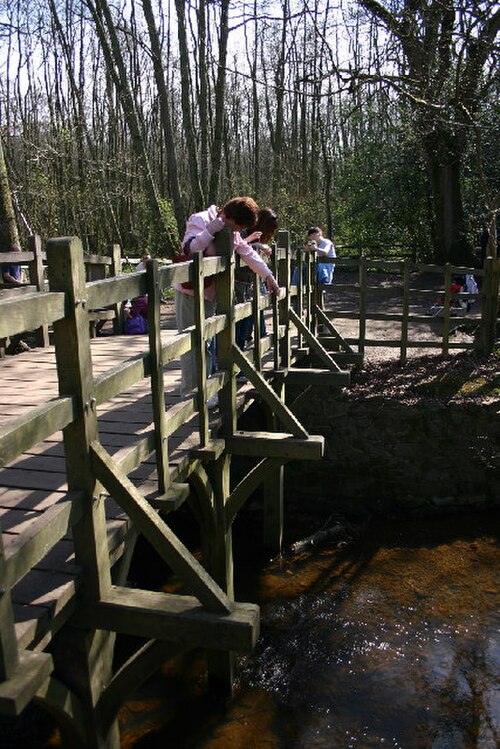
In the "sport" of Poohsticks, competitors drop sticks into a stream from a bridge and then wait to see whose stick will cross the finish line first. Competitors hold their sticks at arms length at the same height, then drop their sticks into the water at the same time.[101] Though it began as a game played by Pooh and his friends in the book The House at Pooh Corner and later in the films, it has crossed over into the real world: a World Championship Poohsticks race takes place in Oxfordshire each year. Ashdown Forest in south-east England, where the Pooh stories are set, is a popular tourist attraction, and includes the wooden Pooh Bridge where Pooh and Piglet invented Poohsticks.[102] The Oxford University Winnie the Pooh Society was founded by undergraduates in 1982.[103]
From December 2017 to April 2018, the Victoria and Albert Museum in London hosted the exhibition Winnie-the-Pooh: Exploring a Classic.[104] On exhibit were A. A. Milne's manuscript of Winnie-the-Pooh and The House at Pooh Corner (on loan from the Wren Library at Trinity College, Cambridge, Milne's alma mater to which he had bequeathed the works), and teddy bears that had not been on display for 40 years because they were so fragile.[91][105] The exhibit was then displayed in museums in the US, Japan, South Korea and Canada.[106][107][108]

In 2018, E. H. Shepard's original 1926 illustrated map of the Hundred Acre Wood, which features in the opening pages of Milne's books and also appears in the opening animation in the first Disney adaptation in 1966, sold for £430,000 ($600,000) at Sotheby's in London, setting a world record for book illustrations.[109][110]
日本のフィギュアスケート選手でオリンピック2連覇の羽生結弦選手は、プーさんを幸運のお守りと考えている。[ 111 ]彼はフィギュアスケートの競技中、プーさんのぬいぐるみをいつも持ち歩いている。そのため、羽生選手のファンは演技後にプーさんのぬいぐるみを氷上に投げ込む。[ 112 ] 2018年の平昌冬季オリンピックでの羽生選手の演技後、ある観客は、氷上に投げ込まれたプーさんのせいで「氷が黄色くなった」とコメントした。[ 113 ]

中国では、 2017年半ばにプーさんの画像がソーシャルメディアのウェブサイトから検閲された。これは、中国の最高指導者で共産党総書記の習近平氏を(ディズニー版の)プーさんと比較するインターネットミームが流行したためである。[ 114 ] 2018年の映画『クリストファー・ロビン』も中国での公開を拒否された。[ 115 ]米国の多くの人々は、クリストファー・ロビンが中国の映画館で上映されなかったのは検閲によるものだと考えていたが、中国当局は公式な説明をしなかった。一部のアナリストは、中国の年間外国映画上映枠が34本であることを挙げ、この決定は政治的な懸念とは無関係である可能性があると主張した。さらに、2011年に劇場公開された『くまのプーさん』も中国では上映されなかった。これは、この論争と習近平氏の総書記就任の両方よりも前のことである。[ 116 ]
習近平がフィリピンを訪問した際、抗議者たちはプーさんの画像をソーシャルメディアに投稿した。[ 117 ]習近平以外にも、バラク・オバマがティガー、キャリー・ラム、ロドリゴ・ドゥテルテ[ 118 ]、彭麗媛がピグレット[ 119 ]、フェルナンド・チュイと安倍晋三がイーヨー[ 120 ]に例えられるなど、他の政治家もくまのプーさんのキャラクターに例えられている。
プーさんの中国語名(中国語:小熊维尼、直訳すると「小さなクマのウィニー」 )は、World of Warcraft、PlayerUnknown's Battlegrounds、Arena of Valor [ 121 ]、Devotion [ 122 ]などのビデオゲームで検閲されている。キングダム ハーツ IIIのプーさんの画像も、ゲームサイト A9VG でぼかされている。[ 123 ]
禁止されているにもかかわらず、上海ディズニーランドではプーさんをテーマにしたアトラクションが2つ稼働しており、中国ではプーさんのグッズやくまのプーさんに関する書籍を購入することも合法です。[ 124 ] [ 116 ] 2021年5月、上海ディズニーランドでくまのプーさんの着ぐるみを着たパフォーマーが子供の観光客に殴られました。中国のマスメディアはこの事件の報道で「くまのプーさん」という言葉が検閲されているため、「プーさん」(中国語:噗噗熊)という言葉を使用しました。しかし、この事件の後、Weiboで「上海ディズニーランドでプーさんが怪我」の検索結果は検閲されました。[ 125 ] [ 126 ]
2019年10月、プーはサウスパークのエピソード「バンド・イン・チャイナ」で習近平に似ているという理由で中国で囚われの身となった。このエピソードで、プーはランディ・マーシュによって残酷に殺される。このエピソードの結果、サウスパークは中国で放送禁止となった。 [ 127 ] [ 128 ]
台湾のパイロットは、プーさんの顔を殴るタイワンクロクマを描いた士気向上パッチを着用している。 [ 129 ]このパッチは民間企業が製造しており、現役隊員が着用している写真が出回った後、需要が大幅に増加した。[ 130 ] [ 131 ]
初めて語られる。
1981年9月、ロンドン動物園にて、父A・A・ミルンと彼の作品であるクマのプーさんを称え、クマの像の除幕式を行う作家クリストファー・ロビン・ミルン。
 LibriVoxで聴けるパブリックドメインの『くまのプーさん』オーディオブック