
Loading article…
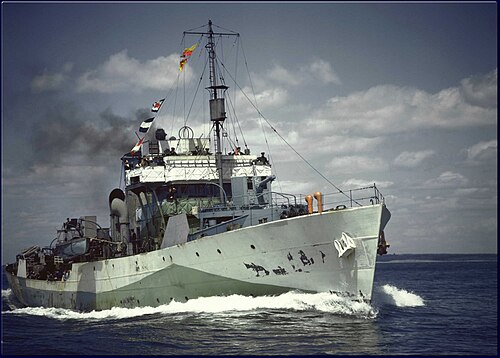 HMCS レジーナ、1942年~1943年
| |
| クラスの概要 | |
|---|---|
| オペレーター | |
| 後継者 | 城クラス |
| 完了 | 225(オリジナル)、69(修正) |
| キャンセル | 5(オリジナル)、6(修正) |
| 失った | 33 第二次世界大戦(22 潜水艦) |
| 保存 | HMCS サックヴィル |
| 一般的な特徴 オリジナルのフラワー級コルベット | |
| タイプ | コルベット |
| 変位 | 925ロングトン(940 t; 1,036 ショートトン) |
| 長さ | 205フィート(62.5メートル)全高 |
| ビーム | 33フィート(10.1メートル) |
| 下書き | 11.5 フィート (3.51 メートル) |
| 推進 | |
| スピード | 16ノット(29.6 km/h) |
| 範囲 | 12ノット(時速22.2km)で3,500海里(6,482km) |
| 補体 | 85 |
| センサーと 処理システム |
|
| 武装 |
|


.svg/500px-Naval_Ensign_of_Greece_(1863-1924_and_1935-1970).svg.png)


.svg/500px-War_Ensign_of_Germany_(1938%E2%80%931945).svg.png)







.svg/500px-Naval_Ensign_of_Yugoslavia_(1949%E2%80%931993).svg.png)
| 一般的な特徴 改良型フラワー級コルベット | |
|---|---|
| 変位 | 1,015ロングトン(1,031 t; 1,137 ショートトン) |
| 長さ | 208フィート(63.4メートル) |
| ビーム | 33フィート(10.1メートル) |
| 下書き | 11フィート(3.35メートル) |
| 推進 |
|
| スピード | 16ノット(29.6 km/h) |
| 範囲 | 12ノット(時速22.2km)で3,500海里(6,482km) |
| 補体 | 90 |
| センサーと 処理システム |
|
| 武装 |
|
フラワー級コルベット[1] [2] [3] (リードシップにちなんでグラディオラス級とも呼ばれる)[4]は、第二次世界大戦中に連合国海軍が特に大西洋の戦いで対潜水艦船団護衛として使用した294隻のイギリス製コルベット艦のクラスである。このクラスのイギリス海軍の艦艇は花にちなんで命名された。
大半は第二次世界大戦中、イギリス海軍(RN)とカナダ海軍(RCN)で運用された。主にカナダで建造された数隻の艦艇は、レンドリース法に基づきイギリス海軍からアメリカ海軍(USN)に移管され、両海軍で運用された。USNに移管されたコルベットの中には、アメリカ沿岸警備隊の乗組員が乗ったものもあった。[5]アメリカ海軍で運用された艦艇は、テンプトレス級およびアクション級哨戒砲艦として知られていた。その他のフラワー級コルベットは、自由フランス海軍、オランダ海軍、ノルウェー海軍、インド海軍、ギリシャ海軍、ニュージーランド海軍、ユーゴスラビア海軍、そして戦争直後には南アフリカ海軍で運用された。
第二次世界大戦後、余剰となったフラワー級艦艇の多くが他国の海軍や民間で使用された。HMCSサックヴィルは、この クラスで博物館船として保存されている唯一の艦艇である。
クラス指定
「コルベット」という用語は、もともとはフリゲート艦とスループ・オブ・ウォーの中間に位置する小型帆船を指すフランス語の名前でした。1830 年代に、この用語はイギリス海軍によって、主に船舶護衛の役割を果たす、ほぼ同じ大きさの帆船を指すために採用されました。蒸気動力の到来とともに、外輪駆動、後にはスクリュー駆動のコルベットが同じ目的で建造され、数十年にわたってパワー、サイズ、武装が強化されました。1877 年、イギリス海軍は従来のカテゴリとしての「コルベット」を廃止し、コルベットとフリゲート艦を統合して「巡洋艦」という新しいカテゴリを設けました。
第二次世界大戦までの数か月間、イギリス海軍は船舶護衛の役割を果たす小型護衛艦というコンセプトに立ち返った。フラワー級は捕鯨船サザン・プライドの設計に基づいており、「コルベット」と名付けられ、イギリス海軍の称号が復活したが、フラワー級は1877年以前の巡洋艦とは関係がない。
このクラスには、2つの異なるグループの艦艇があります。オリジナルのフラワー級は、1939年と1940年の建造計画中に225隻が発注されました。そして、それに続く改良型のフラワー級は、1940年以降にさらに69隻が発注されました。改良型のフラワー級は、若干大型で武装も強化されていました。
米海軍で運用されていたフラワー級艦艇は、当初の設計および改良型で、テンプトレス級およびアクション級砲艦と呼ばれ、船体分類記号PG (「哨戒砲艦」) が付けられていた。
デザイン
.jpg/500px-80-G-289820_HMCS_Riviere_du_Loup_(K_357).jpg)
1939年初頭、ナチスドイツとの戦争の危険が高まる中、イギリス海軍はドイツ海軍の Uボートの脅威に対抗するため、より多くの護衛艦が必要であることは明らかだった。特に懸念されていたのは、英国東海岸沖の船舶を護衛する必要性だった。必要なのは、トロール船よりも大きくて速いが、大量生産できるほど安価な船団護衛艦であり、できれば小規模な商船造船所で建造したいというものだった。というのも、大規模な造船所はすでに忙しかったからである。この要件を満たすため、漁船の設計と建造を専門とするサウスバンク・オン・ティーズのスミス・ドック社は、700トン、16ノット(時速18マイル、時速30キロメートル)の捕鯨船サザン・プライドの開発を提案した。[6] [7]これらは、迅速かつ安価に大量生産できる小型船団護衛艦として意図されていた。海軍の計画者は沿岸船団護衛に配備するつもりだったが、航続距離が長いため、戦争前半は 中央洋護衛部隊の船団護衛の主力となった。
フラワー級は、駆逐艦やフリゲート艦などの大型艦が十分な量産されるまで、北大西洋の船団護衛に欠かせない存在となった。フラワー級は商船によく使われる部品や技術(寸法)を使ったシンプルな設計だったため、イギリスやカナダ各地の小さな民間造船所で建造できた。そうした場所では、より大型の(あるいはより高性能な)軍艦を建造することができなかった。 [8]さらに、蒸気タービンの代わりに民間の三段膨張機械を使用したため、コルベット艦の乗組員の多くはイギリス海軍予備隊やイギリス海軍志願予備隊で構成されており、その操作方法にも精通していた。
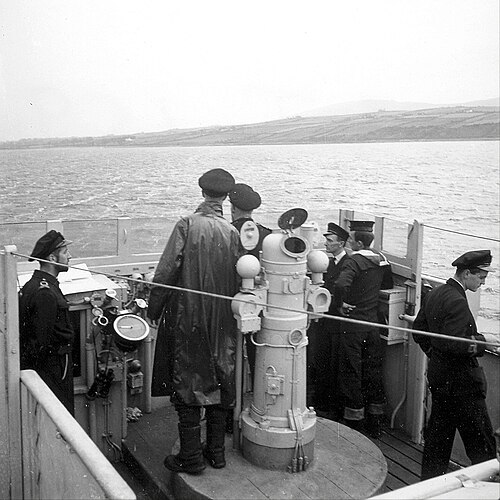
フラワー級艦は軍艦としては低速で、最高速度は16ノット(時速18マイル、30キロメートル)であった。また、対潜水艦戦のみを目的としていたため、武装も非常に軽かった。カナダ海軍の元のフラワー級艦の多くは当初、機雷掃海装置を装備していたが、改修されたフラワー級のほぼすべてには限定的な対空能力が装備されていた。元のフラワー級は標準的なイギリス海軍のレイアウトで、一段高い船首楼、ウェルデッキ、ブリッジまたは操舵室、そして船尾まで続く一続きのデッキで構成されていた。乗組員の居住区は船首楼にあり、調理室は船尾にあったため、食事の取り回しが悪かった。[9]改修されたフラワー級では、船首楼がブリッジを越えて煙突の後端まで後方に延長され、このバリエーションは「ロング・フォカスル」設計として知られている。乗組員全員が天候から逃れて集まることができる非常に便利なスペースを提供すること以外に、追加された重量は船の安定性と速度を改善し、戦争中期から後期にかけて、多くのオリジナルのフラワー級艦艇に適用されました。オリジナルのフラワー級は、当時の海軍の慣例の顕著な例外として、マストが艦橋のすぐ前方に配置されていました。改造されたフラワー級では、マストが艦橋のすぐ後ろの通常の位置に戻されました。これは、オリジナルの艦艇の改造または改造のすべてで行われたわけではないようです。このクラスのすべての艦艇の外観は、 巡洋艦のような船尾で仕上げられています。
注文
_IWM_A_4594.jpg/500px-HMS_Picotee_(K63)_IWM_A_4594.jpg)
イギリス海軍は1939年にフラワー級コルベット145隻を発注した。最初の26隻は7月25日に、さらに30隻は8月31日に発注されたが、いずれも1939年の戦前計画に基づくものであった。第二次世界大戦の勃発後、イギリス海軍本部は1939年の戦争計画に基づき、 9月19日にさらに20隻を発注した(すべてハーランド・アンド・ウルフ社製)。その2日後、さらに10隻のフラワー級コルベットを他のイギリス造船所に発注した。さらに12月12日に18隻、12月15日に2隻を、やはりイギリスの造船所に発注した。イギリス海軍は1940年1月に最後の10隻(1939年の戦争計画に基づく)をカナダの造船所に発注した。
1940年1月末までに、この初期設計に基づいて116隻の船が建造中または発注中であった。カナダの造船所に発注された10隻は、完成後カナダ海軍に移管された。さらに4隻がフランス海軍向けにスミスドック社に発注され、最初の1隻は1940年半ばに自由フランス海軍向けに完成し、他の3隻はカナダ海軍に引き継がれた。さらに31隻のフラワーが1940年の戦争計画に基づいてカナダ海軍から発注されたが、このうち6隻(ハーランド・アンド・ウルフ社に発注)は1941年1月23日にキャンセルされた。
_IWM_FL_22394.jpg/500px-HMS_Jonquil_(K68)_IWM_FL_22394.jpg)
イギリス海軍は、1941年と1942年の戦争計画に基づき、フラワー級コルベットの改修型を27隻発注した。イギリスの造船所は、1941年の計画に基づき7隻、1942年の計画に基づき5隻の建造を請け負ったが、2隻(各年の計画から1隻ずつ)は後にキャンセルされた。イギリス海軍は、1941年の計画に基づき、カナダの造船所にフラワー級コルベットの改修型を15隻発注した。このうち8隻は、逆レンドリース法に基づき、アメリカ海軍に移管された。
カナダ海軍は、カナダの造船所に、フラワー級のオリジナル艦艇 70 隻と、改良型 34 隻を発注した。カナダの造船所は、米海軍の発注によるオリジナル フラワー級艦艇 7 隻も建造したが、完成後、レンドリース計画に基づいてイギリス海軍に移管された。これは、戦時中の米国の造船生産が、米海軍がカナダに発注した艦艇を不要にできるレベルに達していたためである。カナダ海軍の艦艇は、イギリス海軍の艦艇とは設計がいくつか異なっていた。後部ポンポン砲が搭載されていた「バンドスタンド」は、上部構造の後部に移動され、調理室も前方に移動され、機関室のすぐ後ろになった。
戦争勃発後まもなく、フランス海軍はフラワー級艦艇18隻を発注した。内訳はイギリスの造船所に12隻、ダンケルクのフランス製艦艇工場に2隻、サン=ナゼールのペンホエ製艦艇工場に4隻であった。[10] [11]フランス製艦艇2隻は「キャンセル」となっているが、ペンホエ製艦艇4隻はフランス陥落時に建造中であり、ナチスドイツに接収された。[12]ドイツ海軍向けに3隻が完成し、1943年から1944年にかけてパトロールボート・アウスラント哨戒艦艇として就役した。[11] [13]
武装

典型的なBL 4 インチ Mk IX 砲の搭載。ここではHMS バーベインに搭載されている。
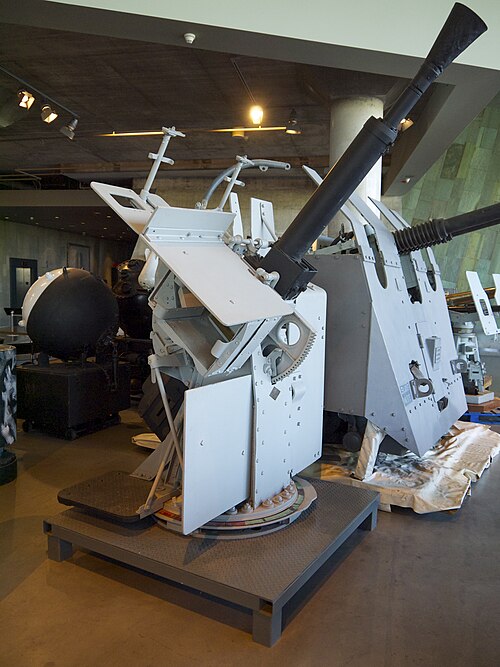
フラワー級の当初の艦首には4インチ (102 mm) 砲、艦尾には爆雷40発を積載できる爆雷架、掃海ウインチ、機関室上部の「バンドスタンド」には2ポンド (40 mm)ポンポン砲が装備されていた。ポンポン砲は不足していたため、ルイス機関銃2挺またはヴィッカース重機関銃4連装に置き換えられることもあったが、北海沿岸の船団護衛と哨戒という想定された役割において、航空機による攻撃に対して非常に脆弱であった。長距離航続距離と、戦時初期の大型護衛艦の不足により、フラワー級はドイツ空軍の航空機と遭遇することがほとんどない大西洋横断船団護衛に配属された。地中海に配属された艦艇には、通常、より多くの対空砲が装備されていた。水中探知能力は固定式のASDICドームによって提供されていたが、これは後に引き込み式に改造された。その後、高周波無線方向探知機 (ハフダフ) などの発明や、さまざまなレーダーシステム (タイプ 271など)が追加され、北大西洋の視界不良の状況で特に効果的であることが証明されました。
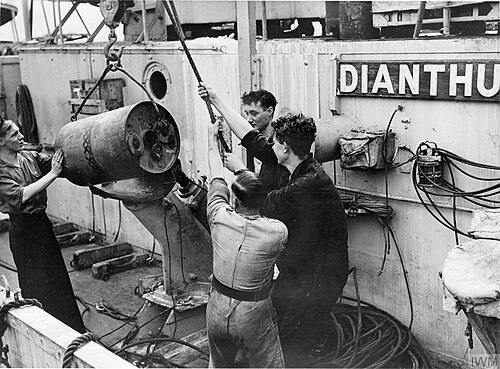
HMSディアンサスに爆雷投射機を搭載中
フラワー級は沿岸哨戒と港湾対潜水艦防衛のために設計されており、連合国海軍が大西洋横断船団護衛に使用し始めたときに多くの艦に小さな改造が必要となった。これらの小型軍艦は、どんな小さな造船所や海軍基地でも支援できたため、多くの艦は、いつどこで改修されたかに応じて、さまざまな兵器システムや設計変更を受けるようになった。実際には、「標準的なフラワー級コルベット」というものは存在しない。
このクラスの船舶が受けた主要な変更のいくつかを、典型的な年代順に以下に示します。
- 元々のツインマスト構成は、ブリッジ前のシングルマストに変更され、その後、視認性を向上させるためにブリッジの後ろに移動されました。
- 深海護衛作業と航続距離の延長のため、重機雷掃海装置を撤去。
- ギャレーが船尾から船体中央部へ移設されました。
- 追加の爆雷保管ラックが船尾に取り付けられました。後に、より多くの爆雷が通路に沿って保管されました。
- ASDIC との通信を維持しながら遠隔攻撃を可能にするためにヘッジホッグを装備しました。
- 艦橋上の「ランタン」ハウジングに取り付けられた水上レーダー。
- 船首楼は船体の中央まで延長され、居住性が向上し、耐航性も向上しました。いくつかの船では「長さの 4 分の 3」まで延長されました。
- 船首のフレアが増大しました。これと上記の変更により、その後の注文用に改良されたフラワー デザインが作成されました。
- 橋にさまざまな変更が加えられ、通常は橋を低くしたり長くしたりします。囲まれたコンパス ハウスは削除されました。
- ブリッジまたは機関室の屋根に取り付けられた追加の2連装ルイス機関銃。
- エリコン 20 mm 砲が装備されており、通常は艦橋の両翼に 2 門装備されていますが、作戦地域によっては機関室の天井に沿って 6 門ほど装備されることもあります。
艦艇には、これらを任意に組み合わせることも、他の専門的な一回限りの改造を施すことも可能であった。カナダ海軍や米海軍など他の海軍に配属された艦艇は、通常、武装やデッキレイアウトが異なっていた。カナダ海軍の艦艇とカナダ海軍、米海軍、その他海軍の艦艇との大きな違いは、改良されたASDICとレーダーの装備であった。カナダ海軍はこれらの技術開発で世界をリードしており、カナダ海軍フラワーズ級は敵潜水艦の遠隔探知に関していくぶん装備が優れていた。その良い例として、カナダ海軍フラワーズ級がカナダ設計のSW1Cメートル法レーダーでUボートを迎撃するのに苦労したのに対し、カナダ海軍の艦艇は技術的に進歩したタイプ271センチメートルセットを装備していたことが挙げられます。さらに、カナダ海軍の艦艇はジャイロコンパスを操作できなかったため、ASDIC攻撃はより困難でした。
オペレーション
フラワー級コルベットは、大西洋の戦いでイギリス海軍とカナダ海軍によって広く使用された。また、イギリス海軍の他、アメリカ海軍、オランダ海軍、ノルウェー海軍、ギリシャ海軍、自由フランス海軍、インド海軍、ニュージーランド海軍などの連合国海軍でも限定的に使用された。ベルギー海軍は第二次世界大戦中にこれらの艦艇の一部を使用し、機雷掃海艇にフラワーの名称を使用し続けている。イギリス海軍のフラワー級艦のほとんどは、イギリス海軍予備隊とイギリス海軍志願予備隊(RNVR) から士官と乗組員が集められた。多くのイギリス海軍フラワー級艦の艦長は商船隊から集められた。
北大西洋でのフラワーズの任務は、典型的には寒く、湿っぽく、単調で不快なものだった。船首楼が迫り来る波に浸るたびに、船体中央のウェルデッキに水が流れ込んだ。[14]戦闘位置にいた乗組員は水しぶきでびしょ濡れになり、弾薬庫にアクセスするために開けられたハッチから居住空間に水が入り込んだ。[14]内部デッキは常に濡れており、頭上から結露が滴り落ちた。[14]トイレ(または衛生便所)からの排水はまっすぐなパイプで海に流され、荒天時には北大西洋の氷河の水が逆流して、トイレを使用する乗組員の尻を清潔にした。[14] 1941年までに、コルベットは当初の設計で予想された数の2倍の乗組員を運んでいた。[14]乗組員はロッカーやテーブルの上、または少しでも暖かさを提供してくれる暗い場所で眠った。[14]生鮮食品を保存することができなかったため、すべての食事はコンビーフや粉末ポテトなどの保存食に頼らざるを得なかった。[15]
フラワー級は「海のペキニーズ」というあだ名がつけられた。フラワー級は航行性能が悪く、荒波では横揺れが頻繁に起こり、80度ロール(垂直状態から左右に40度ずつ)はよくあることで、「濡れた草の上でも横揺れする」と言われた。[16]多くの乗組員は船上生活に慣れるまで数週間、ひどい乗り物酔いに悩まされた。[14]フラワー級は航行性能が悪かったが、耐航性は極めて優れており、第二次世界大戦中、戦闘以外では連合軍の水兵がフラワー級から海に落ちて亡くなったことはなかった。
船団護衛任務中に浮上中のUボートに遭遇したフラワー級駆逐艦の典型的な行動は、潜水艦に真っ向から突進し、潜航を強いて速度と機動性を制限することだった。こうしてコルベットは潜水艦を沈めたままにし、爆雷攻撃を避けることに専念させ、船団が安全に通過できるようにした。フラワー級駆逐艦の最高速度は16ノット(30 km/h、18 mph)で、浮上中のUボート(約17ノット(31 km/h、20 mph))を効果的に追跡することは不可能だったが、潜水中のUボートや船団の周りを操縦するには十分だった。潜水中のUボートや船団の最高速度は通常8ノット(15 km/h、9.2 mph)で、悪天候ではそれよりずっと遅いこともあった。また、低速のため、フラワー級駆逐艦は戦闘後に船団に追いつくのが困難だった。[9]

この技術は、ドイツ海軍がU ボートを「ウルフパック」攻撃に投入し始めたときに妨げられました。これは、護送船団の護衛艦を圧倒し、少なくとも 1 隻の潜水艦が商船を攻撃できるようにすることを目的とした攻撃でした。フラワー級潜水艦にはレーダー、 HF/DF、爆雷投射装置、ASDICなどの優れたセンサーと武装があり、これらの小型艦はそのような攻撃を検知して防御するのに十分な装備が整っていましたが、戦術的な優位性は攻撃側にあり、防御側のフラワー級潜水艦を攻撃して基地から引き離すことができました。フラワー級潜水艦の成功は、撃沈した U ボートの数ではなく、保護したトン数で測られるべきです。これらの船による護送船団の行動の典型的な報告には、U ボートが船団の近くで検知され、その後、銃や爆雷を使用した短い交戦が行われ、別の U ボートが小競り合いを利用して無防備な船団を攻撃したため、急いで基地に戻るという例が多数含まれています。
数的に優勢なUボートの群れに対する継続的な戦闘は、関係者全員に相当な操船技術を要求し、乗組員を非常に消耗させた。このクラスの36隻が第二次世界大戦中に失われたが、その多くは敵の攻撃によるもので、いくつかは連合国の軍艦や商船との衝突によるものであった。浅瀬に沈んだ1隻は引き上げられ、修理された。敵の攻撃で失われた船のうち、22隻はUボートの魚雷で撃沈され、5隻は機雷で包囲され、4隻は航空機によって沈没した。フラワー級コルベットは、47隻のドイツ潜水艦と4隻のイタリア潜水艦の沈没に参加したとされている。フラワー級の建造は戦争の終わり頃には廃止され、大規模造船所はリバー級 フリゲート艦に集中し、小規模造船所は改良されたキャッスル級コルベットの設計に集中した。フラワー級は、第二次世界大戦中、北大西洋における連合国の船団護衛艦の半分を占めた。
船舶
以下の表には、第二次世界大戦中に連合国海軍で運用されたフラワー級コルベットがすべて記載されています。
花組(オリジナル)
自由フランス海軍
カナダ海軍
イギリス海軍
南アフリカ海軍
オランダ海軍
ノルウェー海軍
ギリシャ海軍
アメリカ海軍
フラワークラス(修正版)
カナダ海軍
インド海軍
ニュージーランド海軍
イギリス海軍
アメリカ海軍
戦闘中に失われた船舶
ドイツ海軍の使用
1940 年、フランス海軍向けに 4 隻のフラワー級コルベットがサン・ナゼール=ペンホエで建造中だった。これらはドイツ海軍に接収された。1943年と 1944 年に 3 隻が完成したが、4 隻目は未完成だった。これらの艦の名称「PA」は、Patroullienboot Ausland (外国哨戒艇) の略である。
戦闘クレジット
- U-26は1940年7月1日にグラディオラスによって沈没した。
- マルチェロ級 潜水艦 ナニは1941年1月7日にアネモネによって沈没した。
- U-70は1941年3月7日にカメリアとアービュータスによって沈没した
- U-110 は、1941 年 5 月 9 日に駆逐艦ブルドッグ、ブロードウェイ、コルベット艦オーブリエティアによって拿捕されました。U -110 は、機密保持のため翌日沈没しました。
- U-147は1941年6月2日に駆逐艦ワンダラーとペリウィンクルによって沈没した。
- U-556は1941年6月17日にナスタチウム、セランディン、グラディオラスによって沈没した。
- U-651 was sunk by the destroyers Malcolm, Scimitar, the corvettes Arabis and Violet, and the minesweeper Speedwell on 29 June 1941
- U-401 was sunk by the destroyers Wanderer and St. Albans and the corvette Hydrangea on 3 August 1941
- U-501 was sunk by Chambly and Moosejaw on 10 September 1941
- Argonauta-class submarine Fisalia was sunk by Hyacinth on 28 September 1941
- U-204 was sunk by Mallow and the sloop Rochester on 19 October 1941
- U-433 was sunk by Marigold on 16 November 1941
- U-131 was sunk by the destroyers Exmoor, Blankney, Stanley, the corvette Pentstemon, the sloop Stork, and a Martlet aircraft from Audacity on 17 December 1941
- U-567 was sunk by the sloop Deptford and Samphire on 21 December 1941
- U-356 was sunk by the destroyer St. Laurent, with Chilliwack, Battleford and Napanee on 27 December 1942
- U-756 was sunk by Morden on 1 September 1942
- U-94 was sunk by a US Catalina flying boat and Oakville on 28 August 1942
- U-588 was sunk by Wetaskiwin and the destroyer Skeena on 31 July 1942
- U-379 was sunk by Dianthus on 8 August 1942
- Perla-class submarine Perla was captured by Hyacinth on 9 July 1942
- U-660 was scuttled after being damaged by Lotus and Starwort on 12 November 1942
- U-124 was sunk by Stonecrop and the sloop Black Swan on 2 April 1943
- U-82 was sunk by the sloop Rochester and Tamarisk on 6 February 1942
- U-252 was sunk by the sloop Stork and Vetch on 14 April 1942
- U-432 was sunk by the corvette Aconit on 11 March 1943
- U-444 was sunk by the destroyer Harvester and the corvette Aconit on 11 March 1943
- U-609 was sunk by the corvette Lobelia on 7 February 1943
- U-536 was sunk by the frigate Nene, with Snowberry and Calgary on 20 November 1943
- U-753 was sunk by Drumheller, the frigate Lagan, and a Canadian Sunderland seaplane on 13 May 1943
- Flutto-class submarine Tritone was sunk by Port Arthur and the destroyer Antelope on 19 January 1943
- U-163 was sunk by Prescott on 13 March 1943
- Acciaio-class submarine Avorio was sunk by Regina on 8 February 1943
- U-87 was sunk by Shediac and the destroyer St. Croix on 4 March 1943
- U-224 was sunk by Ville de Quebec on 13 January 1943
- U-135 was sunk by the sloop Rochester, the corvettes Mignonette and Balsam, and an American Consolidated PBY Catalina aircraft on 15 July 1943
- U-306 was sunk by the destroyer Whitehall and Geranium on 31 October 1943
- U-617 was destroyed while grounded by Hyacinth and the Australian minesweeper Wollongong on 12 September 1943
- U-436 was sunk by the frigate Test and Hyderabad on 26 May 1943
- U-192 was sunk by Loosestrife on 6 May 1943
- U-125 was sunk by the destroyer Oribi and Snowflake on 6 May 1943
- U-634 was sunk by the sloop Stork and Stonecrop on 30 August 1943
- U-638 was sunk by Sunflower on 5 May 1943
- U-631 was sunk by Sunflower on 17 October 1943
- U-282 was sunk by the destroyers Vidette and Duncan and the corvette Sunflower on 29 October 1943
- U-414 was sunk by Vetch. on 25 May 1943
- U-523 was sunk by the destroyer Wanderer and Wallflower on 25 August 1943
- U-757 was sunk by the frigate Bayntun and Camrose on 8 January 1944
- U-744 was sunk by the destroyers Icarus, Chaudiere, Gatineau, the frigate St. Catharines, and the corvettes Fennel, Chilliwack, and Kenilworth Castle on 6 March 1944
- U-741 was sunk by Orchis on 15 August 1944
- U-641 was sunk by Violet on 19 January 1944
- U-845 was sunk by the destroyers Forester and St. Laurent, the corvette Owen Sound and the frigate Swansea on 10 March 1944
- U-1199 was sunk by the destroyer Icarus and Mignonette on 21 January 1945
Post-war use
The relatively small Flowers were among the first warships to be declared surplus by Allied navies following the end of World War II. They had seen years of hard service in the North Atlantic and were made obsolete by the numerous destroyer escorts and frigates that entered service in the latter part of the war.
32 vessels from the RN, RCN, and USN were transferred to Argentina, Chile, the Dominican Republic, Greece, India, the Republic of Ireland, South Africa, and Venezuela. These were typically operated according to their original design, as coastal patrol vessels, with many serving until the 1970s.
The Irish Navy bought three Flowers in 1946 (LE Macha, LE Cliona, and LE Maev). The fledgling navy had intended to buy three more corvettes, as well as a number of surplus minesweepers, but severe budget restrictions cancelled these plans, leaving the original three to serve alone through the 1950s and 1960s despite antiquated armament, poor accommodation, and maintenance problems. Taken out of service 1968–1970 and scrapped shortly afterwards. Replaced by Ton-class minesweepers before the building of a similar size vessel, LE Deirdre. Entry into the European Economic Community in 1973 assisted in funding for the building of three future ships.
110 surplus Flowers were sold for commercial use. These saw various careers as mercantile freighters, smugglers, tugs, weather ships, and whalers. The remainder were scrapped. Of particular interest is the story of HMCS Sudbury. She was declared surplus by the RCN and sold as a towboat specializing in deep-sea salvage. In November 1955, she rescued the freighter Makedonia in the North Pacific, towing the vessel for over one month through severe weather, becoming one of the most famous salvage ships of all time.
The surplus RCN Flowers Norsyd and Beauharnois were sold as mercantile freighters but were subsequently acquired in 1946 by the Mossad LeAliyah Bet, a branch of the Jewish Defense Association (Haganah) in the British Mandate for Palestine. Mossad Le'aliyah Bet organized Jewish immigration from Europe into Palestine, in violation of unilateral British restrictions. The corvettes were intercepted in the Mediterranean Sea during the summer of 1946 by the destroyer Venus and interned in Palestine. After Israel became independent in 1948, these commercial ships were commissioned into the Israeli Navy as the warships Hashomer and Hagana respectively.
Allied navies disposed of their Flowers so quickly following the war, the RN could not supply a single vessel to play Compass Rose in the 1953 film production of Nicholas Monsarrat's novel The Cruel Sea. The Royal Hellenic Navy supplied Kriezis (formerly HMS Coreopsis) for the role prior to her scrapping.
The only survivor of the entire class is Sackville, owned by the Canadian Naval Memorial Trust. She was laid up in reserve in March 1946 and converted in 1952 to a research vessel for Canadian Department of Marine and Fisheries, a role she served in until the early 1980s when she was acquired by the trust.[37] She has been restored to her wartime appearance and serves in the summer months as a museum ship in Halifax, Nova Scotia, while wintering securely in the naval dockyard at CFB Halifax under the care of Maritime Forces Atlantic, Maritime Command. Sackville's presence in Halifax is considered very appropriate, given the port was an important North American convoy assembly port during the war. Sackville makes her first appearance each spring when she is towed by a naval tug from HMC Dockyard to a location off Point Pleasant Park on the first Sunday in May to participate in the Commemoration of the Battle of the Atlantic ceremonies held at a memorial in the park overlooking the entrance to Halifax Harbour. Sackville typically hosts several dozen RCN veterans on this day and has also participated in several burials at sea for dispersing the ashes of RCN veterans of the Battle of the Atlantic at this location.
Literature

- Alex H. Cherry wrote Yankee R N, the story of a Wall Street banker who volunteered for active duty in the RN, including details of Flower operations.
- Peter Coy, who served in Narcissus in the North Atlantic between June 1942 and August 1944, wrote 'The Echo of a Fighting Flower' about her and B3 Escort Group, comprising two British and four Free French corvettes.
- Hugh Garner wrote Storm Below which provides a detailed account of Flower-class corvettes and the stresses of shipboard life during World War II.
- James B. Lamb wrote The Corvette Navy, which accounts the use of these vessels by the RCN during World War II.
- Hal Lawrence wrote A Bloody War including first-hand accounts of his service aboard Moosejaw and Oakville.
- Nicholas Monsarrat wrote the best-known fictionalised account of Flower-class corvette operations in his novel The Cruel Sea. A less well known volume by the same author, Three Corvettes, is a collection of wartime essays of his personal experiences as an officer on board a Flower, although only the first part deals with North Atlantic convoy escort duties.
- Robert Radcliffe wrote Upon Dark Waters, a fictionalized account of Flower-class corvette Daisy, set in 1942 on the North Atlantic.
- Denys Rayner wrote Escort, a first-hand account of his experiences as an officer aboard a Flower.
- Douglas Reeman's 1969 novel To Risks Unknown features the fictional Flower-class corvette Thistle.
- Mac Johnston wrote "Corvettes Canada" aptly subtitled "Convoy Veterans of World War II Tell Their True Stories."
See also
- American Flower-class corvettes
- Bathurst-class corvette
- Whale catcher
- List of escorteurs of the French Navy
Notes
- ^ Gardiner and Chesneau 1980, p. 62.
- ^ (reproduction with introduction by Antony Preston), Jane's Fighting Ships of World War II, New Jersey: Random House, 1996, ISBN 0-517-67963-9, page 68.
- ^ United States Navy Warship Identification Manual (NAVPERS 10796)
- ^ Fitzsimons, Bernard, ed. The Illustrated Encyclopedia of 20th Century Weapons & Warfare (London: Phoebus, 1978), Volume 11, pp. 1137–42.
- ^ Silverstone, Paul (2007). The Navy of World War II, 1922-1947. Routledge. p. 175. ISBN 9780415978989.
- ^ Brown 2007, pp. 41–43.
- ^ Lambert and Brown 2008, p. 3.
- ^ Canadian yards, for instance, could not build destroyer hulls.
- ^ a b Brown D K, Nelson to Vanguard
- ^ Le Masson 1969, pp. 27–28
- ^ a b Le Masson 1969, pp. 26, 28.
- ^ Le Masson 1969, p. 28
- ^ a b "Captured gunboats of the Kriegsmarine". German-Navy.de. Retrieved 18 January 2011.
- ^ a b c d e f g Milner 1985, p. 89
- ^ "Flower Class uboat.net
- ^ Monsarrat, N., H.M. corvette. Philadelphia, New York, J.B. Lippincott Co., 1943. OCLC 1523299
- ^ "War Memorials". Inverclyde Council. 9 August 2017. Archived from the original on 9 November 2017. Retrieved 9 November 2017.
- ^ Alamer.fr (in French)
- ^ [1] uboat.net – Officered & crewed by Royal Australian Navy Volunteer Reserve personnel from May 1941 to June 1945
- ^ a b c d e f g h i j k l m n o p q r s t u v w x y z aa ab ac ad ae af ag ah ai aj ak al am an ao ap aq ar as at au av aw ax ay az ba bb bc bd be bf bg bh bi bj bk bl bm bn bo bp bq br bs bt bu bv bw bx by bz ca cb cc cd ce cf cg ch ci cj ck cl cm cn co cp cq cr cs ct cu cv Lambert and Brown 2008, p. 65.
- ^ HMS Arbutus (K 86) (British Corvette) – Ships hit by German U-boats during WWII – uboat.net
- ^ HMS Asphodel (K 56) (British Corvette) – Ships hit by German U-boats during WWII – uboat.net
- ^ HMS Bluebell (K 80) (British Corvette) – Ships hit by German U-boats during WWII – uboat.net
- ^ HMS Fleur de Lys (K 122) (British Corvette) – Ships hit by German U-boats during WWII – uboat.net
- ^ Lambert and Brown 2008, p. 7.
- ^ HMS Gladiolus (K 34) (British Corvette) – Ships hit by German U-boats during WWII – uboat.net
- ^ "Civil Aviation News: First Weather Ship". Flight. Vol. LII, no. 2015. 7 August 1947. p. 145.
- ^ "Weather Observer: First British "Met" Ship". Flight. Vol. LII, no. 2015. 7 August 1947. p. 144.
- ^ HMS Picotee (K 63) (British Corvette) – Ships hit by German U-boats during WWII – uboat.net
- ^ HMS Pink (K 137) (British Corvette) – Ships hit by German U-boats during WWII – uboat.net
- ^ HMS Polyanthus (K 47) (British Corvette) – Ships hit by German U-boats during WWII – uboat.net
- ^ HMS Salvia (K 97) (British Corvette) – Ships hit by German U-boats during WWII – uboat.net
- ^ HMS Vervain (K 190) (British Corvette) – Ships hit by German U-boats during WWII – uboat.net
- ^ HMS Zinnia (K 98) (British Corvette) – Ships hit by German U-boats during WWII – uboat.net
- ^ a b Greenfield, Murray S. & Hochstein, Joseph M., Jews' Secret Fleet, Gefen Publishing House, Jerusalem, 2010, pp. 55–56
- ^ a b "Today in History August 30, 2007". Seawaves. Archived from the original on 27 October 2007. Retrieved 10 June 2008.
- ^ "HMCS Sackville: The last flower (1941–2000)". History in Illustration. Retrieved 10 June 2008.
References
- Brown, David K (2007). Atlantic Escorts: Ships, Weapons & Tactics in World War II. Barnsley: Seaforth Publishing. ISBN 978-1-84415-702-0.
- Brown, David K (2006). Nelson to Vanguard: Warship Design and Development, 1923-1945. Naval Institute Press.
- Gardiner, Robert; Chesneau, Roger (1980). Conway's All The World's Fighting Ships 1922–1946. London: Conway Maritime Press. ISBN 0-85177-146-7.
- Johnson, Harold (2007). "Question 16/05: French Flower Class Corvettes". Warship International. XLIV (2): 145–146. ISSN 0043-0374.
- Le Masson, Henri (1969). The French Navy. Navies of the Second World War. Vol. 2. London: MacDonald & Co. (Publishers) Ltd. ISBN 9780356023847.
- McKay, J; Harland, J (1993). The Flower Class Corvette Agassiz. Conway Maritime Press. ISBN 0-85177-975-1.
- Lambert, John; Brown, Les (2008). Flower Class Corvettes. ShipCraft Special. St. Catharines, Ontario: Vanwell Publishing. ISBN 978-1-55068-986-0.
- Lambert, J; Raven, A (2000). Flower Class Corvettes in World War II. White Raven Press.
- Milner, Marc (1985). North Atlantic Run. Naval Institute Press. ISBN 0-87021-450-0.
External links

Wikimedia Commons has media related to Flower class corvette.
- The Flower-Class Corvette Forums A dedicated discussion forum which maintains the largest online collection of Flower-Class Corvette images and accessible historical documents.
- uboat.net has pages on the original and revised Flower-classes.
- The Flower-Class Corvette Association Archived 10 January 2008 at the Wayback Machine
- HMCS Sackville – The Last Corvette
- "Corvette K-225" – a 1943 film (the real K225 was HMCS Kitchener)
- Flower-Class Corvettes by Bob Pearson & Chris Banyai-Riepl
- 1993 film "Lifeline to Victory"—filmed aboard Sackville
- HMS Violet
- Diary of a Petty Officer on HMS La Malouine during Convoy PQ.17.
- 1953 film "The Cruel Sea" – based on Nicholas Monsarrat's novel
