
Loading article…
銃規制または銃管理と呼ばれる銃に関する法律や政策は、民間人による小型武器の製造、販売、譲渡、所持、改造、使用を規制するものです。[ 1 ]一部の国の法律では、民間人に武器を所持および携帯する権利が認められており、近隣の管轄区域よりも銃規制が緩やかです。銃管理は通常、特定の種類の銃器へのアクセスを制限し、銃器へのアクセスを許可される可能性のある人物のカテゴリーを制限します。[ 2 ]狩猟、スポーツ射撃、自己防衛、収集、隠匿携帯にはそれぞれ異なる要件、特権、責任を伴う個別のライセンスが存在する場合があります。
銃規制法は通常、犯罪における小型武器の使用を抑制するという立法府の意図によって正当化され、この目的のために、拳銃やその他の隠しやすい銃器など、犯罪や銃撃で特定された種類の武器が頻繁に標的とされます。[ 3 ]軍用ライフルから派生した半自動ライフル設計は、俗にアサルトライフルと呼ばれることもあり、立法者からさらに厳しい監視を受けることがよくあります。銃器への合法的なアクセスが制限される人には、一定の年齢未満の人や犯罪歴のある人が含まれる場合があります。銃器の購入または所持の許可は、自分自身や他人に危害を加えたり殺害したりするリスクが最も高いと定義される人、家庭内暴力の履歴がある人、アルコール使用障害または薬物使用障害、精神疾患、うつ病、または自殺未遂をした人には拒否される場合があります。銃器許可を申請する人は、銃器安全コースを修了して能力を証明したり、武器を安全に保管する場所の確保策を示したりする必要がある場合があります。
小型武器を規制する法律は、爆発物、クロスボウ、剣、スタンガン、エアガン、催涙スプレーなどの他の武器も規制する場合があります。また、大容量マガジン、消音器、自動射撃を可能にするオートシアなどの銃器付属品も規制する場合があります。購入できる弾薬の種類や数量に制限があり、特定の種類の弾薬が禁止されている場合もあります。この記事は世界規模で扱っているため、これらの問題すべてを詳細に解説することはできません。そこで、この記事では、各国の小型武器の使用と民間人の所有に関する武器法について、簡潔にまとめていきます。
銃器の定義は国によって異なる。
いくつかの用語は、銃規制法に関連して複数の国で使用されています。それらには以下が含まれます。
銃規制法は、いくつかの共通する特徴に基づいて国ごとに分類される可能性がある。
銃器免許(銃免許、またはイギリス英語ではライセンスとも呼ばれる)は、管轄区域の政府機関(通常は警察)によって発行される免許または許可証であり、免許取得者が銃器を購入、所有、所持、または携帯することを許可するもので、多くの場合、保管要件や銃器安全講習の修了、身元調査などに関する多くの条件や制限が適用されます。銃器免許はすべての管轄区域で必要とされるわけではありません。さらに、一部の国や州では、拳銃や銃器を購入するために法律で「購入許可証」を要求している場合があります。[ 4 ]弾薬を購入するためにも免許が必要になる場合があります。
許可証または免許証の適用範囲は、所持者が合法的に使用できる銃器の種類や活動内容によって異なります。管轄区域によっては、銃器の所有、狩猟、射撃、収集、隠し持った銃器の携帯、または銃器販売業者や銃器修理業者などの事業の運営に銃器免許が必要となる場合があります。また、管轄区域によっては、ライフル、ショットガン、ハンドガンごとに個別の免許が必要となる場合もあります。
銃器免許の取得義務は、通常、銃器登録義務に加えて課される。例えば、オーストラリアの銃規制法では、銃器は製造番号で所有者に登録され、所有者は銃器免許を所持していなければならない。


このセクションでは、 「発行する」および「発行することができる」という表現を使用していますが、これらは部分的に米国の銃器規制制度に特有のものであり、同制度によって定義されています。
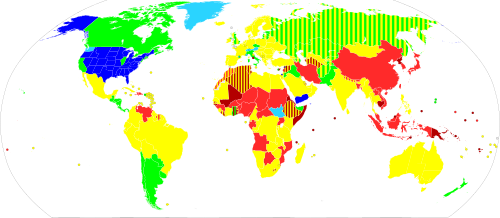
-この地図は、禁止前に製造された銃器が既得権として認められるかどうかに関わらず、新しい銃器を入手する際のポリシーを示しています。

-この地図は、禁止措置以前に製造された銃器が既得権として認められるかどうかに関わらず、新しい銃器を入手する際の政策について説明しています。
小型武器および軽兵器の不法拡散、流通および密売に関するアフリカ共通の立場についてのバマコ宣言は、 2000年12月1日にマリのバマコで、アフリカ統一機構(OAU)の51の加盟国の代表によって採択された。[ 159 ]この宣言の規定は、署名国がそれぞれの国内法の下で小型武器および軽兵器の不法所持を犯罪として定めることを推奨している。[ 160 ]
ボツワナの法律では、ショットガンとライフルのみ所持が許可されています。政府は毎年発行される免許の数に制限を設けており、申請者数に関わらず、免許を取得できるのは50人までです。つまり、承認率は通常1%未満です。[ 161 ]
現在、登録されている銃器は34,550丁(100人あたり1.5丁)である。[ 162 ]
中央アフリカ共和国では、公式には銃器の所持許可証を持っているのはわずか143人で、そのほとんどは国会議員である。彼らは12ゲージのショットガン1丁と9mmの自動拳銃1丁を所持する権利がある。[ 163 ]それにもかかわらず、中央アフリカ共和国では銃器の違法所持と携帯が蔓延しており、その大部分はさまざまな武装集団の支配下にある。アンチバラカと旧セレカ民兵は、自作のショットガン、自動小銃、ロケットランチャーを所持し携帯している。[ 164 ]
1968年に制定された銃器法では、チャドで銃器を所有するには許可が必要であり、許可は毎年更新しなければならない。この法律では、銃器の種類に応じて500~3000CFAフランの税印紙代を支払うこと以外に、許可を取得するために満たさなければならない条件は規定されていない。[法律95 ] 2017年にチャド政府が銃器許可証の発行で500万フランを徴収したことを考慮すると[ 165 ]、チャドには1,666~10,000の有効な銃器許可証があり、100人あたり0.01~0.06になることになる。
ジブチでは、国家元首が例外的な状況で特別な許可を与えた場合を除き、銃器の所持は一般的に禁止されている。[ 166 ]
エジプトでは銃規制法が厳格です。銃を所持するには、内務省の許可が必要です。許可を取得するには、エジプト国籍、21歳以上、良好な評判(重罪や重大な軽犯罪歴がなく、精神疾患がなく、読み書きができるなど)が必要です。銃は申請者のニーズに基づいて選定されます。民間人が公共の場所で銃を携帯することは許可されていません。無許可での所持や密売には終身刑が科せられる可能性があります。[ 167 ]
許可されている銃には、リボルバー、ピストル、ショットガン、および「サウンド/エア/ガス」ピストルが含まれます[ 167 ]
エリトリアでは、例外なく民間人の銃器の使用は完全に禁止されている。[ 168 ]
エスワティニで許可されている銃器の種類は、ショットガン、リボルバー、ピストル、ライフルです。免許を取得するには、地方首長評議会、地方警察署長、地域行政官、警察本部犯罪対策部長、銃器登録局の免許担当官/登録官、免許委員会、そして最後に警察署長の承認を得る必要があります。要件には、地域社会における一般的な地位も含まれます。2002年時点での申請承認率は約57%です。。[ 134 ]
現行法では、ガンビアでは銃器免許は特権であり、当局は免許の発行に関して完全な裁量権を有すると規定されている。[ 169 ]
ガーナの銃器法では、ショットガンとハンドガン(ピストルとリボルバー)の取得が認められています。すべての銃器は毎年再登録する必要があると規定されていますが、これは広く無視されています。合法的に銃を購入した123万人のうち、毎年武器を再登録しているのはわずか4万人です。他のアフリカ諸国とは異なり、ガーナではハンドガンが人気です。例えば、グレーターアクラ地域では、2020年に合法的に銃を取得した人の74.4%がリボルバーを選択し、21%がショットガンを選択しました。アシャンティ地域では、45.5%がショットガンを選択し、21.5%がリボルバーを選択しました。[ 170 ]
ケニアにおける銃規制は、ケニアの銃器法(第114章)によって定められている。[ 171 ]法律には次のように規定されています。「12歳未満の者は、第II部が適用される銃器または弾薬を所持してはならず、14歳未満の者は、第II部が適用される銃器または弾薬を、0.22口径を超えない小型ライフルまたは口径が20ゲージを超えない散弾銃およびそれに適した弾薬以外のものを所持してはならない。ただし、第7条第(8)項、第(9)項または第(10)項の規定により銃器証明書を持たずに所持する権利を有する場合を除く。また、いかなる者も、12歳または14歳未満であると知っている、またはそう信じるに足る理由がある者に、当該銃器または弾薬の所持を譲渡してはならない。ただし、当該者が当該銃器または弾薬を所持する権利を有する場合を除く。」
主任免許官(CLO)は、銃器免許の付与、拒否、または取り消しについて裁量権を有します。申請者は21歳以上で、[ 172 ]犯罪歴、精神状態、家庭内暴力に関する厳格な身元調査に合格し、銃器を私的に所有および携帯する必要がある正当な理由を述べる必要があります。調査は定期的に繰り返され、不合格の場合は免許が即座に取り消されます。銃の所有許可を取得すれば、隠匿携帯用の銃器を携帯するための追加の許可は必要ありません。
銃器所持の申請者は、村長または村長と首長から推薦状を取得しなければならない。[ 173 ]その後、地元の警察署に送られて審査され、次に地区警察に送られて評価され、次に国家安全保障局または犯罪情報部に送られて申請者の身元調査が行われる。その後、申請書は地域警察長官に送られ、地域警察長官はそれを警察本部に送り、警察長官(銃器および爆発物免許委員会)の承認を得る。[ 173 ]
リベリアでは、狩猟目的での単発式ショットガンと黒色火薬式長銃の所持のみが許可されています。民間警備会社は従業員の武装を禁止されています。しかし、一部の犯罪者は自動銃、特にAK型ライフルを所持しています。これらは、同国で10年間断続的に続いた内戦の残骸であると考えられています。自動銃は、ギニア、コートジボワール、シエラレオネとの国境を越えて流入している可能性も高いです。これらの国は、銃の所有に関する法律がより自由です。[ 174 ] [ 175 ] [ 176 ]リベリアの近隣諸国はすべて、過去20年間に何らかの形で武力紛争を経験しており、違法な自動銃が蔓延しています。リベリア国家警察内の唯一の武装部隊である緊急対応部隊(ERU)は、武装事件、特に武装強盗に対応します。
リベリア銃器・弾薬規制法(2015年)は、同国における小型武器および軽火器の所持および使用を規制している。小型武器および軽火器の不法所持は第一級軽犯罪であり、1年以下の懲役刑および不法に所持された武器または弾薬の押収刑に処せられる。[ 177 ]
モザンビークには銃器販売の許可を受けた業者がいないため、銃器を入手したい人は別の国(通常は南アフリカ)へ行き、銃を購入してから戻ってきて、当局に引き渡して、銃の所持を許可してもらう必要がある。[ 88 ]
ナミビアでは、銃器の所有は許可制で認められており、許可は裁量で発行されます。2017年にナミビア警察は9,239件の申請から7,647件の銃器許可を発行し、承認率は約83%でした。[ 178 ]全体として、現在ナミビアには200,100丁の登録銃器があり、これは100人あたり9丁に相当します。民間人が所有する銃器の中で最も人気のある種類は、ピストル(46%)、ライフル(34%)、ショットガン(24%)です。[ 179 ]装填されていない隠し銃器を公共の場で携帯することは許可されています。
2019年、ルワンダは銃器所持に関する新たな法律を可決した。この法律では、当局は銃器を所有できるかどうかを決定する際に完全な裁量権を持ち、たとえ申請者がすべての要件を満たしていても、理由なく申請を却下できると規定している。[ 118 ]
セネガルは銃規制が厳しい。銃器免許の申請には理由を明記する必要はない。申請には、身分証明書のコピー、犯罪歴、健康診断書、写真4枚、納税印紙、性格検査が必要となる。決定は数か月後に行われる。[ 180 ]
銃の所有は非常に稀だが、その数は増加傾向にある。2016年、セネガル警察は1000件の許可証を発行し、250件を却下した(承認率80%)。これは2011年の456件と比較すると少ない。2017年には、警察が合計7000件以上の許可証を発行したと推定されている(人口100人あたり0.04件)。
2012年、シエラレオネは16年間の全面禁止を経て銃の所有を合法化した。[ 181 ]この法律によれば、当局は個人が銃を所有する正当な理由があるかどうかを判断する裁量権を持つ。2021年の武器法は2012年の武器法を廃止したが、免許取得手続きにはほとんど変更がない。[ 182 ]
1992年から2023年まで、国連の禁輸措置により、治安部隊を除き、ソマリアへの銃器の輸入が禁止されていた。[ 183 ] [ 184 ]
2010年の銃規制法によれば、ソマリランドの住民は生命と財産の防衛のために銃器を所持することが認められている。同法では拳銃とAK自動小銃が許可されていると明記されているが、他の銃器も許可される可能性があるとも述べている。各種類の銃器は1丁のみ登録できる。各種類の銃器を複数所持するには正当な理由が必要であり、合法的な人物にのみ許可される。銃器登録の許可は、犯罪歴のない18歳以上の人に与えられる。許可は毎年更新する必要がある。市民と居住者の両方が銃器を登録でき、銃器は相続できる。銃器の販売は政府と認可されたディーラーに限定されている。迫撃砲、爆弾、化学兵器、消音器などの戦争兵器は禁止されている。銃器を公然と携帯することは禁止されている。[法律96 ]ソマリアに対する武器禁輸措置が解除されたため、ソマリランド政府はこの措置に反対した。[ 185 ]
南アフリカで銃器免許を申請するには、申請者は申請する特定の種類の銃器に関する能力試験と、南アフリカの銃器法に関する試験に合格する必要があります。これらの試験に合格すると、能力証明書を申請する必要があり、南アフリカ警察が身元調査を行います。両方の試験に合格し、それぞれの証明書が授与されると、自己防衛からプロの狩猟まで、さまざまなカテゴリーの銃器免許を申請できるようになります。さまざまな免許カテゴリーには、たとえば所有者が所持できる弾薬の量など、さまざまな制限があります。狩猟に銃を使用することは許可されています。[ 186 ]
アルゼンチンでは銃器は規制されており、2015年10月以降、ANMaC(Agencia Nacional de Materiales Controlados:国家規制物質庁)によって管理されています。この機関は、RENAR(Registro Nacional de Armas de la Republica Argentina:アルゼンチン共和国国家武器登録局)に代わり、どちらも法務・人権省の傘下機関です。アルゼンチンで銃器を所有するには、合法的な使用者でなければなりません。申請者は、18歳以上であること、身体的および精神的に健康であることを証明する健康診断書を提出すること、安全講習を修了すること、合法的な収入源があること、身元調査を受け合格することが必要です。申請が承認されると、指紋採取が行われ、5年ごとに更新が必要な免許証が発行されます。たとえ銃が他人の所有物であっても、合法的な使用者でない限り、アルゼンチンで銃器を発砲することは法律で禁じられています。合法的な使用者が銃器を購入しようとする場合、銃器を保管するための安全な場所を提供し、収集、射撃練習、狩猟、ビジネス、または自宅での自己防衛など、銃器を欲しがる正当な理由を提示する必要があります。[ 187 ]
銃器は、ANMaCに登録された認可登録機関を通じて購入しなければなりません。銃器を相続した場合は、再登録フォームを提出する必要があります。銃器は適切に保管されている限り、所有できる銃器の数に制限はありません。弾薬の販売は記録されますが、制限はありません。[ 16 ]認可を受けた拳銃所有者の携帯許可証を取得するのは非常に難しく、ANMaC委員会に出頭して事情を説明する必要があります。携帯許可証は、その「明白かつ現在の」危険性を再検討するために毎年更新され、この危険性が取り除かれた場合は通常、許可証は直ちに取り消されます。金銭や貴重品を扱う者、または民間警備員には、業務携帯許可証が発行される場合があります。[ 188 ]
.32口径を超える拳銃は条件付き使用が許可されています。全自動拳銃は民間人への所持が禁止されています。.22口径を超えるボルトアクションライフル、.22口径を超える長銃および半自動ライフル、着脱式マガジンのない長銃は条件付き使用が許可されています。.22口径を超える全自動ライフルおよび半自動ライフル、着脱式マガジンのある長銃は禁止されています。半自動散弾銃および銃身が380~600mm (15~24インチ)の散弾銃は条件付き使用が許可されています。全自動散弾銃および銃身が380mm (15インチ)未満の散弾銃は禁止されています。[ 189 ]
ベリーズの永住者または市民は、身元調査後に銃を所有することが許可されています。最大口径は9mmで、一度に所持できる弾薬は100発までです。農家は、家畜の保護、狩猟、および自己防衛のために散弾銃を所持するためのライセンスを取得できます。銃器は輸入できますが、到着前に申告する必要があります。輸入された銃は警察によって押収され、ライセンスが付与される前に登録されます。[ 190 ]
ブラジルではすべての銃器の登録が義務付けられています。所有できる最低年齢は25歳で[ 191 ]、銃器の取得前とその後10年ごとに適性証明書と精神状態証明書が必要です[ 192 ] 。
一般的に、自宅、商店、農場以外の場所で銃器を携帯することは違法である。[ 193 ]
2004年7月1日付大統領令第5.123号[ 194 ]は、正当な理由なく所持されている銃器を連邦警察が没収することを認めている[ 195 ]。
ブラジル国内の銃器の総数は1400万丁から1700万丁と推定されており[ 193 ] [ 196 ]、そのうち約900万丁は未登録であると考えられている[ 191 ] 。 2005年の国民投票では、ブラジル国民は民間人への銃器販売を全面的に禁止するという政府の提案に反対票を投じた[ 191 ] [ 197 ] 。
2019年1月、ボルソナロ大統領は、警察が免許申請を拒否する裁量権を剥奪することでブラジルの銃規制を緩和する大統領令に署名した。[ 198 ]
現在、民間人が合法的に登録している銃は100万丁以上ある。[ 199 ]
9月5日、最高裁判所長官のルイス・エドソン・ファチンは、ボルソナロ大統領が署名したいくつかの政令を無効にした。これらの政令は、ADI 6119、ADI 6139、ADI 6466と名付けられている。[ 200 ]これらの政令の即時的な措置は、国内の民間人による自宅防衛用の銃器の購入および弾薬の購入の禁止であった。これらの政令は、制限口径の銃器の取得を禁止することにより、射撃競技にもある程度影響を与えた。
カナダの銃器法は銃器法に規定されています。所持および取得許可証(PAL) は、カナダ銃器プログラム( RCMP内で運営されているプログラム) によって発行され、銃器安全コース (非制限および制限分類用) の受講、筆記および実技試験での 80% 以上での合格、強化された身元調査、配偶者および推薦人との面接が必要です。非制限 PAL では、一般的なスポーツ ライフルとショットガンのほとんどを購入できます。制限 PAL (RPAL) には、制限銃器 (主に拳銃) に関する追加のコースがあり、追加の保管および輸送要件と登録が必要です。[ 201 ] 銃器を所有する主な 2 つの理由は、ターゲット シューティングと狩猟です。狩猟に使用できるのは非制限銃器のみです。
許可なく人身の脅威から身を守るために銃器を携帯することは禁止されています。これらの許可は通常、警察官、および現金輸送車の乗員など貴重品を運ぶ職業に就いている人にのみ発行されます。カナダ王立騎馬警察(RCMP)は、個人の生命が差し迫った危険にさらされており、警察の保護が不十分であるという理由で、民間人にも銃器携帯許可証を発行することができます。これらの許可証はめったに発行されません。1990年代には、トロント市議会議員のノーム・ガードナーが強盗犯を射殺した際に、このような許可証を所持していたことが明らかになりました。2018年10月現在 、国内で生命保護のための許可証が実際に発行されたのはわずか2件だった。[ 202 ]
野生動物から身を守るために、銃器携帯許可証を取得できます。[ 203 ]ただし、これは免許を持つプロの罠猟師、または人里離れた地域で危険な動物に遭遇する職業に就いている人にのみ発行されます。ただし、申請者はライフルやショットガンを携帯できない理由を証明し、状況に適した銃器を選択する必要があります。[ 204 ]
カナダでは、銃器は3つのカテゴリーのいずれかに分類されます。[ 205 ]
制限銃器および禁止銃器は、認可された射撃場でのみ使用可能で、登録が必要であり、狩猟には使用できません。これらの分類に該当する銃器の輸送は、輸送許可証(ATT)によって制限され、認可された射撃場への往復は施錠されたケースに入れてのみ可能です。
非市民は、税関職員から非居住者銃器申告書を取得することで、制限のない銃器をカナダに持ち込むための60日間の一時的な許可を得ることができます。[ 201 ]
チリでは、憲法第103条で銃の所有は特別法に従って付与される特権であると宣言されている。[ 207 ]銃器は警察によって規制されている。民間人の銃所有は法律で認められているが、当局は銃器の所有の危険性を非難する定期的な報道声明やキャンペーンで、銃所有を推奨していない。
警察が発行する銃器許可証を取得するには、申請者は18歳以上であること、[ 208 ]精神科医が発行した精神健康証明書を提出し、家庭内暴力の告発がなく、犯罪歴がなく、銃器の安全性と知識に関する筆記試験に合格する必要があります。最終承認は地区警察署長が行い、法律で明記されていない「正当な理由」がある場合は許可を拒否することができます。許可証には5種類あります。
これらの許可証にはそれぞれ使用できる銃器の種類に制限があり、警察発行の許可証があれば、特定の銃砲店で指定された量の適切な弾薬を購入できる。銃器を所持者の自宅から指定された射撃場または狩猟場に持ち運ぶには輸送許可証が必要で、有効期間は2年間。輸送する銃器は弾薬を装填せず、身体に装着してはならない。
自己防衛許可証は、特定の人的脅威から身を守るために銃器を携帯することを許可するものです。このような許可証は1年間有効ですが、警察署長は理由を述べずに申請を却下できるため、発行されることは非常にまれです。自動火器は民間での使用が禁止されています。[ 209 ]
キューバで2008年に制定された銃規制法は、銃器免許を6つのカテゴリーに分類している。[ 210 ]
コロンビアの銃器法第3条では、民間人は管轄当局の裁量で発行される許可証によってのみ銃器を所持できると規定されている。[ 44 ]
1993年、コロンビアは銃の所有を法制化し、事実上、政府による銃の免許独占体制を確立した。2016年、コロンビアのフアン・マヌエル・サントス大統領は、警備、狩猟、私的防衛、収集などの例外を除き、民間人の銃の携帯を禁止する大統領令に署名した。2018年には、新たに選出されたイバン・ドゥケ大統領によってこの大統領令が延長されたが、「緊急事態または安全保障上の理由により、他の要因の中でも、各申請の特別な状況を考慮する」という条件が追加された。この変更に対する法的異議申し立てが準備されている。[ 211 ]
コスタリカでは、市民および永住者のみが銃器の所持を許可されています。所持できる銃器は、拳銃(3丁まで)、ライフル銃(スポーツ用として3丁まで。コスタリカでは狩猟は違法です)、および口径5.6~18.5ミリの半自動銃です。
銃を国内に持ち込みたい外国人は、公安省に申請し、到着時に税関に申告する必要があります。税関は登録手続きが完了するまで銃を保管します。銃は認可を受けた銃砲店または個人から購入できます。銃の所有者はコスタリカで犯罪歴がなく、心理検査に合格する必要があります。[ 212 ]
エルサルバドルの法律は、民間人の銃器所持を許可し、規制することを目的としている。銃器免許を取得するには、犯罪歴がなく、21歳以上(携帯免許の場合は24歳以上)で、税金印紙を支払い、筆記試験を受けなければならない。[ 214 ] 2017年には、エルサルバドルで344,587丁の銃器が登録されており、これは100人あたり5.6丁に相当する。
グリーンランドでは、ほとんどの長銃の所持は許可なしで認められているが、半自動式および全自動式の銃器と拳銃は許可が必要である。2018年には、銃器法の改正案で銃の購入最低年齢が16歳に引き上げられる予定である。[ 215 ]
ハイチ憲法は、国民に自宅で銃器を所持する憲法上の権利を保障している。ライフル銃を所持できるのは警察と軍人のみである。拳銃は、銃器のシリアル番号と銃器の所有者である個人または組織の名前が記載されたハイチ国家警察発行の適切な許可証があれば、公然と、または隠して携帯することが許可されている。[ 216 ] [ 217 ]
ホンジュラスの銃規制法は、2000年の銃器、弾薬、爆発物およびその他の関連物資の管理に関する法律に規定されている。[ 218 ] 2002年4月には、国家武器登録制度が設立され、すべての国民が国防省に銃器を登録することが義務付けられた。[ 219 ]
2003年には、AK-47やM-16などの軍用ライフルを市民が所持することを制限した特定の「アサルトライフル」の禁止が可決された。[ 220 ] 2007年には、公共の場で銃器を公然と携帯したり隠して携帯したりする権利を停止し、個人が所持できる銃器の数を制限する追加の法令が出された。[ 221 ]
ジャマイカの銃規制は銃器法に規定されており、銃器免許局によって規制されています。[ 222 ] 申請者は、ショットガン、ハンドガン、ライフル銃の銃器免許を取得するために、警察の身元調査に合格し、認証プロセスを完了する必要があります。狩猟またはスポーツ射撃用のショットガンとライフル銃は、ハンドガンよりも入手しやすいです。全自動武器は禁止されています。ハンドガンは、 リボルバーの場合は.45口径以下、 ピストルの場合は10mm以下に制限されています。弾薬の購入は、ショットガンの場合は年間250発、ハンドガンの場合は50発に制限されており、追加の弾薬の申請は通常、狩猟シーズン中に許可されます。すべての銃器と弾薬の保管には銃金庫が必要です。[ 223 ]免許を取得すれば、銃器の携帯が銃器法第22条に基づいて一時的に禁止されていない限り、銃器を公然とまたは隠して携帯するための追加の許可は必要ありません。[ 224 ]
メキシコ憲法第10条に基づき、市民および合法居住者は武器を所有し携帯する権利を有するが、武器の携帯は警察の規則、すなわち「連邦火器爆発物法」第32条に従ってのみ可能である。[ 225 ] 申請者は、犯罪歴がないこと、収入と居住地が証明されていること(ホームレスであってはならない)、義務兵役を終えていること、健康診断書に問題がないこと(薬物検査を含む)、武器の使用を正当化できること、雇用されていることが条件となる。[ 226 ] 新しい銃器は国防省を通じて購入される。禁止されている武器には、大口径の拳銃、銃身が25インチ(640 mm)未満または口径が12ゲージを超える散弾銃、および全自動または大口径のライフル銃が含まれる。自宅防衛用に拳銃1丁が許可されているが、購入後30日以内に登録しなければならない。[ 227 ]狩猟やスポーツ射撃では、狩猟クラブまたは射撃クラブへの入会が必要で、最大9丁の長銃と1丁の拳銃が許可されます。コレクターは、追加の禁止武器の所持を許可される場合があります。[ 228 ] 民間警備会社に雇用されている者には携帯許可証が発行される場合があり、特定の武器は軍隊専用です。[ 229 ]許可証は2年ごとに更新する必要があります。[ 230 ]
パナマで銃器を入手するには、銃器所持証明書(FPC)が必要で、これには犯罪経歴調査、薬物検査、心理検査、銃器訓練が必要です。[ 231 ]銃器を所有できる最低年齢は18歳です。FPCにより、所有者は銃器を装填せずに保管し、射撃場へ持ち込むことができます。年間最低6時間の射撃場での練習が義務付けられています。銃器の口径や弾倉容量に制限はなく、あらゆる種類の半自動銃が民間人の所有を許可されています。自動銃は国家のみが所有できます。弾薬は種類によって制限されています。曳光弾、焼夷弾、徹甲弾、爆発弾は民間人の所有が禁止されています。FPCの有効期間は10年です。
銃器の隠匿携帯は、銃器携帯許可証(FCL)によって認められています。FCLは銃器携帯許可証(FPC)と同じ要件を満たしていますが、携帯者は21歳以上でなければなりません。隠匿携帯が許可されているのは、拳銃や回転式拳銃などのハンドガンのみです。ただし、装填済みのハンドガンは最大2丁まで同時に携帯できます。FCLの有効期間は4年間です。
公安省は銃器に関するすべての事項を管轄しています。合法的に所有されるすべての銃器は所有者に登録され、許可証に記載されなければなりません。銃器の直接または私的な譲渡は禁止されています。購入者は公安省に申請書を提出する必要があり、承認された場合、更新された許可証と銃器が所有者に直接届けられます。個人所有者が販売業者から直接銃器を受け取ることはできません。すべての許可証には「許可証発行義務」が適用され、申請者がすべての要件を満たしていれば、国は許可証を発行しなければなりません。銃器の申請は30営業日以内に処理されなければなりません。
銃器の輸入は、認可を受けた国内販売業者のみに許可されています。個人が他国から移住する際に、私的に銃器を輸入することはできません。スポーツイベントや修理のために一時的に国外へ持ち出すことは可能です。
銃器は、 1972年パナマ憲法第312条および銃器、弾薬及び関連物資に関する一般法(2011年法律第57号)によって規制されている。[ 232 ]
銃器所持許可証を取得するには、犯罪歴がなく、22歳以上であり、銃器の安全な取り扱いに関する証明書を取得している必要があります。携帯許可証には正当な理由が必要です。自動火器は禁止されています。[ 233 ] 2014年現在、登録されている銃器は392,000丁あり、民間人に発行された携帯許可証は1,961件である。[ 234 ]


米国では、銃器は連邦法と各州の法律の両方によって規制されています。連邦銃器法は、アルコール・タバコ・火器・爆発物取締局(ATF)によって執行されます。州および地方の銃器法は大きく異なり、州および地方当局によって執行されます。武器を所持し携帯する権利は、1791年以来、憲法修正第2条によって保護されており、 [ 235 ]米国最高裁判所は、コロンビア特別区対ヘラー事件(2008年)およびニューヨーク州ライフル・ピストル協会対ブルエン事件(2022年)において、民兵での勤務とは関係なく、自宅や公共の場での自己防衛など、伝統的に合法的な目的のために武器を所持し携帯する個人の権利を保護すると判決を下しました。最高裁判所は、マクドナルド対シカゴ市事件(2010年)において、合衆国憲法修正第2条は修正第14条の適正手続き条項によって組み込まれており、連邦法だけでなく州法や地方自治体法にも適用されることを確認した。ほとんどの州憲法もこの権利を保障しているが、銃器の所持と所有には連邦法と州法の両方が適用されるため、国によって多少の違いがある。
米国では銃器の所有は権利であり、免許や必要性の証明は必要ありません。連邦法では、拳銃を所持するには最低18歳ですが、長銃には最低年齢制限はありません。[ 236 ]認可を受けた販売店から購入するには、長銃の場合は18歳、拳銃の場合は21歳である必要があります。[ 237 ]販売店、小売店、またはオンラインで弾薬を購入する場合も、それぞれの年齢要件が適用されます。
連邦法では、新品の銃器は、連邦免許を持つ銃器販売業者(FFL)がフォーム4473を提出し、身元調査を行った上で譲渡しなければなりません。州をまたいで譲渡される中古銃器も、FFLを経由する必要があります。州内の個人間売買は連邦法上FFLの利用は義務付けられていませんが、多くの州では個人間譲渡を行う際にFFLの利用を義務付けています。
連邦法は、一般市民が所持できる銃器の数、弾薬の量、および再装填用品の量に制限を設けていない。
空気銃、アンティークの点火式(前装式)銃、および1899年以前に製造された銃は、米国法では銃器とはみなされないが、それでも致死性武器とみなされている。
連邦法では、米国における銃器を2つのクラスに分類している。
タイトルI、GCA銃器:これには、すべての拳銃、銃身が16インチ以上で全長が26インチ以上のライフル、銃身が18インチ以上で全長が26インチ以上のショットガン、拳銃でも長銃でもない全長26インチ以上のその他の銃器が含まれます。口径.50を超えるスポーツ用銃器はタイトルIに分類され、口径.50を超える非スポーツ用銃器は下記のタイトルIIに分類されます。
第2編、NFA銃器。NFA銃器には以下が含まれます。
21歳以上の非禁止対象者は、ほとんどの州でNFA銃器を所有できますが、一部の州ではこの種類の銃器の一部または全部を禁止しています。NFA銃器は、個人が製造または所有する前に、ATFによる登録と製造または譲渡の承認を受ける必要があります。このプロセスには数ヶ月、場合によっては数年かかることもあります。指紋採取、写真付き身分証明書、および申請(銃器1丁あたり)につき200ドルの税金が必要です。
全自動銃器(機関銃)は厳しく規制されており、1986年5月18日以前に製造および登録されたものに限り、個人が所有することができます。ただし、個人がFFL(連邦銃器免許)保持者としてSOT(特別職業納税者)の資格を取得する場合は除きます。SOT資格を持たない民間人は1986年以前に製造された機関銃しか所有できないため、供給量が限られていることから、1986年以前に製造された譲渡可能な自動銃器の市場価値は、半自動銃器の20~50倍となっています(2022年の例:基本的なAR-15は500~800ドル、M-16は20,000~25,000ドル)[ 238 ]。
法律は州によって、その範囲と適用範囲の両面で大きく異なる。[ 239 ]
18 U.SC § 922 – 違法行為に基づき、以下の場合には銃器または弾薬の所持が禁止されます。[ 240 ]
武器の携帯は、公然と携帯する場合でも隠して携帯する場合でも、州によって規制されており、これらの法律は20世紀後半から急速に変化してきました。一部の州では、住民が許可なしで携帯することを許可していますが、他の州では、許可証または免許証の発行があった場合にのみ、銃器の公然携帯を許可しています。法執行官安全法の下では、現職および元法執行官は、所属機関の写真付き身分証明書を携帯し、当該機関による年次訓練を修了している限り、どこでも(所有者の規則に従う私有地や、学校などの銃器禁止の公共の場所を除く)銃を携帯することができます。
連邦法は、出発地や目的地よりも銃規制が厳しい州を通過する旅行者を保護する規定を設けています。武器がFOPA (連邦銃器保護法)に従って輸送され、かつ武器が合法的に所有されており、出発地または目的地で禁止されていない限り、旅行者は訴追を免れます。
米国では、銃器の輸入、販売、銃器製造、または銃器製造業に従事するには免許が必要です。事業内容に応じて複数の免許の種類があり、国防貿易管理局への登録など、追加の要件が課される免許もあります。
アメリカ合衆国では、一般市民は政府の承認や銃規制法(GCA)第1編に規定される銃器の登録なしに、個人使用目的の武器を製造することができる(ただし、自家製武器には国家銃器法(NFA)の規則が適用される)。販売目的で製造する場合は、許可なく製造することは違法となる。
米国連邦政府は、法律により銃器所有者の登録簿を維持することを禁じられているが、この禁止令以前に制定されたNFA(国家銃器法)に基づく登録制度は例外とされている。一部の州では登録制度を設けている。
ウルグアイの法律では、銃器の所持は許可制で認められています。これらの銃器は、.50 BMG より小さい口径でなければなりません。携帯許可証は許可制で発行されますが、実際には民間警備員として働く人を除いて発行されません。警察官と軍人は、非番のときは許可証なしで銃器を携帯できます。銃器の合法的な携帯は常に隠匿携帯でなければならず、公然携帯は認められていません。最近、与党連合の政治家は、民間人への隠匿携帯許可証の発行を許可する意向を表明しています。ウルグアイは、100 人あたり約 35 丁の民間銃器を保有しており、世界で 8 番目に武装が進んでいる国であり、ラテンアメリカでは最も武装が進んでいる国です。
フアン・ビセンテ・ゴメスの独裁政権下、1914年に連邦直轄区で武装解除令が制定され、その後1919年には武装解除法が布告され、すべての武器所有者に当局への武器の引き渡しが命じられた。例外はマチェーテと狩猟用散弾銃のみであった。公式には犯罪を減らすためとされていたが、この法律は最終的に国民の武装解除と反乱の防止に利用された。[ 241 ]歴史家のマヌエル・カバジェロは、ゴメスの最終的な意図は敵が武器を入手するのを阻止することであったが、この法律はその後100年間ベネズエラで内戦を回避するのに貢献したと主張した。[ 242 ]
2012年、ベネズエラは犯罪率の低下を期待して銃器と弾薬の個人販売を禁止した。軍、警察、および政府に信頼されている特定のグループ(コレクティボス)は禁止の対象外であり、国営メーカーから銃器を購入できる。[ 243 ] 2013年、ベネズエラは新たな銃器免許の発行を停止した。[ 244 ] 2017年、政府は公共の場所での銃器の携帯を禁止した。[ 245 ]
アフガニスタンでは銃器の所有や携帯は法律で厳しく規制されており、免許や許可証が必要です。[ 13 ]自動小銃や拳銃は主にアフガニスタン軍、アフガニスタン国家警察、その他の政府機関で使用されています。散弾銃は一部の地域で自衛用武器として人気があります。
バングラデシュでは銃規制が非常に厳しい。銃器免許を申請できるのは、25歳以上(拳銃の場合は30歳以上)で60歳未満、かつ納税義務のある人に限られる。正当防衛のみが認められる理由であり、生命の危険を証明する必要がある。合法的に銃を所有できるのは、長銃(ショットガンまたはライフル)1丁と拳銃(ピストルまたはリボルバー)1丁のみである。[ 246 ]警備員として働くことはできない。
市民による銃器の所持は禁止されています。軍人および警察官は、スポーツ射撃や銃器収集などの正当な理由を証明すれば、私用銃器の所持許可を申請することができます。[ 247 ]
1999年以降、民間人による銃器の使用は例外なく完全に禁止されている。[ 35 ]
中華人民共和国(PRC)における銃の所有は法律で規制されています。一般的に、一般市民は銃を所有することは許可されていません。民間人の銃の所有は、スポーツ団体、認可された狩猟保護区、野生生物の保護、管理、研究団体など、認可された非個人団体にほぼ限定されています。個人による銃の所有の一般的な禁止に対する主な例外は、狩猟目的です。[ 248 ] [ 249 ] 銃の違法な所持または販売は、最低3年の懲役刑につながる可能性があり、[ 250 ]「戦時中に敵国に武器弾薬またはその他の軍事物資を密輸する」ことに対する罰則には、終身刑が含まれます。[ 251 ]
香港とマカオでは、銃の所有は厳しく管理されており、主に法執行機関、軍、民間警備会社(宝石商や銀行の警備を担当)が所有しています。香港の銃器および弾薬条例第238章第13条では、無制限の銃器および弾薬には免許が必要です。[ 252 ]免許は、犯罪歴や精神疾患の病歴を確認するための厳格な手続きを経て発行される場合があります。免許保持者は、他の銃器を自宅の施錠された箱に保管できますが、弾薬は別の場所に保管する必要があります。[ 253 ]禁止されているのは全自動銃のみのようです。免許なしで所持していることが判明した場合、標準スケールのレベル6の罰金[ 254 ](「最高罰金10万香港ドル」)が科せられ、最長14年の懲役に処せられる可能性があります。[ 255 ]
インドでは銃は法律で規制されている。1959年の武器法と1962年の武器規則は、ライセンスがない限り、銃器と弾薬の販売、製造、所持、取得、輸入、輸出、輸送を禁止しているが、ライセンスの取得は困難である。インド政府は銃器の製造と販売を独占しており、一部の後装式滑腔散弾銃は例外で、限られた数だけ製造および輸入することができる。[ 256 ]武器法は銃器を禁止口径(PB)と非禁止口径(NPB)の2つのカテゴリーに分類しており、すべての半自動および全自動銃器は禁止口径カテゴリーに分類される。 1962年の武器法は、禁止口径のカテゴリーに、.303、7.62 mm、.410、.380、.455、.45リムレス、または9 mmの弾薬を装填および発射できる銃器を追加しました。銃身が20インチ(508 mm)未満の滑腔銃 も禁止銃として指定されています。[ 257 ]
1987年以前は、PB銃器とNPB銃器の両方の取得および所持の許可は、州政府または地区判事によって付与されることができました。その年以降、PB銃器の許可の発行は中央政府の責任となりました。許可は5年間有効で、期限後に更新することができます。銃器の販売には、販売者と購入者の両方が許可証を所持している必要があります。[ 258 ]
NPB 銃器許可証の発行時に考慮される基準は、申請者が生命の脅威に直面しているかどうかです。PB 銃器の基準はより厳格で、多くの場合、差し迫った危険や脅威に直面している政府職員、公然の脅威や危険を伴う職業に従事している者、およびその近親者が対象となります。PB ライセンスは、本来資格のある者が国家安全保障上の理由から頻繁に拒否されるようになった 2014 年以降、厳格化されました。[ 259 ] [ 260 ] [ 261 ] [ 262 ] [ 263 ] [ 264 ]例外として、国防省の規則に基づきライセンスなしで銃器を所持することが認められている国防職員や、少数のプロの射撃選手がいます。
銃器免許は裁量で発行され、申請の約半分が承認されます。例えば、2015年4月から2016年3月の間に、ムンバイ当局は342件の銃器申請のうち169件を却下しました。[ 265 ]
インドネシアでは、銃の免許は、軍隊や法執行機関など、銃器を使用する職業に従事する民間人にのみ発行されるが、政治家や実業家は例外とされている。
銃器免許を取得するには、申請者は21歳以上である必要があり、身元調査と精神鑑定を受けなければなりません。また、狩猟、射撃、収集、警備、自己防衛など、銃器を所有したい正当な理由を述べなければなりません。すべての銃器は登録する必要があります。銃器許可証は5年間有効で、更新できます。[ 266 ] 1951年緊急法第12号の規定により、違法な銃器所有は、最高20年の懲役から終身刑、死刑まで処罰される可能性があります。[ 267 ]
民間人は軍用武器を所持することはできないが、弾薬の長さやセンターファイア弾かリムファイア弾かに関わらず、22口径の長銃を所持することはできる。しかし2012年には、警察が一般市民に許可証を発行していたと主張された。[ 268 ]
遊牧民が登録している銃器は20万丁ある。[ 269 ] イランの法律は2021年から22年にかけて改正され、軍、治安部隊、警察は銃器にアクセスして先制的に使用する許可を得た。[ 270 ] [ 271 ]エアガン、エアソフトガン、狩猟用ライフルは2023年9月に違法となった。[ 272 ]
2012年、イラクは銃規制法を緩和した。「1世帯につきライフルまたはピストル1丁の所持」が、地元の警察署での簡単な登録によって認められた。[ 273 ]
2017年に法律が再び緩和された。護身、狩猟、スポーツ射撃を目的とした拳銃、半自動小銃、その他の武器の所持と携帯が許可された。銃器免許には公式の許可と身分証明書が必要である。[ 274 ] [ 68 ]
イスラエルの銃規制は包括的だが、兵士は勤務中も非番中も制式武器を携帯することが許可されている。民間人は銃器や弾薬を合法的に取得、所持、販売、譲渡するには銃器免許を取得しなければならない。2018年、イスラエルは銃器規制を緩和し、戦闘訓練を受け、上級歩兵訓練(「ライフルマン「07」」)の資格を取得したすべての市民が個人用拳銃免許を申請できるようにした。[ 275 ]
2018 年以前は、銃器免許を取得できるのはごく一部の人々だけでした。退役軍人、警察官、刑務官、占領下のヨルダン川西岸地区のイスラエル居住者、またはそこで頻繁に働く人々、免許を持つ狩猟者、動物管理官などです。年齢要件は異なり、兵役またはそれに相当する公務を完了した人は 21 歳、それ以外の人は 27 歳、非市民は 45 歳です。銃器免許の申請者は、少なくとも 3 年間連続してイスラエルに居住していること、身元調査 (犯罪歴、健康状態、精神状態) に合格すること、銃器を所持するいわゆる「正当な理由」(自己防衛、狩猟、スポーツなど) を確立すること、武器訓練コースに合格することが必要です。[ 276 ]銃器許可申請の最大 40% が却下されました。[ 277 ]
銃器所持許可証保持者は、3年ごとに許可証を更新し、射撃講習に合格しなければならない。警備員は、雇用主所有の銃器を携帯するための許可証を更新するために、これらの試験に合格しなければならない。[ 278 ]申請者は、銃器を保管するための金庫を自宅に持っていることを証明しなければならない。許可証は個人使用のみに与えられ、自己防衛目的の所持者は拳銃を1丁のみ所有し、年間50発の弾薬を購入できる(ただし、射撃場で使用した弾薬を補充するために、それ以上購入することはできる)。[ 279 ]
拳銃の所持許可を持つほとんどの人は、公共の場で拳銃を装填した状態で、隠して、または公然と携帯することができる。[ 276 ]
2005年には、銃器の携帯許可を得ている民間人が237,000人、警備員が154,000人いた。また、銃器許可証の更新を怠ったために、イスラエル人34,000人が違法に銃を所有している。[ 280 ] [ 281 ] 2007年には、民間人が所持する許可を得た小型武器が500,000丁、軍が1,757,500丁、警察が26,040丁あると推定されている。[ 282 ] [ 283 ]
2023年10月7日の攻撃とガザ戦争の勃発後、イスラエルはほぼ即座に、イスラエル市民が自衛や地域社会を守るために銃器をより自由に所持できるように銃規制を緩和することに強く賛成した。イスラエル政府はまた、ガザから始まった攻撃を受けて、武装する方法を見つけた市民に対し、団結して自衛グループを結成するよう呼びかけた。[ 284 ]タイムズ・オブ・イスラエルは、「この改革は、テロ攻撃への対応としてより多くのイスラエル人が武装できるようにすることを推進してきたギラド・エルダン公安大臣によって発表された」と報じた。 [ 285 ]左派政党メレツは変更に反対し、党員のタマル・ザンドベルグは声明で「…[銃]は民間での使用を可能な限り減らす必要がある殺人兵器である…」と述べた。これに対しエルダンは「公共の場で銃を携帯する資格のある市民は安心感に貢献し、『ローンウルフ』攻撃に対する重要な防衛線であり、公共の安全を強化する」とし、「多くの市民がテロ攻撃中に命を救っており、『ローンウルフ』攻撃の時代においては、銃を携帯する資格のある市民が多ければ多いほど、犠牲者を出さずにテロ攻撃を阻止し、犠牲者の数を減らす可能性が高くなる」と主張した。[ 285 ]
フォックスニュースの報道によると、 国家安全保障大臣のイタマル・ベン=グヴィル氏は次のように述べている。
民間人が銃を持っていれば、自衛することができる。[ 286 ]
ベン・グヴィルは攻撃後、イスラエル市民の銃規制をいくつかの方法で緩和する緊急指令を出したが、ソーシャルメディアサイトX(旧ツイッター)のコメント欄には、多くの人が「遅すぎるし、不十分だ」と述べていたと伝えられている。[ 286 ]
アメリカや国際メディアは、イスラエルの歴史的に厳格な銃規制法が、多くの場合、イスラエル国民を無防備な状態にすることで危険にさらす可能性があるとして、概ね批判的な反応を示した[ 287 ] 。奇襲攻撃が展開する中で、イスラエル国民は無防備な状態に置かれていた[ 288 ] 。BBCの報道によると、攻撃前に武装していたイスラエル市民はわずか2%だったのに対し、アメリカの市民は30%程度だった(ただし、銃所有者が正確に報告していないため、この数字は実際にはもっと高い可能性がある)。[ 289 ]
イスラエルのラビ、ラズ・ブリゾフスキーは次のように述べたと伝えられて いる。
(攻撃後)人々の意見は変わりつつあり、今では意識が高まっています。私は何年も前からこの問題(民間人に対する銃規制の緩和)について話し合ってきたグループに関わってきました。平穏な時は、人々は何も行動を起こしません。[ 286 ]
イスラエル国民は、イスラエル国民やユダヤ人の民間人が銃を入手し、自衛手段を持つことを非常に困難にしていた以前の法律を踏まえ、イスラエル国民やユダヤ人の民間人に対する銃規制をさらに緩和するよう、何万人もの署名を集めて政府に請願した[ 286 ]。ある請願書は、イスラエル国民が銃器を購入および携帯する際の制限を緩和することを求めて、24時間以内に2万2000もの署名を集めた[ 290 ] [ 286 ] 。
日本の武器法は「何人も銃器及び刀剣類を所持してはならない」という規定から始まり、例外はほとんど認められていない。[ 291 ] 市民は狩猟やスポーツ射撃のために銃器を所持することは許可されているが、そのためには長期間にわたる免許取得手続きを経なければならない。[ 292 ]手続きの一環として、射撃場での試験に「95%以上の得点」で合格する必要がある。[ 293 ]病院で行われる精神鑑定や、家族や友人への聞き取り調査を含む徹底的な身元調査も手続きの一部である。[ 294 ]
銃の免許は3年後に失効し、その後は免許試験を再度受けなければなりません。[ 293 ]散弾銃を10年間所有した後、免許保持者はライフル銃の取得を申請することができます。[ 295 ]
日本は1685年に「おそらく史上初の銃買い取り制度」を実施した国として知られており、世界で初めて銃規制法を施行した国でもある。[ 294 ]そのため、銃の所有率は非常に低く、2007年には100人あたり0.6丁だった。大量殺人事件が発生する場合、犯人は銃ではなくナイフなどの凶器を使うことが多い。 [ 296 ] 2014年には、日本国内で銃による死亡者が6人出た。[ 293 ]
国内の各都道府県は合計3つの銃砲店を運営できる。新しい弾薬は、使用済みの弾薬を下取りに出した後でなければ購入できない。[ 293 ]また、新しい弾倉は、古い弾倉を下取りに出した後でなければ購入できない。銃の所有者が死亡した場合、その親族は銃器を引き渡さなければならない。[ 293 ]警察官は、銃器を持たずに容疑者を制圧するために柔道に熟達していることが期待されている。[ 293 ]警察官は武装していることが多いが、職務中に発砲することはめったになく[ 297 ]、非番の時は武器を携帯することは許可されていない。[ 294 ]
1952年に制定されたヨルダンの銃規制法によれば、ヨルダン国民は許可証を取得すれば、自己防衛に必要な量の弾薬とともにライフル銃や拳銃を自宅に保管することが認められている。21歳未満の者および犯罪歴のある者には許可証は発行されない。自動小銃の所持および携帯には特別な許可証が必要となる。
2019年にヨルダンで半自動銃と全自動銃の両方を禁止する法律が提案された。[ 298 ]
銃器は、25歳以上で武器の取り扱いに十分な能力があり、犯罪歴がなく、容疑者または警察の監視下になく、収入源がある市民(または内務大臣が推薦する外国人)に許可されることがあります。狩猟用散弾銃が最も一般的に許可されている武器です。.22ロングライフル弾を使用するライフルも一般的ですが、狩猟用ライフルは入手がより困難です。拳銃はVIPのみに許可されています。機関銃は民間人の所持が法律で認められていません。[ 299 ]
レバノン共和国では、拳銃、狩猟用銃、骨董品以外の銃器の所有は違法であり、後者2つのみが所有者の自宅から持ち出すことが許可されている。この法律は無視されている。レバノンでは公式には武器を所持する権利は認められていないが、国内では根強い文化的信念となっている。銃器の免許は特定の個人に付与されるが、試験は一般には公開されておらず、特別な必要性を証明する必要がある。[ 300 ]
レバノンでは、銃の入手と使用に関する歴史的背景、国内の多くの地域に対する効果的な中央政府の統制や権限の欠如、そして地域の不安定な性質のため、銃規制は概して成功していない。かつてこの地域では銃器製造が盛んだったが、1930年代半ば以降はほぼ途絶えており、許可があれば合法である。レバノンは中東最大の武器市場の一つとなっている。[ 301 ]
レバノンは、一人当たりの個人所有銃器数で世界58位にランクされている。[ 300 ]
マレーシアでは銃器の所有は厳しく制限されています。1960年武器法[ 302 ]は、マレーシア国民が銃器の製造、輸入、輸出、修理、または所有を行うには免許が必要であると定めています。銃器免許は、州の警察署長のみが付与できます。2023年以前は、1971年銃器(刑罰強化)法の下で、恐喝、強盗、逮捕抵抗、住居侵入などの犯罪で銃器を発砲した場合の唯一の刑罰は死刑でした。そのような犯罪の共犯者も同じ刑罰を受けます。指定された犯罪のいずれかで銃器を見せびらかした場合(発砲しない場合)、終身刑と6回以上の鞭打ち刑が科せられます。違法な銃器を所持した場合、最長14年の懲役と鞭打ち刑が科せられます。[ 303 ]
2023年、強制死刑廃止法により、2つの銃器法に基づく死刑と終身刑が廃止され、30年から40年の懲役刑と、少なくとも12回または少なくとも6回の鞭打ち刑が科されることになった。[ 304 ]
モンゴルでは現在、2001年に制定された銃器に関する法律が施行されており、誰でも銃器免許を申請することができ、21日後に免許が交付される可能性がある。
モンゴルには46,982丁(100人あたり1.6丁)の登録銃器があり、その内訳は狩猟用が44,306丁、警備・護衛用が1,598丁、スポーツ訓練用が619丁、美術品としての銃器が260丁、収集用が199丁となっている。[ 305 ]
ミャンマーでは、主に1878年の武器法によって規定されている銃器所有の権利は、一般的に制限されている。[ 306 ]この法律は何度か改正されており、一般的に市民には自己防衛のために銃器を所有する権利が認められている。[ 306 ] 1962年のビルマのクーデター以降、歴代の軍事政権は、軍退役軍人を含む政権と密接な関係にある個人にのみ合法的な銃器所有を制限してきた。[ 306 ] 1962年のクーデター後、政府は市民が所有するすべての銃器を没収し、ビルマ社会主義計画党員、退職した公務員、軍退役軍人に再分配した。[ 306 ]
2021年のミャンマーのクーデターとその後の内戦の後、軍事政権は民主化勢力と戦う取り組みの一環として、既存の銃規制法を見直した。2023年1月31日、内務省は、民間人、公務員、軍人を含む「国家に忠実」とみなされる組織や市民が銃器の免許や許可を取得できるようにする指令を出した。[ 307 ] [ 89 ]この指令では、銃器の申請者は18歳以上でなければならず、「個人の安全」のために銃器が必要であることを証明しなければならないと規定している。[ 89 ]この指令は、2023年5月11日に「武器法」として制定され、正式には国家行政会議法49/2023である。[ 91 ]許可手続きでは、申請者が銃器や弾薬をどのように入手したかは明示的に問われず、申請書とともにその情報を提出することだけが求められている。[ 308 ]政府職員は、拳銃、ライフル、機関銃を含む最大 3 丁の銃器を所持することが許可されている。[ 90 ]規制の変更により、軍事政権は、軍の採用が減少していることと、国内の複数の戦場で同時に活動することの困難さを考慮して、ピューサウフティ民兵のような政権支持の準軍事組織を武装させ、国内の民主化勢力を抑圧することが可能になった。[ 309 ] [ 306 ]
ネパールでは、申請者が狩猟や自己防衛など、十分な理由を提示できれば銃器の所有が認められる。
ネパールには、ショットガン13,892丁、ピストル312丁、リボルバー118丁を含む、34,315丁(100人あたり0.1丁)の登録銃器がある。[ 310 ]
2009年の法律によれば、北朝鮮では民間人の銃器所持は禁止されている。[ 311 ]
パキスタンは南アジアの他の国々と比べて銃規制が緩く、個人所有の銃の数は世界で6番目に多い。ほとんどの都市部では、公共の場での武器の携帯は法律で規制されている。私有の銃は、教育機関、ホステル、下宿屋、見本市、政治的、宗教的、儀式的、または宗派的な集会や行進、裁判所や公共機関の敷地内では禁止されている。[ 312 ]パキスタンの法律では、銃の免許を拒否または取り消すかどうかは規定されておらず、免許があれば、あらゆるサイズの拳銃や全自動銃を含む、あらゆる数の武器を所有できる。銃は、北西部の農村地域では伝統的に重要な部分を占めており、RPGや全自動銃を合法的に携帯している人々を見かけるのは珍しくない。
フィリピンの現行の銃規制法は、2013 年に署名された共和国法第 10591 号、すなわち「包括的銃器および弾薬規制法」に規定されています。銃器を所有するには、市民は銃器所有および所持許可証 (LTOPF) を取得する必要があります。申請者は次の要件を満たさなければなりません。(a) 道徳的堕落を伴う犯罪で有罪判決を受けていないこと。(b) PNP 認定の心理学者または精神科医が実施する精神医学的検査に合格していること。(c) 認定され認可された薬物検査研究所またはクリニックが実施する薬物検査に合格していること。(d) PNP または登録され認可された銃クラブが実施する銃器安全セミナーに合格していること。(e) 申請者の個人的な状況を記載した登録銃器の所持申請書を文書で提出していること。(f) 市または町の警察署からの警察証明書を提示すること。 (g) 2年を超える刑罰が科される犯罪で有罪判決を受けていない、または現在、裁判所で係属中の刑事事件の被告人ではないこと。[ 313 ]
免許保持者は、別途、住居外銃器携帯許可証(PTCFOR)を取得すれば、公共の場で隠し拳銃を携帯することができます。PTCFORは裁量発行で付与されます。[ 314 ]一般的に、申請者は差し迫った危険の脅威を証明し、PTCFORの発行を受けるために警察から脅威評価証明書を取得する必要があります。この要件から免除されるのは、全国弁護士会会員(弁護士、検察官、裁判官)、会計士、認定メディア関係者、レジ係、銀行窓口係、聖職者(司祭、牧師、ラビ、イマーム)、医師、看護師、エンジニア、高リスクのビジネスマン、選出された現職および元公務員、現役および退職した軍人および法執行官です。これらの者は、職業、職種または事業の性質上、差し迫った危険にさらされているとみなされるためです。[ 313 ]
多くのフィリピン人は自己防衛や射撃競技のために銃器を所有しており、銃器の所持には免許が必要である。1億人中約200万人が登録済みの銃器を所有している。[ 315 ]
シンガポール国民は、銃器や弾薬を合法的に所持するには免許を取得する必要があります。申請者は免許の正当性を提示する必要があり、免許は軍、警察、民間警備会社に限定されることが多いです。射撃免許では、銃器が承認され保護された射撃場に安全に保管され、特別な許可なしに射撃場から持ち出されないことを条件に、銃器の所有が許可されます。自己防衛許可は、政府に正当化できる生命への「差し迫った脅威」がない限り認められません。免許取得後に所有できる小型武器の種類に制限はありません。違法な銃器および銃器関連の犯罪は、シンガポールでは死刑の対象となります。[ 316 ] [ 317 ] [ 318 ]
義務的な国家奉仕制度のおかげで、民間人のほぼ半数が銃器の操作経験があり、特にM16とSAR 21の操作に十分な訓練を受けている。[ 319 ]
シンガポールと同様に、韓国の男性の大多数は義務兵役のため銃器の使用について十分な訓練を受けている。[ 320 ]また、韓国社会では軍隊以外では銃器がほとんど存在せず、銃の所有率と銃による死亡率は世界でも最低水準にある。[ 321 ] [ 322 ]
韓国は銃規制が厳しい。狩猟やスポーツ用の免許は発行されるが、これらの状況で使用される銃器はすべて地元の警察署に保管しなければならない。エアライフルも警察署に保管しなければならない。クロスボウやスタンガンも銃器に分類されるが、個人での所持は許可されている。テーザー銃は禁止されており、オレンジ色の先端のないおもちゃの銃を所持することは厳しく禁止されている。銃器法に違反すると、18,000米ドルの罰金と最長10年の懲役刑が科される可能性がある。[ 320 ]
2001年の法律によれば、シリア国民とアラブ人外国人は、事業の保護などの正当な理由を提示できる人に発行される許可証の下で、リボルバー1丁とショットガン2丁を所有することができる。[ 323 ] [ 324 ]
反政府勢力が支配するイドリブ地区では、拳銃、ライフル、手榴弾などあらゆる種類の銃器が、主に民兵組織が運営する店で無許可で販売されていると報じられている。[ 325 ] 2020年10月、イドリブの救国政府は銃器の免許制度を開始すると発表したと報じられている。[ 326 ]他の多くの反政府勢力はこれに反対を表明し、イドリブでの銃器登録の可能性を疑問視する声もあった。[ 327 ]
台湾では、国内のすべての人に対して極めて厳格な銃規制が敷かれているが、かつては台湾原住民に対して例外が設けられていた。一部の人々は、この厳格な政策が祖国を中国本土による侵略の危険にさらしていると主張している。[ 328 ]台湾の銃規制制度の特異な点は、先住民に対して狩猟用の黒色火薬式前装式単発ライフルを許可する特別な規定があったことであるが、全面的な銃規制政策の追求により、2021年現在、台湾原住民でさえこれらの銃の使用と所有の権利を失っている。 [ 329 ] [ 330 ]台湾では銃の所有に対して絶対的な「ゼロトレランス政策」が敷かれている。銃の絶対禁止政策の例外が認められていた先住民は、狩猟やその他の目的で銃を所有および使用する台湾原住民の自然権を制限する外国の占領者と見なされる主に漢民族に対してますます敵対的になっている。 [ 331 ]
タイでは、銃器の免許は自己防衛、財産保護、狩猟、スポーツの目的でのみ許可されます。[ 332 ] [ 333 ]銃器免許の申請者は、少なくとも20歳(民商法典に基づく成人年齢)であり、善行の記録があり、職業を持ち収入を得ており、タイ国内に「免許を申請する地域に、少なくとも6か月間、家屋登録に名前が記載されている」永住住所を持っている必要があります。再犯者や精神的に不安定な者には免許は発行されません。ほとんどの銃器免許の申請料は、免許またはユニットごとに1,000バーツです。エアライフルの所持および使用の免許は、免許/ユニットごとに200バーツです。携帯免許も、免許ごとに1,000バーツです。2017年10月以降、銃器の購入および使用には市民権が必要です。[ 334 ]隠し持ちの許可証がない限り、銃を携帯することは認められていません。[ 335 ]全自動銃器および爆発物は禁止されています。[ 336 ]
改正された2017年の法律は、武器消音器、電気ダーツ、バンファイ(地元で作られたロケット)やタライ(「円形の翼を持つロケットのような花火」)などの新しいタイプの花火を対象としています。この改正ではさらに、爆弾騒ぎを起こした者は、最長3年の懲役および/または最高6万バーツの罰金に処せられる可能性があると規定しています。もう1つの重要な変更は、タイ人だけが当局に銃を登録できるということです。以前は、タイに居住する外国人も武器の許可を申請することができました。この法律は、地元の登録官から許可を得た者を除き、銃器または弾薬の製造、購入、所有、使用、注文、または輸入をすでに禁止しています。この規定に違反すると、1年から10年の懲役および/または2,000から20,000バーツの罰金を含む有罪判決を受ける可能性があります。[ 334 ]
東ティモールの法律では、ごくわずかな例外を除き、軍隊と警察のみが銃器を所持、携帯、使用できる。[ 337 ]
2008年6月下旬、シャナナ・グスマン首相は、予定されていた予算審議を延期し、「緊急審議」のために銃規制法案を議会に提出した。民間人の銃所有を認めるこの新法は、東ティモール議会で激しい議論を巻き起こした。同国に平和維持部隊を派遣している国連も、この新法に懸念を表明した。この法案は議会で否決された。[ 338 ]
2019年、アラブ首長国連邦政府は銃規制を緩和した。銃器所持の最低年齢は25歳から21歳に引き下げられ、合法的に銃を所持できるのは最大3丁までとなった。他国の国民は免許を申請できない。銃を所有する最も一般的な目的は、狩猟とクレー射撃である。
武器は、Adihexと呼ばれる毎年恒例の銃器ショーで購入できる。2018年には、1,764丁以上の合法的な武器が販売された。[ 339 ]
銃器免許は、関係当局への申請から60日後に発行されます。返答がない場合は、免許が却下されたことを意味します。[ 340 ]
2019年、ウズベキスタンの大統領は新たな銃規制法に署名した。この法律により、市民は狩猟やスポーツ射撃の目的で滑腔銃とライフル銃身の銃を所有することが認められる。公共の場所での携帯は禁止されており、最低年齢は21歳である。自己防衛目的で使用できるのはガス銃と電気銃のみである。最大装弾数は10発である。[ 151 ]
ベトナムでは銃器は軍と法執行機関に限定されており、民間人の銃器所持は禁止されている。[ 341 ]主な例外は狩猟とスポーツ目的で、使用者は免許を取得するために義務的な身元調査を受ける必要がある。
イエメンは銃規制が緩く、銃の所有に許可は必要ありません。1992年の「銃器および弾薬の携帯と取引の規制に関する法律」は、正当防衛の目的で銃器(ライフル、機関銃、リボルバー、狩猟用ライフル)を所有する権利を確立しました。都市部で銃を携帯するには免許が必要で、免許は都市によって制限が異なる裁量で発行されます。農村部では、銃の公然携帯と隠匿携帯に制限はありません。[ 154 ] 2011年の内戦勃発以来、国家による銃規制はほとんどなく、全自動ライフル/アサルトライフル、対戦車誘導ミサイル、装甲車は、さまざまな民兵や購入を希望する個人が店頭で購入できます。[ 342 ]
2018年の小型武器調査「世界の民間人が所有する銃器数の推定」によると、イエメンには約1490万丁の民間人が所有する銃器があり(住民100人あたり52.8丁)、イエメンは米国に次いで世界で2番目に武装が進んでいる国となっている。[ 343 ]
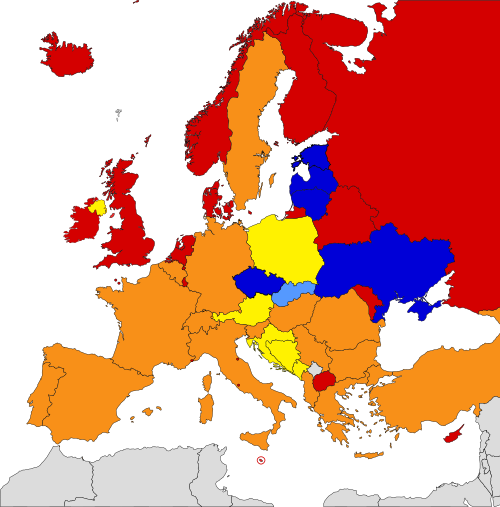
ボスニア・ヘルツェゴビナでは、ボスニア・ヘルツェゴビナ連邦とスルプスカ共和国という2つの自治組織が、ヨーロッパの他の地域と比べて比較的厳しい武器法を施行している。武器は武器弾薬法によって規制されている。[ 29 ] 21歳以上の人は許可を申請できる。犯罪歴、精神障害、アルコールや薬物の使用歴がある人は許可が却下される。また、徹底的な身元調査が行われ、近隣住民や家族にインタビューし、申請者は講習を修了し、多肢選択式の試験に合格する必要がある。最終的な決定権は警察にあり、警察署長に上訴することができる。銃器は住居内の「安全な場所」に保管しなければならず、所有者が「無責任」と判断された場合は警察によって没収される可能性がある。許可があれば隠し持ちも可能。催涙スプレーは、警察に登録すれば女性が携帯できる。

欧州連合およびEFTAにおける銃規制法は国によって大きく異なる。しかしながら、大きく分けて2つの傾向が認められる。ほとんどの国では銃器を主にスポーツ用具として扱っているのに対し、一部の国では銃器を主に個人または集団の安全のための道具とみなしている(オーストリア、チェコ共和国、ポーランド、バルト三国、フィンランドなど)。銃器の主な目的についてのこうした認識の違いが、各国の法律における扱いの違いにつながっている。[ 344 ]
EUおよびEFTA加盟国はすべて、指令(EU)2021/555を自国の法制度に導入する 義務を負う。この指令は、各国が満たさなければならない一定の銃規制基準を定めているが、同時に、各国の立法者はより厳格な規則を採用することもできる。
この指令では、銃器は、可燃性推進剤の作用によって弾丸、弾丸、または発射体を排出する、排出するように設計されている、または排出するように改造できる携帯可能な銃身付き武器と定義されています。[ 345 ]
2017年のEU指令改正以降、武器はEUの3つのカテゴリーに分類されている。
指令第5条に基づき:
第3条の規定を損なうことなく、加盟国は、正当な理由があり、かつ以下の条件を満たす者に限り、銃器の取得及び所持を許可するものとする。
- (a)18歳以上であること、(…)
- (b)本人または他者、公共の秩序または公共の安全に対する危険となる可能性が低いこと。暴力的な故意の犯罪で有罪判決を受けたという事実は、そのような危険性を示すものとみなされる。
(…)
オーストリアは、銃器が部分的にしか免許制になっていない欧州連合唯一の国です。武器法( Waffengesetz)は、銃器を含むあらゆる種類の武器に関する法的条件を規定しています。[ 347 ]法律第1条では、武器を、人が攻撃または自己防衛する能力を直接排除または減少させるように設計された物(例:ナイフ、催涙スプレー、ガスピストルなど)、または狩猟やスポーツ射撃中に発射体を発射するための物(例:クロスボウ、弓など)と定義しています。第2条では、銃器をさらに、発射体を所定の方向に銃身から発射できる武器と定義しています。最も一般的な銃器とその他の武器の一部は、3つの異なるカテゴリーに分類され、それぞれ異なる制限が適用されます。
カテゴリー A は、「戦争物資」と「制限武器」の 2 つのサブカテゴリーに分けられます。「戦争物資」には、例えば戦車、全自動武器、徹甲弾などが含まれます。「制限武器」には、他の物体に偽装された武器、狩猟やスポーツのために通常よりも素早く分解できる銃器、全長が 90 cm (35インチ) 未満または銃身の長さが 45 cm (18インチ) 未満のショットガン、ポンプアクション式ショットガン、消音器および消音器付き銃器、メリケンサック、ブラックジャック、鉄棒などが含まれます。カテゴリー B は、カテゴリー A に該当しないすべてのハンドガン、連発式ショットガン、半自動武器 (例えば、ピストル、リボルバー、半自動ライフル、半自動ショットガン) を対象としています。カテゴリー C は、カテゴリー A または B に該当しないその他のほとんどの銃器 (例えば、連発式ライフル、回転式ライフル、中折れ式ライフル、中折れ式ショットガン) を対象としています。
カテゴリー A、B、C のすべての銃器は、中央武器登録簿 (Zentrales Waffenregister、略称 ZWR) に登録されます。カテゴリー C の銃器は最も制限が少なく、18 歳以上のすべての市民は、銃器免許がなくても (購入者の武器禁止を確認するための 3 日間の待機期間を除く)、認可された販売者から購入できます。カテゴリー B の武器にはさらに制限があり、購入者は銃器免許または携帯許可証を所持し、18 歳に対する例外が認められない限り 21 歳以上でなければなりません。カテゴリー A の武器は通常、所有者に対してさらに例外が認められる必要がありますが、消音器と消音武器の場合は、有効な狩猟免許を持つ人は追加の許可なしで所持できます。「戦争物資」にはさらに特別な連邦許可が必要で、実際には承認された収集家と専門家にのみ許可されます。[ 348 ]一般的に、弾薬の販売は制限されていませんが、拳銃弾薬と一部のライフル弾薬には許可が必要です。 1871年以前に製造されたアンティーク銃器、多くの黒色火薬銃器、およびその他の「効果の低い武器」の一部も、免許や登録は不要です。
さらに、§ 11a では、亡命希望者および多くの第三国国民によるあらゆる武器および弾薬の購入、所持、携帯に関するさらなる制限が規定されています。許可なく武器を所有することは厳しく禁止されており、警察によって管理されています。[ 349 ]
一般的に、公共の場で銃器を携帯するには、携帯許可証(または「Waffenpass」)が必要です。携帯許可証は、理由と申請者に応じて、当局が発行する義務または許可する権利に基づいて発行されます。オーストリアの法律では、隠匿携帯と公然携帯の区別はありません。携帯許可証があれば、所持者は国内全域、さらには特定の「武器禁止区域」でも自由に武器を携帯できます。[ 350 ] [ 351 ]ただし、所持者は公共の迷惑にならない方法で武器を携帯しなければなりません。たとえば、私服を着て映画館でベルトに拳銃を公然と見せることは異常とみなされ、警察に通報された場合は公共の迷惑とみなされる可能性があります。[ 352 ]
ベルギーでは、銃器の所持や携帯は、ごく限られた例外を除き、一般的に違法です。ベルギーの銃規制法は、世界で最も厳しい部類に入ります。有効な銃器免許を所持している人は例外です。2006年のアントワープ銃乱射事件以降、銃所有者が免許を取得するには非常に厳しい条件と規則が設けられています。免許取得の法的理由には、スポーツ射撃、狩猟、収集、自己防衛などがありますが、自己防衛の免許はほとんど承認されません。銃器許可証の発行は、申請者が居住する州の知事の責任です。申請者は必ず理論試験と実技試験に合格し、犯罪歴がなく、武器の取り扱いに適格であることを証明する健康診断書を提出する必要があります。
銃を購入する際、ほとんどの場合、既に免許を持っている場合でも、銃器を登録するために「モデル4」と呼ばれる許可証を最初に申請する必要があります。この許可証の申請費用は約140ユーロ(2025年2月現在)で、毎年値上がりしており、待ち時間は最大4ヶ月です。ただし、この規則には例外があり、銃器を所持する理由によって異なります。例えば、.22LRセミオートマチックピストルはスポーツ射撃用にはモデル4許可証が不要ですが、狩猟用には不要です。リボルバー、センターファイアピストル、セミオートマチックライフル、ポンプアクションショットガンはすべて、常にモデル4許可証が必要です。モデル4を申請する際には、前述の理論試験と実技試験に合格したこと、犯罪歴がないこと、健康診断書を提出すること、認可された射撃場の会員であることを証明する書類を提出すること、そして同居する成人全員から銃器の所持に反対しない旨の書面による許可を得ることが求められます。[ 353 ]
しかし、狩猟者、スポーツ射撃者、コレクターのための銃器の携帯と所持、および銃の輸出入に関する法律と規制は、ベルギーの地域によって若干異なります。有効な免許はほぼ常に必要です。エアソフトガン、ペイントボールガン、および一部の空砲銃は許可や免許を必要とせず、自由に購入できます。無効化された銃も2019年以降は免許が必要です。ベルギーで免許なしで購入できる銃器は、1890年以前に製造されたもの、または黒色火薬のみを使用し、1895年以前に特許を取得し、1945年以前に製造されたもののみです。弾薬の所持は常に有効な免許を持つ人に限定されています。ベルギーは、弾倉も免許と登録の対象となるEU唯一の国です。[ 354 ]
ベルギーの銃規制法は、軍隊や警察などの法執行機関には適用されない(あるいは少なくとも異なる形で適用される)。2019年に廃止されるまでは、ベルギーの裁判所や刑務所移送の警備部隊(Corps de securité Justice/Veiligheidskorps Justitie)も拳銃の携行が許可されていた。
ベルギーでは、非常に厳しい法律と、免許取得のための長くて費用のかかる手続きのため、18歳以上の人が免許なしで射撃をすることは、年に1回、しかも認可された射撃場で厳重な監督下でのみ認められている。
クロアチアでは、自己防衛、狩猟、スポーツ射撃のための銃器許可証が発行されている。
また、すべての許可証には、申請者が18歳以上であること、犯罪歴がないこと、武器が悪用される可能性を示すその他の状況(例えば、アルコール依存症の既往歴など)がないこと、および健康診断に合格することが必要です。
2020年10月現在 クロアチアには99,829人の合法的な銃所有者がいる。14,711人が自己防衛のために銃を所有し携帯することができる。[ 355 ]
キプロス共和国は銃規制が厳格です。一般市民は、.22リムファイア弾を含むあらゆる口径の拳銃やライフルを所有することは完全に禁止されています。2 発までの散弾銃は、州警察が発行する許可証があれば所持できます。散弾銃は狩猟目的でなければならず、許可証を持つ市民は最大 10 丁の散弾銃(通常は二連式)を所有できます。弾薬を購入するには銃器許可証が必要で、1 回の購入につき最大 250 発まで購入でき、販売は記録されます。キプロスではエアガンも規制されており、エアガン所有者には許可証が必要です。自動火器の購入は違法ですが、軍は予備役に自動火器を支給しているため、徴兵により男性人口の大多数が自動火器を所持しています。[ 356 ]


チェコ共和国の銃規制法は欧州銃器指令に準拠している。[ 357 ]銃器の合法的な入手しやすさは、銃器を単なるスポーツ用具ではなく、主に個人または集団の安全のための道具とみなすEUおよびEFTA諸国(スイス、オーストリア、ポーランド、バルト三国、フィンランドなど)と同等である。[ 358 ] [ 359 ]
武器を所持し携帯する権利は、この国では自由の属性の一つとみなされている。これは銃器法第1条で明確に認められている。憲法レベルでは、基本的人権及び自由憲章が「法律で定められた条件の下で、武器を用いて自己の生命又は他人の生命を守る権利」を保障している。
銃器は、銃器所持許可を取得すれば、居住者であれば誰でも入手できます。銃器所持許可は、運転免許証と同様の方法で取得できます。つまり、技能試験(チェコ語のみ)、健康診断に合格し、犯罪歴がないことが条件です。他のほとんどのヨーロッパ諸国とは異なり、チェコの銃器法では、市民が自己防衛のために隠し武器を携帯することも許可されています。2023年12月31日までに、316,859人の銃所有者のうち260,027人が隠し銃器の携帯を許可されました。[ 360 ]チェコの銃所有者が銃器を所有する最も一般的な理由は護身であり、狩猟やスポーツ射撃はそれほど一般的ではありません。[ 361 ]さらに、人々は私有の銃器を持って政府公認の高度な射撃訓練コースに参加し、民兵のような指定予備役のメンバーになることができます。[ 362 ]
チェコにおける民間人の銃器所有の始まりは1421年に遡り、フス派が銃器を主要な武器として初めて使用したことに始まる。銃器は、宗教の自由と政治的独立をめぐる戦争において、主に平民からなる民兵にとって不可欠な道具となった。銃器の所有は、フス戦争中および戦後を通じて一般的になった。「あらゆる身分のすべての人々 」が武器を所持する普遍的な権利は、 1517年の聖ヴァーツラフ協定で正式に確認された。600年にわたる歴史の中で、チェコの銃器法は、ドイツのナチス占領時代と共産主義政権時代を除いて、寛容なままであった。
英語のピストルという用語は、15 世紀のチェコ語に由来します。[ 363 ]ウスティ・ナド・ラベムのマリアンスカー・スカーラは、1617 年に設立されたヨーロッパ最古の継続的にオープンしている射撃場です。[ 364 ] [ 365 ]
デンマークでは、16歳以上の一般市民は狩猟またはスポーツ射撃用の銃器免許を取得できます。これには、筆記試験(多肢選択式)と実技試験に合格する必要があり、その後、認定された狩猟免許教官が申請者が武器を所有するのに適しているかどうかを判断します。通常、申請者に犯罪歴がないか、ごく軽微な犯罪歴しかない場合に免許が交付されます。
狩猟免許があれば、12ゲージまでのショットガンを無制限に店頭で購入・所有できます。これらのショットガンは、デンマーク国内での狩猟に使用する場合は最大2発、訓練用またはデンマーク国外での狩猟に使用する場合は最大10発まで装填できます。その後、オンラインフォームを通じて警察に新しい武器の購入を通知する必要があります。ボルトアクションライフルも店頭で購入できますが、警察からライフル免許を取得する必要があります。許可されている口径は最小から.50 BMGまでですが、.50 BMGは含まれません。セミオートライフルは、ショットガンと同じ条件で装填制限が適用されます。デンマーク国内での狩猟に使用する場合は2発に制限され、訓練用またはデンマーク国外での狩猟に使用する場合は最大10発まで装填できます。現在、狩猟用セミオートライフルは、クラス1の狩猟対象動物(ダマジカ、イノシシ、アカシカなど)の法的要件を満たす必要があるため、 .308ウィンチェスター、6.5 × 55、.300ウィンチェスターマグナムなどの大口径のみが承認されています。これらの動物には、弾丸の最小直径が6mm(.236インチ)、衝撃エネルギー(E100)が2000ジュール以上であることが求められます。そのため、.223レミントン/5.56×45などの小口径は 一般 的に承認されていません。狩猟者は、狩猟を行う前に、散弾銃またはライフル銃の射撃試験に合格する必要があります。
スポーツ射撃では、散弾銃のほか、.50 BMG以下の口径のボルトアクションライフルも使用できます(.50 BMGは除く)。スポーツライフルは、.22 LRや6.5 × 55 mm弾を使用するものが多いです。セミオートマチックライフルはスポーツ射撃では使用できません。
拳銃: 射撃クラブに 2 年間在籍した後、拳銃許可証を申請できます。許可証は身元調査と警察の承認が必要で、申請者は 20 歳以上でなければなりません。 承認された口径: 9mm 未満のすべての口径 (9 × 19、.38 スペシャル、.357 マグナム、.32 ACP など)、および限られた数のより大きな口径。.40 S&W、.45 ACP、.44 スペシャル。 拳銃の最大数は .22 口径で 6 丁です。 3 丁目の銃を申請する場合は、司法省からの特別許可証が必要です。 大口径の銃、つまり .22 口径より大きい銃は、同じ口径で最大 2 丁に制限されています。したがって、 9mm の拳銃は、 一度に 2 丁しか所有できません。ただし、 これらがリボルバーであれば、9mm の拳銃をさらに 2 丁所有することは合法です。すべての拳銃は、口径に関係なく、整形外科用グリップや取り外し可能な部品を除いた状態で、全長が少なくとも210ミリメートル(8.3インチ)でなければならない。
スポーツ目的の武器許可証(長銃・短銃両方)は5年ごとに更新する必要があります。狩猟用ライフル銃の許可証は10年ごとに更新する必要があります。散弾銃は個別の許可証では所有できません。有効な狩猟免許を所持している限り、散弾銃を所有することができ、狩猟免許の有効期限が切れた後も最長10年間は所持できます。ただし、有効な免許なしに弾薬を所持することはできません。
デンマークの銃器法では、拳銃や回転式拳銃、半自動式および全自動式の銃器は特に危険な武器(særligt farlige våben)に分類されます。これらの銃器を取得または所持するには、個人は20歳以上で、当局から「特に信頼できる」(særlig pålidelig)と評価される必要がありますが、免許を持つ狩猟者は半自動式散弾銃を取得する際の年齢要件から免除されます。
公共の場で銃器を携帯することは厳しく禁止されていますが、正当防衛の概念は存在します。人は、差し迫った重大な危害の脅威から身を守るために、必要かつ適切な力を行使することができます。極端な場合、より穏やかな手段では不十分な場合には、致死的な力を行使することも認められます(例えば、死や重傷の差し迫った脅威に直面した際に銃器を使用する場合など)。
全自動火器は、法務省が発行する特別許可がない限り、民間での使用は禁止されている。こうした許可は極めて稀であり、通常は警察や軍隊と協力関係にある、あるいは警察や軍隊に物資を供給する個人または企業にのみ与えられる。
デンマーク郷土防衛隊の隊員は、特定の条件下では、支給された制式武器(全自動)を自宅に保管することができる。ただし、そのような武器は軍の管理下に置かれ、私有物とはみなされない。
銃器の不法所持は、1年以上の懲役刑に処せられる可能性があります。一般市民は、拳銃、リボルバー、ショットガン、ライフルなどの私有武器を自宅に保管することができます。[ 366 ]これらの銃器とその弾薬は、承認された銃器保管庫(EN1143-1 グレード 0 以上)に保管しなければなりません。[ 367 ]警察は、射撃クラブの武器を独自の裁量で検査することができますが、私有の銃器を検査するには裁判所の命令が必要です。[ 368 ]
エストニアは、免許の発行を義務付ける国です。身元調査、医師の承認、筆記試験と実技試験、および銃器講習が義務付けられています。講習は民間団体(法執行機関ではない)によってのみ提供され、法執行機関が実施する国家試験と同様に、エストニア語で実施されなければなりません。[ 369 ]以前は通訳が許可されていましたが、2022年のロシアによるウクライナ侵攻の結果、多数のロシア系住民が免許を申請したため変更されました。[ 370 ]国家試験に合格すると(試験を受けるには既に以前の要件を満たす必要があります)、免許は申請に応じて発行されなければならず、その後、法執行機関は、後日(重罪を犯すなど)の理由で免許が無効にならない限り、最終的な決定権を持ちません。[ 369 ]
フィンランドにおける銃器の所有と使用は、1998年制定の銃器法によって規制されています。銃器は地方警察によって個別に許可され、個人が所持できる許可証の数に制限はありません。許可証は、レクリエーション、展示、または(特定の状況下では)職業上の使用のために発行されます。特定の種類の銃器が明示的に禁止されているわけではありませんが、許可証は正当な理由がある場合にのみ発行されます。自己防衛は許可証の正当な理由として認められません。一般的に、これは狩猟用銃器とスポーツ用銃器以外のすべての銃器を職業以外での使用から除外します。全自動銃器は一般的に許可されていません。法執行機関を除き、特別に訓練された警備員のみが、装填済みの銃器を公共の場で携帯することができます。
2007年、フィンランドは世界で3番目に高い銃所有率(米国とイエメンに次ぐ)[ 371 ] 、ヨーロッパでは1位[ 372 ]であった。フィンランド人は狩猟を実践しており、2007年時点で、フィンランドには登録された武器が160万丁あり、銃器許可証を持つ人は65万人、つまり人口の12%に上る。同年11月、フィンランドは20人が死亡した2件の学校銃乱射事件を受けて銃規制法を改正し[ 373 ]、15~18歳が独自の許可証を持つ権利をなくすことでEU指令を遵守した。既に許可されている武器について、許可証保持者の許可を得て二重許可証を作成する可能性は認められた(例:親の許可)。2011年、憲法委員会は、20歳以上の人は半自動拳銃の許可証を取得できると結論付けた。個人は、その前の2年間、拳銃スポーツグループで継続的に活動していることを証明する必要がある。[ 374 ]
1563年、フランス国王シャルル9世はルーアン議会で銃器禁止に関する演説を行い、その中で次のような発言をした。
フランスでは、無煙火薬銃を購入するには狩猟免許またはスポーツ射撃免許が必要です。2015 年 9 月、銃器は、その所持と使用に適用される規制を定める 4 つのカテゴリーに分類されました。[ 376 ]カテゴリー D の銃器には、1900 年以前に設計された黒色火薬銃器と、2 ~ 20 ジュールの圧縮空気銃器が含まれ、18 歳以上の市民であれば誰でも購入できます。カテゴリー C の銃器は、狩猟免許またはスポーツ射撃免許と健康診断書で取得できます。カテゴリー C には、主に銃身ごとに単発のショットガンと、単発または手動の連発ライフル (狩猟または標的射撃用のセンターファイアライフルを含む) が含まれます。合法的に購入されたこれらのカテゴリー C の銃器は、狩猟またはスポーツ射撃の免許がなくなった後でも、使用せずに保管することができます。
カテゴリー B の銃器は、少なくとも 6 か月の免許を取得し、健康診断書を所持し、重罪の有罪判決を受けておらず、さらに 2 か月間隔でインストラクターによる射撃セッションを 3 回以上受講したスポーツ射撃者のみが購入できます。その後、地元の警察署から購入および所持の特別な許可を申請することができ、これは 5 年間有効で、更新可能です。このような武器は、射撃場でのスポーツ射撃にのみ使用でき、狩猟には使用できません。カテゴリー B には、AK-47 / AKM、AK-74、AR-15 / M16 / M4 などのすべてのアサルトライフル、およびリムファイアカートリッジ(.22 LR)用の類似武器が含まれます。これらはセミオートマチックのみでなければなりません。リムファイア弾薬を使用するものを含むすべてのハンドガンは、カテゴリー B に分類されます。更新されていない特別な許可の有効期限が切れた後、これらのカテゴリー B 武器を所持することは違法です。武器は処分しなければなりません (銃砲店に売却するか、破壊するなど)。認可は、認可の発行に関与する当事者(政府、県、警察)のいずれかによっていつでも取り消される可能性があります。
ピストルを含むエアガンは、エネルギーレベルが20ジュール(以前は10ジュール)を超えない限り、カテゴリーDの武器として成人が自由に購入できます。一般的なエネルギーレベルは、ターゲットピストルで6ジュール、ターゲットライフルで7.5ジュールです。スコープ付きのフィールドターゲットライフルは、15ジュールまたは16ジュール(FT競技で許可されている最大エネルギー)のエネルギーを発生させる可能性があります。非金属製のペレットを発射し、エネルギーが2ジュールを超えないエアソフトガンは、武器ではなくおもちゃとみなされるため、銃器規制の対象外です。
また、最大容量75gまでのカテゴリーDの護身用催涙スプレーは自由に購入できます。これより大きい容量のスプレーは、護身用ではなく攻撃用武器とみなされ、カテゴリーBに分類されるため、特別な許可が必要です。
個人が所有できるセンターファイア式銃器は12丁までで、銃器1丁につきマガジンは10個まで、弾薬は1,000発までと定められています。生命に重大な危険にさらされている人には、最大50発の弾薬を装填した拳銃を携帯できる1年間の携帯許可証が発行される場合があります。ただし、州は通常、このような場合には警察による警護を義務付けるため、このような許可は極めて稀です。2015年11月以降、警察官は非番時にも勤務用武器を携帯することが認められています。
Gun ownership in Germany is restrictive, being regulated by the Federal Weapons Act (German: Waffengesetz) of 1972.[377] The laws apply to weapons with a fire energy exceeding 7.5 J. A firearms license may be granted to those over the age of 18 who have no criminal convictions or mental disability, who are deemed reliable and can justify a reason for owning a firearm. A separate license is required for each firearm owned. Target-shooters must have been a member of a shooting club with 18 recorded visits in the previous 12 months. A firearms carry permit is a second-tier license which allows concealed carrying in public, and is only issued to those with a particular need.
Several weapons and special ammunitions are completely prohibited, such as automatic firearms. Buying, possessing, lending, using, carrying, crafting, altering and the trading of these weapons is illegal and punishable by up to five years imprisonment, confiscation of the weapon and a fine of up to €10,000. Using an illegal weapon for crimes of any kind is punishable by 1–10 years imprisonment.
Germany's National Gun Registry, introduced at the end of 2012, counted 5.5 million firearms legally owned by 1.4 million people.[378]
Greece has gun regulations in place. Shotguns (limited to a 3-round capacity), rifles and handguns require a license issued by Police Headquarters. A license may be issued to a Greek citizen over the age of 18 if: a) there are serious fears about his or her personal security along with a positive recommendation by the Prosecutor and b) it is required for the safety of shops, banks, other financial institutions, etc. To purchase handguns and rifles, citizens must either have a concealed-carry permit or a target-shooting permit (for rifles and pistols). Semi auto rifles are not prohibited since the beginning of 2023. Hunters can own up to 10 shotguns and rifles (with no gun barrel rifling) and sport shooters can own up to 8 guns. There is no license-check or record kept for ammunition purchases for shotguns but target shooters can only own 1000 rounds per weapon, 3500 in total.[379]
Gun laws in Hungary are relatively strict, regulated by Code 24/2004,[380] governmental decision 253/2004. (VIII. 31.)[381] and directive of the Minister of Internal Affairs 49/2004. The law defines a firearm as having muzzle energy that exceeds 7.5 joules (5.5 ft⋅lbf). A firearms license may be granted to those over the age of 18 who have no criminal convictions or mental disability, and have passed a basic firearms theory/practical examination. Three categories of firearms ownership are allowed: Hunting (Firearms restricted to bolt action rifles and double barrel shotguns), Sports shooting (only restriction is no fully automatic firearms), Self defense (special permission from the Police, very rarely granted in special cases e.g. gun shop owners). Sports shooting has in recent years gained popularity with the number of sports category licenses being issued steadily climbing. Government initiatives to popularize shooting sports such as building shooting ranges and introducing shooting as a sport in the schooling system has slowly begun. It is generally expected that obtaining (and keeping) a firearms permit is a slow and somewhat costly process, but once a permit is granted and the necessary yearly memberships are paid, yearly doctors certificates are obtained and the mandatory 2–3 sporting events are attended (for sports shooter) ownership is fairly liberal as to the type of firearm one can own.
In 2010, there were 129,000 registered gun owners (1.3% of the population) in Hungary with 235,000 firearms. The majority of these were hunting rifles. Gun violence is very rare in Hungary. Crime with firearms is very rare and this statistic usually includes crimes committed with non-lethal "pepper spray" guns. Police use lethal force with a firearm less than 10 times per year, on average.[382]
In Iceland, a license is required to own or possess firearms. A national government safety course must be passed before applying for a license. A special license is required to own a handgun, which may only be used for target shooting at a licensed range. Semi-automatic firearms have caliber restrictions, while fully automatic firearms are only permitted for collectors.
Applicants must sit through a mandatory four-hour lecture on the "history and physics of the firearm".[383] Paperwork must be filed in the police, magistrate, and the Environment Agency of Iceland. Applicants need to prove clean criminal records, need to be evaluated by a doctor to prove they "are of sound mind" and have "good enough eyesight". Two books referring to guns must be bought and read, a three-day course must be attended, and the applicant should score at least 75% on exams concerning gun safety, management, "what animals are allowed to be hunted and when. Finally, a practical exam must be taken. After Icelanders have their license, they need to own a gun safe to store the weapons in, plus a separate place to store the ammunition".[384]
Approximately one gun is owned for every three people in the country, being used mostly for hunting and competitive shooting.[383] From January to July 2019, 394 shotguns, 785 rifles, and 208 handguns were registered in Iceland. In total, police counts for guns in Iceland include about 40,000 shotguns, 25,000 rifles, and 3,600 handguns as of July that year.[384]
Gun laws in Ireland are strict, requiring all firearms to be licensed individually through the Gardaí (police). Applicants must be 16 years of age and have a good reason for ownership, a secure location to store firearms, proof of competency with the firearm or arrangements to achieve such, provide access to medical records and two character references, and be of sound mind and temperate habits. Applicants convicted of certain specified offenses will be denied a firearms certificate. Personal protection is not a valid reason for ownership.
Irish firearms law is based on the Firearms Act 1925,[385] which was amended by several following acts in 1964,[386] 1968,[387] 1971,[388] 1990,[389] 1998[390] and 2000.[391] The cumulative effect of these modifications, along with modifications in other acts and confusion over which amendments applied, resulted in a 2006 Irish Law Reform Commission recommendation that all extant legislation be restated (written in a single document with all prior Acts repealed).[392] However, the Criminal Justice Act 2006,[393] contained a rewriting almost 80% of the Firearms Act. It was quickly followed by amendments in 2007[394] and further major amendments in 2009,[395] exacerbating the legislative confusion. As of 2014, the Law Reform Commission recommendation has not as yet been fully enacted; the Firearms Act consists of the initial 1925 Act amended by approximately twenty separate Acts and is well understood by only a handful of those directly involved in its drafting, amendment or usage. Extensive complaints have arisen over the application of the legislation, with several hundred judicial review cases won in the High Court and Supreme Court by firearms owners, all relating to licensing decisions which had not adhered to the Firearms Act.
In Italy, national police issues gun licenses to those over the age of 18 without criminal record, who are not mentally ill or known to use illicit substances, and who can prove competence with firearm safety. A shooting sports license allows to transport unloaded firearms and firing them in designated shooting ranges. A hunting license allows holders to engage in hunting with firearms. A concealed carry license allows a person to carry a loaded firearm in public, and requires proving a "valid reason" to do so (e.g. a security guard or a jeweller at risk of robbery). All weapons must be registered within 72 hours from the moment of purchase. The number of firearms an individual may own and retain at the place declared during registration is limited to:
The last two can be purchased in an authorized firearm shop by anyone who can prove to be at least 18 years old, without the need for a license. The carrying of such weapons is forbidden without a licence and no registration is required (Art. 7 c.4 DM 362/2001).[396] These limits can be exceeded with a collector license.
Ammunition: any licence allows the owner to keep 200 rounds of handgun and 1500 rounds of hunting ammunition or up to 5 kg of gunpowder (smokeless or black) to handload cartridges. Registration is required within 72 hours from acquisition for all ammunition and powder. Registration is not to be repeated if ammunition and powder are used and then bought again, unless the original quantity registered is being exceeded with the new purchase. Smoothbore cartridges not loaded with slugs but instead with shot (regardless of its size) can be owned without registration if the number possessed is inferior to one thousand.
In Luxembourg, anyone wishing to purchase, possess or use a firearm must hold a permit issued by the Minister of Justice in person.[397]
The most common reasons for applying for a permit are hunting, recreational shooting, weapons collecting, and inheriting a firearm. Anyone who inherits a firearm must have a permit even if they have no intention to ever touch or use the gun.[397]
Self-defence is not a valid reason for owning a firearm. However, the Ministry of Justice is concerned that some permit holders falsely cite another reason (such as recreational shooting) as a justification for acquiring their permit when their sole actual motivation is self-defence.[398]
Firearms are allowed in Malta for sport shooting, collection and hunting purposes. To get firearm license one must join a shooting or collectors club for training, which will issue a recommendation letter for the police, after which applicant must pass knowledge of firearm safety and the Arms Act. After successfully completing every step one will get license.
There are 102,610 registered firearms (or 22 per 100 people), including 56,000 shotguns, 10,553 pistols, 7,856 rifles, 5,369 revolvers, 501 machine guns, 477 sub-machine guns, 633 combat shotguns, 22 cannons, 7 humane killers and 2 rocket launchers.
Law allow carrying firearms while hunting, with 10,544 licensed to do so on land and 247 on sea.[83] Carrying loaded firearms outside of hunting grounds or shooting range is illegal. Automatic firearms are allowed only if they were produced before 1946.
In the Netherlands, gun ownership is restricted to hunters, collectors and target shooters.[399] People with felonies, drug addictions, and mental illnesses may not possess firearms.[400] To be a collector one has to limit oneself to a specific area of expertise and demonstrate a serious and thorough knowledge of that area, for instance through publications or lectures.
Once obtained, firearms must be stored in a safe and are inspected annually by the police (every 3 years when over 25). Legally owned firearms may only be used in self-defence as a last resort.[401][402]
Firearm ownership in Norway is controlled by laws passed by the Norwegian Parlament,[403] with further regulations passed by the Ministry of Justice and Public Security.[404] The National Police Directorate can issue government circulars with further in depth definition of how the firearm regulations should be interpreted (by the police).
The Norwegian police can issue firearms licenses to those with a hunting license or members of a sports shooting club. They can also issue licenses to Norwegian historical weapons society collectors,[405] museums, international ship and port facility security and more.
Hunters can own up to 8 firearms, and sports shooters can own up to two firearms per approved shooting disciplines as defined by The National Police Directorate.[406] The purchase of ammunition is restricted to those with a valid firearms license for any given calibre.
Long guns must have a minimum barrel length of 40 centimetres and an overall length of 84 centimetres when operable. Rifles are restricted to 10-round magazines, shotguns to 5 rounds, and pistols to 20 rounds per default. Detachable box magazines for semi-automatic shotguns are prohibited.
Hunters can own semi-automatic and manually loaded rifles and shotguns. Semi-automatic rifles for hunting shall only accept detachable 10-round magazines or smaller ones. They must also have the visual appearance of a "hunting rifle" (i.e. no detachable pistol-grip, or handguard that covers the top half of the barrel).
Sports shooters can own semi-automatic and manually loaded rifles, shotguns and pistols. Sports shooters can apply for unrestricted magazine capacity for each firearm used in an approved sports shooting discipline. However, in practice, it is only approved for rifles and pistols.
Civilians are not permitted to transport/carry firearms loaded or in a manner that allows for easy access in public places, effectively prohibiting any form of concealed or open-carrying of firearms. Moreover, self-defence is not a valid reason for having a firearms licence issued. Firearms licences are only issued for hunting and sporting (or other speciality purposes not generally applicable to ordinary civilians).
Gun ownership in Poland is regulated by the Weapons and Munitions Act of 1999 as further amended.[407] A permit is required to own or possess firearms. Permits are granted for specific purposes, such as self-defense, sport, hunting, collecting etc. and are shall issue except the ones for self-defense, which are may issue. Institutional permits allow for firearm ownership by private security companies, shooting ranges, sport clubs etc.
Permits are issued to permanent residents over 21, not addicted to alcohol or other substances, having no criminal record, being in good physical and mental health, who passed an exam before sporting association, hunting association or the Police. Permits specify the purposes, categories and quantities of allowed guns; categories depend on permit purpose while quantities are assigned at the discretion of the Police, based on documentation provided. Quantities can be increased when one uses up all available slots.
Carrying loaded guns is allowed on all types of permits except permits for collecting and memorial purposes. Hunters can carry loaded only on hunting grounds. Guns shall be carried concealed in a holster close to the body.[408] Carrying in public transport is limited only to self-defense permit holders.[409] It is prohibited to carry while intoxicated, and when attending public gatherings or mass events.
Everyone, including foreigners, is allowed to use legal guns at registered shooting ranges, regardless of actual gun's ownership, e.g. rented from the range or shared by a legal owner present. Discharging a firearm for training or leisure out of a registered shooting range (even on a large private property) is prohibited.
Full-auto or select-fire firearms are permitted only on institutional and training permits. Since 2020 the Police can issue permits for firearms with suppressors for hunting, but only to be used for sanitary shootings, see main article for details. Armor-piercing, incendiary, tracer and other special ammunition is banned. Only valid permit holders are allowed to buy or possess live ammunition, and only of the types exactly matching the guns they legally own. The quantity of matching ammunition in possession is not limited. Hunters, collectors and sport shooters are allowed to manufacture (reload) ammunition, but strictly for their own use. There are further limits regarding allowed types and calibers depending on the purpose of the permit – see main article for details. There are no limits of magazine capacity, except when hunting.
Replicas of cartridgeless black powder firearms designed before 1885 require no permit to own. However, a separate bill of law allows businesses to sell black powder to licensed customers only.[410] This is often circumvented by obtaining a European Firearms Pass for a black powder firearm, asking a licensed colleague (there are no restrictions of private sale or just giving out of black powder) or by buying powder in neighboring countries, mostly the Czech Republic.
Air guns up to 17 Joules of muzzle energy are unregulated. Air guns above that limit are considered pneumatic weapons, no permit is required but the owner has to be 18 and has to pass medical and psychological evaluation as for firearms permit; guns must be registered with the Police and may be used only on registered shooting ranges. Use of pneumatic weapons outside of shooting range is considered the same kind of offense as using firearms.
Some other weapons are restricted and require a permit, such as electroshock weapons with mean current greater than 10 mA, large pepper spray dispensers, crossbows, specific kinds of batons, brass knuckles and nunchakus, however ban on nuchakus is not enforced.
Gun ownership in Romania is regulated by Law 295/2004.[411] Romania has one of the toughest gun ownership laws in the world.[412] In order for citizens to obtain a weapon, they must obtain a permit from the police, and must register their weapon once they purchase it. There are several categories of permits, with different requirements and rights, including hunting permits, self-defense permits, sports shooting permits and collectors permits. The only categories of people who are legally entitled to carry a weapon are owners of self-defense permits, magistrates, MPs, military forces and certain categories of diplomats. A psychological evaluation is required beforehand in all cases.
Furthermore, knives and daggers may in certain conditions (blade longer than 15 cm and at least 0.4 cm in width, double edge along the whole blade, etc.) be considered weapons and have a similar regime to those of firearms.
In order for a hunter to obtain a hunting/gun ownership license, he must spend a certain "practice time" with a professional hunter. To obtain a self-defense permit, one must be under witness protection. Sporting and collectors licenses require membership in a sport shooting club or collectors' association, respectively.
The amount of ammunition that can be owned is regulated by permit type. Sporting permits allow the ownership of 1,000 matching cartridges per gun; hunting permits allow 300 matching cartridges per gun; self-defense permits allow 50 bullet cartridges and 50 blanks per gun; Collectors permits do not allow for private ownership of ammunition.[413]
Explosive weapons and ammunitions, fully automatic weapons, weapons camouflaged in the shape of another object, armor-piercing ammunition and lethal weapons that do not fit in any category defined by the law are prohibited.
The type of gun is also regulated by permit. Below is a shortened version of the table detailing the restrictions by type of lethal weapon and permit, for civilian owners. Note that for collectors, short weapons designed after 1945 are forbidden, while only non-lethal weapons are allowed for self-defense permits.[414]
It is illegal to use or carry weapons with a muzzle velocity of over 10 kJ if "the barrel is fitted with devices conceived or adapted to reduce recoil"[415]
Gun ownership in Slovakia is regulated principally by law 190/2003 (law of weapons and ammunition).[418] A firearms license may be issued to an applicant at least 21 years of age (18 years for category D if they own a valid hunting permit, 15 years for state representative in sport-shooting), with no criminal history, and of sound health and mind, who has a valid reason for owning a gun, passes an oral exam covering aspects of gun law, safe handling, and first aid.[419]
Licenses are issued in 6 categories:
A concealed carry license is only issued if the police deem a sufficient justification. Because of that issue of this license is may-issue in practice, and vary across Slovakia by stance of individual police department issuing licence. It is kind of similar to California, some department is almost shall-issue, another need true sufficient reason (like a constant more than average threat, previous assaults on applicant, transports of money, former service in army or law enforcement, legal awareness of applicant, clientelism). Only about 2% of the adult population holds this license.[420][421][422]
There is an exception for non-repeating muzzle-loaded firearms, which may be purchased without a license.
Gun ownership in Slovenia is regulated under the "Weapons Law" (Zakon o orožju) which is harmonised with the directives of the EU. Gun permits are issued to applicants at least 18 years old, reliable, without criminal history and who has not been a conscientious objector, who passes a medical exam and a test on firearm safety. A specific reason must be given for gun ownership: for hunting or target shooting, the applicant must provide proof of membership in a hunting or sports shooting organization; for collection, the applicant must arrange safe storage with a level of security dependent on the type of weapons; for self-defense, the applicant must prove a risk to personal safety to such an extent that a weapon is needed.
As in most EU member states, the ownership of Category A firearms is prohibited; however these can be owned by weapon collectors, providing that requirements are met. Suppressors are legal and unregulated since 2021. Firearms must be stored in a locked cabinet with ammunition stored separately. Concealed carry is allowed in special circumstances. A gun permit is also required for airguns with muzzle velocity greater than 200 m/s (660 ft/s) or energy of 20 joules (15 ft⋅lbf).[423]
Firearm regulation in Spain is restrictive, enacted in Citizen Security Protection Organic Act of 2015 and the Weapons Regulation (Royal Decree 137/1993). Both laws are covered by article 149.1.26.ª of the Spanish Constitution, which attributes to the State the exclusive competence in terms of the "regime of production, trade, possession and use of weapons and explosives".
A firearm license may be obtained from the Guardia Civil after passing a police background check, a physiological and medical test, and a practical and theoretical exam. Shotgun, rifle and sporting licenses must be renewed after 5 years, subject to firearm inspection. Sporting licence requires to present proof of sporting activity of at least one competition each year. A minimum score may be required for some categories. Police may inspect firearms at any time. A self-defense and concealed carry license must be renewed every year, and is only available under special conditions.
A license-holder may own up to 6 shotguns, and unlimited rifles. With a sporting license, valid for 5 years, 1 to 10 handguns may be owned, depending on sports-shooting level. Magazine capacity for semi-automatic centerfire rifles and semi-automatic shotguns is limited to 10 rounds for sports shooting and 2 rounds for hunting. Handgun magazines are limited to 20 round capacity. Rimfire rifles, regardless of type have no magazine limit. Rifles chambered for certain cartridges with military origins are prohibited, such as .223/5.56 NATO and .50 BMG. The .308 Winchester and 7.62x39 mm (AK round) cartridges are only permitted in bolt-action, repetition or single-shot firearms. Proof of ownership of an approved safe is required for all centerfire rifles and handguns, and the owner is responsible for firearm thefts. Ammunition must be stored separately. Rifle and handgun ammunition may only be possessed for legally owned firearms, and purchases and possession is limited to 200 rounds rifle and 100 rounds for handguns. In addition, there are yearly limits in quantity (1000 for rifles,100 for handguns); however additional quantities can be petitioned, mainly for sporting use. For shotgun Ammunition, adults with a valid ID can purchase/possess up to 5,000 shells and there are no yearly limits in quantity. License-holders are only allowed to transport their unloaded firearms from their residence to the shooting range or hunting field and back, with no detours. Firearms may only be discharged at approved shooting ranges or hunting grounds (in season).
There are firearm license for private security for handguns and rifles. These cannot be used outside of work and must be stored in the workplace premises (with approved safe).
In addition there are handgun license for self-defense in concealed carry. However, this is granted on a "may issue" basis with several standards of necessity to be met and very few are granted. This license must be renewed annually and is not automatic.
Members of police forces and officers and non-commissioned officers of the armed forces have a special firearms license which encompasses all of the others. There are additional licenses for collectors and muzzle-loading firearms.[126][127][424]
Gun ownership in Sweden is regulated by Vapenlagen 1996:67 (literally, The Weapon Law),[425] modified by weapon decree Vapenförordningen 1996:70[426] and FAP 551-3 / RPSFS 2009:13.[427] The police issue licenses to persons older than 18 years in good standing on the "need to have" basis, which generally implies either hunting or sport shooting. Passing a hunting examination or membership in an approved sport shooting club for six months is required. Sport shooting licenses must be renewed every 5 years, whereas hunting licenses are valid for the lifetime of the holder. License-holders may lend a weapon to a person at least 15 years of age for supervised use.
A separate license is required for each particular firearm or caliber conversion kit. There's no codified limit on the number of licenses a person can hold, but in practice a license-holder may own up to six hunting rifles, ten handguns, or a mix of eight rifles and handguns. Firearms must be stored in an approved safe. A firearm registered for hunting may be used for sport shooting, but not vice versa. In 2023, previous restrictions on hunting licenses for semi-automatic firearms based on appearance or military origin were lifted, and as a result the only remaining restrictions specific to hunting are a minimum total weapon length exceeding 60 cm and magazine size on semi-automatic rifles and magazine-fed shotguns.[428] Licenses for fully automatic weapons are not generally issued, with limited exceptions for collection and sport shooting using the WWII era m/45 submachine gun.
Starting 1 July 2022, suppressors no longer require a separate license and can be freely acquired by anyone with a valid gun license and can be legally used both for hunting and target shooting.[429]
Self-defense with firearms, as well as carry, is generally prohibited. Carry permits can be issued by the police under very special circumstances like an immediate and demonstrable threat to life. Transportation of unloaded firearms is allowed to and from approved shooting ranges or hunting grounds. Sweden is notorious for having even pepper spray and other nonlethal self-defence methods under its weapons law with similar legal punishments for misuse.[430]
Firearm collectors must have a clearly stated demarcation of their interest in collecting (e.g.: pre-World War II British handguns). The police may demand security measures on keeping the collection. Collectors may request a time-limited permit to discharge their weapons. Firearms manufactured before 1890 and not using sealed cartridges are exempt from the weapon law.[431]
Firearm regulations in Switzerland are comparatively liberal.[432] Swiss gun laws are primarily about the acquisition of arms, and not ownership. As such a license is not required to own a gun by itself, but a shall-issue permit is required to purchase most types of firearms. Bolt-action rifles do not require an acquisition permit, and can be acquired with just a background check.[433]
The Swiss have male conscription for military service.[434] A 2011 referendum to force military weapons to be kept at military sites was defeated.[435] Weapons may voluntarily be kept in the local armory and there is no longer an obligation to keep the weapon at home.
The Swiss "Federal Law on Arms, Arms Accessories and Ammunitions" (WG, LArm) of 20 June 1997 has as its objectives (Article 1) to combat the wrongful use of arms, their accessories, parts and ammunition. It governs the acquisition of arms, their introduction into Swiss territory, export, storage, possession, carrying, transport, and brokerage. It regulates the manufacture and trade in arms, and seeks to prevent the wrongful carrying of ammunition and dangerous objects. Article 3 states that "The right to acquire, possess and carry arms is guaranteed in the framework of this law".[436][437]
In Georgia, civilians above 18 years of age may obtain a firearm permit from the Ministry of Internal Affairs, allowing them to purchase and keep firearms for hunting and sports (pump-action shotguns, hunting rifles, carbines, combined hunting firearms), self-defense (handguns, air guns, sprays, electric tranquilizers) or collections. Permits are denied to persons who are mentally ill, use illicit substances or alcohol recreationally, and those who have criminal records.[438]
Kazakhstan has strict gun laws, heavily regulating civilian firearm ownership. Only shotguns and hunting rifles are generally permitted for civilians, while handguns and automatic weapons are prohibited. To own a firearm, individuals must be at least 18 years old (21 for some weapons), pass a background check, undergo medical and psychological evaluations, and complete firearm safety training. Guns must be stored securely, and carrying them in public is restricted. Self-defense firearms, such as non-lethal weapons (e.g., rubber-bullet guns), are allowed under specific conditions. The government maintains strict oversight, with periodic license renewals and inspections.
As of 2016, there were about 284,000 (or 1.6 per 100 people) registered firearms in Kazakhstan according to the government data.[439]
Law in Monaco divides firearms into two categories:[440]
To obtain a firearm license in North Macedonia one must be at least 18 years old, able-bodied, healthy, not representing danger to public order, have permanent residency, possess technical knowledge of weapons and regulations related to them and have a justified reason for acquiring the weapon. Justified reasons include:
Fully automatic firearms are prohibited. Carrying firearms in public places is prohibited.
North Macedonia has its own defense industry with ATS Group,[441] Eurokompozit Prilep
Russian citizens over 21 years of age can obtain a firearms license after attending gun safety classes and passing a federal test and background check. Firearms may be acquired for self-defense, hunting, or sports activities. Carry permits may be issued for hunting firearms licensed for hunting purposes. Initially, purchases are limited to long smooth-bore firearms and pneumatic weapons with a muzzle energy of up to 25 joules (18 ft⋅lbf). After five years of shotgun ownership, rifles may be purchased. Handguns are generally not allowed (except traumatic handguns which are allowed for self-defense but can fire only cartridges with rubber bullets[442]), but with the growing popularity of practical shooting events and competitions in Russia in recent years (e.g. IPSC), handgun ownership has now been allowed and the handguns have to be stored at a shooting club. Rifles and shotguns with barrels shorter than 500 mm (20 in) are prohibited, as are firearms which shoot in bursts or have more than a 10-cartridge capacity. Suppressors are prohibited.[443]
Serbia has weapon laws and ranks third in guns per capita with a strong gun culture, especially in rural areas, with about one million guns in legal circulation. Weapons are regulated by the Weapons and Ammunition Law (Zakon o oružju i municiji).[444]
People over age 18 may own firearms with a permit, which is denied to those with a criminal history, mental disorder, or history of alcohol or illegal substance use. There is a thorough background check with police having the final decision. Firearms must be stored in a designated gun cabinet, and may be confiscated by police if the owner is found irresponsible.
Rifles, shotguns and handguns may be owned with an appropriate permit. Having a permit to own a firearm does not itself allow the bearer to carry the firearm anywhere outside the home, regardless of whether it is concealed or not. The owner may transport their firearms at any time provided they are unloaded. Concealed carry permits for handguns require proving an imminent threat, with the police making a final decision. Therefore, concealed carry permits are hard to obtain. There is no limit on the number of firearms one may own, though every gun transaction is recorded by the police. There is no caliber restriction. Fully automatic firearms and suppressors are prohibited for civilians. Automatic long firearms are allowed to be obtained and used by legal entities under special circumstances. People over 18 years of age can buy and carry stun guns and electric tranquilizers with no permit needed. People over 16 can carry OC sprays.[445] There is no restriction regarding the number of rounds that may be purchased. Ammunition may be bought only for the caliber in which an owned firearm is chambered. Reloading is allowed only to those who have passed an exam in handling explosive materials. Old firearms (produced before 1900), historically significant firearms, as well as black powder firearms (all category C items) may be bought without any permit.
Serbia has its own civilian gun and ammunition industry: Zastava Arms,[446]Prvi Partizan,[447] and Krušik.[448]
Turkey is restrictive in terms of gun control statutes.[449] Civilians in Turkey need to get a license from the police or gendarmerie to own and use firearms, and these licenses last for 5 years. Licenses are available for shotguns (including semi-automatic ones), rifles (bolt-action, lever-action, and some semi-automatics), and handguns. To get a license, you must:[450]
As of 2024, fully automatic and short-barreled shotguns are banned. There are no restrictions on magazine size, caliber, or optics for handguns. Some semi-automatic rifles can be owned with a rifle permit, but they are uncommon in the market. Semi-auto rifles typically come in .22LR or 9mm calibers with magazines holding up to 15 rounds. Fully automatic rifles are not allowed for civilians, with very rare exceptions.
Shotgun licenses automatically include a permit to carry or transport the shotgun, but it must be unloaded and covered. Handgun concealed carry permits and rifle carry licenses are harder to get and require a valid reason, like personal protection or hunting. Applicants must show proof of this reason, such as a life threat (approved by the governor) or belonging to specific professions like:[451]
Getting a handgun concealed carry permit is expensive, and each firearm requires a separate carry license. Handgun carry licenses are legally unlimited, but obtaining multiple permits is rare. Rifles can only be carried with a hunting license and for hunting purposes; hunting with semi-automatic rifles is not allowed. Carry licenses usually need renewal every 5 years.
High-powered and tactical semi-automatic rifles are mostly banned for civilians, with very few exceptions. Spare parts for these weapons, especially barrels, are hard to find and replace.[452]
In Turkey, most shooting ranges are indoors and only allow handguns. People with possession licenses need to get a transportation permit from the local police for each trip to the range. However, those with concealed carry licenses do not need such permits.
Shotguns and rifles (for carry license holders) can be used for target shooting outside urban and residential areas. This must be done at least 500 meters away from homes and only with the landowner's permission. To hunt with shotguns or rifles, a hunting license is required.
Licensed armed security personnel, such as those protecting valuable assets, VIPs, critical infrastructure, airports, banks, or high-risk events, can carry semi-automatic and fully automatic weapons, including submachine guns, but only while on duty.
In rural areas, over 50,000 civilians are authorized as "Security Guards" or "Village Guards" to protect against terrorists and looters. This role allows them to carry selective-fire firearms for this specific purpose. These weapons and equipment are usually provided by the military and remain government property.
Public servants, including police officers, military personnel, judges, public prosecutors, and senior politicians, have a lifelong right to apply for free handgun and rifle carry licenses. These licenses are issued on a guaranteed basis.[453][454] All police officers can carry an unlimited number of handguns and rifles with a carry license. Military officers are allowed up to five handguns and two rifles, while generals are not limited by these rules. Mayors, deputies, ministers, and presidents automatically receive lifetime carry licenses without paying any fees. Some other government employees, such as forest rangers, village headmen, customs officers, judges, and prosecutors, also have lifetime carry licenses. Unlike civilians, public servants (active or retired) do not need to renew their medical certificates every five years.
Turkey has a large shotgun industry, and shotguns are widely available and easy to purchase. Getting a shotgun license is simpler and cheaper compared to handgun or rifle licenses. It requires a clean bill of health, a clear criminal record, and no outstanding tax debt. One shotgun license allows ownership of up to five shotguns. Spare parts are widely available, and rebarreling is both easy and legal.[455] Shotguns are much more affordable due to open market conditions and competition among numerous national and international brands, unlike rifles and handguns, which are sold exclusively through the government-controlled monopoly, MKEK.
We Will Stop Femicide Platform (KCDP) has called for gun law to be tightened.[456]
As of 27 February 2022 there are no restrictions on ownership of any types of weapons, in fact the Ukrainian government has given out thousands of military grade weapons to its populace. This is due to the ongoing Russo-Ukrainian war.
Ukraine is the only European country without firearms legislation. Regulation is by executive fiat; specifically, Order No. 622 of the Ministry of Internal Affairs. A firearm license may be issued to citizens who meet an age requirement (21 for shotguns, 18 for shotguns for hunting purposes, and 25 for rifles), have no criminal record or history of domestic violence or mental illness and have a specific reason such as target shooting, hunting or collecting. Handguns of .22, 9 mm, .357 magnum and .38 caliber are permitted only for target shooting and those who can prove a threat against their lives (who are typically also given concealed carry permits).[457] All firearms must be stored unloaded in a safe.
Citizens wishing to purchase weapons must complete courses on the fundamentals of Ukrainian legislation on weapons, their technical design and rules for the safe handling of weapons, as well as practical shooting. The organization of relevant courses is assigned to the internal affairs bodies. In order to obtain a weapon permit, citizens submit an application in the prescribed form, a certificate of completion of relevant courses, undergo a medical examination, an inspection of the internal affairs agencies and pass a test on the fundamentals of current legislation and rules for handling weapons and their application skills.[458]
Article 263 of the Ukrainian Criminal Code says that for illegal carrying, storing and selling firearms, explosives and ammunition a person faces from 3 to 7 years in prison.[459]
Weapon permits are not issued, and issued ones are canceled if there are:[460]
The list of diseases and physical defects, in the presence of which a weapon permit is not issued, is approved by the Cabinet of Ministers of Ukraine.
Foreigners have the right to purchase civilian weapons of ammunition and ammunition for permits issued by the internal affairs bodies on the basis of petitions from diplomatic missions or consular offices of the states of which they are citizens, as well as ministries and other central executive authorities of Ukraine, subject to the export of such weapons from Ukraine later than 5 days after purchase. Foreigners who have received certificates of permanent residence in Ukraine have the right to purchase weapons in the manner established for citizens of Ukraine. Hunting and sporting weapons can be imported by foreigners into Ukraine with the appropriate permission of the internal affairs bodies and hunting agreements made with hunting farms or inviting ministries and other central executive authorities to participate in sports competitions.[460]
The UK increased firearm regulation through several Firearms Acts,[461] leading to an outright ban on automatic firearms and many semi-automatic firearms. Breech-loading handguns are also tightly controlled.[462] The Firearms Act 1968 sets out three main types of firearm that require different licences:
An SGC allows the holder to purchase and own any number of shotguns, so long as they can be securely stored, and does not restrict purchase or storage of ammunition; additionally they may legally give shotgun ammunition to non-licence holders. Section 1 and 5 firearms require individual permission for each firearm, and there are restrictions as to the type and quantity of ammunition held.[463][467] Aside from Northern Ireland, private ownership of most handguns was banned in 1997, with exception for section 5 firearms licences, which are only generally issued to maritime security personnel, and those under police protection. In the run up to the 2012 Olympic Games, British Shooting reached agreement with the Home Office to nominate a small number of elite athletes who could keep and train with Section 5 pistols in the UK at designated ranges.
There are several factors that may disqualify applicants. A custodial sentence of between three months and three years disqualifies applicants for five years from release; three years or greater disqualifies applicants for life. "Intemperate habits", such as substance use, may disqualify applicants. Being of "unsound mind", meaning a history of mental illness, or other relevant medical conditions may disqualify applicants, however there are no conditions that "make them automatically unsuitable to possess a firearm", and police will contact the applicant's general practitioner, who place a flag on the records of all licence holders.[463] Applicants must also have suitable measures for storing firearms and ammunition, such as a gun safe. The FAC additionally requires demonstrating a good reason for each firearm the applicant wishes to own (such as hunting, pest control, collecting, or target shooting). Self-defence is only accepted as a good reason in Northern Ireland.
Firearms are completely prohibited for civilian use without exceptions in Nauru, Palau and Marshall Islands. Fiji suspended all firearm licenses in 2000, Cook Islands and Solomon Islands did the same respectively in 1999 and 1992. Papua New Guinea does not issue new licenses since 2000, but former are still valid. Kiribati effectively made it impossible to obtain new firearms by banning import of them.[54]
Gun laws in Australia are under the jurisdiction of the state governments, with the importation of guns regulated by the federal government. Gun laws were largely aligned in 1996 by the National Firearms Agreement. In two federally funded gun buybacks and voluntary surrenders and state governments' gun amnesties before and after the Port Arthur Massacre, more than a million firearms were collected and destroyed, possibly one third of the national stock.[468]
A person must have a firearm licence to possess or use a firearm. Licence holders must be able to demonstrate at least one "genuine reason" (which explicitly excludes self-defence) for holding a firearm licence and must not be a "prohibited person".[469] All firearms must be registered by serial number to the owner, who must also hold a firearms licence.[470]
New Zealand's gun laws focus mainly on vetting firearm owners. A firearms licence may be issued by police to applicants who attend a safety lecture, pass a written test on safety and the Arms Code, and have secure storage for firearms and ammunition; the police will also interview the applicant and two references to be certain the applicant is "fit and proper" to own a firearm. Having criminal associations, a history of domestic violence, mental instability, or alcohol or drug use almost always result in the application being denied. Misbehavior involving firearms commonly leads to a firearms licence being revoked by police. Even when licensed, a person may only be in possession of a firearm for a particular lawful, proper and sufficient purpose,[471] for which the NZ Police policy is to exclude self-defense, however this is not written in the Arms Act or supporting regulations.[472]
Machine carbines, sub-machine guns, and firearms capable of full automatic fire are all classified as restricted weapons, requiring a special procurement permit issued by the Police.[473] Additionally, pistols intended for use outside of Commissioner-approved shooting ranges are subject to specific regulations and may require special permits beyond those for shooting club use.[472]
After the Christchurch mosque shootings in 2019, legislation to restrict semi-automatic firearms and magazines with a capacity of more than 10 rounds, and provide an amnesty and buyback of such weapons was introduced and passed by the New Zealand parliament.
Between 2011 and this year till date, eight people were granted import license for the arms however only one had imported gun.
According to data from the REAFUC office in Sucre, last year there was no application for a weapons license for personal defense, except for those pending procedures for an exemption that closed in 2018
Decree [...] does not specify that the applicant must show a reason particular to acquire a weapon or ammunition. [...] In practice, the assessment of the validity of the reason is left entirely at the discretion of the authorities.
The National Disarmament, Demobilization and Reintegration Programme (PNDDR)[...] estimated there were about 400 small arms on the island, some belonging to the state military and others thought to have entered the island illegally.
Adanech said no party in Ethiopia has been licensed to transfer or sell rifles and hence those firearms transactions that have been taking place in different parts of the country were illegal, she said
However, very few applications for firearms licenses have been registered in recent years
The Gambia has strict laws regarding the use and possession of dangerous weapons. "Military style" firearms are illegal. The police can license hunting weapons.
[...]licences for hunting rifles. These licences are valid for a year and can be renewed; only 35 such licences were issued in 2018
The homemade manufacture was simply prohibited because the Portuguese feared any transaction of such weapons to the Independentist Fighters. [...] in the first years after independence, the Guinean state published the Law 1 / 73, BO of 04/01/75, which maintains, in the following terms, the same Portuguese colonial law
The other category of people who hold arms are traders who can afford to buy them and are able to carry out the administrative procedures for obtaining a permit to carry weapons
Sem prejuízo do disposto no número anterior, mediante autorização especial do diretor nacional da PSP, podem ser autorizadas a venda, a aquisição, a cedência, a detenção, a utilização, a importação, a exportação e a transferência de armas, munições e acessórios da classe A destinados a colecionadores, museus públicos ou privados, coleções visitáveis, investigação científica ou industrial e utilizações em realizações teatrais, cinematográficas ou outros espetáculos de natureza artística, de reconhecido interesse cultural e histórico, com exceção de bens e tecnologias militares cuja autorização é da competência do membro do Governo responsável pela área da defesa nacional..
Aos atiradores de tiro desportivo pode ser autorizada a aquisição, a detenção, o uso e porte de armas e acessórios previstos nas alíneas ad), af), ag), ah) e ai) do n.º 2 do artigo 3.º.
Only vetted Qatari citizens may request permission from the Interior Ministry to purchase and obtain a shotgun or air gun for hunting purposes.
[...] had two pistols in his luggage that by law can only be used by military forces.
There is no civilian possession of firearms with the police and the military being the only bodies that are permitted to keep firearms. In 1977 President René issued a Presidential Decree to withdraw all civilian firearms licences and not to issue any further licences.
Handgun permits are very difficult to obtain, but many criminals have handguns anyway. Shotguns, the only firearms normally owned by civilians, are also frequently used in the commission of crimes.
Misdemeanours and felonies
{{cite web}}: CS1 maint: bot: original URL status unknown (link)The Palestinian Firearms and Ammunition Law [...] prohibits the possession, acquisition and carrying of firearms or parts thereof or bullets without a license. [...] This law is not applied in the Gaza Strip.
In Kosovo the UNMIK Head of Police has a discretionary right to reject a licence application.
{{cite web}}: CS1 maint: bot: original URL status unknown (link)arms and ammunition or other military materials to an enemy during war time
{{cite web}}: CS1 maint: numeric names: authors list (link){{cite web}}: CS1 maint: url-status (link)Guiding gun control legislation in Syria includes the... Legislative Decree No. 51 of 23 September 2001
On 15 February 2022, Faisal Jammoul, a Syrian delegate, member of the National Security Committee, and the Syrian Parliament's Constitutional Committee, gave a live interview on "Al Madina FM" about upcoming amendments to Syrian Arms and Ammunitions Law. During the interview, Jammoul confirmed that a draft of the law had been discussed in detail and would soon be proposed to the Syrian Parliament. He said: "The proposed amendment to the Arms and Ammunitions Law is in fact an amendment to Law No. 51of 2001 and is an urgent response to mitigate the chaotic spread of arms around Syria."
{{citation}}: CS1 maint: location missing publisher (link){{cite web}}: CS1 maint: bot: original URL status unknown (link){{cite web}}: CS1 maint: bot: original URL status unknown (link)