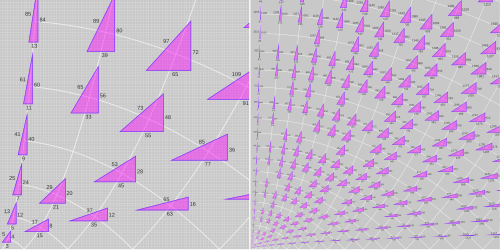
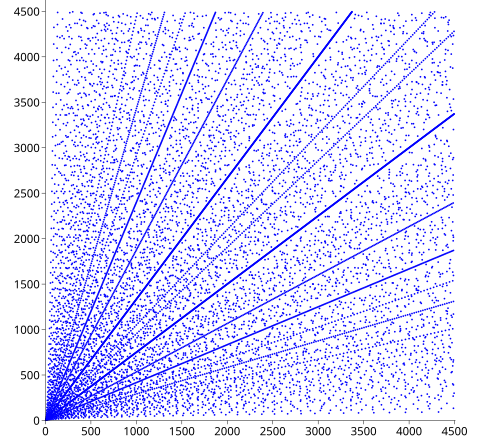
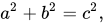
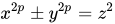
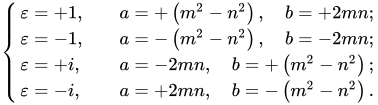
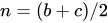
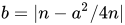
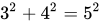
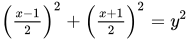
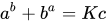
That these formulas generate Pythagorean triples can be verified by expanding a2 + b2 using elementary algebra and verifying that the result equals c2. Since every Pythagorean triple can be divided through by some integer k to obtain a primitive triple, every triple can be generated uniquely by using the formula with m and n to generate its primitive counterpart and then multiplying through by k as in the last equation.
Choosing m and n from certain integer sequences gives interesting results. For example, if m and n are consecutive Pell numbers, a and b will differ by 1.[5]
Many formulas for generating triples with particular properties have been developed since the time of Euclid.
Proof of Euclid's formula
That satisfaction of Euclid's formula by a, b, c is sufficient for the triangle to be Pythagorean is apparent from the fact that for positive integers m and n, m > n, the a, b, and c given by the formula are all positive integers, and from the fact that
任意の原始ピタゴラス数に対してa、b、c がユークリッドの公式で表される必要があることの証明は次のとおりです。 [ 6 ]すべてのこのような原始ピタゴラス数は( a , b , c )と書くことができ、ここで a2 + b2 = c2であり、a、b、cは互いに素です。したがって、 a、b、cはペアごとに互いに素です(素数が 2 つを割り切る場合、3 番目も割り切る必要があります)。a と b は互いに素なので、少なくとも1つは奇数です。aが奇数であると仮定すると、bは偶数でcは奇数になります ( aとb の両方が奇数の場合、c は偶数になり、c2は4 の倍数になりますが、奇数の平方数は 1 を法として 4 に合同であるため、a2 + b2は2を法として 4 に合同になります)。
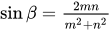
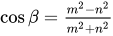
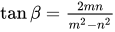
Suppose the sides of a Pythagorean triangle have lengths m2 − n2, 2mn, and m2 + n2, and suppose the angle between the leg of length m2 − n2 and the hypotenuse of length m2 + n2 is denoted as β. Then and the full-angle trigonometric values are , , and .[9]
A variant
The following variant of Euclid's formula is sometimes more convenient, as being more symmetric in m and n (same parity condition on m and n).
If m and n are two odd integers such that m > n, then are three integers that form a Pythagorean triple, which is primitive if and only if m and n are coprime. Conversely, every primitive Pythagorean triple arises (after the exchange of a and b, if a is even) from a unique pair m > n > 0 of coprime odd integers.
Not exchanging a and b
In the presentation above, it is said that all Pythagorean triples are uniquely obtained from Euclid's formula "after the exchange of a and b, if a is even". Euclid's formula and the variant above can be merged as follows to avoid this exchange, leading to the following result.
Every primitive Pythagorean triple can be uniquely written where m and n are positive coprime integers, and if m and n are both odd, and otherwise. Equivalently, if a is odd, and if a is even.
Elementary properties of primitive Pythagorean triples
General properties
a < b < cを満たす原始ピタゴラス数( a , b , c ) ( aとbのどちらが偶数でどちらが奇数かを指定しない場合)の性質には、次のものが含まれます。
2より大きい整数で、2 mod 4 と合同でないもの(つまり、2より大きい整数で、4k + 2 の形ではないもの)はすべて、原始ピタゴラス数の一部です。(整数が 4k の形である場合は、ユークリッドの公式でn = 1 、 m = 2kとすることができます。整数が2k + 1の形である場合は、n = k 、 m = k + 1とすることができます。)
斜辺と最長辺の差がちょうど 1 であるピタゴラスの三つ組は無限に存在する。このような三つ組は必ず原始的であり、(2 n + 1, 2 n 2 + 2 n , 2 n 2 + 2 n +1)の形をとる。これは、ユークリッドの公式において、条件が三つ組が原始的であり、( m 2 + n 2 ) - 2 mn = 1を満たさなければならないことを意味することに注意することで得られる。これは( m – n ) 2 = 1を意味し、したがってm = n + 1となる。上記の三つ組の形は、ユークリッドの公式においてn + 1をmに置き換えることによって得られる。
c = p e が素数のべき乗である場合、 素数pが4 n + 1の形である場合に限り、原始ピタゴラス数a 2 + b 2 = c 2が存在します。この三つ組は、 aとbの交換を除いて一意です。
より一般的には、正の整数cが原始ピタゴラス三つ組の斜辺となるのは、cの各素因数が4 を法として1と合同である場合、すなわち各素因数が4 n + 1の形である場合に限る。この場合、 a < bとなる原始ピタゴラス三つ組( a , b , c )の数は2 k −1であり、ここでkはcの異なる素因数の数である。[ 21 ]
単位円は媒介変数方程式によって定義される場合もある。 ユークリッドのピタゴラス数の公式と逆関係t = y / (1 + x )は、 (−1, 0)を除いて、円上の点( x , y )が有理数であるのは、対応するtの値が有理数である場合に限ることを意味します。t = y / (1 + x ) = b / ( c + a ) = n / mは、長さbの三角形の辺の対角の半分の正接でもあることに注意してください。
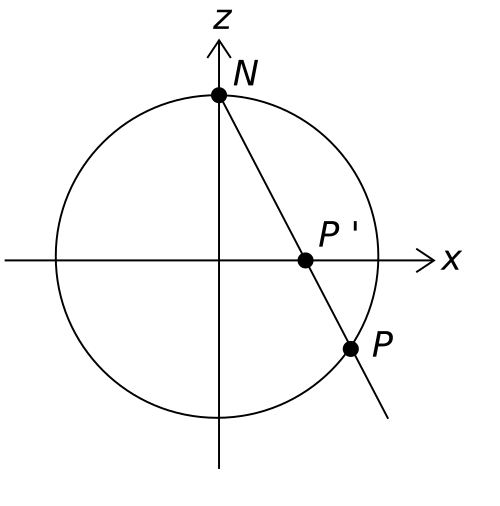
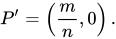
これにより、 x軸上の各有理点が単位円上の有理点に対応することが証明されます。逆の、単位円上のすべての有理点がx軸上のそのような点から生じることは、逆立体投影を適用することで得られます。P ( x , y )がxとyが有理数である単位円上の点であるとします。すると、 x軸への立体投影によって得られる点P ′の座標は次のようになります。
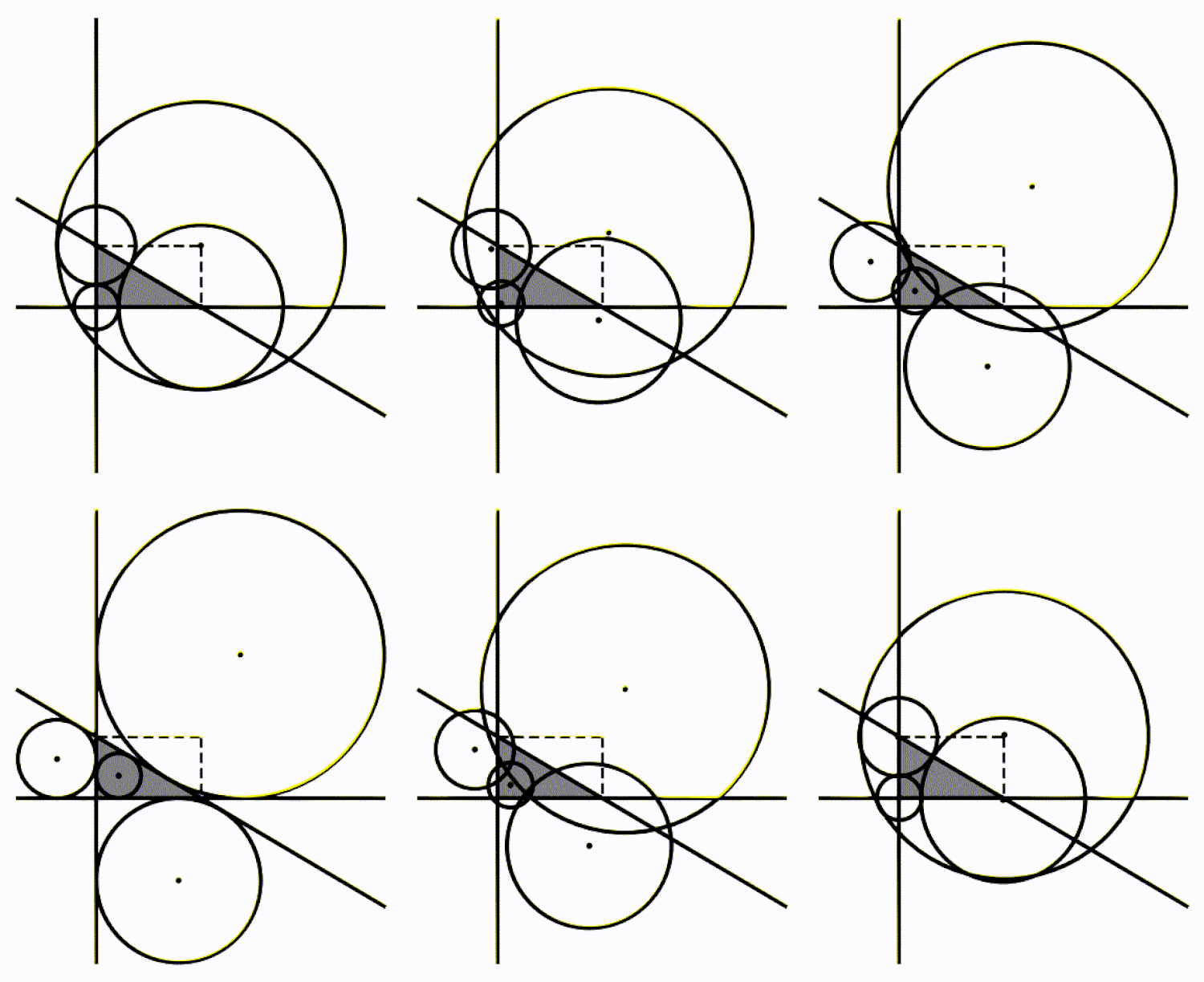
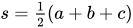
辺a、b、cを持ち面積Kの一般的な三角形の場合、辺 a、b、c に関連付けられた内接半径rと外接半径r a、r b、r cは、 K = rs = r a ( s − a ) = r b ( s − b ) = r c ( s − c )を満たします。ここでは半周長です。[ 25 ] cの対角が直角の場合、そしてすぐにわかるのはこれにより
( a , b , c )がピタゴラス数である場合、 s、したがって 4 つの半径すべてが正の整数になります。原始的な三つ組の場合、ユークリッドの公式はr = n ( m − n )を意味し、辺m 2 − n 2、2mn、および斜辺m 2 + n 2の対辺の外接円の半径はそれぞれm ( m − n )、n ( m + n )、およびm ( m + n )となります。[ 26 ]
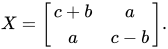
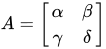
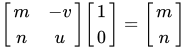
これは、( 1 ) の行列Xに対する作用を生み出します。これは、原始トリプルを非原始トリプルに変換する可能性があるため、原始トリプルに対する明確に定義された作用を与えません。この時点で ( Trautman 1998に従って)、c > 0で、 ( a , b , c )が互いに素であるか、または( a /2, b /2, c /2)が互いに素でa /2が奇数である場合に、トリプル ( a , b , c ) を標準と呼ぶのが便利です。スピノル[ m n ] Tが互いに素なエントリを持つ場合、( 1 )によって決定される関連するトリプル( a , b , c )は標準トリプルです。したがって、モジュラー群の作用は標準トリプルの集合に対して推移的です。
Alternatively, restrict attention to those values of m and n for which m is odd and n is even. Let the subgroup Γ(2) of Γ be the kernel of the group homomorphism
where SL(2,Z2) is the special linear group over the finite fieldZ2 of integers modulo 2. Then Γ(2) is the group of unimodular transformations which preserve the parity of each entry. Thus if the first entry of ξ is odd and the second entry is even, then the same is true of Aξ for all A ∈ Γ(2). In fact, under the action (2), the group Γ(2) acts transitively on the collection of primitive Pythagorean triples (Alperin 2005).
The group Γ(2) is the free group whose generators are the matrices Consequently, every primitive Pythagorean triple can be obtained in a unique way as a product of copies of the matrices U andL.
Parent/child relationships
By a result of Berggren (1934), all primitive Pythagorean triples can be generated from the (3, 4, 5) triangle by using the three linear transformations T1, T2, T3 below, where a, b, c are sides of a triple:
In other words, every primitive triple will be a "parent" to three additional primitive triples. Starting from the initial node with a = 3, b = 4, and c = 5, the operation T1 produces the new triple
and similarly T2 and T3 produce the triples (21, 20, 29) and (15, 8, 17).
The linear transformations T1, T2, and T3 have a geometric interpretation in the language of quadratic forms. They are closely related to (but are not equal to) reflections generating the orthogonal group of x2 + y2 − z2 over the integers.[31]
Relation to Gaussian integers
Alternatively, Euclid's formulae can be analyzed and proved using the Gaussian integers.[32] Gaussian integers are complex numbers of the form α = u + vi, where u and v are ordinary integers and i is the square root of negative one. The units of Gaussian integers are ±1 and ±i. The ordinary integers are called the rational integers and denoted as 'Z'. The Gaussian integers are denoted as Z[i]. The right-hand side of the Pythagorean theorem may be factored in Gaussian integers:
A primitive Pythagorean triple is one in which a and b are coprime, i.e., they share no prime factors in the integers. For such a triple, either a or b is even, and the other is odd; from this, it follows that c is also odd.
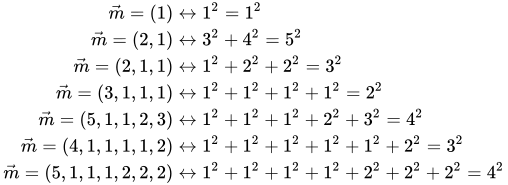
その表現 は、 m 2 1 > m 2 2 + ... + m 2 nを満たす任意の正の整数の組( m 1 , ..., m n )に対する ピタゴラスn組です。ピタゴラスn組は、その値の最大公約数で割ることによって原始数にすることができます。
さらに、この方法で任意の原始ピタゴラスnタプルa 2 1 + ... + a 2 n = c 2を見つけることができます。上記の式を使用して( m 1 , ..., m n ) = ( c + a 1 , a 2 , ..., a n )を使用してピタゴラスnタプルを取得し、最大の共通整数除数である2 m 1 = 2( c + a 1 )で割ります。これらの( m 1 , ..., m n )の値の最大共通除数で割ると、同じ原始ピタゴラスnタプルが得られます。また、 m 2 1 > m 2 2 + ... + m 2 nを満たす集合的に互いに素な正の整数のタプル( m 1 , ..., m n )と原始ピタゴラスnタプルの間には 1 対 1 の対応があります。
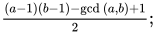
ヘロニアン三角形は、辺の長さが整数で面積も整数である三角形として一般的に定義されます。このような三角形の辺の長さは、a ≤ b ≤ cを満たすヘロニアン三つ組( a, b, c )を形成します。ピタゴラス三つ組は、少なくとも一方の辺aまたはb が偶数でなければならないため、面積ab /2 が整数となることから、すべてのピタゴラス三つ組がヘロニアン三つ組です。ただし、面積が 24 である例(4, 13, 15)が示すように、すべてのヘロニアン三つ組がピタゴラス三つ組であるとは限りません。
( a , b , c )がヘロニアン トリプルである場合、 kが任意の正の整数である( ka , kb , kc )もヘロニアン トリプルです。その面積は、 ( a , b , c )三角形の面積のk 2倍の整数になります。ヘロニアン トリプル( a , b , c )は、 a , b , cが互いに素である場合に原始的です。(原始ピタゴラス トリプルの場合、それらが互いに素であるというより強い条件も適用されますが、原始ヘロニアン三角形の場合、より強い条件は(7, 15, 20)のように常に真であるとは限りません。) 以下は、ピタゴラス トリプルではない最も単純な原始ヘロニアン トリプルのいくつかです。
(4、13、15)面積24
(3、25、26)面積36
(7、15、20)面積42
(6、25、29)面積60
(11、13、20)面積66
(13、14、15)面積84
(13、20、21)面積126
ヘロンの公式によれば、 a < b < cを満たす正の整数の三つ組( a , b , c )がヘロン的であるための追加条件は次のとおりである。
( a 2 + b 2 + c 2 ) 2 − 2( a 4 + b 4 + c 4 )
または同等に
2( a 2 b 2 + a 2 c 2 + b 2 c 2 ) − ( a 4 + b 4 + c 4 )
↑ボーレガード、レイモンド A.、スーリヤナラヤン、ER (2000)、「原始ピタゴラス三つ組のパラメトリック表現」、ネルセン、ロジャー B. (編)、『言葉のない証明:視覚的思考のさらなる演習』、第 II 巻、アメリカ数学協会、 120ページ、ISBN978-0-88385-721-2OCLC 807785075
↑ヒューストン、デイビッド (1993)、「倍角公式によるピタゴラス数」、ネルセン、ロジャー B. (編)、『言葉のない証明:視覚的思考の練習』、アメリカ数学協会、141 ページ、ISBN978-0-88385-700-7OCLC 29664480
↑ aとbがともに平方数であるような解が存在しないことは、もともとフェルマーによって証明された。詳細は、 Koshy, Thomas (2002), Elementary Number Theory with Applications , Academic Press, p. 545, ISBN を参照のこと。9780124211711cが平方数のいずれかである場合については、 Stillwell, John (1998), Numbers and Geometry , Undergraduate Texts in Mathematics , Springer, p. 133, ISBN を参照のこと。9780387982892。
↑サリー、ジュディス D. (2007)、『研究のルーツ:数学問題の垂直的発展』 、アメリカ数学会、 74-75頁、ISBN9780821872673。
↑これは、 abが12で割り切れるという事実と、合同な数を有理数辺を持つ直角三角形の面積として定義することから直ちに導かれる。例えば、 Koblitz, Neal (1993), Introduction to Elliptic Curves and Modular Forms , Graduate Texts in Mathematics, vol. 97, Springer, p. 3, ISBNを参照。9780387979663。
↑ H. Darmon および L. Merel. 巻数商とフェルマーの最終定理のいくつかの変種、J. Reine Angew. Math. 490 (1997), 81–100.
1 2 Yiu, Paul (2008), Heron triangles which cannot be decomposed into two integer right triangles (PDF) , 41st Meeting of Florida Section of Mathematical Association of America, p. 17
↑ Coxeter, HSM (1969), Introduction to Geometry (第2版), Wiley, ISBN9780471182832
↑ Baragar, Arthur (2001), A Survey of Classical and Modern Geometries: With Computer Activities , Prentice Hall, Exercise 15.3, p. 301, ISBN9780130143181
↑ Goehl, John F. Jr. (2005年5月)、「読者の感想」、Mathematics Teacher、98 (9): 580、doi : 10.5951/MT.98.9.0580
↑ Goehl, John F., Jr.、「3つ組、4つ組、5つ組」、 Mathematics Teacher 98、2005年5月、p. 580。
↑キム、スコット(2002 年 5 月)、「難問」、Discover : 82、方程式 w 4 + x 4 + y 4 = z 4は難しい。1988 年、数学者たちが 200 年にわたって不可能であることを証明しようと試みた後、ハーバード大学のノーム・エルキースが反例 2,682,440 4 + 15,365,639 4 + 18,796,760 4 = 20,615,673 4を発見した。
↑エルキーズ、ノーム(1988)、 「A 4 + B 4 + C 4 = D 4について」、Mathematics of Computation、51 (184): 825–835、doi : 10.2307/2008781、JSTOR 2008781、MR 0930224
↑ Kak, S.および Prabhu, M. 原始ピタゴラス三つ組の暗号学的応用. Cryptologia, 38:215–222, 2014.
参考文献
Alperin, Roger C. (2005)、「ピタゴラスのモジュラーツリー」(PDF)、American Mathematical Monthly、112 (9): 807–816、CiteSeerX 10.1.1.112.3085、doi : 10.2307/30037602、JSTOR 30037602、MR 2179860
Berggren, B. (1934), "Pytagoreiska trianglar", Tidskrift för Elementär Matematik, Fysik och Kemi (in Swedish), 17: 129–139
Barning, F.J.M. (1963), "Over pythagorese en bijna-pythagorese driehoeken en een generatieproces met behulp van unimodulaire matrices"(PDF), Math. Centrum Amsterdam Afd. Zuivere Wisk. (in Dutch), ZW-011: 37
Eckert, Ernest (1992), "Primitive Pythagorean triples", The College Mathematics Journal, 23 (5): 413–417, doi:10.2307/2686417, JSTOR2686417
Elkies, Noam, Pythagorean triples and Hilbert's theorem 90(PDF)
Heath, Thomas (1956), The Thirteen Books of Euclid's Elements Vol. 1 (Books I and II) (2nded.), Dover Publications, ISBN978-0-486-60088-8{{citation}}: ISBN / Date incompatibility (help)
Long, Calvin T. (1972), Elementary Introduction to Number Theory (2nded.), Lexington: D. C. Heath and Company, LCCN77171950
Martin, Artemas (1875), "Rational right angled triangles nearly isosceles", The Analyst, 3 (2): 47–50, doi:10.2307/2635906, JSTOR2635906
McCullough, Darryl (2005), "Height and excess of Pythagorean triples"(PDF), Mathematics Magazine, 78 (1): 26–44, doi:10.1080/0025570X.2005.11953298, S2CID1701449
Romik, Dan (2008), "The dynamics of Pythagorean triples"(PDF), Trans. Amer. Math. Soc., 360 (11): 6045–6064, arXiv:math.DS/0406512, doi:10.1090/S0002-9947-08-04467-X, MR2425702
Teigen, M.G.; Hadwin, D.W. (1971), "On Generating Pythagorean Triples", The American Mathematical Monthly, 78 (4): 378–379, doi:10.2307/2316903, JSTOR2316903
トラウトマン、アンジェイ(1998)「ピタゴラスのスピノルとペンローズのツイスター」 SA ハゲット、LJ メイソン、KP トッド、ST ツォウ、NMJ ウッドハウス(編)『幾何学的宇宙(ポストスクリプト)』